
Omega-3 Black 120 196 mg Ingredients & Drug Interactions
by FREZZOR
What is this page for?
First and foremost: checking Omega-3 Black 120 196 mg against your medications. The heart of this page is the interaction checker and the full interaction report — how this product’s ingredients may interact with prescription and over-the-counter medicines you may be taking.
Around that, we add a pharmacist’s high-level view of the product as a whole — what’s inside, the evidence for its stated use, how transparent the label is, and what safety data exists — so you can see the full picture in one place. It’s educational information from our licensed clinical databases and the clinical staff at HelloPharmacist — not medical advice — and we don’t sell or endorse products. Our editorial policy
Omega-3 Black 120 196 mg is a dietary supplement by FREZZOR with 13 active ingredients. Its ingredients are commonly taken for osteoarthritis joint pain, rheumatoid arthritis symptoms, joint stiffness and mobility.Based on those ingredients, 1,247 medications have a known interaction with it, the most serious rated major. The ingredients most likely to interact are Grape Seed Extract, Astaxanthin Oil, Pine Bark Extract. Use the checker below to test your specific medication, or read the full HelloPharmacist Interaction Report.
Check Your Meds Against Omega-3 Black 120 196 mg by FREZZOR
Ask about any prescription or over-the-counter medication and we check it for interactions with Omega-3 Black 120 196 mg by FREZZOR — and tell you which ingredient is responsible.
AI summaries are generated from our interaction database for education only — always confirm with your pharmacist. How we use AI
Ask the Pharmacist
A licensed pharmacist will answer your question by email — free, usually within 24 hours.
Got it — thank you!
A licensed pharmacist will answer within 24 hours. Keep an eye on your email (worth checking spam, just in case).
HelloPharmacist Scorecard of Omega-3 Black 120 196 mg by FREZZOR
Our pharmacy team’s full take, with four database checks built into the cards below — a summary of what is known, not a grade of the product itself.
What’s inside
Low disclosure
Omega-3 Black 120 196 mg contains 13 active ingredients: Grape Seed Extract, Pine Bark Extract, Blackcurrant extract, Flaxseed Oil, Red Grape skin extract, Fulvic Acid extract, Astaxanthin Oil, Kiwifruit extract, Green-Lipped Mussel Oil, Boysenberry Extract, Glucosamine Concentrate, Chondroitin Concentrate, and a blend called UAF1000+ Super Antioxidant. The formula brings together plant extracts rich in polyphenols and antioxidants, omega-3 fatty acids from flaxseed and mussel, joint-supporting compounds like glucosamine and chondroitin, and specialty ingredients like astaxanthin and fulvic acid.
The capsules also contain gelatin, glycerol, and silicon dioxide as inactive ingredients.
Does it work?
Moderate evidence
The evidence for most ingredients in this blend is limited or mixed. Grape seed extract (both regular and from red grape skin) is possibly effective for chronic venous insufficiency (CVI)—a condition affecting blood flow in the legs—but possibly ineffective for hay fever, nausea from chemotherapy, or weight loss.
Glucosamine is likely effective for osteoarthritis. For the other ingredients—blackcurrant, flaxseed oil, kiwifruit, fulvic acid, astaxanthin, green-lipped mussel, boysenberry, and chondroitin—the evidence in our data is either insufficient to rate or not established, meaning we don't yet have enough reliable research to say whether they work for their intended uses.
How safe is it?
Well-documented data
Grape seed extract and red grape skin extract appear generally well tolerated, though some people report abdominal pain, diarrhea, dry mouth, headache, joint pain, or nausea. Rare anaphylaxis to grape skin has been reported.
Flaxseed oil is generally well tolerated; a small number of people (about 3%) report loose stools, dry mouth, or indigestion at typical doses, and higher doses (30 grams daily or more) can cause diarrhea. Blackcurrant supplement safety is less studied than the berry itself; a small number of people in one trial reported mild diarrhea.
Kiwifruit can trigger allergic reactions in sensitive individuals—lips, mouth, or throat swelling, itching, vomiting, and in rare cases anaphylaxis or asthma flare-ups. Glucosamine is generally well tolerated but can cause bloating, constipation, cramps, diarrhea, heartburn, or nausea; rare hypersensitivity reactions and asthma exacerbations have been reported.
Green-lipped mussel is generally well tolerated but can cause abdominal pain, acid reflux, diarrhea, gas, or nausea; rare cases of hepatitis have been reported. Astaxanthin, fulvic acid, and other ingredients appear generally well tolerated, though full long-term safety data are limited.
Meds to double-check
Major interaction found
Check your medications if you take warfarin or any blood thinner (Major interaction with glucosamine). Also double-check before starting if you're on blood pressure medications, other anticoagulants or antiplatelet drugs, cyclosporine, phenothiazines, thyroid hormones, diabetes drugs, midazolam, ezetimibe, or topoisomerase II inhibitor chemotherapy—these carry Moderate or Minor interactions with various ingredients here.
Use the search tool on this page to verify your specific prescriptions.
The bottom line
Scorecard at a glanceFormula with limited ingredient disclosure with some supporting evidence for its stated purpose. Major medication interactions have been identified, and safety information is well characterized.
This is a multi-ingredient supplement with antioxidant and joint-support components. If you take warfarin, have a close look at the glucosamine interaction—you'll need blood clotting checks.
Anyone taking blood pressure meds, blood thinners, cyclosporine, phenothiazines, thyroid hormone, or diabetes drugs should run this product through the medication checker below before starting. If you have a kiwi or shellfish allergy, be cautious.
Talk with your pharmacist before you start, especially if you're on any prescription medications.
Educational only — not medical advice; always confirm with your pharmacist. Our editorial policy · How we use AI
Assessment coverage: 10 of 13 active ingredients matched to our full ingredient reviews (monographs). Based on the product label dated Mar 25, 2025.
This Scorecard evaluates available label information, ingredient evidence, and known medication-safety considerations. It does not independently verify product identity, purity, potency, contamination, or manufacturing quality. How these ratings are computed
General information
Key facts about Omega-3 Black 120 196 mg, straight from the product label.
| Brand | FREZZOR |
|---|---|
| Barcode (UPC) | 631169131207 |
| Net contents | 120 Capsule(s) |
| Market status | On market |
| Date entered into DSLD | Mar 25, 2025 |
| DSLD ID | 320803 |
| Product type | Other Combinations |
| Supplement form | Capsule |
| Dietary claims / uses | Nutrient, All Other, Structure/Function |
| Intended target group(s) | Adult (18 - 50 Years) |
Everything in this section is reproduced from the manufacturer’s own product label — it’s the label speaking, not HelloPharmacist. We show it so you can see exactly what the maker states; we don’t verify or endorse those statements.
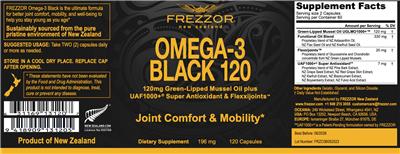
Supplement Facts
The label details for Omega-3 Black 120 196 mg by FREZZOR, sourced from the NIH Dietary Supplement Label Database.
Supplement Facts
| Ingredient | Amount | % DV |
|---|---|---|
| Grape Seed Extract | 0 NP | -- |
| Pine Bark Extract | 0 NP | -- |
| Blackcurrant extract | 0 NP | -- |
| Flaxseed Oil | 0 NP | -- |
| Red Grape skin extract | 0 NP | -- |
| Fulvic Acid extract | 0 NP | -- |
| Astaxanthin Oil | 0 NP | -- |
| Kiwifruit extract | 0 NP | -- |
| Green-Lipped Mussel Oil | 120 mg | -- |
| Boysenberry Extract | 0 NP | -- |
| Functional Oil Blend | 330 mg | -- |
| Kiwifruit Seed Oil | 0 NP | -- |
| Flexxijoints | 20 mg | -- |
| Glucosamine Concentrate | 0 NP | -- |
| Chondroitin Concentrate | 0 NP | -- |
| UAF1000+ Super Antioxidant | 7 mg | -- |
Other ingredients: Gelatin, Glycerol, Silicon Dioxide
Tap any ingredient to jump to its full detail below.
These statements are the manufacturer’s wording, reproduced from the product label — the label is saying it, not HelloPharmacist. We don’t verify or endorse them.
Formula
Frezzor Omega-3 Black is the ultimate formula for better joint comfort, mobility, and well-being to help you stay young as you age
120mg Green-Lipped Mussel Oil plus UAF1000+ Super Antioxidants & Flexxijoints
Suggested/Recommended/Usage/Directions
Suggested usage: Take two (2) capsules daily or more as needed.
Storage
Store in a cool dry place. Replace cap after opening.
FDA Disclaimer Statement
These statements have not been evaluated by the Food and Drug Administration. This product is not intended to diagnose, treat, cure or prevent any disease.
Seals/Symbols
NewZealand.com License No.100706
Formulation
Product of New Zealand Joint comfort & mobility
Sustainably sourced from the pure pristine environment of New Zealand
FDA Statement of Identity
Dietary Supplement
Brand IP Statement(s)
UAF1000+ is a Patent-Pending formulation owned by FREZZOR
General Statements
9 418909 131205
Is this label outdated? Report a formula or label change and our pharmacy team will review it.
Omega-3 Black 120 196 mg by FREZZOR label
The label scan from the NIH Dietary Supplement Label Database. Tap to enlarge.
Label images are published by the NIH Dietary Supplement Label Database for the version of this product on file. Always read your actual product label.
View the full label (PDF)The Ingredients in Omega-3 Black 120 196 mg by FREZZOR
These are the 13 active ingredients this product is made of. Select any to open its full monograph.
Serving size2 Capsule(s) Dosage formCapsule Servings per container60 Amounts shown are per serving.
Most supplement products combine several ingredients, and a medication can interact with the product through any one of them. Each ingredient below shows whether it has known drug interactions.
Green-Lipped Mussel Oil
No knowninteractions
New Zealand green-lipped mussel is a shellfish-derived supplement rich in omega-3 fats that is mostly used for joint pain and arthritis. Some studies...
Green-Lipped Mussel Oil monograph & interactionsFunctional Oil Blend
- › Flaxseed Oil
- › Astaxanthin Oil
- › Kiwifruit Seed Oil
Flexxijoints
- › Glucosamine Concentrate
- › Chondroitin Concentrate
UAF1000+ Super Antioxidant
- › Grape Seed Extract
- › Pine Bark Extract
- › Blackcurrant extract
- › Red Grape skin extract
- › Fulvic Acid extract
- › Kiwifruit extract
- › Boysenberry Extract
Other (inactive) ingredients: Gelatin, Glycerol, Silicon Dioxide. These complete the product’s ingredient list but are not active constituents.
Omega-3 Black 120 196 mg by FREZZOR Drug Interactions
HelloPharmacist Interaction Report
Omega-3 Black 120 196 mg by FREZZOR contains several active ingredients with documented interactions.
The most serious is glucosamine, which carries a Major-severity interaction with warfarin (Coumadin) — a blood thinner. Glucosamine may increase warfarin's effect and raise your bleeding risk, so if you take warfarin, you'll need to have your INR (blood clotting measure) checked closely if you start or stop this product.
Read the full breakdown — every affected drug type, severity by severity
Grape seed extract and red grape skin extract interact with multiple drug types, all at Moderate severity. They may affect how your body processes drugs metabolized by cytochrome P450 enzymes (CYP1A2, CYP2D6, CYP3A4, CYP2E1), potentially changing drug levels.
They also carry theoretical bleeding risk with anticoagulants or antiplatelet drugs (like aspirin or warfarin), and they may reduce absorption of cyclosporine (an immunosuppressant) — if you take cyclosporine, separate doses by at least 2 hours. Additionally, long-term grape extract intake might decrease midazolam (Versed) effectiveness.
Flaxseed oil, blackcurrant extract, kiwifruit extract, fulvic acid, and astaxanthin all have Moderate-severity interactions. Flaxseed and kiwi may lower blood pressure or increase bleeding risk when combined with blood pressure drugs or blood thinners.
Blackcurrant may increase bleeding risk with anticoagulants and theoretically raise seizure risk with phenothiazines (antipsychotics). Fulvic acid may interfere with anticoagulants, immunosuppressants, and thyroid hormone therapy.
Astaxanthin may decrease levels of drugs metabolized by CYP3A4 and CYP2B6 enzymes. Glucosamine also carries Minor interactions with diabetes drugs and acetaminophen (Tylenol).
We could not check Pine Bark Extract, Boysenberry Extract, Kiwifruit Seed Oil, or Chondroitin Concentrate — no interaction data are on file for these. Green-Lipped Mussel Oil was checked and no interactions are documented.
Altogether, these interactions span 1,230 individual medications. Please use the medication checker on this page to verify your exact drugs before starting.
Check your own medications below · Editorial policy · How we use AI
Want to check YOUR meds against Omega-3 Black 120 196 mg?
Ask about interactions with your drugs in plain English — “Can I take it with lisinopril?” — and we find you the answer in seconds, ingredient by ingredient.
Go to the checkerIngredients driving the most interactions
Individual Drug Interactions
The ingredients in Omega-3 Black 120 196 mg interact with 1,247 drugs. Click any drug to see the details.
8 of the 13 ingredients in Omega-3 Black 120 196 mg interact with drugs. Each result below shows which ingredient is responsible. Grape Seed Extract Astaxanthin Oil Pine Bark Extract Flaxseed Oil Kiwifruit extract Fulvic Acid extract Glucosamine Concentrate Blackcurrant extract
WarfarinWarfarin
How Warfarin interacts with Omega-3 Black 120 196 mg — through 8 ingredients. Tap an ingredient for the detail:
Glucosamine ConcentrateWarfarin (coumadin) Major
Interaction Summary
Glucosamine might increase the anticoagulant effects of warfarin and increase the risk of bruising and bleeding.
Read the full Glucosamine Concentrate + Warfarin interactionAstaxanthin OilCytochrome P450 3a4 (cyp3a4) Substrates Moderate
Interaction Summary
Theoretically, astaxanthin may decrease levels of drugs metabolized by CYP3A4.
Read the full Astaxanthin Oil + Warfarin interactionBlackcurrant ExtractAnticoagulant/antiplatelet Drugs Moderate
Interaction Summary
Theoretically, black currant seed oil might increase the risk of bleeding if used in combination with anticoagulant or antiplatelet drugs.
Read the full Blackcurrant Extract + Warfarin interactionFulvic Acid ExtractAnticoagulant/antiplatelet Drugs Moderate
Interaction Summary
Theoretically, taking fulvic acid may decrease the effectiveness of anticoagulant and antiplatelet drugs.
Read the full Fulvic Acid Extract + Warfarin interactionKiwifruit ExtractAnticoagulant/antiplatelet Drugs Moderate
Interaction Summary
Clinical research suggests that kiwi inhibits platelet aggregation.
Read the full Kiwifruit Extract + Warfarin interactionFlaxseed OilAnticoagulant/antiplatelet Drugs Moderate
Interaction Summary
Theoretically, using flaxseed oil in combination with anticoagulant or antiplatelet drugs might have additive effects and increase the risk of bleeding.
Read the full Flaxseed Oil + Warfarin interactionPine Bark ExtractAnticoagulant/antiplatelet Drugs Moderate
Interaction Summary
Theoretically, maritime pine bark extract might increase the risk of bleeding when used with antiplatelet or anticoagulant drugs.
Read the full Pine Bark Extract + Warfarin interactionRed Grape Skin ExtractCytochrome P450 2c9 (cyp2c9) Substrates, Anticoagulant/antiplatelet Drugs +2 Moderate
Interaction Summary
It is unclear if grape juice or grape seed extract inhibits CYP2C9; research is conflicting.
Read the full Red Grape Skin Extract + Warfarin interactionWarfarin SodiumCoumadin, Panwarfin, Sofarin
How Warfarin Sodium interacts with Omega-3 Black 120 196 mg — through 8 ingredients. Tap an ingredient for the detail:
Glucosamine ConcentrateWarfarin (coumadin) Major
Interaction Summary
Glucosamine might increase the anticoagulant effects of warfarin and increase the risk of bruising and bleeding.
Read the full Glucosamine Concentrate + Warfarin Sodium interactionRed Grape Skin ExtractCytochrome P450 1a2 (cyp1a2) Substrates, Cytochrome P450 2c9 (cyp2c9) Substrates +2 Moderate
Interaction Summary
Theoretically, grape juice might reduce the levels of CYP1A2 substrates.
Read the full Red Grape Skin Extract + Warfarin Sodium interactionPine Bark ExtractAnticoagulant/antiplatelet Drugs Moderate
Interaction Summary
Theoretically, maritime pine bark extract might increase the risk of bleeding when used with antiplatelet or anticoagulant drugs.
Read the full Pine Bark Extract + Warfarin Sodium interactionFlaxseed OilAnticoagulant/antiplatelet Drugs Moderate
Interaction Summary
Theoretically, using flaxseed oil in combination with anticoagulant or antiplatelet drugs might have additive effects and increase the risk of bleeding.
Read the full Flaxseed Oil + Warfarin Sodium interactionAstaxanthin OilCytochrome P450 3a4 (cyp3a4) Substrates Moderate
Interaction Summary
Theoretically, astaxanthin may decrease levels of drugs metabolized by CYP3A4.
Read the full Astaxanthin Oil + Warfarin Sodium interactionBlackcurrant ExtractAnticoagulant/antiplatelet Drugs Moderate
Interaction Summary
Theoretically, black currant seed oil might increase the risk of bleeding if used in combination with anticoagulant or antiplatelet drugs.
Read the full Blackcurrant Extract + Warfarin Sodium interactionKiwifruit ExtractAnticoagulant/antiplatelet Drugs Moderate
Interaction Summary
Clinical research suggests that kiwi inhibits platelet aggregation.
Read the full Kiwifruit Extract + Warfarin Sodium interactionFulvic Acid ExtractAnticoagulant/antiplatelet Drugs Moderate
Interaction Summary
Theoretically, taking fulvic acid may decrease the effectiveness of anticoagulant and antiplatelet drugs.
Read the full Fulvic Acid Extract + Warfarin Sodium interaction6-mercaptopurinePurinethol
How 6-mercaptopurine interacts with Omega-3 Black 120 196 mg — through 2 ingredients. Tap an ingredient for the detail:
Fulvic Acid ExtractImmunosuppressants Moderate
Interaction Summary
Theoretically, taking fulvic acid might decrease the effects of immunosuppressive therapy.
Read the full Fulvic Acid Extract + 6-mercaptopurine interactionPine Bark ExtractImmunosuppressants Moderate
Interaction Summary
Theoretically, maritime pine bark extract might decrease the effectiveness of immunosuppressant therapy.
Read the full Pine Bark Extract + 6-mercaptopurine interactionAdo-trastuzumab EmtansineKadcyla
How Ado-trastuzumab Emtansine interacts with Omega-3 Black 120 196 mg — through 2 ingredients. Tap an ingredient for the detail:
Astaxanthin OilCytochrome P450 3a4 (cyp3a4) Substrates Moderate
Interaction Summary
Theoretically, astaxanthin may decrease levels of drugs metabolized by CYP3A4.
Read the full Astaxanthin Oil + Ado-trastuzumab Emtansine interactionRed Grape Skin ExtractCytochrome P450 3a4 (cyp3a4) Substrates Moderate
Interaction Summary
It is unclear if grape seed extract inhibits or induces CYP3A4; research is conflicting.
Read the full Red Grape Skin Extract + Ado-trastuzumab Emtansine interactionAbciximabReoPro
How Abciximab interacts with Omega-3 Black 120 196 mg — through 6 ingredients. Tap an ingredient for the detail:
Flaxseed OilAnticoagulant/antiplatelet Drugs Moderate
Interaction Summary
Theoretically, using flaxseed oil in combination with anticoagulant or antiplatelet drugs might have additive effects and increase the risk of bleeding.
Read the full Flaxseed Oil + Abciximab interactionPine Bark ExtractAnticoagulant/antiplatelet Drugs Moderate
Interaction Summary
Theoretically, maritime pine bark extract might increase the risk of bleeding when used with antiplatelet or anticoagulant drugs.
Read the full Pine Bark Extract + Abciximab interactionBlackcurrant ExtractAnticoagulant/antiplatelet Drugs Moderate
Interaction Summary
Theoretically, black currant seed oil might increase the risk of bleeding if used in combination with anticoagulant or antiplatelet drugs.
Read the full Blackcurrant Extract + Abciximab interactionFulvic Acid ExtractAnticoagulant/antiplatelet Drugs Moderate
Interaction Summary
Theoretically, taking fulvic acid may decrease the effectiveness of anticoagulant and antiplatelet drugs.
Read the full Fulvic Acid Extract + Abciximab interactionKiwifruit ExtractAnticoagulant/antiplatelet Drugs Moderate
Interaction Summary
Clinical research suggests that kiwi inhibits platelet aggregation.
Read the full Kiwifruit Extract + Abciximab interactionRed Grape Skin ExtractAnticoagulant/antiplatelet Drugs Moderate
Interaction Summary
Theoretically, grape extracts may have antiplatelet effects and may increase the risk of bleeding if used with anticoagulant or antiplatelet drugs.
Read the full Red Grape Skin Extract + Abciximab interactionAbemaciclibVerzenio
How Abemaciclib interacts with Omega-3 Black 120 196 mg — through 2 ingredients. Tap an ingredient for the detail:
Red Grape Skin ExtractCytochrome P450 3a4 (cyp3a4) Substrates Moderate
Interaction Summary
It is unclear if grape seed extract inhibits or induces CYP3A4; research is conflicting.
Read the full Red Grape Skin Extract + Abemaciclib interactionAstaxanthin OilCytochrome P450 3a4 (cyp3a4) Substrates Moderate
Interaction Summary
Theoretically, astaxanthin may decrease levels of drugs metabolized by CYP3A4.
Read the full Astaxanthin Oil + Abemaciclib interactionAbiraterone
How Abiraterone interacts with Omega-3 Black 120 196 mg — through 2 ingredients. Tap an ingredient for the detail:
Astaxanthin OilCytochrome P450 3a4 (cyp3a4) Substrates Moderate
Interaction Summary
Theoretically, astaxanthin may decrease levels of drugs metabolized by CYP3A4.
Read the full Astaxanthin Oil + Abiraterone interactionRed Grape Skin ExtractCytochrome P450 3a4 (cyp3a4) Substrates Moderate
Interaction Summary
It is unclear if grape seed extract inhibits or induces CYP3A4; research is conflicting.
Read the full Red Grape Skin Extract + Abiraterone interactionAbiraterone AcetateYonsa, Zytiga
How Abiraterone Acetate interacts with Omega-3 Black 120 196 mg — through 2 ingredients. Tap an ingredient for the detail:
Red Grape Skin ExtractCytochrome P450 3a4 (cyp3a4) Substrates Moderate
Interaction Summary
It is unclear if grape seed extract inhibits or induces CYP3A4; research is conflicting.
Read the full Red Grape Skin Extract + Abiraterone Acetate interactionAstaxanthin OilCytochrome P450 3a4 (cyp3a4) Substrates Moderate
Interaction Summary
Theoretically, astaxanthin may decrease levels of drugs metabolized by CYP3A4.
Read the full Astaxanthin Oil + Abiraterone Acetate interactionAbrocitinibCibinqo
How Abrocitinib interacts with Omega-3 Black 120 196 mg — through 6 ingredients. Tap an ingredient for the detail:
Flaxseed OilAnticoagulant/antiplatelet Drugs Moderate
Interaction Summary
Theoretically, using flaxseed oil in combination with anticoagulant or antiplatelet drugs might have additive effects and increase the risk of bleeding.
Read the full Flaxseed Oil + Abrocitinib interactionPine Bark ExtractAnticoagulant/antiplatelet Drugs, Immunosuppressants Moderate
Interaction Summary
Theoretically, maritime pine bark extract might increase the risk of bleeding when used with antiplatelet or anticoagulant drugs.
Read the full Pine Bark Extract + Abrocitinib interactionFulvic Acid ExtractImmunosuppressants, Anticoagulant/antiplatelet Drugs Moderate
Interaction Summary
Theoretically, taking fulvic acid might decrease the effects of immunosuppressive therapy.
Read the full Fulvic Acid Extract + Abrocitinib interactionBlackcurrant ExtractAnticoagulant/antiplatelet Drugs Moderate
Interaction Summary
Theoretically, black currant seed oil might increase the risk of bleeding if used in combination with anticoagulant or antiplatelet drugs.
Read the full Blackcurrant Extract + Abrocitinib interactionKiwifruit ExtractAnticoagulant/antiplatelet Drugs Moderate
Interaction Summary
Clinical research suggests that kiwi inhibits platelet aggregation.
Read the full Kiwifruit Extract + Abrocitinib interactionRed Grape Skin ExtractCytochrome P450 2c9 (cyp2c9) Substrates, Anticoagulant/antiplatelet Drugs Moderate
Interaction Summary
It is unclear if grape juice or grape seed extract inhibits CYP2C9; research is conflicting.
Read the full Red Grape Skin Extract + Abrocitinib interactionAcalabrutinibCalquence
How Acalabrutinib interacts with Omega-3 Black 120 196 mg — through 2 ingredients. Tap an ingredient for the detail:
Red Grape Skin ExtractCytochrome P450 3a4 (cyp3a4) Substrates Moderate
Interaction Summary
It is unclear if grape seed extract inhibits or induces CYP3A4; research is conflicting.
Read the full Red Grape Skin Extract + Acalabrutinib interactionAstaxanthin OilCytochrome P450 3a4 (cyp3a4) Substrates Moderate
Interaction Summary
Theoretically, astaxanthin may decrease levels of drugs metabolized by CYP3A4.
Read the full Astaxanthin Oil + Acalabrutinib interactionAcarboseGlucobay, Prandase, Precose
How Acarbose interacts with Omega-3 Black 120 196 mg — through 2 ingredients. Tap an ingredient for the detail:
Pine Bark ExtractAntidiabetes Drugs Moderate
Interaction Summary
Theoretically, maritime pine bark extract might increase the risk of hypoglycemia when used with antidiabetes drugs.
Read the full Pine Bark Extract + Acarbose interactionGlucosamine ConcentrateAntidiabetes Drugs Minor
Interaction Summary
Despite initial concerns, it is unlikely that glucosamine will interfere with the effects of antidiabetes drugs.
Read the full Glucosamine Concentrate + Acarbose interactionAcebutololRhotral, Sectral
How Acebutolol interacts with Omega-3 Black 120 196 mg — through 2 ingredients. Tap an ingredient for the detail:
Kiwifruit ExtractAntihypertensive Drugs Moderate
Interaction Summary
Clinical research suggests that consuming kiwi reduces systolic and diastolic blood pressure in hypertensive individuals.
Read the full Kiwifruit Extract + Acebutolol interactionFlaxseed OilAntihypertensive Drugs Moderate
Interaction Summary
Theoretically, combining flaxseed oil with other antihypertensive drugs might have additive effects and increase the risk of hypotension.
Read the full Flaxseed Oil + Acebutolol interactionAcenocoumarolSintrom
How Acenocoumarol interacts with Omega-3 Black 120 196 mg — through 6 ingredients. Tap an ingredient for the detail:
Kiwifruit ExtractAnticoagulant/antiplatelet Drugs Moderate
Interaction Summary
Clinical research suggests that kiwi inhibits platelet aggregation.
Read the full Kiwifruit Extract + Acenocoumarol interactionFlaxseed OilAnticoagulant/antiplatelet Drugs Moderate
Interaction Summary
Theoretically, using flaxseed oil in combination with anticoagulant or antiplatelet drugs might have additive effects and increase the risk of bleeding.
Read the full Flaxseed Oil + Acenocoumarol interactionPine Bark ExtractAnticoagulant/antiplatelet Drugs Moderate
Interaction Summary
Theoretically, maritime pine bark extract might increase the risk of bleeding when used with antiplatelet or anticoagulant drugs.
Read the full Pine Bark Extract + Acenocoumarol interactionBlackcurrant ExtractAnticoagulant/antiplatelet Drugs Moderate
Interaction Summary
Theoretically, black currant seed oil might increase the risk of bleeding if used in combination with anticoagulant or antiplatelet drugs.
Read the full Blackcurrant Extract + Acenocoumarol interactionFulvic Acid ExtractAnticoagulant/antiplatelet Drugs Moderate
Interaction Summary
Theoretically, taking fulvic acid may decrease the effectiveness of anticoagulant and antiplatelet drugs.
Read the full Fulvic Acid Extract + Acenocoumarol interactionRed Grape Skin ExtractAnticoagulant/antiplatelet Drugs Moderate
Interaction Summary
Theoretically, grape extracts may have antiplatelet effects and may increase the risk of bleeding if used with anticoagulant or antiplatelet drugs.
Read the full Red Grape Skin Extract + Acenocoumarol interactionAcepromazineAtravet
How Acepromazine interacts with Omega-3 Black 120 196 mg — through 1 ingredient. Tap an ingredient for the detail:
Blackcurrant ExtractPhenothiazines Moderate
Interaction Summary
Theoretically, black currant seed oil might increase the risk of seizure in patients receiving phenothiazines.
Read the full Blackcurrant Extract + Acepromazine interactionAcetaminophenChildren's Tylenol, Children's Tylenol Meltaways, Tylenol, Tylenol Ex Strength
How Acetaminophen interacts with Omega-3 Black 120 196 mg — through 2 ingredients. Tap an ingredient for the detail:
Red Grape Skin ExtractCytochrome P450 2e1 (cyp2e1) Substrates, Cytochrome P450 1a2 (cyp1a2) Substrates Moderate
Interaction Summary
Theoretically, grape seed extract might increase the levels of CYP2E1 substrates.
Read the full Red Grape Skin Extract + Acetaminophen interactionGlucosamine ConcentrateAcetaminophen (tylenol, Others) Minor
Interaction Summary
Acetaminophen might interfere with the activity of glucosamine sulfate by interacting with the sulfate portion.
Read the full Glucosamine Concentrate + Acetaminophen interactionAcetaminophen, AspirinGemnisyn
How Acetaminophen, Aspirin interacts with Omega-3 Black 120 196 mg — through 7 ingredients. Tap an ingredient for the detail:
Red Grape Skin ExtractCytochrome P450 1a2 (cyp1a2) Substrates, Anticoagulant/antiplatelet Drugs +1 Moderate
Interaction Summary
Theoretically, grape juice might reduce the levels of CYP1A2 substrates.
Read the full Red Grape Skin Extract + Acetaminophen, Aspirin interactionFulvic Acid ExtractAnticoagulant/antiplatelet Drugs Moderate
Interaction Summary
Theoretically, taking fulvic acid may decrease the effectiveness of anticoagulant and antiplatelet drugs.
Read the full Fulvic Acid Extract + Acetaminophen, Aspirin interactionKiwifruit ExtractAnticoagulant/antiplatelet Drugs Moderate
Interaction Summary
Clinical research suggests that kiwi inhibits platelet aggregation.
Read the full Kiwifruit Extract + Acetaminophen, Aspirin interactionFlaxseed OilAnticoagulant/antiplatelet Drugs Moderate
Interaction Summary
Theoretically, using flaxseed oil in combination with anticoagulant or antiplatelet drugs might have additive effects and increase the risk of bleeding.
Read the full Flaxseed Oil + Acetaminophen, Aspirin interactionPine Bark ExtractAnticoagulant/antiplatelet Drugs Moderate
Interaction Summary
Theoretically, maritime pine bark extract might increase the risk of bleeding when used with antiplatelet or anticoagulant drugs.
Read the full Pine Bark Extract + Acetaminophen, Aspirin interactionBlackcurrant ExtractAnticoagulant/antiplatelet Drugs Moderate
Interaction Summary
Theoretically, black currant seed oil might increase the risk of bleeding if used in combination with anticoagulant or antiplatelet drugs.
Read the full Blackcurrant Extract + Acetaminophen, Aspirin interactionGlucosamine ConcentrateAcetaminophen (tylenol, Others) Minor
Interaction Summary
Acetaminophen might interfere with the activity of glucosamine sulfate by interacting with the sulfate portion.
Read the full Glucosamine Concentrate + Acetaminophen, Aspirin interactionAcetaminophen, Aspirin, CaffeineExcedrin, Excedrin Extra Strength, Excedrin Migraine
How Acetaminophen, Aspirin, Caffeine interacts with Omega-3 Black 120 196 mg — through 8 ingredients. Tap an ingredient for the detail:
Blackcurrant ExtractAnticoagulant/antiplatelet Drugs Moderate
Interaction Summary
Theoretically, black currant seed oil might increase the risk of bleeding if used in combination with anticoagulant or antiplatelet drugs.
Read the full Blackcurrant Extract + Acetaminophen, Aspirin, Caffeine interactionKiwifruit ExtractAnticoagulant/antiplatelet Drugs Moderate
Interaction Summary
Clinical research suggests that kiwi inhibits platelet aggregation.
Read the full Kiwifruit Extract + Acetaminophen, Aspirin, Caffeine interactionFulvic Acid ExtractAnticoagulant/antiplatelet Drugs Moderate
Interaction Summary
Theoretically, taking fulvic acid may decrease the effectiveness of anticoagulant and antiplatelet drugs.
Read the full Fulvic Acid Extract + Acetaminophen, Aspirin, Caffeine interactionAstaxanthin OilCytochrome P450 3a4 (cyp3a4) Substrates Moderate
Interaction Summary
Theoretically, astaxanthin may decrease levels of drugs metabolized by CYP3A4.
Read the full Astaxanthin Oil + Acetaminophen, Aspirin, Caffeine interactionPine Bark ExtractAnticoagulant/antiplatelet Drugs Moderate
Interaction Summary
Theoretically, maritime pine bark extract might increase the risk of bleeding when used with antiplatelet or anticoagulant drugs.
Read the full Pine Bark Extract + Acetaminophen, Aspirin, Caffeine interactionFlaxseed OilAnticoagulant/antiplatelet Drugs Moderate
Interaction Summary
Theoretically, using flaxseed oil in combination with anticoagulant or antiplatelet drugs might have additive effects and increase the risk of bleeding.
Read the full Flaxseed Oil + Acetaminophen, Aspirin, Caffeine interactionRed Grape Skin ExtractAnticoagulant/antiplatelet Drugs, Cytochrome P450 2e1 (cyp2e1) Substrates +2 Moderate
Interaction Summary
Theoretically, grape extracts may have antiplatelet effects and may increase the risk of bleeding if used with anticoagulant or antiplatelet drugs.
Read the full Red Grape Skin Extract + Acetaminophen, Aspirin, Caffeine interactionGlucosamine ConcentrateAcetaminophen (tylenol, Others) Minor
Interaction Summary
Acetaminophen might interfere with the activity of glucosamine sulfate by interacting with the sulfate portion.
Read the full Glucosamine Concentrate + Acetaminophen, Aspirin, Caffeine interactionAcetaminophen, Brompheniramine, PhenylpropanolamineDimetapp Cold and Flu
How Acetaminophen, Brompheniramine, Phenylpropanolamine interacts with Omega-3 Black 120 196 mg — through 2 ingredients. Tap an ingredient for the detail:
Red Grape Skin ExtractCytochrome P450 1a2 (cyp1a2) Substrates, Cytochrome P450 2e1 (cyp2e1) Substrates Moderate
Interaction Summary
Theoretically, grape juice might reduce the levels of CYP1A2 substrates.
Read the full Red Grape Skin Extract + Acetaminophen, Brompheniramine, Phenylpropanolamine interactionGlucosamine ConcentrateAcetaminophen (tylenol, Others) Minor
Interaction Summary
Acetaminophen might interfere with the activity of glucosamine sulfate by interacting with the sulfate portion.
Read the full Glucosamine Concentrate + Acetaminophen, Brompheniramine, Phenylpropanolamine interactionAcetaminophen, ButalbitalAxocet, Bancap, Bucet, Butex Forte, Esgic CF, Orbivan CF +5 more
How Acetaminophen, Butalbital interacts with Omega-3 Black 120 196 mg — through 2 ingredients. Tap an ingredient for the detail:
Red Grape Skin ExtractCytochrome P450 2e1 (cyp2e1) Substrates, Cytochrome P450 1a2 (cyp1a2) Substrates Moderate
Interaction Summary
Theoretically, grape seed extract might increase the levels of CYP2E1 substrates.
Read the full Red Grape Skin Extract + Acetaminophen, Butalbital interactionGlucosamine ConcentrateAcetaminophen (tylenol, Others) Minor
Interaction Summary
Acetaminophen might interfere with the activity of glucosamine sulfate by interacting with the sulfate portion.
Read the full Glucosamine Concentrate + Acetaminophen, Butalbital interactionAcetaminophen, Butalbital, CaffeineEsgic, Esgic Plus, Fiogesic, Fioricet, Repan, Tecnal +1 more
How Acetaminophen, Butalbital, Caffeine interacts with Omega-3 Black 120 196 mg — through 3 ingredients. Tap an ingredient for the detail:
Red Grape Skin ExtractCytochrome P450 1a2 (cyp1a2) Substrates, Cytochrome P450 2e1 (cyp2e1) Substrates +1 Moderate
Interaction Summary
Theoretically, grape juice might reduce the levels of CYP1A2 substrates.
Read the full Red Grape Skin Extract + Acetaminophen, Butalbital, Caffeine interactionAstaxanthin OilCytochrome P450 3a4 (cyp3a4) Substrates Moderate
Interaction Summary
Theoretically, astaxanthin may decrease levels of drugs metabolized by CYP3A4.
Read the full Astaxanthin Oil + Acetaminophen, Butalbital, Caffeine interactionGlucosamine ConcentrateAcetaminophen (tylenol, Others) Minor
Interaction Summary
Acetaminophen might interfere with the activity of glucosamine sulfate by interacting with the sulfate portion.
Read the full Glucosamine Concentrate + Acetaminophen, Butalbital, Caffeine interactionAcetaminophen, Butalbital, Caffeine, CodeineEsgic with Codeine, Fioricet w/ Codeine
How Acetaminophen, Butalbital, Caffeine, Codeine interacts with Omega-3 Black 120 196 mg — through 3 ingredients. Tap an ingredient for the detail:
Astaxanthin OilCytochrome P450 3a4 (cyp3a4) Substrates Moderate
Interaction Summary
Theoretically, astaxanthin may decrease levels of drugs metabolized by CYP3A4.
Read the full Astaxanthin Oil + Acetaminophen, Butalbital, Caffeine, Codeine interactionRed Grape Skin ExtractCytochrome P450 2d6 (cyp2d6) Substrates, Cytochrome P450 3a4 (cyp3a4) Substrates +2 Moderate
Interaction Summary
Theoretically, grape seed extract may increase the levels of CYP2D6 substrates.
Read the full Red Grape Skin Extract + Acetaminophen, Butalbital, Caffeine, Codeine interactionGlucosamine ConcentrateAcetaminophen (tylenol, Others) Minor
Interaction Summary
Acetaminophen might interfere with the activity of glucosamine sulfate by interacting with the sulfate portion.
Read the full Glucosamine Concentrate + Acetaminophen, Butalbital, Caffeine, Codeine interactionAcetaminophen, Butalbital, CodeineBancap w/ Codeine
How Acetaminophen, Butalbital, Codeine interacts with Omega-3 Black 120 196 mg — through 2 ingredients. Tap an ingredient for the detail:
Red Grape Skin ExtractCytochrome P450 2e1 (cyp2e1) Substrates, Cytochrome P450 1a2 (cyp1a2) Substrates +1 Moderate
Interaction Summary
Theoretically, grape seed extract might increase the levels of CYP2E1 substrates.
Read the full Red Grape Skin Extract + Acetaminophen, Butalbital, Codeine interactionGlucosamine ConcentrateAcetaminophen (tylenol, Others) Minor
Interaction Summary
Acetaminophen might interfere with the activity of glucosamine sulfate by interacting with the sulfate portion.
Read the full Glucosamine Concentrate + Acetaminophen, Butalbital, Codeine interactionAcetaminophen, Butalbital, Codeine PhosphatePhrenilin #3
How Acetaminophen, Butalbital, Codeine Phosphate interacts with Omega-3 Black 120 196 mg — through 2 ingredients. Tap an ingredient for the detail:
Red Grape Skin ExtractCytochrome P450 1a2 (cyp1a2) Substrates, Cytochrome P450 2e1 (cyp2e1) Substrates +1 Moderate
Interaction Summary
Theoretically, grape juice might reduce the levels of CYP1A2 substrates.
Read the full Red Grape Skin Extract + Acetaminophen, Butalbital, Codeine Phosphate interactionGlucosamine ConcentrateAcetaminophen (tylenol, Others) Minor
Interaction Summary
Acetaminophen might interfere with the activity of glucosamine sulfate by interacting with the sulfate portion.
Read the full Glucosamine Concentrate + Acetaminophen, Butalbital, Codeine Phosphate interactionAcetaminophen, Caffeine, Chlorpheniramine, Hydrocodone, PhenylephrineHycomine Compound
How Acetaminophen, Caffeine, Chlorpheniramine, Hydrocodone, Phenylephrine interacts with Omega-3 Black 120 196 mg — through 3 ingredients. Tap an ingredient for the detail:
Red Grape Skin ExtractCytochrome P450 1a2 (cyp1a2) Substrates, Cytochrome P450 2d6 (cyp2d6) Substrates +2 Moderate
Interaction Summary
Theoretically, grape juice might reduce the levels of CYP1A2 substrates.
Read the full Red Grape Skin Extract + Acetaminophen, Caffeine, Chlorpheniramine, Hydrocodone, Phenylephrine interactionAstaxanthin OilCytochrome P450 3a4 (cyp3a4) Substrates Moderate
Interaction Summary
Theoretically, astaxanthin may decrease levels of drugs metabolized by CYP3A4.
Read the full Astaxanthin Oil + Acetaminophen, Caffeine, Chlorpheniramine, Hydrocodone, Phenylephrine interactionGlucosamine ConcentrateAcetaminophen (tylenol, Others) Minor
Interaction Summary
Acetaminophen might interfere with the activity of glucosamine sulfate by interacting with the sulfate portion.
Read the full Glucosamine Concentrate + Acetaminophen, Caffeine, Chlorpheniramine, Hydrocodone, Phenylephrine interactionAcetaminophen, Caffeine, CodeineGesic C15, Gesic C30, Gesic C8, Lenoltec 1, Lenoltec 2, Lenoltec 3 +1 more
How Acetaminophen, Caffeine, Codeine interacts with Omega-3 Black 120 196 mg — through 3 ingredients. Tap an ingredient for the detail:
Astaxanthin OilCytochrome P450 3a4 (cyp3a4) Substrates Moderate
Interaction Summary
Theoretically, astaxanthin may decrease levels of drugs metabolized by CYP3A4.
Read the full Astaxanthin Oil + Acetaminophen, Caffeine, Codeine interactionRed Grape Skin ExtractCytochrome P450 3a4 (cyp3a4) Substrates, Cytochrome P450 2e1 (cyp2e1) Substrates +2 Moderate
Interaction Summary
It is unclear if grape seed extract inhibits or induces CYP3A4; research is conflicting.
Read the full Red Grape Skin Extract + Acetaminophen, Caffeine, Codeine interactionGlucosamine ConcentrateAcetaminophen (tylenol, Others) Minor
Interaction Summary
Acetaminophen might interfere with the activity of glucosamine sulfate by interacting with the sulfate portion.
Read the full Glucosamine Concentrate + Acetaminophen, Caffeine, Codeine interactionAcetaminophen, Caffeine, Codeine, SalicylamideCodalan No.1, Codalan No.2, Codalan No.3
How Acetaminophen, Caffeine, Codeine, Salicylamide interacts with Omega-3 Black 120 196 mg — through 3 ingredients. Tap an ingredient for the detail:
Red Grape Skin ExtractCytochrome P450 2d6 (cyp2d6) Substrates, Cytochrome P450 1a2 (cyp1a2) Substrates +2 Moderate
Interaction Summary
Theoretically, grape seed extract may increase the levels of CYP2D6 substrates.
Read the full Red Grape Skin Extract + Acetaminophen, Caffeine, Codeine, Salicylamide interactionAstaxanthin OilCytochrome P450 3a4 (cyp3a4) Substrates Moderate
Interaction Summary
Theoretically, astaxanthin may decrease levels of drugs metabolized by CYP3A4.
Read the full Astaxanthin Oil + Acetaminophen, Caffeine, Codeine, Salicylamide interactionGlucosamine ConcentrateAcetaminophen (tylenol, Others) Minor
Interaction Summary
Acetaminophen might interfere with the activity of glucosamine sulfate by interacting with the sulfate portion.
Read the full Glucosamine Concentrate + Acetaminophen, Caffeine, Codeine, Salicylamide interactionAcetaminophen, Caffeine, DihydrocodeineDHC Plus, Panlor DC, Panlor SS
How Acetaminophen, Caffeine, Dihydrocodeine interacts with Omega-3 Black 120 196 mg — through 3 ingredients. Tap an ingredient for the detail:
Astaxanthin OilCytochrome P450 3a4 (cyp3a4) Substrates Moderate
Interaction Summary
Theoretically, astaxanthin may decrease levels of drugs metabolized by CYP3A4.
Read the full Astaxanthin Oil + Acetaminophen, Caffeine, Dihydrocodeine interactionRed Grape Skin ExtractCytochrome P450 2e1 (cyp2e1) Substrates, Cytochrome P450 3a4 (cyp3a4) Substrates +2 Moderate
Interaction Summary
Theoretically, grape seed extract might increase the levels of CYP2E1 substrates.
Read the full Red Grape Skin Extract + Acetaminophen, Caffeine, Dihydrocodeine interactionGlucosamine ConcentrateAcetaminophen (tylenol, Others) Minor
Interaction Summary
Acetaminophen might interfere with the activity of glucosamine sulfate by interacting with the sulfate portion.
Read the full Glucosamine Concentrate + Acetaminophen, Caffeine, Dihydrocodeine interactionAcetaminophen, Caffeine, IsomethepteneMigralam
How Acetaminophen, Caffeine, Isometheptene interacts with Omega-3 Black 120 196 mg — through 3 ingredients. Tap an ingredient for the detail:
Red Grape Skin ExtractCytochrome P450 1a2 (cyp1a2) Substrates, Cytochrome P450 2e1 (cyp2e1) Substrates +1 Moderate
Interaction Summary
Theoretically, grape juice might reduce the levels of CYP1A2 substrates.
Read the full Red Grape Skin Extract + Acetaminophen, Caffeine, Isometheptene interactionAstaxanthin OilCytochrome P450 3a4 (cyp3a4) Substrates Moderate
Interaction Summary
Theoretically, astaxanthin may decrease levels of drugs metabolized by CYP3A4.
Read the full Astaxanthin Oil + Acetaminophen, Caffeine, Isometheptene interactionGlucosamine ConcentrateAcetaminophen (tylenol, Others) Minor
Interaction Summary
Acetaminophen might interfere with the activity of glucosamine sulfate by interacting with the sulfate portion.
Read the full Glucosamine Concentrate + Acetaminophen, Caffeine, Isometheptene interactionAcetaminophen, Caffeine, PyrilamineMidol Max Strength Menstrual
How Acetaminophen, Caffeine, Pyrilamine interacts with Omega-3 Black 120 196 mg — through 3 ingredients. Tap an ingredient for the detail:
Astaxanthin OilCytochrome P450 3a4 (cyp3a4) Substrates Moderate
Interaction Summary
Theoretically, astaxanthin may decrease levels of drugs metabolized by CYP3A4.
Read the full Astaxanthin Oil + Acetaminophen, Caffeine, Pyrilamine interactionRed Grape Skin ExtractCytochrome P450 1a2 (cyp1a2) Substrates, Cytochrome P450 3a4 (cyp3a4) Substrates +1 Moderate
Interaction Summary
Theoretically, grape juice might reduce the levels of CYP1A2 substrates.
Read the full Red Grape Skin Extract + Acetaminophen, Caffeine, Pyrilamine interactionGlucosamine ConcentrateAcetaminophen (tylenol, Others) Minor
Interaction Summary
Acetaminophen might interfere with the activity of glucosamine sulfate by interacting with the sulfate portion.
Read the full Glucosamine Concentrate + Acetaminophen, Caffeine, Pyrilamine interactionAcetaminophen, Chlorpheniramine Maleate, Dextromethorphan HbrVicks Formula 44M Cough, Cold & Flu Relief
How Acetaminophen, Chlorpheniramine Maleate, Dextromethorphan Hbr interacts with Omega-3 Black 120 196 mg — through 3 ingredients. Tap an ingredient for the detail:
Red Grape Skin ExtractCytochrome P450 2e1 (cyp2e1) Substrates, Cytochrome P450 3a4 (cyp3a4) Substrates +2 Moderate
Interaction Summary
Theoretically, grape seed extract might increase the levels of CYP2E1 substrates.
Read the full Red Grape Skin Extract + Acetaminophen, Chlorpheniramine Maleate, Dextromethorphan Hbr interactionAstaxanthin OilCytochrome P450 3a4 (cyp3a4) Substrates Moderate
Interaction Summary
Theoretically, astaxanthin may decrease levels of drugs metabolized by CYP3A4.
Read the full Astaxanthin Oil + Acetaminophen, Chlorpheniramine Maleate, Dextromethorphan Hbr interactionGlucosamine ConcentrateAcetaminophen (tylenol, Others) Minor
Interaction Summary
Acetaminophen might interfere with the activity of glucosamine sulfate by interacting with the sulfate portion.
Read the full Glucosamine Concentrate + Acetaminophen, Chlorpheniramine Maleate, Dextromethorphan Hbr interactionEach ingredient & the kinds of drugs it affects
For each ingredient in Omega-3 Black 120 196 mg with known interactions, here are the types of medications they can affect. Open any type for the detail — or search your exact drug in the checker above.
Grape Seed Extract
Anticoagulant/Antiplatelet Drugs
Theoretically, grape extracts may have antiplatelet effects and may increase the risk of bleeding if used with anticoagulant or antiplatelet drugs.
In vitro evidence suggests that grape extracts might decrease platelet aggregation.
Cyclosporine (Neoral, Sandimmune)
Ingesting grape juice with cyclosporine can reduce cyclosporine absorption.
A small pharmacokinetic study in healthy young adults shows that intake of purple grape juice 200 mL along with cyclosporine can decrease the absorption of cyclosporine by up to 30% when compared with water. Separate doses of grape juice and cyclosporine by at least 2 hours to avoid this interaction.
Cytochrome P450 1A2 (Cyp1A2) Substrates
Theoretically, grape juice might reduce the levels of CYP1A2 substrates.
A small pharmacokinetic study in healthy adults shows that ingestion of 200 mL of grape juice decreases phenacetin plasma levels. This is thought to be due to induction of CYP1A2.
Cytochrome P450 2D6 (Cyp2D6) Substrates
Theoretically, grape seed extract may increase the levels of CYP2D6 substrates.
In vitro evidence suggests that grape seed extract might inhibit CYP2D6 enzymes. However, this interaction has not been reported in humans.
Cytochrome P450 2E1 (Cyp2E1) Substrates
Theoretically, grape seed extract might increase the levels of CYP2E1 substrates.
In vitro and animal research suggests that grape seed proanthocyanidin extract inhibits CYP2E1 enzymes. However, this interaction has not been reported in humans.
Cytochrome P450 3A4 (Cyp3A4) Substrates
It is unclear if grape seed extract inhibits or induces CYP3A4; research is conflicting.
In vitro evidence suggests that grape seed extract might inhibit CYP3A4 enzymes. However, evidence from animal research shows that grape seed extract may induce CYP3A4 in the liver. So far, these interactions have not been reported in humans.
Midazolam (Versed)
Theoretically, long-term intake of grape seed extract might decrease the effects of midazolam.
Animal research shows that subchronic ingestions of grape seed extract can increase the elimination of intravenous midazolam by increasing hepatic CYP3A4 activity. Single doses of grape seed extract do not appear to affect midazolam elimination.
Phenacetin
Grape juice might decrease phenacetin absorption.
A small pharmacokinetic study in healthy adults shows that ingestion of 200 mL of grape juice decreases phenacetin plasma levels. This is thought to be due to induction of cytochrome P450 1A2 (CYP1A2).
Cytochrome P450 2C9 (Cyp2C9) Substrates
It is unclear if grape juice or grape seed extract inhibits CYP2C9; research is conflicting.
In vitro evidence shows that grape seed extract or grape juice might inhibit CYP2C9 enzymes. However, a small pharmacokinetic study in healthy adults shows that drinking 8 ounces of grape juice once does not affect the clearance of flurbiprofen, a probe-drug for CYP2C9 metabolism. The effects of continued grape juice consumption are unclear.
Astaxanthin Oil
Cytochrome P450 2B6 (Cyp2B6) Substrates
Theoretically, astaxanthin may decrease levels of drugs metabolized by CYP2B6.
In vitro research shows that astaxanthin induces cytochrome CYP2B6 enzyme activity in human hepatocytes. This effect has not been reported in humans.
Cytochrome P450 3A4 (Cyp3A4) Substrates
Theoretically, astaxanthin may decrease levels of drugs metabolized by CYP3A4.
In vitro research shows that astaxanthin induces CYP3A4 enzyme activity in human hepatocytes. This effect has not been reported in humans.
Pine Bark Extract
Anticoagulant/Antiplatelet Drugs
Theoretically, maritime pine bark extract might increase the risk of bleeding when used with antiplatelet or anticoagulant drugs.
Clinical research suggests that maritime pine bark extract inhibits platelet aggregation. However, the clinical significance of this effect is unclear.
Antidiabetes Drugs
Theoretically, maritime pine bark extract might increase the risk of hypoglycemia when used with antidiabetes drugs.
One clinical study shows that maritime pine bark extract decreases blood sugar in patients with diabetes being treated with antidiabetes agents. Monitor blood glucose levels closely. Dose adjustments might be necessary.
Immunosuppressants
Theoretically, maritime pine bark extract might decrease the effectiveness of immunosuppressant therapy.
In vitro and animal research suggests that maritime pine bark extract has immunostimulant activity. This effect has not been reported in humans.
Flaxseed Oil
Anticoagulant/Antiplatelet Drugs
Theoretically, using flaxseed oil in combination with anticoagulant or antiplatelet drugs might have additive effects and increase the risk of bleeding.
Small clinical studies show that consuming flaxseed oil might decrease platelet aggregation and increase bleeding time.
Antihypertensive Drugs
Theoretically, combining flaxseed oil with other antihypertensive drugs might have additive effects and increase the risk of hypotension.
Some clinical evidence suggests that long-term consumption of flaxseed oil can modestly lower systolic and diastolic blood pressure, while other clinical research shows no effect.
Ezetimibe (Zetia)
Concomitant use of flaxseed oil and ezetimibe reduces the absorption of alpha-linolenic acid from flaxseed oil.
In one clinical study, concomitant consumption of ezetimibe 10 mg daily with flaxseed oil 2 grams providing 1 gram of alpha-linolenic acid daily blocked the absorption of alpha-linolenic acid, resulting in an overall reduction in alpha-linolenic plasma levels from baseline.
Kiwifruit extract
Anticoagulant/Antiplatelet Drugs
Clinical research suggests that kiwi inhibits platelet aggregation. Theoretically, kiwi might increase the risk of bleeding when used with antiplatelet or anticoagulant drugs. Some anticoagulant or antiplatelet drugs include aspirin, clopidogrel (Plavix), dalteparin (Fragmin), enoxaparin (Lovenox), heparin, ticlopidine (Ticlid), warfarin (Coumadin), and others.
Antihypertensive Drugs
Clinical research suggests that consuming kiwi reduces systolic and diastolic blood pressure in hypertensive individuals. Theoretically, concomitant use of kiwi and antihypertensive drugs may increase the risk of hypotension when used in combination with drugs that lower blood pressure. These include captopril (Capoten), enalapril (Vasotec), losartan (Cozaar), valsartan (Diovan), diltiazem (Cardizem), amlodipine (Norvasc), hydrochlorothiazide (HydroDiuril), furosemide (Lasix), and many others.
Fulvic Acid extract
Anticoagulant/Antiplatelet Drugs
Theoretically, taking fulvic acid may decrease the effectiveness of anticoagulant and antiplatelet drugs.
In vitro evidence shows that fulvic acid, formed from the oxidation and polymerization of protocatechuic acid, can shorten prothrombin time in human plasma, increasing the risk of clot formation.
Immunosuppressants
Theoretically, taking fulvic acid might decrease the effects of immunosuppressive therapy.
Animal research shows that fulvic acid stimulates immune function.
Thyroid Hormone
Theoretically, taking fulvic acid with thyroid hormone therapy might interfere with the ability to normalize thyroid function.
Animal research shows that fulvic acid increases the plasma level of thyroid-stimulating hormone (TSH) and decreases the thyroxine (T4):triiodothyronine (T3) ratio.
Glucosamine Concentrate
Warfarin (Coumadin)
Glucosamine might increase the anticoagulant effects of warfarin and increase the risk of bruising and bleeding.
In two individual case reports, glucosamine/chondroitin combinations were associated with a significant increase in international normalized ratio (INR) in patients previously stabilized on warfarin. In one case, the increase in INR occurred only after tripling the dose of a glucosamine/chondroitin supplement from 500 mg/400 mg daily to 1500/1200 mg daily. Additionally, 20 voluntary case reports to the U.S. Food & Drug Administration (FDA) have linked glucosamine plus chondroitin with increased INR, bruising, and bleeding in patients who were also taking warfarin. There have also been 20 additional case reports to the World Health Organization (WHO) that link glucosamine alone to increased INR in patients taking warfarin. The mechanism of this interaction is unclear. Glucosamine is a small component of heparin, but is not thought to have anticoagulant activity; however, animal research suggests that it might have antiplatelet activity.
Topoisomerase Ii Inhibitors
Theoretically glucosamine may induce resistance to topoisomerase II inhibitors.
In vitro research suggests that glucosamine might induce resistance to etoposide (VP16, VePesid) and doxorubicin (Adriamycin) by reducing inhibition of topoisomerase II, an enzyme required for DNA replication in tumor cells. This effect has not been reported in humans.
Acetaminophen (Tylenol, Others)
Acetaminophen might interfere with the activity of glucosamine sulfate by interacting with the sulfate portion.
Anecdotal reports suggest that adding glucosamine to an acetaminophen regimen might decrease pain control in patients with osteoarthritis. Some research suggests that the sulfate portion of glucosamine sulfate might contribute to its effect in osteoarthritis. Since acetaminophen metabolism requires sulfur and reduces serum sulfate concentrations, acetaminophen could theoretically interfere with the action of glucosamine sulfate. Conversely, the administration of sulfate could theoretically decrease the effectiveness of acetaminophen in sulfate-deficient people by increasing its clearance.
Antidiabetes Drugs
Despite initial concerns, it is unlikely that glucosamine will interfere with the effects of antidiabetes drugs.
In vitro and animal research has suggested that glucosamine might increase insulin resistance or decrease insulin production. This has raised concerns that taking glucosamine might worsen diabetes and decrease the effectiveness of diabetes drugs. However, clinical research suggests that glucosamine does not have adverse effects on blood glucose or glycated hemoglobin (HbA1C) in healthy, obese, or type 2 diabetes patients.
Blackcurrant extract
Anticoagulant/Antiplatelet Drugs
Theoretically, black currant seed oil might increase the risk of bleeding if used in combination with anticoagulant or antiplatelet drugs.
Gamma-linolenic acid (GLA), a constituent of black currant seed oil, appears to have antiplatelet effects.
Phenothiazines
Theoretically, black currant seed oil might increase the risk of seizure in patients receiving phenothiazines.
Black currant seed oil contains gamma-linolenic acid (GLA). There is some concern that taking supplements containing GLA might cause seizures, or lower the seizure threshold, when taken with phenothiazines, although there is no evidence that black currant seed oil causes seizures. In one report, three patients with schizophrenia who had received phenothiazines developed EEG changes suggestive of temporal lobe epilepsy after starting treatment with GLA, although none experienced an actual seizure. In another report, two patients with schizophrenia who were stabilized on phenothiazines developed seizures when evening primrose 4 grams daily, which contains GLA, was added. One of these patients had a prior history of seizures.
Brand information
Manufacturer and brand details for Omega-3 Black 120 196 mg, from the product label.
FREZZOR
See all FREZZOR products- Name
- FREZZOR Oceania
- Street Address
- 249 Wicksteed Street
- City
- Wanganui 4541
- Phone Number
- 1 949 215 3055
- Web Address
- www.frezzor.com
Omega-3 Black 120 196 mg by FREZZOR: Common Questions
Does Omega-3 Black 120 196 mg by FREZZOR interact with any medications?
How can one product interact with so many drugs?
Where does this information come from?
Does this product contain omega-3s?
Is it safe to take if I'm pregnant or breastfeeding?
Can I take this if I have a shellfish allergy?
What's the most common side effect I might notice?
Does this help with joint pain?
What if I can't take the full capsule?
Written and reviewed by the HelloPharmacist editorial staff. Our editorial policy
Not sure if Omega-3 Black 120 196 mg is safe with your meds?
Our pharmacists answer your medication & supplement questions — free.
Label information is sourced from the NIH Dietary Supplement Label Database and reflects the product version on file; always read your actual product label. This page is for education only and is not a substitute for professional medical advice. Confirm with your pharmacist or doctor before combining supplements and medications.
The Full Monographs Behind Omega-3 Black 120 196 mg’s Ingredients
Every ingredient we hold a full HelloPharmacist monograph for — uses, evidence, safety, and the complete interaction list.
New Zealand Green-lipped Mussel
New Zealand green-lipped mussel is a shellfish-derived supplement rich in omega-3 fats that is mostly used for joint pain and arthritis. Some studies suggest a modest benefit for osteoarthri...
Read the full New Zealand Green-lipped Mussel monograph → Herb & supplement monographFlaxseed Oil
Interacts with 293 drugsFlaxseed oil is a plant-based source of the omega-3 fatty acid ALA, which the body can partly convert to the omega-3s found in fish oil. It may help support heart health and provide healthy...
Read the full Flaxseed Oil monograph → Herb & supplement monographAstaxanthin
Interacts with 673 drugsAstaxanthin is a reddish carotenoid pigment with strong antioxidant activity in the lab, and it is widely promoted for skin, eye, heart, and exercise benefits. Early human studies are promis...
Read the full Astaxanthin monograph → Herb & supplement monographGlucosamine
Interacts with 170 drugsGlucosamine is a natural compound found in cartilage and joint fluid, and it is one of the most popular supplements for osteoarthritis, especially of the knee. The evidence is mixed, with so...
Read the full Glucosamine monograph → Herb & supplement monographGrape
Interacts with 912 drugsGrapes and grape products like grape seed extract contain antioxidant compounds such as resveratrol and proanthocyanidins that may support heart and blood vessel health. While the food is he...
Read the full Grape monograph → Herb & supplement monographMaritime Pine
Interacts with 327 drugsMaritime pine bark extract (often sold as Pycnogenol) is a plant-based antioxidant most studied for circulation, vein, and skin health. Some research is promising, but many studies are small...
Read the full Maritime Pine monograph → Herb & supplement monographBlack Currant
Interacts with 140 drugsBlack currant is a nutritious berry that is rich in vitamin C and antioxidants, and its seed oil contains the omega-6 fatty acid GLA. While it is enjoyed safely as a food and is popular as a...
Read the full Black Currant monograph → Herb & supplement monographFulvic Acid
Interacts with 257 drugsFulvic acid is a natural compound formed when plants and microbes break down in soil, and it is sold as a supplement for energy, gut, and overall wellness. Human research is very limited, so...
Read the full Fulvic Acid monograph → Herb & supplement monographKiwi
Interacts with 289 drugsKiwi is a nutritious fruit that is rich in vitamin C, fiber, and antioxidants, and it is generally safe to eat as a food. The strongest evidence is for helping with constipation and overall...
Read the full Kiwi monograph →Sources & How We Checked
Omega-3 Black 120 196 mg's label data comes from the NIH Dietary Supplement Label Database; the ingredient interaction data is from the Natural Medicines database, reviewed by our pharmacists.
- NIH Dietary Supplement Label Database (DSLD) — The official product label on file for this supplement.
- Natural Medicines (Therapeutic Research Center) — Evidence-graded clinical reference behind the ingredient interaction data.
Content is written and reviewed by licensed HelloPharmacist pharmacists. See our data sources and editorial standards for how this information is built and checked.
The 183 references behind this product’s interaction data
Every citation that drives the interaction findings for this product’s ingredients, from the evidence-graded Natural Medicines (TRC Healthcare) database. Open an ingredient to browse its citations — links open the study on PubMed or the publisher’s site.
Grape 34 references
- Kiesewetter H, Koscielny J, Kalus U, et al. Efficacy of orally administered extract of red vine leaf AS 195 (folia vitis viniferae) in chronic venous insufficiency (stages I-II). A randomized, double-blind, placebo-controlled trial. Arzneimittelforschung
- Xiao Dong S, Zhi Ping Z, Zhong Xiao W, et al. Possible enhancement of the first-pass metabolism of phenacetin by ingestion of grape juice in Chinese subjects. Br J Clin Pharmacol 1999;48:638-40. PubMed
- Vaswani SK, Hamilton RG, Carey RN, et al. Anaphylaxis recurrent urticaria and angioedema from grape hypersensitivity. J Allergy Clin Immunol 1998;101:S31.
- Chevallier A. The Encyclopedia of Medicinal Plants. London, UK: Dorling Kindersley, Ltd., 1996.
- Bernstein DI, Bernstein CK, Deng C, et al. Evaluation of the clinical efficacy and safety of grapeseed extract in the treatment of fall seasonal allergic rhinitis: a pilot study. Ann Allergy Asthma Immunol 2002;88:272-8.. PubMed
- Greenblatt DJ, von Moltke LL, Perloff ES, et al. Interaction of flurbiprofen with cranberry juice, grape juice, tea, and fluconazole: in vitro and clinical studies. Clin Pharmacol Ther 2006;79:125-33. PubMed
- Ward NC, Hodgson JM, Croft KD, et al. The combination of vitamin C and grape-seed polyphenols increases blood pressure: a randomized, double-blind, placebo-controlled trial. J Hypertens 2005;23:427-34.. PubMed
- Ray, S. D., Parikh, H., Hickey, E., Bagchi, M., and Bagchi, D. Differential effects of IH636 grape seed proanthocyanidin extract and a DNA repair modulator 4-aminobenzamide on liver microsomal cytochrome 4502E1-dependent aniline hydroxylation. Mol Cell B PubMed
- O'Byrne, D. J., Devaraj, S., Grundy, S. M., and Jialal, I. Comparison of the antioxidant effects of Concord grape juice flavonoids alpha-tocopherol on markers of oxidative stress in healthy adults. Am J Clin.Nutr. 2002;76(6):1367-1374.
- Schaefer, E., Peil, H., Ambrosetti, L., and Petrini, O. Oedema protective properties of the red vine leaf extract AS 195 (Folia vitis viniferae) in the treatment of chronic venous insufficiency. A 6-week observational clinical trial. Arzneimittelforschun PubMed
- Nishikawa, M., Ariyoshi, N., Kotani, A., Ishii, I., Nakamura, H., Nakasa, H., Ida, M., Nakamura, H., Kimura, N., Kimura, M., Hasegawa, A., Kusu, F., Ohmori, S., Nakazawa, K., and Kitada, M. Effects of continuous ingestion of green tea or grape seed extra
- de Lange, D. W., Scholman, W. L., Kraaijenhagen, R. J., Akkerman, J. W., and van de Wiel, A. Alcohol and polyphenolic grape extract inhibit platelet adhesion in flowing blood. Eur.J Clin.Invest 2004;34(12):818-824. PubMed
- Samet, J. M. and Coultas, D. B. Reduced forced vital capacity in California grape workers. What does it mean? Am Rev.Respir.Dis 1992;145(2 Pt 1):255-256. PubMed
- Gamsky, T. E., McCurdy, S. A., Samuels, S. J., and Schenker, M. B. Reduced FVC among California grape workers. Am Rev.Respir.Dis 1992;145(2 Pt 1):257-262. PubMed
- de Lange, D. W., Verhoef, S., Gorter, G., Kraaijenhagen, R. J., van de Wiel, A., and Akkerman, J. W. Polyphenolic grape extract inhibits platelet activation through PECAM-1: an explanation for the French paradox. Alcohol Clin.Exp.Res 2007;31(8):1308-1314 PubMed
- Etheridge, A. S., Black, S. R., Patel, P. R., So, J., and Mathews, J. M. An in vitro evaluation of cytochrome P450 inhibition and P-glycoprotein interaction with goldenseal, Ginkgo biloba, grape seed, milk thistle, and ginseng extracts and their constitu
- Krikorian, R., Nash, T. A., Shidler, M. D., Shukitt-Hale, B., and Joseph, J. A. Concord grape juice supplementation improves memory function in older adults with mild cognitive impairment. Br J Nutr. 2010;103(5):730-734. PubMed
- Ingersoll, G. L., Wasilewski, A., Haller, M., Pandya, K., Bennett, J., He, H., Hoffmire, C., and Berry, C. Effect of concord grape juice on chemotherapy-induced nausea and vomiting: results of a pilot study. Oncol.Nurs.Forum 2010;37(2):213-221. PubMed
- Oliveira-Freitas, V. L., Dalla, Costa T., Manfro, R. C., Cruz, L. B., and Schwartsmann, G. Influence of purple grape juice in cyclosporine bioavailability. J Ren Nutr. 2010;20(5):309-313. PubMed
- Hollis, J. H., Houchins, J. A., Blumberg, J. B., and Mattes, R. D. Effects of concord grape juice on appetite, diet, body weight, lipid profile, and antioxidant status of adults. J Am Coll.Nutr. 2009;28(5):574-582. PubMed
- Dohadwala, M. M., Hamburg, N. M., Holbrook, M., Kim, B. H., Duess, M. A., Levit, A., Titas, M., Chung, W. B., Vincent, F. B., Caiano, T. L., Frame, A. A., Keaney, J. F., Jr., and Vita, J. A. Effects of Concord grape juice on ambulatory blood pressure in
- Rabe, E., Stucker, M., Esperester, A., Schafer, E., and Ottillinger, B. Efficacy and tolerability of a red-vine-leaf extract in patients suffering from chronic venous insufficiency--results of a double-blind placebo-controlled study. Eur.J Vasc.Endovasc. PubMed
- Trotta, M., Cesaretti, M., Conzi, R., Derchi, L. E., and Borgonovo, G. Elderly male with mesogastric pain. Small bowel obstruction caused by an intact fresh grape. Ann.Emerg.Med 2011;58(4):e1-e2. PubMed
- McCurdy, S. A., Wiggins, P., Schenker, M. B., Munn, S., Shaieb, A. M., Weinbaum, Z., Goldsmith, D., McGillis, S. T., Berman, B., and Samuels, S. Assessing dermatitis in epidemiologic studies: occupational skin disease among California grape and tomato ha
- Winter, C. K. and Kurtz, P. H. Factors influencing grape worker susceptibility to skin rashes. Bull.Environ.Contam Toxicol. 1985;35(3):418-426. PubMed
- Yamasaki, R., Dekio, S., and Jidoi, J. Contact dermatitis from grape bud. Contact Dermatitis 1985;12(4):226-227. PubMed
- Cox, J. and Grigg, M. Small bowel obstruction by an intact grape. J Am Geriatr.Soc 1986;34(7):550. PubMed
- Faircloth, D. E. and Robison, W. J. Obstruction of the sigmoid colon by grape seeds. JAMA 11-27-1981;246(21):2430. PubMed
- Marguerie, C. and Drouet, M. [Occupational eosinophilic lung in a grape grower: role of sulfites]. Allerg.Immunol.(Paris) 1995;27(5):163-167.
- Brito, FF., Martinez, A., Palacios, R., Mur, P., Gomez, E., Galindo, P. A., Borja, J., and Martinez, J. Rhinoconjunctivitis and asthma caused by vine pollen: a case report. J Allergy Clin Immunol 1999;103(2 Pt 1):262-266. PubMed
- Ras RT, Zock PL, Zebregs YE, et al. Effect of polyphenol-rich grape seed extract on ambulatory blood pressure in subjects with pre- and stage I hypertension. Br J Nutr 2013;110(12):2234-41. PubMed
- Berry AC, Nakshabendi R, Abidali H, et al. Adverse effects of grape seed extract supplement: A clinical case and long-term follow-up. J Diet Suppl. 2016;13(2):232-5. PubMed
- Martínez-Maqueda D, Zapatera B, Gallego-Narbón A, Vaquero MP, Saura-Calixto F, Pérez-Jiménez J. A 6-week supplementation with grape pomace to subjects at cardiometabolic risk ameliorates insulin sensitivity, without affecting other metabolic syndrome mark
- Moon SW, Shin YU, Cho H, Bae SH, Kim HK; and for the Mogen Study Group. Effect of grape seed proanthocyanidin extract on hard exudates in patients with non-proliferative diabetic retinopathy. Medicine (Baltimore) 2019;98(21):e15515. PubMed
Maritime Pine 14 references
- Rice-Evans CA, Packer L, eds. Flavonoids in Health and Disease. Manhattan, NY: Marcel Dekker, Inc., 1998.
- Liu FJ, Zhang YX, Lau BH. Pycnogenol enhances immune and haemopoietic functions in senescence-accelerated mice. Cell Mol Life Sci 1998;54:1168-72. PubMed
- Putter M, Grotemeyer KH, Wurthwein G, et al. Inhibition of smoking-induced platelet aggregation by aspirin and pycnogenol. Thromb Res 1999;95:155-61. PubMed
- Kohama T, Inoue M. Pycnogenol alleviates pain associated with pregnancy. Phytother Res 2006;20:232-4.
- Liu X, Zhou HJ, Rohdewald P. French maritime pine bark extract pycnogenol dose-dependently lowers glucose in type 2 diabetic patients (letter). Diabetes Care 2004;27:839. PubMed
- Liu X, Wei J, Tan F, et al. Antidiabetic effect of Pycnogenol French maritime pine bark extract in patients with diabetes type II. Life Sci 2004;75:2505-13. PubMed
- Wilson D, Evans M, Guthrie N et al. A randomized, double-blind, placebo-controlled exploratory study to evaluate the potential of pycnogenol for improving allergic rhinitis symptoms. Phytother Res 2010;24:1115-9.
- Araghi-Niknam, M., Hosseini, S., Larson, D., Rohdewald, P., and Watson, R. R. Pine bark extract reduces platelet aggregation. Integr.Med. 3-21-2000;2(2):73-77. PubMed
- Trebaticka, J., Kopasova, S., Hradecna, Z., Cinovsky, K., Skodacek, I., Suba, J., Muchova, J., Zitnanova, I., Waczulikova, I., Rohdewald, P., and Durackova, Z. Treatment of ADHD with French maritime pine bark extract, Pycnogenol. Eur.Child Adolesc.Psychi PubMed
- Suzuki, N., Uebaba, K., Kohama, T., Moniwa, N., Kanayama, N., and Koike, K. French maritime pine bark extract significantly lowers the requirement for analgesic medication in dysmenorrhea: a multicenter, randomized, double-blind, placebo-controlled study
- Cisar, P., Jany, R., Waczulikova, I., Sumegova, K., Muchova, J., Vojtassak, J., Durackova, Z., Lisy, M., and Rohdewald, P. Effect of pine bark extract (Pycnogenol) on symptoms of knee osteoarthritis. Phytother.Res. 2008;22(8):1087-1092.
- Enseleit, F., Sudano, I., Periat, D., Winnik, S., Wolfrum, M., Flammer, A. J., Frohlich, G. M., Kaiser, P., Hirt, A., Haile, S. R., Krasniqi, N., Matter, C. M., Uhlenhut, K., Hogger, P., Neidhart, M., Luscher, T. F., Ruschitzka, F., and Noll, G. Effects
- Schoonees, A., Visser, J., Musekiwa, A., and Volmink, J. Pycnogenol(R) (extract of French maritime pine bark) for the treatment of chronic disorders. Cochrane.Database.Syst.Rev. 2012;4:CD008294.
- Wang S, Tan D Zhao Y et al. The effect of pycnogenol on the microcirculation, platelet function and ischemic myocardium in patients with coronary artery diseases. Eur Bull Drug Res 1999;7:19-25.
Black Currant 6 references
- Guivernau M, Meza N, Barja P, Roman O. Clinical and experimental study on the long-term effect of dietary gamma-linolenic acid on plasma lipids, platelet aggregation, thromboxane formation, and prostacyclin production. Prostaglandins Leukot Essent Fatty A PubMed
- Fa-lin Z, Zhen-yu W, Yan H, et al. Efficacy of blackcurrant oil soft capsule, a Chinese herbal drug, in hyperlipidemia treatment. Phytother Res 2010;24 Suppl 2:S209-13. PubMed
- Holman CP and Bell AF. A trial of evening primrose oil in the treatment of chronic schizophrenia. J Orhtomolecular Psych 1983;12:302-304.
- Vaddadi KS. The use of gamma-linolenic acid and linoleic acid to differentiate between temporal lobe epilepsy and schizophrenia. Prostaglandins Med 1981;6(4):375-379. PubMed
- Norred, C. L. and Brinker, F. Potential coagulation effects of preoperative complementary and alternative medicines. Alt Ther 2001;7(6):58-67.
- Puri BK. The safety of evening primrose oil in epilepsy. Prostaglandins Leukotrienes Essential Fatty Acids 2007;77:101-3. PubMed
Flaxseed Oil 21 references
- Kolonel LN, Nomura AM, Cooney RV. Dietary fat and prostate cancer: current status. J Natl Cancer Inst 1999;91:414-28. PubMed
- Ramon JM, Bou R, Romea S, et al. Dietary fat intake and prostate cancer risk: a case-control study in Spain. Cancer Causes Control 2000;11:679-85. PubMed
- Nordstrom DC, Honkanen VE, Nasu Y, et al. Alpha-linolenic acid in the treatment of rheumatoid arthritis. A double-blind, placebo-controlled and randomized study: flaxseed vs. safflower seed. Rheumatol Int 1995;14:231-4. PubMed
- De Stefani E, Deneo-Pellegrini H, Boffetta P, et al. Alpha-linolenic acid and risk of prostate cancer: a case-control study in Uruguay. Cancer Epidemiol Biomarkers Prev 2000;9:335-8.
- Giovannucci E, Rimm EB, Colditz GA, et al. A prospective study of dietary fat and risk of prostate cancer. J Natl Cancer Inst 1993;85:1571-9. PubMed
- Bloedon LT, Szapary PO. Flaxseed and cardiovascular risk. Nutr Rev 2004;62:18-27. DOI
- Laaksonen DE, Laukkanen JA, Niskanen L, et al. Serum linoleic and total polyunsaturated fatty acids in relation to prostate and other cancers: a population-based cohort study. Int J Cancer 2004;111:444-50.. PubMed
- Brouwer IA, Katan MB, Zock PL. Dietary alpha-linolenic acid is associated with reduced risk of fatal coronary heart disease, but increased prostate cancer risk: a meta-analysis. J Nutr 2004;134:919-22.
- Paschos GK, Magkos F, Panagiotakos DB, et al. Dietary supplementation with flaxseed oil lowers blood pressure in dyslipidaemic patients. Eur J Clin Nutr 2007;61:1201-6. PubMed
- Harper CR, Edwards MC, Jacobson TA. Flaxseed oil supplementation does not affect plasma lipoprotein concentration or particle size in human subjects. J Nutr 2006;136:2844-8. PubMed
- University of Montreal. Pregnant Women Consuming Flaxseed Oil Have High Risk Of Premature Birth.ScienceDaily, October 29, 2008. Available at: www.sciencedaily.com/releases/2008/10/081027140817.htm (Accessed May 14, 2009).
- Allman, M. A., Pena, M. M., and Pang, D. Supplementation with flaxseed oil versus sunflowerseed oil in healthy young men consuming a low fat diet: effects on platelet composition and function. Eur.J Clin.Nutr. 1995;49(3):169-178.
- Ursoniu S, Sahebkar A, Andrica F, Serban C, Banach M; Lipid and Blood Pressure Meta-analysis Collaboration Group. Effects of flaxseed supplements on blood pressure: a systematic review and meta-analysis of controlled clinical trial. Clin Nutr. 2016 Jun;3 PubMed
- Taghizadeh M, Jamilian M, Mazloomi M, Sanami M, Asemi Z. A randomized-controlled clinical trial investigating the effect of omega-3 fatty acids on vitamin E co-supplementation on markers of insulin metabolism and lipid profiles in gestational diabetes. J
- Blackwood DP, LaVallee RK, Al Busaidi A, Jassal DS, Pierce GN. A randomized trial of the effects of ezetimibe on the absorption of omega-3 fatty acids in cardiac disease patients: a pilot study. Clin Nutr ESPEN. 2015 Oct;10(5):e155-e159. PubMed
- Morshedzadeh N, Shahrokh S, Aghdaei HA, et al. Effects of flaxseed and flaxseed oil supplement on serum levels of inflammatory markers, metabolic parameters and severity of disease in patients with ulcerative colitis. Complement Ther Med. 2019;46:36-43. PubMed
- Downie LE, Hom MM, Berdy GJ, et al. An artificial tear containing flaxseed oil for treating dry eye disease: A randomized controlled trial. Ocul Surf. 2020;18(1):148-157. PubMed
- Saleh-Ghadimi S, Kheirouri S, Golmohammadi A, Moludi J, Jafari-Vayghan H, Alizadeh M. Effect of flaxseed oil supplementation on anthropometric and metabolic indices in patients with coronary artery disease: A double-blinded randomized controlled trial. J PubMed
- Jamilian M, Tabassi Z, Reiner Z, et al. The effects of n-3 fatty acids from flaxseed oil on genetic and metabolic profiles in patients with gestational diabetes mellitus: a randomised, double-blind, placebo-controlled trial. Br J Nutr. 2020;123(7):792-799
- Li L, Li H, Gao Y, Vafaei S, Zhang X, Yang M. Effect of flaxseed supplementation on blood pressure: a systematic review, and dose-response meta-analysis of randomized clinical trials. Food Funct 2023;14(2):675-690. PubMed
- Mahmudiono T, Jasim SA, Karim YS, et al. The effect of flaxseed oil consumption on blood pressure among patients with metabolic syndrome and related disorders: A systematic review and meta-analysis of randomized clinical trials. Phytother Res 2022;36(10):
Fulvic Acid 3 references
- Lu, FJ. Arsenic as a promoter in the effect of humic substances on plasma prothrombin time in vitro. Thromb Res 6-15-1990;58(6):537-541. PubMed
- Vucskits, AV, Hullar, I, Bersenyi, A, Andrasofszky, E, Kulcsar, M, Szabo, J. Effect of fulvic and humic acids on performance, immune response and thyroid function in rats. J Anim Physiol Anim Nutr (Berl) 2010;94(6):721-728. PubMed
- Gandy JJ, Meeding JP, Snyman JR, et al. Phase 1 clinical study of the acute and subacute safety and proof-of-concept efficacy of carbohydrate-derived fulvic acid. Clin Pharmacol. 2012;4:7-11. PubMed
Astaxanthin 3 references
- Kupcinskas L, Lafolie P, Lignell A, et al. Efficacy of the natural antioxidant astaxanthin in the treatment of functional dyspepsia in patients with or without Helicobacter pylori infection: A prospective, randomized, double blind, and placebo-controlled
- Kistler, A., Liechti, H., Pichard, L., Wolz, E., Oesterhelt, G., Hayes, A., and Maurel, P. Metabolism and CYP-inducer properties of astaxanthin in man and primary human hepatocytes. Arch.Toxicol. 2002;75(11-12):665-675. PubMed
- Choi HD, Youn YK, Shin WG. Positive effects of astaxanthin on lipid profiles and oxidative stress in overweight subjects. Plant Foods Hum Nutr. 2011;66:363-369. PubMed
Kiwi 32 references
- The Review of Natural Products by Facts and Comparisons. St. Louis, MO: Wolters Kluwer Co., 1999.
- Diez-Gomez ML, Quirce S, Aragoneses E, Cuevas M. Asthma caused by Ficus benjamina latex: evidence of cross-reactivity with fig fruit and papain. Ann Allergy Asthma Immunol 1998;80:24-30.
- Forastiere F, Pistelli R, Sestini P, et al. Consumption of fresh fruit rich in vitamin C and wheezing symptoms in children. Thorax 2000;55:283-8. DOI
- Carey IM, Strachan DP, Cook DG. Effects of changes in fresh fruit consumption on ventilatory function in healthy British adults. Am J Respir Crit Care Med 1998;158:728-33. PubMed
- Schwartz J, Weiss ST. Relationship between dietary vitamin C intake and pulmonary function in the First National Health and Nutrition Examination Survey (NHANES I). Am J Clin Nutr 1994;59:110-4. PubMed
- Butland BK, Fehily AM, Elwood PC. Diet, lung function, and lung function decline in a cohort of 2512 middle aged men. Thorax 2000;55:102-8. PubMed
- Troisi RJ, Willett WC, Weiss ST, et al. A prospective study of diet and adult-onset asthma. Am J Respir Crit Care Med 1995;151:1401-8. PubMed
- Blanco C, Diaz-Perales A, Collada C, et al. Class I chitinases as potential panallergens involved in the latex-fruit syndrome. J Allergy Clin Immunol 1999;103(3 Pt 1):507-13. PubMed
- Diaz-Perales A, Collada C, Blanco C, et al. Cross-reactions in the latex-fruit syndrome: A relevant role of chitinases but not of complex asparagine-linked glycans. J Allergy Clin Immunol 1999;104:681-7. PubMed
- Rance, F. and Dutau, G. Labial food challenge in children with food allergy. Pediatr Allergy Immunol. 1997;8(1):41-44. PubMed
- Kim, K. T. and Hussain, H. Prevalence of food allergy in 137 latex-allergic patients. Allergy Asthma Proc 1999;20(2):95-97. PubMed
- Ishida, T., Murai, K., Yasuda, T., Satou, T., Sejima, T., and Kitamura, K. [Oral allergy syndrome in patients with Japanese cedar pollinosis]. Nippon Jibiinkoka Gakkai Kaiho 2000;103(3):199-205. PubMed
- Lucas, J. S., Lewis, S. A., and Hourihane, J. O. Kiwi fruit allergy: a review. Pediatr.Allergy Immunol. 2003;14(6):420-428. PubMed
- Eriksson, N. E., Moller, C., Werner, S., Magnusson, J., Bengtsson, U., and Zolubas, M. Self-reported food hypersensitivity in Sweden, Denmark, Estonia, Lithuania, and Russia. J Investig.Allergol.Clin Immunol. 2004;14(1):70-79.
- Lucas, J. S., Grimshaw, K. E., Collins, K., Warner, J. O., and Hourihane, J. O. Kiwi fruit is a significant allergen and is associated with differing patterns of reactivity in children and adults. Clin.Exp.Allergy 2004;34(7):1115-1121. PubMed
- Hemmer, W., Focke, M., Gotz, M., and Jarisch, R. Sensitization to Ficus benjamina: relationship to natural rubber latex allergy and identification of foods implicated in the Ficus-fruit syndrome. Clin.Exp.Allergy 2004;34(8):1251-1258.
- Duttaroy, A. K. and Jorgensen, A. Effects of kiwi fruit consumption on platelet aggregation and plasma lipids in healthy human volunteers. Platelets. 2004;15(5):287-292. PubMed
- Chan, A. O., Leung, G., Tong, T., and Wong, N. Y. Increasing dietary fiber intake in terms of kiwifruit improves constipation in Chinese patients. World J Gastroenterol. 9-21-2007;13(35):4771-4775. PubMed
- Chang, C. C., Lin, Y. T., Lu, Y. T., Liu, Y. S., and Liu, J. F. Kiwifruit improves bowel function in patients with irritable bowel syndrome with constipation. Asia Pac.J Clin.Nutr. 2010;19(4):451-457.
- Brevik, A., Gaivao, I., Medin, T., Jorgenesen, A., Piasek, A., Elilasson, J., Karlsen, A., Blomhoff, R., Veggan, T., Duttaroy, A. K., and Collins, A. R. Supplementation of a western diet with golden kiwifruits (Actinidia chinensis var.'Hort 16A':) effect
- Veraldi, S. and Schianchi-Veraldi, R. Contact urticaria from kiwi fruit. Contact Dermatitis 1990;22(4):244. PubMed
- Garcia, B. E., de la Cuesta, C. G., Santos, F., Feliu, X., and Cordoba, H. A rare case of food allergy: monosensitivity to kiwi (Actinidia chinensis). Allergol.Immunopathol.(Madr.) 1989;17(4):217-218.
- Falliers, C. J. Anaphylaxis to Kiwi fruit and related "exoti"" items. J.Asthma 1983;20(3):193-196.
- Shimizu, T. and Morikawa, A. Anaphylaxis to kiwi fruit in a 12-year-old boy. J.Asthma 1995;32(2):159-160. PubMed
- Novembre, E., Bernardini, R., Bertini, G., Massai, G., and Vierucci, A. Skin-prick-test-induced anaphylaxis. Allergy 1995;50(6):511-513. PubMed
- Castillo, R., Delgado, J., Quiralte, J., Blanco, C., and Carrillo, T. Food hypersensitivity among adult patients: epidemiological and clinical aspects. Allergol.Immunopathol.(Madr.) 1996;24(3):93-97.
- Rademaker, M. Allergic contact dermatitis from kiwi fruit vine (actinidia chinensis). Contact Dermatitis 1996;34(3):221-222. PubMed
- Gastaminza, G., Bernaola, G., and Camino, M. E. Acute pancreatitis caused by allergy to kiwi fruit. Allergy 1998;53(11):1104-1105. PubMed
- Svendsen, M., Klemsdal, T. O., Heggen, E., Holme, I., Pedersen, T. R., Seljeflot, I., Blomhoff, R., and Tonstad, S. Effect of Dietary Intake of Kiwi Fruit on 24-Hour Ambulatory Blood Pressure (Abstract 16175). Circulation 2011;
- Eady SL, Wallace AJ, Hedderley DI, Bentley-Hewitt KL, Butts CA. The effects on immune function and digestive health of consuming the skin and flesh of Zespri SunGold Kiwifruit (Actinidia Chinensis var. Chinensis 'Zesy002') in healthy and IBS-constipated i
- Gabrielli S, Clarke AE, Morris J, et al. Fruit-induced anaphylaxis: clinical presentation and management. J Allergy Clin Immunol Pract 2021;9(7):2825-30. PubMed
- Ukleja-Sokolowska N, Zacniewski R, Lis K, Zbikowska-Gotz M, Kuzminski A, Bartuzi Z. Exercise induced anaphylaxis in kiwi allergic patient: case report. Allergy Asthma Clin Immunol 2021;17(1):91. PubMed
New Zealand Green-lipped Mussel 12 references
- Miller T, Wu H. In vivo evidence for prostaglandin inhibitory activity in New Zealand green-lipped mussel extract. N Z Med J 1984;97:355-7.
- Gibson SLM, Gibson RG. The treatment of arthritis with a lipid extract of Perna canaliculus: a randomised trial. Complement Ther Med 1998;6:122-6.
- Gibson RG, Gibson SL, Conway V, Chappell D. Perna canaliculus in the treatment of arthritis. Practitioner 1980;224:955-60.
- Fabrin, B. [Possible toxic hepatitis after intake of an alternative preparation]. Ugeskr.Laeger 6-13-1988;150(24):1474-1475.
- Gibson, R. G. and Gibson, S. L. Green-lipped mussel extract in arthritis. Lancet 2-21-1981;1(8217):439. PubMed
- Ahern, M. J., Milazzo, S. C., and Dymock, R. Granulomatous hepatitis and Seatone. Med J Aust 8-9-1980;2(3):151-152. PubMed
- Croft, J. E. Granulomatous hepatitis and Seatone. Med J Aust 10-4-1980;2(7):401-402. PubMed
- Lau, S., Chiu, P. K., Chu, E. M. Y., Cheng, I. Y. W., Tang, W. M., Man, R. Y. K., and Halpern, G. M. Treatment of knee osteoarthritis with Lyprinol, lipid extract of the green-lipped mussel - a double-blind placebo-controlled study. Progress in Nutrition
- Gruenwald, J., Graubaum, H., Hansen, K., and Grube, B. Efficacy and tolerability of a combination of LYPRINOL and high concentrations of EPA and DHA in inflammatory rheumatoid disorders... eicosapentaenoic acid... decosahexaenoid acid. Advances in Therap PubMed
- Coulson S, Vecchio P, Gramotnev H, Vitetta L. Green-lipped mussel (Perna canaliculus) extract efficacy in knee osteoarthritis and improvement in gastrointestinal dysfunction: a pilot study. Inflammopharmacology 2012;20:71-6. PubMed
- Sukumaran S, Pittman KB, Patterson WK, et al. A phase I study to determine the safety, tolerability and maximum tolerated dose of green-lipped mussel (Perna canaliculus) lipid extract, in patients with advanced prostate and breast cancer. Ann Oncol 2010;2 PubMed
- Lello J, Liang A, Robinson E, et al. Treatment of children's asthma with a lipid extract of the new Zealand green lipped mussel (Perna canaliculus) (Lyprinol®)-A double blind, randomized controlled trial in children with moderate to serve chronic obstruct
See these in context on the New Zealand Green-lipped Mussel monograph →
Glucosamine 58 references
- Adams ME. Hype about glucosamine. Lancet 1999;354:353-4. PubMed
- Balkan B, Dunning BE. Glucosamine inhibits glucokinase in vitro and produces a glucose-specific impairment of in vivo insulin secretion in rats. Diabetes 1994;43:1173-9. PubMed
- Giaccari A, Morviducci L, Zorretta D, et al. In vivo effects of glucosamine on insulin secretion and insulin sensitivity in the rat: possible relevance to the maladaptive responses to chronic hyperglycaemia. Diabetologia 1995;38:518-24. PubMed
- Holmang A, Nilsson C, Niklasson M, et al. Induction of insulin resistance by glucosamine reduces blood flow but not interstitial levels of either glucose or insulin. Diabetes 1999;48:106-11. PubMed
- Houpt JB, McMillan R, Wein C, Paget-Dellio SD. Effect of glucosamine hydrochloride in the treatment of pain of osteoarthritis of the knee. J Rheumatol 1999;26:2423-30.
- Barclay TS, Tsourounis C, McCart GM. Glucosamine. Ann Pharmacother 1998;32:574-9.
- Shankar RR, Zhu JS, Baron AD. Glucosamine infusion in rats mimics the beta-cell dysfunction of non-insulin-dependent diabetes mellitus. Metabolism 1998;47:573-7.
- Almada A, Harvey P, Platt K. Effects of chronic oral glucosamine sulfate on fasting insulin resistance index (FIRI) in non-diabetic individuals. FASEB J 2000;14:A750.
- Reginster JY, Deroisy R, Rovati LC, et al. Long-term effects of glucosamine sulfate on osteoarthritis progression: a randomised, placebo-controlled trial. Lancet 2001;357:251-6.
- Does glucosamine increase serum lipid levels and blood pressure? Pharmacist's Letter/Prescriber's Letter 2001;17(11):171115.
- Food and Nutrition Board, Institute of Medicine. Dietary Reference Intakes for Vitamin A, Vitamin K, Arsenic, Boron, Chromium, Copper, Iodine, Iron, Manganese, Molybdenum, Nickel, Silicon, Vanadium, and Zinc. Washington, DC: National Academy Press, 2002.
- Monauni T, Zenti MG, Cretti A, et al. Effects of glucosamine infusion on insulin secretion and insulin action in humans. Diabetes 2000;49:926-35. PubMed
- Pouwels MJ, Jacobs JR, Span PN, et al. Short-term glucosamine infusion does not affect insulin sensitivity in humans. J Clin Endocrinol Metab 2001;86:2099-103. DOI
- Yun J, Tomida A, Nagata K, Tsuruo T. Glucose-regulated stresses confer resistance to VP-16 in human cancer cells through a decreased expression of DNA topoisomerase II. Oncol Res 1995;7:583-90.
- Pavelka K, Gatterova J, Olejarova M, et al. Glucosamine sulfate use and delay of progression of knee osteoarthritis: A 3-year, randomized, placebo-controlled, double-blind study. Arch Intern Med 2002;162:2113-23. PubMed
- Tallia AF, Cardone DA. Asthma exacerbation associated with glucosamine-chondroitin supplement. J Am Board Fam Pract 2002;15:481-4..
- Scroggie DA, Albright A, Harris MD. The effect of glucosamine-chondroitin supplementation on glycosylated hemoglobin levels in patients with type 2 diabetes mellitus: a placebo-controlled, double-blinded, randomized clinical trial. Arch Intern Med 2003; PubMed
- Hoffer LJ, Kaplan LN, Hamadeh MJ, et al. Sulfate could mediate the therapeutic effect of glucosamine sulfate. Metabolism 2001;50:767-70.. PubMed
- Yu JG, Boies SM, Olefsky JM. The effect of oral glucosamine sulfate on insulin sensitivity in human subjects. Diabetes Care 2003;26:1941-2. PubMed
- Danao-Camara T. Potential side effects of treatment with glucosamine and chondroitin. Arthritis Rheum 2000;43:2853. PubMed
- Guillaume MP, Peretz A. Possible association between glucosamine treatment and renal toxicity: comment on the letter by Danao-Camara. Arthritis Rheum 2001;44:2943-4. PubMed
- Rozenfeld V, Crain JL, Callahan AK. Possible augmentation of warfarin effect by glucosamine-chondroitin. Am J Health Syst Pharm 2004;61:306-307. PubMed
- Tannis AJ, Barban J, Conquer JA. Effect of glucosamine supplementation on fasting and non-fasting plasma glucose and serum insulin concentrations in healthy individuals. Osteoarthritis Cartilage 2004;12:506-11. PubMed
- Bush TM, Rayburn KS, Holloway SW, et al. Adverse interactions between herbal and dietary substances and prescription medications: a clinical survey. Altern Ther Health Med 2007;13:30-5.
- Stumpf JL, Lin SW. Effect of glucosamine on glucose control. Ann Pharmacother 2006;40:694-8. PubMed
- Pham T, Cornea A, Blick KE, et al. Oral glucosamine in doses used to treat osteoarthritis worsens insulin resistance. Am J Med Sci 2007;333:333-9. PubMed
- Muniyappa R, Karne RJ, Hall G, et al. Oral glucosamine for 6 weeks at standard doses does not cause or worsen insulin resistance or endothelial dysfunction in lean or obese subjects. Diabetes 2006;55:3142-50. PubMed
- Knudsen J, Sokol GH. Potential glucosamine-warfarin interaction resulting in increased international normalized ratio: Case report and review of the literature and MedWatch database. Pharmacotherapy 2008;28:540-8. PubMed
- Yue QY, Strandell J, Myrberg O. Concomitant use of glucosamine potentiates the effect of warfarin. Jan 2006. Drug Safety 29(10):911-1010. DOI
- Rozendaal RM, Koes BW, van Osch GJVM, et al. Effect of glucosamine sulfate on hip osteoarthritis: A randomized trial. Ann Intern Med 2008;148:268-77. PubMed
- Baron AD, Zhu JS, Zhu JH, et al. Glucosamine induces insulin resistance in vivo by affecting GLUT 4 translocation in skeletal muscle. Implications for glucose toxicity. J Clin Invest 1995;96(6):2792-801. PubMed
- Nelson BA, Robinson KA, Buse MG. High glucose and glucosamine induce insulin resistance via different mechanisms in 3T3-L1 adipocytes. Diabetes 2000;49(6):981-91. PubMed
- Giordano N, Fioravanti A, Papakostas P, et al. The efficacy and tolerability of glucosamine sulfate in the treatment of knee osteoarthritis: a randomized, double-blind, placebo-controlled trial. Curr Ther Res Clin Exp 2009;70(3):185-196. PubMed
- Shaygannejad, V., Janghorbani, M., Savoj, M. R., and Ashtari, F. Effects of adjunct glucosamine sulfate on relapsing-remitting multiple sclerosis progression: preliminary findings of a randomized, placebo-controlled trial. Neurol Res 2010;32(9):981-985. PubMed
- Cahlin, B. J. and Dahlstrom, L. No effect of glucosamine sulfate on osteoarthritis in the temporomandibular joints--a randomized, controlled, short-term study. Oral Surg Oral Med Oral Pathol Oral Radiol Endod 2011;112(6):760-766. PubMed
- Cerda C, Bruguera M, Parés A. Hepatotoxicity associated with glucosamine and chondroitin sulfate in patients with chronic liver disease. World J Gastroenterol 2013;19(32):5381-4. PubMed
- Hochberg MC, Martel-Pelletier J, Monfort J, Möller I, Castillo JR, Arden N,Berenbaum F, Blanco FJ, Conaghan PG, Doménech G, Henrotin Y, Pap T, Richette P, Sawitzke A, du Souich P, Pelletier JP; on behalf of the MOVES Investigation Group. Combined chondroi
- von Felden J, Montani M, Kessebohm K, Stickel F. Drug-induced acute liver injury mimicking autoimmune hepatitis after intake of dietary supplements containing glucosamine and chondroitin sulfate. Int J Clin Pharmacol Ther 2013;51(3):219-23. PubMed
- Provenza JR, Shinjo SK, Silva JM, Peron CR, Rocha FA. Combined glucosamine and chondroitin sulfate, once or three times daily, provides clinically relevant analgesia in knee osteoarthritis. Clin Rheumatol 2015;34:1455-62. PubMed
- Ossendza RA, Grandval P, Chinoune F, Rocher F, Chapel F, Bernardini D. [Acute cholestatic hepatitis due to glucosamine forte]. Gastroenterol Clin Biol. 2007 Apr;31(4):449-50.
- Audimoolam VK, Bhandari S. Acute interstitial nephritis induced by glucosamine. Nephrol Dial Transplant 2006;21(7):2031. PubMed
- Greenlee H, Crew KD, Shao T, Kranwinkel G, Kalinsky K, Maurer M, Brafman L, Insel B, Tsai WY, Hershman DL. Phase II study of glucosamine with chondroitin on aromatase inhibitor-associated joint symptoms in women with breast cancer. Support Care Cancer 201 PubMed
- Wilkens, P., Scheel, I. B., Grundnes, O., Hellum, C., and Storheim, K. Effect of glucosamine on pain-related disability in patients with chronic low back pain and degenerative lumbar osteoarthritis: a randomized controlled trial. JAMA 2010;304(1):45-52. PubMed
- Simon RR, Marks V, Leeds AR, Anderson JW. A comprehensive review of oral glucosamine use and effects on glucose metabolism in normal and diabetic individuals. Diabetes Metab Res Rev 2011;27(1):14-27. PubMed
- Smidt D, Torpet LA, Nauntofte B, Heegaard KM, Pedersen AM. Associations between labial and whole salivary flow rates, systemic diseases and medications in a sample of older people. Community Dent Oral Epidemiol 2010;38(5):422-35. PubMed
- Wangroongsub Y, Tanavalee A, Wilairatana V, Ngarmukos S. Comparable clinical outcomes between glucosamine sulfate-potassium chloride and glucosamine sulfate sodium chloride in patients with mild and moderate knee osteoarthritis: a randomized, double-blind
- Chopra A, Saluja M, Tillu G, Venugopalan A, Sarmukaddam S, Raut AK, Bichile L, Narsimulu G, Handa R, Patwardhan B. A Randomized Controlled Exploratory Evaluation of Standardized Ayurvedic Formulations in Symptomatic Osteoarthritis Knees: A Government of I
- Swinburne LM. Glucosamine sulphate and osteoarthritis. Lancet 2001;357(9268):1617. PubMed
- Murphy RK, Ketzler L, Rice RD, Johnson SM, Doss MS, Jaccoma EH. Oral glucosamine supplements as a possible ocular hypertensive agent. JAMA Ophthalmol 2013;131(7):955-7. PubMed
- Kimball AB, Kaczvinsky JR, Li J, et al. Reduction in the appearance of facial hyperpigmentation after use of moisturizers with a combination of topical niacinamide and N-acetyl glucosamine: results of a randomized, double-blind, vehicle-controlled trial.
- Ma H, Li X, Sun D, et al. Association of habitual glucosamine use with risk of cardiovascular disease: prospective study in UK Biobank. BMJ. 2019 May 14;365:l1628. PubMed
- Hoban C, Byard R, Musgrave I. Hypersensitive adverse drug reactions to glucosamine and chondroitin preparations in Australia between 2000 and 2011. Postgrad Med J. 2019 Oct 9. pii: postgradmedj-2019-136957. PubMed
- Tenti S, Veronese N, Cheleschi S, et al. Prescription-grade crystalline glucosamine sulfate as an add-on therapy to conventional treatments in erosive osteoarthritis of the hand: results from a 6-month observational retrospective study. Aging Clin Exp Res PubMed
- Yu H, Wu J, Chen H, et al. Glucosamine use is associated with a higher risk of cardiovascular diseases in patients with osteoarthritis: results from a large study in 685,778 subjects. Nutrients 2022;14(18):3694. PubMed
- Chu EC, Huang KHK, Cheung G, Ng G, Lin A. Delayed Skin Allergy to Glucosamine Chondroitin Supplement. Cureus 2023;15(3):e36310. PubMed
- Lila AM, Alekseeva LI, Baranov AA, et al. Chondroitin sulfate and glucosamine combination in patients with knee and hip osteoarthritis: A long-term observational study in Russia. World J Orthop 2023;14(6):443-457. PubMed
- Lehrer S, Morello T, Karrasch C, Rheinstein PH, Danias J. Effect of Glucosamine on Intraocular Pressure and Risk of Developing Glaucoma. J Glaucoma 2023. PubMed
- Rabade A, Viswanatha GL, Nandakumar K, Kishore A. Evaluation of efficacy and safety of glucosamine sulfate, chondroitin sulfate, and their combination regimen in the management of knee osteoarthritis: a systematic review and meta-analysis. Inflammopharmac PubMed
Parts of this content are provided by the Therapeutic Research Center, LLC.
DISCLAIMER: Currently this does not check for drug-drug interactions. This is not an all-inclusive comprehensive list of potential interactions and is for informational purposes only. Not all interactions are known or well-reported in the scientific literature, and new interactions are continually being reported. Input is needed from a qualified healthcare provider including a pharmacist before starting any therapy. Application of clinical judgment is necessary.
© 2021 Therapeutic Research Center, LLC