
Policosanol Ingredients & Drug Interactions
What is this page for?
First and foremost: checking Policosanol against your medications. The heart of this page is the interaction checker and the full interaction report — how this product’s ingredients may interact with prescription and over-the-counter medicines you may be taking.
Around that, we add a pharmacist’s high-level view of the product as a whole — what’s inside, the evidence for its stated use, how transparent the label is, and what safety data exists — so you can see the full picture in one place. It’s educational information from our licensed clinical databases and the clinical staff at HelloPharmacist — not medical advice — and we don’t sell or endorse products. Our editorial policy
Policosanol is a dietary supplement by Douglas Laboratories with 1 active ingredient. Its ingredients are commonly taken for high cholesterol, heart and blood vessel health, leg pain from poor circulation (intermittent claudication).Based on those ingredients, 242 medications have a known interaction with it, the most serious rated moderate. The ingredients most likely to interact are Policosanol. Use the checker below to test your specific medication, or read the full HelloPharmacist Interaction Report.
Check Your Meds Against Policosanol by Douglas Laboratories
Ask about any prescription or over-the-counter medication and we check it for interactions with Policosanol by Douglas Laboratories — and tell you which ingredient is responsible.
AI summaries are generated from our interaction database for education only — always confirm with your pharmacist. How we use AI
Ask the Pharmacist
A licensed pharmacist will answer your question by email — free, usually within 24 hours.
Got it — thank you!
A licensed pharmacist will answer within 24 hours. Keep an eye on your email (worth checking spam, just in case).
HelloPharmacist Scorecard of Policosanol by Douglas Laboratories
Our pharmacy team’s full take, with four database checks built into the cards below — a summary of what is known, not a grade of the product itself.
What’s inside
Full disclosure
This product contains one active ingredient: policosanol. It's derived from plant waxes and has been studied mainly for its effects on blood flow and cholesterol.
The capsule also holds inactive ingredients — microcrystalline cellulose (a filler), hydroxypropyl methylcellulose (a binder), and vegetable stearate — that give the capsule its form and stability.
Does it work?
Strong evidence
Policosanol is rated likely effective for intermittent claudication (leg pain or cramping when walking caused by poor blood flow). For coronary heart disease prevention and familial hypercholesterolemia (a genetic cholesterol condition), the evidence we hold is insufficient to rate its effectiveness reliably.
How safe is it?
Well-documented data
Policosanol is generally well tolerated in studies, though its real-world benefit is uncertain and quality can vary between products. Common side effects are uncommon overall but may include headache, insomnia, mild dizziness, upset stomach, skin rash, and weight loss — a small number of trial participants reported these.
There isn't enough safety information to recommend policosanol during pregnancy or breastfeeding; talk with your doctor or pharmacist if you're pregnant, planning pregnancy, or nursing before you start.
Meds to double-check
Moderate interaction found
Before you take this product, double-check with your pharmacist or doctor if you're on beta-blockers, blood pressure drugs like nitroprusside, blood thinners or antiplatelet drugs (including warfarin), or diabetes medications. Policosanol can add to their effects in ways that need monitoring.
The bottom line
Scorecard at a glanceFully disclosed formula with strong clinical evidence behind its ingredients' uses. Moderate medication interactions have been identified, and safety information is well characterized.
Policosanol may help with intermittent claudication (leg pain from poor blood flow), but you need to be cautious if you take blood pressure medication, blood thinners, diabetes drugs, or nitroprusside. Check your medications and discuss this supplement with your own doctor or pharmacist before you begin.
Educational only — not medical advice; always confirm with your pharmacist. Our editorial policy · How we use AI
Assessment coverage: 1 of 1 active ingredient matched to our full ingredient reviews (monographs). Based on the product label dated Oct 23, 2020.
This Scorecard evaluates available label information, ingredient evidence, and known medication-safety considerations. It does not independently verify product identity, purity, potency, contamination, or manufacturing quality. How these ratings are computed
General information
Key facts about Policosanol, straight from the product label.
| Brand | Douglas Laboratories |
|---|---|
| Barcode (UPC) | 310539022412 |
| Net contents | 60 Vegetarian Capsule(s) |
| Market status | On market |
| Date entered into DSLD | Oct 23, 2020 |
| DSLD ID | 237134 |
| Product type | Non-nutrient/non-botanical |
| Supplement form | Capsule |
| Dietary claims / uses | All Other, Structure/Function |
| Intended target group(s) | Adult (18 - 50 Years), Gluten Free |
Everything in this section is reproduced from the manufacturer’s own product label — it’s the label speaking, not HelloPharmacist. We show it so you can see exactly what the maker states; we don’t verify or endorse those statements.
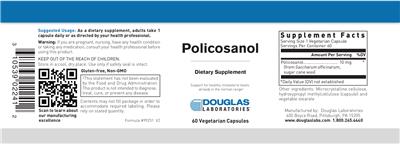
Supplement Facts
The label details for Policosanol by Douglas Laboratories, sourced from the NIH Dietary Supplement Label Database.
Supplement Facts
| Ingredient | Amount | % DV |
|---|---|---|
| Policosanol | 10 mg | -- |
Other ingredients: Microcrystalline Cellulose, Hydroxypropyl Methylcellulose, Vegetable Stearate
Tap any ingredient to jump to its full detail below.
These statements are the manufacturer’s wording, reproduced from the product label — the label is saying it, not HelloPharmacist. We don’t verify or endorse them.
Suggested/Recommended/Usage/Directions
Suggested Usage: As a dietary supplement, adults take 1 capsule daily or as directed by your health professional.
Precautions
Warning: If you are pregnant, nursing, have any health condition or taking any medication, consult your health professional before using this product.
Keep out of the reach of children.
Use only if safety seal is intact.
Storage
Store in a cool, dry place.
Formulation
Gluten-free, Non-GMO
Support for healthy cholesterol levels already in the normal range
FDA Disclaimer Statement
This statement has not been evaluated by the Food and Drug Administration. This product is not intended to diagnose, treat, cure, or prevent any disease.
General Statements
Scan to learn about our manufacturing excellence Contents may not fill package in order to accommodate required labeling. Please rely on stated quantity.
FDA Statement of Identity
Dietary Supplement
Is this label outdated? Report a formula or label change and our pharmacy team will review it.
Policosanol by Douglas Laboratories label
The label scan from the NIH Dietary Supplement Label Database. Tap to enlarge.
Label images are published by the NIH Dietary Supplement Label Database for the version of this product on file. Always read your actual product label.
View the full label (PDF)The Ingredients in Policosanol by Douglas Laboratories
This is the 1 active ingredient this product is made of. Select it to open its full monograph.
Serving size1 Vegetarian Capsule(s) Dosage formCapsule Servings per container60 Amounts shown are per serving.
Policosanol
Interacts with242 drugs
Policosanol is a mix of waxy alcohols (mostly octacosanol) made from sugar cane or other plant waxes, and it is often marketed as a natural way to low...
Policosanol monograph & interactionsOther (inactive) ingredients: Microcrystalline Cellulose, Hydroxypropyl Methylcellulose, Vegetable Stearate. These complete the product’s ingredient list but are not active constituents.
Policosanol by Douglas Laboratories Drug Interactions
HelloPharmacist Interaction Report
Policosanol by Douglas Laboratories does interact with several important medication types.
Through its single active ingredient, policosanol can lower blood pressure additively with beta-blockers and nitroprusside — a combination that needs monitoring. The most serious concern is the potential for increased bleeding when combined with blood thinners (anticoagulants) and antiplatelet drugs like warfarin; while one small trial suggested limited interaction risk, other research shows policosanol can slow clotting.
Read the full breakdown — every affected drug type, severity by severity
You'll also want to flag diabetes medications with your doctor or pharmacist before starting this. Policosanol can lower blood glucose, so combining it with diabetes drugs might push your blood sugar too low (hypoglycemia).
Altogether, these interactions span 242 individual medications.
Check your exact medication list with the search tool on this page before you start. If you take any blood pressure medication, blood thinner, or diabetes drug, clear it with your own pharmacist or doctor first.
Check your own medications below · Editorial policy · How we use AI
Want to check YOUR meds against Policosanol?
Ask about interactions with your drugs in plain English — “Can I take it with lisinopril?” — and we find you the answer in seconds, ingredient by ingredient.
Go to the checkerIngredients driving the most interactions
Individual Drug Interactions
The ingredients in Policosanol interact with 242 drugs. Click any drug to see the details.
1 of the 1 ingredient in Policosanol interact with drugs. Each result below shows which ingredient is responsible. Policosanol
BetrixabanBevyxxa
How Betrixaban interacts with Policosanol — through 1 ingredient. Tap an ingredient for the detail:
PolicosanolAnticoagulant/antiplatelet Drugs Moderate
Interaction Summary
Theoretically, taking policosanol with other antiplatelet or anticoagulant drugs might increase the risk of bruising and bleeding.
Read the full Policosanol + Betrixaban interactionBisoprololZebeta
How Bisoprolol interacts with Policosanol — through 1 ingredient. Tap an ingredient for the detail:
PolicosanolBeta-blockers Moderate
Interaction Summary
Concomitant use of policosanol with beta-blockers can cause additive blood pressure-lowering effects.
Read the full Policosanol + Bisoprolol interactionBisoprolol, HydrochlorothiazideZiac
How Bisoprolol, Hydrochlorothiazide interacts with Policosanol — through 1 ingredient. Tap an ingredient for the detail:
PolicosanolBeta-blockers Moderate
Interaction Summary
Concomitant use of policosanol with beta-blockers can cause additive blood pressure-lowering effects.
Read the full Policosanol + Bisoprolol, Hydrochlorothiazide interactionBivalirudinAngiomax, Angiomax Rtu, Angiox
How Bivalirudin interacts with Policosanol — through 1 ingredient. Tap an ingredient for the detail:
PolicosanolAnticoagulant/antiplatelet Drugs Moderate
Interaction Summary
Theoretically, taking policosanol with other antiplatelet or anticoagulant drugs might increase the risk of bruising and bleeding.
Read the full Policosanol + Bivalirudin interactionBromfenac SodiumBromsite, Prolensa
How Bromfenac Sodium interacts with Policosanol — through 1 ingredient. Tap an ingredient for the detail:
PolicosanolAnticoagulant/antiplatelet Drugs Moderate
Interaction Summary
Theoretically, taking policosanol with other antiplatelet or anticoagulant drugs might increase the risk of bruising and bleeding.
Read the full Policosanol + Bromfenac Sodium interactionCabliviCablivi
How Cablivi interacts with Policosanol — through 1 ingredient. Tap an ingredient for the detail:
PolicosanolAnticoagulant/antiplatelet Drugs Moderate
Interaction Summary
Theoretically, taking policosanol with other antiplatelet or anticoagulant drugs might increase the risk of bruising and bleeding.
Read the full Policosanol + Cablivi interactionCanagliflozinInvokana
How Canagliflozin interacts with Policosanol — through 1 ingredient. Tap an ingredient for the detail:
PolicosanolAntidiabetes Drugs Moderate
Interaction Summary
Theoretically, policosanol might have additive effects with antidiabetes drugs and increase the risk of hypoglycemia.
Read the full Policosanol + Canagliflozin interactionCanagliflozin, MetforminInvokamet
How Canagliflozin, Metformin interacts with Policosanol — through 1 ingredient. Tap an ingredient for the detail:
PolicosanolAntidiabetes Drugs Moderate
Interaction Summary
Theoretically, policosanol might have additive effects with antidiabetes drugs and increase the risk of hypoglycemia.
Read the full Policosanol + Canagliflozin, Metformin interactionCanagliflozin, Metformin HydrochlorideInvokamet XR
How Canagliflozin, Metformin Hydrochloride interacts with Policosanol — through 1 ingredient. Tap an ingredient for the detail:
PolicosanolAntidiabetes Drugs Moderate
Interaction Summary
Theoretically, policosanol might have additive effects with antidiabetes drugs and increase the risk of hypoglycemia.
Read the full Policosanol + Canagliflozin, Metformin Hydrochloride interactionCangrelorKengreal
How Cangrelor interacts with Policosanol — through 1 ingredient. Tap an ingredient for the detail:
PolicosanolAnticoagulant/antiplatelet Drugs Moderate
Interaction Summary
Theoretically, taking policosanol with other antiplatelet or anticoagulant drugs might increase the risk of bruising and bleeding.
Read the full Policosanol + Cangrelor interactionCarteololCartrol, Ocupress
How Carteolol interacts with Policosanol — through 1 ingredient. Tap an ingredient for the detail:
PolicosanolBeta-blockers Moderate
Interaction Summary
Concomitant use of policosanol with beta-blockers can cause additive blood pressure-lowering effects.
Read the full Policosanol + Carteolol interactionCarvedilolCoreg, Coreg CR
How Carvedilol interacts with Policosanol — through 1 ingredient. Tap an ingredient for the detail:
PolicosanolBeta-blockers Moderate
Interaction Summary
Concomitant use of policosanol with beta-blockers can cause additive blood pressure-lowering effects.
Read the full Policosanol + Carvedilol interactionCeliprololCelicard
How Celiprolol interacts with Policosanol — through 1 ingredient. Tap an ingredient for the detail:
PolicosanolBeta-blockers Moderate
Interaction Summary
Concomitant use of policosanol with beta-blockers can cause additive blood pressure-lowering effects.
Read the full Policosanol + Celiprolol interactionChlorpropamideChlorpropam, Diabinese
How Chlorpropamide interacts with Policosanol — through 1 ingredient. Tap an ingredient for the detail:
PolicosanolAntidiabetes Drugs Moderate
Interaction Summary
Theoretically, policosanol might have additive effects with antidiabetes drugs and increase the risk of hypoglycemia.
Read the full Policosanol + Chlorpropamide interactionCilostazolPletal
How Cilostazol interacts with Policosanol — through 1 ingredient. Tap an ingredient for the detail:
PolicosanolAnticoagulant/antiplatelet Drugs Moderate
Interaction Summary
Theoretically, taking policosanol with other antiplatelet or anticoagulant drugs might increase the risk of bruising and bleeding.
Read the full Policosanol + Cilostazol interactionClopidogrelPlavix
How Clopidogrel interacts with Policosanol — through 1 ingredient. Tap an ingredient for the detail:
PolicosanolAnticoagulant/antiplatelet Drugs Moderate
Interaction Summary
Theoretically, taking policosanol with other antiplatelet or anticoagulant drugs might increase the risk of bruising and bleeding.
Read the full Policosanol + Clopidogrel interactionDalteparinFragmin
How Dalteparin interacts with Policosanol — through 1 ingredient. Tap an ingredient for the detail:
PolicosanolAnticoagulant/antiplatelet Drugs Moderate
Interaction Summary
Theoretically, taking policosanol with other antiplatelet or anticoagulant drugs might increase the risk of bruising and bleeding.
Read the full Policosanol + Dalteparin interactionDanaparoidOrgaran
How Danaparoid interacts with Policosanol — through 1 ingredient. Tap an ingredient for the detail:
PolicosanolAnticoagulant/antiplatelet Drugs Moderate
Interaction Summary
Theoretically, taking policosanol with other antiplatelet or anticoagulant drugs might increase the risk of bruising and bleeding.
Read the full Policosanol + Danaparoid interactionDapagliflozinFarxiga
How Dapagliflozin interacts with Policosanol — through 1 ingredient. Tap an ingredient for the detail:
PolicosanolAntidiabetes Drugs Moderate
Interaction Summary
Theoretically, policosanol might have additive effects with antidiabetes drugs and increase the risk of hypoglycemia.
Read the full Policosanol + Dapagliflozin interactionDapagliflozin Propanediol, MetforminXigduo XR
How Dapagliflozin Propanediol, Metformin interacts with Policosanol — through 1 ingredient. Tap an ingredient for the detail:
PolicosanolAntidiabetes Drugs Moderate
Interaction Summary
Theoretically, policosanol might have additive effects with antidiabetes drugs and increase the risk of hypoglycemia.
Read the full Policosanol + Dapagliflozin Propanediol, Metformin interactionDapagliflozin Propanediol, Saxagliptin HydrochlorideQtern
How Dapagliflozin Propanediol, Saxagliptin Hydrochloride interacts with Policosanol — through 1 ingredient. Tap an ingredient for the detail:
PolicosanolAntidiabetes Drugs Moderate
Interaction Summary
Theoretically, policosanol might have additive effects with antidiabetes drugs and increase the risk of hypoglycemia.
Read the full Policosanol + Dapagliflozin Propanediol, Saxagliptin Hydrochloride interactionDapagliflozin, Metformin Hydrochloride, Saxagliptin HydrochlorideQternmet XR
How Dapagliflozin, Metformin Hydrochloride, Saxagliptin Hydrochloride interacts with Policosanol — through 1 ingredient. Tap an ingredient for the detail:
PolicosanolAntidiabetes Drugs Moderate
Interaction Summary
Theoretically, policosanol might have additive effects with antidiabetes drugs and increase the risk of hypoglycemia.
Read the full Policosanol + Dapagliflozin, Metformin Hydrochloride, Saxagliptin Hydrochloride interactionDasiglucagon HydrochlorideZegalogue
How Dasiglucagon Hydrochloride interacts with Policosanol — through 1 ingredient. Tap an ingredient for the detail:
PolicosanolAntidiabetes Drugs Moderate
Interaction Summary
Theoretically, policosanol might have additive effects with antidiabetes drugs and increase the risk of hypoglycemia.
Read the full Policosanol + Dasiglucagon Hydrochloride interactionDefibrotide SodiumDefitelio
How Defibrotide Sodium interacts with Policosanol — through 1 ingredient. Tap an ingredient for the detail:
PolicosanolAnticoagulant/antiplatelet Drugs Moderate
Interaction Summary
Theoretically, taking policosanol with other antiplatelet or anticoagulant drugs might increase the risk of bruising and bleeding.
Read the full Policosanol + Defibrotide Sodium interactionDiclofenacZorvolex
How Diclofenac interacts with Policosanol — through 1 ingredient. Tap an ingredient for the detail:
PolicosanolAnticoagulant/antiplatelet Drugs Moderate
Interaction Summary
Theoretically, taking policosanol with other antiplatelet or anticoagulant drugs might increase the risk of bruising and bleeding.
Read the full Policosanol + Diclofenac interactionDiclofenac PotassiumCambia, Cataflam, Cataflam IR, Voltaren Rapide, Voltarol Rapid
How Diclofenac Potassium interacts with Policosanol — through 1 ingredient. Tap an ingredient for the detail:
PolicosanolAnticoagulant/antiplatelet Drugs Moderate
Interaction Summary
Theoretically, taking policosanol with other antiplatelet or anticoagulant drugs might increase the risk of bruising and bleeding.
Read the full Policosanol + Diclofenac Potassium interactionDiclofenac SodiumAcoflam, Acoflam 75 SR, Acoflam Retard, Defenac, Defenac Retard, Defenac SR +40 more
How Diclofenac Sodium interacts with Policosanol — through 1 ingredient. Tap an ingredient for the detail:
PolicosanolAnticoagulant/antiplatelet Drugs Moderate
Interaction Summary
Theoretically, taking policosanol with other antiplatelet or anticoagulant drugs might increase the risk of bruising and bleeding.
Read the full Policosanol + Diclofenac Sodium interactionDiclofenac Sodium, MisoprostolArthrotec 50, Arthrotec 75
How Diclofenac Sodium, Misoprostol interacts with Policosanol — through 1 ingredient. Tap an ingredient for the detail:
PolicosanolAnticoagulant/antiplatelet Drugs Moderate
Interaction Summary
Theoretically, taking policosanol with other antiplatelet or anticoagulant drugs might increase the risk of bruising and bleeding.
Read the full Policosanol + Diclofenac Sodium, Misoprostol interactionDiclofenac EpolamineFlector, Licart
How Diclofenac Epolamine interacts with Policosanol — through 1 ingredient. Tap an ingredient for the detail:
PolicosanolAnticoagulant/antiplatelet Drugs Moderate
Interaction Summary
Theoretically, taking policosanol with other antiplatelet or anticoagulant drugs might increase the risk of bruising and bleeding.
Read the full Policosanol + Diclofenac Epolamine interactionDicumarolDicumarol
How Dicumarol interacts with Policosanol — through 1 ingredient. Tap an ingredient for the detail:
PolicosanolAnticoagulant/antiplatelet Drugs Moderate
Interaction Summary
Theoretically, taking policosanol with other antiplatelet or anticoagulant drugs might increase the risk of bruising and bleeding.
Read the full Policosanol + Dicumarol interactionEach ingredient & the kinds of drugs it affects
For each ingredient in Policosanol with known interactions, here are the types of medications it can affect. Open any type for the detail — or search your exact drug in the checker above.
Policosanol
Anticoagulant/Antiplatelet Drugs
Theoretically, taking policosanol with other antiplatelet or anticoagulant drugs might increase the risk of bruising and bleeding.
Some clinical research shows that taking policosanol 10-50 mg daily for 7-15 days can inhibit platelet aggregation in healthy patients. Although, one clinical trial shows that taking policosanol 10 mg twice daily for 2 weeks prior to warfarin dosing does not affect warfarin pharmacokinetics or warfarin response. Furthermore, a study in patients undergoing percutaneous coronary intervention with a drug-eluting stent found that taking policosanol 40 mg plus clopidogrel and aspirin daily for 30 days modestly reduced the risk for minor bleeding events when compared with taking clopidogrel and aspirin alone. Until more is known, use with caution.
Antidiabetes Drugs
Theoretically, policosanol might have additive effects with antidiabetes drugs and increase the risk of hypoglycemia.
Clinical research shows that policosanol can lower blood glucose levels.
Beta-Blockers
Concomitant use of policosanol with beta-blockers can cause additive blood pressure-lowering effects.
Clinical research shows that policosanol 5 mg daily can have additive blood pressure-lowering effects in patients with hypertension who are taking beta-blockers. Also, animal research shows that policosanol can increase the blood-pressure lowering effects of propranolol.
Nitroprusside (Nitropress)
Theoretically, concomitant use of policosanol with nitroprusside might cause additive blood pressure-lowering effects.
Animal research shows that taking policosanol along with nitroprusside can increase the blood pressure-lowering effects of nitroprusside.
Propranolol (Inderal)
Animal research shows that taking policosanol along with propranolol can increase the blood pressure-lowering effects of propranolol.
Warfarin (Coumadin)
Theoretically, taking policosanol with warfarin might increase the risk of bruising and bleeding.
Some clinical research shows that taking policosanol 10-50 mg daily for 7-15 days can inhibit platelet aggregation in healthy patients. However, one clinical trial shows that taking policosanol 10 mg twice daily for 2 weeks prior to warfarin dosing does not affect warfarin pharmacokinetics or warfarin response.
Brand information
Manufacturer and brand details for Policosanol, from the product label.
Douglas Laboratories
See all Douglas Laboratories products- Name
- Douglas Laboratories
- Street Address
- 600 Boyce Road
- City
- Pittsburgh
- State
- PA
- ZipCode
- 15205
- Phone Number
- 1.800.245.4440
- Web Address
- www.douglaslabs.com
Policosanol by Douglas Laboratories: Common Questions
Does Policosanol by Douglas Laboratories interact with any medications?
How can one product interact with so many drugs?
Where does this information come from?
Does policosanol actually lower cholesterol?
What's policosanol made from?
Can I take policosanol while pregnant or breastfeeding?
What side effects might I notice?
Why does the product quality vary between brands?
Written and reviewed by the HelloPharmacist editorial staff. Our editorial policy
Not sure if Policosanol is safe with your meds?
Our pharmacists answer your medication & supplement questions — free.
Label information is sourced from the NIH Dietary Supplement Label Database and reflects the product version on file; always read your actual product label. This page is for education only and is not a substitute for professional medical advice. Confirm with your pharmacist or doctor before combining supplements and medications.
The Full Monographs Behind Policosanol’s Ingredients
Every ingredient we hold a full HelloPharmacist monograph for — uses, evidence, safety, and the complete interaction list.
Sources & How We Checked
Policosanol's label data comes from the NIH Dietary Supplement Label Database; the ingredient interaction data is from the Natural Medicines database, reviewed by our pharmacists.
- NIH Dietary Supplement Label Database (DSLD) — The official product label on file for this supplement.
- Natural Medicines (Therapeutic Research Center) — Evidence-graded clinical reference behind the ingredient interaction data.
Content is written and reviewed by licensed HelloPharmacist pharmacists. See our data sources and editorial standards for how this information is built and checked.
The 15 references behind this product’s interaction data
Every citation that drives the interaction findings for this product’s ingredients, from the evidence-graded Natural Medicines (TRC Healthcare) database. Open an ingredient to browse its citations — links open the study on PubMed or the publisher’s site.
Policosanol 15 references
- Carbajal D, Arruzazabala ML, Valdes S, Mas R. Effect of policosanol on platelet aggregation and serum levels of arachidonic acid metabolites in healthy volunteers. Prostaglandins Leukot Essent Fatty Acids 1998;58:61-4.
- Arruzazabala ML, Valdes S, Mas R, et al. Comparative study of policosanol, aspirin and the combination therapy policosanol-aspirin on platelet aggregation in healthy volunteers. Pharmacol Res 1997;36:293-7. PubMed
- Valdes S, Arruzazabala ML, Fernandez L. Effect of policosanol on platelet aggregation in healthy volunteers. Int J Clin Pharmacol Res 1996;16:67-72.
- Greyling A, De Witt C, Oosthuizen W, Jerling JC. Effects of a policosanol supplement on serum lipid concentrations in hypercholesterolaemic and heterozygous familial hypercholesterolaemic subjects. Br J Nutr 2006;95:968-75. PubMed
- Abdul MI, Jiang X, Williams KM, et al. Pharmacokinetic and pharmacodynamic interactions of echinacea and policosanol with warfarin in healthy subjects. Br J Clin.Pharmacol. 2010;69:508-15. PubMed
- Molina, Cuevas, V, Arruzazabala, M. L., Carbajal, Quintana D., Mas, Ferreiro R., and Valdes, Garcia S. Effect of policosanol on arterial blood pressure in rats. Study of the pharmacological interaction with nifedipine and propranolol. Arch Med Res 1998;29
- Castano G, Fernandez L, Mas R, et al. Comparison of the efficacy, safety and tolerability of original policosanol versus other mixtures of higher aliphatic primary alcohols in patients with type II hypercholesterolemia. Int.J.Clin.Pharmacol.Res. 2002;22:5
- Arruzazabala, M. L., Carbajal, D., Mas, R., Valdes, S., and Molina, V. Pharmacological Interaction Between Policosanol and Nitroprusside in Rats. J Med Food 2001;4(2):67-70. PubMed
- Castano G, Mas R, Gamez R, et al. Concomitant use of policosanol and beta-blockers in older patients. Int J Clin Pharmacol.Res 2004;24:65-77.
- Francini-Pesenti F, Brocadello F, Beltramolli D, et al. Sugar cane policosanol failed to lower plasma cholesterol in primitive, diet-resistant hypercholesterolaemia: A double blind, controlled study. Complement Ther Med 2008;16:61-65. PubMed
- Castaño G, Fernández L, Mas R, Illnait J, Mesa M, Fernández JC. Comparison of the effects of policosanol and atorvastatin on lipid profile and platelet aggregation in patients with dyslipidaemia and type 2 diabetes mellitus. Clin Drug Investig. 2003;23(10 PubMed
- Fernandez L, Mas R, Illnait J, Fernandez JC. Policosanol: results of a postmarketing surveillance study of 27,879 patients. Curr Ther Res 1998;59(10):717-22. DOI
- Wang HY, Jiao QP, Chen SY, et al. Efficacy and safety of policosanol plus fenofibrate combination therapy in elderly patients with mixed dyslipidemia: A randomized, controlled clinical study. Am J Med Sci. 2018;356(3):254-261. PubMed
- Xu K, Liu X, Li Y, Wang Y, Zang H, Guo L, et al. Safety and efficacy of policosanol in patients with high on-treatment platelet reactivity after drug-eluting stent implantation: two-year follow-up results. Cardiovasc Ther. 2016 Oct;34(5):337-42. doi: 10.1 PubMed
- Li C, Ding Y, Si Q, Li K, Xu K. Multiple functions of policosanol in elderly patients with dyslipidemia. J Int Med Res. 2020;48(7):300060520936082. PubMed
Parts of this content are provided by the Therapeutic Research Center, LLC.
DISCLAIMER: Currently this does not check for drug-drug interactions. This is not an all-inclusive comprehensive list of potential interactions and is for informational purposes only. Not all interactions are known or well-reported in the scientific literature, and new interactions are continually being reported. Input is needed from a qualified healthcare provider including a pharmacist before starting any therapy. Application of clinical judgment is necessary.
© 2021 Therapeutic Research Center, LLC