
Prenatal DHA Ingredients & Drug Interactions
What is this page for?
First and foremost: checking Prenatal DHA against your medications. The heart of this page is the interaction checker and the full interaction report — how this product’s ingredients may interact with prescription and over-the-counter medicines you may be taking.
Around that, we add a pharmacist’s high-level view of the product as a whole — what’s inside, the evidence for its stated use, how transparent the label is, and what safety data exists — so you can see the full picture in one place. It’s educational information from our licensed clinical databases and the clinical staff at HelloPharmacist — not medical advice — and we don’t sell or endorse products. Our editorial policy
Prenatal DHA is a dietary supplement by Nordic Naturals with 4 active ingredients. Its ingredients are commonly taken for bone health and osteoporosis, correcting vitamin d deficiency, immune system support.Based on those ingredients, 715 medications have a known interaction with it, the most serious rated moderate. The ingredients most likely to interact are Vitamin D3. Use the checker below to test your specific medication, or read the full HelloPharmacist Interaction Report.
Check Your Meds Against Prenatal DHA by Nordic Naturals
Ask about any prescription or over-the-counter medication and we check it for interactions with Prenatal DHA by Nordic Naturals — and tell you which ingredient is responsible.
AI summaries are generated from our interaction database for education only — always confirm with your pharmacist. How we use AI
Ask the Pharmacist
A licensed pharmacist will answer your question by email — free, usually within 24 hours.
Got it — thank you!
A licensed pharmacist will answer within 24 hours. Keep an eye on your email (worth checking spam, just in case).
HelloPharmacist Scorecard of Prenatal DHA by Nordic Naturals
Our pharmacy team’s full take, with four database checks built into the cards below — a summary of what is known, not a grade of the product itself.
What’s inside
Full disclosure
Prenatal DHA by Nordic Naturals contains 4 active ingredients: eicosapentaenoic acid and docosahexaenoic acid (both omega-3 fatty acids from fish oil), vitamin D3, and total omega-3 fatty acids. The omega-3s support fetal brain and eye development during pregnancy.
Vitamin D aids calcium absorption and bone health for both you and your baby. The product also includes inactive ingredients like purified deep sea fish oil, vitamin E, and a softgel capsule shell.
Does it work?
Not established
Vitamin D3 is rated effective for treating rickets, renal bone disease, hypoparathyroidism, and familial hypophosphatemia — conditions where your body doesn't absorb or use calcium properly. We hold no effectiveness data in our system for the omega-3 fatty acids in this product, so I can't tell you from our facts what the evidence shows for their prenatal benefits.
How safe is it?
Well-documented data
Vitamin D3 is generally well tolerated at recommended doses, though very high doses over time can cause toxicity with symptoms like elevated blood calcium, bone loss in adults, or slowed growth in children. The safety data advises that while vitamin D is often used during pregnancy at recommended amounts, you should use it only under your doctor's guidance.
There's no data on file for the pregnancy or breastfeeding safety of the omega-3 ingredients in this product — talk with your doctor or pharmacist for personalized advice about those components.
Meds to double-check
Moderate interaction found
Before taking this product, double-check if you're on thiazide diuretics (water pills), verapamil or diltiazem (heart rhythm or blood pressure medications), atorvastatin (a cholesterol drug), digoxin (a heart medication), calcipotriene (a vitamin D-like psoriasis cream), or aluminum-containing antacids. These are the medication types where vitamin D3 in this prenatal supplement may cause problems.
The bottom line
Scorecard at a glanceFully disclosed formula with no established evidence rating for its marketed use. Moderate medication interactions have been identified, and safety information is well characterized.
This prenatal supplement is designed to support omega-3 and vitamin D intake during pregnancy, but vitamin D can interact with several heart and blood pressure medications and cholesterol drugs. If you take any prescription medications — especially thiazide diuretics, heart rhythm drugs, or statin cholesterol pills — check them with your pharmacist before starting.
Always use it under your doctor's supervision during pregnancy.
Educational only — not medical advice; always confirm with your pharmacist. Our editorial policy · How we use AI
Assessment coverage: 1 of 4 active ingredients matched to our full ingredient reviews (monographs). Based on the product label dated Jun 24, 2020.
This Scorecard evaluates available label information, ingredient evidence, and known medication-safety considerations. It does not independently verify product identity, purity, potency, contamination, or manufacturing quality. How these ratings are computed
General information
Key facts about Prenatal DHA, straight from the product label.
| Brand | Nordic Naturals |
|---|---|
| Barcode (UPC) | 768990017490 |
| Net contents | 180 Softgel(s) |
| Market status | On market |
| Date entered into DSLD | Jun 24, 2020 |
| DSLD ID | 221683 |
| Product type | Fat/fatty Acid |
| Supplement form | Softgel Capsule |
| Dietary claims / uses | Nutrient, All Other, Qualified Health |
| Intended target group(s) | Pregnant Women, Adult Female (18 - 50 Years), Lactating, Gluten Free, Dairy Free |
Everything in this section is reproduced from the manufacturer’s own product label — it’s the label speaking, not HelloPharmacist. We show it so you can see exactly what the maker states; we don’t verify or endorse those statements.
Supplement Facts
The label details for Prenatal DHA by Nordic Naturals, sourced from the NIH Dietary Supplement Label Database.
Supplement Facts
| Ingredient | Amount | % DV |
|---|---|---|
| Calories | 10 Calorie(s) | -- |
| Eicosapentaenoic Acid | 205 mg | -- |
| Docosahexaenoic Acid | 480 mg | -- |
| Saturated Fat | 0 Gram(s) | -- |
| Trans Fat | 0 Gram(s) | -- |
| Total Fat | 1 Gram(s) | 1% |
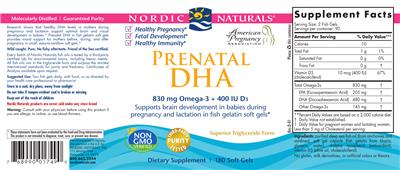
| Vitamin D3 | 10 mcg | 67% |
| Total Omega-3 Fatty Acids | 830 mg | -- |
| Other Omega-3 Fatty Acids | 145 mg | -- |
Other ingredients: purified deep sea Fish Oil, Softgel Capsule, D-Alpha-Tocopherol, Vitamin D3
Tap any ingredient to jump to its full detail below.
These statements are the manufacturer’s wording, reproduced from the product label — the label is saying it, not HelloPharmacist. We don’t verify or endorse them.
Formulation
Molecularly distilled Guaranteed purity
Research shows that healthy DHA levels in mothers during pregnancy and lactation support optimal brain and visual development in babies. Prenatal DHA provides mood support for mothers before, during, and after pregnancy in small, easy-to-swallow soft gels.
Wild caught. Pure. No fishy aftertaste. Friend of the Sea certified. Every batch of Nordic Naturals fish oils is tested by a third-party certified lab for environmental toxins, including heavy metals. All fish oils are in the triglyceride form and surpass the strictest international standards for purity and freshness. Certificates of Analysis available upon request.
Fish oil processed in Norway.
Healthy pregnancy Fetal development Healthy immunity
Supports brain development in babies during pregnancy and lactation in fish gelatin soft gels
Non GMO
Superior triglyceride form
No gluten, milk derivatives, or artificial colors or flavors.
Suggested/Recommended/Usage/Directions
Suggested Use: Two fish gels daily, with food, or as directed by your health care professional or pharmacist.
Storage
Store in a cool, dry place, away from sunlight
Precautions
Do not take if tamper-evident seal is broken or missing
Keep out of the reach of children
Warning: Consult with your physician before using this product if you are allergic to iodine, or use blood thinners.
Warning: Consult with your physician before using this product if you are allergic to iodine, or use blood thinners
General Statements
Nordic Naturals products are never sold under any store brand
Please recycle this container
FDA Disclaimer Statement
These statements have not been evaluated by the Food and Drug Administration. This product is not intended to diagnose, treat, cure, or prevent any disease.
Brand IP Statement(s)
American Pregnancy Association
Formula
830 mg omega-3 + 400 I.U. D3
Seals/Symbols
Non GMO Verified
Third-Party Purity Tested
FDA Statement of Identity
Dietary Supplement
Is this label outdated? Report a formula or label change and our pharmacy team will review it.
Prenatal DHA by Nordic Naturals label
The label scan from the NIH Dietary Supplement Label Database. Tap to enlarge.
Label images are published by the NIH Dietary Supplement Label Database for the version of this product on file. Always read your actual product label.
View the full label (PDF)The Ingredients in Prenatal DHA by Nordic Naturals
These are the 4 active ingredients this product is made of. Select any to open its full monograph.
Serving size2 Softgel(s) Dosage formSoftgel Capsule Servings per container90 Amounts shown are per serving.
Most supplement products combine several ingredients, and a medication can interact with the product through any one of them. Each ingredient below shows whether it has known drug interactions.
Vitamin D3
Interacts with715 drugs
Vitamin D is a fat-soluble vitamin that helps your body absorb calcium and is important for healthy bones, muscles, and immune function. Many people,...
Vitamin D3 monograph & interactionsTotal Omega-3 Fatty Acids
- › Eicosapentaenoic Acid
- › Docosahexaenoic Acid
- › Other Omega-3 Fatty Acids
Other (inactive) ingredients: Purified deep sea Fish Oil, Softgel Capsule, D-Alpha-Tocopherol, Vitamin D3. These complete the product’s ingredient list but are not active constituents.
Prenatal DHA by Nordic Naturals Drug Interactions
HelloPharmacist Interaction Report
Nordic Naturals Prenatal DHA contains vitamin D3, which does interact with several medication types.
The most serious concern is with thiazide diuretics, verapamil, atorvastatin, digoxin, diltiazem, and calcipotriene — all rated Moderate severity. Vitamin D can raise calcium levels in your bloodstream, and when combined with thiazide water pills or heart rhythm medications, this can reduce how well those drugs work or cause problems.
High-dose vitamin D with atorvastatin may also lower cholesterol-lowering effectiveness, and combining it with calcipotriene (a vitamin D-like psoriasis treatment) increases the risk of elevated calcium.
Read the full breakdown — every affected drug type, severity by severity
Additionally, vitamin D may increase aluminum absorption if you take aluminum-containing antacids, particularly if you have kidney problems. There's also a Minor-severity concern: vitamin D might speed up how your body breaks down certain medications processed by your liver (CYP3A4 substrates), potentially reducing their effect.
We could not check two of the omega-3 ingredients — eicosapentaenoic acid and other omega-3 fatty acids — because we hold no interaction data for them. Before you start this prenatal supplement, run your exact medications through the checker below.
Check your own medications below · Editorial policy · How we use AI
Want to check YOUR meds against Prenatal DHA?
Ask about interactions with your drugs in plain English — “Can I take it with lisinopril?” — and we find you the answer in seconds, ingredient by ingredient.
Go to the checkerIngredients driving the most interactions
Individual Drug Interactions
The ingredients in Prenatal DHA interact with 715 drugs. Click any drug to see the details.
1 of the 4 ingredients in Prenatal DHA interact with drugs. Each result below shows which ingredient is responsible. Vitamin D3
Alginic Acid, Aluminum HydroxideRafton
How Alginic Acid, Aluminum Hydroxide interacts with Prenatal DHA — through 1 ingredient. Tap an ingredient for the detail:
Vitamin D3Aluminum Moderate
Interaction Summary
Vitamin D might increase aluminum absorption and toxicity, but this has only been reported in people with renal failure.
Read the full Vitamin D3 + Alginic Acid, Aluminum Hydroxide interactionAluminum Acetate, Benzethonium ChlorideBuro-Sol Otic Solution
How Aluminum Acetate, Benzethonium Chloride interacts with Prenatal DHA — through 1 ingredient. Tap an ingredient for the detail:
Vitamin D3Aluminum Moderate
Interaction Summary
Vitamin D might increase aluminum absorption and toxicity, but this has only been reported in people with renal failure.
Read the full Vitamin D3 + Aluminum Acetate, Benzethonium Chloride interactionAluminum ChlorideAluminum Chloride, Anhydrol Forte, Driclor, Drysol
How Aluminum Chloride interacts with Prenatal DHA — through 1 ingredient. Tap an ingredient for the detail:
Vitamin D3Aluminum Moderate
Interaction Summary
Vitamin D might increase aluminum absorption and toxicity, but this has only been reported in people with renal failure.
Read the full Vitamin D3 + Aluminum Chloride interactionAluminum HydroxideAlu-Cap, Amphojel, Gaviscon
How Aluminum Hydroxide interacts with Prenatal DHA — through 1 ingredient. Tap an ingredient for the detail:
Vitamin D3Aluminum Moderate
Interaction Summary
Vitamin D might increase aluminum absorption and toxicity, but this has only been reported in people with renal failure.
Read the full Vitamin D3 + Aluminum Hydroxide interactionAluminum Hydroxide, Aspirin, Codeine Phosphate, Magnesium HydroxideAscriptin Codeine #2
How Aluminum Hydroxide, Aspirin, Codeine Phosphate, Magnesium Hydroxide interacts with Prenatal DHA — through 1 ingredient. Tap an ingredient for the detail:
Vitamin D3Aluminum Moderate
Interaction Summary
Vitamin D might increase aluminum absorption and toxicity, but this has only been reported in people with renal failure.
Read the full Vitamin D3 + Aluminum Hydroxide, Aspirin, Codeine Phosphate, Magnesium Hydroxide interactionAluminum Hydroxide, Aspirin, Magnesium HydroxideAscriptin
How Aluminum Hydroxide, Aspirin, Magnesium Hydroxide interacts with Prenatal DHA — through 1 ingredient. Tap an ingredient for the detail:
Vitamin D3Aluminum Moderate
Interaction Summary
Vitamin D might increase aluminum absorption and toxicity, but this has only been reported in people with renal failure.
Read the full Vitamin D3 + Aluminum Hydroxide, Aspirin, Magnesium Hydroxide interactionAluminum Hydroxide, Magnesium Hydroxide (otc Drug)Maalox, Mucogel
How Aluminum Hydroxide, Magnesium Hydroxide (otc Drug) interacts with Prenatal DHA — through 1 ingredient. Tap an ingredient for the detail:
Vitamin D3Aluminum Moderate
Interaction Summary
Vitamin D might increase aluminum absorption and toxicity, but this has only been reported in people with renal failure.
Read the full Vitamin D3 + Aluminum Hydroxide, Magnesium Hydroxide (otc Drug) interactionAluminum Hydroxide, Magnesium Hydroxide, Simethicone (otc Drug)Mylanta
How Aluminum Hydroxide, Magnesium Hydroxide, Simethicone (otc Drug) interacts with Prenatal DHA — through 1 ingredient. Tap an ingredient for the detail:
Vitamin D3Aluminum Moderate
Interaction Summary
Vitamin D might increase aluminum absorption and toxicity, but this has only been reported in people with renal failure.
Read the full Vitamin D3 + Aluminum Hydroxide, Magnesium Hydroxide, Simethicone (otc Drug) interactionAluminum, CalciumDomeboro
How Aluminum, Calcium interacts with Prenatal DHA — through 1 ingredient. Tap an ingredient for the detail:
Vitamin D3Aluminum Moderate
Interaction Summary
Vitamin D might increase aluminum absorption and toxicity, but this has only been reported in people with renal failure.
Read the full Vitamin D3 + Aluminum, Calcium interactionAluminum, Magnesium (otc Drug)Almagel
How Aluminum, Magnesium (otc Drug) interacts with Prenatal DHA — through 1 ingredient. Tap an ingredient for the detail:
Vitamin D3Aluminum Moderate
Interaction Summary
Vitamin D might increase aluminum absorption and toxicity, but this has only been reported in people with renal failure.
Read the full Vitamin D3 + Aluminum, Magnesium (otc Drug) interactionAluminum, Magnesium Hydroxide (otc Drug)Wingel
How Aluminum, Magnesium Hydroxide (otc Drug) interacts with Prenatal DHA — through 1 ingredient. Tap an ingredient for the detail:
Vitamin D3Aluminum Moderate
Interaction Summary
Vitamin D might increase aluminum absorption and toxicity, but this has only been reported in people with renal failure.
Read the full Vitamin D3 + Aluminum, Magnesium Hydroxide (otc Drug) interactionAmiloride, HydrochlorothiazideAmil-Co, Amilzide, Moduret 25, Moduretic
How Amiloride, Hydrochlorothiazide interacts with Prenatal DHA — through 1 ingredient. Tap an ingredient for the detail:
Vitamin D3Thiazide Diuretics Moderate
Interaction Summary
Theoretically, taking thiazide diuretics and high-dose vitamin D can increase the risk of hypercalcemia.
Read the full Vitamin D3 + Amiloride, Hydrochlorothiazide interactionAspirin, Aluminum Hydroxide, Codeine Phosphate, Magnesium HydroxideAscriptin Codeine #3
How Aspirin, Aluminum Hydroxide, Codeine Phosphate, Magnesium Hydroxide interacts with Prenatal DHA — through 1 ingredient. Tap an ingredient for the detail:
Vitamin D3Aluminum Moderate
Interaction Summary
Vitamin D might increase aluminum absorption and toxicity, but this has only been reported in people with renal failure.
Read the full Vitamin D3 + Aspirin, Aluminum Hydroxide, Codeine Phosphate, Magnesium Hydroxide interactionAtenolol, ChlortalidoneAtenixCo, Tenoret 50, Totaretic
How Atenolol, Chlortalidone interacts with Prenatal DHA — through 1 ingredient. Tap an ingredient for the detail:
Vitamin D3Thiazide Diuretics Moderate
Interaction Summary
Theoretically, taking thiazide diuretics and high-dose vitamin D can increase the risk of hypercalcemia.
Read the full Vitamin D3 + Atenolol, Chlortalidone interactionAtenolol, ChlorthalidoneTenoretic
How Atenolol, Chlorthalidone interacts with Prenatal DHA — through 1 ingredient. Tap an ingredient for the detail:
Vitamin D3Thiazide Diuretics Moderate
Interaction Summary
Theoretically, taking thiazide diuretics and high-dose vitamin D can increase the risk of hypercalcemia.
Read the full Vitamin D3 + Atenolol, Chlorthalidone interactionAtorvastatinAtorvaliq
How Atorvastatin interacts with Prenatal DHA — through 1 ingredient. Tap an ingredient for the detail:
Vitamin D3Cytochrome P450 3a4 (cyp3a4) Substrates, Atorvastatin (lipitor) Moderate
Interaction Summary
Vitamin D might induce CYP3A4 enzymes and reduce the bioavailability of CYP3A4 substrates.
Read the full Vitamin D3 + Atorvastatin interactionAtorvastatin CalciumLipitor
How Atorvastatin Calcium interacts with Prenatal DHA — through 1 ingredient. Tap an ingredient for the detail:
Vitamin D3Atorvastatin (lipitor), Cytochrome P450 3a4 (cyp3a4) Substrates Moderate
Interaction Summary
Vitamin D might reduce absorption of atorvastatin.
Read the full Vitamin D3 + Atorvastatin Calcium interactionAzilsartan, ChlorthalidoneEdarbyclor
How Azilsartan, Chlorthalidone interacts with Prenatal DHA — through 1 ingredient. Tap an ingredient for the detail:
Vitamin D3Thiazide Diuretics Moderate
Interaction Summary
Theoretically, taking thiazide diuretics and high-dose vitamin D can increase the risk of hypercalcemia.
Read the full Vitamin D3 + Azilsartan, Chlorthalidone interactionBenazepril, HydrochlorothiazideLotensin HCT
How Benazepril, Hydrochlorothiazide interacts with Prenatal DHA — through 1 ingredient. Tap an ingredient for the detail:
Vitamin D3Thiazide Diuretics Moderate
Interaction Summary
Theoretically, taking thiazide diuretics and high-dose vitamin D can increase the risk of hypercalcemia.
Read the full Vitamin D3 + Benazepril, Hydrochlorothiazide interactionBendroflumethiazideAprinox, Naturetin, Neo-NaClex
How Bendroflumethiazide interacts with Prenatal DHA — through 1 ingredient. Tap an ingredient for the detail:
Vitamin D3Thiazide Diuretics Moderate
Interaction Summary
Theoretically, taking thiazide diuretics and high-dose vitamin D can increase the risk of hypercalcemia.
Read the full Vitamin D3 + Bendroflumethiazide interactionBendroflumethiazide, NadololCorzide
How Bendroflumethiazide, Nadolol interacts with Prenatal DHA — through 1 ingredient. Tap an ingredient for the detail:
Vitamin D3Thiazide Diuretics Moderate
Interaction Summary
Theoretically, taking thiazide diuretics and high-dose vitamin D can increase the risk of hypercalcemia.
Read the full Vitamin D3 + Bendroflumethiazide, Nadolol interactionBendroflumethiazide, PotassiumCentyl K, Neo-NaClex-K
How Bendroflumethiazide, Potassium interacts with Prenatal DHA — through 1 ingredient. Tap an ingredient for the detail:
Vitamin D3Thiazide Diuretics Moderate
Interaction Summary
Theoretically, taking thiazide diuretics and high-dose vitamin D can increase the risk of hypercalcemia.
Read the full Vitamin D3 + Bendroflumethiazide, Potassium interactionBendroflumethiazide, Rauwolfia SerpentinaRauzide
How Bendroflumethiazide, Rauwolfia Serpentina interacts with Prenatal DHA — through 1 ingredient. Tap an ingredient for the detail:
Vitamin D3Thiazide Diuretics Moderate
Interaction Summary
Theoretically, taking thiazide diuretics and high-dose vitamin D can increase the risk of hypercalcemia.
Read the full Vitamin D3 + Bendroflumethiazide, Rauwolfia Serpentina interactionBenzthiazideExna
How Benzthiazide interacts with Prenatal DHA — through 1 ingredient. Tap an ingredient for the detail:
Vitamin D3Thiazide Diuretics Moderate
Interaction Summary
Theoretically, taking thiazide diuretics and high-dose vitamin D can increase the risk of hypercalcemia.
Read the full Vitamin D3 + Benzthiazide interactionBetamethasone Dipropionate, CalcipotrieneEnstilar, Wynzora
How Betamethasone Dipropionate, Calcipotriene interacts with Prenatal DHA — through 1 ingredient. Tap an ingredient for the detail:
Vitamin D3Calcipotriene (dovonex) Moderate
Interaction Summary
Taking calcipotriene with vitamin D increases the risk for hypercalcemia.
Read the full Vitamin D3 + Betamethasone Dipropionate, Calcipotriene interactionBisoprolol, HydrochlorothiazideZiac
How Bisoprolol, Hydrochlorothiazide interacts with Prenatal DHA — through 1 ingredient. Tap an ingredient for the detail:
Vitamin D3Thiazide Diuretics Moderate
Interaction Summary
Theoretically, taking thiazide diuretics and high-dose vitamin D can increase the risk of hypercalcemia.
Read the full Vitamin D3 + Bisoprolol, Hydrochlorothiazide interactionCalcipotrieneDovonex
How Calcipotriene interacts with Prenatal DHA — through 1 ingredient. Tap an ingredient for the detail:
Vitamin D3Calcipotriene (dovonex) Moderate
Interaction Summary
Taking calcipotriene with vitamin D increases the risk for hypercalcemia.
Read the full Vitamin D3 + Calcipotriene interactionCandesartan Cilexetil, HydrochlorothiazideAtacand HCT
How Candesartan Cilexetil, Hydrochlorothiazide interacts with Prenatal DHA — through 1 ingredient. Tap an ingredient for the detail:
Vitamin D3Thiazide Diuretics Moderate
Interaction Summary
Theoretically, taking thiazide diuretics and high-dose vitamin D can increase the risk of hypercalcemia.
Read the full Vitamin D3 + Candesartan Cilexetil, Hydrochlorothiazide interactionCaptopril, HydrochlorothiazideAcezide, Capozide
How Captopril, Hydrochlorothiazide interacts with Prenatal DHA — through 1 ingredient. Tap an ingredient for the detail:
Vitamin D3Thiazide Diuretics Moderate
Interaction Summary
Theoretically, taking thiazide diuretics and high-dose vitamin D can increase the risk of hypercalcemia.
Read the full Vitamin D3 + Captopril, Hydrochlorothiazide interactionChlorothiazideDiuril
How Chlorothiazide interacts with Prenatal DHA — through 1 ingredient. Tap an ingredient for the detail:
Vitamin D3Thiazide Diuretics Moderate
Interaction Summary
Theoretically, taking thiazide diuretics and high-dose vitamin D can increase the risk of hypercalcemia.
Read the full Vitamin D3 + Chlorothiazide interactionEach ingredient & the kinds of drugs it affects
For each ingredient in Prenatal DHA with known interactions, here are the types of medications it can affect. Open any type for the detail — or search your exact drug in the checker above.
Vitamin D3
Aluminum
Vitamin D might increase aluminum absorption and toxicity, but this has only been reported in people with renal failure.
The protein that transports calcium across the intestinal wall can also bind and transport aluminum. This protein is stimulated by vitamin D, which may therefore increase aluminum absorption. This mechanism may contribute to increased aluminum levels and toxicity in people with renal failure, when they take vitamin D and aluminum-containing phosphate binders chronically.
Atorvastatin (Lipitor)
Vitamin D might reduce absorption of atorvastatin.
A small, low-quality clinical study shows that taking vitamin D reduces levels of atorvastatin and its active metabolites by up to 55%. However, while atorvastatin levels decreased, total cholesterol, low-density lipoprotein (LDL) cholesterol, and high-density lipoprotein (HDL) cholesterol levels did not substantially change. Atorvastatin is metabolized in the gut by CYP3A4 enzymes, and researchers theorized that vitamin D might induce CYP3A4, causing reduced levels of atorvastatin. However, this proposed mechanism was not specifically studied.
Calcipotriene (Dovonex)
Taking calcipotriene with vitamin D increases the risk for hypercalcemia.
Calcipotriene is a vitamin D analog used topically for psoriasis. It can be absorbed in sufficient amounts to cause systemic effects, including hypercalcemia. Theoretically, combining calcipotriene with vitamin D supplements might increase the risk of hypercalcemia.
Digoxin (Lanoxin)
Theoretically, hypercalcemia induced by high-dose vitamin D can increase the risk of arrhythmia from digoxin.
High doses of vitamin D can cause hypercalcemia. Hypercalcemia increases the risk of fatal cardiac arrhythmias with digoxin. Avoid vitamin D doses above the tolerable upper intake level (4000 IU daily for adults) and monitor serum calcium levels in people taking vitamin D and digoxin concurrently.
Diltiazem (Cardizem, Others)
Theoretically, hypercalcemia induced by high-dose vitamin D can reduce the therapeutic effects of diltiazem for arrhythmia.
High doses of vitamin D can cause hypercalcemia. Hypercalcemia can reduce the effectiveness of verapamil in atrial fibrillation. Theoretically this could also occur with diltiazem. Avoid vitamin D doses above the tolerable upper intake level (4000 IU daily for adults) and monitor serum calcium levels in people taking vitamin D and diltiazem concurrently.
Thiazide Diuretics
Theoretically, taking thiazide diuretics and high-dose vitamin D can increase the risk of hypercalcemia.
Thiazide diuretics decrease urinary calcium excretion, which could lead to hypercalcemia if vitamin D supplements are taken concurrently. This has been reported in people being treated with vitamin D for hypoparathyroidism, and also in elderly people with normal parathyroid function who were taking a thiazide, vitamin D, and calcium-containing antacids daily.
Verapamil (Calan, Others)
Hypercalcemia induced by high-dose vitamin D can reduce the therapeutic effects of verapamil for arrhythmia.
Hypercalcemia due to high doses of vitamin D can reduce the effectiveness of verapamil in atrial fibrillation. Avoid vitamin D doses above the tolerable upper intake level (4000 IU daily for adults) and monitor serum calcium levels in people taking vitamin D and verapamil concurrently.
Cytochrome P450 3A4 (Cyp3A4) Substrates
Vitamin D might induce CYP3A4 enzymes and reduce the bioavailability of CYP3A4 substrates.
There is some concern that vitamin D might induce CYP3A4. In vitro research suggests that vitamin D induces CYP3A4 transcription. Additionally, observational research has found that increased UV light exposure and serum vitamin D levels are associated with decreased serum levels of CYP3A4 substrates such as tacrolimus and sirolimus, while no association between UV light exposure or vitamin D levels and levels of mycophenolic acid, a non-CYP3A4 substrate, was found. A small, low-quality clinical study shows that taking vitamin D reduces levels of the CYP3A4 substrate atorvastatin and its active metabolites by up to 55%; however, the clinical effects of atorvastatin were not reduced. While researchers theorized that vitamin D might induce CYP3A4, this proposed mechanism was not specifically studied.
Brand information
Manufacturer and brand details for Prenatal DHA, from the product label.
Nordic Naturals
See all Nordic Naturals products- Name
- Nordic Naturals, Mfg.
- Street Address
- 111 Jennings Drive
- City
- Watsonville
- State
- CA
- ZipCode
- 95076
- Phone Number
- 800-662-2544
- Web Address
- nordicnaturals.com
Prenatal DHA by Nordic Naturals: Common Questions
Does Prenatal DHA by Nordic Naturals interact with any medications?
How can one product interact with so many drugs?
Where does this information come from?
Is it safe to take this prenatal DHA while I'm pregnant?
Can I take this if I'm breastfeeding?
What are the omega-3s in this supposed to do?
What does vitamin D do in a prenatal supplement?
Can too much vitamin D be a problem?
Are there any fillers or other ingredients I should know about?
Written and reviewed by the HelloPharmacist editorial staff. Our editorial policy
Not sure if Prenatal DHA is safe with your meds?
Our pharmacists answer your medication & supplement questions — free.
Label information is sourced from the NIH Dietary Supplement Label Database and reflects the product version on file; always read your actual product label. This page is for education only and is not a substitute for professional medical advice. Confirm with your pharmacist or doctor before combining supplements and medications.
The Full Monographs Behind Prenatal DHA’s Ingredients
Every ingredient we hold a full HelloPharmacist monograph for — uses, evidence, safety, and the complete interaction list.
Sources & How We Checked
Prenatal DHA's label data comes from the NIH Dietary Supplement Label Database; the ingredient interaction data is from the Natural Medicines database, reviewed by our pharmacists.
- NIH Dietary Supplement Label Database (DSLD) — The official product label on file for this supplement.
- Natural Medicines (Therapeutic Research Center) — Evidence-graded clinical reference behind the ingredient interaction data.
Content is written and reviewed by licensed HelloPharmacist pharmacists. See our data sources and editorial standards for how this information is built and checked.
The 26 references behind this product’s interaction data
Every citation that drives the interaction findings for this product’s ingredients, from the evidence-graded Natural Medicines (TRC Healthcare) database. Open an ingredient to browse its citations — links open the study on PubMed or the publisher’s site.
Vitamin D 26 references
- McEvoy GK, ed. AHFS Drug Information. Bethesda, MD: American Society of Health-System Pharmacists, 1998.
- Tatro DS, ed. Drug Interactions Facts. Facts and Comparisons Inc., St. Louis, MO. 1999.
- Koutkia P, Chen TC, Holick MF. Vitamin D intoxication associated with an over-the-counter supplement. N Engl J Med 2001;345:66-7. PubMed
- Bar-Or D, Yoel G. Calcium and calciferol antagonize effect of verapamil in atrial fibrillation. Br Med J 1981;282:1585-6.
- Demontis R, Leflon A, Fournier A, et al. 1 alpha(OH) vitamin D3 increases plasma aluminum in hemodialyzed patients taking AI(OH)3. Clin Nephrol 1986;26:146-9.
- Crowe M, Wollner L, Griffiths RA. Hypercalcemia following vitamin D and thiazide therapy in the elderly. Practitioner 1984;228:312-3.
- Parfitt AM. Thiazide-induced hypercalcemia in vitamin D-treated hypoparathyroidism. Ann Intern Med 1972;77:557-63. PubMed
- Thiazide diuretics and the risk of osteoporosis. Pharmacist's Letter/Prescriber's Letter 2003;19(11):191105.
- Moon J. The role of vitamin D in toxic metal absorption. J Am Coll Nutr 1994;13:559-64.
- Demontis R, Reissi D, Noel C, et al. Indirect clinical evidence that 1alphaOH vitamin D<SUB>3</SUB> increases the intestinal absorption of aluminum. Clin Nephrol 1989;31:123-7.
- Adler AJ, Berlyne GM. Duodenal aluminum absorption in the rat: effect of vitamin D. Am J Physiol 1985;249:G209-13. PubMed
- Schwartz JB. Effects of vitamin D supplementation in atorvastatin-treated patients: A new drug interaction with an unexpected consequence. Clin Pharmacol Ther 2009;85:198-203. PubMed
- Dietary reference intakes for calcium and vitamin D. Institute of Medicine, November 30, 2010. Available at: http://www.iom.edu/~/media/Files/Report%20Files/2010/Dietary-Reference-Intakes-for-Calcium-and-Vitamin-D/Vitamin%20D%20and%20Calcium%202010%20Repo
- Cox KA, Dunn MA. Aluminum toxicity alters the regulation of calbindin-D28k protein and mRNA expression in chick intestine. J Nutr 2001;131:2007-13. PubMed
- Escribano, J., Balaguer, A., Pagone, F., Feliu, A., and Roque, I. Figuls. Pharmacological interventions for preventing complications in idiopathic hypercalciuria. Cochrane.Database.Syst.Rev. 2009;(1):CD004754. PubMed
- Carlton, S., Clopton, D., and Cappuzzo, K. A. Vitamin D deficiency: appropriate replenishment therapies and the effects of vitamin D toxicity. Consult Pharm 2010;25(3):171-177. PubMed
- Wang, H., Xia, N., Yang, Y., and Peng, D. Q. Influence of vitamin D supplementation on plasma lipid profiles: a meta-analysis of randomized controlled trials. Lipids Health Dis. 2012;11:42. PubMed
- Turner AN, Carr Reese P, Fields KS, Anderson J, Ervin M, Davis JA, Fichorova RN, Roberts MW, Klebanoff MA, Jackson RD. A blinded, randomized controlled trial of high-dose vitamin D supplementation to reduce recurrence of bacterial vaginosis. Am J Obstet G PubMed
- Weiner M, Epstein FH. Signs and symptoms of electrolyte disorders. Yale J Biol Med. 1970;43(2):76-109.
- Lappe J, Watson P, Travers-Gustafson D, Recker R, Garland C, Gorham E, Baggerly K, McDonnell SL. Effect of Vitamin D and Calcium Supplementation on Cancer Incidence in Older Women: A Randomized Clinical Trial. JAMA. 2017 Mar 28;317(12):1234-1243. PubMed
- Roth DE, Leung M, Mesfin E, Qamar H, Watterworth J, Papp E. Vitamin D supplementation during pregnancy: state of the evidence from a systematic review of randomised trials. BMJ. 2017;359:j5237. PubMed
- Murai IH, Fernandes AL, Sales LP, et al. Effect of a single high dose of vitamin D3 on hospital length of stay in patients with moderate to severe COVID-19: A randomized clinical trial. JAMA. 2021.
- Wang Z, Schuetz EG, Xu Y, Thummel KE. Interplay between vitamin D and the drug metabolizing enzyme CYP3A4. J Steroid Biochem Mol Biol 2013;136:54-8. PubMed
- Doyle D, Browne U, Brickley A, Murphy D. Vitamin D-induced hypercalcaemia and acute kidney injury in sarcoidosis. BMJ Case Rep 2023;16(1):e250580. PubMed
- Williamson A, Martineau AR, Sheikh A, Jolliffe D, Griffiths CJ. Vitamin D for the management of asthma. Cochrane Database Syst Rev 2023;2(2):CD011511. PubMed
- Kinesya E, Santoso D, Gde Arya N, et al. Vitamin D as adjuvant therapy for diabetic foot ulcers: Systematic review and meta-analysis approach. Clin Nutr ESPEN 2023;54:137-143. PubMed
Parts of this content are provided by the Therapeutic Research Center, LLC.
DISCLAIMER: Currently this does not check for drug-drug interactions. This is not an all-inclusive comprehensive list of potential interactions and is for informational purposes only. Not all interactions are known or well-reported in the scientific literature, and new interactions are continually being reported. Input is needed from a qualified healthcare provider including a pharmacist before starting any therapy. Application of clinical judgment is necessary.
© 2021 Therapeutic Research Center, LLC