
Prime Factor (Human Growth Factor Formula) For Men Ingredients & Drug Interactions
by Prime
What is this page for?
First and foremost: checking Prime Factor (Human Growth Factor Formula) For Men against your medications. The heart of this page is the interaction checker and the full interaction report — how this product’s ingredients may interact with prescription and over-the-counter medicines you may be taking.
Around that, we add a pharmacist’s high-level view of the product as a whole — what’s inside, the evidence for its stated use, how transparent the label is, and what safety data exists — so you can see the full picture in one place. It’s educational information from our licensed clinical databases and the clinical staff at HelloPharmacist — not medical advice — and we don’t sell or endorse products. Our editorial policy
Prime Factor (Human Growth Factor Formula) For Men is a dietary supplement by Prime with 19 active ingredients. Its ingredients are commonly taken for general nutrition and energy, skin and hair health, acne (topical and oral).Based on those ingredients, 1,664 medications have a known interaction with it, the most serious rated major. The ingredients most likely to interact are Ashwagandha root extract, Fo Ti root extract, Panax ginseng. Use the checker below to test your specific medication, or read the full HelloPharmacist Interaction Report.
Check Your Meds Against Prime Factor (Human Growth Factor Formula) For Men by Prime
Ask about any prescription or over-the-counter medication and we check it for interactions with Prime Factor (Human Growth Factor Formula) For Men by Prime — and tell you which ingredient is responsible.
AI summaries are generated from our interaction database for education only — always confirm with your pharmacist. How we use AI
Ask the Pharmacist
A licensed pharmacist will answer your question by email — free, usually within 24 hours.
Got it — thank you!
A licensed pharmacist will answer within 24 hours. Keep an eye on your email (worth checking spam, just in case).
HelloPharmacist Scorecard of Prime Factor (Human Growth Factor Formula) For Men by Prime
Four independent checks of what is known — a summary of the available information, not a grade of the product itself.
By FDA rules, dietary supplements can’t claim to treat, cure, or prevent disease — so labels speak in careful marketing language. We discern each product’s intended use from its name, label claims, and label statements, then grade the clinical evidence for that use. How these ratings are computed
The stated purpose hasn't been mapped to our evidence data yet.
Why this rating?
- We haven't mapped this product's purpose to our evidence data yet — it'll be graded on the next content refresh.
Most active ingredients don't disclose an individual amount — you can't tell how much of each you're getting.
Why this rating?
- The label discloses an exact amount for 4 of its 19 active ingredients.
- “Proprietary Blend” is a proprietary blend — the label gives one combined amount (1,564 mg) without saying how much of each component you get.
At least one ingredient has a documented Major-severity interaction. Check your medications for a personalized result.
Why this rating?
- 13 of the 14 matched ingredients can interact with medications — Iodine, Dhea, Schisandra, Gamma-aminobutyric Acid (gaba), Fo-ti, among others.
- The most serious interaction on file is rated Major.
- Some involve high-stakes drug classes: anticoagulant / antiplatelet drugs; immunosuppressants / transplant drugs; diabetes medications; heart-rhythm medications; lithium.
- For scale: 1,665 individual medications appear in the full list. A big number alone doesn't make a product dangerous — what matters is whether YOUR medication is on it, so run yours through the interaction checker on this page.
Adverse-effect, pregnancy, and general safety data are on file for most of these ingredients.
Why this rating?
- We hold adverse-effect (side-effect) data for 14 of the 14 matched ingredients.
- Pregnancy & breastfeeding safety ratings cover 14 of 14.
- General safety write-ups exist for 14 of 14.
- Remember: this measures how much safety information exists. Thin data is not the same as being safe.
HelloPharmacist summaryFormula with limited ingredient disclosure with no assessable stated purpose. Major medication interactions have been identified, and safety information is well characterized.
Assessment coverage: 14 of 19 active ingredients matched to our full ingredient reviews (monographs). Based on the product label dated Feb 23, 2012.
This Scorecard evaluates available label information, ingredient evidence, and known medication-safety considerations. It does not independently verify product identity, purity, potency, contamination, or manufacturing quality. How these ratings are computed
General information
Key facts about Prime Factor (Human Growth Factor Formula) For Men, straight from the product label.
| Brand | Prime |
|---|---|
| Net contents | 63 Tablet(s) |
| Market status | Off market |
| Date entered into DSLD | Feb 23, 2012 |
| DSLD ID | 6182 |
| Product type | Other Combinations |
| Supplement form | Tablet Or Pill |
| Dietary claims / uses | All Other, Structure/Function |
| Intended target group(s) | Adult Male (18-50 Years), Seniors/Mature (>50 Years) - Men ONLY |
Everything in this section is reproduced from the manufacturer’s own product label — it’s the label speaking, not HelloPharmacist. We show it so you can see exactly what the maker states; we don’t verify or endorse those statements.
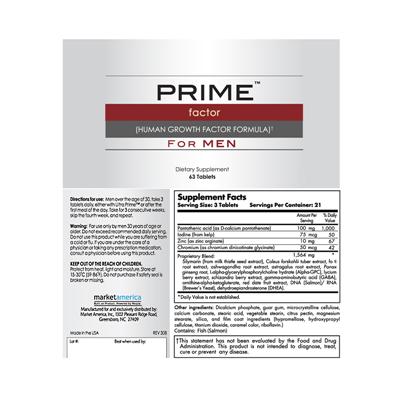
Supplement Facts
The label details for Prime Factor (Human Growth Factor Formula) For Men by Prime, sourced from the NIH Dietary Supplement Label Database.
Supplement Facts
| Ingredient | Amount | % DV |
|---|---|---|
| Pantothenic Acid | 100 mg | 1000% |
| Iodine | 75 mcg | 50% |
| Dehydroepiandrosterone | 0 NP | -- |
| Zinc | 10 mg | 67% |
| Schizandra berry extract | 0 NP | -- |
| Ashwagandha root extract | 0 NP | -- |
| Fo Ti root extract | 0 NP | -- |
| Proprietary Blend | 1564 mg | -- |
| Astragalus root extract | 0 NP | -- |
| Silymarin | 0 NP | -- |
| Chromium | 50 mcg | 42% |
| Lycium berry extract | 0 NP | -- |
| Gamma-Aminobutyric Acid | 0 NP | -- |
| Coleus forskohlii tuber extract | 0 NP | -- |
| L-Alpha-Glycerylphosphorylcholine Hydrate | 0 NP | -- |
| DNA | 0 NP | -- |
| RNA | 0 NP | -- |
| Panax ginseng | 0 NP | -- |
| Ornithine-Alpha-Ketogluterate | 0 NP | -- |
| Red Date fruit extract | 0 NP | -- |
Other ingredients: Dicalcium Phosphate, Guar Gum, Microcrystalline Cellulose, Calcium Carbonate, Stearic Acid, Vegetable Stearin, citrus pectin, Magnesium Stearate, Silica, Film Coat Ingredients
Tap any ingredient to jump to its full detail below.
These statements are the manufacturer’s wording, reproduced from the product label — the label is saying it, not HelloPharmacist. We don’t verify or endorse them.
FDA Statement of Identity
Dietary Supplement
Suggested/Recommended/Usage/Directions
Directions for use: Men over the age of 30, take 3 tablets daily, either with Ultra Prime(TM) of after the first meal of the day. Take for 3 consecutive weeks, skip the fourth week, and repeat.
Precautions
KEEP OUT OF THE REACH OF CHILDREN.
Do not purchase if safety seal is broken or missing.
If you are under the care of a physician or taking any prescription medication, consult a physician before using this product.
Warning: For use only by men 30 years of age or older. Do not exceed recommended daily serving. Do not use this product while you are suffering from a cold or flu.
FDA Disclaimer Statement
This statement has not been evaluated by the Food and Drug Administration. This product is not intended to diagnose, treat, cure or prevent any disease.
Storage
Protect from heat, light and moisture. Store at 15-30°C (59-86°F).
Formula
Contains: Fish (Salmon)
General Statements
Made in the USA
marketamerica Built on Product. Powered by People.
General
REV 308
Is this label outdated? Report a formula or label change and our pharmacy team will review it.
Prime Factor (Human Growth Factor Formula) For Men by Prime label
The label scan from the NIH Dietary Supplement Label Database. Tap to enlarge.
Label images are published by the NIH Dietary Supplement Label Database for the version of this product on file. Always read your actual product label.
View the full label (PDF)The Ingredients in Prime Factor (Human Growth Factor Formula) For Men by Prime
These are the 19 active ingredients this product is made of. Select any to open its full monograph.
Serving size3 Tablet(s) Dosage formTablet Or Pill Servings per container21 Amounts shown are per serving.
Most supplement products combine several ingredients, and a medication can interact with the product through any one of them. Each ingredient below shows whether it has known drug interactions.
Pantothenic Acid
No knowninteractions
Pantothenic acid is vitamin B5, an essential nutrient your body uses to turn food into energy. True deficiency is very rare because it is found in nea...
Pantothenic Acid monograph & interactionsIodine
Interacts with7 drugs
Iodine is an essential mineral your body needs to make thyroid hormones, and most people get enough from iodized salt, dairy, and seafood. Supplements...
Iodine monograph & interactionsZinc
Interacts with67 drugs
Zinc is an essential mineral that your body needs for immune function, wound healing, taste, and smell. Most people get enough from food, but suppleme...
Zinc monograph & interactionsProprietary Blend
- › Dehydroepiandrosterone
- › Schizandra berry extract
- › Ashwagandha root extract
- › Fo Ti root extract
- › Astragalus root extract
- › Silymarin
- › Lycium berry extract
- › Gamma-Aminobutyric Acid
- › Coleus forskohlii tuber extract
- › L-Alpha-Glycerylphosphorylcholine Hydrate
- › DNA
- › RNA
- › Panax ginseng
- › Ornithine-Alpha-Ketogluterate
- › Red Date fruit extract
Chromium
Interacts with178 drugs
Chromium is an essential trace mineral involved in how the body handles sugar and fat. Some studies suggest it may modestly help blood sugar control i...
Chromium monograph & interactionsOther (inactive) ingredients: Dicalcium Phosphate, Guar Gum, Microcrystalline Cellulose, Calcium Carbonate, Stearic Acid, Vegetable Stearin, Citrus pectin, Magnesium Stearate, Silica, Film Coat Ingredients. These complete the product’s ingredient list but are not active constituents.
Prime Factor (Human Growth Factor Formula) For Men by Prime Drug Interactions
Prime Factor (Human Growth Factor Formula) For Men contains 19 ingredients, and 13 of them have known drug interactions. Altogether they interact with 1,664 medications. Here’s the picture, then you can look up your own drug.
Want to check YOUR meds against Prime Factor (Human Growth Factor Formula) For Men?
Ask about interactions with your drugs in plain English — “Can I take it with lisinopril?” — and we find you the answer in seconds, ingredient by ingredient.
Go to the checkerIngredients driving the most interactions
Individual Drug Interactions
The ingredients in Prime Factor (Human Growth Factor Formula) For Men interact with 1,664 drugs. Click any drug to see the details.
13 of the 19 ingredients in Prime Factor (Human Growth Factor Formula) For Men interact with drugs. Each result below shows which ingredient is responsible. Ashwagandha root extract Fo Ti root extract Panax ginseng Lycium berry extract Coleus forskohlii tuber extract Schizandra berry extract Dehydroepiandrosterone Gamma-Aminobutyric Acid Astragalus root extract Chromium Zinc L-Alpha-Glycerylphosphorylcholine Hydrate Iodine
Acetaminophen, Chlorpheniramine, Codeine, PhenylephrineColrex
How Acetaminophen, Chlorpheniramine, Codeine, Phenylephrine interacts with Prime Factor (Human Growth Factor Formula) For Men — through 8 ingredients. Tap an ingredient for the detail:
Ashwagandha Root ExtractCns Depressants, Serotonergic Drugs +3 Moderate
Interaction Summary
Theoretically, taking ashwagandha might increase the sedative effects of CNS depressants.
Read the full Ashwagandha Root Extract + Acetaminophen, Chlorpheniramine, Codeine, Phenylephrine interactionFo Ti Root ExtractCytochrome P450 3a4 (cyp3a4) Substrates, Cytochrome P450 1a2 (cyp1a2) Substrates +2 Moderate
Interaction Summary
Theoretically, fo-ti might increase the levels and clinical effects of drugs metabolized by CYP3A4.
Read the full Fo Ti Root Extract + Acetaminophen, Chlorpheniramine, Codeine, Phenylephrine interactionPanax GinsengStimulant Drugs, Cytochrome P450 3a4 (cyp3a4) Substrates +1 Moderate
Interaction Summary
Theoretically, taking Panax ginseng with stimulant drugs might increase the risk of adverse stimulant effects.
Read the full Panax Ginseng + Acetaminophen, Chlorpheniramine, Codeine, Phenylephrine interactionLycium Berry ExtractCytochrome P450 2d6 (cyp2d6) Substrates, Cytochrome P450 3a4 (cyp3a4) Substrates Moderate
Interaction Summary
Theoretically, goji berry might inhibit CYP2D6 and reduce metabolism of CYP2D6 substrates.
Read the full Lycium Berry Extract + Acetaminophen, Chlorpheniramine, Codeine, Phenylephrine interactionSchizandra Berry ExtractCytochrome P450 3a4 (cyp3a4) Substrates Moderate
Interaction Summary
Schisandra can increase the levels and clinical effects of drugs metabolized by CYP3A4.
Read the full Schizandra Berry Extract + Acetaminophen, Chlorpheniramine, Codeine, Phenylephrine interactionDehydroepiandrosteroneCytochrome P450 3a4 (cyp3a4) Substrates Moderate
Interaction Summary
Theoretically, DHEA might increase the levels of drugs metabolized by CYP3A4.
Read the full Dehydroepiandrosterone + Acetaminophen, Chlorpheniramine, Codeine, Phenylephrine interactionColeus Forskohlii Tuber ExtractCytochrome P450 3a4 (cyp3a4) Substrates Moderate
Interaction Summary
Theoretically, taking coleus might decrease serum levels of drugs metabolized by CYP3A4.
Read the full Coleus Forskohlii Tuber Extract + Acetaminophen, Chlorpheniramine, Codeine, Phenylephrine interactionGamma-aminobutyric AcidCns Depressants Minor
Interaction Summary
Theoretically, GABA might have additive sedative effects when used in conjunction with CNS depressants.
Read the full Gamma-aminobutyric Acid + Acetaminophen, Chlorpheniramine, Codeine, Phenylephrine interactionAcetaminophen, Chlorpheniramine, DextromethorphanCoricidin II Extra Strength Cold and Flu
How Acetaminophen, Chlorpheniramine, Dextromethorphan interacts with Prime Factor (Human Growth Factor Formula) For Men — through 7 ingredients. Tap an ingredient for the detail:
Ashwagandha Root ExtractHepatotoxic Drugs, Cytochrome P450 1a2 (cyp1a2) Substrates +2 Moderate
Interaction Summary
Theoretically, taking ashwagandha with hepatotoxic drugs might increase the risk of liver damage.
Read the full Ashwagandha Root Extract + Acetaminophen, Chlorpheniramine, Dextromethorphan interactionLycium Berry ExtractCytochrome P450 3a4 (cyp3a4) Substrates, Cytochrome P450 2d6 (cyp2d6) Substrates Moderate
Interaction Summary
Theoretically, goji berry might inhibit CYP3A4 and reduce metabolism of CYP3A4 substrates.
Read the full Lycium Berry Extract + Acetaminophen, Chlorpheniramine, Dextromethorphan interactionFo Ti Root ExtractCytochrome P450 3a4 (cyp3a4) Substrates, Cytochrome P450 1a2 (cyp1a2) Substrates +2 Moderate
Interaction Summary
Theoretically, fo-ti might increase the levels and clinical effects of drugs metabolized by CYP3A4.
Read the full Fo Ti Root Extract + Acetaminophen, Chlorpheniramine, Dextromethorphan interactionColeus Forskohlii Tuber ExtractCytochrome P450 3a4 (cyp3a4) Substrates Moderate
Interaction Summary
Theoretically, taking coleus might decrease serum levels of drugs metabolized by CYP3A4.
Read the full Coleus Forskohlii Tuber Extract + Acetaminophen, Chlorpheniramine, Dextromethorphan interactionSchizandra Berry ExtractCytochrome P450 3a4 (cyp3a4) Substrates Moderate
Interaction Summary
Schisandra can increase the levels and clinical effects of drugs metabolized by CYP3A4.
Read the full Schizandra Berry Extract + Acetaminophen, Chlorpheniramine, Dextromethorphan interactionDehydroepiandrosteroneCytochrome P450 3a4 (cyp3a4) Substrates Moderate
Interaction Summary
Theoretically, DHEA might increase the levels of drugs metabolized by CYP3A4.
Read the full Dehydroepiandrosterone + Acetaminophen, Chlorpheniramine, Dextromethorphan interactionPanax GinsengCytochrome P450 3a4 (cyp3a4) Substrates, Cytochrome P450 2d6 (cyp2d6) Substrates Moderate
Interaction Summary
Theoretically, Panax ginseng might increase or decrease levels of drugs metabolized by CYP3A4.
Read the full Panax Ginseng + Acetaminophen, Chlorpheniramine, Dextromethorphan interactionAcetaminophen, Chlorpheniramine, Dextromethorphan HydrobromideCoricidin HBP Maximum Strength Flu
How Acetaminophen, Chlorpheniramine, Dextromethorphan Hydrobromide interacts with Prime Factor (Human Growth Factor Formula) For Men — through 7 ingredients. Tap an ingredient for the detail:
Panax GinsengCytochrome P450 2d6 (cyp2d6) Substrates, Cytochrome P450 3a4 (cyp3a4) Substrates Moderate
Interaction Summary
Theoretically, Panax ginseng might increase levels of drugs metabolized by CYP2D6.
Read the full Panax Ginseng + Acetaminophen, Chlorpheniramine, Dextromethorphan Hydrobromide interactionAshwagandha Root ExtractSerotonergic Drugs, Cytochrome P450 3a4 (cyp3a4) Substrates +2 Moderate
Interaction Summary
Some animal studies have reported that ashwagandha can enhance serotonergic transmission by altering certain serotonin (5-HT) receptors.
Read the full Ashwagandha Root Extract + Acetaminophen, Chlorpheniramine, Dextromethorphan Hydrobromide interactionFo Ti Root ExtractCytochrome P450 3a4 (cyp3a4) Substrates, Cytochrome P450 2d6 (cyp2d6) Substrates +2 Moderate
Interaction Summary
Theoretically, fo-ti might increase the levels and clinical effects of drugs metabolized by CYP3A4.
Read the full Fo Ti Root Extract + Acetaminophen, Chlorpheniramine, Dextromethorphan Hydrobromide interactionLycium Berry ExtractCytochrome P450 2d6 (cyp2d6) Substrates, Cytochrome P450 3a4 (cyp3a4) Substrates Moderate
Interaction Summary
Theoretically, goji berry might inhibit CYP2D6 and reduce metabolism of CYP2D6 substrates.
Read the full Lycium Berry Extract + Acetaminophen, Chlorpheniramine, Dextromethorphan Hydrobromide interactionDehydroepiandrosteroneCytochrome P450 3a4 (cyp3a4) Substrates Moderate
Interaction Summary
Theoretically, DHEA might increase the levels of drugs metabolized by CYP3A4.
Read the full Dehydroepiandrosterone + Acetaminophen, Chlorpheniramine, Dextromethorphan Hydrobromide interactionSchizandra Berry ExtractCytochrome P450 3a4 (cyp3a4) Substrates Moderate
Interaction Summary
Schisandra can increase the levels and clinical effects of drugs metabolized by CYP3A4.
Read the full Schizandra Berry Extract + Acetaminophen, Chlorpheniramine, Dextromethorphan Hydrobromide interactionColeus Forskohlii Tuber ExtractCytochrome P450 3a4 (cyp3a4) Substrates Moderate
Interaction Summary
Theoretically, taking coleus might decrease serum levels of drugs metabolized by CYP3A4.
Read the full Coleus Forskohlii Tuber Extract + Acetaminophen, Chlorpheniramine, Dextromethorphan Hydrobromide interactionAcetaminophen, Chlorpheniramine, Dextromethorphan, PhenylpropanolamineMulti Symptom Cold Relief
How Acetaminophen, Chlorpheniramine, Dextromethorphan, Phenylpropanolamine interacts with Prime Factor (Human Growth Factor Formula) For Men — through 7 ingredients. Tap an ingredient for the detail:
Coleus Forskohlii Tuber ExtractCytochrome P450 3a4 (cyp3a4) Substrates Moderate
Interaction Summary
Theoretically, taking coleus might decrease serum levels of drugs metabolized by CYP3A4.
Read the full Coleus Forskohlii Tuber Extract + Acetaminophen, Chlorpheniramine, Dextromethorphan, Phenylpropanolamine interactionAshwagandha Root ExtractCytochrome P450 3a4 (cyp3a4) Substrates, Hepatotoxic Drugs +2 Moderate
Interaction Summary
Theoretically, ashwagandha might decrease the levels and clinical effects of CYP3A4 substrates.
Read the full Ashwagandha Root Extract + Acetaminophen, Chlorpheniramine, Dextromethorphan, Phenylpropanolamine interactionPanax GinsengCytochrome P450 2d6 (cyp2d6) Substrates, Cytochrome P450 3a4 (cyp3a4) Substrates +1 Moderate
Interaction Summary
Theoretically, Panax ginseng might increase levels of drugs metabolized by CYP2D6.
Read the full Panax Ginseng + Acetaminophen, Chlorpheniramine, Dextromethorphan, Phenylpropanolamine interactionFo Ti Root ExtractCytochrome P450 3a4 (cyp3a4) Substrates, Hepatotoxic Drugs +2 Moderate
Interaction Summary
Theoretically, fo-ti might increase the levels and clinical effects of drugs metabolized by CYP3A4.
Read the full Fo Ti Root Extract + Acetaminophen, Chlorpheniramine, Dextromethorphan, Phenylpropanolamine interactionLycium Berry ExtractCytochrome P450 3a4 (cyp3a4) Substrates, Cytochrome P450 2d6 (cyp2d6) Substrates Moderate
Interaction Summary
Theoretically, goji berry might inhibit CYP3A4 and reduce metabolism of CYP3A4 substrates.
Read the full Lycium Berry Extract + Acetaminophen, Chlorpheniramine, Dextromethorphan, Phenylpropanolamine interactionDehydroepiandrosteroneCytochrome P450 3a4 (cyp3a4) Substrates Moderate
Interaction Summary
Theoretically, DHEA might increase the levels of drugs metabolized by CYP3A4.
Read the full Dehydroepiandrosterone + Acetaminophen, Chlorpheniramine, Dextromethorphan, Phenylpropanolamine interactionSchizandra Berry ExtractCytochrome P450 3a4 (cyp3a4) Substrates Moderate
Interaction Summary
Schisandra can increase the levels and clinical effects of drugs metabolized by CYP3A4.
Read the full Schizandra Berry Extract + Acetaminophen, Chlorpheniramine, Dextromethorphan, Phenylpropanolamine interactionAcetaminophen, Chlorpheniramine, Dextromethorphan, PseudoephedrineChildren's Tylenol Cold Plus Cough, Tylenol Cold Ex Strength
How Acetaminophen, Chlorpheniramine, Dextromethorphan, Pseudoephedrine interacts with Prime Factor (Human Growth Factor Formula) For Men — through 7 ingredients. Tap an ingredient for the detail:
Schizandra Berry ExtractCytochrome P450 3a4 (cyp3a4) Substrates Moderate
Interaction Summary
Schisandra can increase the levels and clinical effects of drugs metabolized by CYP3A4.
Read the full Schizandra Berry Extract + Acetaminophen, Chlorpheniramine, Dextromethorphan, Pseudoephedrine interactionDehydroepiandrosteroneCytochrome P450 3a4 (cyp3a4) Substrates Moderate
Interaction Summary
Theoretically, DHEA might increase the levels of drugs metabolized by CYP3A4.
Read the full Dehydroepiandrosterone + Acetaminophen, Chlorpheniramine, Dextromethorphan, Pseudoephedrine interactionPanax GinsengCytochrome P450 3a4 (cyp3a4) Substrates, Cytochrome P450 2d6 (cyp2d6) Substrates +1 Moderate
Interaction Summary
Theoretically, Panax ginseng might increase or decrease levels of drugs metabolized by CYP3A4.
Read the full Panax Ginseng + Acetaminophen, Chlorpheniramine, Dextromethorphan, Pseudoephedrine interactionAshwagandha Root ExtractSerotonergic Drugs, Cytochrome P450 1a2 (cyp1a2) Substrates +2 Moderate
Interaction Summary
Some animal studies have reported that ashwagandha can enhance serotonergic transmission by altering certain serotonin (5-HT) receptors.
Read the full Ashwagandha Root Extract + Acetaminophen, Chlorpheniramine, Dextromethorphan, Pseudoephedrine interactionColeus Forskohlii Tuber ExtractCytochrome P450 3a4 (cyp3a4) Substrates Moderate
Interaction Summary
Theoretically, taking coleus might decrease serum levels of drugs metabolized by CYP3A4.
Read the full Coleus Forskohlii Tuber Extract + Acetaminophen, Chlorpheniramine, Dextromethorphan, Pseudoephedrine interactionLycium Berry ExtractCytochrome P450 2d6 (cyp2d6) Substrates, Cytochrome P450 3a4 (cyp3a4) Substrates Moderate
Interaction Summary
Theoretically, goji berry might inhibit CYP2D6 and reduce metabolism of CYP2D6 substrates.
Read the full Lycium Berry Extract + Acetaminophen, Chlorpheniramine, Dextromethorphan, Pseudoephedrine interactionFo Ti Root ExtractCytochrome P450 3a4 (cyp3a4) Substrates, Cytochrome P450 1a2 (cyp1a2) Substrates +2 Moderate
Interaction Summary
Theoretically, fo-ti might increase the levels and clinical effects of drugs metabolized by CYP3A4.
Read the full Fo Ti Root Extract + Acetaminophen, Chlorpheniramine, Dextromethorphan, Pseudoephedrine interactionAcetaminophen, Chlorpheniramine, Guaifenesin, Phenylephrine, SalicylamideRhinogesic GG
How Acetaminophen, Chlorpheniramine, Guaifenesin, Phenylephrine, Salicylamide interacts with Prime Factor (Human Growth Factor Formula) For Men — through 7 ingredients. Tap an ingredient for the detail:
Fo Ti Root ExtractCytochrome P450 1a2 (cyp1a2) Substrates, Hepatotoxic Drugs +1 Moderate
Interaction Summary
Theoretically, fo-ti might increase or decrease the levels and clinical effects of drugs metabolized by CYP1A2.
Read the full Fo Ti Root Extract + Acetaminophen, Chlorpheniramine, Guaifenesin, Phenylephrine, Salicylamide interactionColeus Forskohlii Tuber ExtractCytochrome P450 3a4 (cyp3a4) Substrates Moderate
Interaction Summary
Theoretically, taking coleus might decrease serum levels of drugs metabolized by CYP3A4.
Read the full Coleus Forskohlii Tuber Extract + Acetaminophen, Chlorpheniramine, Guaifenesin, Phenylephrine, Salicylamide interactionSchizandra Berry ExtractCytochrome P450 3a4 (cyp3a4) Substrates Moderate
Interaction Summary
Schisandra can increase the levels and clinical effects of drugs metabolized by CYP3A4.
Read the full Schizandra Berry Extract + Acetaminophen, Chlorpheniramine, Guaifenesin, Phenylephrine, Salicylamide interactionDehydroepiandrosteroneCytochrome P450 3a4 (cyp3a4) Substrates Moderate
Interaction Summary
Theoretically, DHEA might increase the levels of drugs metabolized by CYP3A4.
Read the full Dehydroepiandrosterone + Acetaminophen, Chlorpheniramine, Guaifenesin, Phenylephrine, Salicylamide interactionAshwagandha Root ExtractSerotonergic Drugs, Cytochrome P450 3a4 (cyp3a4) Substrates +2 Moderate
Interaction Summary
Some animal studies have reported that ashwagandha can enhance serotonergic transmission by altering certain serotonin (5-HT) receptors.
Read the full Ashwagandha Root Extract + Acetaminophen, Chlorpheniramine, Guaifenesin, Phenylephrine, Salicylamide interactionPanax GinsengCytochrome P450 3a4 (cyp3a4) Substrates, Stimulant Drugs Moderate
Interaction Summary
Theoretically, Panax ginseng might increase or decrease levels of drugs metabolized by CYP3A4.
Read the full Panax Ginseng + Acetaminophen, Chlorpheniramine, Guaifenesin, Phenylephrine, Salicylamide interactionLycium Berry ExtractCytochrome P450 3a4 (cyp3a4) Substrates Moderate
Interaction Summary
Theoretically, goji berry might inhibit CYP3A4 and reduce metabolism of CYP3A4 substrates.
Read the full Lycium Berry Extract + Acetaminophen, Chlorpheniramine, Guaifenesin, Phenylephrine, Salicylamide interactionAcetaminophen, Chlorpheniramine, PhenylephrineAlka-Seltzer PLUS, Histex SR, Protid
How Acetaminophen, Chlorpheniramine, Phenylephrine interacts with Prime Factor (Human Growth Factor Formula) For Men — through 7 ingredients. Tap an ingredient for the detail:
Panax GinsengStimulant Drugs, Cytochrome P450 3a4 (cyp3a4) Substrates Moderate
Interaction Summary
Theoretically, taking Panax ginseng with stimulant drugs might increase the risk of adverse stimulant effects.
Read the full Panax Ginseng + Acetaminophen, Chlorpheniramine, Phenylephrine interactionLycium Berry ExtractCytochrome P450 3a4 (cyp3a4) Substrates Moderate
Interaction Summary
Theoretically, goji berry might inhibit CYP3A4 and reduce metabolism of CYP3A4 substrates.
Read the full Lycium Berry Extract + Acetaminophen, Chlorpheniramine, Phenylephrine interactionSchizandra Berry ExtractCytochrome P450 3a4 (cyp3a4) Substrates Moderate
Interaction Summary
Schisandra can increase the levels and clinical effects of drugs metabolized by CYP3A4.
Read the full Schizandra Berry Extract + Acetaminophen, Chlorpheniramine, Phenylephrine interactionDehydroepiandrosteroneCytochrome P450 3a4 (cyp3a4) Substrates Moderate
Interaction Summary
Theoretically, DHEA might increase the levels of drugs metabolized by CYP3A4.
Read the full Dehydroepiandrosterone + Acetaminophen, Chlorpheniramine, Phenylephrine interactionFo Ti Root ExtractHepatotoxic Drugs, Cytochrome P450 1a2 (cyp1a2) Substrates +1 Moderate
Interaction Summary
Theoretically, fo-ti might increase the risk of liver damage when taken with hepatotoxic drugs.
Read the full Fo Ti Root Extract + Acetaminophen, Chlorpheniramine, Phenylephrine interactionColeus Forskohlii Tuber ExtractCytochrome P450 3a4 (cyp3a4) Substrates Moderate
Interaction Summary
Theoretically, taking coleus might decrease serum levels of drugs metabolized by CYP3A4.
Read the full Coleus Forskohlii Tuber Extract + Acetaminophen, Chlorpheniramine, Phenylephrine interactionAshwagandha Root ExtractCytochrome P450 1a2 (cyp1a2) Substrates, Hepatotoxic Drugs +2 Moderate
Interaction Summary
Theoretically, ashwagandha might decrease the levels and clinical effects of CYP1A2 substrates.
Read the full Ashwagandha Root Extract + Acetaminophen, Chlorpheniramine, Phenylephrine interactionAcetaminophen, Chlorpheniramine, Phenylephrine, SalicylamideRhinogesic, Rhinogesic JR
How Acetaminophen, Chlorpheniramine, Phenylephrine, Salicylamide interacts with Prime Factor (Human Growth Factor Formula) For Men — through 7 ingredients. Tap an ingredient for the detail:
Fo Ti Root ExtractCytochrome P450 3a4 (cyp3a4) Substrates, Cytochrome P450 1a2 (cyp1a2) Substrates +1 Moderate
Interaction Summary
Theoretically, fo-ti might increase the levels and clinical effects of drugs metabolized by CYP3A4.
Read the full Fo Ti Root Extract + Acetaminophen, Chlorpheniramine, Phenylephrine, Salicylamide interactionPanax GinsengStimulant Drugs, Cytochrome P450 3a4 (cyp3a4) Substrates Moderate
Interaction Summary
Theoretically, taking Panax ginseng with stimulant drugs might increase the risk of adverse stimulant effects.
Read the full Panax Ginseng + Acetaminophen, Chlorpheniramine, Phenylephrine, Salicylamide interactionLycium Berry ExtractCytochrome P450 3a4 (cyp3a4) Substrates Moderate
Interaction Summary
Theoretically, goji berry might inhibit CYP3A4 and reduce metabolism of CYP3A4 substrates.
Read the full Lycium Berry Extract + Acetaminophen, Chlorpheniramine, Phenylephrine, Salicylamide interactionSchizandra Berry ExtractCytochrome P450 3a4 (cyp3a4) Substrates Moderate
Interaction Summary
Schisandra can increase the levels and clinical effects of drugs metabolized by CYP3A4.
Read the full Schizandra Berry Extract + Acetaminophen, Chlorpheniramine, Phenylephrine, Salicylamide interactionDehydroepiandrosteroneCytochrome P450 3a4 (cyp3a4) Substrates Moderate
Interaction Summary
Theoretically, DHEA might increase the levels of drugs metabolized by CYP3A4.
Read the full Dehydroepiandrosterone + Acetaminophen, Chlorpheniramine, Phenylephrine, Salicylamide interactionAshwagandha Root ExtractSerotonergic Drugs, Cytochrome P450 3a4 (cyp3a4) Substrates +2 Moderate
Interaction Summary
Some animal studies have reported that ashwagandha can enhance serotonergic transmission by altering certain serotonin (5-HT) receptors.
Read the full Ashwagandha Root Extract + Acetaminophen, Chlorpheniramine, Phenylephrine, Salicylamide interactionColeus Forskohlii Tuber ExtractCytochrome P450 3a4 (cyp3a4) Substrates Moderate
Interaction Summary
Theoretically, taking coleus might decrease serum levels of drugs metabolized by CYP3A4.
Read the full Coleus Forskohlii Tuber Extract + Acetaminophen, Chlorpheniramine, Phenylephrine, Salicylamide interactionAcetaminophen, Chlorpheniramine, PhenylpropanolamineAlumadrine, Conex, Sinadrin Max Strength, Sinulin
How Acetaminophen, Chlorpheniramine, Phenylpropanolamine interacts with Prime Factor (Human Growth Factor Formula) For Men — through 7 ingredients. Tap an ingredient for the detail:
Ashwagandha Root ExtractCytochrome P450 1a2 (cyp1a2) Substrates, Cytochrome P450 3a4 (cyp3a4) Substrates +2 Moderate
Interaction Summary
Theoretically, ashwagandha might decrease the levels and clinical effects of CYP1A2 substrates.
Read the full Ashwagandha Root Extract + Acetaminophen, Chlorpheniramine, Phenylpropanolamine interactionLycium Berry ExtractCytochrome P450 3a4 (cyp3a4) Substrates Moderate
Interaction Summary
Theoretically, goji berry might inhibit CYP3A4 and reduce metabolism of CYP3A4 substrates.
Read the full Lycium Berry Extract + Acetaminophen, Chlorpheniramine, Phenylpropanolamine interactionPanax GinsengStimulant Drugs, Cytochrome P450 3a4 (cyp3a4) Substrates Moderate
Interaction Summary
Theoretically, taking Panax ginseng with stimulant drugs might increase the risk of adverse stimulant effects.
Read the full Panax Ginseng + Acetaminophen, Chlorpheniramine, Phenylpropanolamine interactionFo Ti Root ExtractCytochrome P450 3a4 (cyp3a4) Substrates, Hepatotoxic Drugs +1 Moderate
Interaction Summary
Theoretically, fo-ti might increase the levels and clinical effects of drugs metabolized by CYP3A4.
Read the full Fo Ti Root Extract + Acetaminophen, Chlorpheniramine, Phenylpropanolamine interactionColeus Forskohlii Tuber ExtractCytochrome P450 3a4 (cyp3a4) Substrates Moderate
Interaction Summary
Theoretically, taking coleus might decrease serum levels of drugs metabolized by CYP3A4.
Read the full Coleus Forskohlii Tuber Extract + Acetaminophen, Chlorpheniramine, Phenylpropanolamine interactionSchizandra Berry ExtractCytochrome P450 3a4 (cyp3a4) Substrates Moderate
Interaction Summary
Schisandra can increase the levels and clinical effects of drugs metabolized by CYP3A4.
Read the full Schizandra Berry Extract + Acetaminophen, Chlorpheniramine, Phenylpropanolamine interactionDehydroepiandrosteroneCytochrome P450 3a4 (cyp3a4) Substrates Moderate
Interaction Summary
Theoretically, DHEA might increase the levels of drugs metabolized by CYP3A4.
Read the full Dehydroepiandrosterone + Acetaminophen, Chlorpheniramine, Phenylpropanolamine interactionAcetaminophen, Chlorpheniramine, Phenylpropanolamine, OpiumHista-Derfule
How Acetaminophen, Chlorpheniramine, Phenylpropanolamine, Opium interacts with Prime Factor (Human Growth Factor Formula) For Men — through 8 ingredients. Tap an ingredient for the detail:
Ashwagandha Root ExtractSerotonergic Drugs, Cns Depressants +3 Moderate
Interaction Summary
Some animal studies have reported that ashwagandha can enhance serotonergic transmission by altering certain serotonin (5-HT) receptors.
Read the full Ashwagandha Root Extract + Acetaminophen, Chlorpheniramine, Phenylpropanolamine, Opium interactionPanax GinsengCytochrome P450 3a4 (cyp3a4) Substrates, Stimulant Drugs Moderate
Interaction Summary
Theoretically, Panax ginseng might increase or decrease levels of drugs metabolized by CYP3A4.
Read the full Panax Ginseng + Acetaminophen, Chlorpheniramine, Phenylpropanolamine, Opium interactionFo Ti Root ExtractCytochrome P450 3a4 (cyp3a4) Substrates, Cytochrome P450 1a2 (cyp1a2) Substrates +1 Moderate
Interaction Summary
Theoretically, fo-ti might increase the levels and clinical effects of drugs metabolized by CYP3A4.
Read the full Fo Ti Root Extract + Acetaminophen, Chlorpheniramine, Phenylpropanolamine, Opium interactionLycium Berry ExtractCytochrome P450 3a4 (cyp3a4) Substrates Moderate
Interaction Summary
Theoretically, goji berry might inhibit CYP3A4 and reduce metabolism of CYP3A4 substrates.
Read the full Lycium Berry Extract + Acetaminophen, Chlorpheniramine, Phenylpropanolamine, Opium interactionDehydroepiandrosteroneCytochrome P450 3a4 (cyp3a4) Substrates Moderate
Interaction Summary
Theoretically, DHEA might increase the levels of drugs metabolized by CYP3A4.
Read the full Dehydroepiandrosterone + Acetaminophen, Chlorpheniramine, Phenylpropanolamine, Opium interactionSchizandra Berry ExtractCytochrome P450 3a4 (cyp3a4) Substrates Moderate
Interaction Summary
Schisandra can increase the levels and clinical effects of drugs metabolized by CYP3A4.
Read the full Schizandra Berry Extract + Acetaminophen, Chlorpheniramine, Phenylpropanolamine, Opium interactionColeus Forskohlii Tuber ExtractCytochrome P450 3a4 (cyp3a4) Substrates Moderate
Interaction Summary
Theoretically, taking coleus might decrease serum levels of drugs metabolized by CYP3A4.
Read the full Coleus Forskohlii Tuber Extract + Acetaminophen, Chlorpheniramine, Phenylpropanolamine, Opium interactionGamma-aminobutyric AcidCns Depressants Minor
Interaction Summary
Theoretically, GABA might have additive sedative effects when used in conjunction with CNS depressants.
Read the full Gamma-aminobutyric Acid + Acetaminophen, Chlorpheniramine, Phenylpropanolamine, Opium interactionAcetaminophen, Chlorpheniramine, Phenylpropanolamine, PhenyltoloxamineNorel Plus
How Acetaminophen, Chlorpheniramine, Phenylpropanolamine, Phenyltoloxamine interacts with Prime Factor (Human Growth Factor Formula) For Men — through 7 ingredients. Tap an ingredient for the detail:
Coleus Forskohlii Tuber ExtractCytochrome P450 3a4 (cyp3a4) Substrates Moderate
Interaction Summary
Theoretically, taking coleus might decrease serum levels of drugs metabolized by CYP3A4.
Read the full Coleus Forskohlii Tuber Extract + Acetaminophen, Chlorpheniramine, Phenylpropanolamine, Phenyltoloxamine interactionAshwagandha Root ExtractHepatotoxic Drugs, Cytochrome P450 1a2 (cyp1a2) Substrates +2 Moderate
Interaction Summary
Theoretically, taking ashwagandha with hepatotoxic drugs might increase the risk of liver damage.
Read the full Ashwagandha Root Extract + Acetaminophen, Chlorpheniramine, Phenylpropanolamine, Phenyltoloxamine interactionPanax GinsengCytochrome P450 3a4 (cyp3a4) Substrates, Stimulant Drugs Moderate
Interaction Summary
Theoretically, Panax ginseng might increase or decrease levels of drugs metabolized by CYP3A4.
Read the full Panax Ginseng + Acetaminophen, Chlorpheniramine, Phenylpropanolamine, Phenyltoloxamine interactionFo Ti Root ExtractCytochrome P450 3a4 (cyp3a4) Substrates, Cytochrome P450 1a2 (cyp1a2) Substrates +1 Moderate
Interaction Summary
Theoretically, fo-ti might increase the levels and clinical effects of drugs metabolized by CYP3A4.
Read the full Fo Ti Root Extract + Acetaminophen, Chlorpheniramine, Phenylpropanolamine, Phenyltoloxamine interactionLycium Berry ExtractCytochrome P450 3a4 (cyp3a4) Substrates Moderate
Interaction Summary
Theoretically, goji berry might inhibit CYP3A4 and reduce metabolism of CYP3A4 substrates.
Read the full Lycium Berry Extract + Acetaminophen, Chlorpheniramine, Phenylpropanolamine, Phenyltoloxamine interactionDehydroepiandrosteroneCytochrome P450 3a4 (cyp3a4) Substrates Moderate
Interaction Summary
Theoretically, DHEA might increase the levels of drugs metabolized by CYP3A4.
Read the full Dehydroepiandrosterone + Acetaminophen, Chlorpheniramine, Phenylpropanolamine, Phenyltoloxamine interactionSchizandra Berry ExtractCytochrome P450 3a4 (cyp3a4) Substrates Moderate
Interaction Summary
Schisandra can increase the levels and clinical effects of drugs metabolized by CYP3A4.
Read the full Schizandra Berry Extract + Acetaminophen, Chlorpheniramine, Phenylpropanolamine, Phenyltoloxamine interactionAcetaminophen, Chlorpheniramine, PseudoephedrineAlka-Seltzer PLUS Liquid Gels, Children's Tylenol Cold, Codimal, Comtrex, Extra Strength Tylenol Allergy Sinus, Lorsin +3 more
How Acetaminophen, Chlorpheniramine, Pseudoephedrine interacts with Prime Factor (Human Growth Factor Formula) For Men — through 7 ingredients. Tap an ingredient for the detail:
Schizandra Berry ExtractCytochrome P450 3a4 (cyp3a4) Substrates Moderate
Interaction Summary
Schisandra can increase the levels and clinical effects of drugs metabolized by CYP3A4.
Read the full Schizandra Berry Extract + Acetaminophen, Chlorpheniramine, Pseudoephedrine interactionDehydroepiandrosteroneCytochrome P450 3a4 (cyp3a4) Substrates Moderate
Interaction Summary
Theoretically, DHEA might increase the levels of drugs metabolized by CYP3A4.
Read the full Dehydroepiandrosterone + Acetaminophen, Chlorpheniramine, Pseudoephedrine interactionAshwagandha Root ExtractSerotonergic Drugs, Cytochrome P450 3a4 (cyp3a4) Substrates +2 Moderate
Interaction Summary
Some animal studies have reported that ashwagandha can enhance serotonergic transmission by altering certain serotonin (5-HT) receptors.
Read the full Ashwagandha Root Extract + Acetaminophen, Chlorpheniramine, Pseudoephedrine interactionPanax GinsengCytochrome P450 3a4 (cyp3a4) Substrates, Stimulant Drugs Moderate
Interaction Summary
Theoretically, Panax ginseng might increase or decrease levels of drugs metabolized by CYP3A4.
Read the full Panax Ginseng + Acetaminophen, Chlorpheniramine, Pseudoephedrine interactionColeus Forskohlii Tuber ExtractCytochrome P450 3a4 (cyp3a4) Substrates Moderate
Interaction Summary
Theoretically, taking coleus might decrease serum levels of drugs metabolized by CYP3A4.
Read the full Coleus Forskohlii Tuber Extract + Acetaminophen, Chlorpheniramine, Pseudoephedrine interactionLycium Berry ExtractCytochrome P450 3a4 (cyp3a4) Substrates Moderate
Interaction Summary
Theoretically, goji berry might inhibit CYP3A4 and reduce metabolism of CYP3A4 substrates.
Read the full Lycium Berry Extract + Acetaminophen, Chlorpheniramine, Pseudoephedrine interactionFo Ti Root ExtractCytochrome P450 3a4 (cyp3a4) Substrates, Hepatotoxic Drugs +1 Moderate
Interaction Summary
Theoretically, fo-ti might increase the levels and clinical effects of drugs metabolized by CYP3A4.
Read the full Fo Ti Root Extract + Acetaminophen, Chlorpheniramine, Pseudoephedrine interactionAcetaminophen, ChlorzoxazoneAcetazone Forte, Extra Strength Tylenol Aches & Strains, Parafon Forte
How Acetaminophen, Chlorzoxazone interacts with Prime Factor (Human Growth Factor Formula) For Men — through 2 ingredients. Tap an ingredient for the detail:
Fo Ti Root ExtractCytochrome P450 1a2 (cyp1a2) Substrates, Hepatotoxic Drugs Moderate
Interaction Summary
Theoretically, fo-ti might increase or decrease the levels and clinical effects of drugs metabolized by CYP1A2.
Read the full Fo Ti Root Extract + Acetaminophen, Chlorzoxazone interactionAshwagandha Root ExtractHepatotoxic Drugs, Cytochrome P450 1a2 (cyp1a2) Substrates Moderate
Interaction Summary
Theoretically, taking ashwagandha with hepatotoxic drugs might increase the risk of liver damage.
Read the full Ashwagandha Root Extract + Acetaminophen, Chlorzoxazone interactionAcetaminophen, Chlorzoxazone, CodeineAcetazone Forte C8, Parafon Forte C8
How Acetaminophen, Chlorzoxazone, Codeine interacts with Prime Factor (Human Growth Factor Formula) For Men — through 5 ingredients. Tap an ingredient for the detail:
Ashwagandha Root ExtractCytochrome P450 1a2 (cyp1a2) Substrates, Hepatotoxic Drugs +1 Moderate
Interaction Summary
Theoretically, ashwagandha might decrease the levels and clinical effects of CYP1A2 substrates.
Read the full Ashwagandha Root Extract + Acetaminophen, Chlorzoxazone, Codeine interactionPanax GinsengCytochrome P450 2d6 (cyp2d6) Substrates Moderate
Interaction Summary
Theoretically, Panax ginseng might increase levels of drugs metabolized by CYP2D6.
Read the full Panax Ginseng + Acetaminophen, Chlorzoxazone, Codeine interactionFo Ti Root ExtractHepatotoxic Drugs, Cytochrome P450 2d6 (cyp2d6) Substrates +1 Moderate
Interaction Summary
Theoretically, fo-ti might increase the risk of liver damage when taken with hepatotoxic drugs.
Read the full Fo Ti Root Extract + Acetaminophen, Chlorzoxazone, Codeine interactionLycium Berry ExtractCytochrome P450 2d6 (cyp2d6) Substrates Moderate
Interaction Summary
Theoretically, goji berry might inhibit CYP2D6 and reduce metabolism of CYP2D6 substrates.
Read the full Lycium Berry Extract + Acetaminophen, Chlorzoxazone, Codeine interactionGamma-aminobutyric AcidCns Depressants Minor
Interaction Summary
Theoretically, GABA might have additive sedative effects when used in conjunction with CNS depressants.
Read the full Gamma-aminobutyric Acid + Acetaminophen, Chlorzoxazone, Codeine interactionAcetaminophen, CodeineTylenol No.3, Tylenol w/ Codeine
How Acetaminophen, Codeine interacts with Prime Factor (Human Growth Factor Formula) For Men — through 5 ingredients. Tap an ingredient for the detail:
Lycium Berry ExtractCytochrome P450 2d6 (cyp2d6) Substrates Moderate
Interaction Summary
Theoretically, goji berry might inhibit CYP2D6 and reduce metabolism of CYP2D6 substrates.
Read the full Lycium Berry Extract + Acetaminophen, Codeine interactionAshwagandha Root ExtractHepatotoxic Drugs, Cytochrome P450 1a2 (cyp1a2) Substrates +1 Moderate
Interaction Summary
Theoretically, taking ashwagandha with hepatotoxic drugs might increase the risk of liver damage.
Read the full Ashwagandha Root Extract + Acetaminophen, Codeine interactionPanax GinsengCytochrome P450 2d6 (cyp2d6) Substrates Moderate
Interaction Summary
Theoretically, Panax ginseng might increase levels of drugs metabolized by CYP2D6.
Read the full Panax Ginseng + Acetaminophen, Codeine interactionFo Ti Root ExtractCytochrome P450 1a2 (cyp1a2) Substrates, Hepatotoxic Drugs +1 Moderate
Interaction Summary
Theoretically, fo-ti might increase or decrease the levels and clinical effects of drugs metabolized by CYP1A2.
Read the full Fo Ti Root Extract + Acetaminophen, Codeine interactionGamma-aminobutyric AcidCns Depressants Minor
Interaction Summary
Theoretically, GABA might have additive sedative effects when used in conjunction with CNS depressants.
Read the full Gamma-aminobutyric Acid + Acetaminophen, Codeine interactionAcetaminophen, Codeine, DoxylamineMersyndol
How Acetaminophen, Codeine, Doxylamine interacts with Prime Factor (Human Growth Factor Formula) For Men — through 5 ingredients. Tap an ingredient for the detail:
Fo Ti Root ExtractCytochrome P450 2d6 (cyp2d6) Substrates, Cytochrome P450 1a2 (cyp1a2) Substrates +1 Moderate
Interaction Summary
Theoretically, fo-ti may increase the levels and clinical effects of drugs metabolized by CYP2D6.
Read the full Fo Ti Root Extract + Acetaminophen, Codeine, Doxylamine interactionLycium Berry ExtractCytochrome P450 2d6 (cyp2d6) Substrates Moderate
Interaction Summary
Theoretically, goji berry might inhibit CYP2D6 and reduce metabolism of CYP2D6 substrates.
Read the full Lycium Berry Extract + Acetaminophen, Codeine, Doxylamine interactionPanax GinsengCytochrome P450 2d6 (cyp2d6) Substrates Moderate
Interaction Summary
Theoretically, Panax ginseng might increase levels of drugs metabolized by CYP2D6.
Read the full Panax Ginseng + Acetaminophen, Codeine, Doxylamine interactionAshwagandha Root ExtractCytochrome P450 1a2 (cyp1a2) Substrates, Hepatotoxic Drugs +1 Moderate
Interaction Summary
Theoretically, ashwagandha might decrease the levels and clinical effects of CYP1A2 substrates.
Read the full Ashwagandha Root Extract + Acetaminophen, Codeine, Doxylamine interactionGamma-aminobutyric AcidCns Depressants Minor
Interaction Summary
Theoretically, GABA might have additive sedative effects when used in conjunction with CNS depressants.
Read the full Gamma-aminobutyric Acid + Acetaminophen, Codeine, Doxylamine interactionAcetaminophen, Codeine, MethocarbamolAcetaminophen, Codeine, Methocarbamol, Robaxacet 8
How Acetaminophen, Codeine, Methocarbamol interacts with Prime Factor (Human Growth Factor Formula) For Men — through 5 ingredients. Tap an ingredient for the detail:
Ashwagandha Root ExtractCns Depressants, Hepatotoxic Drugs +1 Moderate
Interaction Summary
Theoretically, taking ashwagandha might increase the sedative effects of CNS depressants.
Read the full Ashwagandha Root Extract + Acetaminophen, Codeine, Methocarbamol interactionFo Ti Root ExtractHepatotoxic Drugs, Cytochrome P450 2d6 (cyp2d6) Substrates +1 Moderate
Interaction Summary
Theoretically, fo-ti might increase the risk of liver damage when taken with hepatotoxic drugs.
Read the full Fo Ti Root Extract + Acetaminophen, Codeine, Methocarbamol interactionLycium Berry ExtractCytochrome P450 2d6 (cyp2d6) Substrates Moderate
Interaction Summary
Theoretically, goji berry might inhibit CYP2D6 and reduce metabolism of CYP2D6 substrates.
Read the full Lycium Berry Extract + Acetaminophen, Codeine, Methocarbamol interactionPanax GinsengCytochrome P450 2d6 (cyp2d6) Substrates Moderate
Interaction Summary
Theoretically, Panax ginseng might increase levels of drugs metabolized by CYP2D6.
Read the full Panax Ginseng + Acetaminophen, Codeine, Methocarbamol interactionGamma-aminobutyric AcidCns Depressants Minor
Interaction Summary
Theoretically, GABA might have additive sedative effects when used in conjunction with CNS depressants.
Read the full Gamma-aminobutyric Acid + Acetaminophen, Codeine, Methocarbamol interactionAcetaminophen, Dexbrompheniramine, PseudoephedrineSinadrin Plus
How Acetaminophen, Dexbrompheniramine, Pseudoephedrine interacts with Prime Factor (Human Growth Factor Formula) For Men — through 3 ingredients. Tap an ingredient for the detail:
Panax GinsengStimulant Drugs Moderate
Interaction Summary
Theoretically, taking Panax ginseng with stimulant drugs might increase the risk of adverse stimulant effects.
Read the full Panax Ginseng + Acetaminophen, Dexbrompheniramine, Pseudoephedrine interactionFo Ti Root ExtractCytochrome P450 1a2 (cyp1a2) Substrates, Hepatotoxic Drugs Moderate
Interaction Summary
Theoretically, fo-ti might increase or decrease the levels and clinical effects of drugs metabolized by CYP1A2.
Read the full Fo Ti Root Extract + Acetaminophen, Dexbrompheniramine, Pseudoephedrine interactionAshwagandha Root ExtractCytochrome P450 1a2 (cyp1a2) Substrates, Hepatotoxic Drugs Moderate
Interaction Summary
Theoretically, ashwagandha might decrease the levels and clinical effects of CYP1A2 substrates.
Read the full Ashwagandha Root Extract + Acetaminophen, Dexbrompheniramine, Pseudoephedrine interactionAcetaminophen, DextromethorphanTylenol Cough Ex Strength
How Acetaminophen, Dextromethorphan interacts with Prime Factor (Human Growth Factor Formula) For Men — through 7 ingredients. Tap an ingredient for the detail:
Ashwagandha Root ExtractHepatotoxic Drugs, Cytochrome P450 3a4 (cyp3a4) Substrates +2 Moderate
Interaction Summary
Theoretically, taking ashwagandha with hepatotoxic drugs might increase the risk of liver damage.
Read the full Ashwagandha Root Extract + Acetaminophen, Dextromethorphan interactionFo Ti Root ExtractCytochrome P450 3a4 (cyp3a4) Substrates, Hepatotoxic Drugs +2 Moderate
Interaction Summary
Theoretically, fo-ti might increase the levels and clinical effects of drugs metabolized by CYP3A4.
Read the full Fo Ti Root Extract + Acetaminophen, Dextromethorphan interactionDehydroepiandrosteroneCytochrome P450 3a4 (cyp3a4) Substrates Moderate
Interaction Summary
Theoretically, DHEA might increase the levels of drugs metabolized by CYP3A4.
Read the full Dehydroepiandrosterone + Acetaminophen, Dextromethorphan interactionSchizandra Berry ExtractCytochrome P450 3a4 (cyp3a4) Substrates Moderate
Interaction Summary
Schisandra can increase the levels and clinical effects of drugs metabolized by CYP3A4.
Read the full Schizandra Berry Extract + Acetaminophen, Dextromethorphan interactionColeus Forskohlii Tuber ExtractCytochrome P450 3a4 (cyp3a4) Substrates Moderate
Interaction Summary
Theoretically, taking coleus might decrease serum levels of drugs metabolized by CYP3A4.
Read the full Coleus Forskohlii Tuber Extract + Acetaminophen, Dextromethorphan interactionPanax GinsengCytochrome P450 2d6 (cyp2d6) Substrates, Cytochrome P450 3a4 (cyp3a4) Substrates Moderate
Interaction Summary
Theoretically, Panax ginseng might increase levels of drugs metabolized by CYP2D6.
Read the full Panax Ginseng + Acetaminophen, Dextromethorphan interactionLycium Berry ExtractCytochrome P450 3a4 (cyp3a4) Substrates, Cytochrome P450 2d6 (cyp2d6) Substrates Moderate
Interaction Summary
Theoretically, goji berry might inhibit CYP3A4 and reduce metabolism of CYP3A4 substrates.
Read the full Lycium Berry Extract + Acetaminophen, Dextromethorphan interactionAcetaminophen, Dextromethorphan, Doxylamine, PseudoephedrineVicks NyQuil
How Acetaminophen, Dextromethorphan, Doxylamine, Pseudoephedrine interacts with Prime Factor (Human Growth Factor Formula) For Men — through 7 ingredients. Tap an ingredient for the detail:
Fo Ti Root ExtractCytochrome P450 1a2 (cyp1a2) Substrates, Hepatotoxic Drugs +2 Moderate
Interaction Summary
Theoretically, fo-ti might increase or decrease the levels and clinical effects of drugs metabolized by CYP1A2.
Read the full Fo Ti Root Extract + Acetaminophen, Dextromethorphan, Doxylamine, Pseudoephedrine interactionLycium Berry ExtractCytochrome P450 3a4 (cyp3a4) Substrates, Cytochrome P450 2d6 (cyp2d6) Substrates Moderate
Interaction Summary
Theoretically, goji berry might inhibit CYP3A4 and reduce metabolism of CYP3A4 substrates.
Read the full Lycium Berry Extract + Acetaminophen, Dextromethorphan, Doxylamine, Pseudoephedrine interactionPanax GinsengStimulant Drugs, Cytochrome P450 3a4 (cyp3a4) Substrates +1 Moderate
Interaction Summary
Theoretically, taking Panax ginseng with stimulant drugs might increase the risk of adverse stimulant effects.
Read the full Panax Ginseng + Acetaminophen, Dextromethorphan, Doxylamine, Pseudoephedrine interactionSchizandra Berry ExtractCytochrome P450 3a4 (cyp3a4) Substrates Moderate
Interaction Summary
Schisandra can increase the levels and clinical effects of drugs metabolized by CYP3A4.
Read the full Schizandra Berry Extract + Acetaminophen, Dextromethorphan, Doxylamine, Pseudoephedrine interactionDehydroepiandrosteroneCytochrome P450 3a4 (cyp3a4) Substrates Moderate
Interaction Summary
Theoretically, DHEA might increase the levels of drugs metabolized by CYP3A4.
Read the full Dehydroepiandrosterone + Acetaminophen, Dextromethorphan, Doxylamine, Pseudoephedrine interactionAshwagandha Root ExtractCytochrome P450 1a2 (cyp1a2) Substrates, Hepatotoxic Drugs +2 Moderate
Interaction Summary
Theoretically, ashwagandha might decrease the levels and clinical effects of CYP1A2 substrates.
Read the full Ashwagandha Root Extract + Acetaminophen, Dextromethorphan, Doxylamine, Pseudoephedrine interactionColeus Forskohlii Tuber ExtractCytochrome P450 3a4 (cyp3a4) Substrates Moderate
Interaction Summary
Theoretically, taking coleus might decrease serum levels of drugs metabolized by CYP3A4.
Read the full Coleus Forskohlii Tuber Extract + Acetaminophen, Dextromethorphan, Doxylamine, Pseudoephedrine interactionAcetaminophen, Dextromethorphan, Guaifenesin, PhenylephrineConar-A
How Acetaminophen, Dextromethorphan, Guaifenesin, Phenylephrine interacts with Prime Factor (Human Growth Factor Formula) For Men — through 7 ingredients. Tap an ingredient for the detail:
Panax GinsengCytochrome P450 2d6 (cyp2d6) Substrates, Cytochrome P450 3a4 (cyp3a4) Substrates +1 Moderate
Interaction Summary
Theoretically, Panax ginseng might increase levels of drugs metabolized by CYP2D6.
Read the full Panax Ginseng + Acetaminophen, Dextromethorphan, Guaifenesin, Phenylephrine interactionAshwagandha Root ExtractSerotonergic Drugs, Cytochrome P450 3a4 (cyp3a4) Substrates +2 Moderate
Interaction Summary
Some animal studies have reported that ashwagandha can enhance serotonergic transmission by altering certain serotonin (5-HT) receptors.
Read the full Ashwagandha Root Extract + Acetaminophen, Dextromethorphan, Guaifenesin, Phenylephrine interactionDehydroepiandrosteroneCytochrome P450 3a4 (cyp3a4) Substrates Moderate
Interaction Summary
Theoretically, DHEA might increase the levels of drugs metabolized by CYP3A4.
Read the full Dehydroepiandrosterone + Acetaminophen, Dextromethorphan, Guaifenesin, Phenylephrine interactionSchizandra Berry ExtractCytochrome P450 3a4 (cyp3a4) Substrates Moderate
Interaction Summary
Schisandra can increase the levels and clinical effects of drugs metabolized by CYP3A4.
Read the full Schizandra Berry Extract + Acetaminophen, Dextromethorphan, Guaifenesin, Phenylephrine interactionFo Ti Root ExtractCytochrome P450 2d6 (cyp2d6) Substrates, Cytochrome P450 1a2 (cyp1a2) Substrates +2 Moderate
Interaction Summary
Theoretically, fo-ti may increase the levels and clinical effects of drugs metabolized by CYP2D6.
Read the full Fo Ti Root Extract + Acetaminophen, Dextromethorphan, Guaifenesin, Phenylephrine interactionLycium Berry ExtractCytochrome P450 2d6 (cyp2d6) Substrates, Cytochrome P450 3a4 (cyp3a4) Substrates Moderate
Interaction Summary
Theoretically, goji berry might inhibit CYP2D6 and reduce metabolism of CYP2D6 substrates.
Read the full Lycium Berry Extract + Acetaminophen, Dextromethorphan, Guaifenesin, Phenylephrine interactionColeus Forskohlii Tuber ExtractCytochrome P450 3a4 (cyp3a4) Substrates Moderate
Interaction Summary
Theoretically, taking coleus might decrease serum levels of drugs metabolized by CYP3A4.
Read the full Coleus Forskohlii Tuber Extract + Acetaminophen, Dextromethorphan, Guaifenesin, Phenylephrine interactionAcetaminophen, Dextromethorphan, Guaifenesin, PhenylpropanolamineAnatuss
How Acetaminophen, Dextromethorphan, Guaifenesin, Phenylpropanolamine interacts with Prime Factor (Human Growth Factor Formula) For Men — through 7 ingredients. Tap an ingredient for the detail:
Ashwagandha Root ExtractHepatotoxic Drugs, Cytochrome P450 1a2 (cyp1a2) Substrates +2 Moderate
Interaction Summary
Theoretically, taking ashwagandha with hepatotoxic drugs might increase the risk of liver damage.
Read the full Ashwagandha Root Extract + Acetaminophen, Dextromethorphan, Guaifenesin, Phenylpropanolamine interactionFo Ti Root ExtractCytochrome P450 1a2 (cyp1a2) Substrates, Hepatotoxic Drugs +2 Moderate
Interaction Summary
Theoretically, fo-ti might increase or decrease the levels and clinical effects of drugs metabolized by CYP1A2.
Read the full Fo Ti Root Extract + Acetaminophen, Dextromethorphan, Guaifenesin, Phenylpropanolamine interactionPanax GinsengCytochrome P450 2d6 (cyp2d6) Substrates, Cytochrome P450 3a4 (cyp3a4) Substrates +1 Moderate
Interaction Summary
Theoretically, Panax ginseng might increase levels of drugs metabolized by CYP2D6.
Read the full Panax Ginseng + Acetaminophen, Dextromethorphan, Guaifenesin, Phenylpropanolamine interactionDehydroepiandrosteroneCytochrome P450 3a4 (cyp3a4) Substrates Moderate
Interaction Summary
Theoretically, DHEA might increase the levels of drugs metabolized by CYP3A4.
Read the full Dehydroepiandrosterone + Acetaminophen, Dextromethorphan, Guaifenesin, Phenylpropanolamine interactionSchizandra Berry ExtractCytochrome P450 3a4 (cyp3a4) Substrates Moderate
Interaction Summary
Schisandra can increase the levels and clinical effects of drugs metabolized by CYP3A4.
Read the full Schizandra Berry Extract + Acetaminophen, Dextromethorphan, Guaifenesin, Phenylpropanolamine interactionLycium Berry ExtractCytochrome P450 2d6 (cyp2d6) Substrates, Cytochrome P450 3a4 (cyp3a4) Substrates Moderate
Interaction Summary
Theoretically, goji berry might inhibit CYP2D6 and reduce metabolism of CYP2D6 substrates.
Read the full Lycium Berry Extract + Acetaminophen, Dextromethorphan, Guaifenesin, Phenylpropanolamine interactionColeus Forskohlii Tuber ExtractCytochrome P450 3a4 (cyp3a4) Substrates Moderate
Interaction Summary
Theoretically, taking coleus might decrease serum levels of drugs metabolized by CYP3A4.
Read the full Coleus Forskohlii Tuber Extract + Acetaminophen, Dextromethorphan, Guaifenesin, Phenylpropanolamine interactionAcetaminophen, Dextromethorphan, Guaifenesin, PseudoephedrineRobitussin Cold, Severe Cold, Suphedrine Cold/Cough
How Acetaminophen, Dextromethorphan, Guaifenesin, Pseudoephedrine interacts with Prime Factor (Human Growth Factor Formula) For Men — through 7 ingredients. Tap an ingredient for the detail:
Coleus Forskohlii Tuber ExtractCytochrome P450 3a4 (cyp3a4) Substrates Moderate
Interaction Summary
Theoretically, taking coleus might decrease serum levels of drugs metabolized by CYP3A4.
Read the full Coleus Forskohlii Tuber Extract + Acetaminophen, Dextromethorphan, Guaifenesin, Pseudoephedrine interactionAshwagandha Root ExtractSerotonergic Drugs, Cytochrome P450 3a4 (cyp3a4) Substrates +2 Moderate
Interaction Summary
Some animal studies have reported that ashwagandha can enhance serotonergic transmission by altering certain serotonin (5-HT) receptors.
Read the full Ashwagandha Root Extract + Acetaminophen, Dextromethorphan, Guaifenesin, Pseudoephedrine interactionPanax GinsengCytochrome P450 3a4 (cyp3a4) Substrates, Cytochrome P450 2d6 (cyp2d6) Substrates +1 Moderate
Interaction Summary
Theoretically, Panax ginseng might increase or decrease levels of drugs metabolized by CYP3A4.
Read the full Panax Ginseng + Acetaminophen, Dextromethorphan, Guaifenesin, Pseudoephedrine interactionFo Ti Root ExtractCytochrome P450 1a2 (cyp1a2) Substrates, Hepatotoxic Drugs +2 Moderate
Interaction Summary
Theoretically, fo-ti might increase or decrease the levels and clinical effects of drugs metabolized by CYP1A2.
Read the full Fo Ti Root Extract + Acetaminophen, Dextromethorphan, Guaifenesin, Pseudoephedrine interactionLycium Berry ExtractCytochrome P450 3a4 (cyp3a4) Substrates, Cytochrome P450 2d6 (cyp2d6) Substrates Moderate
Interaction Summary
Theoretically, goji berry might inhibit CYP3A4 and reduce metabolism of CYP3A4 substrates.
Read the full Lycium Berry Extract + Acetaminophen, Dextromethorphan, Guaifenesin, Pseudoephedrine interactionDehydroepiandrosteroneCytochrome P450 3a4 (cyp3a4) Substrates Moderate
Interaction Summary
Theoretically, DHEA might increase the levels of drugs metabolized by CYP3A4.
Read the full Dehydroepiandrosterone + Acetaminophen, Dextromethorphan, Guaifenesin, Pseudoephedrine interactionSchizandra Berry ExtractCytochrome P450 3a4 (cyp3a4) Substrates Moderate
Interaction Summary
Schisandra can increase the levels and clinical effects of drugs metabolized by CYP3A4.
Read the full Schizandra Berry Extract + Acetaminophen, Dextromethorphan, Guaifenesin, Pseudoephedrine interactionAcetaminophen, Dextromethorphan, Phenylpropanolamine, PyrilamineTheracaps
How Acetaminophen, Dextromethorphan, Phenylpropanolamine, Pyrilamine interacts with Prime Factor (Human Growth Factor Formula) For Men — through 7 ingredients. Tap an ingredient for the detail:
Fo Ti Root ExtractCytochrome P450 3a4 (cyp3a4) Substrates, Cytochrome P450 1a2 (cyp1a2) Substrates +2 Moderate
Interaction Summary
Theoretically, fo-ti might increase the levels and clinical effects of drugs metabolized by CYP3A4.
Read the full Fo Ti Root Extract + Acetaminophen, Dextromethorphan, Phenylpropanolamine, Pyrilamine interactionAshwagandha Root ExtractHepatotoxic Drugs, Cytochrome P450 3a4 (cyp3a4) Substrates +2 Moderate
Interaction Summary
Theoretically, taking ashwagandha with hepatotoxic drugs might increase the risk of liver damage.
Read the full Ashwagandha Root Extract + Acetaminophen, Dextromethorphan, Phenylpropanolamine, Pyrilamine interactionColeus Forskohlii Tuber ExtractCytochrome P450 3a4 (cyp3a4) Substrates Moderate
Interaction Summary
Theoretically, taking coleus might decrease serum levels of drugs metabolized by CYP3A4.
Read the full Coleus Forskohlii Tuber Extract + Acetaminophen, Dextromethorphan, Phenylpropanolamine, Pyrilamine interactionPanax GinsengCytochrome P450 3a4 (cyp3a4) Substrates, Cytochrome P450 2d6 (cyp2d6) Substrates +1 Moderate
Interaction Summary
Theoretically, Panax ginseng might increase or decrease levels of drugs metabolized by CYP3A4.
Read the full Panax Ginseng + Acetaminophen, Dextromethorphan, Phenylpropanolamine, Pyrilamine interactionDehydroepiandrosteroneCytochrome P450 3a4 (cyp3a4) Substrates Moderate
Interaction Summary
Theoretically, DHEA might increase the levels of drugs metabolized by CYP3A4.
Read the full Dehydroepiandrosterone + Acetaminophen, Dextromethorphan, Phenylpropanolamine, Pyrilamine interactionSchizandra Berry ExtractCytochrome P450 3a4 (cyp3a4) Substrates Moderate
Interaction Summary
Schisandra can increase the levels and clinical effects of drugs metabolized by CYP3A4.
Read the full Schizandra Berry Extract + Acetaminophen, Dextromethorphan, Phenylpropanolamine, Pyrilamine interactionLycium Berry ExtractCytochrome P450 3a4 (cyp3a4) Substrates, Cytochrome P450 2d6 (cyp2d6) Substrates Moderate
Interaction Summary
Theoretically, goji berry might inhibit CYP3A4 and reduce metabolism of CYP3A4 substrates.
Read the full Lycium Berry Extract + Acetaminophen, Dextromethorphan, Phenylpropanolamine, Pyrilamine interactionAcetaminophen, Dextromethorphan, PseudoephedrineAlka-Seltzer PLUS Flu Liquid Gels, Non Aspirin Cold Caps, Tylenol Cold, Tylenol Flu Daytime Ex Strength, Tylenol Flu Ex Strength
How Acetaminophen, Dextromethorphan, Pseudoephedrine interacts with Prime Factor (Human Growth Factor Formula) For Men — through 7 ingredients. Tap an ingredient for the detail:
Panax GinsengStimulant Drugs, Cytochrome P450 2d6 (cyp2d6) Substrates +1 Moderate
Interaction Summary
Theoretically, taking Panax ginseng with stimulant drugs might increase the risk of adverse stimulant effects.
Read the full Panax Ginseng + Acetaminophen, Dextromethorphan, Pseudoephedrine interactionLycium Berry ExtractCytochrome P450 3a4 (cyp3a4) Substrates, Cytochrome P450 2d6 (cyp2d6) Substrates Moderate
Interaction Summary
Theoretically, goji berry might inhibit CYP3A4 and reduce metabolism of CYP3A4 substrates.
Read the full Lycium Berry Extract + Acetaminophen, Dextromethorphan, Pseudoephedrine interactionColeus Forskohlii Tuber ExtractCytochrome P450 3a4 (cyp3a4) Substrates Moderate
Interaction Summary
Theoretically, taking coleus might decrease serum levels of drugs metabolized by CYP3A4.
Read the full Coleus Forskohlii Tuber Extract + Acetaminophen, Dextromethorphan, Pseudoephedrine interactionFo Ti Root ExtractCytochrome P450 3a4 (cyp3a4) Substrates, Cytochrome P450 2d6 (cyp2d6) Substrates +2 Moderate
Interaction Summary
Theoretically, fo-ti might increase the levels and clinical effects of drugs metabolized by CYP3A4.
Read the full Fo Ti Root Extract + Acetaminophen, Dextromethorphan, Pseudoephedrine interactionAshwagandha Root ExtractCytochrome P450 1a2 (cyp1a2) Substrates, Hepatotoxic Drugs +2 Moderate
Interaction Summary
Theoretically, ashwagandha might decrease the levels and clinical effects of CYP1A2 substrates.
Read the full Ashwagandha Root Extract + Acetaminophen, Dextromethorphan, Pseudoephedrine interactionSchizandra Berry ExtractCytochrome P450 3a4 (cyp3a4) Substrates Moderate
Interaction Summary
Schisandra can increase the levels and clinical effects of drugs metabolized by CYP3A4.
Read the full Schizandra Berry Extract + Acetaminophen, Dextromethorphan, Pseudoephedrine interactionDehydroepiandrosteroneCytochrome P450 3a4 (cyp3a4) Substrates Moderate
Interaction Summary
Theoretically, DHEA might increase the levels of drugs metabolized by CYP3A4.
Read the full Dehydroepiandrosterone + Acetaminophen, Dextromethorphan, Pseudoephedrine interactionAcetaminophen, Dichloralantipyrine, IsomethepteneAmidrine, Midchlor, Migquin, Migratine
How Acetaminophen, Dichloralantipyrine, Isometheptene interacts with Prime Factor (Human Growth Factor Formula) For Men — through 4 ingredients. Tap an ingredient for the detail:
Ashwagandha Root ExtractCns Depressants, Cytochrome P450 1a2 (cyp1a2) Substrates +1 Moderate
Interaction Summary
Theoretically, taking ashwagandha might increase the sedative effects of CNS depressants.
Read the full Ashwagandha Root Extract + Acetaminophen, Dichloralantipyrine, Isometheptene interactionPanax GinsengStimulant Drugs Moderate
Interaction Summary
Theoretically, taking Panax ginseng with stimulant drugs might increase the risk of adverse stimulant effects.
Read the full Panax Ginseng + Acetaminophen, Dichloralantipyrine, Isometheptene interactionFo Ti Root ExtractCytochrome P450 1a2 (cyp1a2) Substrates, Hepatotoxic Drugs Moderate
Interaction Summary
Theoretically, fo-ti might increase or decrease the levels and clinical effects of drugs metabolized by CYP1A2.
Read the full Fo Ti Root Extract + Acetaminophen, Dichloralantipyrine, Isometheptene interactionGamma-aminobutyric AcidCns Depressants Minor
Interaction Summary
Theoretically, GABA might have additive sedative effects when used in conjunction with CNS depressants.
Read the full Gamma-aminobutyric Acid + Acetaminophen, Dichloralantipyrine, Isometheptene interactionAcetaminophen, Dichloralphenazone, IsomethepteneMidrin
How Acetaminophen, Dichloralphenazone, Isometheptene interacts with Prime Factor (Human Growth Factor Formula) For Men — through 4 ingredients. Tap an ingredient for the detail:
Fo Ti Root ExtractCytochrome P450 1a2 (cyp1a2) Substrates, Hepatotoxic Drugs Moderate
Interaction Summary
Theoretically, fo-ti might increase or decrease the levels and clinical effects of drugs metabolized by CYP1A2.
Read the full Fo Ti Root Extract + Acetaminophen, Dichloralphenazone, Isometheptene interactionAshwagandha Root ExtractCns Depressants, Hepatotoxic Drugs +1 Moderate
Interaction Summary
Theoretically, taking ashwagandha might increase the sedative effects of CNS depressants.
Read the full Ashwagandha Root Extract + Acetaminophen, Dichloralphenazone, Isometheptene interactionPanax GinsengStimulant Drugs Moderate
Interaction Summary
Theoretically, taking Panax ginseng with stimulant drugs might increase the risk of adverse stimulant effects.
Read the full Panax Ginseng + Acetaminophen, Dichloralphenazone, Isometheptene interactionGamma-aminobutyric AcidCns Depressants Minor
Interaction Summary
Theoretically, GABA might have additive sedative effects when used in conjunction with CNS depressants.
Read the full Gamma-aminobutyric Acid + Acetaminophen, Dichloralphenazone, Isometheptene interactionAcetaminophen, Dichlorophenazone, IsometheptaneIsocom
How Acetaminophen, Dichlorophenazone, Isometheptane interacts with Prime Factor (Human Growth Factor Formula) For Men — through 4 ingredients. Tap an ingredient for the detail:
Panax GinsengStimulant Drugs Moderate
Interaction Summary
Theoretically, taking Panax ginseng with stimulant drugs might increase the risk of adverse stimulant effects.
Read the full Panax Ginseng + Acetaminophen, Dichlorophenazone, Isometheptane interactionFo Ti Root ExtractCytochrome P450 1a2 (cyp1a2) Substrates, Hepatotoxic Drugs Moderate
Interaction Summary
Theoretically, fo-ti might increase or decrease the levels and clinical effects of drugs metabolized by CYP1A2.
Read the full Fo Ti Root Extract + Acetaminophen, Dichlorophenazone, Isometheptane interactionAshwagandha Root ExtractCytochrome P450 1a2 (cyp1a2) Substrates, Hepatotoxic Drugs +1 Moderate
Interaction Summary
Theoretically, ashwagandha might decrease the levels and clinical effects of CYP1A2 substrates.
Read the full Ashwagandha Root Extract + Acetaminophen, Dichlorophenazone, Isometheptane interactionGamma-aminobutyric AcidCns Depressants Minor
Interaction Summary
Theoretically, GABA might have additive sedative effects when used in conjunction with CNS depressants.
Read the full Gamma-aminobutyric Acid + Acetaminophen, Dichlorophenazone, Isometheptane interactionAcetaminophen, DiphenhydramineTylenol PM, Tylenol PM Ex Strength
How Acetaminophen, Diphenhydramine interacts with Prime Factor (Human Growth Factor Formula) For Men — through 3 ingredients. Tap an ingredient for the detail:
Ashwagandha Root ExtractCns Depressants, Hepatotoxic Drugs +1 Moderate
Interaction Summary
Theoretically, taking ashwagandha might increase the sedative effects of CNS depressants.
Read the full Ashwagandha Root Extract + Acetaminophen, Diphenhydramine interactionFo Ti Root ExtractHepatotoxic Drugs, Cytochrome P450 1a2 (cyp1a2) Substrates Moderate
Interaction Summary
Theoretically, fo-ti might increase the risk of liver damage when taken with hepatotoxic drugs.
Read the full Fo Ti Root Extract + Acetaminophen, Diphenhydramine interactionGamma-aminobutyric AcidCns Depressants Minor
Interaction Summary
Theoretically, GABA might have additive sedative effects when used in conjunction with CNS depressants.
Read the full Gamma-aminobutyric Acid + Acetaminophen, Diphenhydramine interactionAcetaminophen, Diphenhydramine, PseudoephedrineChildren's Tylenol Allergy, Cold Control, Contac Night Allergy Relief
How Acetaminophen, Diphenhydramine, Pseudoephedrine interacts with Prime Factor (Human Growth Factor Formula) For Men — through 4 ingredients. Tap an ingredient for the detail:
Fo Ti Root ExtractHepatotoxic Drugs, Cytochrome P450 1a2 (cyp1a2) Substrates Moderate
Interaction Summary
Theoretically, fo-ti might increase the risk of liver damage when taken with hepatotoxic drugs.
Read the full Fo Ti Root Extract + Acetaminophen, Diphenhydramine, Pseudoephedrine interactionPanax GinsengStimulant Drugs Moderate
Interaction Summary
Theoretically, taking Panax ginseng with stimulant drugs might increase the risk of adverse stimulant effects.
Read the full Panax Ginseng + Acetaminophen, Diphenhydramine, Pseudoephedrine interactionAshwagandha Root ExtractCytochrome P450 1a2 (cyp1a2) Substrates, Hepatotoxic Drugs +1 Moderate
Interaction Summary
Theoretically, ashwagandha might decrease the levels and clinical effects of CYP1A2 substrates.
Read the full Ashwagandha Root Extract + Acetaminophen, Diphenhydramine, Pseudoephedrine interactionGamma-aminobutyric AcidCns Depressants Minor
Interaction Summary
Theoretically, GABA might have additive sedative effects when used in conjunction with CNS depressants.
Read the full Gamma-aminobutyric Acid + Acetaminophen, Diphenhydramine, Pseudoephedrine interactionEach ingredient & the kinds of drugs it affects
For each ingredient in Prime Factor (Human Growth Factor Formula) For Men with known interactions, here are the types of medications they can affect. Open any type for the detail — or search your exact drug in the checker above.
Ashwagandha root extract
Antidiabetes Drugs
Theoretically, taking ashwagandha with antidiabetes drugs might increase the risk of hypoglycemia.
There is preliminary clinical evidence suggesting that ashwagandha might lower blood glucose levels. Theoretically, ashwagandha might have additive effects when used with antidiabetes drugs and increase the risk of hypoglycemia.
Antihypertensive Drugs
Theoretically, taking ashwagandha with antihypertensive drugs might increase the risk of hypotension.
Animal research suggests that ashwagandha might lower systolic and diastolic blood pressure. Theoretically, ashwagandha might have additive effects when used with antihypertensive drugs and increase the risk of hypotension.
Benzodiazepines
Theoretically, taking ashwagandha might increase the sedative effects of benzodiazepines.
There is preliminary evidence that ashwagandha might have an additive effect with diazepam (Valium) and clonazepam (Klonopin). This may also occur with other benzodiazepines.
Cns Depressants
Theoretically, taking ashwagandha might increase the sedative effects of CNS depressants.
Ashwagandha seems to have sedative effects. Theoretically, this may potentiate the effects of barbiturates, other sedatives, and anxiolytics.
Hepatotoxic Drugs
Theoretically, taking ashwagandha with hepatotoxic drugs might increase the risk of liver damage.
Ashwagandha has been linked to cases of acute hepatitis, liver failure, hepatic encephalopathy, autoimmune hepatitis, the need for liver transplantation, and death due to liver failure.
Immunosuppressants
Theoretically, taking ashwagandha might decrease the effects of immunosuppressants.
Ashwagandha has demonstrated immunostimulant effects in humans. Animal research has shown that ashwagandha can attenuate the immunosuppression caused by cyclophosphamide.
Thyroid Hormone
Ashwagandha might increase the effects and adverse effects of thyroid hormone.
Concomitant use of ashwagandha with thyroid hormones may cause additive therapeutic and adverse effects. Preliminary clinical research and animal studies suggest that ashwagandha boosts thyroid hormone synthesis and secretion. In one clinical study, ashwagandha increased triiodothyronine (T3) and thyroxine (T4) levels by 41.5% and 19.6%, respectively, and reduced serum TSH levels by 17.4% from baseline in adults with subclinical hypothyroidism.
Cytochrome P450 1A2 (Cyp1A2) Substrates
Theoretically, ashwagandha might decrease the levels and clinical effects of CYP1A2 substrates.
In vitro research shows that ashwagandha extract induces CYP1A2 enzymes.
Cytochrome P450 3A4 (Cyp3A4) Substrates
Theoretically, ashwagandha might decrease the levels and clinical effects of CYP3A4 substrates.
In vitro research shows that ashwagandha extract induces CYP3A4 enzymes.
Serotonergic Drugs
Some animal studies have reported that ashwagandha can enhance serotonergic transmission by altering certain serotonin (5-HT) receptors. However, there is no evidence to suggest that ashwagandha increases the risk of serotonin-related effects, and there have been no published case reports of serotonin syndrome when combined with other serotonergic drugs. Nevertheless, due to the lack of extensive studies on the matter and the fact that ashwagandha appears to affect serotonergic pathways, it would be prudent to exercise caution when combining it with drugs that affect serotonin. [References: - Effects of Withania somnifera (Ashwaga ndha) on Stress and the Stress-Related Neuropsychiatric Disorders Anxiety, Depression, and Insomnia. Curr Neuropharmacol. 2021 Sep 14; 19: 1468–1495. - A Prospective, Randomized Double-Blind, Placebo-Controlled Study of Safety and Efficacy of a High-Concentration Full-Spectrum Extract of Ashwagandha Root in Reducing Stress and Anxiety in Adults. https://www.ncbi.nlm.nih.gov/pmc/articles/PMC3573577/]
Fo Ti root extract
Anticoagulant/Antiplatelet Drugs
Fo-ti has been linked to cases of acute liver failure which can decrease clotting factor production and increase the effects of anticoagulants. In one case, a patient who had been stable on warfarin presented with acute hepatitis and an INR elevated to 14.98. The patient had been taking fo-ti for 90 days prior to admission. Discontinuation of warfarin and fo-ti lead to a decrease in the INR and full recovery. Theoretically, concomitant use of fo-ti with anticoagulant or antiplatelet drugs may increase the risk of bleeding in some patients. Until more is known, monitor patients taking fo-ti and drugs that affect bleeding.
Some of these drugs include aspirin, clopidogrel (Plavix), dalteparin (Fragmin), dipyridamole (Persantine), enoxaparin (Lovenox), heparin, ticlopidine (Ticlid), warfarin (Coumadin), and others.
Antidiabetes Drugs
Theoretically, fo-ti might increase the risk of hypoglycemia when taken with antidiabetes drugs.
Fo-ti reportedly has hypoglycemic effects.
Contraceptive Drugs
Theoretically, taking large amounts of fo-ti might interfere with contraceptive drugs due to competition for estrogen receptors.
In vitro research suggests that fo-ti extract has estrogenic activity.
Cytochrome P450 1A2 (Cyp1A2) Substrates
Theoretically, fo-ti might increase or decrease the levels and clinical effects of drugs metabolized by CYP1A2.
In vitro research suggests that fo-ti might inhibit CYP1A2. Additionally, in vitro research suggests that the degree of CYP1A2 inhibition depends on the type of fo-ti extract (i.e., the raw plant leads to greater inhibition than extensively processed extracts). However, in an animal study, an aqueous extract of fo-ti inhibited CYP1A2 while an alcoholic extract of fo-ti induced CYP1A2. Induction or inhibition of CYP1A2 by fo-ti has not been reported in humans.
Cytochrome P450 2B6 (Cyp2B6) Substrates
Theoretically, fo-ti might increase the levels and clinical effects of drugs metabolized by CYP2B6.
Animal research suggests that fo-ti might inhibit CYP2B6. One in vitro study suggests that the degree of CYP2B6 inhibition may depend on the type of fo-ti extract (i.e., the raw plant leads to greater inhibition than extensively processed extracts). However, this interaction has not been reported in humans.
Cytochrome P450 2C19 (Cyp2C19) Substrates
Theoretically, fo-ti may increase the levels and clinical effects of drugs metabolized by CYP2C19.
Animal and in vitro research suggests that fo-ti may inhibit CYP2C19. An in vitro study suggests that the degree of CYP2C19 inhibition may depend on the type of fo-ti extract (i.e., the raw plant leads to greater inhibition than extensively processed extracts). However, this interaction has not been reported in humans.
Cytochrome P450 2C8 (Cyp2C8) Substrates
Theoretically, fo-ti might increase the levels and clinical effects of drugs metabolized by CYP2C8.
In vitro research suggests that fo-ti might inhibit CYP2C8. However, this interaction has not been reported in humans.
Cytochrome P450 2C9 (Cyp2C9) Substrates
Theoretically, fo-ti may increase the levels and clinical effects of drugs metabolized by CYP2C9.
Animal and in vitro research suggests that fo-ti may inhibit CYP2C9. However, this interaction has not been reported in humans.
Cytochrome P450 2D6 (Cyp2D6) Substrates
Theoretically, fo-ti may increase the levels and clinical effects of drugs metabolized by CYP2D6.
Animal research suggests that fo-ti might inhibit CYP2D6. Additionally, an in vitro study suggests that the degree of CYP2D6 inhibition may depend on the type of fo-ti extract (i.e., the raw plant leads to greater inhibition than extensively processed extracts). However, this interaction has not been reported in humans.
Cytochrome P450 3A4 (Cyp3A4) Substrates
Theoretically, fo-ti might increase the levels and clinical effects of drugs metabolized by CYP3A4.
In vitro research suggests that fo-ti might inhibit CYP3A4. One in vitro study suggests that the degree of CYP3A4 inhibition may depend on the type of fo-ti extract (i.e., the raw plant leads to greater inhibition than extensively processed extracts). However, this evidence conflicts with animal research suggesting that fo-ti does not inhibit CYP3A4. This interaction has not been reported in humans.
Digoxin (Lanoxin)
Theoretically, fo-ti, particularly raw fo-ti root, might increase the risk of hypokalemia and cardiotoxicity when taken with digoxin.
Raw fo-ti root contains anthraquinone derivatives, which might have stimulant laxative effects. In vitro research shows that fermented and processed fo-ti root have reduced laxative effects compared with raw fo-ti root.
Diuretic Drugs
Theoretically, fo-ti, particularly raw fo-ti root, might increase the risk of hypokalemia when taken with diuretic drugs.
Raw fo-ti root contains anthraquinone derivatives, which might have stimulant laxative effects and compound diuretic-induced potassium loss. In vitro research shows that fermented and processed fo-ti root have reduced laxative effects compared with raw fo-ti root.
Estrogens
Theoretically, taking large amounts of fo-ti might interfere with hormone replacement therapy through competition for estrogen receptors.
In vitro research suggests that fo-ti extract has estrogenic activity.
Hepatotoxic Drugs
Theoretically, fo-ti might increase the risk of liver damage when taken with hepatotoxic drugs.
Fo-ti has been linked to liver damage in many reports.
Stimulant Laxatives
Theoretically, fo-ti, particularly raw fo-ti root, might increase the risk of fluid and electrolyte depletion when taken with stimulant laxatives.
Raw fo-ti root contains anthraquinone derivatives, which might have stimulant laxative effects. However, in vitro research shows that fermented and processed fo-ti root have reduced laxative effects compared with raw fo-ti root.
Sulindac (Clinoril)
Theoretically, fo-ti might increase or decrease the levels and clinical effects of sulindac.
Animal research suggests that the type of fo-ti extract might affect the levels of sulindac differently; the raw plant may increase levels, but processed parts may decrease levels. Induction or inhibition of CYP1A2 by fo-ti has not been reported in humans.
Warfarin (Coumadin)
Theoretically, fo-ti might increase the effects and adverse effects of warfarin.
Fo-ti may have stimulant laxative effects and cause diarrhea, especially when the raw or unprocessed fo-ti root is used. Diarrhea can increase the effects of warfarin, increase international normalized ratio (INR), and increase the risk of bleeding. Also, fo-ti has been linked to cases of acute liver failure which can decrease clotting factor production and increase the effects of warfarin. In one case, a patient who had been stable on warfarin presented with acute hepatitis and an INR elevated to 14.98. The patient had been taking fo-ti for 90 days prior to admission. Discontinuation of warfarin and fo-ti lead to a decrease in the INR and full recovery.
Panax ginseng
Anticoagulant/Antiplatelet Drugs
Although Panax ginseng has shown antiplatelet effects in the laboratory, it is unlikely to increase the risk of bleeding if used with anticoagulant or antiplatelet drugs.
In vitro evidence suggests that ginsenoside constituents in Panax ginseng might decrease platelet aggregation. However, research in humans suggests that ginseng does not affect platelet aggregation. Animal research indicates low oral bioavailability of Rb1 and rapid elimination of Rg1, which might explain the discrepancy between in vitro and human research. Until more is known, use with caution in patients concurrently taking anticoagulant or antiplatelet drugs.
Antidiabetes Drugs
Theoretically, taking Panax ginseng with antidiabetes drugs might increase the risk of hypoglycemia.
Clinical research suggests that Panax ginseng might decrease blood glucose levels. Monitor blood glucose levels closely.
Caffeine
Theoretically, taking Panax ginseng with caffeine might increase the risk of adverse stimulant effects.
Panax ginseng has been shown to have stimulant effects. Theoretically, caffeine might have an additive effect on the stimulant effects of Panax ginseng.
Cytochrome P450 2D6 (Cyp2D6) Substrates
Theoretically, Panax ginseng might increase levels of drugs metabolized by CYP2D6. However, research is conflicting.
There is some evidence that Panax ginseng can inhibit the CYP2D6 enzyme by approximately 6%. In addition, in animal research, Panax ginseng inhibits the metabolism of dextromethorphan, a drug metabolized by CYP2D6, by a small amount. However, contradictory research suggests Panax ginseng might not inhibit CYP2D6. Until more is known, use Panax ginseng cautiously in patients taking drugs metabolized by these enzymes.
Cytochrome P450 3A4 (Cyp3A4) Substrates
Theoretically, Panax ginseng might increase or decrease levels of drugs metabolized by CYP3A4.
Panax ginseng may affect the clearance of drugs metabolized by CYP3A4. One such drug is imatinib. Inhibition of CYP3A4 was believed to be responsible for a case of imatinib-induced hepatotoxicity. In contrast, Panax ginseng has been shown to increase the clearance of midazolam, another drug metabolized by CYP3A4. Clinical research shows that Panax ginseng can reduce midazolam area under the curve by 44%, maximum plasma concentration by 26%, and time to reach maximum plasma concentration by 29%. Midazolam metabolism was also increased in animals given Panax ginseng. Until more is known, use Panax ginseng cautiously in combination with CYP3A4 substrates.
Estrogens
Theoretically, concomitant use of large amounts of Panax ginseng might interfere with hormone replacement therapy.
Laboratory research and some case reports suggest that Panax ginseng can have estrogenic effects due to competition for estrogen receptors. The estrogenic activity is attributed to the ginsenoside constituents of Panax ginseng.
Furosemide (Lasix)
Theoretically, Panax ginseng might reduce the effects of furosemide.
There is some concern that Panax ginseng might contribute to furosemide resistance. There is one case of resistance to furosemide diuresis in a patient taking a germanium-containing ginseng product.
Imatinib (Gleevec)
Theoretically, Panax ginseng might increase the effects and adverse effects of imatinib.
A case of imatinib-induced hepatotoxicity has been reported for a 26-year-old male with chronic myelogenous leukemia stabilized on imatinib for 7 years. The patient took imatinib 400 mg along with a Panax ginseng-containing energy drink daily for 3 months. Since imatinib-associated hepatotoxicity typically occurs within 2 years of initiating therapy, it is believed that Panax ginseng affected imatinib toxicity though inhibition of cytochrome P450 3A4. CYP3A4 is the primary enzyme involved in imatinib metabolism.
Immunosuppressants
Theoretically, Panax ginseng use might interfere with immunosuppressive therapy.
Panax ginseng might have immune system stimulating properties.
Insulin
Theoretically, taking Panax ginseng with insulin might increase the risk of hypoglycemia.
Clinical research suggests that Panax ginseng might decrease blood glucose levels. Insulin dose adjustments might be necessary in patients taking Panax ginseng; use with caution.
Midazolam (Versed)
Theoretically, Panax ginseng may increase the clearance of midazolam.
Midazolam is metabolized by cytochrome P450 3A4 (CYP3A4). Clinical research suggests that Panax ginseng can reduce midazolam area under the curve by 44%, maximum plasma concentration by 26%, and time to reach maximum plasma concentration by 29%. Midazolam metabolism was also increased in animals given Panax ginseng.
Monoamine Oxidase Inhibitors (Maois)
Theoretically, Panax ginseng can interfere with MAOI therapy.
Concomitant use of Panax ginseng with phenelzine (Nardil) is associated with insomnia, headache, tremors, and hypomania.
Nifedipine (Procardia)
Theoretically, taking Panax ginseng with nifedipine might increase serum levels of nifedipine and the risk of hypotension.
Preliminary clinical research shows that concomitant use can increase serum levels of nifedipine in healthy volunteers. This might cause the blood pressure lowering effects of nifedipine to be increased when taken concomitantly with Panax ginseng.
Qt Interval-Prolonging Drugs
Theoretically, Panax ginseng has an additive effect with drugs that prolong the QT interval and potentially increase the risk of ventricular arrhythmias. However, research is conflicting.
Clinical research shows that short-term use of Panax ginseng can increase the QT interval. However, no changes in QT interval have been identified with prolonged use.
Raltegravir (Isentress)
Theoretically, taking Panax ginseng with raltegravir might increase the risk of liver toxicity.
A case report suggests that concomitant use of Panax ginseng with raltegravir can increase serum levels of raltegravir, resulting in elevated liver enzymes levels.
Selegiline (Eldepryl)
Theoretically, Panax ginseng might increase or decrease levels of selegiline, possibly altering the effects and side effects of selegiline.
Animal research shows that taking selegiline with a low dose of Panax ginseng extract (1 gram/kg) reduces selegiline bioavailability, while taking a high dose of Panax ginseng extract (3 grams/kg) increases selegiline bioavailability. More research is needed to confirm these effects.
Stimulant Drugs
Theoretically, taking Panax ginseng with stimulant drugs might increase the risk of adverse stimulant effects.
Panax ginseng has been shown to have stimulant effects.
Warfarin (Coumadin)
Panax ginseng might affect the clearance of warfarin. However, this interaction appears to be unlikely.
There has been a single case report of decreased effectiveness of warfarin in a patient who also took Panax ginseng. However, it is questionable whether Panax ginseng was the cause of this decrease in warfarin effectiveness. Some research in humans and animals suggests that Panax ginseng does not affect the pharmacokinetics of warfarin. However, other research in humans suggests that Panax ginseng might modestly increase the clearance of the S-warfarin isomer. More evidence is needed to determine whether Panax ginseng causes a significant interaction with warfarin.
Fexofenadine (Allegra)
Theoretically, Panax ginseng might decrease blood levels of oral or intravenous fexofenadine.
Animal research suggests that taking Panax ginseng in combination with oral or intravenous fexofenadine may reduce the bioavailability of fexofenadine. Some scientists have attributed this effect to the ability of Panax ginseng to increase the expression of P-glycoprotein.
Lopinavir/Ritonavir (Kaletra)
Although Panax ginseng has demonstrated variable effects on cytochrome P450 3A4 (CYP3A4), which metabolizes lopinavir, Panax ginseng is unlikely to alter levels of lopinavir/ritonavir.
Lopinavir is metabolized by CYP3A4 and is administered with the CYP3A4 inhibitor ritonavir to increase its plasma concentrations. Panax ginseng has shown variable effects on CYP3A4 activity in humans. However, taking Panax ginseng (Vitamer Laboratories) 500 mg twice daily for 14 days did not alter the pharmacokinetics of lopinavir/ritonavir in 12 healthy volunteers.
Lycium berry extract
Warfarin (Coumadin)
Goji can increase the effects of warfarin and possibly increase the risk of bleeding.
There are at least 5 case reports of increased international normalized ratio (INR) in patients stabilized on warfarin who began drinking goji juice, concentrated goji tea, or goji wine. Goji may inhibit the metabolism of warfarin by cytochrome P450 2C9 (CYP2C9).
Antihypertensive Drugs
Theoretically, concomitant use of goji root bark, but not goji fruit, with antihypertensive drugs might have additive effects.
Animal and in vitro research suggest that goji root bark has hypotensive effects. However, goji fruit juice does not appear to reduce systolic or diastolic blood pressure in humans.
Cytochrome P450 2C19 (Cyp2C19) Substrates
Theoretically, goji berry might inhibit CYP2C19 and reduce metabolism of CYP2C19 substrates.
In vitro research shows that goji berry tincture and juice inhibit CYP2C19 enzymes. Concomitant use with goji may decrease metabolism and increase levels of CYP2C19 substrates. However, this has not been reported in humans.
Cytochrome P450 2C9 (Cyp2C9) Substrates
Theoretically, goji berry might inhibit CYP2C9 and reduce metabolism of CYP2C9 substrates.
In vitro research shows that goji berry tincture and juice inhibit CYP2C9 enzymes. Additionally, multiple case reports suggest that goji berry concentrated tea and juice inhibit the metabolism of warfarin, a CYP2C9 substrate. Concomitant use with goji may decrease metabolism and increase levels of CYP2C9 substrates.
Cytochrome P450 2D6 (Cyp2D6) Substrates
Theoretically, goji berry might inhibit CYP2D6 and reduce metabolism of CYP2D6 substrates.
In vitro research shows that goji berry juice inhibits CYP2D6 enzymes. Concomitant use with goji may decrease metabolism and increase levels of CYP2D6 substrates. However, this has not been reported in humans.
Cytochrome P450 3A4 (Cyp3A4) Substrates
Theoretically, goji berry might inhibit CYP3A4 and reduce metabolism of CYP3A4 substrates.
In vitro research shows that goji berry juice inhibits CYP3A4 enzymes. Concomitant use with goji may decrease metabolism and increase levels of CYP3A4 substrates. However, this has not been reported in humans.
Flecainide (Tambocor)
Theoretically, goji berry might increase the levels and clinical effects of flecainide.
In one case report, a 75-year-old patient stable on flecainide and warfarin presented to the emergency room with fainting and pleomorphic arrhythmia caused by flecainide toxicity. Flecainide toxicity was attributed to drinking 1-2 glasses of concentrated goji tea daily for 2 weeks. Theoretically, goji may have inhibited the cytochrome P450 2D6 (CYP2D6) metabolism of flecainide.
Antidiabetes Drugs
Theoretically, concomitant use of goji fruit polysaccharides or goji root bark with antidiabetes drugs might have additive effects.
Animal and in vitro research show that goji root bark and fruit polysaccharides might have hypoglycemic effects. However, clinical research has only shown that taking goji fruit polysaccharides with or without antidiabetes drugs modestly reduces postprandial glucose when compared with control, with no reports of hypoglycemia.
Coleus forskohlii tuber extract
Calcium Channel Blockers
Theoretically, combining coleus with calcium channel blockers might increase the coronary vasodilatory effects.
Forskolin, a constituent of coleus, and calcium channel blockers both cause coronary vasodilatory effects.
Nitrates
Theoretically, combining coleus with nitrates might increase the coronary vasodilatory effects.
Forskolin, a constituent of coleus, and nitrates both cause coronary vasodilatory effects.
Anticoagulant/Antiplatelet Drugs
Theoretically, concomitant use of coleus and anticoagulant or antiplatelet drugs might increase the risk of bruising and bleeding.
In vitro and animal research shows that forskolin, a constituent of coleus, can inhibit platelet aggregation and adhesion.
Antihypertensive Drugs
Theoretically, combining coleus with antihypertensive drugs might cause additive blood pressure lowering effects and increase the risk of hypotension.
Animal research shows that forskolin, a constituent of coleus, may lower blood pressure.
Cytochrome P450 2C9 (Cyp2C9) Substrates
Theoretically, taking coleus may affect drugs metabolized by CYP2C9 and increase the risk of adverse effects or reduce the effectiveness.
Research on the effect of coleus on CYP2C9 is conflicting. Some animal research shows that coleus extract can induce CYP2C9, while in vitro research shows that coleus can inhibit CYP2C9. Until more is known, advise patients that taking coleus might increase or decrease levels of drugs metabolized by CYP2C9.
Cytochrome P450 3A4 (Cyp3A4) Substrates
Theoretically, taking coleus might decrease serum levels of drugs metabolized by CYP3A4.
In vitro research shows that coleus can activate the nuclear receptor, pregnane X receptor (PXR), which results in increased expression of CYP3A4. Although the clinical significance of this is not known, use caution when considering concomitant use of coleus and other drugs affected by these enzymes.
Warfarin (Coumadin)
Theoretically, taking coleus may affect the metabolism of warfarin and increase the risk of adverse effects or reduce the effectiveness.
Some animal research shows that coleus extract can induce cytochrome P450 2C9 (CYP2C9), an enzyme that metabolizes warfarin. However, other in vitro research shows that coleus can inhibit CYP2C9. Theoretically, taking coleus with drugs metabolized by CYP2C9 might affect drug levels and the risk of adverse effects. Until more is known, advise patients that taking coleus might increase or decrease levels of warfarin.
Schizandra berry extract
Cyclophosphamide
Theoretically, schisandra might increase the levels and clinical effects of cyclophosphamide.
In vitro research shows that schisandra increases the concentration of cyclophosphamide, likely through inhibition of cytochrome P450 3A4. After multiple doses of the schisandra constituents schisandrin A and schisantherin A, the maximum concentration of cyclophosphamide was increased by 7% and 75%, respectively, while the overall exposure to cyclophosphamide was increased by 29% and 301%, respectively.
Cyclosporine (Neoral, Sandimmune)
Schisandra can increase the levels and clinical effects of cyclosporine.
A small observational study in children with aplastic anemia found that taking schisandra with cyclosporine increased cyclosporine trough levels by 93% without increasing the risk of adverse events. However, the dose of cyclosporine was reduced in 9% of children to maintain appropriate cyclosporine blood concentrations.
Cytochrome P450 2C19 (Cyp2C19) Substrates
Theoretically, schisandra might increase the levels and clinical effects of CYP2C19 substrates.
In vitro research shows that schisandra inhibits CYP2C19, and animal research shows that schisandra increases the concentration of voriconazole, a CYP2C19 substrate. Theoretically, schisandra may also inhibit the metabolism of other CYP2C19 substrates. This effect has not been reported in humans.
Cytochrome P450 2C9 (Cyp2C9) Substrates
Theoretically, schisandra might decrease the levels and clinical effects of CYP2C9 substrates.
In vitro and animal research suggests that schisandra induces CYP2C9 enzymes. This effect has not been reported in humans.
Cytochrome P450 3A4 (Cyp3A4) Substrates
Schisandra can increase the levels and clinical effects of drugs metabolized by CYP3A4.
Most clinical and laboratory research shows that schisandra, administered either as a single dose or up to twice daily for 14 days, inhibits CYP3A4 and increases the concentration of CYP3A4 substrates such as cyclophosphamide, midazolam, tacrolimus, and talinolol. Although one in vitro and animal study shows that schisandra may induce CYP3A4 metabolism, this effect appears to be overpowered by schisandra's CYP3A4 inhibitory activity and has not been reported in humans.
Midazolam (Versed)
Schisandra can increase the levels and clinical effects of midazolam.
A small pharmacokinetic study in healthy adults shows that taking schisandra extract (Hezheng Pharmaceutical Co.) containing deoxyschizandrin 33.75 mg twice daily for 8 days and a single dose of midazolam 15 mg on day 8 increases the overall exposure to midazolam by about 119%, increases the peak plasma level of midazolam by 86%, and decreases midazolam clearance by about 52%. This effect has been attributed to inhibition of CYP3A4 by schisandra.
P-Glycoprotein Substrates
Schisandra might increase the levels and clinical effects of P-glycoprotein substrates.
In vitro research shows that schisandra extracts and constituents such as schisandrin B inhibit P-glycoprotein mediated efflux in intestinal cells and in P-glycoprotein over-expressing cell lines. Additionally, a small clinical study shows that schisandra increases the peak concentration and overall exposure to talinolol, a P-glycoprotein probe substrate. Theoretically, schisandra might inhibit the efflux of other P-glycoprotein substrates.
Sirolimus (Rapamune)
Schisandra can increase the levels and clinical effects of sirolimus.
A small pharmacokinetic study in healthy volunteers shows that taking 3 capsules of schisandra (Hezheng Pharmaceutical Company) containing a total of 33.75 mg deoxyschizandrin twice daily for 13 days and then taking a single dose of sirolimus 2 mg increases the overall exposure and peak level of sirolimus by two-fold. This effect is thought to be due to inhibition of cytochrome P450 3A4 by schisandra, as well as possible inhibition of the P-glycoprotein drug transporter.
Tacrolimus (Prograf)
Schisandra can increase the levels and clinical effects of tacrolimus.
Clinical research in healthy children and adults, transplant patients, and patients with nephrotic syndrome and various rheumatic immunologic disorders shows that taking schisandra with tacrolimus increases tacrolimus peak levels by 183% to 268%, prolongs or delays time to peak tacrolimus concentrations, increases overall exposure to tacrolimus by 126% to 343%, and decreases tacrolimus clearance by 19% to 73%. This effect is thought to be due to inhibition of P-glycoprotein drug transporter and CYP3A4 and CYP3A5 by schisandra. Some clinical and observational studies suggest that schisandra increases tacrolimus levels similarly in both expressors and non-expressors of CYP3A5, while other studies suggest it does so to a greater degree in CYP3A5 expressors than non-expressors. Animal research suggests that the greatest increase in tacrolimus levels occurs when schisandra is taken either concomitantly or up to 2 hours before tacrolimus, and clinical and observational research in humans suggests that schisandra may increase whole blood levels of tacrolimus and decrease clearance of tacrolimus in a dose-dependent manner.
Talinolol
Schisandra can increase the levels and clinical effects of talinolol.
A small pharmacokinetic study in healthy volunteers shows that taking schisandra extract 300 mg twice daily for 14 days with a single dose of talinolol 100 mg on day 14 increases the peak talinolol level by 51% and the overall exposure to talinolol by 47%. This effect is thought to be due to the possible inhibition of cytochrome P450 3A4 and P-glycoprotein by schisandra.
tly.
Voriconazole (Vfend)
Theoretically, schisandra might increase the levels and clinical effects of voriconazole.
Animal research shows that oral schisandra given daily for 1 or 14 days increases levels of intravenously administered voriconazole, a cytochrome P450 (CYP) 2C19 substrate. This effect is thought to be due to inhibition of CYP2C19 by schisandra. However, this interaction has not been reported in humans.
Warfarin (Coumadin)
Theoretically, schisandra might decrease the levels and clinical effects of warfarin.
Animal research suggests that oral schisandra extract, given daily for 6 days, reduces levels of intravenously administered warfarin. This effect might be due to the induction of cytochrome P450 (CYP) 2C9 metabolism by schisandra. However, this interaction has not been reported in humans.
Dehydroepiandrosterone
Anticoagulant/Antiplatelet Drugs
Theoretically, DHEA might increase the risk of bleeding if used with anticoagulant or antiplatelet drugs.
Human and laboratory research show that DHEA and DHEA-S can inhibit platelet aggregation.
Antidepressant Drugs
Theoretically, DHEA might increase the risk of psychiatric adverse events when used with antidepressants.
In a human case report, the use of a selective serotonin reuptake inhibitor (SSRI) with DHEA caused a manic episode. Concern for this interaction may be greater in younger individuals with higher baseline DHEA levels.
Aromatase Inhibitors
Theoretically, DHEA might interfere with the clinical effects of aromatase inhibitors.
DHEA is a potent estrogen agonist, which may antagonize the anti-estrogen activity of aromatase inhibitors.
Cytochrome P450 3A4 (Cyp3A4) Substrates
Theoretically, DHEA might increase the levels of drugs metabolized by CYP3A4.
Some preliminary evidence shows that DHEA may inhibit CYP3A4; however, the clinical significance of this potential interaction is not known.
Fulvestrant (Faslodex)
Theoretically, DHEA might interfere with the anti-estrogen effects of fulvestrant.
DHEA is a potent estrogen agonist. Some research shows that it can overcome the estrogen receptor antagonist action of fulvestrant in estrogen-receptor positive cancer cells.
Tamoxifen (Nolvadex)
Theoretically, DHEA might interfere with the anti-estrogen effects of tamoxifen.
DHEA is a potent estrogen agonist. Some research shows that it can overcome the estrogen receptor antagonist activity of tamoxifen in estrogen-receptor positive cancer cells.
Triazolam (Halcion)
DHEA can increase blood levels of triazolam.
Administration of DHEA 200 mg daily for two weeks was shown to inhibit the cytochrome P450 3A4 (CYP3A4) metabolism of triazolam. This inhibition appears to be due to DHEA-S, rather than DHEA.
Tuberculosis Vaccine
DHEA might reduce the effectiveness of the tuberculosis vaccine.
Animal research shows that high doses of DHEA can reduce the efficacy of the Bacillus Calmette-Guérin (BCG) tuberculosis vaccine.
Estrogens
Theoretically, DHEA might increase the effects and adverse effects of estrogen therapy.
DHEA is a precursor to estrogen and androgen and is metabolized into those substances. In clinical research, DHEA supplements increase the levels of these hormones. Also, in clinical research, estrogen-progestin oral contraceptives and conjugated estrogens reduce blood levels of DHEA and DHEA-S. The clinical significance of these findings is unclear.
Testosterone
Theoretically, DHEA might increase the effects and side effects of testosterone therapy.
DHEA is a precursor to estrogen and androgen and is metabolized into those substances. In clinical research, DHEA supplements increase the levels of these hormones. The clinical significance of these findings is unclear.
Gamma-Aminobutyric Acid
Antihypertensive Drugs
Theoretically, taking GABA with antihypertensive drugs might increase the risk of hypotension.
Some clinical research shows that GABA can decrease blood pressure in patients with hypertension.
Cns Depressants
Theoretically, GABA might have additive sedative effects when used in conjunction with CNS depressants. However, it is unclear if this concern is clinically relevant.
Endogenous GABA has well-established relaxant effects and GABA(A) receptors have an established physiological role in sleep. However, the effects of GABA supplements are unclear, as it is unknown whether exogenous GABA crosses the blood-brain barrier. Although there have been limited reports of drowsiness or tiredness with GABA supplements, these effects have not been widely reported in clinical studies. Additionally, intravenous GABA 0.1-1 mg/kg has been shown to induce anxiety in a dose-dependent manner.
Astragalus root extract
Antidiabetes Drugs
Theoretically, taking astragalus with antidiabetes drugs might increase the risk of hypoglycemia.
Clinical research in humans shows that astragalus might have hypoglycemic effects. Theoretically, taking astragalus, especially in combination with other hypoglycemic agents, might increase the risk of hypoglycemia.
Cyclophosphamide
Theoretically, astragalus might interfere with cyclophosphamide therapy.
Evidence regarding the effect of astragalus on immunosuppression caused by cyclophosphamide is conflicting. Some animal research suggests that astragalus reverses cyclophosphamide-induced immunosuppression. However, other animal research shows no effect.
Immunosuppressants
Theoretically, astragalus might interfere with immunosuppressive therapy.
Astragalus seems to stimulate immune function. Theoretically, taking astragalus might decrease the effects of immunosuppressive therapy.
Lithium
Theoretically, astragalus might increase levels and adverse effects of lithium.
Animal research suggests that astragalus has diuretic properties. Theoretically, due to this diuretic effect, astragalus might reduce excretion and increase levels of lithium.
Chromium
Antidiabetes Drugs
Theoretically, chromium may have additive effects with antidiabetic agents and increase the risk of hypoglycemia.
Some research shows that taking chromium might lower blood glucose levels, especially in patients with poorly controlled type 2 diabetes.
Insulin
Theoretically, concomitant use of chromium and insulin might increase the risk of hypoglycemia.
In clinical research, chromium has been shown to increase insulin sensitivity,
Levothyroxine (Synthroid, Others)
Chromium might bind levothyroxine in the intestinal tract and decrease levothyroxine absorption.
Clinical research in healthy volunteers shows that taking chromium picolinate 1000 mcg with levothyroxine 1 mg decreases serum levels of levothyroxine by 17% when compared to taking levothyroxine alone. Advise patients to take levothyroxine at least 30 minutes before or 3-4 hours after taking chromium.
Aspirin
Theoretically, aspirin might increase chromium absorption.
Animal research suggests that aspirin may increase chromium absorption and chromium levels in the blood.
Nonsteroidal Anti-Inflammatory Drugs (Nsaids)
NSAIDs might increase chromium levels in the body.
Drugs that are prostaglandin inhibitors, such as NSAIDs, seem to increase chromium absorption and retention.
Zinc
Bictegravir/Emtricitabine/Tenofovir Alafenamide (Biktarvy)
Theoretically, zinc might decrease levels of bictegravir/emtricitabine/tenofovir alafenamide by reducing its absorption.
Advise patients that bictegravir/emtricitabine/tenofovir alafenamide should be taken at least 2 hours before or 6 hours after zinc containing products.
Cephalexin (Keflex)
Zinc might decrease cephalexin levels by chelating with cephalexin in the gut and preventing its absorption.
A pharmacokinetic study shows that zinc sulfate 250 mg taken concomitantly with cephalexin 500 mg decreases peak levels of cephalexin by 31% and reduces the exposure to cephalexin by 27%. Also, taking zinc sulfate 3 hours before cephalexin decreases peak levels of cephalexin by 11% and reduces the exposure to cephalexin by 18%. By decreasing cephalexin levels, zinc might increase the risk of treatment failure. This effect does not occur when zinc is taken 3 hours after the cephalexin dose. To avoid an interaction, advise patients take zinc sulfate 3 hours after taking cephalexin.
Cisplatin (Platinol-Aq)
Theoretically, zinc might interfere with the therapeutic effects of cisplatin.
Animal research suggests that zinc stimulates tumor cell production of the protein metallothionein, which binds and inactivates cisplatin. It is not known whether zinc supplements or high dietary zinc intake can cause clinically significant interference with cisplatin therapy. Cisplatin might also increase zinc excretion.
Integrase Inhibitors
Theoretically, taking zinc along with integrase inhibitors might decrease the levels and clinical effects of these drugs.
Zinc is a divalent cation. Pharmacokinetic studies have shown that other divalent cations such as calcium and iron can decrease blood levels of the integrase inhibitor dolutegravir through chelation.
Penicillamine (Cuprimine, Depen)
Zinc might reduce the levels and clinical effects of penicillamine.
By forming an insoluble complex with penicillamine, zinc interferes with penicillamine absorption and activity. Zinc supplements reduce the efficacy of low-dose penicillamine (0.5-1 gram/day), but do not seem to affect higher doses (1-2.75 gram/day), provided dosing times are separated. Advise patients to take zinc and penicillamine at least 2 hours apart.
Quinolone Antibiotics
Zinc can decrease the levels and clinical effects of quinolones antibiotics.
Quinolones form complexes with zinc in the gastrointestinal tract, reducing absorption of both the quinolone and zinc if taken at the same time. Advise patients to take these drugs at least 2 hours before, or 4-6 hours after, zinc supplements.
Ritonavir (Norvir)
Zinc modestly reduces levels of ritonavir.
Clinical research shows that zinc might reduce serum ritonavir levels by chelating with ritonavir in the gut and preventing its absorption. In patients with HIV, ritonavir is taken with atazanavir to prevent the metabolism and increase the effects of atazanavir. A pharmacokinetic study shows that, in patients being treated with atazanavir/ritonavir, co-administration of zinc sulfate (Solvazinc tablets) 125 mg as a single dose or as multiple daily doses for 2 weeks reduces plasma levels of ritonavir by about 16%. However, atazanavir levels still remains high enough to prevent HIV virus replication. Therefore, the decrease in ritonavir levels is not likely to be clinically significant.
Tetracycline Antibiotics
Zinc might reduce levels of tetracycline antibiotics.
Tetracyclines form complexes with zinc in the gastrointestinal tract, which can reduce absorption of both the tetracycline and zinc when taken at the same time. Taking zinc sulfate 200 mg with tetracycline reduces absorption of the antibiotic by 30% to 40%. Demeclocycline and minocycline cause a similar interaction. However, doxycycline does not seem to interact significantly with zinc. Advise patients to take tetracyclines at least 2 hours before, or 4-6 hours after, zinc supplements to avoid any interactions.
Amiloride (Midamor)
Amiloride can modestly reduce zinc excretion and increase zinc levels.
Clinical research shows that amiloride can reduce urinary zinc excretion, especially at doses of 10 mg per day or more. This zinc-sparing effect can help to counteract zinc losses caused by thiazide diuretics, but it is unlikely to cause zinc toxicity at usual amiloride doses. The other potassium-sparing diuretics, spironolactone (Aldactone) and triamterene (Dyrenium), do not seem to have a zinc-sparing effect.
Atazanavir (Reyataz)
Zinc modestly reduces levels of atazanavir, although this effect does not seem to be clinically significant.
Clinical research shows that zinc might decrease serum atazanavir levels by chelating with atazanavir in the gut and preventing its absorption. Although a single dose of zinc sulfate (Solvazinc tablets) 125 mg orally does not affect atazanavir concentrations in patients being treated with atazanavir/ritonavir, co-administration of zinc sulfate 125 mg daily for 2 weeks reduces plasma levels of atazanavir by about 22% in these patients. However, despite this decrease, atazanavir levels still remain at high enough concentrations for the prevention of HIV virus replication.
L-Alpha-Glycerylphosphorylcholine Hydrate
Scopolamine (Transderm Scop)
Theoretically, alpha-GPC might decrease the effects of scopolamine.
A small clinical study shows that alpha-GPC can partially counteract the attention and memory impairment effects caused by scopolamine given intramuscularly. Whether alpha-GPC can decrease the beneficial anti-motion sickness effects of the scopolamine patch (Transderm Scop) is unclear.
Iodine
Amiodarone (Cordarone)
Combining iodine with amiodarone might cause excessively high iodine levels.
Amiodarone contains 37.3% iodine and can increase iodine levels. Concomitant use with iodine might increase the risk of having excessive iodine levels and adversely affecting thyroid function. Monitor thyroid function.
Antithyroid Drugs
Iodine might alter the effects of antithyroid drugs.
Iodine in high doses has been reported to cause both hyperthyroidism and hypothyroidism, depending on the individual's past medical history. Taking iodine while using antithyroid drugs could alter the effects of the antithyroid drugs.
Lithium
Combining iodine with lithium might have additive hypothyroid effects.
Lithium can inhibit thyroid function. Several case reports suggest that concomitant use of lithium and potassium iodide can reduce thyroid function in otherwise healthy adults. Monitor thyroid function.
Brand information
Manufacturer and brand details for Prime Factor (Human Growth Factor Formula) For Men, from the product label.
Prime
See all Prime products- Name
- Market America, Inc.
- Street Address
- 1302 Pleasant Ridge Road
- City
- Greensboro
- State
- NC
- ZipCode
- 27409
Prime Factor (Human Growth Factor Formula) For Men by Prime: Common Questions
Does Prime Factor (Human Growth Factor Formula) For Men by Prime interact with any medications?
How can one product interact with so many drugs?
Where does this information come from?
Written and reviewed by the HelloPharmacist editorial staff. Our editorial policy
Not sure if Prime Factor (Human Growth Factor Formula) For Men is safe with your meds?
Our pharmacists answer your medication & supplement questions — free.
Label information is sourced from the NIH Dietary Supplement Label Database and reflects the product version on file; always read your actual product label. This page is for education only and is not a substitute for professional medical advice. Confirm with your pharmacist or doctor before combining supplements and medications.
The Full Monographs Behind Prime Factor (Human Growth Factor Formula) For Men’s Ingredients
Every ingredient we hold a full HelloPharmacist monograph for — uses, evidence, safety, and the complete interaction list.
Pantothenic Acid
Pantothenic acid is vitamin B5, an essential nutrient your body uses to turn food into energy. True deficiency is very rare because it is found in nearly all foods, and most people meet thei...
Read the full Pantothenic Acid monograph → Herb & supplement monographIodine
Interacts with 7 drugsIodine is an essential mineral your body needs to make thyroid hormones, and most people get enough from iodized salt, dairy, and seafood. Supplements help when you are truly deficient, but...
Read the full Iodine monograph → Herb & supplement monographZinc
Interacts with 67 drugsZinc is an essential mineral that your body needs for immune function, wound healing, taste, and smell. Most people get enough from food, but supplements can help correct or prevent a defici...
Read the full Zinc monograph → Herb & supplement monographDhea
Interacts with 776 drugsDHEA is a natural hormone that the body makes and that declines with age, and it is sold as a supplement claiming many benefits. The evidence is mixed and limited for most uses, and because...
Read the full Dhea monograph → Herb & supplement monographSchisandra
Interacts with 803 drugsSchisandra is a traditional Chinese medicine berry used as an adaptogen for stress, fatigue, and liver support. Human evidence is limited and most claims are not well proven, but it appears...
Read the full Schisandra monograph → Herb & supplement monographAshwagandha
Interacts with 1,372 drugsAshwagandha is an Ayurvedic herb most often taken to help with stress, anxiety, and sleep, and some small studies suggest it may help, though the evidence is still limited. It is generally w...
Read the full Ashwagandha monograph → Herb & supplement monographFo-ti
Interacts with 1,257 drugsFo-ti (He Shou Wu) is a root used in traditional Chinese medicine, often promoted for healthy aging and hair. High-quality human evidence for these benefits is limited, and processed Fo-ti h...
Read the full Fo-ti monograph → Herb & supplement monographAstragalus
Interacts with 208 drugsAstragalus is a root used for centuries in traditional Chinese medicine, mainly to support the immune system and help the body cope with stress. While early studies are interesting, strong h...
Read the full Astragalus monograph → Herb & supplement monographGoji
Interacts with 1,000 drugsGoji berries are a nutritious fruit rich in antioxidants, vitamins, and plant polysaccharides, and they are safe for most people as a food. While they are popular for eye health, immune supp...
Read the full Goji monograph → Herb & supplement monographGamma-aminobutyric Acid (gaba)
Interacts with 419 drugsGABA is a calming chemical messenger (neurotransmitter) that your body makes on its own, and it is sold as a supplement for stress, anxiety, and sleep. The science behind oral GABA supplemen...
Read the full Gamma-aminobutyric Acid (gaba) monograph → Herb & supplement monographColeus
Interacts with 915 drugsColeus is a plant from the mint family whose root contains a compound called forskolin, often marketed for weight loss, asthma, and heart health. While early lab and small human studies are...
Read the full Coleus monograph → Herb & supplement monographAlpha-gpc
Interacts with 16 drugsAlpha-GPC is a choline-containing compound used mainly for memory, brain health, and as a choline source. There is some evidence it may help cognition in people with dementia, but evidence i...
Read the full Alpha-gpc monograph → Herb & supplement monographPanax Ginseng
Interacts with 1,130 drugsPanax ginseng is a popular traditional herb used to boost energy, ease stress, and support overall wellness, though scientific evidence is mixed and mostly preliminary. It is generally well...
Read the full Panax Ginseng monograph → Herb & supplement monographChromium
Interacts with 178 drugsChromium is an essential trace mineral involved in how the body handles sugar and fat. Some studies suggest it may modestly help blood sugar control in certain people with type 2 diabetes, b...
Read the full Chromium monograph →Sources & How We Checked
Prime Factor (Human Growth Factor Formula) For Men's label data comes from the NIH Dietary Supplement Label Database; the ingredient interaction data is from the Natural Medicines database, reviewed by our pharmacists.
- NIH Dietary Supplement Label Database (DSLD) — The official product label on file for this supplement.
- Natural Medicines (Therapeutic Research Center) — Evidence-graded clinical reference behind the ingredient interaction data.
Content is written and reviewed by licensed HelloPharmacist pharmacists. See our data sources and editorial standards for how this information is built and checked.
The 487 references behind this product’s interaction data
Every citation that drives the interaction findings for this product’s ingredients, from the evidence-graded Natural Medicines (TRC Healthcare) database. Open an ingredient to browse its citations — links open the study on PubMed or the publisher’s site.
Pantothenic Acid 11 references
- McEvoy GK, ed. AHFS Drug Information. Bethesda, MD: American Society of Health-System Pharmacists, 1998.
- Yates AA, Schlicker SA, Suitor CW. Dietary reference intakes: The new basis for recommendations for calcium and related nutrients, B vitamins, and choline. J Am Diet Assoc 1998;98:699-706. PubMed
- Debourdeau PM, Djezzar S, Estival JL, et al. Life-threatening eosinophilic pleuropericardial effusion related to vitamins B5 and H. Ann Pharmacother 2001;35:424-6. DOI
- Schmuth, M., Wimmer, M. A., Hofer, S., Sztankay, A., Weinlich, G., Linder, D. M., Elias, P. M., Fritsch, P. O., and Fritsch, E. Topical corticosteroid therapy for acute radiation dermatitis: a prospective, randomized, double-blind study. Br.J.Dermatol. 2 PubMed
- Schreck, U., Paulsen, F., Bamberg, M., and Budach, W. Intraindividual comparison of two different skin care conceptions in patients undergoing radiotherapy of the head-and-neck region. Creme or powder? Strahlenther.Onkol. 2002;178(6):321-329. PubMed
- Herbst, R. A., Uter, W., Pirker, C., Geier, J., and Frosch, P. J. Allergic and non-allergic periorbital dermatitis: patch test results of the Information Network of the Departments of Dermatology during a 5-year period. Contact Dermatitis 2004;51(1):13-1 PubMed
- Champault, G. and Patel, J. C. [Treatment of constipation with Bepanthene]. Med.Chir Dig. 1977;6(1):57-59.
- Scott LN, Fiume M, Bergfeld WF, et al. Safety Assessment of Panthenol, Pantothenic Acid, and Derivatives as Used in Cosmetics. Int J Toxicol 2022;41(3_suppl):77-128. PubMed
- Han J, Warshaw EM. Allergic Contact Dermatitis to Panthenol in "Hypoallergenic" Products. Dermatitis 2023;34(1):62-63. PubMed
- Blanchard G, Kerre S, Walker A, et al. Allergic contact dermatitis from pantolactone and dexpanthenol in wound healing creams. Contact Dermatitis 2022;87(5):468-471. PubMed
- Peltier E, Trapp S, de Salvo R, et al. A new dexpanthenol-containing liquid cleanser for atopic-prone skin: Results from two prospective clinical studies evaluating cutaneous tolerability, moisturization potential, and effects on barrier function. J Cosme PubMed
Iodine 26 references
- McEvoy GK, ed. AHFS Drug Information. Bethesda, MD: American Society of Health-System Pharmacists, 1998.
- Goodman GA, Rall TW, Nies AS, Taylor P. The Pharmacological Basis of Therapeutics, 9th ed.
- Ghent WR, Eskin BA, Low DA, Hill LP. Iodine replacement in fibrocystic disease of the breast. Can J Surg 1993;36:453-60.
- Potassium iodide for nuclear exposure. Pharmacist's Letter/Prescriber's Letter 2001;17(12):171214.
- Food and Nutrition Board, Institute of Medicine. Dietary Reference Intakes for Vitamin A, Vitamin K, Arsenic, Boron, Chromium, Copper, Iodine, Iron, Manganese, Molybdenum, Nickel, Silicon, Vanadium, and Zinc. Washington, DC: National Academy Press, 2002.
- Cabezas C, Bustamante B, Holgado W, Begue RE. Treatment of cutaneous sporotrichosis with one daily dose of potassium iodide. Pediatr Infect Dis J 1996;15:352-4. PubMed
- Sterling JB, Heymann WR. Potassium iodide in dermatology: a 19th century drug for the 21st century-uses, pharmacology, adverse effects, and contraindications. J Am Acad Dermatol 2000;43:691-7. PubMed
- Yarrington CD, Pearce EN. Dietary iodine in pregnancy and postpartum. Clin Obstet Gynecol 2011;54:459-70. PubMed
- Goel, S., Mandhani, A., Srivastava, A., Kapoor, R., Gogoi, S., Kumar, A., and Bhandari, M. Is povidone iodine an alternative to silver nitrate for renal pelvic instillation sclerotherapy in chyluria? BJU.Int 2004;94(7):1082-1085. PubMed
- Teng, W., Shan, Z., Teng, X., Guan, H., Li, Y., Teng, D., Jin, Y., Yu, X., Fan, C., Chong, W., Yang, F., Dai, H., Yu, Y., Li, J., Chen, Y., Zhao, D., Shi, X., Hu, F., Mao, J., Gu, X., Yang, R., Tong, Y., Wang, W., Gao, T., and Li, C. Effect of iodine int
- Crawford, B. A., Cowell, C. T., Emder, P. J., Learoyd, D. L., Chua, E. L., Sinn, J., and Jack, M. M. Iodine toxicity from soy milk and seaweed ingestion is associated with serious thyroid dysfunction. Med J Aust. 10-4-2010;193(7):413-415. PubMed
- Ohkuma, M. Molluscum contagiosum treated with iodine solution and salicylic acid plaster. Int J Dermatol. 1990;29(6):443-445. PubMed
- Connelly KJ, Boston BA, Pearce EN, Sesser D, Snyder D, Braverman LE, Pino S, LaFranchi SH. Congenital hypothyroidism caused by excess prenatal maternal iodine ingestion. J Pediatr. 2012 Oct;161(4):760-2. PubMed
- Kasahara T, Narumi S, Okasora K, Takaya R, Tamai H, Hasegawa T. Delayed onset congenital hypothyroidism in a patient with DUOX2 mutations and maternal iodine excess. Am J Med Genet A. 2013 Jan;161A(1):214-7.
- Murcia M, Rebagliato M, Iñiguez C, Lopez-Espinosa MJ, Estarlich M, Plaza B, Barona-Vilar C, Espada M, Vioque J, Ballester F. Effect of iodine supplementation during pregnancy on infant neurodevelopment at 1 year of age. Am J Epidemiol. 2011 Apr 1;173(7):8 PubMed
- Sang Z, Wang PP, Yao Z, Shen J, Halfyard B, Tan L, Zhao N, Wu Y, Gao S, Tan J, Liu J, Chen Z, Zhang W. Exploration of the safe upper level of iodine intake in euthyroid Chinese adults: a randomized double-blind trial. Am J Clin Nutr. 2012 Feb;95(2):367-73 PubMed
- Speeckaert MM, Speeckaert R, Wierckx K, Delanghe JR, Kaufman JM. Value and pitfalls in iodine fortification and supplementation in the 21st century. Br J Nutr. 2011 Oct;106(7):964-73. PubMed
- Yun SE, Kang Y, Bae EJ, Hwang K, Jang HN, Cho HS, Chang SH, Park DJ. Iodine-induced thyrotoxic hypokalemic paralysis after ingestion of Salicornia herbace. Ren Fail. 2014 Apr;36(3):461-3.
- Iodine Hypersensitivity. Pharmacist's Letter/Prescriber's Letter 2011; 27(5):270504.
- Hammel JA, Selby JC. Pustular eruption in a patient with cancer treated with complementary and alternative medicine. JAMA Dermatology 2017 October; E1. doi: 10.1001/jamadermatol.2017.3749. [Epub ahead of print] PubMed
- Gil GS, Smith BW, Guerra JR, Williams WT. Acute Delirium in a Hypothyroid Patient Precipitated by Iodine Supplements Use. Am J Ther. 2018;25(6):e717-e718. PubMed
- Hamby T, Kunnel N, Dallas JS, Wilson DP. Maternal iodine excess: an uncommon cause of acquired neonatal hypothyroidism. J Pediatr Endocrinol Metab. 2018;31(9):1061-1064. PubMed
- Censi S, Watutantrige-Fernando S, Groccia G, et al. The Effects of Iodine Supplementation in Pregnancy on Iodine Status, Thyroglobulin Levels and Thyroid Function Parameters: Results from a Randomized Controlled Clinical Trial in a Mild-to-Moderate Iodine
- Rovner MS, Wolf BJ, Rubin M, et al. Instillation of 5% Povidone-Iodine Ophthalmic Drops Decreases the Respiratory Rate in Children Undergoing Strabismus Surgery: A Randomized Controlled Trial. J Pediatr Ophthalmol Strabismus. 2019;56(6):378-382. PubMed
- Guenezan J, Garcia M, Strasters D, et al. Povidone Iodine Mouthwash, Gargle, and Nasal Spray to Reduce Nasopharyngeal Viral Load in Patients With COVID-19: A Randomized Clinical Trial. JAMA Otolaryngol Head Neck Surg. 2021;147(4):400-401. PubMed
- Li F, Wan S, Zhang L, et al. A Meta-Analysis of the Effect of Iodine Excess on the Intellectual Development of Children in Areas with High Iodine Levels in their Drinking Water. Biol Trace Elem Res 2022;200(4):1580-1590. PubMed
Dhea 98 references
- Frye RF, Kroboth PD, Folan MM, et al. Effect of DHEA on CYP3A-mediated metabolism of triazolam. Clin Pharmacol Ther 2000;67:109 (abstract PI-82).
- Kuritzky L. DHEA: Science or wishful thinking? Hosp Pract 1998;33:85-6. PubMed
- Van Vollenhoven RF, Morabito LM, Engleman EG, et al. Treatment of systemic lupus erythematosus with dehydroepiandrosterone: 50 patients treated up to 12 months. J Rheumatol 1998;25:285-9.
- Van Vollenhoven RF, Engleman EG, McGurie JL. Dehydroepiandrosterone in Systemic Lupus Erythematosus. Arth Rheum 1995;38:1826-31. DOI
- Ebeling P, Koivisto VA. Physiological importance of dehydroepiandrosterone. Lancet 1994;343:1479-81. PubMed
- Yen SS, Morales AJ, Khorram O. Replacement of DHEA in aging men and women. Potential remedial effects. Ann N Y Acad Sci 1995;774:128-42. PubMed
- Labrie F, Diamond P, Cusan L, et al. Effect of 12 month dehydroepiandrosterone replacement therapy on bone, vagina, and endometrium in postmenopausal women. J Clin Endocrinol Metab 1997;82:3498-505. PubMed
- Casson PR, Faquin LC, Stentz FB. Replacement of dehydroepiandrosterone enhances T-lymphocyte insulin binding in postmenopausal women. (abstract) Fertil Steril 1995;63:1027-31. DOI
- Morales AJ, Haubrich RH, Hwang JY, et al. The effect of six months treatment with a 100 mg daily dose of dehydroepiandrosterone (DHEA) on circulating sex steroids, body composition and muscle strength in age-advanced men and women. Clin Endocrinol (Oxf)1 PubMed
- Arlt W, Justl H, Callies F, et al. Oral dehydroepiandrosterone for adrenal androgen replacement: pharmacokinetics and peripheral conversion to androgens and estrogens in young healthy females after dexamethasone suppression. [Abstract] J Clin Endocrinol PubMed
- Kline MD, Jaggers ED. Mania onset while using dehydroepiandrosterone (letter). Am J Psychiatry 1999;156:971. PubMed
- Callies F, Arlt W, Siekmann L, et al. Influence of oral dehydroepiandrosterone (DHEA) on urinary steroid metabolites in males and females. Steroids 2000;65:98-102. PubMed
- Markowitz JS, Carson WH, Jackson CW. Possible dihydroepiandrosterone-induced mania. Biol Psychiatry 1999;45:241-2. PubMed
- Stoll BA. Dietary supplements of dehydroepiandrosterone in relation to breast cancer risk. Eur J Clin Nutr 1999;53:771-5. PubMed
- Dean CE. Prasterone (DHEA) and mania. Ann Pharmacother 2000;34:1419-22. PubMed
- Himmel PB, Seligman TM. A Pilot Study Employing Dehydroepiandrosterone (DHEA) in the Treatment of Chronic Fatigue Syndrome. [Abstract]. J Clin Rheumatol 1999:5:56-9. PubMed
- Hunt PJ, Gurnell EM, Huppert FA, et al. Improvement in mood and fatigue after dehydroepiandrosterone replacement in Addison's disease in a randomized, double blind trial. J Clin Endocrinol Metab 2000;85:4650-6.. PubMed
- Johannsson G, Burman P, Wiren L, et al. Low dose dehydroepiandrosterone affects behavior in hypopituitary androgen-deficient women: a placebo-controlled trial. J Clin Endocrinol Metab 2002;87:2046-52. PubMed
- Calhoun KE, Pommier RF, Muller P, et al. Dehydroepiandrosterone sulfate causes proliferation of estrogen receptor-positive breast cancer cells despite treatment with fulvestrant. Arch Surg 2003;138:879-83.. PubMed
- Morris KT, Toth-Fejel S, Schmidt J, et al. High dehydroepiandrosterone-sulfate predicts breast cancer progression during new aromatase inhibitor therapy and stimulates breast cancer cell growth in tissue culture: a renewed role for adrenalectomy. Surgery PubMed
- Calhoun K, Pommier R, Cheek J, et al. The effect of high dehydroepiandrosterone sulfate levels on tamoxifen blockade and breast cancer progression. Am J Surg 2003;185:411-5.. PubMed
- Stomati M, Monteleone P, Casarosa E, et al. Six-month oral dehydroepiandrosterone supplementation in early and late postmenopause. Gynecol Endocrinol 2000;14:342-63.. PubMed
- Petri MA, Mease PJ, Merrill JT, et al. Effects of prasterone on disease activity and symptoms in women with active systemic lupus erythematosus. Arthritis Rheum 2004;50:2858-68. PubMed
- Villareal DT, Holloszy JO, Kohrt WM. Effects of DHEA replacement on bone mineral density and body composition in elderly women and men. Clin Endocrinol (Oxf) 2000;53:561-8. PubMed
- Acacio BD, Stanczyk FZ, Mullin P, et al. Pharmacokinetics of dehydroepiandrosterone and its metabolites after long-term daily oral administration to healthy young men. Fertil Steril 2004;81:595-604. PubMed
- Petri MA, Lahita RG, Van Vollenhoven RF, et al. Effects of prasterone on corticosteroid requirements of women with systemic lupus erythematosus: a double-blind, randomized, placebo-controlled trial. Arthritis Rheum 2002;46:1820-9. PubMed
- Pino JA, Marbot R. Volatile flavor constituents of acerola (Malpighia emarginata DC.) fruit. J Agric Food Chem 2001;49:5880-2.
- Nair KS, Rizza RA, O'Brien P, et al. DHEA in elderly women and DHEA or testosterone in elderly men. N Engl J Med 2006;355:1647-59. PubMed
- Alkatib AA, Cosma M, Elamin MB, et al. A systematic review and meta-analysis of randomized placebo-controlled trials of DHEA treatment effects on quality of life in women with adrenal insufficiency. J Clin Endocrinol Metab 2009;94:3676-81. PubMed
- Jesse, R. L., Loesser, K., Eich, D. M., Qian, Y. Z., Hess, M. L., Nestler, J. E. Dehydroepiandrosterone inhibits human platelet aggregation in vitro and in vivo. Ann N.Y.Acad Sci 1995;774:281-90.
- Bertoni, A., Rastoldo, A., Sarasso, C., Di Vito C., Sampietro, S., Nalin, M., Bagarotti, A., Sinigaglia, F. Dehydroepiandrosterone-sulfate inhibits thrombin-induced platelet aggregation. Steroids 2012;77(3):260-8. PubMed
- Cui, Y., Choi, I. S., Koh, Y. A., Lin, X. H., Cho, Y. B., Won, Y. H. Effects of combined BCG and DHEA treatment in preventing the development of asthma. Immunol Invest 2008;37(3):191-202. PubMed
- Aisaka, K., Mori, H., Ogawa, T., Kigawa, T. Effects of dehydroepiandrosterone-sulphate (DHEA-S) administration on puerperal lactation and maternal prolactin and estradiol levels. Nippon Sanka Fujinka Gakkai Zasshi 1984;36(10):1935-42.
- Lauritzen, C. [Therapeutic attempts with dehydroepiandrosterone sulfate in threatened pregnancies]. Arch Gynakol 1971;211(1):247-9.
- Mortola, J. F. Yen, S. S. The effects of oral dehydroepiandrosterone on endocrine-metabolic parameters in postmenopausal women. J Clin Endocrinol Metab 1990;71(3):696-704. PubMed
- Rabijewski, M., Zgliczynski, W. [Positive effects of DHEA therapy on insulin resistance and lipids in men with angiographically verified coronary heart disease--preliminary study]. Endokrynol Pol 2005;56(6):904-10.
- Weiss, E. P., Shah, K., Fontana, L., Lambert, C. P., Holloszy, J. O., Villareal, D. T. Dehydroepiandrosterone replacement therapy in older adults: 1- and 2-y effects on bone. Am J Clin Nutr 2009;89(5):1459-67. PubMed
- Jankowski, C. M., Gozansky, W. S., Kittelson, J. M., Van Pelt, R. E., Schwartz, R. S., Kohrt, W. M. Increases in bone mineral density in response to oral dehydroepiandrosterone replacement in older adults appear to be mediated by serum estrogens. J Clin E PubMed
- Poretsky, L., Song, L., Brillon, D. J., Ferrando, S., Chiu, J., McElhiney, M., Ferenczi, A., Sison, C., Haller, I., Rabkin, J. Metabolic and hormonal effects of oral DHEA in premenopausal women with HIV infection: a randomized, prospective, placebo-contro
- Libe, R., Barbetta, L., Dall'Asta, C., Salvaggio, F., Gala, C., Beck-Peccoz, P., Ambrosi, B. Effects of dehydroepiandrosterone (DHEA) supplementation on hormonal, metabolic and behavioral status in patients with hypoadrenalism. J Endocrinol Invest 2004;27 PubMed
- Genazzani, A. R., Inglese, S., Lombardi, I., Pieri, M., Bernardi, F., Genazzani, A. D., Rovati, L., Luisi, M. Long-term low-dose dehydroepiandrosterone replacement therapy in aging males with partial androgen deficiency. Aging Male 2004;7(2):133-43. PubMed
- von Muhlen D., Laughlin, G. A., Kritz-Silverstein, D., Bergstrom, J., Bettencourt, R. Effect of dehydroepiandrosterone supplementation on bone mineral density, bone markers, and body composition in older adults: the DAWN trial. Osteoporos Int 2008;19(5):
- Kritz-Silverstein, D., von, Muhlen D., Laughlin, G. A., Bettencourt, R. Effects of dehydroepiandrosterone supplementation on cognitive function and quality of life: the DHEA and Well-Ness (DAWN) Trial. J Am Geriatr Soc 2008;56(7):1292-8. PubMed
- Penisson-Besnier, I., Devillers, M., Porcher, R., Orlikowski, D., Doppler, V., Desnuelle, C., Ferrer, X., Bes, M. C., Bouhour, F., Tranchant, C., Lagrange, E., Vershueren, A., Uzenot, D., Cintas, P., Sole, G., Hogrel, J. Y., Laforet, P., Vial, C., Vila, A
- Casson, P. R., Santoro, N., Elkind-Hirsch, K., Carson, S. A., Hornsby, P. J., Abraham, G., Buster, J. E. Postmenopausal dehydroepiandrosterone administration increases free insulin-like growth factor-I and decreases high-density lipoprotein: a six-month t
- Araneo, B. Daynes, R. Dehydroepiandrosterone functions as more than an antiglucocorticoid in preserving immunocompetence after thermal injury. Endocrinology 1995;136(2):393-401. PubMed
- Nordmark, G., Bengtsson, C., Larsson, A., Karlsson, F. A., Sturfelt, G., Ronnblom, L. Effects of dehydroepiandrosterone supplement on health-related quality of life in glucocorticoid treated female patients with systemic lupus erythematosus. Autoimmunity PubMed
- Srinivasan, M., Irving, B. A., Frye, R. L., O'Brien, P., Hartman, S. J., McConnell, J. P., Nair, K. S. Effects on lipoprotein particles of long-term dehydroepiandrosterone in elderly men and women and testosterone in elderly men. J Clin Endocrinol Metab 2 PubMed
- Srinivasan, M., Irving, B. A., Dhatariya, K., Klaus, K. A., Hartman, S. J., McConnell, J. P., Nair, K. S. Effect of dehydroepiandrosterone replacement on lipoprotein profile in hypoadrenal women. J Clin Endocrinol Metab 2009;94(3):761-4. PubMed
- Jankowski, C. M., Gozansky, W. S., Van Pelt, R. E., Wolfe, P., Schwartz, R. S., Kohrt, W. M. Oral dehydroepiandrosterone replacement in older adults: effects on central adiposity, glucose metabolism and blood lipids. Clin Endocrinol (Oxf) 2011;75(4):456-6 PubMed
- McHenry, C. M., Bell, P. M., Hunter, S. J., Thompson, C. J., Courtney, C. H., Ennis, C. N., Sheridan, B., McCance, D. R., Mullan, K. R., Atkinson, A. B. Effects of dehydroepiandrosterone sulphate (DHEAS) replacement on insulin action and quality of life i
- Jankowski, C. M., Gozansky, W. S., Schwartz, R. S., Dahl, D. J., Kittelson, J. M., Scott, S. M., Van Pelt, R. E., Kohrt, W. M. Effects of dehydroepiandrosterone replacement therapy on bone mineral density in older adults: a randomized, controlled trial. J PubMed
- Forsblad-d'Elia, H., Carlsten, H., Labrie, F., Konttinen, Y. T., Ohlsson, C. Low serum levels of sex steroids are associated with disease characteristics in primary Sjogren's syndrome; supplementation with dehydroepiandrosterone restores the concentration
- Finckh, A., Berner, I. C., Aubry-Rozier, B., So, A. K. A randomized controlled trial of dehydroepiandrosterone in postmenopausal women with fibromyalgia. J Rheumatol 2005;32(7):1336-40.
- Gebre-Medhin, G., Husebye, E. S., Mallmin, H., Helstrom, L., Berne, C., Karlsson, F. A., Kampe, O. Oral dehydroepiandrosterone (DHEA) replacement therapy in women with Addison's disease. Clin Endocrinol (Oxf) 2000;52(6):775-80. PubMed
- Lovas, K., Gebre-Medhin, G., Trovik, T. S., Fougner, K. J., Uhlving, S., Nedrebo, B. G., Myking, O. L., Kampe, O., Husebye, E. S. Replacement of dehydroepiandrosterone in adrenal failure: no benefit for subjective health status and sexuality in a 9-month,
- Pillemer, S. R., Brennan, M. T., Sankar, V., Leakan, R. A., Smith, J. A., Grisius, M., Ligier, S., Radfar, L., Kok, M. R., Kingman, A., Fox, P. C. Pilot clinical trial of dehydroepiandrosterone (DHEA) versus placebo for Sjogren's syndrome. Arthritis Rheum
- Christiansen, J. J., Andersen, N. H., Sorensen, K. E., Pedersen, E. M., Bennett, P., Andersen, M., Christiansen, J. S., Jorgensen, J. O., Gravholt, C. H. Dehydroepiandrosterone substitution in female adrenal failure: no impact on endothelial function and
- Panjari, M., Bell, R. J., Jane, F., Wolfe, R., Adams, J., Morrow, C., Davis, S. R. A randomized trial of oral DHEA treatment for sexual function, well-being, and menopausal symptoms in postmenopausal women with low libido. J Sex Med 2009;6(9):2579-90. PubMed
- Mamas, L., Mamas, E. Dehydroepiandrosterone supplementation in assisted reproduction: rationale and results. Curr Opin Obstet Gynecol 2009;21(4):306-8. PubMed
- Hartkamp, A., Geenen, R., Godaert, G. L., Bootsma, H., Kruize, A. A., Bijlsma, J. W., Derksen, R. H. Effect of dehydroepiandrosterone administration on fatigue, well-being, and functioning in women with primary Sjogren syndrome: a randomised controlled tr
- Yeung, T. W., Li, R. H., Lee, V. C., Ho, P. C., Ng, E. H. A randomized double-blinded placebo-controlled trial on the effect of dehydroepiandrosterone for 16 weeks on ovarian response markers in women with primary ovarian insufficiency. J Clin Endocrinol PubMed
- Virkki, L. M., Porola, P., Forsblad-d'Elia, H., Valtysdottir, S., Solovieva, S. A., Konttinen, Y. T. Dehydroepiandrosterone (DHEA) substitution treatment for severe fatigue in DHEA-deficient patients with primary Sjogren's syndrome. Arthritis Care Res (Ho
- Binder, G., Weber, S., Ehrismann, M., Zaiser, N., Meisner, C., Ranke, M. B., Maier, L., Wudy, S. A., Hartmann, M. F., Heinrich, U., Bettendorf, M., Doerr, H. G., Pfaeffle, R. W., Keller, E. Effects of dehydroepiandrosterone therapy on pubic hair growth an
- Klove, K. L., Roy, S., Lobo, R. A. The effect of different contraceptive treatments on the serum concentration of dehydroepiandrosterone sulfate. Contraception 1984;29(4):319-24. PubMed
- Cibula, D., Fanta, M., Vrbikova, J., Stanicka, S., Dvorakova, K., Hill, M., Skrha, J., Zivny, J., Skrenkova, J. The effect of combination therapy with metformin and combined oral contraceptives (COC) versus COC alone on insulin sensitivity, hyperandrogena
- White, T., Jain, J. K., Stanczyk, F. Z. Effect of oral versus transdermal steroidal contraceptives on androgenic markers. Am J Obstet Gynecol 2005;192(6):2055-9. PubMed
- Vacheron-Trystram, M. N., Cheref, S., Gauillard, J., Plas, J. [A case report of mania precipitated by use of DHEA]. Encephale 2002;28(6 Pt 1):563-6.
- Gurnell, E. M., Hunt, P. J., Curran, S. E., Conway, C. L., Pullenayegum, E. M., Huppert, F. A., Compston, J. E., Herbert, J., Chatterjee, V. K. Long-term DHEA replacement in primary adrenal insufficiency: a randomized, controlled trial. J Clin Endocrinol PubMed
- Christiansen, J. J., Bruun, J. M., Christiansen, J. S., Jorgensen, J. O., Gravholt, C. H. Long-term DHEA substitution in female adrenocortical failure, body composition, muscle function, and bone metabolism: a randomized trial. Eur J Endocrinol 2011;165(2 PubMed
- Bloch, M., Ish-Shalom, S., Greenman, Y., Klein, E., Latzer, Y. Dehydroepiandrosterone treatment effects on weight, bone density, bone metabolism and mood in women suffering from anorexia nervosa-a pilot study. Psychiatry Res 2012;200(2-3):544-9. PubMed
- Merritt, P., Stangl, B., Hirshman, E., Verbalis, J. Administration of dehydroepiandrosterone (DHEA) increases serum levels of androgens and estrogens but does not enhance short-term memory in post-menopausal women. Brain Res 11-5-2012;1483:54-62. PubMed
- Stangl, B., Hirshman, E., and Verbalis, J. Administration of dehydroepiandrosterone (DHEA) enhances visual-spatial performance in postmenopausal women. Behav Neurosci 2011;125(5):742-52. PubMed
- Artini, P. G., Simi, G., Ruggiero, M., Pinelli, S., Di Berardino, O. M., Papini, F., Papini, S., Monteleone, P., Cela, V. DHEA supplementation improves follicular microenviroment in poor responder patients. Gynecol Endocrinol 2012;28(9):669-73. PubMed
- Genazzani, A. R., Stomati, M., Valentino, V., Pluchino, N., Pot, E., Casarosa, E., Merlini, S., Giannini, A., Luisi, M. Effect of 1-year, low-dose DHEA therapy on climacteric symptoms and female sexuality. Climacteric 2011;14(6):661-8. PubMed
- Dayal, M., Sammel, M. D., Zhao, J., Hummel, A. C., Vandenbourne, K., Barnhart, K. T. Supplementation with DHEA: effect on muscle size, strength, quality of life, and lipids. J Womens Health (Larchmt) 2005;14(5):391-400. PubMed
- Vogiatzi, M. G., Boeck, M. A., Vlachopapadopoulou, E., el-Rashid, R., New, M. I. Dehydroepiandrosterone in morbidly obese adolescents: effects on weight, body composition, lipids, and insulin resistance. Metabolism 1996;45(8):1011-5. PubMed
- Bernardi, F., Pieri, M., Stomati, M., Luisi, S., Palumbo, M., Pluchino, N., Ceccarelli, C., Genazzani, A. R. Effect of different hormonal replacement therapies on circulating allopregnanolone and dehydroepiandrosterone levels in postmenopausal women. Gyne DOI
- Schlegel, W., Petersdorf, L. I., Junker, R., Schulte, H., Ebert, C., Von Eckardstein, A. The effects of six months of treatment with a low-dose of conjugated oestrogens in menopausal women. Clin Endocrinol (Oxf) 1999;51(5):643-51. PubMed
- Rao, M. S., Subbarao, V., Yeldandi, A. V., and Reddy, J. K. Hepatocarcinogenicity of dehydroepiandrosterone in the rat. Cancer Res. 5-15-1992;52(10):2977-2979.
- Tagliaferro, A. R., Roebuck, B. D., Ronan, A. M., and Meeker, L. D. Enhancement of pancreatic carcinogenesis by dehydroepiandrosterone. Adv.Exp.Med Biol. 1992;322:119-129. PubMed
- Buster, J. E., Casson, P. R., Straughn, A. B., Dale, D., Umstot, E. S., Chiamori, N., and Abraham, G. E. Postmenopausal steroid replacement with micronized dehydroepiandrosterone: preliminary oral bioavailability and dose proportionality studies. Am J Ob
- Kocis, P. Prasterone. Am J Health Syst.Pharm. 11-15-2006;63(22):2201-2210.
- Karp, G., Bentov, Y., Masalha, R., and Ifergane, G. Onset of late posttraumatic seizure after dehydroepiandrosterone treatment. Fertil.Steril. 2009;91(3):931-932. PubMed
- Stanczyk, F. Z., Slater, C. C., Ramos, D. E., Azen, C., Cherala, G., Hakala, C., Abraham, G., and Roy, S. Pharmacokinetics of dehydroepiandrosterone and its metabolites after long-term oral dehydroepiandrosterone treatment in postmenopausal women. Menopa PubMed
- Rice, S. P., Agarwal, N., Bolusani, H., Newcombe, R., Scanlon, M. F., Ludgate, M., and Rees, D. A. Effects of dehydroepiandrosterone replacement on vascular function in primary and secondary adrenal insufficiency: a randomized crossover trial. J Clin End PubMed
- Mizokami, A., Koh, E., Izumi, K., Narimoto, K., Takeda, M., Honma, S., Dai, J., Keller, E. T., and Namiki, M. Prostate cancer stromal cells and LNCaP cells coordinately activate the androgen receptor through synthesis of testosterone and dihydrotestoster
- Liu, X., Arnold, J. T., and Blackman, M. R. Dehydroepiandrosterone administration or G{alpha}q overexpression induces {beta}-catenin/T-Cell factor signaling and growth via increasing association of estrogen receptor-{beta}/Dishevelled2 in androgen-indepe
- El-Alfy, M., Deloche, C., Azzi, L., Bernard, B. A., Bernerd, F., Coutet, J., Chaussade, V., Martel, C., Leclaire, J., and Labrie, F. Skin responses to topical dehydroepiandrosterone: implications in antiageing treatment? Br.J Dermatol. 2010;163(5):968-97 PubMed
- Chen, M. J., Chen, C. D., Yang, J. H., Chen, C. L., Ho, H. N., Yang, W. S., and Yang, Y. S. High serum dehydroepiandrosterone sulfate is associated with phenotypic acne and a reduced risk of abdominal obesity in women with polycystic ovary syndrome. Hum. PubMed
- Goldberg, M. Dehydroepiandrosterone, insulin-like growth factor-I, and prostate cancer. Ann Intern Med 10-1-1998;129(7):587-588. PubMed
- Sahelian, R. and Borken, S. Dehydroepiandrosterone and cardiac arrhythmia. Ann Intern.Med 10-1-1998;129(7):588. PubMed
- Liao YH, Liao KF, Kao CL, et al. Effect of dehydroepiandrosterone administration on recovery from mix-type exercise training-induced muscle damage. Eur J Appl Physiol 2013;113(1):99-107. PubMed
- Yeung TW, Chai J, Li RH, et al. A randomized, controlled, pilot trial on the effect of dehydroepiandrosterone on ovarian response markers, ovarian response, and in vitro fertilization outcomes in poor responders. Fertil Steril 2014;102(1):108-115.e1. PubMed
- Buisson C, Frelat C, Privat K, Martinat N, Audran M, Collomp K. Metabolic and isotopic signature of short-term DHEA administration in women: Comparison with findings in men. Drug Test Anal. 2018;10(11-12):1744-1754. PubMed
- Gravisse N, Vibarel-Rebot N, Labsy Z, et al. Short-term dehydroepiandrosterone intake and supramaximal exercise in young recreationally-trained women. Int J Sports Med. 2018;39(9):712-719. PubMed
- Chen SN, Tsui KH, Wang PH, Chern CU, Wen ZH, Lin LT. Dehydroepiandrosterone supplementation improves the outcomes of in vitro fertilization cycles in older patients with diminished ovarian reserve. Front Endocrinol (Lausanne). 2019;10:800. PubMed
- Li Y, Ren J, Li N, et al. A dose-response and meta-analysis of dehydroepiandrosterone (DHEA) supplementation on testosterone levels: perinatal prediction of randomized clinical trials. Exp Gerontol 2020;141:111110. Online ahead of print. PubMed
Zinc 88 references
- Barceloux DG. Zinc. J Toxicol Clin Toxicol 1999;37:279-92.
- Eby GA, Davis DR, Halcomb WW. Reduction in duration of common colds by zinc gluconate lozenges in a double-blind study. Antimicrob Agents Chemother 1984;25:20-4. DOI
- Smith DS, Helzner EC, Nuttall CE Jr, et al. Failure of zinc gluconate in treatment of acute upper respiratory tract infections. Antimicrob Agents Chemother 1989;33:646-8. PubMed
- Blondeau JM. Expanded activity and utility of the new fluoroquinolones: a review. Clin Ther 1999;21:3-40. PubMed
- Reyes AJ, Olhaberry JV, Leary WP, et al. Urinary zinc excretion, diuretics, zinc deficiency and some side-effects of diuretics. S Afr Med J 1983;64:936-41.
- Kugelmas M. Preliminary observation: oral zinc sulfate replacement is effective in treating muscle cramps in cirrhotic patients. J Am Coll Nutr 2000;19:13-5. PubMed
- Hebel SK, ed. Drug Facts and Comparisons. 52nd ed. St. Louis: Facts and Comparisons, 1998.
- Chan S, Gerson B, Subramaniam S. The role of copper, molybdenum, selenium, and zinc in nutrition and health. Clin Lab Med 1998;18:673-85. DOI
- Brewer GJ, Yuzbasiyan-Gurkan V, Johnson V, et al. Treatment of Wilson's disease with zinc: XI. Interaction with other anticopper agents. J Am Coll Nutr 1993;12:26-30. PubMed
- Fosmire GJ. Zinc toxicity. Am J Clin Nutr 1990;51:225-7.
- Lomaestro BM, Bailie GR. Absorption interactions with fluoroquinolones. 1995 update. Drug Saf 1995;12:314-33. PubMed
- Hansten PD, Horn JR. Drug Interactions Analysis and Management. Vancouver, WA: Applied Therapeutics Inc., 1997 and updates.
- Seelig MS. Auto-immune complications of D-penicillamine - A possible result of zinc and magnesium depletion and of pyridoxine inactivation. J Am Coll Nutr 1982;1:207-14. PubMed
- Neuvonen PJ. Interactions with the absorption of tetracyclines. Drugs 1976;11:45-54.. PubMed
- Hirt M, Nobel S, Barron E. Zinc nasal gel for the treatment of common cold symptoms: A double-blind, placebo-controlled trial. Ear Nose Throat J 2000;79:778-82.. DOI
- Simkin PA. Oral zinc sulphate in rheumatoid arthritis. Lancet 1976;2:539-42. PubMed
- Wray D. A double-blind trial of systemic zinc sulfate in recurrent aphthous stomatitis. Oral Surg Oral Med Oral Pathol 1982;53:469-72. PubMed
- Douglas RM, Miles HB, Moore BW, et al. Failure of effervescent zinc acetate lozenges to alter the course of upper respiratory tract infections in Australian adults. Antimicrob Agents Chemother 1987;31:1263-5. PubMed
- Lagiou P, Wuu J, Trichopoulou A, et al. Diet and benign prostatic hyperplasia: a study in Greece. Urology 1999;54:284-90. PubMed
- Ewing CI, Gibbs AC, Ashcroft C, David TJ. Failure of oral zinc supplementation in atopic eczema. Eur J Clin Nutr 1991;45:507-10.
- Food and Nutrition Board, Institute of Medicine. Dietary Reference Intakes for Vitamin A, Vitamin K, Arsenic, Boron, Chromium, Copper, Iodine, Iron, Manganese, Molybdenum, Nickel, Silicon, Vanadium, and Zinc. Washington, DC: National Academy Press, 2002.
- Age-Related Eye Disease Study Research Group. A randomized, placebo-controlled, clinical trial of high-dose supplementation with vitamins C and E, beta carotene, and zinc for age-related macular degeneration and vision loss. AREDS report no. 8. Arch Oph
- Greenberg JE, Lynn M, Kirsner RS, et al. Mucocutaneous pigmented macule as a result of zinc deposition. J Cutan Pathol 2002;29:613-5. PubMed
- Godfrey HR, Godfrey NJ, Godfrey JC, Riley D. A randomized clinical trial on the treatment of oral herpes with topical zinc oxide/glycine. Altern Ther Health Med 2001;7:49-56.
- Turner RB. Ineffectiveness of intranasal zinc gluconate for prevention of experimental rhinovirus colds. Clin Infect Dis 2001;33:1865-70. PubMed
- Belongia EA, Berg R, Liu K. A randomized trial of zinc nasal spray for the treatment of upper respiratory illness in adults. Am J Med 2001;111:103-8. PubMed
- Mossad SB. Effect of zincum gluconicum nasal gel on the duration and symptom severity of the common cold in otherwise healthy adults. QJM 2003;96:35-43. DOI
- Leitzmann MF, Stampfer MJ, Wu K, et al. Zinc supplement use and risk of prostate cancer. J Natl Cancer Inst 2003;95:1004-7.. PubMed
- Jafek BW, Linschoten M, Murrow BW. Zicam Induced Anosmia. American Rhinologic Society 49th Annual Fall Scientific Meeting abstract. Orlando, Florida. September 20, 2003. http://app.american-rhinologic.org/programs/2003ARSFallProgram071503.pdf (Accessed 24
- Uebayashi H, Hatanaka T, Kanemura F, Tonosaki K. Acute anosmia in the mouse: behavioral discrimination among the four basic taste substances. Physiol Behav 2001;72:291-6.. PubMed
- Barrett S. Zicam Marketers Sued. United States District Court Western District of Michigan Southern Division, Filed October 14, 2003, Case No. 4:03CV0146.
- Bilici M, Yildirim F, Kandil S, et al. Double-blind, placebo-controlled study of zinc sulfate in the treatment of attention deficit hyperactivity disorder. Prog Neuropsychopharmacol Biol Psychiatry 2004;28:181-90.. PubMed
- Polk RE, Healy DP, Sahai J, et al. Effect of ferrous sulfate and multivitamins with zinc on absorption of ciprofloxacin in normal volunteers. Antimicrob Agents Chemother 1989;33:1841-4. PubMed
- Mery C, Delrieu F, Ghozlan R, et al. Controlled trial of D-penicillamine in rheumatoid arthritis. Dose effect and the role of zinc. Scand J Rheumatol 1976;5:241-7. PubMed
- Penttila O, Hurme H, Neuvonen PJ. Effect of zinc sulfate on the absorption of tetracycline and doxycycline in man. Eur J Clin Pharmacol 1975;9:131-4.
- Kondo Y, Yamagata K, Satoh M, et al. Optimal administration schedule of cisplatin for bladder tumor with minimal induction of metallothionein. J Urol 2003;170:2467-70. PubMed
- Doz F, Berens ME, Deschepper CF, et al. Experimental basis for increasing the therapeutic index of cis-diamminedicarboxylatocyclobutaneplatinum(II) in brain tumor therapy by a high-zinc diet. Cancer Chemother Pharmacol 1992;29:219-26.
- Wester PO. Urinary zinc excretion during treatment with different diuretics. Acta Med Scand 1980;208:209-12. PubMed
- Golik A, Modai D, Weissgarten J, et al. Hydrochlorothiazide-amiloride causes excessive urinary zinc excretion. Clin Pharmacol Ther 1987;42:42-4. PubMed
- Leary WP, Reyes AJ, Van der Byl K. Urinary magnesium and zinc excretion after two different single doses of amiloride in healthy adults. Curr Ther Res 1983;34:205-16.
- McBride K, Slotnick B, Margolis FL. Does intranasal application of zinc sulfate produce anosmia in the mouse? An olfactometric and anatomical study. Chem Senses 2003;28:659-70. PubMed
- Burd GD. Morphological study of the effects of intranasal zinc sulfate irrigation on the mouse olfactory epithelium and olfactory bulb. Microsc Res Tech 1993;24:195-213. PubMed
- Ducray A, Bondier JR, Michel G, et al. Recovery following peripheral destruction of olfactory neurons in young and adult mice. Eur J Neurosci 2002;15:1907-17. PubMed
- Mayer AD, Rosenblatt JS. Peripheral olfactory deafferentation of the primary olfactory system in rats using ZnSO4 nasal spray with special reference to maternal behavior. Physiol Behav 1993;53:587-92. PubMed
- DeCook CA, Hirsch AR. Anosmia due to inhalational zinc: a case report (abstract). Chem Senses 2000;25:659.
- Tisdall FF, Brown A, Defries RD. Persistent anosmia following zinc sulfate nasal spraying. JPed 1938;18:60-2. DOI
- Lawson KA, Wright ME, Subar A, et al. Multivitamin use and risk of prostate cancer in the National Institutes of Health-AARP Diet and Health Study. J Natl Cancer Inst 2007;99:754-64. PubMed
- Public Health Advisory. Loss of sense of smell with intranasal cold remedies containing zinc. U.S. Food and Drug Administration, June 16, 2009. Available at: http://www.fda.gov/Drugs/DrugSafety/PublicHealthAdvisories/ucm166059.htm (Accessed 16 June 2009)
- Dooren JC. FDA warns against use of Zicam. The Wall Street Journal, June 16, 2009. Available at: http://online.wsj.com/article/SB124516778692319231.html#mod=djemHL?mg=com-wsj (Accessed 16 June 2009).
- Alexander TH, Davidson TM. Intranasal zinc and anosmia: the zinc-induced anosmia syndrome. Laryngoscope 2006;116:217-20.
- Health Canada / GlaxoSmithKline Consumer Healthcare. Association of long-term, excessive use of zinc-containing Poli-Grip products with myeloneuropathy and blood dyscrasias. February 18, 2010. Available at: http://hc-sc.gc.ca/dhp-mps/alt_formats/pdf/medef
- GlaxoSmithKline Consumer Advisory. GlaxoSmithKline (GSK) warns about a potential health risk associated with long-term, excessive use of GSK's zinc-containing denture adhesives Super Polygrip Original, Ultra Fresh and Extra Care. February 18, 2010. Availa
- Science M, Johnstone J, Roth DE, et al. Zinc for the treatment of the common cold: a systematic review and meta-analysis of randomized controlled trials. CMAJ 2012;184:E551-61. PubMed
- Castilla-Higuero, L., Romero-Gomez, M., Suarez, E., and Castro, M. Acute hepatitis after starting zinc therapy in a patient with presymptomatic Wilson's disease. Hepatology 2000;32(4 Pt 1):877. PubMed
- Sharquie, K. E., Najim, R. A., Farjou, I. B., and Al Timimi, D. J. Oral zinc sulphate in the treatment of acute cutaneous leishmaniasis. Clin.Exp.Dermatol. 2001;26(1):21-26. PubMed
- Dreno, B., Moyse, D., Alirezai, M., Amblard, P., Auffret, N., Beylot, C., Bodokh, I., Chivot, M., Daniel, F., Humbert, P., Meynadier, J., and Poli, F. Multicenter randomized comparative double-blind controlled clinical trial of the safety and efficacy of
- Moore, R. Bleeding gastric erosion after oral zinc sulphate. Br.Med J 3-25-1978;1(6115):754. PubMed
- Jafek, B. W., Linschoten, M. R., and Murrow, B. W. Anosmia after intranasal zinc gluconate use. Am J Rhinol. 2004;18(3):137-141. DOI
- Simonart, T. and de, Maertelaer, V. Systemic treatments for cutaneous warts: a systematic review. J Dermatolog.Treat. 2012;23(1):72-77. PubMed
- Cochran, R. J., Tucker, S. B., and Flannigan, S. A. Topical zinc therapy for acne vulgaris. Int.J Dermatol. 1985;24(3):188-190. DOI
- Morgan, A. A. Bleeding gastric erosion after oral zinc sulphate. Br.Med.J. 5-13-1978;1(6122):1283-1284. PubMed
- Murphy, J. V. Intoxication following ingestion of elemental zinc. JAMA 6-22-1970;212(12):2119-2120.
- Lang, C. J., Rabas-Kolominsky, P., Engelhardt, A., Kobras, G., and Konig, H. J. Fatal deterioration of Wilson's disease after institution of oral zinc therapy. Arch Neurol. 1993;50(10):1007-1008. PubMed
- Fjellner, B. Drug-induced lupus erythematosus aggravated by oral zinc therapy. Acta Derm.Venereol. 1979;59(4):368-370. DOI
- Varas Lorenzo, M. J. Zinc acexamate and ranitidine in the short- and mid-term management of gastroduodenal ulcers. Curr Ther Res 21986;39:19-29.
- Bosch, F. and Jimenez, E. Post-marketing surveillance of zinc acexamate in peptic ulcer treatment. Clin Trials J 1990;27:301-312.
- DeCook, C. A. and Hirsch, A. R. Anosmia due to inhalational zinc: a case report (abstract). Chem Senses 2000;25:659.
- Crown LA, May JA. Zinc toxicity: denture adhesives, bone marrow failure and polyneuropathy. Tenn Med. 2012 Feb;105(2):39-40, 42.
- Dadamio J, Van Tournout M, Teughels W, Dekeyser C, Coucke W, Quirynen M. Efficacy of different mouthrinse formulations in reducing oral malodour: a randomized clinical trial. J Clin Periodontol. 2013 May;40(5):505-13. PubMed
- Moyle G, Else L, Jackson A, Back D, Yapa MH, Seymour N, Ringner-Nackter L, Karolia Z, Gazzard B, Boffito M. Coadministration of atazanavir-ritonavir and zinc sulfate: impact on hyperbilirubinemia and pharmacokinetics. Antimicrob Agents Chemother. 2013 Aug PubMed
- Zittel S, Ufer F, Gerloff C, Münchau A, Rosenkranz M. Severe myelopathy after denture cream use--is copper deficiency or excess zinc the cause? Clin Neurol Neurosurg. 2014 Jun;121:17-8. PubMed
- Jalloh MA, Gregory PJ, Hein D, et al. Dietary supplement interactions with antiretrovirals: a systematic review. Int J STD AIDS. 2017 Jan;28(1):4-15. PubMed
- Guidelines for the Use of Antiretroviral Agents in HIV-1-Infected Adults and Adolescents: Drug Interactions between Integrase Inhibitors and Other Drugs. AIDSinfo. July 14, 2016. Available at: https://aidsinfo.nih.gov/guidelines/html/1/adult-and-adolescen
- Ding Y, Jia YY, Li F, et al. The effect of staggered administration of zinc sulfate on the pharmacokinetics of oral cephalexin. Br J Clin Pharmacol. 2012 Mar;73(3):422-7. PubMed
- Fallah R, Sabbaghzadegan S, Karbasi SA, Binesh F. Efficacy of zinc sulfate supplement on febrile seizure recurrence prevention in children with normal serum zinc level: A randomised clinical trial. Nutrition. 2015;31(11-12):1358-61. PubMed
- Lazzerini M, Wanzira H. Oral zinc for treating diarrhoea in children. Cochrane Database Syst Rev. 2016;12:CD005436. PubMed
- Mahmoud AM, Al-Alem U, Dabbous F, et al. Zinc intake and risk of prostate cancer: Case-control study and meta-analysis. PLoS One. 2016;11(11):e0165956. PubMed
- Nagraj SK, George RP, Shetty N, Levenson D, Ferraiolo DM, Shrestha A. Interventions for managing taste disturbances. Cochrane Database Syst Rev. 2017 Dec 20;12(12):CD010470. PubMed
- Yee BE, Richards P, Sui JY, Marsch AF. Serum zinc levels and efficacy of zinc treatment in acne vulgaris: A systematic review and meta-analysis. Dermatol Ther. 2020:e14252. PubMed
- Janyajirawong R, Vilaichone RK, Sethasine S. Efficacy of zinc supplement in minimal hepatic encephalopathy: A prospective, randomized controlled study (Zinc-MHE Trial). Asian Pac J Cancer Prev 2021;22(9):2879-2887. PubMed
- Nakano M, Nakamura Y, Miyazaki A, Takahashi J. Zinc pharmacotherapy for elderly osteoporotic patients with zinc deficiency in a clinical setting. Nutrients 2021;13(6):1814. PubMed
- Tolino E, Skroza N, Mambrin A, et al. An open-label study comparing oral zinc to lymecycline in the treatment of acne vulgaris. J Clin Aesthet Dermatol 2021;14(5):56-58.
- Hunter J, Arentz S, Goldenberg J, et al. Zinc for the prevention or treatment of acute viral respiratory tract infections in adults: a rapid systematic review and meta-analysis of randomised controlled trials. BMJ Open. 2021;11(11):e047474. PubMed
- Yamazaki K, Kageyama H, Fujiyama T, Ito T, Urano S, Honda T. A case of systemic contact dermatitis due to zinc supplements. Int J Dermatol 2022. PubMed
- Magham K, Han J, Eilbert W, Bunney EB. Severe copper deficiency anemia caused by zinc supplement use. Am J Emerg Med 2023;72:222. PubMed
- Sivakumar RR, Chinnaiah Govindareddy D, Sahoo J, Bobby Z, Chinnakali P. Effect of daily zinc supplementation for 12 weeks on serum thyroid auto-antibody levels in children and adolescents with autoimmune thyroiditis - a randomized controlled trial. J Pedi PubMed
- AlDhasee O, AlMalki H, AlKharashi N, AlJeraisy N, Al Deeb M. Acute zinc sulfate overdose: clinical presentation and management. BMJ Case Rep 2025;18(1):e263899. PubMed
- US Food and Drug Administration (FDA). Biktarvy Prescribing Information. October 2024. Available at: https://www.accessdata.fda.gov/drugsatfda_docs/label/2024/210251Orig1s020lbl.pdf. Accessed July 16, 2025.
Schisandra 26 references
- Leung AY, Foster S. Encyclopedia of Common Natural Ingredients Used in Food, Drugs and Cosmetics. 2nd ed. New York, NY: John Wiley & Sons, 1996.
- Iwata H, Tezuka Y, Kadota S, et al. Identification and characterization of potent CYP3A4 inhibitors in Schisandra fruit extract. Drug Metab Dispos 2004;32:1351-8. PubMed
- Mu Y, Zhang J, Zhang S, et al. Traditional Chinese medicines Wu Wei Zi (Schisandra chinensis Baill) and Gan Cao (Glycyrrhiza uralensis Fisch) activate pregnane X receptor and increase warfarin clearance in rats. J Pharmacol Exp Ther 2006;316:1369-77. PubMed
- Xin HW, Wu XC, Li Q, et al. Effects of Schisandra sphenanthera extract on the pharmacokinetics of tacrolimus in healthy volunteers. Br J Clin Pharmacol 2007;64:469-75.
- Qin XL, Bi HC, Wang XD, et al. Mechanistic understanding of the different effects of Wuhzi Tablet (Schisandra sphenanthera extract) on the absorption and first-pass intestinal and hepatic metabolism of tacrolimus (FK506). Int J Pharm 2010;389:114-21.
- Makino, T., Mizuno, F., and Mizukami, H. Does a kampo medicine containing schisandra fruit affect pharmacokinetics of nifedipine like grapefruit juice? Biol.Pharm.Bull. 2006;29(10):2065-2069. PubMed
- Fan L, Mao XQ, Tao GY, Wang G, Jiang F, Chen Y, Li Q, Zhang W, Lei HP, Hu DL, Huang YF, Wang D, Zhou HH. Effect of Schisandra chinensis extract and Ginkgo biloba extract on the pharmacokinetics of talinolol in healthy volunteers. Xenobiotica. 2009 Mar;39(
- Jiang W, Wang X, Xu X, Kong L. Effect of Schisandra sphenanthera extract on the concentration of tacrolimus in the blood of liver transplant patients. Int J Clin Pharmacol Ther. 2010 Mar;48(3):224-9. PubMed
- Xin HW, Wu XC, Li Q, Yu AR, Xiong L. Effects of Schisandra sphenanthera extract on the pharmacokinetics of midazolam in healthy volunteers. Br J Clin Pharmacol. 2009 May;67(5):541-6.
- Li J, Chen S, Qin X, et at. Wuzhi Tablet (<i>Schisandra sphenanthera</i> Extract) is a Promising Tacrolimus-Sparing Agent for Renal Transplant Recipients Who are CYP3A5 Expressers: a Two-Phase Prospective Study. Drug Metab Dispos. 2017;45(11):1114-1119.
- Qin XL, Li JL, Wang SH, Chen X, Huang M, Bi HC. Co-administration of Wuzhi tablet (Schisandra sphenanthera extract) alters tacrolimus pharmacokinetics in a dose- and time-dependent manner in rats. J Ethnopharmacol. 2020;263:113233. PubMed
- Yuan F, Liang X, Chen X, Qin X, Tan C, Wang L. CYP2C19 is involved in the effect of Wuzhi tablet (Schisandra sphenanthera extract) and its constituents on the pharmacokinetics of intravenous voriconazole. Pharmazie. 2020;75(11):559-564. DOI
- Zhang Z, Lu X, Dong L, Ma J, Fan X. Clinical observation on the effect of Wuzhi soft capsule on FK506 concentration in membranous nephropathy patients. Medicine (Baltimore). 2019;98(48):e18150. PubMed
- Yoo HH, Lee M, Lee MW, Lim SY, Shin J, Kim DH. Effects of Schisandra lignans on P-glycoprotein-mediated drug efflux in human intestinal Caco-2. Planta Med. 2007;73(5):444-50.
- Qiangrong P, Wang T, Lu Q, Hu X. Schisandrin B--a novel inhibitor of P-glycoprotein. Biochem Biophys Res Commun. 2005;335(2):406-11. PubMed
- Chen L, Ji N, Zhang M, Chen W. The influence of Wuzhi capsule on the pharmacokinetics of cyclophosphamide. Recent Pat Anticancer Drug Discov 2021. PubMed
- Cheng X, Ma J, Xu X, Zhang L, Wang X, Wu R. Effect of Wuzhi capsules on cyclosporine A concentration in children with aplastic anemia immunotherapy: a single-center observational study. Expert Rev Clin Pharmacol 2022:1-5. PubMed
- Cheng F, Li Q, Wang J, Zeng F, Zhang Y. Effects and safety evaluation of Wuzhi capsules combined with tacrolimus for the treatment of kidney transplantation recipients. J Clin Pharm Ther 2021;46(6):1636-49. PubMed
- Teng F, Wang W, Zhang W, et al. Effect of hepar-protecting Wuzhi capsule on pharmacokinetics and dose-effect character of tacrolimus in healthy volunteers. Biopharm Drug Dispos 2022.
- Kou K, Sun X, Li M, et al. Beneficial effects of Wuzhi capsule on tacrolimus blood concentrations in liver transplant patients with different donor-recipient CYP3A5 genotypes. J Clin Pharm Ther 2022;47(2):200-10. PubMed
- Peng Y, Jiang F, Zhou R, et al. Clinical evaluation of the efficacy and safety of co-administration of Wuzhi capsule and tacrolimus in adult Chinese patients with myasthenia gravis. Neuropsychiatr Dis Treat 2021;17:2281-9. PubMed
- Chen P, Dai R, She Y, et al. Prediction of tacrolimus and Wuzhi tablet pharmacokinetic interaction magnitude in renal transplant recipients. Clin Transplant 2022;36(12):e14807. PubMed
- Qu J, Bian R, Liu B, et al. The pharmacokinetic study of tacrolimus and Wuzhi capsule in Chinese liver transplant patients. Front Pharmacol 2022;13:956166. PubMed
- Zhou Y, Huang X, Liu L, et al. Effect of Wuzhi preparations on tacrolimus in CYP3A5 expressers during the early period after transplantation: A real-life experience from heart transplant recipients. Transpl Immunol 2023;76:101748. PubMed
- Huang Q, Lin X, Wang Y, et al. Tacrolimus pharmacokinetics in pediatric nephrotic syndrome: A combination of population pharmacokinetic modelling and machine learning approaches to improve individual prediction. Front Pharmacol 2022;13:942129. PubMed
- Wang CB, Zhang YJ, Zhao MM, Zhao LM. Population pharmacokinetic analyses of tacrolimus in non-transplant patients: a systematic review. Eur J Clin Pharmacol 2023;79(7):897-913. PubMed
Ashwagandha 32 references
- McGuffin M, Hobbs C, Upton R, Goldberg A, eds. American Herbal Products Association's Botanical Safety Handbook. Boca Raton, FL: CRC Press, LLC 1997.
- Upton R, ed. Ashwagandha Root (Withania somnifera): Analytical, quality control, and therapuetic monograph. Santa Cruz, CA: American Herbal Pharmacopoeia 2000:1-25.
- Davis L, Kuttan G. Effect of Withania somnifera on cyclophosphamide-induced urotoxicity. Cancer Lett 2000;148:9-17. PubMed
- Davis L, Kuttan G. Suppressive effect of cyclophosphamide-induced toxicity by Withania somnifera extract in mice. J Ethnopharmacol 1998;62:209-14. PubMed
- Mishra LC, Singh BB, Dagenais S. Scientific basis for the therapeutic use of Withania somnifera (ashwagandha): a review. Altern Med Rev 2000;5:334-46. DOI
- Andallu B, Radhika B. Hypoglycemic, diuretic and hypocholesterolemic effect of winter cherry (Withania somnifera, Dunal) root. Indian J Exp Biol 2000;38:607-9.
- Kulkarni RR, Patki PS, Jog VP, et al. Treatment of osteoarthritis with a herbomineral formulation: a double-blind, placebo-controlled, cross-over study. J Ethnopharmacol 1991;33:91-5. PubMed
- Ahumada F, Aspee F, Wikman G, Hancke J. Withania somnifera exract. Its effects on arterial blood pressure in anaesthetized dogs. Phytother Res 1991;5:111-14.
- Panda S, Kar A. Withania somnifera and Bauhinia purpurea in the regulation of circulating thyroid hormone concentrations in female mice. J Ethnopharmacol 1999;67:233-39. PubMed
- Panda S, Kar A. Changes in thyroid hormone concentrations after administration of ashwagandha root extract to adult male mice. J Pharm Pharmacol 1998;50:1065-68. PubMed
- Sehgal, V. N., Verma, P., and Bhattacharya, S. N. Fixed-drug eruption caused by ashwagandha (Withania somnifera): a widely used Ayurvedic drug. Skinmed. 2012;10(1):48-49.
- Agnihotri AP, Sontakke SD, Thawani VR, Saoji A, Goswami VS. Effects of Withania somnifera in patients of schizophrenia: a randomized, double blind, placebo controlled pilot trial study. Indian J Pharmacol. 2013;45(4):417-8. PubMed
- Biswal BM, Sulaiman SA, Ismail HC, Zakaria H, Musa KI. Effect of Withania somnifera (Ashwagandha) on the development of chemotherapy-induced fatigue and quality of life in breast cancer patients. Integr Cancer Ther. 2013;12(4):312-22.
- Sharma AK, Basu I, Singh S. Efficacy and safety of Ashwagandha root extract in subclinical hypothyroid patients: a double-blind, randomized placebo-controlled trial. J Altern Complement Med. 2018 Mar;24(3):243-248. PubMed
- Durg S, Bavage S, Shivaram SB. Withania somnifera (Indian ginseng) in diabetes mellitus: A systematic review and meta-analysis of scientific evidence from experimental research to clinical application. Phytother Res. 2020;34(5):1041-1059.
- Björnsson HK, Björnsson ES, Avula B, et al. Ashwagandha-induced liver injury: A case series from Iceland and the US Drug-Induced Liver Injury Network. Liver Int. 2020;40(4):825-829. PubMed
- Tharakan A, Shukla H, Benny IR, Tharakan M, George L, Koshy S. Immunomodulatory Effect of Withania somnifera (Ashwagandha) Extract-A Randomized, Double-Blind, Placebo Controlled Trial with an Open Label Extension on Healthy Participants. J Clin Med 2021;1 PubMed
- Ireland PJ, Hardy T, Burt AD, Donnelly MC. Drug-induced hepatocellular injury due to herbal supplement ashwagandha. J R Coll Physicians Edinb. 2021;51(4):363-365. PubMed
- Kamal HI, Patel K, Brdak A, Heffernan J, Ahmad N. Ashwagandha as a unique cause of thyrotoxicosis presenting with supraventricular tachycardia. Cureus. 2022 Mar 25;14(3):e23494. PubMed
- Suryawanshi G, Abdallah M, Thomson M, Desai N, Chauhan A, Lim N. Ashwagandha-Associated Acute Liver Failure Requiring Liver Transplantation. Am J Ther 2023;30(1):e80-e83. PubMed
- Pusec CM, Wolsky R, Llerena C, Sura P. A Case of Supplement-Induced Hepatitis. Cureus 2022;14(10):e30433. PubMed
- Ajgaonkar A, Jain M, Debnath K. Efficacy and Safety of Ashwagandha (Withania somnifera) Root Extract for Improvement of Sexual Health in Healthy Women: A Prospective, Randomized, Placebo-Controlled Study. Cureus 2022;14(10):e30787. PubMed
- Haron MH, Dale O, Martin K, et al. Evaluation of the Herb-Drug Interaction Potential of Commonly Used Botanicals on the US Market with Regard to PXR- and AhR-Mediated Influences on CYP3A4 and CYP1A2. J Diet Suppl 2022. PubMed
- Lubarska M, Halasinski P, Hryhorowicz S, et al. Liver Dangers of Herbal Products: A Case Report of Ashwagandha-Induced Liver Injury. Int J Environ Res Public Health 2023;20(5):3921. PubMed
- Tóth M, Benedek AE, Longerich T, Seitz HK. Ashwagandha-induced acute liver injury: A case report. Clin Case Rep 2023;11(3):e7078.
- Bokan G, Glamocanin T, Mavija Z, et al. Herb-Induced Liver Injury by Ayurvedic Ashwagandha as Assessed for Causality by the Updated RUCAM: An Emerging Cause. Pharmaceuticals (Basel) 2023;16(8):1129. PubMed
- Patel PA, Sanborn E, Then R, Williams DM. Recurrent Reversible Cerebral Vasoconstriction Syndrome: A Report of Two Cases. Cureus 2023;15(8):e42992. PubMed
- Majeed M, Nagabhushanam K, Murali A, Vishwanathan DT, Mamidala RV, Mundkur L. A Standardized Withania somniferra (Linn.) Root Extract with Piperine Alleviates the Symptoms of Anxiety and Depression by Increasing Serotonin Levels: A Double-Blind, Randomize
- Philips CA, Valsan A, Theruvath AH, et al. Ashwagandha-induced liver injury-A case series from India and literature review. Hepatol Commun 2023;7(10):e0270. PubMed
- Hayashi M, Hamada H, Azuma SI, Hayashi K. Painless Thyroiditis by Withania somnifera (Ashwagandha). Cureus 2024;16(3):e55352. PubMed
- Vazirani S, Kothari A, Fujimoto J, Gomez M. Supplements Are Not a Synonym for Safe: Suspected Liver Injury From Ashwagandha. Fed Pract 2023;40(9):315-319. PubMed
- Patel M, Newell R, Hillier M, Ramalingam R. Herbal remedies as a potential cause of hypoadrenalism. Br J Hosp Med (Lond) 2024;85(6):1-4. PubMed
Fo-ti 28 references
- Foster S, Tyler VE. Tyler's Honest Herbal: A Sensible Guide to the Use of Herbs and Related Remedies. 3rd ed., Binghamton, NY: Haworth Herbal Press, 1993.
- McGuffin M, Hobbs C, Upton R, Goldberg A, eds. American Herbal Products Association's Botanical Safety Handbook. Boca Raton, FL: CRC Press, LLC 1997.
- Brinker F. Herb Contraindications and Drug Interactions. 2nd ed. Sandy, OR: Eclectic Medical Publications, 1998.
- Covington TR, et al. Handbook of Nonprescription Drugs. 11th ed. Washington, DC: American Pharmaceutical Association, 1996.
- Park GJ, Mann SP, Ngu MC. Acute hepatitis induced by Shou-Wu-Pian, a herbal product derived from Polygonum multiflorum. J Gastroenterol Hepatol 2001;16:115-7.
- But PP, Tomlinson B, Lee KL. Hepatitis related to the Chinese medicine Shou-wu-pian manufactured from Polygonum multiflorum. Vet Hum Toxicol 1996;38:280-2.
- Oerter Klein KO, Janfaza M, Wong JA, Chang RJ. Estrogen bioactivity in Fo-Ti and other herbs used for their estrogen-like effects as determined by a recombinant cell bioassay. J Clin Endocrinol Metab 2003;88:4077-9.. PubMed
- Unger M, Frank A. Simultaneous determination of the inhibitory potency of herbal extracts on the activity of six major cytochrome P450 enzymes using liquid chromatography/mass spectrometry and automated online extraction. Rapid Commun Mass Spectrom 2004;1 PubMed
- UK Medicines and Healthcare Products Regulatory Agency. Polygonum multiflorum and liver reactions. April 2006. Available at: www.mhra.gov.uk/home/idcplg?IdcService= SS_GET_PAGE&useSecondary=true&ssDocName= CON2023590&ssTargetNodeId= 833 (Accessed 10 May 2
- Panis B, Wong DR, Hooymans PM, De Smet PA, Rosias PP. Recurrent toxic hepatitis in a Caucasian girl related to the use of Shou-Wu-Pian, a Chinese herbal preparation. J Pediatr Gastroenterol Nutr 2005;41:256-8. PubMed
- Mazzanti G, Battinelli L, Daniele C, et al. New case of acute hepatitis following the consumption of Shou Wu Pian, a Chinese herbal product derived from Polygonum multiflorum. Ann Intern Med 2004;140:E589-90.
- Cardenas A, Restrepo JC, Sierra F, Correa G. Acute hepatitis due to shen-min: a herbal product derived from Polygonum multiflorum. J Clin Gastroenterol 2006;40:629-32. PubMed
- Zhang CZ, Wang SX, Zhang Y, et al. In vitro estrogenic activities of Chinese medicinal plants traditionally used for the management of menopausal symptoms. J Ethnopharmacol 2005;98:295-300. PubMed
- Laird AR, Ramchandani N, deGoma EM, et al. Acute hepatitis associated with the use of an herbal supplement (Polygonum multiflorum) mimicking iron-overload syndrome. J Clin Gastroenterol 2008;42:861-2. PubMed
- Jung KA, Min HJ, Yoo SS, et al. Drug-Induced Liver Injury: Twenty Five Cases of Acute Hepatitis Following Ingestion of Polygonum multiflorum Thunb. Gut Liver 2011;5(4):493-9. PubMed
- Kang, S. C., Lee, C. M., Choi, H., Lee, J. H., Oh, J. S., Kwak, J. H., and Zee, O. P. Evaluation of oriental medicinal herbs for estrogenic and antiproliferative activities. Phytother Res 2006;20(11):1017-1019. PubMed
- Yuen, M. F., Tam, S., Fung, J., Wong, D. K., Wong, B. C., and Lai, C. L. Traditional Chinese medicine causing hepatotoxicity in patients with chronic hepatitis B infection: a 1-year prospective study. Aliment.Pharmacol.Ther 10-15-2006;24(8):1179-1186. PubMed
- Zhang, L., Yang, X., Sun, Z., and Qu, Y. [Retrospective study of adverse events of Polygonum multiflorum and risk control]. Zhongguo Zhong.Yao Za Zhi. 2009;34(13):1724-1729.
- Bae, S. H., Kim, D. H., Bae, Y. S., Lee, K. J., Kim, D. W., Yoon, J. B., Hong, J. H., and Kim, S. H. [Toxic hepatitis associated with Polygoni multiflori]. Korean J.Hepatol. 2010;16(2):182-186. PubMed
- Furukawa, M., Kasajima, S., Nakamura, Y., Shouzushima, M., Nagatani, N., Takinishi, A., Taguchi, A., Fujita, M., Niimi, A., Misaka, R., and Nagahara, H. Toxic hepatitis induced by show-wu-pian, a Chinese herbal preparation. Intern.Med. 2010;49(15):1537-1 PubMed
- McGuffin, M., Hobbs, C., Upton, R., and Goldberg, A. American Herbal Products Association's Botanical Safety Handbook. Boca Raton, FL: CRC Press, LLC;1997.
- Dong H, Slain D, Cheng J, Ma W, Liang W. Eighteen cases of liver injury following ingestion of Polygonum multiflorum. Complement Ther Med 2014;22(1):70-4. PubMed
- Lei X, Chen J, Ren J, et al. Liver damage associated with Polygonum multiflorum Thunb.: a systematic review of case reports and case series. Evid Based Complement Alternat Med 2015;2015:459749.
- Ma KF, Zhang XG, Jia HY. CYP1A2 polymorphism in Chinese patients with acute liver injury induced by Polygonum multiflorum. Genet Mol Res 2014;13(3):5637-43. PubMed
- Zhang Y, Ding T, Diao T, Deng M, Chen S. Effects of Polygonum multiflorum on the activity of cytochrome P450 isoforms in rats. Pharmazie 2015;70(1):47-54. DOI
- Yu J, Xie J, Mao XJ, et al. Comparison of laxative and antioxidant activities of raw, processed and fermented Polygoni multiflori radix. Chin J Nat Med 2012;10(1):63-7. DOI
- Shao YL, Ma CM, Wu JM, Guo FC, Zhang SC. Concurrent severe hepatotoxicity and agranulocytosis induced by Polygonum multiflorum: A case report. World J Clin Cases 2022;10(27):9921-9928.
- Xing Y, Yu Q, Zhou L, et al. Cytochrome P450-mediated herb-drug interaction (HDI) of Polygonum multiflorum Thunb. based on pharmacokinetic studies and in vitro inhibition assays. Phytomedicine 2023;112:154710. PubMed
Astragalus 13 references
- Upton R, ed. Astragalus Root: Analytical, quality control, and therapeutic monograph. Santa Cruz, CA: American Herbal Pharmacopoeia. 1999:1-25.
- Khoo KS, Ang PT. Extract of astragalus membranaceus and ligustrum lucidum does not prevent cyclophosphamide-induced myelosuppression. Singapore Med J 1995;36:387-90.
- Chu DT, Wong WL, Mavligit GM. Immunotherapy with Chinese medicinal herbs. II. Reversal of cyclophosphamide-induced immune suppression by administration of fractionated Astragalus membranaceus in vivo. J Clin Lab Immunol 1988;25:125-9.
- Sun Y, Hersh EM, Lee SL, et al. Preliminary observations on the effects of the Chinese medicinal herbs Astragalus membranaceus and Ligustrum lucidum on lymphocyte blastogenic responses. J Biol Response Mod 1983;2:227-37..
- Ma J, Peng A, Lin S. Mechanisms of the therapeutic effect of astragalus membranaceus on sodium and water retention in experimental heart failure. Chin Med J (Engl) 1998;111:17-23.
- Matkovic Z, Zivkovic V, Korica M, et al. Efficacy and safety of Astragalus membranaceus in the treatment of patients with seasonal allergic rhinitis. Phytother Res 2010;24:175-81.
- Zhang, J. G., Yang, N., He, H., Wei, G. H., Gao, D. S., Wang, X. L., Wang, X. Z., and Song, G. Y. [Effect of Astragalus injection on plasma levels of apoptosis-related factors in aged patients with chronic heart failure.]. Chin J Integr.Med 2005;11(3):18 PubMed
- Chen, H. W., Lin, I. H., Chen, Y. J., Chang, K. H., Wu, M. H., Su, W. H., Huang, G. C., and Lai, Y. L. A novel infusible botanically-derived drug, PG2, for cancer-related fatigue: a phase II double-blind, randomized placebo-controlled study. Clin Invest PubMed
- Tian H, Lu J, He H, et al.The effect of Astragalus as an adjuvant treatment in type 2 diabetes mellitus: A (preliminary) meta-analysis. J Ethnopharmacol. 2016;191:206-215. doi: 10.1016/j.jep.2016.05.062. PubMed
- Hong KF, Liu PY, Zhang W, Gui DK, Xu YH. The Efficacy and Safety of Astragalus as an Adjuvant Treatment for Type 2 Diabetes Mellitus: A Systematic Review and Meta-Analysis. J Integr Complement Med 2023. PubMed
- Chan KW, Kwong ASK, Tsui PN, et al. Add-on astragalus in type 2 diabetes and chronic kidney disease: A multi-center, assessor-blind, randomized controlled trial. Phytomedicine 2024;130:155457. PubMed
- Han X, Yu T, Chen X, Du Z, Yu M, Xiong J. Effect of Astragalus membranaceus on left ventricular remodeling in HFrEF: a systematic review and meta-analysis. Front Pharmacol 2024;15:1345797. PubMed
- Jing P, Hongzheng H, Zhenqi WU, Meijuan Z, Zuojing LI, Gang C. Long-term efficacy and safety of Huangqi ()-based Traditional Chinese Medicine in diabetic peripheral neuropathy: a Meta-analysis of randomized controlled trials. J Tradit Chin Med 2024;44(2):
Chromium 53 references
- Cerulli J, Grabe DW, Gauthier I, et al. Chromium picolinate toxicity. Ann Pharmacother 1998;32:428-31. PubMed
- Urberg M, Zemel MB. Evidence for synergism between chromium and nicotinic acid in the control of glucose tolerance in elderly humans. Metabolism 1987;36:896-9. PubMed
- Mohamedshah FY, Moser-Veillon PB, Yamini S, et al. Distribution of a stable isotope of chromium (53Cr) in serum, urine, and breast milk in lactating women. Am J Clin Nutr 1998;67:1250-5. PubMed
- Wasser WG, Feldman NS, D'Agati VD. Chronic renal failure after ingestion of over-the-counter chromium picolinate. [letter]. Ann Intern Med 1997;126:410. PubMed
- Mertz W. Interaction of chromium with insulin: a progress report. Nutr Rev 1998;56:174-7. PubMed
- Anderson RA. Chromium, glucose intolerance and diabetes. J Am Coll Nutr 1998;17:548-55. PubMed
- McLeod MN, Gaynes BN, Golden RN. Chromium potentiation of antidepressant pharmacotherapy for dysthymic disorder in 5 patients. J Clin Psych 1999;60:237-40. PubMed
- Fowler JF Jr. Systemic contact dermatitis caused by oral chromium picolinate. Cutis 2000;65:116. DOI
- Trent LK, Thieding-Cancel D. Effects of chromium picolinate on body composition. J Sports Med Phys Fitness 1995;35:273-80.
- Food and Nutrition Board, Institute of Medicine. Dietary Reference Intakes for Vitamin A, Vitamin K, Arsenic, Boron, Chromium, Copper, Iodine, Iron, Manganese, Molybdenum, Nickel, Silicon, Vanadium, and Zinc. Washington, DC: National Academy Press, 2002.
- Rabinovitz H, Friedensohn A, Leibovitz A, et al. Effect of chromium supplementation on blood glucose and lipid levels in type 2 diabetes mellitus elderly patients. Int J Vitam Nutr Res 2004;74:178-82. PubMed
- Lanca S, Alves A, Vieira AI, et al. Chromium-induced toxic hepatitis. Eur J Intern Med 2002;13:518-20. PubMed
- Kockler DR, McCarthy MW, Lawson CL. Seizure activity and unresponsiveness after hydroxycut ingestion. Pharmacotherapy 2001;21:647-51.. PubMed
- Davidson JR, Abraham K, Connor KM, McLeod MN. Effectiveness of chromium in atypical depression: a placebo-controlled trial. Biol Psychiatry 2003;53:261-4.. PubMed
- Food Standards Agency. Medicines and Healthcare products Regulatory Agency (MHRA). Expert Group on Vitamins and Minerals. Available at: http://cot.food.gov.uk/sites/default/files/vitmin2003.pdf.
- Mouser JF, Hak EB, Helms RA, et al. Chromium and zinc concentrations in pediatric patients receiving long-term parenteral nutrition. Am J Health Syst Pharm 1999;56:1950-6. PubMed
- Stevens T, Qadri A, Zein NN. Two patients with acute liver injury associated with use of the herbal weight-loss supplement hydroxycut. Ann Intern Med 2005;142:477-8. PubMed
- Wani S, Weskamp C, Marple J, Spry L. Acute tubular necrosis associated with chromium picolinate-containing dietary supplement. Ann Pharmacother 2006;40:563-6. PubMed
- Kleefstra N, Houweling ST, Jansman FG, et al. Chromium treatment has no effect in patients with poorly controlled, insulin-treated type 2 diabetes in an obese Western population: a randomized, double-blind, placebo-controlled trial. Diabetes Care 2006;29: PubMed
- Martin J, Wang ZQ, Zhang XH, et al. Chromium picolinate supplementation attenuates body weight gain and increases insulin sensitivity in subjects with type 2 diabetes. Diabetes Care 2006;29:1826-32. PubMed
- Singer GM, Geohas J. The effect of chromium picolinate and biotin supplementation on glycemic control in poorly controlled patients with type 2 diabetes mellitus: a placebo-controlled, double-blinded, randomized trial. Diabetes Technol Ther 2006;8:636-43. PubMed
- John-Kalarickal J, Pearlman G, Carlson HE. New medications which decrease levothyroxine absorption. Thyroid 2007;17:763-5. PubMed
- Yazaki Y, Faridi Z, Ma Y, et al. A pilot study of chromium picolinate for weight loss. J Altern Complement Med 2010;16:291-9. PubMed
- Davis ML, Seaborn CD, and Stoecker BJ. Effects of over-the-counter drugs on chromium retention and urinary excretion in rats. Nutrition Research 1995;15(2):201-210.
- Young P, Turiansky G, Bonner M, and et al. Acute generalized exanthematous pustulosis induced by chromium picolinate. J.Am Acad.Dermatol. 1999;41(5 Pt 2):820-823. PubMed
- Gibb, H. J., Lees, P. S., Pinsky, P. F., and Rooney, B. C. Lung cancer among workers in chromium chemical production. Am J Ind.Med 2000;38(2):115-126. DOI
- Gibb, H. J., Lees, P. S., Pinsky, P. F., and Rooney, B. C. Clinical findings of irritation among chromium chemical production workers. Am J Ind.Med 2000;38(2):127-131. PubMed
- Pittler, M. H. and Ernst, E. Dietary supplements for body-weight reduction: a systematic review. Am.J.Clin Nutr. 2004;79(4):529-536. PubMed
- Pei, D., Hsieh, C. H., Hung, Y. J., Li, J. C., Lee, C. H., and Kuo, S. W. The influence of chromium chloride-containing milk to glycemic control of patients with type 2 diabetes mellitus: a randomized, double-blind, placebo-controlled trial. Metabolism 2 PubMed
- Hisatomi, K., Ishii, H., Hashiguchi, K., Seki, M., Ide, M., Sugiyama, K., Ishimoto, H., Nakayama, S., Mukae, H., and Kohno, S. Interstitial pneumonia caused by inhalation of fumes of nickel and chrome. Respirology. 2006;11(6):814-817. PubMed
- Kleefstra, N., Houweling, S. T., Bakker, S. J., Verhoeven, S., Gans, R. O., Meyboom-de Jong, B., and Bilo, H. J. Chromium treatment has no effect in patients with type 2 diabetes in a Western population: a randomized, double-blind, placebo-controlled tri DOI
- Parsons, A., Ingram, J., Inglis, J., Aveyard, P., Johnstone, E., Brown, K., Franklin, M., and Bermudez, I. A proof of concept randomised placebo controlled factorial trial to examine the efficacy of St John's wort for smoking cessation and chromium to pr
- Bagdon RE and Hazen RE. Skin permeation and cutaneous hypersensitivity as a basis for making risk assessments of chromium as a soil contaminant. Environ.Health Perspect. 1991;92:111-119. PubMed
- Bharmal, S. V., Moyes, V., Ahmed, S., and Grossman, A. Hypoglycaemia: possible mediation by chromium salt medication. Hormones.(Athens.) 2010;9(2):181-183. PubMed
- Krol, E., Krejpcio, Z., Byks, H., Bogdanski, P., and Pupek-Musialik, D. Effects of chromium brewer's yeast supplementation on body mass, blood carbohydrates, and lipids and minerals in type 2 diabetic patients. Biol.Trace Elem.Res. 2011;143(2):726-737.
- Unisa, S., Jagannath, P., Dhir, V., Khandelwal, C., Sarangi, L., and Roy, T. K. Population-based study to estimate prevalence and determine risk factors of gallbladder diseases in the rural Gangetic basin of North India. HPB (Oxford) 2011;13(2):117-125. PubMed
- Noda, S., Asano, Y., and Sato, S. Lichen planus in a patient with long-term exposure to chrome. Eur.J.Dermatol. 2011;21(3):417-418. PubMed
- Xiang, J., Sun, Z., and Huan, J. N. Intensive chromic acid burns and acute chromium poisoning with acute renal failure. Chin Med.J.(Engl.) 7-5-2011;124(13):2071-2073.
- Chhabra, D., Oda, K., Jagannath, P., Utsunomiya, H., Takekoshi, S., and Nimura, Y. Chronic heavy metal exposure and gallbladder cancer risk in India, a comparative study with Japan. Asian Pac.J.Cancer Prev. 2012;13(1):187-190. PubMed
- Huszonek, J. Over-the-counter chromium picolinate. Am J Psychiatry 1993;150(10):1560-1561. PubMed
- Bunner S and McGinnis R. Chromium-induced hypoglycemia. Psychosomatics 1998;39(3):298-299. PubMed
- Martin, W. R. and Fuller, R. E. Suspected chromium picolinate-induced rhabdomyolysis. Pharmacotherapy 1998;18(4):860-862. DOI
- Proctor, D. M., Fredrick, M. M., Scott, P. K., Paustenbach, D. J., and Finley, B. L. The prevalence of chromium allergy in the United States and its implications for setting soil cleanup: a cost-effectiveness case study. Regul.Toxicol Pharmacol 1998;28(1 PubMed
- De Marchi S, Cecchin E, De Marchi SU. Systemic allergic dermatitis resulting from oral administration of chromium with a food supplement. Contact Dermatitis 2014;70(2):123-5. PubMed
- Hedberg YS, Gumulka M, Lind ML, Matura M, Lidén C. Severe occupational chromium allergy despite cement legislation. Contact Dermatitis. 2014;70(5):321-3. PubMed
- Thyssen JP, Jellesen MS, Møller P, Menné T, Johansen JD. Allergic chromium dermatitis from wearing 'chromium-free' footwear. Contact Dermatitis 2014;70(3):185-7. PubMed
- Liu Y, Cotillard A, Vatier C, et al. A Dietary Supplement Containing Cinnamon, Chromium and Carnosine Decreases Fasting Plasma Glucose and Increases Lean Mass in Overweight or Obese Pre-Diabetic Subjects: A Randomized, Placebo-Controlled Trial. PLoS One.
- Jamilian M, Asemi Z. Chromium Supplementation and the Effects on Metabolic Status in Women with Polycystic Ovary Syndrome: A Randomized, Double-Blind, Placebo-Controlled Trial. Ann Nutr Metab. 2015;67(1):42-8. PubMed
- Guimarães MM, Carvalho AC, Silva MS. Effect of chromium supplementation on the glucose homeostasis and anthropometry of type 2 diabetic patients: Double blind, randomized clinical trial: Chromium, glucose homeostasis and anthropometry. J Trace Elem Med Bi PubMed
- Paiva AN, Lima JG, Medeiros AC, et al. Beneficial effects of oral chromium picolinate supplementation on glycemic control in patients with type 2 diabetes: A randomized clinical study. J Trace Elem Med Biol. 2015;32:66-72. PubMed
- Yin RV, Phung OJ. Effect of chromium supplementation on glycated hemoglobin and fasting plasma glucose in patients with diabetes mellitus. Nutr J. 2015;14:14. PubMed
- Jamilian M, Zadeh Modarres S, Amiri Siavashani M, et al. The influences of chromium supplementation on glycemic control, markers of cardio-metabolic risk, and oxidative stress in infertile polycystic ovary syndrome women candidate for in vitro fertilizati
- Alinaghi F, Thyssen JP, Zachariae C, Johansen JD. No immediate effect of regulatory reduction of chromium in leather among adult patients with chromium allergy. Contact Dermatitis 2021;85(5):514-522. PubMed
Goji 14 references
- Huang KC. The Pharmacology of Chinese Herbs. 2nd ed. Boca Raton, FL: CRC Press, LLC 1999.
- Lam AY, Elmer GW, Mohutsky MA. Possible interaction between warfarin and Lycium Barbarum. Ann Pharmacother 2001;35:1199-201.
- Leung H, Hung A, Hui AC, Chan TY. Warfarin overdose due to the possible effects of Lycium barbarum L. Food Chem Toxicol 2008;46:1860-2. PubMed
- Amagase H, Nance DM. A randomized, double-blind, placebo-controlled, clinical study of the general effects of a standardized Lycium barbarum (goji) juice, GoChi. J Altern Complement Med 2008;14:403-12.
- Rivera, C. A., Ferro, C. L., Bursua, A. J., and Gerber, B. S. Probable interaction between Lycium barbarum (goji) and warfarin. Pharmacotherapy 2012;32(3):e50-e53.
- Monzon, Ballarin S., Lopez-Matas, M. A., Saenz, Abad D., Perez-Cinto, N., and Carnes, J. Anaphylaxis associated with the ingestion of Goji berries (Lycium barbarum). J.Investig.Allergol.Clin.Immunol. 2011;21(7):567-570.
- Franco, M., Monmany, J., Domingo, P., and Turbau, M. [Autoimmune hepatitis triggered by consumption of Goji berries]. Med.Clin.(Barc.) 9-22-2012;139(7):320-321.
- Jiménez-Encarnación E, Ríos G, Muñoz-Mirabal A, Vilá LM. Euforia-induced acute hepatitis in a patient with scleroderma. BMJ Case Rep 2012;2012. PubMed
- Larramendi CH, García-Abujeta JL, Vicario S, García-Endrino A, López-Matas MA, García-Sedeño MD, et al. Goji berries (Lycium barbarum): Risk of allergic reactions in individuals with food allergy. J Investig Allergol Clin Immunol. 2012;22(5):345-50.
- Cai H, Liu F, Zuo P, Huang G, Song Z, Wang T, et al. Practical application of antidiabetic efficacy of Lycium barbarum polysaccharide in patients with type 2 diabetes. Med Chem. 2015;11(4):383-90.
- Potterat O. Goji (Lycium barbarum and L. chinense): Phytochemistry, pharmacology and safety in the perspective of traditional uses and recent popularity. Planta Med 2010;76(1):7-19.
- Guzmán CE, Guzmán-Moreno CG, Assad-Morell JL, Edgar Francisco Carrizales-Sepúlveda EF. Flecainide toxicity associated with the use of goji berries: a case report. Eur Heart J Case Rep. 2021;5(6):ytab204. PubMed
- Liu R, Tam TW, Mao J, et al. In vitro activity of Lycium barbarum (Goji) against major human phase I metabolism enzymes. Complement Integr Med. 2016;13(3):257-265.
- Zhang J, Tian L, Xie B. Bleeding due to a probable interaction between warfarin and Gouqizi (Lycium Barbarum L.). Toxicol Rep. 2015;2:1209-1212. PubMed
Gamma-aminobutyric Acid (gaba) 12 references
- Cavagnini F, Invitti C, Pinto M, et al. Effect of acute and repeated administration of gamma aminobutyric acid (GABA) on growth hormone and prolactin secretion in man. Acta Endocrinol (Copenh) 1980;93:149-54.
- Nurnberger JI Jr, Berrettini WH, Simmons-Alling S, et al. Intravenous GABA administration is anxiogenic in man. Psychiatry Res 1986;19:113-7. PubMed
- Gershman RN, Vasilenko MA, Iliushina GG, et al. [Gammalon in the rehabilitation in infantile cerebral palsy]. Pediatr.Akus.Ginekol. 1977;(6):26-7.
- Loeb C, Benassi E, Bo, GP, et al. Preliminary evaluation of the effect of GABA and phosphatidylserine in epileptic patients. Epilepsy Res. 1987;1:209-12 . PubMed
- Inoue K, Shirai T, Ochiai H, et al. Blood-pressure-lowering effect of a novel fermented milk containing gamma-aminobutyric acid (GABA) in mild hypertensives. Eur J Clin Nutr 2003;57:490-95.
- ELLIOTT, K. A. and JASPER, H. H. Gammaaminobutyric acid. Physiol Rev. 1959;39(2):383-406.
- Winsky-Sommerer, R. Role of GABAA receptors in the physiology and pharmacology of sleep. Eur.J.Neurosci. 2009;29(9):1779-1794.
- Meldrum, B. S. GABAergic mechanisms in the pathogenesis and treatment of epilepsy. Br.J.Clin.Pharmacol. 1989;27 Suppl 1:3S-11S. PubMed
- Loeb, C., Marinari, U. M., Benassi, E., Besio, G., Cottalasso, D., Cupello, A., Maffini, M., Mainardi, P., Pronzato, M. A., and Scotto, P. A. Phosphatidylserine increases in vivo the synaptosomal uptake of exogenous GABA in rats. Exp.Neurol. 1988;99(2):4 PubMed
- Melis, G. B., Paoletti, A. M., Mais, V., and Fioretti, P. Interference of dopamine infusion on gamma-amino butyric acid (GABA)-stimulated prolactin increase. J.Endocrinol.Invest 1980;3(4):445-448.
- Boonstra E, de Kleijn R, Colzato LS, Alkemade A, Forstmann BU, Nieuwenhuis S. Neurotransmitters as food supplements: the effects of GABA on brain and behavior. Front Psychol. 2015 Oct 6;6:1520. doi: 10.3389/fpsyg.2015.01520. eCollection 2015. PubMed
- de Bie TH, Witkamp RF, Balvers MG, Jongsma MA. Effects of ?-aminobutyric acid supplementation on glucose control in adults with prediabetes: A double-blind, randomized, placebo-controlled trial. Am J Clin Nutr 2023;118(3):708-719. PubMed
See these in context on the Gamma-aminobutyric Acid (gaba) monograph →
Coleus 16 references
- Baumann G, Felix S, Sattelberger U, Klein G. Cardiovascular effects of forskolin (HL-362) in patients with idiopathic congestiv cardiomyopathy. A comparative study with dobutamine and sodium nitroprusside. J Cardiovasc Pharmacol 1990;16:93-100.
- Kramer W, Thormann J, Kindler M, Schlepper M. Effects of forskolin on left ventricular function in dilated cardiomyopathy. Arzneimittelforschung 1987;37:364-7.
- Bauer K, Dietersdorfer F, Kaspar S, et al. Pharmacodynamic effects of inhaled dry powder formulations of fenoterol and colforsin in asthma. Clin Pharmacol Ther 1993;53:76-83. PubMed
- Christenson JT, Thulesius O, Nazzal MM. The effect of forskolin on blood flow, platelet metabolism, aggregation and ATP release. Vasa 1995;24:56-61.
- Agarwal KC, Zielinski BA, Maitra RS. Significance of plasma adenosine in the antiplatelet activity of forskolin: potentiation by dipyridamole and dilazep. Thromb Haemost 1989;61:106-10. DOI
- Agarwal KC, Parks RE. Forskolin: a potential antimetastatic agent. Int J Cancer 1983;32:801-4. PubMed
- Almeida, F. C. and Lemonica, I. P. The toxic effects of Coleus barbatus B. on the different periods of pregnancy in rats. J Ethnopharmacol 2000;73(1-2):53-60. PubMed
- Ding, X. and Staudinger, J. L. Induction of drug metabolism by forskolin: the role of the pregnane X receptor and the protein kinase a signal transduction pathway. J Pharmacol Exp Ther 2005;312(2):849-856. PubMed
- Staudinger, J. L., Ding, X., and Lichti, K. Pregnane X receptor and natural products: beyond drug-drug interactions. Expert.Opin Drug Metab Toxicol 2006;2(6):847-857. PubMed
- van Hecke, E., Hindryckx, P., Geuns, J. M., and Devriese, E. Airborne contact dermatitis from coleus in a housewife. Contact Dermatitis 1991;25(2):128-129. PubMed
- Schlepper, M., Thormann, J., and Mitrovic, V. Cardiovascular effects of forskolin and phosphodiesterase-III inhibitors. Basic Res Cardiol 1989;84 Suppl 1:197-212. PubMed
- Dooms-Goossens, A., Borghijs, A., Degreef, H., Devriese, E. G., and Geuns, J. M. Airborne contact dermatitis to Coleus. Contact Dermatitis 1987;17(2):109-110. PubMed
- Lindner, E., Dohadwalla, A. N., and Bhattacharya, B. K. Positive inotropic and blood pressure lowering activity of a diterpene derivative isolated from Coleus forskohli: Forskolin. Arzneimittelforschung 1978;28(2):284-289.
- Loftus HL, Astell KJ, Mathai ML, et al. Coleus forskohlii Extract Supplementation in Conjunction with a Hypocaloric Diet Reduces the Risk Factors of Metabolic Syndrome in Overweight and Obese Subjects: A Randomized Controlled Trial. Nutrients. 2015;7(11): PubMed
- Yokotani K, Chiba T, Sato Y, et al. Hepatic cytochrome P450 mediates interaction between warfarin and Coleus forskohlii extract in vivo and in vitro. J Pharm Pharmacol. 2012;64(12):1793-801.
- Nishijima C, Chiba T, Sato Y, Umegaki K. Nationwide Online Survey Enables the Reevaluation of the Safety of Coleus forskohlii Extract Intake Based on the Adverse Event Frequencies. Nutrients. 2019;11(4). pii: E866. PubMed
Alpha-gpc 4 references
- Di Perri R, Coppola G, Ambrosio LA, et al. A multicentre trial to the evaluate the efficacy and tolerability of alpha-glycerylphosphorylcholine versus cytosine diphosphocholine in patients with vascular dementia. J Int Med Res 1991;19:330-41.
- Barbagallo Sangiorgi G, Barbagallo M, Giordano M, et al. Alpha-glycerophosphocholine in the mental recovery of cerebral ischemic attacks: An Italian multicenter clinical trial. Ann N Y Acad Sci 1994;717:253-69. PubMed
- Canal N, Franceschi M, Alberoni M, et al. Effect of L-alpha-glyceryl-phosphorylcholine on amnesia caused by scopolamine. Int J Clin Pharmacol Ther Toxicol 1991;29:103-7.
- Lee G, Choi S, Chang J, et al. Association of L-a glycerylphosphorylcholine with subsequent stroke risk after 10 Years. JAMA Netw Open 2021;4(11):e2136008.
Panax Ginseng 66 references
- Scaglione F, Cattaneo G, Alessandria M, Cogo R. Efficacy and safety of the standardized Ginseng extract G115 for potentiating vaccination against the influenza syndrome and protection against the common cold. Drugs Exp Clin Res 1996;22:65-72.
- Palmer BV, Montgomery AC, Monteiro JC, et al. Gin Seng and mastalgia [letter]. BMJ 1978;1:1284. PubMed
- Hopkins MP, Androff L, Benninghoff AS. Ginseng face cream and unexplained vaginal bleeding. Am J Obstet Gynecol 1988;159:1121-2. PubMed
- Greenspan EM. Ginseng and vaginal bleeding [letter]. JAMA 1983;249:2018.
- Gonzalez-Seijo JC, Ramos YM, Lastra I. Manic episode and ginseng: Report of a possible case. J Clin Psychopharmacol 1995;15:447-8.
- Dega H, Laporte JL, Frances C, et al. Ginseng as a cause of Stevens-Johnson syndrome. Lancet 1996;347:1344.
- Hamid S, Rojter S, Vierling J. Protracted cholestatic hepatitis after the use of Prostata. Ann Intern Med 1997;127:169-70.
- Shader RI, Greenblatt DJ. Phenelzine and the dream machine-ramblings and reflections. J Clin Psychopharmacol 1985;5:65. PubMed
- Jones BD, Runikis AM. Interaction of ginseng with phenelzine. J Clin Psychopharmacol 1987;7:201-2. PubMed
- Janetzky K, Morreale AP. Probable interaction between warfarin and ginseng. Am J Health Syst Pharm 1997;54:692-3. PubMed
- Becker BN. Ginseng-induced diuretic resistance. JAMA 1996;276:606-7. PubMed
- Gurley BJ, Gardner SF, Hubbard MA. Clinical assessment of potential cytochrome P450-mediated herb-drug interactions. AAPS Ann Mtg & Expo Indianapolis, IN: 2000; Oct 29 - Nov 2:presentation #3460.
- Park HJ, Lee JH, Song YB, Park KH. Effects of dietary supplementation of lipophilic fraction from Panax ginseng on cGMP and cAMP in rat platelets and on blood coagulation. Biol Pharm Bull 1996;19:1434-9. PubMed
- Zhu M, Chan KW, Ng LS, et al. Possible influences of ginseng on the pharmacodynamics of warfarin in rats. J Pharm Pharmacol 1999;51:175-80.
- Choi HK, Jung GW, Moon KH, et al. Clinical study of SS-Cream in patients with lifelong premature ejaculation. Urology 2000;55:257-61. PubMed
- Shin HR, Kim JY, Yun TK, et al. The cancer-preventive potential of Panax ginseng: a review of human and experimental evidence. Cancer Causes Control 2000;11:565-76. PubMed
- Siegel RK. Ginseng Abuse Syndrome. JAMA 1979;241:1614-5. DOI
- Palop-Larrea V, Gonzalvez-Perales JL, Catalan-Oliver C, et al. Metrorrhagia and ginseng. Ann Pharmacother 2000;34:1347-8. PubMed
- Caron MF, Hotsko AL, Robertson S, et al. Electrocardiographic and hemodynamic effects of Panax ginseng. Ann Pharmacother 2002;36:758-63..
- Eagon PK, Elm MS, Hunter DS, et al. Medicinal herbs: modulation of estrogen action. Era of Hope Mtg, Dept Defense; Breast Cancer Res Prog, Atlanta, GA 2000;Jun 8-11.
- Chan LY, Chiu PY, Lau TK. An in-vitro study of ginsenoside Rb(1)-induced teratogenicity using a whole rat embryo culture model. Hum Reprod 2003;18:2166-8..
- Gurley BJ, Gardner SF, Hubbard MA, et al. Cytochrome P450 phenotypic ratios for predicting herb-drug interactions in humans. Clin Pharmacol Ther 2002;72:276-87.. PubMed
- Wiklund IK, Mattsson LA, Lindgren R, et al. Effects of a standardized ginseng extract on quality of life and physiological parameters in symptomatic postmenopausal women: a double-blind, placebo-controlled trial. Int J Clin Pharmacol Res 1999;19:89-99..
- Hammond TG, Whitworth JA. Adverse reactions to ginseng [letter]. Med J Aust 1981;1:492.. PubMed
- Punnonen R, Lukola A. Oestrogen-like effect of ginseng. Br Med J 1980;281:1110.. PubMed
- Lee YJ, Jin YR, Lim WC, et al. Ginsenoside-Rb1 acts as a weak phytoestrogen in MCF-7 human breast cancer cells. Arch Pharm Res 2003;26:58-63.. PubMed
- Xu QF, Fang XL, Chen DF. Pharmacokinetics and bioavailability of ginsenoside Rb1 and Rg1 from Panax notoginseng in rats. J Ethnopharmacol 2003;84:187-92. PubMed
- Jiang X, Williams KM, Liauw WS, et al. Effect of St John's wort and ginseng on the pharmacokinetics and pharmacodynamics of warfarin in healthy subjects. Br J Clin Pharmacol 2004;57:592-9. PubMed
- Yun YP, Do JH, Ko SR, et al. Effects of Korean red ginseng and its mixed prescription on the high molecular weight dextran-induced blood stasis in rats and human platelet aggregation. J Ethnopharmacol 2001;77:259-64. PubMed
- Wiwanikit V, Taungjarwinai W. A case report of suspected ginseng allergy. Medscape General Medicine 6 (3), 2004. Available at: www.medscape.com/viewarticle/482833 (Accessed 17 September 2004).
- Kabalak AA, Soyal OB, Urfalioglu A, et al. Menometrorrhagia and tachyarrhythmia after using oral and topical ginseng. J Womens Health (Larchmt) 2004;13:830-3. PubMed
- Jiang X, Blair EY, McLachlan AJ. Investigation of the effects of herbal medicines on warfarin response in healthy subjects: a population pharmacokinetic-pharmacodynamic modeling approach. J Clin Pharmacol 2006;46:1370-8. PubMed
- Lee SH, Ahn YM, Ahn SY, et al. Interaction between warfarin and Panax ginseng in ischemic stroke patients. J Altern Complement Med 2008;14:715-721.
- Smith M, Lin KM, and Zheng YP. PIII-89 an open trial of nifedipine-herb interactions: Nifedipine with St. John's wort, ginseng or ginkgo biloba. Clin Pharm Ther 2001;69:P86.
- Mateo-Carrasco, H., Galvez-Contreras, M. C., Fernandez-Gines, F. D., and Nguyen, T. V. Elevated liver enzymes resulting from an interaction between Raltegravir and Panax ginseng: a case report and brief review. Drug Metabol.Drug Interact. 2012;27(3):171-1
- Oh, K. J., Chae, M. J., Lee, H. S., Hong, H. D., and Park, K. Effects of Korean red ginseng on sexual arousal in menopausal women: placebo-controlled, double-blind crossover clinical study. J Sex Med 2010;7(4 Pt 1):1469-1477. PubMed
- Kim, T. H., Jeon, S. H., Hahn, E. J., Paek, K. Y., Park, J. K., Youn, N. Y., and Lee, H. L. Effects of tissue-cultured mountain ginseng (Panax ginseng CA Meyer) extract on male patients with erectile dysfunction. Asian J Androl 2009;11(3):356-361. PubMed
- Hu, Z., Yang, X., Ho, P. C., Chan, S. Y., Heng, P. W., Chan, E., Duan, W., Koh, H. L., and Zhou, S. Herb-drug interactions: a literature review. Drugs 2005;65(9):1239-1282. PubMed
- Zhang, R., Jie, J., Zhou, Y., Cao, Z., and Li, W. Long-term effects of Panax ginseng on disposition of fexofenadine in rats in vivo. Am J Chin Med 2009;37(4):657-667.
- Lee, Y. H., Lee, B. K., Choi, Y. J., Yoon, I. K., Chang, B. C., and Gwak, H. S. Interaction between warfarin and Korean red ginseng in patients with cardiac valve replacement. Int J Cardiol. 11-19-2010;145(2):275-276. PubMed
- Liu, P., Yin, H., Xu, Y., Zhang, Z., Chen, K., and Li, Y. Effects of ginsenoside Rg1 on postimplantation rat and mouse embryos cultured in vitro. Toxicol In Vitro 2006;20(2):234-238. PubMed
- Liu, P., Xu, Y., Yin, H., Wang, J., Chen, K., and Li, Y. Developmental toxicity research of ginsenoside Rb1 using a whole mouse embryo culture model. Birth Defects Res B Dev Reprod Toxicol 2005;74(2):207-209. PubMed
- Gurley, B. J., Gardner, S. F., Hubbard, M. A., Williams, D. K., Gentry, W. B., Cui, Y., and Ang, C. Y. Clinical assessment of effects of botanical supplementation on cytochrome P450 phenotypes in the elderly: St John's wort, garlic oil, Panax ginseng and DOI
- Wesnes KA, Faleni RA, Hefting NR, and et al. The cognitive, subjective, and physical effects of a Ginkgo biloba/Panax ginseng combination in healthy volunteers with neurasthenic complaints. Psychopharmacol Bull 1997;33(4):677-683.
- Martínez-Mir I, Rubio E, Morales-Olivas FJ, Palop-Larrea V. Transient ischemic attack secondary to hypertensive crisis related to Panax ginseng. Ann Pharmacother 2004;38(11):1970.
- Kakisaka Y, Ohara T, Tozawa H, Sato S, Katayama S, Suzuki T, Hino-Fukuyo N, Kure S. Panax ginseng: a newly identified cause of gynecomastia. Tohoku J Exp Med 2012;228(2):143-5. PubMed
- Malati CY, Robertson SM, Hunt JD, Chairez C, Alfaro RM, Kovacs JA, Penzak SR. Influence of Panax ginseng on cytochrome P450 (CYP)3A and P-glycoprotein (P-gp) activity in healthy participants. J Clin Pharmacol 2012;52(6):932-9.
- Sen A. Orobuccolingual dyskinesia after long-term use of black cohosh and ginseng. J Neuropsychiatry Clin Neurosci 2013 Fall;25(4):E50. PubMed
- Oh MR, Park SH, Kim SY, Back HI, Kim MG, Jeon JY, Ha KC, Na WT, Cha YS, Park BH, Park TS, Chae SW. Postprandial glucose-lowering effects of fermented red ginseng in subjects with impaired fasting glucose or type 2 diabetes: a randomized, double-blind, pla
- Kim HG, Cho JH, Yoo SR, Lee JS, Han JM, Lee NH, Ahn YC, Son CG. Antifatigue effects of Panax ginseng C.A. Meyer: a randomised, double-blind, placebo-controlled trial. PLoS One 2013;8(4):e61271. PubMed
- Rhee MY, Kim YS, Bae JH, Nah DY, Kim YK, Lee MM, Kim HY. Effect of Korean red ginseng on arterial stiffness in subjects with hypertension. J Altern Complement Med 2011;17(1):45-9.
- Bilgi N, Bell K, Ananthakrishnan AN, Atallah E. Imatinib and Panax ginseng: a potential interaction resulting in liver toxicity. Ann Pharmacother 2010;44(5):926-8.
- Jalloh MA, Gregory PJ, Hein D, et al. Dietary supplement interactions with antiretrovirals: a systematic review. Int J STD AIDS. 2017 Jan;28(1):4-15. PubMed
- Shah SA, Occiano A, Nguyen TA, et al. Electrocardiographic and blood pressure effects of energy drinks and panax ginseng in healthy volunteers: a randomized clinical trial. Int J Cardiol. 2016 Sep 1;218:318-23. PubMed
- Yang L, Li CL, Tsai TH. Preclinical Herb-Drug Pharmacokinetic Interaction of Panax ginseng Extract and Selegiline in Freely Moving Rats. ACS Omega. 2020;5(9):4682-4688.
- Shen L, Gwak SR, Joo JC, et al. Effectiveness and safety of Panax ginseng extract on hepatic dysfunction: A randomized, double-blind, placebo-controlled clinical trial. Evid Based Complement Alternat Med. 2020;2020:2689565.
- Kim Y, Jo JJ, Cho P, et al. Characterization of red ginseng-drug interaction by CYP3A activity increased in high dose administration in mice. Biopharm Drug Dispos. 2020;41(7):295-306. PubMed
- Bessell E, Fuller NR, Markovic TP, et al. Effects of a-cyclodextrin on cholesterol control and hydrolyzed ginseng extract on glycemic control in people with prediabetes: a randomized clinical trial. JAMA Netw Open 2020 Nov 2;3(11):e2023491.
- Lee SR, Hur K, Cho S. Subcorneal pustular dermatosis as a cause of pityriasis amiantacea in a young child. JAAD Case Rep 2021;18:40-44. PubMed
- Liu J, Chang D, Cordato D, et al. A pilot randomized controlled trial of WeiNaoKang (SaiLuoTong) in treating vascular dementia. Aging Med (Milton). 2022;5(4):246-256. PubMed
- Shin D, Yoon BI, Bang S, et al. Safety and Efficacy Assessment of Red Ginseng Oil (RXGIN) in Men with Lower Urinary Tract Symptoms in a Randomized, Double-Blind, Placebo-Controlled Trial. World J Mens Health 2023. PubMed
- Shin MB, Kim SA, Lee S, et al. Pharmacokinetic Comparison of Ginsenosides between Fermented and Non-Fermented Red Ginseng in Healthy Volunteers. Pharmaceutics 2022;14(12):2807. PubMed
- Gao J, Shi J, Ma X, et al. Effects of ginseng berry saponins from panax ginseng on glucose metabolism of patients with prediabetes: A randomized, double-blinded, placebo-controlled, crossover trial. Phytomedicine 2024;132:155842. PubMed
- Cho SK, Song YJ, Han JY, Kim HW, Nam E, Sung YK. Effectiveness of Korean Red Ginseng on fatigue in patients with rheumatic diseases: a randomized, double-blind, placebo-controlled study. Korean J Intern Med 2024;39(4):680-690. PubMed
- Arabi SM, Shahraki-Jazinaki M, Nayyerabadi M, et al. The Effect of Ginseng Supplementation on Lipid Profile: GRADE-assessed Systematic Review and Dose-response Meta-analysis of Randomized Controlled Trials. Curr Pharm Des 2024;30(26):2047-205. PubMed
- Zeng X, Zhou X, Zhang A, et al. Pityriasis Rosea-Like Eruption following anti-fatigue traditional herbs: Aconitum carmichaelii Debx and Panax Ginseng suspected. BMC Complement Med Ther 2024;24(1):248. PubMed
Parts of this content are provided by the Therapeutic Research Center, LLC.
DISCLAIMER: Currently this does not check for drug-drug interactions. This is not an all-inclusive comprehensive list of potential interactions and is for informational purposes only. Not all interactions are known or well-reported in the scientific literature, and new interactions are continually being reported. Input is needed from a qualified healthcare provider including a pharmacist before starting any therapy. Application of clinical judgment is necessary.
© 2021 Therapeutic Research Center, LLC