
Pycnogenol 100 Ingredients & Drug Interactions
What is this page for?
First and foremost: checking Pycnogenol 100 against your medications. The heart of this page is the interaction checker and the full interaction report — how this product’s ingredients may interact with prescription and over-the-counter medicines you may be taking.
Around that, we add a pharmacist’s high-level view of the product as a whole — what’s inside, the evidence for its stated use, how transparent the label is, and what safety data exists — so you can see the full picture in one place. It’s educational information from our licensed clinical databases and the clinical staff at HelloPharmacist — not medical advice — and we don’t sell or endorse products. Our editorial policy
Pycnogenol 100 is a dietary supplement by Allergy Research Group with 1 active ingredient. Its ingredients are commonly taken for circulation and vein health, antioxidant support, skin health and aging.Based on those ingredients, 327 medications have a known interaction with it, the most serious rated moderate. The ingredients most likely to interact are French Maritime Pine Bark Extract. Use the checker below to test your specific medication, or read the full HelloPharmacist Interaction Report.
Check Your Meds Against Pycnogenol 100 by Allergy Research Group
Ask about any prescription or over-the-counter medication and we check it for interactions with Pycnogenol 100 by Allergy Research Group — and tell you which ingredient is responsible.
AI summaries are generated from our interaction database for education only — always confirm with your pharmacist. How we use AI
Ask the Pharmacist
A licensed pharmacist will answer your question by email — free, usually within 24 hours.
Got it — thank you!
A licensed pharmacist will answer within 24 hours. Keep an eye on your email (worth checking spam, just in case).
HelloPharmacist Scorecard of Pycnogenol 100 by Allergy Research Group
Our pharmacy team’s full take, with four database checks built into the cards below — a summary of what is known, not a grade of the product itself.
What’s inside
Full disclosure
Pycnogenol 100 is a single-ingredient supplement: French Maritime Pine Bark Extract (standardized as pycnogenol). This is the active ingredient.
The capsule also contains inactive fillers and binders—hydroxypropyl methylcellulose, microcrystalline cellulose, rice hull concentrate, gum arabic, sunflower oil, and silicon dioxide—which help hold the capsule together and have no therapeutic role.
Does it work?
Moderate evidence
The evidence shows maritime pine bark extract is possibly effective for osteoarthritis and chronic venous insufficiency (CVI)—a condition where veins in the legs have trouble returning blood to the heart. It's also possibly effective for asthma.
For high cholesterol (hyperlipidemia), the data suggests it's possibly ineffective, so don't expect it to lower your lipid levels.
How safe is it?
Well-documented data
Maritime pine bark extract is generally well tolerated in studies, but long-term safety data is limited. The most common side effects are gastrointestinal complaints, dizziness, and vertigo.
Headache has been reported in a single trial. A couple of rare cases of chest pain and heart failure worsening have been reported, though it's unclear whether the extract caused them—one patient had prior heart disease in both cases.
During pregnancy, there isn't enough safety data, so it's best avoided. The same applies to breastfeeding—evidence is insufficient, so talk with your doctor or pharmacist for personalized advice.
Meds to double-check
Moderate interaction found
Check with your pharmacist before using this product if you take blood thinners or antiplatelet drugs (like warfarin or aspirin)—the extract may increase bleeding risk. Immunosuppressants and diabetes medications are also concerns: the extract may reduce how well immunosuppressants work and lower blood sugar too much.
Use the medication checker on this page with your prescription list.
The bottom line
Scorecard at a glanceFully disclosed formula with some supporting evidence for its stated purpose. Moderate medication interactions have been identified, and safety information is well characterized.
Pycnogenol 100 may be worth considering if you have osteoarthritis, chronic venous insufficiency, or asthma and want to explore botanical options. Be cautious if you take blood thinners, immune suppressors, or diabetes medications—these need to be checked before you start.
Talk to your pharmacist about your exact medications and whether this product fits your situation.
Educational only — not medical advice; always confirm with your pharmacist. Our editorial policy · How we use AI
Assessment coverage: 1 of 1 active ingredient matched to our full ingredient reviews (monographs). Based on the product label dated Mar 22, 2024.
This Scorecard evaluates available label information, ingredient evidence, and known medication-safety considerations. It does not independently verify product identity, purity, potency, contamination, or manufacturing quality. How these ratings are computed
General information
Key facts about Pycnogenol 100, straight from the product label.
| Brand | Allergy Research Group |
|---|---|
| Barcode (UPC) | 713947772700 |
| Net contents | 30 Vegetarian Capsule(s) |
| Market status | On market |
| Date entered into DSLD | Mar 22, 2024 |
| DSLD ID | 304273 |
| Product type | Botanical |
| Supplement form | Capsule |
| Dietary claims / uses | All Other, Structure/Function |
| Intended target group(s) | Adult (18 - 50 Years) |
Everything in this section is reproduced from the manufacturer’s own product label — it’s the label speaking, not HelloPharmacist. We show it so you can see exactly what the maker states; we don’t verify or endorse those statements.
Supplement Facts
The label details for Pycnogenol 100 by Allergy Research Group, sourced from the NIH Dietary Supplement Label Database.
Supplement Facts
| Ingredient | Amount | % DV |
|---|---|---|
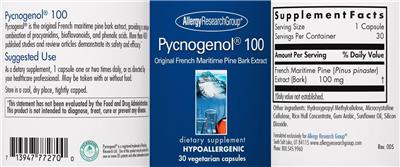
| French Maritime Pine Bark Extract | 100 mg | -- |
Other ingredients: Hydroxypropyl Methylcellulose, Microcrystalline Cellulose, Rice hull concentrate, Gum Arabic, Sunflower Oil, Silicon Dioxide
Tap any ingredient to jump to its full detail below.
These statements are the manufacturer’s wording, reproduced from the product label — the label is saying it, not HelloPharmacist. We don’t verify or endorse them.
Formula
Pycnogenol is the original French maritime pine bark extract, providing a unique combination of procyanidins, bioflavonoids, and phenolic acids. More than 400 published studies and review articles demonstrate its safety and efficacy.
Original French maritime pine bark extract
Suggested/Recommended/Usage/Directions
Suggested use As a dietary supplement, 1 capsule one or two times daily, or as directed by your healthcare professional. May be taken with or without food.
Storage
Store in a cool, dry place, tightly capped.
FDA Disclaimer Statement
This statement has not been evaluated by the Food and Drug Administration. This product is not intended to diagnose, treat, cure or prevent any disease.
Brand IP Statement(s)
Pycnogenol Nature's Super Antioxidant Pycnogenol is a registered trademark of Horphag Research Ltd. Use of this product may be protected by one or more US patents and other international patents.
FDA Statement of Identity
Dietary Supplement
Formulation
Hypoallergenic
Is this label outdated? Report a formula or label change and our pharmacy team will review it.
Pycnogenol 100 by Allergy Research Group label
The label scan from the NIH Dietary Supplement Label Database. Tap to enlarge.
Label images are published by the NIH Dietary Supplement Label Database for the version of this product on file. Always read your actual product label.
View the full label (PDF)The Ingredients in Pycnogenol 100 by Allergy Research Group
This is the 1 active ingredient this product is made of. Select it to open its full monograph.
Serving size1 Capsule(s) Dosage formCapsule Servings per container30 Amounts shown are per serving.
French Maritime Pine Bark Extract
Interacts with327 drugs
Maritime pine bark extract (often sold as Pycnogenol) is a plant-based antioxidant most studied for circulation, vein, and skin health. Some research...
French Maritime Pine Bark Extract monograph & interactionsOther (inactive) ingredients: Hydroxypropyl Methylcellulose, Microcrystalline Cellulose, Rice hull concentrate, Gum Arabic, Sunflower Oil, Silicon Dioxide. These complete the product’s ingredient list but are not active constituents.
Pycnogenol 100 by Allergy Research Group Drug Interactions
HelloPharmacist Interaction Report
Pycnogenol 100 by Allergy Research Group contains French Maritime Pine Bark Extract, which has documented interactions with three medication categories.
The most serious concern is with blood thinners and antiplatelet drugs (like warfarin, aspirin, and clopidogrel)—the extract may increase bleeding risk by slowing how your blood clots. This is a Moderate severity interaction.
Read the full breakdown — every affected drug type, severity by severity
Immune-suppressing medications face a Moderate-severity concern: the extract may theoretically reduce how well these drugs work, though this hasn't been reported in people yet. Diabetes medications also interact at Moderate severity—the extract can lower blood sugar, so if you're on diabetes drugs, you'll need close glucose monitoring and possibly dose adjustments.
Altogether, these interactions span 322 individual medications. Before you start Pycnogenol 100, use the checker below to look up your exact prescriptions.
Check your own medications below · Editorial policy · How we use AI
Want to check YOUR meds against Pycnogenol 100?
Ask about interactions with your drugs in plain English — “Can I take it with lisinopril?” — and we find you the answer in seconds, ingredient by ingredient.
Go to the checkerIngredients driving the most interactions
Individual Drug Interactions
The ingredients in Pycnogenol 100 interact with 327 drugs. Click any drug to see the details.
1 of the 1 ingredient in Pycnogenol 100 interact with drugs. Each result below shows which ingredient is responsible. French Maritime Pine Bark Extract
6-mercaptopurinePurinethol
How 6-mercaptopurine interacts with Pycnogenol 100 — through 1 ingredient. Tap an ingredient for the detail:
French Maritime Pine Bark ExtractImmunosuppressants Moderate
Interaction Summary
Theoretically, maritime pine bark extract might decrease the effectiveness of immunosuppressant therapy.
Read the full French Maritime Pine Bark Extract + 6-mercaptopurine interactionAbciximabReoPro
How Abciximab interacts with Pycnogenol 100 — through 1 ingredient. Tap an ingredient for the detail:
French Maritime Pine Bark ExtractAnticoagulant/antiplatelet Drugs Moderate
Interaction Summary
Theoretically, maritime pine bark extract might increase the risk of bleeding when used with antiplatelet or anticoagulant drugs.
Read the full French Maritime Pine Bark Extract + Abciximab interactionAbrocitinibCibinqo
How Abrocitinib interacts with Pycnogenol 100 — through 1 ingredient. Tap an ingredient for the detail:
French Maritime Pine Bark ExtractAnticoagulant/antiplatelet Drugs, Immunosuppressants Moderate
Interaction Summary
Theoretically, maritime pine bark extract might increase the risk of bleeding when used with antiplatelet or anticoagulant drugs.
Read the full French Maritime Pine Bark Extract + Abrocitinib interactionAcarboseGlucobay, Prandase, Precose
How Acarbose interacts with Pycnogenol 100 — through 1 ingredient. Tap an ingredient for the detail:
French Maritime Pine Bark ExtractAntidiabetes Drugs Moderate
Interaction Summary
Theoretically, maritime pine bark extract might increase the risk of hypoglycemia when used with antidiabetes drugs.
Read the full French Maritime Pine Bark Extract + Acarbose interactionAcenocoumarolSintrom
How Acenocoumarol interacts with Pycnogenol 100 — through 1 ingredient. Tap an ingredient for the detail:
French Maritime Pine Bark ExtractAnticoagulant/antiplatelet Drugs Moderate
Interaction Summary
Theoretically, maritime pine bark extract might increase the risk of bleeding when used with antiplatelet or anticoagulant drugs.
Read the full French Maritime Pine Bark Extract + Acenocoumarol interactionAcetaminophen, AspirinGemnisyn
How Acetaminophen, Aspirin interacts with Pycnogenol 100 — through 1 ingredient. Tap an ingredient for the detail:
French Maritime Pine Bark ExtractAnticoagulant/antiplatelet Drugs Moderate
Interaction Summary
Theoretically, maritime pine bark extract might increase the risk of bleeding when used with antiplatelet or anticoagulant drugs.
Read the full French Maritime Pine Bark Extract + Acetaminophen, Aspirin interactionAcetaminophen, Aspirin, CaffeineExcedrin, Excedrin Extra Strength, Excedrin Migraine
How Acetaminophen, Aspirin, Caffeine interacts with Pycnogenol 100 — through 1 ingredient. Tap an ingredient for the detail:
French Maritime Pine Bark ExtractAnticoagulant/antiplatelet Drugs Moderate
Interaction Summary
Theoretically, maritime pine bark extract might increase the risk of bleeding when used with antiplatelet or anticoagulant drugs.
Read the full French Maritime Pine Bark Extract + Acetaminophen, Aspirin, Caffeine interactionAcetaminophen, IbuprofenCombogesic
How Acetaminophen, Ibuprofen interacts with Pycnogenol 100 — through 1 ingredient. Tap an ingredient for the detail:
French Maritime Pine Bark ExtractAnticoagulant/antiplatelet Drugs Moderate
Interaction Summary
Theoretically, maritime pine bark extract might increase the risk of bleeding when used with antiplatelet or anticoagulant drugs.
Read the full French Maritime Pine Bark Extract + Acetaminophen, Ibuprofen interactionAcetohexamideDymelor
How Acetohexamide interacts with Pycnogenol 100 — through 1 ingredient. Tap an ingredient for the detail:
French Maritime Pine Bark ExtractAntidiabetes Drugs Moderate
Interaction Summary
Theoretically, maritime pine bark extract might increase the risk of hypoglycemia when used with antidiabetes drugs.
Read the full French Maritime Pine Bark Extract + Acetohexamide interactionAcetylsalicylic AcidEntrophen
How Acetylsalicylic Acid interacts with Pycnogenol 100 — through 1 ingredient. Tap an ingredient for the detail:
French Maritime Pine Bark ExtractAnticoagulant/antiplatelet Drugs Moderate
Interaction Summary
Theoretically, maritime pine bark extract might increase the risk of bleeding when used with antiplatelet or anticoagulant drugs.
Read the full French Maritime Pine Bark Extract + Acetylsalicylic Acid interactionAdalimumabHumira
How Adalimumab interacts with Pycnogenol 100 — through 1 ingredient. Tap an ingredient for the detail:
French Maritime Pine Bark ExtractImmunosuppressants Moderate
Interaction Summary
Theoretically, maritime pine bark extract might decrease the effectiveness of immunosuppressant therapy.
Read the full French Maritime Pine Bark Extract + Adalimumab interactionAdalimumab-adazHyrimoz
How Adalimumab-adaz interacts with Pycnogenol 100 — through 1 ingredient. Tap an ingredient for the detail:
French Maritime Pine Bark ExtractImmunosuppressants Moderate
Interaction Summary
Theoretically, maritime pine bark extract might decrease the effectiveness of immunosuppressant therapy.
Read the full French Maritime Pine Bark Extract + Adalimumab-adaz interactionAdalimumab-adbmCyltezo
How Adalimumab-adbm interacts with Pycnogenol 100 — through 1 ingredient. Tap an ingredient for the detail:
French Maritime Pine Bark ExtractImmunosuppressants Moderate
Interaction Summary
Theoretically, maritime pine bark extract might decrease the effectiveness of immunosuppressant therapy.
Read the full French Maritime Pine Bark Extract + Adalimumab-adbm interactionAdalimumab-afzbAbrilada
How Adalimumab-afzb interacts with Pycnogenol 100 — through 1 ingredient. Tap an ingredient for the detail:
French Maritime Pine Bark ExtractImmunosuppressants Moderate
Interaction Summary
Theoretically, maritime pine bark extract might decrease the effectiveness of immunosuppressant therapy.
Read the full French Maritime Pine Bark Extract + Adalimumab-afzb interactionAdalimumab-attoAmjevita
How Adalimumab-atto interacts with Pycnogenol 100 — through 1 ingredient. Tap an ingredient for the detail:
French Maritime Pine Bark ExtractImmunosuppressants Moderate
Interaction Summary
Theoretically, maritime pine bark extract might decrease the effectiveness of immunosuppressant therapy.
Read the full French Maritime Pine Bark Extract + Adalimumab-atto interactionAdalimumab-bwwdHadlima
How Adalimumab-bwwd interacts with Pycnogenol 100 — through 1 ingredient. Tap an ingredient for the detail:
French Maritime Pine Bark ExtractImmunosuppressants Moderate
Interaction Summary
Theoretically, maritime pine bark extract might decrease the effectiveness of immunosuppressant therapy.
Read the full French Maritime Pine Bark Extract + Adalimumab-bwwd interactionAdalimumab-fkjpHulio
How Adalimumab-fkjp interacts with Pycnogenol 100 — through 1 ingredient. Tap an ingredient for the detail:
French Maritime Pine Bark ExtractImmunosuppressants Moderate
Interaction Summary
Theoretically, maritime pine bark extract might decrease the effectiveness of immunosuppressant therapy.
Read the full French Maritime Pine Bark Extract + Adalimumab-fkjp interactionAlbiglutideTanzeum
How Albiglutide interacts with Pycnogenol 100 — through 1 ingredient. Tap an ingredient for the detail:
French Maritime Pine Bark ExtractAntidiabetes Drugs Moderate
Interaction Summary
Theoretically, maritime pine bark extract might increase the risk of hypoglycemia when used with antidiabetes drugs.
Read the full French Maritime Pine Bark Extract + Albiglutide interactionAlefaceptAmevive
How Alefacept interacts with Pycnogenol 100 — through 1 ingredient. Tap an ingredient for the detail:
French Maritime Pine Bark ExtractImmunosuppressants Moderate
Interaction Summary
Theoretically, maritime pine bark extract might decrease the effectiveness of immunosuppressant therapy.
Read the full French Maritime Pine Bark Extract + Alefacept interactionAlemtuzumabCampath
How Alemtuzumab interacts with Pycnogenol 100 — through 1 ingredient. Tap an ingredient for the detail:
French Maritime Pine Bark ExtractImmunosuppressants Moderate
Interaction Summary
Theoretically, maritime pine bark extract might decrease the effectiveness of immunosuppressant therapy.
Read the full French Maritime Pine Bark Extract + Alemtuzumab interactionAlogliptinNesina
How Alogliptin interacts with Pycnogenol 100 — through 1 ingredient. Tap an ingredient for the detail:
French Maritime Pine Bark ExtractAntidiabetes Drugs Moderate
Interaction Summary
Theoretically, maritime pine bark extract might increase the risk of hypoglycemia when used with antidiabetes drugs.
Read the full French Maritime Pine Bark Extract + Alogliptin interactionAlogliptin, MetforminKazano
How Alogliptin, Metformin interacts with Pycnogenol 100 — through 1 ingredient. Tap an ingredient for the detail:
French Maritime Pine Bark ExtractAntidiabetes Drugs Moderate
Interaction Summary
Theoretically, maritime pine bark extract might increase the risk of hypoglycemia when used with antidiabetes drugs.
Read the full French Maritime Pine Bark Extract + Alogliptin, Metformin interactionAlogliptin, PioglitazoneOseni
How Alogliptin, Pioglitazone interacts with Pycnogenol 100 — through 1 ingredient. Tap an ingredient for the detail:
French Maritime Pine Bark ExtractAntidiabetes Drugs Moderate
Interaction Summary
Theoretically, maritime pine bark extract might increase the risk of hypoglycemia when used with antidiabetes drugs.
Read the full French Maritime Pine Bark Extract + Alogliptin, Pioglitazone interactionAlteplase, TpaActilyse, Activase
How Alteplase, Tpa interacts with Pycnogenol 100 — through 1 ingredient. Tap an ingredient for the detail:
French Maritime Pine Bark ExtractAnticoagulant/antiplatelet Drugs Moderate
Interaction Summary
Theoretically, maritime pine bark extract might increase the risk of bleeding when used with antiplatelet or anticoagulant drugs.
Read the full French Maritime Pine Bark Extract + Alteplase, Tpa interactionAluminum Hydroxide, Aspirin, Codeine Phosphate, Magnesium HydroxideAscriptin Codeine #2
How Aluminum Hydroxide, Aspirin, Codeine Phosphate, Magnesium Hydroxide interacts with Pycnogenol 100 — through 1 ingredient. Tap an ingredient for the detail:
French Maritime Pine Bark ExtractAnticoagulant/antiplatelet Drugs Moderate
Interaction Summary
Theoretically, maritime pine bark extract might increase the risk of bleeding when used with antiplatelet or anticoagulant drugs.
Read the full French Maritime Pine Bark Extract + Aluminum Hydroxide, Aspirin, Codeine Phosphate, Magnesium Hydroxide interactionAluminum Hydroxide, Aspirin, Magnesium HydroxideAscriptin
How Aluminum Hydroxide, Aspirin, Magnesium Hydroxide interacts with Pycnogenol 100 — through 1 ingredient. Tap an ingredient for the detail:
French Maritime Pine Bark ExtractAnticoagulant/antiplatelet Drugs Moderate
Interaction Summary
Theoretically, maritime pine bark extract might increase the risk of bleeding when used with antiplatelet or anticoagulant drugs.
Read the full French Maritime Pine Bark Extract + Aluminum Hydroxide, Aspirin, Magnesium Hydroxide interactionAnacaulase-bcdbNexoBrid
How Anacaulase-bcdb interacts with Pycnogenol 100 — through 1 ingredient. Tap an ingredient for the detail:
French Maritime Pine Bark ExtractAnticoagulant/antiplatelet Drugs Moderate
Interaction Summary
Theoretically, maritime pine bark extract might increase the risk of bleeding when used with antiplatelet or anticoagulant drugs.
Read the full French Maritime Pine Bark Extract + Anacaulase-bcdb interactionAnagrelideAgrylin
How Anagrelide interacts with Pycnogenol 100 — through 1 ingredient. Tap an ingredient for the detail:
French Maritime Pine Bark ExtractAnticoagulant/antiplatelet Drugs Moderate
Interaction Summary
Theoretically, maritime pine bark extract might increase the risk of bleeding when used with antiplatelet or anticoagulant drugs.
Read the full French Maritime Pine Bark Extract + Anagrelide interactionAnifrolumab-fniaSaphnelo
How Anifrolumab-fnia interacts with Pycnogenol 100 — through 1 ingredient. Tap an ingredient for the detail:
French Maritime Pine Bark ExtractImmunosuppressants Moderate
Interaction Summary
Theoretically, maritime pine bark extract might decrease the effectiveness of immunosuppressant therapy.
Read the full French Maritime Pine Bark Extract + Anifrolumab-fnia interactionAnisindioneMiradon
How Anisindione interacts with Pycnogenol 100 — through 1 ingredient. Tap an ingredient for the detail:
French Maritime Pine Bark ExtractAnticoagulant/antiplatelet Drugs Moderate
Interaction Summary
Theoretically, maritime pine bark extract might increase the risk of bleeding when used with antiplatelet or anticoagulant drugs.
Read the full French Maritime Pine Bark Extract + Anisindione interactionEach ingredient & the kinds of drugs it affects
For each ingredient in Pycnogenol 100 with known interactions, here are the types of medications it can affect. Open any type for the detail — or search your exact drug in the checker above.
French Maritime Pine Bark Extract
Anticoagulant/Antiplatelet Drugs
Theoretically, maritime pine bark extract might increase the risk of bleeding when used with antiplatelet or anticoagulant drugs.
Clinical research suggests that maritime pine bark extract inhibits platelet aggregation. However, the clinical significance of this effect is unclear.
Antidiabetes Drugs
Theoretically, maritime pine bark extract might increase the risk of hypoglycemia when used with antidiabetes drugs.
One clinical study shows that maritime pine bark extract decreases blood sugar in patients with diabetes being treated with antidiabetes agents. Monitor blood glucose levels closely. Dose adjustments might be necessary.
Immunosuppressants
Theoretically, maritime pine bark extract might decrease the effectiveness of immunosuppressant therapy.
In vitro and animal research suggests that maritime pine bark extract has immunostimulant activity. This effect has not been reported in humans.
Brand information
Manufacturer and brand details for Pycnogenol 100, from the product label.
Allergy Research Group
See all Allergy Research Group products- Name
- Allergy Research Group
- City
- South Salt Lake
- State
- UT
- ZipCode
- 84115
- Phone Number
- 800-545-9960
- Web Address
- www.allergyresearchgroup.com
Pycnogenol 100 by Allergy Research Group: Common Questions
Does Pycnogenol 100 by Allergy Research Group interact with any medications?
How can one product interact with so many drugs?
Where does this information come from?
What is pycnogenol, and what does it do?
Can I take this while pregnant or breastfeeding?
What are the side effects?
Do I need to worry about interactions with my medications?
How many active ingredients does this product have?
Written and reviewed by the HelloPharmacist editorial staff. Our editorial policy
Not sure if Pycnogenol 100 is safe with your meds?
Our pharmacists answer your medication & supplement questions — free.
Label information is sourced from the NIH Dietary Supplement Label Database and reflects the product version on file; always read your actual product label. This page is for education only and is not a substitute for professional medical advice. Confirm with your pharmacist or doctor before combining supplements and medications.
The Full Monographs Behind Pycnogenol 100’s Ingredients
Every ingredient we hold a full HelloPharmacist monograph for — uses, evidence, safety, and the complete interaction list.
Sources & How We Checked
Pycnogenol 100's label data comes from the NIH Dietary Supplement Label Database; the ingredient interaction data is from the Natural Medicines database, reviewed by our pharmacists.
- NIH Dietary Supplement Label Database (DSLD) — The official product label on file for this supplement.
- Natural Medicines (Therapeutic Research Center) — Evidence-graded clinical reference behind the ingredient interaction data.
Content is written and reviewed by licensed HelloPharmacist pharmacists. See our data sources and editorial standards for how this information is built and checked.
The 14 references behind this product’s interaction data
Every citation that drives the interaction findings for this product’s ingredients, from the evidence-graded Natural Medicines (TRC Healthcare) database. Open an ingredient to browse its citations — links open the study on PubMed or the publisher’s site.
Maritime Pine 14 references
- Rice-Evans CA, Packer L, eds. Flavonoids in Health and Disease. Manhattan, NY: Marcel Dekker, Inc., 1998.
- Liu FJ, Zhang YX, Lau BH. Pycnogenol enhances immune and haemopoietic functions in senescence-accelerated mice. Cell Mol Life Sci 1998;54:1168-72. PubMed
- Putter M, Grotemeyer KH, Wurthwein G, et al. Inhibition of smoking-induced platelet aggregation by aspirin and pycnogenol. Thromb Res 1999;95:155-61. PubMed
- Kohama T, Inoue M. Pycnogenol alleviates pain associated with pregnancy. Phytother Res 2006;20:232-4.
- Liu X, Zhou HJ, Rohdewald P. French maritime pine bark extract pycnogenol dose-dependently lowers glucose in type 2 diabetic patients (letter). Diabetes Care 2004;27:839. PubMed
- Liu X, Wei J, Tan F, et al. Antidiabetic effect of Pycnogenol French maritime pine bark extract in patients with diabetes type II. Life Sci 2004;75:2505-13. PubMed
- Wilson D, Evans M, Guthrie N et al. A randomized, double-blind, placebo-controlled exploratory study to evaluate the potential of pycnogenol for improving allergic rhinitis symptoms. Phytother Res 2010;24:1115-9.
- Araghi-Niknam, M., Hosseini, S., Larson, D., Rohdewald, P., and Watson, R. R. Pine bark extract reduces platelet aggregation. Integr.Med. 3-21-2000;2(2):73-77. PubMed
- Trebaticka, J., Kopasova, S., Hradecna, Z., Cinovsky, K., Skodacek, I., Suba, J., Muchova, J., Zitnanova, I., Waczulikova, I., Rohdewald, P., and Durackova, Z. Treatment of ADHD with French maritime pine bark extract, Pycnogenol. Eur.Child Adolesc.Psychi PubMed
- Suzuki, N., Uebaba, K., Kohama, T., Moniwa, N., Kanayama, N., and Koike, K. French maritime pine bark extract significantly lowers the requirement for analgesic medication in dysmenorrhea: a multicenter, randomized, double-blind, placebo-controlled study
- Cisar, P., Jany, R., Waczulikova, I., Sumegova, K., Muchova, J., Vojtassak, J., Durackova, Z., Lisy, M., and Rohdewald, P. Effect of pine bark extract (Pycnogenol) on symptoms of knee osteoarthritis. Phytother.Res. 2008;22(8):1087-1092.
- Enseleit, F., Sudano, I., Periat, D., Winnik, S., Wolfrum, M., Flammer, A. J., Frohlich, G. M., Kaiser, P., Hirt, A., Haile, S. R., Krasniqi, N., Matter, C. M., Uhlenhut, K., Hogger, P., Neidhart, M., Luscher, T. F., Ruschitzka, F., and Noll, G. Effects
- Schoonees, A., Visser, J., Musekiwa, A., and Volmink, J. Pycnogenol(R) (extract of French maritime pine bark) for the treatment of chronic disorders. Cochrane.Database.Syst.Rev. 2012;4:CD008294.
- Wang S, Tan D Zhao Y et al. The effect of pycnogenol on the microcirculation, platelet function and ischemic myocardium in patients with coronary artery diseases. Eur Bull Drug Res 1999;7:19-25.
Parts of this content are provided by the Therapeutic Research Center, LLC.
DISCLAIMER: Currently this does not check for drug-drug interactions. This is not an all-inclusive comprehensive list of potential interactions and is for informational purposes only. Not all interactions are known or well-reported in the scientific literature, and new interactions are continually being reported. Input is needed from a qualified healthcare provider including a pharmacist before starting any therapy. Application of clinical judgment is necessary.
© 2021 Therapeutic Research Center, LLC