
Quadracarn Ingredients & Drug Interactions
What is this page for?
First and foremost: checking Quadracarn against your medications. The heart of this page is the interaction checker and the full interaction report — how this product’s ingredients may interact with prescription and over-the-counter medicines you may be taking.
Around that, we add a pharmacist’s high-level view of the product as a whole — what’s inside, the evidence for its stated use, how transparent the label is, and what safety data exists — so you can see the full picture in one place. It’s educational information from our licensed clinical databases and the clinical staff at HelloPharmacist — not medical advice — and we don’t sell or endorse products. Our editorial policy
Quadracarn is a dietary supplement by Beverly International with 5 active ingredients. Its ingredients are commonly taken for blood sugar support, type 2 diabetes, sugar cravings.Based on those ingredients, 930 medications have a known interaction with it, the most serious rated moderate. The ingredients most likely to interact are Gymnema leaf extract, Acetyl-L-Carnitine Hydrochloride, Propionyl L-Carnitine HCl. Use the checker below to test your specific medication, or read the full HelloPharmacist Interaction Report.
Check Your Meds Against Quadracarn by Beverly International
Ask about any prescription or over-the-counter medication and we check it for interactions with Quadracarn by Beverly International — and tell you which ingredient is responsible.
AI summaries are generated from our interaction database for education only — always confirm with your pharmacist. How we use AI
Ask the Pharmacist
A licensed pharmacist will answer your question by email — free, usually within 24 hours.
Got it — thank you!
A licensed pharmacist will answer within 24 hours. Keep an eye on your email (worth checking spam, just in case).
HelloPharmacist Scorecard of Quadracarn by Beverly International
Our pharmacy team’s full take, with four database checks built into the cards below — a summary of what is known, not a grade of the product itself.
What’s inside
Full disclosure
Quadracarn contains 5 active ingredients. Gymnema leaf extract is an herbal ingredient traditionally used for blood sugar support.
The product also contains three forms of carnitine—Acetyl-L-Carnitine Hydrochloride, Propionyl L-Carnitine HCl, and L-Carnitine (plus L-Carnitine-L-Tartrate)—which are compounds that play a role in energy metabolism and cardiovascular function. The remaining ingredients are inactive: microcrystalline cellulose, calcium carbonate, stearic acid, croscarmellose sodium, silicon dioxide, magnesium stearate, hydroxypropylcellulose, and gum acacia (fillers, binders, and capsule material).
Does it work?
Moderate evidence
The evidence for gymnema leaf extract is limited—we don't have enough reliable data to rate its effectiveness for diabetes, prediabetes, obesity, or metabolic syndrome. Acetyl-L-Carnitine is possibly effective for age-related cognitive decline, Alzheimer disease, alcohol use disorder, diabetic neuropathy, and depression.
Propionyl L-Carnitine is possibly effective for ulcerative colitis, congestive heart failure, and angina. L-Carnitine and L-Carnitine-L-Tartrate are effective for L-carnitine deficiency itself, and possibly effective for heart failure, angina, and high cholesterol.
How safe is it?
Well-documented data
Gymnema leaf extract is generally well tolerated short-term but can lower blood sugar; quality varies between products. Rare cases of hepatitis and hepatitis-associated aplastic anemia (a serious blood disorder) have been reported.
The product is best avoided during pregnancy and breastfeeding due to insufficient safety data. The carnitine compounds are generally well tolerated at typical doses, though they may cause abdominal cramps, diarrhea, nausea, and heartburn.
A rare serious side effect—seizures—has been reported. A metabolite of some carnitine forms can cause a fishy odor of urine, breath, and sweat.
Long-term safety isn't fully established. All three carnitine forms should be avoided during pregnancy; safety while breastfeeding is either unknown or only possibly safe, so caution is advised.
Meds to double-check
Moderate interaction found
Check your medications if you take blood thinners (warfarin, acenocoumarol), thyroid hormone replacement, diabetes drugs, or serotonergic drugs (like certain antidepressants). The product may also interact with medications cleared by liver enzymes CYP1A2, CYP2C9, or CYP3A4.
Use the search tool on this page for your exact medications.
The bottom line
Scorecard at a glanceFully disclosed formula with some supporting evidence for its stated purpose. Moderate medication interactions have been identified, and safety information is well characterized.
This product is built around carnitine and gymnema—ingredients with modest to incomplete evidence. If you take blood thinners, thyroid hormone, diabetes medication, or antidepressants, you absolutely need to check your specific drugs before starting.
Talk to your pharmacist or doctor, especially if you're pregnant, breastfeeding, or managing a chronic condition.
Educational only — not medical advice; always confirm with your pharmacist. Our editorial policy · How we use AI
Assessment coverage: 5 of 5 active ingredients matched to our full ingredient reviews (monographs). Based on the product label dated May 21, 2025.
This Scorecard evaluates available label information, ingredient evidence, and known medication-safety considerations. It does not independently verify product identity, purity, potency, contamination, or manufacturing quality. How these ratings are computed
General information
Key facts about Quadracarn, straight from the product label.
| Brand | Beverly International |
|---|---|
| Barcode (UPC) | 857254000184 |
| Net contents | 120 Tablet(s) |
| Market status | On market |
| Date entered into DSLD | May 21, 2025 |
| DSLD ID | 332855 |
| Product type | Other Combinations |
| Supplement form | Tablet Or Pill |
| Dietary claims / uses | All Other, Structure/Function |
| Intended target group(s) | Adult (18 - 50 Years) |
Everything in this section is reproduced from the manufacturer’s own product label — it’s the label speaking, not HelloPharmacist. We show it so you can see exactly what the maker states; we don’t verify or endorse those statements.
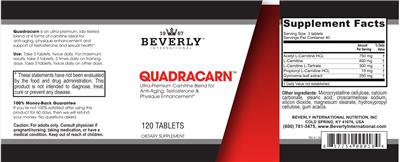
Supplement Facts
The label details for Quadracarn by Beverly International, sourced from the NIH Dietary Supplement Label Database.
Supplement Facts
| Ingredient | Amount | % DV |
|---|---|---|
| Gymnema leaf extract | 250 mg | -- |
| Acetyl-L-Carnitine Hydrochloride | 750 mg | -- |
| Propionyl L-Carnitine HCl | 15 mg | -- |
| L-Carnitine | 450 mg | -- |
| L-Carnitine-L-Tartrate | 300 mg | -- |
Other ingredients: Microcrystalline Cellulose, Calcium Carbonate, Stearic Acid, Croscarmellose Sodium, Silicon Dioxide, Magnesium Stearate, Hydroxypropylcellulose, Gum Acacia
Tap any ingredient to jump to its full detail below.
These statements are the manufacturer’s wording, reproduced from the product label — the label is saying it, not HelloPharmacist. We don’t verify or endorse them.
Formulation
Quadracarn is an ultra-premium, lab-tested blend of 4 forms of carnitine ideal for anti-aging, physique enhancement and support of testosterone and sexual health.
100% Money-Back Guarantee If you're not 100% satisfied after using this product for 60 days, then we will refund your money. No questions asked.
Ultra-Premium Carnitine Blend for Anti-Aging, Testosterone & Physique Enhancement
Suggested/Recommended/Usage/Directions
Use: Take 3 tablets, twice daily. For maximum results, take 3 tablets, 3 times daily on training days. Take 3 tablets, twice daily on other days.
FDA Disclaimer Statement
These statements have not been evaluated by the Food and Drug Administration. This product is not intended to diagnose, treat, cure or prevent any disease.
Precautions
Caution: For adults only. Keep out of reach of children.
Consult physician if pregnant/nursing, taking medication, or have a medical condition.
FDA Statement of Identity
Dietary Supplement
Is this label outdated? Report a formula or label change and our pharmacy team will review it.
Quadracarn by Beverly International label
The label scan from the NIH Dietary Supplement Label Database. Tap to enlarge.
Label images are published by the NIH Dietary Supplement Label Database for the version of this product on file. Always read your actual product label.
View the full label (PDF)The Ingredients in Quadracarn by Beverly International
These are the 5 active ingredients this product is made of. Select any to open its full monograph.
Serving size3 Tablet(s) Dosage formTablet Or Pill Servings per container40 Amounts shown are per serving.
Most supplement products combine several ingredients, and a medication can interact with the product through any one of them. Each ingredient below shows whether it has known drug interactions.
Gymnema leaf extract
Interacts with851 drugs
Gymnema is an Ayurvedic herb best known for possibly helping lower blood sugar and reducing the taste of sweetness on the tongue. Some early human stu...
Gymnema leaf extract monograph & interactionsAcetyl-L-Carnitine Hydrochloride
Interacts with203 drugs
Acetyl-L-carnitine is a form of the amino acid carnitine that the body uses to help produce energy in cells. It is most studied for nerve pain and mem...
Acetyl-L-Carnitine Hydrochloride monograph & interactionsPropionyl L-Carnitine HCl
Interacts with19 drugs
Propionyl-l-carnitine is a form of the amino acid derivative carnitine that the body uses to help turn fat into energy, and it is studied mostly for c...
Propionyl L-Carnitine HCl monograph & interactionsL-Carnitine
Interacts with19 drugs
L-carnitine is a compound your body makes naturally and also gets from foods like meat. It helps cells turn fat into energy, and supplements are most...
L-Carnitine monograph & interactionsL-Carnitine-L-Tartrate
Interacts with19 drugs
L-carnitine is a compound your body makes naturally and also gets from foods like meat. It helps cells turn fat into energy, and supplements are most...
L-Carnitine-L-Tartrate monograph & interactionsOther (inactive) ingredients: Microcrystalline Cellulose, Calcium Carbonate, Stearic Acid, Croscarmellose Sodium, Silicon Dioxide, Magnesium Stearate, Hydroxypropylcellulose, Gum Acacia. These complete the product’s ingredient list but are not active constituents.
Quadracarn by Beverly International Drug Interactions
HelloPharmacist Interaction Report
Quadracarn by Beverly International contains five active ingredients, and the three carnitine compounds (Acetyl-L-Carnitine, Propionyl L-Carnitine, and L-Carnitine/L-Carnitine-L-Tartrate) interact with blood thinners like warfarin and acenocoumarol—theoretically increasing their anticoagulant effects and raising the risk of bleeding.
The gymnema leaf extract presents the most diverse interaction profile: it can inhibit or induce liver enzymes (CYP1A2, CYP2C9, CYP3A4) that clear many medications, potentially raising or lowering drug levels, and it may enhance the blood-sugar-lowering effects of diabetes medications, raising the risk of low blood sugar.
Read the full breakdown — every affected drug type, severity by severity
All three carnitine forms can theoretically decrease the effectiveness of thyroid hormone replacement by blocking the hormone's entry into cells. Acetyl-L-Carnitine also interacts with serotonergic drugs (like certain antidepressants), theoretically increasing the risk of serotonin syndrome.
Altogether, these interactions span 919 individual medications.
Check your exact medications—especially any blood thinners, thyroid hormone, diabetes drugs, antidepressants, or other prescription medications—with the search tool on this page before starting this product.
Check your own medications below · Editorial policy · How we use AI
Want to check YOUR meds against Quadracarn?
Ask about interactions with your drugs in plain English — “Can I take it with lisinopril?” — and we find you the answer in seconds, ingredient by ingredient.
Go to the checkerIngredients driving the most interactions
Individual Drug Interactions
The ingredients in Quadracarn interact with 930 drugs. Click any drug to see the details.
4 of the 5 ingredients in Quadracarn interact with drugs. Each result below shows which ingredient is responsible. Gymnema leaf extract Acetyl-L-Carnitine Hydrochloride Propionyl L-Carnitine HCl L-Carnitine
AbrocitinibCibinqo
How Abrocitinib interacts with Quadracarn — through 1 ingredient. Tap an ingredient for the detail:
Gymnema Leaf ExtractCytochrome P450 2c9 (cyp2c9) Substrates Moderate
Interaction Summary
Theoretically, gymnema might increase or decrease levels of drugs metabolized by CYP2C9.
Read the full Gymnema Leaf Extract + Abrocitinib interactionAcarboseGlucobay, Prandase, Precose
How Acarbose interacts with Quadracarn — through 1 ingredient. Tap an ingredient for the detail:
Gymnema Leaf ExtractAntidiabetes Drugs Moderate
Interaction Summary
Theoretically, taking gymnema with antidiabetes drugs might increase the risk of hypoglycemia.
Read the full Gymnema Leaf Extract + Acarbose interactionAcenocoumarolSintrom
How Acenocoumarol interacts with Quadracarn — through 3 ingredients. Tap an ingredient for the detail:
L-carnitine-l-tartrateAcenocoumarol (sintrom) Moderate
Interaction Summary
Theoretically, L-carnitine might increase the anticoagulant effects of acenocoumarol.
Read the full L-carnitine-l-tartrate + Acenocoumarol interactionPropionyl L-carnitine HclAcenocoumarol (sintrom) Moderate
Interaction Summary
Theoretically, propionyl-L-carnitine might increase the anticoagulant effects of acenocoumarol.
Read the full Propionyl L-carnitine Hcl + Acenocoumarol interactionAcetyl-l-carnitine HydrochlorideAcenocoumarol (sintrom) Moderate
Interaction Summary
Theoretically, acetyl-L-carnitine might increase the anticoagulant effects of acenocoumarol.
Read the full Acetyl-l-carnitine Hydrochloride + Acenocoumarol interactionAcetaminophenChildren's Tylenol, Children's Tylenol Meltaways, Tylenol, Tylenol Ex Strength
How Acetaminophen interacts with Quadracarn — through 1 ingredient. Tap an ingredient for the detail:
Gymnema Leaf ExtractCytochrome P450 1a2 (cyp1a2) Substrates Moderate
Interaction Summary
Theoretically, gymnema might increase levels of drugs metabolized by CYP1A2.
Read the full Gymnema Leaf Extract + Acetaminophen interactionAcetaminophen, AspirinGemnisyn
How Acetaminophen, Aspirin interacts with Quadracarn — through 1 ingredient. Tap an ingredient for the detail:
Gymnema Leaf ExtractCytochrome P450 1a2 (cyp1a2) Substrates Moderate
Interaction Summary
Theoretically, gymnema might increase levels of drugs metabolized by CYP1A2.
Read the full Gymnema Leaf Extract + Acetaminophen, Aspirin interactionAcetaminophen, Aspirin, CaffeineExcedrin, Excedrin Extra Strength, Excedrin Migraine
How Acetaminophen, Aspirin, Caffeine interacts with Quadracarn — through 1 ingredient. Tap an ingredient for the detail:
Gymnema Leaf ExtractCytochrome P450 1a2 (cyp1a2) Substrates, Cytochrome P450 3a4 (cyp3a4) Substrates Moderate
Interaction Summary
Theoretically, gymnema might increase levels of drugs metabolized by CYP1A2.
Read the full Gymnema Leaf Extract + Acetaminophen, Aspirin, Caffeine interactionAcetaminophen, Brompheniramine, PhenylpropanolamineDimetapp Cold and Flu
How Acetaminophen, Brompheniramine, Phenylpropanolamine interacts with Quadracarn — through 1 ingredient. Tap an ingredient for the detail:
Gymnema Leaf ExtractCytochrome P450 1a2 (cyp1a2) Substrates Moderate
Interaction Summary
Theoretically, gymnema might increase levels of drugs metabolized by CYP1A2.
Read the full Gymnema Leaf Extract + Acetaminophen, Brompheniramine, Phenylpropanolamine interactionAcetaminophen, ButalbitalAxocet, Bancap, Bucet, Butex Forte, Esgic CF, Orbivan CF +5 more
How Acetaminophen, Butalbital interacts with Quadracarn — through 1 ingredient. Tap an ingredient for the detail:
Gymnema Leaf ExtractCytochrome P450 1a2 (cyp1a2) Substrates Moderate
Interaction Summary
Theoretically, gymnema might increase levels of drugs metabolized by CYP1A2.
Read the full Gymnema Leaf Extract + Acetaminophen, Butalbital interactionAcetaminophen, Butalbital, CaffeineEsgic, Esgic Plus, Fiogesic, Fioricet, Repan, Tecnal +1 more
How Acetaminophen, Butalbital, Caffeine interacts with Quadracarn — through 1 ingredient. Tap an ingredient for the detail:
Gymnema Leaf ExtractCytochrome P450 1a2 (cyp1a2) Substrates, Cytochrome P450 3a4 (cyp3a4) Substrates Moderate
Interaction Summary
Theoretically, gymnema might increase levels of drugs metabolized by CYP1A2.
Read the full Gymnema Leaf Extract + Acetaminophen, Butalbital, Caffeine interactionAcetaminophen, Butalbital, Caffeine, CodeineEsgic with Codeine, Fioricet w/ Codeine
How Acetaminophen, Butalbital, Caffeine, Codeine interacts with Quadracarn — through 1 ingredient. Tap an ingredient for the detail:
Gymnema Leaf ExtractCytochrome P450 3a4 (cyp3a4) Substrates, Cytochrome P450 1a2 (cyp1a2) Substrates Moderate
Interaction Summary
Theoretically, gymnema might increase levels of drugs metabolized by CYP3A4.
Read the full Gymnema Leaf Extract + Acetaminophen, Butalbital, Caffeine, Codeine interactionAcetaminophen, Butalbital, CodeineBancap w/ Codeine
How Acetaminophen, Butalbital, Codeine interacts with Quadracarn — through 1 ingredient. Tap an ingredient for the detail:
Gymnema Leaf ExtractCytochrome P450 1a2 (cyp1a2) Substrates Moderate
Interaction Summary
Theoretically, gymnema might increase levels of drugs metabolized by CYP1A2.
Read the full Gymnema Leaf Extract + Acetaminophen, Butalbital, Codeine interactionAcetaminophen, Butalbital, Codeine PhosphatePhrenilin #3
How Acetaminophen, Butalbital, Codeine Phosphate interacts with Quadracarn — through 1 ingredient. Tap an ingredient for the detail:
Gymnema Leaf ExtractCytochrome P450 1a2 (cyp1a2) Substrates Moderate
Interaction Summary
Theoretically, gymnema might increase levels of drugs metabolized by CYP1A2.
Read the full Gymnema Leaf Extract + Acetaminophen, Butalbital, Codeine Phosphate interactionAcetaminophen, Caffeine, Chlorpheniramine, Hydrocodone, PhenylephrineHycomine Compound
How Acetaminophen, Caffeine, Chlorpheniramine, Hydrocodone, Phenylephrine interacts with Quadracarn — through 1 ingredient. Tap an ingredient for the detail:
Gymnema Leaf ExtractCytochrome P450 1a2 (cyp1a2) Substrates, Cytochrome P450 3a4 (cyp3a4) Substrates Moderate
Interaction Summary
Theoretically, gymnema might increase levels of drugs metabolized by CYP1A2.
Read the full Gymnema Leaf Extract + Acetaminophen, Caffeine, Chlorpheniramine, Hydrocodone, Phenylephrine interactionAcetaminophen, Caffeine, CodeineGesic C15, Gesic C30, Gesic C8, Lenoltec 1, Lenoltec 2, Lenoltec 3 +1 more
How Acetaminophen, Caffeine, Codeine interacts with Quadracarn — through 1 ingredient. Tap an ingredient for the detail:
Gymnema Leaf ExtractCytochrome P450 3a4 (cyp3a4) Substrates, Cytochrome P450 1a2 (cyp1a2) Substrates Moderate
Interaction Summary
Theoretically, gymnema might increase levels of drugs metabolized by CYP3A4.
Read the full Gymnema Leaf Extract + Acetaminophen, Caffeine, Codeine interactionAcetaminophen, Caffeine, Codeine, SalicylamideCodalan No.1, Codalan No.2, Codalan No.3
How Acetaminophen, Caffeine, Codeine, Salicylamide interacts with Quadracarn — through 1 ingredient. Tap an ingredient for the detail:
Gymnema Leaf ExtractCytochrome P450 1a2 (cyp1a2) Substrates, Cytochrome P450 3a4 (cyp3a4) Substrates Moderate
Interaction Summary
Theoretically, gymnema might increase levels of drugs metabolized by CYP1A2.
Read the full Gymnema Leaf Extract + Acetaminophen, Caffeine, Codeine, Salicylamide interactionAcetaminophen, Caffeine, DihydrocodeineDHC Plus, Panlor DC, Panlor SS
How Acetaminophen, Caffeine, Dihydrocodeine interacts with Quadracarn — through 1 ingredient. Tap an ingredient for the detail:
Gymnema Leaf ExtractCytochrome P450 3a4 (cyp3a4) Substrates, Cytochrome P450 1a2 (cyp1a2) Substrates Moderate
Interaction Summary
Theoretically, gymnema might increase levels of drugs metabolized by CYP3A4.
Read the full Gymnema Leaf Extract + Acetaminophen, Caffeine, Dihydrocodeine interactionAcetaminophen, Caffeine, IsomethepteneMigralam
How Acetaminophen, Caffeine, Isometheptene interacts with Quadracarn — through 1 ingredient. Tap an ingredient for the detail:
Gymnema Leaf ExtractCytochrome P450 1a2 (cyp1a2) Substrates, Cytochrome P450 3a4 (cyp3a4) Substrates Moderate
Interaction Summary
Theoretically, gymnema might increase levels of drugs metabolized by CYP1A2.
Read the full Gymnema Leaf Extract + Acetaminophen, Caffeine, Isometheptene interactionAcetaminophen, Caffeine, PyrilamineMidol Max Strength Menstrual
How Acetaminophen, Caffeine, Pyrilamine interacts with Quadracarn — through 1 ingredient. Tap an ingredient for the detail:
Gymnema Leaf ExtractCytochrome P450 3a4 (cyp3a4) Substrates, Cytochrome P450 1a2 (cyp1a2) Substrates Moderate
Interaction Summary
Theoretically, gymnema might increase levels of drugs metabolized by CYP3A4.
Read the full Gymnema Leaf Extract + Acetaminophen, Caffeine, Pyrilamine interactionAcetaminophen, Chlorpheniramine Maleate, Dextromethorphan HbrVicks Formula 44M Cough, Cold & Flu Relief
How Acetaminophen, Chlorpheniramine Maleate, Dextromethorphan Hbr interacts with Quadracarn — through 2 ingredients. Tap an ingredient for the detail:
Gymnema Leaf ExtractCytochrome P450 1a2 (cyp1a2) Substrates, Cytochrome P450 3a4 (cyp3a4) Substrates Moderate
Interaction Summary
Theoretically, gymnema might increase levels of drugs metabolized by CYP1A2.
Read the full Gymnema Leaf Extract + Acetaminophen, Chlorpheniramine Maleate, Dextromethorphan Hbr interactionAcetyl-l-carnitine HydrochlorideSerotonergic Drugs Moderate
Interaction Summary
Theoretically, acetyl-L-carnitine might increase the risk of serotonergic side effects, including serotonin syndrome and cerebral vasoconstrictive disorders, when taken with serotonergic drugs.
Read the full Acetyl-l-carnitine Hydrochloride + Acetaminophen, Chlorpheniramine Maleate, Dextromethorphan Hbr interactionAcetaminophen, Chlorpheniramine, Codeine, PhenylephrineColrex
How Acetaminophen, Chlorpheniramine, Codeine, Phenylephrine interacts with Quadracarn — through 2 ingredients. Tap an ingredient for the detail:
Acetyl-l-carnitine HydrochlorideSerotonergic Drugs Moderate
Interaction Summary
Theoretically, acetyl-L-carnitine might increase the risk of serotonergic side effects, including serotonin syndrome and cerebral vasoconstrictive disorders, when taken with serotonergic drugs.
Read the full Acetyl-l-carnitine Hydrochloride + Acetaminophen, Chlorpheniramine, Codeine, Phenylephrine interactionGymnema Leaf ExtractCytochrome P450 1a2 (cyp1a2) Substrates, Cytochrome P450 3a4 (cyp3a4) Substrates Moderate
Interaction Summary
Theoretically, gymnema might increase levels of drugs metabolized by CYP1A2.
Read the full Gymnema Leaf Extract + Acetaminophen, Chlorpheniramine, Codeine, Phenylephrine interactionAcetaminophen, Chlorpheniramine, DextromethorphanCoricidin II Extra Strength Cold and Flu
How Acetaminophen, Chlorpheniramine, Dextromethorphan interacts with Quadracarn — through 2 ingredients. Tap an ingredient for the detail:
Gymnema Leaf ExtractCytochrome P450 1a2 (cyp1a2) Substrates, Cytochrome P450 3a4 (cyp3a4) Substrates Moderate
Interaction Summary
Theoretically, gymnema might increase levels of drugs metabolized by CYP1A2.
Read the full Gymnema Leaf Extract + Acetaminophen, Chlorpheniramine, Dextromethorphan interactionAcetyl-l-carnitine HydrochlorideSerotonergic Drugs Moderate
Interaction Summary
Theoretically, acetyl-L-carnitine might increase the risk of serotonergic side effects, including serotonin syndrome and cerebral vasoconstrictive disorders, when taken with serotonergic drugs.
Read the full Acetyl-l-carnitine Hydrochloride + Acetaminophen, Chlorpheniramine, Dextromethorphan interactionAcetaminophen, Chlorpheniramine, Dextromethorphan HydrobromideCoricidin HBP Maximum Strength Flu
How Acetaminophen, Chlorpheniramine, Dextromethorphan Hydrobromide interacts with Quadracarn — through 2 ingredients. Tap an ingredient for the detail:
Gymnema Leaf ExtractCytochrome P450 3a4 (cyp3a4) Substrates, Cytochrome P450 1a2 (cyp1a2) Substrates Moderate
Interaction Summary
Theoretically, gymnema might increase levels of drugs metabolized by CYP3A4.
Read the full Gymnema Leaf Extract + Acetaminophen, Chlorpheniramine, Dextromethorphan Hydrobromide interactionAcetyl-l-carnitine HydrochlorideSerotonergic Drugs Moderate
Interaction Summary
Theoretically, acetyl-L-carnitine might increase the risk of serotonergic side effects, including serotonin syndrome and cerebral vasoconstrictive disorders, when taken with serotonergic drugs.
Read the full Acetyl-l-carnitine Hydrochloride + Acetaminophen, Chlorpheniramine, Dextromethorphan Hydrobromide interactionAcetaminophen, Chlorpheniramine, Dextromethorphan, PhenylpropanolamineMulti Symptom Cold Relief
How Acetaminophen, Chlorpheniramine, Dextromethorphan, Phenylpropanolamine interacts with Quadracarn — through 2 ingredients. Tap an ingredient for the detail:
Acetyl-l-carnitine HydrochlorideSerotonergic Drugs Moderate
Interaction Summary
Theoretically, acetyl-L-carnitine might increase the risk of serotonergic side effects, including serotonin syndrome and cerebral vasoconstrictive disorders, when taken with serotonergic drugs.
Read the full Acetyl-l-carnitine Hydrochloride + Acetaminophen, Chlorpheniramine, Dextromethorphan, Phenylpropanolamine interactionGymnema Leaf ExtractCytochrome P450 3a4 (cyp3a4) Substrates, Cytochrome P450 1a2 (cyp1a2) Substrates Moderate
Interaction Summary
Theoretically, gymnema might increase levels of drugs metabolized by CYP3A4.
Read the full Gymnema Leaf Extract + Acetaminophen, Chlorpheniramine, Dextromethorphan, Phenylpropanolamine interactionAcetaminophen, Chlorpheniramine, Dextromethorphan, PseudoephedrineChildren's Tylenol Cold Plus Cough, Tylenol Cold Ex Strength
How Acetaminophen, Chlorpheniramine, Dextromethorphan, Pseudoephedrine interacts with Quadracarn — through 2 ingredients. Tap an ingredient for the detail:
Gymnema Leaf ExtractCytochrome P450 1a2 (cyp1a2) Substrates, Cytochrome P450 3a4 (cyp3a4) Substrates Moderate
Interaction Summary
Theoretically, gymnema might increase levels of drugs metabolized by CYP1A2.
Read the full Gymnema Leaf Extract + Acetaminophen, Chlorpheniramine, Dextromethorphan, Pseudoephedrine interactionAcetyl-l-carnitine HydrochlorideSerotonergic Drugs Moderate
Interaction Summary
Theoretically, acetyl-L-carnitine might increase the risk of serotonergic side effects, including serotonin syndrome and cerebral vasoconstrictive disorders, when taken with serotonergic drugs.
Read the full Acetyl-l-carnitine Hydrochloride + Acetaminophen, Chlorpheniramine, Dextromethorphan, Pseudoephedrine interactionAcetaminophen, Chlorpheniramine, Guaifenesin, Phenylephrine, SalicylamideRhinogesic GG
How Acetaminophen, Chlorpheniramine, Guaifenesin, Phenylephrine, Salicylamide interacts with Quadracarn — through 2 ingredients. Tap an ingredient for the detail:
Gymnema Leaf ExtractCytochrome P450 1a2 (cyp1a2) Substrates, Cytochrome P450 3a4 (cyp3a4) Substrates Moderate
Interaction Summary
Theoretically, gymnema might increase levels of drugs metabolized by CYP1A2.
Read the full Gymnema Leaf Extract + Acetaminophen, Chlorpheniramine, Guaifenesin, Phenylephrine, Salicylamide interactionAcetyl-l-carnitine HydrochlorideSerotonergic Drugs Moderate
Interaction Summary
Theoretically, acetyl-L-carnitine might increase the risk of serotonergic side effects, including serotonin syndrome and cerebral vasoconstrictive disorders, when taken with serotonergic drugs.
Read the full Acetyl-l-carnitine Hydrochloride + Acetaminophen, Chlorpheniramine, Guaifenesin, Phenylephrine, Salicylamide interactionAcetaminophen, Chlorpheniramine, PhenylephrineAlka-Seltzer PLUS, Histex SR, Protid
How Acetaminophen, Chlorpheniramine, Phenylephrine interacts with Quadracarn — through 2 ingredients. Tap an ingredient for the detail:
Acetyl-l-carnitine HydrochlorideSerotonergic Drugs Moderate
Interaction Summary
Theoretically, acetyl-L-carnitine might increase the risk of serotonergic side effects, including serotonin syndrome and cerebral vasoconstrictive disorders, when taken with serotonergic drugs.
Read the full Acetyl-l-carnitine Hydrochloride + Acetaminophen, Chlorpheniramine, Phenylephrine interactionGymnema Leaf ExtractCytochrome P450 1a2 (cyp1a2) Substrates, Cytochrome P450 3a4 (cyp3a4) Substrates Moderate
Interaction Summary
Theoretically, gymnema might increase levels of drugs metabolized by CYP1A2.
Read the full Gymnema Leaf Extract + Acetaminophen, Chlorpheniramine, Phenylephrine interactionAcetaminophen, Chlorpheniramine, Phenylephrine, SalicylamideRhinogesic, Rhinogesic JR
How Acetaminophen, Chlorpheniramine, Phenylephrine, Salicylamide interacts with Quadracarn — through 2 ingredients. Tap an ingredient for the detail:
Gymnema Leaf ExtractCytochrome P450 1a2 (cyp1a2) Substrates, Cytochrome P450 3a4 (cyp3a4) Substrates Moderate
Interaction Summary
Theoretically, gymnema might increase levels of drugs metabolized by CYP1A2.
Read the full Gymnema Leaf Extract + Acetaminophen, Chlorpheniramine, Phenylephrine, Salicylamide interactionAcetyl-l-carnitine HydrochlorideSerotonergic Drugs Moderate
Interaction Summary
Theoretically, acetyl-L-carnitine might increase the risk of serotonergic side effects, including serotonin syndrome and cerebral vasoconstrictive disorders, when taken with serotonergic drugs.
Read the full Acetyl-l-carnitine Hydrochloride + Acetaminophen, Chlorpheniramine, Phenylephrine, Salicylamide interactionAcetaminophen, Chlorpheniramine, PhenylpropanolamineAlumadrine, Conex, Sinadrin Max Strength, Sinulin
How Acetaminophen, Chlorpheniramine, Phenylpropanolamine interacts with Quadracarn — through 2 ingredients. Tap an ingredient for the detail:
Gymnema Leaf ExtractCytochrome P450 1a2 (cyp1a2) Substrates, Cytochrome P450 3a4 (cyp3a4) Substrates Moderate
Interaction Summary
Theoretically, gymnema might increase levels of drugs metabolized by CYP1A2.
Read the full Gymnema Leaf Extract + Acetaminophen, Chlorpheniramine, Phenylpropanolamine interactionAcetyl-l-carnitine HydrochlorideSerotonergic Drugs Moderate
Interaction Summary
Theoretically, acetyl-L-carnitine might increase the risk of serotonergic side effects, including serotonin syndrome and cerebral vasoconstrictive disorders, when taken with serotonergic drugs.
Read the full Acetyl-l-carnitine Hydrochloride + Acetaminophen, Chlorpheniramine, Phenylpropanolamine interactionAcetaminophen, Chlorpheniramine, Phenylpropanolamine, OpiumHista-Derfule
How Acetaminophen, Chlorpheniramine, Phenylpropanolamine, Opium interacts with Quadracarn — through 2 ingredients. Tap an ingredient for the detail:
Acetyl-l-carnitine HydrochlorideSerotonergic Drugs Moderate
Interaction Summary
Theoretically, acetyl-L-carnitine might increase the risk of serotonergic side effects, including serotonin syndrome and cerebral vasoconstrictive disorders, when taken with serotonergic drugs.
Read the full Acetyl-l-carnitine Hydrochloride + Acetaminophen, Chlorpheniramine, Phenylpropanolamine, Opium interactionGymnema Leaf ExtractCytochrome P450 1a2 (cyp1a2) Substrates, Cytochrome P450 3a4 (cyp3a4) Substrates Moderate
Interaction Summary
Theoretically, gymnema might increase levels of drugs metabolized by CYP1A2.
Read the full Gymnema Leaf Extract + Acetaminophen, Chlorpheniramine, Phenylpropanolamine, Opium interactionAcetaminophen, Chlorpheniramine, Phenylpropanolamine, PhenyltoloxamineNorel Plus
How Acetaminophen, Chlorpheniramine, Phenylpropanolamine, Phenyltoloxamine interacts with Quadracarn — through 2 ingredients. Tap an ingredient for the detail:
Gymnema Leaf ExtractCytochrome P450 3a4 (cyp3a4) Substrates, Cytochrome P450 1a2 (cyp1a2) Substrates Moderate
Interaction Summary
Theoretically, gymnema might increase levels of drugs metabolized by CYP3A4.
Read the full Gymnema Leaf Extract + Acetaminophen, Chlorpheniramine, Phenylpropanolamine, Phenyltoloxamine interactionAcetyl-l-carnitine HydrochlorideSerotonergic Drugs Moderate
Interaction Summary
Theoretically, acetyl-L-carnitine might increase the risk of serotonergic side effects, including serotonin syndrome and cerebral vasoconstrictive disorders, when taken with serotonergic drugs.
Read the full Acetyl-l-carnitine Hydrochloride + Acetaminophen, Chlorpheniramine, Phenylpropanolamine, Phenyltoloxamine interactionEach ingredient & the kinds of drugs it affects
For each ingredient in Quadracarn with known interactions, here are the types of medications they can affect. Open any type for the detail — or search your exact drug in the checker above.
Gymnema leaf extract
Antidiabetes Drugs
Theoretically, taking gymnema with antidiabetes drugs might increase the risk of hypoglycemia.
Gymnema reduces blood glucose levels in some human and animal research. In human studies, it has been shown to enhance the blood glucose lowering effects of hypoglycemic drugs. However, other research in adults with prediabetes or metabolic syndrome suggests that gymnema does not reduce fasting levels of blood glucose. Until more is known, monitor blood glucose levels closely.
Cytochrome P450 1A2 (Cyp1A2) Substrates
Theoretically, gymnema might increase levels of drugs metabolized by CYP1A2.
Animal and in vitro research shows that gymnema can inhibit the CYP1A2 enzyme. In one animal study, oral administration of gymnema for 7 days increased the plasma concentrations of phenacetin, a CYP1A2 substrate, by about 1.4-fold and reduced the clearance of phenacetin by about 29%.
Cytochrome P450 2C9 (Cyp2C9) Substrates
Theoretically, gymnema might increase or decrease levels of drugs metabolized by CYP2C9.
Animal research shows that gymnema can induce the CYP2C9 enzyme. In one animal study, gymnema caused a 2.4-fold increase in the clearance of tolbutamide, a CYP2C9 substrate, in rats. In vitro research also shows that gymnema can inhibit CYP2C9.
Phenacetin
Theoretically, taking gymnema with phenacetin might increase the levels of phenacetin.
Animal research shows that gymnema, administered orally for 7 days, decreases the clearance of phenacetin in a dose-dependent manner by about 21% to 29% and increases plasma levels about 1.3- to 1.4-fold when compared to control.
Tolbutamide (Orinase)
Theoretically, taking gymnema with tolbutamide might the decrease levels of tolbutamide.
Animal research shows that gymnema, administered orally for 7 days, increases the clearance of tolbutamide by 2.4-fold when compared to control.
Cytochrome P450 3A4 (Cyp3A4) Substrates
Theoretically, gymnema might increase levels of drugs metabolized by CYP3A4.
One in vitro study using rat liver microsomes shows that gymnema can modestly inhibit the CYP3A4 enzyme. However, other in vitro research using human liver microsomes shows that gymnema does not affect CYP3A4 activity. Animal research also shows that gymnema does not alter the function of CYP3A4. In one study in rats, oral administration of gymnema for 7 days did not alter the clearance of amlodipine, a CYP3A4 substrate.
Acetyl-L-Carnitine Hydrochloride
Acenocoumarol (Sintrom)
Theoretically, acetyl-L-carnitine might increase the anticoagulant effects of acenocoumarol.
L-carnitine, the parent compound of acetyl-L-carnitine, might enhance the anticoagulant effects of acenocoumarol, an oral anticoagulant that is similar to warfarin, but shorter-acting. There are at least two case reports of INR elevation when L-carnitine was taken with acenocoumarol. In one case, a 33-year-old male with a previously stable INR had an elevated INR of 4.65 after L-carnitine was started and continued for 10 weeks. INR normalized after discontinuation of the L-carnitine-containing product. It is unclear if such an interaction would also occur with acetyl-L-carnitine.
Serotonergic Drugs
Theoretically, acetyl-L-carnitine might increase the risk of serotonergic side effects, including serotonin syndrome and cerebral vasoconstrictive disorders, when taken with serotonergic drugs.
Animal research shows that acetyl-L-carnitine can increase levels of serotonin in the brain.
Thyroid Hormone
Theoretically, acetyl-L-carnitine might decrease the effectiveness of thyroid hormone replacement.
L-carnitine appears to act as a peripheral thyroid hormone antagonist by inhibiting entry of thyroid hormone into the nucleus of cells. Taking L-carnitine also seems to diminish some of the symptoms of hyperthyroidism. It is unclear if such an interaction would occur with acetyl-L-carnitine.
Warfarin (Coumadin)
Theoretically, acetyl-L-carnitine might increase the anticoagulant effects of warfarin.
L-carnitine, the parent compound of acetyl-L-carnitine, might increase the anticoagulant effects of acenocoumarol, a shorter-acting oral anticoagulant similar to warfarin. There is not enough information to know whether this interaction occurs with acetyl-L-carnitine and warfarin.
Propionyl L-Carnitine HCl
Acenocoumarol (Sintrom)
Theoretically, propionyl-L-carnitine might increase the anticoagulant effects of acenocoumarol.
L-carnitine, the parent compound of propionyl-L-carnitine, might enhance the anticoagulant effects of acenocoumarol, an oral anticoagulant similar to warfarin, but shorter-acting. There are at least two case reports of INR elevation when L-carnitine was taken with acenocoumarol. In one case, a 33-year-old male with a previously stable INR had an elevated INR of 4.65 after L-carnitine was started and continued for 10 weeks. INR normalized after discontinuation of the L-carnitine-containing product. It is unclear if such an interaction would also occur with propionyl-L-carnitine.
Thyroid Hormone
Theoretically, acetyl-L-carnitine might decrease the effectiveness of thyroid hormone replacement.
L-carnitine appears to act as a peripheral thyroid hormone antagonist by inhibiting entry of thyroid hormone into the nucleus of cells. Taking L-carnitine also seems to diminish some of the symptoms of hyperthyroidism. It is unclear if such an interaction would occur with propionyl-L-carnitine.
Warfarin (Coumadin)
Theoretically, propionyl-L-carnitine might increase the anticoagulant effects of warfarin.
L-carnitine, the parent compound of propionyl-L-carnitine, might increase the anticoagulant effects of acenocoumarol, a shorter-acting oral anticoagulant similar to warfarin. There is not enough information to know whether this interaction occurs with propionyl-L-carnitine and warfarin.
L-Carnitine
Acenocoumarol (Sintrom)
Theoretically, L-carnitine might increase the anticoagulant effects of acenocoumarol.
L-carnitine might enhance the anticoagulant effects of acenocoumarol, an oral anticoagulant similar to warfarin, but shorter-acting. There are at least two case reports of INR elevation with concomitant use. In one case, a 33-year-old male with a previously stable INR had an elevated INR of 4.65 after L-carnitine was started and continued for 10 weeks. INR normalized after discontinuation of the L-carnitine-containing product.
Thyroid Hormone
Theoretically, L-carnitine might decrease the effectiveness of thyroid hormone replacement.
L-carnitine appears to act as a peripheral thyroid hormone antagonist by inhibiting entry of thyroid hormone into the nucleus of cells. Taking L-carnitine also seems to diminish some of the symptoms of hyperthyroidism.
Warfarin (Coumadin)
Theoretically, L-carnitine might increase the anticoagulant effects of warfarin.
L-carnitine might increase the anticoagulant effects of acenocoumarol, a shorter-acting oral anticoagulant similar to warfarin. There is not enough information to know whether this interaction occurs with L-carnitine and warfarin.
Brand information
Manufacturer and brand details for Quadracarn, from the product label.
Beverly International
See all Beverly International products- Name
- Beverly International Nutrition, Inc
- City
- Cold Spring
- State
- KY
- ZipCode
- 41076
- Phone Number
- (800) 781-3475
- Web Address
- www.BeverlyInternational.com
Quadracarn by Beverly International: Common Questions
Does Quadracarn by Beverly International interact with any medications?
How can one product interact with so many drugs?
Where does this information come from?
Is Quadracarn safe during pregnancy?
Is it safe while breastfeeding?
Can Quadracarn lower my blood sugar?
What are the most common side effects?
Does Quadracarn work for weight loss or energy?
Can I take this if I'm on thyroid medication?
Written and reviewed by the HelloPharmacist editorial staff. Our editorial policy
Not sure if Quadracarn is safe with your meds?
Our pharmacists answer your medication & supplement questions — free.
Label information is sourced from the NIH Dietary Supplement Label Database and reflects the product version on file; always read your actual product label. This page is for education only and is not a substitute for professional medical advice. Confirm with your pharmacist or doctor before combining supplements and medications.
The Full Monographs Behind Quadracarn’s Ingredients
Every ingredient we hold a full HelloPharmacist monograph for — uses, evidence, safety, and the complete interaction list.
Gymnema
Interacts with 851 drugsGymnema is an Ayurvedic herb best known for possibly helping lower blood sugar and reducing the taste of sweetness on the tongue. Some early human studies are encouraging for blood sugar sup...
Read the full Gymnema monograph → Herb & supplement monographAcetyl-l-carnitine
Interacts with 203 drugsAcetyl-L-carnitine is a form of the amino acid carnitine that the body uses to help produce energy in cells. It is most studied for nerve pain and memory-related conditions, though the evide...
Read the full Acetyl-l-carnitine monograph → Herb & supplement monographPropionyl-l-carnitine
Interacts with 19 drugsPropionyl-l-carnitine is a form of the amino acid derivative carnitine that the body uses to help turn fat into energy, and it is studied mostly for circulation problems like peripheral arte...
Read the full Propionyl-l-carnitine monograph → Herb & supplement monographL-carnitine
Interacts with 19 drugsL-carnitine is a compound your body makes naturally and also gets from foods like meat. It helps cells turn fat into energy, and supplements are most clearly useful for people with a true ca...
Read the full L-carnitine monograph →Sources & How We Checked
Quadracarn's label data comes from the NIH Dietary Supplement Label Database; the ingredient interaction data is from the Natural Medicines database, reviewed by our pharmacists.
- NIH Dietary Supplement Label Database (DSLD) — The official product label on file for this supplement.
- Natural Medicines (Therapeutic Research Center) — Evidence-graded clinical reference behind the ingredient interaction data.
Content is written and reviewed by licensed HelloPharmacist pharmacists. See our data sources and editorial standards for how this information is built and checked.
The 87 references behind this product’s interaction data
Every citation that drives the interaction findings for this product’s ingredients, from the evidence-graded Natural Medicines (TRC Healthcare) database. Open an ingredient to browse its citations — links open the study on PubMed or the publisher’s site.
Gymnema 12 references
- Shanmugasundaram ER, Rajeswari G, Baskaran K, et al. Use of Gymnema sylvestre leaf extract in the control of blood glucose in insulin-dependent diabetes mellitus. J Ethnopharmacol 1990;30:281-94. PubMed
- Baskaran K, Kizar Ahamath B, Radha Shanmugasundaram K, Shanmugasundaram ER. Antidiabetic effect of leaf extract from Gymnema sylvestre in non-insulin-dependent diabetes mellitus patients. J Ethnopharmacol 1990;30:295-300.
- Kamble B, Gupta A, Moothedath I, Khatal L, Janrao S, Jadhav A, et al. Effects of Gymnema sylvestre extract on the pharmacokinetics and pharmacodynamics of glimepiride in streptozotocin induced diabetic rats. Chem Biol Interact. 2016;245:30-8. PubMed
- Tiwari P, Mishra BN, Sangwan NS. Phytochemical and pharmacological properties of Gymnema sylvestre: an important medicinal plant. Biomed Res Int. 2014; 2014:830285.
- Fabio GD, Romanucci V, De Marco A, Zarrelli A. Triterpenoids from Gymnema sylvestre and their pharmacological activities. Molecules. 2014;19(8):10956-81. PubMed
- Shiyovich A, Sztarkier I, Nesher L. Toxic hepatitis induced by Gymnema sylvestre, a natural remedy for type 2 diabetes mellitus. Am J Med Sci. 2010;340(6):514-7. PubMed
- Zuniga LY, Gonzalez-Ortiz M, Martinez-Abundis E. Effect of gymnema sylvestre administration on metabolic syndrome, insulin sensitivity, and insulin secretion. J Med Food. 2017 Aug;20(8):750-54.
- Rammohan B, Samit K, Chinmoy D, et al. Human cytochrome P450 enzyme modulation by gymnema sylvestre: a predictive safety evaluation by LC-MS/MS. Pharmacogn Mag. 2016 Jul;12(Suppl 4):S389-S394.
- Vaghela M, Sahu N, Kharkar P, Pandita N. In vivo pharmacokinetic interaction by ethanolic extract of gymnema sylvestre with CYP2C9 (tolbutamide), CYP3A4 (amlodipine) and CYP1A2 (phenacetin) in rats. Chem Biol Interact. 2017 Dec 25;278:141-151. PubMed
- Vaghela M, Iyer K, Pandita N. In vitro inhibitory effect of gymnema sylvestre extracts and total gymnemic acids fraction on select cytochrome P450 activities in rat liver microsomes. Eur J Drug Metab Pharmacokinet. 2017 Oct 10. PubMed
- Gaytán Martínez LA, Sánchez-Ruiz LA, Zuñiga LY, González-Ortiz M, Martínez-Abundis E. Effect of Gymnema sylvestre administration on glycemic control, insulin secretion, and insulin sensitivity in patients with impaired glucose tolerance. J Med Food. 2021;
- Philips CA, Theruvath AH, Ravindran R. Toxic hepatitis-associated aplastic anaemia after dual homeopathic remedies and Gymnema sylvestre use. BMJ Case Rep 2022;15(3):e247867. PubMed
Acetyl-l-carnitine 22 references
- Thal LJ, Carta A, Clarke WR, et al. A 1-year multicenter placebo-controlled study of acetyl-L-carnitine in patients with Alzheimer's Disease. Neurology 1996;47:705-11. PubMed
- Sano M, Bell K, Cote L, et al. Double-blind parallel design pilot study of acetyl levocarnitine in patients with Alzheimer's Disease. Arch Neurol 1992;49:1137-41. PubMed
- Spagnoli A, Lucca U, Menasce G, et al. Long-term acetyl-L-carnitine treatment in Alzheimer's Disease. Neurology 1991;41:1726-32. PubMed
- Brooks JO 3rd, Yesavage JA, Carta A, Bravi D. Acetyl L-carnitine slows decline in younger patients with Alzheimer's disease: a reanalysis of a double-blind, placebo-controlled study using the trilinear approach. Int Psychoger 1998;10:193-203. PubMed
- Pettegrew JW, Klunk WE, Panchalingam K, et al. Clinical and neurochemical effects of acetyl-L-carnitine in Alzheimer's disease. Neurobiol Aging 1995;16:1-4. PubMed
- Rai G, Wright G, Scott L, et al. Double-blind, placebo controlled study of acetyl-l-carnitine in patients with Alzheimer's dementia. Curr Med Res Opin 1990;11:638-47. PubMed
- Benvenga S, Ruggeri RM, Russo A, et al. Usefulness of L-carnitine, a naturally occurring peripheral antagonist of thyroid hormone action, in iatrogenic hyperthyroidism: a randomized, double-blind, placebo-controlled clinical trial. J Clin Endocrinol Meta
- Montgomery SA, Thal LJ, Amrein R. Meta-analysis of double blind randomized controlled clinical trials of acetyl-L-carnitine versus placebo in the treatment of mild cognitive impairment and mild Alzheimer's disease. Int Clin Psychopharmacol 2003;18:61-71.. PubMed
- Martinez E, Domingo P, Roca-Cusachs A. Potentiation of acenocoumarol action by L-carnitine. J Intern Med 1993;233:94.
- Hudson S, Tabet N. Acetyl-L-carnitine for dementia. Cochrane Database Syst Rev 2003;2:CD003158.. PubMed
- Bachmann HU, Hoffmann A. Interaction of food supplement L-carnitine with oral anticoagulant acenocoumarol. Swiss Med Wkly 2004;134:385. PubMed
- De Grandis D, Minardi C. Acetyl-L-carnitine (levacecarnine) in the treatment of diabetic neuropathy. A long-term, randomised, double-blind, placebo-controlled study. Drugs R D 2002;3:223-31. PubMed
- 12761 Benvenga S, Amato A, Calvani M, Trimarchi F. Effects of carnitine on thyroid hormone action. Ann N Y Acad Sci 2004;1033:158-67. PubMed
- Sima AAF, Calvani M, Mehra M, et al. Acetyl-L-carnitine improves pain, nerve regeneration, and vibratory perception in patients with chronic diabetic neuropathy: An analysis of two randomized, placebo-controlled trials. Diabetes Care 2005;28:89-94.
- Youle, M. and Osio, M. A double-blind, parallel-group, placebo-controlled, multicentre study of acetyl L-carnitine in the symptomatic treatment of antiretroviral toxic neuropathy in patients with HIV-1 infection. HIV.Med. 2007;8(4):241-250.
- Brennan BP, Jensen JE, Hudson JI, Coit CE, Beaulieu A, Pope HG Jr, Renshaw PF, Cohen BM. A placebo-controlled trial of acetyl-L-carnitine and a-lipoic acid in the treatment of bipolar depression. J Clin Psychopharmacol. 2013 Oct;33(5):627-35.
- Ledinek AH, Sajko MC, Rot U. Evaluating the effects of amantadin, modafinil and acetyl-L-carnitine on fatigue in multiple sclerosis--result of a pilot randomized, blind study. Clin Neurol Neurosurg. 2013 Dec;115 Suppl 1:S86-9. PubMed
- Martinotti G, Andreoli S, Reina D, Di Nicola M, Ortolani I, Tedeschi D, Fanella F, Pozzi G, Iannoni E, D'Iddio S, Prof LJ. Acetyl-l-Carnitine in the treatment of anhedonia, melancholic and negative symptoms in alcohol dependent subjects. Prog Neuropsychop PubMed
- Baek SM, Zheng R, Seo EJ, Hwang DY, Kim BH. Pharmacokinetic comparisons of two acetyl-L-carnitine formulations in healthy Korean volunteers. Int J Clin Pharmacol Ther. 2015;53(11):980-6. PubMed
- Goodison G, Overeem K, de Monte V, Siskind D. Mania associated with self-prescribed acetyl-l-carnitine in a man with bipolar I disorder. Australas Psychiatry. 2017;25(1):13-4.
- Bruno A, Pandolfo G, Crucitti M, Lorusso S, Zoccali RA, Muscatello MR. Acetyl-L-Carnitine Augmentation of Clozapine in Partial-Responder Schizophrenia: A 12-Week, Open-Label Uncontrolled Preliminary Study. Clin Neuropharmacol. 2016;39(6):277-80. PubMed
- Veronese N, Stubbs B, Solmi M, Ajnakina O, Carvalho AF, Maggi S. Acetyl-L-Carnitine Supplementation and the Treatment of Depressive Symptoms: A Systematic Review and Meta-Analysis. Psychosom Med. 2018;80(2):154-9. PubMed
Propionyl-l-carnitine 12 references
- Cherchi A, Lai C, Onnis E, et al. Propionyl carnitine in stable effort angina. Cardiovasc Drugs Ther 1990;4:481-6. PubMed
- Bartels GL, Remme WJ, den Hartog FR, et al. Additional anti-ischemic effects of long-term L-propionylcarnitine in anginal patients treated with conventional antianginal therapy. Cardiovasc Drugs Ther 1995;9:749-53.
- Caponnetto S, Canale C, Masperone MA, et al. Efficacy of L-propionylcarnitine treatment in patients with left ventricular dysfunction. Eur Heart J 1994;15:1267-73. PubMed
- Benvenga S, Ruggeri RM, Russo A, et al. Usefulness of L-carnitine, a naturally occurring peripheral antagonist of thyroid hormone action, in iatrogenic hyperthyroidism: a randomized, double-blind, placebo-controlled clinical trial. J Clin Endocrinol Meta
- Martinez E, Domingo P, Roca-Cusachs A. Potentiation of acenocoumarol action by L-carnitine. J Intern Med 1993;233:94.
- Bachmann HU, Hoffmann A. Interaction of food supplement L-carnitine with oral anticoagulant acenocoumarol. Swiss Med Wkly 2004;134:385. PubMed
- Gentile V, Vicini P, Prigiotti G, et al. Preliminary observations on the use of propionyl-L-carnitine in combination with sildenafil in patients with erectile dysfunction and diabetes. Curr Med Res Opin 2004;20:1377-84. PubMed
- 12761 Benvenga S, Amato A, Calvani M, Trimarchi F. Effects of carnitine on thyroid hormone action. Ann N Y Acad Sci 2004;1033:158-67. PubMed
- Brass EP, Koster D, Hiatt WR, Amato A. A systematic review and meta-analysis of propionyl-L-carnitine effects on exercise performance in patients with claudication. Vasc Med 2013;18:3-12.
- Hiatt WR, Creager MA, Amato A, Brass EP. Effect of propionyl-L-carnitine on a background of monitored exercise in patients with claudication secondary to peripheral artery disease. J Cardiopulm Rehabil Prev 2011;31:125-32. PubMed
- Jacobs PL, Goldstein ER, Blackburn W, et al. Glycine propionyl-L-carnitine produces enhanced anaerobic work capacity with reduced lactate accumulation in resistance trained males. J Int Soc Sports Nutr 2009;6:9. PubMed
- Jacobs PL, Goldstein ER. Long-term glycine propionyl-l-carnitine supplementation and paradoxical effects on repeated anaerobic sprint performance. J Int Soc Sports Nutr 2010;7:35.
See these in context on the Propionyl-l-carnitine monograph →
L-carnitine 41 references
- Ellaway CM, Williams K, Leonard H, et al. Rett syndrome: randomized controlled trial of L-carnitine. J Child Neurol 1999;14:162-7. PubMed
- Anon. Carnitor (levocarnitine) package insert. Sigma-Tau Pharmaceuticals Inc, Gaithersburg, MD. December 1999.
- Cherchi A, Lai C, Angelino F, et al. Effects of L-carnitine on exercise tolerance in chronic stable angina: a multicenter, double-blind, randomized, placebo-controlled, crossover study. Int J Clin Pharmacol Ther Toxicol 1985;23:569-72.
- Plioplys AV, Plioplys S. Amantadine and L-carnitine treatment of Chronic Fatigue Syndrome. Neuropsychobiology 1997;35:16-23. PubMed
- Benvenga S, Ruggeri RM, Russo A, et al. Usefulness of L-carnitine, a naturally occurring peripheral antagonist of thyroid hormone action, in iatrogenic hyperthyroidism: a randomized, double-blind, placebo-controlled clinical trial. J Clin Endocrinol Meta
- Martinez E, Domingo P, Roca-Cusachs A. Potentiation of acenocoumarol action by L-carnitine. J Intern Med 1993;233:94.
- Bachmann HU, Hoffmann A. Interaction of food supplement L-carnitine with oral anticoagulant acenocoumarol. Swiss Med Wkly 2004;134:385. PubMed
- Evans AM, Fornasini G. Pharmacokinetics of L-carnitine. Clin Pharmacokinet 2003;42:941-67. PubMed
- 12761 Benvenga S, Amato A, Calvani M, Trimarchi F. Effects of carnitine on thyroid hormone action. Ann N Y Acad Sci 2004;1033:158-67. PubMed
- Ciacci C, Peluso G, Iannoni E, et al. L-Carnitine in the treatment of fatigue in adult celiac disease patients: a pilot study. Dig Liver Dis 2007;39:922-8. PubMed
- Cruciani RA, Dvorkin E, Homel P, et al. Safety, tolerability and symptom outcomes associated with L-carnitine supplementation in patients with cancer, fatigue, and carnitine deficiency: a phase I/II study. J Pain Symptom Manage 2006;32:551-9. PubMed
- Lebrun C, Alchaar H, Candito M, et al. Levocarnitine administration in multiple sclerosis patients with immunosuppressive therapy-induced fatigue. Mult Scler 2006;12:321-4. PubMed
- Malaguarnera M, Cammalleri L, Gargante MP, et al. L-Carnitine treatment reduces severity of physical and mental fatigue and increases cognitive functions in centenarians: a randomized and controlled clinical trial. Am J Clin Nutr 2007;86:1738-44. PubMed
- Mantovani G, Maccio A, Madeddu C, et al. Randomized phase III clinical trial of five different arms of treatment in 322 patients with cancer cachexia. Oncologist 2010;15:200-11.
- Angelova-Fischer I, Rippke F, Fischer TW, Neufang G, Zillikens D. A double-blind, randomized, vehicle-controlled efficacy assessment study of a skin care formulation for improvement of mild to moderately severe acne. J Eur Acad Dermatol Venereol. 2013 Jul PubMed
- Hatamkhani S, Khalili H, Karimzadeh I, Dashti-Khavidaki S, Abdollahi A, Jafari S. Carnitine for prevention of antituberculosis drug-induced hepatotoxicity: a randomized, clinical trial. J Gastroenterol. Hepatol. 2014 May;29(5):997-1004. PubMed
- Boehm G, Stahl B. Oligosaccharides from milk. J Nutr 2007;137(3 Suppl 2):847S-849S.
- Van Oudheusden, L. J. and Scholte, H. R. Efficacy of carnitine in the treatment of children with attention-deficit hyperactivity disorder. Prostaglandins Leukot.Essent.Fatty Acids 2002;67(1):33-38. PubMed
- Derosa, G., Cicero, A. F., Gaddi, A., Mugellini, A., Ciccarelli, L., and Fogari, R. The effect of L-carnitine on plasma lipoprotein(a) levels in hypercholesterolemic patients with type 2 diabetes mellitus. Clin Ther 2003;25(5):1429-1439. PubMed
- Foitzik, K., Hoting, E., Heinrich, U., Tronnier, H., and Paus, R. Indications that topical L-carnitin-L-tartrate promotes human hair growth in vivo. J Dermatol.Sci 2007;48(2):141-144. PubMed
- Kumar, A., Singh, R. B., Saxena, M., Niaz, M. A., Josh, S. R., Chattopadhyay, P., Mechirova, V., Pella, D., and Fedacko, J. Effect of carni Q-gel (ubiquinol and carnitine) on cytokines in patients with heart failure in the Tishcon study. Acta Cardiol. 20
- Cruciani, R. A., Dvorkin, E., Homel, P., Culliney, B., Malamud, S., Lapin, J., Portenoy, R. K., and Esteban-Cruciani, N. L-carnitine supplementation in patients with advanced cancer and carnitine deficiency: a double-blind, placebo-controlled study. J Pa PubMed
- Malaguarnera, M., Vacante, M., Avitabile, T., Malaguarnera, M., Cammalleri, L., and Motta, M. L-Carnitine supplementation reduces oxidized LDL cholesterol in patients with diabetes. Am J Clin.Nutr 2009;89(1):71-76. PubMed
- Alvarez, T. M., Guardiola, P. D., Roldan, J. O., Elviro, R., Wevers, R., and Guijarro, G. [Primary trimethylaminuria: the fish odor syndrome]. Endocrinol.Nutr. 2009;56(6):337-340.
- Wu, Z. M., Lu, X., Wang, Y. W., Sun, J., Tao, J. W., Yin, F. H., and Cheng, H. J. [Short-term medication of L-carnitine before intracytoplasmic sperm injection for infertile men with oligoasthenozoospermia]. Zhonghua Nan.Ke.Xue 2012;18(3):253-256.
- Tarighat, Esfanjani A., Mahdavi, R., Ebrahimi, Mameghani M., Talebi, M., Nikniaz, Z., and Safaiyan, A. The effects of magnesium, L-carnitine, and concurrent magnesium-L-carnitine supplementation in migraine prophylaxis. Biol.Trace Elem.Res 2012;150(1-3): PubMed
- DiNicolantonio, J. J., Lavie, C. J., Fares, H., Menezes, A. R., and O'Keefe, J. H. L-carnitine in the secondary prevention of cardiovascular disease: systematic review and meta-analysis. Mayo Clin Proc. 2013;88(6):544-551. PubMed
- Huang, W. W., Wang, M. Y., Shi, H. M., Peng, Y., Peng, C. S., Zhang, M., Li, Y., Lu, J., and Li, X. B. Comparative study of bioactive constituents in crude and processed Glycyrrhizae radix and their respective metabolic profiles in gastrointestinal tract
- Madsen KL, Preisler N, Orngreen MC, Andersen SP, Olesen JH, Lund AM, Vissing J. Patients with medium-chain acyl-coenzyme a dehydrogenase deficiency have impaired oxidation of fat during exercise but no effect of L-carnitine supplementation. J Clin Endocri
- Prohaska ES, Muzyk AJ, Rivelli SK. Levocarnitine-induced hypophosphatemia in a hemodialysis patient with acute valproic acid toxicity. J Neuropsychiatry Clin Neurosci. 2012 Winter;24(1):E18-9. PubMed
- Shang R, Sun Z, Li H. Effective dosing of L-carnitine in the secondary prevention of cardiovascular disease: a systematic review and meta-analysis. BMC Cardiovasc Disord. 2014 Jul 21;14:88. PubMed
- Zhang JJ, Wu ZB, Cai YJ, Ke B, Huang YJ, Qiu CP, Yang YB, Shi LY, Qin J. L-carnitine ameliorated fasting-induced fatigue, hunger, and metabolic abnormalities in patients with metabolic syndrome: a randomized controlled study. Nutr J. 2014 Nov 26;13:110. PubMed
- Koeth RA, Wang Z, Levison BS, Buffa JA, Org E, Sheehy BT, Britt EB, Fu X, Wu Y, Li L, Smith JD, DiDonato JA, Chen J, Li H, Wu GD, Lewis JD, Warrier M, Brown JM, Krauss RM, Tang WH, Bushman FD, Lusis AJ, Hazen SL. Intestinal microbiota metabolism of L-carn
- Jun DW, Kim BI, Cho YK, Kim HJ, Kwon YO, Park SY, Han SY, Baek YH, Jung YJ, Kim HY, Kim W, Heo J, Woo HY, Hwang SG, Rim KS, Choi JY, Bae SH, Lee YS, Lim YS,Cheong JY, Cho SW, Lee BS, Kim SH, Sohn JH, Kim TY, Paik YH, Kim JK, Lee KS. Efficacy and safety of
- An JH, Kim YJ, Kim KJ, et al. L-carnitine supplementation for the management of fatigue in patients with hypothyroidism on levothyroxine treatment: a randomized, double-blind, placebo-controlled trial. Endocr J. 2016;63(10):885-95. PubMed
- Chen N, Yang M, Zhou M, Xiao J, Guo J, He L. L-carnitine for cognitive enhancement in people without cognitive impairment. Cochrane Database Syst Rev. 2017;3:CD009374. PubMed
- Khajeh B, Dashti-Khavidaki S, Nasiri-Toosi M, Mohammadi K, Jafari A. Effects of pre-transplant L-carnitine supplementation on primary graft dysfunction in liver transplant recipients: a pilot, randomized, placebo-controlled clinical trial. Res Pharm Sci. PubMed
- Kubota K, Uojima H, Shao X, et al. Additional L-carnitine Reduced the Risk of Hospitalization in Patients with Overt Hepatic Encephalopathy on Rifaximin. Dig Dis 2021. PubMed
- Amini L, Yaghini O, Ghazavi M, Aslani N. L-carnitine versus propranolol for pediatric migraine prophylaxis. Iran J Child Neurol 2021;15(2):77-86.
- Shakibaei F, Jelvani D. Effect of adding l -carnitine to risperidone on behavioral, cognitive, social, and physical symptoms in children and adolescents with autism: A randomized double-blinded placebo-controlled clinical trial. Clin Neuropharmacol 2023;4 PubMed
- Moustafa I, Connolly C, Anis M, Mustafa H, Oosthuizen F, Viljoen M. A prospective study to evaluate the efficacy and safety of vitamin E and levocarnitine prophylaxis against doxorubicin-induced cardiotoxicity in adult breast cancer patients. J Oncol Phar PubMed
Parts of this content are provided by the Therapeutic Research Center, LLC.
DISCLAIMER: Currently this does not check for drug-drug interactions. This is not an all-inclusive comprehensive list of potential interactions and is for informational purposes only. Not all interactions are known or well-reported in the scientific literature, and new interactions are continually being reported. Input is needed from a qualified healthcare provider including a pharmacist before starting any therapy. Application of clinical judgment is necessary.
© 2021 Therapeutic Research Center, LLC