
Saffron Extract 88.5 mg Ingredients & Drug Interactions
What is this page for?
First and foremost: checking Saffron Extract 88.5 mg against your medications. The heart of this page is the interaction checker and the full interaction report — how this product’s ingredients may interact with prescription and over-the-counter medicines you may be taking.
Around that, we add a pharmacist’s high-level view of the product as a whole — what’s inside, the evidence for its stated use, how transparent the label is, and what safety data exists — so you can see the full picture in one place. It’s educational information from our licensed clinical databases and the clinical staff at HelloPharmacist — not medical advice — and we don’t sell or endorse products. Our editorial policy
Saffron Extract 88.5 mg is a dietary supplement by Nutra Harmony with 1 active ingredient. Its ingredients are commonly taken for depression and low mood, anxiety, pms symptoms.Based on those ingredients, 521 medications have a known interaction with it, the most serious rated moderate. The ingredients most likely to interact are Saffron Flower Extract. Use the checker below to test your specific medication, or read the full HelloPharmacist Interaction Report.
Check Your Meds Against Saffron Extract 88.5 mg by Nutra Harmony
Ask about any prescription or over-the-counter medication and we check it for interactions with Saffron Extract 88.5 mg by Nutra Harmony — and tell you which ingredient is responsible.
AI summaries are generated from our interaction database for education only — always confirm with your pharmacist. How we use AI
Ask the Pharmacist
A licensed pharmacist will answer your question by email — free, usually within 24 hours.
Got it — thank you!
A licensed pharmacist will answer within 24 hours. Keep an eye on your email (worth checking spam, just in case).
HelloPharmacist Scorecard of Saffron Extract 88.5 mg by Nutra Harmony
Our pharmacy team’s full take, with four database checks built into the cards below — a summary of what is known, not a grade of the product itself.
What’s inside
Full disclosure
This product contains one active ingredient: Saffron Flower Extract at 88.5 mg per capsule. Saffron is the dried stigma (the thin threadlike part) of the saffron crocus flower and has been used in traditional medicine for centuries.
The capsule itself is made from vegetable material, and the inactive ingredients are rice flour, magnesium stearate, and silicon dioxide — standard fillers and binders.
Does it work?
Not established
Saffron extract is rated possibly effective for chemotherapy-induced peripheral neuropathy (nerve pain from cancer treatment) and Alzheimer disease based on the evidence we hold. That means some clinical research supports its use for these conditions, but more robust evidence would be needed to call it definitively effective.
For other uses, the evidence isn't established in our data.
How safe is it?
Well-documented data
Saffron extract is generally well tolerated when taken orally. The most common side effects are gastrointestinal complaints, nausea, vomiting, and sedation.
Rare serious side effects include anaphylaxis (a severe allergic reaction) and allergy-related reactions like rhinoconjunctivitis and asthma, especially with occupational exposure. At higher doses (30 mg twice daily), saffron has been reported to cause anxiety and hypomania in clinical trials, though at lower doses (30 mg daily) the rate was similar to placebo.
The safety data advises against saffron in pregnancy because it may stimulate the uterus. For breastfeeding, there isn't enough reliable safety information, so talk with your doctor or pharmacist before use.
Meds to double-check
Moderate interaction found
Check before using this product if you take CNS depressants (sleep aids, sedatives, prescription pain relievers, alcohol), blood pressure medications, diabetes medications, or significant amounts of caffeine. All carry Moderate-severity interactions with saffron extract.
The bottom line
Scorecard at a glanceFully disclosed formula with no established evidence rating for its marketed use. Moderate medication interactions have been identified, and safety information is well characterized.
Saffron extract may be worth considering if you're dealing with chemotherapy-related nerve pain or Alzheimer disease and want to explore a possibly effective supplement. However, if you take blood pressure medications, diabetes drugs, sedatives, or consume a lot of caffeine, you'll need to check this with your pharmacist first — the interactions are real.
Skip it entirely if you're pregnant. Talk to your pharmacist about your full medication list before starting.
Educational only — not medical advice; always confirm with your pharmacist. Our editorial policy · How we use AI
Assessment coverage: 1 of 1 active ingredient matched to our full ingredient reviews (monographs). Based on the product label dated Sep 25, 2025.
This Scorecard evaluates available label information, ingredient evidence, and known medication-safety considerations. It does not independently verify product identity, purity, potency, contamination, or manufacturing quality. How these ratings are computed
General information
Key facts about Saffron Extract 88.5 mg, straight from the product label.
| Brand | Nutra Harmony |
|---|---|
| Net contents | 90 Capsule(s) |
| Market status | On market |
| Date entered into DSLD | Sep 25, 2025 |
| DSLD ID | 338571 |
| Product type | Botanical |
| Supplement form | Capsule |
| Dietary claims / uses | All Other, Structure/Function |
| Intended target group(s) | Vegan, Vegetarian, Adult (18 - 50 Years), Women (not pregnant or lactating), Dairy Free |
Everything in this section is reproduced from the manufacturer’s own product label — it’s the label speaking, not HelloPharmacist. We show it so you can see exactly what the maker states; we don’t verify or endorse those statements.
Supplement Facts
The label details for Saffron Extract 88.5 mg by Nutra Harmony, sourced from the NIH Dietary Supplement Label Database.
Supplement Facts
| Ingredient | Amount | % DV |
|---|---|---|
| Saffron Flower Extract | 88.5 mg | -- |
Other ingredients: Vegetable Capsule, Rice Flour, Magnesium Stearate, Silicon Dioxide
Tap any ingredient to jump to its full detail below.
These statements are the manufacturer’s wording, reproduced from the product label — the label is saying it, not HelloPharmacist. We don’t verify or endorse them.
Formulation
Mood & Mind Support
Made with Non GMO Ingredients
Vegan Vegan-Friendly
Mood, Focus & Vision Natural
Suggested/Recommended/Usage/Directions
Suggested use: As a dietary supplement, it is recommended to be consumed before a meal. Take 1 (one) capsule with water once daily or as directed by your physician. Do not exceed the recommended dosage.
Precautions
Warnings: For adult use only. Keep out of reach of children.
Consult with your physician before use if you are taking any medications. Do not use it if you are pregnant or nursing.
Do not use it if the safety seal is broken or missing.
It is manufactured in a facility that processes milk, eggs, wheat, soy, fish, tree nuts, and peanuts.
Storage
Store in a cool, dry place below 85°F.
Seals/Symbols
GMP Compliant Good Manufacturing Practice Made with Non GMO Ingredients Vegan Vegan-Friendly
Made in USA with globally sourced ingredients
Climate Partner Certified product climate-id.com/AUQWGU
Formula
Includes Natural ingredients
General Statements
Happiness Guarantee If you are not 100% satisfied with the product, please reach out to us: [email protected] 3 month supply
Faceboook Instagram @Nutra_Harmony
FDA Statement of Identity
Dietary Supplement
FDA Disclaimer Statement
These statements have not been evaluated by the Food and Drug Administration. This product is not intended to diagnose, treat, cure, or prevent any disease.
Is this label outdated? Report a formula or label change and our pharmacy team will review it.
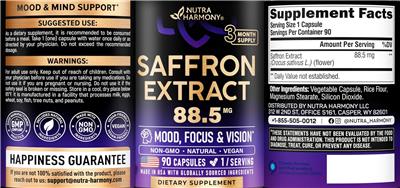
Saffron Extract 88.5 mg by Nutra Harmony label
The label scan from the NIH Dietary Supplement Label Database. Tap to enlarge.
Label images are published by the NIH Dietary Supplement Label Database for the version of this product on file. Always read your actual product label.
View the full label (PDF)The Ingredients in Saffron Extract 88.5 mg by Nutra Harmony
This is the 1 active ingredient this product is made of. Select it to open its full monograph.
Serving size1 Capsule(s) Dosage formCapsule Servings per container90 Amounts shown are per serving.
Saffron Flower Extract
Interacts with521 drugs
Saffron is a costly spice that has shown promise in early studies for mild-to-moderate depression and some mood and PMS symptoms, but most research us...
Saffron Flower Extract monograph & interactionsOther (inactive) ingredients: Vegetable Capsule, Rice Flour, Magnesium Stearate, Silicon Dioxide. These complete the product’s ingredient list but are not active constituents.
Saffron Extract 88.5 mg by Nutra Harmony Drug Interactions
HelloPharmacist Interaction Report
Saffron Extract 88.5 mg by Nutra Harmony does interact with several medication types.
The most serious concern is with CNS depressants (sedatives, sleep aids, prescription pain relievers, alcohol). Clinical research shows that saffron extract can cause drowsiness and sedation on its own, and animal studies suggest it may add to the sedative effects of these drugs, potentially making you too drowsy or impairing motor control.
Read the full breakdown — every affected drug type, severity by severity
Saffron also has Moderate interactions with blood pressure medications (antihypertensive drugs), diabetes medications (antidiabetes drugs), and caffeine. It can lower blood pressure further and may increase the risk of low blood sugar (hypoglycemia) when combined with diabetes drugs.
A small study suggests saffron may slow how your body processes caffeine, which could increase caffeine's effects.
Before you start this supplement, check your exact medications with the tool on this page — we need to know what you're actually taking. Altogether, these interactions span 518 individual medications.
Check your own medications below · Editorial policy · How we use AI
Want to check YOUR meds against Saffron Extract 88.5 mg?
Ask about interactions with your drugs in plain English — “Can I take it with lisinopril?” — and we find you the answer in seconds, ingredient by ingredient.
Go to the checkerIngredients driving the most interactions
Individual Drug Interactions
The ingredients in Saffron Extract 88.5 mg interact with 521 drugs. Click any drug to see the details.
1 of the 1 ingredient in Saffron Extract 88.5 mg interact with drugs. Each result below shows which ingredient is responsible. Saffron Flower Extract
AcetazolamideAk-Zol, Diamox
How Acetazolamide interacts with Saffron Extract 88.5 mg — through 1 ingredient. Tap an ingredient for the detail:
Saffron Flower ExtractCns Depressants, Antihypertensive Drugs Moderate
Interaction Summary
Theoretically, concomitant use of saffron and CNS depressants might have additive sedative effects.
Read the full Saffron Flower Extract + Acetazolamide interactionAcetohexamideDymelor
How Acetohexamide interacts with Saffron Extract 88.5 mg — through 1 ingredient. Tap an ingredient for the detail:
Saffron Flower ExtractAntidiabetes Drugs Moderate
Interaction Summary
Theoretically, concomitant use of saffron with antidiabetes drugs might increase the risk of hypoglycemia.
Read the full Saffron Flower Extract + Acetohexamide interactionAlbiglutideTanzeum
How Albiglutide interacts with Saffron Extract 88.5 mg — through 1 ingredient. Tap an ingredient for the detail:
Saffron Flower ExtractAntidiabetes Drugs Moderate
Interaction Summary
Theoretically, concomitant use of saffron with antidiabetes drugs might increase the risk of hypoglycemia.
Read the full Saffron Flower Extract + Albiglutide interactionAlfentanilAlfenta
How Alfentanil interacts with Saffron Extract 88.5 mg — through 1 ingredient. Tap an ingredient for the detail:
Saffron Flower ExtractCns Depressants Moderate
Interaction Summary
Theoretically, concomitant use of saffron and CNS depressants might have additive sedative effects.
Read the full Saffron Flower Extract + Alfentanil interactionAliskirenTekturna
How Aliskiren interacts with Saffron Extract 88.5 mg — through 1 ingredient. Tap an ingredient for the detail:
Saffron Flower ExtractAntihypertensive Drugs Moderate
Interaction Summary
Theoretically, concomitant use of saffron with antihypertensive drugs might have additive effects.
Read the full Saffron Flower Extract + Aliskiren interactionAlogliptinNesina
How Alogliptin interacts with Saffron Extract 88.5 mg — through 1 ingredient. Tap an ingredient for the detail:
Saffron Flower ExtractAntidiabetes Drugs Moderate
Interaction Summary
Theoretically, concomitant use of saffron with antidiabetes drugs might increase the risk of hypoglycemia.
Read the full Saffron Flower Extract + Alogliptin interactionAlogliptin, MetforminKazano
How Alogliptin, Metformin interacts with Saffron Extract 88.5 mg — through 1 ingredient. Tap an ingredient for the detail:
Saffron Flower ExtractAntidiabetes Drugs Moderate
Interaction Summary
Theoretically, concomitant use of saffron with antidiabetes drugs might increase the risk of hypoglycemia.
Read the full Saffron Flower Extract + Alogliptin, Metformin interactionAlogliptin, PioglitazoneOseni
How Alogliptin, Pioglitazone interacts with Saffron Extract 88.5 mg — through 1 ingredient. Tap an ingredient for the detail:
Saffron Flower ExtractAntidiabetes Drugs Moderate
Interaction Summary
Theoretically, concomitant use of saffron with antidiabetes drugs might increase the risk of hypoglycemia.
Read the full Saffron Flower Extract + Alogliptin, Pioglitazone interactionAlprazolamNiravam, Xanax
How Alprazolam interacts with Saffron Extract 88.5 mg — through 1 ingredient. Tap an ingredient for the detail:
Saffron Flower ExtractCns Depressants Moderate
Interaction Summary
Theoretically, concomitant use of saffron and CNS depressants might have additive sedative effects.
Read the full Saffron Flower Extract + Alprazolam interactionAluminum Hydroxide, Aspirin, Codeine Phosphate, Magnesium HydroxideAscriptin Codeine #2
How Aluminum Hydroxide, Aspirin, Codeine Phosphate, Magnesium Hydroxide interacts with Saffron Extract 88.5 mg — through 1 ingredient. Tap an ingredient for the detail:
Saffron Flower ExtractCns Depressants Moderate
Interaction Summary
Theoretically, concomitant use of saffron and CNS depressants might have additive sedative effects.
Read the full Saffron Flower Extract + Aluminum Hydroxide, Aspirin, Codeine Phosphate, Magnesium Hydroxide interactionAmbrisentanLetairis, Volibris
How Ambrisentan interacts with Saffron Extract 88.5 mg — through 1 ingredient. Tap an ingredient for the detail:
Saffron Flower ExtractAntihypertensive Drugs Moderate
Interaction Summary
Theoretically, concomitant use of saffron with antihypertensive drugs might have additive effects.
Read the full Saffron Flower Extract + Ambrisentan interactionAmilorideAmilamont, Midamor
How Amiloride interacts with Saffron Extract 88.5 mg — through 1 ingredient. Tap an ingredient for the detail:
Saffron Flower ExtractAntihypertensive Drugs Moderate
Interaction Summary
Theoretically, concomitant use of saffron with antihypertensive drugs might have additive effects.
Read the full Saffron Flower Extract + Amiloride interactionAmiloride, HydrochlorothiazideAmil-Co, Amilzide, Moduret 25, Moduretic
How Amiloride, Hydrochlorothiazide interacts with Saffron Extract 88.5 mg — through 1 ingredient. Tap an ingredient for the detail:
Saffron Flower ExtractAntihypertensive Drugs Moderate
Interaction Summary
Theoretically, concomitant use of saffron with antihypertensive drugs might have additive effects.
Read the full Saffron Flower Extract + Amiloride, Hydrochlorothiazide interactionAminoglutethimideCytadren
How Aminoglutethimide interacts with Saffron Extract 88.5 mg — through 1 ingredient. Tap an ingredient for the detail:
Saffron Flower ExtractCns Depressants Moderate
Interaction Summary
Theoretically, concomitant use of saffron and CNS depressants might have additive sedative effects.
Read the full Saffron Flower Extract + Aminoglutethimide interactionAminophylline, Amobarbital, EphedrineAmesec
How Aminophylline, Amobarbital, Ephedrine interacts with Saffron Extract 88.5 mg — through 1 ingredient. Tap an ingredient for the detail:
Saffron Flower ExtractCns Depressants Moderate
Interaction Summary
Theoretically, concomitant use of saffron and CNS depressants might have additive sedative effects.
Read the full Saffron Flower Extract + Aminophylline, Amobarbital, Ephedrine interactionAmitriptylineElavil
How Amitriptyline interacts with Saffron Extract 88.5 mg — through 1 ingredient. Tap an ingredient for the detail:
Saffron Flower ExtractCns Depressants Moderate
Interaction Summary
Theoretically, concomitant use of saffron and CNS depressants might have additive sedative effects.
Read the full Saffron Flower Extract + Amitriptyline interactionAmitriptyline, ChlordiazepoxideLimbitrol DS
How Amitriptyline, Chlordiazepoxide interacts with Saffron Extract 88.5 mg — through 1 ingredient. Tap an ingredient for the detail:
Saffron Flower ExtractCns Depressants Moderate
Interaction Summary
Theoretically, concomitant use of saffron and CNS depressants might have additive sedative effects.
Read the full Saffron Flower Extract + Amitriptyline, Chlordiazepoxide interactionAmitriptyline, PerphenazineEtrafon, Etrafon-A, Etrafon-Forte, Triavil
How Amitriptyline, Perphenazine interacts with Saffron Extract 88.5 mg — through 1 ingredient. Tap an ingredient for the detail:
Saffron Flower ExtractCns Depressants Moderate
Interaction Summary
Theoretically, concomitant use of saffron and CNS depressants might have additive sedative effects.
Read the full Saffron Flower Extract + Amitriptyline, Perphenazine interactionAmlodipineNorliqva
How Amlodipine interacts with Saffron Extract 88.5 mg — through 1 ingredient. Tap an ingredient for the detail:
Saffron Flower ExtractAntihypertensive Drugs Moderate
Interaction Summary
Theoretically, concomitant use of saffron with antihypertensive drugs might have additive effects.
Read the full Saffron Flower Extract + Amlodipine interactionAmlodipine BenzoateKaterzia
How Amlodipine Benzoate interacts with Saffron Extract 88.5 mg — through 1 ingredient. Tap an ingredient for the detail:
Saffron Flower ExtractAntihypertensive Drugs Moderate
Interaction Summary
Theoretically, concomitant use of saffron with antihypertensive drugs might have additive effects.
Read the full Saffron Flower Extract + Amlodipine Benzoate interactionAmlodipine BesilateIstin
How Amlodipine Besilate interacts with Saffron Extract 88.5 mg — through 1 ingredient. Tap an ingredient for the detail:
Saffron Flower ExtractAntihypertensive Drugs Moderate
Interaction Summary
Theoretically, concomitant use of saffron with antihypertensive drugs might have additive effects.
Read the full Saffron Flower Extract + Amlodipine Besilate interactionAmlodipine BesylateNorvasc
How Amlodipine Besylate interacts with Saffron Extract 88.5 mg — through 1 ingredient. Tap an ingredient for the detail:
Saffron Flower ExtractAntihypertensive Drugs Moderate
Interaction Summary
Theoretically, concomitant use of saffron with antihypertensive drugs might have additive effects.
Read the full Saffron Flower Extract + Amlodipine Besylate interactionAmlodipine Besylate, BenazeprilLotrel
How Amlodipine Besylate, Benazepril interacts with Saffron Extract 88.5 mg — through 1 ingredient. Tap an ingredient for the detail:
Saffron Flower ExtractAntihypertensive Drugs Moderate
Interaction Summary
Theoretically, concomitant use of saffron with antihypertensive drugs might have additive effects.
Read the full Saffron Flower Extract + Amlodipine Besylate, Benazepril interactionAmlodipine, CelecoxibConsensi
How Amlodipine, Celecoxib interacts with Saffron Extract 88.5 mg — through 1 ingredient. Tap an ingredient for the detail:
Saffron Flower ExtractAntihypertensive Drugs Moderate
Interaction Summary
Theoretically, concomitant use of saffron with antihypertensive drugs might have additive effects.
Read the full Saffron Flower Extract + Amlodipine, Celecoxib interactionAmmonium ChlorideAmmonium Chloride
How Ammonium Chloride interacts with Saffron Extract 88.5 mg — through 1 ingredient. Tap an ingredient for the detail:
Saffron Flower ExtractAntihypertensive Drugs Moderate
Interaction Summary
Theoretically, concomitant use of saffron with antihypertensive drugs might have additive effects.
Read the full Saffron Flower Extract + Ammonium Chloride interactionAmobarbitalAmytal
How Amobarbital interacts with Saffron Extract 88.5 mg — through 1 ingredient. Tap an ingredient for the detail:
Saffron Flower ExtractCns Depressants Moderate
Interaction Summary
Theoretically, concomitant use of saffron and CNS depressants might have additive sedative effects.
Read the full Saffron Flower Extract + Amobarbital interactionAmobarbital, Ephedrine SulfateEphedrine & Amytal
How Amobarbital, Ephedrine Sulfate interacts with Saffron Extract 88.5 mg — through 1 ingredient. Tap an ingredient for the detail:
Saffron Flower ExtractCns Depressants Moderate
Interaction Summary
Theoretically, concomitant use of saffron and CNS depressants might have additive sedative effects.
Read the full Saffron Flower Extract + Amobarbital, Ephedrine Sulfate interactionAmobarbital, SecobarbitalTuinal
How Amobarbital, Secobarbital interacts with Saffron Extract 88.5 mg — through 1 ingredient. Tap an ingredient for the detail:
Saffron Flower ExtractCns Depressants Moderate
Interaction Summary
Theoretically, concomitant use of saffron and CNS depressants might have additive sedative effects.
Read the full Saffron Flower Extract + Amobarbital, Secobarbital interactionAntidiabetes, Dipeptidyl Peptidase-4 (dpp-iv) InhibitorGlyxambi
How Antidiabetes, Dipeptidyl Peptidase-4 (dpp-iv) Inhibitor interacts with Saffron Extract 88.5 mg — through 1 ingredient. Tap an ingredient for the detail:
Saffron Flower ExtractAntidiabetes Drugs Moderate
Interaction Summary
Theoretically, concomitant use of saffron with antidiabetes drugs might increase the risk of hypoglycemia.
Read the full Saffron Flower Extract + Antidiabetes, Dipeptidyl Peptidase-4 (dpp-iv) Inhibitor interactionAprobarbital, Butabarbital, PhenobarbitalTriple Barbital
How Aprobarbital, Butabarbital, Phenobarbital interacts with Saffron Extract 88.5 mg — through 1 ingredient. Tap an ingredient for the detail:
Saffron Flower ExtractCns Depressants Moderate
Interaction Summary
Theoretically, concomitant use of saffron and CNS depressants might have additive sedative effects.
Read the full Saffron Flower Extract + Aprobarbital, Butabarbital, Phenobarbital interactionEach ingredient & the kinds of drugs it affects
For each ingredient in Saffron Extract 88.5 mg with known interactions, here are the types of medications it can affect. Open any type for the detail — or search your exact drug in the checker above.
Saffron Flower Extract
Antidiabetes Drugs
Theoretically, concomitant use of saffron with antidiabetes drugs might increase the risk of hypoglycemia.
Some clinical research shows that taking saffron extract reduces fasting levels of glucose when used in addition to hypoglycemic agents. However, saffron powder itself has not been shown to reduce fasting glucose levels.
Antihypertensive Drugs
Theoretically, concomitant use of saffron with antihypertensive drugs might have additive effects.
Animal and human research suggests that saffron extract can decrease blood pressure.
Caffeine
Theoretically, saffron might inhibit the metabolism of caffeine.
A small clinical study suggests that taking saffron powder 300 mg in 150 mL water daily for 5 days and then taking caffeine 200 mg seems to reduce caffeine metabolite levels in the saliva and urine in males, but not females. Theoretically, this may be due to the inhibition of cytochrome P450 1A2 by saffron.
Cns Depressants
Theoretically, concomitant use of saffron and CNS depressants might have additive sedative effects.
Clinical research shows that taking saffron extract 60 mg orally daily for 26 weeks can cause drowsiness and sedation. Animal research suggests that adding saffron to hexobarbital further increases sleeping and slows motor activity.
Brand information
Manufacturer and brand details for Saffron Extract 88.5 mg, from the product label.
Nutra Harmony
See all Nutra Harmony products- Name
- Nutra Harmony LLC
- Street Address
- 312 W 2nd St, Office 5161
- City
- Casper
- State
- WY
- ZipCode
- 82601
- Phone Number
- 1-855-505-0012
Saffron Extract 88.5 mg by Nutra Harmony: Common Questions
Does Saffron Extract 88.5 mg by Nutra Harmony interact with any medications?
How can one product interact with so many drugs?
Where does this information come from?
Can I take this if I'm pregnant or breastfeeding?
What are the most common side effects I might notice?
Is this product safe for people with allergies to saffron?
Will this really help with Alzheimer disease or nerve pain?
What exactly is saffron extract?
Can I take this with my caffeine?
Written and reviewed by the HelloPharmacist editorial staff. Our editorial policy
Not sure if Saffron Extract 88.5 mg is safe with your meds?
Our pharmacists answer your medication & supplement questions — free.
Label information is sourced from the NIH Dietary Supplement Label Database and reflects the product version on file; always read your actual product label. This page is for education only and is not a substitute for professional medical advice. Confirm with your pharmacist or doctor before combining supplements and medications.
The Full Monographs Behind Saffron Extract 88.5 mg’s Ingredients
Every ingredient we hold a full HelloPharmacist monograph for — uses, evidence, safety, and the complete interaction list.
Sources & How We Checked
Saffron Extract 88.5 mg's label data comes from the NIH Dietary Supplement Label Database; the ingredient interaction data is from the Natural Medicines database, reviewed by our pharmacists.
- NIH Dietary Supplement Label Database (DSLD) — The official product label on file for this supplement.
- Natural Medicines (Therapeutic Research Center) — Evidence-graded clinical reference behind the ingredient interaction data.
Content is written and reviewed by licensed HelloPharmacist pharmacists. See our data sources and editorial standards for how this information is built and checked.
The 22 references behind this product’s interaction data
Every citation that drives the interaction findings for this product’s ingredients, from the evidence-graded Natural Medicines (TRC Healthcare) database. Open an ingredient to browse its citations — links open the study on PubMed or the publisher’s site.
Saffron 22 references
- Blumenthal M, ed. The Complete German Commission E Monographs: Therapeutic Guide to Herbal Medicines. Trans. S. Klein. Boston, MA: American Botanical Council, 1998.
- Leung AY, Foster S. Encyclopedia of Common Natural Ingredients Used in Food, Drugs and Cosmetics. 2nd ed. New York, NY: John Wiley & Sons, 1996.
- Gruenwald J, Brendler T, Jaenicke C. PDR for Herbal Medicines. 1st ed. Montvale, NJ: Medical Economics Company, Inc., 1998.
- Feo F, Martinez J, Martinez A, et al. Occupational allergy in saffron workers. Allergy 1997;52:633-41. PubMed
- Wuthrich B, Schmid-Grendelmeyer P, Lundberg M. Anaphylaxis to saffron. Allergy 1997;52:476-7. PubMed
- Akhondzadeh S, Tahmacebi-Pour N, Noorbala AA, et al. Crocus sativus L. in the treatment of mild to moderate depression: a double-blind, randomized and placebo-controlled trial. Phytother Res 2005;19:148-51.
- Safarinejad MR, Shafiei N, Safarinejad S. A prospective double-blind randomized placebo-controlled study of the effect of saffron (Crocus sativus Linn.) on semen parameters and seminal plasma antioxidant capacity in infertile men with idiopathic oligoasth
- Fatehi, M., Rashidabady, T., and Fatehi-Hassanabad, Z. Effects of Crocus sativus petals' extract on rat blood pressure and on responses induced by electrical field stimulation in the rat isolated vas deferens and guinea-pig ileum. J Ethnopharmacol. 2003; PubMed
- Modaghegh, M. H., Shahabian, M., Esmaeili, H. A., Rajbai, O., and Hosseinzadeh, H. Safety evaluation of saffron (Crocus sativus) tablets in healthy volunteers. Phytomedicine. 2008;15(12):1032-1037. PubMed
- Imenshahidi, M., Hosseinzadeh, H., and Javadpour, Y. Hypotensive effect of aqueous saffron extract (Crocus sativus L.) and its constituents, safranal and crocin, in normotensive and hypertensive rats. Phytother.Res 12-9-2009;
- Zhang, Y., Shoyama, Y., Sugiura, M., and Saito, H. Effects of Crocus sativus L. on the ethanol-induced impairment of passive avoidance performances in mice. Biol.Pharm Bull. 1994;17(2):217-221. PubMed
- Wuthrich, B., Schmid-Grendelmeyer, P., and Lundberg, M. Anaphylaxis to saffron. Allergy 1997;52(4):476-477. PubMed
- Akhondzadeh S, Sabet MS, Harirchian MH, Togha M, Cheraghmakani H, Razeghi S, Hejazi SSh, Yousefi MH, Alimardani R, Jamshidi A, Zare F, Moradi A. Saffron in the treatment of patients with mild to moderate Alzheimer's disease: a 16-week, randomized and plac
- Kashani L, Eslatmanesh S, Saedi N, Niroomand N, Ebrahimi M, Hosseinian M, Foroughifar T, Salimi S, Akhondzadeh S. Comparison of Saffron versus Fluoxetine in Treatment of Mild to Moderate Postpartum Depression: A Double-Blind, Randomized Clinical Trial. Ph PubMed
- Kianbakht S, Ghazavi A. Immunomodulatory effects of saffron: a randomized double-blind placebo-controlled clinical trial. Phytother Res. 2011 Dec;25(12):1801-5. PubMed
- Mazidi M, Shemshian M, Mousavi SH, Norouzy A, Kermani T, Moghiman T, Sadeghi A, Mokhber N, Ghayour-Mobarhan M, Ferns GA. A double-blind, randomized and placebo-controlled trial of Saffron (Crocus sativus L.) in the treatment of anxiety and depression. J C
- Safarinejad MR, Shafiei N, Safarinejad S. An open label, randomized, fixed-dose, crossover study comparing efficacy and safety of sildenafil citrate and saffron (Crocus sativus Linn.) for treating erectile dysfunction in men naïve to treatment. Int J Impo PubMed
- Talaei A, Hassanpour Moghadam M, Sajadi Tabassi SA, Mohajeri SA. Crocin, the main active saffron constituent, as an adjunctive treatment in major depressive disorder: a randomized, double-blind, placebo-controlled, pilot clinical trial. J Affect Disord. 2 PubMed
- Azimi P, Ghiasvand R Feizi A, Hariri M, Abbasi B. Effects of cinnamon, cardamom, saffron, and ginger consumption on markers of glycemic control, lipid profile, oxidative stress, and inflammation in type 2 diabetes. Rev Diabet Stud. 2014 Fall-Winter;11(3-4
- Begas E, Bounitsi M, Kilindris T, et al. Effects of short-term saffron (Crocus sativus L.) intake on the in vivo activities of xenobiotic metabolizing enzymes in healthy volunteers. Food Chem Toxicol. 2019;130:32-43. PubMed
- Moravej Aleali A, Amani R, Shahbazian H, Namjooyan F, Latifi SM, Cheraghian B. The effect of hydroalcoholic Saffron (Crocus sativus L.) extract on fasting plasma glucose, HbA1c, lipid profile, liver, and renal function tests in patients with type 2 diabet
- Abbaszadeh-Mashkani S, Hoque SS, Banafshe HR, Ghaderi A. The effect of crocin (the main active saffron constituent) on the cognitive functions, craving, and withdrawal syndrome in opioid patients under methadone maintenance treatment. Phytother Res. 2021; PubMed
Parts of this content are provided by the Therapeutic Research Center, LLC.
DISCLAIMER: Currently this does not check for drug-drug interactions. This is not an all-inclusive comprehensive list of potential interactions and is for informational purposes only. Not all interactions are known or well-reported in the scientific literature, and new interactions are continually being reported. Input is needed from a qualified healthcare provider including a pharmacist before starting any therapy. Application of clinical judgment is necessary.
© 2021 Therapeutic Research Center, LLC