
Saffron Gummies Natural Apple Flavored Ingredients & Drug Interactions
What is this page for?
First and foremost: checking Saffron Gummies Natural Apple Flavored against your medications. The heart of this page is the interaction checker and the full interaction report — how this product’s ingredients may interact with prescription and over-the-counter medicines you may be taking.
Around that, we add a pharmacist’s high-level view of the product as a whole — what’s inside, the evidence for its stated use, how transparent the label is, and what safety data exists — so you can see the full picture in one place. It’s educational information from our licensed clinical databases and the clinical staff at HelloPharmacist — not medical advice — and we don’t sell or endorse products. Our editorial policy
Saffron Gummies Natural Apple Flavored is a dietary supplement by Flamingo Supplements with 4 active ingredients. Its ingredients are commonly taken for fatigue and low energy, stress and coping (adaptogen), mental performance and focus.Based on those ingredients, 1,284 medications have a known interaction with it, the most serious rated moderate. The ingredients most likely to interact are Rhodiola rosea Extract, Saffron Extract, Gamma Aminobutyric Acid. Use the checker below to test your specific medication, or read the full HelloPharmacist Interaction Report.
Check Your Meds Against Saffron Gummies Natural Apple Flavored by Flamingo Supplements
Ask about any prescription or over-the-counter medication and we check it for interactions with Saffron Gummies Natural Apple Flavored by Flamingo Supplements — and tell you which ingredient is responsible.
AI summaries are generated from our interaction database for education only — always confirm with your pharmacist. How we use AI
Ask the Pharmacist
A licensed pharmacist will answer your question by email — free, usually within 24 hours.
Got it — thank you!
A licensed pharmacist will answer within 24 hours. Keep an eye on your email (worth checking spam, just in case).
HelloPharmacist Scorecard of Saffron Gummies Natural Apple Flavored by Flamingo Supplements
Our pharmacy team’s full take, with four database checks built into the cards below — a summary of what is known, not a grade of the product itself.
What’s inside
Full disclosure
Saffron Gummies Natural Apple Flavored contains four active ingredients. Rhodiola rosea extract is an herbal adaptogen.
Gamma-aminobutyric acid, or GABA, is a natural brain chemical involved in relaxation. Lemon balm extract comes from the lemon balm plant.
Saffron extract is derived from the saffron crocus flower. The gummies also contain inactive ingredients—glucose syrup, beet sugar, water, citric acid, pectin, trisodium citrate, coconut oil, turmeric, natural apple flavor, spirulina, and carnauba wax—which serve as sweeteners, thickeners, and coatings.
Does it work?
Moderate evidence
The evidence we hold is mixed and limited. Lemon balm extract is rated possibly effective for cold sores, stress, and depression.
Saffron extract is rated possibly effective for chemotherapy-induced nerve pain (peripheral neuropathy) and Alzheimer disease. However, rhodiola rosea extract and GABA are both rated as having insufficient reliable evidence for the conditions we have data on—including altitude sickness, anxiety, athletic performance, ADHD, and others.
That means the science doesn't yet support using either of these ingredients for those purposes, based on our current records.
How safe is it?
Well-documented data
Rhodiola and GABA are generally well tolerated for short-term use, but long-term safety isn't well studied for either. Common side effects of rhodiola include dizziness and changes in saliva production.
GABA may cause drowsiness, stomach upset, nausea, muscle weakness, or a minor burning feeling in the throat. Lemon balm is generally well tolerated, though high doses and long-term safety aren't established; dizziness and sedation have been reported but don't appear more frequent than placebo.
Saffron is likely safe in food amounts but can be toxic at high supplement doses; common side effects include nausea, vomiting, and sedation. Regarding pregnancy and breastfeeding: rhodiola should be avoided during pregnancy and breastfeeding due to insufficient safety data.
Saffron is likely unsafe in medicinal amounts during pregnancy because it may stimulate the uterus; breastfeeding safety isn't reliably documented. Lemon balm should be avoided during pregnancy unless your doctor advises otherwise, and caution is warranted while breastfeeding.
GABA has insufficient safety information—avoid during pregnancy unless your doctor advises otherwise, and avoid supplement amounts while breastfeeding. Talk with your doctor or pharmacist about your individual situation if you're pregnant, planning pregnancy, or breastfeeding.
Meds to double-check
Moderate interaction found
Check your medications against this product if you take any of the following: blood pressure medications (antihypertensive drugs)—rhodiola, GABA, and saffron all may lower blood pressure further. Sedatives, sleep aids, or anti-anxiety medications (CNS depressants)—GABA, lemon balm, and saffron may increase drowsiness.
Diabetes medications (antidiabetes drugs)—rhodiola and saffron may increase the risk of low blood sugar. Blood thinners and other drugs processed by liver enzyme CYP2C9, including losartan.
Thyroid hormone replacement therapy—lemon balm may interfere. Caffeine supplements or high-dose caffeine—saffron may raise caffeine levels.
Immunosuppressants—rhodiola may reduce their effectiveness. Talk with your doctor or pharmacist before combining this product with any prescription or over-the-counter medication.
The bottom line
Scorecard at a glanceFully disclosed formula with some supporting evidence behind its ingredients' uses. Moderate medication interactions have been identified, and safety information is well characterized.
This product may help with cold sores, stress, or depression based on lemon balm and saffron content, though the overall evidence is limited. However, if you take blood pressure medications, sedatives, diabetes drugs, thyroid medications, or caffeine supplements, you need to check with your doctor or pharmacist first—the interactions are real and potentially serious.
Short-term use appears generally well tolerated, but long-term safety data is sparse. Make the call with your own healthcare provider based on your medications and health needs.
Educational only — not medical advice; always confirm with your pharmacist. Our editorial policy · How we use AI
Assessment coverage: 4 of 4 active ingredients matched to our full ingredient reviews (monographs). Based on the product label dated Sep 25, 2024.
This Scorecard evaluates available label information, ingredient evidence, and known medication-safety considerations. It does not independently verify product identity, purity, potency, contamination, or manufacturing quality. How these ratings are computed
General information
Key facts about Saffron Gummies Natural Apple Flavored, straight from the product label.
| Brand | Flamingo Supplements |
|---|---|
| Barcode (UPC) | X002YBL643 |
| Net contents | 60 Natural Apple Flavored Gummy(ies) |
| Market status | On market |
| Date entered into DSLD | Sep 25, 2024 |
| DSLD ID | 314629 |
| Product type | Other Combinations |
| Supplement form | Gummy Or Jelly |
| Dietary claims / uses | All Other, Structure/Function |
| Intended target group(s) | Adult (18 - 50 Years), Gluten Free, Dairy Free |
Everything in this section is reproduced from the manufacturer’s own product label — it’s the label speaking, not HelloPharmacist. We show it so you can see exactly what the maker states; we don’t verify or endorse those statements.
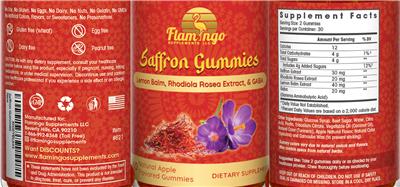
Supplement Facts
The label details for Saffron Gummies Natural Apple Flavored by Flamingo Supplements, sourced from the NIH Dietary Supplement Label Database.
Supplement Facts
| Ingredient | Amount | % DV |
|---|---|---|
| Calories | 12 Calorie(s) | -- |
| Total Carbohydrates | 4 Gram(s) | 1% |
| Added Sugars | 4 Gram(s) | 12% |
| Total Sugars | 4 Gram(s) | -- |
| Rhodiola rosea Extract | 20 mg | -- |
| Gamma Aminobutyric Acid | 20 mg | -- |
| Lemon Balm extract | 40 mg | -- |
| Saffron Extract | 30 mg | -- |
Other ingredients: Glucose Syrup, Beet Sugar, Water, Citric Acid, Pectin, Trisodium Citrate, Coconut Oil, Turmeric, Apple Flavor, Natural, Spirulina, Carnauba Wax
Tap any ingredient to jump to its full detail below.
These statements are the manufacturer’s wording, reproduced from the product label — the label is saying it, not HelloPharmacist. We don’t verify or endorse them.
Formulation
No soy, no gluten, no eggs, no dairy, no nuts, no gelatin, no GMOs No artificial colors, flavors, or sweeteners, no preservatives. Gluten free (wheat) Dairy free Egg free Peanut free
Gummy colors vary due to natural colors and flavors. May contain specs from natural herbs.
Precautions
Caution: As with any dietary supplement, consult your healthcare provider before using this product, especially if pregnant, nursing, taking medications, or under medical supervision.
Discontinue use and contact your healthcare professional if you experience a side effect or an allergic reaction.
Keep out of reach of children.
Do not use if safety seal is damaged or missing.
Seals/Symbols
Registered cGMP
General Statements
New Instagram @flamingosupplements Want discounts? Scan QR or go to www.flamingosupplements.com
FDA Disclaimer Statement
These statements have not been evaluated by the Food and Drug Administration. This product is not intended to diagnose, treat, cure, or prevent any disease.
Formula
Lemon balm, Rhodiola Rosea Extract, & GABA
FDA Statement of Identity
Dietary Supplement
Suggested/Recommended/Usage/Directions
Suggested use: Take 2 gummies daily or as directed by your healthcare provider. Chew thoroughly before swallowing.
Storage
Store in a cool, dry place.
Is this label outdated? Report a formula or label change and our pharmacy team will review it.
Saffron Gummies Natural Apple Flavored by Flamingo Supplements label
The label scan from the NIH Dietary Supplement Label Database. Tap to enlarge.
Label images are published by the NIH Dietary Supplement Label Database for the version of this product on file. Always read your actual product label.
View the full label (PDF)The Ingredients in Saffron Gummies Natural Apple Flavored by Flamingo Supplements
These are the 4 active ingredients this product is made of. Select any to open its full monograph.
Serving size2 Gummy(ies) Dosage formGummy Or Jelly Servings per container30 Amounts shown are per serving.
Most supplement products combine several ingredients, and a medication can interact with the product through any one of them. Each ingredient below shows whether it has known drug interactions.
Rhodiola rosea Extract
Interacts with1,271 drugs
Rhodiola is an herb traditionally used to fight fatigue and help the body cope with stress. Some small studies suggest it may modestly reduce fatigue...
Rhodiola rosea Extract monograph & interactionsGamma Aminobutyric Acid
Interacts with419 drugs
GABA is a calming chemical messenger (neurotransmitter) that your body makes on its own, and it is sold as a supplement for stress, anxiety, and sleep...
Gamma Aminobutyric Acid monograph & interactionsLemon Balm extract
Interacts with264 drugs
Lemon balm is a gentle, lemon-scented mint-family herb traditionally used to ease stress, support sleep, and calm digestion, and topically for cold so...
Lemon Balm extract monograph & interactionsSaffron Extract
Interacts with521 drugs
Saffron is a costly spice that has shown promise in early studies for mild-to-moderate depression and some mood and PMS symptoms, but most research us...
Saffron Extract monograph & interactionsOther (inactive) ingredients: Glucose Syrup, Beet Sugar, Water, Citric Acid, Pectin, Trisodium Citrate, Coconut Oil, Turmeric, Apple Flavor, Natural, Spirulina, Carnauba Wax. These complete the product’s ingredient list but are not active constituents.
Saffron Gummies Natural Apple Flavored by Flamingo Supplements Drug Interactions
HelloPharmacist Interaction Report
Saffron Gummies Natural Apple Flavored by Flamingo Supplements contains four active ingredients—rhodiola rosea extract, gamma-aminobutyric acid (GABA), lemon balm extract, and saffron extract—that together interact with a range of medications.
The most serious interaction we've documented is Moderate severity: rhodiola, GABA, and saffron all may lower blood pressure when combined with antihypertensive drugs (blood pressure medications), potentially causing dangerously low blood pressure.
Read the full breakdown — every affected drug type, severity by severity
Rhodiola also interacts with several drug-metabolizing pathways. It may raise levels of drugs broken down by the liver enzyme CYP2C9, including losartan (a blood pressure medication), as well as drugs handled by other liver enzymes.
It may also interact with immunosuppressants, antidiabetes drugs (raising the risk of low blood sugar), and P-glycoprotein substrates (drugs pumped out of cells by a protective transport system). GABA and lemon balm both carry a Moderate interaction with CNS depressants (sedatives, sleep aids, anxiety medications)—additive drowsiness is a concern.
Saffron extract adds Moderate interactions with antidiabetes drugs and caffeine; saffron may increase caffeine levels in the body. Lemon balm may interfere with thyroid hormone replacement therapy.
Altogether, these interactions span 1,285 individual medications.
Before starting this product, run your exact medications through the search tool on this page or check with your doctor or pharmacist—especially if you take blood pressure medications, sedatives, diabetes drugs, thyroid hormones, or caffeine supplements.
Check your own medications below · Editorial policy · How we use AI
Want to check YOUR meds against Saffron Gummies Natural Apple Flavored?
Ask about interactions with your drugs in plain English — “Can I take it with lisinopril?” — and we find you the answer in seconds, ingredient by ingredient.
Go to the checkerIngredients driving the most interactions
Individual Drug Interactions
The ingredients in Saffron Gummies Natural Apple Flavored interact with 1,284 drugs. Click any drug to see the details.
4 of the 4 ingredients in Saffron Gummies Natural Apple Flavored interact with drugs. Each result below shows which ingredient is responsible. Rhodiola rosea Extract Saffron Extract Gamma Aminobutyric Acid Lemon Balm extract
6-mercaptopurinePurinethol
How 6-mercaptopurine interacts with Saffron Gummies Natural Apple Flavored — through 1 ingredient. Tap an ingredient for the detail:
Rhodiola Rosea ExtractImmunosuppressants Moderate
Interaction Summary
Theoretically, rhodiola use might interfere with immunosuppressive therapy.
Read the full Rhodiola Rosea Extract + 6-mercaptopurine interactionAbrocitinibCibinqo
How Abrocitinib interacts with Saffron Gummies Natural Apple Flavored — through 1 ingredient. Tap an ingredient for the detail:
Rhodiola Rosea ExtractCytochrome P450 2c9 (cyp2c9) Substrates, Immunosuppressants Moderate
Interaction Summary
Theoretically, rhodiola might increase levels of drugs metabolized by CYP2C9.
Read the full Rhodiola Rosea Extract + Abrocitinib interactionAcalabrutinibCalquence
How Acalabrutinib interacts with Saffron Gummies Natural Apple Flavored — through 1 ingredient. Tap an ingredient for the detail:
Rhodiola Rosea ExtractCytochrome P450 3a4 (cyp3a4) Substrates, P-glycoprotein Substrates Moderate
Interaction Summary
Theoretically, rhodiola might increase levels of drugs metabolized by CYP3A4.
Read the full Rhodiola Rosea Extract + Acalabrutinib interactionAcarboseGlucobay, Prandase, Precose
How Acarbose interacts with Saffron Gummies Natural Apple Flavored — through 2 ingredients. Tap an ingredient for the detail:
Saffron ExtractAntidiabetes Drugs Moderate
Interaction Summary
Theoretically, concomitant use of saffron with antidiabetes drugs might increase the risk of hypoglycemia.
Read the full Saffron Extract + Acarbose interactionRhodiola Rosea ExtractAntidiabetes Drugs Moderate
Interaction Summary
Theoretically, taking rhodiola with antidiabetes drugs might increase the risk of hypoglycemia.
Read the full Rhodiola Rosea Extract + Acarbose interactionAcebutololRhotral, Sectral
How Acebutolol interacts with Saffron Gummies Natural Apple Flavored — through 3 ingredients. Tap an ingredient for the detail:
Saffron ExtractAntihypertensive Drugs Moderate
Interaction Summary
Theoretically, concomitant use of saffron with antihypertensive drugs might have additive effects.
Read the full Saffron Extract + Acebutolol interactionGamma Aminobutyric AcidAntihypertensive Drugs Moderate
Interaction Summary
Theoretically, taking GABA with antihypertensive drugs might increase the risk of hypotension.
Read the full Gamma Aminobutyric Acid + Acebutolol interactionRhodiola Rosea ExtractAntihypertensive Drugs Moderate
Interaction Summary
Theoretically, taking rhodiola with antihypertensive drugs might increase the risk of hypotension.
Read the full Rhodiola Rosea Extract + Acebutolol interactionAcepromazineAtravet
How Acepromazine interacts with Saffron Gummies Natural Apple Flavored — through 4 ingredients. Tap an ingredient for the detail:
Lemon Balm ExtractCns Depressants Moderate
Interaction Summary
Theoretically, concomitant use of lemon balm might have additive effects with CNS depressant drugs.
Read the full Lemon Balm Extract + Acepromazine interactionSaffron ExtractCns Depressants Moderate
Interaction Summary
Theoretically, concomitant use of saffron and CNS depressants might have additive sedative effects.
Read the full Saffron Extract + Acepromazine interactionGamma Aminobutyric AcidCns Depressants Minor
Interaction Summary
Theoretically, GABA might have additive sedative effects when used in conjunction with CNS depressants.
Read the full Gamma Aminobutyric Acid + Acepromazine interactionRhodiola Rosea ExtractCns Depressants Minor
Interaction Summary
Theoretically, rhodiola might increase the risk of adverse effects when taken with CNS depressants.
Read the full Rhodiola Rosea Extract + Acepromazine interactionAcetaminophen, Aspirin, CaffeineExcedrin, Excedrin Extra Strength, Excedrin Migraine
How Acetaminophen, Aspirin, Caffeine interacts with Saffron Gummies Natural Apple Flavored — through 2 ingredients. Tap an ingredient for the detail:
Saffron ExtractCaffeine Moderate
Interaction Summary
Theoretically, saffron might inhibit the metabolism of caffeine.
Read the full Saffron Extract + Acetaminophen, Aspirin, Caffeine interactionRhodiola Rosea ExtractCytochrome P450 1a2 (cyp1a2) Substrates, Cytochrome P450 3a4 (cyp3a4) Substrates Minor
Interaction Summary
Theoretically, rhodiola might increase levels of drugs metabolized by CYP1A2.
Read the full Rhodiola Rosea Extract + Acetaminophen, Aspirin, Caffeine interactionAcetaminophen, Butalbital, CaffeineEsgic, Esgic Plus, Fiogesic, Fioricet, Repan, Tecnal +1 more
How Acetaminophen, Butalbital, Caffeine interacts with Saffron Gummies Natural Apple Flavored — through 2 ingredients. Tap an ingredient for the detail:
Saffron ExtractCaffeine Moderate
Interaction Summary
Theoretically, saffron might inhibit the metabolism of caffeine.
Read the full Saffron Extract + Acetaminophen, Butalbital, Caffeine interactionRhodiola Rosea ExtractCytochrome P450 1a2 (cyp1a2) Substrates, Cytochrome P450 3a4 (cyp3a4) Substrates Minor
Interaction Summary
Theoretically, rhodiola might increase levels of drugs metabolized by CYP1A2.
Read the full Rhodiola Rosea Extract + Acetaminophen, Butalbital, Caffeine interactionAcetaminophen, Butalbital, Caffeine, CodeineEsgic with Codeine, Fioricet w/ Codeine
How Acetaminophen, Butalbital, Caffeine, Codeine interacts with Saffron Gummies Natural Apple Flavored — through 4 ingredients. Tap an ingredient for the detail:
Saffron ExtractCaffeine, Cns Depressants Moderate
Interaction Summary
Theoretically, saffron might inhibit the metabolism of caffeine.
Read the full Saffron Extract + Acetaminophen, Butalbital, Caffeine, Codeine interactionLemon Balm ExtractCns Depressants Moderate
Interaction Summary
Theoretically, concomitant use of lemon balm might have additive effects with CNS depressant drugs.
Read the full Lemon Balm Extract + Acetaminophen, Butalbital, Caffeine, Codeine interactionRhodiola Rosea ExtractCytochrome P450 3a4 (cyp3a4) Substrates, Cytochrome P450 1a2 (cyp1a2) Substrates +1 Minor
Interaction Summary
Theoretically, rhodiola might increase levels of drugs metabolized by CYP3A4.
Read the full Rhodiola Rosea Extract + Acetaminophen, Butalbital, Caffeine, Codeine interactionGamma Aminobutyric AcidCns Depressants Minor
Interaction Summary
Theoretically, GABA might have additive sedative effects when used in conjunction with CNS depressants.
Read the full Gamma Aminobutyric Acid + Acetaminophen, Butalbital, Caffeine, Codeine interactionAcetaminophen, Butalbital, CodeineBancap w/ Codeine
How Acetaminophen, Butalbital, Codeine interacts with Saffron Gummies Natural Apple Flavored — through 4 ingredients. Tap an ingredient for the detail:
Saffron ExtractCns Depressants Moderate
Interaction Summary
Theoretically, concomitant use of saffron and CNS depressants might have additive sedative effects.
Read the full Saffron Extract + Acetaminophen, Butalbital, Codeine interactionLemon Balm ExtractCns Depressants Moderate
Interaction Summary
Theoretically, concomitant use of lemon balm might have additive effects with CNS depressant drugs.
Read the full Lemon Balm Extract + Acetaminophen, Butalbital, Codeine interactionGamma Aminobutyric AcidCns Depressants Minor
Interaction Summary
Theoretically, GABA might have additive sedative effects when used in conjunction with CNS depressants.
Read the full Gamma Aminobutyric Acid + Acetaminophen, Butalbital, Codeine interactionRhodiola Rosea ExtractCytochrome P450 1a2 (cyp1a2) Substrates, Cns Depressants Minor
Interaction Summary
Theoretically, rhodiola might increase levels of drugs metabolized by CYP1A2.
Read the full Rhodiola Rosea Extract + Acetaminophen, Butalbital, Codeine interactionAcetaminophen, Butalbital, Codeine PhosphatePhrenilin #3
How Acetaminophen, Butalbital, Codeine Phosphate interacts with Saffron Gummies Natural Apple Flavored — through 4 ingredients. Tap an ingredient for the detail:
Lemon Balm ExtractCns Depressants Moderate
Interaction Summary
Theoretically, concomitant use of lemon balm might have additive effects with CNS depressant drugs.
Read the full Lemon Balm Extract + Acetaminophen, Butalbital, Codeine Phosphate interactionSaffron ExtractCns Depressants Moderate
Interaction Summary
Theoretically, concomitant use of saffron and CNS depressants might have additive sedative effects.
Read the full Saffron Extract + Acetaminophen, Butalbital, Codeine Phosphate interactionRhodiola Rosea ExtractCns Depressants, Cytochrome P450 1a2 (cyp1a2) Substrates Minor
Interaction Summary
Theoretically, rhodiola might increase the risk of adverse effects when taken with CNS depressants.
Read the full Rhodiola Rosea Extract + Acetaminophen, Butalbital, Codeine Phosphate interactionGamma Aminobutyric AcidCns Depressants Minor
Interaction Summary
Theoretically, GABA might have additive sedative effects when used in conjunction with CNS depressants.
Read the full Gamma Aminobutyric Acid + Acetaminophen, Butalbital, Codeine Phosphate interactionAcetaminophen, Caffeine, Chlorpheniramine, Hydrocodone, PhenylephrineHycomine Compound
How Acetaminophen, Caffeine, Chlorpheniramine, Hydrocodone, Phenylephrine interacts with Saffron Gummies Natural Apple Flavored — through 4 ingredients. Tap an ingredient for the detail:
Saffron ExtractCns Depressants, Caffeine Moderate
Interaction Summary
Theoretically, concomitant use of saffron and CNS depressants might have additive sedative effects.
Read the full Saffron Extract + Acetaminophen, Caffeine, Chlorpheniramine, Hydrocodone, Phenylephrine interactionLemon Balm ExtractCns Depressants Moderate
Interaction Summary
Theoretically, concomitant use of lemon balm might have additive effects with CNS depressant drugs.
Read the full Lemon Balm Extract + Acetaminophen, Caffeine, Chlorpheniramine, Hydrocodone, Phenylephrine interactionRhodiola Rosea ExtractCns Depressants, Cytochrome P450 3a4 (cyp3a4) Substrates +1 Minor
Interaction Summary
Theoretically, rhodiola might increase the risk of adverse effects when taken with CNS depressants.
Read the full Rhodiola Rosea Extract + Acetaminophen, Caffeine, Chlorpheniramine, Hydrocodone, Phenylephrine interactionGamma Aminobutyric AcidCns Depressants Minor
Interaction Summary
Theoretically, GABA might have additive sedative effects when used in conjunction with CNS depressants.
Read the full Gamma Aminobutyric Acid + Acetaminophen, Caffeine, Chlorpheniramine, Hydrocodone, Phenylephrine interactionAcetaminophen, Caffeine, CodeineGesic C15, Gesic C30, Gesic C8, Lenoltec 1, Lenoltec 2, Lenoltec 3 +1 more
How Acetaminophen, Caffeine, Codeine interacts with Saffron Gummies Natural Apple Flavored — through 4 ingredients. Tap an ingredient for the detail:
Lemon Balm ExtractCns Depressants Moderate
Interaction Summary
Theoretically, concomitant use of lemon balm might have additive effects with CNS depressant drugs.
Read the full Lemon Balm Extract + Acetaminophen, Caffeine, Codeine interactionSaffron ExtractCns Depressants, Caffeine Moderate
Interaction Summary
Theoretically, concomitant use of saffron and CNS depressants might have additive sedative effects.
Read the full Saffron Extract + Acetaminophen, Caffeine, Codeine interactionRhodiola Rosea ExtractCytochrome P450 3a4 (cyp3a4) Substrates, Cns Depressants +1 Minor
Interaction Summary
Theoretically, rhodiola might increase levels of drugs metabolized by CYP3A4.
Read the full Rhodiola Rosea Extract + Acetaminophen, Caffeine, Codeine interactionGamma Aminobutyric AcidCns Depressants Minor
Interaction Summary
Theoretically, GABA might have additive sedative effects when used in conjunction with CNS depressants.
Read the full Gamma Aminobutyric Acid + Acetaminophen, Caffeine, Codeine interactionAcetaminophen, Caffeine, Codeine, SalicylamideCodalan No.1, Codalan No.2, Codalan No.3
How Acetaminophen, Caffeine, Codeine, Salicylamide interacts with Saffron Gummies Natural Apple Flavored — through 4 ingredients. Tap an ingredient for the detail:
Lemon Balm ExtractCns Depressants Moderate
Interaction Summary
Theoretically, concomitant use of lemon balm might have additive effects with CNS depressant drugs.
Read the full Lemon Balm Extract + Acetaminophen, Caffeine, Codeine, Salicylamide interactionSaffron ExtractCaffeine, Cns Depressants Moderate
Interaction Summary
Theoretically, saffron might inhibit the metabolism of caffeine.
Read the full Saffron Extract + Acetaminophen, Caffeine, Codeine, Salicylamide interactionRhodiola Rosea ExtractCytochrome P450 1a2 (cyp1a2) Substrates, Cns Depressants +1 Minor
Interaction Summary
Theoretically, rhodiola might increase levels of drugs metabolized by CYP1A2.
Read the full Rhodiola Rosea Extract + Acetaminophen, Caffeine, Codeine, Salicylamide interactionGamma Aminobutyric AcidCns Depressants Minor
Interaction Summary
Theoretically, GABA might have additive sedative effects when used in conjunction with CNS depressants.
Read the full Gamma Aminobutyric Acid + Acetaminophen, Caffeine, Codeine, Salicylamide interactionAcetaminophen, Caffeine, DihydrocodeineDHC Plus, Panlor DC, Panlor SS
How Acetaminophen, Caffeine, Dihydrocodeine interacts with Saffron Gummies Natural Apple Flavored — through 4 ingredients. Tap an ingredient for the detail:
Saffron ExtractCns Depressants, Caffeine Moderate
Interaction Summary
Theoretically, concomitant use of saffron and CNS depressants might have additive sedative effects.
Read the full Saffron Extract + Acetaminophen, Caffeine, Dihydrocodeine interactionLemon Balm ExtractCns Depressants Moderate
Interaction Summary
Theoretically, concomitant use of lemon balm might have additive effects with CNS depressant drugs.
Read the full Lemon Balm Extract + Acetaminophen, Caffeine, Dihydrocodeine interactionGamma Aminobutyric AcidCns Depressants Minor
Interaction Summary
Theoretically, GABA might have additive sedative effects when used in conjunction with CNS depressants.
Read the full Gamma Aminobutyric Acid + Acetaminophen, Caffeine, Dihydrocodeine interactionRhodiola Rosea ExtractCytochrome P450 3a4 (cyp3a4) Substrates, Cns Depressants +1 Minor
Interaction Summary
Theoretically, rhodiola might increase levels of drugs metabolized by CYP3A4.
Read the full Rhodiola Rosea Extract + Acetaminophen, Caffeine, Dihydrocodeine interactionAcetaminophen, Caffeine, IsomethepteneMigralam
How Acetaminophen, Caffeine, Isometheptene interacts with Saffron Gummies Natural Apple Flavored — through 2 ingredients. Tap an ingredient for the detail:
Saffron ExtractCaffeine Moderate
Interaction Summary
Theoretically, saffron might inhibit the metabolism of caffeine.
Read the full Saffron Extract + Acetaminophen, Caffeine, Isometheptene interactionRhodiola Rosea ExtractCytochrome P450 3a4 (cyp3a4) Substrates, Cytochrome P450 1a2 (cyp1a2) Substrates Minor
Interaction Summary
Theoretically, rhodiola might increase levels of drugs metabolized by CYP3A4.
Read the full Rhodiola Rosea Extract + Acetaminophen, Caffeine, Isometheptene interactionAcetaminophen, Caffeine, PyrilamineMidol Max Strength Menstrual
How Acetaminophen, Caffeine, Pyrilamine interacts with Saffron Gummies Natural Apple Flavored — through 2 ingredients. Tap an ingredient for the detail:
Saffron ExtractCaffeine Moderate
Interaction Summary
Theoretically, saffron might inhibit the metabolism of caffeine.
Read the full Saffron Extract + Acetaminophen, Caffeine, Pyrilamine interactionRhodiola Rosea ExtractCytochrome P450 1a2 (cyp1a2) Substrates, Cytochrome P450 3a4 (cyp3a4) Substrates Minor
Interaction Summary
Theoretically, rhodiola might increase levels of drugs metabolized by CYP1A2.
Read the full Rhodiola Rosea Extract + Acetaminophen, Caffeine, Pyrilamine interactionAcetaminophen, Chlorpheniramine, Codeine, PhenylephrineColrex
How Acetaminophen, Chlorpheniramine, Codeine, Phenylephrine interacts with Saffron Gummies Natural Apple Flavored — through 4 ingredients. Tap an ingredient for the detail:
Lemon Balm ExtractCns Depressants Moderate
Interaction Summary
Theoretically, concomitant use of lemon balm might have additive effects with CNS depressant drugs.
Read the full Lemon Balm Extract + Acetaminophen, Chlorpheniramine, Codeine, Phenylephrine interactionSaffron ExtractCns Depressants Moderate
Interaction Summary
Theoretically, concomitant use of saffron and CNS depressants might have additive sedative effects.
Read the full Saffron Extract + Acetaminophen, Chlorpheniramine, Codeine, Phenylephrine interactionRhodiola Rosea ExtractCytochrome P450 1a2 (cyp1a2) Substrates, Cytochrome P450 3a4 (cyp3a4) Substrates +1 Minor
Interaction Summary
Theoretically, rhodiola might increase levels of drugs metabolized by CYP1A2.
Read the full Rhodiola Rosea Extract + Acetaminophen, Chlorpheniramine, Codeine, Phenylephrine interactionGamma Aminobutyric AcidCns Depressants Minor
Interaction Summary
Theoretically, GABA might have additive sedative effects when used in conjunction with CNS depressants.
Read the full Gamma Aminobutyric Acid + Acetaminophen, Chlorpheniramine, Codeine, Phenylephrine interactionAcetaminophen, Chlorpheniramine, Phenylpropanolamine, OpiumHista-Derfule
How Acetaminophen, Chlorpheniramine, Phenylpropanolamine, Opium interacts with Saffron Gummies Natural Apple Flavored — through 4 ingredients. Tap an ingredient for the detail:
Saffron ExtractCns Depressants Moderate
Interaction Summary
Theoretically, concomitant use of saffron and CNS depressants might have additive sedative effects.
Read the full Saffron Extract + Acetaminophen, Chlorpheniramine, Phenylpropanolamine, Opium interactionLemon Balm ExtractCns Depressants Moderate
Interaction Summary
Theoretically, concomitant use of lemon balm might have additive effects with CNS depressant drugs.
Read the full Lemon Balm Extract + Acetaminophen, Chlorpheniramine, Phenylpropanolamine, Opium interactionRhodiola Rosea ExtractCytochrome P450 3a4 (cyp3a4) Substrates, Cytochrome P450 1a2 (cyp1a2) Substrates +1 Minor
Interaction Summary
Theoretically, rhodiola might increase levels of drugs metabolized by CYP3A4.
Read the full Rhodiola Rosea Extract + Acetaminophen, Chlorpheniramine, Phenylpropanolamine, Opium interactionGamma Aminobutyric AcidCns Depressants Minor
Interaction Summary
Theoretically, GABA might have additive sedative effects when used in conjunction with CNS depressants.
Read the full Gamma Aminobutyric Acid + Acetaminophen, Chlorpheniramine, Phenylpropanolamine, Opium interactionAcetaminophen, Chlorzoxazone, CodeineAcetazone Forte C8, Parafon Forte C8
How Acetaminophen, Chlorzoxazone, Codeine interacts with Saffron Gummies Natural Apple Flavored — through 4 ingredients. Tap an ingredient for the detail:
Saffron ExtractCns Depressants Moderate
Interaction Summary
Theoretically, concomitant use of saffron and CNS depressants might have additive sedative effects.
Read the full Saffron Extract + Acetaminophen, Chlorzoxazone, Codeine interactionLemon Balm ExtractCns Depressants Moderate
Interaction Summary
Theoretically, concomitant use of lemon balm might have additive effects with CNS depressant drugs.
Read the full Lemon Balm Extract + Acetaminophen, Chlorzoxazone, Codeine interactionRhodiola Rosea ExtractCytochrome P450 1a2 (cyp1a2) Substrates, Cns Depressants Minor
Interaction Summary
Theoretically, rhodiola might increase levels of drugs metabolized by CYP1A2.
Read the full Rhodiola Rosea Extract + Acetaminophen, Chlorzoxazone, Codeine interactionGamma Aminobutyric AcidCns Depressants Minor
Interaction Summary
Theoretically, GABA might have additive sedative effects when used in conjunction with CNS depressants.
Read the full Gamma Aminobutyric Acid + Acetaminophen, Chlorzoxazone, Codeine interactionAcetaminophen, CodeineTylenol No.3, Tylenol w/ Codeine
How Acetaminophen, Codeine interacts with Saffron Gummies Natural Apple Flavored — through 4 ingredients. Tap an ingredient for the detail:
Lemon Balm ExtractCns Depressants Moderate
Interaction Summary
Theoretically, concomitant use of lemon balm might have additive effects with CNS depressant drugs.
Read the full Lemon Balm Extract + Acetaminophen, Codeine interactionSaffron ExtractCns Depressants Moderate
Interaction Summary
Theoretically, concomitant use of saffron and CNS depressants might have additive sedative effects.
Read the full Saffron Extract + Acetaminophen, Codeine interactionRhodiola Rosea ExtractCns Depressants, Cytochrome P450 1a2 (cyp1a2) Substrates Minor
Interaction Summary
Theoretically, rhodiola might increase the risk of adverse effects when taken with CNS depressants.
Read the full Rhodiola Rosea Extract + Acetaminophen, Codeine interactionGamma Aminobutyric AcidCns Depressants Minor
Interaction Summary
Theoretically, GABA might have additive sedative effects when used in conjunction with CNS depressants.
Read the full Gamma Aminobutyric Acid + Acetaminophen, Codeine interactionAcetaminophen, Codeine, DoxylamineMersyndol
How Acetaminophen, Codeine, Doxylamine interacts with Saffron Gummies Natural Apple Flavored — through 4 ingredients. Tap an ingredient for the detail:
Saffron ExtractCns Depressants Moderate
Interaction Summary
Theoretically, concomitant use of saffron and CNS depressants might have additive sedative effects.
Read the full Saffron Extract + Acetaminophen, Codeine, Doxylamine interactionLemon Balm ExtractCns Depressants Moderate
Interaction Summary
Theoretically, concomitant use of lemon balm might have additive effects with CNS depressant drugs.
Read the full Lemon Balm Extract + Acetaminophen, Codeine, Doxylamine interactionGamma Aminobutyric AcidCns Depressants Minor
Interaction Summary
Theoretically, GABA might have additive sedative effects when used in conjunction with CNS depressants.
Read the full Gamma Aminobutyric Acid + Acetaminophen, Codeine, Doxylamine interactionRhodiola Rosea ExtractCns Depressants, Cytochrome P450 1a2 (cyp1a2) Substrates Minor
Interaction Summary
Theoretically, rhodiola might increase the risk of adverse effects when taken with CNS depressants.
Read the full Rhodiola Rosea Extract + Acetaminophen, Codeine, Doxylamine interactionAcetaminophen, Codeine, MethocarbamolAcetaminophen, Codeine, Methocarbamol, Robaxacet 8
How Acetaminophen, Codeine, Methocarbamol interacts with Saffron Gummies Natural Apple Flavored — through 4 ingredients. Tap an ingredient for the detail:
Saffron ExtractCns Depressants Moderate
Interaction Summary
Theoretically, concomitant use of saffron and CNS depressants might have additive sedative effects.
Read the full Saffron Extract + Acetaminophen, Codeine, Methocarbamol interactionLemon Balm ExtractCns Depressants Moderate
Interaction Summary
Theoretically, concomitant use of lemon balm might have additive effects with CNS depressant drugs.
Read the full Lemon Balm Extract + Acetaminophen, Codeine, Methocarbamol interactionRhodiola Rosea ExtractCytochrome P450 1a2 (cyp1a2) Substrates, Cns Depressants Minor
Interaction Summary
Theoretically, rhodiola might increase levels of drugs metabolized by CYP1A2.
Read the full Rhodiola Rosea Extract + Acetaminophen, Codeine, Methocarbamol interactionGamma Aminobutyric AcidCns Depressants Minor
Interaction Summary
Theoretically, GABA might have additive sedative effects when used in conjunction with CNS depressants.
Read the full Gamma Aminobutyric Acid + Acetaminophen, Codeine, Methocarbamol interactionAcetaminophen, Dichloralantipyrine, IsomethepteneAmidrine, Midchlor, Migquin, Migratine
How Acetaminophen, Dichloralantipyrine, Isometheptene interacts with Saffron Gummies Natural Apple Flavored — through 4 ingredients. Tap an ingredient for the detail:
Lemon Balm ExtractCns Depressants Moderate
Interaction Summary
Theoretically, concomitant use of lemon balm might have additive effects with CNS depressant drugs.
Read the full Lemon Balm Extract + Acetaminophen, Dichloralantipyrine, Isometheptene interactionSaffron ExtractCns Depressants Moderate
Interaction Summary
Theoretically, concomitant use of saffron and CNS depressants might have additive sedative effects.
Read the full Saffron Extract + Acetaminophen, Dichloralantipyrine, Isometheptene interactionRhodiola Rosea ExtractCytochrome P450 1a2 (cyp1a2) Substrates, Cns Depressants Minor
Interaction Summary
Theoretically, rhodiola might increase levels of drugs metabolized by CYP1A2.
Read the full Rhodiola Rosea Extract + Acetaminophen, Dichloralantipyrine, Isometheptene interactionGamma Aminobutyric AcidCns Depressants Minor
Interaction Summary
Theoretically, GABA might have additive sedative effects when used in conjunction with CNS depressants.
Read the full Gamma Aminobutyric Acid + Acetaminophen, Dichloralantipyrine, Isometheptene interactionAcetaminophen, Dichloralphenazone, IsomethepteneMidrin
How Acetaminophen, Dichloralphenazone, Isometheptene interacts with Saffron Gummies Natural Apple Flavored — through 4 ingredients. Tap an ingredient for the detail:
Saffron ExtractCns Depressants Moderate
Interaction Summary
Theoretically, concomitant use of saffron and CNS depressants might have additive sedative effects.
Read the full Saffron Extract + Acetaminophen, Dichloralphenazone, Isometheptene interactionLemon Balm ExtractCns Depressants Moderate
Interaction Summary
Theoretically, concomitant use of lemon balm might have additive effects with CNS depressant drugs.
Read the full Lemon Balm Extract + Acetaminophen, Dichloralphenazone, Isometheptene interactionRhodiola Rosea ExtractCytochrome P450 1a2 (cyp1a2) Substrates, Cns Depressants Minor
Interaction Summary
Theoretically, rhodiola might increase levels of drugs metabolized by CYP1A2.
Read the full Rhodiola Rosea Extract + Acetaminophen, Dichloralphenazone, Isometheptene interactionGamma Aminobutyric AcidCns Depressants Minor
Interaction Summary
Theoretically, GABA might have additive sedative effects when used in conjunction with CNS depressants.
Read the full Gamma Aminobutyric Acid + Acetaminophen, Dichloralphenazone, Isometheptene interactionAcetaminophen, Dichlorophenazone, IsometheptaneIsocom
How Acetaminophen, Dichlorophenazone, Isometheptane interacts with Saffron Gummies Natural Apple Flavored — through 4 ingredients. Tap an ingredient for the detail:
Saffron ExtractCns Depressants Moderate
Interaction Summary
Theoretically, concomitant use of saffron and CNS depressants might have additive sedative effects.
Read the full Saffron Extract + Acetaminophen, Dichlorophenazone, Isometheptane interactionLemon Balm ExtractCns Depressants Moderate
Interaction Summary
Theoretically, concomitant use of lemon balm might have additive effects with CNS depressant drugs.
Read the full Lemon Balm Extract + Acetaminophen, Dichlorophenazone, Isometheptane interactionRhodiola Rosea ExtractCns Depressants, Cytochrome P450 1a2 (cyp1a2) Substrates Minor
Interaction Summary
Theoretically, rhodiola might increase the risk of adverse effects when taken with CNS depressants.
Read the full Rhodiola Rosea Extract + Acetaminophen, Dichlorophenazone, Isometheptane interactionGamma Aminobutyric AcidCns Depressants Minor
Interaction Summary
Theoretically, GABA might have additive sedative effects when used in conjunction with CNS depressants.
Read the full Gamma Aminobutyric Acid + Acetaminophen, Dichlorophenazone, Isometheptane interactionAcetaminophen, DiphenhydramineTylenol PM, Tylenol PM Ex Strength
How Acetaminophen, Diphenhydramine interacts with Saffron Gummies Natural Apple Flavored — through 4 ingredients. Tap an ingredient for the detail:
Lemon Balm ExtractCns Depressants Moderate
Interaction Summary
Theoretically, concomitant use of lemon balm might have additive effects with CNS depressant drugs.
Read the full Lemon Balm Extract + Acetaminophen, Diphenhydramine interactionSaffron ExtractCns Depressants Moderate
Interaction Summary
Theoretically, concomitant use of saffron and CNS depressants might have additive sedative effects.
Read the full Saffron Extract + Acetaminophen, Diphenhydramine interactionRhodiola Rosea ExtractCytochrome P450 1a2 (cyp1a2) Substrates, Cns Depressants Minor
Interaction Summary
Theoretically, rhodiola might increase levels of drugs metabolized by CYP1A2.
Read the full Rhodiola Rosea Extract + Acetaminophen, Diphenhydramine interactionGamma Aminobutyric AcidCns Depressants Minor
Interaction Summary
Theoretically, GABA might have additive sedative effects when used in conjunction with CNS depressants.
Read the full Gamma Aminobutyric Acid + Acetaminophen, Diphenhydramine interactionAcetaminophen, Diphenhydramine, PseudoephedrineChildren's Tylenol Allergy, Cold Control, Contac Night Allergy Relief
How Acetaminophen, Diphenhydramine, Pseudoephedrine interacts with Saffron Gummies Natural Apple Flavored — through 4 ingredients. Tap an ingredient for the detail:
Saffron ExtractCns Depressants Moderate
Interaction Summary
Theoretically, concomitant use of saffron and CNS depressants might have additive sedative effects.
Read the full Saffron Extract + Acetaminophen, Diphenhydramine, Pseudoephedrine interactionLemon Balm ExtractCns Depressants Moderate
Interaction Summary
Theoretically, concomitant use of lemon balm might have additive effects with CNS depressant drugs.
Read the full Lemon Balm Extract + Acetaminophen, Diphenhydramine, Pseudoephedrine interactionRhodiola Rosea ExtractCytochrome P450 1a2 (cyp1a2) Substrates, Cns Depressants Minor
Interaction Summary
Theoretically, rhodiola might increase levels of drugs metabolized by CYP1A2.
Read the full Rhodiola Rosea Extract + Acetaminophen, Diphenhydramine, Pseudoephedrine interactionGamma Aminobutyric AcidCns Depressants Minor
Interaction Summary
Theoretically, GABA might have additive sedative effects when used in conjunction with CNS depressants.
Read the full Gamma Aminobutyric Acid + Acetaminophen, Diphenhydramine, Pseudoephedrine interactionAcetaminophen, HydrocodoneAnexsia, Anodynos DHC, Azdone, Co-Gesic, Doucet, Lorcet +9 more
How Acetaminophen, Hydrocodone interacts with Saffron Gummies Natural Apple Flavored — through 4 ingredients. Tap an ingredient for the detail:
Saffron ExtractCns Depressants Moderate
Interaction Summary
Theoretically, concomitant use of saffron and CNS depressants might have additive sedative effects.
Read the full Saffron Extract + Acetaminophen, Hydrocodone interactionLemon Balm ExtractCns Depressants Moderate
Interaction Summary
Theoretically, concomitant use of lemon balm might have additive effects with CNS depressant drugs.
Read the full Lemon Balm Extract + Acetaminophen, Hydrocodone interactionRhodiola Rosea ExtractCytochrome P450 1a2 (cyp1a2) Substrates, Cytochrome P450 3a4 (cyp3a4) Substrates +1 Minor
Interaction Summary
Theoretically, rhodiola might increase levels of drugs metabolized by CYP1A2.
Read the full Rhodiola Rosea Extract + Acetaminophen, Hydrocodone interactionGamma Aminobutyric AcidCns Depressants Minor
Interaction Summary
Theoretically, GABA might have additive sedative effects when used in conjunction with CNS depressants.
Read the full Gamma Aminobutyric Acid + Acetaminophen, Hydrocodone interactionAcetaminophen, IbuprofenCombogesic
How Acetaminophen, Ibuprofen interacts with Saffron Gummies Natural Apple Flavored — through 1 ingredient. Tap an ingredient for the detail:
Rhodiola Rosea ExtractCytochrome P450 1a2 (cyp1a2) Substrates, Cytochrome P450 2c9 (cyp2c9) Substrates Moderate
Interaction Summary
Theoretically, rhodiola might increase levels of drugs metabolized by CYP1A2.
Read the full Rhodiola Rosea Extract + Acetaminophen, Ibuprofen interactionEach ingredient & the kinds of drugs it affects
For each ingredient in Saffron Gummies Natural Apple Flavored with known interactions, here are the types of medications they can affect. Open any type for the detail — or search your exact drug in the checker above.
Rhodiola rosea Extract
Antidiabetes Drugs
Theoretically, taking rhodiola with antidiabetes drugs might increase the risk of hypoglycemia.
In vitro and animal research shows that rhodiola extract can decrease blood glucose due to alpha-glucosidase activity.
Antihypertensive Drugs
Theoretically, taking rhodiola with antihypertensive drugs might increase the risk of hypotension.
In vitro and animal research shows that rhodiola extract inhibits angiotensin-converting enzyme (ACE) and might lower blood pressure.
Cytochrome P450 2C9 (Cyp2C9) Substrates
Theoretically, rhodiola might increase levels of drugs metabolized by CYP2C9.
In vitro research shows that rhodiola inhibits CYP2C9. This effect is highly variable and appears to be dependent on the rhodiola product studied. Also, a clinical study in healthy young males found that taking rhodiola extract 290 mg daily for 14 days reduces the metabolism of losartan, a CYP2C9 substrate, by 21% after 4 hours.
Immunosuppressants
Theoretically, rhodiola use might interfere with immunosuppressive therapy.
In vitro and animal research show that rhodiola has immunostimulatory effects.
Losartan (Cozaar)
Rhodiola might increase the levels and adverse effects of losartan.
A clinical study in healthy young males found that taking rhodiola extract 290 mg daily for 14 days reduces the metabolism of losartan, a CYP2C9 substrate, by 21% after 4 hours.
P-Glycoprotein Substrates
Theoretically, rhodiola might increase levels of P-glycoprotein substrates.
In vitro research shows that rhodiola inhibits P-glycoprotein. Theoretically, using rhodiola with P-glycoprotein substrates might increase drug levels and potentially increase the risk of adverse effects.
Antidepressant Drugs
Theoretically, rhodiola might increase the risk of adverse effects when taken with antidepressants.
A review of adverse event reports in Poland identified cases of tachyarrhythmias, myalgia, arthralgia, gum pain, restless leg syndrome, swallowing disorders, and changes in consciousness when rhodiola was taken in combination with paroxetine, escitalopram, fluoxetine, sertraline, trazodone, and/or duloxetine.
Cns Depressants
Theoretically, rhodiola might increase the risk of adverse effects when taken with CNS depressants.
A review of adverse event reports in Poland identified cases of excessive sedation, myoclonus, hypotension, and hallucinations when rhodiola was taken with haloperidol, diazepam, or alprazolam.
Cytochrome P450 1A2 (Cyp1A2) Substrates
Theoretically, rhodiola might increase levels of drugs metabolized by CYP1A2.
In vitro research shows that rhodiola inhibits CYP1A2. This effect is highly variable and appears to be dependent on the rhodiola product studied. However, a clinical study in healthy young males found that taking rhodiola extract 290 mg daily for 14 days does not inhibit the metabolism of caffeine, a CYP1A2 substrate.
Cytochrome P450 3A4 (Cyp3A4) Substrates
Theoretically, rhodiola might increase levels of drugs metabolized by CYP3A4.
In vitro research shows that rhodiola inhibits CYP3A4. This effect is highly variable and appears to be dependent on the rhodiola product studied. However, a clinical study in healthy young males found that taking rhodiola extract 290 mg daily for 14 days does not inhibit the metabolism of midazolam, a CYP3A4 substrate.
Saffron Extract
Antidiabetes Drugs
Theoretically, concomitant use of saffron with antidiabetes drugs might increase the risk of hypoglycemia.
Some clinical research shows that taking saffron extract reduces fasting levels of glucose when used in addition to hypoglycemic agents. However, saffron powder itself has not been shown to reduce fasting glucose levels.
Antihypertensive Drugs
Theoretically, concomitant use of saffron with antihypertensive drugs might have additive effects.
Animal and human research suggests that saffron extract can decrease blood pressure.
Caffeine
Theoretically, saffron might inhibit the metabolism of caffeine.
A small clinical study suggests that taking saffron powder 300 mg in 150 mL water daily for 5 days and then taking caffeine 200 mg seems to reduce caffeine metabolite levels in the saliva and urine in males, but not females. Theoretically, this may be due to the inhibition of cytochrome P450 1A2 by saffron.
Cns Depressants
Theoretically, concomitant use of saffron and CNS depressants might have additive sedative effects.
Clinical research shows that taking saffron extract 60 mg orally daily for 26 weeks can cause drowsiness and sedation. Animal research suggests that adding saffron to hexobarbital further increases sleeping and slows motor activity.
Gamma Aminobutyric Acid
Antihypertensive Drugs
Theoretically, taking GABA with antihypertensive drugs might increase the risk of hypotension.
Some clinical research shows that GABA can decrease blood pressure in patients with hypertension.
Cns Depressants
Theoretically, GABA might have additive sedative effects when used in conjunction with CNS depressants. However, it is unclear if this concern is clinically relevant.
Endogenous GABA has well-established relaxant effects and GABA(A) receptors have an established physiological role in sleep. However, the effects of GABA supplements are unclear, as it is unknown whether exogenous GABA crosses the blood-brain barrier. Although there have been limited reports of drowsiness or tiredness with GABA supplements, these effects have not been widely reported in clinical studies. Additionally, intravenous GABA 0.1-1 mg/kg has been shown to induce anxiety in a dose-dependent manner.
Lemon Balm extract
Cns Depressants
Theoretically, concomitant use of lemon balm might have additive effects with CNS depressant drugs.
Lemon balm seems to have CNS depressant activity in animals and in humans.
Thyroid Hormone
Theoretically, lemon balm might interfere with thyroid hormone replacement therapy.
In vitro, constituents of lemon balm extract bind to thyroid stimulating hormone (TSH), preventing TSH receptor-binding and leading to the inhibition of TSH-stimulated adenylate cyclase activity. In animals, lemon balm extract has been shown to decrease levels of circulating TSH and inhibit thyroid secretion.
Brand information
Manufacturer and brand details for Saffron Gummies Natural Apple Flavored, from the product label.
Flamingo Supplements
See all Flamingo Supplements products- Name
- Flamingo Supplements LLC
- City
- Beverly Hills
- State
- CA
- ZipCode
- 90210
- Phone Number
- 1-866-992-8368
- Web Address
- www.flamingosupplements.com
Saffron Gummies Natural Apple Flavored by Flamingo Supplements: Common Questions
Does Saffron Gummies Natural Apple Flavored by Flamingo Supplements interact with any medications?
How can one product interact with so many drugs?
Where does this information come from?
Is it safe to take this if I'm pregnant or breastfeeding?
Does lemon balm in this product actually help with cold sores?
Can this help with anxiety?
What are the most common side effects I might notice?
Is there a risk of an allergic reaction?
How long can I safely take this?
Written and reviewed by the HelloPharmacist editorial staff. Our editorial policy
Not sure if Saffron Gummies Natural Apple Flavored is safe with your meds?
Our pharmacists answer your medication & supplement questions — free.
Label information is sourced from the NIH Dietary Supplement Label Database and reflects the product version on file; always read your actual product label. This page is for education only and is not a substitute for professional medical advice. Confirm with your pharmacist or doctor before combining supplements and medications.
The Full Monographs Behind Saffron Gummies Natural Apple Flavored’s Ingredients
Every ingredient we hold a full HelloPharmacist monograph for — uses, evidence, safety, and the complete interaction list.
Rhodiola
Interacts with 1,271 drugsRhodiola is an herb traditionally used to fight fatigue and help the body cope with stress. Some small studies suggest it may modestly reduce fatigue and improve mood, but the evidence is li...
Read the full Rhodiola monograph → Herb & supplement monographGamma-aminobutyric Acid (gaba)
Interacts with 419 drugsGABA is a calming chemical messenger (neurotransmitter) that your body makes on its own, and it is sold as a supplement for stress, anxiety, and sleep. The science behind oral GABA supplemen...
Read the full Gamma-aminobutyric Acid (gaba) monograph → Herb & supplement monographLemon Balm
Interacts with 264 drugsLemon balm is a gentle, lemon-scented mint-family herb traditionally used to ease stress, support sleep, and calm digestion, and topically for cold sores. Early studies are promising but gen...
Read the full Lemon Balm monograph → Herb & supplement monographSaffron
Interacts with 521 drugsSaffron is a costly spice that has shown promise in early studies for mild-to-moderate depression and some mood and PMS symptoms, but most research uses small trials, so results are not defi...
Read the full Saffron monograph →Sources & How We Checked
Saffron Gummies Natural Apple Flavored's label data comes from the NIH Dietary Supplement Label Database; the ingredient interaction data is from the Natural Medicines database, reviewed by our pharmacists.
- NIH Dietary Supplement Label Database (DSLD) — The official product label on file for this supplement.
- Natural Medicines (Therapeutic Research Center) — Evidence-graded clinical reference behind the ingredient interaction data.
Content is written and reviewed by licensed HelloPharmacist pharmacists. See our data sources and editorial standards for how this information is built and checked.
The 59 references behind this product’s interaction data
Every citation that drives the interaction findings for this product’s ingredients, from the evidence-graded Natural Medicines (TRC Healthcare) database. Open an ingredient to browse its citations — links open the study on PubMed or the publisher’s site.
Rhodiola 13 references
- Kim SH, Hyun SH, Choung SY. Antioxidative effects of Cinnamomi cassiae and Rhodiola rosea extracts in liver of diabetic mice. Biofactors 2006;26:209-19.
- Kwon YI, Jang HD, Shetty K. Evaluation of Rhodiola crenulata and Rhodiola rosea for management of type II diabetes and hypertension. Asia Pac J Clin Nutr 2006;15:425-32.
- Bystritsky A, Kerwin L, Feusner JD. A pilot study of Rhodiola rosea (Rhodax) for generalized anxiety disorder (GAD). J Altern Complement Med 2008;14:175-80.
- Shevtsov VA, Zholus BI, Shervarly VI, et al. A randomized trial of two different doses of a SHR-5 Rhodiola rosea extract versus placebo and control of capacity for mental work. Phytomedicine 2003;10:95-105. PubMed
- Apostolidis E, Kwon YI, Shetty K. Potential of cranberry-based herbal synergies for diabetes and hypertension management. Asia Pac J Clin Nutr 2006;15:433-41.
- Hellum BH, Tosse A, Hoybakk K, et al. Potent in vitro inhibition of CYP3A4 and P-glycoprotein by Rhodiola rosea. Planta Med 2010;76:331-8.
- Skopriska-Rozewska E, Wojcik R, Siwicki AK, et al. The effect of Rhodiola quadrifida extracts on cellular immunity in mice and rats. Pol J Vet Sci 2008;11:105-11.
- Mishra KP, Chanda S, Shukla K, Ganju L. Adjuvant effect of aqueous extract of Rhodiola imbricate rhizome on the immune responses to tetanus toxoid and ovalbumin in rats. Immunopharmacol Immunotoxicol 2010;32:141-6.
- Li HX, Sze SC, Tong Y, Ng TB. Production of Th1- and Th2-dependent cytokines induced by the Chinese medicine herb, Rhodiola algida, on human peripheral blood monocytes. J Ethnopharmacol 2009;123:257-66. PubMed
- Mishra KP, Ganju L, Chanda S, et al. Aqueous extract of Rhodiola imbricate rhizome stimulates Toll-like receptor 4, granzyme-B and Th1 cytokines in vitro. Immunobiology 2009;214:27-31.
- Thu OK, Nilsen OG, Hellum B. In vitro inhibition of cytochrome P-450 activities and quantification of constituents in a selection of commercial Rhodiola rosea products. Pharm Bio. 2016 Dec;54(12):3249-3256.
- Thu OK, Spigset O, Nilsen OG, Hellum B. Effect of commercial Rhodiola rosea on CYP enzyme activity in humans. Eur J Clin Pharmacol. 2016 Mar;72(3):295-300. PubMed
- Woron J, Siwek M. Unwanted effects of psychotropic drug interactions with medicinal products and diet supplements containing plant extracts. Psychiatr Pol 2018;52(6):983-96. PubMed
Gamma-aminobutyric Acid (gaba) 12 references
- Cavagnini F, Invitti C, Pinto M, et al. Effect of acute and repeated administration of gamma aminobutyric acid (GABA) on growth hormone and prolactin secretion in man. Acta Endocrinol (Copenh) 1980;93:149-54.
- Nurnberger JI Jr, Berrettini WH, Simmons-Alling S, et al. Intravenous GABA administration is anxiogenic in man. Psychiatry Res 1986;19:113-7. PubMed
- Gershman RN, Vasilenko MA, Iliushina GG, et al. [Gammalon in the rehabilitation in infantile cerebral palsy]. Pediatr.Akus.Ginekol. 1977;(6):26-7.
- Loeb C, Benassi E, Bo, GP, et al. Preliminary evaluation of the effect of GABA and phosphatidylserine in epileptic patients. Epilepsy Res. 1987;1:209-12 . PubMed
- Inoue K, Shirai T, Ochiai H, et al. Blood-pressure-lowering effect of a novel fermented milk containing gamma-aminobutyric acid (GABA) in mild hypertensives. Eur J Clin Nutr 2003;57:490-95.
- ELLIOTT, K. A. and JASPER, H. H. Gammaaminobutyric acid. Physiol Rev. 1959;39(2):383-406.
- Winsky-Sommerer, R. Role of GABAA receptors in the physiology and pharmacology of sleep. Eur.J.Neurosci. 2009;29(9):1779-1794.
- Meldrum, B. S. GABAergic mechanisms in the pathogenesis and treatment of epilepsy. Br.J.Clin.Pharmacol. 1989;27 Suppl 1:3S-11S. PubMed
- Loeb, C., Marinari, U. M., Benassi, E., Besio, G., Cottalasso, D., Cupello, A., Maffini, M., Mainardi, P., Pronzato, M. A., and Scotto, P. A. Phosphatidylserine increases in vivo the synaptosomal uptake of exogenous GABA in rats. Exp.Neurol. 1988;99(2):4 PubMed
- Melis, G. B., Paoletti, A. M., Mais, V., and Fioretti, P. Interference of dopamine infusion on gamma-amino butyric acid (GABA)-stimulated prolactin increase. J.Endocrinol.Invest 1980;3(4):445-448.
- Boonstra E, de Kleijn R, Colzato LS, Alkemade A, Forstmann BU, Nieuwenhuis S. Neurotransmitters as food supplements: the effects of GABA on brain and behavior. Front Psychol. 2015 Oct 6;6:1520. doi: 10.3389/fpsyg.2015.01520. eCollection 2015. PubMed
- de Bie TH, Witkamp RF, Balvers MG, Jongsma MA. Effects of ?-aminobutyric acid supplementation on glucose control in adults with prediabetes: A double-blind, randomized, placebo-controlled trial. Am J Clin Nutr 2023;118(3):708-719. PubMed
See these in context on the Gamma-aminobutyric Acid (gaba) monograph →
Lemon Balm 12 references
- Wolbling RH, Leonhardt K. Local therapy of herpes simplex with dried extract from Melissa officinalis. Phytomedicine 1994;1:25-31.
- Akhondzadeh S, Noroozian M, Mohammadi M, et al. Melissa officinalis extract in the treatment of patients with mild to moderate Alzheimer's disease: a double blind, randomised, placebo controlled trial. J Neurol Neurosurg Psychiatry 2003;74:863-6. PubMed
- Kennedy DO, Scholey AB, Tildesley NT, et al. Modulation of mood and cognitive performance following acute administration of Melissa officinalis (lemon balm). Pharmacol Biochem Behav 2002;72:953-64. PubMed
- Albrecht M, Berger W, Laux P, Schmidt U, et al. Psychopharmaka und Verkehrssicherheit. Der Einfluß von Euvegal® - Dragees forte auf die Fahrtüchtigkeit und Kombinationswirkungen mit Alkohol Z Allg Med 1995;71:1215-25.
- Herberg, KW. Nebenwirkungen pflanzlicher Beruhigungsmittel/ Leistung und Befinden nach Einnahme einer Baldrian-Hopfen-Kombination. Z.Allg Med 1996;72:234-240.
- Soulimani R, Fleurentin J, Mortier F, et al. Neurotropic action of the hydroalcoholic extract of Melissa officinalis in the mouse. Planta Med. 1991 Apr;57:105-9.
- Sourgens H, Winterhoff H, Gumbinger HG, et al. Antihormonal effects of plant extracts. TSH- and prolactin-suppressing properties of Lithospermum officinale and other plants. Planta Med. 1982 Jun;45:78-86. DOI
- Auf'mkolk M, Ingbar JC, Amir SM, et al. Inhibition by certain plant extracts of the binding and adenylate cyclase stimulatory effect of bovine thyrotropin in human thyroid membranes. Endocrinology. 1984 Aug;115:527-34. PubMed
- Santini F, Vitti P, Ceccarini G, et al. In vitro assay of thyroid disruptors affecting TSH-stimulated adenylate cyclase activity. J Endocrinol Invest. 2003 Oct;26:950-5. PubMed
- Alijaniha F, et al. Heart palpitation relief with Melissa officinalis leaf extract: double blind, randomized, placebo controlled trial of efficacy and safety. J Ethnopharmacol. 2015;164:378-384. doi: 10.1016/j.jep.2015.02.007. Epub 2015 Feb 11. PubMed
- Araj-Khodaei M, Noorbala AA, Yarani R, et al. A double-blind, randomized pilot study for comparison of Melissa officinalis L. and Lavandula angustifolia Mill. with Fluoxetine for the treatment of depression. BMC Complement Med Ther. 2020;20(1):207. PubMed
- Kucuk U, Pham M, Raza Raja MH, Saad Shaukat MH, Clark R. Transient complete atrioventricular block associated with herbal supplement use. S D Med 2023;76(7):311-313.
Saffron 22 references
- Blumenthal M, ed. The Complete German Commission E Monographs: Therapeutic Guide to Herbal Medicines. Trans. S. Klein. Boston, MA: American Botanical Council, 1998.
- Leung AY, Foster S. Encyclopedia of Common Natural Ingredients Used in Food, Drugs and Cosmetics. 2nd ed. New York, NY: John Wiley & Sons, 1996.
- Gruenwald J, Brendler T, Jaenicke C. PDR for Herbal Medicines. 1st ed. Montvale, NJ: Medical Economics Company, Inc., 1998.
- Feo F, Martinez J, Martinez A, et al. Occupational allergy in saffron workers. Allergy 1997;52:633-41. PubMed
- Wuthrich B, Schmid-Grendelmeyer P, Lundberg M. Anaphylaxis to saffron. Allergy 1997;52:476-7. PubMed
- Akhondzadeh S, Tahmacebi-Pour N, Noorbala AA, et al. Crocus sativus L. in the treatment of mild to moderate depression: a double-blind, randomized and placebo-controlled trial. Phytother Res 2005;19:148-51.
- Safarinejad MR, Shafiei N, Safarinejad S. A prospective double-blind randomized placebo-controlled study of the effect of saffron (Crocus sativus Linn.) on semen parameters and seminal plasma antioxidant capacity in infertile men with idiopathic oligoasth
- Fatehi, M., Rashidabady, T., and Fatehi-Hassanabad, Z. Effects of Crocus sativus petals' extract on rat blood pressure and on responses induced by electrical field stimulation in the rat isolated vas deferens and guinea-pig ileum. J Ethnopharmacol. 2003; PubMed
- Modaghegh, M. H., Shahabian, M., Esmaeili, H. A., Rajbai, O., and Hosseinzadeh, H. Safety evaluation of saffron (Crocus sativus) tablets in healthy volunteers. Phytomedicine. 2008;15(12):1032-1037. PubMed
- Imenshahidi, M., Hosseinzadeh, H., and Javadpour, Y. Hypotensive effect of aqueous saffron extract (Crocus sativus L.) and its constituents, safranal and crocin, in normotensive and hypertensive rats. Phytother.Res 12-9-2009;
- Zhang, Y., Shoyama, Y., Sugiura, M., and Saito, H. Effects of Crocus sativus L. on the ethanol-induced impairment of passive avoidance performances in mice. Biol.Pharm Bull. 1994;17(2):217-221. PubMed
- Wuthrich, B., Schmid-Grendelmeyer, P., and Lundberg, M. Anaphylaxis to saffron. Allergy 1997;52(4):476-477. PubMed
- Akhondzadeh S, Sabet MS, Harirchian MH, Togha M, Cheraghmakani H, Razeghi S, Hejazi SSh, Yousefi MH, Alimardani R, Jamshidi A, Zare F, Moradi A. Saffron in the treatment of patients with mild to moderate Alzheimer's disease: a 16-week, randomized and plac
- Kashani L, Eslatmanesh S, Saedi N, Niroomand N, Ebrahimi M, Hosseinian M, Foroughifar T, Salimi S, Akhondzadeh S. Comparison of Saffron versus Fluoxetine in Treatment of Mild to Moderate Postpartum Depression: A Double-Blind, Randomized Clinical Trial. Ph PubMed
- Kianbakht S, Ghazavi A. Immunomodulatory effects of saffron: a randomized double-blind placebo-controlled clinical trial. Phytother Res. 2011 Dec;25(12):1801-5. PubMed
- Mazidi M, Shemshian M, Mousavi SH, Norouzy A, Kermani T, Moghiman T, Sadeghi A, Mokhber N, Ghayour-Mobarhan M, Ferns GA. A double-blind, randomized and placebo-controlled trial of Saffron (Crocus sativus L.) in the treatment of anxiety and depression. J C
- Safarinejad MR, Shafiei N, Safarinejad S. An open label, randomized, fixed-dose, crossover study comparing efficacy and safety of sildenafil citrate and saffron (Crocus sativus Linn.) for treating erectile dysfunction in men naïve to treatment. Int J Impo PubMed
- Talaei A, Hassanpour Moghadam M, Sajadi Tabassi SA, Mohajeri SA. Crocin, the main active saffron constituent, as an adjunctive treatment in major depressive disorder: a randomized, double-blind, placebo-controlled, pilot clinical trial. J Affect Disord. 2 PubMed
- Azimi P, Ghiasvand R Feizi A, Hariri M, Abbasi B. Effects of cinnamon, cardamom, saffron, and ginger consumption on markers of glycemic control, lipid profile, oxidative stress, and inflammation in type 2 diabetes. Rev Diabet Stud. 2014 Fall-Winter;11(3-4
- Begas E, Bounitsi M, Kilindris T, et al. Effects of short-term saffron (Crocus sativus L.) intake on the in vivo activities of xenobiotic metabolizing enzymes in healthy volunteers. Food Chem Toxicol. 2019;130:32-43. PubMed
- Moravej Aleali A, Amani R, Shahbazian H, Namjooyan F, Latifi SM, Cheraghian B. The effect of hydroalcoholic Saffron (Crocus sativus L.) extract on fasting plasma glucose, HbA1c, lipid profile, liver, and renal function tests in patients with type 2 diabet
- Abbaszadeh-Mashkani S, Hoque SS, Banafshe HR, Ghaderi A. The effect of crocin (the main active saffron constituent) on the cognitive functions, craving, and withdrawal syndrome in opioid patients under methadone maintenance treatment. Phytother Res. 2021; PubMed
Parts of this content are provided by the Therapeutic Research Center, LLC.
DISCLAIMER: Currently this does not check for drug-drug interactions. This is not an all-inclusive comprehensive list of potential interactions and is for informational purposes only. Not all interactions are known or well-reported in the scientific literature, and new interactions are continually being reported. Input is needed from a qualified healthcare provider including a pharmacist before starting any therapy. Application of clinical judgment is necessary.
© 2021 Therapeutic Research Center, LLC