
Sports Series Iced Tea Ingredients & Drug Interactions
by MET-Rx
What is this page for?
First and foremost: checking Sports Series Iced Tea against your medications. The heart of this page is the interaction checker and the full interaction report — how this product’s ingredients may interact with prescription and over-the-counter medicines you may be taking.
Around that, we add a pharmacist’s high-level view of the product as a whole — what’s inside, the evidence for its stated use, how transparent the label is, and what safety data exists — so you can see the full picture in one place. It’s educational information from our licensed clinical databases and the clinical staff at HelloPharmacist — not medical advice — and we don’t sell or endorse products. Our editorial policy
Sports Series Iced Tea is a dietary supplement by MET-Rx with 7 active ingredients. Its ingredients are commonly taken for constipation, diarrhea, high cholesterol.Based on those ingredients, 2,143 medications have a known interaction with it, the most serious rated moderate. The ingredients most likely to interact are Dietary Fiber, Rooibos extract, Fenugreek extract. Use the checker below to test your specific medication, or read the full HelloPharmacist Interaction Report.
Check Your Meds Against Sports Series Iced Tea by MET-Rx
Ask about any prescription or over-the-counter medication and we check it for interactions with Sports Series Iced Tea by MET-Rx — and tell you which ingredient is responsible.
AI summaries are generated from our interaction database for education only — always confirm with your pharmacist. How we use AI
Ask the Pharmacist
A licensed pharmacist will answer your question by email — free, usually within 24 hours.
Got it — thank you!
A licensed pharmacist will answer within 24 hours. Keep an eye on your email (worth checking spam, just in case).
HelloPharmacist Scorecard of Sports Series Iced Tea by MET-Rx
Our pharmacy team’s full take, with four database checks built into the cards below — a summary of what is known, not a grade of the product itself.
What’s inside
Full disclosure
This powder contains 5 active ingredients designed to support athletic and physical performance. L-Leucine is a branched-chain amino acid; CarnoSyn (beta-alanine) is added to help with muscle endurance; L-Citrulline DL-Malate supports blood flow and oxygen delivery; Fenugreek extract is included for potential sexual function and metabolic benefits; and Rooibos extract adds antioxidant support.
The product also contains inactive ingredients including fructose, natural flavors, citric acid, silica, sucralose, soy lecithin, and caramel color.
Does it work?
Strong evidence
Beta-alanine (CarnoSyn) is possibly effective for athletic and physical performance, though evidence for cognitive or other health claims is insufficient. L-citrulline is possibly effective for athletic performance but possibly ineffective for muscle loss (sarcopenia), with insufficient evidence for cardiovascular or liver health claims.
Fenugreek extract is possibly effective for sexual function and dysmenorrhea, and possibly effective for diabetes management. Rooibos extract has insufficient evidence to rate for cognitive decline, hay fever, anxiety, cancer, cardiovascular disease, or diabetes in our data.
How safe is it?
Well-documented data
Beta-alanine is generally well tolerated but commonly causes a harmless tingling sensation (paresthesia) and skin flushing, especially on the scalp within 20 minutes of taking it, lasting about an hour—severity depends on dose. L-citrulline is generally well tolerated but may cause gastrointestinal discomfort or heartburn; long-term safety hasn't been fully studied.
Fenugreek is generally well tolerated at food doses but may cause abdominal pain, bloating, diarrhea, nausea, or flatulence at supplement doses; rare severe allergic reactions (including bronchospasm and shock) have been reported. Rooibos tea is generally safe at normal beverage amounts, but concentrated extracts haven't been well studied and large long-term doses have rarely caused liver problems.
For pregnancy: beta-alanine and L-citrulline safety data is insufficient—avoid supplemental use. Fenugreek is likely unsafe in pregnancy and should be avoided.
For breastfeeding: beta-alanine and L-citrulline safety is unknown—avoid supplemental use. Fenugreek is possibly safe and is sometimes used to support milk supply, though evidence is limited—discuss with your healthcare provider first.
Rooibos safety data during pregnancy and breastfeeding is not on file.
Meds to double-check
Moderate interaction found
Before taking this product, check with your doctor or pharmacist if you take blood thinners like warfarin or clopidogrel, blood pressure medications, diabetes drugs, theophylline, phenytoin, metoprolol, erectile dysfunction drugs (sildenafil), ACE inhibitors, cholesterol medications (atorvastatin), or any drug processed by your liver's CYP enzymes (CYP2C19, CYP1A2, CYP2D6, CYP2C9, CYP3A4). No interactions are documented for L-leucine in our data.
The bottom line
Scorecard at a glanceFully disclosed formula with strong clinical evidence behind its ingredients' uses. Moderate medication interactions have been identified, and safety information is well characterized.
This product is aimed at athletes and active people looking to boost performance and muscle endurance. If you take any prescription or over-the-counter medications—especially blood thinners, blood pressure drugs, diabetes medications, or any drug your liver processes—you'll want to check your exact medications with the tool on this page before starting.
Talk with your doctor or pharmacist about whether this product fits your health picture and whether the tingling from beta-alanine or potential stomach effects are acceptable to you.
Educational only — not medical advice; always confirm with your pharmacist. Our editorial policy · How we use AI
Assessment coverage: 5 of 6 active ingredients matched to our full ingredient reviews (monographs). Based on the product label dated Jul 25, 2016.
This Scorecard evaluates available label information, ingredient evidence, and known medication-safety considerations. It does not independently verify product identity, purity, potency, contamination, or manufacturing quality. How these ratings are computed
General information
Key facts about Sports Series Iced Tea, straight from the product label.
| Brand | MET-Rx |
|---|---|
| Barcode (UPC) | 786560670982 |
| Net contents | 12.69 oz.; 360 Gram(s) |
| Market status | On market |
| Date entered into DSLD | Jul 25, 2016 |
| DSLD ID | 63126 |
| Product type | Botanical With Nutrients |
| Supplement form | Powder |
| Dietary claims / uses | All Other, Structure/Function |
| Intended target group(s) | Adult (18 - 50 Years) |
Everything in this section is reproduced from the manufacturer’s own product label — it’s the label speaking, not HelloPharmacist. We show it so you can see exactly what the maker states; we don’t verify or endorse those statements.
Supplement Facts
The label details for Sports Series Iced Tea by MET-Rx, sourced from the NIH Dietary Supplement Label Database.
Supplement Facts
| Ingredient | Amount | % DV |
|---|---|---|
| Calories | 25 Calorie(s) | -- |
| Total Carbohydrates | 3 Gram(s) | 1% |
| Sugar | 2 Gram(s) | -- |
| Dietary Fiber | 1 Gram(s) | 3% |
| L-Leucine | 2000 mg | -- |
| CarnoSyn | 2400 mg | -- |
| L-Citrulline DL-Malate | 500 mg | -- |
| Fenugreek extract | 250 mg | -- |
| Rooibos extract | 48 mg | -- |
Other ingredients: Fructose, Natural Flavors, Citric Acid, Silica, Sucralose, Soy Lecithin, Caramel color
Tap any ingredient to jump to its full detail below.
These statements are the manufacturer’s wording, reproduced from the product label — the label is saying it, not HelloPharmacist. We don’t verify or endorse them.
General Statements
Contents are sold by weight. Some settling may occur.
Per Daily Serving
PRE-GAME
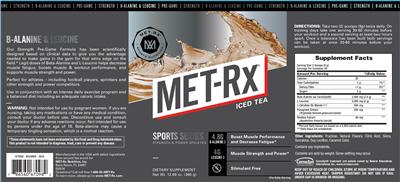
Our Strength Pre-Game Formula has been scientifically designed based on clinical data to give you the advantage needed to make gains in the gym for that extra edge on the field.* Legit doses of Beta-Alanine and L-Leucine helps decrease muscle fatigue, boosts muscle & workout performance, and supports muscle strength and power.
STRENGTH
Brand IP Statement(s)
CarnoSyn Carnosine Synthesizer CarnoSyn trademark and patents owned by Natural Alternatives International, Inc., www.carnosyn.com.
2016
MET-RX SPORTS NUTRITION
Precautions
KEEP OUT OF REACH OF CHILDREN.
TAMPER RESISTANT: DO NOT USE IF SEAL UNDER CAP IS BROKEN OR MISSING.
Discontinue use and consult your doctor if any adverse reactions occur.
Not intended for use by persons under the age of 18.
Beta-alanine may cause a temporary tingling sensation, which is a normal reaction.
Contains soy ingredients.
WARNING: Not intended for use by pregnant women. If you are nursing, taking any medications or have any medical condition, consult your doctor before use.
Storage
STORE AT ROOM TEMPERATURE AND AVOID EXCESSIVE HEAT.
FDA Disclaimer Statement
*These statements have not been evaluated by the Food and Drug Administration. This product is not intended to diagnose, treat, cure or prevent any disease.
General
67098 00A B54868
Formula
STRENGTH & POWER ATHLETES
4.8g B-Alanine Boost Muscle Performance and Decrease Fatigue 4g Leucine Muscle Strength and Power
Contains soy ingredients.
B-ALANINE & LEUCINE
Perfect for athletes – including football players, sprinters and other strength and power competitors.
FDA Statement of Identity
DIETARY SUPPLEMENT
Formulation
Stimulant Free
Suggested/Recommended/Usage/Directions
DIRECTIONS: Take two (2) scoops (9g) twice daily. On training days take one serving 30-60 minutes before your workout and a second serving at least two hours apart. Once a tolerance has been built both servings can be taken at once 30-60 minutes before your workout.
Use in conjunction with an intense daily exercise program and a balanced diet including an adequate caloric intake.
Is this label outdated? Report a formula or label change and our pharmacy team will review it.
Sports Series Iced Tea by MET-Rx label
The label scan from the NIH Dietary Supplement Label Database. Tap to enlarge.
Label images are published by the NIH Dietary Supplement Label Database for the version of this product on file. Always read your actual product label.
View the full label (PDF)The Ingredients in Sports Series Iced Tea by MET-Rx
These are the 7 active ingredients this product is made of. Select any to open its full monograph.
Serving size9 Gram(s) Dosage formPowder Servings per container40 Amounts shown are per serving.
Most supplement products combine several ingredients, and a medication can interact with the product through any one of them. Each ingredient below shows whether it has known drug interactions.
Sugar
Dietary Fiber
Interacts with2,025 drugs
Black psyllium is a soluble-fiber supplement made from the seeds of a Plantago plant, used mostly to ease constipation and support digestive health. I...
Dietary Fiber monograph & interactionsL-Leucine
CarnoSyn
No knowninteractions
Beta-alanine is an amino acid taken mostly by athletes to raise muscle carnosine, which may help buffer acid and reduce fatigue during short, high-int...
CarnoSyn monograph & interactionsL-Citrulline DL-Malate
Interacts with178 drugs
L-citrulline is an amino acid that the body turns into L-arginine to help make nitric oxide, which relaxes blood vessels and may improve blood flow. I...
L-Citrulline DL-Malate monograph & interactionsFenugreek extract
Interacts with389 drugs
Fenugreek is a common kitchen spice that is also taken as a supplement, mainly for blood sugar, cholesterol, and to support breast milk production. So...
Fenugreek extract monograph & interactionsRooibos extract
Interacts with881 drugs
Rooibos is a caffeine-free herbal tea from South Africa that is rich in antioxidants and generally considered safe as a beverage. While lab and early...
Rooibos extract monograph & interactionsOther (inactive) ingredients: Fructose, Natural Flavors, Citric Acid, Silica, Sucralose, Soy Lecithin, Caramel color. These complete the product’s ingredient list but are not active constituents.
Sports Series Iced Tea by MET-Rx Drug Interactions
HelloPharmacist Interaction Report
MET-Rx Sports Series Iced Tea contains ingredients with documented medication interactions through its L-citrulline, fenugreek extract, and rooibos extract content.
The most serious interaction is Moderate severity: fenugreek may increase bleeding risk when combined with blood thinners like warfarin or clopidogrel, or antiplatelet drugs in general. L-citrulline may lower blood pressure additively with blood pressure medications and erectile dysfunction drugs.
Rooibos extract may slow how your body clears certain medications by inhibiting liver enzymes (CYP2C19, CYP1A2, CYP2D6, CYP2C9, and CYP3A4), potentially raising their levels—this affects a wide range of common drugs. Fenugreek also interacts with diabetes medications (risk of low blood sugar), theophylline, phenytoin, metoprolol, and sildenafil; rooibos may enhance ACE inhibitor blood pressure effects and atorvastatin cholesterol-lowering effects.
Altogether, these interactions span 1,108 individual medications. We could not check L-leucine for interactions.
Use the medication checker below with your exact prescriptions before starting this product.
Check your own medications below · Editorial policy · How we use AI
Want to check YOUR meds against Sports Series Iced Tea?
Ask about interactions with your drugs in plain English — “Can I take it with lisinopril?” — and we find you the answer in seconds, ingredient by ingredient.
Go to the checkerIngredients driving the most interactions
Individual Drug Interactions
The ingredients in Sports Series Iced Tea interact with 2,143 drugs. Click any drug to see the details.
4 of the 7 ingredients in Sports Series Iced Tea interact with drugs. Each result below shows which ingredient is responsible. Dietary Fiber Rooibos extract Fenugreek extract L-Citrulline DL-Malate
Ado-trastuzumab EmtansineKadcyla
How Ado-trastuzumab Emtansine interacts with Sports Series Iced Tea — through 1 ingredient. Tap an ingredient for the detail:
Rooibos ExtractCytochrome P450 3a4 (cyp3a4) Substrates Moderate
Interaction Summary
Theoretically, taking rooibos with CYP3A4 substrates may increase the effects of CYP3A4 substrates.
Read the full Rooibos Extract + Ado-trastuzumab Emtansine interactionAbciximabReoPro
How Abciximab interacts with Sports Series Iced Tea — through 2 ingredients. Tap an ingredient for the detail:
Fenugreek ExtractAnticoagulant/antiplatelet Drugs Moderate
Interaction Summary
Theoretically, fenugreek might have additive effects when used with anticoagulant or antiplatelet drugs.
Read the full Fenugreek Extract + Abciximab interactionDietary FiberOral Drugs Minor
Interaction Summary
Theoretically, psyllium might increase, decrease, or have no effect on the absorption of oral drugs.
Read the full Dietary Fiber + Abciximab interactionAbemaciclibVerzenio
How Abemaciclib interacts with Sports Series Iced Tea — through 2 ingredients. Tap an ingredient for the detail:
Rooibos ExtractCytochrome P450 3a4 (cyp3a4) Substrates Moderate
Interaction Summary
Theoretically, taking rooibos with CYP3A4 substrates may increase the effects of CYP3A4 substrates.
Read the full Rooibos Extract + Abemaciclib interactionDietary FiberOral Drugs Minor
Interaction Summary
Theoretically, psyllium might increase, decrease, or have no effect on the absorption of oral drugs.
Read the full Dietary Fiber + Abemaciclib interactionAbiraterone
How Abiraterone interacts with Sports Series Iced Tea — through 2 ingredients. Tap an ingredient for the detail:
Rooibos ExtractCytochrome P450 3a4 (cyp3a4) Substrates Moderate
Interaction Summary
Theoretically, taking rooibos with CYP3A4 substrates may increase the effects of CYP3A4 substrates.
Read the full Rooibos Extract + Abiraterone interactionDietary FiberOral Drugs Minor
Interaction Summary
Theoretically, psyllium might increase, decrease, or have no effect on the absorption of oral drugs.
Read the full Dietary Fiber + Abiraterone interactionAbiraterone AcetateYonsa, Zytiga
How Abiraterone Acetate interacts with Sports Series Iced Tea — through 2 ingredients. Tap an ingredient for the detail:
Rooibos ExtractCytochrome P450 3a4 (cyp3a4) Substrates Moderate
Interaction Summary
Theoretically, taking rooibos with CYP3A4 substrates may increase the effects of CYP3A4 substrates.
Read the full Rooibos Extract + Abiraterone Acetate interactionDietary FiberOral Drugs Minor
Interaction Summary
Theoretically, psyllium might increase, decrease, or have no effect on the absorption of oral drugs.
Read the full Dietary Fiber + Abiraterone Acetate interactionAbrocitinibCibinqo
How Abrocitinib interacts with Sports Series Iced Tea — through 3 ingredients. Tap an ingredient for the detail:
Rooibos ExtractCytochrome P450 2c9 (cyp2c9) Substrates, Cytochrome P450 2c19 (cyp2c19) Substrates Moderate
Interaction Summary
Theoretically, taking rooibos with CYP2C9 substrates may increase the effects of CYP2C9 substrates.
Read the full Rooibos Extract + Abrocitinib interactionFenugreek ExtractAnticoagulant/antiplatelet Drugs Moderate
Interaction Summary
Theoretically, fenugreek might have additive effects when used with anticoagulant or antiplatelet drugs.
Read the full Fenugreek Extract + Abrocitinib interactionDietary FiberOral Drugs Minor
Interaction Summary
Theoretically, psyllium might increase, decrease, or have no effect on the absorption of oral drugs.
Read the full Dietary Fiber + Abrocitinib interactionAcalabrutinibCalquence
How Acalabrutinib interacts with Sports Series Iced Tea — through 2 ingredients. Tap an ingredient for the detail:
Rooibos ExtractCytochrome P450 3a4 (cyp3a4) Substrates Moderate
Interaction Summary
Theoretically, taking rooibos with CYP3A4 substrates may increase the effects of CYP3A4 substrates.
Read the full Rooibos Extract + Acalabrutinib interactionDietary FiberOral Drugs Minor
Interaction Summary
Theoretically, psyllium might increase, decrease, or have no effect on the absorption of oral drugs.
Read the full Dietary Fiber + Acalabrutinib interactionAcarboseGlucobay, Prandase, Precose
How Acarbose interacts with Sports Series Iced Tea — through 2 ingredients. Tap an ingredient for the detail:
Fenugreek ExtractAntidiabetes Drugs Moderate
Interaction Summary
Theoretically, fenugreek seed might have additive hypoglycemic effects when used with antidiabetes drugs.
Read the full Fenugreek Extract + Acarbose interactionDietary FiberOral Drugs Minor
Interaction Summary
Theoretically, psyllium might increase, decrease, or have no effect on the absorption of oral drugs.
Read the full Dietary Fiber + Acarbose interactionAcebutololRhotral, Sectral
How Acebutolol interacts with Sports Series Iced Tea — through 3 ingredients. Tap an ingredient for the detail:
L-citrulline Dl-malateAntihypertensive Drugs Moderate
Interaction Summary
Theoretically, concomitant use of L-citrulline with antihypertensive drugs might have additive effects and increase the chance of hypotension.
Read the full L-citrulline Dl-malate + Acebutolol interactionFenugreek ExtractAntihypertensive Drugs Minor
Interaction Summary
Fenugreek may also have an additive effect on blood pressure-lowering medications.
Read the full Fenugreek Extract + Acebutolol interactionDietary FiberOral Drugs Minor
Interaction Summary
Theoretically, psyllium might increase, decrease, or have no effect on the absorption of oral drugs.
Read the full Dietary Fiber + Acebutolol interactionAcenocoumarolSintrom
How Acenocoumarol interacts with Sports Series Iced Tea — through 2 ingredients. Tap an ingredient for the detail:
Fenugreek ExtractAnticoagulant/antiplatelet Drugs Moderate
Interaction Summary
Theoretically, fenugreek might have additive effects when used with anticoagulant or antiplatelet drugs.
Read the full Fenugreek Extract + Acenocoumarol interactionDietary FiberOral Drugs Minor
Interaction Summary
Theoretically, psyllium might increase, decrease, or have no effect on the absorption of oral drugs.
Read the full Dietary Fiber + Acenocoumarol interactionAcetaminophenChildren's Tylenol, Children's Tylenol Meltaways, Tylenol, Tylenol Ex Strength
How Acetaminophen interacts with Sports Series Iced Tea — through 2 ingredients. Tap an ingredient for the detail:
Rooibos ExtractCytochrome P450 1a2 (cyp1a2) Substrates Moderate
Interaction Summary
Theoretically, taking rooibos with CYP1A2 substrates may increase the effects of CYP1A2 substrates.
Read the full Rooibos Extract + Acetaminophen interactionDietary FiberOral Drugs Minor
Interaction Summary
Theoretically, psyllium might increase, decrease, or have no effect on the absorption of oral drugs.
Read the full Dietary Fiber + Acetaminophen interactionAcetaminophen, AspirinGemnisyn
How Acetaminophen, Aspirin interacts with Sports Series Iced Tea — through 3 ingredients. Tap an ingredient for the detail:
Rooibos ExtractCytochrome P450 1a2 (cyp1a2) Substrates Moderate
Interaction Summary
Theoretically, taking rooibos with CYP1A2 substrates may increase the effects of CYP1A2 substrates.
Read the full Rooibos Extract + Acetaminophen, Aspirin interactionFenugreek ExtractAnticoagulant/antiplatelet Drugs Moderate
Interaction Summary
Theoretically, fenugreek might have additive effects when used with anticoagulant or antiplatelet drugs.
Read the full Fenugreek Extract + Acetaminophen, Aspirin interactionDietary FiberOral Drugs Minor
Interaction Summary
Theoretically, psyllium might increase, decrease, or have no effect on the absorption of oral drugs.
Read the full Dietary Fiber + Acetaminophen, Aspirin interactionAcetaminophen, Aspirin, CaffeineExcedrin, Excedrin Extra Strength, Excedrin Migraine
How Acetaminophen, Aspirin, Caffeine interacts with Sports Series Iced Tea — through 3 ingredients. Tap an ingredient for the detail:
Fenugreek ExtractAnticoagulant/antiplatelet Drugs Moderate
Interaction Summary
Theoretically, fenugreek might have additive effects when used with anticoagulant or antiplatelet drugs.
Read the full Fenugreek Extract + Acetaminophen, Aspirin, Caffeine interactionRooibos ExtractCytochrome P450 1a2 (cyp1a2) Substrates, Cytochrome P450 3a4 (cyp3a4) Substrates Moderate
Interaction Summary
Theoretically, taking rooibos with CYP1A2 substrates may increase the effects of CYP1A2 substrates.
Read the full Rooibos Extract + Acetaminophen, Aspirin, Caffeine interactionDietary FiberOral Drugs Minor
Interaction Summary
Theoretically, psyllium might increase, decrease, or have no effect on the absorption of oral drugs.
Read the full Dietary Fiber + Acetaminophen, Aspirin, Caffeine interactionAcetaminophen, Brompheniramine, PhenylpropanolamineDimetapp Cold and Flu
How Acetaminophen, Brompheniramine, Phenylpropanolamine interacts with Sports Series Iced Tea — through 2 ingredients. Tap an ingredient for the detail:
Rooibos ExtractCytochrome P450 1a2 (cyp1a2) Substrates Moderate
Interaction Summary
Theoretically, taking rooibos with CYP1A2 substrates may increase the effects of CYP1A2 substrates.
Read the full Rooibos Extract + Acetaminophen, Brompheniramine, Phenylpropanolamine interactionDietary FiberOral Drugs Minor
Interaction Summary
Theoretically, psyllium might increase, decrease, or have no effect on the absorption of oral drugs.
Read the full Dietary Fiber + Acetaminophen, Brompheniramine, Phenylpropanolamine interactionAcetaminophen, ButalbitalAxocet, Bancap, Bucet, Butex Forte, Esgic CF, Orbivan CF +5 more
How Acetaminophen, Butalbital interacts with Sports Series Iced Tea — through 2 ingredients. Tap an ingredient for the detail:
Rooibos ExtractCytochrome P450 1a2 (cyp1a2) Substrates Moderate
Interaction Summary
Theoretically, taking rooibos with CYP1A2 substrates may increase the effects of CYP1A2 substrates.
Read the full Rooibos Extract + Acetaminophen, Butalbital interactionDietary FiberOral Drugs Minor
Interaction Summary
Theoretically, psyllium might increase, decrease, or have no effect on the absorption of oral drugs.
Read the full Dietary Fiber + Acetaminophen, Butalbital interactionAcetaminophen, Butalbital, CaffeineEsgic, Esgic Plus, Fiogesic, Fioricet, Repan, Tecnal +1 more
How Acetaminophen, Butalbital, Caffeine interacts with Sports Series Iced Tea — through 2 ingredients. Tap an ingredient for the detail:
Rooibos ExtractCytochrome P450 1a2 (cyp1a2) Substrates, Cytochrome P450 3a4 (cyp3a4) Substrates Moderate
Interaction Summary
Theoretically, taking rooibos with CYP1A2 substrates may increase the effects of CYP1A2 substrates.
Read the full Rooibos Extract + Acetaminophen, Butalbital, Caffeine interactionDietary FiberOral Drugs Minor
Interaction Summary
Theoretically, psyllium might increase, decrease, or have no effect on the absorption of oral drugs.
Read the full Dietary Fiber + Acetaminophen, Butalbital, Caffeine interactionAcetaminophen, Butalbital, Caffeine, CodeineEsgic with Codeine, Fioricet w/ Codeine
How Acetaminophen, Butalbital, Caffeine, Codeine interacts with Sports Series Iced Tea — through 2 ingredients. Tap an ingredient for the detail:
Rooibos ExtractCytochrome P450 1a2 (cyp1a2) Substrates, Cytochrome P450 2d6 (cyp2d6) Substrates +1 Moderate
Interaction Summary
Theoretically, taking rooibos with CYP1A2 substrates may increase the effects of CYP1A2 substrates.
Read the full Rooibos Extract + Acetaminophen, Butalbital, Caffeine, Codeine interactionDietary FiberOral Drugs Minor
Interaction Summary
Theoretically, psyllium might increase, decrease, or have no effect on the absorption of oral drugs.
Read the full Dietary Fiber + Acetaminophen, Butalbital, Caffeine, Codeine interactionAcetaminophen, Butalbital, CodeineBancap w/ Codeine
How Acetaminophen, Butalbital, Codeine interacts with Sports Series Iced Tea — through 2 ingredients. Tap an ingredient for the detail:
Rooibos ExtractCytochrome P450 1a2 (cyp1a2) Substrates, Cytochrome P450 2d6 (cyp2d6) Substrates Moderate
Interaction Summary
Theoretically, taking rooibos with CYP1A2 substrates may increase the effects of CYP1A2 substrates.
Read the full Rooibos Extract + Acetaminophen, Butalbital, Codeine interactionDietary FiberOral Drugs Minor
Interaction Summary
Theoretically, psyllium might increase, decrease, or have no effect on the absorption of oral drugs.
Read the full Dietary Fiber + Acetaminophen, Butalbital, Codeine interactionAcetaminophen, Butalbital, Codeine PhosphatePhrenilin #3
How Acetaminophen, Butalbital, Codeine Phosphate interacts with Sports Series Iced Tea — through 2 ingredients. Tap an ingredient for the detail:
Rooibos ExtractCytochrome P450 2d6 (cyp2d6) Substrates, Cytochrome P450 1a2 (cyp1a2) Substrates Moderate
Interaction Summary
Theoretically, taking rooibos with CYP2D6 substrates may increase the effects of CYP2D6 substrates.
Read the full Rooibos Extract + Acetaminophen, Butalbital, Codeine Phosphate interactionDietary FiberOral Drugs Minor
Interaction Summary
Theoretically, psyllium might increase, decrease, or have no effect on the absorption of oral drugs.
Read the full Dietary Fiber + Acetaminophen, Butalbital, Codeine Phosphate interactionAcetaminophen, Caffeine, Chlorpheniramine, Hydrocodone, PhenylephrineHycomine Compound
How Acetaminophen, Caffeine, Chlorpheniramine, Hydrocodone, Phenylephrine interacts with Sports Series Iced Tea — through 2 ingredients. Tap an ingredient for the detail:
Rooibos ExtractCytochrome P450 1a2 (cyp1a2) Substrates, Cytochrome P450 3a4 (cyp3a4) Substrates +1 Moderate
Interaction Summary
Theoretically, taking rooibos with CYP1A2 substrates may increase the effects of CYP1A2 substrates.
Read the full Rooibos Extract + Acetaminophen, Caffeine, Chlorpheniramine, Hydrocodone, Phenylephrine interactionDietary FiberOral Drugs Minor
Interaction Summary
Theoretically, psyllium might increase, decrease, or have no effect on the absorption of oral drugs.
Read the full Dietary Fiber + Acetaminophen, Caffeine, Chlorpheniramine, Hydrocodone, Phenylephrine interactionAcetaminophen, Caffeine, CodeineGesic C15, Gesic C30, Gesic C8, Lenoltec 1, Lenoltec 2, Lenoltec 3 +1 more
How Acetaminophen, Caffeine, Codeine interacts with Sports Series Iced Tea — through 2 ingredients. Tap an ingredient for the detail:
Rooibos ExtractCytochrome P450 2d6 (cyp2d6) Substrates, Cytochrome P450 1a2 (cyp1a2) Substrates +1 Moderate
Interaction Summary
Theoretically, taking rooibos with CYP2D6 substrates may increase the effects of CYP2D6 substrates.
Read the full Rooibos Extract + Acetaminophen, Caffeine, Codeine interactionDietary FiberOral Drugs Minor
Interaction Summary
Theoretically, psyllium might increase, decrease, or have no effect on the absorption of oral drugs.
Read the full Dietary Fiber + Acetaminophen, Caffeine, Codeine interactionAcetaminophen, Caffeine, Codeine, SalicylamideCodalan No.1, Codalan No.2, Codalan No.3
How Acetaminophen, Caffeine, Codeine, Salicylamide interacts with Sports Series Iced Tea — through 2 ingredients. Tap an ingredient for the detail:
Rooibos ExtractCytochrome P450 2d6 (cyp2d6) Substrates, Cytochrome P450 3a4 (cyp3a4) Substrates +1 Moderate
Interaction Summary
Theoretically, taking rooibos with CYP2D6 substrates may increase the effects of CYP2D6 substrates.
Read the full Rooibos Extract + Acetaminophen, Caffeine, Codeine, Salicylamide interactionDietary FiberOral Drugs Minor
Interaction Summary
Theoretically, psyllium might increase, decrease, or have no effect on the absorption of oral drugs.
Read the full Dietary Fiber + Acetaminophen, Caffeine, Codeine, Salicylamide interactionAcetaminophen, Caffeine, DihydrocodeineDHC Plus, Panlor DC, Panlor SS
How Acetaminophen, Caffeine, Dihydrocodeine interacts with Sports Series Iced Tea — through 2 ingredients. Tap an ingredient for the detail:
Rooibos ExtractCytochrome P450 1a2 (cyp1a2) Substrates, Cytochrome P450 2d6 (cyp2d6) Substrates +1 Moderate
Interaction Summary
Theoretically, taking rooibos with CYP1A2 substrates may increase the effects of CYP1A2 substrates.
Read the full Rooibos Extract + Acetaminophen, Caffeine, Dihydrocodeine interactionDietary FiberOral Drugs Minor
Interaction Summary
Theoretically, psyllium might increase, decrease, or have no effect on the absorption of oral drugs.
Read the full Dietary Fiber + Acetaminophen, Caffeine, Dihydrocodeine interactionAcetaminophen, Caffeine, IsomethepteneMigralam
How Acetaminophen, Caffeine, Isometheptene interacts with Sports Series Iced Tea — through 2 ingredients. Tap an ingredient for the detail:
Rooibos ExtractCytochrome P450 3a4 (cyp3a4) Substrates, Cytochrome P450 1a2 (cyp1a2) Substrates Moderate
Interaction Summary
Theoretically, taking rooibos with CYP3A4 substrates may increase the effects of CYP3A4 substrates.
Read the full Rooibos Extract + Acetaminophen, Caffeine, Isometheptene interactionDietary FiberOral Drugs Minor
Interaction Summary
Theoretically, psyllium might increase, decrease, or have no effect on the absorption of oral drugs.
Read the full Dietary Fiber + Acetaminophen, Caffeine, Isometheptene interactionAcetaminophen, Caffeine, PyrilamineMidol Max Strength Menstrual
How Acetaminophen, Caffeine, Pyrilamine interacts with Sports Series Iced Tea — through 2 ingredients. Tap an ingredient for the detail:
Rooibos ExtractCytochrome P450 1a2 (cyp1a2) Substrates, Cytochrome P450 3a4 (cyp3a4) Substrates Moderate
Interaction Summary
Theoretically, taking rooibos with CYP1A2 substrates may increase the effects of CYP1A2 substrates.
Read the full Rooibos Extract + Acetaminophen, Caffeine, Pyrilamine interactionDietary FiberOral Drugs Minor
Interaction Summary
Theoretically, psyllium might increase, decrease, or have no effect on the absorption of oral drugs.
Read the full Dietary Fiber + Acetaminophen, Caffeine, Pyrilamine interactionAcetaminophen, Chlorpheniramine Maleate, Dextromethorphan HbrVicks Formula 44M Cough, Cold & Flu Relief
How Acetaminophen, Chlorpheniramine Maleate, Dextromethorphan Hbr interacts with Sports Series Iced Tea — through 2 ingredients. Tap an ingredient for the detail:
Rooibos ExtractCytochrome P450 1a2 (cyp1a2) Substrates, Cytochrome P450 2d6 (cyp2d6) Substrates +1 Moderate
Interaction Summary
Theoretically, taking rooibos with CYP1A2 substrates may increase the effects of CYP1A2 substrates.
Read the full Rooibos Extract + Acetaminophen, Chlorpheniramine Maleate, Dextromethorphan Hbr interactionDietary FiberOral Drugs Minor
Interaction Summary
Theoretically, psyllium might increase, decrease, or have no effect on the absorption of oral drugs.
Read the full Dietary Fiber + Acetaminophen, Chlorpheniramine Maleate, Dextromethorphan Hbr interactionAcetaminophen, Chlorpheniramine, Codeine, PhenylephrineColrex
How Acetaminophen, Chlorpheniramine, Codeine, Phenylephrine interacts with Sports Series Iced Tea — through 2 ingredients. Tap an ingredient for the detail:
Rooibos ExtractCytochrome P450 2d6 (cyp2d6) Substrates, Cytochrome P450 1a2 (cyp1a2) Substrates +1 Moderate
Interaction Summary
Theoretically, taking rooibos with CYP2D6 substrates may increase the effects of CYP2D6 substrates.
Read the full Rooibos Extract + Acetaminophen, Chlorpheniramine, Codeine, Phenylephrine interactionDietary FiberOral Drugs Minor
Interaction Summary
Theoretically, psyllium might increase, decrease, or have no effect on the absorption of oral drugs.
Read the full Dietary Fiber + Acetaminophen, Chlorpheniramine, Codeine, Phenylephrine interactionAcetaminophen, Chlorpheniramine, DextromethorphanCoricidin II Extra Strength Cold and Flu
How Acetaminophen, Chlorpheniramine, Dextromethorphan interacts with Sports Series Iced Tea — through 2 ingredients. Tap an ingredient for the detail:
Rooibos ExtractCytochrome P450 3a4 (cyp3a4) Substrates, Cytochrome P450 1a2 (cyp1a2) Substrates +1 Moderate
Interaction Summary
Theoretically, taking rooibos with CYP3A4 substrates may increase the effects of CYP3A4 substrates.
Read the full Rooibos Extract + Acetaminophen, Chlorpheniramine, Dextromethorphan interactionDietary FiberOral Drugs Minor
Interaction Summary
Theoretically, psyllium might increase, decrease, or have no effect on the absorption of oral drugs.
Read the full Dietary Fiber + Acetaminophen, Chlorpheniramine, Dextromethorphan interactionAcetaminophen, Chlorpheniramine, Dextromethorphan HydrobromideCoricidin HBP Maximum Strength Flu
How Acetaminophen, Chlorpheniramine, Dextromethorphan Hydrobromide interacts with Sports Series Iced Tea — through 2 ingredients. Tap an ingredient for the detail:
Rooibos ExtractCytochrome P450 1a2 (cyp1a2) Substrates, Cytochrome P450 2d6 (cyp2d6) Substrates +1 Moderate
Interaction Summary
Theoretically, taking rooibos with CYP1A2 substrates may increase the effects of CYP1A2 substrates.
Read the full Rooibos Extract + Acetaminophen, Chlorpheniramine, Dextromethorphan Hydrobromide interactionDietary FiberOral Drugs Minor
Interaction Summary
Theoretically, psyllium might increase, decrease, or have no effect on the absorption of oral drugs.
Read the full Dietary Fiber + Acetaminophen, Chlorpheniramine, Dextromethorphan Hydrobromide interactionAcetaminophen, Chlorpheniramine, Dextromethorphan, PhenylpropanolamineMulti Symptom Cold Relief
How Acetaminophen, Chlorpheniramine, Dextromethorphan, Phenylpropanolamine interacts with Sports Series Iced Tea — through 2 ingredients. Tap an ingredient for the detail:
Rooibos ExtractCytochrome P450 2d6 (cyp2d6) Substrates, Cytochrome P450 1a2 (cyp1a2) Substrates +1 Moderate
Interaction Summary
Theoretically, taking rooibos with CYP2D6 substrates may increase the effects of CYP2D6 substrates.
Read the full Rooibos Extract + Acetaminophen, Chlorpheniramine, Dextromethorphan, Phenylpropanolamine interactionDietary FiberOral Drugs Minor
Interaction Summary
Theoretically, psyllium might increase, decrease, or have no effect on the absorption of oral drugs.
Read the full Dietary Fiber + Acetaminophen, Chlorpheniramine, Dextromethorphan, Phenylpropanolamine interactionEach ingredient & the kinds of drugs it affects
For each ingredient in Sports Series Iced Tea with known interactions, here are the types of medications they can affect. Open any type for the detail — or search your exact drug in the checker above.
Dietary Fiber
Carbamazepine (Tegretol)
Theoretically, black psyllium might reduce the effects of carbamazepine and increase the risk for convulsions.
Theoretically, black psyllium might reduce carbamazepine absorption. A preliminary study using blond psyllium reported decreased carbamazepine bioavailability due to binding of the drug to psyllium, as well as reduction of available fluid in the gut for dissolution of the drug. This interaction may also occur with black psyllium.
Lithium
Theoretically, taking black psyllium at the same time as lithium might reduce lithium absorption.
The fiber in black psyllium might reduce lithium absorption and plasma levels. Some case reports describe a reduction in plasma lithium levels with concomitant administration of blond psyllium. This was reversed when psyllium was stopped. This interaction may also occur with black psyllium.
Metformin (Glucophage)
Theoretically, black psyllium might increase the therapeutic and adverse effects of metformin.
Animal research shows that concurrent consumption of blond psyllium with metformin slows and increases the absorption of metformin. This interaction may also occur with black psyllium. To avoid changes in absorption, take psyllium 30-60 minutes after metformin.
Olanzapine (Zyprexa)
Theoretically, taking black psyllium at the same time as olanzapine might reduce olanzapine absorption.
The fiber in black psyllium might decrease the absorption of olanzapine. A single case report describes a reduction in the effectiveness of olanzapine when it was concomitantly administered with an unspecified type of psyllium 3 grams orally twice daily. This effect was reversed when psyllium was stopped.
Digoxin (Lanoxin)
Theoretically, taking black psyllium at the same time as digoxin might reduce digoxin absorption and decrease digoxin levels.
Psyllium might bind digoxin in the gut. However, some clinical evidence suggests that psyllium does not impact digoxin absorption.
Ethinyl Estradiol
Theoretically, taking black psyllium at the same time as ethinyl estradiol might alter levels of estradiol.
Concurrent use of blond psyllium with ethinyl estradiol results in a slight increase in the extent of ethinyl estradiol absorption and a slower rate of absorption. This is unlikely to be clinically significant.
Oral Drugs
Theoretically, psyllium might increase, decrease, or have no effect on the absorption of oral drugs.
Psyllium seems to have variable effects on drug absorption. To avoid changes in absorption, take psyllium 30-60 minutes after oral medications. Animal research shows that blond psyllium delays and increases the absorption of metformin and ethinyl estradiol. Case reports and animal research suggest that blond psyllium might reduce absorption of lithium, digoxin, olanzapine, and carbamazepine. Finally, some pharmacokinetic studies show that psyllium does not affect the absorption of levothyroxine or warfarin. Although many of these studies evaluated blond psyllium, the fiber content in black psyllium may have similar effects.
Rooibos extract
Ace Inhibitors (Aceis)
Theoretically, taking rooibos with ACEIs may increase the therapeutic and adverse effects of ACEIs.
Clinical research in healthy adults shows that taking a single dose of rooibos tea, 400 mL orally, inhibits angiotensin-converting enzyme activity.
Atorvastatin (Lipitor)
Theoretically, taking rooibos with atorvastatin may increase the therapeutic and adverse effects of atorvastatin.
Animal research shows that consuming green rooibos extract with atorvastatin daily for 3 weeks increases the maximum plasma concentration of atorvastatin by 6-fold and reduces the clearance of atorvastatin.
Cytochrome P450 1A2 (Cyp1A2) Substrates
Theoretically, taking rooibos with CYP1A2 substrates may increase the effects of CYP1A2 substrates.
In vitro research shows that the methanol extract of rooibos leaves and stems inhibits CYP1A2 enzyme activity.
Cytochrome P450 2C19 (Cyp2C19) Substrates
Theoretically, taking rooibos with CYP2C19 substrates may increase the effects of CYP2C19 substrates.
In vitro research shows that the methanol extract of rooibos leaves and stems strongly inhibits CYP2C19 enzyme activity.
Cytochrome P450 2C9 (Cyp2C9) Substrates
Theoretically, taking rooibos with CYP2C9 substrates may increase the effects of CYP2C9 substrates.
In vitro research shows that the methanol extract of rooibos leaves and stems inhibits CYP2C9 enzyme activity.
Cytochrome P450 2D6 (Cyp2D6) Substrates
Theoretically, taking rooibos with CYP2D6 substrates may increase the effects of CYP2D6 substrates.
In vitro research shows that the methanol extract of rooibos leaves and stems inhibits CYP2D6 enzyme activity.
Cytochrome P450 3A4 (Cyp3A4) Substrates
Theoretically, taking rooibos with CYP3A4 substrates may increase the effects of CYP3A4 substrates.
In vitro research shows that the methanol extract of rooibos leaves and stems strongly inhibits CYP3A4 enzyme activity.
Fenugreek extract
Anticoagulant/Antiplatelet Drugs
Theoretically, fenugreek might have additive effects when used with anticoagulant or antiplatelet drugs.
Some of the constituents in fenugreek have antiplatelet effects in animal and in vitro research. However, common fenugreek products might not contain sufficient concentrations of these constituents for clinical effects. A clinical study in patients with coronary artery disease or diabetes shows that taking fenugreek seed powder 2.5 grams twice daily for 3 months does not affect platelet aggregation, fibrinolytic activity, or fibrinogen levels .
Antidiabetes Drugs
Theoretically, fenugreek seed might have additive hypoglycemic effects when used with antidiabetes drugs.
Clinical research shows that fenugreek seed can reduce fasting blood glucose and 2-hour postprandial glucose levels in adults with type 2 diabetes.
Clopidogrel (Plavix)
Theoretically, fenugreek seed might alter the clinical effects of clopidogrel by inhibiting its conversion to the active form.
Animal research shows that fenugreek seed 200 mg/kg daily for 14 days increases the maximum serum concentration of clopidogrel by 21%. It is unclear how this affects the pharmacokinetics of the active metabolite of clopidogrel; however, this study found that concomitant use of fenugreek seed and clopidogrel prolonged bleeding time by an additional 11%.
Metoprolol (Toprol)
Theoretically, fenugreek seed might have additive hypotensive effects when used with metoprolol.
Animal research shows that fenugreek seed 300 mg/kg daily for 2 weeks decreases systolic and diastolic blood pressure by 9% and 11%, respectively, when administered alone, and by 15% and 22%, respectively, when given with metoprolol 10 mg/kg.
Phenytoin (Dilantin)
Theoretically, fenugreek might decrease plasma levels of phenytoin.
Animal research shows that taking fenugreek seeds for 1 week decreases maximum concentrations and the area under the curve of a single dose of phenytoin by 44% and 72%, respectively. This seems to be related to increased clearance. So far, this interaction has not been reported in humans.
Sildenafil (Viagra)
Theoretically, concurrent use of sildenafil and fenugreek might reduce levels and therapeutic effects of sildenafil.
Animal research shows that taking fenugreek seeds for 1 week reduces maximum concentrations and the area under the curve of a single dose of sildenafil by 27% and 48%, respectively. So far, this interaction has not been reported in humans.
Theophylline
Theoretically, fenugreek may reduce the levels and clinical effects of theophylline.
Animal research shows that fenugreek 50 grams daily for 7 days reduces the maximum serum concentration (Cmax) of theophylline by 28% and the area under the plasma drug concentration-time curve (AUC) by 22%.
Warfarin (Coumadin)
Theoretically, fenugreek might have additive effects with warfarin and increase the international normalized ratio (INR).
Some fenugreek constituents have antiplatelet effects, although these might not be present in concentrations that are clinically significant. In one case report, a patient taking warfarin experienced an increased INR when starting to take fenugreek in combination with boldo.
Antihypertensive Drugs
Fenugreek may also have an additive effect on blood pressure-lowering medications. Studies on animals have shown that fenugreek seed can decrease both systolic and diastolic blood pressure by up to 22% when combined with metoprolol. Therefore, it is essential to monitor your blood pressure regularly if you are taking fenugreek and metoprolol together or any other antihypertensive drugs.
L-Citrulline DL-Malate
Antihypertensive Drugs
Theoretically, concomitant use of L-citrulline with antihypertensive drugs might have additive effects and increase the chance of hypotension.
L-citrulline is converted to L-arginine, which can increase nitric oxide and cause vasodilation. However, a meta-analysis of 5 small clinical studies suggests that taking L-citrulline 3-6 grams daily for 1-8 weeks does not lower blood pressure when compared with control.
Phosphodiesterase-5 Inhibitors
Theoretically, concurrent use of phosphodiesterase-5 (PDE-5) inhibitors and L-citrulline might result in additive vasodilation.
L-citrulline is converted to L-arginine, which can increase nitric oxide and cause vasodilation. Theoretically, taking L-arginine with PDE-5 inhibitors might have additive vasodilatory and hypotensive effects. However, in studies evaluating the combined use of L-arginine and sildenafil for erectile dysfunction, hypotension was not reported.
Brand information
Manufacturer and brand details for Sports Series Iced Tea, from the product label.
MET-Rx
See all MET-Rx products- Name
- MET-Rx Nutrition, Inc.
- City
- Boca Raton
- State
- FL
- ZipCode
- 33487
- Phone Number
- 1-800-556-3879
- Web Address
- www.MET-Rx.com
Sports Series Iced Tea by MET-Rx: Common Questions
Does Sports Series Iced Tea by MET-Rx interact with any medications?
How can one product interact with so many drugs?
Where does this information come from?
Will I feel weird tingling if I take this?
Can I take this while pregnant?
Will this help my athletic performance?
Can I take this if I have stomach problems?
What is fenugreek in this product supposed to do?
Can I take this while breastfeeding?
Written and reviewed by the HelloPharmacist editorial staff. Our editorial policy
Not sure if Sports Series Iced Tea is safe with your meds?
Our pharmacists answer your medication & supplement questions — free.
Label information is sourced from the NIH Dietary Supplement Label Database and reflects the product version on file; always read your actual product label. This page is for education only and is not a substitute for professional medical advice. Confirm with your pharmacist or doctor before combining supplements and medications.
The Full Monographs Behind Sports Series Iced Tea’s Ingredients
Every ingredient we hold a full HelloPharmacist monograph for — uses, evidence, safety, and the complete interaction list.
Black Psyllium
Interacts with 2,025 drugsBlack psyllium is a soluble-fiber supplement made from the seeds of a Plantago plant, used mostly to ease constipation and support digestive health. It is best known and most studied for rel...
Read the full Black Psyllium monograph → Herb & supplement monographBeta-alanine
Beta-alanine is an amino acid taken mostly by athletes to raise muscle carnosine, which may help buffer acid and reduce fatigue during short, high-intensity exercise. The evidence is moderat...
Read the full Beta-alanine monograph → Herb & supplement monographL-citrulline
Interacts with 178 drugsL-citrulline is an amino acid that the body turns into L-arginine to help make nitric oxide, which relaxes blood vessels and may improve blood flow. It is popular for exercise performance an...
Read the full L-citrulline monograph → Herb & supplement monographFenugreek
Interacts with 389 drugsFenugreek is a common kitchen spice that is also taken as a supplement, mainly for blood sugar, cholesterol, and to support breast milk production. Some early research is encouraging for blo...
Read the full Fenugreek monograph → Herb & supplement monographRooibos
Interacts with 881 drugsRooibos is a caffeine-free herbal tea from South Africa that is rich in antioxidants and generally considered safe as a beverage. While lab and early studies suggest possible benefits for he...
Read the full Rooibos monograph →Sources & How We Checked
Sports Series Iced Tea's label data comes from the NIH Dietary Supplement Label Database; the ingredient interaction data is from the Natural Medicines database, reviewed by our pharmacists.
- NIH Dietary Supplement Label Database (DSLD) — The official product label on file for this supplement.
- Natural Medicines (Therapeutic Research Center) — Evidence-graded clinical reference behind the ingredient interaction data.
Content is written and reviewed by licensed HelloPharmacist pharmacists. See our data sources and editorial standards for how this information is built and checked.
The 73 references behind this product’s interaction data
Every citation that drives the interaction findings for this product’s ingredients, from the evidence-graded Natural Medicines (TRC Healthcare) database. Open an ingredient to browse its citations — links open the study on PubMed or the publisher’s site.
Black Psyllium 18 references
- McGuffin M, Hobbs C, Upton R, Goldberg A, eds. American Herbal Products Association's Botanical Safety Handbook. Boca Raton, FL: CRC Press, LLC 1997.
- Gruenwald J, Brendler T, Jaenicke C. PDR for Herbal Medicines. 1st ed. Montvale, NJ: Medical Economics Company, Inc., 1998.
- Covington TR, et al. Handbook of Nonprescription Drugs. 11th ed. Washington, DC: American Pharmaceutical Association, 1996.
- Etman M. Effect of a bulk forming laxative on the bioavailablility of carbamazepine in man. Drug Dev Ind Pharm 1995;21:1901-6.
- Perlman BB. Interaction between lithium salts and ispaghula husk. Lancet 1990;335:416.
- Vaswani SK, Hamilton RG, Valentine MD, Adkinson NF. Psyllium laxative-induced anaphylaxis, asthma, and rhinitis. Allergy 1996;51:266-8. PubMed
- Lantner RR, Espiritu BR, Zumerchik P, Tobin MC. Anaphylaxis following ingestion of a psyllium-containing cereal. JAMA 1990;264:2534-6. DOI
- Kaplan MJ. Anaphylactic reaction to "Heartwise." N Engl J Med 1990;323:1072-3. DOI
- Nordstrom M, Melander A, Robertsson E, Steen B. Influence of wheat bran and of a bulk-forming ispaghula cathartic on the bioavailability of digoxin in geriatric in-patients. Drug Nutr Interact 1987;5:67-9..
- Robinson DS, Benjamin DM, McCormack JJ. Interaction of warfarin and nonsystemic gastrointestinal drugs. Clin Pharmacol Ther 1971;12:491-5. PubMed
- Garcia JJ, Fernandez N, Diez MJ, et al. Influence of two dietary fibers in the oral bioavailability and other pharmacokinetic parameters of ethinyloestradiol. Contraception 2000;62:253-7. PubMed
- Fernandez N, Lopez C, Díez R, et al. Drug interactions with the dietary fiber Plantago ovata husk. Expert Opin Drug Metab Toxicol 2012;8(11):1377-86.
- Semen plantaginis in: WHO Monographs on Selected Medicinal Plants, volume 1. World Health Organization, Geneva, 1999. Available at http://apps.who.int/medicinedocs/en/d/Js2200e/. Accessed November 26, 1026.
- Code of Federal Regulations, Title 21 (21CFR 101.17). Food labeling warning, notice, and safe handling statements. Available at www.ecfr.gov/cgi-bin/text-idx?SID=20f647d3b74161501f46564b915b4048&mc=true&node=se21.2.101_117&rgn=div8. Accessed December 3, 2
- Code of Federal Regulations, Title 21 (21CFR 201.319). Specific labeling requirements - water-soluble gums, hydrophilic gums, and hydrophilic mucilloids. Available at www.accessdata.fda.gov/scripts/cdrh/cfdocs/cfcfr/CFRSearch.cfm?fr=201.319. Accessed Dece
- Diez R, Garcia JJ, Diez MJ, Sierra M, Sahagun AM, Fernandez N. Influence of Plantago ovata husk (dietary fiber) on the bioavailability and other pharmacokinetic parameters of metformin in diabetic rabbits. BMC Complement Altern Med. 2017 Jun 7;17(1):298. PubMed
- Chiu AC, Sherman SI. Effects of pharmacological fiber supplements on levothyroxine absorption. Thyroid. 1998;8(8):667-71. PubMed
- Merrick C, Madden CA, Capurso NA. A Case of Blunted Orally Disintegrating Olanzapine Effect Due to Coadministered Psyllium. J Clin Psychiatry 2021;82(2):20cr13633. PubMed
Beta-alanine 13 references
- Harris RC, Tallon MJ, Dunnett M, et al. The absorption of orally supplied beta-alanine and its effect on muscle carnosine synthesis in human vastus lateralis. Amino Acids 2006;30:279-89.
- Hill CA, Harris RC, Kim HJ, et al. Influence of beta-alanine supplementation on skeletal muscle carnosine concentrations and high intensity cycling capacity. Amino Acids 2007;32:225-33.
- Bellinger PM, Minahan CL. The effect of ß-alanine supplementation on cycling time trials of different length. Eur J Sport Sci 2016;16(7):829-36.
- Chung W, Shaw G, Anderson ME, et al. Effect of 10 week beta-alanine supplementation on competition and training performance in elite swimmers. Nutrients 2012;4(10):1441-53. PubMed
- Glenn JM, Gray M, Stewart R, et al. Incremental effects of 28 days of beta-alanine supplementation on high-intensity cycling performance and blood lactate in masters female cyclists. Amino Acids 2015;47(12):2593-600. PubMed
- Gross M, Bieri K, Hoppeler H, Norman B, Vogt M. Beta-alanine supplementation improves jumping power and affects severe-intensity performance in professional alpine skiers. Int J Sport Nutr Exerc Metab 2014;24(6):665-73. PubMed
- Howe ST, Bellinger PM, Driller MW, Shing CM, Fell JW. The effect of beta-alanine supplementation on isokinetic force and cycling performance in highly trained cyclists. Int J Sport Nutr Exerc Metab 2013;23(6):562-70. PubMed
- Sweeney KM, Wright GA, Glenn Brice A, Doberstein ST. The effect of beta-alanine supplementation on power performance during repeated sprint activity. J Strength Cond Res 2010;24(1):79-87.
- Décombaz J, Beaumont M, Vuichoud J, Bouisset F, Stellingwerff T. Effect of slow-release ß-alanine tablets on absorption kinetics and paresthesia. Amino Acids 2012;43(1):67-76. Erratum in: Amino Acids 2013;45(4):1015.
- Stellingwerff T, Anwander H, Egger A, et al. Effect of two ß-alanine dosing protocols on muscle carnosine synthesis and washout. Amino Acids 2012;42(6):2461-72. PubMed
- da Silva RP, de Oliveira LF, Saunders B, et al. Effects of ß-alanine and sodium bicarbonate supplementation on the estimated energy system contribution during high-intensity intermittent exercise. Amino Acids. 2019;51(1):83-96. PubMed
- Varanoske AN, Hoffman JR, Church DD, et al. Comparison of sustained-release and rapid-release ß-alanine formulations on changes in skeletal muscle carnosine and histidine content and isometric performance following a muscle-damaging protocol. Amino Acids. PubMed
- Perim P, Gobbi N, Duarte B, et al. Beta-alanine did not improve high-intensity performance throughout simulated road cycling. Eur J Sport Sci 2021. PubMed
L-citrulline 8 references
- Cheng JW, Balwin SN. L-arginine in the management of cardiovascular diseases. Ann Pharmacother 2001;35:755-64. PubMed
- Schwedhelm E, Maas R, Freese R, et al. Pharmacokinetic and pharmacodynamic properties of oral L-citrulline and L-arginine: impact on nitric oxide metabolism. Br J Clin Pharmacol 2008;65:51-9. PubMed
- Romero MJ, Platt DH, Caldwell RB, Caldwell RW. Therapeutic use of citrulline in cardiovascular disease. Cardiovasc Drug Rev 2006;24:275-90. PubMed
- Balderas-Munoz K, Castillo-Martínez L, Orea-Tejeda A, et al. Improvement of ventricular function in systolic heart failure patients with oral L-citrulline supplementation. Cardiol J 2012;19:612-7. PubMed
- Sharif Kashani B, Tahmaseb Pour P, Malekmohammad M, et al. Oral l-citrulline malate in patients with idiopathic pulmonary arterial hypertension and Eisenmenger Syndrome: a clinical trial. J Cardiol 2014;64:231-5. PubMed
- Pérez-Guisado J, Jakeman PM. Citrulline malate enhances athletic anaerobic performance and relieves muscle soreness. J Strength Cond Res 2010;24:1215-22. PubMed
- Mirenayat MS, Moradi S, Mohammadi H, Rouhani MH. Effect of L-citrulline supplementation on blood pressure: a systematic review and meta-analysis of clinical trials. Curr Hypertens Rep. 2018;20(11):98. PubMed
- Xu Z, Liu C, Liu S, Zhou Z. Comparison of efficacy and safety of daily oral L-arginine and PDE5Is alone or combination in treating erectile dysfunction: A systematic review and meta-analysis of randomised controlled trials. Andrologia. 2021:e14007. PubMed
Fenugreek 30 references
- Madar Z, Thorne R. Dietary fiber. Prog Food Nutr Sci 1987;11:153-74.
- Sharma RD, Raghuram TC, Rao NS. Effect of fenugreek seeds on blood glucose and serum lipids in type I diabetes. Eur J Clin Nutr 1990;44:301-6.
- Patil SP, Niphadkar PV, Bapat MM. Allergy to fenugreek (Trigonella foenum graecum). Ann Allergy Asthma Immunol 1997;78:297-300. PubMed
- Lambert J, Cormier J. Potential interaction between warfarin and boldo-fenugreek. Pharmacotherapy 2001;21:509-12. PubMed
- Bordia A, Verma SK, Srivastava KC. Effect of ginger (Zingiber officinale Rosc.) and fenugreek (Trigonella foenumgraecum L.) on blood lipids, blood sugar and platelet aggregation in patients with coronary artery disease. Prostaglandins Leukot Essent Fatty PubMed
- Yalcin SS, Tekinalp G, Ozalp I. Peculiar odor of traditional food and maple syrup urine disease. Pediatr Int 1999;41:108-9. PubMed
- Sewell AC, Mosandl A, Bohles H. False diagnosis of maple syrup urine disease owing to ingestion of herbal tea. N Engl J Med 1999;341:769.. PubMed
- Abdo MS, al-Kafawi AA. Experimental studies on the effect of Trigonella foenum-graecum (abstract). Planta Med 1969;17:14-8.
- Gupta A, Gupta R, Lal B. Effect of Trigonella foenum-graecum (fenugreek) seeds on glycaemic control and insulin resistance in type 2 diabetes mellitus: a double blind placebo controlled study. J Assoc Physicians India 2001;49:1057-61.
- Gabay MP. Galactogogues: medications that induce lactation. J Hum Lact 2002;18:274-9. PubMed
- Chevassus H, Gaillard JB, Farret A, et al. A fenugreek seed extract selectively reduces spontaneous fat intake in overweight subjects. Eur J Clin Pharmacol 2010;66(5):449-55. PubMed
- Turkyilmaz C, Onal E, Hirfanoglu IM, et al. The effect of galactagogue herbal tea on breast milk production and short-term catch-up of birth weight in the first week of life. J Altern Complement Med 2011;17(2):139-42. PubMed
- Swafford S, Berens P. Effect of fenugreek on breast milk volume. Abstract presented at: 5th International Meeting of the Academy of Breastfeeding Medicine; September 11-13,2000, Tucson, Arizona.
- Abdel-Barry, J. A., Abdel-Hassan, I. A., Jawad, A. M., and al Hakiem, M. H. Hypoglycaemic effect of aqueous extract of the leaves of Trigonella foenum-graecum in healthy volunteers. East Mediterr.Health J 2000;6(1):83-88. DOI
- Parvizpur, A., Ahmadiani, A., and Kamalinejad, M. Probable role of spinal purinoceptors in the analgesic effect of Trigonella foenum (TFG) leaves extract. J Ethnopharmacol 3-8-2006;104(1-2):108-112. PubMed
- Mora, A., Herrrera, A., Lopez, C., Dahbi, G., Mamani, R., Pita, J. M., Alonso, M. P., Llovo, J., Bernardez, M. I., Blanco, J. E., Blanco, M., and Blanco, J. Characteristics of the Shiga-toxin-producing enteroaggregative Escherichia coli O104:H4 German ou
- Blanco, J. [Stx2a-producing enteroaggregative Escherichia coli O104:H4-ST678. Microbiological diagnostic already, for this and other STEC/VTEC serotypes!]. Enferm.Infecc.Microbiol.Clin. 2012;30(2):84-89.
- Beutin, L. and Martin, A. Outbreak of Shiga toxin-producing Escherichia coli (STEC) O104:H4 infection in Germany causes a paradigm shift with regard to human pathogenicity of STEC strains. J Food Prot. 2012;75(2):408-418. PubMed
- King LA, Nogareda F, Weill FX, Mariani-Kurkdjian P, Loukiadis E, Gault G, Jourdan-DaSilva N, Bingen E, Macé M, Thevenot D, Ong N, Castor C, Noël H, Van Cauteren D, Charron M, Vaillant V, Aldabe B, Goulet V, Delmas G, Couturier E, Le Strat Y, Combe C, Delm
- Reeder C, Legrand A, O'Connor-Von SK. The Effect of Fenugreek on Milk Production and Prolactin Levels in Mothers of Preterm Infants. Clinical Lactation 2013;4(4):159-165. DOI
- Al-Jenoobi FI, Ahad A, Mahrous GM, Al-Mohizea AM, AlKharfy KM, Al-Suwayeh SA. Effects of fenugreek, garden cress, and black seed on theophylline pharmacokinetics in beagle dogs. Pharm Biol 2015;53(2):296-300. PubMed
- Rao A, Steels E, Inder WJ, Abraham S, Vitetta L. Testofen, a specialised Trigonella foenum-graecum seed extract reduces age-related symptoms of androgen decrease, increases testosterone levels and improves sexual function in healthy aging males in a doubl
- Steels E, Rao A, Vitetta L. Physiological aspects of male libido enhanced by standardized Trigonella foenum-graecum extract and mineral formulation. Phytother Res. 2011 Sep;25(9):1294-300.
- Gong J, Fang K, Dong H, Wang D, Hu M, Lu F. Effect of fenugreek on hyperglycaemia and hyperlipidemia in diabetes and prediabetes: A meta-analysis. J Ethnopharmacol. 2016 Dec 24;194:260-268. PubMed
- Ouzir M, El Bairi K, Amzazi S. Toxicological properties of fenugreek (Trigonella foenum graecum). Food Chem Toxicol. 2016 Oct;96:145-54. PubMed
- Khodamoradi K, Khosropanah MH, Ayati Z, et al. The Effects of Fenugreek on Cardiometabolic Risk Factors in Adults: A Systematic Review and Meta-analysis. Complement Ther Med. 2020;52:102416. PubMed
- Alkharfy K, Jan B, Alotaibi K, et al. Clopidogrel-herb Interactions: A Pharmacokinetic and Pharmacodynamic Assessment in a Rat Model. Curr Drug Metab 2021;22(12):969-977. PubMed
- Bin Jardan YA, Ahad A, Raish M, Alam MA, Al-Mohizea AM, Al-Jenoobi FI. Effects of garden cress, fenugreek and black seed on the pharmacodynamics of metoprolol: an herb-drug interaction study in rats with hypertension. Pharm Biol 2021;59(1):1088-1097. PubMed
- Al-Mohizea AM, Ahad A, El-Maghraby GM, et al. Effects of Nigella sativa, Lepidium sativum and Trigonella foenum-graecum on sildenafil disposition in beagle dogs. Eur J Drug Metab Pharmacokinet. 2015;40(2):219-24. PubMed
- Alkharfy KM, Al-Jenoobi FI, Al-Mohizea AM, et al. Effects of Lepidium sativum, Nigella sativa and Trigonella foenum-graceum on phenytoin pharmacokinetics in beagle dogs. Phytother Res. 2013;27(12):1800-4.
Rooibos 4 references
- Fantoukh OI, Dale OR, Parveen A, et al. Safety Assessment of Phytochemicals Derived from the Globalized South African Rooibos Tea (Aspalathus linearis) through Interaction with CYP, PXR, and P-gp. J Agric Food Chem. 2019;67(17):4967-4975.
- Persson IA, Persson K, Hägg S, Andersson RG. Effects of green tea, black tea and Rooibos tea on angiotensin-converting enzyme and nitric oxide in healthy volunteers. Public Health Nutr. 2010;13(5):730-7. PubMed
- Reddy S, Mishra P, Qureshi S, Nair S, Straker T. Hepatotoxicity due to red bush tea consumption: a case report. J Clin Anesth. 2016;35:96-98. PubMed
- Patel O, Muller CJF, Joubert E, et al. Pharmacokinetic Interaction of Green Rooibos Extract With Atorvastatin and Metformin in Rats. Front Pharmacol. 2019;10:1243. PubMed
Parts of this content are provided by the Therapeutic Research Center, LLC.
DISCLAIMER: Currently this does not check for drug-drug interactions. This is not an all-inclusive comprehensive list of potential interactions and is for informational purposes only. Not all interactions are known or well-reported in the scientific literature, and new interactions are continually being reported. Input is needed from a qualified healthcare provider including a pharmacist before starting any therapy. Application of clinical judgment is necessary.
© 2021 Therapeutic Research Center, LLC