
Tangerine Ingredients & Drug Interactions
by doTERRA
What is this page for?
First and foremost: checking Tangerine against your medications. The heart of this page is the interaction checker and the full interaction report — how this product’s ingredients may interact with prescription and over-the-counter medicines you may be taking.
Around that, we add a pharmacist’s high-level view of the product as a whole — what’s inside, the evidence for its stated use, how transparent the label is, and what safety data exists — so you can see the full picture in one place. It’s educational information from our licensed clinical databases and the clinical staff at HelloPharmacist — not medical advice — and we don’t sell or endorse products. Our editorial policy
Tangerine is a dietary supplement by doTERRA with 1 active ingredient. Its ingredients are commonly taken for source of vitamin c, digestive support, aromatherapy and relaxation.Based on those ingredients, 643 medications have a known interaction with it, the most serious rated minor. The ingredients most likely to interact are Tangerine. Use the checker below to test your specific medication, or read the full HelloPharmacist Interaction Report.
Check Your Meds Against Tangerine by doTERRA
Ask about any prescription or over-the-counter medication and we check it for interactions with Tangerine by doTERRA — and tell you which ingredient is responsible.
AI summaries are generated from our interaction database for education only — always confirm with your pharmacist. How we use AI
Ask the Pharmacist
A licensed pharmacist will answer your question by email — free, usually within 24 hours.
Got it — thank you!
A licensed pharmacist will answer within 24 hours. Keep an eye on your email (worth checking spam, just in case).
HelloPharmacist Scorecard of Tangerine by doTERRA
Our pharmacy team’s full take, with four database checks built into the cards below — a summary of what is known, not a grade of the product itself.
What’s inside
Full disclosure
This product contains one active ingredient: tangerine (Citrus reticulata), delivered in liquid form. Tangerine is a citrus fruit whose peel and juice contain compounds like tangeretin and limonene.
The product has no inactive ingredients listed.
Does it work?
Couldn't assess
The data we hold rates tangerine for cancer prevention as having insufficient reliable evidence to rate. In other words, we don't yet have enough quality research to tell you whether it works for that purpose.
If you're considering this supplement for a specific health goal, talk it over with your doctor or pharmacist—they can help you weigh what the current evidence shows.
How safe is it?
Well-documented data
Tangerine fruit is generally well tolerated when you eat it as food. However, the safety data notes that concentrated extracts and essential oils should be used with caution and only under medical advice, since safety studies on supplements and oils are more limited than for the whole fruit.
A small number of cases report contact dermatitis (skin redness or irritation) from tangerine essential oil in fragrances and topical products. Very few adverse effects from medicinal use have been reported, though a thorough safety evaluation hasn't been completed.
Pregnancy and lactation safety data is not on file for this ingredient—talk with your doctor or pharmacist if you're pregnant or nursing and want to use this product.
Meds to double-check
Minor interactions only
Before taking doTERRA Tangerine, double-check with your pharmacist or doctor if you take any medications that depend on the CYP3A4 enzyme to break them down—this includes sedatives like midazolam (Versed), many heart medications, immunosuppressants, statins, and a very wide range of other drugs. The interaction is documented as Minor severity based on human studies, but the sheer number of drugs affected makes it worth confirming your specific medications first.
The bottom line
Scorecard at a glanceFully disclosed formula with no assessable stated purpose. Only minor medication interactions are documented, and safety information is well characterized.
doTERRA Tangerine is a straightforward single-ingredient supplement made from tangerine fruit in liquid form. It's generally well tolerated as food, but concentrated supplements and oils warrant caution.
Because tangerine may affect how your liver processes a very large number of medications through the CYP3A4 pathway, check your exact medications with your doctor or pharmacist before starting—especially if you take sedatives, heart drugs, or immunosuppressants.
Educational only — not medical advice; always confirm with your pharmacist. Our editorial policy · How we use AI
Assessment coverage: 1 of 1 active ingredient matched to our full ingredient reviews (monographs). Based on the product label dated May 28, 2019.
This Scorecard evaluates available label information, ingredient evidence, and known medication-safety considerations. It does not independently verify product identity, purity, potency, contamination, or manufacturing quality. How these ratings are computed
General information
Key facts about Tangerine, straight from the product label.
Everything in this section is reproduced from the manufacturer’s own product label — it’s the label speaking, not HelloPharmacist. We show it so you can see exactly what the maker states; we don’t verify or endorse those statements.
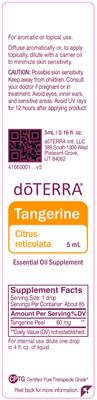
Supplement Facts
The label details for Tangerine by doTERRA, sourced from the NIH Dietary Supplement Label Database.
Supplement Facts
| Ingredient | Amount | % DV |
|---|---|---|
| Tangerine | 60 mg | -- |
Tap any ingredient to jump to its full detail below.
These statements are the manufacturer’s wording, reproduced from the product label — the label is saying it, not HelloPharmacist. We don’t verify or endorse them.
Suggested/Recommended/Usage/Directions
For aromatic or topical use. Diffuse aromatically or, to apply topically, dilute with a carrier oil to minimize skin sensitivity.
For internal use dilute one drop in 4 fl. oz. of liquid.
Precautions
Caution: Possible skin sensitivity.
Keep away from children.
Consult your doctor if pregnant or in treatment.
Avoid eyes, inner ears, and sensitive areas. Avoid UV rays for 12 hours after applying product.
General
v5 41660001
Formula
Citrus reticulata
FDA Statement of Identity
Essential Oil Supplement
Brand IP Statement(s)
CPTG Certified Pure Therapeutic Grade
General Statements
Peel back for more information.
Is this label outdated? Report a formula or label change and our pharmacy team will review it.
Tangerine by doTERRA label
The label scan from the NIH Dietary Supplement Label Database. Tap to enlarge.
Label images are published by the NIH Dietary Supplement Label Database for the version of this product on file. Always read your actual product label.
View the full label (PDF)The Ingredients in Tangerine by doTERRA
This is the 1 active ingredient this product is made of. Select it to open its full monograph.
Serving size1 Drop(s) Dosage formLiquid Servings per container85 Amounts shown are per serving.
Tangerine
Interacts with643 drugs
Tangerine is a sweet citrus fruit that is a good source of vitamin C and other nutrients, and is widely enjoyed as food. While the peel and essential...
Tangerine monograph & interactionsTangerine by doTERRA Drug Interactions
HelloPharmacist Interaction Report
doTERRA Tangerine is a single-ingredient liquid supplement, and its tangerine content has documented interactions with medications.
The most serious interaction is Minor in severity: tangerine may affect how your body processes certain sedatives and other drugs that depend on a liver enzyme called cytochrome P450 3A4 (CYP3A4). In laboratory studies, tangeretin (a compound in tangerine) appeared to speed up the metabolism of midazolam (Versed), a sedative used for anxiety and before procedures.
However, human studies using 200 mL of tangerine juice showed only a slight delay in absorption—the medication itself was metabolized normally. Altogether, these interactions span 644 individual medications.
The CYP3A4 enzyme is involved in breaking down a very large number of drugs across many categories, so if you take any prescription medication, it's worth running it through the medication checker on this page or speaking with your pharmacist before starting tangerine supplementation.
Check your own medications below · Editorial policy · How we use AI
Want to check YOUR meds against Tangerine?
Ask about interactions with your drugs in plain English — “Can I take it with lisinopril?” — and we find you the answer in seconds, ingredient by ingredient.
Go to the checkerIngredients driving the most interactions
Individual Drug Interactions
The ingredients in Tangerine interact with 643 drugs. Click any drug to see the details.
1 of the 1 ingredient in Tangerine interact with drugs. Each result below shows which ingredient is responsible. Tangerine
DexchlorpheniraminePolaramine, Polaramine Repetabs
How Dexchlorpheniramine interacts with Tangerine — through 1 ingredient. Tap an ingredient for the detail:
TangerineCytochrome P450 3a4 (cyp3a4) Substrates Minor
Interaction Summary
In vitro, tangeretin, a constituent of tangerine, induces a 52% increase in the metabolism of midazolam by cytochrome P450 3A4 (CYP3A4).
Read the full Tangerine + Dexchlorpheniramine interactionDexlansoprazoleDexilant Solutab
How Dexlansoprazole interacts with Tangerine — through 1 ingredient. Tap an ingredient for the detail:
TangerineCytochrome P450 3a4 (cyp3a4) Substrates Minor
Interaction Summary
In vitro, tangeretin, a constituent of tangerine, induces a 52% increase in the metabolism of midazolam by cytochrome P450 3A4 (CYP3A4).
Read the full Tangerine + Dexlansoprazole interactionDextromethorphanBenylin Adult, Benylin Pediatric, Hold, Neo Citran Thin Strips Cough, Theraflu Thin Strips Long Acting Cough
How Dextromethorphan interacts with Tangerine — through 1 ingredient. Tap an ingredient for the detail:
TangerineCytochrome P450 3a4 (cyp3a4) Substrates Minor
Interaction Summary
In vitro, tangeretin, a constituent of tangerine, induces a 52% increase in the metabolism of midazolam by cytochrome P450 3A4 (CYP3A4).
Read the full Tangerine + Dextromethorphan interactionDextromethorphan HbrVicks Formula 44 Cough Relief
How Dextromethorphan Hbr interacts with Tangerine — through 1 ingredient. Tap an ingredient for the detail:
TangerineCytochrome P450 3a4 (cyp3a4) Substrates Minor
Interaction Summary
In vitro, tangeretin, a constituent of tangerine, induces a 52% increase in the metabolism of midazolam by cytochrome P450 3A4 (CYP3A4).
Read the full Tangerine + Dextromethorphan Hbr interactionDextromethorphan Hbr, GuaifenesinPediatric Vicks Formula 44e Cough & Chest Congesti, Vicks Formula 44E Cough & Chest Congestion Relief
How Dextromethorphan Hbr, Guaifenesin interacts with Tangerine — through 1 ingredient. Tap an ingredient for the detail:
TangerineCytochrome P450 3a4 (cyp3a4) Substrates Minor
Interaction Summary
In vitro, tangeretin, a constituent of tangerine, induces a 52% increase in the metabolism of midazolam by cytochrome P450 3A4 (CYP3A4).
Read the full Tangerine + Dextromethorphan Hbr, Guaifenesin interactionDextromethorphan Hbr, Phenylephrine HclVicks Formula 44D Cough & Head Congestion Relief
How Dextromethorphan Hbr, Phenylephrine Hcl interacts with Tangerine — through 1 ingredient. Tap an ingredient for the detail:
TangerineCytochrome P450 3a4 (cyp3a4) Substrates Minor
Interaction Summary
In vitro, tangeretin, a constituent of tangerine, induces a 52% increase in the metabolism of midazolam by cytochrome P450 3A4 (CYP3A4).
Read the full Tangerine + Dextromethorphan Hbr, Phenylephrine Hcl interactionDextromethorphan, GuaifenesinAmibid DM, Aquatab DM, Benylin Expectorant, Bidex DM, Fenesin DM, GFN 500 DTMH 30 +17 more
How Dextromethorphan, Guaifenesin interacts with Tangerine — through 1 ingredient. Tap an ingredient for the detail:
TangerineCytochrome P450 3a4 (cyp3a4) Substrates Minor
Interaction Summary
In vitro, tangeretin, a constituent of tangerine, induces a 52% increase in the metabolism of midazolam by cytochrome P450 3A4 (CYP3A4).
Read the full Tangerine + Dextromethorphan, Guaifenesin interactionDextromethorphan, Guaifenesin, PhenylephrineAlbatussin Sr, Giltuss
How Dextromethorphan, Guaifenesin, Phenylephrine interacts with Tangerine — through 1 ingredient. Tap an ingredient for the detail:
TangerineCytochrome P450 3a4 (cyp3a4) Substrates Minor
Interaction Summary
In vitro, tangeretin, a constituent of tangerine, induces a 52% increase in the metabolism of midazolam by cytochrome P450 3A4 (CYP3A4).
Read the full Tangerine + Dextromethorphan, Guaifenesin, Phenylephrine interactionDextromethorphan, Guaifenesin, PhenylpropanolamineProfen LA
How Dextromethorphan, Guaifenesin, Phenylpropanolamine interacts with Tangerine — through 1 ingredient. Tap an ingredient for the detail:
TangerineCytochrome P450 3a4 (cyp3a4) Substrates Minor
Interaction Summary
In vitro, tangeretin, a constituent of tangerine, induces a 52% increase in the metabolism of midazolam by cytochrome P450 3A4 (CYP3A4).
Read the full Tangerine + Dextromethorphan, Guaifenesin, Phenylpropanolamine interactionDextromethorphan, Guaifenesin, PseudoephedrineMaxifed DM, Med Rx DM, Medent DM, Panmist DM, Profen Forte DM, Profen II DM +4 more
How Dextromethorphan, Guaifenesin, Pseudoephedrine interacts with Tangerine — through 1 ingredient. Tap an ingredient for the detail:
TangerineCytochrome P450 3a4 (cyp3a4) Substrates Minor
Interaction Summary
In vitro, tangeretin, a constituent of tangerine, induces a 52% increase in the metabolism of midazolam by cytochrome P450 3A4 (CYP3A4).
Read the full Tangerine + Dextromethorphan, Guaifenesin, Pseudoephedrine interactionDextromethorphan, Guaifenesin, PseudophedrineAnatuss DM, Organidin NR
How Dextromethorphan, Guaifenesin, Pseudophedrine interacts with Tangerine — through 1 ingredient. Tap an ingredient for the detail:
TangerineCytochrome P450 3a4 (cyp3a4) Substrates Minor
Interaction Summary
In vitro, tangeretin, a constituent of tangerine, induces a 52% increase in the metabolism of midazolam by cytochrome P450 3A4 (CYP3A4).
Read the full Tangerine + Dextromethorphan, Guaifenesin, Pseudophedrine interactionDextromethorphan, Guaifenesin, PsuedoephedrineAquatab C
How Dextromethorphan, Guaifenesin, Psuedoephedrine interacts with Tangerine — through 1 ingredient. Tap an ingredient for the detail:
TangerineCytochrome P450 3a4 (cyp3a4) Substrates Minor
Interaction Summary
In vitro, tangeretin, a constituent of tangerine, induces a 52% increase in the metabolism of midazolam by cytochrome P450 3A4 (CYP3A4).
Read the full Tangerine + Dextromethorphan, Guaifenesin, Psuedoephedrine interactionDextromethorphan, Methscopolamine, PhenylephrineDA Chewable
How Dextromethorphan, Methscopolamine, Phenylephrine interacts with Tangerine — through 1 ingredient. Tap an ingredient for the detail:
TangerineCytochrome P450 3a4 (cyp3a4) Substrates Minor
Interaction Summary
In vitro, tangeretin, a constituent of tangerine, induces a 52% increase in the metabolism of midazolam by cytochrome P450 3A4 (CYP3A4).
Read the full Tangerine + Dextromethorphan, Methscopolamine, Phenylephrine interactionDextromethorphan, PseudoephedrineSudafed Cold/Flu
How Dextromethorphan, Pseudoephedrine interacts with Tangerine — through 1 ingredient. Tap an ingredient for the detail:
TangerineCytochrome P450 3a4 (cyp3a4) Substrates Minor
Interaction Summary
In vitro, tangeretin, a constituent of tangerine, induces a 52% increase in the metabolism of midazolam by cytochrome P450 3A4 (CYP3A4).
Read the full Tangerine + Dextromethorphan, Pseudoephedrine interactionDextromethorphan, Pseudoephedrine, TriprolidineActifed DM
How Dextromethorphan, Pseudoephedrine, Triprolidine interacts with Tangerine — through 1 ingredient. Tap an ingredient for the detail:
TangerineCytochrome P450 3a4 (cyp3a4) Substrates Minor
Interaction Summary
In vitro, tangeretin, a constituent of tangerine, induces a 52% increase in the metabolism of midazolam by cytochrome P450 3A4 (CYP3A4).
Read the full Tangerine + Dextromethorphan, Pseudoephedrine, Triprolidine interactionDiazepamDiastat AcuDial, Valium, Valium injection, Valtoco
How Diazepam interacts with Tangerine — through 1 ingredient. Tap an ingredient for the detail:
TangerineCytochrome P450 3a4 (cyp3a4) Substrates Minor
Interaction Summary
In vitro, tangeretin, a constituent of tangerine, induces a 52% increase in the metabolism of midazolam by cytochrome P450 3A4 (CYP3A4).
Read the full Tangerine + Diazepam interactionDienogestVisanne
How Dienogest interacts with Tangerine — through 1 ingredient. Tap an ingredient for the detail:
TangerineCytochrome P450 3a4 (cyp3a4) Substrates Minor
Interaction Summary
In vitro, tangeretin, a constituent of tangerine, induces a 52% increase in the metabolism of midazolam by cytochrome P450 3A4 (CYP3A4).
Read the full Tangerine + Dienogest interactionDihydroergotamineDHE-45, Migranal
How Dihydroergotamine interacts with Tangerine — through 1 ingredient. Tap an ingredient for the detail:
TangerineCytochrome P450 3a4 (cyp3a4) Substrates Minor
Interaction Summary
In vitro, tangeretin, a constituent of tangerine, induces a 52% increase in the metabolism of midazolam by cytochrome P450 3A4 (CYP3A4).
Read the full Tangerine + Dihydroergotamine interactionDihydroergotamine MesylateTrudhesa
How Dihydroergotamine Mesylate interacts with Tangerine — through 1 ingredient. Tap an ingredient for the detail:
TangerineCytochrome P450 3a4 (cyp3a4) Substrates Minor
Interaction Summary
In vitro, tangeretin, a constituent of tangerine, induces a 52% increase in the metabolism of midazolam by cytochrome P450 3A4 (CYP3A4).
Read the full Tangerine + Dihydroergotamine Mesylate interactionDiltiazemAdizem-SR, Adizem-XL, Angitil SR, Angitil XL, Calcicard CR, Cardizem +23 more
How Diltiazem interacts with Tangerine — through 1 ingredient. Tap an ingredient for the detail:
TangerineCytochrome P450 3a4 (cyp3a4) Substrates Minor
Interaction Summary
In vitro, tangeretin, a constituent of tangerine, induces a 52% increase in the metabolism of midazolam by cytochrome P450 3A4 (CYP3A4).
Read the full Tangerine + Diltiazem interactionDiltiazem, EnalaprilTeczem
How Diltiazem, Enalapril interacts with Tangerine — through 1 ingredient. Tap an ingredient for the detail:
TangerineCytochrome P450 3a4 (cyp3a4) Substrates Minor
Interaction Summary
In vitro, tangeretin, a constituent of tangerine, induces a 52% increase in the metabolism of midazolam by cytochrome P450 3A4 (CYP3A4).
Read the full Tangerine + Diltiazem, Enalapril interactionDisopyramide PhosphateNorpace, Norpace CR
How Disopyramide Phosphate interacts with Tangerine — through 1 ingredient. Tap an ingredient for the detail:
TangerineCytochrome P450 3a4 (cyp3a4) Substrates Minor
Interaction Summary
In vitro, tangeretin, a constituent of tangerine, induces a 52% increase in the metabolism of midazolam by cytochrome P450 3A4 (CYP3A4).
Read the full Tangerine + Disopyramide Phosphate interactionDocetaxelTaxotere
How Docetaxel interacts with Tangerine — through 1 ingredient. Tap an ingredient for the detail:
TangerineCytochrome P450 3a4 (cyp3a4) Substrates Minor
Interaction Summary
In vitro, tangeretin, a constituent of tangerine, induces a 52% increase in the metabolism of midazolam by cytochrome P450 3A4 (CYP3A4).
Read the full Tangerine + Docetaxel interactionDofetilideTikosyn
How Dofetilide interacts with Tangerine — through 1 ingredient. Tap an ingredient for the detail:
TangerineCytochrome P450 3a4 (cyp3a4) Substrates Minor
Interaction Summary
In vitro, tangeretin, a constituent of tangerine, induces a 52% increase in the metabolism of midazolam by cytochrome P450 3A4 (CYP3A4).
Read the full Tangerine + Dofetilide interactionDolasetronAnzemet
How Dolasetron interacts with Tangerine — through 1 ingredient. Tap an ingredient for the detail:
TangerineCytochrome P450 3a4 (cyp3a4) Substrates Minor
Interaction Summary
In vitro, tangeretin, a constituent of tangerine, induces a 52% increase in the metabolism of midazolam by cytochrome P450 3A4 (CYP3A4).
Read the full Tangerine + Dolasetron interactionDolutegravir, RilpivirineJuluca
How Dolutegravir, Rilpivirine interacts with Tangerine — through 1 ingredient. Tap an ingredient for the detail:
TangerineCytochrome P450 3a4 (cyp3a4) Substrates Minor
Interaction Summary
In vitro, tangeretin, a constituent of tangerine, induces a 52% increase in the metabolism of midazolam by cytochrome P450 3A4 (CYP3A4).
Read the full Tangerine + Dolutegravir, Rilpivirine interactionDonepezilAricept
How Donepezil interacts with Tangerine — through 1 ingredient. Tap an ingredient for the detail:
TangerineCytochrome P450 3a4 (cyp3a4) Substrates Minor
Interaction Summary
In vitro, tangeretin, a constituent of tangerine, induces a 52% increase in the metabolism of midazolam by cytochrome P450 3A4 (CYP3A4).
Read the full Tangerine + Donepezil interactionDonepezil (patch)Adlarity
How Donepezil (patch) interacts with Tangerine — through 1 ingredient. Tap an ingredient for the detail:
TangerineCytochrome P450 3a4 (cyp3a4) Substrates Minor
Interaction Summary
In vitro, tangeretin, a constituent of tangerine, induces a 52% increase in the metabolism of midazolam by cytochrome P450 3A4 (CYP3A4).
Read the full Tangerine + Donepezil (patch) interactionDoravirinePifeltro
How Doravirine interacts with Tangerine — through 1 ingredient. Tap an ingredient for the detail:
TangerineCytochrome P450 3a4 (cyp3a4) Substrates Minor
Interaction Summary
In vitro, tangeretin, a constituent of tangerine, induces a 52% increase in the metabolism of midazolam by cytochrome P450 3A4 (CYP3A4).
Read the full Tangerine + Doravirine interactionDoravirine, Lamivudine, Tenofovir Disoproxil FumarateDelstrigo
How Doravirine, Lamivudine, Tenofovir Disoproxil Fumarate interacts with Tangerine — through 1 ingredient. Tap an ingredient for the detail:
TangerineCytochrome P450 3a4 (cyp3a4) Substrates Minor
Interaction Summary
In vitro, tangeretin, a constituent of tangerine, induces a 52% increase in the metabolism of midazolam by cytochrome P450 3A4 (CYP3A4).
Read the full Tangerine + Doravirine, Lamivudine, Tenofovir Disoproxil Fumarate interactionEach ingredient & the kinds of drugs it affects
For each ingredient in Tangerine with known interactions, here are the types of medications it can affect. Open any type for the detail — or search your exact drug in the checker above.
Tangerine
Cytochrome P450 3A4 (Cyp3A4) Substrates
In vitro, tangeretin, a constituent of tangerine, induces a 52% increase in the metabolism of midazolam by cytochrome P450 3A4 (CYP3A4). This suggests that tangeretin may stimulate CYP3A4 activity. However, in humans, drinking tangerine juice 200 mL slightly delayed the absorption, but did not affect the metabolism, of midazolam, a CYP3A4 substrate. Theoretically, tangerine juice might increase CYP3A4 activity and decrease levels of drugs metabolized by this enzyme. However, this effect is unlikely.
Some drugs metabolized by CYP3A4 include amitriptyline (Elavil), amiodarone (Cordarone), citalopram (Celexa), felodipine (Plendil), lansoprazole (Prevacid), ondansetron (Zofran), prednisone (Deltasone, Orasone), sertraline (Zoloft), sibutramine (Meridia), and many others.
Midazolam (Versed)
In vitro, tangeretin, a constituent of tangerine, appears to increase the metabolism of midazolam in human liver microsomes by up to 52%. However, in humans, drinking tangerine juice 200 mL slightly delayed the absorption, but did not affect the metabolism, of midazolam. Theoretically, tangerine juice might increase the metabolism and reduce the effects of midazolam. However, this effect is unlikely.
Brand information
Manufacturer and brand details for Tangerine, from the product label.
doTERRA
See all doTERRA products- Name
- doTERRA Intl, LLC
- Street Address
- 389 South 1300 West
- City
- Pleasant Grove
- State
- UT
- ZipCode
- 84062
Tangerine by doTERRA: Common Questions
Does Tangerine by doTERRA interact with any medications?
How can one product interact with so many drugs?
Where does this information come from?
Is tangerine essential oil the same as this liquid supplement?
Can I take this if I'm pregnant or breastfeeding?
Will tangerine affect my sedative medication?
What does this supplement actually do?
Are there side effects from taking tangerine supplements?
Written and reviewed by the HelloPharmacist editorial staff. Our editorial policy
Not sure if Tangerine is safe with your meds?
Our pharmacists answer your medication & supplement questions — free.
Label information is sourced from the NIH Dietary Supplement Label Database and reflects the product version on file; always read your actual product label. This page is for education only and is not a substitute for professional medical advice. Confirm with your pharmacist or doctor before combining supplements and medications.
The Full Monographs Behind Tangerine’s Ingredients
Every ingredient we hold a full HelloPharmacist monograph for — uses, evidence, safety, and the complete interaction list.
Sources & How We Checked
Tangerine's label data comes from the NIH Dietary Supplement Label Database; the ingredient interaction data is from the Natural Medicines database, reviewed by our pharmacists.
- NIH Dietary Supplement Label Database (DSLD) — The official product label on file for this supplement.
- Natural Medicines (Therapeutic Research Center) — Evidence-graded clinical reference behind the ingredient interaction data.
Content is written and reviewed by licensed HelloPharmacist pharmacists. See our data sources and editorial standards for how this information is built and checked.
The 3 references behind this product’s interaction data
Every citation that drives the interaction findings for this product’s ingredients, from the evidence-graded Natural Medicines (TRC Healthcare) database. Open an ingredient to browse its citations — links open the study on PubMed or the publisher’s site.
Tangerine 3 references
- Yuan, J. M., Wang, X. L., Xiang, Y. B., Gao, Y. T., Ross, R. K., and Yu, M. C. Preserved foods in relation to risk of nasopharyngeal carcinoma in Shanghai, China. Int J Cancer 2000;85(3):358-363. DOI
- Backman, J. T., Maenpaa, J., Belle, D. J., Wrighton, S. A., Kivisto, K. T., and Neuvonen, P. J. Lack of correlation between in vitro and in vivo studies on the effects of tangeretin and tangerine juice on midazolam hydroxylation. Clin Pharmacol Ther 2000; PubMed
- Vilaplana, J. and Romaguera, C. Contact dermatitis from the essential oil of tangerine in fragrance. Contact Dermatitis 2002;46(2):108. PubMed
Parts of this content are provided by the Therapeutic Research Center, LLC.
DISCLAIMER: Currently this does not check for drug-drug interactions. This is not an all-inclusive comprehensive list of potential interactions and is for informational purposes only. Not all interactions are known or well-reported in the scientific literature, and new interactions are continually being reported. Input is needed from a qualified healthcare provider including a pharmacist before starting any therapy. Application of clinical judgment is necessary.
© 2021 Therapeutic Research Center, LLC