
Thera Supreme 575 mg Ingredients & Drug Interactions
What is this page for?
First and foremost: checking Thera Supreme 575 mg against your medications. The heart of this page is the interaction checker and the full interaction report — how this product’s ingredients may interact with prescription and over-the-counter medicines you may be taking.
Around that, we add a pharmacist’s high-level view of the product as a whole — what’s inside, the evidence for its stated use, how transparent the label is, and what safety data exists — so you can see the full picture in one place. It’s educational information from our licensed clinical databases and the clinical staff at HelloPharmacist — not medical advice — and we don’t sell or endorse products. Our editorial policy
Thera Supreme 575 mg is a dietary supplement by Supreme Nutrition Products with 6 active ingredients. Its ingredients are commonly taken for antioxidant support, heart health, brain and memory health.Based on those ingredients, 925 medications have a known interaction with it, the most serious rated moderate. The ingredients most likely to interact are Cilantro, Bilberry, Brussels Sprout. Use the checker below to test your specific medication, or read the full HelloPharmacist Interaction Report.
Check Your Meds Against Thera Supreme 575 mg by Supreme Nutrition Products
Ask about any prescription or over-the-counter medication and we check it for interactions with Thera Supreme 575 mg by Supreme Nutrition Products — and tell you which ingredient is responsible.
AI summaries are generated from our interaction database for education only — always confirm with your pharmacist. How we use AI
Ask the Pharmacist
A licensed pharmacist will answer your question by email — free, usually within 24 hours.
Got it — thank you!
A licensed pharmacist will answer within 24 hours. Keep an eye on your email (worth checking spam, just in case).
HelloPharmacist Scorecard of Thera Supreme 575 mg by Supreme Nutrition Products
Our pharmacy team’s full take, with four database checks built into the cards below — a summary of what is known, not a grade of the product itself.
What’s inside
Low disclosure
Thera Supreme 575 mg contains six active ingredients. Blueberry, bilberry, and baobab are fruit-based; cilantro (also called coriander) is an herb; Brussels sprout and black radish are vegetables.
The product also contains cellulose as an inactive ingredient (a binder and capsule material). Beyond that, the product facts don't specify what roles these ingredients are meant to play, so we can't tell you what the formula is designed to support.
Does it work?
Couldn't assess
For most conditions these ingredients are used for, the evidence in our data is rated Insufficient Reliable Evidence — that means studies either don't exist, are too small, or are too mixed to draw firm conclusions. Blueberry is rated Possibly Ineffective for high blood pressure.
Bilberry is rated Possibly Ineffective for night vision. For the rest — diabetes, anxiety, cognitive decline, heart health, and others — the data we hold doesn't establish whether these ingredients work.
How safe is it?
Well-documented data
Blueberry, Brussels sprout, and black radish are generally well tolerated when eaten as food. Freeze-dried blueberries may cause constipation, diarrhea, nausea, or vomiting; in one trial, 26% of people taking 50 grams daily dropped out in the first week due to stomach complaints.
Cilantro is generally well tolerated, though topical contact can rarely cause dermatitis, and a rare case of anaphylaxis has been reported. Bilberry fruit seems well tolerated but may cause flatulence, dark-colored stools, or temporary tongue discoloration.
Baobab is generally safe as food, but one case of anaphylaxis after consuming baobab fruit has been reported. Black radish is generally safe, though large amounts may irritate the stomach lining.
Pregnancy and lactation data: blueberry is rated Likely Safe in pregnancy and lactation; bilberry is rated Likely Safe; for cilantro, Brussels sprout, baobab, and black radish, we hold no pregnancy or lactation rating on file.
Meds to double-check
Moderate interaction found
Check the following medication types before you start: blood thinners and antiplatelet drugs (bilberry increases bleeding risk); antidiabetes drugs (multiple ingredients may lower blood sugar); blood pressure medications (cilantro may increase the drop); CNS depressants like sedatives and anxiety drugs (cilantro and Brussels sprout may reduce their effects); and drugs metabolized by your liver's CYP1A2 and CYP2E1 pathways (Brussels sprout and bilberry may speed up their clearance). If you take any of these, use the search tool on this page to check your specific medications.
The bottom line
Scorecard at a glanceFormula with limited ingredient disclosure with no assessable stated purpose. Moderate medication interactions have been identified, and safety information is well characterized.
If you take blood thinners, antidiabetes drugs, blood pressure medications, or anxiety medications, talk to your pharmacist before starting this product — several ingredients interact with these drug types. If you have a history of berry allergies or a severe spice sensitivity, exercise caution.
This product is a multi-ingredient blend, so check your exact medications using the tool on this page before you begin.
Educational only — not medical advice; always confirm with your pharmacist. Our editorial policy · How we use AI
Assessment coverage: 6 of 6 active ingredients matched to our full ingredient reviews (monographs). Based on the product label dated Sep 25, 2025.
This Scorecard evaluates available label information, ingredient evidence, and known medication-safety considerations. It does not independently verify product identity, purity, potency, contamination, or manufacturing quality. How these ratings are computed
General information
Key facts about Thera Supreme 575 mg, straight from the product label.
| Brand | Supreme Nutrition Products |
|---|---|
| Barcode (UPC) | 794504888966 |
| Net contents | 130 Vegetable Capsule(s) |
| Market status | On market |
| Date entered into DSLD | Sep 25, 2025 |
| DSLD ID | 335654 |
| Product type | Botanical |
| Supplement form | Capsule |
| Dietary claims / uses | All Other, Structure/Function |
| Intended target group(s) | Adult (18 - 50 Years) |
Everything in this section is reproduced from the manufacturer’s own product label — it’s the label speaking, not HelloPharmacist. We show it so you can see exactly what the maker states; we don’t verify or endorse those statements.
Supplement Facts
The label details for Thera Supreme 575 mg by Supreme Nutrition Products, sourced from the NIH Dietary Supplement Label Database.
Supplement Facts
| Ingredient | Amount | % DV |
|---|---|---|
| Blueberry | 0 NP | -- |
| Cilantro | 0 NP | -- |
| Brussels Sprout | 0 NP | -- |
| Bilberry | 0 NP | -- |
| Baobab | 0 NP | -- |
| Black Radish | 0 NP | -- |
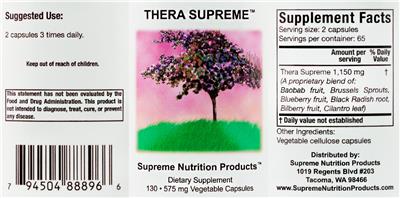
| Thera Supreme | 1150 mg | -- |
Other ingredients: Cellulose
Tap any ingredient to jump to its full detail below.
These statements are the manufacturer’s wording, reproduced from the product label — the label is saying it, not HelloPharmacist. We don’t verify or endorse them.
Suggested/Recommended/Usage/Directions
Suggested use: 2 capsules 3 times daily.
Precautions
Keep out of reach of children.
FDA Disclaimer Statement
This statement has not been evaluated by the Food and Drug Administration. This product is not intended to diagnose, treat, cure, or prevent any disease.
FDA Statement of Identity
Dietary Supplement
Is this label outdated? Report a formula or label change and our pharmacy team will review it.
Thera Supreme 575 mg by Supreme Nutrition Products label
The label scan from the NIH Dietary Supplement Label Database. Tap to enlarge.
Label images are published by the NIH Dietary Supplement Label Database for the version of this product on file. Always read your actual product label.
View the full label (PDF)The Ingredients in Thera Supreme 575 mg by Supreme Nutrition Products
These are the 6 active ingredients this product is made of. Select any to open its full monograph.
Serving size2 Capsule(s) Dosage formCapsule Servings per container65 Amounts shown are per serving.
Most supplement products combine several ingredients, and a medication can interact with the product through any one of them. Each ingredient below shows whether it has known drug interactions.
Thera Supreme
- › Blueberry
- › Cilantro
- › Brussels Sprout
- › Bilberry
- › Baobab
- › Black Radish
Other (inactive) ingredients: Cellulose. These complete the product’s ingredient list but are not active constituents.
Thera Supreme 575 mg by Supreme Nutrition Products Drug Interactions
HelloPharmacist Interaction Report
Thera Supreme 575 mg by Supreme Nutrition Products contains six active ingredients, and several of them interact with medications.
The most serious interaction we have on file involves bilberry and blood thinners (anticoagulants) and antiplatelet drugs — bilberry may increase bleeding risk by inhibiting platelet clumping. This is rated Moderate severity.
Read the full breakdown — every affected drug type, severity by severity
Cilantro poses Moderate interactions with CNS depressants (sedatives, sleeping pills, anxiety medications), antihypertensive drugs (blood pressure medications), and photosensitizing drugs. Brussels sprout and black radish also carry Moderate interactions: Brussels sprout affects drugs metabolized through several liver pathways, including warfarin (a blood thinner), acetaminophen, and anti-anxiety medications like oxazepam; black radish may increase the blood sugar-lowering effect of antidiabetes drugs.
Blueberry poses Minor interactions with antidiabetes drugs, flurbiprofen (an anti-inflammatory), and buspirone (an anxiety medication).
Barobab and cilantro's pregnancy and lactation data show insufficient information — we could not find pregnancy or lactation safety data on file for baobab or black radish. Altogether, these interactions span 920 individual medications.
Before you start this product, check your exact medications with the search tool on this page.
Check your own medications below · Editorial policy · How we use AI
Want to check YOUR meds against Thera Supreme 575 mg?
Ask about interactions with your drugs in plain English — “Can I take it with lisinopril?” — and we find you the answer in seconds, ingredient by ingredient.
Go to the checkerIngredients driving the most interactions
Individual Drug Interactions
The ingredients in Thera Supreme 575 mg interact with 925 drugs. Click any drug to see the details.
5 of the 6 ingredients in Thera Supreme 575 mg interact with drugs. Each result below shows which ingredient is responsible. Cilantro Bilberry Brussels Sprout Blueberry Black Radish
AbciximabReoPro
How Abciximab interacts with Thera Supreme 575 mg — through 1 ingredient. Tap an ingredient for the detail:
BilberryAnticoagulant/antiplatelet Drugs Moderate
Interaction Summary
Theoretically, bilberry fruit extract might increase the risk of bleeding when taken with anticoagulant or antiplatelet drugs.
Read the full Bilberry + Abciximab interactionAbrocitinibCibinqo
How Abrocitinib interacts with Thera Supreme 575 mg — through 1 ingredient. Tap an ingredient for the detail:
BilberryAnticoagulant/antiplatelet Drugs Moderate
Interaction Summary
Theoretically, bilberry fruit extract might increase the risk of bleeding when taken with anticoagulant or antiplatelet drugs.
Read the full Bilberry + Abrocitinib interactionAcarboseGlucobay, Prandase, Precose
How Acarbose interacts with Thera Supreme 575 mg — through 4 ingredients. Tap an ingredient for the detail:
BilberryAntidiabetes Drugs Moderate
Interaction Summary
Theoretically, bilberry leaf or fruit extract may increase the risk of hypoglycemia when taken with antidiabetes drugs.
Read the full Bilberry + Acarbose interactionBlack RadishAntidiabetes Drugs Moderate
Interaction Summary
Theoretically, radish might increase the risk of hypoglycemia when taken with antidiabetes drugs.
Read the full Black Radish + Acarbose interactionCilantroAntidiabetes Drugs Moderate
Interaction Summary
Theoretically, coriander might increase the risk of hypoglycemia when taken with antidiabetes drugs.
Read the full Cilantro + Acarbose interactionBlueberryAntidiabetes Drugs Minor
Interaction Summary
Theoretically, blueberries or blueberry leaf extracts might increase the risk of hypoglycemia when taken with antidiabetes drugs.
Read the full Blueberry + Acarbose interactionAcebutololRhotral, Sectral
How Acebutolol interacts with Thera Supreme 575 mg — through 1 ingredient. Tap an ingredient for the detail:
CilantroAntihypertensive Drugs Moderate
Interaction Summary
Theoretically, coriander might increase the risk of hypotension when taken with antihypertensive drugs.
Read the full Cilantro + Acebutolol interactionAcenocoumarolSintrom
How Acenocoumarol interacts with Thera Supreme 575 mg — through 1 ingredient. Tap an ingredient for the detail:
BilberryAnticoagulant/antiplatelet Drugs Moderate
Interaction Summary
Theoretically, bilberry fruit extract might increase the risk of bleeding when taken with anticoagulant or antiplatelet drugs.
Read the full Bilberry + Acenocoumarol interactionAcepromazineAtravet
How Acepromazine interacts with Thera Supreme 575 mg — through 1 ingredient. Tap an ingredient for the detail:
CilantroCns Depressants, Photosensitizing Drugs Moderate
Interaction Summary
Theoretically, coriander might cause additive sedative effects when taken with CNS depressants.
Read the full Cilantro + Acepromazine interactionAcetaminophenChildren's Tylenol, Children's Tylenol Meltaways, Tylenol, Tylenol Ex Strength
How Acetaminophen interacts with Thera Supreme 575 mg — through 2 ingredients. Tap an ingredient for the detail:
Brussels SproutCytochrome P450 1a2 (cyp1a2) Substrates, Acetaminophen (tylenol, Others) +1 Moderate
Interaction Summary
Animal research suggests that Brussels sprout can induce cytochrome P450 1A2 (CYP1A2) activity.
Read the full Brussels Sprout + Acetaminophen interactionBilberryCytochrome P450 2e1 (cyp2e1) Substrates Moderate
Interaction Summary
Theoretically, bilberry fruit extract might decrease levels of drugs metabolized by CYP2E1.
Read the full Bilberry + Acetaminophen interactionAcetaminophen, AspirinGemnisyn
How Acetaminophen, Aspirin interacts with Thera Supreme 575 mg — through 2 ingredients. Tap an ingredient for the detail:
Brussels SproutGlucuronidated Drugs, Acetaminophen (tylenol, Others) +1 Moderate
Interaction Summary
A cabbage and Brussels sprout-containing diet seems to boost elimination through glucuronide conjugation.
Read the full Brussels Sprout + Acetaminophen, Aspirin interactionBilberryAnticoagulant/antiplatelet Drugs, Cytochrome P450 2e1 (cyp2e1) Substrates Moderate
Interaction Summary
Theoretically, bilberry fruit extract might increase the risk of bleeding when taken with anticoagulant or antiplatelet drugs.
Read the full Bilberry + Acetaminophen, Aspirin interactionAcetaminophen, Aspirin, CaffeineExcedrin, Excedrin Extra Strength, Excedrin Migraine
How Acetaminophen, Aspirin, Caffeine interacts with Thera Supreme 575 mg — through 2 ingredients. Tap an ingredient for the detail:
BilberryCytochrome P450 2e1 (cyp2e1) Substrates, Anticoagulant/antiplatelet Drugs Moderate
Interaction Summary
Theoretically, bilberry fruit extract might decrease levels of drugs metabolized by CYP2E1.
Read the full Bilberry + Acetaminophen, Aspirin, Caffeine interactionBrussels SproutGlucuronidated Drugs, Acetaminophen (tylenol, Others) +1 Moderate
Interaction Summary
A cabbage and Brussels sprout-containing diet seems to boost elimination through glucuronide conjugation.
Read the full Brussels Sprout + Acetaminophen, Aspirin, Caffeine interactionAcetaminophen, Brompheniramine, PhenylpropanolamineDimetapp Cold and Flu
How Acetaminophen, Brompheniramine, Phenylpropanolamine interacts with Thera Supreme 575 mg — through 3 ingredients. Tap an ingredient for the detail:
Brussels SproutCytochrome P450 1a2 (cyp1a2) Substrates, Glucuronidated Drugs +1 Moderate
Interaction Summary
Animal research suggests that Brussels sprout can induce cytochrome P450 1A2 (CYP1A2) activity.
Read the full Brussels Sprout + Acetaminophen, Brompheniramine, Phenylpropanolamine interactionBilberryCytochrome P450 2e1 (cyp2e1) Substrates Moderate
Interaction Summary
Theoretically, bilberry fruit extract might decrease levels of drugs metabolized by CYP2E1.
Read the full Bilberry + Acetaminophen, Brompheniramine, Phenylpropanolamine interactionCilantroPhotosensitizing Drugs Moderate
Interaction Summary
Theoretically, coriander might increase the risk of photosensitivity when taken with photosensitizing drugs.
Read the full Cilantro + Acetaminophen, Brompheniramine, Phenylpropanolamine interactionAcetaminophen, ButalbitalAxocet, Bancap, Bucet, Butex Forte, Esgic CF, Orbivan CF +5 more
How Acetaminophen, Butalbital interacts with Thera Supreme 575 mg — through 2 ingredients. Tap an ingredient for the detail:
Brussels SproutGlucuronidated Drugs, Cytochrome P450 1a2 (cyp1a2) Substrates +1 Moderate
Interaction Summary
A cabbage and Brussels sprout-containing diet seems to boost elimination through glucuronide conjugation.
Read the full Brussels Sprout + Acetaminophen, Butalbital interactionBilberryCytochrome P450 2e1 (cyp2e1) Substrates Moderate
Interaction Summary
Theoretically, bilberry fruit extract might decrease levels of drugs metabolized by CYP2E1.
Read the full Bilberry + Acetaminophen, Butalbital interactionAcetaminophen, Butalbital, CaffeineEsgic, Esgic Plus, Fiogesic, Fioricet, Repan, Tecnal +1 more
How Acetaminophen, Butalbital, Caffeine interacts with Thera Supreme 575 mg — through 2 ingredients. Tap an ingredient for the detail:
BilberryCytochrome P450 2e1 (cyp2e1) Substrates Moderate
Interaction Summary
Theoretically, bilberry fruit extract might decrease levels of drugs metabolized by CYP2E1.
Read the full Bilberry + Acetaminophen, Butalbital, Caffeine interactionBrussels SproutGlucuronidated Drugs, Acetaminophen (tylenol, Others) +1 Moderate
Interaction Summary
A cabbage and Brussels sprout-containing diet seems to boost elimination through glucuronide conjugation.
Read the full Brussels Sprout + Acetaminophen, Butalbital, Caffeine interactionAcetaminophen, Butalbital, Caffeine, CodeineEsgic with Codeine, Fioricet w/ Codeine
How Acetaminophen, Butalbital, Caffeine, Codeine interacts with Thera Supreme 575 mg — through 3 ingredients. Tap an ingredient for the detail:
BilberryCytochrome P450 2e1 (cyp2e1) Substrates Moderate
Interaction Summary
Theoretically, bilberry fruit extract might decrease levels of drugs metabolized by CYP2E1.
Read the full Bilberry + Acetaminophen, Butalbital, Caffeine, Codeine interactionBrussels SproutAcetaminophen (tylenol, Others), Cytochrome P450 1a2 (cyp1a2) Substrates +1 Moderate
Interaction Summary
A cabbage and Brussels sprout-containing diet can increase metabolism and decrease levels of acetaminophen.
Read the full Brussels Sprout + Acetaminophen, Butalbital, Caffeine, Codeine interactionCilantroCns Depressants Moderate
Interaction Summary
Theoretically, coriander might cause additive sedative effects when taken with CNS depressants.
Read the full Cilantro + Acetaminophen, Butalbital, Caffeine, Codeine interactionAcetaminophen, Butalbital, CodeineBancap w/ Codeine
How Acetaminophen, Butalbital, Codeine interacts with Thera Supreme 575 mg — through 3 ingredients. Tap an ingredient for the detail:
CilantroCns Depressants Moderate
Interaction Summary
Theoretically, coriander might cause additive sedative effects when taken with CNS depressants.
Read the full Cilantro + Acetaminophen, Butalbital, Codeine interactionBrussels SproutCytochrome P450 1a2 (cyp1a2) Substrates, Glucuronidated Drugs +1 Moderate
Interaction Summary
Animal research suggests that Brussels sprout can induce cytochrome P450 1A2 (CYP1A2) activity.
Read the full Brussels Sprout + Acetaminophen, Butalbital, Codeine interactionBilberryCytochrome P450 2e1 (cyp2e1) Substrates Moderate
Interaction Summary
Theoretically, bilberry fruit extract might decrease levels of drugs metabolized by CYP2E1.
Read the full Bilberry + Acetaminophen, Butalbital, Codeine interactionAcetaminophen, Butalbital, Codeine PhosphatePhrenilin #3
How Acetaminophen, Butalbital, Codeine Phosphate interacts with Thera Supreme 575 mg — through 3 ingredients. Tap an ingredient for the detail:
Brussels SproutAcetaminophen (tylenol, Others), Cytochrome P450 1a2 (cyp1a2) Substrates +1 Moderate
Interaction Summary
A cabbage and Brussels sprout-containing diet can increase metabolism and decrease levels of acetaminophen.
Read the full Brussels Sprout + Acetaminophen, Butalbital, Codeine Phosphate interactionCilantroCns Depressants Moderate
Interaction Summary
Theoretically, coriander might cause additive sedative effects when taken with CNS depressants.
Read the full Cilantro + Acetaminophen, Butalbital, Codeine Phosphate interactionBilberryCytochrome P450 2e1 (cyp2e1) Substrates Moderate
Interaction Summary
Theoretically, bilberry fruit extract might decrease levels of drugs metabolized by CYP2E1.
Read the full Bilberry + Acetaminophen, Butalbital, Codeine Phosphate interactionAcetaminophen, Caffeine, Chlorpheniramine, Hydrocodone, PhenylephrineHycomine Compound
How Acetaminophen, Caffeine, Chlorpheniramine, Hydrocodone, Phenylephrine interacts with Thera Supreme 575 mg — through 3 ingredients. Tap an ingredient for the detail:
Brussels SproutGlucuronidated Drugs, Acetaminophen (tylenol, Others) +1 Moderate
Interaction Summary
A cabbage and Brussels sprout-containing diet seems to boost elimination through glucuronide conjugation.
Read the full Brussels Sprout + Acetaminophen, Caffeine, Chlorpheniramine, Hydrocodone, Phenylephrine interactionCilantroPhotosensitizing Drugs, Cns Depressants Moderate
Interaction Summary
Theoretically, coriander might increase the risk of photosensitivity when taken with photosensitizing drugs.
Read the full Cilantro + Acetaminophen, Caffeine, Chlorpheniramine, Hydrocodone, Phenylephrine interactionBilberryCytochrome P450 2e1 (cyp2e1) Substrates Moderate
Interaction Summary
Theoretically, bilberry fruit extract might decrease levels of drugs metabolized by CYP2E1.
Read the full Bilberry + Acetaminophen, Caffeine, Chlorpheniramine, Hydrocodone, Phenylephrine interactionAcetaminophen, Caffeine, CodeineGesic C15, Gesic C30, Gesic C8, Lenoltec 1, Lenoltec 2, Lenoltec 3 +1 more
How Acetaminophen, Caffeine, Codeine interacts with Thera Supreme 575 mg — through 3 ingredients. Tap an ingredient for the detail:
CilantroCns Depressants Moderate
Interaction Summary
Theoretically, coriander might cause additive sedative effects when taken with CNS depressants.
Read the full Cilantro + Acetaminophen, Caffeine, Codeine interactionBrussels SproutAcetaminophen (tylenol, Others), Glucuronidated Drugs +1 Moderate
Interaction Summary
A cabbage and Brussels sprout-containing diet can increase metabolism and decrease levels of acetaminophen.
Read the full Brussels Sprout + Acetaminophen, Caffeine, Codeine interactionBilberryCytochrome P450 2e1 (cyp2e1) Substrates Moderate
Interaction Summary
Theoretically, bilberry fruit extract might decrease levels of drugs metabolized by CYP2E1.
Read the full Bilberry + Acetaminophen, Caffeine, Codeine interactionAcetaminophen, Caffeine, Codeine, SalicylamideCodalan No.1, Codalan No.2, Codalan No.3
How Acetaminophen, Caffeine, Codeine, Salicylamide interacts with Thera Supreme 575 mg — through 3 ingredients. Tap an ingredient for the detail:
BilberryCytochrome P450 2e1 (cyp2e1) Substrates Moderate
Interaction Summary
Theoretically, bilberry fruit extract might decrease levels of drugs metabolized by CYP2E1.
Read the full Bilberry + Acetaminophen, Caffeine, Codeine, Salicylamide interactionBrussels SproutAcetaminophen (tylenol, Others), Cytochrome P450 1a2 (cyp1a2) Substrates +1 Moderate
Interaction Summary
A cabbage and Brussels sprout-containing diet can increase metabolism and decrease levels of acetaminophen.
Read the full Brussels Sprout + Acetaminophen, Caffeine, Codeine, Salicylamide interactionCilantroCns Depressants Moderate
Interaction Summary
Theoretically, coriander might cause additive sedative effects when taken with CNS depressants.
Read the full Cilantro + Acetaminophen, Caffeine, Codeine, Salicylamide interactionAcetaminophen, Caffeine, DihydrocodeineDHC Plus, Panlor DC, Panlor SS
How Acetaminophen, Caffeine, Dihydrocodeine interacts with Thera Supreme 575 mg — through 3 ingredients. Tap an ingredient for the detail:
Brussels SproutGlucuronidated Drugs, Acetaminophen (tylenol, Others) +1 Moderate
Interaction Summary
A cabbage and Brussels sprout-containing diet seems to boost elimination through glucuronide conjugation.
Read the full Brussels Sprout + Acetaminophen, Caffeine, Dihydrocodeine interactionBilberryCytochrome P450 2e1 (cyp2e1) Substrates Moderate
Interaction Summary
Theoretically, bilberry fruit extract might decrease levels of drugs metabolized by CYP2E1.
Read the full Bilberry + Acetaminophen, Caffeine, Dihydrocodeine interactionCilantroCns Depressants Moderate
Interaction Summary
Theoretically, coriander might cause additive sedative effects when taken with CNS depressants.
Read the full Cilantro + Acetaminophen, Caffeine, Dihydrocodeine interactionAcetaminophen, Caffeine, IsomethepteneMigralam
How Acetaminophen, Caffeine, Isometheptene interacts with Thera Supreme 575 mg — through 2 ingredients. Tap an ingredient for the detail:
Brussels SproutCytochrome P450 1a2 (cyp1a2) Substrates, Acetaminophen (tylenol, Others) +1 Moderate
Interaction Summary
Animal research suggests that Brussels sprout can induce cytochrome P450 1A2 (CYP1A2) activity.
Read the full Brussels Sprout + Acetaminophen, Caffeine, Isometheptene interactionBilberryCytochrome P450 2e1 (cyp2e1) Substrates Moderate
Interaction Summary
Theoretically, bilberry fruit extract might decrease levels of drugs metabolized by CYP2E1.
Read the full Bilberry + Acetaminophen, Caffeine, Isometheptene interactionAcetaminophen, Caffeine, PyrilamineMidol Max Strength Menstrual
How Acetaminophen, Caffeine, Pyrilamine interacts with Thera Supreme 575 mg — through 2 ingredients. Tap an ingredient for the detail:
BilberryCytochrome P450 2e1 (cyp2e1) Substrates Moderate
Interaction Summary
Theoretically, bilberry fruit extract might decrease levels of drugs metabolized by CYP2E1.
Read the full Bilberry + Acetaminophen, Caffeine, Pyrilamine interactionBrussels SproutAcetaminophen (tylenol, Others), Cytochrome P450 1a2 (cyp1a2) Substrates +1 Moderate
Interaction Summary
A cabbage and Brussels sprout-containing diet can increase metabolism and decrease levels of acetaminophen.
Read the full Brussels Sprout + Acetaminophen, Caffeine, Pyrilamine interactionAcetaminophen, Chlorpheniramine Maleate, Dextromethorphan HbrVicks Formula 44M Cough, Cold & Flu Relief
How Acetaminophen, Chlorpheniramine Maleate, Dextromethorphan Hbr interacts with Thera Supreme 575 mg — through 3 ingredients. Tap an ingredient for the detail:
Brussels SproutCytochrome P450 1a2 (cyp1a2) Substrates, Glucuronidated Drugs +1 Moderate
Interaction Summary
Animal research suggests that Brussels sprout can induce cytochrome P450 1A2 (CYP1A2) activity.
Read the full Brussels Sprout + Acetaminophen, Chlorpheniramine Maleate, Dextromethorphan Hbr interactionBilberryCytochrome P450 2e1 (cyp2e1) Substrates Moderate
Interaction Summary
Theoretically, bilberry fruit extract might decrease levels of drugs metabolized by CYP2E1.
Read the full Bilberry + Acetaminophen, Chlorpheniramine Maleate, Dextromethorphan Hbr interactionCilantroPhotosensitizing Drugs Moderate
Interaction Summary
Theoretically, coriander might increase the risk of photosensitivity when taken with photosensitizing drugs.
Read the full Cilantro + Acetaminophen, Chlorpheniramine Maleate, Dextromethorphan Hbr interactionAcetaminophen, Chlorpheniramine, Codeine, PhenylephrineColrex
How Acetaminophen, Chlorpheniramine, Codeine, Phenylephrine interacts with Thera Supreme 575 mg — through 3 ingredients. Tap an ingredient for the detail:
BilberryCytochrome P450 2e1 (cyp2e1) Substrates Moderate
Interaction Summary
Theoretically, bilberry fruit extract might decrease levels of drugs metabolized by CYP2E1.
Read the full Bilberry + Acetaminophen, Chlorpheniramine, Codeine, Phenylephrine interactionBrussels SproutGlucuronidated Drugs, Acetaminophen (tylenol, Others) +1 Moderate
Interaction Summary
A cabbage and Brussels sprout-containing diet seems to boost elimination through glucuronide conjugation.
Read the full Brussels Sprout + Acetaminophen, Chlorpheniramine, Codeine, Phenylephrine interactionCilantroPhotosensitizing Drugs, Cns Depressants Moderate
Interaction Summary
Theoretically, coriander might increase the risk of photosensitivity when taken with photosensitizing drugs.
Read the full Cilantro + Acetaminophen, Chlorpheniramine, Codeine, Phenylephrine interactionAcetaminophen, Chlorpheniramine, DextromethorphanCoricidin II Extra Strength Cold and Flu
How Acetaminophen, Chlorpheniramine, Dextromethorphan interacts with Thera Supreme 575 mg — through 3 ingredients. Tap an ingredient for the detail:
Brussels SproutCytochrome P450 1a2 (cyp1a2) Substrates, Glucuronidated Drugs +1 Moderate
Interaction Summary
Animal research suggests that Brussels sprout can induce cytochrome P450 1A2 (CYP1A2) activity.
Read the full Brussels Sprout + Acetaminophen, Chlorpheniramine, Dextromethorphan interactionCilantroPhotosensitizing Drugs Moderate
Interaction Summary
Theoretically, coriander might increase the risk of photosensitivity when taken with photosensitizing drugs.
Read the full Cilantro + Acetaminophen, Chlorpheniramine, Dextromethorphan interactionBilberryCytochrome P450 2e1 (cyp2e1) Substrates Moderate
Interaction Summary
Theoretically, bilberry fruit extract might decrease levels of drugs metabolized by CYP2E1.
Read the full Bilberry + Acetaminophen, Chlorpheniramine, Dextromethorphan interactionAcetaminophen, Chlorpheniramine, Dextromethorphan HydrobromideCoricidin HBP Maximum Strength Flu
How Acetaminophen, Chlorpheniramine, Dextromethorphan Hydrobromide interacts with Thera Supreme 575 mg — through 3 ingredients. Tap an ingredient for the detail:
Brussels SproutAcetaminophen (tylenol, Others), Cytochrome P450 1a2 (cyp1a2) Substrates +1 Moderate
Interaction Summary
A cabbage and Brussels sprout-containing diet can increase metabolism and decrease levels of acetaminophen.
Read the full Brussels Sprout + Acetaminophen, Chlorpheniramine, Dextromethorphan Hydrobromide interactionCilantroPhotosensitizing Drugs Moderate
Interaction Summary
Theoretically, coriander might increase the risk of photosensitivity when taken with photosensitizing drugs.
Read the full Cilantro + Acetaminophen, Chlorpheniramine, Dextromethorphan Hydrobromide interactionBilberryCytochrome P450 2e1 (cyp2e1) Substrates Moderate
Interaction Summary
Theoretically, bilberry fruit extract might decrease levels of drugs metabolized by CYP2E1.
Read the full Bilberry + Acetaminophen, Chlorpheniramine, Dextromethorphan Hydrobromide interactionAcetaminophen, Chlorpheniramine, Dextromethorphan, PhenylpropanolamineMulti Symptom Cold Relief
How Acetaminophen, Chlorpheniramine, Dextromethorphan, Phenylpropanolamine interacts with Thera Supreme 575 mg — through 3 ingredients. Tap an ingredient for the detail:
BilberryCytochrome P450 2e1 (cyp2e1) Substrates Moderate
Interaction Summary
Theoretically, bilberry fruit extract might decrease levels of drugs metabolized by CYP2E1.
Read the full Bilberry + Acetaminophen, Chlorpheniramine, Dextromethorphan, Phenylpropanolamine interactionCilantroPhotosensitizing Drugs Moderate
Interaction Summary
Theoretically, coriander might increase the risk of photosensitivity when taken with photosensitizing drugs.
Read the full Cilantro + Acetaminophen, Chlorpheniramine, Dextromethorphan, Phenylpropanolamine interactionBrussels SproutAcetaminophen (tylenol, Others), Glucuronidated Drugs +1 Moderate
Interaction Summary
A cabbage and Brussels sprout-containing diet can increase metabolism and decrease levels of acetaminophen.
Read the full Brussels Sprout + Acetaminophen, Chlorpheniramine, Dextromethorphan, Phenylpropanolamine interactionAcetaminophen, Chlorpheniramine, Dextromethorphan, PseudoephedrineChildren's Tylenol Cold Plus Cough, Tylenol Cold Ex Strength
How Acetaminophen, Chlorpheniramine, Dextromethorphan, Pseudoephedrine interacts with Thera Supreme 575 mg — through 3 ingredients. Tap an ingredient for the detail:
Brussels SproutCytochrome P450 1a2 (cyp1a2) Substrates, Glucuronidated Drugs +1 Moderate
Interaction Summary
Animal research suggests that Brussels sprout can induce cytochrome P450 1A2 (CYP1A2) activity.
Read the full Brussels Sprout + Acetaminophen, Chlorpheniramine, Dextromethorphan, Pseudoephedrine interactionCilantroPhotosensitizing Drugs Moderate
Interaction Summary
Theoretically, coriander might increase the risk of photosensitivity when taken with photosensitizing drugs.
Read the full Cilantro + Acetaminophen, Chlorpheniramine, Dextromethorphan, Pseudoephedrine interactionBilberryCytochrome P450 2e1 (cyp2e1) Substrates Moderate
Interaction Summary
Theoretically, bilberry fruit extract might decrease levels of drugs metabolized by CYP2E1.
Read the full Bilberry + Acetaminophen, Chlorpheniramine, Dextromethorphan, Pseudoephedrine interactionAcetaminophen, Chlorpheniramine, Guaifenesin, Phenylephrine, SalicylamideRhinogesic GG
How Acetaminophen, Chlorpheniramine, Guaifenesin, Phenylephrine, Salicylamide interacts with Thera Supreme 575 mg — through 3 ingredients. Tap an ingredient for the detail:
Brussels SproutAcetaminophen (tylenol, Others), Cytochrome P450 1a2 (cyp1a2) Substrates +1 Moderate
Interaction Summary
A cabbage and Brussels sprout-containing diet can increase metabolism and decrease levels of acetaminophen.
Read the full Brussels Sprout + Acetaminophen, Chlorpheniramine, Guaifenesin, Phenylephrine, Salicylamide interactionCilantroPhotosensitizing Drugs Moderate
Interaction Summary
Theoretically, coriander might increase the risk of photosensitivity when taken with photosensitizing drugs.
Read the full Cilantro + Acetaminophen, Chlorpheniramine, Guaifenesin, Phenylephrine, Salicylamide interactionBilberryCytochrome P450 2e1 (cyp2e1) Substrates Moderate
Interaction Summary
Theoretically, bilberry fruit extract might decrease levels of drugs metabolized by CYP2E1.
Read the full Bilberry + Acetaminophen, Chlorpheniramine, Guaifenesin, Phenylephrine, Salicylamide interactionAcetaminophen, Chlorpheniramine, PhenylephrineAlka-Seltzer PLUS, Histex SR, Protid
How Acetaminophen, Chlorpheniramine, Phenylephrine interacts with Thera Supreme 575 mg — through 3 ingredients. Tap an ingredient for the detail:
BilberryCytochrome P450 2e1 (cyp2e1) Substrates Moderate
Interaction Summary
Theoretically, bilberry fruit extract might decrease levels of drugs metabolized by CYP2E1.
Read the full Bilberry + Acetaminophen, Chlorpheniramine, Phenylephrine interactionBrussels SproutAcetaminophen (tylenol, Others), Cytochrome P450 1a2 (cyp1a2) Substrates +1 Moderate
Interaction Summary
A cabbage and Brussels sprout-containing diet can increase metabolism and decrease levels of acetaminophen.
Read the full Brussels Sprout + Acetaminophen, Chlorpheniramine, Phenylephrine interactionCilantroPhotosensitizing Drugs Moderate
Interaction Summary
Theoretically, coriander might increase the risk of photosensitivity when taken with photosensitizing drugs.
Read the full Cilantro + Acetaminophen, Chlorpheniramine, Phenylephrine interactionAcetaminophen, Chlorpheniramine, Phenylephrine, SalicylamideRhinogesic, Rhinogesic JR
How Acetaminophen, Chlorpheniramine, Phenylephrine, Salicylamide interacts with Thera Supreme 575 mg — through 3 ingredients. Tap an ingredient for the detail:
CilantroPhotosensitizing Drugs Moderate
Interaction Summary
Theoretically, coriander might increase the risk of photosensitivity when taken with photosensitizing drugs.
Read the full Cilantro + Acetaminophen, Chlorpheniramine, Phenylephrine, Salicylamide interactionBrussels SproutAcetaminophen (tylenol, Others), Cytochrome P450 1a2 (cyp1a2) Substrates +1 Moderate
Interaction Summary
A cabbage and Brussels sprout-containing diet can increase metabolism and decrease levels of acetaminophen.
Read the full Brussels Sprout + Acetaminophen, Chlorpheniramine, Phenylephrine, Salicylamide interactionBilberryCytochrome P450 2e1 (cyp2e1) Substrates Moderate
Interaction Summary
Theoretically, bilberry fruit extract might decrease levels of drugs metabolized by CYP2E1.
Read the full Bilberry + Acetaminophen, Chlorpheniramine, Phenylephrine, Salicylamide interactionEach ingredient & the kinds of drugs it affects
For each ingredient in Thera Supreme 575 mg with known interactions, here are the types of medications they can affect. Open any type for the detail — or search your exact drug in the checker above.
Cilantro
Antidiabetes Drugs
Theoretically, coriander might increase the risk of hypoglycemia when taken with antidiabetes drugs.
Evidence from animal research suggests that coriander fruit and coriander extract can reduce blood glucose levels. Monitor blood glucose levels closely. Dose adjustments might be necessary.
Antihypertensive Drugs
Theoretically, coriander might increase the risk of hypotension when taken with antihypertensive drugs.
Evidence from animal research suggests that coriander fruit can lower blood pressure.
Cns Depressants
Theoretically, coriander might cause additive sedative effects when taken with CNS depressants.
Evidence from animal research suggests that coriander fruit extract has sedative effects.
Photosensitizing Drugs
Theoretically, coriander might increase the risk of photosensitivity when taken with photosensitizing drugs.
Evidence from in vitro research suggests that coriandrin, a constituent of coriander, has photosensitizing effects.
Bilberry
Anticoagulant/Antiplatelet Drugs
Theoretically, bilberry fruit extract might increase the risk of bleeding when taken with anticoagulant or antiplatelet drugs.
In vitro, animal, and clinical research suggest that anthocyanidin extracts from bilberry can inhibit platelet aggregation.
Antidiabetes Drugs
Theoretically, bilberry leaf or fruit extract may increase the risk of hypoglycemia when taken with antidiabetes drugs.
Animal research suggests that bilberry leaf extract might have blood glucose-lowering activity. Also, one small clinical trial in patients with type 2 diabetes shows that taking bilberry fruit extract 470 mg as a single dose prior to an oral glucose tolerance test lowers plasma glucose levels when compared with placebo.
Cytochrome P450 2E1 (Cyp2E1) Substrates
Theoretically, bilberry fruit extract might decrease levels of drugs metabolized by CYP2E1.
Animal research shows that exposure to small concentrations of bilberry extract in drinking water for around one month increased CYP2E1 activity by 31%. However, exposure over a 2-month period did not increase CYP2E1 activity. This effect has not been reported in humans.
Erlotinib (Tarceva)
Theoretically, bilberry fruit extract might reduce the efficacy of erlotinib.
In vitro research suggests that bilberry fruit extract and its constituents, delphinidin and delphinidin-3-O-glucoside, inhibit the activity of erlotinib. This interaction has not been reported in humans.
Brussels Sprout
Acetaminophen (Tylenol, Others)
A cabbage and Brussels sprout-containing diet can increase metabolism and decrease levels of acetaminophen. In clinical research, a diet that includes daily consumption of cabbage and Brussels sprout decreases acetaminophen levels by as much as 16%. This appears to occur due to a boost of elimination through glucuronide conjugation.
Cytochrome P450 1A2 (Cyp1A2) Substrates
Animal research suggests that Brussels sprout can induce cytochrome P450 1A2 (CYP1A2) activity. Theoretically, Brussels sprout might increase the clearance and decrease the effects of drugs metabolized by CYP1A2. Some drugs metabolized by CYP1A2 include clozapine (Clozaril), cyclobenzaprine (Flexeril), fluvoxamine (Luvox), haloperidol (Haldol), imipramine (Tofranil), mexiletine (Mexitil), olanzapine (Zyprexa), pentazocine (Talwin), propranolol (Inderal), tacrine (Cognex), theophylline, zileuton (Zyflo), zolmitriptan (Zomig), and others.
Glucuronidated Drugs
A cabbage and Brussels sprout-containing diet seems to boost elimination through glucuronide conjugation. Theoretically, these foods might also lower levels of other drugs that are metabolized through glucuronide conjugation, including acetaminophen (Tylenol, others) and oxazepam (Serax), haloperidol (Haldol), lamotrigine (Lamictal), morphine (MS Contin, Roxanol), zidovudine (AZT, Retrovir), and others.
Oxazepam (Serax)
A diet that includes daily consumption of cabbage and Brussels sprout decreases oxazepam levels by as much as 17%. This appears to occur due to a boost of elimination through glucuronide conjugation. Theoretically, Brussels sprout might also lower levels of other drugs that are metabolized through glucuronide conjugation including acetaminophen (Tylenol, others), haloperidol (Haldol), lamotrigine (Lamictal), morphine (MS Contin, Roxanol), zidovudine (AZT, Retrovir), and others.
Warfarin (Coumadin)
Preliminary clinical research shows that increasing Brussels sprout consumption by 400 grams daily can increase warfarin clearance rate by 27% and decrease plasma concentrations of warfarin by 16%. Theoretically, consuming Brussels sprout while taking warfarin might decrease the effects of warfarin and increase the risk of blood clots in some people.
Blueberry
Antidiabetes Drugs
Theoretically, blueberries or blueberry leaf extracts might increase the risk of hypoglycemia when taken with antidiabetes drugs.
Animal and in vitro research suggests that blueberry and/or blueberry leaf extracts can lower blood glucose levels.
Buspirone (Buspar)
Theoretically, blueberry juice might increase blood levels of buspirone.
In vitro research shows that blueberry juice can inhibit the metabolism of buspirone, possibly by inhibiting cytochrome P450 3A (CYP3A) enzymes. However, pharmacokinetic research in humans shows that drinking 300 mL of blueberry juice 30 minutes before taking buspirone hydrochloride 10 mg does not significantly affect the concentration or clearance of buspirone.
Flurbiprofen (Ansaid, Others)
Theoretically, blueberry juice might increase blood levels of flurbiprofen.
In vitro research shows that blueberry juice can inhibit the metabolism of flurbiprofen, possibly by inhibiting cytochrome P450 2C9 (CYP2C9) enzymes. However, pharmacokinetic research in humans shows that drinking 300 mL of blueberry juice 30 minutes before taking flurbiprofen 100 mg does not significantly affect the concentration or clearance of flurbiprofen.
Black Radish
Antidiabetes Drugs
Theoretically, radish might increase the risk of hypoglycemia when taken with antidiabetes drugs.
Animal research shows that radish extract, juice, and sprouts can reduce glucose levels. Animal research also shows that radish root juice 300 mg/kg reduces fasting and postprandial blood glucose in a rat model of diabetes, with effects similar to glibenclamide.
Brand information
Manufacturer and brand details for Thera Supreme 575 mg, from the product label.
Supreme Nutrition Products
See all Supreme Nutrition Products products- Name
- Supreme Nutrition Products
- Street Address
- 1019 Regents Blvd #203
- City
- Tacoma
- State
- WA
- ZipCode
- 98466
- Web Address
- www.SupremeNutritionProducts.com
Thera Supreme 575 mg by Supreme Nutrition Products: Common Questions
Does Thera Supreme 575 mg by Supreme Nutrition Products interact with any medications?
How can one product interact with so many drugs?
Where does this information come from?
Can I take this if I'm pregnant or breastfeeding?
Will this upset my stomach?
Does this really work for [condition]?
What is black radish for?
What is baobab in this product?
Can I be allergic to this product?
Written and reviewed by the HelloPharmacist editorial staff. Our editorial policy
Not sure if Thera Supreme 575 mg is safe with your meds?
Our pharmacists answer your medication & supplement questions — free.
Label information is sourced from the NIH Dietary Supplement Label Database and reflects the product version on file; always read your actual product label. This page is for education only and is not a substitute for professional medical advice. Confirm with your pharmacist or doctor before combining supplements and medications.
The Full Monographs Behind Thera Supreme 575 mg’s Ingredients
Every ingredient we hold a full HelloPharmacist monograph for — uses, evidence, safety, and the complete interaction list.
Blueberry
Interacts with 88 drugsBlueberries are a nutritious fruit rich in antioxidants called anthocyanins, and eating them as part of a balanced diet is healthy and safe for most people. Concentrated supplements are mark...
Read the full Blueberry monograph → Herb & supplement monographCoriander
Interacts with 717 drugsCoriander (also called cilantro) is a common cooking herb and spice that has long been used in traditional medicine for digestive complaints. As a food it is generally safe for most people,...
Read the full Coriander monograph → Herb & supplement monographBrussels Sprout
Interacts with 241 drugsBrussels sprouts are a nutritious cruciferous vegetable rich in fiber, vitamin C, vitamin K, and plant compounds called glucosinolates. Eating them as part of a balanced diet is healthy and...
Read the full Brussels Sprout monograph → Herb & supplement monographBilberry
Interacts with 275 drugsBilberry is a blueberry-like fruit rich in antioxidant plant compounds called anthocyanins, and it has a long history of traditional use for eye health, circulation, and mild diarrhea. While...
Read the full Bilberry monograph → Herb & supplement monographBaobab
Baobab is a nutrient-rich fruit from a tree native to Africa and is most often used as a food and source of vitamin C and fiber. Early research hints it may help with blood sugar and digesti...
Read the full Baobab monograph → Herb & supplement monographRadish
Interacts with 86 drugsRadish is a common edible root vegetable that is nutritious and generally safe to eat as food. Some people use radish (especially black radish) and its extracts for digestion and liver suppo...
Read the full Radish monograph →Sources & How We Checked
Thera Supreme 575 mg's label data comes from the NIH Dietary Supplement Label Database; the ingredient interaction data is from the Natural Medicines database, reviewed by our pharmacists.
- NIH Dietary Supplement Label Database (DSLD) — The official product label on file for this supplement.
- Natural Medicines (Therapeutic Research Center) — Evidence-graded clinical reference behind the ingredient interaction data.
Content is written and reviewed by licensed HelloPharmacist pharmacists. See our data sources and editorial standards for how this information is built and checked.
The 58 references behind this product’s interaction data
Every citation that drives the interaction findings for this product’s ingredients, from the evidence-graded Natural Medicines (TRC Healthcare) database. Open an ingredient to browse its citations — links open the study on PubMed or the publisher’s site.
Blueberry 7 references
- Cignarella A, Nastasi M, Cavalli E, Puglisi L. Novel lipid-lowering properties of Vaccinium myrtillus L. leaves, a traditional antidiabetic treatment, in several models of rat dyslipidaemia: a comparison with ciprofibrate. Thromb Res 1996;84:311-22. PubMed
- Wang SY, Lin HS. Antioxidant activity in fruits and leaves of blackberry, raspberry, and strawberry varies with cultivar and developmental stage. J Agric Food Chem 2000;48:140-6.. PubMed
- Martineau, L. C., Couture, A., Spoor, D., Benhaddou-Andaloussi, A., Harris, C., Meddah, B., Leduc, C., Burt, A., Vuong, T., Mai, Le P., Prentki, M., Bennett, S. A., Arnason, J. T., and Haddad, P. S. Anti-diabetic properties of the Canadian lowbush bluebe
- Vuong, T., Martineau, L. C., Ramassamy, C., Matar, C., and Haddad, P. S. Fermented Canadian lowbush blueberry juice stimulates glucose uptake and AMP-activated protein kinase in insulin-sensitive cultured muscle cells and adipocytes. Can J Physiol Pharma
- Hanley MJ, Masse G, Harmatz JS, Cancalon PF, Dolnikowski GG, Court MH, Greenblatt DJ. Effect of blueberry juice on clearance of buspirone and flurbiprofen in human volunteers. Br J Clin Pharmacol. 2013 Apr;75(4):1041-52. PubMed
- Basu A, Du M, Leyva MJ, et al. Blueberries decrease cardiovascular risk factors in obese men and women with metabolic syndrome. J Nutr 2010;140(9):1582-7. PubMed
- Basu A, Feng D, Planinic P, Ebersole JL, Lyons TJ, Alexander JM. Dietary blueberry and soluble fiber supplementation reduces risk of gestational diabetes in women with obesity in a randomized controlled trial. J Nutr 2021;151(5):1128-38. PubMed
Coriander 12 references
- Brinker F. Herb Contraindications and Drug Interactions. 2nd ed. Sandy, OR: Eclectic Medical Publications, 1998.
- Swanston-Flatt SK, Day C, Bailey CJ, Flatt PR. Traditional plant treatments for diabetes. Studies in normal and streptozotocin diabetic mice. Diabetologia 1990;33:462-4. PubMed
- Gray, A. M. and Flatt, P. R. Insulin-releasing and insulin-like activity of the traditional anti-diabetic plant Coriandrum sativum (coriander). Br.J Nutr. 1999;81(3):203-209.
- Kanerva, L. and Soini, M. Occupational protein contact dermatitis from coriander. Contact Dermatitis 2001;45(6):354-355. PubMed
- Emamghoreishi, M., Khasaki, M., and Aazam, M. F. Coriandrum sativum: evaluation of its anxiolytic effect in the elevated plus-maze. J Ethnopharmacol. 1-15-2005;96(3):365-370. PubMed
- Ebo, D. G., Bridts, C. H., Mertens, M. H., and Stevens, W. J. Coriander anaphylaxis in a spice grinder with undetected occupational allergy. Acta Clin Belg. 2006;61(3):152-156. PubMed
- Eidi, M., Eidi, A., Saeidi, A., Molanaei, S., Sadeghipour, A., Bahar, M., and Bahar, K. Effect of coriander seed (Coriandrum sativum L.) ethanol extract on insulin release from pancreatic beta cells in streptozotocin-induced diabetic rats. Phytother.Res
- Jabeen, Q., Bashir, S., Lyoussi, B., and Gilani, A. H. Coriander fruit exhibits gut modulatory, blood pressure lowering and diuretic activities. J Ethnopharmacol. 2-25-2009;122(1):123-130. PubMed
- van Toorenenbergen, A. W. and Dieges, P. H. Immunoglobulin E antibodies against coriander and other spices. J Allergy Clin Immunol. 1985;76(3):477-481. PubMed
- Ashwood-Smith, M. J., Warrington, P. J., Jenkins, M., Ceska, O., and Romaniuk, P. J. Photobiological properties of a novel, naturally occurring furoisocoumarin, coriandrin. Photochem.Photobiol. 1989;50(6):745-751. PubMed
- Sastre, J., Olmo, M., Novalvos, A., Ibanez, D., and Lahoz, C. Occupational asthma due to different spices. Allergy 1996;51(2):117-120. PubMed
- Beikert FC, Anastasiadou Z, Fritzen B, Frank U, Augustin M. Topical treatment of tinea pedis using 6% coriander oil in unguentum leniens: a randomized, controlled, comparative pilot study. Dermatology. 2013;226(1):47-51. PubMed
Brussels Sprout 19 references
- Pantuck EJ, Pantuck CB, Anderson KE, et al. Effect of brussels sprouts and cabbage on drug conjugation. Clin Pharmacol Ther 1984;35:161-9. PubMed
- Joshipura KJ, Ascherio A, Manson JE, et al. Fruit and vegetable intake in relation to risk of ischemic stroke. JAMA 1999;282:1233-39. PubMed
- Zhao H, Lin J, Grossman HB, et al. Dietary isothiocyanates, GSTM1, GSTT1, NAT2 polymorphisms and bladder cancer risk. Int J Cancer 2007;120:2208-13.
- Cohen, J. H., Kristal, A. R., and Stanford, J. L. Fruit and vegetable intakes and prostate cancer risk. J Natl.Cancer Inst. 1-5-2000;92(1):61-68. PubMed
- Kolonel, L. N., Hankin, J. H., Whittemore, A. S., Wu, A. H., Gallagher, R. P., Wilkens, L. R., John, E. M., Howe, G. R., Dreon, D. M., West, D. W., and Paffenbarger, R. S., Jr. Vegetables, fruits, legumes and prostate cancer: a multiethnic case-control st
- Kissel JT, Scott CB, Reyna SP, Crawford TO, Simard LR, Krosschell KJ, Acsadi G, Elsheik B, Schroth MK, D'Anjou G, LaSalle B, Prior TW, Sorenson S, Maczulski JA, Bromberg MB, Chan GM, Swoboda KJ; Project Cure Spinal Muscular Atrophy Investigators' Network.
- Ovesen L, Lyduch S, Idorn ML. The effect of a diet rich in Brussels sprouts on warfarin pharmacokinetics. Eur J Clin Pharmacol 1998;34(5):521-523. PubMed
- Wortelboer HM, de Kruif CA, van Iersel AAJ, et al. Effects of cooked Brussels sprouts on cytochrome P-450 profile and phase II enzymes in liver and small intestinal mucosa of the rat. Food Chem Toxicol 1992;30(1):17-27. PubMed
- Michaud DS, Spiegelman D, Clinton SK, et al. Fruit and vegetable intake and incidence of bladder cancer in a male prospective cohort. J Natl Cancer Inst 1999;91(7):605-13. PubMed
- Chang ET, Smedby KE, Zhang SM, et al. Dietary factors and risk of non-Hodgkin lymphoma in men and women. Cancer Epidemiol Biomarkers Prev 2005;14(2):512-20. PubMed
- Liu S, Serdula M, Janket SJ, et al. A prospective study of fruit and vegetable intake and the risk of type 2 diabetes in women. Diabetes Care 2004;27(12):2993-6. PubMed
- Gaudet MM, Britton JA, Kabat GC, et al. Fruits, vegetables, and micronutrients in relation to breast cancer modified by menopause and hormone receptor status. Cancer Epidemiol Biomarkers Prev 2004;13(9):1485-94. DOI
- Smith-Warner SA, Spiegelman D, Yaun SS, et al. Intake of fruits and vegetables and risk of breast cancer: a pooled analysis of cohort studies. JAMA 2001;285(6):769-76.
- Rohrmann S, Giovannucci E, Willett WC, Platz EA. Fruit and vegetable consumption, intake of micronutrients, and benign prostatic hyperplasia in US men. Am J Clin Nutr 2007;85(2):523-9. PubMed
- Brennan P, Hsu CC, Moullan N, et al. Effect of cruciferous vegetables on lung cancer in patients stratified by genetic status: a mendelian randomisation approach. Lancet 2005;366(9496):1558-60. PubMed
- Allaby RG, Peterson GW, Merriwether DA, Fu YB. Evidence of the domestication history of flax (Linum usitatissimum L.) from genetic diversity of the sad2 locus. Theor Appl Genet. 2005 Dec;112(1):58-65. PubMed
- Davis SJ, Arscott SA, Goltz S, Muir C, Binkley N, Tanumihardjo SA. Urinary 2- to 16a-hydroxyestrone ratio did not change with cruciferous vegetable intake in premenopausal women. Int J Vitam Nutr Res. 2023 Jun 19. doi: 10.1024/0300-9831/a000785.
- Madsen H, Sen A, Aune D. Fruit and vegetable consumption and the risk of hypertension: a systematic review and meta-analysis of prospective studies. Eur J Nutr. 2023 Aug;62(5):1941-1955. PubMed
- Halvorsen RE, Elvestad M, Molin M, Aune D. Fruit and vegetable consumption and the risk of type 2 diabetes: a systematic review and dose-response meta-analysis of prospective studies. BMJ Nutr Prev Health. 2021 Jul 2;4(2):519-531. PubMed
Bilberry 14 references
- Cignarella A, Nastasi M, Cavalli E, Puglisi L. Novel lipid-lowering properties of Vaccinium myrtillus L. leaves, a traditional antidiabetic treatment, in several models of rat dyslipidaemia: a comparison with ciprofibrate. Thromb Res 1996;84:311-22. PubMed
- Morazzoni P, Magistretti MJ. Activity of Myrtocyan, an anthosyanoside complex from Vaccinium myrtillus (VMA), on platelet aggregation and adhesiveness. Fitoterapia 1990;61:13-21.
- Erlund, I., Koli, R., Alfthan, G., Marniemi, J., Puukka, P., Mustonen, P., Mattila, P., and Jula, A. Favorable effects of berry consumption on platelet function, blood pressure, and HDL cholesterol. Am J Clin Nutr 2008;87(2):323-331. PubMed
- Hawrelak, J. A. and Myers, S. P. Effects of two natural medicine formulations on irritable bowel syndrome symptoms: a pilot study. J Altern Complement Med 2010;16(10):1065-1071. PubMed
- Morazzoni P and Magistretti MJ. Effects of Vaccinium myrtillus anthocyanosides on prostacyclin-like activity in rat arterial issue. Fitoterapia 1986;57:11-14.
- Pulliero G, Montin S, Bettini V, and et al. Ex vivo study of the inhibitory effects of Vaccinium myrtillus anthocyanosides on human platelet aggregation. Fitoterapia 1989;60:69-75.
- Bottecchia D. Preliminary report on the inhibitory effect of vaccinium myrtillus anthocyanosides on platelet aggregation and clot retraction. Fitoterapia 1987;48:3-8.
- Fdez, M., Zaragoza, F., and Alvarez, P. In vitro platelet aggregation effects of anthocyanosides of vaccinium myrtilus L. Anales de la Real Academia de Farmacia 1983;49:79-90.
- Biedermann L, Mwinyi J, Scharl M, Frei P, Zeitz J, Kullak-Ublick GA, et al. Bilberry ingestion improves disease activity in mild to moderate ulcerative colitis-an open pilot study. 2013 May;7(4):271-9. PubMed
- Hoggard N, Cruickshank M, Moar KM, Bestwick C, Holst J, Russell W, et al. A single supplement of a standardized bilberry (Vaccinium myrtillus L.) extract (36% wet weight anthocyanins) modifies glycaemic response in individuals with type 2 diabetes control
- Aichinger G, Pahlke G, Nagel LJ, Berger W, Marko D. Bilberry extract, its major phenolic compounds, and soy isoflavone genistein antagonize the cytostatic drug erlotinib in human epithelial cells. Food Funct 2016;7(8):3628-36.
- Prokop J, Lněničková K, Cibicek N, et al. Effect of bilberry extract (Vaccinium myrtillus L.) on drug-metabolizing enzymes in rats. Food Chem Toxicol 2019;129:382-90. PubMed
- Chan SW, Chu TTW, Choi SW, Benzie IFF, Tomlinson B. Impact of short-term bilberry supplementation on glycemic control, cardiovascular disease risk factors, and antioxidant status in Chinese patients with type 2 diabetes. Phytother Res 2021. Online ahead o PubMed
- Bøhn SK, Myhrstad MCW, Thoresen M, et al. Bilberry/red grape juice decreases plasma biomarkers of inflammation and tissue damage in aged men with subjective memory impairment -a randomized clinical trial. BMC Nutr 2021;7(1):75. PubMed
Baobab 1 reference
- Martini M, Mistrello G, Amato S, et al. Anaphylaxis to baobab fruit: the paradox of "natural healthy food". Eur Ann Allergy Clin Immunol 2019;51(6):282-4. doi: 10.23822/EurAnnACI.1764-1489.91. PubMed
Radish 5 references
- Gruenwald J, Brendler T, Jaenicke C. PDR for Herbal Medicines. 1st ed. Montvale, NJ: Medical Economics Company, Inc., 1998.
- Damiani E, Aloia AM, Priore MG, Nardulli S, Ferrannini A. Generalized urticaria after ingestion of Raphanus sativus. Ann Allergy Asthma Immunol. 2011 Feb;106(2):168. PubMed
- Evans M, Paterson E, Barnes DM. An open label pilot study to evaluate the efficacy of Spanish black radish on the induction of phase I and phase II enzymes in healthy male subjects. BMC Complement Altern Med. 2014 Dec 9;14:475. PubMed
- Banihani SA. Radish (Raphanus sativus) and diabetes. Nutrients. 2017;9(9). pii: E1014. PubMed
- Shukla S, Chatterji S, Mehta S, Rai PK, Singh RK, Yadav DK, Watal G. Antidiabetic effect of Raphanus sativus root juice. Pharm Biol. 2011 Jan;49(1):32-7.
Parts of this content are provided by the Therapeutic Research Center, LLC.
DISCLAIMER: Currently this does not check for drug-drug interactions. This is not an all-inclusive comprehensive list of potential interactions and is for informational purposes only. Not all interactions are known or well-reported in the scientific literature, and new interactions are continually being reported. Input is needed from a qualified healthcare provider including a pharmacist before starting any therapy. Application of clinical judgment is necessary.
© 2021 Therapeutic Research Center, LLC