
Tulsi Jasmine Ingredients & Drug Interactions
What is this page for?
First and foremost: checking Tulsi Jasmine against your medications. The heart of this page is the interaction checker and the full interaction report — how this product’s ingredients may interact with prescription and over-the-counter medicines you may be taking.
Around that, we add a pharmacist’s high-level view of the product as a whole — what’s inside, the evidence for its stated use, how transparent the label is, and what safety data exists — so you can see the full picture in one place. It’s educational information from our licensed clinical databases and the clinical staff at HelloPharmacist — not medical advice — and we don’t sell or endorse products. Our editorial policy
Tulsi Jasmine is a dietary supplement by Organic India with 4 active ingredients. Its ingredients are commonly taken for digestive upset and bloating, infant colic, menstrual cramps.Based on those ingredients, 824 medications have a known interaction with it, the most serious rated moderate. The ingredients most likely to interact are organic Fennel, organic Tulsi (Holy Basil) Blend. Use the checker below to test your specific medication, or read the full HelloPharmacist Interaction Report.
Check Your Meds Against Tulsi Jasmine by Organic India
Ask about any prescription or over-the-counter medication and we check it for interactions with Tulsi Jasmine by Organic India — and tell you which ingredient is responsible.
AI summaries are generated from our interaction database for education only — always confirm with your pharmacist. How we use AI
Ask the Pharmacist
A licensed pharmacist will answer your question by email — free, usually within 24 hours.
Got it — thank you!
A licensed pharmacist will answer within 24 hours. Keep an eye on your email (worth checking spam, just in case).
HelloPharmacist Scorecard of Tulsi Jasmine by Organic India
Our pharmacy team’s full take, with four database checks built into the cards below — a summary of what is known, not a grade of the product itself.
What’s inside
Low disclosure
This tea blend has 5 active ingredients: organic chamomile, organic fennel, holy basil, east Indian basil (another name for holy basil), organic tulsi (holy basil) blend, and organic jasmine. It also contains organic jasmine flavor as an inactive ingredient.
The holy basil and jasmine give the blend its name and flavor profile, while fennel and chamomile are traditional herbal tea components.
Does it work?
Not established
The evidence for what this blend can do is sparse. Fennel is possibly effective for painful periods (dysmenorrhea), but the other uses listed—anxiety, bronchitis, bedwetting, and cholera—lack reliable evidence in our data.
Holy basil and jasmine have insufficient evidence to rate their effectiveness for anxiety, asthma, headache, respiratory infections, dental plaque, and diabetes. This is a tea blend marketed for flavor and traditional use, not a proven treatment for any specific condition.
How safe is it?
Well-documented data
Fennel and both holy basil ingredients are generally well tolerated as food or short-term use in adults, though long-term safety data for medicinal doses are limited. The most common side effects from holy basil in studies were loose stools and nausea in a small number of participants.
Fennel can cause gastrointestinal discomfort, sensitivity to sun exposure (photosensitivity), and allergic reactions, including rare seizures. Jasmine tea at food amounts is generally fine, but concentrated forms can cause allergic skin reactions in sensitive people.
Both holy basil ingredients are rated possibly unsafe during pregnancy, and there isn't enough data to know about breastfeeding safety—talk with your doctor about use while pregnant or nursing. Fennel should be avoided in medicinal amounts during pregnancy due to its hormone-like effects and limited safety data.
Meds to double-check
Moderate interaction found
Before you use Tulsi Jasmine, double-check with us if you take birth control pills or hormone replacement therapy (estrogen-related); blood thinners or antiplatelet drugs; diabetes medications; the antibiotic ciprofloxacin; tamoxifen for breast cancer; or pentobarbital or other sedatives. All of these have documented Moderate-severity interactions with ingredients in this blend.
The bottom line
Scorecard at a glanceFormula with limited ingredient disclosure with no established evidence rating for its marketed use. Moderate medication interactions have been identified, and safety information is well characterized.
This is a pleasant herbal tea blend, not a supplement made to treat a medical condition. If you take birth control, blood thinners, diabetes drugs, or any prescription medication, run it through our interaction checker before you start.
Pregnant or breastfeeding—check with your doctor or pharmacist first.
Educational only — not medical advice; always confirm with your pharmacist. Our editorial policy · How we use AI
Assessment coverage: 4 of 5 active ingredients matched to our full ingredient reviews (monographs). Based on the product label dated Dec 22, 2017.
This Scorecard evaluates available label information, ingredient evidence, and known medication-safety considerations. It does not independently verify product identity, purity, potency, contamination, or manufacturing quality. How these ratings are computed
General information
Key facts about Tulsi Jasmine, straight from the product label.
| Brand | Organic India |
|---|---|
| Barcode (UPC) | 801541500079 |
| Net contents | 18 Infusion Bag(s); 1.08 Oz(s); 30.6 Gram(s) |
| Market status | On market |
| Date entered into DSLD | Dec 22, 2017 |
| DSLD ID | 81581 |
| Product type | Botanical |
| Supplement form | Other (e.g. Tea Bag) |
| Dietary claims / uses | All Other, Structure/Function |
| Intended target group(s) | Adult (18 - 50 Years), Kosher, Organic, Halal, Gluten Free |
Everything in this section is reproduced from the manufacturer’s own product label — it’s the label speaking, not HelloPharmacist. We show it so you can see exactly what the maker states; we don’t verify or endorse those statements.
Supplement Facts
The label details for Tulsi Jasmine by Organic India, sourced from the NIH Dietary Supplement Label Database.
Supplement Facts
| Ingredient | Amount | % DV |
|---|---|---|
| organic Chamomile | 0 NP | -- |
| organic Fennel | 0 NP | -- |
| Holy Basil | 0 NP | -- |
| East Indian Basil | 0 NP | -- |
| Proprietary Organic Blend | 1.7 Gram(s) | -- |
| organic Tulsi (Holy Basil) Blend | 0 NP | -- |
| organic Jasmine | 0 NP | -- |
Other ingredients: organic Jasmine flavor
Tap any ingredient to jump to its full detail below.
These statements are the manufacturer’s wording, reproduced from the product label — the label is saying it, not HelloPharmacist. We don’t verify or endorse them.
General Statements
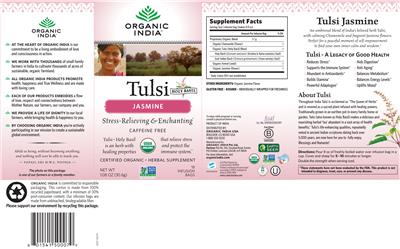
At the heart of Organic India is our commitment to be a living embodiment of love and consciousness in action. We work with thousands of small family farmers in India to cultivate thousands of acres of sustainable, organic farmland. All Organic India products promote health, happiness and true wellness and are made with loving care. Each of our products embodies a flow of love, respect and connectedness between Mother Nature, our farmers, our company and you. We provide a life of dignity to our local farmers, while bringing health & happiness to you. By choosing Organic India you're actively participating in our mission to create a sustainable global environment. Abide as being, without becoming anything, and nothing will ever be able to touch you. -Papaji, Sri H.W.L. Poonja- The photo on this package is one of our farmers or a family member. Organic India is committed to responsible packaging. This carton is made from 100% recycled paperboard, with a minimum of 30% post-consumer content. Our infusion bags are made from unbleached, biodegradable fiber. Please support our environment by recycling this package.
Stress-relieving & enchanting
Tulsi - Holy basil is an herb with healing properties that relieve stress and protect the immune system.
Individually wrapped for freshness
Product of India
Lic. No. 10015051001397
Earth seer
NPOP/NAB/0010
Perfect for a peaceful moment of self empowerment to find your own inner calm and wisdom. Tulsi - A Legacy Of Good Health Reduces stress Supports the immune system Abundant in antioxidants Builds stamina Powerful adaptogen Aids digestion Anti aging Balancing metabolism Balances energy levels Uplifts mood
About Tulsi Throughout India tulsi is acclaimed as “The queen of herbs” and is revered as a sacred plant infused with healing powers. Traditionally grown in an earthen pot in every family home or garden, tulsi (also known as holy basil) makes a delicious and nourishing herbal ‘tea’ abundant in a vast array of health benefits. Tulsi’s life-enhancing qualities, repeatedly noted in ancient Indian scriptures dating back over 5,000 years, are now here for you to fully enjoy. Blessings and namaste!
Formula
Holy basil
Kosher
Halal Mumbai India Halal Committee Registration No. 0854
An ambrosial blend of India's beloved herb tulsi, with calming chamomile and fragrant jasmine flowers.
Formulation
Caffeine free
Certified organic
Gluten free
Certified Organic by Control Union-801983 Product produced and processed according to NPOP standard of India & USDA-NOP www.controlunion.com
Non GMO
Seals/Symbols
USDA Organic
Non GMO Project Verified Nongmoproject.org
fssai
Certified B Corporation
Control Union Certified
India Organic
Halal Mumbai India Halal Committee Registration No. 0854
OU
FDA Statement of Identity
Herbal Supplement
Precautions
To enjoy while pregnant or nursing, consult a physician before use.
Suggested/Recommended/Usage/Directions
Directions: Pour 8 oz of freshly boiled water over infusion bag in a cup. Cover and steep for 5-10 minutes or longer. Double the strength when serving iced.
FDA Disclaimer Statement
These statements have not been evaluated by the FDA. This product is not intended to diagnose, treat, cure, or prevent any disease.
General
USOI1607A
Is this label outdated? Report a formula or label change and our pharmacy team will review it.
Tulsi Jasmine by Organic India label
The label scan from the NIH Dietary Supplement Label Database. Tap to enlarge.
Label images are published by the NIH Dietary Supplement Label Database for the version of this product on file. Always read your actual product label.
View the full label (PDF)The Ingredients in Tulsi Jasmine by Organic India
These are the 4 active ingredients this product is made of. Select any to open its full monograph.
Serving size1 Infusion Bag(s) Dosage formOther (e.g. Tea Bag) Amounts shown are per serving.
Most supplement products combine several ingredients, and a medication can interact with the product through any one of them. Each ingredient below shows whether it has known drug interactions.
Proprietary Organic Blend
- › Organic Chamomile
- › Organic Fennel
- › Organic Tulsi (Holy Basil) Blend
- › Organic Jasmine
Other (inactive) ingredients: Organic Jasmine flavor. These complete the product’s ingredient list but are not active constituents.
Tulsi Jasmine by Organic India Drug Interactions
HelloPharmacist Interaction Report
Organic India's Tulsi Jasmine tea contains several ingredients with documented interactions.
Fennel and both holy basil ingredients carry Moderate-severity interactions across multiple drug categories.
Read the full breakdown — every affected drug type, severity by severity
Fennel may interfere with birth control pills and hormone replacement therapy due to its estrogen-like compounds, and it could theoretically reduce how well your body breaks down certain drugs (CYP3A4 substrates) or make the antibiotic ciprofloxacin less effective. It may also increase bleeding risk with blood thinners (anticoagulants) and antiplatelet drugs, and could interfere with tamoxifen, a breast cancer medication.
Both holy basil ingredients may raise your low blood sugar (hypoglycemia) risk if you take diabetes medications, increase bleeding risk with blood thinners and antiplatelet drugs, and heighten the sedative effects of the barbiturate pentobarbital. We could not check chamomile for interactions.
Altogether, these interactions span 811 individual medications.
Check your exact prescriptions with the search tool below before you start.
Check your own medications below · Editorial policy · How we use AI
Want to check YOUR meds against Tulsi Jasmine?
Ask about interactions with your drugs in plain English — “Can I take it with lisinopril?” — and we find you the answer in seconds, ingredient by ingredient.
Go to the checkerIngredients driving the most interactions
Individual Drug Interactions
The ingredients in Tulsi Jasmine interact with 824 drugs. Click any drug to see the details.
2 of the 4 ingredients in Tulsi Jasmine interact with drugs. Each result below shows which ingredient is responsible. organic Fennel organic Tulsi (Holy Basil) Blend
Ado-trastuzumab EmtansineKadcyla
How Ado-trastuzumab Emtansine interacts with Tulsi Jasmine — through 1 ingredient. Tap an ingredient for the detail:
Organic FennelCytochrome P450 3a4 (cyp3a4) Substrates Moderate
Interaction Summary
Theoretically, fennel might increase levels of drugs metabolized by CYP3A4.
Read the full Organic Fennel + Ado-trastuzumab Emtansine interactionAbciximabReoPro
How Abciximab interacts with Tulsi Jasmine — through 2 ingredients. Tap an ingredient for the detail:
Organic FennelAnticoagulant/antiplatelet Drugs Moderate
Interaction Summary
Theoretically, fennel might increase the risk of bleeding when used with antiplatelet or anticoagulant drugs.
Read the full Organic Fennel + Abciximab interactionOrganic Tulsi (holy Basil) BlendAnticoagulant/antiplatelet Drugs Moderate
Interaction Summary
Theoretically, holy basil seed oil might increase the risk of bleeding when used with anticoagulant or antiplatelet drugs.
Read the full Organic Tulsi (holy Basil) Blend + Abciximab interactionAbemaciclibVerzenio
How Abemaciclib interacts with Tulsi Jasmine — through 1 ingredient. Tap an ingredient for the detail:
Organic FennelCytochrome P450 3a4 (cyp3a4) Substrates Moderate
Interaction Summary
Theoretically, fennel might increase levels of drugs metabolized by CYP3A4.
Read the full Organic Fennel + Abemaciclib interactionAbiraterone
How Abiraterone interacts with Tulsi Jasmine — through 1 ingredient. Tap an ingredient for the detail:
Organic FennelCytochrome P450 3a4 (cyp3a4) Substrates Moderate
Interaction Summary
Theoretically, fennel might increase levels of drugs metabolized by CYP3A4.
Read the full Organic Fennel + Abiraterone interactionAbiraterone AcetateYonsa, Zytiga
How Abiraterone Acetate interacts with Tulsi Jasmine — through 1 ingredient. Tap an ingredient for the detail:
Organic FennelCytochrome P450 3a4 (cyp3a4) Substrates Moderate
Interaction Summary
Theoretically, fennel might increase levels of drugs metabolized by CYP3A4.
Read the full Organic Fennel + Abiraterone Acetate interactionAbrocitinibCibinqo
How Abrocitinib interacts with Tulsi Jasmine — through 2 ingredients. Tap an ingredient for the detail:
Organic FennelAnticoagulant/antiplatelet Drugs Moderate
Interaction Summary
Theoretically, fennel might increase the risk of bleeding when used with antiplatelet or anticoagulant drugs.
Read the full Organic Fennel + Abrocitinib interactionOrganic Tulsi (holy Basil) BlendAnticoagulant/antiplatelet Drugs Moderate
Interaction Summary
Theoretically, holy basil seed oil might increase the risk of bleeding when used with anticoagulant or antiplatelet drugs.
Read the full Organic Tulsi (holy Basil) Blend + Abrocitinib interactionAcalabrutinibCalquence
How Acalabrutinib interacts with Tulsi Jasmine — through 1 ingredient. Tap an ingredient for the detail:
Organic FennelCytochrome P450 3a4 (cyp3a4) Substrates Moderate
Interaction Summary
Theoretically, fennel might increase levels of drugs metabolized by CYP3A4.
Read the full Organic Fennel + Acalabrutinib interactionAcarboseGlucobay, Prandase, Precose
How Acarbose interacts with Tulsi Jasmine — through 1 ingredient. Tap an ingredient for the detail:
Organic Tulsi (holy Basil) BlendAntidiabetes Drugs Moderate
Interaction Summary
Theoretically, holy basil might increase the risk of hypoglycemia when taken with antidiabetes drugs.
Read the full Organic Tulsi (holy Basil) Blend + Acarbose interactionAcenocoumarolSintrom
How Acenocoumarol interacts with Tulsi Jasmine — through 2 ingredients. Tap an ingredient for the detail:
Organic Tulsi (holy Basil) BlendAnticoagulant/antiplatelet Drugs Moderate
Interaction Summary
Theoretically, holy basil seed oil might increase the risk of bleeding when used with anticoagulant or antiplatelet drugs.
Read the full Organic Tulsi (holy Basil) Blend + Acenocoumarol interactionOrganic FennelAnticoagulant/antiplatelet Drugs Moderate
Interaction Summary
Theoretically, fennel might increase the risk of bleeding when used with antiplatelet or anticoagulant drugs.
Read the full Organic Fennel + Acenocoumarol interactionAcetaminophen, AspirinGemnisyn
How Acetaminophen, Aspirin interacts with Tulsi Jasmine — through 2 ingredients. Tap an ingredient for the detail:
Organic FennelAnticoagulant/antiplatelet Drugs Moderate
Interaction Summary
Theoretically, fennel might increase the risk of bleeding when used with antiplatelet or anticoagulant drugs.
Read the full Organic Fennel + Acetaminophen, Aspirin interactionOrganic Tulsi (holy Basil) BlendAnticoagulant/antiplatelet Drugs Moderate
Interaction Summary
Theoretically, holy basil seed oil might increase the risk of bleeding when used with anticoagulant or antiplatelet drugs.
Read the full Organic Tulsi (holy Basil) Blend + Acetaminophen, Aspirin interactionAcetaminophen, Aspirin, CaffeineExcedrin, Excedrin Extra Strength, Excedrin Migraine
How Acetaminophen, Aspirin, Caffeine interacts with Tulsi Jasmine — through 2 ingredients. Tap an ingredient for the detail:
Organic FennelAnticoagulant/antiplatelet Drugs, Cytochrome P450 3a4 (cyp3a4) Substrates Moderate
Interaction Summary
Theoretically, fennel might increase the risk of bleeding when used with antiplatelet or anticoagulant drugs.
Read the full Organic Fennel + Acetaminophen, Aspirin, Caffeine interactionOrganic Tulsi (holy Basil) BlendAnticoagulant/antiplatelet Drugs Moderate
Interaction Summary
Theoretically, holy basil seed oil might increase the risk of bleeding when used with anticoagulant or antiplatelet drugs.
Read the full Organic Tulsi (holy Basil) Blend + Acetaminophen, Aspirin, Caffeine interactionAcetaminophen, Butalbital, CaffeineEsgic, Esgic Plus, Fiogesic, Fioricet, Repan, Tecnal +1 more
How Acetaminophen, Butalbital, Caffeine interacts with Tulsi Jasmine — through 1 ingredient. Tap an ingredient for the detail:
Organic FennelCytochrome P450 3a4 (cyp3a4) Substrates Moderate
Interaction Summary
Theoretically, fennel might increase levels of drugs metabolized by CYP3A4.
Read the full Organic Fennel + Acetaminophen, Butalbital, Caffeine interactionAcetaminophen, Butalbital, Caffeine, CodeineEsgic with Codeine, Fioricet w/ Codeine
How Acetaminophen, Butalbital, Caffeine, Codeine interacts with Tulsi Jasmine — through 1 ingredient. Tap an ingredient for the detail:
Organic FennelCytochrome P450 3a4 (cyp3a4) Substrates Moderate
Interaction Summary
Theoretically, fennel might increase levels of drugs metabolized by CYP3A4.
Read the full Organic Fennel + Acetaminophen, Butalbital, Caffeine, Codeine interactionAcetaminophen, Caffeine, Chlorpheniramine, Hydrocodone, PhenylephrineHycomine Compound
How Acetaminophen, Caffeine, Chlorpheniramine, Hydrocodone, Phenylephrine interacts with Tulsi Jasmine — through 1 ingredient. Tap an ingredient for the detail:
Organic FennelCytochrome P450 3a4 (cyp3a4) Substrates Moderate
Interaction Summary
Theoretically, fennel might increase levels of drugs metabolized by CYP3A4.
Read the full Organic Fennel + Acetaminophen, Caffeine, Chlorpheniramine, Hydrocodone, Phenylephrine interactionAcetaminophen, Caffeine, CodeineGesic C15, Gesic C30, Gesic C8, Lenoltec 1, Lenoltec 2, Lenoltec 3 +1 more
How Acetaminophen, Caffeine, Codeine interacts with Tulsi Jasmine — through 1 ingredient. Tap an ingredient for the detail:
Organic FennelCytochrome P450 3a4 (cyp3a4) Substrates Moderate
Interaction Summary
Theoretically, fennel might increase levels of drugs metabolized by CYP3A4.
Read the full Organic Fennel + Acetaminophen, Caffeine, Codeine interactionAcetaminophen, Caffeine, Codeine, SalicylamideCodalan No.1, Codalan No.2, Codalan No.3
How Acetaminophen, Caffeine, Codeine, Salicylamide interacts with Tulsi Jasmine — through 1 ingredient. Tap an ingredient for the detail:
Organic FennelCytochrome P450 3a4 (cyp3a4) Substrates Moderate
Interaction Summary
Theoretically, fennel might increase levels of drugs metabolized by CYP3A4.
Read the full Organic Fennel + Acetaminophen, Caffeine, Codeine, Salicylamide interactionAcetaminophen, Caffeine, DihydrocodeineDHC Plus, Panlor DC, Panlor SS
How Acetaminophen, Caffeine, Dihydrocodeine interacts with Tulsi Jasmine — through 1 ingredient. Tap an ingredient for the detail:
Organic FennelCytochrome P450 3a4 (cyp3a4) Substrates Moderate
Interaction Summary
Theoretically, fennel might increase levels of drugs metabolized by CYP3A4.
Read the full Organic Fennel + Acetaminophen, Caffeine, Dihydrocodeine interactionAcetaminophen, Caffeine, IsomethepteneMigralam
How Acetaminophen, Caffeine, Isometheptene interacts with Tulsi Jasmine — through 1 ingredient. Tap an ingredient for the detail:
Organic FennelCytochrome P450 3a4 (cyp3a4) Substrates Moderate
Interaction Summary
Theoretically, fennel might increase levels of drugs metabolized by CYP3A4.
Read the full Organic Fennel + Acetaminophen, Caffeine, Isometheptene interactionAcetaminophen, Caffeine, PyrilamineMidol Max Strength Menstrual
How Acetaminophen, Caffeine, Pyrilamine interacts with Tulsi Jasmine — through 1 ingredient. Tap an ingredient for the detail:
Organic FennelCytochrome P450 3a4 (cyp3a4) Substrates Moderate
Interaction Summary
Theoretically, fennel might increase levels of drugs metabolized by CYP3A4.
Read the full Organic Fennel + Acetaminophen, Caffeine, Pyrilamine interactionAcetaminophen, Chlorpheniramine Maleate, Dextromethorphan HbrVicks Formula 44M Cough, Cold & Flu Relief
How Acetaminophen, Chlorpheniramine Maleate, Dextromethorphan Hbr interacts with Tulsi Jasmine — through 1 ingredient. Tap an ingredient for the detail:
Organic FennelCytochrome P450 3a4 (cyp3a4) Substrates Moderate
Interaction Summary
Theoretically, fennel might increase levels of drugs metabolized by CYP3A4.
Read the full Organic Fennel + Acetaminophen, Chlorpheniramine Maleate, Dextromethorphan Hbr interactionAcetaminophen, Chlorpheniramine, Codeine, PhenylephrineColrex
How Acetaminophen, Chlorpheniramine, Codeine, Phenylephrine interacts with Tulsi Jasmine — through 1 ingredient. Tap an ingredient for the detail:
Organic FennelCytochrome P450 3a4 (cyp3a4) Substrates Moderate
Interaction Summary
Theoretically, fennel might increase levels of drugs metabolized by CYP3A4.
Read the full Organic Fennel + Acetaminophen, Chlorpheniramine, Codeine, Phenylephrine interactionAcetaminophen, Chlorpheniramine, DextromethorphanCoricidin II Extra Strength Cold and Flu
How Acetaminophen, Chlorpheniramine, Dextromethorphan interacts with Tulsi Jasmine — through 1 ingredient. Tap an ingredient for the detail:
Organic FennelCytochrome P450 3a4 (cyp3a4) Substrates Moderate
Interaction Summary
Theoretically, fennel might increase levels of drugs metabolized by CYP3A4.
Read the full Organic Fennel + Acetaminophen, Chlorpheniramine, Dextromethorphan interactionAcetaminophen, Chlorpheniramine, Dextromethorphan HydrobromideCoricidin HBP Maximum Strength Flu
How Acetaminophen, Chlorpheniramine, Dextromethorphan Hydrobromide interacts with Tulsi Jasmine — through 1 ingredient. Tap an ingredient for the detail:
Organic FennelCytochrome P450 3a4 (cyp3a4) Substrates Moderate
Interaction Summary
Theoretically, fennel might increase levels of drugs metabolized by CYP3A4.
Read the full Organic Fennel + Acetaminophen, Chlorpheniramine, Dextromethorphan Hydrobromide interactionAcetaminophen, Chlorpheniramine, Dextromethorphan, PhenylpropanolamineMulti Symptom Cold Relief
How Acetaminophen, Chlorpheniramine, Dextromethorphan, Phenylpropanolamine interacts with Tulsi Jasmine — through 1 ingredient. Tap an ingredient for the detail:
Organic FennelCytochrome P450 3a4 (cyp3a4) Substrates Moderate
Interaction Summary
Theoretically, fennel might increase levels of drugs metabolized by CYP3A4.
Read the full Organic Fennel + Acetaminophen, Chlorpheniramine, Dextromethorphan, Phenylpropanolamine interactionAcetaminophen, Chlorpheniramine, Dextromethorphan, PseudoephedrineChildren's Tylenol Cold Plus Cough, Tylenol Cold Ex Strength
How Acetaminophen, Chlorpheniramine, Dextromethorphan, Pseudoephedrine interacts with Tulsi Jasmine — through 1 ingredient. Tap an ingredient for the detail:
Organic FennelCytochrome P450 3a4 (cyp3a4) Substrates Moderate
Interaction Summary
Theoretically, fennel might increase levels of drugs metabolized by CYP3A4.
Read the full Organic Fennel + Acetaminophen, Chlorpheniramine, Dextromethorphan, Pseudoephedrine interactionAcetaminophen, Chlorpheniramine, Guaifenesin, Phenylephrine, SalicylamideRhinogesic GG
How Acetaminophen, Chlorpheniramine, Guaifenesin, Phenylephrine, Salicylamide interacts with Tulsi Jasmine — through 1 ingredient. Tap an ingredient for the detail:
Organic FennelCytochrome P450 3a4 (cyp3a4) Substrates Moderate
Interaction Summary
Theoretically, fennel might increase levels of drugs metabolized by CYP3A4.
Read the full Organic Fennel + Acetaminophen, Chlorpheniramine, Guaifenesin, Phenylephrine, Salicylamide interactionAcetaminophen, Chlorpheniramine, PhenylephrineAlka-Seltzer PLUS, Histex SR, Protid
How Acetaminophen, Chlorpheniramine, Phenylephrine interacts with Tulsi Jasmine — through 1 ingredient. Tap an ingredient for the detail:
Organic FennelCytochrome P450 3a4 (cyp3a4) Substrates Moderate
Interaction Summary
Theoretically, fennel might increase levels of drugs metabolized by CYP3A4.
Read the full Organic Fennel + Acetaminophen, Chlorpheniramine, Phenylephrine interactionAcetaminophen, Chlorpheniramine, Phenylephrine, SalicylamideRhinogesic, Rhinogesic JR
How Acetaminophen, Chlorpheniramine, Phenylephrine, Salicylamide interacts with Tulsi Jasmine — through 1 ingredient. Tap an ingredient for the detail:
Organic FennelCytochrome P450 3a4 (cyp3a4) Substrates Moderate
Interaction Summary
Theoretically, fennel might increase levels of drugs metabolized by CYP3A4.
Read the full Organic Fennel + Acetaminophen, Chlorpheniramine, Phenylephrine, Salicylamide interactionAcetaminophen, Chlorpheniramine, PhenylpropanolamineAlumadrine, Conex, Sinadrin Max Strength, Sinulin
How Acetaminophen, Chlorpheniramine, Phenylpropanolamine interacts with Tulsi Jasmine — through 1 ingredient. Tap an ingredient for the detail:
Organic FennelCytochrome P450 3a4 (cyp3a4) Substrates Moderate
Interaction Summary
Theoretically, fennel might increase levels of drugs metabolized by CYP3A4.
Read the full Organic Fennel + Acetaminophen, Chlorpheniramine, Phenylpropanolamine interactionAcetaminophen, Chlorpheniramine, Phenylpropanolamine, OpiumHista-Derfule
How Acetaminophen, Chlorpheniramine, Phenylpropanolamine, Opium interacts with Tulsi Jasmine — through 1 ingredient. Tap an ingredient for the detail:
Organic FennelCytochrome P450 3a4 (cyp3a4) Substrates Moderate
Interaction Summary
Theoretically, fennel might increase levels of drugs metabolized by CYP3A4.
Read the full Organic Fennel + Acetaminophen, Chlorpheniramine, Phenylpropanolamine, Opium interactionEach ingredient & the kinds of drugs it affects
For each ingredient in Tulsi Jasmine with known interactions, here are the types of medications they can affect. Open any type for the detail — or search your exact drug in the checker above.
organic Fennel
Anticoagulant/Antiplatelet Drugs
Theoretically, fennel might increase the risk of bleeding when used with antiplatelet or anticoagulant drugs.
Animal research suggests that fennel oil has antithrombotic and antiplatelet effects.
Ciprofloxacin (Cipro)
Theoretically, fennel might decrease the levels and clinical effects of ciprofloxacin.
Animal research shows that fennel reduces ciprofloxacin bioavailability by nearly 50%, possibly due to the metal cations such as calcium, iron, and magnesium contained in fennel. This study also found that fennel increased tissue distribution and slowed elimination of ciprofloxacin.
Contraceptive Drugs
Theoretically, taking large amounts of fennel might decrease the effects of contraceptive drugs due to competition for estrogen receptors.
Some constituents of fennel have estrogenic activity.
Cytochrome P450 3A4 (Cyp3A4) Substrates
Theoretically, fennel might increase levels of drugs metabolized by CYP3A4.
In vitro research suggests that fennel inhibits CYP3A4 enzyme activity. This effect has not been reported in humans.
Estrogens
Theoretically, taking large amounts of fennel might interfere with hormone replacement therapy due to competition for estrogen receptors.
Some constituents of fennel have estrogenic activity.
Tamoxifen (Nolvadex)
Theoretically, taking large amounts of fennel might decrease the antiestrogenic effect of tamoxifen.
Some constituents of fennel have estrogenic activity, which may interfere with the antiestrogenic activity of tamoxifen.
organic Tulsi (Holy Basil) Blend
Anticoagulant/Antiplatelet Drugs
Theoretically, holy basil seed oil might increase the risk of bleeding when used with anticoagulant or antiplatelet drugs.
Animal research shows that holy basil seed oil can prolong bleeding time, possibly due to inhibition of platelet aggregation. However, it is not known if this occurs in humans.
Antidiabetes Drugs
Theoretically, holy basil might increase the risk of hypoglycemia when taken with antidiabetes drugs.
Small clinical studies show that taking holy basil can decrease fasting blood glucose and other measures of glycemic control in patients with type 2 diabetes.
Pentobarbital (Nembutal)
Theoretically, holy basil seed oil might increase the sedative effects of pentobarbital.
Animal research shows that holy basil seed oil increases pentobarbitone-induced sleeping time. However, it is not known if this occurs in humans or if this applies to other barbiturates or sedatives.
Brand information
Manufacturer and brand details for Tulsi Jasmine, from the product label.
Organic India
See all Organic India products- Name
- Organic India Pvt. Ltd.
- Street Address
- Factory: Plot No. 266 Faizabad Road
- City
- Kamta P.O. Chinhat, Lucknow
- State
- U.P.
- ZipCode
- 226028
Tulsi Jasmine by Organic India: Common Questions
Does Tulsi Jasmine by Organic India interact with any medications?
How can one product interact with so many drugs?
Where does this information come from?
Can I drink this if I'm on birth control?
Is it safe during pregnancy?
What does fennel do in this tea?
Can it help with anxiety?
What are the most common side effects?
Is it safe while breastfeeding?
Written and reviewed by the HelloPharmacist editorial staff. Our editorial policy
Not sure if Tulsi Jasmine is safe with your meds?
Our pharmacists answer your medication & supplement questions — free.
Label information is sourced from the NIH Dietary Supplement Label Database and reflects the product version on file; always read your actual product label. This page is for education only and is not a substitute for professional medical advice. Confirm with your pharmacist or doctor before combining supplements and medications.
The Full Monographs Behind Tulsi Jasmine’s Ingredients
Every ingredient we hold a full HelloPharmacist monograph for — uses, evidence, safety, and the complete interaction list.
Fennel
Interacts with 742 drugsFennel is a Mediterranean herb widely used as a food and spice, and traditionally taken for digestive complaints, colic, and menstrual cramps. Some small studies suggest possible benefit for...
Read the full Fennel monograph → Herb & supplement monographHoly Basil
Interacts with 212 drugsHoly basil (tulsi) is a traditional Ayurvedic herb most often used today for stress and general wellness, but the human evidence is mostly small and preliminary. It is generally well tolerat...
Read the full Holy Basil monograph → Herb & supplement monographJasmine
Jasmine is a fragrant flowering plant most often used in aromatherapy and as a tea flavoring, with popular use for relaxation, mood, and sleep. Human evidence for its health benefits is limi...
Read the full Jasmine monograph →Sources & How We Checked
Tulsi Jasmine's label data comes from the NIH Dietary Supplement Label Database; the ingredient interaction data is from the Natural Medicines database, reviewed by our pharmacists.
- NIH Dietary Supplement Label Database (DSLD) — The official product label on file for this supplement.
- Natural Medicines (Therapeutic Research Center) — Evidence-graded clinical reference behind the ingredient interaction data.
Content is written and reviewed by licensed HelloPharmacist pharmacists. See our data sources and editorial standards for how this information is built and checked.
The 32 references behind this product’s interaction data
Every citation that drives the interaction findings for this product’s ingredients, from the evidence-graded Natural Medicines (TRC Healthcare) database. Open an ingredient to browse its citations — links open the study on PubMed or the publisher’s site.
Fennel 17 references
- Leung AY, Foster S. Encyclopedia of Common Natural Ingredients Used in Food, Drugs and Cosmetics. 2nd ed. New York, NY: John Wiley & Sons, 1996.
- Brinker F. Herb Contraindications and Drug Interactions. 2nd ed. Sandy, OR: Eclectic Medical Publications, 1998.
- Zhu M, Wong PY, Li RC. Effect of oral administration of fennel (Foeniculum vulgare) on ciprofloxacin absorption and disposition in the rat. J Pharm Pharmacol 1999;51:1391-6.
- Gral N, Beani JC, Bonnot D, et al. [Plasma levels of psoralens after celery ingestion]. Ann Dermatol Venereol 1993;120:599-603.
- Burkhard PR, Burkhardt K, Haenggeli CA, Landis T. Plant-induced seizures: reappearance of an old problem. J Neurol 1999;246:667-70. PubMed
- Rosti L, Nardini A, Bettinelli ME, Rosti D. Toxic effects of a herbal tea mixture in two newborns. Acta Paediatrica 1994;83:683. PubMed
- Cuzzolin L, Zaffani S, and Benoni G. Safety implications regarding use of phytomedicines. Eur.J Clin Pharmacol. 2006;62:37-42. PubMed
- Tognolini, M., Ballabeni, V., Bertoni, S., Bruni, R., Impicciatore, M., and Barocelli, E. Protective effect of Foeniculum vulgare essential oil and anethole in an experimental model of thrombosis. Pharmacol.Res 2007;56(3):254-260. PubMed
- Subehan, Usia, T., Iwata, H., Kadota, S., and Tezuka, Y. Mechanism-based inhibition of CYP3A4 and CYP2D6 by Indonesian medicinal plants. J Ethnopharmacol. 5-24-2006;105(3):449-455. PubMed
- Tognolini, M., Barocelli, E., Ballabeni, V., Bruni, R., Bianchi, A., Chiavarini, M., and Impicciatore, M. Comparative screening of plant essential oils: phenylpropanoid moiety as basic core for antiplatelet activity. Life Sci. 2-23-2006;78(13):1419-1432. PubMed
- Subehan, Zaidi, S. F., Kadota, S., and Tezuka, Y. Inhibition on human liver cytochrome P450 3A4 by constituents of fennel (Foeniculum vulgare): identification and characterization of a mechanism-based inactivator. J Agric.Food Chem. 12-12-2007;55(25):101 PubMed
- LEVY, S. B. Bronchial asthma due to ingestion of fennel and fennel seed. Ann.Allergy 1948;6(4):415.
- Ottolenghi, A., De Chiara, A., Arrigoni, S., Terracciano, L., and De Amici, M. [Diagnosis of food allergy caused by fruit and vegetables in children with atopic dermatitis]. Pediatr Med Chir 1995;17(6):525-530.
- Trabace L, Tucci P, Ciuffreda L, et al. "Natural" relief of pregnancy-related symptoms and neonatal outcomes: above all do no harm. J Ethnopharmacol. 2015;174:396-402. PubMed
- Denaxa D, Arkwright PD. Fennel as a cause of immediate hypersensitivity to toothpaste. Ann Allergy Asthma Immunol. 2020;125(1):99-100. PubMed
- Lee HW, Ang L, Lee MS, Alimoradi Z, Kim E. Fennel for reducing pain in primary dysmenorrhea: a systematic review and meta-analysis of randomized controlled trials. Nutrients 2020;12(11):3438. PubMed
- Mathew T, John SK, Javali M, Vasireddy M, Nadig R, Sarma GRK. Substance use related cluster headache: A case series. Headache 2022;62(7):908-910. PubMed
Holy Basil 8 references
- Agrawal P, Rai V, Singh RB. Randomized placebo-controlled, single blind trial of holy basil leaves in patients with noninsulin-dependent diabetes mellitus. Int J Clin Pharmacol Ther 1996;34:406-9.
- Sakina MR, Dandiya PC, Hamdard ME, Hameed A. Preliminary psychopharmacological evaluation of Ocimum sanctum leaf extract. J Ethnopharmacol 1990;28:143-50. PubMed
- Singh S, Rehan HM, Majumdar DK. Effect of Ocimum sanctum fixed oil on blood pressure, blood clotting time and pentobarbitone-induced sleeping time. J Ethnopharmacol 2001;78:139-43. PubMed
- Mondal, S., Varma, S., Bamola, V. D., Naik, S. N., Mirdha, B. R., Padhi, M. M., Mehta, N., and Mahapatra, S. C. Double-blinded randomized controlled trial for immunomodulatory effects of Tulsi (Ocimum sanctum Linn.) leaf extract on healthy volunteers. J PubMed
- Agarwal, P. and Nagesh, L. Comparative evaluation of efficacy of 0.2% Chlorhexidine, Listerine and Tulsi extract mouth rinses on salivary Streptococcus mutans count of high school children--RCT. Contemp.Clin Trials 2011;32(6):802-808. PubMed
- Vohora, S. B., Garg, S. K., and Chaudhury, R. R. Antifertility screening of plants. 3. Effect of six indigenous plants on early pregnancy in albino rats. Indian J Med Res 1969;57(5):893-899.
- Khanna S, Gupta SR, Grover JK. Effect of long term feeding of tulsi (Ocimum sanctum Linn) on reproductive performance of adult albino rats. Indian J Exp Biol 1986;24(5):302-4.
- Somasundaram G, Manimekalai K, Salwe KJ, Pandiamunian J. Evaluation of the antidiabetic effect of Ocimum sanctum in type 2 diabetes patients. Int J Life Sci Pharma Res 2012;2(3):75-81.
Jasmine 7 references
- Larsen, W., Nakayama, H., Fischer, T., Elsner, P., Frosch, P., Burrows, D., Jordan, W., Shaw, S., Wilkinson, J., Marks, J., Jr., Sugawara, M., Nethercott, M., and Nethercott, J. Fragrance contact dermatitis: a worldwide multicenter investigation (Part II PubMed
- Sakamoto, R., Minoura, K., Usui, A., Ishizuka, Y., and Kanba, S. Effectiveness of aroma on work efficiency: lavender aroma during recesses prevents deterioration of work performance. Chem Senses 2005;30(8):683-691. PubMed
- Heuberger, E. and Ilmberger, J. The influence of essential oils on human vigilance. Nat.Prod.Commun. 2010;5(9):1441-1446. DOI
- Bedi, B. M. Jasmine flower-contact dermatitis. (Report of a case). Indian J.Dermatol. 1971;16(3):61-62.
- Schaller M and Korting HC. Allergic airborne contact dermatitis from essential oils used in aromatherapy. Clin Exp Dermatol 1995;20(2):143-145.
- Morgan CJ, Das RK, Joye A, et al. Cannabidiol reduces cigarette consumption in tobacco smokers: preliminary findings. Addict Behav 2013;38(9):2433-6. PubMed
- González-de-Olano D, Córdoba-Guijarro S, Marín-Manzano E, Bartolomé B. Allergy to jasmine is not always delayed contact allergy. Dermatitis. 2012;23(2):94-5. PubMed
Parts of this content are provided by the Therapeutic Research Center, LLC.
DISCLAIMER: Currently this does not check for drug-drug interactions. This is not an all-inclusive comprehensive list of potential interactions and is for informational purposes only. Not all interactions are known or well-reported in the scientific literature, and new interactions are continually being reported. Input is needed from a qualified healthcare provider including a pharmacist before starting any therapy. Application of clinical judgment is necessary.
© 2021 Therapeutic Research Center, LLC