
Tulsi Powder Ingredients & Drug Interactions
What is this page for?
First and foremost: checking Tulsi Powder against your medications. The heart of this page is the interaction checker and the full interaction report — how this product’s ingredients may interact with prescription and over-the-counter medicines you may be taking.
Around that, we add a pharmacist’s high-level view of the product as a whole — what’s inside, the evidence for its stated use, how transparent the label is, and what safety data exists — so you can see the full picture in one place. It’s educational information from our licensed clinical databases and the clinical staff at HelloPharmacist — not medical advice — and we don’t sell or endorse products. Our editorial policy
Tulsi Powder is a dietary supplement by Banyan Botanicals with 1 active ingredient. Its ingredients are commonly taken for stress and anxiety, blood sugar support, respiratory complaints.Based on those ingredients, 212 medications have a known interaction with it, the most serious rated moderate. The ingredients most likely to interact are Holy Basil. Use the checker below to test your specific medication, or read the full HelloPharmacist Interaction Report.
Check Your Meds Against Tulsi Powder by Banyan Botanicals
Ask about any prescription or over-the-counter medication and we check it for interactions with Tulsi Powder by Banyan Botanicals — and tell you which ingredient is responsible.
AI summaries are generated from our interaction database for education only — always confirm with your pharmacist. How we use AI
Ask the Pharmacist
A licensed pharmacist will answer your question by email — free, usually within 24 hours.
Got it — thank you!
A licensed pharmacist will answer within 24 hours. Keep an eye on your email (worth checking spam, just in case).
HelloPharmacist Scorecard of Tulsi Powder by Banyan Botanicals
Our pharmacy team’s full take, with four database checks built into the cards below — a summary of what is known, not a grade of the product itself.
What’s inside
Full disclosure
Banyan Botanicals Tulsi Powder is a single-ingredient product: holy basil, the active component. Holy basil, also called tulsi, is an herb traditionally used in Ayurvedic medicine.
There are no other active ingredients, and no inactive fillers or binders are listed.
Does it work?
Not established
The evidence for holy basil's effectiveness is limited. Our data rates it as having insufficient reliable evidence to support its use for generalized anxiety disorder, asthma, headache, respiratory tract infections, dental plaque, or diabetes.
That means the studies we have aren't strong enough yet to say whether it works for these purposes. If you're considering it for a specific health goal, it's worth talking through with your pharmacist or doctor first.
How safe is it?
Well-documented data
Holy basil extract is generally well tolerated in the short term, but long-term safety data in humans are sparse. The most common side effects when taken by mouth are loose stools and nausea — only a small number of trial participants reported these.
Safety data in pregnancy and breastfeeding are insufficient, and animal data raise concerns, so the guidance is to avoid it during both pregnancy and while breastfeeding. If you're pregnant, planning to become pregnant, or nursing, talk with your doctor or pharmacist before starting.
Meds to double-check
Moderate interaction found
Before you start this product, double-check with your pharmacist if you take blood thinners or antiplatelet drugs (like warfarin or aspirin), diabetes medications, or pentobarbital or other sedatives. Holy basil may amplify their effects or change how well they work.
The bottom line
Scorecard at a glanceFully disclosed formula with no established evidence rating for its marketed use. Moderate medication interactions have been identified, and safety information is well characterized.
Tulsi powder might appeal to you if you're interested in traditional herbal support, but the evidence for specific health claims isn't established yet. If you take blood thinners, diabetes medications, or sedative drugs, check with your pharmacist first — holy basil may interact with them.
Pregnant or breastfeeding? Skip it and talk to your provider.
Educational only — not medical advice; always confirm with your pharmacist. Our editorial policy · How we use AI
Assessment coverage: 1 of 1 active ingredient matched to our full ingredient reviews (monographs). Based on the product label dated May 23, 2024.
This Scorecard evaluates available label information, ingredient evidence, and known medication-safety considerations. It does not independently verify product identity, purity, potency, contamination, or manufacturing quality. How these ratings are computed
General information
Key facts about Tulsi Powder, straight from the product label.
| Brand | Banyan Botanicals |
|---|---|
| Barcode (UPC) | 618192067314 |
| Net contents | 1 Pound(s); 454 Gram(s) |
| Market status | On market |
| Date entered into DSLD | May 23, 2024 |
| DSLD ID | 308392 |
| Product type | Botanical |
| Supplement form | Powder |
| Dietary claims / uses | All Other, Structure/Function |
| Intended target group(s) | Adult (18 - 50 Years), Women (not pregnant or lactating), Organic |
Everything in this section is reproduced from the manufacturer’s own product label — it’s the label speaking, not HelloPharmacist. We show it so you can see exactly what the maker states; we don’t verify or endorse those statements.
Supplement Facts
The label details for Tulsi Powder by Banyan Botanicals, sourced from the NIH Dietary Supplement Label Database.
Supplement Facts
| Ingredient | Amount | % DV |
|---|---|---|
| Holy Basil | 0.5 Teaspoon(s) | -- |
Tap any ingredient to jump to its full detail below.
These statements are the manufacturer’s wording, reproduced from the product label — the label is saying it, not HelloPharmacist. We don’t verify or endorse them.
Formula
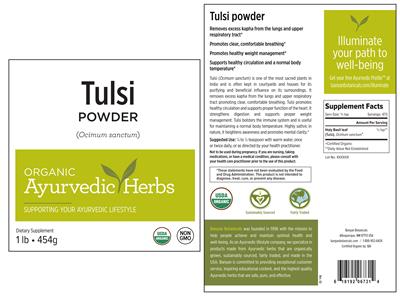
(Ocimum sanctum) Organic ayurvedic herbs
Tulsi (Ocimum sanctum) is one of the most sacred plants in India and is often kept in courtyards and houses for its purifying and beneficial influence on its surroundings. It removes excess kapha from the lungs and upper respiratory tract promoting clear, comfortable breathing. Tulsi promotes healthy circulation and supports proper function of the heart. It strengthens digestion and supports proper weight management. Tulsi bolsters the immune system and is useful for maintaining a normal body temperature. Highly sattvic in nature, it heightens awareness and promotes mental clarity.
Formulation
Supporting your ayurvedic lifestyle
Non GMO
Removes excess kapha from the lungs and upper respiratory tract Promotes clear, comfortable breathing Promotes healthy weight management Supports healthy circulation and a normal body temperature
Certified organic by: QAI
FDA Statement of Identity
Dietary Supplement
Seals/Symbols
USDA Organic
Sustainably sourced Fairly traded
Suggested/Recommended/Usage/Directions
Suggested use: 1/4 to 1/2 teaspoon with warm water, once or twice daily, or as directed by your health practitioner.
Precautions
Not to be used during pregnancy. If you are nursing, taking medications, or have a medical condition, please consult with your health care practitioner prior to the use of this product.
FDA Disclaimer Statement
These statements have not been evaluated by the Food and Drug Administration. This product is not intended to diagnose, treat, cure, or prevent any disease.
General Statements
Banyan Botanicals was founded in 1996 with the mission to help people achieve and maintain optimal health and well-being. As an ayurvedic lifestyle company, we specialize in products made from ayurvedic herbs that are organically grown, sustainably sourced, fairly traded, and made in the USA. Banyan is committed to providing exceptional customer service, inspiring educational content, and the highest quality ayurvedic herbs that are safe, pure, and effective. Illuminate your path to well-being Get your free ayurvedic profile at banyanbotanicals.com/illuminate
Is this label outdated? Report a formula or label change and our pharmacy team will review it.
Tulsi Powder by Banyan Botanicals label
The label scan from the NIH Dietary Supplement Label Database. Tap to enlarge.
Label images are published by the NIH Dietary Supplement Label Database for the version of this product on file. Always read your actual product label.
View the full label (PDF)The Ingredients in Tulsi Powder by Banyan Botanicals
This is the 1 active ingredient this product is made of. Select it to open its full monograph.
Serving size0.25 Teaspoon(s) Dosage formPowder Servings per container473 Amounts shown are per serving.
Holy Basil
Interacts with212 drugs
Holy basil (tulsi) is a traditional Ayurvedic herb most often used today for stress and general wellness, but the human evidence is mostly small and p...
Holy Basil monograph & interactionsTulsi Powder by Banyan Botanicals Drug Interactions
HelloPharmacist Interaction Report
Banyan Botanicals Tulsi Powder contains one active ingredient, holy basil, which has documented interactions with several medication types.
The most serious concern is with blood thinners (anticoagulants) and antiplatelet drugs like aspirin or clopidogrel — holy basil seed oil may increase bleeding risk, though animal studies show this effect and it's not confirmed in humans.
Read the full breakdown — every affected drug type, severity by severity
Holy basil also interacts moderately with diabetes medications. Small clinical trials show it can lower blood sugar, so taking it alongside diabetes drugs raises the risk of low blood sugar (hypoglycemia).
Additionally, pentobarbital (Nembutal), a sedative barbiturate, may have its drowsiness-boosting effects amplified by holy basil seed oil, though again this is shown only in animal research.
Although these interactions are based on theoretical concerns and animal data rather than large human trials, they're worth checking against your own medications before you start. Altogether, these interactions span 211 individual medications.
Use the medication checker on this page to look up your exact prescriptions.
Check your own medications below · Editorial policy · How we use AI
Want to check YOUR meds against Tulsi Powder?
Ask about interactions with your drugs in plain English — “Can I take it with lisinopril?” — and we find you the answer in seconds, ingredient by ingredient.
Go to the checkerIngredients driving the most interactions
Individual Drug Interactions
The ingredients in Tulsi Powder interact with 212 drugs. Click any drug to see the details.
1 of the 1 ingredient in Tulsi Powder interact with drugs. Each result below shows which ingredient is responsible. Holy Basil
AbciximabReoPro
How Abciximab interacts with Tulsi Powder — through 1 ingredient. Tap an ingredient for the detail:
Holy BasilAnticoagulant/antiplatelet Drugs Moderate
Interaction Summary
Theoretically, holy basil seed oil might increase the risk of bleeding when used with anticoagulant or antiplatelet drugs.
Read the full Holy Basil + Abciximab interactionAbrocitinibCibinqo
How Abrocitinib interacts with Tulsi Powder — through 1 ingredient. Tap an ingredient for the detail:
Holy BasilAnticoagulant/antiplatelet Drugs Moderate
Interaction Summary
Theoretically, holy basil seed oil might increase the risk of bleeding when used with anticoagulant or antiplatelet drugs.
Read the full Holy Basil + Abrocitinib interactionAcarboseGlucobay, Prandase, Precose
How Acarbose interacts with Tulsi Powder — through 1 ingredient. Tap an ingredient for the detail:
Holy BasilAntidiabetes Drugs Moderate
Interaction Summary
Theoretically, holy basil might increase the risk of hypoglycemia when taken with antidiabetes drugs.
Read the full Holy Basil + Acarbose interactionAcenocoumarolSintrom
How Acenocoumarol interacts with Tulsi Powder — through 1 ingredient. Tap an ingredient for the detail:
Holy BasilAnticoagulant/antiplatelet Drugs Moderate
Interaction Summary
Theoretically, holy basil seed oil might increase the risk of bleeding when used with anticoagulant or antiplatelet drugs.
Read the full Holy Basil + Acenocoumarol interactionAcetaminophen, AspirinGemnisyn
How Acetaminophen, Aspirin interacts with Tulsi Powder — through 1 ingredient. Tap an ingredient for the detail:
Holy BasilAnticoagulant/antiplatelet Drugs Moderate
Interaction Summary
Theoretically, holy basil seed oil might increase the risk of bleeding when used with anticoagulant or antiplatelet drugs.
Read the full Holy Basil + Acetaminophen, Aspirin interactionAcetaminophen, Aspirin, CaffeineExcedrin, Excedrin Extra Strength, Excedrin Migraine
How Acetaminophen, Aspirin, Caffeine interacts with Tulsi Powder — through 1 ingredient. Tap an ingredient for the detail:
Holy BasilAnticoagulant/antiplatelet Drugs Moderate
Interaction Summary
Theoretically, holy basil seed oil might increase the risk of bleeding when used with anticoagulant or antiplatelet drugs.
Read the full Holy Basil + Acetaminophen, Aspirin, Caffeine interactionAcetaminophen, IbuprofenCombogesic
How Acetaminophen, Ibuprofen interacts with Tulsi Powder — through 1 ingredient. Tap an ingredient for the detail:
Holy BasilAnticoagulant/antiplatelet Drugs Moderate
Interaction Summary
Theoretically, holy basil seed oil might increase the risk of bleeding when used with anticoagulant or antiplatelet drugs.
Read the full Holy Basil + Acetaminophen, Ibuprofen interactionAcetohexamideDymelor
How Acetohexamide interacts with Tulsi Powder — through 1 ingredient. Tap an ingredient for the detail:
Holy BasilAntidiabetes Drugs Moderate
Interaction Summary
Theoretically, holy basil might increase the risk of hypoglycemia when taken with antidiabetes drugs.
Read the full Holy Basil + Acetohexamide interactionAcetylsalicylic AcidEntrophen
How Acetylsalicylic Acid interacts with Tulsi Powder — through 1 ingredient. Tap an ingredient for the detail:
Holy BasilAnticoagulant/antiplatelet Drugs Moderate
Interaction Summary
Theoretically, holy basil seed oil might increase the risk of bleeding when used with anticoagulant or antiplatelet drugs.
Read the full Holy Basil + Acetylsalicylic Acid interactionAlbiglutideTanzeum
How Albiglutide interacts with Tulsi Powder — through 1 ingredient. Tap an ingredient for the detail:
Holy BasilAntidiabetes Drugs Moderate
Interaction Summary
Theoretically, holy basil might increase the risk of hypoglycemia when taken with antidiabetes drugs.
Read the full Holy Basil + Albiglutide interactionAlogliptinNesina
How Alogliptin interacts with Tulsi Powder — through 1 ingredient. Tap an ingredient for the detail:
Holy BasilAntidiabetes Drugs Moderate
Interaction Summary
Theoretically, holy basil might increase the risk of hypoglycemia when taken with antidiabetes drugs.
Read the full Holy Basil + Alogliptin interactionAlogliptin, MetforminKazano
How Alogliptin, Metformin interacts with Tulsi Powder — through 1 ingredient. Tap an ingredient for the detail:
Holy BasilAntidiabetes Drugs Moderate
Interaction Summary
Theoretically, holy basil might increase the risk of hypoglycemia when taken with antidiabetes drugs.
Read the full Holy Basil + Alogliptin, Metformin interactionAlogliptin, PioglitazoneOseni
How Alogliptin, Pioglitazone interacts with Tulsi Powder — through 1 ingredient. Tap an ingredient for the detail:
Holy BasilAntidiabetes Drugs Moderate
Interaction Summary
Theoretically, holy basil might increase the risk of hypoglycemia when taken with antidiabetes drugs.
Read the full Holy Basil + Alogliptin, Pioglitazone interactionAlteplase, TpaActilyse, Activase
How Alteplase, Tpa interacts with Tulsi Powder — through 1 ingredient. Tap an ingredient for the detail:
Holy BasilAnticoagulant/antiplatelet Drugs Moderate
Interaction Summary
Theoretically, holy basil seed oil might increase the risk of bleeding when used with anticoagulant or antiplatelet drugs.
Read the full Holy Basil + Alteplase, Tpa interactionAluminum Hydroxide, Aspirin, Codeine Phosphate, Magnesium HydroxideAscriptin Codeine #2
How Aluminum Hydroxide, Aspirin, Codeine Phosphate, Magnesium Hydroxide interacts with Tulsi Powder — through 1 ingredient. Tap an ingredient for the detail:
Holy BasilAnticoagulant/antiplatelet Drugs Moderate
Interaction Summary
Theoretically, holy basil seed oil might increase the risk of bleeding when used with anticoagulant or antiplatelet drugs.
Read the full Holy Basil + Aluminum Hydroxide, Aspirin, Codeine Phosphate, Magnesium Hydroxide interactionAluminum Hydroxide, Aspirin, Magnesium HydroxideAscriptin
How Aluminum Hydroxide, Aspirin, Magnesium Hydroxide interacts with Tulsi Powder — through 1 ingredient. Tap an ingredient for the detail:
Holy BasilAnticoagulant/antiplatelet Drugs Moderate
Interaction Summary
Theoretically, holy basil seed oil might increase the risk of bleeding when used with anticoagulant or antiplatelet drugs.
Read the full Holy Basil + Aluminum Hydroxide, Aspirin, Magnesium Hydroxide interactionAnacaulase-bcdbNexoBrid
How Anacaulase-bcdb interacts with Tulsi Powder — through 1 ingredient. Tap an ingredient for the detail:
Holy BasilAnticoagulant/antiplatelet Drugs Moderate
Interaction Summary
Theoretically, holy basil seed oil might increase the risk of bleeding when used with anticoagulant or antiplatelet drugs.
Read the full Holy Basil + Anacaulase-bcdb interactionAnagrelideAgrylin
How Anagrelide interacts with Tulsi Powder — through 1 ingredient. Tap an ingredient for the detail:
Holy BasilAnticoagulant/antiplatelet Drugs Moderate
Interaction Summary
Theoretically, holy basil seed oil might increase the risk of bleeding when used with anticoagulant or antiplatelet drugs.
Read the full Holy Basil + Anagrelide interactionAnisindioneMiradon
How Anisindione interacts with Tulsi Powder — through 1 ingredient. Tap an ingredient for the detail:
Holy BasilAnticoagulant/antiplatelet Drugs Moderate
Interaction Summary
Theoretically, holy basil seed oil might increase the risk of bleeding when used with anticoagulant or antiplatelet drugs.
Read the full Holy Basil + Anisindione interactionAntidiabetes, Dipeptidyl Peptidase-4 (dpp-iv) InhibitorGlyxambi
How Antidiabetes, Dipeptidyl Peptidase-4 (dpp-iv) Inhibitor interacts with Tulsi Powder — through 1 ingredient. Tap an ingredient for the detail:
Holy BasilAntidiabetes Drugs Moderate
Interaction Summary
Theoretically, holy basil might increase the risk of hypoglycemia when taken with antidiabetes drugs.
Read the full Holy Basil + Antidiabetes, Dipeptidyl Peptidase-4 (dpp-iv) Inhibitor interactionAntithrombin IiiThrombate III
How Antithrombin Iii interacts with Tulsi Powder — through 1 ingredient. Tap an ingredient for the detail:
Holy BasilAnticoagulant/antiplatelet Drugs Moderate
Interaction Summary
Theoretically, holy basil seed oil might increase the risk of bleeding when used with anticoagulant or antiplatelet drugs.
Read the full Holy Basil + Antithrombin Iii interactionApixabanEliquis
How Apixaban interacts with Tulsi Powder — through 1 ingredient. Tap an ingredient for the detail:
Holy BasilAnticoagulant/antiplatelet Drugs Moderate
Interaction Summary
Theoretically, holy basil seed oil might increase the risk of bleeding when used with anticoagulant or antiplatelet drugs.
Read the full Holy Basil + Apixaban interactionArgatrobanArgatroban
How Argatroban interacts with Tulsi Powder — through 1 ingredient. Tap an ingredient for the detail:
Holy BasilAnticoagulant/antiplatelet Drugs Moderate
Interaction Summary
Theoretically, holy basil seed oil might increase the risk of bleeding when used with anticoagulant or antiplatelet drugs.
Read the full Holy Basil + Argatroban interactionAspirinAngettes 75, ASA, Asaphen, Aspirin, Caprin, Cartia +8 more
How Aspirin interacts with Tulsi Powder — through 1 ingredient. Tap an ingredient for the detail:
Holy BasilAnticoagulant/antiplatelet Drugs Moderate
Interaction Summary
Theoretically, holy basil seed oil might increase the risk of bleeding when used with anticoagulant or antiplatelet drugs.
Read the full Holy Basil + Aspirin interactionAspirin, Aluminum Hydroxide, Codeine Phosphate, Magnesium HydroxideAscriptin Codeine #3
How Aspirin, Aluminum Hydroxide, Codeine Phosphate, Magnesium Hydroxide interacts with Tulsi Powder — through 1 ingredient. Tap an ingredient for the detail:
Holy BasilAnticoagulant/antiplatelet Drugs Moderate
Interaction Summary
Theoretically, holy basil seed oil might increase the risk of bleeding when used with anticoagulant or antiplatelet drugs.
Read the full Holy Basil + Aspirin, Aluminum Hydroxide, Codeine Phosphate, Magnesium Hydroxide interactionAspirin, ButalbitalAxotal
How Aspirin, Butalbital interacts with Tulsi Powder — through 1 ingredient. Tap an ingredient for the detail:
Holy BasilAnticoagulant/antiplatelet Drugs Moderate
Interaction Summary
Theoretically, holy basil seed oil might increase the risk of bleeding when used with anticoagulant or antiplatelet drugs.
Read the full Holy Basil + Aspirin, Butalbital interactionAspirin, Butalbital, CaffeineFiorinal
How Aspirin, Butalbital, Caffeine interacts with Tulsi Powder — through 1 ingredient. Tap an ingredient for the detail:
Holy BasilAnticoagulant/antiplatelet Drugs Moderate
Interaction Summary
Theoretically, holy basil seed oil might increase the risk of bleeding when used with anticoagulant or antiplatelet drugs.
Read the full Holy Basil + Aspirin, Butalbital, Caffeine interactionAspirin, Butalbital, Caffeine, Codeine PhosphateFiorinal w/ Codeine
How Aspirin, Butalbital, Caffeine, Codeine Phosphate interacts with Tulsi Powder — through 1 ingredient. Tap an ingredient for the detail:
Holy BasilAnticoagulant/antiplatelet Drugs Moderate
Interaction Summary
Theoretically, holy basil seed oil might increase the risk of bleeding when used with anticoagulant or antiplatelet drugs.
Read the full Holy Basil + Aspirin, Butalbital, Caffeine, Codeine Phosphate interactionAspirin, Butalbital, Caffeine, PhenacetinMarnal
How Aspirin, Butalbital, Caffeine, Phenacetin interacts with Tulsi Powder — through 1 ingredient. Tap an ingredient for the detail:
Holy BasilAnticoagulant/antiplatelet Drugs Moderate
Interaction Summary
Theoretically, holy basil seed oil might increase the risk of bleeding when used with anticoagulant or antiplatelet drugs.
Read the full Holy Basil + Aspirin, Butalbital, Caffeine, Phenacetin interactionAspirin, CaffeineAnacin
How Aspirin, Caffeine interacts with Tulsi Powder — through 1 ingredient. Tap an ingredient for the detail:
Holy BasilAnticoagulant/antiplatelet Drugs Moderate
Interaction Summary
Theoretically, holy basil seed oil might increase the risk of bleeding when used with anticoagulant or antiplatelet drugs.
Read the full Holy Basil + Aspirin, Caffeine interactionEach ingredient & the kinds of drugs it affects
For each ingredient in Tulsi Powder with known interactions, here are the types of medications it can affect. Open any type for the detail — or search your exact drug in the checker above.
Holy Basil
Anticoagulant/Antiplatelet Drugs
Theoretically, holy basil seed oil might increase the risk of bleeding when used with anticoagulant or antiplatelet drugs.
Animal research shows that holy basil seed oil can prolong bleeding time, possibly due to inhibition of platelet aggregation. However, it is not known if this occurs in humans.
Antidiabetes Drugs
Theoretically, holy basil might increase the risk of hypoglycemia when taken with antidiabetes drugs.
Small clinical studies show that taking holy basil can decrease fasting blood glucose and other measures of glycemic control in patients with type 2 diabetes.
Pentobarbital (Nembutal)
Theoretically, holy basil seed oil might increase the sedative effects of pentobarbital.
Animal research shows that holy basil seed oil increases pentobarbitone-induced sleeping time. However, it is not known if this occurs in humans or if this applies to other barbiturates or sedatives.
Brand information
Manufacturer and brand details for Tulsi Powder, from the product label.
Banyan Botanicals
See all Banyan Botanicals products- Name
- Banyan Botanicals
- City
- Albuquerque
- State
- NM
- ZipCode
- 87113
- Phone Number
- 1-800-953-6424
- Web Address
- banyanbotanicals.com
Tulsi Powder by Banyan Botanicals: Common Questions
Does Tulsi Powder by Banyan Botanicals interact with any medications?
How can one product interact with so many drugs?
Where does this information come from?
Can I take Tulsi Powder if I'm pregnant?
Can I take Tulsi Powder while breastfeeding?
What are the side effects?
Does Tulsi Powder actually work for anxiety or diabetes?
Is Tulsi Powder safe to take long-term?
Written and reviewed by the HelloPharmacist editorial staff. Our editorial policy
Not sure if Tulsi Powder is safe with your meds?
Our pharmacists answer your medication & supplement questions — free.
Label information is sourced from the NIH Dietary Supplement Label Database and reflects the product version on file; always read your actual product label. This page is for education only and is not a substitute for professional medical advice. Confirm with your pharmacist or doctor before combining supplements and medications.
The Full Monographs Behind Tulsi Powder’s Ingredients
Every ingredient we hold a full HelloPharmacist monograph for — uses, evidence, safety, and the complete interaction list.
Sources & How We Checked
Tulsi Powder's label data comes from the NIH Dietary Supplement Label Database; the ingredient interaction data is from the Natural Medicines database, reviewed by our pharmacists.
- NIH Dietary Supplement Label Database (DSLD) — The official product label on file for this supplement.
- Natural Medicines (Therapeutic Research Center) — Evidence-graded clinical reference behind the ingredient interaction data.
Content is written and reviewed by licensed HelloPharmacist pharmacists. See our data sources and editorial standards for how this information is built and checked.
The 8 references behind this product’s interaction data
Every citation that drives the interaction findings for this product’s ingredients, from the evidence-graded Natural Medicines (TRC Healthcare) database. Open an ingredient to browse its citations — links open the study on PubMed or the publisher’s site.
Holy Basil 8 references
- Agrawal P, Rai V, Singh RB. Randomized placebo-controlled, single blind trial of holy basil leaves in patients with noninsulin-dependent diabetes mellitus. Int J Clin Pharmacol Ther 1996;34:406-9.
- Sakina MR, Dandiya PC, Hamdard ME, Hameed A. Preliminary psychopharmacological evaluation of Ocimum sanctum leaf extract. J Ethnopharmacol 1990;28:143-50. PubMed
- Singh S, Rehan HM, Majumdar DK. Effect of Ocimum sanctum fixed oil on blood pressure, blood clotting time and pentobarbitone-induced sleeping time. J Ethnopharmacol 2001;78:139-43. PubMed
- Mondal, S., Varma, S., Bamola, V. D., Naik, S. N., Mirdha, B. R., Padhi, M. M., Mehta, N., and Mahapatra, S. C. Double-blinded randomized controlled trial for immunomodulatory effects of Tulsi (Ocimum sanctum Linn.) leaf extract on healthy volunteers. J PubMed
- Agarwal, P. and Nagesh, L. Comparative evaluation of efficacy of 0.2% Chlorhexidine, Listerine and Tulsi extract mouth rinses on salivary Streptococcus mutans count of high school children--RCT. Contemp.Clin Trials 2011;32(6):802-808. PubMed
- Vohora, S. B., Garg, S. K., and Chaudhury, R. R. Antifertility screening of plants. 3. Effect of six indigenous plants on early pregnancy in albino rats. Indian J Med Res 1969;57(5):893-899.
- Khanna S, Gupta SR, Grover JK. Effect of long term feeding of tulsi (Ocimum sanctum Linn) on reproductive performance of adult albino rats. Indian J Exp Biol 1986;24(5):302-4.
- Somasundaram G, Manimekalai K, Salwe KJ, Pandiamunian J. Evaluation of the antidiabetic effect of Ocimum sanctum in type 2 diabetes patients. Int J Life Sci Pharma Res 2012;2(3):75-81.
Parts of this content are provided by the Therapeutic Research Center, LLC.
DISCLAIMER: Currently this does not check for drug-drug interactions. This is not an all-inclusive comprehensive list of potential interactions and is for informational purposes only. Not all interactions are known or well-reported in the scientific literature, and new interactions are continually being reported. Input is needed from a qualified healthcare provider including a pharmacist before starting any therapy. Application of clinical judgment is necessary.
© 2021 Therapeutic Research Center, LLC