
Turkey Tail Mushroom Ingredients & Drug Interactions
by Brain Forza
What is this page for?
First and foremost: checking Turkey Tail Mushroom against your medications. The heart of this page is the interaction checker and the full interaction report — how this product’s ingredients may interact with prescription and over-the-counter medicines you may be taking.
Around that, we add a pharmacist’s high-level view of the product as a whole — what’s inside, the evidence for its stated use, how transparent the label is, and what safety data exists — so you can see the full picture in one place. It’s educational information from our licensed clinical databases and the clinical staff at HelloPharmacist — not medical advice — and we don’t sell or endorse products. Our editorial policy
Turkey Tail Mushroom is a dietary supplement by Brain Forza with 1 active ingredient. Its ingredients are commonly taken for immune support, used alongside cancer care, gut and digestive health.Based on those ingredients, 188 medications have a known interaction with it, the most serious rated moderate. The ingredients most likely to interact are Turkey Tail Mushroom. Use the checker below to test your specific medication, or read the full HelloPharmacist Interaction Report.
Check Your Meds Against Turkey Tail Mushroom by Brain Forza
Ask about any prescription or over-the-counter medication and we check it for interactions with Turkey Tail Mushroom by Brain Forza — and tell you which ingredient is responsible.
AI summaries are generated from our interaction database for education only — always confirm with your pharmacist. How we use AI
Ask the Pharmacist
A licensed pharmacist will answer your question by email — free, usually within 24 hours.
Got it — thank you!
A licensed pharmacist will answer within 24 hours. Keep an eye on your email (worth checking spam, just in case).
HelloPharmacist Scorecard of Turkey Tail Mushroom by Brain Forza
Our pharmacy team’s full take, with four database checks built into the cards below — a summary of what is known, not a grade of the product itself.
What’s inside
Full disclosure
Brain Forza Turkey Tail Mushroom is a single-ingredient supplement containing turkey tail mushroom, a fungus used in traditional medicine. Turkey tail contains bioactive compounds, notably a polysaccharide peptide called PSP, which appears to be responsible for many of its effects in the body.
The capsule also includes two inactive ingredients: pullulan and sorghum, which serve as the capsule material and filler.
Does it work?
Not established
Turkey tail mushroom is rated possibly effective for cancer based on available evidence. For chronic fatigue syndrome, tinea corporis (ringworm), upper respiratory tract infections, and genital herpes, the evidence is insufficient to rate — meaning we don't have strong enough data in our files to say whether it works for those conditions.
If you're considering it for any of these uses, talk with your doctor about what the current research shows and whether it fits your situation.
How safe is it?
Well-documented data
Turkey tail mushroom is generally well tolerated in healthy adults when taken by mouth, though quality and strength of products vary — it's worth checking with a healthcare provider before you start. The safety data advises against use during pregnancy and while breastfeeding due to insufficient information.
In people taking it alongside chemotherapy, gastrointestinal side effects (nausea, vomiting, appetite loss, stomach discomfort, diarrhea, constipation, ulcers) and blood-related abnormalities have been reported, but it's unclear whether these came from the supplement, the chemotherapy, or both.
Meds to double-check
Moderate interaction found
Before you start, double-check if you take cyclophosphamide or antidiabetes medications (moderate severity), tamoxifen (moderate severity), or drugs metabolized by the CYP2C9 enzyme in your liver (minor severity). If you're unsure whether your medications fall into any of these categories, use the interaction checker below with your exact drug names and doses.
The bottom line
Scorecard at a glanceFully disclosed formula with no established evidence rating for its marketed use. Moderate medication interactions have been identified, and safety information is well characterized.
Turkey tail may be worth considering if you're interested in immune support or have been researching it for cancer — but if you take any medications, especially blood sugar drugs, tamoxifen, cyclophosphamide, or anything metabolized by your liver, check your specific meds with our tool first. Pregnancy and breastfeeding: skip it until you've talked to your doctor.
When in doubt, run it by your pharmacist.
Educational only — not medical advice; always confirm with your pharmacist. Our editorial policy · How we use AI
Assessment coverage: 1 of 1 active ingredient matched to our full ingredient reviews (monographs). Based on the product label dated Sep 25, 2024.
This Scorecard evaluates available label information, ingredient evidence, and known medication-safety considerations. It does not independently verify product identity, purity, potency, contamination, or manufacturing quality. How these ratings are computed
General information
Key facts about Turkey Tail Mushroom, straight from the product label.
| Brand | Brain Forza |
|---|---|
| Barcode (UPC) | 683615350533 |
| Net contents | 90 Capsule(s) |
| Market status | On market |
| Date entered into DSLD | Sep 25, 2024 |
| DSLD ID | 317977 |
| Product type | Botanical |
| Supplement form | Capsule |
| Dietary claims / uses | All Other, Structure/Function |
| Intended target group(s) | Adult (18 - 50 Years), Kosher, Organic, Halal, Gluten Free |
Everything in this section is reproduced from the manufacturer’s own product label — it’s the label speaking, not HelloPharmacist. We show it so you can see exactly what the maker states; we don’t verify or endorse those statements.
Supplement Facts
The label details for Turkey Tail Mushroom by Brain Forza, sourced from the NIH Dietary Supplement Label Database.
Supplement Facts
| Ingredient | Amount | % DV |
|---|---|---|
| Turkey Tail Mushroom | 1500 mg | -- |
Other ingredients: Pullulan, Sorghum
Tap any ingredient to jump to its full detail below.
These statements are the manufacturer’s wording, reproduced from the product label — the label is saying it, not HelloPharmacist. We don’t verify or endorse them.
Formulation
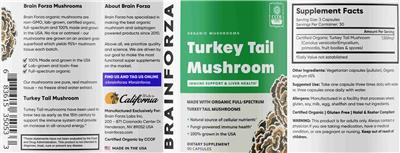
Brain Forza Mushrooms Brain Forza organic mushrooms are non-GMO, lab-grown, certified organic, full-spectrum and 100% made and grown in the USA.
Brain Forza organic mushrooms are non-GMO, lab-grown, certified organic, full-spectrum and 100% made and grown in the USA. Full-spectrum organic
No rice or oatmeal - our mushrooms are grown on an ancient grain superfood which yields 95%+ mushroom tissue each batch. Lab-grown and toxin-free
100% Made and grown in the USA Lab-grown and toxin-free No rice or oatmeal - our mushrooms are grown on an ancient grain superfood which yields 95%+ mushroom tissue each batch.
Certified Organic by CCOF
Made in: California Immune support & liver health Natural source of cellular nutrients Fungi-powered immune health
100% grown in the USA
Certified Organic
Gluten Free
Formula
Turkey Tail Mushroom Turkey Tail mushrooms have been used to brew tea as the 15th century to support the immune system and provide an increase in all-around energy. Our mushrooms are pure, real mushroom tissue - no freeze dried water extract.
Halal & Kosher Compliant
Halal & Kosher compliant
Made with organic full-spectrum turkey tail mushrooms
FDA Disclaimer Statement
These statements have not been evaluated by the Food and Drug Administration. This product is not intended to diagnose, treat, cure or prevent any disease.
General Statements
About Brain Forza Brain Forza has specialized in making the best organic mushroom and adaptogen powered products since 2010. Above all, we prioritize quality and science. We are driven by our goal to make the most functional super supplements on the market. Find us and tag us online @brainforza #brainforza
Organic Mushrooms
Seals/Symbols
Made in the USA
Certified CCOF Organic
FDA Statement of Identity
Dietary Supplement
Suggested/Recommended/Usage/Directions
Suggested Use: Take one capsule three times daily with water or, three capsules once daily with water.
Precautions
Allergens: Manufactured in a facility that processes wheat, gluten, soy, milk, egg, shellfish, and tree nut ingredients.
Warning: This product is for adults only. Keep out of reach of children.
Always contact a physician if you are taking medication, have a medical condition, or are pregnant or nursing.
Is this label outdated? Report a formula or label change and our pharmacy team will review it.
Turkey Tail Mushroom by Brain Forza label
The label scan from the NIH Dietary Supplement Label Database. Tap to enlarge.
Label images are published by the NIH Dietary Supplement Label Database for the version of this product on file. Always read your actual product label.
View the full label (PDF)The Ingredients in Turkey Tail Mushroom by Brain Forza
This is the 1 active ingredient this product is made of. Select it to open its full monograph.
Serving size3 Capsule(s) Dosage formCapsule Servings per container30 Amounts shown are per serving.
Turkey Tail Mushroom
Interacts with188 drugs
Turkey tail is a woodland mushroom rich in polysaccharides like beta-glucans, and it is mainly used to support the immune system. Some of its purified...
Turkey Tail Mushroom monograph & interactionsOther (inactive) ingredients: Pullulan, Sorghum. These complete the product’s ingredient list but are not active constituents.
Turkey Tail Mushroom by Brain Forza Drug Interactions
HelloPharmacist Interaction Report
Brain Forza Turkey Tail Mushroom has documented interactions with several medication types.
The most serious is with cyclophosphamide, a chemotherapy drug — the polysaccharide peptide (PSP) component in turkey tail may increase how much cyclophosphamide stays in your body and how long it lingers, potentially raising the risk of side effects.
Read the full breakdown — every affected drug type, severity by severity
Turkey tail also interacts with antidiabetes drugs (those that lower blood sugar) at moderate severity — animal research suggests it may lower blood sugar further, raising the risk of low blood sugar (hypoglycemia). It may also slow how your body absorbs tamoxifen, a hormone therapy drug used for breast cancer, delaying when it reaches its peak level in your bloodstream.
Additionally, the PSP in turkey tail theoretically inhibits CYP2C9, an enzyme your liver uses to metabolize certain drugs — this is rated minor severity, but it could raise levels of medications broken down this way.
Altogether, these interactions span 184 individual medications. If you take any of these drug types or any prescription medication at all, use the interaction checker on this page to verify your exact medications before starting this supplement.
Check your own medications below · Editorial policy · How we use AI
Want to check YOUR meds against Turkey Tail Mushroom?
Ask about interactions with your drugs in plain English — “Can I take it with lisinopril?” — and we find you the answer in seconds, ingredient by ingredient.
Go to the checkerIngredients driving the most interactions
Individual Drug Interactions
The ingredients in Turkey Tail Mushroom interact with 188 drugs. Click any drug to see the details.
1 of the 1 ingredient in Turkey Tail Mushroom interact with drugs. Each result below shows which ingredient is responsible. Turkey Tail Mushroom
AcarboseGlucobay, Prandase, Precose
How Acarbose interacts with Turkey Tail Mushroom — through 1 ingredient. Tap an ingredient for the detail:
Turkey Tail MushroomAntidiabetes Drugs Moderate
Interaction Summary
Theoretically, taking turkey tail mushroom with antidiabetes drugs might increase the risk of hypoglycemia.
Read the full Turkey Tail Mushroom + Acarbose interactionAcetohexamideDymelor
How Acetohexamide interacts with Turkey Tail Mushroom — through 1 ingredient. Tap an ingredient for the detail:
Turkey Tail MushroomAntidiabetes Drugs Moderate
Interaction Summary
Theoretically, taking turkey tail mushroom with antidiabetes drugs might increase the risk of hypoglycemia.
Read the full Turkey Tail Mushroom + Acetohexamide interactionAlbiglutideTanzeum
How Albiglutide interacts with Turkey Tail Mushroom — through 1 ingredient. Tap an ingredient for the detail:
Turkey Tail MushroomAntidiabetes Drugs Moderate
Interaction Summary
Theoretically, taking turkey tail mushroom with antidiabetes drugs might increase the risk of hypoglycemia.
Read the full Turkey Tail Mushroom + Albiglutide interactionAlogliptinNesina
How Alogliptin interacts with Turkey Tail Mushroom — through 1 ingredient. Tap an ingredient for the detail:
Turkey Tail MushroomAntidiabetes Drugs Moderate
Interaction Summary
Theoretically, taking turkey tail mushroom with antidiabetes drugs might increase the risk of hypoglycemia.
Read the full Turkey Tail Mushroom + Alogliptin interactionAlogliptin, MetforminKazano
How Alogliptin, Metformin interacts with Turkey Tail Mushroom — through 1 ingredient. Tap an ingredient for the detail:
Turkey Tail MushroomAntidiabetes Drugs Moderate
Interaction Summary
Theoretically, taking turkey tail mushroom with antidiabetes drugs might increase the risk of hypoglycemia.
Read the full Turkey Tail Mushroom + Alogliptin, Metformin interactionAlogliptin, PioglitazoneOseni
How Alogliptin, Pioglitazone interacts with Turkey Tail Mushroom — through 1 ingredient. Tap an ingredient for the detail:
Turkey Tail MushroomAntidiabetes Drugs Moderate
Interaction Summary
Theoretically, taking turkey tail mushroom with antidiabetes drugs might increase the risk of hypoglycemia.
Read the full Turkey Tail Mushroom + Alogliptin, Pioglitazone interactionAntidiabetes, Dipeptidyl Peptidase-4 (dpp-iv) InhibitorGlyxambi
How Antidiabetes, Dipeptidyl Peptidase-4 (dpp-iv) Inhibitor interacts with Turkey Tail Mushroom — through 1 ingredient. Tap an ingredient for the detail:
Turkey Tail MushroomAntidiabetes Drugs Moderate
Interaction Summary
Theoretically, taking turkey tail mushroom with antidiabetes drugs might increase the risk of hypoglycemia.
Read the full Turkey Tail Mushroom + Antidiabetes, Dipeptidyl Peptidase-4 (dpp-iv) Inhibitor interactionCanagliflozinInvokana
How Canagliflozin interacts with Turkey Tail Mushroom — through 1 ingredient. Tap an ingredient for the detail:
Turkey Tail MushroomAntidiabetes Drugs Moderate
Interaction Summary
Theoretically, taking turkey tail mushroom with antidiabetes drugs might increase the risk of hypoglycemia.
Read the full Turkey Tail Mushroom + Canagliflozin interactionCanagliflozin, MetforminInvokamet
How Canagliflozin, Metformin interacts with Turkey Tail Mushroom — through 1 ingredient. Tap an ingredient for the detail:
Turkey Tail MushroomAntidiabetes Drugs Moderate
Interaction Summary
Theoretically, taking turkey tail mushroom with antidiabetes drugs might increase the risk of hypoglycemia.
Read the full Turkey Tail Mushroom + Canagliflozin, Metformin interactionCanagliflozin, Metformin HydrochlorideInvokamet XR
How Canagliflozin, Metformin Hydrochloride interacts with Turkey Tail Mushroom — through 1 ingredient. Tap an ingredient for the detail:
Turkey Tail MushroomAntidiabetes Drugs Moderate
Interaction Summary
Theoretically, taking turkey tail mushroom with antidiabetes drugs might increase the risk of hypoglycemia.
Read the full Turkey Tail Mushroom + Canagliflozin, Metformin Hydrochloride interactionChlorpropamideChlorpropam, Diabinese
How Chlorpropamide interacts with Turkey Tail Mushroom — through 1 ingredient. Tap an ingredient for the detail:
Turkey Tail MushroomAntidiabetes Drugs Moderate
Interaction Summary
Theoretically, taking turkey tail mushroom with antidiabetes drugs might increase the risk of hypoglycemia.
Read the full Turkey Tail Mushroom + Chlorpropamide interactionCyclophosphamideCytoxan, Neosar
How Cyclophosphamide interacts with Turkey Tail Mushroom — through 1 ingredient. Tap an ingredient for the detail:
Turkey Tail MushroomCyclophosphamide Moderate
Interaction Summary
Theoretically, the polysaccharide peptide (PSP) component of turkey tail mushroom might increase exposure to cyclophosphamide.
Read the full Turkey Tail Mushroom + Cyclophosphamide interactionDapagliflozinFarxiga
How Dapagliflozin interacts with Turkey Tail Mushroom — through 1 ingredient. Tap an ingredient for the detail:
Turkey Tail MushroomAntidiabetes Drugs Moderate
Interaction Summary
Theoretically, taking turkey tail mushroom with antidiabetes drugs might increase the risk of hypoglycemia.
Read the full Turkey Tail Mushroom + Dapagliflozin interactionDapagliflozin Propanediol, MetforminXigduo XR
How Dapagliflozin Propanediol, Metformin interacts with Turkey Tail Mushroom — through 1 ingredient. Tap an ingredient for the detail:
Turkey Tail MushroomAntidiabetes Drugs Moderate
Interaction Summary
Theoretically, taking turkey tail mushroom with antidiabetes drugs might increase the risk of hypoglycemia.
Read the full Turkey Tail Mushroom + Dapagliflozin Propanediol, Metformin interactionDapagliflozin Propanediol, Saxagliptin HydrochlorideQtern
How Dapagliflozin Propanediol, Saxagliptin Hydrochloride interacts with Turkey Tail Mushroom — through 1 ingredient. Tap an ingredient for the detail:
Turkey Tail MushroomAntidiabetes Drugs Moderate
Interaction Summary
Theoretically, taking turkey tail mushroom with antidiabetes drugs might increase the risk of hypoglycemia.
Read the full Turkey Tail Mushroom + Dapagliflozin Propanediol, Saxagliptin Hydrochloride interactionDapagliflozin, Metformin Hydrochloride, Saxagliptin HydrochlorideQternmet XR
How Dapagliflozin, Metformin Hydrochloride, Saxagliptin Hydrochloride interacts with Turkey Tail Mushroom — through 1 ingredient. Tap an ingredient for the detail:
Turkey Tail MushroomAntidiabetes Drugs Moderate
Interaction Summary
Theoretically, taking turkey tail mushroom with antidiabetes drugs might increase the risk of hypoglycemia.
Read the full Turkey Tail Mushroom + Dapagliflozin, Metformin Hydrochloride, Saxagliptin Hydrochloride interactionDasiglucagon HydrochlorideZegalogue
How Dasiglucagon Hydrochloride interacts with Turkey Tail Mushroom — through 1 ingredient. Tap an ingredient for the detail:
Turkey Tail MushroomAntidiabetes Drugs Moderate
Interaction Summary
Theoretically, taking turkey tail mushroom with antidiabetes drugs might increase the risk of hypoglycemia.
Read the full Turkey Tail Mushroom + Dasiglucagon Hydrochloride interactionDulaglutideTrulicity
How Dulaglutide interacts with Turkey Tail Mushroom — through 1 ingredient. Tap an ingredient for the detail:
Turkey Tail MushroomAntidiabetes Drugs Moderate
Interaction Summary
Theoretically, taking turkey tail mushroom with antidiabetes drugs might increase the risk of hypoglycemia.
Read the full Turkey Tail Mushroom + Dulaglutide interactionEmpagliflozinJardiance
How Empagliflozin interacts with Turkey Tail Mushroom — through 1 ingredient. Tap an ingredient for the detail:
Turkey Tail MushroomAntidiabetes Drugs Moderate
Interaction Summary
Theoretically, taking turkey tail mushroom with antidiabetes drugs might increase the risk of hypoglycemia.
Read the full Turkey Tail Mushroom + Empagliflozin interactionEmpagliflozin, Linagliptin, Metformin HydrochlorideTrijardy XR
How Empagliflozin, Linagliptin, Metformin Hydrochloride interacts with Turkey Tail Mushroom — through 1 ingredient. Tap an ingredient for the detail:
Turkey Tail MushroomAntidiabetes Drugs Moderate
Interaction Summary
Theoretically, taking turkey tail mushroom with antidiabetes drugs might increase the risk of hypoglycemia.
Read the full Turkey Tail Mushroom + Empagliflozin, Linagliptin, Metformin Hydrochloride interactionEmpagliflozin, MetforminSynjardy
How Empagliflozin, Metformin interacts with Turkey Tail Mushroom — through 1 ingredient. Tap an ingredient for the detail:
Turkey Tail MushroomAntidiabetes Drugs Moderate
Interaction Summary
Theoretically, taking turkey tail mushroom with antidiabetes drugs might increase the risk of hypoglycemia.
Read the full Turkey Tail Mushroom + Empagliflozin, Metformin interactionEmpagliflozin, Metformin HydrochlorideSynjardy XR
How Empagliflozin, Metformin Hydrochloride interacts with Turkey Tail Mushroom — through 1 ingredient. Tap an ingredient for the detail:
Turkey Tail MushroomAntidiabetes Drugs Moderate
Interaction Summary
Theoretically, taking turkey tail mushroom with antidiabetes drugs might increase the risk of hypoglycemia.
Read the full Turkey Tail Mushroom + Empagliflozin, Metformin Hydrochloride interactionErtugliflozinSteglatro
How Ertugliflozin interacts with Turkey Tail Mushroom — through 1 ingredient. Tap an ingredient for the detail:
Turkey Tail MushroomAntidiabetes Drugs Moderate
Interaction Summary
Theoretically, taking turkey tail mushroom with antidiabetes drugs might increase the risk of hypoglycemia.
Read the full Turkey Tail Mushroom + Ertugliflozin interactionErtugliflozin, Metformin HydrochlorideSegluromet
How Ertugliflozin, Metformin Hydrochloride interacts with Turkey Tail Mushroom — through 1 ingredient. Tap an ingredient for the detail:
Turkey Tail MushroomAntidiabetes Drugs Moderate
Interaction Summary
Theoretically, taking turkey tail mushroom with antidiabetes drugs might increase the risk of hypoglycemia.
Read the full Turkey Tail Mushroom + Ertugliflozin, Metformin Hydrochloride interactionExenatideBydureon, Byetta
How Exenatide interacts with Turkey Tail Mushroom — through 1 ingredient. Tap an ingredient for the detail:
Turkey Tail MushroomAntidiabetes Drugs Moderate
Interaction Summary
Theoretically, taking turkey tail mushroom with antidiabetes drugs might increase the risk of hypoglycemia.
Read the full Turkey Tail Mushroom + Exenatide interactionExenatide SyntheticBydureon BCISE
How Exenatide Synthetic interacts with Turkey Tail Mushroom — through 1 ingredient. Tap an ingredient for the detail:
Turkey Tail MushroomAntidiabetes Drugs Moderate
Interaction Summary
Theoretically, taking turkey tail mushroom with antidiabetes drugs might increase the risk of hypoglycemia.
Read the full Turkey Tail Mushroom + Exenatide Synthetic interactionGliclazideDiamicron
How Gliclazide interacts with Turkey Tail Mushroom — through 1 ingredient. Tap an ingredient for the detail:
Turkey Tail MushroomCytochrome P450 2c9 (cyp2c9) Substrates, Antidiabetes Drugs Moderate
Interaction Summary
Theoretically, the polysaccharide peptide (PSP) component of turkey tail mushroom might inhibit CYP2C9.
Read the full Turkey Tail Mushroom + Gliclazide interactionGlimepirideAmaryl
How Glimepiride interacts with Turkey Tail Mushroom — through 1 ingredient. Tap an ingredient for the detail:
Turkey Tail MushroomCytochrome P450 2c9 (cyp2c9) Substrates, Antidiabetes Drugs Moderate
Interaction Summary
Theoretically, the polysaccharide peptide (PSP) component of turkey tail mushroom might inhibit CYP2C9.
Read the full Turkey Tail Mushroom + Glimepiride interactionGlipizideGlucotrol, Glucotrol XL
How Glipizide interacts with Turkey Tail Mushroom — through 1 ingredient. Tap an ingredient for the detail:
Turkey Tail MushroomCytochrome P450 2c9 (cyp2c9) Substrates, Antidiabetes Drugs Moderate
Interaction Summary
Theoretically, the polysaccharide peptide (PSP) component of turkey tail mushroom might inhibit CYP2C9.
Read the full Turkey Tail Mushroom + Glipizide interactionGlipizide, MetforminMetaglip
How Glipizide, Metformin interacts with Turkey Tail Mushroom — through 1 ingredient. Tap an ingredient for the detail:
Turkey Tail MushroomCytochrome P450 2c9 (cyp2c9) Substrates, Antidiabetes Drugs Moderate
Interaction Summary
Theoretically, the polysaccharide peptide (PSP) component of turkey tail mushroom might inhibit CYP2C9.
Read the full Turkey Tail Mushroom + Glipizide, Metformin interactionEach ingredient & the kinds of drugs it affects
For each ingredient in Turkey Tail Mushroom with known interactions, here are the types of medications it can affect. Open any type for the detail — or search your exact drug in the checker above.
Turkey Tail Mushroom
Antidiabetes Drugs
Theoretically, taking turkey tail mushroom with antidiabetes drugs might increase the risk of hypoglycemia.
Animal research suggests that turkey tail mushroom and a polysaccharide component can have hypoglycemic effects.
Cyclophosphamide
Theoretically, the polysaccharide peptide (PSP) component of turkey tail mushroom might increase exposure to cyclophosphamide.
Some animal research shows that the PSP component of turkey tail mushroom can increase the area under the concentration-time curve (AUC) of cyclophosphamide by 44% to 50% and the half-life by 34% to 43%. This interaction could potentially increase the effects and adverse effects of cyclophosphamide. However, it is not known whether PSP affects the levels of the active metabolites of cyclophosphamide that are responsible for its clinical activity.
Tamoxifen (Nolvadex)
Theoretically, the polysaccharide peptide (PSP) component of turkey tail mushroom might interfere with the absorption of tamoxifen.
Animal research suggests that PSP increases the time to reach maximum concentration of a single dose of tamoxifen by about 9.5 hours, or 228%. When repeated doses of tamoxifen were given, the time to reach maximum concentration was increased by about 5.6 hours, or 93%. However, PSP did not affect the maximum concentration or the area under the curve of tamoxifen.
Cytochrome P450 2C9 (Cyp2C9) Substrates
Theoretically, the polysaccharide peptide (PSP) component of turkey tail mushroom might inhibit CYP2C9.
Laboratory research suggests that the PSP component of turkey tail mushroom dose-dependently inhibits CYP2C9. Theoretically, taking PSP with drugs metabolized by CYP2C9 might increase drug levels and the risk of adverse effects. However, this has not been reported in humans.
Brand information
Manufacturer and brand details for Turkey Tail Mushroom, from the product label.
Brain Forza
See all Brain Forza products- Name
- Brain Forza Labs Inc.
- Street Address
- 200-871 Coronado Center Dr.
- City
- Henderson
- State
- NV
- ZipCode
- 89052
- Web Address
- brainforza.com
Turkey Tail Mushroom by Brain Forza: Common Questions
Does Turkey Tail Mushroom by Brain Forza interact with any medications?
How can one product interact with so many drugs?
Where does this information come from?
Is turkey tail mushroom safe to take while I'm pregnant or breastfeeding?
What is PSP, and why does it matter for interactions?
Does turkey tail actually help with cancer?
What side effects should I watch for?
Can I take this if I'm on blood sugar medication?
Why does the product label list inactive ingredients like pullulan and sorghum?
Written and reviewed by the HelloPharmacist editorial staff. Our editorial policy
Not sure if Turkey Tail Mushroom is safe with your meds?
Our pharmacists answer your medication & supplement questions — free.
Label information is sourced from the NIH Dietary Supplement Label Database and reflects the product version on file; always read your actual product label. This page is for education only and is not a substitute for professional medical advice. Confirm with your pharmacist or doctor before combining supplements and medications.
The Full Monographs Behind Turkey Tail Mushroom’s Ingredients
Every ingredient we hold a full HelloPharmacist monograph for — uses, evidence, safety, and the complete interaction list.
Sources & How We Checked
Turkey Tail Mushroom's label data comes from the NIH Dietary Supplement Label Database; the ingredient interaction data is from the Natural Medicines database, reviewed by our pharmacists.
- NIH Dietary Supplement Label Database (DSLD) — The official product label on file for this supplement.
- Natural Medicines (Therapeutic Research Center) — Evidence-graded clinical reference behind the ingredient interaction data.
Content is written and reviewed by licensed HelloPharmacist pharmacists. See our data sources and editorial standards for how this information is built and checked.
The 15 references behind this product’s interaction data
Every citation that drives the interaction findings for this product’s ingredients, from the evidence-graded Natural Medicines (TRC Healthcare) database. Open an ingredient to browse its citations — links open the study on PubMed or the publisher’s site.
Turkey Tail Mushroom 15 references
- Nakazato H, Koike A, Saji S, et al. Efficacy of immunochemotherapy as adjuvant treatment after curative resection of gastric cancer. Study Group of Immunochemotherapy with PSK for Gastric Cancer. Lancet 1994;343:1122-6. PubMed
- Mitomi T, Tsuchiya S, Iijima N, et al. Randomized, controlled study on adjuvant immunochemotherapy with PSK in curatively resected colorectal cancer. The Cooperative Study Group of Surgical Adjuvant Immunochemotherapy for Cancer of Colon and Rectum (Kanag DOI
- Torisu M, Hayashi Y, Ishimitsu T, et al. Significant prolongation of disease-free period gained by oral polysaccharide K (PSK) administration after curative surgical operation of colorectal cancer. Cancer Immunol Immunother 1990;31:261-8. PubMed
- Tsujitani, S., Kakeji, Y., Orita, H., Watanabe, A., Kohnoe, S., Baba, H., Anai, H., Maehara, Y., and Sugimachi, K. Postoperative adjuvant immunochemotherapy and infiltration of dendritic cells for patients with advanced gastric cancer. Anticancer Res 199
- Kojima, J., Kamata, T., and Monna, T. [Evaluation of immunochemotherapy in patients with primary liver cancer. Osaka Research Society for Liver, Gallbladder and Pancreas]. Gan To Kagaku Ryoho 1987;14(1):179-187.
- Fukuo, Y., Terashi, A., Hayashi, Y., Yano, Y., and Atarashi, J. [A clinical trial of cis-platinum (II) in combination with PSK and FT-207 in advanced stomach cancer]. Gan To Kagaku Ryoho 1985;12(4):960-965.
- Imaizumi, M., Kondo, T., Kamei, H., and Ichihashi, H. [Cooperative studies on surgical adjuvant immunochemotherapy for prevention of postoperative recurrence of gastric cancer]. Gan To Kagaku Ryoho 1984;11(1):60-68.
- Yeung JH and Or PM. Polysaccharide peptides from Coriolus versicolor competitively inhibit tolbutamide 4-hydroxylation in specific human CYP2C9 isoform and pooled human liver microsomes. Phytomedicine 2011;18(13):1170-5. PubMed
- Eliza WL, Fai CK, Chung LP. Efficacy of Yun Zhi (Coriolus versicolor) on survival in cancer patients: systematic review and meta-analysis. Recent Pat Inflamm Allergy Drug Discov 2012;6(1):78-87. PubMed
- Chan SL, Yeung JH. Effects of polysaccharide peptide (PSP) from Coriolus versicolor on the pharmacokinetics of cyclophosphamide in the rat and cytotoxicity in HepG2 cells. Food Chem Toxicol 2006;44:689-94. PubMed
- Serrano L, López AC, González SP, et al. Efficacy of a Coriolus versicolor-based vaginal gel in women with human papillomavirus-dependent cervical lesions: The PALOMA study. J Low Genit Tract Dis 2021;25(2):130-136. PubMed
- Meng F, Lin Y, Hu L, Feng W, Su P, Wu L. The therapeutic effect of Coriolus versicolor fruiting body on STZ-induced ICR diabetic mice. J Healthc Eng 2022;2022:7282453. PubMed
- Razmovski-Naumovski V, Kimble B, Laurenti D, Nammi S, Norimoto H, Chan K. Polysaccharide peptide extract from Coriolus versicolor increased T(max) of tamoxifen and maintained biochemical serum parameters, with no change in the metabolism of tamoxifen in t
- Cortés Bordoy J, de Santiago García J, Agenjo González M, et al. Effect of a multi-ingredient Coriolus-versicolor-based vaginal gel in women with HPV-dependent cervical lesions: The papilobs real-life prospective study. Cancers (Basel) 2023;15(15):3863. PubMed
- Nikolic M, Lazarevic N, Novakovic J, et al. Characterization, in vitro biological activity and in vivo cardioprotective properties of Trametes versicolor (L.:Fr.) quél. heteropolysaccharides in a rat model of metabolic syndrome. Pharmaceuticals (Basel) 20 PubMed
See these in context on the Turkey Tail Mushroom monograph →
Parts of this content are provided by the Therapeutic Research Center, LLC.
DISCLAIMER: Currently this does not check for drug-drug interactions. This is not an all-inclusive comprehensive list of potential interactions and is for informational purposes only. Not all interactions are known or well-reported in the scientific literature, and new interactions are continually being reported. Input is needed from a qualified healthcare provider including a pharmacist before starting any therapy. Application of clinical judgment is necessary.
© 2021 Therapeutic Research Center, LLC