
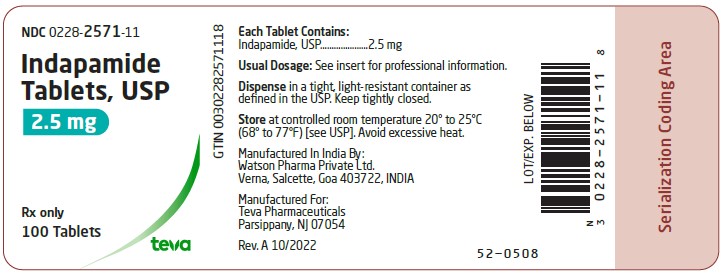
Indapamide 2.5 mg Tablet, Film Coated, 1,000-count
🆔 Identity & classification
Where does this data come from?
🏷️ RxNorm drug class
This medicine belongs to the Thiazide-like Diuretic class.
Where does this data come from?
🏭 Manufacturer & labeler
Where does this data come from?
🩺 Clinical
Indapamide is used to treat hypertension (high blood pressure) and fluid retention (swelling caused by body fluid pooling in certain tissues) that can happen with heart failure(HF; a condition where the heart muscle weakens and cannot blood as well). Indapamide is in a class of medications called diuretics ("water pills"). It works by causing the kidneys to get rid of unneeded salt and water from the body into the urine. Untreated high blood pressure can damage the brain, heart, blood vessels, kidneys and other parts of the body. This damage may cause heart disease, a heart attack, stroke, kid...
Read the full MedlinePlus article ↗- Indapamide is a 'water pill' (diuretic) that's approved for two things: lowering high blood pressure, and reducing the fluid buildup (swelling) that can happen with congestive hear...
- The label recommends taking it once a day in the morning — that way, most of the diuretic (fluid-removing) effect happens during daytime hours so you're not running to the bathroom...
- When should I take indapamide, and does it matter if I take it with food?
- The most common ones are headache, dizziness, fatigue, muscle cramps, and more frequent urination — especially when you first start. Low potassium is also pretty common with this t...
Patient education
Supplement & herbal interactions
Some supplements/herbs that may interact with Indapamide — tap one for details:
Indapamide may be associated with lower levels of 8 nutrients — worth a chat with your pharmacist, not a cause for alarm.
Where does this data come from?
Ask a licensed pharmacist directly — free, answered by our team.
💊 What it looks like
Where does this data come from?
🧪 Inactive Ingredients / Excipients
Inactive ingredients, also called excipients, are components of the drug product other than the active ingredient. They may include fillers, dyes, coatings, preservatives, flavors, or other formulation ingredients.
💡 Tap an ingredient (hover on desktop) to see what it is and why it’s used.
-
UNII OP1R32D61U
Microcrystalline cellulose is a purified form of cellulose, a natural fiber from plant sources. It acts as a binder and filler in tablets and capsules, helping hold ingredients together and give the medicine its shape and size.
-
UNII 3NXW29V3WO
Hypromellose is a plant-based thickener made from cellulose. It's used in medicines as a binder to hold ingredients together, a coating for tablets, and a thickener for liquids.
-
UNII EWQ57Q8I5X
Lactose monohydrate is a natural sugar derived from milk. It serves as a filler and binder in tablets and capsules, helping create the proper size, texture, and consistency of the medicine.
-
UNII 70097M6I30
Magnesium stearate is a salt made from magnesium and stearic acid, a fatty substance. It's used in tablets and capsules as a lubricant and glidant to help ingredients flow smoothly during manufacturing and prevent sticking.
-
UNII 7CVR7L4A2D
A starch-derived carbohydrate produced by breaking down corn, potato, or tapioca starch. It functions as a filler and binder to give the medicine bulk and texture, and sometimes as a mild sweetener or texture enhancer in powders and tablets.
-
UNII VH2XOU12IE
Polydextrose is a synthetic polymer made from dextrose (sugar) that acts as a bulking agent and filler in medicines. It helps give tablets and capsules proper volume and texture while often adding slight sweetness.
-
UNII 3WJQ0SDW1A
Polyethylene glycol is a synthetic liquid or solid polymer used in medicines as a solvent, lubricant, and humectant. It helps dissolve active ingredients, reduces friction during manufacturing, and retains moisture in the final product.
-
UNII O8232NY3SJ
A plant-based carbohydrate derived from corn kernels. It acts as a filler to add bulk, a binder to hold ingredients together, and a disintegrant to help the tablet break apart in your stomach for absorption.
-
UNII 7SEV7J4R1U
A powder made from a naturally occurring mineral. In medicines, talc works as a glidant and anti-caking agent, helping tablets and capsules flow smoothly during manufacturing and preventing clumping.
-
UNII 15FIX9V2JP
Titanium dioxide is a bright white mineral powder commonly used as a colorant and opacifying agent. It makes pills and tablets white or lighter in color and helps make coatings non-transparent.
-
UNII XHX3C3X673
Triacetin is a clear, oily liquid made from glycerin and acetic acid. It works as a plasticizer and solvent in medicines, helping soften coatings and improve how liquids mix together in formulations.
11 inactive ingredients listed in the exact product block matched to this NDC.
Where does this data come from?
ingredient classCode="IACT" elements from the exact product block matched by this NDC. Label-section narrative from DailyMed / the openFDA label index is shown separately when available.Inactive ingredient FAQ
Are inactive ingredients the same for every manufacturer?
Why might an inactive ingredient be missing?
Can inactive ingredients matter?
💲 Pricing
A drug doesn't have one price. Each row is a different public payment system, and none is what you'd pay at the counter — that depends on your insurance. The ⓘ on each row explains what it measures.
| Price system | Per ea | Per package |
|---|---|---|
| Retail pharmacies payNADAC · weekly | $0.108 | $107.60 / 1000 tablets |
| Medicaid paysCMS SDUD · 12 mo | $0.3255 | $325.50 / 1000 tablets |
| Medicare drug plans payPart D · Q2 2026 | $0.2159 | $215.90 / 1000 tablets |
Where does this data come from?
🔁 Therapeutic equivalents
| Product | Labeler | Pack | NADAC/unit | TE | Status | Price vs. this |
|---|---|---|---|---|---|---|
| Indapamide 2.5 mgthis 00228-2571-96 | Actavis | 1000 tablets | $0.108 | AB | Availability likely | — |
| Indapamide 2.5 mg 16571-0876-01 | Rising | 100 tablets | $0.108 | AB | Availability likely | — |
| Indapamide 2.5 mg 62559-0511-01 | ANI | 100 tablets | $0.108 | AB | Availability likely | — |
| Indapamide 2.5 mg 50090-7826-01 | A-S | 90 tablets | — | AB | FDA listed | — |
| Indapamide 2.5 mg 51407-0025-01 | Golden | 100 tablets | — | AB | FDA listed | — |
| Indapamide 2.5 mg 63629-1954-01 | Bryant | 100 tablets | — | AB | FDA listed | — |
| Indapamide 2.5 mg 68788-7247-01 | Preferred | 100 tablets | — | AB | FDA listed | — |
| Indapamide 2.5 mg 72162-1767-01 | Bryant | 100 tablets | — | AB | FDA listed | — |
| Indapamide 2.5 mg 72189-0591-60 | Direct_Rx | 60 tablets | — | AB | FDA listed | — |
Where does this data come from?
⏳ Availability & generic status
This product is an FDA-approved generic. Other versions of the same drug are listed under Therapeutic equivalents, least expensive first.
Where does this data come from?
🗺️ Medicaid utilization & spend
💊 Medicaid utilization by pack size
📊 Medicare Part D spend CMS · PART D · 2026 (Q1)
🔬 Reported adverse events (FAERS)
Top reported reactions
Age at onset
Reporter sex
Serious outcomes
Where does this data come from?
📦 Packaging — all sizes for this product
| Package NDC | Description | Per unit | Per pack | Marketing start | Status |
|---|---|---|---|---|---|
| 00228-2571-11 | 100 TABLET, FILM COATED in 1 BOTTLE (0228-2571-11) | $0.1076 / ea | $10.76 | 2007-01-02 | Active |
| 00228-2571-96 You're viewing this | 1000 TABLET, FILM COATED in 1 BOTTLE (0228-2571-96) | $0.1076 / ea | $107.61 | 2007-01-02 | Active |
| 00228-2571-00 | 68670 TABLET, FILM COATED in 1 BOX (0228-2571-00) | — | — | — | Active |
| 00228-2571-77 | 82404 TABLET, FILM COATED in 1 CONTAINER (0228-2571-77) | — | — | — | Active |
You're viewing one of 4 pack sizes for this product.
This pack effectively ties for the lowest per-ea cost of the 2 priced pack sizes ($0.1076 NADAC).
This pack accounts for about 0.8% of this product's recent Medicaid fills; most go to the 100 tablets pack. See all packs ↓
Pack size FAQ
What quantity is in NDC 00228-2571-96?
What is the difference between NDC 00228-2571-96 and NDC 00228-2571-11?
What NDC number is used to bill for this package of Indapamide 2.5 mg Tablet, Film Coated?
Prices are the latest CMS NADAC pharmacy acquisition cost per NDC; per-pack figures are per-unit × pack quantity, shown only when the pack is denominated in the same measure NADAC prices.
📄 Full prescribing information FDA SPL
🎯 Indications and Usage ▾
INDICATIONS AND USAGE Indapamide tablets are indicated for the treatment of hypertension, alone or in combination with other antihypertensive drugs. Indapamide tablets are also indicated for the treatment of salt and fluid retention associated with congestive heart failure. Usage in Pregnancy: The routine use of diuretics in an otherwise healthy woman is inappropriate and exposes mother and fetus to unnecessary hazard (see PRECAUTIONS ).
Diuretics do not prevent development of toxemia of pregnancy, and there is no satisfactory evidence that they are useful in the treatment of developed toxemia. Edema during pregnancy may arise from pathological causes or from the physiologic and mechanical consequences of pregnancy. Indapamide is indicated in pregnancy when edema is due to pathologic causes, just as it is in the absence of pregnancy (however, see PRECAUTIONS ).
Dependent edema in pregnancy, resulting from restriction of venous return by the expanded uterus, is properly treated through elevation of the lower extremities and use of support hose; use of diuretics to lower intravascular volume in this case is illogical and unnecessary. There is hypervolemia during normal pregnancy which is not harmful to either the fetus or the mother (in the absence of cardiovascular disease), but which is associated with edema, including generalized edema in the majority of pregnant women. If this edema produces discomfort, increased recumbency will often provide relief.
In rare instances, this edema may cause extreme discomfort which is not relieved by rest. In these cases, a short course of diuretics may provide relief and may be appropriate.
⏱️ Dosage and Administration ▾
DOSAGE AND ADMINISTRATION Hypertension: The adult starting indapamide dose for hypertension is 1.25 mg as a single daily dose taken in the morning. If the response to 1.25 mg is not satisfactory after four weeks, the daily dose may be increased to 2.5 mg taken once daily. If the response to 2.5 mg is not satisfactory after four weeks, the daily dose may be increased to 5 mg taken once daily, but adding another antihypertensive should be considered.
Edema of Congestive Heart Failure: The adult starting indapamide dose for edema of congestive heart failure is 2.5 mg as a single daily dose taken in the morning. If the response to 2.5 mg is not satisfactory after one week, the daily dose may be increased to 5 mg taken once daily. If the antihypertensive response to indapamide is insufficient, indapamide may be combined with other antihypertensive drugs, with careful monitoring of blood pressure.
It is recommended that the usual dose of other agents be reduced by 50% during initial combination therapy. As the blood pressure response becomes evident, further dosage adjustments may be necessary. In general, doses of 5 mg and larger have not appeared to provide additional effects on blood pressure or heart failure, but are associated with a greater degree of hypokalemia.
There is minimal clinical trial experience in patients with doses greater than 5 mg once a day.
⛔ Contraindications ▾
CONTRAINDICATIONS Anuria. Known hypersensitivity to indapamide or to other sulfonamide-derived drugs.
⚠️ Warnings ▾
WARNINGS Severe cases of hyponatremia, accompanied by hypokalemia have been reported with recommended doses of indapamide. This occurred primarily in elderly females (see PRECAUTIONS, Geriatric Use ). This appears to be dose-related.
Also, a large case-controlled pharmacoepidemiology study indicates that there is an increased risk of hyponatremia with indapamide 2.5 mg and 5 mg doses. Hyponatremia considered possibly clinically significant (< 125 mEq/L) has not been observed in clinical trials with the 1.25 mg dosage (see PRECAUTIONS ). Thus, patients should be started at the 1.25 mg dose and maintained at the lowest possible dose (see DOSAGE AND ADMINISTRATION ).
Hypokalemia occurs commonly with diuretics (see ADVERSE REACTIONS ), and electrolyte monitoring is essential, particularly in patients who would be at increased risk from hypokalemia, such as those with cardiac arrhythmias or who are receiving concomitant cardiac glycosides. In general, diuretics should not be given concomitantly with lithium because they reduce its renal clearance and add a high risk of lithium toxicity. Read prescribing information for lithium preparations before use of such concomitant therapy.
🤒 Adverse Reactions ▾
ADVERSE REACTIONS Most adverse effects have been mild and transient. The Clinical Adverse Reactions listed in Table 1 represent data from Phase II/III placebo-controlled studies (306 patients given indapamide 1.25 mg). The Clinical Adverse Reactions listed in Table 2 represent data from Phase II placebo-controlled studies and long-term controlled clinical trials (426 patients given indapamide 2.5 mg or 5 mg).
The reactions are arranged into two groups: 1) a cumulative incidence equal to or greater than 5%; 2) a cumulative incidence less than 5%. Reactions are counted regardless of relation to drug. TABLE 1: Adverse Reactions from Studies of 1.25 mg Incidence ≥ 5% Incidence < 5%* BODY AS A WHOLE Headache Asthenia Infection Flu Syndrome Pain Abdominal Pain Back Pain Chest Pain GASTROINTESTINAL SYSTEM Constipation Diarrhea Dyspepsia Nausea METABOLIC SYSTEM Peripheral Edema CENTRAL NERVOUS SYSTEM Nervousness Dizziness Hypertonia RESPIRATORY SYSTEM Cough Rhinitis Pharyngitis Sinusitis SPECIAL SENSES Conjunctivitis *OTHER All other clinical adverse reactions occurred at an incidence of < 1%.
Approximately 4% of patients given indapamide 1.25 mg compared to 5% of the patients given placebo discontinued treatment in the trials of up to eight weeks because of adverse reactions. In controlled clinical trials of six to eight weeks in duration, 20% of patients receiving indapamide 1.25 mg, 61% of patients receiving indapamide 5 mg, and 80% of patients receiving indapamide 10 mg had at least one potassium value below 3.4 mEq/L. In the indapamide 1.25 mg group, about 40% of those patients who reported hypokalemia as a laboratory adverse event returned to normal serum potassium values without intervention.
Hypokalemia with concomitant clinical signs or symptoms occurred in 2% of patients receiving indapamide 1.25 mg. TABLE 2: Adverse Reactions from Studies of 2.5 mg and 5 mg Incidence ≥ 5% Incidence < 5% CENTRAL NERVOUS SYSTEM / NEUROMUSCULAR Headache Lightheadedness Dizziness Drowsiness Fatigue, weakness, loss of energy, lethargy, tiredness, or malaise Vertigo Insomnia Muscle cramps or spasm, or numbness of the extremities Depression Blurred Vision Nervousness, tension, anxiety, irritability, or agitation GASTROINTESTINAL SYSTEM Constipation Nausea Vomiting Diarrhea Gastric irritation Abdominal pain or cramps Anorexia CARDIOVASCULAR SYSTEM Orthostatic hypotension Premature ventricular contractions Irregular heart beat Palpitations GENITOURINARY SYSTEM Frequency of urination Nocturia Polyuria DERMATOLOGIC/HYPERSENSITIVITY Rash Hives Pruritus Vasculitis OTHER Impotence or reduced libido Rhinorrhea Flushing Hyperuricemia Hyperglycemia Hyponatremia Hypochloremia Increase in serum urea nitrogen (BUN) or creatinine Glycosuria Weight loss Dry mouth Tingling of extremities Because most of these data are from long-term studies (up to 40 weeks of treatment), it is probable that many of the adverse experiences reported are due to causes other than the drug.
Approximately 10% of patients given indapamide discontinued treatment in long-term trials because of reactions either related or unrelated to the drug. Hypokalemia with concomitant clinical signs or symptoms occurred in 3% of patients receiving indapamide 2.5 mg q.d. and 7% of patients receiving indapamide 5 mg q.d. In long-term controlled clinical trials comparing the hypokalemic effects of daily doses of indapamide and hydrochlorothiazide, however, 47% of patients receiving indapamide 2.5 mg, 72% of patients receiving indapamide 5 mg, and 44% of patients receiving hydrochlorothiazide 50 mg had at least one potassium value (out of a total of 11 taken during the study) below 3.5 mEq/L.
In the indapamide 2.5 mg group, over 50% of those patients returned to normal serum potassium values without intervention. In clinical trials of six to eight weeks, the mean changes in selected values were as shown in the tables below. Mean Changes from Baseline after 8 Weeks of Treatment – 1.25 mg Serum Electrolytes…
🔄 Drug Interactions ▾
Drug Interactions Other Antihypertensives: Indapamide may add to or potentiate the action of other antihypertensive drugs. In limited controlled trials that compared the effect of indapamide combined with other antihypertensive drugs with the effect of the other drugs administered alone, there was no notable change in the nature or frequency of adverse reactions associated with the combined therapy. Lithium: See WARNINGS .
Post-Sympathectomy Patient: The antihypertensive effect of the drug may be enhanced in the post-sympathectomized patient. Norepinephrine: Indapamide, like the thiazides, may decrease arterial responsiveness to norepinephrine, but this diminution is not sufficient to preclude effectiveness of the pressor agent for therapeutic use.
🤰 Pregnancy ▾
Pregnancy: Teratogenic Effects: Reproduction studies have been performed in rats, mice and rabbits at doses up to 6,250 times the therapeutic human dose and have revealed no evidence of impaired fertility or harm to the fetus due to indapamide. Postnatal development in rats and mice was unaffected by pre-treatment of parent animals during gestation. There are, however, no adequate and well-controlled studies in pregnant women.
Moreover, diuretics are known to cross the placental barrier and appear in cord blood. Because animal reproduction studies are not always predictive of human response, this drug should be used during pregnancy only if clearly needed. There may be hazards associated with this use such as fetal or neonatal jaundice, thrombocytopenia, and possibly other adverse reactions that have occurred in the adult.
🧒 Pediatric Use ▾
Pediatric Use: Safety and effectiveness of indapamide in pediatric patients have not been established.
🧓 Geriatric Use ▾
Geriatric Use: Clinical studies of indapamide did not include sufficient numbers of subjects aged 65 and over to determine whether they respond differently from younger subjects. Other reported clinical experience has not identified differences in responses between the elderly and younger patients. In general, dose selection for an elderly patient should be cautious, usually starting at the low end of the dosing range, reflecting the greater frequency of decreased hepatic, renal, or cardiac function, and of concomitant disease or other drug therapy.
Severe cases of hyponatremia, accompanied by hypokalemia have been reported with recommended doses of indapamide in elderly females (see WARNINGS ).
🆘 Overdosage ▾
OVERDOSAGE Symptoms of overdosage include nausea, vomiting, weakness, gastrointestinal disorders and disturbances of electrolyte balance. In severe instances, hypotension and depressed respiration may be observed. If this occurs, support of respiration and cardiac circulation should be instituted.
There is no specific antidote. An evacuation of the stomach is recommended by emesis and gastric lavage after which the electrolyte and fluid balance should be evaluated carefully.
🧬 Clinical Pharmacology ▾
CLINICAL PHARMACOLOGY Indapamide is the first of a new class of antihypertensive/diuretics, the indolines. The oral administration of 2.5 mg (two 1.25 mg tablets) of indapamide to male subjects produced peak concentrations of approximately 115 ng/mL of the drug in blood within two hours. The oral administration of 5 mg (two 2.5 mg tablets) of indapamide to healthy male subjects produced peak concentrations of approximately 260 ng/mL of the drug in the blood within two hours.
A minimum of 70% of a single oral dose is eliminated by the kidneys and an additional 23% by the gastrointestinal tract, probably including the biliary route. The half-life of indapamide in whole blood is approximately 14 hours. Indapamide is preferentially and reversibly taken up by the erythrocytes in the peripheral blood.
The whole blood/plasma ratio is approximately 6:1 at the time of peak concentration and decreases to 3.5:1 at eight hours. From 71% to 79% of the indapamide in plasma is reversibly bound to plasma proteins. Indapamide is an extensively metabolized drug, with only about 7% of the total dose administered, recovered in the urine as unchanged drug during the first 48 hours after administration.
The urinary elimination of 14 C-labeled indapamide and metabolites is biphasic with a terminal half-life of excretion of total radioactivity of 26 hours. In a parallel design double-blind, placebo controlled trial in hypertension, daily doses of indapamide between 1.25 mg and 10 mg produced dose-related antihypertensive effects. Doses of 5 mg and 10 mg were not distinguishable from each other although each was differentiated from placebo and 1.25 mg indapamide.
At daily doses of 1.25 mg, 5 mg and 10 mg, a mean decrease of serum potassium of 0.28, 0.61 and 0.76 mEq/L, respectively, was observed and uric acid increased by about 0.69 mg/100 mL. In other parallel design, dose-ranging clinical trials in hypertension and edema, daily doses of indapamide between 0.5 mg and 5 mg produced dose-related effects. Generally, doses of 2.5 mg and 5 mg were not distinguishable from each other although each was differentiated from placebo and from 0.5 mg or 1 mg indapamide.
At daily doses of 2.5 mg and 5 mg a mean decrease of serum potassium of 0.5 and 0.6 mEq/Liter, respectively, was observed and uric acid increased by about 1 mg/100 mL. At these doses, the effects of indapamide on blood pressure and edema are approximately equal to those obtained with conventional doses of other antihypertensive/diuretics. In hypertensive patients, daily doses of 1.25 mg, 2.5 mg and 5 mg of indapamide have no appreciable cardiac inotropic or chronotropic effect.
The drug decreases peripheral resistance with little or no effect on cardiac output, rate or rhythm. Chronic administration of indapamide to hypertensive patients has little or no effect on glomerular filtration rate or renal plasma flow. Indapamide had an antihypertensive effect in patients with varying degrees of renal impairment, although in general, diuretic effects declined as renal function decreased.
In a small number of controlled studies, indapamide taken with other antihypertensive drugs such as hydralazine, propranolol, guanethidine and methyldopa, appeared to have the additive effect typical of thiazide-type diuretics.
📦 How Supplied / Storage and Handling ▾
HOW SUPPLIED Indapamide Tablets, USP are available as follows: 1.25 mg — Each orange, round, film-coated tablet imprinted with on one side and 597 on the other side contains 1.25 mg of indapamide, USP. Tablets are supplied in bottles of 100 (NDC 0228-2597-11) and 1000 (NDC 0228-2597-96). 2.5 mg — Each white, round, film-coated tablet imprinted with on one side and 571 on the other side contains 2.5 mg of indapamide, USP.
Tablets are supplied in bottles of 100 (NDC 0228-2571-11) and 1000 (NDC 0228-2571-96). Keep tightly closed. Store at controlled room temperature 20° to 25°C (68° to 77°F) [see USP].
Avoid excessive heat. Dispense in a tight, light-resistant container as defined in the USP. Manufactured In India By: Watson Pharma Private Ltd.
Verna, Salcette, Goa 403722, INDIA Manufactured For: Teva Pharmaceuticals Parsippany, NJ 07054 Rev. A 10/2022 c8144390-figure-02 c8144390-figure-03
📋 Description ▾
DESCRIPTION Indapamide is an oral antihypertensive/diuretic. Its molecule contains both a polar sulfamoyl chlorobenzamide moiety and a lipid-soluble methylindoline moiety. It differs chemically from the thiazides in that it does not possess the thiazide ring system and contains only one sulfonamide group.
The chemical name of indapamide is 4-Chloro- N -(2-methyl-1-indolinyl)-3-Sulfamoylbenzamide, and its molecular weight is 365.84. The compound is a weak acid, pK a =8.8, and is soluble in aqueous solutions of strong bases. It is a white to yellow-white crystalline (tetragonal) powder, and has the following structural formula: Each tablet, for oral administration, contains 1.25 mg or 2.5 mg of indapamide, USP.
In addition, each tablet contains the following inactive ingredients: corn starch, hypromellose, lactose monohydrate, magnesium stearate, maltodextrin, microcrystalline cellulose, polydextrose, polyethylene glycol, talc, titanium dioxide, triacetin. The 1.25 mg tablet also contains FD&C yellow #6 aluminum lake (sunset yellow lake). structure