
Clindamycin Phosphate and Benzoyl Peroxide Kit — NDC 0378-8688-35 (Billing 00378-8688-35)
This is a package of Clindamycin Phosphate and Benzoyl Peroxide Kit from Mylan Pharmaceuticals Inc., marketed since Sep 2014 and currently FDA-listed; retail pharmacies pay about $0.7423 per g (NADAC).
NDC database record
One package, one record: these facts belong to NDC 0378-8688-35 alone.
- Record
- FDA NDC Directory package listing · Human prescription drug
- Code segments
- 0378 labeler · 8688 product · 35 package
- Package marketed since
- Sep 19, 2014
- Sample package
- No — commercial package
- Listing certified through
- Dec 31, 2026
- Barcode (UPC-A, from the NDC)
- 3 0378868835 5
- Medicaid fills, this package
- 6,339 prescriptions in the last four reported quarters
- FDA record last changed
- Oct 6, 2026
Identity & classification
Regulatory identifiers FDA, NLM and CMS codes for this package
Drug-database identifiers Medi-Span GPI and First Databank GCN / HICL / AHFS classification
- GSN (GCN sequence number): 037628
- GCN: 08205
- GPI-14 (Medi-Span): 90059902194020
- HICL (First Databank): 017263
- AHFS class code: 08:12.28.20
- RxCUI (RxNorm): 308689
Where does this data come from?
- FDA openFDA NDC Directory · synced Oct 1, 2026
- FDA label on DailyMed · label index refreshed Oct 6, 2026
- RxNorm (NLM RxNav) · catalog refreshed Oct 1, 2026
- Medi-Span GPI (licensed)
- First Databank (licensed) · refreshed Oct 1, 2026
RxNorm drug class
This medicine belongs to the Peroxides class.
Where does this data come from?
- RxClass (NLM) · catalog refreshed Oct 1, 2026
Clinical
The combination of clindamycin and benzoyl peroxide is used to treat acne. Clindamycin and benzoyl peroxide are in a class of medications called topical antibiotics. The combination of clindamycin and benzoyl peroxide works by killing the bacteria that cause acne.
Read the full MedlinePlus article ↗Patient education
Supplement & herbal interactions
Where does this data come from?
- MedlinePlus (NLM) · refreshed Oct 1, 2026
- FDA label on DailyMed · label index refreshed Oct 6, 2026
Ask a licensed pharmacist directly — free, answered by our team.
Pricing
A drug doesn't have one price. Each row is a different public payment system, and none is what you'd pay at the counter — that depends on your insurance. The ⓘ on each row explains what it measures.
| Price system | Per g | Per package |
|---|---|---|
| Retail pharmacies payNADAC · weekly | $0.742 | — |
| Medicaid paysCMS SDUD · 12 mo | $1.08 | — |
| Medicare drug plans payPart D · Q2 2026 | $1.02 | — |
Where does this data come from?
- CMS NADAC weekly file · file of Sep 30, 2026
- CMS ASP pricing files · refreshed Sep 20, 2026
- CMS Medicaid State Drug Utilization Data · through Q1 2026
- CMS Part D plan pricing files · refreshed Sep 24, 2026
- VA National Acquisition Center price file
Packaging — all sizes for this product
| Package NDC | Description | Per unit | Per pack | Marketing start | Marketing end | Status |
|---|---|---|---|---|---|---|
| 00378-8688-54 0378-8688-54 Main listing | 1 KIT in 1 CARTON * 10 g in 1 BOTTLE, PLASTIC * 40 g in 1 JAR | $0.5007 / g | — | 2009-08-25 | — | Active |
| 00378-8688-35 You're viewing this | 1 KIT in 1 CARTON * 5 g in 1 BOTTLE, PLASTIC * 20 g in 1 JAR | $0.7423 / g | — | 2014-09-19 | — | Active |
Per g, this pack runs about 48% above the cheapest pack (NDC 00378-8688-54, $0.5007 vs $0.7423 NADAC).
This pack accounts for about 35% of this product's recent Medicaid fills; most go to a different pack size. See all packs ↓
Pack size FAQ
What quantity is in this package?
What NDC number is used to bill for this package of Clindamycin Phosphate and Benzoyl Peroxide Kit?
Prices are the latest CMS NADAC pharmacy acquisition cost per NDC; per-pack figures are per-unit × pack quantity, shown only when the pack is denominated in the same measure NADAC prices.
Therapeutic equivalents
| Product | Labeler | Pack | NADAC/unit | TE | Status | Price vs. this |
|---|---|---|---|---|---|---|
| Clindamycin Phosphate and Benzoyl Peroxide 51672-1381-04 | Sun | 1 kit | $0.501 | AB | Availability likely | save 33% |
| Clindamycin Phosphate and Benzoyl Peroxidethis 00378-8688-35 | Mylan | 1 kit | $0.742 | AB | Availability likely | — |
| clindamycin and benzoyl peroxide 10 mg/g; 50 mg/g 16714-0984-25 | NorthStar | 1 jar | $0.742 | AB | Availability likely | — |
| Clindamycin and Benzoyl Peroxide 21922-0068-43 | Encube | 1 kit | $0.742 | AB | Availability likely | — |
| clindamycin and benzoyl peroxide 45802-0509-01 | Padagis | 1 kit | $0.742 | AB | Availability likely | — |
| clindamycin and benzoyl peroxide 10 mg/g; 50 mg/g 68462-0486-19 | Glenmark | 1 jar | $0.742 | AB | Availability likely | — |
| clindamycin and benzoyl peroxide 45802-0507-04 | Padagis | 1 kit | $0.901 | AB | Availability likely | +21% |
| clindamycin and benzoyl peroxide 45802-0510-03 | Padagis | 1 kit | $1.128 | AB | Availability likely | +52% |
| clindamycin and benzoyl peroxide 10 mg/g; 50 mg/g 68462-0859-24 | Glenmark | 1 bottle | $1.128 | AB | Availability likely | +52% |
| Clindamycin Phosphate and Benzoyl Peroxide 10 mg/g; 50 mg/g 70771-1450-04 | Zydus | 1 tube | — | AB | FDA listed | — |
| Clindamycin And Benzoyl Peroxide 72162-2074-02 | Bryant | 1 kit | — | AB | FDA listed | — |
Where does this data come from?
- FDA openFDA NDC Directory · synced Oct 1, 2026
- FDA Orange Book · refreshed Oct 3, 2026
- CMS NADAC weekly file · file of Sep 30, 2026
Availability & generic status
This product is an FDA-approved generic. Other versions of the same drug are listed under Therapeutic equivalents, least expensive first.
Where does this data come from?
- FDA Orange Book · refreshed Oct 3, 2026
Inactive Ingredients / Excipients
Inactive ingredients, also called excipients, are components of the drug product other than the active ingredient. They may include fillers, dyes, coatings, preservatives, flavors, or other formulation ingredients.
Where does this data come from?
IACT rows and label-wide narrative are kept separate; availability and product-level specificity depend on the submitted label.- FDA label on DailyMed · label index refreshed Oct 6, 2026
- FDA openFDA NDC Directory · synced Oct 1, 2026
Inactive ingredient FAQ
Are inactive ingredients the same for every manufacturer?
Why might an inactive ingredient be missing?
Can inactive ingredients matter?
Manufacturer & labeler
More NDCs from Mylan Pharmaceuticals Inc. labeler code 00378
- Vusion miconazole nitrate, zinc oxide, white petrolatum 2.5 mg/g; 150 mg/g; 813.5 mg/g Ointment NDC 0378-8222-50
- Methylphenidate 1.1 mg/h Patch NDC 0378-8260-93
- Methylphenidate 1.6 mg/h Patch NDC 0378-8261-93
- Methylphenidate 2.2 mg/h Patch NDC 0378-8262-93
- Methylphenidate 3.3 mg/h Patch NDC 0378-8263-93
- Albuterol Sulfate 2.5 mg/3mL Solution NDC 0378-8270-52
- Cyclosporine .5 mg/mL Emulsion NDC 0378-8760-58
- Buprenorphine and Naloxone 2 mg; .5 mg Film NDC 0378-8765-93
- Buprenorphine and Naloxone 4 mg; 1 mg Film NDC 0378-8766-93
- Buprenorphine and Naloxone 8 mg; 2 mg Film NDC 0378-8767-93
- Buprenorphine and Naloxone 12 mg; 3 mg Film NDC 0378-8768-93
- Estradiol .1 mg/g Cream NDC 0378-8770-35
Where does this data come from?
- FDA openFDA NDC Directory · synced Oct 1, 2026
- Drugs@FDA
Full prescribing information FDA SPL
🎯 Indications and Usage ▾
INDICATIONS AND USAGE Clindamycin Phosphate and Benzoyl Peroxide Gel, 1%/5% is indicated for the topical treatment of acne vulgaris.
⏱️ Dosage and Administration ▾
DOSAGE AND ADMINISTRATION Clindamycin Phosphate and Benzoyl Peroxide Gel, 1%/5% should be applied twice daily, morning and evening, or as directed by a physician, to affected areas after the skin is gently washed, rinsed with warm water and patted dry.
⛔ Contraindications ▾
CONTRAINDICATIONS Clindamycin Phosphate and Benzoyl Peroxide Gel, 1%/5% is contraindicated in those individuals who have shown hypersensitivity to any of its components or to lincomycin. It is also contraindicated in those having a history of regional enteritis, ulcerative colitis, or antibiotic-associated colitis.
⚠️ Warnings ▾
WARNINGS ORALLY AND PARENTERALLY ADMINISTERED CLINDAMYCIN HAS BEEN ASSOCIATED WITH SEVERE COLITIS WHICH MAY RESULT IN PATIENT DEATH. USE OF THE TOPICAL FORMULATION OF CLINDAMYCIN RESULTS IN ABSORPTION OF THE ANTIBIOTIC FROM THE SKIN SURFACE. DIARRHEA, BLOODY DIARRHEA, AND COLITIS (INCLUDING PSEUDOMEMBRANOUS COLITIS) HAVE BEEN REPORTED WITH THE USE OF TOPICAL AND SYSTEMIC CLINDAMYCIN.
STUDIES INDICATE A TOXIN(S) PRODUCED BY CLOSTRIDIA IS ONE PRIMARY CAUSE OF ANTIBIOTIC- ASSOCIATED COLITIS. THE COLITIS IS USUALLY CHARACTERIZED BY SEVERE PERSISTENT DIARRHEA AND SEVERE ABDOMINAL CRAMPS AND MAY BE ASSOCIATED WITH THE PASSAGE OF BLOOD AND MUCUS. ENDOSCOPIC EXAMINATION MAY REVEAL PSEUDOMEMBRANOUS COLITIS.
STOOL CULTURE FOR Clostridium Difficile AND STOOL ASSAY FOR C. difficile TOXIN MAY BE HELPFUL DIAGNOSTICALLY. WHEN SIGNIFICANT DIARRHEA OCCURS, THE DRUG SHOULD BE DISCONTINUED. LARGE BOWEL ENDOSCOPY SHOULD BE CONSIDERED TO ESTABLISH A DEFINITIVE DIAGNOSIS IN CASES OF SEVERE DIARRHEA.
ANTIPERISTALTIC AGENTS SUCH AS OPIATES AND DIPHENOXYLATE WITH ATROPINE MAY PROLONG AND/OR WORSEN THE CONDITION. DIARRHEA, COLITIS, AND PSEUDOMEMBRANOUS COLITIS HAVE BEEN OBSERVED TO BEGIN UP TO SEVERAL WEEKS FOLLOWING CESSATION OF ORAL AND PARENTERAL THERAPY WITH CLINDAMYCIN. Mild cases of pseudomembranous colitis usually respond to drug discontinuation alone.
In moderate to severe cases, consideration should be given to management with fluids and electrolytes, protein supplementation and treatment with an antibacterial drug clinically effective against C. difficile colitis.
🤒 Adverse Reactions ▾
ADVERSE REACTIONS During clinical trials, the most frequently reported adverse event in the Clindamycin Phosphate and Benzoyl Peroxide Gel, 1%/5% treatment group was dry skin (12%). The Table below lists local adverse events reported by at least 1% of patients in the Clindamycin Phosphate and Benzoyl Peroxide Gel, 1%/5% and vehicle groups. Local Adverse Events - all causalities in >/= 1% of patients Clindamycin Phosphate and Benzoyl Peroxide Gel, 1%/5% n = 420 Vehicle n = 168 Application Site Reaction 13 (3%) 1 (< 1%) Dry Skin 50 (12%) 10 (6%) Pruritis 8 (2%) 1 (< 1%) Peeling 9 (2%) - Erythema 6 (1%) 1 (< 1%) Sunburn 5 (1%) - The actual incidence of dry skin might have been greater were it not for the use of a moisturizer in these studies.
Anaphylaxis, as well as allergic reactions leading to hospitalization, have been reported during post-marketing use of clindamycin/benzoyl peroxide products. Because these reactions are reported voluntarily from a population of uncertain size, it is not always possible to reliably estimate their frequency or establish a causal relationship to drug exposure.
🤰 Pregnancy ▾
Pregnancy Teratogenic Effects Animal reproductive/developmental toxicity studies have not been conducted with Clindamycin Phosphate and Benzoyl Peroxide Gel, 1%/5% or benzoyl peroxide. Developmental toxicity studies performed in rats and mice using oral doses of clindamycin up to 600 mg/kg/day (240 and 120 times amount of clindamycin in the highest recommended adult human dose based on mg/m 2 , respectively) or subcutaneous doses of clindamycin up to 250 mg/kg/day (100 and 50 times the amount of clindamycin in the highest recommended adult human dose based on mg/m 2 , respectively) revealed no evidence of teratogenicity.
There are no well-controlled trials in pregnant women treated with Clindamycin Phosphate and Benzoyl Peroxide Gel, 1%/5%. It also is not known whether Clindamycin Phosphate and Benzoyl Peroxide Gel, 1%/5% can cause fetal harm when administered to a pregnant woman.
🧒 Pediatric Use ▾
Pediatric Use Safety and effectiveness of this product in pediatric patients below the age of 12 have not been established.
🧬 Clinical Pharmacology ▾
CLINICAL PHARMACOLOGY An in vitro percutaneous penetration study comparing Clindamycin Phosphate and Benzoyl Peroxide Gel, 1%/5% and topical 1% clindamycin gel alone, demonstrated there was no statistical difference in penetration between the two drugs. Mean systemic bioavailability of topical clindamycin in Clindamycin Phosphate and Benzoyl Peroxide Gel, 1%/5% is suggested to be less than 1%. Benzoyl peroxide has been shown to be absorbed by the skin where it is converted to benzoic acid.
Less than 2% of the dose enters systemic circulation as benzoic acid. It is suggested that the lipophilic nature of benzoyl peroxide acts to concentrate the compound into the lipid-rich sebaceous follicle. Pharmacokinetics The pharmacokinetics (plasma and urine) of clindamycin from Clindamycin Phosphate and Benzoyl Peroxide Gel, 1%/5% was studied in male and female patients (n=13) with acne vulgaris.
Clindamycin Phosphate and Benzoyl Peroxide Gel, 1%/5% (~2g) was applied topically to the face and back twice daily for four and a half (4.5) days. Quantifiable (>LOQ=1ng/mL) clindamycin plasma concentrations were obtained in six of thirteen subjects (46.2%) on Day 1 and twelve of thirteen subjects (92.3%) on Day 5. Peak plasma concentrations (C max ) of clindamycin ranged from 1.47 ng/mL to 2.77 ng/mL on Day 1 and 1.43 ng/mL to 7.18 ng/mL on Day 5.
The AUC (0-12h) ranged from 2.74 ng.h/mL to 12.86 ng.h/mL on Day 1 and 11.4 ng.h/mL to 69.7 ng.h/mL on Day 5. The amount of clindamycin excreted in the urine during the 12 hour dosing interval increased from a mean (SD) of 5745 (3130) ng on Day 1 to 12069 (7660) ng on Day 5. The mean % (SD) of the administered dose that was excreted in the urine ranged from 0.03% (0.02) to 0.08% (0.04).
A comparison of the single (Day 1) and multiple (Day 5) dose plasma urinary concentrations of clindamycin indicates that there is accumulation of clindamycin following multiple dosing of Clindamycin Phosphate and Benzoyl Peroxide Gel, 1%/5%. The degree of accumulation calculated from the plasma and urinary excretion data was ~2-fold. Microbiology The clindamycin and benzoyl peroxide components individually have been shown to have in vitro activity against Propionibacterium acnes an organism which has been associated with acne vulgaris; however, the clinical significance of this activity against P. acnes was not examined in clinical trials with this product.
📦 How Supplied / Storage and Handling ▾
HOW SUPPLIED AND COMPOUNDING INSTRUCTIONS Size (Net Weight) NDC # Benzoyl Peroxide Gel Clindamycin Phosphate Solution (in plastic bottle) 25 grams 0378-8688-35 20 grams 5 grams 50 grams 0378-8688-54 40 grams 10 grams Prior to dispensing, add the solution in the bottle to the gel and stir until homogenous in appearance (1 to 1½ minutes). Clindamycin Phosphate and Benzoyl Peroxide Gel, 1%/5% can be stored at room temperature up to 25°C (77°F) for 3 months. Place a 3 month expiration date on the label immediately following mixing.
Store at room temperature up to 25°C (77°F) [see USP]. Do not freeze. Keep tightly closed.
Keep out of the reach of children. Manufactured for: Mylan Pharmaceuticals Inc. Morgantown, WV 26505 U.S.A.
Manufactured by: Kavis Pharma LLC Sugar Land, TX 77478 U.S.A. 1188.10 101033 Revised: 10/2024 KP:CLBZPX:R1
📋 Description ▾
DESCRIPTION Clindamycin Phosphate and Benzoyl Peroxide Gel, 1%/5% contains clindamycin phosphate, (7(S)-chloro-7-deoxylincomycin-2-phosphate). Clindamycin phosphate is a water soluble ester of the semi-synthetic antibiotic produced by a 7(S)-chloro-substitution of the 7(R)-hydroxyl group of the parent antibiotic lincomycin. Chemically, clindamycin phosphate is (C 18 H 34 ClN 2 O 8 PS).
The structural formula for clindamycin is represented below: Clindamycin phosphate has a molecular weight of 504.97 and its chemical name is Methyl 7-chloro-6,7,8-trideoxy-6-(1-methyl-trans- 4-propyl-L-2-pyrrolidinecarboxamido) - 1-thio-L- threo-alpha-D- galacto-octopyranoside 2-(dihydrogen phosphate). Clindamycin Phosphate and Benzoyl Peroxide Gel, 1%/5% also contains benzoyl peroxide, for topical use. Chemically, benzoyl peroxide is (C 14 H 10 O 4 ).
It has the following structural formula: Benzoyl peroxide has a molecular weight of 242.23. Each gram of Clindamycin Phosphate and Benzoyl Peroxide Gel, 1%/5% contains, as dispensed, 10 mg (1%) clindamycin as phosphate and 50 mg (5%) benzoyl peroxide in a base of carbomer, propylene glycol, potassium hydroxide, and purified water. Clindamycin Phosphate Structural Formula Benzoyl Peroxide Structural Formula
💬 Information for Patients ▾
Information for Patients Patients using Clindamycin Phosphate and Benzoyl Peroxide Gel, 1%/5% should receive the following information and instructions: 1. Clindamycin Phosphate and Benzoyl Peroxide Gel, 1%/5% is to be used as directed by the physician. It is for external use only.
Avoid contact with eyes, and inside the nose, mouth, and all mucous membranes, as this product may be irritating. 2. This medication should not be used for any disorder other than that for which it was prescribed.
3. Patients should not use any other topical acne preparation unless otherwise directed by physician. 4.
Patients should minimize or avoid exposure to natural or artificial sunlight (tanning beds or UVA/B treatment) while using Clindamycin Phosphate and Benzoyl Peroxide Gel, 1%/5%. To minimize exposure to sunlight, a wide-brimmed hat or other protective clothing should be worn, and a sunscreen with SPF 15 rating or higher should be used. 5.
Patients who develop allergic symptoms such as severe swelling or shortness of breath should discontinue Clindamycin Phosphate and Benzoyl Peroxide Gel, 1%/5% and contact their physician immediately. In addition, patients should report any signs of local adverse reactions to their physician. 6.
Clindamycin Phosphate and Benzoyl Peroxide Gel, 1%/5% may bleach hair or colored fabric. 7. Clindamycin Phosphate and Benzoyl Peroxide Gel, 1%/5% can be stored at room temperature up to 25°C (77°F) for 3 months.
Do not freeze. Discard any unused product after 3 months. 8.
Before applying Clindamycin Phosphate and Benzoyl Peroxide Gel, 1%/5% to affected areas wash the skin gently, then rinse with warm water and pat dry.
⚠️ Precautions ▾
PRECAUTIONS General For dermatological use only; not for ophthalmic use. Concomitant topical acne therapy should be used with caution because a possible cumulative irritancy effect may occur, especially with the use of peeling, desquamating, or abrasive agents. The use of antibiotic agents may be associated with the overgrowth of non-susceptible organisms including fungi.
If this occurs, discontinue use of this medication and take appropriate measures. Avoid contact with eyes and mucous membranes. Clindamycin and erythromycin containing products should not be used in combination.
In vitro studies have shown antagonism between these two antimicrobials. The clinical significance of this in vitro antagonism is not known. Information for Patients Patients using Clindamycin Phosphate and Benzoyl Peroxide Gel, 1%/5% should receive the following information and instructions: 1.
Clindamycin Phosphate and Benzoyl Peroxide Gel, 1%/5% is to be used as directed by the physician. It is for external use only. Avoid contact with eyes, and inside the nose, mouth, and all mucous membranes, as this product may be irritating.
2. This medication should not be used for any disorder other than that for which it was prescribed. 3.
Patients should not use any other topical acne preparation unless otherwise directed by physician. 4. Patients should minimize or avoid exposure to natural or artificial sunlight (tanning beds or UVA/B treatment) while using Clindamycin Phosphate and Benzoyl Peroxide Gel, 1%/5%.
To minimize exposure to sunlight, a wide-brimmed hat or other protective clothing should be worn, and a sunscreen with SPF 15 rating or higher should be used. 5. Patients who develop allergic symptoms such as severe swelling or shortness of breath should discontinue Clindamycin Phosphate and Benzoyl Peroxide Gel, 1%/5% and contact their physician immediately.
In addition, patients should report any signs of local adverse reactions to their physician. 6. Clindamycin Phosphate and Benzoyl Peroxide Gel, 1%/5% may bleach hair or colored fabric.
7. Clindamycin Phosphate and Benzoyl Peroxide Gel, 1%/5% can be stored at room temperature up to 25°C (77°F) for 3 months. Do not freeze.
Discard any unused product after 3 months. 8. Before applying Clindamycin Phosphate and Benzoyl Peroxide Gel, 1%/5% to affected areas wash the skin gently, then rinse with warm water and pat dry.
Carcinogenesis, Mutagenesis, Impairment of Fertility Benzoyl peroxide has been shown to be a tumor promoter and progression agent in a number of animal studies. The clinical significance of this is unknown. Benzoyl peroxide in acetone at doses of 5 and 10 mg administered twice per week induced skin tumors in transgenic Tg.AC mice in a study using 20 weeks of topical treatment.
In a 52 week dermal photocarcinogenicity study in hairless mice, the median time to onset of skin tumor formation was decreased and the number of tumors per mouse increased following chronic concurrent topical administration of Clindamycin Phosphate and Benzoyl Peroxide Gel, 1%/5% with exposure to ultraviolet radiation (40 weeks of treatment followed by 12 weeks of observation). In a 2-year dermal carcinogenicity study in rats, treatment with Clindamycin Phosphate and Benzoyl Peroxide Gel, 1%/5% at doses of 100, 500 and 2000 mg/kg/day caused a dose-dependent increase in the incidence of keratoacanthoma at the treated skin site of male rats.
The incidence of keratoacanthoma at the treated site of males treated with 2000 mg/kg/day (8 times the highest recommended adult human dose of 2.5 g Clindamycin Phosphate and Benzoyl Peroxide Gel, 1%/5%, based on mg/m 2 ) was statistically significantly higher than that in the sham- and vehicle-controls. Genotoxicity studies were not conducted with Clindamycin Phosphate and Benzoyl Peroxide Gel, 1%/5%. Clindamycin phosphate was not genotoxic in Salmonella typhimurium or in a rat micronucleus test.
Clindamycin phosphate sulfoxide, an oxidative degradation product of clindamyci… [Excerpted — this section continues on DailyMed.]
🍼 Nursing Mothers ▾
Nursing Women It is not known whether Clindamycin Phosphate and Benzoyl Peroxide Gel, 1%/5% is excreted in human milk after topical application. However, orally and parenterally administered clindamycin has been reported to appear in breast milk. Because of the potential for serious adverse reactions in nursing infants, a decision should be made whether to discontinue nursing or to discontinue the drug, taking into account the importance of the drug to the mother.
🧬 Pharmacokinetics ▾
Pharmacokinetics The pharmacokinetics (plasma and urine) of clindamycin from Clindamycin Phosphate and Benzoyl Peroxide Gel, 1%/5% was studied in male and female patients (n=13) with acne vulgaris. Clindamycin Phosphate and Benzoyl Peroxide Gel, 1%/5% (~2g) was applied topically to the face and back twice daily for four and a half (4.5) days. Quantifiable (>LOQ=1ng/mL) clindamycin plasma concentrations were obtained in six of thirteen subjects (46.2%) on Day 1 and twelve of thirteen subjects (92.3%) on Day 5.
Peak plasma concentrations (C max ) of clindamycin ranged from 1.47 ng/mL to 2.77 ng/mL on Day 1 and 1.43 ng/mL to 7.18 ng/mL on Day 5. The AUC (0-12h) ranged from 2.74 ng.h/mL to 12.86 ng.h/mL on Day 1 and 11.4 ng.h/mL to 69.7 ng.h/mL on Day 5. The amount of clindamycin excreted in the urine during the 12 hour dosing interval increased from a mean (SD) of 5745 (3130) ng on Day 1 to 12069 (7660) ng on Day 5.
The mean % (SD) of the administered dose that was excreted in the urine ranged from 0.03% (0.02) to 0.08% (0.04). A comparison of the single (Day 1) and multiple (Day 5) dose plasma urinary concentrations of clindamycin indicates that there is accumulation of clindamycin following multiple dosing of Clindamycin Phosphate and Benzoyl Peroxide Gel, 1%/5%. The degree of accumulation calculated from the plasma and urinary excretion data was ~2-fold.
🔬 Clinical Studies ▾
CLINICAL STUDIES In two adequate and well controlled clinical studies of 758 patients, 214 used Clindamycin Phosphate and Benzoyl Peroxide Gel, 1%/5%, 210 used benzoyl peroxide, 168 used clindamycin, and 166 used vehicle. Clindamycin Phosphate and Benzoyl Peroxide Gel, 1%/5% applied twice daily for 10 weeks was significantly more effective than vehicle in the treatment of moderate to moderately severe facial acne vulgaris. Patients were evaluated and acne lesions counted at each clinical visit; weeks 2, 4, 6, 8 and 10.
The primary efficacy measures were the lesion counts and the investigator’s global assessment evaluated at week 10. Patients were instructed to wash the face with a mild soap, using only the hands. Fifteen minutes after the face was thoroughly dry, application was made to the entire face.
Non-medicated make-up could be applied at one hour after the Clindamycin Phosphate and Benzoyl Peroxide Gel, 1%/5% application. If a moisturizer was required, the patients were provided a moisturizer to be used as needed. Patients were instructed to avoid sun exposure.
Percent reductions in lesion counts after treatment for 10 weeks in these two studies are shown below. Study 1 Clindamycin Phosphate and Benzoyl Peroxide Gel, 1%/5% n = 120 Benzoyl Peroxide n = 120 Clindamycin n = 120 Vehicle n = 120 Mean percent reduction in inflammatory lesion counts 46% 32% 16% +3% Mean percent reduction in non-inflammatory lesion counts 22% 22% 9% +1% Mean percent reduction in total lesion counts 36% 28% 15% 0.2% Study 2 Clindamycin Phosphate and Benzoyl Peroxide Gel, 1%/5% n = 95 Benzoyl Peroxide n = 95 Clindamycin n = 49 Vehicle n = 48 Mean percent reduction in inflammatory lesion counts 63% 53% 45% 42% Mean percent reduction in non-inflammatory lesion counts 54% 50% 39% 36% Mean percent reduction in total lesion counts 58% 52% 42% 39% The Clindamycin Phosphate and Benzoyl Peroxide Gel, 1%/5% group showed greater overall improvement than the benzoyl peroxide, clindamycin and vehicle groups as rated by the investigator.
📄 Carcinogenesis, Mutagenesis, Impairment of Fertility ▾
Carcinogenesis, Mutagenesis, Impairment of Fertility Benzoyl peroxide has been shown to be a tumor promoter and progression agent in a number of animal studies. The clinical significance of this is unknown. Benzoyl peroxide in acetone at doses of 5 and 10 mg administered twice per week induced skin tumors in transgenic Tg.AC mice in a study using 20 weeks of topical treatment.
In a 52 week dermal photocarcinogenicity study in hairless mice, the median time to onset of skin tumor formation was decreased and the number of tumors per mouse increased following chronic concurrent topical administration of Clindamycin Phosphate and Benzoyl Peroxide Gel, 1%/5% with exposure to ultraviolet radiation (40 weeks of treatment followed by 12 weeks of observation). In a 2-year dermal carcinogenicity study in rats, treatment with Clindamycin Phosphate and Benzoyl Peroxide Gel, 1%/5% at doses of 100, 500 and 2000 mg/kg/day caused a dose-dependent increase in the incidence of keratoacanthoma at the treated skin site of male rats.
The incidence of keratoacanthoma at the treated site of males treated with 2000 mg/kg/day (8 times the highest recommended adult human dose of 2.5 g Clindamycin Phosphate and Benzoyl Peroxide Gel, 1%/5%, based on mg/m 2 ) was statistically significantly higher than that in the sham- and vehicle-controls. Genotoxicity studies were not conducted with Clindamycin Phosphate and Benzoyl Peroxide Gel, 1%/5%. Clindamycin phosphate was not genotoxic in Salmonella typhimurium or in a rat micronucleus test.
Clindamycin phosphate sulfoxide, an oxidative degradation product of clindamycin phosphate and benzoyl peroxide, was not clastogenic in a mouse micronucleus test. Benzoyl peroxide has been found to cause DNA strand breaks in a variety of mammalian cell types, to be mutagenic in S. typhimurium tests by some but not all investigators, and to cause sister chromatid exchanges in Chinese hamster ovary cells. Studies have not been performed with Clindamycin Phosphate and Benzoyl Peroxide Gel, 1%/5% or benzoyl peroxide to evaluate the effect on fertility.
Fertility studies in rats treated orally with up to 300 mg/kg/day of clindamycin (approximately 120 times the amount of clindamycin in the highest recommended adult human dose of 2.5 grams Clindamycin Phosphate and Benzoyl Peroxide Gel, 1%/5%, based on mg/m2) revealed no effects on fertility or mating ability.
📄 Package Label / Principal Display Panel ▾
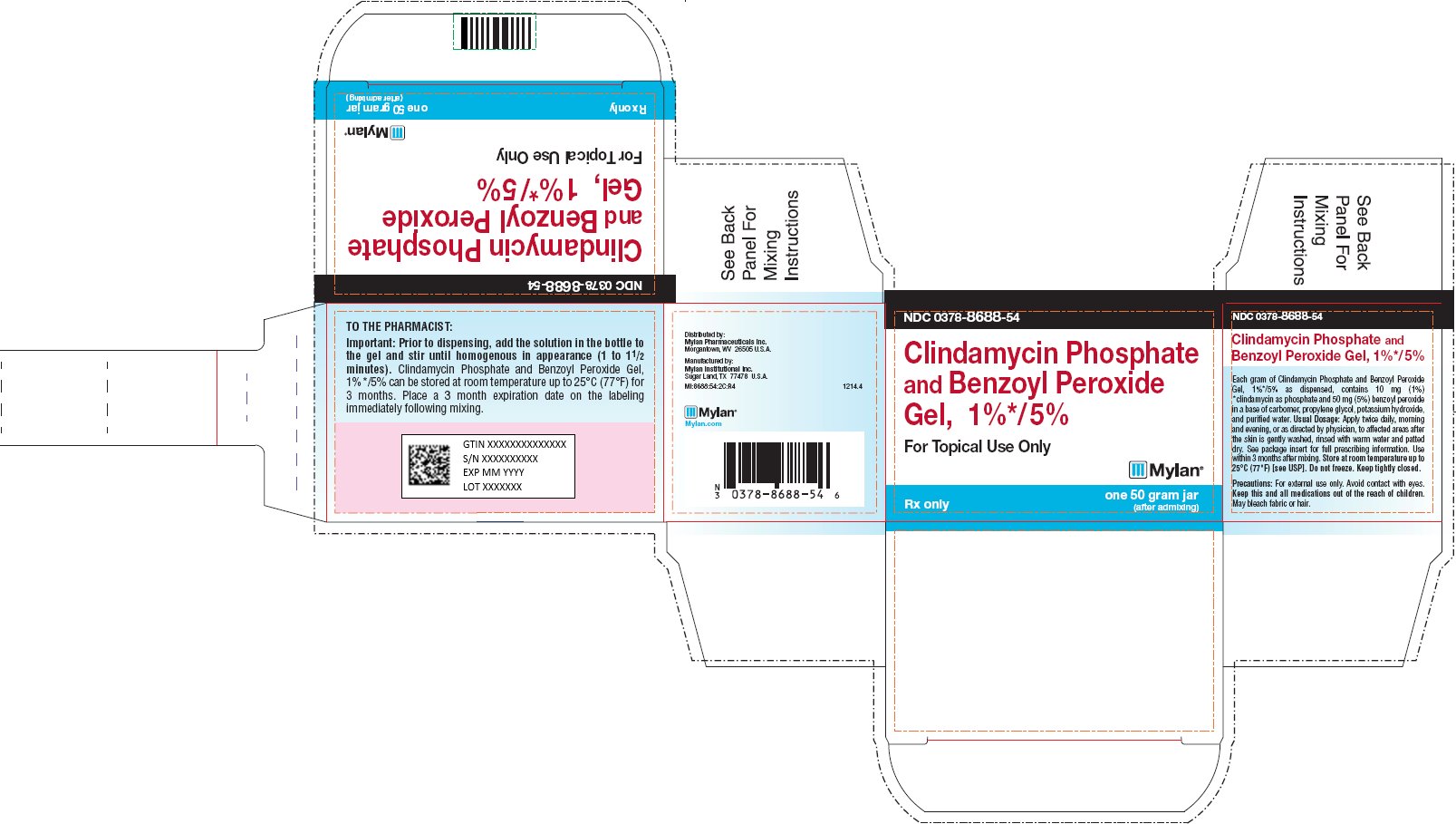
PRINCIPAL DISPLAY PANEL – 1%/5% NDC 0378-8688-54 Clindamycin Phosphate and Benzoyl Peroxide Gel, 1%*/5% For Topical Use Only Rx only one 50 gram jar (after admixing) TO THE PHARMACIST: Important: Prior to dispensing, add the solution in the bottle to the gel and stir until homogenous in appearance (1 to 11/2 minutes). Clindamycin Phosphate and Benzoyl Peroxide Gel, 1%*/5% can be stored at room temperature up to 25°C (77°F) for 3 months. Place a 3 month expiration date on the labeling immediately following mixing.
Each gram of Clindamycin Phosphate and Benzoyl Peroxide Gel, 1%*/5% as dispensed, contains 10 mg (1%) *clindamycin as phosphate and 50 mg (5%) benzoyl peroxide in a base of carbomer, propylene glycol, potassium hydroxide, and purified water. Usual Dosage: Apply twice daily, morning and evening, or as directed by physician, to affected areas after the skin is gently washed, rinsed with warm water and patted dry. See package insert for full prescribing information.
Use within 3 months after mixing. Store at room temperature up to 25°C (77°F) [see USP]. Do not freeze.
Keep tightly closed. Precautions: For external use only. Avoid contact with eyes.
Keep this and all medications out of the reach of children. May bleach fabric or hair. Manufactured for: Mylan Pharmaceuticals Inc.
Morgantown, WV 26505 U.S.A. Manufactured by: Kavis Pharma LLC Sugar Land, TX 77478 U.S.A. KP:8688:54:2C:R1 1214.5 101034 Mylan.com Clindamycin Phosphate and Benzoyl Peroxide Gel 1%/5% Carton Label
Medicaid utilization & spend
Medicaid utilization by pack size
Reported adverse events (FAERS)
Top reported reactions
Age at onset
Reporter sex
Serious outcomes
Where does this data come from?
About this NDC listing & data coverage
Kit / multi-component package
This NDC identifies a kit — a package containing more than one component. Structured data (pricing, ingredients, equivalents) is often reported per component rather than for the kit NDC itself, which can make this page look thinner than the components' own pages.
What data is (and isn’t) available for this NDC — tap to expand
| NDC identity (package / product / labeler codes) | ✓ Available |
| Labeler | ✓ Available |
| Product & package description | ✓ Available |
| Marketing category & status | ✓ Available |
| Active ingredient / dosage form / route | ✓ Available |
| FDA label (SPL via DailyMed) | ✓ Available |
| Package photos | ✓ Available |
| Inactive ingredients (structured) | — Not published for this NDC The labeler did not submit a structured excipient list, or no SPL is available. |
| NADAC pharmacy acquisition price (CMS) | ✓ Available |
| Orange Book / therapeutic-equivalence data | ✓ Available |
| HCPCS J-code billing crosswalk | — Not published for this NDC Most self-administered / retail products have no J-code — that is normal. |
| Medicaid utilization (CMS SDUD) | ✓ Available |