
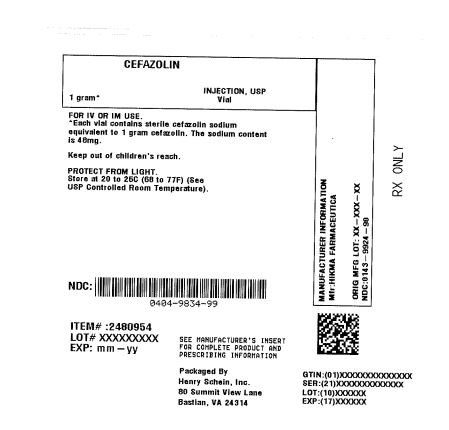
CEFAZOLIN 330 mg/mL Injection, Powder, For Solution — NDC 0404-9834-99 (Billing 00404-9834-99)
This is a package of CEFAZOLIN 330 mg/mL Injection, Powder, For Solution from Henry Schein, Inc., marketed since Jan 2022 and currently FDA-listed. It is this product's only package size.
NDC database record
One package, one record: these facts belong to NDC 0404-9834-99 alone.
- Record
- FDA NDC Directory package listing · Human prescription drug
- Code segments
- 0404 labeler · 9834 product · 99 package
- Package marketed since
- Jan 9, 2022
- Sample package
- No — commercial package
- Listing certified through
- Dec 31, 2026
- Barcode (UPC-A, from the NDC)
- 3 0404983499 3
- FDA record last changed
- Jul 24, 2026
Other active recalls for Cefazolin (different manufacturers) — 1 · tap to view
Identity & classification
Regulatory identifiers FDA, NLM and CMS codes for this package
- RxCUI (RxNorm): 1665050
Where does this data come from?
- FDA openFDA NDC Directory · synced Oct 8, 2026
- FDA label on DailyMed · label index refreshed Oct 6, 2026
- RxNorm (NLM RxNav) · catalog refreshed Oct 1, 2026
- Medi-Span GPI (licensed)
- First Databank (licensed) · refreshed Oct 8, 2026
RxNorm drug class
This medicine belongs to the Cephalosporin Antibacterial class.
Where does this data come from?
- RxClass (NLM) · catalog refreshed Oct 1, 2026
Clinical
- It is an antibiotic for bacterial infections such as urinary tract, skin, bone and joint, and respiratory infections. It also treats septicemia and endocarditis, and some products...
- You get it as an injection into a vein, and some products can go into a muscle. A healthcare professional gives it, often every several hours. Follow your prescriber’s plan.
- Nausea, vomiting, diarrhea, rash, headache, or soreness at the injection site are the most common. Let your care team know if they bother you.
- Get help right away for trouble breathing, swelling, hives, or severe skin reactions. Call your doctor for severe or watery diarrhea, a seizure, or unusual bleeding. Diarrhea can s...
Patient education
Supplement & herbal interactions
Some supplements/herbs that may interact with Cefazolin — tap one for details:
Cefazolin may be associated with lower levels of 7 nutrients — worth a chat with your pharmacist, not a cause for alarm.
Where does this data come from?
- MedlinePlus (NLM) · refreshed Oct 1, 2026
- FDA label on DailyMed · label index refreshed Oct 6, 2026
Ask a licensed pharmacist directly — free, answered by our team.
Pricing
A drug doesn't have one price. Each row is a different public payment system, and none is what you'd pay at the counter — that depends on your insurance. The ⓘ on each row explains what it measures.
| Price system | Per mL | Per package |
|---|---|---|
| Retail pharmacies payNADAC · weekly | Not in the retail survey — common for institutional, discontinued, or low-volume packs. | |
| Medicaid paysCMS SDUD · 12 mo | No recent Medicaid claims on file for this NDC — rare and low-volume NDCs are suppressed in the public data. | |
| Medicare drug plans payPart D · Q2 2026 | $1.50 | $4.49 / 3 ml |
| Medicare Part B allowsASP · J0690 | $0.796 / J0690 unit | — |
Where does this data come from?
- CMS NADAC weekly file
- CMS ASP pricing files · refreshed Sep 20, 2026
- CMS Medicaid State Drug Utilization Data · refreshed Oct 8, 2026
- CMS Part D plan pricing files · refreshed Sep 24, 2026
- VA National Acquisition Center price file
Billing & reimbursement
Where does this data come from?
- CMS ASP NDC-HCPCS crosswalk · refreshed Sep 22, 2026
- DMEPDAC NDC-HCPCS crosswalk
- openFDA NSDE billing units · refreshed Oct 7, 2026
Packaging — all sizes for this product
| Package NDC | Description | Marketing start | Marketing end | Status |
|---|---|---|---|---|
| 00404-9834-99 You're viewing this Main listing | 1 VIAL in 1 BAG / 3 mL in 1 VIAL | 2022-01-09 | — | Active |
Therapeutic equivalents
| Product | Labeler | Pack | NADAC/unit | TE | Status | Price vs. this |
|---|---|---|---|---|---|---|
| Cefazolin 330 mg/mL 00143-9262-25 | Hikma | 25 vials | $1.070 | AP | Availability likely | — |
| Cefazolin 330 mg/mL 00143-9924-90 | Hikma | 3 ml | $1.070 | AP | Availability likely | — |
| Cefazolin 1 g 00781-3451-96 | Sandoz | 25 vials | $1.070 | AP | Availability likely | — |
| Cefazolin 1 g 44567-0120-25 | WG | 25 vials | $1.070 | AP | Availability likely | — |
| Cefazolin 1 g 44567-0707-25 | WG | 25 vials | $1.070 | AP | Availability likely | — |
| Cefazolin 1 g 60505-6142-05 | Apotex | 25 vials | $1.070 | AP | Availability likely | — |
| Cefazolin 1 g 60505-6243-04 | Apotex | 25 vials | $1.070 | AP | Availability likely | — |
| Cefazolin 1 g/3mL 63323-0237-10 | Fresenius | 25 vials | $1.070 | AP | Availability likely | — |
| Cefazolin 1 g 72572-0055-25 | Civica, | 25 vials | $1.070 | AP | Availability likely | — |
| Cefazolin Sodium 1 g/50mL 00264-3103-11 | B. | 50 ml | — | — | Discontinued | — |
| Cefazolin 1 g/50mL 00338-3503-41 | Baxter | 50 ml | — | — | FDA listed | — |
| Cefazolin 1 g 00404-9833-99 | Henry | 1 vial | — | AP | FDA listed | — |
| Cefazolin 330 mg/mLthis 00404-9834-99 | Henry | 1 vial | — | AP | FDA listed | — |
| Cefazolin 1 g 00409-2585-01 | Hospira, | 25 vials | — | — | Discontinued | — |
| Cefazolin 330 mg/mL 50090-4256-00 | A-S | 25 vials | — | AP | FDA listed | — |
| Cefazolin 1 g 67184-1001-02 | Qilu | 25 vials | — | AP | FDA listed | — |
| Cefazolin 1 g 71205-0679-01 | Proficient | 1 vial | — | AP | FDA listed | — |
| Cefazolin 330 mg/mL 71872-7027-01 | Medical | 1 vial | — | AP | FDA listed | — |
| Cefazolin 1 g 71872-7141-01 | Medical | 1 vial | — | AP | FDA listed | — |
| Cefazolin Sodium 1 g 72189-0584-01 | Direct_rx | 1 injection | — | AP | FDA listed | — |
| Cefazolin 1 g 84549-0142-05 | ProPharma | 1 injection | — | AP | FDA listed | — |
Where does this data come from?
- FDA openFDA NDC Directory · synced Oct 8, 2026
- FDA Orange Book · refreshed Oct 3, 2026
- CMS NADAC weekly file
Availability & generic status
This product is an FDA-approved generic. Other versions of the same drug are listed under Therapeutic equivalents, least expensive first.
Where does this data come from?
- FDA Orange Book · refreshed Oct 3, 2026
Inactive Ingredients / Excipients
Inactive ingredients, also called excipients, are components of the drug product other than the active ingredient. They may include fillers, dyes, coatings, preservatives, flavors, or other formulation ingredients.
🧪 Avoiding an ingredient? See Cefazolin inactive ingredients by manufacturer: every current product's list side by side, so you can ask your pharmacy for the version that does not list it.
Where does this data come from?
IACT rows and label-wide narrative are kept separate; availability and product-level specificity depend on the submitted label.- FDA label on DailyMed · label index refreshed Oct 6, 2026
- FDA openFDA NDC Directory · synced Oct 8, 2026
Inactive ingredient FAQ
Are inactive ingredients the same for every manufacturer?
Why might an inactive ingredient be missing?
Can inactive ingredients matter?
Manufacturer & labeler
More NDCs from Henry Schein, Inc. labeler code 00404
- Bupivacaine Hydrochloride 2.5 mg/mL Injection, Solution NDC 0404-9826-50
- Bupivacaine Hydrochloride 5 mg/mL Injection, Solution NDC 0404-9827-50
- Bupivacaine Hydrochloride and Epinephrine 2.5 mg/mL; 5 ug/mL Injection, Solution NDC 0404-9828-30
- Calcium Chloride 100 mg/mL Injection, Solution NDC 0404-9830-10
- Calcium Gluconate 98 mg/mL Injection, Solution NDC 0404-9831-10
- Cefazolin 1 g Injection, Powder, For Solution NDC 0404-9833-99
- CEFAZOLIN 225 mg/mL Injection, Powder, For Solution NDC 0404-9835-99
- CHLORPROMAZINE HYDROCHLORIDE 25 mg/mL Injection NDC 0404-9836-01
- CLEOCIN PHOSPHATE clindamycin 150 mg/mL Injection, Solution NDC 0404-9837-02
- Clindamycin 150 mg/mL Injection, Solution NDC 0404-9838-02
- Cortrosyn .25 mg/mL Injection, Powder, Lyophilized, For Solution NDC 0404-9839-99
- Dexamethasone Sodium Phosphate 10 mg/mL Injection, Solution NDC 0404-9842-10
Where does this data come from?
- FDA openFDA NDC Directory · synced Oct 8, 2026
- Drugs@FDA
Full prescribing information FDA SPL
🎯 Indications and Usage ▾
Indications And Usage Cefazolin for Injection, USP is indicated in the treatment of the following serious infections due to susceptible organisms: Respiratory Tract Infections: Due to S. pneumoniae , Klebsiella species, H. influenzae, S. aureus (penicillin-sensitive and penicillin-resistant), and group A beta-hemolytic streptococci. Injectable benzathine penicillin is considered to be the drug of choice in treatment and prevention of streptococcal infections, including the prophylaxis of rheumatic fever. Cefazolin for Injection is effective in the eradication of streptococci from the nasopharynx; however, data establishing the efficacy of Cefazolin for Injection in the subsequent prevention of rheumatic fever are not available at present.
Urinary Tract Infections: Due to E. coli, P. mirabilis, Klebsiella species, and some strains of enterobacter and enterococci. Skin and Skin Structure Infections: Due to S. aureus (penicillin-sensitive and penicillin-resistant), group A beta-hemolytic streptococci, and other strains of streptococci. Biliary Tract Infections: Due to E. coli , various strains of streptococci, P. mirabilis, Klebsiella species, and S. aureus.
Bone and Joint Infections: Due to S. aureus. Genital Infections: (i.e., prostatitis, epididymitis) due to E. coli, P. mirabilis, Klebsiella species, and some strains of enterococci. Septicemia: Due to S. pneumoniae, S. aureus (penicillin-sensitive and penicillin-resistant), P. mirabilis, E. coli and Klebsiella species.
Endocarditis: Due to S. aureus (penicillin-sensitive and penicillin-resistant) and group A beta-hemolytic streptococci. Perioperative Prophylaxis: The prophylactic administration of Cefazolin for Injection preoperatively, intraoperatively and postoperatively may reduce the incidence of certain postoperative infections in patients undergoing surgical procedures which are classified as contaminated or potentially contaminated (e.g., vaginal hysterectomy, and cholecystectomy in high-risk patients such as those older than 70 years, with acute cholecystitis, obstructive jaundice, or common duct bile stones).
The perioperative use of Cefazolin for Injection may also be effective in surgical patients in whom infection at the operative site would present a serious risk (e.g., during open-heart surgery and prosthetic arthroplasty). The prophylactic administration of Cefazolin for Injection should usually be discontinued within a 24 hour period after the surgical procedure. In surgery where the occurrence of infection may be particularly devastating (e.g., open-heart surgery and prosthetic arthroplasty), the prophylactic administration of Cefazolin for Injection may be continued for 3 to 5 days following the completion of surgery.
If there are signs of infection, specimens for cultures should be obtained for the identification of the causative organism so that appropriate therapy may be instituted (see DOSAGE AND ADMINISTRATION ). To reduce the development of drug-resistant bacteria and maintain the effectiveness of Cefazolin for Injection, USP and other antibacterial drugs, Cefazolin for Injection, USP should be used only to treat or prevent infections that are proven or strongly suspected to be caused by susceptible bacteria. When culture and susceptibility information are available, they should be considered in selecting or modifying antibacterial therapy.
In the absence of such data, local epidemiology and susceptibility patterns may contribute to the empiric selection of therapy.
⏱️ Dosage and Administration ▾
Dosage and Administration Perioperative Prophylactic Use To prevent postoperative infection in contaminated or potentially contaminated surgery, recommended doses are: a. 1 gram IV or IM administered 1/2 hour to 1 hour prior to the start of surgery. b. For lengthy operative procedures (e.g., 2 hours or more), 500 mg to 1 gram IV or IM during surgery (administration modified depending on the duration of the operative procedure). c.
500 mg to 1 gram IV or IM every 6 to 8 hours for 24 hours postoperatively. It is important that (1) the preoperative dose be given just (1/2 to 1 hour) prior to the start of surgery so that adequate antibiotic levels are present in the serum and tissues at the time of initial surgical incision; and (2) Cefazolin for Injection be administered, if necessary, at appropriate intervals during surgery to provide sufficient levels of the antibiotic at the anticipated moments of greatest exposure to infective organisms. In surgery where the occurrence of infection may be particularly devastating (e.g., open-heart surgery and prosthetic arthroplasty), the prophylactic administration of Cefazolin for Injection may be continued for 3 to 5 days following the completion of surgery.
Dosage Adjustment for Patients with Reduced Renal Function Cefazolin for Injection may be used in patients with reduced renal function with the following dosage adjustments: Patients with a creatinine clearance of 55 mL/min. or greater or a serum creatinine of 1.5 mg % or less can be given full doses. Patients with creatinine clearance rates of 35 to 54 mL/min. or serum creatinine of 1.6 to 3 mg % can also be given full doses but dosage should be restricted to at least 8 hour intervals. Patients with creatinine clearance rates of 11 to 34 mL/min. or serum creatinine of 3.1 to 4.5 mg % should be given 1/2 the usual dose every 12 hours.
Patients with creatinine clearance rates of 10 mL/min. or less or serum creatinine of 4.6 mg % or greater should be given 1/2 the usual dose every 18 to 24 hours. All reduced dosage recommendations apply after an initial loading dose appropriate to the severity of the infection. Patients undergoing peritoneal dialysis: See CLINICAL PHARMACOLOGY .
Pediatric Dosage In pediatric patients, a total daily dosage of 25 to 50 mg per kg (approximately 10 to 20 mg per pound) of body weight, divided into 3 or 4 equal doses, is effective for most mild to moderately severe infections. Total daily dosage may be increased to 100 mg per kg (45 mg per pound) of body weight for severe infections. Since safety for use in premature infants and in neonates has not been established, the use of Cefazolin for Injection in these patients is not recommended.
In pediatric patients with mild to moderate renal impairment (creatinine clearance of 70 to 40 mL/min.), 60 percent of the normal daily dose given in equally divided doses every 12 hours should be sufficient. In patients with moderate impairment (creatinine clearance of 40 to 20 mL/min.), 25 percent of the normal daily dose given in equally divided doses every 12 hours should be adequate. Pediatric patients with severe renal impairment (creatinine clearance of 20 to 5 mL/min.) may be given 10 percent of the normal daily dose every 24 hours.
All dosage recommendations apply after an initial loading dose Image1.jpg Image2.jpg Image3.jpg
⛔ Contraindications ▾
Contraindications Cefazolin for Injection IS CONTRAINDICATED IN PATIENTS WITH KNOWN ALLERGY TO THE CEPHALOSPORIN GROUP OF ANTIBIOTICS.
⚠️ Warnings ▾
Warnings BEFORE THERAPY WITH CEFAZOLIN FOR INJECTION IS INSTITUTED, CAREFUL INQUIRY SHOULD BE MADE TO DETERMINE WHETHER THE PATIENT HAS HAD PREVIOUS HYPERSENSITIVITY REACTIONS TO CEFAZOLIN, CEPHALOSPORINS, PENICILLINS, OR OTHER DRUGS. IF THIS PRODUCT IS GIVEN TO PENICILLIN-SENSITIVE PATIENTS, CAUTION SHOULD BE EXERCISED BECAUSE CROSS-HYPERSENSITIVITY AMONG BETA-LACTAM ANTIBIOTICS HAS BEEN CLEARLY DOCUMENTED AND MAY OCCUR IN UP TO 10% OF PATIENTS WITH A HISTORY OF PENICILLIN ALLERGY. IF AN ALLERGIC REACTION TO CEFAZOLIN FOR INJECTION OCCURS, DISCONTINUE TREATMENT WITH THE DRUG.
SERIOUS ACUTE HYPERSENSITIVITY REACTIONS MAY REQUIRE TREATMENT WITH EPINEPHRINE AND OTHER EMERGENCY MEASURES, INCLUDING OXYGEN, IV FLUIDS, IV ANTIHISTAMINES, CORTICOSTEROIDS, PRESSOR AMINES, AND AIRWAY MANAGEMENT, AS CLINICALLY INDICATED. Pseudomembranous colitis has been reported with nearly all antibacterial agents, including cefazolin, and may range in severity from mild to life-threatening. Therefore, it is important to consider this diagnosis in patients who present with diarrhea subsequent to the administration of antibacterial agents.
Treatment with antibacterial agents alters the normal flora of the colon and may permit overgrowth of clostridia. Studies indicate that a toxin produced by Clostridium difficile is a primary cause of “antibiotic-associated colitis”. After the diagnosis of pseudomembranous colitis has been established, therapeutic measures should be initiated.
Mild cases of pseudomembranous colitis usually respond to drug discontinuation alone. In moderate to severe cases, consideration should be given to management with fluids and electrolytes, protein supplementation, and treatment with an oral antibacterial drug clinically effective against C. difficile colitis.
🧬 Clinical Pharmacology ▾
Clinical Pharmacology After intramuscular administration of Cefazolin for Injection to normal volunteers, the mean serum concentrations were 37 mcg/mL at 1 hour and 3 mcg/mL at 8 hours following a 500 mg dose, and 64 mcg/mL at 1 hour and 7 mcg/mL at 8 hours following a 1 gram dose. Studies have shown that following intravenous administration of Cefazolin for Injection to normal volunteers, mean serum concentrations peaked at approximately 185 mcg/mL and were approximately 4 mcg/mL at 8 hours for a 1 gram dose. The serum half-life for Cefazolin for Injection is approximately 1.8 hours following IV administration and approximately 2 hours following IM administration.
In a study (using normal volunteers) of constant intravenous infusion with dosages of 3.5 mg/kg for 1 hour (approximately 250 mg) and 1.5 mg/kg the next 2 hours (approximately 100 mg), Cefazolin for Injection produced a steady serum level at the third hour of approximately 28 mcg/mL. Studies in patients hospitalized with infections indicate that Cefazolin for Injection produces mean peak serum levels approximately equivalent to those seen in normal volunteers. Bile levels in patients without obstructive biliary disease can reach or exceed serum levels by up to five times; however, in patients with obstructive biliary disease, bile levels of Cefazolin for Injection are considerably lower than serum levels (< 1 mcg/mL).
In synovial fluid, the level of Cefazolin for Injection becomes comparable to that reached in serum at about 4 hours after drug administration. Studies of cord blood show prompt transfer of Cefazolin for Injection across the placenta. Cefazolin for Injection is present in very low concentrations in the milk of nursing mothers.
Cefazolin for Injection is excreted unchanged in the urine. In the first 6 hours approximately 60% of the drug is excreted in the urine and this increases to 70% to 80% within 24 hours. Cefazolin for Injection achieves peak urine concentrations of approximately 2,400 mcg/mL and 4,000 mcg/mL respectively following 500 mg and 1 gram intramuscular doses.
In patients undergoing peritoneal dialysis (2 L/hr.), Cefazolin for Injection produced mean serum levels of approximately 10 and 30 mcg/mL after 24 hours’ instillation of a dialyzing solution containing 50 mg/L and 150 mg/L, respectively. Mean peak levels were 29 mcg/mL (range 13 to 44 mcg/mL) with 50 mg/L (3 patients), and 72 mcg/mL (range 26 to 142 mcg/mL) with 150 mg/L (6 patients). Intraperitoneal administration of Cefazolin for Injection is usually well tolerated.
Controlled studies on adult normal volunteers, receiving 1 gram 4 times a day for 10 days, monitoring CBC, SGOT, SGPT, bilirubin, alkaline phosphatase, BUN, creatinine and urinalysis, indicated no clinically significant changes attributed to Cefazolin for Injection. Microbiology Mechanism of Action Cefazolin is a bactericidal agent that acts by inhibition of bacterial cell wall synthesis. Resistance Predominant mechanisms of bacterial resistance to cephalosporins include the presence of extended-spectrum beta-lactamases and enzymatic hydrolysis.
Antimicrobial Activity Cefazolin has been shown to be active against most isolates of the following microorganisms, both in vitro and in clinical infections as described in the INDICATIONS AND USAGE(1) section: Gram-Positive Bacteria: Staphylococcus aureus Staphylococcus epidermidis Streptococcus agalactiae Streptococcus pneumoniae Streptococcus pyogenes Methicillin-resistant staphylococci are uniformly resistant to cefazolin. Gram-Negative Bacteria: Escherichia coli Proteus mirabilis Most isolates of indole positive Proteus (Proteus vulgaris), Enterobacter spp., Morganella morganii, Providencia rettgeri, Serratia spp., and Pseudomonas spp. are resistant to cefazolin.
Susceptibility Test Methods For specific information regarding susceptibility test interpretive criteria and associated test methods and quality control standards recognized by FDA for this drug, please see: HTTP… [Excerpted — this section continues on DailyMed.]
📦 How Supplied / Storage and Handling ▾
How Supplied Cefazolin for Injection, USP is supplied in vials containing cefazolin sodium equivalent to 500 mg or 1 gram cefazolin. Also available as Pharmacy Bulk Package, as follows: As with other cephalosporins, Cefazolin for Injection, USP tends to darken depending on storage conditions; within the stated recommendations, however, product potency is not adversely affected. Before reconstitution protect from light and store at 20° to 25°C (68° to 77°F) [See USP Controlled Room Temperature].
Product repackaged by: Henry Schein, Inc., Bastian, VA 24314 From Original Manufacturer/Distributor's NDC and Unit of Sale To Henry Schein Repackaged Product NDC and Unit of Sale Total Strength/Total Volume (Concentration) per unit NDC 0143-9923-90 Carton of 25 vials NDC 0404-9835-99 1 10 mL vial in a bag (Vial bears NDC 0143-9923-90) 500 mg NDC 0143-9924-90 Carton of 25 vials NDC 0404-9834-99 1 10 mL vial in a bag (Vial bears NDC 0143-9924-90) 1 gram Image5.jpg Image6.jpg
📋 Description ▾
Description Cefazolin for Injection, USP is a semi-synthetic cephalosporin for parenteral administration. It is the sodium salt of 3-{[(5-methyl-1,3,4-thiadiazol-2-yl)thio]-methyl}-8-oxo-7-[2-(1H-tetrazol-1-yl) acetamido]-5-thia-1-azabicyclo [4.2.0]oct-2-ene-2-carboxylic acid. The molecular formula is C14H13N8NaO4S3 and molecular weight is 476.49.
Structural Formula: Each vial contains 48 mg of sodium/1 gram of cefazolin sodium. Cefazolin for Injection, USP is white to off-white crystalline powder, supplied in vials equivalent to 500 mg or 1 gram of cefazolin. Formula1.jpg
⚠️ Precautions ▾
Precautions General Prolonged use of Cefazolin for Injection may result in the overgrowth of nonsusceptible organisms. Careful clinical observation of the patient is essential. When Cefazolin for Injection is administered to patients with low urinary output because of impaired renal function, lower daily dosage is required (see DOSAGE AND ADMINISTRATION ).
As with other β-lactam antibiotics, seizures may occur if inappropriately high doses are administered to patients with impaired renal function (see DOSAGE AND ADMINISTRATION ). Cefazolin for Injection, as with all cephalosporins, should be prescribed with caution in individuals with a history of gastrointestinal disease, particularly colitis. Cephalosporins may be associated with a fall in prothrombin activity.
Those at risk include patients with renal or hepatic impairment or poor nutritional state, as well as patients receiving a protracted course of antimicrobial therapy, and patients previously stabilized on anticoagulant therapy. Prothrombin time should be monitored in patients at risk and exogenous vitamin K administered as indicated. Prescribing Cefazolin for Injection in the absence of a proven or strongly suspected bacterial infection or a prophylactic indication is unlikely to provide benefit to the patient and increases the risk of the development of drug-resistant bacteria.
Drug Interactions Probenecid may decrease renal tubular secretion of cephalosporins when used concurrently, resulting in increased and more prolonged cephalosporin blood levels. Drug/Laboratory Test Interactions A false positive reaction for glucose in the urine may occur with Benedict's solution, Fehling’s solution or with CLINITEST® tablets, but not with enzyme-based tests such as CLINISTIX®. Positive direct and indirect antiglobulin (Coombs) tests have occurred; these may also occur in neonates whose mothers received cephalosporins before delivery.
Information for Patients Patients should be counseled that antibacterial drugs including Cefazolin for Injection, should only be used to treat bacterial infections. They do not treat viral infections (e.g., the common cold). When Cefazolin for Injection is prescribed to treat a bacterial infection, patients should be told that although it is common to feel better early in the course of therapy, the medication should be taken exactly as directed.
Skipping doses or not completing the full course of therapy may: (1) decrease the effectiveness of the immediate treatment, and (2) increase the likelihood that bacteria will develop resistance and will not be treatable by Cefazolin for Injection or other antibacterial drugs in the future. Carcinogenesis/Mutagenesis Mutagenicity studies and long-term studies in animals to determine the carcinogenic potential of Cefazolin for Injection have not been performed. Pregnancy Teratogenic Effects Pregnancy Category B Reproduction studies have been performed in rats, mice and rabbits at doses up to 25 times the human dose and have revealed no evidence of impaired fertility or harm to the fetus due to Cefazolin for Injection.
There are, however, no adequate and well-controlled studies in pregnant women. Because animal reproduction studies are not always predictive of human response, this drug should be used during pregnancy only if clearly needed. Labor and Delivery When cefazolin has been administered prior to caesarean section, drug levels in cord blood have been approximately one quarter to one third of maternal drug levels.
The drug appears to have no adverse effect on the fetus. Nursing Mothers Cefazolin for Injection is present in very low concentrations in the milk of nursing mothers. Caution should be exercised when Cefazolin for Injection is administered to a nursing woman.
Pediatric Use Safety and effectiveness for use in premature infants and neonates have not been established. See DOSAGE AND ADMINISTRATION for recommended dosage in pediatric patients older than 1 month. Geriatric Use Of the 920 subjects… [Excerpted — this section continues on DailyMed.]
📄 Package Label / Principal Display Panel ▾
Sample Package Label Label1.jpg
About this NDC listing & data coverage
What data is (and isn’t) available for this NDC — tap to expand
| NDC identity (package / product / labeler codes) | ✓ Available |
| Labeler | ✓ Available |
| Product & package description | ✓ Available |
| Marketing category & status | ✓ Available |
| Active ingredient / dosage form / route | ✓ Available |
| FDA label (SPL via DailyMed) | ✓ Available |
| Package photos | ✓ Available |
| Inactive ingredients (structured) | — Not published for this NDC The labeler did not submit a structured excipient list, or no SPL is available. |
| NADAC pharmacy acquisition price (CMS) | — Not published for this NDC CMS publishes NADAC only for NDCs reported in its retail-pharmacy survey. |
| Orange Book / therapeutic-equivalence data | ✓ Available |
| HCPCS J-code billing crosswalk | ✓ Available |
| Medicaid utilization (CMS SDUD) | — Not published for this NDC CMS reports utilization only for NDCs with Medicaid claims above its privacy threshold. |