
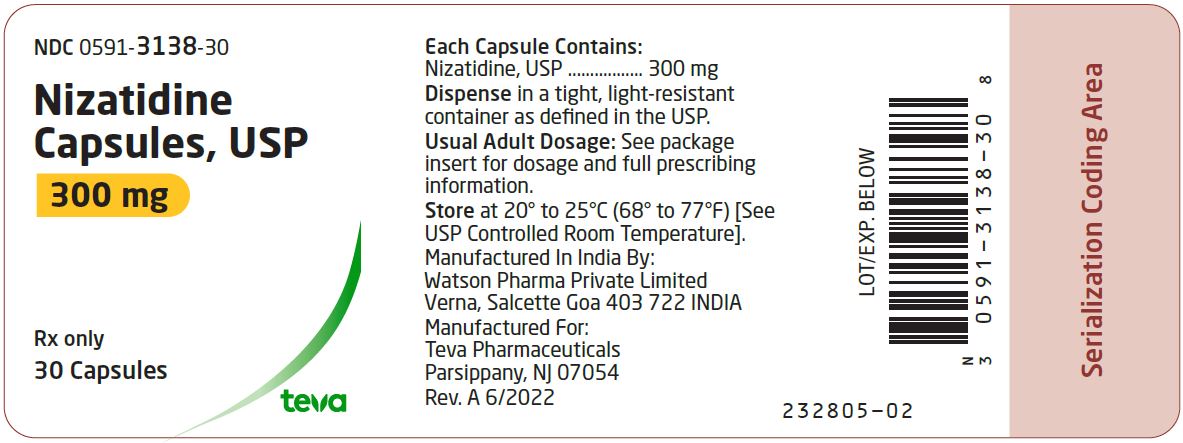
Nizatidine 300 mg Capsule, 30-count — NDC 0591-3138-30 (Billing 00591-3138-30)
This is a package of 30 capsules of Nizatidine 300 mg Capsule from Actavis Pharma, Inc., marketed since Jul 2002 and currently FDA-listed; retail pharmacies pay about $0.7988 per capsule (NADAC). It is the main listing for this product, which comes in 3 package sizes.
NDC database record
One package, one record: these facts belong to NDC 0591-3138-30 alone.
- Record
- FDA NDC Directory package listing · Human prescription drug
- Code segments
- 0591 labeler · 3138 product · 30 package
- Listing certified through
- Dec 31, 2026
- Billing quantity
- 30 EA per package
- Barcode (UPC-A, from the NDC)
- 3 0591313830 8
- Medicaid fills, this package
- 646 prescriptions in the last four reported quarters
- FDA record last changed
- Jul 24, 2026
Identity & classification
Regulatory identifiers FDA, NLM and CMS codes for this package
Drug-database identifiers Medi-Span GPI and First Databank GCN / HICL / AHFS classification
- GSN (GCN sequence number): 011680
- GCN: 47711
- GPI-14 (Medi-Span): 49200040000120
- HICL (First Databank): 004522
- AHFS class code: 04:92.00.00
- RxCUI (RxNorm): 198041
Where does this data come from?
- FDA openFDA NDC Directory · synced Oct 8, 2026
- FDA label on DailyMed · label index refreshed Oct 6, 2026
- RxNorm (NLM RxNav) · catalog refreshed Oct 1, 2026
- Medi-Span GPI (licensed)
- First Databank (licensed) · refreshed Oct 8, 2026
RxNorm drug class
This medicine belongs to the Histamine-2 Receptor Antagonist class.
Where does this data come from?
- RxClass (NLM) · catalog refreshed Oct 1, 2026
Clinical
Nizatidine is used to treat and prevent the recurrence of ulcers and to treat other conditions where the stomach makes too much acid. Nizatidine also is used to treat or prevent occasional heartburn, acid indigestion, or sour stomach. It decreases the amount of acid made in the stomach. Nizatidine is available with and without a prescription. This medication is sometimes prescribed for other uses; ask your doctor or pharmacist for more information.
Read the full MedlinePlus article ↗- Nizatidine is used to treat ulcers in the stomach and small intestine, and to manage acid reflux disease (GERD) — including when acid has caused actual damage or inflammation in th...
- Your stomach has special cells that release acid when a chemical called histamine tells them to. Nizatidine blocks the histamine 'switch' on those cells — called H2 receptors — so...
- You can take nizatidine with or without food — it doesn't make a big difference either way. One thing to avoid: if you're taking the capsule form, don't mix or dissolve it in apple...
- Can I take nizatidine with food, or does it have to be on an empty stomach?
Patient education
Supplement & herbal interactions
Some supplements/herbs that may interact with Nizatidine — tap one for details:
Nizatidine may be associated with lower levels of 6 nutrients — worth a chat with your pharmacist, not a cause for alarm.
Where does this data come from?
- MedlinePlus (NLM) · refreshed Oct 1, 2026
- FDA label on DailyMed · label index refreshed Oct 6, 2026
Ask a licensed pharmacist directly — free, answered by our team.
Pricing
A drug doesn't have one price. Each row is a different public payment system, and none is what you'd pay at the counter — that depends on your insurance. The ⓘ on each row explains what it measures.
| Price system | Per ea | Per package |
|---|---|---|
| Retail pharmacies payNADAC · weekly | $0.799 | $23.96 / 30 capsules |
| Medicaid paysCMS SDUD · 12 mo | $0.6146 | $18.44 / 30 capsules |
| Medicare drug plans payPart D · Q2 2026 | $2.14 | $64.35 / 30 capsules |
Where does this data come from?
- CMS NADAC weekly file · file of Oct 7, 2026
- CMS ASP pricing files · refreshed Sep 20, 2026
- CMS Medicaid State Drug Utilization Data · through Q1 2026
- CMS Part D plan pricing files · refreshed Sep 24, 2026
- VA National Acquisition Center price file
Packaging — all sizes for this product
| Package NDC | Description | Per unit | Per pack | Marketing start | Marketing end | Status |
|---|---|---|---|---|---|---|
| 00591-3138-30 You're viewing this Main listing | 30 CAPSULE in 1 BOTTLE, PLASTIC | $0.7988 / ea | $23.96 | 2002-07-09 | — | Active |
| 00591-3138-00 0591-3138-00 | 19000 CAPSULE in 1 BAG | — | — | — | — | Active |
| 00591-3138-77 0591-3138-77 | 9330 CAPSULE in 1 CONTAINER | — | — | — | — | Active |
You're viewing the smallest of 3 pack sizes for this product.
In Medicaid, this is the most-dispensed pack of this product — about 100% of fills over the last four reported quarters. See all packs ↓
Pack size FAQ
What quantity is in this package?
How does this package differ from NDC 00591-3138-77?
What NDC number is used to bill for this package of Nizatidine 300 mg Capsule?
Prices are the latest CMS NADAC pharmacy acquisition cost per NDC; per-pack figures are per-unit × pack quantity, shown only when the pack is denominated in the same measure NADAC prices.
Therapeutic equivalents
| Product | Labeler | Pack | NADAC/unit | TE | Status | Price vs. this |
|---|---|---|---|---|---|---|
| Nizatidine 300 mgthis 00591-3138-30 | Actavis | 30 capsules | $0.799 | AB | Availability likely | — |
| Nizatidine 300 mg 42806-0300-30 | Epic | 30 capsules | — | AB | FDA listed | — |
| Nizatidine 300 mg 55111-0311-01 | Dr | 100 capsules | — | AB | FDA listed | — |
Where does this data come from?
- FDA openFDA NDC Directory · synced Oct 8, 2026
- FDA Orange Book · refreshed Oct 3, 2026
- CMS NADAC weekly file · file of Oct 7, 2026
Availability & generic status
This product is an FDA-approved generic. Other versions of the same drug are listed under Therapeutic equivalents, least expensive first.
Where does this data come from?
- FDA Orange Book · refreshed Oct 3, 2026
What it looks like
Where does this data come from?
- FDA label on DailyMed · label index refreshed Oct 6, 2026
Inactive Ingredients / Excipients
Inactive ingredients, also called excipients, are components of the drug product other than the active ingredient. They may include fillers, dyes, coatings, preservatives, flavors, or other formulation ingredients.
🧪 Avoiding an ingredient? See Nizatidine inactive ingredients by manufacturer: every current product's list side by side, so you can ask your pharmacy for the version that does not list it.
💡 Tap an ingredient (hover on desktop) to see what it is and why it’s used.
-
UNII 5138Q19F1X
Ammonia is a colorless gas made from nitrogen and hydrogen. It's used in medicines as a pH buffer to maintain the correct acidity level and help keep the product stable.
-
UNII M28OL1HH48
Croscarmellose sodium is a plant-based substance derived from cellulose. It acts as a disintegrant, helping tablets and capsules break down quickly in the digestive system so the medicine can be absorbed.
-
UNII 1K09F3G675
Ferric oxide red is an inorganic iron compound used as a colorant in medicines. It gives tablets, capsules, or other dosage forms a red or reddish tint for identification and appearance.
-
UNII EX438O2MRT
Ferric oxide yellow is a naturally occurring iron compound used as a colorant in medications. It gives tablets, capsules, and other forms a yellow or golden hue for identification and appearance.
-
UNII XM0M87F357
A dark iron oxide compound that gives medicines their black or dark color. It's used as a colorant in tablets and capsules to help identify the product and make it visually distinctive.
-
UNII 2G86QN327L
Gelatin is a protein derived from animal collagen, commonly used in medicines as a gelling agent and capsule material. It helps create soft or hard capsule shells that hold and release medication, and can also thicken liquid formulations.
-
UNII 70097M6I30
Magnesium stearate is a salt made from magnesium and stearic acid, a fatty substance. It's used in tablets and capsules as a lubricant and glidant to help ingredients flow smoothly during manufacturing and prevent sticking.
-
UNII WZH3C48M4T
Potassium hydroxide is a strong alkaline chemical used in medicines to adjust and maintain the pH level of liquid formulations, helping keep the product stable and the active ingredients effective.
-
UNII 6DC9Q167V3
Propylene glycol is a clear liquid derived from petroleum or vegetable sources. It acts as a solvent, humectant, and preservative in medicines, helping dissolve active ingredients and maintain product stability.
-
UNII 46N107B71O
Shellac is a natural resin secreted by the lac beetle. It's used as a coating on tablets and capsules to control how quickly the medicine dissolves and to improve appearance and stability.
-
UNII ETJ7Z6XBU4
Silicon dioxide is a naturally occurring mineral used as a glidant and anti-caking agent. It helps powder ingredients flow smoothly and prevents clumping during manufacturing and storage.
-
UNII 368GB5141J
A detergent and foaming agent derived from coconut or palm oil. In medications, it helps break down and mix oil and water-based ingredients, aids in tablet disintegration, and improves how the drug dissolves and spreads in the mouth or digestive system.
-
UNII O8232NY3SJ
A plant-based carbohydrate derived from corn kernels. It acts as a filler to add bulk, a binder to hold ingredients together, and a disintegrant to help the tablet break apart in your stomach for absorption.
-
UNII 15FIX9V2JP
Titanium dioxide is a bright white mineral powder commonly used as a colorant and opacifying agent. It makes pills and tablets white or lighter in color and helps make coatings non-transparent.
14 inactive ingredients listed in the exact product block matched to this NDC.
Where does this data come from?
ingredient classCode="IACT" elements from the exact product block matched by this NDC. Label-section narrative from DailyMed / the openFDA label index is shown separately when available.- FDA label on DailyMed · label index refreshed Oct 6, 2026
- FDA openFDA NDC Directory · synced Oct 8, 2026
Inactive ingredient FAQ
Are inactive ingredients the same for every manufacturer?
Why might an inactive ingredient be missing?
Can inactive ingredients matter?
Manufacturer & labeler
More NDCs from Actavis Pharma, Inc. labeler code 00591
- Levalbuterol tartrate HFA inhalation 45 ug Aerosol, Metered NDC 0591-2927-54
- pimecrolimus 10 mg/g Cream NDC 0591-2944-30
- Docosanol 100 mg/g Cream NDC 0591-2981-00
- Fluocinolone Acetonide Topical .1 mg/mL Solution NDC 0591-2990-60
- PROGESTERONE 50 mg/mL Injection, Solution NDC 0591-3128-79
- Nizatidine 150 mg Capsule NDC 0591-3137-00
- Minocycline Hydrochloride 75 mg Capsule NDC 0591-3153-00
- Ursodiol 300 mg Capsule NDC 0591-3159-00
- Testosterone 10 mg/g Gel NDC 0591-3216-30
- Testosterone 10 mg/g Gel NDC 0591-3217-30
- Butalbital, Acetaminophen, Caffeine, and Codeine Phosphate 30 mg; 50 mg; 40 mg; 325 mg Capsule NDC 0591-3220-01
- Orphenadrine Citrate 30 mg/mL Injection NDC 0591-3222-47
Where does this data come from?
- FDA openFDA NDC Directory · synced Oct 8, 2026
- Drugs@FDA
Full prescribing information FDA SPL
🎯 Indications and Usage ▾
INDICATIONS AND USAGE Nizatidine is indicated for up to 8 weeks for the treatment of active duodenal ulcer. In most patients, the ulcer will heal within 4 weeks. Nizatidine is indicated for maintenance therapy for duodenal ulcer patients, at a reduced dosage of 150 mg h.s. after healing of an active duodenal ulcer.
The consequences of continuous therapy with nizatidine for longer than 1 year are not known. Nizatidine is indicated for up to 12 weeks for the treatment of endoscopically diagnosed esophagitis, including erosive and ulcerative esophagitis, and associated heartburn due to GERD. Nizatidine is indicated for up to 8 weeks for the treatment of active benign gastric ulcer.
Before initiating therapy, care should be taken to exclude the possibility of malignant gastric ulceration.
⏱️ Dosage and Administration ▾
DOSAGE AND ADMINISTRATION Active Duodenal Ulcer – The recommended oral dosage for adults is 300 mg once daily at bedtime. An alternative dosage regimen is 150 mg twice daily. Maintenance of Healed Duodenal Ulcer – The recommended oral dosage for adults is 150 mg once daily at bedtime.
Gastroesophageal Reflux Disease – The recommended oral dosage in adults for the treatment of erosions, ulcerations, and associated heartburn is 150 mg twice daily. Active Benign Gastric Ulcer – The recommended oral dosage is 300 mg given either as 150 mg twice daily or 300 mg once daily at bedtime. Prior to treatment, care should be taken to exclude the possibility of malignant gastric ulceration.
Dosage Adjustment for Patients With Moderate to Severe Renal Insufficiency – The dose for patients with renal dysfunction should be reduced as follows: Active Duodenal Ulcer, GERD and Benign Gastric Ulcer C cr Dose 20-50 mL/min 150 mg daily <20 mL/min 150 mg every other day Maintenance Therapy C cr Dose 20-50 mL/min 150 mg every other day <20 mL/min 150 mg every 3 days Some elderly patients may have creatinine clearances of less than 50 mL/min, and based on pharmacokinetic data in patients with renal impairment, the dose for such patients should be reduced accordingly.
The clinical effects of this dosage reduction in patients with renal failure have not been evaluated.
🤒 Adverse Reactions ▾
ADVERSE REACTIONS Worldwide, controlled clinical trials of nizatidine included over 6,000 patients given nizatidine in studies of varying durations. Placebo-controlled trials in the United States and Canada included over 2,600 patients given nizatidine and over 1,700 given placebo. Among the adverse events in these placebo-controlled trials, anemia (0.2% vs 0%) and urticaria (0.5% vs 0.1%) were significantly more common in the nizatidine group.
Incidence in Placebo-Controlled Clinical Trials in the United States and Canada – Table 5 lists adverse events that occurred at a frequency of 1% or more among nizatidine-treated patients who participated in placebo-controlled trials. The cited figures provide some basis for estimating the relative contribution of drug and nondrug factors to the side effect incidence rate in the population studied. Table 5.
Incidence of Treatment-Emergent Adverse Events in Placebo-Controlled Clinical Trials In The United States and Canada Percentage of Patients Reporting Event Body System/Adverse Event * Nizatidine (N=2,694) Placebo (N=1,729) Body as a Whole Headache 16.6
15.6Abdominal pain 7.5
12.5Pain 4.2
3.8Asthenia 3.1
2.9Back pain 2.4
2.6Chest pain 2.3
2.1Infection 1.7
1.1Fever 1.6
2.3Surgical procedure 1.4
1.5Injury, accident 1.2
0.9Digestive Diarrhea 7.2
6.9Nausea 5.4
7.4Flatulence 4.9
5.4Vomiting 3.6
5.6Dyspepsia 3.6
4.4Constipation 2.5
3.8Dry mouth 1.4
1.3Nausea and vomiting 1.2
1.9Anorexia 1.2
1.6Gastrointestinal disorder 1.1
1.2Tooth disorder 1.0
0.8Musculoskeletal Myalgia 1.7
1.5Nervous Dizziness 4.6
3.8Insomnia 2.7
3.4Abnormal dreams 1.9
1.9Somnolence 1.9
1.6Anxiety 1.6
1.4Nervousness 1.1
0.8Respiratory Rhinitis 9.8
9.6Pharyngitis 3.3
3.1Sinusitis 2.4
2.1Cough, increased 2.0
2.0Skin and Appendages Rash 1.9
2.1Pruritus 1.7
1.3Special Senses Amblyopia 1.0 0.9 * Events reported by at least 1% of nizatidine-treated patients are included. A variety of less common events were also reported; it was not possible to determine whether these were caused by nizatidine. Hepatic – Hepatocellular injury, evidenced by elevated liver enzyme tests (SGOT [AST], SGPT [ALT], or alkaline phosphatase), occurred in some patients and was possibly or probably related to nizatidine.
In some cases there was marked elevation of SGOT, SGPT enzymes (greater than 500 IU/L) and, in a single instance, SGPT was greater than 2,000 IU/L. The overall rate of occurrences of elevated liver enzymes and elevations to 3 times the upper limit of normal, however, did not significantly differ from the rate of liver enzyme abnormalities in placebo-treated patients. All abnormalities were reversible after discontinuation of nizatidine.
Since market introduction, hepatitis and jaundice have been reported. Rare cases of cholestatic or mixed hepatocellular and cholestatic injury with jaundice have been reported with reversal of the abnormalities after discontinuation of nizatidine. Cardiovascular – In clinical pharmacology studies, short episodes of asymptomatic ventricular tachycardia occurred in 2 individuals administered nizatidine and in 3 untreated subjects.
CNS – Rare cases of reversible mental confusion have been reported. Endocrine – Clinical pharmacology studies and controlled clinical trials showed no evidence of anti-androgenic activity due to nizatidine. Impotence and decreased libido were reported with similar frequency by patients who received nizatidine and by those given placebo.
Rare reports of gynecomastia occurred. Hematologic – Anemia was reported significantly more frequently in nizatidine- than in placebo-treated patients. Fatal thrombocytopenia was reported in a patient who was treated with nizatidine and another H 2 -receptor antagonist.
On previous occasions, this patient had experienced thrombocytopenia while taking other drugs. Rare cases of thrombocytopenic purpura have been reported. Integumental – Sweating and urticaria were reported significantly more frequently in nizatidine-… [Excerpted — this section continues on DailyMed.]
🆘 Overdosage ▾
OVERDOSAGE Overdoses of nizatidine have been reported rarely. The following is provided to serve as a guide should such an overdose be encountered. Signs and Symptoms – There is little clinical experience with overdosage of nizatidine in humans.
Test animals that received large doses of nizatidine have exhibited cholinergic-type effects, including lacrimation, salivation, emesis, miosis, and diarrhea. Single oral doses of 800 mg/kg in dogs and of 1,200 mg/kg in monkeys were not lethal. Intravenous median lethal doses in the rat and mouse were 301 mg/kg and 232 mg/kg respectively.
Treatment – To obtain up-to-date information about the treatment of overdose, a good resource is your certified Regional Poison Control Center. Telephone numbers of certified poison control centers are listed in the Physicians' Desk Reference (PDR). In managing overdosage, consider the possibility of multiple drug overdoses, interaction among drugs, and unusual drug kinetics in your patient.
If overdosage occurs, use of activated charcoal, emesis, or lavage should be considered along with clinical monitoring and supportive therapy. The ability of hemodialysis to remove nizatidine from the body has not been conclusively demonstrated; however, due to its large volume of distribution, nizatidine is not expected to be efficiently removed from the body by this method.
🧬 Clinical Pharmacology ▾
CLINICAL PHARMACOLOGY Nizatidine is a competitive, reversible inhibitor of histamine at the histamine H2-receptors, particularly those in the gastric parietal cells. Antisecretory Activity – 1. Effects on Acid Secretion : Nizatidine significantly inhibited nocturnal gastric acid secretion for up to 12 hours.
Nizatidine also significantly inhibited gastric acid secretion stimulated by food, caffeine, betazole, and pentagastrin (Table 1). Table 1. – Effect of Oral Nizatidine on Gastric Acid Secretion Time After Dose (h) % Inhibition of Gastric Acid Output by Dose (mg) 20 to 50 75 100 150 300 Nocturnal Up to 10 57 73 90 Betazole Up to 3 93 100 99 Pentagastrin Up to 6 25 64 67 Meal Up to 4 41 64 98 97 Caffeine Up to 3 73 85 96 2. Effects on Other Gastrointestinal Secretions – Pepsin : Oral administration of 75 to 300 mg of nizatidine did not affect pepsin activity in gastric secretions.
Total pepsin output was reduced in proportion to the reduced volume of gastric secretions. Intrinsic Factor : Oral administration of 75 to 300 mg of nizatidine increased betazole-stimulated secretion of intrinsic factor. Serum Gastrin : Nizatidine had no effect on basal serum gastrin.
No rebound of gastrin secretion was observed when food was ingested 12 hours after administration of nizatidine. 3. Other Pharmacologic Actions Hormones : Nizatidine was not shown to affect the serum concentrations of gonadotropins, prolactin, growth hormone, antidiuretic hormone, cortisol, triiodothyronine, thyroxin, testosterone, 5α-dihydrotestosterone, androstenedione, or estradiol.
Nizatidine had no demonstrable antiandrogenic action. 4. Pharmacokinetics – The absolute oral bioavailability of nizatidine exceeds 70%.
Peak plasma concentrations (700 to 1,800 mcg/L for a 150 mg dose and 1,400 to 3,600 mcg/L for a 300 mg dose) occur from 0.5 to 3 hours following the dose. A concentration of 1,000 mcg/L is equivalent to 3 mcmol/L; a dose of 300 mg is equivalent to 905 mcmoles. Plasma concentrations 12 hours after administration are less than 10 mcg/L.
The elimination half-life is 1 to 2 hours, plasma clearance is 40 to 60 L/h, and the volume of distribution is 0.8 to
1.5L/kg. Because of the short half-life and rapid clearance of nizatidine, accumulation of the drug would not be expected in individuals with normal renal function who take either 300 mg once daily at bedtime or 150 mg twice daily. Nizatidine exhibits dose proportionality over the recommended dose range.
The oral bioavailability of nizatidine is unaffected by concomitant ingestion of propantheline. Antacids consisting of aluminum and magnesium hydroxides with simethicone decrease the absorption of nizatidine by about 10%. With food, the AUC and C max increase by approximately 10%.
In humans, less than 7% of an oral dose is metabolized as N2-monodesmethylnizatidine, an H 2 -receptor antagonist, which is the principal metabolite excreted in the urine. Other likely metabolites are the N2-oxide (less than 5% of the dose) and the S-oxide (less than 6% of the dose). More than 90% of an oral dose of nizatidine is excreted in the urine within 12 hours.
About 60% of an oral dose is excreted as unchanged drug. Renal clearance is about 500 mL/min, which indicates excretion by active tubular secretion. Less than 6% of an administered dose is eliminated in the feces.
Moderate to severe renal impairment significantly prolongs the half-life and decreases the clearance of nizatidine. In individuals who are functionally anephric, the half-life is 3.5 to 11 hours, and the plasma clearance is 7 to 14 L/h. To avoid accumulation of the drug in individuals with clinically significant renal impairment, the amount and/or frequency of doses of nizatidine should be reduced in proportion to the severity of dysfunction (see DOSAGE AND ADMINISTRATION ).
Approximately 35% of nizatidine is bound to plasma protein, mainly to α 1 -acid glycoprotein. Warfarin, diazepam, acetaminophen, propantheline, phenobarbital, and propranolol did not… [Excerpted — this section continues on DailyMed.]
📦 How Supplied / Storage and Handling ▾
HOW SUPPLIED Nizatidine capsules, USP are available as follows: 150 mg - Size #2, two-piece hard-gelatin buff opaque capsules imprinted “ 3137 ” on cap and “ WPI ” on body. Capsules are supplied in bottles of 60 (NDC 0591-3137-60). 300 mg - Size #0, two-piece hard-gelatin light brown opaque capsules imprinted with “ 3138 ” on cap and “ WPI ” on body.
Capsules are supplied in bottles of 30 (NDC 0591-3138-30). Store at 20° to 25°C (68° to 77°F) [See USP Controlled Room Temperature]. Dispense in a tight, light-resistant container as defined in the USP.
Manufactured In India By: Watson Pharma Private Limited Verna, Salcette Goa 403 722 INDIA Manufactured For: Teva Pharmaceuticals Parsippany, NJ 07054 Rev. A 6/2022
📋 Description ▾
DESCRIPTION Nizatidine, USP is a histamine H 2 -receptor antagonist. Chemically, it is N -[2-[[[2-[(Dimethylamino)methyl]-4-thiazolyl]methyl]thio]ethyl]- N' -methyl-2-nitro-1,1-ethenediamine. The structural formula is represented below: It is an off-white to buff crystalline solid that is soluble in water.
Nizatidine, USP has a bitter taste and mild sulfur-like odor. Nizatidine capsules USP, for oral administration, contain 150 mg or 300 mg nizatidine, USP and the following inactive ingredients: colloidal silicon dioxide, corn starch, croscarmellose sodium, magnesium stearate and pregelatinized starch. The capsule shells contain: ammonium hydroxide, black iron oxide, gelatin, potassium hydroxide, propylene glycol, shellac, silicon dioxide, sodium lauryl sulfate and titanium dioxide.
The 150 mg capsule shell also contains D&C Yellow No. 10 and FD&C Yellow No. 6.
The 300 mg capsule shell also contains black iron oxide, red iron oxide and yellow iron oxide. Image
⚠️ Precautions ▾
PRECAUTIONS General – 1. Symptomatic response to nizatidine therapy does not preclude the presence of gastric malignancy. 2.
Because nizatidine is excreted primarily by the kidney, dosage should be reduced in patients with moderate to severe renal insufficiency (see DOSAGE AND ADMINISTRATION ). 3. Pharmacokinetic studies in patients with hepatorenal syndrome have not been done.
Part of the dose of nizatidine is metabolized in the liver. In patients with normal renal function and uncomplicated hepatic dysfunction, the disposition of nizatidine is similar to that in normal subjects. Laboratory Tests – False-positive tests for urobilinogen with Multistix ® may occur during therapy with nizatidine.
Drug Interactions – No interactions have been observed between nizatidine and theophylline, chlordiazepoxide, lorazepam, lidocaine, phenytoin, and warfarin. Nizatidine does not inhibit the cytochrome P-450-linked drug-metabolizing enzyme system; therefore, drug interactions mediated by inhibition of hepatic metabolism are not expected to occur. In patients given very high doses (3,900 mg) of aspirin daily, increases in serum salicylate levels were seen when nizatidine, 150 mg b.i.d., was administered concurrently.
Carcinogenesis, Mutagenesis, Impairment of Fertility – A 2-year oral carcinogenicity study in rats with doses as high as 500 mg/kg/day (about 80 times the recommended daily therapeutic dose) showed no evidence of a carcinogenic effect. There was a dose-related increase in the density of enterochromaffin-like (ECL) cells in the gastric oxyntic mucosa. In a 2-year study in mice, there was no evidence of a carcinogenic effect in male mice; although hyperplastic nodules of the liver were increased in the high-dose males as compared with placebo.
Female mice given the high dose of nizatidine (2,000 mg/kg/day, about 330 times the human dose) showed marginally statistically significant increases in hepatic carcinoma and hepatic nodular hyperplasia with no numerical increase seen in any of the other dose groups. The rate of hepatic carcinoma in the high-dose animals was within the historical control limits seen for the strain of mice used. The female mice were given a dose larger than the maximum tolerated dose, as indicated by excessive (30%) weight decrement as compared with concurrent controls and evidence of mild liver injury (transaminase elevations).
The occurrence of a marginal finding at high dose only in animals given an excessive and somewhat hepatotoxic dose, with no evidence of a carcinogenic effect in rats, male mice, and female mice (given up to 360 mg/kg/day, about 60 times the human dose), and a negative mutagenicity battery are not considered evidence of a carcinogenic potential for nizatidine. Nizatidine was not mutagenic in a battery of tests performed to evaluate its potential genetic toxicity, including bacterial mutation tests, unscheduled DNA synthesis, sister chromatid exchange, the mouse lymphoma assay, chromosome aberration tests, and a micronucleus test.
In a 2-generation, perinatal and postnatal fertility study in rats, doses of nizatidine up to 650 mg/kg/day produced no adverse effects on the reproductive performance of parental animals or their progeny. P regnancy-Teratogenic Effects – Oral reproduction studies in pregnant rats at doses up to 1500 mg/kg/day (9000 mg/m 2 /day, 40.5 times the recommended human dose based on body surface area) and in pregnant rabbits at doses up to 275 mg/kg/day (3245 mg/m 2 /day, 14.6 times the recommended human dose based on body surface area) have revealed no evidence of impaired fertility or harm to the fetus due to nizatidine.
There are, however, no adequate and well-controlled studies in pregnant women. Because animal reproduction studies are not always predictive of human response, this drug should be used during pregnancy only if clearly needed. Nursing Mothers – Studies conducted in lactating women have shown that 0.1% of the administered oral dose of nizatidine is… [Excerpted — this section continues on DailyMed.]
📄 Package Label / Principal Display Panel ▾
PRINCIPAL DISPLAY PANEL - 150 mg NDC 0591-3137-60 Nizatidine Capsules, USP 150 mg Rx only 60 Capsules 150 mg
PRINCIPAL DISPLAY PANEL - 300 mg NDC 0591-3138-30 Nizatidine Capsules, USP 300 mg Rx only 30 Capsules 300 mg