
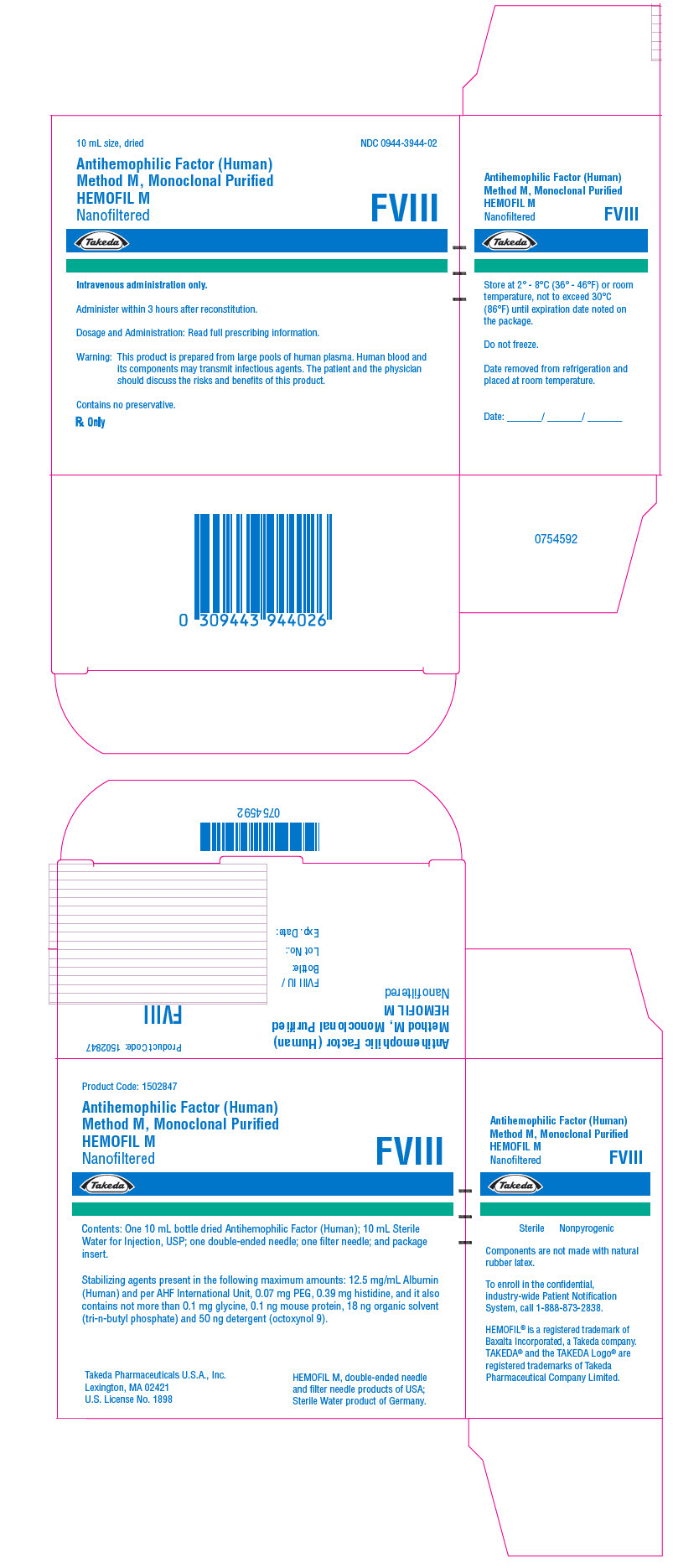
HEMOFIL M antihemophilic factor human Kit — NDC 0944-3944-02 (Billing 00944-3944-02)
This is a package of HEMOFIL M antihemophilic factor human Kit from Takeda Pharmaceuticals America, Inc., marketed since Feb 1988 and currently FDA-listed. It is this product's only package size.
NDC database record
One package, one record: these facts belong to NDC 0944-3944-02 alone.
- Record
- FDA NDC Directory package listing · Plasma derivative
- Code segments
- 0944 labeler · 3944 product · 02 package
- Package marketed since
- Feb 23, 1988
- Sample package
- No — commercial package
- Listing certified through
- Dec 31, 2026
- Barcode (UPC-A, from the NDC)
- 3 0944394402 6
- FDA record last changed
- Oct 8, 2026
Identity & classification
Regulatory identifiers FDA, NLM and CMS codes for this package
Drug-database identifiers Medi-Span GPI and First Databank GCN / HICL / AHFS classification
- GSN (GCN sequence number): 067605
- GCN: 30193
- GPI-14 (Medi-Span): 85100010002140
- HICL (First Databank): 011417
- AHFS class code: 20:28.16.00
Where does this data come from?
- FDA openFDA NDC Directory · synced Oct 8, 2026
- FDA label on DailyMed · label index refreshed Oct 8, 2026
- RxNorm (NLM RxNav) · catalog refreshed Oct 8, 2026
- Medi-Span GPI (licensed)
- First Databank (licensed) · refreshed Oct 8, 2026
Clinical
Patient education
Supplement & herbal interactions
Where does this data come from?
- MedlinePlus (NLM) · refreshed Oct 8, 2026
- FDA label on DailyMed · label index refreshed Oct 8, 2026
Ask a licensed pharmacist directly — free, answered by our team.
Pricing
A drug doesn't have one price. Each row is a different public payment system, and none is what you'd pay at the counter — that depends on your insurance. The ⓘ on each row explains what it measures.
| Price system | Per each | Per package |
|---|---|---|
| Retail pharmacies payNADAC · weekly | Not in the retail survey — common for institutional, discontinued, or low-volume packs. | |
| Medicaid paysCMS SDUD · 12 mo | No recent Medicaid claims on file for this NDC — rare and low-volume NDCs are suppressed in the public data. | |
| Medicare drug plans payPart D · quarterly | No Part D plan price is available for this NDC in our data. | |
| Medicare Part B allowsASP · J7190 | $1.246 / J7190 unit | — |
Where does this data come from?
- CMS NADAC weekly file
- CMS ASP pricing files · refreshed Sep 20, 2026
- CMS Medicaid State Drug Utilization Data · refreshed Oct 9, 2026
- CMS Part D plan pricing files · refreshed Sep 24, 2026
- VA National Acquisition Center price file
Billing & reimbursement
Where does this data come from?
- CMS ASP NDC-HCPCS crosswalk · refreshed Sep 22, 2026
- DMEPDAC NDC-HCPCS crosswalk
- openFDA NSDE billing units · refreshed Oct 7, 2026
Packaging — all sizes for this product
| Package NDC | Description | Marketing start | Marketing end | Status |
|---|---|---|---|---|
| 00944-3944-02 You're viewing this Main listing | 1 KIT in 1 CARTON * 10 mL in 1 BOTTLE * 10 mL in 1 VIAL, GLASS | 1988-02-23 | — | Active |
Therapeutic equivalents
| Product | Labeler | Pack | NADAC/unit | TE | Status | Price vs. this |
|---|---|---|---|---|---|---|
| Hemofil Mthis 00944-3944-02 | Takeda | 1 kit | — | — | FDA listed | — |
| Hemofil M 00944-3946-02 | Takeda | 1 kit | — | — | FDA listed | — |
| Hemofil M 00944-3940-02 | Takeda | 1 kit | — | — | FDA listed | — |
| Hemofil M 00944-3942-02 | Takeda | 1 kit | — | — | FDA listed | — |
Where does this data come from?
- FDA openFDA NDC Directory · synced Oct 8, 2026
- FDA Purple Book · refreshed Oct 5, 2026
- CMS NADAC weekly file
Availability & biosimilar status
Biologics have no small-molecule generics; biosimilar competition is tracked in the FDA Purple Book.
Where does this data come from?
- FDA Purple Book · refreshed Oct 5, 2026
Inactive Ingredients / Excipients
Inactive ingredients, also called excipients, are components of the drug product other than the active ingredient. They may include fillers, dyes, coatings, preservatives, flavors, or other formulation ingredients.
Where does this data come from?
IACT rows and label-wide narrative are kept separate; availability and product-level specificity depend on the submitted label.- FDA label on DailyMed · label index refreshed Oct 8, 2026
- FDA openFDA NDC Directory · synced Oct 8, 2026
Inactive ingredient FAQ
Are inactive ingredients the same for every manufacturer?
Why might an inactive ingredient be missing?
Can inactive ingredients matter?
Manufacturer & labeler
More NDCs from Takeda Pharmaceuticals America, Inc. labeler code 00944
- ADVATE Antihemophilic Factor (Recombinant) Kit NDC 0944-3051-02
- ADVATE Antihemophilic Factor (Recombinant) Kit NDC 0944-3052-02
- ADVATE Antihemophilic Factor (Recombinant) Kit NDC 0944-3053-02
- ADVATE Antihemophilic Factor (Recombinant) Kit NDC 0944-3054-02
- HEMOFIL M antihemophilic factor human Kit NDC 0944-3940-02
- HEMOFIL M antihemophilic factor human Kit NDC 0944-3942-02
- HEMOFIL M antihemophilic factor human Kit NDC 0944-3946-02
- CEPROTIN Protein C Concentrate Human Kit NDC 0944-4177-05
- CEPROTIN Protein C Concentrate Human Kit NDC 0944-4179-10
- ADYNOVATE Antihemophilic Factor (Recombinant) PEGylated Kit NDC 0944-4622-01
- ADYNOVATE Antihemophilic Factor (Recombinant) PEGylated Kit NDC 0944-4623-01
- ADYNOVATE Antihemophilic Factor (Recombinant) PEGylated Kit NDC 0944-4624-01
Where does this data come from?
- FDA openFDA NDC Directory · synced Oct 8, 2026
- Drugs@FDA
Full FDA label FDA SPL
🎯 Indications and Usage ▾
INDICATIONS AND USAGE The use of HEMOFIL M is indicated in hemophilia A (classical hemophilia) for the prevention and control of hemorrhagic episodes. HEMOFIL M is not indicated in von Willebrand's disease.
⏱️ Dosage and Administration ▾
DOSAGE AND ADMINISTRATION HEMOFIL M is to be administered only intravenously. The expected in vivo peak AHF level, expressed as IU/dL of plasma or % (percent) of normal, can be calculated by multiplying the dose administered per kg body weight (IU/kg) by two. This calculation is based on the clinical finding by Abildgaard, et al , 2 which is supported by data from the collaborative study of in vivo recovery and survival with 15 different lots of HEMOFIL M on 56 hemophiliacs that demonstrated a mean peak recovery point above the mean pre-infusion baseline of about
2.0IU/dL per infused IU/kg body weight. 3 Example: (1) A dose of 1750 IU AHF administered to a 70 kg patient, i.e., 25 IU/kg (1750/70), should be expected to cause a peak post-infusion AHF increase of 25 x 2 = 50 IU/dL (50% of normal). (2) A peak level of 70% is required in a 40 kg child.
In this situation the dose would be 70/2 x 40 = 1400 IU. Recommended Dosage Schedule Physician supervision of the dosage is required. The following dosage schedule may be used as a guide.
HEMORRHAGE Degree of hemorrhage Required peak post-infusion AHF activity in the blood (as % of normal or IU/dL plasma) Frequency of infusion Early hemarthrosis or muscle bleed or oral bleed 20-40 Begin infusion every 12 to 24 hours for one-three days until the bleeding episode as indicated by pain is resolved or healing is achieved. More extensive hemarthrosis, muscle bleed, or hematoma 30-60 Repeat infusion every 12 to 24 hours for usually three days or more until pain and disability are resolved. Life threatening bleeds such as head injury, throat bleed, severe abdominal pain 60-100 Repeat infusion every 8 to 24 hours until threat is resolved.
SURGERY Type of operation Minor surgery, including tooth extraction 60-80 A single infusion plus oral antifibrinolytic therapy within one hour is sufficient in approximately 70% of cases. Major surgery 80-100 (pre- and post-operative) Repeat infusion every 8 to 24 hours depending on state of healing. If bleeding is not controlled with the prescribed dose, the plasma level of Factor VIII should be determined and a sufficient dose of HEMOFIL M administered to achieve a satisfactory clinical response.
Under certain circumstances (e.g., presence of a low titer inhibitor) doses larger than those recommended may be necessary as per standard care. In patients with high titer Factor VIII inhibitors, HEMOFIL M therapy may not be effective and other therapeutic options should be considered. The dosage and duration of treatment depend on the severity of Factor VIII deficiency, the location and extent of the bleeding, and the patient’s clinical condition.
Careful control of replacement therapy is especially important in cases of major surgery or life threatening hemorrhages. Although dosage can be estimated by the calculations above, it is strongly recommended that whenever possible, appropriate laboratory tests including serial AHF assays be performed on the patient’s plasma at suitable intervals to assure that adequate AHF levels have been reached and are maintained. Reconstitution: Use Aseptic Technique Bring HEMOFIL M (dry concentrate) and Sterile Water for Injection, USP, (diluent) to room temperature.
Remove caps from concentrate and diluent bottles to expose central portion of rubber stoppers. Cleanse stoppers with germicidal solution. Remove protective covering from one end of double-ended needle and insert exposed needle through diluent stopper.
Remove protective covering from other end of double-ended needle. Invert diluent bottle over upright HEMOFIL M bottle, then rapidly insert free end of the needle through the HEMOFIL M bottle stopper at its center. The vacuum in the HEMOFIL M bottle will draw in the diluent.
Disconnect the two bottles by removing needle from diluent bottle stopper, then remove needle from HEMOFIL M bottle. Swirl gently until all material is dissolved. Be sure that HEMOFIL M is completely dissolved, otherwise active material will be remo… [Excerpted — this section continues on DailyMed.]
⛔ Contraindications ▾
CONTRAINDICATIONS HEMOFIL M is contraindicated in patients with a known hypersensitivity to the active substance, to excipients, or to mouse proteins.
⚠️ Warnings ▾
WARNINGS Hypersenitivity Allergic-type hypersensitivity reactions, including anaphylaxis, have been reported with HEMOFIL M and have been manifested by, for example, bronchospasm, dyspnea, hypotension, chest pain, facial edema, urticaria, rash, flushing, pruritus, nausea. Neutralizing Antibodies The development of neutralizing antibodies (inhibitors) to Factor VIII is a known complication of the treatment of patients with Hemophilia A. Inhibitors have predominantly been reported in previously untreated patients.
The risk of developing inhibitors is correlated to the extent of exposure to Factor VIII, the risk being highest within the first 20 exposure days, and to other genetic and environmental factors. The risk for inhibitor development depends on a number of factors relating to the characteristics of the patient (e.g., type of the Factor VIII gene mutation, family history, ethnicity), which are believed to represent the most significant risk factors for inhibitor formation. Transmission of Infectious Agents HEMOFIL M is made from human plasma.
Products made from human plasma may contain infectious agents, such as viruses, that can cause disease. The risk that such products will transmit an infectious agent has been reduced by screening plasma donors for prior exposure to certain viruses, by testing for the presence of certain current virus infections, and by inactivating and/or removing certain viruses. Appropriate vaccination (against hepatitis A and B) should be considered for patients in regular/repeated receipt of plasma-derived products including HEMOFIL M.
Despite these measures, such products can still potentially transmit disease. Because this product is made from human plasma, a risk of transmitting infectious agents, e.g., viruses and, theoretically, the Creutzfeldt-Jakob disease (CJD) agent, cannot be totally excluded. This also applies to unknown or emerging viruses and other pathogens.
ALL infections thought by a physician possibly to have been transmitted by this product should be reported by the physician or other healthcare provider to Baxter Healthcare Corporation at 1-800-423-2862 (in the U.S.). The physician should discuss the risks and benefits of this product with the patient. Individuals who receive infusions of blood or plasma products may develop signs and/or symptoms of some viral infections, particularly non A, non B hepatitis.
As indicated under CLINICAL PHARMACOLOGY , however, a group of such patients treated with HEMOFIL M did not demonstrate signs or symptoms of non A, non B hepatitis over observation periods ranging from three to nine months.
Hypersenitivity Allergic-type hypersensitivity reactions, including anaphylaxis, have been reported with HEMOFIL M and have been manifested by, for example, bronchospasm, dyspnea, hypotension, chest pain, facial edema, urticaria, rash, flushing, pruritus, nausea.
Neutralizing Antibodies The development of neutralizing antibodies (inhibitors) to Factor VIII is a known complication of the treatment of patients with Hemophilia A. Inhibitors have predominantly been reported in previously untreated patients. The risk of developing inhibitors is correlated to the extent of exposure to Factor VIII, the risk being highest within the first 20 exposure days, and to other genetic and environmental factors.
The risk for inhibitor development depends on a number of factors relating to the characteristics of the patient (e.g., type of the Factor VIII gene mutation, family history, ethnicity), which are believed to represent the most significant risk factors for inhibitor formation.
Transmission of Infectious Agents HEMOFIL M is made from human plasma. Products made from human plasma may contain infectious agents, such as viruses, that can cause disease. The risk that such products will transmit an infectious agent has been reduced by screening plasma donors for prior exposure to certain viruses, by testing for the presence of certain current virus infections, and by… [Excerpted — this section continues on DailyMed.]
🤒 Adverse Reactions ▾
ADVERSE REACTIONS Adverse Reactions from Clinical Trials The adverse reactions presented in this section have been identified based on clinical trial experience with HEMOFIL M in patients previously treated with other Factor VIII concentrates or blood products (N = 74), and previously untreated patients (PUPs; N = 50). Clinical Trial Adverse Reactions System Organ Class (SOC) Preferred MedDRA Term Number of Cases (Frequency Percentage) BLOOD AND LYMPHATIC SYSTEM DISORDERS Factor VIII inhibition 3 (5.7%) In a study that included 43 evaluable PUPs and 10 minimally treated patients (MTPs), i.e., patients with a single exposure to other Factor VIII concentrates or blood products, 3 of the total of 53 patients (5.7%) developed an inhibitor while on study.
NERVOUS SYSTEM DISORDERS Dizziness 1 (0.8%) Headache 1 (0.8%) Dysgeusia 1 (0.8%) GENERAL DISORDERS AND ADMINISTRATION SITE CONDITIONS Pyrexia 1 (0.8%) Infusion site inflammation 2 (1.6%) HEMOFIL M was administered to 11 patients previously untreated with Antihemophilic Factor (Human). They have shown no signs of hepatitis or HIV infection following three to nine months of evaluation. A study of 25 patients treated with HEMOFIL M, and monitored for three to six months has demonstrated no evidence of antibody response to mouse protein.
More than 1,000 infusions of HEMOFIL M have been administered during the clinical trials. Reported events included a single episode each of chest tightness, fuzziness and dizziness, and one patient reported an unusual taste after each infusion. Post-marketing Adverse Reactions In addition to clinical trials, the following adverse reactions have been reported in the post-marketing experience, listed by MedDRA System Organ Class (SOC), then by Preferred Term.
IMMUNE SYSTEM DISORDERS: Anaphylaxis, Hypersensitivity reactions EYE DISORDERS: Visual impairment, Ocular hyperemia CARDIAC DISORDERS: Cyanosis, Bradycardia, Tachycardia VASCULAR DISORDERS: Hypotension, Flushing RESPIRATORY, THORACIC, AND MEDIASTINAL DISORDERS: Bronchospasm, Dyspnea, Cough, Hyperventilation GASTROINTESTINAL DISORDERS: Diarrhea, Vomiting, Nausea, Abdominal pain SKIN AND SUBCUTANEOUS TISSUE DISORDERS: Urticaria, Rash, Pruritus, Hyperhidrosis GENERAL DISORDERS AND ADMINISTRATION SITE CONDITIONS: Facial edema, Edema, Chills, Fatigue, Chest pain, Musculoskeletal pain, Irritability
Adverse Reactions from Clinical Trials The adverse reactions presented in this section have been identified based on clinical trial experience with HEMOFIL M in patients previously treated with other Factor VIII concentrates or blood products (N = 74), and previously untreated patients (PUPs; N = 50). Clinical Trial Adverse Reactions System Organ Class (SOC) Preferred MedDRA Term Number of Cases (Frequency Percentage) BLOOD AND LYMPHATIC SYSTEM DISORDERS Factor VIII inhibition 3 (5.7%) In a study that included 43 evaluable PUPs and 10 minimally treated patients (MTPs), i.e., patients with a single exposure to other Factor VIII concentrates or blood products, 3 of the total of 53 patients (5.7%) developed an inhibitor while on study.
NERVOUS SYSTEM DISORDERS Dizziness 1 (0.8%) Headache 1 (0.8%) Dysgeusia 1 (0.8%) GENERAL DISORDERS AND ADMINISTRATION SITE CONDITIONS Pyrexia 1 (0.8%) Infusion site inflammation 2 (1.6%) HEMOFIL M was administered to 11 patients previously untreated with Antihemophilic Factor (Human). They have shown no signs of hepatitis or HIV infection following three to nine months of evaluation. A study of 25 patients treated with HEMOFIL M, and monitored for three to six months has demonstrated no evidence of antibody response to mouse protein.
More than 1,000 infusions of HEMOFIL M have been administered during the clinical trials. Reported events included a single episode each of chest tightness, fuzziness and dizziness, and one patient reported an unusual taste after each infusion.
Post-marketing Adverse Reactions In addition to clinical trials, the following adverse reactions have been… [Excerpted — this section continues on DailyMed.]
🤰 Pregnancy ▾
Pregnancy Pregnancy Category C. Animal reproduction studies have not been conducted with HEMOFIL M. The safety of HEMOFIL M for use in pregnant women has not been established. It is not known whether HEMOFIL M can cause fetal harm when administered to a pregnant woman or can affect reproduction capacity. HEMOFIL M should be given to a pregnant woman only if clearly needed.
🧬 Clinical Pharmacology ▾
CLINICAL PHARMACOLOGY Antihemophilic factor (AHF) is a protein found in normal plasma which is necessary for clot formation. The administration of HEMOFIL M provides an increase in plasma levels of AHF and can temporarily correct the coagulation defect of patients with hemophilia A (classical hemophilia). The half-life of HEMOFIL M administered to Factor VIII deficient patients has been shown to be 14.8 ± 3.0 hours.
📦 How Supplied / Storage and Handling ▾
HOW SUPPLIED HEMOFIL M is available as single dose bottles that contain the following nominal potencies: Nominal Potency NDC Number 250 IU 0944-2930-01 500 IU 0944-2931-01 1000 IU 0944-2932-01 1700 IU 0944-2933-01 Each bottle is labeled with the potency in International Units, and is packaged together with 10 mL of Sterile Water for Injection, USP, a double-ended needle, and a filter needle.
📦 Storage and Handling ▾
STORAGE HEMOFIL M can be stored at 2° - 8°C (36° - 46°F) or at room temperature, not to exceed 30°C (86°F), until expiration date noted on the package. Avoid freezing to prevent damage to the diluent bottle.
📋 Description ▾
DESCRIPTION HEMOFIL M, Antihemophilic Factor (Human) (AHF), Method M, Monoclonal Purified, is a sterile, nonpyrogenic, dried preparation of antihemophilic factor (Factor VIII, Factor VIII:C, AHF) in concentrated form with a specific activity range of 2 to 22 AHF International Units/mg of total protein. HEMOFIL M contains a maximum of 12.5 mg/mL Albumin, and per AHF International Unit, 0.07 mg polyethylene glycol (3350), 0.39 mg histidine as stabilizing agents, not more than 0.1 mg glycine, 0.1 ng mouse protein, 18 ng organic solvent (tri-n-butyl phosphate) and 50 ng detergent (octoxynol 9).
In the absence of the added Albumin (Human), the specific activity is approximately 2,000 AHF International Units/mg of protein. See CLINICAL PHARMACOLOGY . HEMOFIL M is prepared by the Method M process from pooled human plasma by immunoaffinity chromatography utilizing a murine monoclonal antibody to Factor VIII:C, followed by an ion exchange chromatography step for further purification.
Source material may be provided by other US licensed manufacturers. HEMOFIL M also includes an organic solvent (tri-n-butyl phosphate) and detergent (octoxynol 9) virus inactivation step designed to reduce the risk of transmission of hepatitis and other viral diseases. However, no procedure has been shown to be totally effective in removing viral infectivity from coagulation factor products.
Use of an organic solvent (tri-n-butyl phosphate; TNBP) in the manufacture of Antihemophilic Factor (Human) has little or no effect on AHF activity, while lipid enveloped viruses, such as hepatitis B and human immunodeficiency virus (HIV) are inactivated. 1 Each bottle of HEMOFIL M is labeled with the AHF activity expressed in International Units (IU) per bottle. This potency assignment is referenced to the World Health Organization International Standard.
The purity of HEMOFIL M has been thought to influence the difficulty of producing an accurate potency measurement. Experiments have shown that to achieve accurate activity levels, such a potency assay should be conducted using plastic test tubes and pipets as well as substrate containing normal levels of von Willebrand's Factor. In vitro studies demonstrate that the HEMOFIL M manufacturing process provides for significant viral reduction.
These studies, summarized in Table 1 , demonstrate virus clearance during the HEMOFIL M manufacturing process using human immunodeficiency virus, Type 1 (HIV-1); bovine viral diarrhea virus (BVDV), a generic model for lipid enveloped RNA viruses, such as hepatitis C virus (HCV); pseudorabies virus (PRV), a model for lipid enveloped DNA viruses, such as hepatitis B virus (HBV); canine parvovirus (CPV), a model for non-lipid enveloped DNA viruses, such as human parvovirus B19 (B19V); and hepatitis A virus (HAV). These reductions are achieved through a combination of process chemistry, partitioning and/or inactivation during solvent/detergent treatment and immunoaffinity chromatography.
Table 1 In Vitro Virus Clearance During the Manufacture of HEMOFIL M Process Step Evaluated Virus Clearance, log 10 Lipid-enveloped Non-Lipid enveloped HIV-1 BVDV PRV CPV HAV Solvent/Detergent Treatment >4.8 >6.8 >6.9 Solvent/Detergent treatment inactivates only lipid enveloped viruses. CPV and HAV are non-lipid enveloped viruses. Immunoaffinity Chromatography N.A.
Not Applicable for lipid enveloped viruses due to the presence of solvent/detergent in the starting material. N.A. N.A. ≥3.9 ≥4.5 Cumulative Total, log 10 >4.8 >6.8 >6.9 ≥3.9 ≥4.5
💬 Information for Patients ▾
Information for Patients Advise patients to report any adverse reactions or problems following HEMOFIL M administration to their physician or healthcare provider. Advise pregnant women or immune compromised individuals of the affects of Parvovirus B19 . Symptoms of parvovirus B19 infection include fever, drowsiness, chills, and runny nose followed about two weeks later by a rash, and joint pain.
Inform patients of the signs and symptoms of hepatitis A which include several days to weeks of poor appetite, tiredness, and low-grade fever followed by nausea, vomiting, and pain in the belly. Dark urine and a yellowed complexion are also common symptoms. Patients should be encouraged to consult their physician if such symptoms appear.
Inform patients of the early signs of hypersensitivity reactions including hives, generalized urticaria, facial edema, flushing, nausea, tightness of the chest, wheezing, dyspnea, hypotension, and anaphylaxis . Advise patients to discontinue use of the product and contact their physician if these symptoms occur.
⚠️ Precautions ▾
PRECAUTIONS Identification of the clotting defect as a Factor VIII deficiency is essential before the administration of HEMOFIL M is initiated. Factor VIII Inhibitors Patients should be evaluated for the development of Factor VIII inhibitors if the expected plasma Factor VIII activity levels are not attained, or if bleeding is not controlled with an appropriate dose. No benefit may be expected from this product in treating other deficiencies.
Formation of Antibodies to Mouse Protein HEMOFIL M contains trace amounts of mouse protein (less than 0.1 ng/AHF activity units). The possibility exists that patients treated with HEMOFIL M may develop hypersensitivity to the mouse proteins . There have been no cases of hypersensitivity to the mouse proteins reported.
Increase in Pulse Rate The pulse rate should be determined before and during administration of HEMOFIL M. Should a significant increase occur, reducing the rate of administration or temporarily halting the injection usually allows the symptoms to disappear promptly. Latex Sensitivity Certain components used in the packaging of this product contain natural rubber latex which may cause allergic reactions.
Use precaution when treating patients with sensitivity to natural rubber latex. Information for Patients Advise patients to report any adverse reactions or problems following HEMOFIL M administration to their physician or healthcare provider. Advise pregnant women or immune compromised individuals of the affects of Parvovirus B19 .
Symptoms of parvovirus B19 infection include fever, drowsiness, chills, and runny nose followed about two weeks later by a rash, and joint pain. Inform patients of the signs and symptoms of hepatitis A which include several days to weeks of poor appetite, tiredness, and low-grade fever followed by nausea, vomiting, and pain in the belly. Dark urine and a yellowed complexion are also common symptoms.
Patients should be encouraged to consult their physician if such symptoms appear. Inform patients of the early signs of hypersensitivity reactions including hives, generalized urticaria, facial edema, flushing, nausea, tightness of the chest, wheezing, dyspnea, hypotension, and anaphylaxis . Advise patients to discontinue use of the product and contact their physician if these symptoms occur.
Laboratory Tests Although dosage can be estimated by the calculations which follow, it is strongly recommended that whenever possible, appropriate laboratory tests be performed on the patient's plasma at suitable intervals to assure that adequate AHF levels have been reached and are maintained. If the AHF content of the patient's plasma fails to reach expected levels or if bleeding is not controlled after apparently adequate dosage, the presence of inhibitor should be suspected. By appropriate laboratory procedures, the presence of inhibitor can be demonstrated and quantified in terms of AHF units neutralized by each mL of plasma or by the total estimated plasma volume.
If the inhibitor is at low levels (i.e., <10 Bethesda Units/mL), after administration of sufficient AHF units to neutralize the inhibitor, additional AHF units will elicit the predicted response. Pregnancy Pregnancy Category C. Animal reproduction studies have not been conducted with HEMOFIL M.
The safety of HEMOFIL M for use in pregnant women has not been established. It is not known whether HEMOFIL M can cause fetal harm when administered to a pregnant woman or can affect reproduction capacity. HEMOFIL M should be given to a pregnant woman only if clearly needed.
Nursing Mothers The safety of HEMOFIL M for use in nursing mothers has not been established. It is not known whether this drug is excreted into human milk. Physicians should carefully consider the potential risks and benefits for each specific patient before prescribing HEMOFIL M.
HEMOFIL M should be given to nursing mothers only if clinically indicated.
Factor VIII Inhibitors Patients should be evaluated for the development of Factor VI… [Excerpted — this section continues on DailyMed.]
🍼 Nursing Mothers ▾
Nursing Mothers The safety of HEMOFIL M for use in nursing mothers has not been established. It is not known whether this drug is excreted into human milk. Physicians should carefully consider the potential risks and benefits for each specific patient before prescribing HEMOFIL M. HEMOFIL M should be given to nursing mothers only if clinically indicated.
📚 References ▾
REFERENCES Horowitz B, Wiebe ME, Lippin A, et al: Inactivation of viruses in labile blood derivatives: 1. Disruption of lipid enveloped viruses by tri(n-butyl)phosphate detergent combinations. Transfusion 25 :516-522, 1985 Abildgaard CF, Simone JV, Corrigan JJ, et al: Treatment of hemophilia with glycine-precipitated Factor VIII.
New Eng J Med 275 :471-475, 1966 Addiego, Jr. JE, Gomperts E, Liu S. et al: Treatment of hemophilia A with a highly purified Factor VIII concentrate prepared by Anti-FVIIIc immunoaffinity chromatography. Thrombosis and Haemostasis 67 :19-27, 1992 To enroll in the confidential, industry-wide Patient Notification System, call 1-888-UPDATE U (1-888-873-2838) Baxter and Hemofil are trademarks of Baxter International Inc. and are registered in the U.S.
Patent and Trademark office. Baxter Healthcare Corporation Westlake Village, CA 91362 USA U.S. License No.
140 Printed in USA Revised Nov 10, 2010
📄 Package Label / Principal Display Panel ▾
Principle Display Panel HEMOFIL M 1000 unit carton 10 mL size, dried NDC 0944-2932-01 Antihemophilic Factor (Human) Method M, Monoclonal Purified HEMOFIL M FVIII For intravenous administration only. Administer within three hours after reconstitution is complete. See package insert for more information.
Store at 2°-8°C (38°-46°F) or room temperature, not to exceed 30°C (86°F) until the expiration date noted on the package. Avoid freezing to prevent damage to the diluent bottle. Sterile Nonpyrogenic No preservatives Warning : This product is prepared from large pools of human plasma.
Human blood and its components may transit infectious agents. The patient and the physician should discuss the risks and benefits of this product. Rx Only Read both front and back panels Baxter Healthcare Corporation Westlake Village , CA 91362 USA U.S.
License No. 140 Baxter and Hemofil are trademarks of Baxter International, Inc., and are registered in the U.S Patent and Trademark office. HEMOFIL M 1000 vial label 10 mL size, dried List 1501807 NDC 0944-2932-02 Antihemophilic Factor (Human) Method M, Monoclonal Purified HEMOFIL M FVII Store at 2°-8°C (38°-46°F) or room temperature, not to exceed 30°C (86°F) until the expiration date noted on the package.
See package insert for more information. Contains no preservative. For intravenous administration only.
Warning : This product is prepared from large pools of human plasma. Human blood and its components may transit infectious agents. The patient and the physician should discuss the risks and benefits of this product.
Rx Only Baxter Healthcare Corporation Westlake Village, CA 91362 USA U.S. License No. 140 Sterile Water vial label NDC 0338-0764-61 Nonpyrogenic Single-Dose Container 10 mL Sterile Water for Injection, USP for reconstitution of accompanying product Do not use unless clear.
No antimicrobial agent or other substance has been added. Do not use for intravascular injection without making approximately isotonic by injection of suitable solute. Discard unused portion.
Rx Only. This Product Contains Dry Natural Rubber. Baxter Manufactured by Baxter Healthcare Corporation Deerfield, IL 60015 USA HEMOFIL M 1000 unit carton HEMOFIL M 1000 vial label Sterile Water vial label
About this NDC listing & data coverage
Kit / multi-component package
This NDC identifies a kit — a package containing more than one component. Structured data (pricing, ingredients, equivalents) is often reported per component rather than for the kit NDC itself, which can make this page look thinner than the components' own pages.
What data is (and isn’t) available for this NDC — tap to expand
| NDC identity (package / product / labeler codes) | ✓ Available |
| Labeler | ✓ Available |
| Product & package description | ✓ Available |
| Marketing category & status | ✓ Available |
| Active ingredient / dosage form / route | ✓ Available |
| FDA label (SPL via DailyMed) | ✓ Available |
| Package photos | ✓ Available |
| Inactive ingredients (structured) | — Not published for this NDC The labeler did not submit a structured excipient list, or no SPL is available. |
| NADAC pharmacy acquisition price (CMS) | — Not published for this NDC CMS publishes NADAC only for NDCs reported in its retail-pharmacy survey. |
| Orange Book / therapeutic-equivalence data | — Not published for this NDC Applies only to products approved under an NDA/ANDA; many listings are out of scope. |
| HCPCS J-code billing crosswalk | ✓ Available |
| Medicaid utilization (CMS SDUD) | — Not published for this NDC CMS reports utilization only for NDCs with Medicaid claims above its privacy threshold. |