
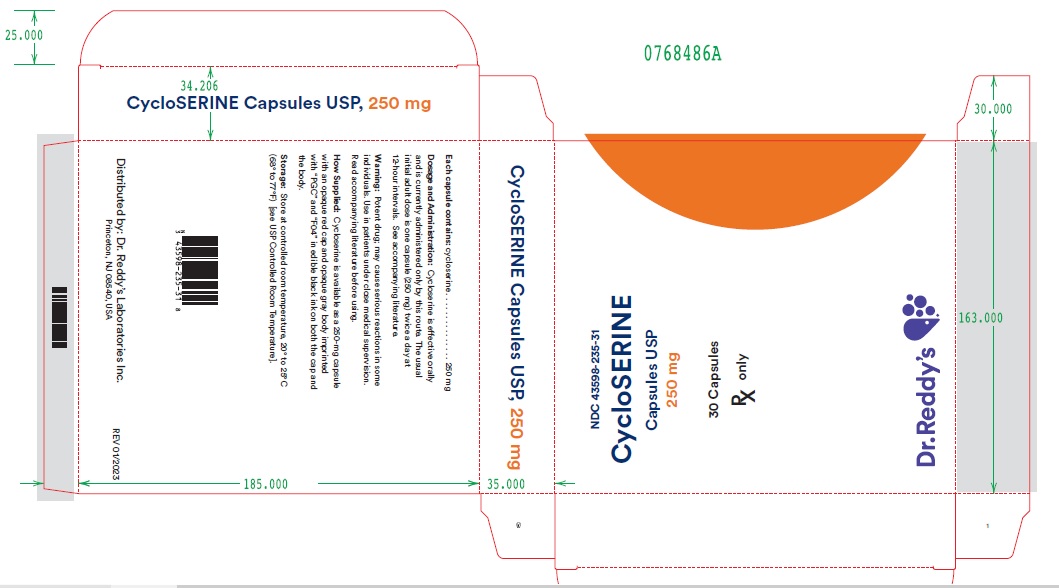
Cycloserine 250 mg Capsule, 30-count — NDC 43598-235-31 (Billing 43598-0235-31)
This is a package of 30 capsules of Cycloserine 250 mg Capsule from Dr. Reddys Laboratories, Inc., marketed since Mar 2023 and currently FDA-listed. It is this product's only package size.
NDC database record
One package, one record: these facts belong to NDC 43598-235-31 alone.
- Record
- FDA NDC Directory package listing · Human prescription drug
- Code segments
- 43598 labeler · 235 product · 31 package
- Package marketed since
- Mar 15, 2023
- Sample package
- No — commercial package
- Listing certified through
- Dec 31, 2026
- Billing quantity
- 30 EA per package
- Barcode (UPC-A, from the NDC)
- 3 4359823531 8
- FDA record last changed
- Oct 8, 2026
Identity & classification
Regulatory identifiers FDA, NLM and CMS codes for this package
Drug-database identifiers Medi-Span GPI and First Databank GCN / HICL / AHFS classification
- GSN (GCN sequence number): 009319
- GCN: 41250
- GPI-14 (Medi-Span): 09000030000105
- HICL (First Databank): 004038
- AHFS class code: 08:16.04.00
- RxCUI (RxNorm): 197551
Where does this data come from?
- FDA openFDA NDC Directory · synced Oct 8, 2026
- FDA label on DailyMed · label index refreshed Oct 8, 2026
- RxNorm (NLM RxNav) · catalog refreshed Oct 1, 2026
- Medi-Span GPI (licensed)
- First Databank (licensed) · refreshed Oct 8, 2026
RxNorm drug class
This medicine belongs to the Antibiotics class.
Where does this data come from?
- RxClass (NLM) · catalog refreshed Oct 1, 2026
Clinical
Patient education
Supplement & herbal interactions
Some supplements/herbs that may interact with Cycloserine — tap one for details:
Cycloserine may be associated with lower levels of 8 nutrients — worth a chat with your pharmacist, not a cause for alarm.
Where does this data come from?
- MedlinePlus (NLM) · refreshed Oct 8, 2026
- FDA label on DailyMed · label index refreshed Oct 8, 2026
Ask a licensed pharmacist directly — free, answered by our team.
Pricing
A drug doesn't have one price. Each row is a different public payment system, and none is what you'd pay at the counter — that depends on your insurance. The ⓘ on each row explains what it measures.
| Price system | Per each | Per package |
|---|---|---|
| Retail pharmacies payNADAC · weekly | Not in the retail survey — common for institutional, discontinued, or low-volume packs. | |
| Medicaid paysCMS SDUD · 12 mo | No recent Medicaid claims on file for this NDC — rare and low-volume NDCs are suppressed in the public data. | |
| Medicare drug plans payPart D · Q2 2026 | $58.39 | $1,751.67 / 30 capsules |
Where does this data come from?
- CMS NADAC weekly file
- CMS ASP pricing files · refreshed Sep 20, 2026
- CMS Medicaid State Drug Utilization Data · refreshed Oct 8, 2026
- CMS Part D plan pricing files · refreshed Sep 24, 2026
- VA National Acquisition Center price file
Packaging — all sizes for this product
| Package NDC | Description | Marketing start | Marketing end | Status |
|---|---|---|---|---|
| 43598-0235-31 You're viewing this Main listing | 3 BLISTER PACK in 1 CARTON / 10 CAPSULE in 1 BLISTER PACK | 2023-03-15 | — | Active |
Therapeutic equivalents
| Product | Labeler | Pack | NADAC/unit | TE | Status | Price vs. this |
|---|---|---|---|---|---|---|
| Cycloserine 250 mgthis 43598-0235-31 | Dr. | 30 capsules | — | — | FDA listed | — |
Where does this data come from?
- FDA openFDA NDC Directory · synced Oct 8, 2026
- FDA Orange Book · refreshed Oct 3, 2026
- CMS NADAC weekly file
Availability & generic status
This product is an FDA-approved generic. Other versions of the same drug are listed under Therapeutic equivalents, least expensive first.
Where does this data come from?
- FDA Orange Book · refreshed Oct 3, 2026
What it looks like
Where does this data come from?
- FDA label on DailyMed · label index refreshed Oct 8, 2026
Inactive Ingredients / Excipients
Inactive ingredients, also called excipients, are components of the drug product other than the active ingredient. They may include fillers, dyes, coatings, preservatives, flavors, or other formulation ingredients.
Where does this data come from?
IACT rows and label-wide narrative are kept separate; availability and product-level specificity depend on the submitted label.- FDA label on DailyMed · label index refreshed Oct 8, 2026
- FDA openFDA NDC Directory · synced Oct 8, 2026
Inactive ingredient FAQ
Are inactive ingredients the same for every manufacturer?
Why might an inactive ingredient be missing?
Can inactive ingredients matter?
Manufacturer & labeler
More NDCs from Dr. Reddys Laboratories, Inc. labeler code 43598
- Biorphen Phenylephrine hydrochloride 10 mg/mL Injection, Solution NDC 43598-199-10
- SSD Cream Silver Sulfadiazine 10 g/1000g Cream NDC 43598-210-25
- Colesevelam Hydrochloride 625 mg Tablet NDC 43598-230-18
- Guaifenesin and Dextromethorphan HBR 600 mg; 30 mg Tablet, Extended Release NDC 43598-231-01
- Guaifenesin and Dextromethorphan HBR 1200 mg; 60 mg Tablet, Extended Release NDC 43598-232-37
- Zoledronic Acid 4 mg/5mL Injection, Solution, Concentrate NDC 43598-233-11
- Fesoterodine fumarate 4 mg Tablet, Extended Release NDC 43598-247-30
- Fesoterodine fumarate 8 mg Tablet, Extended Release NDC 43598-248-30
- Zoledronic acid 4 mg/100mL Injection, Solution NDC 43598-255-52
- Docetaxel 20 mg/mL Injection, Solution NDC 43598-258-11
- Docetaxel 80 mg/4mL Injection, Solution NDC 43598-259-40
- Fulvestrant 50 mg/mL Injection, Solution NDC 43598-262-02
Where does this data come from?
- FDA openFDA NDC Directory · synced Oct 8, 2026
- Drugs@FDA
Full prescribing information FDA SPL
🎯 Indications and Usage ▾
INDICATIONS AND USAGE Cycloserine is indicated in the treatment of active pulmonary and extrapulmonary tuberculosis (including renal disease) when the causative organisms are susceptible to this drug and when treatment with the primary medications (streptomycin, isoniazid, rifampin, and ethambutol) has proved inadequate. Like all antituberculosis drugs, cycloserine should be administered in conjunction with other effective chemotherapy and not as the sole therapeutic agent. Cycloserine may be effective in the treatment of acute urinary tract infections caused by susceptible strains of gram-positive and gram- negative bacteria.
Use of cycloserine in these infections should be considered only when more conventional therapy has failed and when the organism has been demonstrated to be susceptible to the drug
⏱️ Dosage and Administration ▾
DOSAGE AND ADMINISTRATION Cycloserine is effective orally and is currently administered only by this route. The usual dosage is 500 mg to 1 g daily in divided doses monitored by blood levels. 1 The initial adult dosage most frequently given is 250 mg twice daily at 12-hour intervals for the first 2 weeks. A daily dosage of 1 g should not be exceeded.
⛔ Contraindications ▾
CONTRAINDICATIONS Administration is contraindicated in patients with any of the following: • Hypersensitivity to cycloserine • Epilepsy • Depression, severe anxiety, or psychosis • Severe renal insufficiency • Excessive concurrent use of alcoho
⚠️ Warnings ▾
WARNINGS Administration of cycloserine should be discontinued or the dosage reduced if the patient develops allergic dermatitis or symptoms of CNS toxicity, such as convulsions, psychosis, somnolence, depression, confusion, hyperreflexia, headache, tremor, vertigo paresis, or dysarthria. The toxicity of cycloserine is closely related to excessive blood levels (above 30 mcg/mL), as determined by high dosage or inadequate renal clearance. The ratio of toxic dose to effective dose in tuberculosis is small.
The risk of convulsions is increased in chronic alcoholics. Patients should be monitored by hematologic, renal excretion, blood level, and liver function studies.
🤒 Adverse Reactions ▾
ADVERSE REACTIONS Most adverse reactions occurring during therapy with cycloserine involve the nervous system or are manifestations of drug hypersensitivity. The following side effects have been observed in patients receiving cycloserine: Nervous system symptoms (which appear to be related to higher dosages of the drug, i.e., more than 500 mg daily) • Convulsions • Drowsiness and somnolence • Headache • Tremor • Dysarthria • Vertigo • Confusion and disorientation with loss of memory • Psychoses, possibly with suicidal tendencies • Character changes • Hyperirritability • Aggression • Paresis • Hyperreflexia • Paresthesia • Major & minor (localized) clonic seizures • Coma Cardiovascular: Sudden development of congestive heart failure in patients receiving 1 to 1.5 g of cycloserine daily has been reported.
Allergy (apparently not related to dosage) Skin rash Miscellaneous: Elevated serum transaminase, especially in patients with preexisting liver disease To report SUSPECTED ADVERSE REACTIONS, contact Cerovene, Inc. at 1-833-304-9569 or FDA at 1‑800-FDA-1088 or www.fda.gov/medwatch.
🆘 Overdosage ▾
OVERDOSAGE Signs and Symptoms: Acute toxicity from cycloserine can occur if more than 1 g is ingested by an adult. Chronic toxicity from cycloserine is dose related and can occur if more than 500 mg is administered daily. The central nervous system is the most common organ system involved with toxicity.
Toxic effects may include headache, vertigo, confusion, drowsiness, hyperirritability, paresthesias, dysarthria, psychosis paresis, convulsions, and coma. Treatment: In adults, many of the neurotoxic effects of cycloserine can be both treated and prevented with the administration of 200 to 300 mg of pyridoxine daily. Hemodialysis has been shown to remove cycloserine from the bloodstream.
This procedure should be reserved for patients with life threatening toxicity that is unresponsive to less invasive therapy.
🧬 Clinical Pharmacology ▾
CLINICAL PHARMACOLOGY After oral administration, cycloserine is readily absorbed from the gastrointestinal tract, with peak blood levels occurring in 4 to 8 hours. Blood levels of 25 to 30 mcg/mL can generally be maintained with the usual dosage of 250 mg twice a day, although the relationship of plasma levels to dosage is not always consistent. Concentrations in the cerebrospinal fluid, pleural fluid, fetal blood, and mother’s milk approach those found in the serum.
Detectable amounts are found in ascitic fluid, file, sputum, amniotic fluid, and lung and lymph tissues. Approximately 65% of a single dose of cycloserine can be recovered in the urine within 72 hours after oral administration. The remaining 35% is apparently metabolized to unknown substances.
The maximum excretion rate occurs 2 to 6 hours after administration, with 50% of the drug eliminated in 12 hours. Mechanism of Action: The antibacterial activity of Cycloserine results from inhibition of cell-wall synthesis in susceptible strains of gram-positive and gram-negative bacteria. Antibacterial Activity: Cycloserine has been shown to be active against most isolates of the following microorganism, both in vitro and in clinical infections [see Indications and Usage]: Mycobacterium tuberculosis.
📦 How Supplied / Storage and Handling ▾
HOW SUPPLIED Cycloserine is available as a 250 mg capsule with an opaque red cap and opaque gray body imprinted with “PGC” and “F04” in edible black ink on both the cap and the body. Cycloserine Capsules, USP are supplied in cartons of 3 cards. Each card is a ten-capsules blister card as follows: NDC 43598-235-31: carton with 3 cards.
NDC 43598-235-10 (ten 250mg capsules per card). Store at controlled room temperature, 20° to 25°C (68° to 77°F) [see USP Controlled Room Temperature].
📋 Description ▾
DESCRIPTION D -Cycloserine, (R)-4-amino-3-isoxazolidinone, is a broad-spectrum antibiotic that is produced by a strain of Streptomyces orchidaceus and has also been synthesized. Cycloserine is a white to off-white powder that is soluble in water and stable in alkaline solution. It is rapidly destroyed at a neutral or acid pH.
Cycloserine has a pH between 5.5 and 6.5 in a solution containing 100 mg/mL. The molecular weight of cycloserine is 102.09, and it has an empirical formula of C 3H6N2O 2 . The structural formula of cycloserine is as follows: Each capsule contains cycloserine, 250 mg (2.45 mmol); D & C Yellow No.
10, F D & C Blue No. 1, F D & C Red No. 3, F D & C Yellow No.
6, gelatin, iron oxide, talc, and titanium dioxide. Structural Formula of Cycloserine
⚠️ Precautions ▾
PRECAUTIONS General: Before treatment with cycloserine is initiated, cultures should be taken and the organism’s susceptibility to the drug should be established. In tuberculous infections, the organism’s susceptibility to the other antituberculosis agents in the regimen should also be demonstrated. Anticonvulsant drugs or sedatives may be effective in controlling symptoms of CNS toxicity, such as convulsions, anxiety, and tremor.
Patients receiving more than 500 mg of cycloserine daily should be closely observed for such symptoms. The value of pyridoxine in preventing CNS toxicity from cycloserine has not been proved. Administration of cycloserine and other antituberculosis drugs has been associated in a few instances with vitamin B 12 and/or folic- acid deficiency, megaloblastic anemia, and sideroblastic anemia.
If evidence of anemia develops during treatment, appropriate studies and therapy should be instituted. Laboratory Tests: Blood levels should be determined at least weekly for patients with reduced renal function, for individuals receiving a daily dosage of more than 500 mg, and for those showing signs and symptoms suggestive of toxicity. The dosage should be adjusted to keep the blood level below 30 mcg/mL.
Drug Interactions: Concurrent administration of ethionamide has been reported to potentiate neurotoxic side effects. Alcohol and cycloserine are incompatible, especially during a regimen calling for large doses of the latter. Alcohol increases the possibility and risk of epileptic episodes.
Concurrent administration of isoniazid may result in increased incidence of CNS effects, such as dizziness or drowsiness. Dosage adjustments may be necessary and patients should be monitored closely for signs of CNS toxicity. Carcinogenesis, Mutagenicity, and Impairment of Fertility: Studies have not been performed to determine potential for carcinogenicity.
The Ames test and unscheduled DNA repair test were negative. A study in 2 generations of rats showed no impairment of fertility relative to controls for the first mating but somewhat lower fertility in the second mating. Pregnancy Category C: There are no adequate and well-controlled studies with the use of Cycloserine in pregnant women.
A study in 2 generations of rats given doses up to 100 mg/kg/day (approximately equivalent to the maximum recommended human dose on a body surface area basis) demonstrated no teratogenic effect in offspring. Cycloserine should be used during pregnancy only if the potential benefit justifies the potential risk to the fetus. Nursing Mothers: Because of the potential for serious adverse reactions in nursing infants from cycloserine, a decision should be made whether to discontinue nursing or to discontinue the drug, taking into account the importance of the drug to the mother.
Usage in Pediatric Patients: Safety and effectiveness in pediatric patients have not been established. Geriatric Use: Clinical studies of cycloserine did not include sufficient numbers of subjects aged 65 and over to determine whether they responded differently from younger subjects. Other reported clinical experience has not identified differences in responses between the elderly and younger patients.
In general, dose selection for an elderly patient should be cautious, usually starting at the low end of the dosing range, reflecting the greater frequency of decreased hepatic, renal, or cardiac function, and of concomitant disease or other drug therapy. This drug is known to be substantially excreted by the kidney, and the risk of toxic reactions to this drug may be greater in patients with impaired renal function. Because elderly patients are more likely to have decreased renal function, care should be taken in dose selection, and it may be useful to monitor renal function.
The toxicity of cycloserine is closely related to excessive blood levels (above 30 mcg/mL) as determined by high dosage or inadequate renal clearance (see WARNINGS). Blood levels should be determined… [Excerpted — this section continues on DailyMed.]
📚 References ▾
REFERENCES 1. Jones LR: Colorimetric determination of cycloserine, a new antibiotic. Anal Chem 1956;28:39.
📄 Package Label / Principal Display Panel ▾
PACKAGE LABEL DISPLAY Cycloserine Capsules USP, 250 mg - Carton Label carton250
Medicare Part D spend CMS · PART D · 2025 (Q1-Q4)
About this NDC listing & data coverage
What data is (and isn’t) available for this NDC — tap to expand
| NDC identity (package / product / labeler codes) | ✓ Available |
| Labeler | ✓ Available |
| Product & package description | ✓ Available |
| Marketing category & status | ✓ Available |
| Active ingredient / dosage form / route | ✓ Available |
| FDA label (SPL via DailyMed) | ✓ Available |
| Package photos | ✓ Available |
| Inactive ingredients (structured) | — Not published for this NDC The labeler did not submit a structured excipient list, or no SPL is available. |
| NADAC pharmacy acquisition price (CMS) | — Not published for this NDC CMS publishes NADAC only for NDCs reported in its retail-pharmacy survey. |
| Orange Book / therapeutic-equivalence data | — Not published for this NDC Applies only to products approved under an NDA/ANDA; many listings are out of scope. |
| HCPCS J-code billing crosswalk | — Not published for this NDC Most self-administered / retail products have no J-code — that is normal. |
| Medicaid utilization (CMS SDUD) | — Not published for this NDC CMS reports utilization only for NDCs with Medicaid claims above its privacy threshold. |