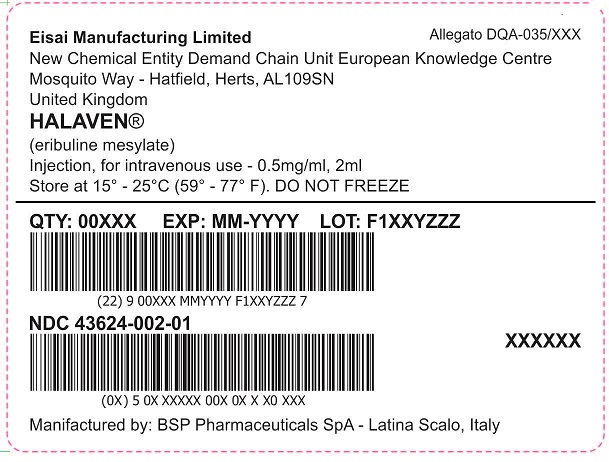
Why two NDCs?
The FDA registers this code as 43624-002-01 — a 5-3-2 layout, and that's what's printed on the package and shown on DailyMed. For insurance claims, every NDC is standardized to a uniform 11-digit 5-4-2 format by adding a zero to the product segment → 43624-0002-01. Same drug, same package — only the format differs.
Where does this data come from?
Identifiers from the FDA openFDA NDC Directory and Structured Product Labeling; RxCUI from RxNorm (NLM); GPI from Medi-Span; GCN / HIC / AHFS / legend from First Databank.
🏷️RxNorm drug class
This medicine belongs to the Microtubule Inhibitor class.
Pharmacologic classMicrotubule Inhibitor
Drug family (ATC)Other antineoplastic agents
Where does this data come from?
Therapeutic classes from RxNorm RxClass (U.S. National Library of Medicine) — Established Pharmacologic Class (FDA), ATC drug family (WHO) and mechanism of action, matched by this product’s RxCUI.
The labeler markets the product; the application holder owns the FDA approval. They’re often the same company but can differ (e.g. a repackager or an authorized generic). A mailing address / phone appears here when the manufacturer includes it in the product’s FDA label (not all do).
Where does this data come from?
Labeler, application holder and registered establishment from the FDA openFDA NDC Directory and Drugs@FDA; address/contact from the product’s FDA label.
🩺 Clinical
📗 Our plain-language guide HelloPharmacist
Eribulin (brand name Halaven) is approved for two specific cancers: metastatic breast cancer and a type of soft tissue cancer called liposarcoma. For breast cancer, it's used after...
What exactly is eribulin used for — and is it right for my type of cancer?
No, you won't need daily visits. Eribulin is given as a quick IV infusion — usually just 2 to 5 minutes — directly into a vein by your care team. You receive it on Day 1 and Day 8...
How is eribulin given, and will I have to go to a clinic every day?
Plain-language summary from MedlinePlus (U.S. National Library of Medicine); supplement & herbal interactions and nutrient depletion data from the Natural Medicines database; our full guide is HelloPharmacist editorial content.
💬 Questions about eribulin mesylate?
Ask a licensed pharmacist directly — free, answered by our team.
One label can cover several strengths, so colors may be combined — always confirm a loose pill against the dispensed prescription label or a pharmacist.
Where does this data come from?
Physical description (imprint, shape, color, scoring, coating) from this product’s FDA Structured Product Labeling (SPL), mirrored from DailyMed / openFDA.
🧪 Inactive Ingredients / Excipients
Inactive ingredients, also called excipients, are components of the drug product
other than the active ingredient. They may include fillers, dyes, coatings, preservatives, flavors,
or other formulation ingredients.
💡 Tap an ingredient (hover on desktop) to see what it is and why it’s used.
UNII 3K9958V90M
A liquid solvent derived from fermentation or chemical synthesis. In medicines, alcohol dissolves active ingredients, helps preserve the product, and improves how the body absorbs certain drugs.
UNII 059QF0KO0R
Water is a liquid solvent that dissolves and mixes ingredients together in liquid medicines, syrups, and injections. It helps distribute the active drug evenly throughout the product.
2 inactive ingredients listed in the exact product block matched to this NDC.
Where does this data come from?
Data sourced from official FDA Structured Product Labeling (SPL) via DailyMed — ingredient classCode="IACT" elements from the exact product block matched by this NDC. Label-section narrative from DailyMed / the openFDA label index is shown separately when available.
Inactive ingredient FAQ
Are inactive ingredients the same for every manufacturer?
No. Inactive ingredients can differ by manufacturer, dosage form, strength, and package / product version.
Why might an inactive ingredient be missing?
Some SPLs do not provide a complete structured inactive-ingredient list, and older or unusual labels may only include the information in narrative text.
Can inactive ingredients matter?
Yes. They can matter for allergies, intolerances, dyes, gluten / lactose concerns, preservatives, and formulation differences — but confirm with a pharmacist or the manufacturer when it’s clinically important.
💲 Pricing
A drug doesn't have one price. Each row is a different public payment system, and none is what you'd pay at the counter — that depends on your insurance. The ⓘ on each row explains what it measures.
Price system
Per each
Per package
Retail pharmacies payNADAC · weekly
Not in the retail survey — common for institutional, discontinued, or low-volume packs.
Medicaid paysCMS SDUD · 12 mo
No recent Medicaid claims on file for this NDC — rare and low-volume NDCs are suppressed in the public data.
Medicare drug plans payPart D · quarterly
No Part D plan price is available for this NDC in our data.
ℹ️
No price is published for this exact package yet. CMS surveys NADAC per package size, so a different pack of the same drug often has one.
Where does this data come from?
NADAC (National Average Drug Acquisition Cost) is the CMS weekly pharmacy-acquisition-cost survey — what pharmacies pay. ASP (Average Sales Price) is the CMS Medicare Part B drug-payment file, published quarterly. Medicaid pays is computed by us from CMS State Drug Utilization Data (total reimbursed ÷ units, trailing 12 months) — gross of rebates and inclusive of dispensing fees, so it reflects what Medicaid paid, not an acquisition cost. Medicare drug plans pay is the median negotiated point-of-sale unit cost across plans listing this NDC in the CMS quarterly Prescription Drug Plan pricing files, before rebates. The VA pays is the federal contract price (FSS, and the statutory Big 4 ceiling where listed) from the VA National Acquisition Center pharmaceutical price file. All are free public government data; each measures a different payer, so the figures are not directly comparable.
About this product: this is the brand-name version. Some generic versions are approved by the FDA, but we could not confirm current pharmacy availability from our pricing/market data.
Where does this data come from?
Equivalents are other NDCs of the same ingredient, form and route from the openFDA NDC Directory, ranked least-expensive-first by NADAC. Therapeutic-equivalence (AB) ratings come from the FDA Orange Book; biologics use the FDA Purple Book for biosimilar & interchangeable status.
⏳ Availability & generic status
🏛️
2010
First FDA approval
Nov 2010
📍
2026
Currently FDA-listed
16 years listed
🛡️
2027
Latest patent/protection listed
not a guaranteed launch date
🔒Generic approved by FDA, but pharmacy availability is not confirmed
The FDA lists approved generic versions of this medicine, but that does not always mean a pharmacy can get one today. Patent rules, launch agreements, supply and pricing can affect when generics actually arrive.
🛡️ Latest patent/protection date listed: FDA patent/protection data lists protections through Jul 2027. This may affect when a full generic version becomes widely available, but it is not a guaranteed launch date.
📅 FDA approved Nov 15, 2010APTE-ratedRLDRS⏳ ~0.8 yr to latest listed protection
Why the date isn’t exact: Generic timing can change because patents may be challenged, settled, licensed, added, removed, or worked around with a narrower label — and FDA approval does not always mean a pharmacy can get the generic today.
FDA-granted marketing protection. It’s separate from patents and may be shorter than patent protection.
🧪Product / substance patents
Patents covering the active ingredient, product, formulation, or related drug features.
🎯Method-of-use patents
Patents covering specific approved uses. These can sometimes be carved out with a “skinny label,” but not always.
🛈 What do these terms mean?
Patent
Legal protection listed in the Orange Book that may delay generic approval or launch. Issued by the U.S. Patent & Trademark Office.
Substance patent
Covers the active drug molecule itself — the hardest to design around. A generic generally can’t launch until it expires.
Formulation (product) patent
Covers a specific formulation or dosage form. A generic can sometimes work around it with a different formulation.
Method-of-use patent
A patent covering one specific approved use of the drug — not necessarily the whole molecule. A generic can sometimes launch with a “skinny label” that carves out the protected use and keeps the others.
Skinny label
A generic label that omits a still-patented use when the FDA allows it — letting a generic reach the market for the unprotected uses.
Exclusivity
FDA-granted marketing protection, separate from patents — e.g. 5-yr new chemical entity, 7-yr orphan drug, or a +6-month pediatric extension.
Paragraph IV
A generic applicant’s formal challenge to a listed patent. It can potentially lead to earlier generic entry, but often involves litigation or a settlement.
RLD / RS
Reference Listed Drug — the brand product the FDA uses as the reference for generic applications. Reference Standard — the product the FDA expects generics to compare against in bioequivalence testing.
TE / AB rating
FDA therapeutic-equivalence rating. An AB rating generally means the FDA considers a generic therapeutically equivalent to — and substitutable for — the brand.
LOE (loss of exclusivity)
The latest patent or exclusivity currently listed — the loss-of-exclusivity / latest-listed-protection date shown on this page. Paragraph-IV challenges and settlements can move the real date earlier; FDA approval and a manufacturer’s decision to market can move it later.
Built from the FDA Orange Book. The bars above are scaled to each protection’s expiry; the red LOE marker is the last one to lapse.
Yes — an FDA-approved generic equivalent is listed in the FDA Orange Book for this drug. See the alternatives section for substitutable, lower-cost products.
The FDA approved a generic — why can’t I get it at my pharmacy yet?
FDA approval and pharmacy availability are two different things. The FDA can approve a generic years before it actually reaches pharmacies, because the brand company may still hold patents or have a settlement that delays the launch. A manufacturer also has to choose to make and sell it, and have supply ready. So a drug can be “FDA-approved generic exists” and still be brand-only at the counter today.
Why do different websites show different generic release dates?
Generic availability is not based on one single date. Some sources use the first exclusivity expiration, some use the last product patent, and others use the latest method-of-use patent. Patent challenges, settlements, licenses, and label carve-outs can also change the real-world launch date. This page shows the underlying Orange Book dates so you can see why estimates may differ.
What does “FDA listed” mean?
It means the product appears in the FDA’s official NDC directory. That’s a good sign a product exists and is intended for the U.S. market, but on its own it does not confirm a pharmacy can fill it today. Where we have recent retail pricing data (NADAC) for a product, we label it “Availability likely” instead.
What does a patent or protection date mean here?
It’s the latest date currently listed in the FDA Orange Book for a patent or exclusivity on the brand product. It can affect when a full generic version becomes widely available — but it is not a guaranteed generic launch date. Generics sometimes arrive earlier (through a settlement or patent challenge) or later (a manufacturer still has to make and sell one).
What does “current Orange Book estimate” mean?
It means we are using the latest patent and exclusivity dates currently listed in the FDA Orange Book. It is not a guaranteed launch date.
Can a generic come out before the last patent expires?
Sometimes. A generic company may challenge a patent, settle with the brand manufacturer, receive a license, or obtain approval with a narrower label that avoids a patented use. In other cases, the last listed protection may delay full-label generic competition.
Can a generic come out after the listed dates?
Yes. Even after patents or exclusivity expire, a generic still needs FDA approval and a manufacturer must choose to market it. Supply, litigation, business decisions, or regulatory issues can delay actual availability.
What is the difference between patents and exclusivity?
Patents are legal protections usually issued by the U.S. Patent and Trademark Office. FDA exclusivity is marketing protection granted by the FDA. They are separate, and either one can affect generic timing.
Why are there multiple patent dates?
One drug can have several patents covering different things: the active ingredient, a formulation, a manufacturing process, or a specific approved use. That is why a page may show several expiration dates instead of one simple generic date.
Built from FDA Orange Book patent and exclusivity data. Dates are refreshed from public FDA data when available; the marker is max(latest patent expiry, latest exclusivity expiry). Paragraph-IV settlements and first-filer 180-day exclusivity can shift the real date; a method-of-use patent may allow an earlier skinny-label generic for non-protected indications. Generic launch timing is an estimate, not a guarantee.
Where does this data come from?
Patents and exclusivity from the FDA Orange Book (small-molecule drugs), refreshed from public FDA data. Generic launch timing is an estimate, not a guarantee.
📊 Medicare Part D spend CMS · PART D · 2025 (Q1-Q4)
Medicare Part D (outpatient prescription) spending for Halaven — the program that covers self-administered drugs. 1 manufacturer.
⚠️ Drug-level data: CMS publishes Part D spending by drug, not by NDC — these figures combine every manufacturer, strength and package size sold under the name Halaven. That’s a different level of aggregation than the Medicaid card above, which is specific to this exact 11-digit NDC (pack size included), so the two aren’t directly comparable.
Total Part D spend
$321.3K
Claims incl. refills
51
Beneficiaries
13
Spend / beneficiary
$24,714.92
Spend / claim
$6,299.88
💵 About the dollar figures: spending is what Part D plans paid before confidential manufacturer rebates, so the program’s real net cost is lower. A blank patient count means fewer than 11 people — CMS hides counts that small to protect privacy. Source: CMS Medicare Quarterly Part D Spending by Drug (data.cms.gov), updated quarterly.
🔬 Reported adverse events (FAERS)
Read carefully: FAERS reports are voluntary and unverified. Counts are not incidence, do not establish causation, are subject to reporting bias, and cannot be used to compare one drug to another. Shown for signal context only. Reports for Halaven (this brand).
Top reported reactions
Neutropenia537
Malignant Neoplasm Progression382
Febrile Neutropenia331
Myelosuppression310
Pyrexia215
Neuropathy Peripheral214
Leukopenia208
Age at onset
Adolescent3
Adult871
Elderly402
Reporter sex
Male · 6%
Female · 94%
Unknown · 0%
Serious outcomes
Hospitalization1,948
Death659
Life-threatening184
Disabling106
Reports over time (by year) — tap or hover for the count & year
Most recent year is provisional (FAERS lags ~3 months).
Where does this data come from?
Adverse-event reports from the FDA Adverse Event Reporting System (FAERS) via openFDA. FAERS reports are voluntary and unverified — counts are not incidence and don’t establish causation.
📦 Packaging — all sizes for this product
Package NDC
Description
Marketing start
Status
43624-0002-01 You're viewing this
100 TRAY in 1 BOX, UNIT-DOSE (43624-002-01) / 3 mL in 1 TRAY
2017-04-21
Active
🧭 About this NDC listing & data coverage
Finished prescription product
What data is (and isn’t) available for this NDC — tap to expand
NDC identity (package / product / labeler codes)
✓ Available
Labeler
✓ Available
Product & package description
✓ Available
Marketing category & status
✓ Available
Active ingredient / dosage form / route
✓ Available
FDA label (SPL via DailyMed)
✓ Available
Package photos
✓ Available
Inactive ingredients (structured)
✓ Available
NADAC pharmacy acquisition price (CMS)
— Not published for this NDCCMS publishes NADAC only for NDCs reported in its retail-pharmacy survey.
Orange Book / therapeutic-equivalence data
✓ Available
HCPCS J-code billing crosswalk
— Not published for this NDCMost self-administered / retail products have no J-code — that is normal.
Medicaid utilization (CMS SDUD)
— Not published for this NDCCMS reports utilization only for NDCs with Medicaid claims above its privacy threshold.
“Not published” reflects what the public FDA / CMS / NLM sources provide for this exact package code — it is a property of the data feeds, not a judgment about the product.
Questions about this listing
Why is there no price listed?
The pricing shown on our NDC pages comes from CMS NADAC, a voluntary survey of retail community pharmacy invoices. CMS does not publish a NADAC for every NDC — packages outside the retail survey (institutional and hospital products, bulk packages, discontinued items, and many OTC items) may never receive one. A missing price reflects the survey's scope, not this product's actual cost, and does not mean the product is free or unavailable.
Is the NDC printed on the package the same as the 11-digit billing NDC?
Yes, they identify this exact package in different formats. The FDA registers it as 43624-002-01, which is what is printed on the packaging and shown on DailyMed. Insurance claims use a fixed 11-digit 5-4-2 format, so the short segment is padded with a leading zero: 43624-0002-01, written without dashes as 43624000201. The Identity section at the top of this page lists every form of this code.
What do the three segments of this NDC mean?
In 43624-0002-01, the first segment (43624) is the labeler code FDA assigned to BSP Pharmaceuticals SpA; the middle segment (0002) identifies this specific product — its ingredient, strength, and dosage form; and the last segment (01) identifies this exact package size and type. Together they name one specific package of one specific product.
Is this package still being marketed?
Yes, per the latest FDA NDC Directory data on this page: this package is listed as actively marketed, with no marketing end date reported by BSP Pharmaceuticals SpA. Listing status can change — the directory data on this page refreshes weekly.
Who lists this product with the FDA?
BSP Pharmaceuticals SpA is the labeler of record for this NDC — the company under whose FDA-assigned code the package is listed. The labeler may be the manufacturer itself or a distributor marketing the product under its own code.
Do I need a prescription for this product?
This NDC is listed with FDA as a prescription product, so it is dispensed under a prescriber's order. Your pharmacist can tell you whether any over-the-counter forms of the same medication exist.
This page identifies an FDA-listed package (the NDC) and reports public regulatory and pricing data about the listing. It is reference information, not a medical recommendation — talk to your pharmacist or prescriber about your own medication.
Where does this data come from?
Listing facts (marketing category, packager status, marketing dates) from the FDA openFDA NDC Directory; label availability from DailyMed; pricing coverage from CMS NADAC; equivalence scope from the FDA Orange Book.
📄 Full prescribing information FDA SPL
The complete FDA label for this product — the official prescribing information, verbatim, section by section. Jump with a chip, search within the label, or expand everything.
For educational and professional reference only — not medical advice. Pricing reflects published
NADAC and CMS ASP (free public data) and may differ from your acquisition cost; always verify before billing or dispensing.