
NDC 45802-0055-35: Triamcinolone Acetonide 1 mg/g Ointment
This is a package of Triamcinolone Acetonide 1 mg/g Ointment from Padagis Israel Pharmaceuticals Ltd, first listed with the FDA Aug 2006 and currently FDA-listed; retail pharmacies pay about $0.1103 per g (NADAC). It is the main listing for this product, which comes in 3 package sizes.
NDC Database Record
One package, one record: these facts belong to NDC 45802-055-35 alone.
- Record
- FDA NDC Directory package listing · Human prescription drug
- Code segments
- 45802 labeler · 055 product · 35 package
- Package marketed since
- Mar 13, 2007
- Sample package
- No — commercial package
- Listing certified through
- Dec 31, 2027
- Barcode (UPC-A, from the NDC)
- 3 4580205535 4
- Medicaid fills, this package
- 133,981 prescriptions in the last four reported quarters
- FDA record last changed
- Nov 19, 2026
Other active recalls for Triamcinolone Acetonide (different manufacturers) — 1 · tap to view
Identity & Classification
Regulatory identifiers FDA, NLM and CMS codes for this package
Drug-database identifiers Medi-Span GPI and First Databank GCN / HICL / AHFS classification
- GSN (GCN sequence number): 007597
- GCN: 31242
- GPI-14 (Medi-Span): 90550085104210
- HICL (First Databank): 002891
- AHFS class code: 48:10.08.00
- RxCUI (RxNorm): 1085633
Where does this data come from?
- FDA openFDA NDC Directory · synced Nov 26, 2026
- FDA label on DailyMed · label index refreshed Nov 26, 2026
- RxNorm (NLM RxNav) · catalog refreshed Nov 26, 2026
- Medi-Span GPI (licensed)
- First Databank (licensed) · refreshed Nov 26, 2026
RxNorm Drug Class
This medicine belongs to the Corticosteroid class.
Where does this data come from?
- RxClass (NLM) · catalog refreshed Nov 26, 2026
Clinical
Triamcinolone topical is used to treat the itching, redness, dryness, crusting, scaling, inflammation, and discomfort of various skin conditions, including psoriasis (a skin disease in which red, scaly patches form on some areas of the body and eczema (a skin disease that causes the skin to be dry and itchy and to sometimes develop red, scaly rashes). It is also used as a dental paste to relieve the discomfort of mouth sores. Triamcinolone is in a class of medications called corticosteroids. It works by activating natural substances in the skin to reduce swelling, redness, and itching.
Read the full MedlinePlus article ↗- It calms inflammation and itching. Creams and sprays treat steroid-responsive skin conditions, dental paste treats mouth sores, nasal spray eases hay fever symptoms, and injections...
- Apply a thin film to the affected skin, usually two to three times a day. Only use a sealed dressing over it if your prescriber tells you to.
- Yes, steroids can raise blood sugar, especially if you have diabetes. Your doctor may need to adjust your diabetes medicines.
- It can. Steroids can make infections easier to catch and harder to spot. Call your doctor if you develop a fever or signs of infection, and tell them right away if you are exposed...
Patient education
Drug interactions
Supplement & herbal interactions
Some supplements/herbs that may interact with Triamcinolone Acetonide — tap one for details:
Triamcinolone Acetonide may be associated with lower levels of 8 nutrients — worth a chat with your pharmacist, not a cause for alarm.
Where does this data come from?
- MedlinePlus (NLM) · refreshed Nov 26, 2026
- FDA label on DailyMed · label index refreshed Nov 26, 2026
Ask a licensed pharmacist directly — free, answered by our team.
Pricing
A drug doesn't have one price. Each row is a different public payment system, and none is what you'd pay at the counter — that depends on your insurance. The ⓘ on each row explains what it measures.
| Price system | Per g | Per package |
|---|---|---|
| Retail pharmacies payNADAC · weekly | $0.110 | $1.65 / 15 g |
| Medicaid paysCMS SDUD · 12 mo | $0.2777 | $4.17 / 15 g |
| Medicare drug plans payPart D · Q2 2026 | $0.1209 | $1.81 / 15 g |
See this NDC in the NADAC Price Lookup: every NDC at its price and what a fill costs the pharmacy →
Where does this data come from?
- CMS NADAC weekly file · file of Nov 25, 2026
- CMS ASP pricing files · refreshed Nov 20, 2026
- CMS Medicaid State Drug Utilization Data · through Q1 2026
- CMS Part D plan pricing files · refreshed Nov 24, 2026
- VA National Acquisition Center price file
Packaging — All Sizes for This Product
| Package NDC | Description | Per unit | Per pack | Marketing start | Marketing end | Status |
|---|---|---|---|---|---|---|
| 45802-0055-05 45802-055-05 | 454 g in 1 JAR | $0.0353 / g | $16.03 | 2006-08-04 | — | Active |
| 45802-0055-35 You're viewing this Main listing | 1 TUBE in 1 CARTON / 15 g in 1 TUBE | $0.1103 / g | $1.65 | 2007-03-13 | — | Active |
| 45802-0055-36 45802-055-36 | 1 TUBE in 1 CARTON / 80 g in 1 TUBE | $0.0630 / g | $5.04 | 2006-10-02 | — | Active |
Per g, this pack runs about 212% above the cheapest pack (454 g, $0.0353 vs $0.1103 NADAC).
In Medicaid, this is the most-dispensed pack of this product — about 35% of fills over the last four reported quarters. See all packs ↓
Pack size FAQ
What quantity is in this package?
What NDC number is used to bill for this package of Triamcinolone Acetonide 1 mg/g Ointment?
Prices are the latest CMS NADAC pharmacy acquisition cost per NDC; per-pack figures are per-unit × pack quantity, shown only when the pack is denominated in the same measure NADAC prices.
Therapeutic Equivalents
| Product | Labeler | Pack | NADAC/unit | TE | Status | Price vs. this |
|---|---|---|---|---|---|---|
| Triamcinolone Acetonide 1 mg/g 45802-0064-05 | Padagis | 454 g | $0.027 | AT | Availability likely | save 76% |
| Triamcinolone Acetonide 1 mg/g 00713-0225-15 | Cosette | 1 tube | $0.105 | AT | Discontinued | save 5% |
| Triamcinolone Acetonide 1 mg/g 16714-0986-01 | NorthStar | 1 tube | $0.105 | AT | Availability likely | save 5% |
| Triamcinolone Acetonide 1 mg/g 33342-0329-15 | Macleods | 1 tube | $0.105 | AT | Availability likely | save 5% |
| Triamcinolone Acetonide 1 mg/g 67877-0251-15 | Ascend | 15 g | $0.105 | AT | Availability likely | save 5% |
| Triamcinolone Acetonide 1 mg/g 71656-0042-15 | Saptalis | 1 tube | $0.105 | AT | Availability likely | save 5% |
| Triamcinolone Acetonide 1 mg/g 21922-0062-04 | Encube | 1 tube | $0.105 | AT | Availability likely | save 5% |
| Triamcinolone Acetonide 1 mg/g 51672-1282-01 | Sun | 1 tube | $0.105 | AT | Availability likely | save 5% |
| triamcinolone acetonide 1 mg/g 00168-0004-15 | E. | 1 tube | $0.105 | AT | Availability likely | save 5% |
| Triamcinolone Acetonide 1 mg/g 00168-0006-15 | E. | 15 g | $0.110 | AT | Availability likely | — |
| Triamcinolone Acetonide 1 mg/g 00713-0228-15 | Cosette | 1 tube | $0.110 | AT | Availability likely | — |
| Triamcinolone acetonide 1 mg/g 16714-0276-01 | NorthStar | 1 tube | $0.110 | AT | Availability likely | — |
| Triamcinolone Acetonide 1 mg/g 21922-0063-04 | Encube | 1 tube | $0.110 | AT | Availability likely | — |
| Triamcinolone acetonide 1 mg/g 33342-0333-15 | Macleods | 1 tube | $0.110 | AT | Availability likely | — |
| Triamcinolone Acetonide 1 mg/gthis 45802-0055-35 | Padagis | 1 tube | $0.110 | AT | Availability likely | — |
| Triamcinolone Acetonide 1 mg/g 51672-1284-01 | Sun | 1 tube | $0.110 | AT | Availability likely | — |
| Triamcinolone Acetonide 1 mg/g 64980-0320-05 | Rising | 1 tube | $2.484 | AT | Availability likely | +2152% |
| Triamcinolone Acetonide 1 mg/g 50090-2244-00 | A-S | 1 tube | — | AT | FDA listed | — |
| Triamcinolone Acetonide 1 mg/g 50090-3508-00 | A-S | 1 tube | — | AT | FDA listed | — |
| Triamcinolone Acetonide 1 mg/g 50090-4761-00 | A-S | 1 tube | — | AT | FDA listed | — |
| Triamcinolone acetonide 1 mg/g 50090-6978-00 | A-S | 1 tube | — | AT | FDA listed | — |
| Triamcinolone Acetonide 1 mg/g 50090-7679-00 | A-S | 1 tube | — | AT | FDA listed | — |
| Triasil 59088-0730-00 | PureTek | 1 kit | — | — | FDA listed | — |
| Triamcinolone Acetonide 1 mg/g 61919-0619-15 | DIRECTRX | 15 g | — | AT | FDA listed | — |
| Triamcinolone Acetonide 1 mg/g 67296-1927-01 | RedpharmDrug | 1 tube | — | AT | FDA listed | — |
| Triamcinolone Acetonide 1 mg/g 68071-1872-08 | NuCare | 80 g | — | AT | FDA listed | — |
| Triamcinolone acetonide 1 mg/g 68071-2362-05 | NuCare | 1 tube | — | AT | FDA listed | — |
| Triamcinolone Acetonide 1 mg/g 68071-4286-05 | NuCare | 15 g | — | — | FDA listed | — |
| Triamcinolone Acetonide 1 mg/g 68462-0797-17 | Glenmark | 1 tube | — | — | FDA listed | — |
| Triamcinolone Acetonide 1 mg/g 70518-3689-00 | REMEDYREPACK | 1 tube | — | AT | FDA listed | — |
| Triamcinolone Acetonide 5 mg/g 71205-0033-15 | Proficient | 1 tube | — | — | FDA listed | — |
| Triamcinolone Acetonide 1 mg/g 71205-0108-15 | Proficient | 1 tube | — | AT | FDA listed | — |
| Triamcinolone Acetonide 1 mg/g 72162-2336-02 | Bryant | 1 tube | — | AT | FDA listed | — |
| Triamcinolone Acetonide 1 mg/g 76420-0361-00 | Asclemed | 454 g | — | AT | FDA listed | — |
| Triamcinolone Acetonide 1 mg/g 82804-0079-30 | Proficient | 1 tube | — | AT | FDA listed | — |
| Triamcinolone Acetonide 1 mg/g 63187-0053-15 | Proficient | 15 g | — | AT | FDA listed | — |
| Triamcinolone Acetonide 1 mg/g 71205-0627-15 | Proficient | 1 tube | — | AT | FDA listed | — |
| Triamcinolone Acetonide 1 mg/g 76420-0203-15 | Asclemed | 1 tube | — | AT | FDA listed | — |
| Triamcinolone Acetonide 1 mg/g 50090-6547-00 | A-S | 1 tube | — | AT | FDA listed | — |
| Triamcinolone Acetonide 1 mg/g 50090-6566-00 | A-S | 454 g | — | AT | FDA listed | — |
| Triamcinolone Acetonide 1 mg/g 63187-0870-15 | Proficient | 1 tube | — | — | FDA listed | — |
| Triamcinolone acetonide 1 mg/g 63629-8779-01 | Bryant | 30 g | — | AT | FDA listed | — |
| Triamcinolone Acetonide 1 mg/g 68462-0131-17 | Glenmark | 1 tube | — | — | Discontinued | — |
| Triamcinolone acetonide 1 mg/g 71335-2211-01 | Bryant | 454 g | — | AT | FDA listed | — |
| Triamcinolone acetonide 1 mg/g 50090-2106-00 | A-S | 30000 mg | — | AT | FDA listed | — |
| Triamcinolone Acetonide 1 mg/g 68071-2736-03 | NuCare | 1 tube | — | AT | FDA listed | — |
| Triamcinolone Acetonide 1 mg/g 72189-0277-15 | Direct_Rx | 15 g | — | AT | FDA listed | — |
| Triamcinolone Acetonide 1 mg/g 63629-9573-01 | Bryant | 454 g | — | AT | FDA listed | — |
| Triamcinolone Acetonide 1 mg/g 68071-3852-08 | NuCare | 1 tube | — | AT | FDA listed | — |
| Triamcinolone Acetonide 1 mg/g 68788-7797-01 | Preferred | 1 tube | — | AT | Discontinued | — |
| Triamcinolone Acetonide 1 mg/g 71335-2712-01 | Bryant | 454 g | — | AT | FDA listed | — |
| Triamcinolone acetonide 1 mg/g 63187-0025-15 | Proficient | 15 g | — | AT | FDA listed | — |
| Triamcinolone acetonide 1 mg/g 63629-8778-01 | Bryant | 15 g | — | AT | FDA listed | — |
| Triamcinolone Acetonide 1 mg/g 68071-4383-05 | NuCare | 15 g | — | — | FDA listed | — |
| Triamcinolone Acetonide 1 mg/g 68071-4945-05 | NuCare | 15 g | — | AT | FDA listed | — |
| Triamcinolone Acetonide 1 mg/g 68788-8356-00 | Preferred | 1 tube | — | AT | Discontinued | — |
| Triamcinolone acetonide 1 mg/g 72162-1832-03 | Bryant | 30 g | — | AT | FDA listed | — |
| Triamcinolone Acetonide 1 mg/g 72189-0571-80 | Direct_rx | 80 g | — | AT | FDA listed | — |
| Triamcinolone Acetonide 1 mg/g 82804-0145-30 | Proficient | 1 tube | — | AT | FDA listed | — |
| triamcinolone acetonide 1 mg/g 68071-4391-03 | NuCare | 30 g | — | AT | FDA listed | — |
| Triamcinolone Acetonide 1 mg/g 82804-0071-30 | Proficient | 1 tube | — | AT | FDA listed | — |
| Triamcinolone Acetonide 1 mg/g 72189-0039-80 | Direct_Rx | 80 g | — | AT | FDA listed | — |
| Kourzeq 1 mg/g 82682-0001-05 | MidAmerica | 1 tube | — | AT | FDA listed | — |
| Triamcinolone Acetonide 1 mg/g 61919-0650-15 | DIRECTRX | 15 g | — | AT | FDA listed | — |
| Triamcinolone Acetonide 1 mg/g 63629-9574-01 | Bryant | 1 tube | — | AT | FDA listed | — |
| Triamcinolone Acetonide 1 mg/g 68071-3666-03 | NuCare | 1 tube | — | AT | FDA listed | — |
| Triamcinolone Acetonide 1 mg/g 72162-1386-04 | Bryant | 1 tube | — | AT | FDA listed | — |
| Triamcinolone acetonide 1 mg/g 50090-0162-00 | A-S | 80 g | — | AT | FDA listed | — |
| Triamcinolone Acetonide 1 mg/g 52817-0811-15 | TruPharma, | 1 tube | — | AT | FDA listed | — |
| Triamcinolone Acetonide 1 mg/g 66267-0933-80 | NuCare | 80 g | — | — | FDA listed | — |
| Triamcinolone Acetonide 1 mg/g 70518-1524-00 | REMEDYREPACK | 15 g | — | AT | FDA listed | — |
| Triamcinolone Acetonide 1 mg/g 70518-2403-00 | REMEDYREPACK | 1 tube | — | AT | FDA listed | — |
| Triamcinolone Acetonide 1 mg/g 71335-2713-01 | Bryant | 80 g | — | AT | FDA listed | — |
| Triamcinolone Acetonide 1 mg/g 76420-0348-00 | Asclemed | 454 g | — | AT | FDA listed | — |
| Triamcinolone acetonide 1 mg/g 63629-8781-01 | Bryant | 454 g | — | AT | FDA listed | — |
| Triderm 1 mg/g 00316-0170-01 | Crown | 1 tube | — | AT | FDA listed | — |
| Triamcinolone Acetonide 1 mg/g 68071-3982-05 | NuCare | 1 tube | — | AT | FDA listed | — |
| Triamcinolone Acetonide 1 mg/g 68788-8350-01 | Preferred | 1 tube | — | AT | Discontinued | — |
| Triamcinolone Acetonide 1 mg/g 70518-2285-00 | REMEDYREPACK | 1 tube | — | AT | FDA listed | — |
| Triamcinolone acetonide 1 mg/g 50090-0228-00 | A-S | 15 g | — | AT | FDA listed | — |
| Triamcinolone Acetonide 1 mg/g 61919-0234-30 | Direct_Rx | 30 g | — | AT | FDA listed | — |
| Triamcinolone acetonide 1 mg/g 63629-8780-01 | Bryant | 80 g | — | AT | FDA listed | — |
| Triamcinolone Acetonide 1 mg/g 68788-8753-01 | Preferred | 1 tube | — | AT | FDA listed | — |
| Triamcinolone Acetonide 1 mg/g 70518-2963-00 | REMEDYREPACK | 1 tube | — | AT | Discontinued | — |
| Triamcinolone Acetonide 1 mg/g 72189-0670-30 | Direct_rx | 30 g | — | AT | FDA listed | — |
| Triamcinolone Acetonide 1 mg/g 68788-8386-05 | Preferred | 1 tube | — | AT | FDA listed | — |
| Triamcinolone Acetonide 1 mg/g 70518-4527-00 | REMEDYREPACK | 1 tube | — | AT | FDA listed | — |
| Triamcinolone Acetonide 1 mg/g 85766-0244-15 | Sportpharm | 1 tube | — | AT | FDA listed | — |
| Triamcinolone acetonide 1 mg/g 67296-2327-01 | Redpharm | 1 tube | — | AT | FDA listed | — |
| Triamcinolone Acetonide 1 mg/g 67296-2346-01 | Redpharm | 1 tube | — | AT | FDA listed | — |
| Triamcinolone Acetonide 1 mg/g 50090-1445-00 | A-S | 1 tube | — | AT | FDA listed | — |
| Triamcinolone acetonide 1 mg/g 50090-8187-00 | A-S | 1 tube | — | AT | FDA listed | — |
Where does this data come from?
- FDA openFDA NDC Directory · synced Nov 26, 2026
- FDA Orange Book · refreshed Nov 6, 2026
- CMS NADAC weekly file · file of Nov 25, 2026
Availability & Generic Status
This product is an FDA-approved generic. Other versions of the same drug are listed under Therapeutic equivalents, least expensive first.
Where does this data come from?
- FDA Orange Book · refreshed Nov 6, 2026
Inactive Ingredients / Excipients
Inactive ingredients, also called excipients, are components of the drug product other than the active ingredient. They may include fillers, dyes, coatings, preservatives, flavors, or other formulation ingredients.
Avoiding an ingredient? See Triamcinolone inactive ingredients by manufacturer: every current product's list side by side, so you can ask your pharmacy for the version that does not list it.
Tap an ingredient (hover on desktop) to see what it is and why it’s used.
-
UNII N6K5787QVP
Light mineral oil is a clear, odorless liquid derived from petroleum. In medicines, it acts as a lubricant and emollient to help the product spread smoothly and improve texture.
-
UNII 4T6H12BN9U
Petrolatum is a purified mineral oil-based jelly derived from petroleum. In medicines, it acts as an emollient, lubricant, and moisture barrier to soften skin, reduce friction, and help prevent water loss from formulations.
2 inactive ingredients listed in the exact product block matched to this NDC.
Where does this data come from?
ingredient classCode="IACT" elements from the exact product block matched by this NDC. Label-section narrative from DailyMed / the openFDA label index is shown separately when available.- FDA label on DailyMed · label index refreshed Nov 26, 2026
- FDA openFDA NDC Directory · synced Nov 26, 2026
Inactive ingredient FAQ
Are inactive ingredients the same for every manufacturer?
Why might an inactive ingredient be missing?
Can inactive ingredients matter?
Manufacturer & Labeler
More NDCs from Padagis Israel Pharmaceuticals Ltd labeler code 45802
- Triamcinolone Acetonide .147 mg/g Aerosol, Spray NDC 45802-045-01
- Gentamicin Sulfate 1 mg/g Ointment NDC 45802-046-11
- Nystatin 100000 USP units/g Ointment NDC 45802-048-11
- Triamcinolone Acetonide 5 mg/g Ointment NDC 45802-049-35
- Betamethasone Valerate 1.2 mg/g Aerosol, Foam NDC 45802-053-01
- Triamcinolone Acetonide .25 mg/g Ointment NDC 45802-054-05
- Gentamicin Sulfate 1 mg/g Cream NDC 45802-056-11
- Nystatin 100000 USP units/g Cream NDC 45802-059-11
- Bacitracin 500 USP units/g Ointment NDC 45802-060-01
- Triamcinolone Acetonide .25 mg/g Cream NDC 45802-063-05
- Triamcinolone Acetonide 1 mg/g Cream NDC 45802-064-05
- Triamcinolone Acetonide 5 mg/g Cream NDC 45802-065-35
Where does this data come from?
- FDA openFDA NDC Directory · synced Nov 26, 2026
- Drugs@FDA
Full Prescribing Information FDA SPL
Indications and Usage
INDICATIONS AND USAGE Topical corticosteroids are indicated for the relief of the inflammatory and pruritic manifestations of corticosteroid-responsive dermatoses.
Dosage and Administration
DOSAGE AND ADMINISTRATION Topical corticosteroids are generally applied to the affected area as a thin film from two to four times daily depending on the severity of the condition. Occlusive dressing may be used for the management of psoriasis or recalcitrant conditions. If an infection develops, the use of occlusive dressing should be discontinued and appropriate antimicrobial therapy instituted.
Contraindications
CONTRAINDICATIONS Topical corticosteroids are contraindicated in those patients with a history of hypersensitivity to any of the components of the preparations.
Adverse Reactions
ADVERSE REACTIONS The following local adverse reactions are reported infrequently with topical corticosteroids, but may occur more frequently with the use of occlusive dressings. These reactions are listed in an approximate decreasing order of occurrence: burning, itching, irritation, dryness, folliculitis, hypertrichosis, acneiform eruptions, hypopigmentation, perioral dermatitis, allergic contact dermatitis, maceration of the skin, secondary infection, skin atrophy, striae, and miliaria.
Pregnancy
Pregnancy: Teratogenic Effects: Pregnancy Category C - Corticosteroids are generally teratogenic in laboratory animals when administered systemically at relatively low dosage levels. The more potent corticosteroids have been shown to be teratogenic after dermal application in laboratory animals. There are no adequate and well-controlled studies in pregnant women on the teratogenic effects from topically applied corticosteroids.
Therefore, topical corticosteroids should be used during pregnancy only if the potential benefit justifies the potential risk to the fetus. Drugs of this class should not be used extensively on pregnant patients, in large amounts, or for prolonged periods of time.
Pediatric Use
Pediatric Use - Pediatric patients may demonstrate greater susceptibility to topical corticosteroid-induced HPA axis suppression and Cushing’s syndrome than mature patients because of a larger skin surface area to body weight ratio. Hypothalamic-pituitary-adrenal (HPA) axis suppression, Cushing’s syndrome and intracranial hypertension have been reported in children receiving topical corticosteroids. Manifestations of adrenal suppression in children include linear growth retardation, delayed weight gain, low plasma cortisol levels, and absence of response to ACTH stimulation.
Manifestations of intracranial hypertension include bulging fontanelles, headaches, and bilateral papilledema. Administration of topical corticosteroids to children should be limited to the least amount compatible with an effective therapeutic regimen. Chronic corticosteroid therapy may interfere with the growth and development of children.
Overdosage
OVERDOSAGE Topically applied corticosteroids can be absorbed in sufficient amounts to produce systemic effects (see PRECAUTIONS ).
Clinical Pharmacology
CLINICAL PHARMACOLOGY Topical corticosteroids share anti-inflammatory, anti-pruritic and vasoconstrictive actions. The mechanism of anti-inflammatory activity of the topical corticosteroids is unclear. Various laboratory methods, including vasoconstrictor assays, are used to compare and predict potencies and/or clinical efficacies of the topical corticosteroids.
There is some evidence to suggest that a recognizable correlation exists between vasoconstrictor potency and therapeutic efficacy in man. Pharmacokinetics - The extent of percutaneous absorption of topical corticosteroids is determined by many factors including the vehicle, the integrity of the epidermal barrier, and the use of occlusive dressings. Topical corticosteroids can be absorbed from normal intact skin.
Inflammation and/or other disease processes in the skin increase percutaneous absorption. Occlusive dressings substantially increase the percutaneous absorption of topical corticosteroids. Thus, occlusive dressings may be a valuable therapeutic adjunct for treatment of resistant dermatoses (see DOSAGE AND ADMINISTRATION ).
Once absorbed through the skin, topical corticosteroids are handled through pharmacokinetic pathways similar to systemically administered corticosteroids. Corticosteroids are bound to plasma proteins in varying degrees. Corticosteroids are metabolized primarily in the liver and are then excreted by the kidneys.
Some of the topical corticosteroids and their metabolites are also excreted into the bile.
How Supplied / Storage and Handling
HOW SUPPLIED Triamcinolone Acetonide Ointment USP, 0.025% is available as follows: 15 g tube (NDC 45802- 054 -35) 80 g tube (NDC 45802- 054 -36) 454 g jar (NDC 45802- 054 -05) Triamcinolone Acetonide Ointment USP, 0.1% is available as follows: 15 g tube (NDC 45802- 055 -35) 80 g tube (NDC 45802- 055 -36) 454 g jar (NDC 45802- 055 -05) Triamcinolone Acetonide Ointment USP, 0.5% is available as follows: 15 g tube (NDC 45802- 049 -35)
Storage and Handling
STORAGE Store at 20-25°C (68-77°F) [see USP Controlled Room Temperature]. Manufactured by Padagis® Yeruham, Israel www.padagis.com Rev 10-23 5A200 RC PH
Description
DESCRIPTION The topical corticosteroids constitute a class of primarily synthetic steroids used as anti-inflammatory and anti-pruritic agents. Triamcinolone acetonide is designated chemically as pregna-1,4-diene-3,20-dione, 9-fluoro-11,21-dihydroxy-16,17-[(1-methylethylidene) bis (oxy)]-,(11β,16α)-. C 24 H 31 FO 6 , M.W.
434.51; CAS Reg. No. 76-25-5.
Each gram of Triamcinolone Acetonide Ointment USP, 0.025%, 0.1% or 0.5% contains 0.25 mg, 1 mg or 5 mg triamcinolone acetonide, respectively, in an ointment base of light mineral oil and white petrolatum. Triamcinolone Acetonide Chemical Structure
Information for Patients
Information for Patients Patients using topical corticosteroids should receive the following information and instructions: 1. This medication is to be used as directed by the physician. It is for external use only.
Avoid contact with the eyes. 2. Patients should be advised not to use this medication for any disorder other than for which it was prescribed.
3. The treated skin area should not be bandaged or otherwise covered or wrapped as to be occlusive unless directed by the physician. 4.
Patients should report any signs of local adverse reactions especially under occlusive dressing. 5. Parents of pediatric patients should be advised not to use tight-fitting diapers or plastic pants on a child being treated in the diaper area, as these garments may constitute occlusive dressings.
Precautions
PRECAUTIONS General - Systemic absorption of topical corticosteroids has produced reversible hypothalamic-pituitary-adrenal (HPA) axis suppression, manifestations of Cushing’s syndrome, hyperglycemia, and glucosuria in some patients. Conditions which augment systemic absorption include the application of the more potent steroids, use over large surface areas, prolonged use, and the addition of occlusive dressings. Therefore, patients receiving a large dose of a potent topical steroid applied to a large surface area or under an occlusive dressing should be evaluated periodically for evidence of HPA axis suppression by using the urinary free cortisol and ACTH stimulation tests.
If HPA axis suppression is noted, an attempt should be made to withdraw the drug, to reduce the frequency of application, or to substitute a less potent steroid. Recovery of HPA axis function is generally prompt and complete upon discontinuation of the drug. Infrequently, signs and symptoms of steroid withdrawal may occur, requiring supplemental systemic corticosteroids.
Children may absorb proportionally larger amounts of topical corticosteroids and thus be more susceptible to systemic toxicity (see PRECAUTIONS - Pediatric Use ). If irritation develops, topical corticosteroids should be discontinued and appropriate therapy instituted. In the presence of dermatological infections, the use of an appropriate antifungal or antibacterial agent should be instituted.
If a favorable response does not occur promptly, the corticosteroid should be discontinued until the infection has been adequately controlled. Information for Patients Patients using topical corticosteroids should receive the following information and instructions: 1. This medication is to be used as directed by the physician.
It is for external use only. Avoid contact with the eyes. 2.
Patients should be advised not to use this medication for any disorder other than for which it was prescribed. 3. The treated skin area should not be bandaged or otherwise covered or wrapped as to be occlusive unless directed by the physician.
4. Patients should report any signs of local adverse reactions especially under occlusive dressing. 5.
Parents of pediatric patients should be advised not to use tight-fitting diapers or plastic pants on a child being treated in the diaper area, as these garments may constitute occlusive dressings. Laboratory Tests The following tests may be helpful in evaluating the HPA axis suppression: urinary free cortisol test and ACTH stimulation test. Carcinogenesis, Mutagenesis, Impairment of Fertility - Long-term animal studies have not been performed to evaluate the carcinogenic potential or the effect on fertility of topical corticosteroids.
Studies to determine mutagenicity with prednisolone and hydrocortisone have revealed negative results Pregnancy: Teratogenic Effects: Pregnancy Category C - Corticosteroids are generally teratogenic in laboratory animals when administered systemically at relatively low dosage levels. The more potent corticosteroids have been shown to be teratogenic after dermal application in laboratory animals. There are no adequate and well-controlled studies in pregnant women on the teratogenic effects from topically applied corticosteroids.
Therefore, topical corticosteroids should be used during pregnancy only if the potential benefit justifies the potential risk to the fetus. Drugs of this class should not be used extensively on pregnant patients, in large amounts, or for prolonged periods of time. Nursing Mothers - It is not known whether topical administration of corticosteroids could result in sufficient systemic absorption to produce detectable quantities in breast milk.
Systemically administered corticosteroids are secreted into breast milk in quantities not likely to have a deleterious effect on the infant. Nevertheless, caution should be exercised when topical corticosteroids are administered to a nursing woman. Pediatric Use - Pediatric patients ma… [Excerpted — this section continues on DailyMed.]
Nursing Mothers
Nursing Mothers - It is not known whether topical administration of corticosteroids could result in sufficient systemic absorption to produce detectable quantities in breast milk. Systemically administered corticosteroids are secreted into breast milk in quantities not likely to have a deleterious effect on the infant. Nevertheless, caution should be exercised when topical corticosteroids are administered to a nursing woman.
Pharmacokinetics
Pharmacokinetics - The extent of percutaneous absorption of topical corticosteroids is determined by many factors including the vehicle, the integrity of the epidermal barrier, and the use of occlusive dressings. Topical corticosteroids can be absorbed from normal intact skin. Inflammation and/or other disease processes in the skin increase percutaneous absorption.
Occlusive dressings substantially increase the percutaneous absorption of topical corticosteroids. Thus, occlusive dressings may be a valuable therapeutic adjunct for treatment of resistant dermatoses (see DOSAGE AND ADMINISTRATION ). Once absorbed through the skin, topical corticosteroids are handled through pharmacokinetic pathways similar to systemically administered corticosteroids.
Corticosteroids are bound to plasma proteins in varying degrees. Corticosteroids are metabolized primarily in the liver and are then excreted by the kidneys. Some of the topical corticosteroids and their metabolites are also excreted into the bile.
Carcinogenesis, Mutagenesis, Impairment of Fertility
Carcinogenesis, Mutagenesis, Impairment of Fertility - Long-term animal studies have not been performed to evaluate the carcinogenic potential or the effect on fertility of topical corticosteroids. Studies to determine mutagenicity with prednisolone and hydrocortisone have revealed negative results
Package Label / Principal Display Panel
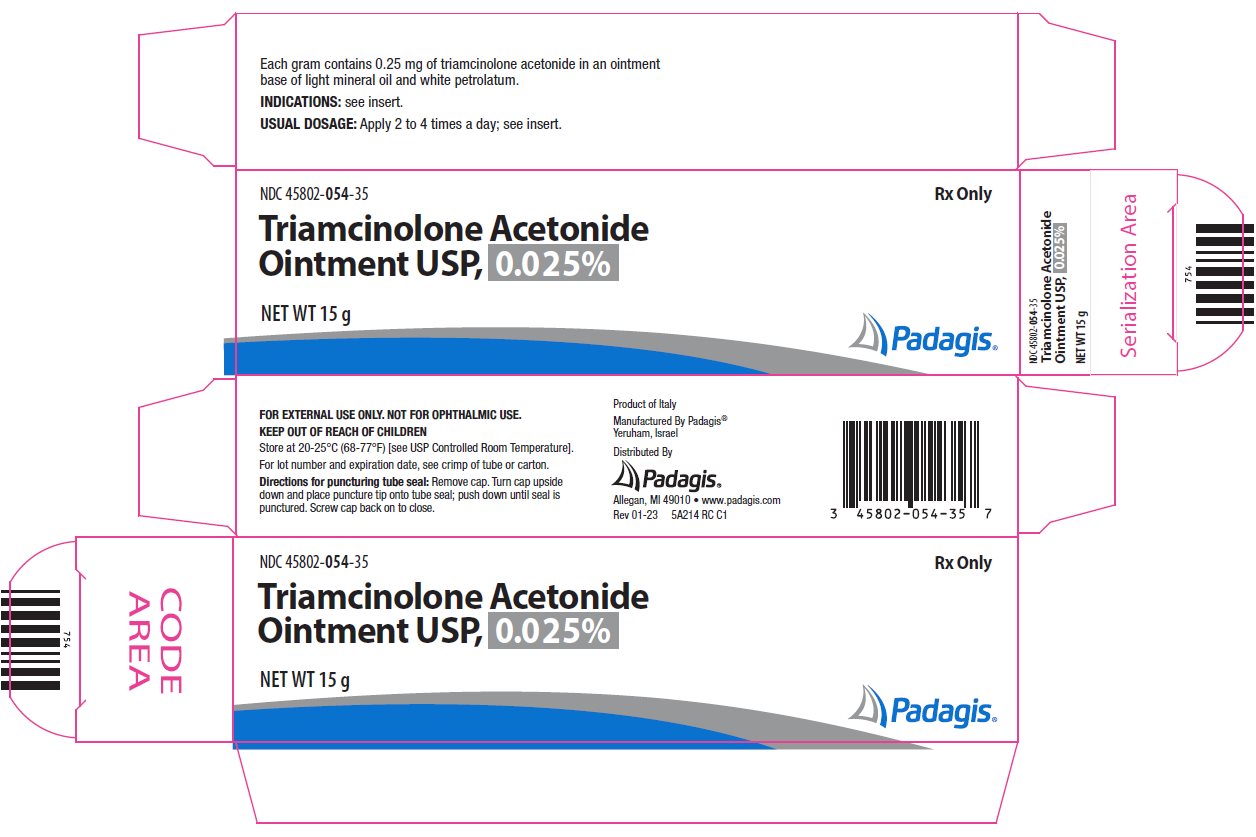
Principal Display Panel – 0.025% Rx Only Triamcinolone Acetonide Ointment USP, 0.025% NET WT 15 g 0.025% carton image
Principal Display Panel - 0.1% Rx Only Triamcinolone Acetonide Ointment USP, 0.1% NET WT 15 g 0.1% carton image
Principal Display Panel - 0.5% Carton Rx Only Triamcinolone Acetonide Ointment USP, 0.5% NET WT 15 g 0.5% carton image