
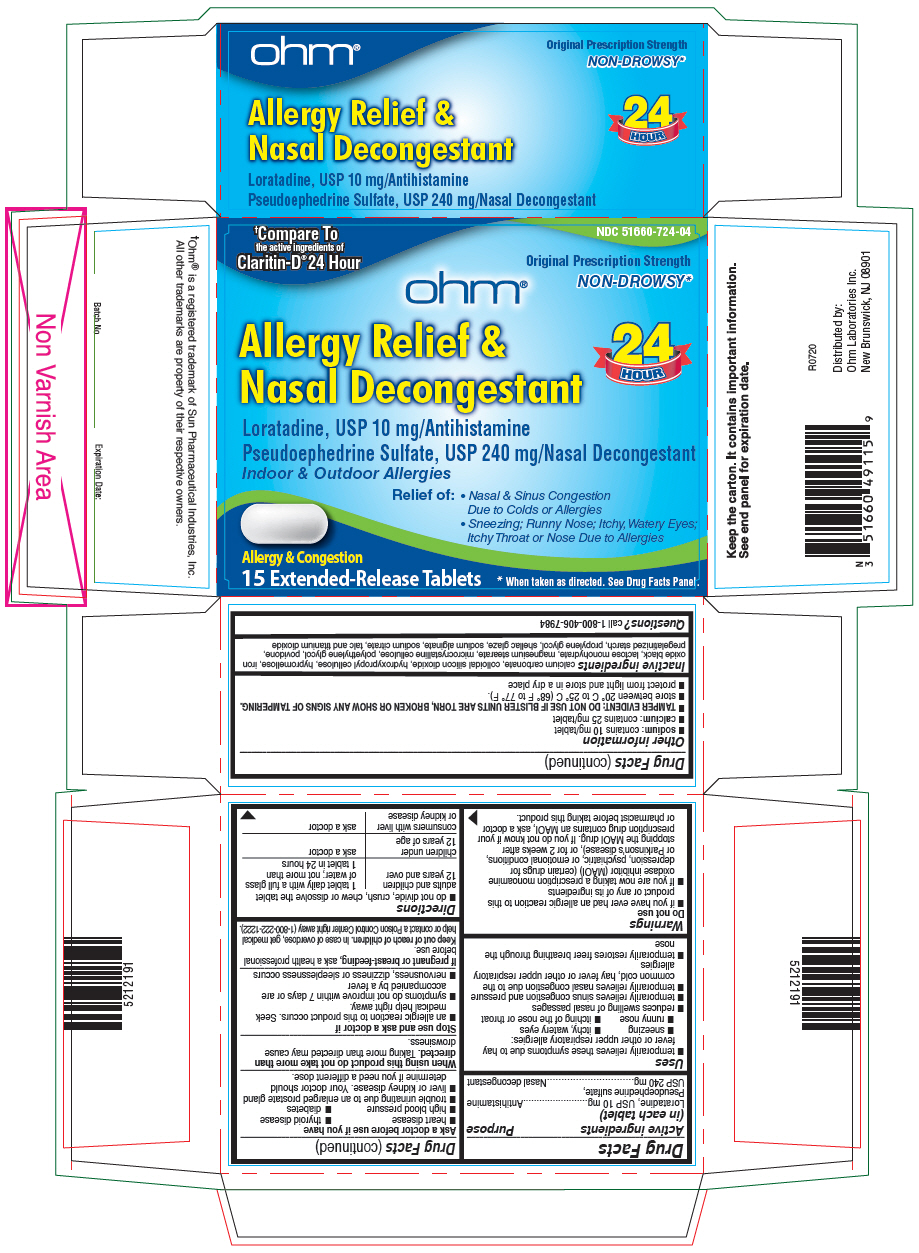
Loratadine and Pseudoephedrine 10 mg; 240 mg Tablet, Extended Release
🆔 Identity & classification
Where does this data come from?
🏷️ RxNorm drug class
This medicine belongs to the Other antihistamines for systemic use class.
Where does this data come from?
🏭 Manufacturer & labeler
Where does this data come from?
🩺 Clinical
Loratadine is used to treat allergy symptoms: sneezing runny nose itching of the nose or throat red, itchy, or watery eyes Loratadine is in a class of medications called antihistamines. It works by blocking the action of histamine, a substance in the body that causes allergic symptoms.
Read the full MedlinePlus article ↗- Great question. The two ingredients each do something different. Loratadine is an antihistamine — it targets the sneezing, runny nose, itchy eyes, and throat itching that come with...
- What exactly does this medicine do, and why does it have two ingredients?
- You take it by mouth with a full glass of water — but it's really important that you swallow it whole. Do not crush, split, chew, or dissolve it. These are extended-release tablets...
- How do I take it, and does it matter if I crush or split the tablet?
Patient education
Supplement & herbal interactions
Where does this data come from?
Ask a licensed pharmacist directly — free, answered by our team.
💊 What it looks like
Where does this data come from?
🧪 Inactive Ingredients / Excipients
Inactive ingredients, also called excipients, are components of the drug product other than the active ingredient. They may include fillers, dyes, coatings, preservatives, flavors, or other formulation ingredients.
💡 Tap an ingredient (hover on desktop) to see what it is and why it’s used.
-
UNII H0G9379FGK
Calcium carbonate is a white mineral powder used as a filler and buffering agent in medicines. It helps give tablets their bulk and size while neutralizing stomach acid in some formulations.
-
UNII XM0M87F357
A dark iron oxide compound that gives medicines their black or dark color. It's used as a colorant in tablets and capsules to help identify the product and make it visually distinctive.
-
UNII RFW2ET671P
Hydroxypropyl cellulose is a plant-derived thickening agent made from cellulose. It acts as a binder to hold tablet ingredients together and as a film-former to coat tablets or control how fast the medicine releases.
-
UNII 3NXW29V3WO
Hypromellose is a plant-based thickener made from cellulose. It's used in medicines as a binder to hold ingredients together, a coating for tablets, and a thickener for liquids.
-
UNII EWQ57Q8I5X
Lactose monohydrate is a natural sugar derived from milk. It serves as a filler and binder in tablets and capsules, helping create the proper size, texture, and consistency of the medicine.
-
UNII 70097M6I30
Magnesium stearate is a salt made from magnesium and stearic acid, a fatty substance. It's used in tablets and capsules as a lubricant and glidant to help ingredients flow smoothly during manufacturing and prevent sticking.
-
UNII OP1R32D61U
Microcrystalline cellulose is a purified form of cellulose, a natural fiber from plant sources. It acts as a binder and filler in tablets and capsules, helping hold ingredients together and give the medicine its shape and size.
-
UNII 3WJQ0SDW1A
Polyethylene glycol is a synthetic liquid or solid polymer used in medicines as a solvent, lubricant, and humectant. It helps dissolve active ingredients, reduces friction during manufacturing, and retains moisture in the final product.
-
UNII FZ989GH94E
Povidone is a synthetic polymer made from a plastic-like material. It acts as a binder to hold tablet ingredients together and as a disintegrant to help the tablet break apart in your stomach so the medicine can be absorbed.
-
UNII 6DC9Q167V3
Propylene glycol is a clear liquid derived from petroleum or vegetable sources. It acts as a solvent, humectant, and preservative in medicines, helping dissolve active ingredients and maintain product stability.
-
UNII 46N107B71O
Shellac is a natural resin secreted by the lac beetle. It's used as a coating on tablets and capsules to control how quickly the medicine dissolves and to improve appearance and stability.
-
UNII ETJ7Z6XBU4
Silicon dioxide is a naturally occurring mineral used as a glidant and anti-caking agent. It helps powder ingredients flow smoothly and prevents clumping during manufacturing and storage.
-
UNII C269C4G2ZQ
Sodium alginate is a natural thickener and gelling agent derived from seaweed. In medicines, it acts as a binder to hold ingredients together, a thickener to adjust texture, and a disintegrant to help the tablet or capsule break apart for absorption.
-
UNII 1Q73Q2JULR
Sodium citrate is a salt derived from citric acid. It works as a buffer to maintain the medicine's pH level and may also help improve taste or act as a preservative in the formulation.
-
UNII O8232NY3SJ
A plant-based carbohydrate derived from corn kernels. It acts as a filler to add bulk, a binder to hold ingredients together, and a disintegrant to help the tablet break apart in your stomach for absorption.
-
UNII 7SEV7J4R1U
A powder made from a naturally occurring mineral. In medicines, talc works as a glidant and anti-caking agent, helping tablets and capsules flow smoothly during manufacturing and preventing clumping.
-
UNII 15FIX9V2JP
Titanium dioxide is a bright white mineral powder commonly used as a colorant and opacifying agent. It makes pills and tablets white or lighter in color and helps make coatings non-transparent.
17 inactive ingredients listed in the exact product block matched to this NDC.
Label-section wording can be broader than the structured product block and may mention additional formulation ingredients.
Where does this data come from?
ingredient classCode="IACT" elements from the exact product block matched by this NDC. Label-section narrative from DailyMed / the openFDA label index is shown separately when available.Inactive ingredient FAQ
Are inactive ingredients the same for every manufacturer?
Why might an inactive ingredient be missing?
Can inactive ingredients matter?
💲 Pricing
A drug doesn't have one price. Each row is a different public payment system, and none is what you'd pay at the counter — that depends on your insurance. The ⓘ on each row explains what it measures.
| Price system | Per ea | Per package |
|---|---|---|
| Retail pharmacies payNADAC · weekly | $0.566 | $8.48 / 15 tablets |
| Medicaid paysCMS SDUD · 12 mo | $0.6107 | $9.16 / 15 tablets |
| Medicare drug plans payPart D · quarterly | No Part D plan price is available for this NDC in our data. | |
Where does this data come from?
🔁 Therapeutic equivalents
| Product | Labeler | Pack | NADAC/unit | TE | Status | Price vs. this |
|---|---|---|---|---|---|---|
| allergy d 10 mg/1; 240 mg 00113-9004-22 | L. | 1 tablet | $0.566 | — | Availability likely | — |
| Loratadine and Pseudoephedrine Sulfate 10 mg/1; 240 mg 00904-5833-15 | Major | 10 tablets | $0.566 | — | Availability likely | — |
| Loratadine and Pseudoephedrine Sulfate 10 mg/1; 240 mg 46122-0167-52 | Amerisource | 10 tablets | $0.566 | — | Availability likely | — |
| Loratadine and Pseudoephedrine 10 mg/1; 240 mg 46122-0383-22 | AMERISOURCE | 15 tablets | $0.566 | — | Availability likely | — |
| Loratadine and Pseudoephedrine 10 mg/1; 240 mgthis 51660-0724-04 | Ohm | 5 tablets | $0.566 | — | Availability likely | — |
| Leader Allergy Relief D-24 10 mg/1; 240 mg 70000-0162-01 | Cardinal | 10 tablets | $0.566 | — | Availability likely | — |
| Loratadine and Pseudoephedrine 10 mg/1; 240 mg 70677-1018-01 | STRATEGIC | 10 tablets | $0.566 | — | Availability likely | — |
| Loratadine and Pseudoephedrine Sulfate 10 mg/1; 240 mg 49348-0543-01 | STRATEGIC | 10 tablets | $0.574 | — | FDA listed | +2% |
| Loratadine and Pseudoephedrine Sulfate 10 mg/1; 240 mg 62011-0071-01 | Strategic | 10 tablets | $0.574 | — | FDA listed | +2% |
| Loratadine and Pseudoephedrine 10 mg/1; 240 mg 00363-0725-15 | Walgreen | 15 tablets | — | — | FDA listed | — |
| Allergy Relief D 10 mg/1; 240 mg 00363-2010-22 | Walgreen | 1 tablet | — | — | FDA listed | — |
| Claritin-D 24 Hour 10 mg/1; 240 mg 11523-0102-01 | Bayer | 10 tablets | — | — | FDA listed | — |
| Claritin-D 24 Hour 10 mg/1; 240 mg 11523-4332-01 | Bayer | 5 tablets | — | — | Discontinued | — |
| Loratadine and Pseudoephedrine 10 mg/1; 240 mg 11822-9990-00 | Rite | 10 tablets | — | — | FDA listed | — |
| Loratadine and Pseudoephedrine Sulfate 10 mg/1; 240 mg 21130-0724-15 | Safeway | 15 tablets | — | — | FDA listed | — |
| Loratadine and Pseudoephedrine Sulfate 10 mg/1; 240 mg 30142-0724-15 | The | 1 tablet | — | — | FDA listed | — |
| allergy congestion relief 10 mg/1; 240 mg 30142-0846-22 | Kroger | 1 tablet | — | — | FDA listed | — |
| topcare allergy and congestion relief 10 mg/1; 240 mg 36800-0706-22 | Topco | 1 tablet | — | — | FDA listed | — |
| Loratadine and Pseudoephedrine Sulfate 10 mg/1; 240 mg 37808-0427-69 | HEB | 10 tablets | — | — | FDA listed | — |
| Loratadine and Pseudoephedrine Sulfate 10 mg/1; 240 mg 37808-0724-69 | HEB | 10 tablets | — | — | FDA listed | — |
| Allergy Relief-D 240 mg/1; 10 mg 37808-0787-07 | HEB | 5 tablets | — | — | FDA listed | — |
| Loratadine and Pseudoephedrine Sulfate 10 mg/1; 240 mg 41250-0724-52 | Meijer | 15 tablets | — | — | FDA listed | — |
| Loratadine and Pseudoephedrine Sulfate 10 mg/1; 240 mg 49035-0488-15 | WAL-MART | 15 tablets | — | — | FDA listed | — |
| Loratadine and Pseudoephedrine 10 mg/1; 240 mg 51660-0491-15 | Ohm | 15 tablets | — | — | Discontinued | — |
| Loratadine and Pseudoephedrine Sulfate 10 mg/1; 240 mg 56062-0724-15 | Publix | 15 tablets | — | — | FDA listed | — |
| Allergy Relief-D 10 mg/1; 240 mg 59779-0726-15 | CVS | 5 tablets | — | — | FDA listed | — |
| Loratadine and Pseudoephedrine 10 mg/1; 240 mg 63187-0305-10 | Proficient | 10 tablets | — | — | FDA listed | — |
| kirkland signature allerclear d 24 hr 10 mg/1; 240 mg 63981-0138-22 | Costco | 1 tablet | — | — | FDA listed | — |
| KIRKLAND SIGNATURE ALLERCLEAR D 24 HR Extended Release 10 mg/1; 240 mg 63981-0724-15 | Kirkland-COSTCO | 15 tablets | — | — | FDA listed | — |
| Loratadine and Pseudoephedrine 10 mg/1; 240 mg 85766-0048-10 | Sportpharm | 10 tablets | — | — | FDA listed | — |
Where does this data come from?
⏳ Availability & generic status
This product is an FDA-approved generic. Other versions of the same drug are listed under Therapeutic equivalents, least expensive first.
Where does this data come from?
🗺️ Medicaid utilization & spend
💊 Medicaid utilization by pack size
📦 Packaging — all sizes for this product
| Package NDC | Description | Per unit | Per pack | Marketing start | Status |
|---|---|---|---|---|---|
| 51660-0724-04 You're viewing this | 3 BLISTER PACK in 1 CARTON (51660-724-04) / 5 TABLET, EXTENDED RELEASE in 1 BLISTER PACK | $0.5656 / ea | $8.48 | 2004-11-17 | Active |
| 51660-0724-15 | 1 BLISTER PACK in 1 CARTON (51660-724-15) / 15 TABLET, EXTENDED RELEASE in 1 BLISTER PACK | $0.5656 / ea | $8.48 | 2004-11-17 | Active |
| 51660-0724-56 | 1 BLISTER PACK in 1 CARTON (51660-724-56) / 5 TABLET, EXTENDED RELEASE in 1 BLISTER PACK | — | — | 2004-11-17 | Discontinued by firm |
| 51660-0724-69 | 1 BLISTER PACK in 1 CARTON (51660-724-69) / 10 TABLET, EXTENDED RELEASE in 1 BLISTER PACK | $0.5656 / ea | $5.66 | 2004-11-17 | Active |
This pack has the lowest per-ea cost of the 3 priced pack sizes ($0.5656 NADAC).
Pack size FAQ
What quantity is in NDC 51660-0724-04?
What NDC number is used to bill for this package of Loratadine and Pseudoephedrine 10 mg; 240 mg Tablet, Extended Release?
Prices are the latest CMS NADAC pharmacy acquisition cost per NDC; per-pack figures are per-unit × pack quantity, shown only when the pack is denominated in the same measure NADAC prices.
📄 FDA label — Drug Facts FDA SPL
🎯 Indications and Usage ▾
USES temporarily relieves these symptoms due to hay fever or other upper respiratory allergies: sneezing itchy, watery eyes runny nose itching of the nose or throat reduces swelling of nasal passages temporarily relieves sinus congestion and pressure temporarily relieves nasal congestion due to the common cold, hay fever or other upper respiratory allergies temporarily restores freer breathing through the nose
⏱️ Dosage and Administration ▾
DIRECTIONS do not divide, crush, chew or dissolve the tablet adults and children 12 years and over 1 tablet daily with a full glass of water; not more than 1 tablet in 24 hours children under 12 years of age ask a doctor consumers with liver or kidney disease ask a doctor
⚠️ Warnings ▾
WARNINGS Do not use if you have ever had an allergic reaction to this product or any of its ingredients if you are now taking a prescription monoamine oxidase inhibitor (MAOI) (certain drugs for depression, psychiatric, or emotional conditions, or Parkinson's disease), or for 2 weeks after stopping the MAOI drug. If you do not know if your prescription drug contains an MAOI, ask a doctor or pharmacist before taking this product. Ask a doctor before use if you have heart disease thyroid disease high blood pressure diabetes trouble urinating due to an enlarged prostate gland liver or kidney disease.
Your doctor should determine if you need a different dose. When using this product do not take more than directed. Taking more than directed may cause drowsiness.
Stop use and ask a doctor if an allergic reaction to this product occurs. Seek medical help right away. symptoms do not improve within 7 days or are accompanied by a fever. nervousness, dizziness or sleeplessness occurs If pregnant or breast-feeding Ask a health professional before use. Keep out of reach of children.
In case of overdose, get medical help or contact a Poison Control Center right away (1-800-222-1222).
🧪 Active Ingredient ▾
ACTIVE INGREDIENTS (IN EACH TABLET) Loratadine, USP 10 mg Pseudoephedrine sulfate, USP 240 mg
🧪 Inactive Ingredients ▾
INACTIVE INGREDIENTS Calcium carbonate, colloidal silicon dioxide, hydroxypropyl cellulose, hypromellose, iron oxide black, lactose monohydrate, magnesium stearate, microcrystalline cellulose, polyethylene glycol, povidone, pregelatinized starch, propylene glycol, shellac glaze, sodium alginate, sodium citrate, talc and titanium dioxide
🎯 Purpose ▾
PURPOSE Antihistamine Nasal decongestant