
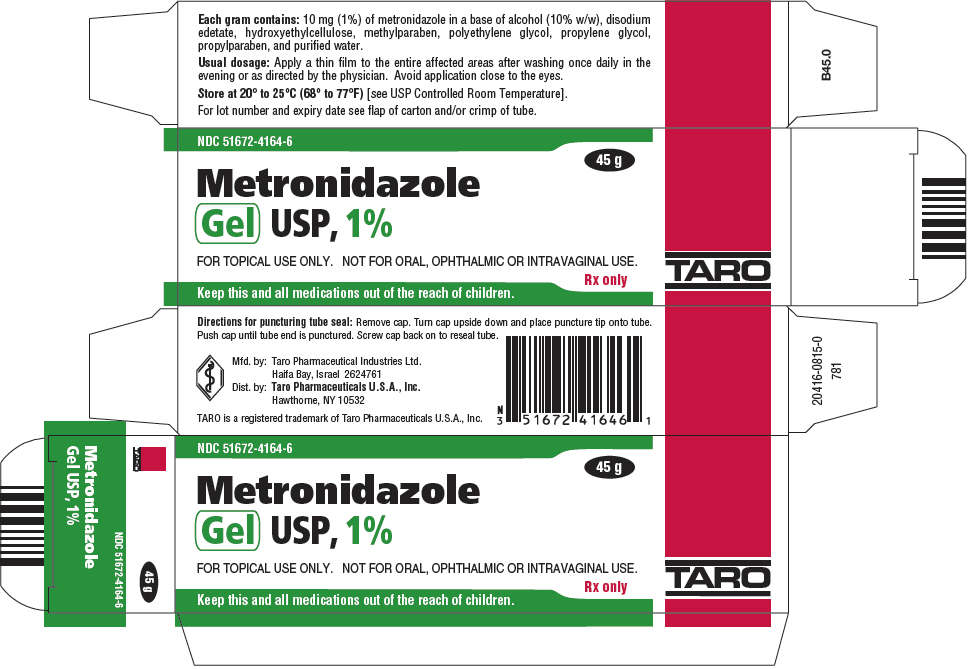
Metronidazole 10 mg/g Gel — NDC 51672-4164-9 (Billing 51672-4164-09)
This is a package of Metronidazole 10 mg/g Gel from Sun Pharmaceutical Industries, Inc., no longer marketed (first marketed Mar 2017), no longer in the FDA NDC Directory; retail pharmacies pay about $0.5229 per g (NADAC).
NDC database record
One package, one record: these facts belong to NDC 51672-4164-9 alone.
- Record
- FDA NDC Directory package listing · Human prescription drug
- Code segments
- 51672 labeler · 4164 product · 9 package
- Package marketed since
- Aug 15, 2017
- Sample package
- No — commercial package
- Listing certified through
- Dec 31, 2027
- Barcode (UPC-A, from the NDC)
- 3 5167241649 2
- FDA record last changed
- Jul 24, 2026
Identity & classification
Regulatory identifiers FDA, NLM and CMS codes for this package
Drug-database identifiers Medi-Span GPI and First Databank GCN / HICL / AHFS classification
- GSN (GCN sequence number): 068879
- GCN: 31774
- HICL (First Databank): 004157
- AHFS class code: 08:30.04.00
- RxCUI (RxNorm): 577237
Where does this data come from?
- FDA openFDA NDC Directory · synced Oct 8, 2026
- FDA label on DailyMed · label index refreshed Oct 6, 2026
- RxNorm (NLM RxNav) · catalog refreshed Oct 1, 2026
- Medi-Span GPI (licensed)
- First Databank (licensed) · refreshed Oct 8, 2026
RxNorm drug class
This medicine belongs to the Nitroimidazole Antimicrobial class.
Where does this data come from?
- RxClass (NLM) · catalog refreshed Oct 1, 2026
Clinical
- It depends on the product. Oral forms treat trichomoniasis, and some also treat amebiasis and anaerobic infections. Vaginal gels treat bacterial vaginosis, and topical cream or lot...
- No. Alcohol with oral metronidazole can cause cramps, nausea, vomiting, headache and flushing. Avoid alcohol and products with propylene glycol during treatment and for at least th...
- The most common are nausea, headache, loss of appetite, vomiting, diarrhea and stomach cramps. A metallic taste is also common. Call your doctor if you notice numbness or tingling,...
- Yes. Metronidazole can interact with warfarin, lithium, busulfan, disulfiram and drugs that affect heart rhythm. Some of these combinations need blood tests or should be avoided, s...
Patient education
Supplement & herbal interactions
Some supplements/herbs that may interact with Metronidazole — tap one for details:
Metronidazole may be associated with lower levels of 7 nutrients — worth a chat with your pharmacist, not a cause for alarm.
Where does this data come from?
- MedlinePlus (NLM) · refreshed Oct 1, 2026
- FDA label on DailyMed · label index refreshed Oct 6, 2026
Ask a licensed pharmacist directly — free, answered by our team.
Pricing
A drug doesn't have one price. Each row is a different public payment system, and none is what you'd pay at the counter — that depends on your insurance. The ⓘ on each row explains what it measures.
| Price system | Per g | Per package |
|---|---|---|
| Retail pharmacies payNADAC · weekly | $0.523 | $28.76 / 55 g |
| Medicaid paysCMS SDUD · 12 mo | No recent Medicaid claims on file for this NDC — rare and low-volume NDCs are suppressed in the public data. | |
| Medicare drug plans payPart D · Q2 2026 | $1.40 | $76.73 / 55 g |
Where does this data come from?
- CMS NADAC weekly file · file of Feb 18, 2026
- CMS ASP pricing files · refreshed Sep 20, 2026
- CMS Medicaid State Drug Utilization Data · refreshed Oct 8, 2026
- CMS Part D plan pricing files · refreshed Sep 24, 2026
- VA National Acquisition Center price file
Packaging — all sizes for this product
| Package NDC | Description | Per unit | Per pack | Marketing start | Marketing end | Status |
|---|---|---|---|---|---|---|
| 51672-4164-03 51672-4164-3 Main listing | 1 TUBE in 1 CARTON / 60 g in 1 TUBE | $0.6724 / g | $40.34 | 2017-03-14 | — | Discontinued by firm |
| 51672-4164-06 51672-4164-6 | 1 TUBE in 1 CARTON / 45 g in 1 TUBE | — | — | 2017-03-14 | — | Discontinued by firm |
| 51672-4164-09 You're viewing this | 1 BOTTLE, PUMP in 1 CARTON / 55 g in 1 BOTTLE, PUMP | $0.5229 / g | $28.76 | 2017-08-15 | — | Discontinued by firm |
This pack has the lowest per-g cost of the 2 priced pack sizes ($0.5229 NADAC).
Pack size FAQ
What quantity is in this package?
What NDC number is used to bill for this package of Metronidazole 10 mg/g Gel?
Prices are the latest CMS NADAC pharmacy acquisition cost per NDC; per-pack figures are per-unit × pack quantity, shown only when the pack is denominated in the same measure NADAC prices.
Therapeutic equivalents
| Product | Labeler | Pack | NADAC/unit | TE | Status | Price vs. this |
|---|---|---|---|---|---|---|
| Metronidazole 10 mg/gthis 51672-4164-09 | Sun | 1 bottle | $0.523 | AB | Discontinued | — |
| Metronidazole 10 mg/g 68308-0663-55 | Mayne | 1 bottle | $0.540 | AB | Availability likely | +3% |
| Metronidazole 10 mg/g 00713-0574-60 | Cosette | 1 tube | $0.621 | AB | Availability likely | +19% |
| Metronidazole 10 mg/g 51672-4215-03 | Sun | 1 tube | $0.621 | AB | Availability likely | +19% |
| Metronidazole 10 mg/g 59651-0813-60 | Aurobindo | 1 tube | $0.621 | AB | Availability likely | +19% |
| metronidazole 10 mg/g 66993-0936-58 | Prasco | 55 g | $0.866 | AB | Discontinued | +66% |
| Metronidazole 10 mg/g 46708-0630-45 | Alembic | 1 tube | — | AB | FDA listed | — |
| Metronidazole 10 mg/g 62332-0630-45 | Alembic | 1 tube | — | AB | FDA listed | — |
Where does this data come from?
- FDA openFDA NDC Directory · synced Oct 8, 2026
- FDA Orange Book · refreshed Oct 3, 2026
- CMS NADAC weekly file · file of Feb 18, 2026
Availability & generic status
This product is an FDA-approved generic. Other versions of the same drug are listed under Therapeutic equivalents, least expensive first.
Where does this data come from?
- FDA Orange Book · refreshed Oct 3, 2026
What it looks like
Where does this data come from?
- FDA label on DailyMed · label index refreshed Oct 6, 2026
Inactive Ingredients / Excipients
Inactive ingredients, also called excipients, are components of the drug product other than the active ingredient. They may include fillers, dyes, coatings, preservatives, flavors, or other formulation ingredients.
🧪 Avoiding an ingredient? See Metronidazole inactive ingredients by manufacturer: every current product's list side by side, so you can ask your pharmacy for the version that does not list it.
💡 Tap an ingredient (hover on desktop) to see what it is and why it’s used.
-
UNII 3K9958V90M
A liquid solvent derived from fermentation or chemical synthesis. In medicines, alcohol dissolves active ingredients, helps preserve the product, and improves how the body absorbs certain drugs.
-
UNII 7FLD91C86K
Edetate disodium is a chemical compound that binds and removes certain metal ions. In medicines, it acts as a preservative and stabilizer by preventing metals like calcium from interfering with the product's shelf life and consistency.
-
UNII A2I8C7HI9T
Methylparaben is a preservative derived from benzoic acid that prevents growth of bacteria, fungi, and mold in medicines. It extends the product's shelf life and maintains safety during storage.
-
UNII 3WJQ0SDW1A
Polyethylene glycol is a synthetic liquid or solid polymer used in medicines as a solvent, lubricant, and humectant. It helps dissolve active ingredients, reduces friction during manufacturing, and retains moisture in the final product.
-
UNII 6DC9Q167V3
Propylene glycol is a clear liquid derived from petroleum or vegetable sources. It acts as a solvent, humectant, and preservative in medicines, helping dissolve active ingredients and maintain product stability.
-
UNII Z8IX2SC1OH
Propylparaben is a chemical preservative used to prevent bacterial and fungal growth in medicines and personal care products. It helps extend shelf life and maintain product safety during storage.
-
UNII 059QF0KO0R
Water is a liquid solvent that dissolves and mixes ingredients together in liquid medicines, syrups, and injections. It helps distribute the active drug evenly throughout the product.
7 inactive ingredients listed in the exact product block matched to this NDC.
Where does this data come from?
ingredient classCode="IACT" elements from the exact product block matched by this NDC. Label-section narrative from DailyMed / the openFDA label index is shown separately when available.- FDA label on DailyMed · label index refreshed Oct 6, 2026
- FDA openFDA NDC Directory · synced Oct 8, 2026
Inactive ingredient FAQ
Are inactive ingredients the same for every manufacturer?
Why might an inactive ingredient be missing?
Can inactive ingredients matter?
Manufacturer & labeler
More NDCs from Sun Pharmaceutical Industries, Inc. labeler code 51672
- Lamotrigine 150 mg Tablet NDC 51672-4132-0
- Lamotrigine 200 mg Tablet NDC 51672-4133-0
- Levetiracetam 100 mg/mL Solution NDC 51672-4136-0
- Imiquimod 50 mg/g Cream NDC 51672-4145-6
- Phenytoin 50 mg Tablet, Chewable NDC 51672-4146-1
- Calcipotriene .05 mg/g Ointment NDC 51672-4154-3
- Clocortolone Pivalate .001 g/g Cream NDC 51672-4166-6
- Sodium Sulfate, Potassium Sulfate, and Magnesium Sulfate Bowel Prep kit sodium sulfate anhydrous, 17.5 g/177mL; 3.13 g/177mL; 1.6 g/177mL Solution NDC 51672-4170-5
- Felbamate 600 mg/5mL Suspension NDC 51672-4172-1
- Imiquimod 37.5 mg/g Cream NDC 51672-4174-6
- Felbamate 400 mg Tablet NDC 51672-4185-1
- Felbamate 600 mg Tablet NDC 51672-4186-1
Where does this data come from?
- FDA openFDA NDC Directory · synced Oct 8, 2026
- Drugs@FDA
Full prescribing information FDA SPL
🎯 Indications and Usage ▾
1 INDICATIONS AND USAGE Metronidazole Gel USP, 1% is indicated for the topical treatment of inflammatory lesions of rosacea. Metronidazole Gel USP, 1% is a nitroimidazole indicated for the topical treatment of inflammatory lesions of rosacea. ( 1 )
⏱️ Dosage and Administration ▾
2 DOSAGE AND ADMINISTRATION Apply and rub in a thin film of metronidazole once daily to affected area(s). A gentle cleanser should be used before the application of metronidazole. Cosmetics may be applied after the application of metronidazole.
Not for oral, ophthalmic or intravaginal use. Not for oral, ophthalmic or intravaginal use. Apply and rub in a thin film of metronidazole once daily to affected area(s).
( 2 ) Treated areas should be cleansed before the application of metronidazole. ( 2 ) Cosmetics may be applied after the application of metronidazole. ( 2 )
💊 Dosage Forms and Strengths ▾
3 DOSAGE FORMS AND STRENGTHS Gel, 1%. Metronidazole is a colorless to slightly yellow gel. Each gram of metronidazole contains 10 mg (1%) of metronidazole. Gel, 1%.
⛔ Contraindications ▾
4 CONTRAINDICATIONS Metronidazole Gel USP, 1% is contraindicated in patients with a history of hypersensitivity to metronidazole or to any other ingredient in the formulation. Metronidazole Gel USP, 1% is contraindicated in those patients with a history of hypersensitivity to metronidazole or to any other ingredient in this formulation. ( 4 )
⚠️ Warnings and Cautions ▾
5 WARNINGS AND PRECAUTIONS Peripheral neuropathy, characterized by numbness or paresthesia of an extremity has been reported in patients treated with systemic metronidazole. Although not evident in clinical trials for topical metronidazole, peripheral neuropathy has been reported with the post approval use. The appearance of abnormal neurologic signs should prompt immediate reevaluation of metronidazole therapy.
( 5.1 ) Metronidazole is a nitroimidazole and should be used with care in patients with evidence of, or history of, blood dyscrasia. ( 5.2 ) If dermatitis occurs, patients may need to discontinue use. ( 5.3 ) Topical metronidazole has been reported to cause tearing of the eyes.
Therefore, contact with the eyes should be avoided. ( 5.4 )
5.1Neurologic Disease Peripheral neuropathy, characterized by numbness or paresthesia of an extremity has been reported in patients treated with systemic metronidazole. Although not evident in clinical trials for topical metronidazole, peripheral neuropathy has been reported with the post approval use. The appearance of abnormal neurologic signs should prompt immediate reevaluation of metronidazole therapy.
Metronidazole should be administered with caution to patients with central nervous system diseases.
5.2Blood Dyscrasias Metronidazole is a nitroimidazole; use with care in patients with evidence of, or history of, blood dyscrasia.
5.3Contact Dermatitis Irritant and allergic contact dermatitis have been reported. If dermatitis occurs, patients may need to discontinue use.
5.4Eye Irritation Topical metronidazole has been reported to cause tearing of the eyes. Avoid contact with the eyes.
🤒 Adverse Reactions ▾
6 ADVERSE REACTIONS Most common adverse reactions (incidence > 2%) are nasopharyngitis, upper respiratory tract infection, and headache ( 6 ) To report SUSPECTED ADVERSE REACTIONS, contact Taro Pharmaceuticals U.S.A., Inc. at 1-866-923-4914 or FDA at 1-800-FDA-1088 or www.fda.gov/medwatch.
6.1Clinical Trials Experience Because clinical trials are conducted under widely varying conditions, adverse reaction rates observed in the clinical trials of a drug cannot be directly compared to rates in the clinical trials of another drug and may not reflect the rates observed in practice. In a controlled clinical trial, 557 patients used metronidazole gel USP, 1% and 189 patients used the gel vehicle once daily for up to 10 weeks. The following table summarizes selected adverse reactions that occurred at a rate of ≥ 1%: Table 1: Adverse Reactions That Occurred at a Rate of ≥1% System Organ Class/Preferred Term Metronidazole Gel USP, 1% Gel Vehicle N=557 N=189 Patients with at least one AE Number (%) of Patients 186 (33.4) 51 (27.0) Infections and infestations 76 (13.6) 28 (14.8) Bronchitis 6 (1.1) 3 (1.6) Influenza 8 (1.4) 1 (0.5) Nasopharyngitis 17 (3.1) 8 (4.2) Sinusitis 8 (1.4) 3 (1.6) Upper respiratory tract infection 14 (2.5) 4 (2.1) Urinary tract infection 6 (1.1) 1 (0.5) Vaginal mycosis 1 (0.2) 2 (1.1) Musculoskeletal and connective tissue disorders 19 (3.4) 5 (2.6) Back pain 3 (0.5) 2 (1.1) Neoplasms 4 (0.7) 2 (1.1) Basal cell carcinoma 1 (0.2) 2 (1.1) Nervous system disorders 18 (3.2) 3 (1.6) Headache 12 (2.2) 1 (0.5) Respiratory, thoracic and mediastinal disorders 22 (3.9) 5 (2.6) Nasal congestion 6 (1.1) 3 (1.6) Skin and subcutaneous tissue disorders 36 (6.5) 12 (6.3) Contact dermatitis 7 (1.3) 1 (0.5) Dry skin 6 (1.1) 3 (1.6) Vascular disorders 8 (1.4) 1 (0.5) Hypertension 6 (1.1) 1 (0.5) Table 2: Local Cutaneous Signs and Symptoms of Irritation That Were Worse Than Baseline Metronidazole Gel USP, 1% Gel Vehicle Sign/Symptom N=544 N=184 Dryness 138 (25.4) 63 (34.2) Mild 93 (17.1) 41 (22.3) Moderate 42 (7.7) 20 (10.9) Severe 3 (0.6) 2 (1.1) Scaling 134 (24.6) 60 (32.6) Mild 88 (16.2) 32 (17.4) Moderate 43 (7.9) 27 (14.7) Severe 3 (0.6) 1 (0.5) Pruritus 86 (15.8) 35 (19.0) Mild 53 (9.7) 21 (11.4) Moderate 27 (5.0) 13 (7.1) Severe 6 (1.1) 1 (0.5) Stinging/burning 56 (10.3) 28 (15.2) Mild 39 (7.2) 18 (9.8) Moderate 7 (1.3) 9 (4.9) Severe 10 (1.8) 1 (0.5) The following additional adverse experiences have been reported with the topical use of metronidazole: skin irritation, transient redness, metallic taste, tingling or numbness of extremities, and nausea.
6.2Post Marketing Experience The following adverse reaction has been identified during post approval use of topical metronidazole: peripheral neuropathy. Because this reaction is reported voluntarily from a population of uncertain size, it is not always possible to reliably estimate the frequency or establish a causal relationship to drug exposure.
🔄 Drug Interactions ▾
7 DRUG INTERACTIONS Oral metronidazole has been reported to potentiate the anticoagulant effect of coumarin and warfarin, resulting in a prolongation of prothrombin time. Drug interactions should be kept in mind when metronidazole is prescribed for patients who are receiving anticoagulant treatment, although they are less likely to occur with topical metronidazole administration because of low absorption. Oral metronidazole has been reported to potentiate the anticoagulant effect of coumarin and warfarin, resulting in a prolongation of prothrombin time.
Drug interactions should be kept in mind when metronidazole is prescribed for patients who are receiving anticoagulant treatment, although they are less likely to occur with topical metronidazole administration because of low absorption. ( 7 )
👥 Use in Specific Populations ▾
8 USE IN SPECIFIC POPULATIONS
8.1Pregnancy Teratogenic Effects: Pregnancy Category B. There are no adequate and well-controlled studies with the use of metronidazole in pregnant women. Metronidazole crosses the placental barrier and enters the fetal circulation rapidly.
No fetotoxicity was observed after oral administration of metronidazole in rats or mice at 200 and 20 times, respectively, the expected clinical dose. However, oral metronidazole has shown carcinogenic activity in rodents. Because animal reproduction studies are not always predictive of human response, metronidazole should be used during pregnancy only if clearly needed.
8.3Nursing Mothers After oral administration, metronidazole is secreted in breast milk in concentrations similar to those found in the plasma. Even though blood levels taken after topical metronidazole application are significantly lower than those achieved after oral metronidazole a decision should be made whether to discontinue nursing or to discontinue the drug, taking into account the importance of the drug to the mother and the risk to the infant.
8.4Pediatric Use Safety and effectiveness in pediatric patients have not been established.
8.5Geriatric Use Sixty-six subjects aged 65 years and older were treated with metronidazole gel USP, 1% in the clinical study. No overall differences in safety or effectiveness were observed between these subjects and younger subjects, and other reported clinical experience has not identified differences in responses between the elderly and younger patients, but greater sensitivity of some older individuals cannot be ruled out.
🤰 Pregnancy ▾
8.1Pregnancy Teratogenic Effects: Pregnancy Category B. There are no adequate and well-controlled studies with the use of metronidazole in pregnant women. Metronidazole crosses the placental barrier and enters the fetal circulation rapidly.
No fetotoxicity was observed after oral administration of metronidazole in rats or mice at 200 and 20 times, respectively, the expected clinical dose. However, oral metronidazole has shown carcinogenic activity in rodents. Because animal reproduction studies are not always predictive of human response, metronidazole should be used during pregnancy only if clearly needed.
🧒 Pediatric Use ▾
8.4Pediatric Use Safety and effectiveness in pediatric patients have not been established.
🧓 Geriatric Use ▾
8.5Geriatric Use Sixty-six subjects aged 65 years and older were treated with metronidazole gel USP, 1% in the clinical study. No overall differences in safety or effectiveness were observed between these subjects and younger subjects, and other reported clinical experience has not identified differences in responses between the elderly and younger patients, but greater sensitivity of some older individuals cannot be ruled out.
🆘 Overdosage ▾
10 OVERDOSAGE There are no reported human experiences with overdosage of metronidazole. Topically applied metronidazole can be absorbed in sufficient amount to produce systemic effects.
🧬 Clinical Pharmacology ▾
12 CLINICAL PHARMACOLOGY
12.1Mechanism of Action The mechanism of action of metronidazole in the treatment of rosacea is unknown.
12.2Pharmacodynamics The pharmacodynamics of metronidazole in association with the treatment of rosacea are unknown.
12.3Pharmacokinetics Topical administration of a one gram dose of metronidazole to the face of 13 patients with moderate to severe rosacea once daily for 7 days resulted in a mean ± SD C max of metronidazole of 32 ± 9 ng/mL. The mean ± SD AUC (0-24) was 595 ± 154 ng*hr/mL. The mean C max and AUC (0-24) are less than 1% of the value reported for a single 250 mg oral dose of metronidazole.
The time to maximum plasma concentration (T max ) was 6 to 10 hours after topical application.
🧬 Mechanism of Action ▾
12.1Mechanism of Action The mechanism of action of metronidazole in the treatment of rosacea is unknown.
📦 How Supplied / Storage and Handling ▾
16 HOW SUPPLIED/STORAGE AND HANDLING Metronidazole Gel USP, 1% is colorless to slightly yellow in color, and supplied as follows: 45 g tube - (NDC 51672-4164-6) 60 g tube - (NDC 51672-4164-3) 55 g pump - (NDC 51672-4164-9) Storage Conditions: Store at 20° to 25°C (68° to 77°F) [see USP Controlled Room Temperature].
📦 Storage and Handling ▾
Storage Conditions: Store at 20° to 25°C (68° to 77°F) [see USP Controlled Room Temperature].
📋 Description ▾
11 DESCRIPTION Metronidazole Gel USP, 1% contains metronidazole, USP. Chemically, metronidazole is 2-methyl-5-nitro-1 H -imidazole- 1-ethanol. The molecular formula for metronidazole is C 6 H 9 N 3 O 3 .
It has the following structural formula: Metronidazole has a molecular weight of 171.16. It is a white to pale yellow crystalline powder. It is slightly soluble in alcohol and has solubility in water of 10 mg/mL at 20°C.
Metronidazole belongs to the nitroimidazole class of compounds. Metronidazole is a colorless to slightly yellow gel; each gram contains 10 mg of metronidazole in a base of alcohol (10% w/w), disodium edetate, hydroxyethylcellulose, methylparaben, polyethylene glycol, propylene glycol, propylparaben, and purified water. Chemical Structure
💬 Information for Patients ▾
17 PATIENT COUNSELING INFORMATION Patients using Metronidazole Gel USP, 1% should receive the following information and instructions: This medication is to be used as directed. It is for external use only. Avoid contact with the eyes.
Cleanse affected area(s) before applying Metronidazole Gel USP, 1%. This medication should not be used for any condition other than that for which it is prescribed. Keep out of reach of children.
Patients should report any adverse reaction to their physicians.
🍼 Nursing Mothers ▾
8.3Nursing Mothers After oral administration, metronidazole is secreted in breast milk in concentrations similar to those found in the plasma. Even though blood levels taken after topical metronidazole application are significantly lower than those achieved after oral metronidazole a decision should be made whether to discontinue nursing or to discontinue the drug, taking into account the importance of the drug to the mother and the risk to the infant.
🧬 Pharmacokinetics ▾
12.3Pharmacokinetics Topical administration of a one gram dose of metronidazole to the face of 13 patients with moderate to severe rosacea once daily for 7 days resulted in a mean ± SD C max of metronidazole of 32 ± 9 ng/mL. The mean ± SD AUC (0-24) was 595 ± 154 ng*hr/mL. The mean C max and AUC (0-24) are less than 1% of the value reported for a single 250 mg oral dose of metronidazole.
The time to maximum plasma concentration (T max ) was 6 to 10 hours after topical application.
🧬 Pharmacodynamics ▾
12.2Pharmacodynamics The pharmacodynamics of metronidazole in association with the treatment of rosacea are unknown.
🔬 Clinical Studies ▾
14 CLINICAL STUDIES In a randomized, vehicle-controlled trial, 746 subjects with rosacea were treated with metronidazole gel USP, 1% or gel vehicle once daily for 10 weeks. Most subjects had "moderate" rosacea at baseline. Efficacy was determined by recording reduction in inflammatory lesion counts and success rate in the Investigator Global Assessment (percentage of subjects "clear" and "almost clear" of rosacea at the end of the study).
The scale is based on the following definitions: Table 3: Investigator Global Assessment Scale Score Grade Definition 0 Clear No signs or symptoms present; at most, mild erythema 1 Almost Clear Very mild erythema present. Very few small papules/pustules 2 Mild Mild erythema. Several small papules/pustules 3 Moderate Moderate erythema.
Several small or large papules/pustules, and up to 2 nodules 4 Severe Severe erythema. Numerous small and/or large papules/pustules, up to several nodules The results are shown in the following table: Table 4: Inflammatory Lesion Counts and Global Scores in a Clinical Trial of Rosacea Metronidazole Gel USP, 1% Vehicle N Results N (%) N Results N (%) Inflammatory lesions 557 189 Baseline, mean count 18.3
18.4Week-10, mean count 8.9
12.8Reduction 9.4 (50.7) 5.6 (32.6) Investigator Global Assessment 557 189 Subject clear or almost clear 214 (38.42) 52 (27.51) Subject with no change 159 (28.5) 77 (40.7) Subjects treated with metronidazole gel USP, 1% experienced a mean reduction of 9.4 inflammatory lesions in the Week-10 LOCF group, compared to a reduction of 5.6 for those treated with vehicle, or a difference in means of 3.8 lesions. The contribution to efficacy of individual components of the vehicle has not been established.
🧪 Nonclinical Toxicology ▾
13 NONCLINICAL TOXICOLOGY
13.1Carcinogenesis, Mutagenesis, Impairment of Fertility Metronidazole has shown evidence of carcinogenic activity in a number of studies involving chronic, oral administration in mice and rats, but not in studies involving hamsters. In several long-term studies in mice, oral doses of approximately 225 mg/m 2 /day or greater (approximately 37 times the human topical dose on a mg/m 2 basis) were associated with an increase in pulmonary tumors and lymphomas. Several long-term oral studies in the rat have shown statistically significant increases in mammary and hepatic tumors at doses >885 mg/m 2 /day (144 times the human dose).
Metronidazole has shown evidence of mutagenic activity in several in vitro bacterial assay systems. In addition, a dose-related increase in the frequency of micronuclei was observed in mice after intraperitoneal injections. An increase in chromosomal aberrations in peripheral blood lymphocytes was reported in patients with Crohn's disease who were treated with 200 to 1200 mg/day of metronidazole for 1 to 24 months.
However, in another study, no increase in chromosomal aberrations in circulating lymphocytes was observed in patients with Crohn's disease treated with the drug for 8 months. In one published study, using albino hairless mice, intraperitoneal administration of metronidazole at a dose of 45 mg/m 2 /day (approximately 7 times the human topical dose on a mg/m 2 basis) was associated with an increase in ultraviolet radiation induced skin carcinogenesis. Neither dermal carcinogenicity nor photocarcinogenicity studies have been performed with metronidazole gel USP, 1% or any marketed metronidazole formulations.
📄 Carcinogenesis, Mutagenesis, Impairment of Fertility ▾
13.1Carcinogenesis, Mutagenesis, Impairment of Fertility Metronidazole has shown evidence of carcinogenic activity in a number of studies involving chronic, oral administration in mice and rats, but not in studies involving hamsters. In several long-term studies in mice, oral doses of approximately 225 mg/m 2 /day or greater (approximately 37 times the human topical dose on a mg/m 2 basis) were associated with an increase in pulmonary tumors and lymphomas. Several long-term oral studies in the rat have shown statistically significant increases in mammary and hepatic tumors at doses >885 mg/m 2 /day (144 times the human dose).
Metronidazole has shown evidence of mutagenic activity in several in vitro bacterial assay systems. In addition, a dose-related increase in the frequency of micronuclei was observed in mice after intraperitoneal injections. An increase in chromosomal aberrations in peripheral blood lymphocytes was reported in patients with Crohn's disease who were treated with 200 to 1200 mg/day of metronidazole for 1 to 24 months.
However, in another study, no increase in chromosomal aberrations in circulating lymphocytes was observed in patients with Crohn's disease treated with the drug for 8 months. In one published study, using albino hairless mice, intraperitoneal administration of metronidazole at a dose of 45 mg/m 2 /day (approximately 7 times the human topical dose on a mg/m 2 basis) was associated with an increase in ultraviolet radiation induced skin carcinogenesis. Neither dermal carcinogenicity nor photocarcinogenicity studies have been performed with metronidazole gel USP, 1% or any marketed metronidazole formulations.
📄 Package Label / Principal Display Panel ▾
PRINCIPAL DISPLAY PANEL - 45 g Tube Carton NDC 51672-4164-6 45 g Metronidazole Gel USP, 1% FOR TOPICAL USE ONLY. NOT FOR ORAL, OPHTHALMIC OR INTRAVAGINAL USE. Rx only Keep this and all medications out of the reach of children. TARO PRINCIPAL DISPLAY PANEL - 45 g Tube Carton
Medicare Part D spend CMS · PART D · 2026 (Q1)
About this NDC listing & data coverage
What data is (and isn’t) available for this NDC — tap to expand
| NDC identity (package / product / labeler codes) | ✓ Available |
| Labeler | ✓ Available |
| Product & package description | ✓ Available |
| Marketing category & status | ✓ Available |
| Active ingredient / dosage form / route | ✓ Available |
| FDA label (SPL via DailyMed) | ✓ Available |
| Package photos | ✓ Available |
| Inactive ingredients (structured) | ✓ Available |
| NADAC pharmacy acquisition price (CMS) | ✓ Available |
| Orange Book / therapeutic-equivalence data | ✓ Available |
| HCPCS J-code billing crosswalk | — Not published for this NDC Most self-administered / retail products have no J-code — that is normal. |
| Medicaid utilization (CMS SDUD) | — Not published for this NDC CMS reports utilization only for NDCs with Medicaid claims above its privacy threshold. |