
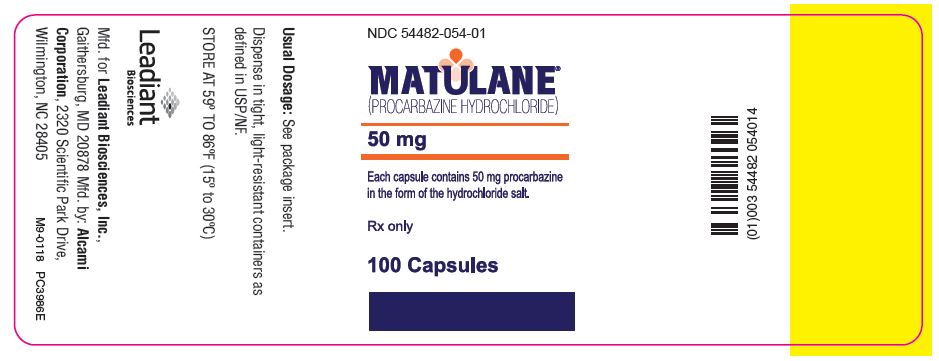
Matulane procarbazine hydrochloride 50 mg Capsule, 100-count — NDC 54482-054-01 (Billing 54482-0054-01)
This is a package of 100 capsules of Matulane procarbazine hydrochloride 50 mg Capsule from Leadiant Biosciences, Inc., marketed since Dec 1985 and currently FDA-listed. It is this product's only package size.
NDC database record
One package, one record: these facts belong to NDC 54482-054-01 alone.
- Record
- FDA NDC Directory package listing · Human prescription drug
- Code segments
- 54482 labeler · 054 product · 01 package
- Package marketed since
- Dec 27, 1985
- Sample package
- No — commercial package
- Listing certified through
- Dec 31, 2026
- Billing quantity
- 100 EA per package
- Barcode (UPC-A, from the NDC)
- 3 5448205401 4
- FDA record last changed
- Jul 24, 2026
Identity & classification
Regulatory identifiers FDA, NLM and CMS codes for this package
Drug-database identifiers Medi-Span GPI and First Databank GCN / HICL / AHFS classification
- GSN (GCN sequence number): 008836
- GCN: 38740
- GPI-14 (Medi-Span): 21700050100105
- HICL (First Databank): 003928
- AHFS class code: 10:00.00.00
- RxCUI (RxNorm): 207588
Where does this data come from?
- FDA openFDA NDC Directory · synced Oct 8, 2026
- FDA label on DailyMed · label index refreshed Oct 8, 2026
- RxNorm (NLM RxNav) · catalog refreshed Oct 8, 2026
- Medi-Span GPI (licensed)
- First Databank (licensed) · refreshed Oct 8, 2026
RxNorm drug class
This medicine belongs to the Alkylating Drug class.
Where does this data come from?
- RxClass (NLM) · catalog refreshed Oct 8, 2026
Clinical
Procarbazine is used in combination with other medications to treat certain types of Hodgkins disease (types of cancer that begin in a type of white blood cells that normally fights infection). Procarbazine is in a class of medications called alkylating agents. It works by slowing or stopping the growth of cancer cells in your body.
Read the full MedlinePlus article ↗- Matulane is a chemotherapy drug used to treat Stage III and IV Hodgkin's disease — an advanced form of cancer that affects the lymph system. It's always given as part of a combinat...
- Matulane has what's called MAO inhibitor activity — it blocks an enzyme your body uses to break down certain chemicals. When that enzyme is blocked, eating foods high in tyramine (...
- Why do I have to avoid certain foods while taking this?
- No — you need to completely avoid alcohol while taking Matulane. Combining the two can trigger a severe reaction similar to what happens with the drug Antabuse: flushing, nausea, r...
Patient education
Supplement & herbal interactions
Procarbazine may be associated with lower levels of 1 nutrient — worth a chat with your pharmacist, not a cause for alarm.
Where does this data come from?
- MedlinePlus (NLM) · refreshed Oct 8, 2026
- FDA label on DailyMed · label index refreshed Oct 8, 2026
Ask a licensed pharmacist directly — free, answered by our team.
Pricing
A drug doesn't have one price. Each row is a different public payment system, and none is what you'd pay at the counter — that depends on your insurance. The ⓘ on each row explains what it measures.
| Price system | Per each | Per package |
|---|---|---|
| Retail pharmacies payNADAC · weekly | Not in the retail survey — common for institutional, discontinued, or low-volume packs. | |
| Medicaid paysCMS SDUD · 12 mo | No recent Medicaid claims on file for this NDC — rare and low-volume NDCs are suppressed in the public data. | |
| Medicare drug plans payPart D · Q2 2026 | $178.95 | $17,894.86 / 100 capsules |
| Medicare Part B allowsASP · J8999 | No ASP payment limit on file for J8999 this quarter. | |
Where does this data come from?
- CMS NADAC weekly file
- CMS ASP pricing files · refreshed Sep 20, 2026
- CMS Medicaid State Drug Utilization Data · refreshed Oct 9, 2026
- CMS Part D plan pricing files · refreshed Sep 24, 2026
- VA National Acquisition Center price file
Billing & reimbursement
Where does this data come from?
- CMS ASP NDC-HCPCS crosswalk · refreshed Sep 22, 2026
- DMEPDAC NDC-HCPCS crosswalk
- openFDA NSDE billing units · refreshed Oct 7, 2026
Packaging — all sizes for this product
| Package NDC | Description | Marketing start | Marketing end | Status |
|---|---|---|---|---|
| 54482-0054-01 You're viewing this Main listing | 100 CAPSULE in 1 BOTTLE | 1985-12-27 | — | Active |
Therapeutic equivalents
| Product | Labeler | Pack | NADAC/unit | TE | Status | Price vs. this |
|---|---|---|---|---|---|---|
| Matulane 50 mgthis 54482-0054-01 | Leadiant | 100 capsules | — | — | FDA listed | — |
Where does this data come from?
- FDA openFDA NDC Directory · synced Oct 8, 2026
- FDA Orange Book · refreshed Oct 9, 2026
- CMS NADAC weekly file
Availability & generic status
We did not find an FDA-approved generic match for this exact strength, form and route.
Where does this data come from?
- FDA Orange Book · refreshed Oct 9, 2026
What it looks like
Where does this data come from?
- FDA label on DailyMed · label index refreshed Oct 8, 2026
Inactive Ingredients / Excipients
Inactive ingredients, also called excipients, are components of the drug product other than the active ingredient. They may include fillers, dyes, coatings, preservatives, flavors, or other formulation ingredients.
🧪 Avoiding an ingredient? See Procarbazine inactive ingredients by manufacturer: every current product's list side by side, so you can ask your pharmacy for the version that does not list it.
💡 Tap an ingredient (hover on desktop) to see what it is and why it’s used.
-
UNII 35SW5USQ3G
A synthetic yellow dye used to color medicines. It helps make tablets, capsules, and liquids visually distinct so patients can easily identify their medication.
-
UNII H77VEI93A8
A synthetic yellow dye used to color medications. It helps identify the drug and make it visually distinctive, with no effect on how the medicine works.
-
UNII 2G86QN327L
Gelatin is a protein derived from animal collagen, commonly used in medicines as a gelling agent and capsule material. It helps create soft or hard capsule shells that hold and release medication, and can also thicken liquid formulations.
-
UNII 3OWL53L36A
A natural sugar alcohol derived from seaweed or synthesized in the lab. It's used as a filler to add bulk, a sweetener in sugar-free formulas, and a disintegrant to help tablets break apart in the stomach.
-
UNII O8232NY3SJ
A plant-based carbohydrate derived from corn kernels. It acts as a filler to add bulk, a binder to hold ingredients together, and a disintegrant to help the tablet break apart in your stomach for absorption.
-
UNII 7SEV7J4R1U
A powder made from a naturally occurring mineral. In medicines, talc works as a glidant and anti-caking agent, helping tablets and capsules flow smoothly during manufacturing and preventing clumping.
-
UNII 15FIX9V2JP
Titanium dioxide is a bright white mineral powder commonly used as a colorant and opacifying agent. It makes pills and tablets white or lighter in color and helps make coatings non-transparent.
7 inactive ingredients listed in the exact product block matched to this NDC.
Where does this data come from?
ingredient classCode="IACT" elements from the exact product block matched by this NDC. Label-section narrative from DailyMed / the openFDA label index is shown separately when available.- FDA label on DailyMed · label index refreshed Oct 8, 2026
- FDA openFDA NDC Directory · synced Oct 8, 2026
Inactive ingredient FAQ
Are inactive ingredients the same for every manufacturer?
Why might an inactive ingredient be missing?
Can inactive ingredients matter?
Manufacturer & labeler
More NDCs from Leadiant Biosciences, Inc. labeler code 54482
- CYSTARAN cysteamine hydrochloride 6.5 mg/mL Solution NDC 54482-020-02
- CYSTARAN cysteamine hydrochloride 6.5 mg/mL Solution NDC 54482-035-02
- Carnitor levocarnitine 330 mg Tablet NDC 54482-144-07
- Carnitor levocarnitine 1 g/10mL Solution NDC 54482-145-08
- Carnitor levocarnitine 1 g/5mL Injection, Solution NDC 54482-147-01
- Carnitor SF levocarnitine 1 g/10mL Solution NDC 54482-148-01
Where does this data come from?
- FDA openFDA NDC Directory · synced Oct 8, 2026
- Drugs@FDA
Full prescribing information FDA SPL
🚨 Boxed Warning ▾
WARNING It is recommended that MATULANE be given only by or under the supervision of a physician experienced in the use of potent antineoplastic drugs. Adequate clinical and laboratory facilities should be available to patients for proper monitoring of treatment.
🎯 Indications and Usage ▾
INDICATIONS AND USAGE Matulane is indicated for use in combination with other anticancer drugs for the treatment of Stage III and IV Hodgkin's disease. Matulane is used as part of the MOPP (nitrogen mustard, vincristine, procarbazine, prednisone) regimen.
⏱️ Dosage and Administration ▾
DOSAGE AND ADMINISTRATION The following doses are for administration of the drug as a single agent. When used in combination with other anticancer drugs, the Matulane dose should be appropriately reduced, eg, in the MOPP regimen, the Matulane dose is 100 mg/m2 daily for 14 days. All dosages are based on the patient's actual weight.
However, the estimated lean body mass (dry weight) is used if the patient is obese or if there has been a spurious weight gain due to edema, ascites or other forms of abnormal fluid retention. Adults: To minimize the nausea and vomiting experienced by a high percentage of patients beginning Matulane therapy, single or divided doses of 2 to 4 mg/kg/day for the first week are recommended. Daily dosage should then be maintained at 4 to 6 mg/kg/day until maximum response is obtained or until the white blood count falls below 4000/cmm or the platelets fall below 100,000/ cmm.
When maximum response is obtained, the dose may be maintained at 1 to 2 mg/kg/day. Upon evidence of hematologic or other toxicity (see PRECAUTIONS section), the drug should be discontinued until there has been satisfactory recovery. After toxic side effects have subsided, therapy may then be resumed at the discretion of the physician, based on clinical evaluation and appropriate laboratory studies, at a dosage of 1 to 2 mg/kg/day.
Pediatric Patients: Very close clinical monitoring is mandatory. Undue toxicity, evidenced by tremors, coma and convulsions, has occurred in a few cases. Dosage, therefore, should be individualized.
The following dosage schedule is provided as a guideline only. Fifty (50) mg per square meter of body surface per day is recommended for the first week. Dosage should then be maintained at 100 mg per square meter of body surface per day until maximum response is obtained or until leukopenia or thrombocytopenia occurs.
When maximum response is attained, the dose may be maintained at 50 mg per square meter of body surface per day. Upon evidence of hematologic or other toxicity (see PRECAUTIONS section), the drug should be discontinued until there has been satisfactory recovery, based on clinical evaluation and appropriate laboratory tests. After toxic side effects have subsided, therapy may then be resumed.
Procedures for proper handling and disposal of anticancer drugs should be considered. Several guidelines on this subject have been published. 1-6 There is no general agreement that all of the procedures recommended in the guidelines are necessary or appropriate.
⛔ Contraindications ▾
CONTRAINDICATIONS Matulane is contraindicated in patients with known hypersensitivity to the drug or inadequate marrow reserve as demonstrated by bone marrow aspiration. Due consideration of this possible state should be given to each patient who has leukopenia, thrombocytopenia or anemia.
⚠️ Warnings ▾
WARNINGS To minimize CNS depression and possible potentiation, barbiturates, antihistamines, narcotics, hypotensive agents or phenothiazines should be used with caution. Ethyl alcohol should not be used since there may be an Antabuse (disulfiram)-like reaction. Because Matulane exhibits some monoamine oxidase inhibitory activity, sympathomimetic drugs, tricyclic antidepressant drugs (eg, amitriptyline HCI, imipramine HCI) and other drugs and foods with known high tyramine content, such as wine, yogurt, ripe cheese and bananas, should be avoided.
A further phenomenon of toxicity common to many hydrazine derivatives is hemolysis and the appearance of Heinz‑Ehrlich inclusion bodies in erythrocytes. Pregnancy Teratogenic Effects Procarbazine hydrochloride can cause fetal harm when administered to a pregnant woman. While there are no adequate and well‑controlled studies with procarbazine hydrochloride in pregnant women, there are case reports of malformations in the offspring of women who were exposed to procarbazine hydrochloride in combination with other antineoplastic agents during pregnancy.
Matulane should be used during pregnancy only if the potential benefit justifies the potential risk to the fetus. If this drug is used during pregnancy, or if the patient becomes pregnant while taking this drug, the patient should be apprised of the potential hazard to the fetus. Women of childbearing potential should be advised to avoid becoming pregnant.
Procarbazine hydrochloride is teratogenic in the rat when given at doses approximately 4 to 13 times the maximum recommended human therapeutic dose of 6 mg/kg/day. Nonteratogenic Effects Procarbazine hydrochloride has not been adequately studied in animals for its effects on peri- and postnatal development. However, neurogenic tumors were noted in the offspring of rats given intravenous injections of 125 mg/kg of procarbazine hydrochloride on day 22 of gestation.
Compounds which inhibit DNA, RNA and protein synthesis might be expected to have adverse effects on peri- and postnatal development. Carcinogenesis, Mutagenesis, Impairment of Fertility Carcinogenesis The carcinogenicity of procarbazine hydrochloride in mice, rats and monkeys has been reported in a considerable number of studies. Instances of a second nonlymphoid malignancy, including lung cancer and acute myelocytic leukemia, have been reported in patients with Hodgkin's disease treated with procarbazine in combination with other chemotherapy and/or radiation.
The risks of secondary lung cancer from treatment appear to be multiplied by tobacco use. The International Agency for Research on Cancer (IARC) considers that there is "sufficient evidence" for the human carcinogenicity of procarbazine hydrochloride when it is given in intensive regimens which include other antineoplastic agents but that there is inadequate evidence of carcinogenicity in humans given procarbazine hydrochloride alone. Mutagenesis Procarbazine hydrochloride has been shown to be mutagenic in a variety of bacterial and mammalian test systems.
Impairment of Fertility Azoospermia and antifertility effects associated with procarbazine hydrochloride administration in combination with other chemotherapeutic agents for treating Hodgkin's disease have been reported in human clinical studies. Since these patients received multicombination therapy, it is difficult to determine to what extent procarbazine hydrochloride alone was involved in the male germcell damage. The usual Segment I fertility/reproduction studies in laboratory animals have not been carried out with procarbazine hydrochloride.
However, compounds which inhibit DNA, RNA and/or protein synthesis might be expected to have adverse effects on gametogenesis. Unscheduled DNA synthesis in the testis of rabbits and decreased fertility in male mice treated with procarbazine hydrochloride have been reported.
🤒 Adverse Reactions ▾
ADVERSE REACTIONS Leukopenia, anemia and thrombopenia occur frequently. Nausea and vomiting are the most commonly reported side effects. Other adverse reactions are: Hematologic Pancytopenia; eosinophilia; hemolytic anemia; bleeding tendencies such as petechiae, purpura, epistaxis and hemoptysis.
Gastrointestinal Hepatic dysfunction, jaundice, stomatitis, hematemesis, melena, diarrhea, dysphagia, anorexia, abdominal pain, constipation, dry mouth. Neurologic Coma, convulsions, neuropathy, ataxia, paresthesia, nystagmus, diminished reflexes, falling, foot drop, headache, dizziness, unsteadiness. Cardiovascular Hypotension, tachycardia, syncope.
Ophthalmic Retinal hemorrhage, papilledema, photophobia, diplopia, inability to focus. Respiratory Pneumonitis, pleural effusion, cough. Dermatologic Herpes, dermatitis, pruritus, alopecia, hyperpigmentation, rash, urticaria, flushing.
Allergic Generalized allergic reactions. Genitourinary Hematuria, urinary frequency, nocturia. Musculoskeletal Pain, including myalgia and arthralgia; tremors.
Psychiatric Hallucinations, depression, apprehension, nervousness, confusion, nightmares. Endocrine Gynecomastia in prepubertal and early pubertal boys. Miscellaneous Intercurrent infections, hearing loss, pyrexia, diaphoresis, lethargy, weakness, fatigue, edema, chills, insomnia, slurred speech, hoarseness, drowsiness.
Second nonlymphoid malignancies (including lung cancer, acute myelocytic leukemia and malignant myelosclerosis) and azoospermia have been reported in patients with Hodgkin's disease treated with procarbazine in combination with other chemotherapy and/or radiation. The risks of secondary lung cancer from treatment appear to be multiplied by tobacco use.
🔄 Drug Interactions ▾
Drug Interactions See WARNINGS section. No cross-resistance with other chemotherapeutic agents, radiotherapy or steroids has been demonstrated.
🤰 Pregnancy ▾
Pregnancy Teratogenic Effects Procarbazine hydrochloride can cause fetal harm when administered to a pregnant woman. While there are no adequate and well‑controlled studies with procarbazine hydrochloride in pregnant women, there are case reports of malformations in the offspring of women who were exposed to procarbazine hydrochloride in combination with other antineoplastic agents during pregnancy. Matulane should be used during pregnancy only if the potential benefit justifies the potential risk to the fetus.
If this drug is used during pregnancy, or if the patient becomes pregnant while taking this drug, the patient should be apprised of the potential hazard to the fetus. Women of childbearing potential should be advised to avoid becoming pregnant. Procarbazine hydrochloride is teratogenic in the rat when given at doses approximately 4 to 13 times the maximum recommended human therapeutic dose of 6 mg/kg/day.
Nonteratogenic Effects Procarbazine hydrochloride has not been adequately studied in animals for its effects on peri- and postnatal development. However, neurogenic tumors were noted in the offspring of rats given intravenous injections of 125 mg/kg of procarbazine hydrochloride on day 22 of gestation. Compounds which inhibit DNA, RNA and protein synthesis might be expected to have adverse effects on peri- and postnatal development.
Pregnancy See WARNINGS section.
🧒 Pediatric Use ▾
Pediatric Use Undue toxicity, evidenced by tremors, coma and convulsions, has occurred in a few cases. Dosage, therefore, should be individualized (see DOSAGE AND ADMINISTRATION). Very close clinical monitoring is mandatory.
🆘 Overdosage ▾
OVERDOSAGE The major manifestations of overdosage with Matulane would be anticipated to be nausea, vomiting, enteritis, diarrhea, hypotension, tremors, convulsions and coma. Treatment should consist of either the administration of an emetic or gastric lavage. General supportive measures such as intravenous fluids are advised.
Since the major toxicity of procarbazine hydrochloride is hematologic and hepatic, patients should have frequent complete blood counts and liver function tests throughout their period of recovery and for a minimum of two weeks thereafter. Should abnormalities appear in any of these determinations, appropriate measures for correction and stabilization should be immediately undertaken. The estimated mean lethal dose of procarbazine hydrochloride in laboratory animals varied from approximately 150 mg/kg in rabbits to 1300 mg/kg in mice.
🧬 Clinical Pharmacology ▾
CLINICAL PHARMACOLOGY The precise mode of cytotoxic action of procarbazine has not been clearly defined. There is evidence that the drug may act by inhibition of protein, RNA and DNA synthesis. Studies have suggested that procarbazine may inhibit transmethylation of methyl groups of methionine into t‑RNA.
The absence of functional t‑RNA could cause the cessation of protein synthesis and consequently DNA and RNA synthesis. In addition, procarbazine may directly damage DNA. Hydrogen peroxide, formed during the auto‑oxidation of the drug, may attack protein sulfhydryl groups contained in residual protein which is tightly bound to DNA.
Procarbazine is metabolized primarily in the liver and kidneys. The drug appears to be auto-oxidized to the azo derivative with the release of hydrogen peroxide. The azo derivative isomerizes to the hydrazone, and following hydrolysis splits into a benzylaldehyde derivative and methylhydrazine.
The methylhydrazine is further degraded to CO 2 and CH 4 and possibly hydrazine, whereas the aldehyde is oxidized to N -isopropylterephthalamic acid, which is excreted in the urine. Procarbazine is rapidly and completely absorbed. Following oral administration of 30 mg of 14 C-labeled procarbazine, maximum peak plasma radioactive concentrations were reached within 60 minutes.
After intravenous injection, the plasma half-life of procarbazine is approximately 10 minutes. Approximately 70% of the radioactivity is excreted in the urine as N -isopropylterephthalamic acid within 24 hours following both oral and intravenous administration of 14 C-labeled procarbazine. Procarbazine crosses the blood-brain barrier and rapidly equilibrates between plasma and cerebrospinal fluid after oral administration.
📦 How Supplied / Storage and Handling ▾
HOW SUPPLIED Capsules, ivory, containing the equivalent of 50 mg procarbazine as the hydrochloride; in bottles of 100 (NDC 54482-054-01). Imprint on capsules: MATULANE LB213.
📋 Description ▾
DESCRIPTION Matulane (procarbazine hydrochloride), a hydrazine derivative antineoplastic agent, is available as capsules containing the equivalent of 50 mg procarbazine as the hydrochloride. Each capsule also contains cornstarch, mannitol and talc. Gelatin capsule shells contain titanium dioxide, FD&C Yellow No.
6 and D&C Yellow No. 10. Chemically, procarbazine hydrochloride is N ‑isopropyl-∝-(2‑methylhydrazino)‑ p ‑toluamide monohydrochloride.
It is a white to pale yellow crystalline powder which is soluble but unstable in water or aqueous solutions. The molecular weight of procarbazine hydrochloride is 257.76 and the structural formula is: chemical structure
💬 Information for Patients ▾
Information for Patients Patients should be warned not to drink alcoholic beverages while on Matulane therapy since there may be an Antabuse (disulfiram)‑like reaction. They should also be cautioned to avoid foods with known high tyramine content such as wine, yogurt, ripe cheese and bananas. Over-the-counter drug preparations which contain antihistamines or sympathomimetic drugs should also be avoided.
Patients taking Matulane should also be warned against the use of prescription drugs without the knowledge and consent of their physician. Patients should be advised to discontinue tobacco use.
⚠️ Precautions ▾
PRECAUTIONS General Undue toxicity may occur if Matulane is used in patients with impairment of renal and/or hepatic function. When appropriate, hospitalization for the initial course of treatment should be considered. If radiation or a chemotherapeutic agent known to have marrow-depressant activity has been used, an interval of one month or longer without such therapy is recommended before starting treatment with Matulane.
The length of this interval may also be determined by evidence of bone marrow recovery based on successive bone marrow studies. Prompt cessation of therapy is recommended if any one of the following occurs: Central nervous system signs or symptoms such as paresthesias, neuropathies or confusion. Leukopenia (white blood count under 4000).
Thrombocytopenia (platelets under 100,000). Hypersensitivity reaction. Stomatitis - The first small ulceration or persistent spot soreness around the oral cavity is a signal for cessation of therapy.
Diarrhea - Frequent bowel movements or watery stools. Hemorrhage or bleeding tendencies. Bone marrow depression often occurs 2 to 8 weeks after the start of treatment.
If leukopenia occurs, hospitalization of the patient may be needed for appropriate treatment to prevent systemic infection. Information for Patients Patients should be warned not to drink alcoholic beverages while on Matulane therapy since there may be an Antabuse (disulfiram)‑like reaction. They should also be cautioned to avoid foods with known high tyramine content such as wine, yogurt, ripe cheese and bananas.
Over-the-counter drug preparations which contain antihistamines or sympathomimetic drugs should also be avoided. Patients taking Matulane should also be warned against the use of prescription drugs without the knowledge and consent of their physician. Patients should be advised to discontinue tobacco use.
Laboratory Tests Baseline laboratory data should be obtained prior to initiation of therapy. The hematologic status as indicated by hemoglobin, hematocrit, white blood count (WBC), differential, reticulocytes and platelets should be monitored closely - at least every 3 or 4 days. Hepatic and renal evaluation are indicated prior to beginning therapy.
Urinalysis, transaminase, alkaline phosphatase and blood urea nitrogen tests should be repeated at least weekly. Drug Interactions See WARNINGS section. No cross-resistance with other chemotherapeutic agents, radiotherapy or steroids has been demonstrated.
Carcinogenesis, Mutagenesis, Impairment of Fertility See WARNINGS section. Pregnancy See WARNINGS section. Nursing Mothers It is not known whether Matulane is excreted in human milk.
Because of the potential for tumorigenicity shown for procarbazine hydrochloride in animal studies, mothers should not nurse while receiving this drug. Pediatric Use Undue toxicity, evidenced by tremors, coma and convulsions, has occurred in a few cases. Dosage, therefore, should be individualized (see DOSAGE AND ADMINISTRATION).
Very close clinical monitoring is mandatory.
🍼 Nursing Mothers ▾
Nursing Mothers It is not known whether Matulane is excreted in human milk. Because of the potential for tumorigenicity shown for procarbazine hydrochloride in animal studies, mothers should not nurse while receiving this drug.
📄 Carcinogenesis, Mutagenesis, Impairment of Fertility ▾
Carcinogenesis, Mutagenesis, Impairment of Fertility Carcinogenesis The carcinogenicity of procarbazine hydrochloride in mice, rats and monkeys has been reported in a considerable number of studies. Instances of a second nonlymphoid malignancy, including lung cancer and acute myelocytic leukemia, have been reported in patients with Hodgkin's disease treated with procarbazine in combination with other chemotherapy and/or radiation. The risks of secondary lung cancer from treatment appear to be multiplied by tobacco use.
The International Agency for Research on Cancer (IARC) considers that there is "sufficient evidence" for the human carcinogenicity of procarbazine hydrochloride when it is given in intensive regimens which include other antineoplastic agents but that there is inadequate evidence of carcinogenicity in humans given procarbazine hydrochloride alone. Mutagenesis Procarbazine hydrochloride has been shown to be mutagenic in a variety of bacterial and mammalian test systems. Impairment of Fertility Azoospermia and antifertility effects associated with procarbazine hydrochloride administration in combination with other chemotherapeutic agents for treating Hodgkin's disease have been reported in human clinical studies.
Since these patients received multicombination therapy, it is difficult to determine to what extent procarbazine hydrochloride alone was involved in the male germcell damage. The usual Segment I fertility/reproduction studies in laboratory animals have not been carried out with procarbazine hydrochloride. However, compounds which inhibit DNA, RNA and/or protein synthesis might be expected to have adverse effects on gametogenesis.
Unscheduled DNA synthesis in the testis of rabbits and decreased fertility in male mice treated with procarbazine hydrochloride have been reported.
Carcinogenesis The carcinogenicity of procarbazine hydrochloride in mice, rats and monkeys has been reported in a considerable number of studies. Instances of a second nonlymphoid malignancy, including lung cancer and acute myelocytic leukemia, have been reported in patients with Hodgkin's disease treated with procarbazine in combination with other chemotherapy and/or radiation. The risks of secondary lung cancer from treatment appear to be multiplied by tobacco use.
The International Agency for Research on Cancer (IARC) considers that there is "sufficient evidence" for the human carcinogenicity of procarbazine hydrochloride when it is given in intensive regimens which include other antineoplastic agents but that there is inadequate evidence of carcinogenicity in humans given procarbazine hydrochloride alone.
Mutagenesis Procarbazine hydrochloride has been shown to be mutagenic in a variety of bacterial and mammalian test systems.
Impairment of Fertility Azoospermia and antifertility effects associated with procarbazine hydrochloride administration in combination with other chemotherapeutic agents for treating Hodgkin's disease have been reported in human clinical studies. Since these patients received multicombination therapy, it is difficult to determine to what extent procarbazine hydrochloride alone was involved in the male germcell damage. The usual Segment I fertility/reproduction studies in laboratory animals have not been carried out with procarbazine hydrochloride.
However, compounds which inhibit DNA, RNA and/or protein synthesis might be expected to have adverse effects on gametogenesis. Unscheduled DNA synthesis in the testis of rabbits and decreased fertility in male mice treated with procarbazine hydrochloride have been reported.
Carcinogenesis, Mutagenesis, Impairment of Fertility See WARNINGS section.
📚 References ▾
REFERENCES Recommendations for the safe handling of parenteral antineoplastic drugs. Washington, DC: U.S. Government Printing Office NIH Publication No.
83-2621. AMA Council Report. Guidelines for handling parenteral antineoplastics.
JAMA . Mar 15, 1985; 253:1590-1592. National Study Commission on Cytotoxic Exposure: Recommendations for handling cytotoxic agents.
Available from Louis P. Jeffrey, ScD, Director of Pharmacy Services, Rhode Island Hospital, 593 Eddy Street, Providence, Rhode Island 02902. Clinical Oncological Society of Australia: Guidelines and recommendations for safe handling of antineoplastic agents.
Med J Aust. Apr 30,1983; 1:426-428. Jones RB, Frank R, Mass T: Safe handling of chemotherapeutic agents: a report from the Mount Sinai Medical Center.
CA. Sept-Oct 1983; 33:258-263. ASHP technical assistance bulletin on handling cytotoxic drugs in hospitals.
Am J Hosp Pharm. Jan 1985; 42:131-137. Manufactured by Alcami Corporation 1726 North 23rd St.
Wilmington, NC 28405 for Leadiant Biosciences, Inc. Rockville, MD 20850 Revised: November 2023 MAT12 Printed in U.S.A. Leadiant Logo
📄 Package Label / Principal Display Panel ▾
PRINCIPAL DISPLAY PANEL - BOTTLE LABEL NDC 54482-054-01 MATULANE ® (PROCARBAZINE HYDROCHLORIDE) 50 mg Each capsule contains 50 mg procarbazine in the form of the hydrochloride salt. Rx only 100 Capsules Usual Dosage: See package insert. Dispense in tight, light-resistant containers as defined in USP/NF.
STORE AT 59° TO 86°F (15° to 30°C) Leadiant Biosciences Mfd. for Leadiant Biosciences, Inc. Rockville, MD 20850 Mfd. by: Alcami Corporation 2320 Scientific Park Drive Wilmington, NC 28405 M10 PC3986F image-03
Medicare Part D spend CMS · PART D · 2026 (Q1)
Reported adverse events (FAERS)
Top reported reactions
Age at onset
Reporter sex
Serious outcomes
Where does this data come from?
About this NDC listing & data coverage
What data is (and isn’t) available for this NDC — tap to expand
| NDC identity (package / product / labeler codes) | ✓ Available |
| Labeler | ✓ Available |
| Product & package description | ✓ Available |
| Marketing category & status | ✓ Available |
| Active ingredient / dosage form / route | ✓ Available |
| FDA label (SPL via DailyMed) | ✓ Available |
| Package photos | ✓ Available |
| Inactive ingredients (structured) | ✓ Available |
| NADAC pharmacy acquisition price (CMS) | — Not published for this NDC CMS publishes NADAC only for NDCs reported in its retail-pharmacy survey. |
| Orange Book / therapeutic-equivalence data | — Not published for this NDC Applies only to products approved under an NDA/ANDA; many listings are out of scope. |
| HCPCS J-code billing crosswalk | ✓ Available |
| Medicaid utilization (CMS SDUD) | — Not published for this NDC CMS reports utilization only for NDCs with Medicaid claims above its privacy threshold. |