
Primidone 250 mg Tablet, 500-count — NDC 55111-476-05 (Billing 55111-0476-05)
This is a package of 500 tablets of Primidone 250 mg Tablet from Dr. Reddy's Laboratories Limited, marketed since Oct 2008 and currently FDA-listed.
NDC database record
One package, one record: these facts belong to NDC 55111-476-05 alone.
- Record
- FDA NDC Directory package listing · Human prescription drug
- Code segments
- 55111 labeler · 476 product · 05 package
- Package marketed since
- Oct 3, 2008
- Sample package
- No — commercial package
- Listing certified through
- Dec 31, 2026
- Barcode (UPC-A, from the NDC)
- 3 5511147605 4
- FDA record last changed
- Jul 24, 2026
Other active recalls for Primidone (different manufacturers) — 6 · tap to view
Identity & classification
Regulatory identifiers FDA, NLM and CMS codes for this package
Drug-database identifiers Medi-Span GPI and First Databank GCN / HICL / AHFS classification
- GSN (GCN sequence number): 004543
- GCN: 17321
- HICL (First Databank): 001886
- AHFS class code: 28:12.04.00
- RxCUI (RxNorm): 96304
Where does this data come from?
- FDA openFDA NDC Directory · synced Oct 8, 2026
- FDA label on DailyMed · label index refreshed Oct 8, 2026
- RxNorm (NLM RxNav) · catalog refreshed Oct 1, 2026
- Medi-Span GPI (licensed)
- First Databank (licensed) · refreshed Oct 8, 2026
RxNorm drug class
This medicine belongs to the Anti-epileptic Agent class.
Where does this data come from?
- RxClass (NLM) · catalog refreshed Oct 1, 2026
Clinical
- Primidone helps control certain epileptic seizures: grand mal, psychomotor, and focal seizures. You can take it alone or with other seizure medicines. It may also help grand mal se...
- You swallow the tablets by mouth. Your doctor will usually start you on a small bedtime dose and increase it over about 10 days. After that you take it in divided doses through the...
- Early on, many people feel dizzy or unsteady. This often fades with time or a lower starting dose. Nausea, tiredness, drowsiness, double vision, and irritability can also happen. T...
- No. Stopping suddenly can trigger status epilepticus, a prolonged and dangerous seizure. If you want to stop or change your dose, talk to your doctor first so it can be done safely...
Patient education
Supplement & herbal interactions
Some supplements/herbs that may interact with Primidone — tap one for details:
Primidone may be associated with lower levels of 3 nutrients — worth a chat with your pharmacist, not a cause for alarm.
Where does this data come from?
- MedlinePlus (NLM) · refreshed Oct 8, 2026
- FDA label on DailyMed · label index refreshed Oct 8, 2026
Ask a licensed pharmacist directly — free, answered by our team.
Pricing
A drug doesn't have one price. Each row is a different public payment system, and none is what you'd pay at the counter — that depends on your insurance. The ⓘ on each row explains what it measures.
| Price system | Per each | Per package |
|---|---|---|
| Retail pharmacies payNADAC · weekly | Not in the retail survey — common for institutional, discontinued, or low-volume packs. | |
| Medicaid paysCMS SDUD · 12 mo | No recent Medicaid claims on file for this NDC — rare and low-volume NDCs are suppressed in the public data. | |
| Medicare drug plans payPart D · Q2 2026 | $0.1997 | $99.85 / 500 tablets |
Where does this data come from?
- CMS NADAC weekly file
- CMS ASP pricing files · refreshed Sep 20, 2026
- CMS Medicaid State Drug Utilization Data · refreshed Oct 8, 2026
- CMS Part D plan pricing files · refreshed Sep 24, 2026
- VA National Acquisition Center price file
Packaging — all sizes for this product
| Package NDC | Description | Marketing start | Marketing end | Status |
|---|---|---|---|---|
| 55111-0476-01 55111-476-01 Main listing | 100 TABLET in 1 BOTTLE | 2008-10-03 | — | Active |
| 55111-0476-05 You're viewing this | 500 TABLET in 1 BOTTLE | 2008-10-03 | — | Active |
| 55111-0476-30 55111-476-30 | 30 TABLET in 1 BOTTLE | 2008-10-03 | — | Active |
| 55111-0476-60 55111-476-60 | 60 TABLET in 1 BOTTLE | 2008-10-03 | — | Active |
| 55111-0476-78 55111-476-78 | 10 BLISTER PACK in 1 CARTON / 10 TABLET in 1 BLISTER PACK | 2008-10-03 | — | Active |
Pack size FAQ
What quantity is in this package?
How does this package differ from NDC 55111-0476-30?
What NDC number is used to bill for this package of Primidone 250 mg Tablet?
Therapeutic equivalents
| Product | Labeler | Pack | NADAC/unit | TE | Status | Price vs. this |
|---|---|---|---|---|---|---|
| Primidone 250 mg 00527-1231-01 | Lannett | 100 tablets | $0.228 | AB | Availability likely | — |
| Primidone 250 mg 00591-5321-01 | Actavis | 100 tablets | $0.228 | AB | Availability likely | — |
| Primidone 250 mg 50268-0687-15 | AvPAK | 50 tablets | $0.228 | AB | Availability likely | — |
| Primidone 250 mg 53746-0545-01 | Amneal | 100 tablets | $0.228 | AB | Availability likely | — |
| Primidone 250 mg 68084-0203-01 | American | 100 tablets | $0.228 | AB | Availability likely | — |
| Primidone 250 mg 69584-0685-10 | Oxford | 100 tablets | $0.228 | AB | Availability likely | — |
| Primidone 250 mg 72603-0610-01 | NorthStar | 100 tablets | $0.228 | AB | Availability likely | — |
| Primidone 250 mg 72888-0046-01 | Advagen | 100 tablets | $0.228 | AB | Availability likely | — |
| Primidone 250 mg 80005-0118-11 | Carnegie | 100 tablets | $0.228 | AB | Availability likely | — |
| Primidone 250 mg 65162-0545-10 | Amneal | 100 tablets | $0.300 | AB | FDA listed | — |
| Primidone 250 mg 42291-0511-01 | AvKARE | 100 tablets | — | AB | FDA listed | — |
| Primidone 250 mg 51407-0638-01 | Golden | 100 tablets | — | AB | FDA listed | — |
| Primidone 250 mgthis 55111-0476-05 | Dr. | 500 tablets | — | — | FDA listed | — |
| Mysoline 250 mg 66490-0691-10 | Bausch | 100 tablets | — | AB | FDA listed | — |
| Primidone 250 mg 72789-0177-01 | PD-Rx | 100 tablets | — | AB | FDA listed | — |
| Primidone 250 mg 82804-0953-00 | Proficient | 100 tablets | — | AB | FDA listed | — |
Where does this data come from?
- FDA openFDA NDC Directory · synced Oct 8, 2026
- FDA Orange Book · refreshed Oct 3, 2026
- CMS NADAC weekly file
Availability & generic status
This product is an FDA-approved generic. Other versions of the same drug are listed under Therapeutic equivalents, least expensive first.
Where does this data come from?
- FDA Orange Book · refreshed Oct 3, 2026
What it looks like
Where does this data come from?
- FDA label on DailyMed · label index refreshed Oct 8, 2026
Inactive Ingredients / Excipients
Inactive ingredients, also called excipients, are components of the drug product other than the active ingredient. They may include fillers, dyes, coatings, preservatives, flavors, or other formulation ingredients.
🧪 Avoiding an ingredient? See Primidone inactive ingredients by manufacturer: every current product's list side by side, so you can ask your pharmacy for the version that does not list it.
💡 Tap an ingredient (hover on desktop) to see what it is and why it’s used.
-
UNII EX438O2MRT
Ferric oxide yellow is a naturally occurring iron compound used as a colorant in medications. It gives tablets, capsules, and other forms a yellow or golden hue for identification and appearance.
-
UNII EWQ57Q8I5X
Lactose monohydrate is a natural sugar derived from milk. It serves as a filler and binder in tablets and capsules, helping create the proper size, texture, and consistency of the medicine.
-
UNII 70097M6I30
Magnesium stearate is a salt made from magnesium and stearic acid, a fatty substance. It's used in tablets and capsules as a lubricant and glidant to help ingredients flow smoothly during manufacturing and prevent sticking.
-
UNII 368GB5141J
A detergent and foaming agent derived from coconut or palm oil. In medications, it helps break down and mix oil and water-based ingredients, aids in tablet disintegration, and improves how the drug dissolves and spreads in the mouth or digestive system.
-
UNII 5856J3G2A2
A starch-based powder made from potatoes and processed with sodium. It acts as a disintegrant, helping the tablet or capsule break apart quickly in the stomach so the medicine can be absorbed.
-
UNII 7SEV7J4R1U
A powder made from a naturally occurring mineral. In medicines, talc works as a glidant and anti-caking agent, helping tablets and capsules flow smoothly during manufacturing and preventing clumping.
-
UNII 059QF0KO0R
Water is a liquid solvent that dissolves and mixes ingredients together in liquid medicines, syrups, and injections. It helps distribute the active drug evenly throughout the product.
7 inactive ingredients listed in the exact product block matched to this NDC.
Where does this data come from?
ingredient classCode="IACT" elements from the exact product block matched by this NDC. Label-section narrative from DailyMed / the openFDA label index is shown separately when available.- FDA label on DailyMed · label index refreshed Oct 8, 2026
- FDA openFDA NDC Directory · synced Oct 8, 2026
Inactive ingredient FAQ
Are inactive ingredients the same for every manufacturer?
Why might an inactive ingredient be missing?
Can inactive ingredients matter?
Manufacturer & labeler
More NDCs from Dr. Reddy's Laboratories Limited labeler code 55111
- venlafaxine hydrochloride 75 mg Capsule, Extended Release NDC 55111-454-01
- venlafaxine hydrochloride 150 mg Capsule, Extended Release NDC 55111-455-01
- Metoprolol succinate 25 mg Tablet, Extended Release NDC 55111-466-01
- Metoprolol succinate 50 mg Tablet, Film Coated, Extended Release NDC 55111-467-01
- Metoprolol succinate 100 mg Tablet, Extended Release NDC 55111-468-01
- Metoprolol succinate 200 mg Tablet, Film Coated, Extended Release NDC 55111-469-01
- Primidone 50 mg Tablet NDC 55111-477-01
- capecitabine 150 mg Tablet NDC 55111-496-05
- capecitabine 500 mg Tablet NDC 55111-497-04
- Atomoxetine 10 mg Capsule NDC 55111-519-05
- Atomoxetine 18 mg Capsule NDC 55111-520-05
- Atomoxetine 40 mg Capsule NDC 55111-521-05
Where does this data come from?
- FDA openFDA NDC Directory · synced Oct 8, 2026
- Drugs@FDA
Full prescribing information FDA SPL
🎯 Indications and Usage ▾
INDICATIONS AND USAGE Primidone tablets, used alone or concomitantly with other anticonvulsants, are indicated in the control of grand mal, psychomotor, and focal epileptic seizures. It may control grand mal seizures refractory to other anticonvulsant therapy.
⏱️ Dosage and Administration ▾
DOSAGE AND ADMINISTRATION Adult Dosage Patients 8 years of age and older who have received no previous treatment may be started on primidone tablets according to the following regimen using either 50 mg or scored 250 mg primidone tablets: Days 1 to 3: 100 to 125 mg at bedtime Days 4 to 6: 100 to 125 mg b.i.d. Days 7 to 9: 100 to 125 mg t.i.d. Day 10 to maintenance: 250 mg t.i.d.
For most adults and children 8 years of age and over, the usual maintenance dosage is three to four 250 mg primidone tablets in divided doses (250 mg t.i.d. or q.i.d.). If required, an increase to five or six 250 mg tablets daily may be made but daily doses should not exceed 500 mg q.i.d. INITIAL:ADULTS AND CHILDREN OVER 8 KEY:• = 50 mg tablet; ● = 250 mg tablet DAY 1 2 3 4 5 6 AM •• •• •• NOON PM •• •• •• •• •• •• DAY 7 8 9 10 11 12 AM •• •• •• ● Adjust to Maintenance NOON •• •• •• ● PM •• •• •• ● Dosage should be individualized to provide maximum benefit.
In some cases, serum blood level determinations of primidone tablets may be necessary for optimal dosage adjustment. The clinically effective serum level for primidone tablets is between 5 to 12 μg/mL. In Patients Already Receiving Other Anticonvulsants Primidone tablets should be started at 100 to 125 mg at bedtime and gradually increased to maintenance level as the other drug is gradually decreased.
This regimen should be continued until satisfactory dosage level is achieved for the combination, or the other medication is completely withdrawn. When therapy with primidone tablets alone is the objective, the transition from concomitant therapy should not be completed in less than two weeks. Pediatric Dosage For children under 8 years of age, the following regimen may be used: Days 1 to 3: 50 mg at bedtime Days 4 to 6: 50 mg b.i.d.
Days 7 to 9: 100 mg b.i.d. Day 10 to maintenance: 125 mg t.i.d. to 250 mg t.i.d. For children under 8 years of age, the usual maintenance dosage is 125 to 250 mg three times daily or, 10 to 25 mg/kg/day in divided doses.
⛔ Contraindications ▾
CONTRAINDICATIONS Primidone tablet is contraindicated in: 1) patients with porphyria and 2) patients who are hypersensitive to phenobarbital (see CLINICAL PHARMACOLOGY ).
⚠️ Warnings ▾
WARNINGS The abrupt withdrawal of antiepileptic medication may precipitate status epilepticus. The therapeutic efficacy of a dosage regimen takes several weeks before it can be assessed. Suicidal Behavior and Ideation Antiepileptic drugs (AEDs), including primidone, increase the risk of suicidal thoughts or behavior in patients taking these drugs for any indication.
Patients treated with any AED for any indication should be monitored for the emergence or worsening of depression, suicidal thoughts or behavior, and/or any unusual changes in mood or behavior. Pooled analyses of 199 placebo-controlled clinical trials (mono- and adjunctive therapy) of 11 different AEDs showed that patients randomized to one of the AEDs had approximately twice the risk (adjusted Relative Risk 1.8, 95% CI:1.2, 2.7) of suicidal thinking or behavior compared to patients randomized to placebo. In these trials, which had a median treatment duration of 12 weeks, the estimated incidence rate of suicidal behavior or ideation among 27,863 AED-treated patients was 0.43%, compared to 0.24% among 16,029 placebo-treated patients, representing an increase of approximately one case of suicidal thinking or behavior for every 530 patients treated.
There were four suicides in drug-treated patients in the trials and none in placebo-treated patients, but the number is too small to allow any conclusion about drug effect on suicide. The increased risk of suicidal thoughts or behavior with AEDs was observed as early as one week after starting drug treatment with AEDs and persisted for the duration of treatment assessed. Because most trials included in the analysis did not extend beyond 24 weeks, the risk of suicidal thoughts or behavior beyond 24 weeks could not be assessed.
The risk of suicidal thoughts or behavior was generally consistent among drugs in the data analyzed. The finding of increased risk with AEDs of varying mechanisms of action and across a range of indications suggests that the risk applies to all AEDs used for any indication. The risk did not vary substantially by age (5 to 100 years) in the clinical trials analyzed.
Table 1 shows absolute and relative risk by indication for all evaluated AEDs. Table 1 Risk by indication for antiepileptic drugs in the pooled analysis Indication Placebo Patientswith Events Per1000 Patients Drug Patientswith Events Per1000 Patients Relative Risk: Incidence of Events in Drug Patients/Incidence in Placebo Patients Risk Difference: Additional Drug Patients with Events Per 1000 Patients Epilepsy 1.0 3.4 3.5
2.4Psychiatric 5.7 8.5 1.5
2.9Other 1.0 1.8 1.9
0.9Total 2.4 4.3 1.8
1.9The relative risk for suicidal thoughts or behavior was higher in clinical trials for epilepsy than in clinical trials for psychiatric or other conditions, but the absolute risk differences were similar for the epilepsy and psychiatric indications. Anyone considering prescribing primidone or any other AED must balance the risk of suicidal thoughts or behavior with the risk of untreated illness. Epilepsy and many other illnesses for which AEDs are prescribed are themselves associated with morbidity and mortality and an increased risk of suicidal thoughts and behavior.
Should suicidal thoughts and behavior emerge during treatment, the prescriber needs to consider whether the emergence of these symptoms in any given patient may be related to the illness being treated. Patients, their caregivers, and families should be informed that AEDs increase the risk of suicidal thoughts and behavior and should be advised of the need to be alert for the emergence or worsening of the signs and symptoms of depression, any unusual changes in mood or behavior, or the emergence of suicidal thoughts, behavior, or thoughts about self-harm.
Behaviors of concern should be reported immediately to healthcare providers. Usage in Pregnancy To provide information regarding the effects of in utero exposure to primidone, physicians are advised to recommend that pregnant patients… [Excerpted — this section continues on DailyMed.]
🤒 Adverse Reactions ▾
ADVERSE REACTIONS The most frequently occurring early side effects are ataxia and vertigo. These tend to disappear with continued therapy, or with reduction of initial dosage. Occasionally, the following have been reported: nausea, anorexia, vomiting, fatigue, hyperirritability, emotional disturbances, sexual impotency, diplopia, nystagmus, drowsiness and morbilliform skin eruptions.
Granulocytopenia, agranulocytosis, and redcell hypoplasia and aplasia, have been reported rarely. These and, occasionally, other persistent or severe side effects may necessitate withdrawal of the drug. Megaloblastic anemia may occur as a rare idiosyncrasy to primidone and to other anticonvulsants.
The anemia responds to folic acid without necessity of discontinuing medication.
🧬 Clinical Pharmacology ▾
CLINICAL PHARMACOLOGY Primidone raises electro- or chemoshock seizure thresholds or alters seizure patterns in experimental animals. The mechanism(s) of primidone’s antiepileptic action is not known. Primidone per se has anticonvulsant activity as do its two metabolites, phenobarbital and phenylethylmalonamide (PEMA). In addition to its anticonvulsant activity, PEMA potentiates the anticonvulsant activity of phenobarbital in experimental animals.
📦 How Supplied / Storage and Handling ▾
HOW SUPPLIED Primidone tablets USP, 50 mg are white to off white, round, flat, beveled edged uncoated tablets debossed “RDY” and “477” on the periphery on one side and break line on other side. They are supplied in bottles of 30’s, 60’s, 100’s, 500’s and unit dose package of 100 (10 x 10). Bottles of 30 NDC 55111-477-30 Bottles of 60 NDC 55111-477-60 Bottles of 100 NDC 55111-477-01 Bottles of 500 NDC 55111-477-05 Unit Dosage Package of 100 (10 x 10) NDC 55111-477-78 Primidone tablets USP, 250 mg are cream to yellow, round, flat, beveled edged uncoated tablets debossed “RDY” and “476” on the periphery on one side and break line on other side.
They are supplied in bottles of 30’s, 60’s, 100’s, 500’s and unit dose package of 100 (10 x 10). Bottles of 30 NDC 55111-476-30 Bottles of 60 NDC 55111-476-60 Bottles of 100 NDC 55111-476-01 Bottles of 500 NDC 55111-476-05 Unit Dosage Package of 100 (10 x 10) NDC 55111-476-78 Store at 20°–25° C (68°–77° F) [See USP Controlled Room Temperature]. Dispense in a well-closed container with a child-resistant closure. structure
📋 Description ▾
DESCRIPTION Chemical name: 5-ethyldihydro- 5-phenyl-4,6 (1H, 5H) pyrimidinedione. Structural formula: C 12 H 14 N 2 O 2 M.W. 218.25 Primidone is a white crystalline powder, M.P.
279-284°C. It is very slightly soluble in methanol and methylene dichloride, slightly soluble in alcohol and insoluble in water. It possesses no acidic properties, in contrast to its barbiturate analog.
Primidone tablets 50 mg and 250 mg contain the following inactive ingredients: lactose monohydrate, magnesium stearate, methyl cellulose, purified water, sodium lauryl sulphate, sodium starch glycolate and talc. Primidone tablets 250 mg also contain yellow iron oxide.
💬 Medication Guide ▾
MEDICATION GUIDE PRIMIDONE TABLETS USP Read this Medication Guide before you start taking primidone and each time you get a refill. There may be new information. This information does not take the place of talking to your healthcare provider about your medical condition or treatment.
What is the most important information I should know about primidone? Do not stop taking primidone without first talking to your healthcare provider. Stopping primidone suddenly can cause serious problems.
Primidone can cause serious side effects, including : 1 . Like other antiepileptic drugs, primidone may cause suicidal thoughts or actions in a very small number of people, about 1 in 500. Call a healthcare provider right away if you have any of these symptoms, especially if they are new, worse, or worry you: thoughts about suicide or dying attempts to commit suicide new or worse depression new or worse anxiety feeling agitated or restless panic attacks trouble sleeping (insomnia) new or worse irritability acting aggressive, being angry, or violent acting on dangerous impulses an extreme increase in activity and talking (mania) other unusual changes in behavior or mood How can I watch for early symptoms of suicidal thoughts and actions?
Pay attention to any changes, especially sudden changes, in mood, behaviors, thoughts, or feelings. Keep all follow-up visits with your healthcare provider as scheduled. Call your healthcare provider between visits as needed, especially if you are worried about symptoms.
Do not stop primidone without first talking to a healthcare provider. Stopping primidone suddenly can cause serious problems. Stopping a seizure medicine suddenly in a patient who has epilepsy can cause seizures that will not stop (status epilepticus).
Suicidal thoughts or actions can be caused by things other than medicines. If you have suicidal thoughts or actions, your healthcare provider may check for other causes. What is primidone?
Primidone is a prescription medicine used alone or with other medicines to treat people with: generalized tonic-clonic (grand mal) seizures complex partial (psychomotor) seizures partial (focal) epileptic seizures. Who should not take primidone? Do not take primidone if you: have a genetic disorder called porphyria are allergic to phenobarbital What should I tell my healthcare provider before taking primidone?
Before you take primidone, tell your healthcare provider if you: have or have had depression, mood problems or suicidal thoughts or behavior have any other medical conditions are pregnant or planning to become pregnant. Primidone may harm your unborn baby. Tell your healthcare provider right away if you become pregnant while taking primidone.
You and your healthcare provider will decide if you should take primidone while you are pregnant. If you become pregnant while taking primidone, talk to your healthcare provider about registering with the North American Antiepileptic Drug (NAAED) Pregnancy Registry. You can enroll in this registry by calling 1-888-233-2334.
The purpose of this registry is to collect information about the safety of antiepileptic drugs during pregnancy. are breastfeeding or plan to breastfeed. Primidone can pass into breast milk. Talk to your healthcare provider about the best way to feed your baby if you take primidone.
Tell your healthcare provider about all the medicines you take, including prescription and non-prescription medicines, vitamins, and herbal supplements. Taking primidone with certain other medicines can cause side effects or affect how well they work. Do not start or stop other medicines without talking to your healthcare provider.
Know the medicines you take. Keep a list of them and show it to your healthcare provider and pharmacist each time you get a new medicine. How should I take primidone?
Take primidone exactly as prescribed. Your healthcare provider will tell you how much primidone to take and when to take it. Your healthcare provider may change your dose.
Do not… [Excerpted — this section continues on DailyMed.]
⚠️ Precautions ▾
PRECAUTIONS The total daily dosage should not exceed 2 g. Since primidone therapy generally extends over prolonged periods, a complete blood count and a sequential multiple analysis-12 (SMA-12) test should be made every six months. In Nursing Mothers There is evidence in mothers treated with primidone, the drug appears in the milk in substantial quantities.
Since tests for the presence of primidone in biological fluids are too complex to be carried out in the average clinical laboratory, it is suggested that the presence of undue somnolence and drowsiness in nursing newborns of primidone-treated mothers be taken as an indication that nursing should be discontinued. Information for Patients Suicidal Thinking and Behavior - Patients, their caregivers, and families should be counseled that AEDs, including primidone, may increase the risk of suicidal thoughts and behavior and should be advised of the need to be alert for the emergence or worsening of symptoms of depression, any unusual changes in mood or behavior, or the emergence of suicidal thoughts, behavior, or thoughts about self-harm.
Behaviors of concern should be reported immediately to healthcare providers. Patients should be encouraged to enroll in the NAAED Pregnancy Registry if they become pregnant. This registry is collecting information about the safety of antiepileptic drugs during pregnancy.
To enroll, patients can call the toll free number 1-888-233-2334 (see Usage in Pregnancy section ). Please refer to the Primidone Tablets USP Medication Guide provided with the product for more information.
🍼 Nursing Mothers ▾
In Nursing Mothers There is evidence in mothers treated with primidone, the drug appears in the milk in substantial quantities. Since tests for the presence of primidone in biological fluids are too complex to be carried out in the average clinical laboratory, it is suggested that the presence of undue somnolence and drowsiness in nursing newborns of primidone-treated mothers be taken as an indication that nursing should be discontinued.
📄 Package Label / Principal Display Panel ▾
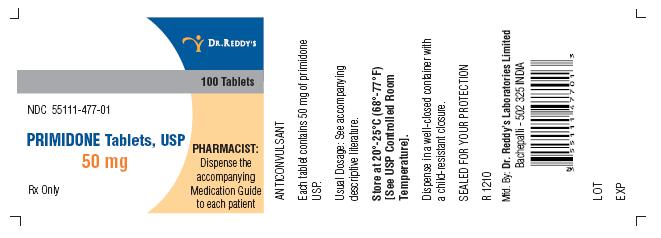
PACKAGE LABEL.PRINCIPAL DISPLAY PANEL SECTION Primidone Tablets USP, 50 mg - Container
Primidone Tablets USP, 50 mg - Carton
Primidone Tablets USP, 250 mg - Container
Primidone Tablets USP, 250 mg - Carton
Medicare Part D spend CMS · PART D · 2026 (Q1)
About this NDC listing & data coverage
What data is (and isn’t) available for this NDC — tap to expand
| NDC identity (package / product / labeler codes) | ✓ Available |
| Labeler | ✓ Available |
| Product & package description | ✓ Available |
| Marketing category & status | ✓ Available |
| Active ingredient / dosage form / route | ✓ Available |
| FDA label (SPL via DailyMed) | ✓ Available |
| Package photos | ✓ Available |
| Inactive ingredients (structured) | ✓ Available |
| NADAC pharmacy acquisition price (CMS) | — Not published for this NDC CMS publishes NADAC only for NDCs reported in its retail-pharmacy survey. |
| Orange Book / therapeutic-equivalence data | — Not published for this NDC Applies only to products approved under an NDA/ANDA; many listings are out of scope. |
| HCPCS J-code billing crosswalk | — Not published for this NDC Most self-administered / retail products have no J-code — that is normal. |
| Medicaid utilization (CMS SDUD) | — Not published for this NDC CMS reports utilization only for NDCs with Medicaid claims above its privacy threshold. |