
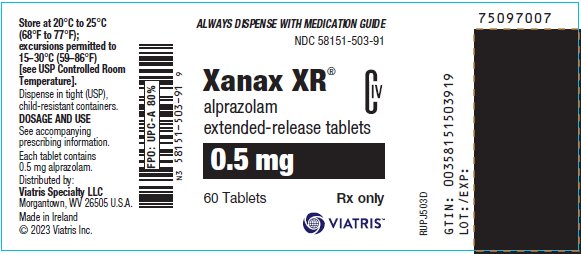
Xanax XR alprazolam .5 mg Tablet, Extended Release, 60-count — NDC 58151-503-91 (Billing 58151-0503-91)
This is a package of 60 tablets of Xanax XR alprazolam .5 mg Tablet, Extended Release from Viatris Specialty LLC, no longer marketed (first marketed May 2024), no longer in the FDA NDC Directory, this package's marketing ended Aug 2026. It is this product's only package size.
NDC database record
One package, one record: these facts belong to NDC 58151-503-91 alone.
- Record
- FDA NDC Directory package listing · Human prescription drug
- Code segments
- 58151 labeler · 503 product · 91 package
- Package marketed since
- May 21, 2024
- Package marketing ended
- Aug 31, 2026
- Sample package
- No — commercial package
- Billing quantity
- 60 EA per package
- Barcode (UPC)
- 0358151506910, 0358151504916, 0358151503919, 0358151505913
- FDA record last changed
- Jul 24, 2026
Identity & classification
Regulatory identifiers FDA, NLM and CMS codes for this package
Drug-database identifiers Medi-Span GPI and First Databank GCN / HICL / AHFS classification
- GSN (GCN sequence number): 050399
- GCN: 17423
- HICL (First Databank): 001617
- AHFS class code: 28:24.08.00
- RxCUI (RxNorm): 433798
Where does this data come from?
- FDA openFDA NDC Directory · synced Oct 8, 2026
- FDA label on DailyMed · label index refreshed Oct 8, 2026
- RxNorm (NLM RxNav) · catalog refreshed Oct 8, 2026
- Medi-Span GPI (licensed)
- First Databank (licensed) · refreshed Oct 8, 2026
RxNorm drug class
This medicine belongs to the Benzodiazepine class.
Where does this data come from?
- RxClass (NLM) · catalog refreshed Oct 8, 2026
Clinical
Alprazolam is used to treat anxiety disorders and panic disorder (sudden, unexpected attacks of extreme fear and worry about these attacks). Alprazolam is in a class of medications called benzodiazepines. It works by decreasing abnormal excitement in the brain.
Read the full MedlinePlus article ↗- It treats generalized anxiety disorder and panic disorder in adults. Some forms, like the extended-release tablets, are only for panic disorder. Your pharmacy label will show which...
- Please don't stop suddenly. Quitting abruptly or cutting down too fast can cause withdrawal, including seizures. Your prescriber will give you a slow taper plan.
- It's best to avoid alcohol. Opioid pain medicines are especially risky, since the combination can slow your breathing and can be fatal. Always tell your prescriber and pharmacist a...
- Can I have a drink or take my pain medicine with it?
Patient education
Supplement & herbal interactions
Some supplements/herbs that may interact with Alprazolam — tap one for details:
Where does this data come from?
- MedlinePlus (NLM) · refreshed Oct 8, 2026
- FDA label on DailyMed · label index refreshed Oct 8, 2026
Ask a licensed pharmacist directly — free, answered by our team.
Pricing
A drug doesn't have one price. Each row is a different public payment system, and none is what you'd pay at the counter — that depends on your insurance. The ⓘ on each row explains what it measures.
| Price system | Per each | Per package |
|---|---|---|
| Retail pharmacies payNADAC · weekly | Not in the retail survey — common for institutional, discontinued, or low-volume packs. | |
| Medicaid paysCMS SDUD · 12 mo | No recent Medicaid claims on file for this NDC — rare and low-volume NDCs are suppressed in the public data. | |
| Medicare drug plans payPart D · quarterly | No Part D plan price is available for this NDC in our data. | |
Where does this data come from?
- CMS NADAC weekly file
- CMS ASP pricing files · refreshed Sep 20, 2026
- CMS Medicaid State Drug Utilization Data · refreshed Oct 9, 2026
- CMS Part D plan pricing files · refreshed Sep 24, 2026
- VA National Acquisition Center price file
Packaging — all sizes for this product
| Package NDC | Description | Marketing start | Marketing end | Status |
|---|---|---|---|---|
| 58151-0503-91 You're viewing this Main listing | 60 TABLET, EXTENDED RELEASE in 1 BOTTLE | 2024-05-21 | Aug 31, 2026 | Discontinued by firm |
Therapeutic equivalents
| Product | Labeler | Pack | NADAC/unit | TE | Status | Price vs. this |
|---|---|---|---|---|---|---|
| Alprazolam XR .5 mg 59762-0057-01 | Mylan | 60 tablets | $0.153 | AB | Availability likely | — |
| Alprazolam .5 mg 65862-0454-60 | Aurobindo | 60 tablets | $0.153 | — | Availability likely | — |
| Alprazolam Extended Release .5 mg 00228-3083-06 | Actavis | 60 tablets | $0.157 | — | Discontinued | — |
| Xanax XR .5 mgthis 58151-0503-91 | Viatris | 60 tablets | — | AB | Discontinued | — |
| Alprazolam .5 mg 63187-0518-30 | Proficient | 30 tablets | — | AB | FDA listed | — |
| Alprazolam .5 mg 65162-0809-03 | Amneal | 30 tablets | — | AB | FDA listed | — |
| Alprazolam Extended Release .5 mg 71335-1129-01 | Bryant | 60 tablets | — | — | Discontinued | — |
| Alprazolam .5 mg 71335-1669-01 | Bryant | 60 tablets | — | AB | FDA listed | — |
| Alprazolam Extended Release .5 mg 72162-1059-02 | Bryant | 45 tablets | — | — | FDA listed | — |
| Alprazolam .5 mg 76420-0652-30 | Asclemed | 30 tablets | — | AB | FDA listed | — |
Where does this data come from?
- FDA openFDA NDC Directory · synced Oct 8, 2026
- FDA Orange Book · refreshed Oct 3, 2026
- CMS NADAC weekly file
Availability & generic status
FDA-approved generic versions are listed, and recent pricing/market data suggests they may be available — see Therapeutic equivalents.
Where does this data come from?
- FDA Orange Book · refreshed Oct 3, 2026
What it looks like
Where does this data come from?
- FDA label on DailyMed · label index refreshed Oct 8, 2026
Inactive Ingredients / Excipients
Inactive ingredients, also called excipients, are components of the drug product other than the active ingredient. They may include fillers, dyes, coatings, preservatives, flavors, or other formulation ingredients.
🧪 Avoiding an ingredient? See Alprazolam inactive ingredients by manufacturer: every current product's list side by side, so you can ask your pharmacy for the version that does not list it.
💡 Tap an ingredient (hover on desktop) to see what it is and why it’s used.
-
UNII 3NXW29V3WO
Hypromellose is a plant-based thickener made from cellulose. It's used in medicines as a binder to hold ingredients together, a coating for tablets, and a thickener for liquids.
-
UNII J2B2A4N98G
Lactose is a natural sugar derived from milk. In medications, it serves as a filler and binder to add bulk and help hold tablet or capsule ingredients together during manufacturing.
-
UNII 70097M6I30
Magnesium stearate is a salt made from magnesium and stearic acid, a fatty substance. It's used in tablets and capsules as a lubricant and glidant to help ingredients flow smoothly during manufacturing and prevent sticking.
-
UNII ETJ7Z6XBU4
Silicon dioxide is a naturally occurring mineral used as a glidant and anti-caking agent. It helps powder ingredients flow smoothly and prevents clumping during manufacturing and storage.
4 inactive ingredients listed in the exact product block matched to this NDC.
Where does this data come from?
ingredient classCode="IACT" elements from the exact product block matched by this NDC. Label-section narrative from DailyMed / the openFDA label index is shown separately when available.- FDA label on DailyMed · label index refreshed Oct 8, 2026
- FDA openFDA NDC Directory · synced Oct 8, 2026
Inactive ingredient FAQ
Are inactive ingredients the same for every manufacturer?
Why might an inactive ingredient be missing?
Can inactive ingredients matter?
Manufacturer & labeler
More NDCs from Viatris Specialty LLC labeler code 58151
- Viagra sildenafil citrate 50 mg Tablet, Film Coated NDC 58151-427-01
- Viagra sildenafil citrate 100 mg Tablet, Film Coated NDC 58151-428-01
- Xanax alprazolam .25 mg Tablet NDC 58151-452-01
- Xanax alprazolam .5 mg Tablet NDC 58151-453-01
- Xanax alprazolam 1 mg Tablet NDC 58151-454-01
- Xanax alprazolam 2 mg Tablet NDC 58151-455-01
- Xanax XR alprazolam 1 mg Tablet, Extended Release NDC 58151-504-91
- Xanax XR alprazolam 2 mg Tablet, Extended Release NDC 58151-505-91
- Xanax XR alprazolam 3 mg Tablet, Extended Release NDC 58151-506-91
- Zoloft sertraline hydrochloride 25 mg Tablet, Film Coated NDC 58151-574-93
- Zoloft sertraline hydrochloride 50 mg Tablet, Film Coated NDC 58151-575-88
- Zoloft sertraline hydrochloride 100 mg Tablet, Film Coated NDC 58151-576-88
Where does this data come from?
- FDA openFDA NDC Directory · synced Oct 8, 2026
- Drugs@FDA
Full prescribing information FDA SPL
🚨 Boxed Warning ▾
WARNING: RISKS FROM CONCOMITANT USE WITH OPIOIDS; ABUSE, MISUSE, AND ADDICTION; and DEPENDENCE AND WITHDRAWAL REACTIONS • Concomitant use of benzodiazepines and opioids may result in profound sedation, respiratory depression, coma, and death. Reserve concomitant prescribing of these drugs for patients for whom alternative treatment options are inadequate. Limit dosages and durations to the minimum required.
Follow patients for signs and symptoms of respiratory depression and sedation [see Warnings and Precautions (5.1) , Drug Interactions (7.1) ] . • The use of benzodiazepines, including XANAX XR, exposes users to risks of abuse, misuse, and addiction, which can lead to overdose or death. Abuse and misuse of benzodiazepines commonly involve concomitant use of other medications, alcohol, and/or illicit substances, which is associated with an increased frequency of serious adverse outcomes. Before prescribing XANAX XR and throughout treatment, assess each patient’s risk for abuse, misuse, and addiction [see Warnings and Precautions (5.2) ] . • The continued use of benzodiazepines, including XANAX XR, may lead to clinically significant physical dependence.
The risks of dependence and withdrawal increase with longer treatment duration and higher daily dose. Abrupt discontinuation or rapid dosage reduction of XANAX XR after continued use may precipitate acute withdrawal reactions, which can be life-threatening. To reduce the risk of withdrawal reactions, use a gradual taper to discontinue XANAX XR or reduce the dosage [see Dosage and Administration (2.2) , Warnings and Precautions (5.3) ] .
WARNING: RISKS FROM CONCOMITANT USE WITH OPIOIDS; ABUSE, MISUSE, AND ADDICTION; and DEPENDENCE AND WITHDRAWAL REACTIONS See full prescribing information for complete boxed warning. • Concomitant use of benzodiazepines and opioids may result in profound sedation, respiratory depression, coma, and death. Reserve concomitant prescribing of these drugs for use in patients for whom alternative treatment options are inadequate. Limit dosages and durations to the minimum required.
Follow patients for signs and symptoms of respiratory depression and sedation. ( 5.1 , 7.1 ) • The use of benzodiazepines, including XANAX XR, exposes users to risks of abuse, misuse, and addiction, which can lead to overdose or death. Before prescribing XANAX XR and throughout treatment, assess each patient’s risk for abuse, misuse, and addiction.
( 5.2 ) • Abrupt discontinuation or rapid dosage reduction of XANAX XR after continued use may precipitate acute withdrawal reactions, which can be life-threatening. To reduce the risk of withdrawal reactions, use a gradual taper to discontinue XANAX XR or reduce the dosage. ( 2.2 , 5.3 )
🎯 Indications and Usage ▾
1 INDICATIONS AND USAGE XANAX XR is indicated for the treatment of panic disorder with or without agoraphobia, in adults. XANAX XR is a benzodiazepine indicated for the treatment of panic disorder with or without agoraphobia, in adults. ( 1 )
⏱️ Dosage and Administration ▾
2 DOSAGE AND ADMINISTRATION • Recommended starting oral dosage is 0.5 mg to 1 mg once daily (preferably in the morning). Depending on the response, the dose may be increased at intervals of 3 to 4 days in increments of no more than 1 mg daily. ( 2.1 ) • Recommended total daily dosage is 3 mg to 6 mg daily.
( 2.1 ) • Swallow tablets whole; do not divide, crush, or chew. ( 2.1 ) • When tapering, decrease dosage by no more than 0.5 mg every 3 days. Some patients may require an even slower dosage reduction.
( 2.2 , 5.2 ) • See the Full Prescribing Information for the recommended dosage in geriatric patients, patients with hepatic impairment, and with use with ritonavir. ( 2.3 , 2.4 , 2.5 )
2.1Recommended Dosage Administer XANAX XR orally once daily, preferably in the morning. Swallow tablets whole; do not divide, crush, or chew. The recommended starting oral dosage for XANAX XR is 0.5 mg to 1 mg once daily.
Depending on the response, the dosage may be adjusted at intervals of every 3 to 4 days in increments of no more than 1 mg daily. The recommended dosage range is 3 mg to 6 mg once daily. Controlled trials of XANAX XR for the treatment of panic disorder included dosages in the range of 1 mg to 10 mg per day.
Most patients showed a response in the dosage range of 3 mg to 6 mg per day. Occasional patients required as much as 10 mg per day. The longer term efficacy of XANAX XR has not been systematically evaluated.
If XANAX XR is used for periods longer than 8 weeks, the healthcare provider should periodically reassess the usefulness of the drug for the individual patient. After a period of extended freedom from panic attacks, a carefully supervised tapered discontinuation may be attempted, but there is evidence that this may often be difficult to accomplish without recurrence of symptoms and/or the manifestation of withdrawal phenomena [see Dosage and Administration (2.2) , Warnings and Precautions (5.2) ] .
2.2Discontinuation or Dosage Reduction of XANAX XR To reduce the risk of withdrawal reactions, use a gradual taper to discontinue XANAX XR or reduce the dosage. If a patient develops withdrawal reactions, consider pausing the taper or increasing the dosage to the previous tapered dosage level. Subsequently decrease the dosage more slowly [see Warnings and Precautions (5.3) , Drug Abuse and Dependence (9.3) ] .
Reduce the dosage by no more than 0.5 mg every three days. Some patients may benefit from an even more gradual discontinuation. Some patients may prove resistant to all discontinuation regimens.
In a controlled postmarketing discontinuation study of panic disorder patients which compared the recommended taper schedule with a slower taper schedule, no difference was observed between the groups in the proportion of patients who tapered to zero dose; however, the slower schedule was associated with a reduction in symptoms associated with a withdrawal syndrome.
2.3Dosage Recommendations in Geriatric Patients In geriatric patients, the recommended starting dosage of XANAX XR is 0.5 mg once daily. This may be gradually increased if needed and tolerated. Geriatric patients may be sensitive to the effects of benzodiazepines [see Use in Specific Populations (8.5) , Clinical Pharmacology (12.3) ] .
2.4Dosage Recommendations in Patients with Hepatic Impairment In patients with hepatic impairment, the recommended starting dosage of XANAX XR is 0.5 mg once daily. This may be gradually increased if needed and tolerated [see Use in Specific Populations (8.6) , Clinical Pharmacology (12.3) ] .
2.5Dosage Modifications for Drug Interactions XANAX XR should be reduced to half of the recommended dosage when a patient is started on ritonavir and XANAX XR together, or when ritonavir is added to a patient treated with XANAX XR. Increase XANAX XR dosage to the target dose after 10 to 14 days of dosing ritonavir and XANAX XR together. It is not necessary to reduce XANAX XR dosage in patients who have been taking ritonavir for more than 10 t… [Excerpted — this section continues on DailyMed.]
💊 Dosage Forms and Strengths ▾
3 DOSAGE FORMS AND STRENGTHS XANAX XR extended-release tablets are available as: • 0.5 mg: white, pentagonal shaped tablets debossed with an "X" on one side and "0.5" on the other side • 1 mg: yellow, square shaped tablets debossed with an "X" on one side and "1" on the other side • 2 mg: blue, round shaped tablets debossed with an "X" on one side and "2" on the other side • 3 mg: green, triangular shaped tablets debossed with an "X" on one side and "3" on the other side Extended-Release Tablets: 0.5 mg, 1 mg, 2 mg, and 3 mg ( 3 )
⛔ Contraindications ▾
4 CONTRAINDICATIONS XANAX XR is contraindicated in patients: • with known hypersensitivity to alprazolam or other benzodiazepines. Angioedema has been reported [see Adverse Reactions (6.2) ] . • taking strong cytochrome P450 3A (CYP3A) inhibitors (e.g., ketoconazole, itraconazole), except ritonavir [see Dosage and Administration (2.5) , Warnings and Precautions (5.5) , Drug Interactions (7.1) ] . • Known hypersensitivity to alprazolam or other benzodiazepines. ( 4 ) • Concomitant use with strong cytochrome P450 3A (CYP3A) inhibitors, except ritonavir.
( 4 , 5.5 , 7.1 )
⚠️ Warnings and Cautions ▾
5 WARNINGS AND PRECAUTIONS • Effects on Driving and Operating Machinery: Patients receiving XANAX XR should be cautioned against operating machinery or driving a motor vehicle, as well as avoiding concomitant use of alcohol and other central nervous system (CNS) depressant drugs. ( 5.4 ) • Patients with Depression: Exercise caution in patients with signs or symptoms of depression. Prescribe the least number of tablets feasible to avoid intentional overdosage.
( 5.6 ) • Neonatal Sedation and Withdrawal Syndrome: XANAX XR use during pregnancy can result in neonatal sedation and/or neonatal withdrawal. ( 5.8 , 8.1 )
5.1Risks from Concomitant Use with Opioids Concomitant use of benzodiazepines, including XANAX XR, and opioids may result in profound sedation, respiratory depression, coma, and death. Because of these risks, reserve concomitant prescribing of these drugs in patients for whom alternative treatment options are inadequate. Observational studies have demonstrated that concomitant use of opioid analgesics and benzodiazepines increases the risk of drug-related mortality compared to use of opioids alone.
If a decision is made to prescribe XANAX XR concomitantly with opioids, prescribe the lowest effective dosages and minimum durations of concomitant use, and follow patients closely for signs and symptoms of respiratory depression and sedation. In patients already receiving an opioid analgesic, prescribe a lower initial dose of XANAX XR than indicated in the absence of an opioid and titrate based on clinical response. If an opioid is initiated in a patient already taking XANAX XR, prescribe a lower initial dose of the opioid and titrate based upon clinical response.
Advise both patients and caregivers about the risks of respiratory depression and sedation when XANAX XR is used with opioids. Advise patients not to drive or operate heavy machinery until the effects of concomitant use with the opioid have been determined [see Drug Interactions (7.1) ] .
5.2Abuse, Misuse, and Addiction The use of benzodiazepines, including XANAX XR, exposes users to the risks of abuse, misuse, and addiction, which can lead to overdose or death. Abuse and misuse of benzodiazepines often (but not always) involve the use of doses greater than the maximum recommended dosage and commonly involve concomitant use of other medications, alcohol, and/or illicit substances, which is associated with an increased frequency of serious adverse outcomes, including respiratory depression, overdose, or death [see Drug Abuse and Dependence (9.2) ] .
Before prescribing XANAX XR and throughout treatment, assess each patient’s risk for abuse, misuse, and addiction (e.g., using a standardized screening tool). Use of XANAX XR, particularly in patients at elevated risk, necessitates counseling about the risks and proper use of XANAX XR along with monitoring for signs and symptoms of abuse, misuse, and addiction. Prescribe the lowest effective dosage; avoid or minimize concomitant use of CNS depressants and other substances associated with abuse, misuse, and addiction (e.g., opioid analgesics, stimulants); and advise patients on the proper disposal of unused drug.
If a substance use disorder is suspected, evaluate the patient and institute (or refer them for) early treatment, as appropriate.
5.3Dependence and Withdrawal Reactions To reduce the risk of withdrawal reactions, use a gradual taper to discontinue XANAX XR or reduce the dosage (a patient-specific plan should be used to taper the dose) [see Dosage and Administration (2.3) ] . Patients at an increased risk of withdrawal adverse reactions after benzodiazepine discontinuation or rapid dosage reduction include those who take higher dosages, and those who have had longer durations of use. Acute Withdrawal Reactions The continued use of benzodiazepines, including XANAX XR, may lead to clinically significant physical dependence.
Abrupt discontinuation or rapid dosage reduction of XANAX XR after continued use, or adm… [Excerpted — this section continues on DailyMed.]
🤒 Adverse Reactions ▾
6 ADVERSE REACTIONS The following clinically significant adverse reactions are described elsewhere in the labeling: • Risks from Concomitant Use with Opioids [see Warnings and Precautions (5.1) ] • Abuse, Misuse, and Addiction [see Warnings and Precautions (5.2) ] • Dependence and Withdrawal Reactions [see Warnings and Precautions (5.3) ] • Effects on Driving and Operating Machinery [see Warnings and Precautions (5.4) ] • Patients with Depression [see Warnings and Precautions (5.7) ] • Neonatal Sedation and Withdrawal Syndrome [see Warnings and Precautions (5.8) ] • Risks in Patients with Impaired Respiratory Function [see Warnings and Precautions (5.9) ] The most common adverse reactions in panic disorder patients treated with XANAX XR (incidence of ≥ 5% and at least twice that of placebo) include: somnolence, memory impairment, dysarthria, coordination abnormal, ataxia, libido decreased, constipation, and nausea.
( 6.1 ) To report SUSPECTED ADVERSE REACTIONS, contact Viatris at 1-877-446-3679 (1-877-4-INFO-RX) or FDA at 1-800-FDA-1088 or www.fda.gov/medwatch.
6.1Clinical Trials Experience Because clinical trials are conducted under widely varying conditions, adverse reaction rates observed in the clinical trials of a drug cannot be directly compared to rates in the clinical trials of another drug and may not reflect the rates observed in practice. The information included in the section on Adverse Reactions Observed in Short-Term, Placebo-Controlled Trials with XANAX XR is based on pooled data of five 6- and 8-week placebo-controlled clinical studies in panic disorder. Adverse Reactions Observed in Short-Term, Placebo-Controlled Trials of XANAX XR Adverse Reactions Reported as Reasons for Discontinuation of Treatment in Placebo-Controlled Trials Approximately 17% of the 531 patients who received XANAX XR in placebo-controlled clinical trials for panic disorder had at least 1 adverse event that led to discontinuation compared to 8% of 349 placebo-treated patients.
The most common events leading to discontinuation and considered to be drug-related (i.e., leading to discontinuation in at least 1% of the patients treated with XANAX XR at a rate at least twice that of placebo) are shown in Table 1. Table 1: Adverse Reactions Leading to Discontinuation in ≥1% of XANAX XR-Treated Patients and at Least Twice the Rate of Placebo-Treated Patients in Placebo-Controlled Trials n=number of patients Percentage of Patients Discontinuing Due to Adverse Reactions XANAX XR (n=531) Placebo (n=349) Nervous system disorders Sedation Somnolence Dysarthria Coordination abnormal Memory impairment 7.5 3.2 2.1 1.9 1.5 0.6 0.3 0 0.3
0.3General disorders/administration site conditions Fatigue 1.7
0.6Psychiatric disorders Depression 2.5
1.2Adverse Reactions Occurring at an Incidence of 1% or More Among Patients Treated with XANAX XR Table 2 shows the incidence of adverse reactions that occurred during 6- and 8-week placebo-controlled trials in 1% or more of patients treated with XANAX XR where the incidence in patients treated with XANAX XR was greater than the incidence in placebo-treated patients. The most commonly observed adverse reactions in panic disorder patients treated with XANAX XR (incidence of 5% or greater and at least twice the incidence in placebo patients) were: sedation, somnolence, memory impairment, dysarthria, coordination abnormal, ataxia, libido decreased.
Table 2: Adverse Reactions Occurring in ≥ 1% in XANAX-Treated Patients and Greater than Placebo-Treated Patients in 6- and 8-Week Placebo-Controlled Trials Panic Disorder XANAX XR (n=531) Placebo (n=349) Nervous system disorders Sedation Somnolence Memory impairment Dysarthria Coordination abnormal Mental impairment Ataxia Disturbance in attention Balance impaired Dyskinesia Hypoesthesia Hypersomnia 45% 23% 15% 11% 9% 7% 7% 3% 3% 2% 1% 1% 23% 6% 7% 3% 1% 6% 3% 1% 1% 1% <1% 0% General disorders/administration site conditions Fatigue Lethargy 14% 2% 9% 1% Psychiatric disorders… [Excerpted — this section continues on DailyMed.]
🔄 Drug Interactions ▾
7 DRUG INTERACTIONS • Use with Opioids: Increase the risk of respiratory depression. ( 7.1 ) • Use with Other CNS Depressants: Produces additive CNS depressant effects. ( 7.1 ) • Use with Digoxin: Increase the risk of digoxin toxicity. ( 7.1 ) • Use with CYP3A Inhibitors (except ritonavir): Increase the risk of adverse reactions of alprazolam. ( 4 , 5.5 , 7.1 ) • Use with CYP3A Inducers: Increase the risk of reduced efficacy of alprazolam. ( 7.1 )
7.1Drugs Having Clinically Important Interactions with XANAX XR Table 4 includes clinically significant drug interactions with XANAX XR [see Clinical Pharmacology (12.3) ] . Table 4: Clinically Significant Drug Interactions with XANAX XR Opioids Clinical implication The concomitant use of benzodiazepines and opioids increases the risk of respiratory depression because of actions at different receptor sites in the CNS that control respiration. Benzodiazepines interact at gamma-aminobutyric acid (GABAA) sites and opioids interact primarily at mu receptors.
When benzodiazepines and opioids are combined, the potential for benzodiazepines to significantly worsen opioid-related respiratory depression exists. Prevention or management Limit dosage and duration of concomitant use of XANAX XR and opioids, and monitor patients closely for respiratory depression and sedation [see Warnings and Precautions (5.1) ] . Examples Morphine, buprenorphine, hydromorphone, oxymorphone, oxycodone, fentanyl, methadone, alfentanil, butorphanol, codeine, dihydrocodeine, meperidine, pentazocine, remifentanil, sufentanil, tapentadol, tramadol.
CNS Depressants Clinical implication The benzodiazepines, including alprazolam, produce additive CNS depressant effects when coadministered with other CNS depressants. Prevention or management Limit dosage and duration of XANAX XR during concomitant use with CNS depressants [see Warnings and Precautions (5.3) ] . Examples Psychotropic medications, anticonvulsants, antihistaminics, ethanol, and other drugs which themselves produce CNS depression.
Strong Inhibitors of CYP3A (except ritonavir) Clinical implication Concomitant use of XANAX XR with strong CYP3A inhibitors has a profound effect on the clearance of alprazolam, resulting in increased concentrations of alprazolam and increased risk of adverse reactions [see Clinical Pharmacology (12.3) ] . Prevention or management Concomitant use of XANAX XR with a strong CYP3A4 inhibitor (except ritonavir) is contraindicated [see Contraindications (4) , Warnings and Precautions (5.5) ] . Examples Ketoconazole, itraconazole, clarithromycin Moderate or Weak Inhibitors of CYP3A Clinical implication Concomitant use of XANAX XR with CYP3A inhibitors may increase the concentrations of XANAX XR, resulting in increased risk of adverse reactions [see Clinical Pharmacology (12.3) ] .
Prevention or management Avoid use and consider appropriate dose reduction when XANAX XR is coadministered with a moderate or weak CYP3A inhibitor [see Warnings and Precautions (5.5) ] . Examples Nefazodone, fluvoxamine, cimetidine, erythromycin CYP3A Inducers Clinical implication Concomitant use of CYP3A inducers can increase alprazolam metabolism and therefore can decease plasma levels of alprazolam [see Clinical Pharmacology (12.3) ] . Prevention or management Caution is recommended during coadministration with alprazolam.
Examples Carbamazepine, phenytoin Ritonavir Clinical implication Interactions involving ritonavir and alprazolam are complex and time dependent. Short term administration of ritonavir increased alprazolam exposure due to CYP3A4 inhibition. Following long term treatment of ritonavir (> 10-14 days), CYP3A4 induction offsets this inhibition.
Alprazolam exposure was not meaningfully affected in the presence of ritonavir. Prevention or management Reduce XANAX XR dose when a patient is initiated with ritonavir and XANAX XR concomitantly, or when ritonavir is added to a regimen where XANAX XR is stabilized. Increase XANAX XR dosage to the target… [Excerpted — this section continues on DailyMed.]
👥 Use in Specific Populations ▾
8 USE IN SPECIFIC POPULATIONS Lactation: Breastfeeding not recommended. ( 8.2 )
8.1Pregnancy Pregnancy Exposure Registry There is a pregnancy exposure registry that monitors pregnancy outcomes in women exposed to psychiatric medications, including XANAX XR, during pregnancy. Healthcare providers are encouraged to register patients by calling the National Pregnancy Registry for Psychiatric Medications at 1-866-961-2388 or visiting online at https://womensmentalhealth.org/pregnancyregistry/. Risk Summary Neonates born to mothers using benzodiazepines late in pregnancy have been reported to experience symptoms of sedation and/or neonatal withdrawal [see Warnings and Precautions (5.8) , and Clinical Considerations ] .
Available data from published observational studies of pregnant women exposed to benzodiazepines do not report a clear association with benzodiazepines and major birth defects (see Data ) . The background risk of major birth defects and miscarriage for the indicated population is unknown. All pregnancies have a background risk of birth defect, loss, or other adverse outcomes.
In the U.S. general population, the estimated risk of major birth defects and of miscarriage in clinically recognized pregnancies is 2% to 4% and 15% to 20%, respectively. Clinical Considerations Fetal/Neonatal Adverse Reactions Benzodiazepines cross the placenta and may produce respiratory depression, hypotonia, and sedation in neonates. Monitor neonates exposed to XANAX XR during pregnancy or labor for signs of sedation, respiratory depression, hypotonia, and feeding problems.
Monitor neonates exposed to XANAX XR during pregnancy for signs of withdrawal. Manage these neonates accordingly [see Warnings and Precautions (5.8) ] . Data Human Data Published data from observational studies on the use of benzodiazepines during pregnancy do not report a clear association with benzodiazepines and major birth defects.
Although early studies reported an increased risk of congenital malformations with diazepam and chlordiazepoxide, there was no consistent pattern noted. In addition, the majority of recent case-control and cohort studies of benzodiazepine use during pregnancy, which were adjusted for confounding exposures to alcohol, tobacco, and other medications, have not confirmed these findings.
8.2Lactation Risk Summary Limited data from published literature reports the presence of alprazolam in human breast milk. There are reports of sedation, poor feeding and poor weight gain in infants exposed to benzodiazepines through breast milk. The effects of alprazolam on lactation are unknown.
Because of the potential for serious adverse reactions, including sedation and withdrawal symptoms in breastfed infants, advise patients that breastfeeding is not recommended during treatment with XANAX XR.
8.4Pediatric Use Safety and effectiveness of XANAX XR have not been established in pediatric patients.
8.5Geriatric Use XANAX XR treated geriatric patients had higher plasma concentrations of alprazolam (due to reduced clearance) compared to younger adults receiving the same doses. Therefore, dosage reduction of XANAX XR is recommended in geriatric patients [see Dosage and Administration (2.3) and Clinical Pharmacology (12.3) ] .
8.6Hepatic Impairment Patients with alcoholic liver disease exhibit a longer elimination half-life (19.7 hours), compared to healthy subjects (11.4 hours). This may be caused by decreased clearance of alprazolam in patients with alcoholic liver disease. Dosage reduction of XANAX XR is recommended in patients with hepatic impairment [see Dosage and Administration (2.4) , Clinical Pharmacology (12.3) ] .
🤰 Pregnancy ▾
8.1Pregnancy Pregnancy Exposure Registry There is a pregnancy exposure registry that monitors pregnancy outcomes in women exposed to psychiatric medications, including XANAX XR, during pregnancy. Healthcare providers are encouraged to register patients by calling the National Pregnancy Registry for Psychiatric Medications at 1-866-961-2388 or visiting online at https://womensmentalhealth.org/pregnancyregistry/. Risk Summary Neonates born to mothers using benzodiazepines late in pregnancy have been reported to experience symptoms of sedation and/or neonatal withdrawal [see Warnings and Precautions (5.8) , and Clinical Considerations ] .
Available data from published observational studies of pregnant women exposed to benzodiazepines do not report a clear association with benzodiazepines and major birth defects (see Data ) . The background risk of major birth defects and miscarriage for the indicated population is unknown. All pregnancies have a background risk of birth defect, loss, or other adverse outcomes.
In the U.S. general population, the estimated risk of major birth defects and of miscarriage in clinically recognized pregnancies is 2% to 4% and 15% to 20%, respectively. Clinical Considerations Fetal/Neonatal Adverse Reactions Benzodiazepines cross the placenta and may produce respiratory depression, hypotonia, and sedation in neonates. Monitor neonates exposed to XANAX XR during pregnancy or labor for signs of sedation, respiratory depression, hypotonia, and feeding problems.
Monitor neonates exposed to XANAX XR during pregnancy for signs of withdrawal. Manage these neonates accordingly [see Warnings and Precautions (5.8) ] . Data Human Data Published data from observational studies on the use of benzodiazepines during pregnancy do not report a clear association with benzodiazepines and major birth defects.
Although early studies reported an increased risk of congenital malformations with diazepam and chlordiazepoxide, there was no consistent pattern noted. In addition, the majority of recent case-control and cohort studies of benzodiazepine use during pregnancy, which were adjusted for confounding exposures to alcohol, tobacco, and other medications, have not confirmed these findings.
🧒 Pediatric Use ▾
8.4Pediatric Use Safety and effectiveness of XANAX XR have not been established in pediatric patients.
🧓 Geriatric Use ▾
8.5Geriatric Use XANAX XR treated geriatric patients had higher plasma concentrations of alprazolam (due to reduced clearance) compared to younger adults receiving the same doses. Therefore, dosage reduction of XANAX XR is recommended in geriatric patients [see Dosage and Administration (2.3) and Clinical Pharmacology (12.3) ] .
🆘 Overdosage ▾
10 OVERDOSAGE Overdosage of benzodiazepines is characterized by central nervous system depression ranging from drowsiness to coma. In mild to moderate cases, symptoms can include drowsiness, confusion, dysarthria, lethargy, hypnotic state, diminished reflexes, ataxia, and hypotonia. Rarely, paradoxical or disinhibitory reactions (including agitation, irritability, impulsivity, violent behavior, confusion, restlessness, excitement, and talkativeness) may occur.
In severe overdosage cases, patients may develop respiratory depression and coma. Overdosage of benzodiazepines in combination with other CNS depressants (including alcohol and opioids) may be fatal [see Warnings and Precautions (5.2) ] . Markedly abnormal (lowered or elevated) blood pressure, heart rate, or respiratory rate raise the concern that additional drugs and/or alcohol are involved in the overdosage.
In managing benzodiazepine overdosage, employ general supportive measures, including intravenous fluids and airway management. Flumazenil, a specific benzodiazepine receptor antagonist indicated for the complete or partial reversal of the sedative effects of benzodiazepines in the management of benzodiazepine overdosage, can lead to withdrawal and adverse reactions, including seizures, particularly in the context of mixed overdosage with drugs that increase seizure risk (e.g., tricyclic and tetracyclic antidepressants) and in patients with long-term benzodiazepine use and physical dependency.
The risk of withdrawal seizures with flumazenil use may be increased in patients with epilepsy. Flumazenil is contraindicated in patients who have received a benzodiazepine for control of a potentially life-threatening condition (e.g., status epilepticus). If the decision is made to use flumazenil, it should be used as an adjunct to, not as a substitute for, supportive management of benzodiazepine overdosage.
See the flumazenil injection Prescribing Information. Consider contacting the Poison Help Line at (1-800-222-1222), or a medical toxicologist for additional overdosage management recommendations.
🧬 Clinical Pharmacology ▾
12 CLINICAL PHARMACOLOGY
12.1Mechanism of Action Alprazolam is a 1,4 benzodiazepine. Alprazolam exerts its effect for the treatment of panic disorder through binding to the benzodiazepine site of gamma aminobutyric acid-A (GABA A ) receptors in the brain and enhances GABA-mediated synaptic inhibition.
12.3Pharmacokinetics The pharmacokinetics of alprazolam and two of its major active metabolites (4-hydroxyalprazolam and α-hydroxyalprazolam) are linear, and concentrations are proportional up to 10 mg XANAX XR given once daily. Absorption Following oral administration of XANAX XR in the morning, peak plasma concentration of alprazolam (C max ) occurs in about 10 hours postdose. Compared to morning dosing, alprazolam C max increased by 30% and the T max decreased by an hour following dosing at night.
The mean absolute bioavailability of alprazolam following administration of XANAX XR is approximately 90%, and the relative bioavailability compared to XANAX is about 100%. The bioavailability and pharmacokinetics of alprazolam following administration of XANAX XR are similar to that for XANAX, with the exception of a slower rate of absorption. Effect of Food A high-fat meal given up to 2 hours before dosing with XANAX XR increased the mean C max by about 25%.
The effect of this meal on T max depended on the timing of the meal, with a reduction in T max by about 1/3 for subjects eating immediately before dosing and an increase in T max by about 1/3 for subjects eating 1 hour or more after dosing. The extent of exposure (AUC) and elimination half-life (t½) were not affected by eating. Distribution The apparent volume of distribution of alprazolam is similar for XANAX XR and XANAX.
Alprazolam is 80% bound to human serum protein, and albumin accounts for the majority of the binding. Elimination The mean plasma elimination half-life of alprazolam following administration of XANAX XR ranges from 10.7 to 15.8 hours in healthy adults. Metabolism Alprazolam is extensively metabolized in humans, primarily by cytochrome P450 3A4 (CYP3A4), to two major active metabolites in the plasma: 4-hydroxyalprazolam and α-hydroxyalprazolam.
The plasma circulation levels of the two active metabolites after both XANAX XR and XANAX are less than 10% and 4% of the parent, respectively. The reported relative potencies in benzodiazepine receptor binding experiments and in animal models of induced seizure inhibition are 0.20 and 0.66, respectively, for 4-hydroxyalprazolam and α-hydroxyalprazolam. The low concentrations and low potencies of 4-hydroxyalprazolam and α-hydroxyalprazolam indicate that they unlikely contribute much to the effects of alprazolam.
A benzophenone derived from alprazolam is also found in humans. Their half-lives appear to be similar to that of alprazolam. The pharmacokinetic parameters at steady-state for the two hydroxylated metabolites of alprazolam (4-hydroxyalprazolam and α-hydroxyalprazolam) were similar for XANAX and XANAX XR, indicating that the metabolism of alprazolam is not affected by absorption rate.
Excretion Alprazolam and its metabolites are excreted primarily in the urine. Specific Populations Geriatric Patients The mean T 1/2 of alprazolam was 16.3 hours (range: 9.0 to 26.9 hours) in healthy elderly subjects compared to 11.0 hours (range: 6.3 to 15.8 hours, n=16) in healthy adult subjects. Obese Patients The mean T 1/2 of alprazolam was 21.8 hours (range: 9.9 to 40.4 hours) in a group of obese subjects.
Patients with Hepatic Impairment The mean T 1/2 of alprazolam was 19.7 hours (range: 5.8 to 65.3 hours) in patients with alcoholic liver disease. Racial or Ethnic Groups Maximal concentrations and T 1/2 of alprazolam are approximately 15% and 25% higher in Asians compared to Caucasians. Smoking Alprazolam concentrations may be reduced by up to 50% in smokers compared to non-smokers.
Drug Interaction Studies In Vivo Studies Most of the interactions that have been documented with alprazolam are with drugs that modulate CYP3… [Excerpted — this section continues on DailyMed.]
🧬 Mechanism of Action ▾
12.1Mechanism of Action Alprazolam is a 1,4 benzodiazepine. Alprazolam exerts its effect for the treatment of panic disorder through binding to the benzodiazepine site of gamma aminobutyric acid-A (GABA A ) receptors in the brain and enhances GABA-mediated synaptic inhibition.
📦 How Supplied / Storage and Handling ▾
16 HOW SUPPLIED/STORAGE AND HANDLING XANAX XR is supplied in the following strengths and package configurations: XANAX XR Tablets Package Configuration Tablet Strength (mg) NDC Print Bottles of 60 0.5 mg NDC 58151-503-91 white, pentagonal shaped tablets debossed with an "X" on one side and "0.5" on the other side Bottles of 60 1 mg NDC 58151-504-91 yellow, square shaped tablets debossed with an "X" on one side and "1" on the other side Bottles of 60 2 mg NDC 58151-505-91 blue, round shaped tablets debossed with an "X" on one side and "2" on the other side Bottles of 60 3 mg NDC 58151-506-91 green, triangular shaped tablets debossed with an "X" on one side and "3" on the other side Store at 20°C to 25°C (68°F to 77°F); excursions permitted to 15–30°C (59–86°F) [see USP Controlled Room Temperature].
📋 Description ▾
11 DESCRIPTION XANAX XR contains alprazolam which is a triazolo analog of the 1,4 benzodiazepine class of central nervous system-active compounds. The chemical name of alprazolam is 8-chloro-1-methyl-6-phenyl-4 H - s -triazolo [4,3-α] [1,4] benzodiazepine. The molecular formula is C 17 H 13 ClN 4 which corresponds to a molecular weight of 308.76.
The structural formula is represented below: Alprazolam is a white crystalline powder, which is soluble in methanol or ethanol but which has no appreciable solubility in water at physiological pH. Each XANAX XR extended-release tablet, for oral administration, contains 0.5 mg, 1 mg, 2 mg, or 3 mg of alprazolam. The inactive ingredients are colloidal silicon dioxide, hypromellose, lactose, and magnesium stearate.
In addition, the 1 mg and 3 mg tablets contain D & C yellow No. 10 and the 2 mg and 3 mg tablets contain FD&C blue No. 2.
Alprazolam structural formula
💬 Information for Patients ▾
17 PATIENT COUNSELING INFORMATION Advise the patient to read the FDA-approved patient labeling ( Medication Guide ). Risks from Concomitant Use with Opioids Advise both patients and caregivers about the risks of potentially fatal respiratory depression and sedation when XANAX XR is used with opioids and not to use such drugs concomitantly unless supervised by a healthcare provider. Advise patients not to drive or operate heavy machinery until the effects of concomitant use with the opioid have been determined [see Warnings and Precautions (5.1) , Drug Interactions (7.1) ] .
Abuse, Misuse, and Addiction Inform patients that the use of XANAX XR, even at recommended dosages, exposes users to risks of abuse, misuse, and addiction, which can lead to overdose and death, especially when used in combination with other medications (e.g., opioid analgesics), alcohol, and/or illicit substances. Inform patients about the signs and symptoms of benzodiazepine abuse, misuse, and addiction; to seek medical help if they develop these signs and/or symptoms; and on the proper disposal of unused drug [see Warnings and Precautions (5.2) , Drug Abuse and Dependence (9.2) ] .
Withdrawal Reactions Inform patients that the continued use of XANAX XR may lead to clinically significant physical dependence and that abrupt discontinuation or rapid dosage reduction of XANAX XR may precipitate acute withdrawal reactions, which can be life-threatening. Inform patients that in some cases, patients taking benzodiazepines have developed a protracted withdrawal syndrome with withdrawal symptoms lasting weeks to more than 12 months. Instruct patients that discontinuation or dosage reduction of XANAX XR may require a slow taper [see Warnings and Precautions (5.3) , Drug Abuse and Dependence (9.3) ] .
Effects on Driving and Operating Machinery Advise patients not to drive a motor vehicle or operate heavy machinery while taking XANAX XR due to its CNS depressant effects. Also advise patients to avoid use of alcohol or other CNS depressants while taking XANAX XR [see Warnings and Precautions (5.3) ] . Patients with Depression Advise patients, their families and caregivers to look for signs of suicidality or worsening depression, and to inform the patient’s healthcare provider immediately [see Warnings and Precautions (5.6) ] .
Concomitant Medications Advise patients to inform their healthcare provider of all medicines they take, including prescription and nonprescription medications, vitamins and herbal supplements [see Drug Interactions (7) ] . Pregnancy Advise pregnant females that use of XANAX XR late in pregnancy can result in sedation (respiratory depression, lethargy, hypotonia) and/or withdrawal symptoms (hyperreflexia, irritability, restlessness, tremors, inconsolable crying, and feeding difficulties) in newborns [see Warnings and Precautions (5.8) , Use in Specific Populations (8.1) ] .
Instruct patients to inform their healthcare provider if they are pregnant. Advise patients that there is a pregnancy exposure registry that monitors pregnancy outcomes in women exposed to XANAX XR during pregnancy [see Use in Specific Populations (8.1) ] . Lactation Advise patients that breastfeeding is not recommended during treatment with XANAX XR [see Use in Specific Populations (8.2) ] .
Distributed by: Viatris Specialty LLC Morgantown, WV 26505 U.S.A. Made in Ireland © 2023 Viatris Inc. XANAX XR is a registered trademark of UPJOHN US 2 LLC, a Viatris Company.
UPJ:XNXXRT:R1
💬 Medication Guide ▾
Medication Guide XANAX XR (ZAN-aks XR) (alprazolam) extended-release tablets, C-IV What is the most important information I should know about XANAX XR? • XANAX XR is a benzodiazepine medicine. Taking benzodiazepines with opioid medicines, alcohol, or other central nervous system (CNS) depressants (including street drugs) can cause severe drowsiness, breathing problems (respiratory depression), coma and death. Get emergency help right away if any of the following happens: o shallow or slowed breathing o breathing stops (which may lead to the heart stopping) o excessive sleepiness (sedation) Do not drive or operate heavy machinery until you know how taking XANAX XR with opioids affects you. • Risk of abuse, misuse, and addiction.
There is a risk of abuse, misuse, and addiction with benzodiazepines including XANAX XR which can lead to overdose and serious side effects including coma and death. o Serious side effects including coma and death have happened in people who have abused or misused benzodiazepines, including XANAX XR. These serious side effects may also include delirium, paranoia, suicidal thoughts or actions, seizures, and difficulty breathing. Call your healthcare provider or go to the nearest hospital emergency room right away if you get any of these serious side effects. o You can develop an addiction even if you take XANAX XR as prescribed by your healthcare provider. o Take XANAX XR exactly as your healthcare provider prescribed. o Do not share your XANAX XR with other people. o Keep XANAX XR in a safe place and away from children. • Physical dependence and withdrawal reactions .
XANAX XR can cause physical dependence and withdrawal reactions. o Do not suddenly stop taking XANAX XR . Stopping XANAX XR suddenly can cause serious and life-threatening side effects, including unusual movements, responses, or expressions, seizures, sudden and severe mental or nervous system changes, depression, seeing or hearing things that others do not see or hear, an extreme increase in activity or talking, losing touch with reality, and suicidal thoughts or actions. Call your healthcare provider or go to the nearest hospital emergency room right away if you get any of the following symptoms. o Some people who suddenly stop benzodiazepines, have symptoms that can last for several weeks to more than 12 months , including anxiety, trouble remembering, learning, or concentrating, depression, problems sleeping, feeling like insects are crawling under your skin, weakness, shaking, muscle twitching, burning or prickling feeling in your hands, arms, legs or feet, and ringing in your ears. o Physical dependence is not the same as drug addiction.
Your healthcare provider can tell you more about the differences between physical dependence and drug addiction. o Do not take more XANAX XR than prescribed or take XANAX XR for longer than prescribed. What is XANAX XR? • XANAX XR is a prescription medicine used to treat panic disorder, with or without a fear of places and situations that might cause panic, helplessness, or embarrassment (agoraphobia). • XANAX XR is a federal controlled substance (C-IV) because it contains alprazolam that can be abused or lead to dependence.
Keep XANAX XR in a safe place to prevent misuse and abuse. Selling or giving away XANAX XR may harm others and is against the law. Tell your healthcare provider if you have abused or been dependent on alcohol, prescription medicines or street drugs. • It is not known if XANAX XR is safe and effective in children. • Elderly patients are especially susceptible to dose related adverse effects when taking XANAX XR. • It is not known if XANAX XR is safe and effective in the treatment of panic disorder for use longer than 8 weeks.
Do not take XANAX XR if: • you are allergic to alprazolam, other benzodiazepines, or any of the ingredients in XANAX XR. See the end of this Medication Guide for a complete list of ingredients in XANAX XR. • you are taking antifungal medicines including ketoc… [Excerpted — this section continues on DailyMed.]
🧬 Pharmacokinetics ▾
12.3Pharmacokinetics The pharmacokinetics of alprazolam and two of its major active metabolites (4-hydroxyalprazolam and α-hydroxyalprazolam) are linear, and concentrations are proportional up to 10 mg XANAX XR given once daily. Absorption Following oral administration of XANAX XR in the morning, peak plasma concentration of alprazolam (C max ) occurs in about 10 hours postdose. Compared to morning dosing, alprazolam C max increased by 30% and the T max decreased by an hour following dosing at night.
The mean absolute bioavailability of alprazolam following administration of XANAX XR is approximately 90%, and the relative bioavailability compared to XANAX is about 100%. The bioavailability and pharmacokinetics of alprazolam following administration of XANAX XR are similar to that for XANAX, with the exception of a slower rate of absorption. Effect of Food A high-fat meal given up to 2 hours before dosing with XANAX XR increased the mean C max by about 25%.
The effect of this meal on T max depended on the timing of the meal, with a reduction in T max by about 1/3 for subjects eating immediately before dosing and an increase in T max by about 1/3 for subjects eating 1 hour or more after dosing. The extent of exposure (AUC) and elimination half-life (t½) were not affected by eating. Distribution The apparent volume of distribution of alprazolam is similar for XANAX XR and XANAX.
Alprazolam is 80% bound to human serum protein, and albumin accounts for the majority of the binding. Elimination The mean plasma elimination half-life of alprazolam following administration of XANAX XR ranges from 10.7 to 15.8 hours in healthy adults. Metabolism Alprazolam is extensively metabolized in humans, primarily by cytochrome P450 3A4 (CYP3A4), to two major active metabolites in the plasma: 4-hydroxyalprazolam and α-hydroxyalprazolam.
The plasma circulation levels of the two active metabolites after both XANAX XR and XANAX are less than 10% and 4% of the parent, respectively. The reported relative potencies in benzodiazepine receptor binding experiments and in animal models of induced seizure inhibition are 0.20 and 0.66, respectively, for 4-hydroxyalprazolam and α-hydroxyalprazolam. The low concentrations and low potencies of 4-hydroxyalprazolam and α-hydroxyalprazolam indicate that they unlikely contribute much to the effects of alprazolam.
A benzophenone derived from alprazolam is also found in humans. Their half-lives appear to be similar to that of alprazolam. The pharmacokinetic parameters at steady-state for the two hydroxylated metabolites of alprazolam (4-hydroxyalprazolam and α-hydroxyalprazolam) were similar for XANAX and XANAX XR, indicating that the metabolism of alprazolam is not affected by absorption rate.
Excretion Alprazolam and its metabolites are excreted primarily in the urine. Specific Populations Geriatric Patients The mean T 1/2 of alprazolam was 16.3 hours (range: 9.0 to 26.9 hours) in healthy elderly subjects compared to 11.0 hours (range: 6.3 to 15.8 hours, n=16) in healthy adult subjects. Obese Patients The mean T 1/2 of alprazolam was 21.8 hours (range: 9.9 to 40.4 hours) in a group of obese subjects.
Patients with Hepatic Impairment The mean T 1/2 of alprazolam was 19.7 hours (range: 5.8 to 65.3 hours) in patients with alcoholic liver disease. Racial or Ethnic Groups Maximal concentrations and T 1/2 of alprazolam are approximately 15% and 25% higher in Asians compared to Caucasians. Smoking Alprazolam concentrations may be reduced by up to 50% in smokers compared to non-smokers.
Drug Interaction Studies In Vivo Studies Most of the interactions that have been documented with alprazolam are with drugs that modulate CYP3A4 activity. Compounds that are inhibitors or inducers of CYP3A would be expected to increase or decrease plasma alprazolam concentrations, respectively. Drug products that have been studied in vivo, along with their effect on increasing alprazolam AUC, are as follows: ketoconazole, 3.98 fold; itraconaz… [Excerpted — this section continues on DailyMed.]
🔬 Clinical Studies ▾
14 CLINICAL STUDIES The efficacy of XANAX XR in the treatment of panic disorder in adults was established in two 6-week, flexible-dose, placebo-controlled studies in adult patients meeting DSM-III criteria for panic disorder. In these studies, patients were treated with XANAX XR in a dose range of 1 mg to 10 mg once per day. The effectiveness of XANAX XR was assessed on the basis of changes in various measures of panic attack frequency, on various measures of the Clinical Global Impression, and on the Overall Phobia Scale.
In all, there were 7 primary efficacy measures in these studies, and XANAX XR was superior to placebo on all 7 outcomes in both studies. The mean dose of XANAX XR at the last treatment visit was 4.2 mg per day in the first study and 4.6 mg per day in the second. In addition, there were two 8-week, fixed-dose, placebo-controlled studies of XANAX XR in adult patients with panic disorder, involving fixed XANAX XR doses of 4 mg and 6 mg once per day that did not show a benefit for either dose of XANAX XR.
Analyses of the relationship between treatment outcome and gender did not suggest any differential responsiveness on the basis of gender.
🔒 Drug Abuse and Dependence ▾
9 DRUG ABUSE AND DEPENDENCE
9.1Controlled Substance XANAX XR contains alprazolam, which is a Schedule IV controlled substance.
9.2Abuse XANAX XR is a benzodiazepine and a CNS depressant with a potential for abuse and addiction. Abuse is the intentional, non-therapeutic use of a drug, even once, for its desirable psychological or physiological effects. Misuse is the intentional use, for therapeutic purposes, of a drug by an individual in a way other than prescribed by a health care provider or for whom it was not prescribed.
Drug addiction is a cluster of behavioral, cognitive, and physiological phenomena that may include a strong desire to take the drug, difficulties in controlling drug use (e.g., continuing drug use despite harmful consequences, giving a higher priority to drug use than other activities and obligations), and possible tolerance or physical dependence. Even taking benzodiazepines as prescribed may put patients at risk for abuse and misuse of their medication. Abuse and misuse of benzodiazepines may lead to addiction.
Abuse and misuse of benzodiazepines often (but not always) involve the use of doses greater than the maximum recommended dosage and commonly involve concomitant use of other medications, alcohol, and/or illicit substances, which is associated with an increased frequency of serious adverse outcomes, including respiratory depression, overdose, or death. Benzodiazepines are often sought by individuals who abuse drugs and other substances, and by individuals with addictive disorders [see Warnings and Precautions (5.2) ] .
The following adverse reactions have occurred with benzodiazepine abuse and/or misuse: abdominal pain, amnesia, anorexia, anxiety, aggression, ataxia, blurred vision, confusion, depression, disinhibition, disorientation, dizziness, euphoria, impaired concentration and memory, indigestion, irritability, muscle pain, slurred speech, tremors, and vertigo. The following severe adverse reactions have occurred with benzodiazepine abuse and/or misuse: delirium, paranoia, suicidal ideation and behavior, seizures, coma, breathing difficulty, and death.
Death is more often associated with polysubstance use (especially benzodiazepines with other CNS depressants such as opioids and alcohol).
9.3Dependence Physical Dependence XANAX XR may produce physical dependence from continued therapy. Physical dependence is a state that develops as a result of physiological adaptation in response to repeated drug use, manifested by withdrawal signs and symptoms after abrupt discontinuation or a significant dose reduction of a drug. Abrupt discontinuation or rapid dosage reduction of benzodiazepines or administration of flumazenil, a benzodiazepine antagonist, may precipitate acute withdrawal reactions, including seizures, which can be life-threatening.
Patients at an increased risk of withdrawal adverse reactions after benzodiazepine discontinuation or rapid dosage reduction include those who take higher dosages (i.e., higher and/or more frequent doses) and those who have had longer durations of use [see Warnings and Precautions (5.3) ] . To reduce the risk of withdrawal reactions, use a gradual taper to discontinue XANAX XR or reduce the dosage [see Dosage and Administration (2.3) , Warnings and Precautions (5.3) ] . Acute Withdrawal Signs and Symptoms Acute withdrawal signs and symptoms associated with benzodiazepines have included abnormal involuntary movements, anxiety, blurred vision, depersonalization, depression, derealization, dizziness, fatigue, gastrointestinal adverse reactions (e.g., nausea, vomiting, diarrhea, weight loss, decreased appetite), headache, hyperacusis, hypertension, irritability, insomnia, memory impairment, muscle pain and stiffness, panic attacks, photophobia, restlessness, tachycardia, and tremor.
More severe acute withdrawal signs and symptoms, including life-threatening reactions, have included catatonia, convulsions, delirium tremens, depression, hallucinations, mania, psyc… [Excerpted — this section continues on DailyMed.]
🔒 Controlled Substance ▾
9.1Controlled Substance XANAX XR contains alprazolam, which is a Schedule IV controlled substance.
🧪 Nonclinical Toxicology ▾
13 NONCLINICAL TOXICOLOGY
13.1Carcinogenesis, Mutagenesis, Impairment of Fertility Carcinogenesis No evidence of carcinogenic potential was observed in rats or mice administered alprazolam for 2 years at doses up to 30 and 10 mg/kg/day, respectively. These doses are 29 times and 4.8 times the maximum recommended human dose of 10 mg/day based on mg/m2 body surface area, respectively. Mutagenesis Alprazolam was negative in the in vitro Ames bacterial reverse mutation assay and DNA Damage/Alkaline Elution Assay and in vivo rat micronucleus genetic toxicology assays.
Impairment of Fertility Alprazolam produced no impairment of fertility in rats at doses up to 5 mg/kg per day, which is approximately 5 times the maximum recommended human dose of 10 mg per day based on mg/m2 body surface area.
13.2Animal Toxicology and/or Pharmacology When rats were treated with alprazolam at oral doses of 3 mg/kg, 10 mg/kg, and 30 mg/kg per day (3 to 29 times the maximum recommended human dose based on mg/m 2 body surface area) for 2 years, a tendency for a dose related increase in the number of cataracts was observed in females and a tendency for a dose related increase in corneal vascularization was observed in males. These lesions did not appear until after 11 months of treatment.
📄 Carcinogenesis, Mutagenesis, Impairment of Fertility ▾
13.1Carcinogenesis, Mutagenesis, Impairment of Fertility Carcinogenesis No evidence of carcinogenic potential was observed in rats or mice administered alprazolam for 2 years at doses up to 30 and 10 mg/kg/day, respectively. These doses are 29 times and 4.8 times the maximum recommended human dose of 10 mg/day based on mg/m2 body surface area, respectively. Mutagenesis Alprazolam was negative in the in vitro Ames bacterial reverse mutation assay and DNA Damage/Alkaline Elution Assay and in vivo rat micronucleus genetic toxicology assays.
Impairment of Fertility Alprazolam produced no impairment of fertility in rats at doses up to 5 mg/kg per day, which is approximately 5 times the maximum recommended human dose of 10 mg per day based on mg/m2 body surface area.
📄 Recent Major Changes ▾
Warnings and Precautions ( 5.8 ) 1/2023
📄 Package Label / Principal Display Panel ▾
PRINCIPAL DISPLAY PANEL – 0.5 mg ALWAYS DISPENSE WITH MEDICATION GUIDE NDC 58151-503-91 Xanax XR ® CIV alprazolam extended-release tablets 0.5 mg 60 Tablets Rx only VIATRIS Store at 20°C to 25°C (68°F to 77°F); excursions permitted to 15–30°C (59–86°F) [see USP Controlled Room Temperature]. Dispense in tight (USP), child-resistant containers. DOSAGE AND USE See accompanying prescribing information.
Each tablet contains 0.5 mg alprazolam. Distributed by: Viatris Specialty LLC Morgantown, WV 26505 U.S.A. Made in Ireland © 2025 Viatris Inc.
RUPJ503D1 Xanax XR 0.5 mg Carton Label
PRINCIPAL DISPLAY PANEL – 1 mg ALWAYS DISPENSE WITH MEDICATION GUIDE NDC 58151-504-91 Xanax XR ® CIV alprazolam extended-release tablets 1 mg 60 Tablets Rx only VIATRIS Store at 20°C to 25°C (68°F to 77°F); excursions permitted to 15–30°C (59–86°F) [see USP Controlled Room Temperature]. Dispense in tight (USP), child-resistant containers. DOSAGE AND USE See accompanying prescribing information.
Each tablet contains 1 mg alprazolam. Distributed by: Viatris Specialty LLC Morgantown, WV 26505 U.S.A. Made in Ireland © 2025 Viatris Inc.
RUPJ504D1 Xanax XR 1 mg Carton Label
PRINCIPAL DISPLAY PANEL – 2 mg ALWAYS DISPENSE WITH MEDICATION GUIDE NDC 58151-505-91 Xanax XR ® CIV alprazolam extended-release tablets 2 mg 60 Tablets Rx only VIATRIS Store at 20°C to 25°C (68°F to 77°F); excursions permitted to 15–30°C (59–86°F) [see USP Controlled Room Temperature]. Dispense in tight (USP), child-resistant containers. DOSAGE AND USE See accompanying prescribing information.
Each tablet contains 2 mg alprazolam. Distributed by: Viatris Specialty LLC Morgantown, WV 26505 U.S.A. Made in Ireland © 2025 Viatris Inc.
RUPJ505D1 Xanax XR 2 mg Carton Label
PRINCIPAL DISPLAY PANEL – 3 mg ALWAYS DISPENSE WITH MEDICATION GUIDE NDC 58151-506-91 Xanax XR ® CIV alprazolam extended-release tablets 3 mg 60 Tablets Rx only VIATRIS Store at 20°C to 25°C (68°F to 77°F); excursions permitted to 15–30°C (59–86°F) [see USP Controlled Room Temperature]. Dispense in tight (USP), child-resistant containers. DOSAGE AND USE See accompanying prescribing information.
Each tablet contains 3 mg alprazolam. Distributed by: Viatris Specialty LLC Morgantown, WV 26505 U.S.A. Made in Ireland © 2025 Viatris Inc.
RUPJ506D1 Xanax XR 3 mg Carton Label
Medicare Part D spend CMS · PART D · 2026 (Q1)
About this NDC listing & data coverage
What data is (and isn’t) available for this NDC — tap to expand
| NDC identity (package / product / labeler codes) | ✓ Available |
| Labeler | ✓ Available |
| Product & package description | ✓ Available |
| Marketing category & status | ✓ Available |
| Active ingredient / dosage form / route | ✓ Available |
| FDA label (SPL via DailyMed) | ✓ Available |
| Package photos | ✓ Available |
| Inactive ingredients (structured) | ✓ Available |
| NADAC pharmacy acquisition price (CMS) | — Not published for this NDC CMS publishes NADAC only for NDCs reported in its retail-pharmacy survey. |
| Orange Book / therapeutic-equivalence data | ✓ Available |
| HCPCS J-code billing crosswalk | — Not published for this NDC Most self-administered / retail products have no J-code — that is normal. |
| Medicaid utilization (CMS SDUD) | — Not published for this NDC CMS reports utilization only for NDCs with Medicaid claims above its privacy threshold. |