
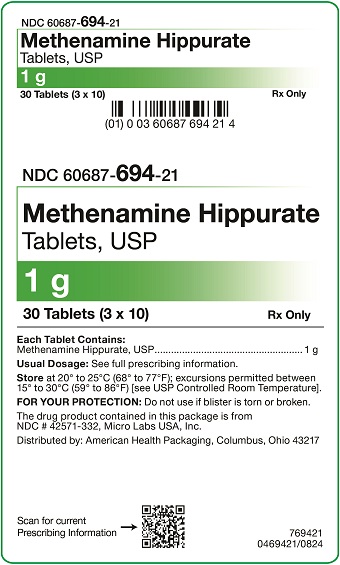
Methenamine Hippurate 1000 mg Tablet, 30-count — NDC 60687-694-21 (Billing 60687-0694-21)
This is a package of 30 tablets of Methenamine Hippurate 1000 mg Tablet from American Health Packaging, marketed since Aug 2022 and currently FDA-listed; retail pharmacies pay about $0.3126 per tablet (NADAC). It is this product's only package size.
NDC database record
One package, one record: these facts belong to NDC 60687-694-21 alone.
- Record
- FDA NDC Directory package listing · Human prescription drug
- Code segments
- 60687 labeler · 694 product · 21 package
- Package marketed since
- Aug 12, 2022
- Sample package
- No — commercial package
- Listing certified through
- Dec 31, 2026
- Billing quantity
- 30 EA per package
- Barcode (UPC-A, from the NDC)
- 3 6068769421 4
- FDA record last changed
- Jul 24, 2026
Identity & classification
Regulatory identifiers FDA, NLM and CMS codes for this package
Drug-database identifiers Medi-Span GPI and First Databank GCN / HICL / AHFS classification
- GSN (GCN sequence number): 009457
- GCN: 41980
- HICL (First Databank): 004101
- AHFS class code: 08:36.00.00
- RxCUI (RxNorm): 992150
Where does this data come from?
- FDA openFDA NDC Directory · synced Oct 8, 2026
- FDA label on DailyMed · label index refreshed Oct 8, 2026
- RxNorm (NLM RxNav) · catalog refreshed Oct 8, 2026
- Medi-Span GPI (licensed)
- First Databank (licensed) · refreshed Oct 8, 2026
RxNorm drug class
This medicine belongs to the Other antibacterials class.
Where does this data come from?
- RxClass (NLM) · catalog refreshed Oct 8, 2026
Clinical
Methenamine, an antibiotic, eliminates bacteria that cause urinary tract infections. It usually is used on a long-term basis to treat chronic infections and to prevent recurrence of infections. Antibiotics will not work for colds, flu, or other viral infections. This medication is sometimes prescribed for other uses; ask your doctor or pharmacist for more information.
Read the full MedlinePlus article ↗- That's a great question. Methenamine isn't used to clear an active infection — it's used to prevent another one from taking hold. Once your other antibiotic has done that job, meth...
- Why do I need to take methenamine if my infection is already gone?
- Yes, it actually does. Methenamine only converts into its active antibacterial form in acidic urine. Foods and medications that make your urine more alkaline — less acidic — can re...
- Does it matter what I eat or drink while I'm on this medication?
Patient education
Supplement & herbal interactions
Some supplements/herbs that may interact with Methenamine Hippurate — tap one for details:
Methenamine Hippurate may be associated with lower levels of 7 nutrients — worth a chat with your pharmacist, not a cause for alarm.
Where does this data come from?
- MedlinePlus (NLM) · refreshed Oct 8, 2026
- FDA label on DailyMed · label index refreshed Oct 8, 2026
Ask a licensed pharmacist directly — free, answered by our team.
Pricing
A drug doesn't have one price. Each row is a different public payment system, and none is what you'd pay at the counter — that depends on your insurance. The ⓘ on each row explains what it measures.
| Price system | Per ea | Per package |
|---|---|---|
| Retail pharmacies payNADAC · weekly | $0.313 | $9.38 / 30 tablet |
| Medicaid paysCMS SDUD · 12 mo | No recent Medicaid claims on file for this NDC — rare and low-volume NDCs are suppressed in the public data. | |
| Medicare drug plans payPart D · Q2 2026 | $0.5951 | $17.85 / 30 tablet |
Where does this data come from?
- CMS NADAC weekly file · file of Oct 7, 2026
- CMS ASP pricing files · refreshed Sep 20, 2026
- CMS Medicaid State Drug Utilization Data · refreshed Oct 9, 2026
- CMS Part D plan pricing files · refreshed Sep 24, 2026
- VA National Acquisition Center price file
Packaging — all sizes for this product
| Package NDC | Description | Marketing start | Marketing end | Status |
|---|---|---|---|---|
| 60687-0694-21 You're viewing this Main listing | 30 BLISTER PACK in 1 CARTON / 1 TABLET in 1 BLISTER PACK | 2022-07-20 | — | Active |
Therapeutic equivalents
| Product | Labeler | Pack | NADAC/unit | TE | Status | Price vs. this |
|---|---|---|---|---|---|---|
| Methenamine Hippurate 1000 mg 42571-0332-01 | Micro | 100 tablets | $0.313 | AB | Availability likely | — |
| Methenamine Hippurate 1 g 47781-0577-01 | Alvogen | 100 tablets | $0.313 | AB | Availability likely | — |
| Methenamine Hippurate 1000 mg 50268-0549-15 | AvPAK | 50 tablets | $0.313 | AB | Availability likely | — |
| Methenamine Hippurate 1 g 50742-0142-01 | Ingenus | 100 tablets | $0.313 | AB | Availability likely | — |
| Methenamine Hippurate 1 g 59746-0797-01 | Jubilant | 100 tablets | $0.313 | AB | Availability likely | — |
| Methenamine Hippurate 1000 mgthis 60687-0694-21 | American | 30 tablets | $0.313 | AB | Availability likely | — |
| Methenamine Hippurate 1 g 65862-0782-01 | Aurobindo | 100 tablets | $0.313 | AB | Availability likely | — |
| Methenamine hippurate 1 g 72578-0175-01 | Viona | 100 tablets | $0.313 | AB | Availability likely | — |
| Methenamine Hippurate 1 g 72603-0816-01 | NorthStar | 100 tablets | $0.313 | AB | Availability likely | — |
| Methenamine Hippurate 1 g 51407-0880-01 | Golden | 100 tablets | — | AB | FDA listed | — |
| Methenamine Hippurate 1 g 70685-0050-01 | Esjay | 100 tablets | — | AB | Discontinued | — |
| Methenamine hippurate 1 g 70771-1919-01 | Zydus | 100 tablets | — | AB | FDA listed | — |
Where does this data come from?
- FDA openFDA NDC Directory · synced Oct 8, 2026
- FDA Orange Book · refreshed Oct 9, 2026
- CMS NADAC weekly file · file of Oct 7, 2026
Availability & generic status
This product is an FDA-approved generic. Other versions of the same drug are listed under Therapeutic equivalents, least expensive first.
Where does this data come from?
- FDA Orange Book · refreshed Oct 9, 2026
What it looks like
Where does this data come from?
- FDA label on DailyMed · label index refreshed Oct 8, 2026
Inactive Ingredients / Excipients
Inactive ingredients, also called excipients, are components of the drug product other than the active ingredient. They may include fillers, dyes, coatings, preservatives, flavors, or other formulation ingredients.
🧪 Avoiding an ingredient? See Methenamine inactive ingredients by manufacturer: every current product's list side by side, so you can ask your pharmacy for the version that does not list it.
💡 Tap an ingredient (hover on desktop) to see what it is and why it’s used.
-
UNII 70097M6I30
Magnesium stearate is a salt made from magnesium and stearic acid, a fatty substance. It's used in tablets and capsules as a lubricant and glidant to help ingredients flow smoothly during manufacturing and prevent sticking.
-
UNII RDH86HJV5Z
Povidone K90 is a synthetic polymer made from a chemical called vinyl pyrrolidone. It acts as a binder to hold pill ingredients together and as a dispersant to help the medicine break down and dissolve properly in your body.
-
UNII ETJ7Z6XBU4
Silicon dioxide is a naturally occurring mineral used as a glidant and anti-caking agent. It helps powder ingredients flow smoothly and prevents clumping during manufacturing and storage.
3 inactive ingredients listed in the exact product block matched to this NDC.
Where does this data come from?
ingredient classCode="IACT" elements from the exact product block matched by this NDC. Label-section narrative from DailyMed / the openFDA label index is shown separately when available.- FDA label on DailyMed · label index refreshed Oct 8, 2026
- FDA openFDA NDC Directory · synced Oct 8, 2026
Inactive ingredient FAQ
Are inactive ingredients the same for every manufacturer?
Why might an inactive ingredient be missing?
Can inactive ingredients matter?
Manufacturer & labeler
More NDCs from American Health Packaging labeler code 60687
- Allopurinol 300 mg Tablet NDC 60687-688-01
- Bethanechol Chloride 10 mg Tablet NDC 60687-689-01
- Glipizide 5 mg Tablet NDC 60687-690-01
- Demeclocycline Hydrochloride 150 mg Tablet NDC 60687-691-01
- Ramelteon 8 mg Tablet NDC 60687-692-65
- Lamotrigine 150 mg Tablet NDC 60687-693-01
- Sucralfate 1 g Tablet NDC 60687-695-01
- Hydroxyzine Pamoate 25 mg Capsule NDC 60687-696-01
- Lacosamide 200 mg Tablet, Film Coated NDC 60687-698-57
- Cefdinir 300 mg Capsule NDC 60687-699-21
- Bethanechol Chloride 25 mg Tablet NDC 60687-700-01
- Glipizide 10 mg Tablet NDC 60687-701-01
Where does this data come from?
- FDA openFDA NDC Directory · synced Oct 8, 2026
- Drugs@FDA
Full prescribing information FDA SPL
🎯 Indications and Usage ▾
INDICATIONS Methenamine hippurate tablets USP are indicated for prophylactic or suppressive treatment of frequently recurring urinary tract infections when long-term therapy is considered necessary. This drug should only be used after eradication of the infection by other appropriate antimicrobial agents. To reduce the development of drug-resistant bacteria and maintain the effectiveness of methenamine hippurate and other antibacterial drugs, methenamine hippurate should be used only to treat or prevent infections that are proven or strongly suspected to be caused by susceptible bacteria.
When culture and susceptibility information are available, they should be considered in selecting or modifying antibacterial therapy. In the absence of such data, local epidemiology and susceptibility patterns may contribute to the empiric selection of therapy.
⏱️ Dosage and Administration ▾
DOSAGE AND ADMINISTRATION 1 tablet (1 g) twice daily (morning and night) for adults and pediatric patients over 12 years of age. 1/2 to 1 tablet (0.5 to 1 g) twice daily (morning and night) for pediatric patients 6 to 12 years of age. Since the antibacterial activity of methenamine hippurate is greater in acid urine, restriction of alkalinizing foods and medications is desirable.
If necessary, as indicated by urinary pH and clinical response, supplemental acidification of the urine should be instituted. The efficacy of therapy should be monitored by repeated urine cultures.
⛔ Contraindications ▾
CONTRAINDICATIONS Methenamine hippurate tablets USP are contraindicated in patients with renal insufficiency, severe hepatic insufficiency, or severe dehydration. Methenamine preparations should not be given to patients taking sulfonamides because some sulfonamides may form an insoluble precipitate with formaldehyde in the urine.
⚠️ Warnings ▾
WARNINGS Large doses of methenamine (8 grams daily for 3 to 4 weeks) have caused bladder irritation, painful and frequent micturition, albuminuria, and gross hematuria.
🤒 Adverse Reactions ▾
ADVERSE REACTIONS Minor adverse reactions have been reported in less than 3.5% of patients treated. These reactions have included nausea, upset stomach, dysuria, and rash. To report SUSPECTED ADVERSE REACTIONS, contact Micro Labs USA Inc. at 1-855-839-8195 or FDA at 1-800-FDA-1088 or www.fda.gov/medwatch .
🧓 Geriatric Use ▾
Geriatric Use Clinical studies of methenamine hippurate did not include sufficient numbers of subjects aged 65 and over to determine whether they respond differently from younger subjects. Other reported clinical experience has not identified differences in responses between the elderly and younger patients. In general, dose selection for an elderly patient should be cautious, usually starting at the low end of the dosing range, reflecting the greater frequency of decreased hepatic, renal or cardiac function, and of concomitant disease or other drug therapy.
Methenamine hippurate is contraindicated in patients with renal insufficiency and severe hepatic insufficiency (see CONTRAINDICATIONS ). Information for Patients Patients should be counseled that antibacterial drugs including methenamine hippurate should only be used to treat bacterial infections. They do not treat viral infections (e.g., the common cold).
When methenamine hippurate is prescribed to treat a bacterial infection, patients should be told that although it is common to feel better early in the course of therapy, the medication should be taken exactly as directed. Skipping doses or not completing the full course of therapy may (1) decrease the effectiveness of the immediate treatment and (2) increase the likelihood that bacteria will develop resistance and will not be treatable by methenamine hippurate or other antibacterial drugs in the future.
📦 How Supplied / Storage and Handling ▾
HOW SUPPLIED White to off white colored, capsule shaped, biconvex tablets, debossed with "H" and "1" on either side of breakline on one side and other side plain with approximate length 20.00 mm, width 8.00 mm and thickness 7.40 mm. Unit dose packages of 30 (3 x 10) NDC 60687-694-21 Store at 20°C to 25°C (68°F to 77°F); excursions permitted between 15°C and 30°C (59°F and 86°F) [see USP Controlled Room Temperature]. FOR YOUR PROTECTION: Do not use if blister torn or broken.
📋 Description ▾
DESCRIPTION Each white to off-white capsule-shaped tablet contains 1 g Methenamine Hippurate USP which is the Hippuric Acid Salt of Methenamine (hexamethylene tetramine). The tablet also contains inactive ingredients Colloidal silicon dioxide, magnesium stearate and povidone K90.
⚠️ Precautions ▾
PRECAUTIONS Prescribing methenamine hippurate in the absence of a proven or strongly suspected bacterial infection or a prophylactic indication is unlikely to provide benefit to the patient and increases the risk of the development of drug-resistant bacteria. Care should be taken to maintain an acid pH of the urine, especially when treating infections due to urea-splitting organisms such as Proteus and strains of Pseudomonas . In a few instances in one study, the serum transaminase levels were slightly elevated during treatment but returned to normal while the patients were still taking methenamine hippurate.
Because of this report, it is recommended that liver function studies be performed periodically on patients taking the drug, especially those with liver dysfunction. Use in Pregnancy: In early pregnancy the safe use of methenamine hippurate is not established. In the last trimester, safety is suggested, but not definitely proved.
No adverse effects on the fetus were seen in studies in pregnant rats and rabbits. Methenamine hippurate taken during pregnancy can interfere with laboratory tests of urine estriol (resulting in unmeasurably low values) when acid hydrolysis is used in the laboratory procedure. This interference is due to the presence in the urine of methenamine and/or formaldehyde.
Enzymatic hydrolysis, in place of acid hydrolysis, will circumvent this problem. Geriatric Use Clinical studies of methenamine hippurate did not include sufficient numbers of subjects aged 65 and over to determine whether they respond differently from younger subjects. Other reported clinical experience has not identified differences in responses between the elderly and younger patients.
In general, dose selection for an elderly patient should be cautious, usually starting at the low end of the dosing range, reflecting the greater frequency of decreased hepatic, renal or cardiac function, and of concomitant disease or other drug therapy. Methenamine hippurate is contraindicated in patients with renal insufficiency and severe hepatic insufficiency (see CONTRAINDICATIONS ). Information for Patients Patients should be counseled that antibacterial drugs including methenamine hippurate should only be used to treat bacterial infections.
They do not treat viral infections (e.g., the common cold). When methenamine hippurate is prescribed to treat a bacterial infection, patients should be told that although it is common to feel better early in the course of therapy, the medication should be taken exactly as directed. Skipping doses or not completing the full course of therapy may (1) decrease the effectiveness of the immediate treatment and (2) increase the likelihood that bacteria will develop resistance and will not be treatable by methenamine hippurate or other antibacterial drugs in the future.
📄 Package Label / Principal Display Panel ▾
Package/Label Display Panel – Carton – 1 g NDC 60687- 694 -21 Methenamine Hippurate Tablets, USP 1 g 30 Tablets (3 x 10) Rx Only Each Tablet Contains: Methenamine Hippurate, USP...................................................... 1 g Usual Dosage: See full prescribing information. Store at 20° to 25°C (68° to 77°F); excursions permitted between 15° to 30°C (59° to 86°F) [see USP Controlled Room Temperature].
FOR YOUR PROTECTION: Do not use if blister is torn or broken. The drug product contained in this package is from NDC # 42571-332, Micro Labs USA, Inc. Distributed by: American Health Packaging, Columbus, Ohio 43217 769421 0469421/0824 1 g Methenamine Tablets Carton
Package/Label Display Panel – Blister – 1 g Methenamine Hippurate Tablet, USP 1 g 1 g Methenamine Hippurate Tablet Blister