
Methenamine Mandelate 1000 mg Tablet, Film Coated, 120-count — NDC 62135-201-12 (Billing 62135-0201-12)
This is a package of 120 tablets of Methenamine Mandelate 1000 mg Tablet, Film Coated from Chartwell RX, LLC, marketed since Oct 2021 and currently FDA-listed; retail pharmacies pay about $2.60 per tablet (NADAC).
NDC database record
One package, one record: these facts belong to NDC 62135-201-12 alone.
- Record
- FDA NDC Directory package listing · Human prescription drug
- Code segments
- 62135 labeler · 201 product · 12 package
- Package marketed since
- Oct 1, 2021
- Sample package
- No — commercial package
- Listing certified through
- Dec 31, 2026
- Billing quantity
- 120 EA per package
- Barcode (UPC)
- 0362135201609, 0362135200121, 0362135200015, 0362135200602 +2 more
- FDA record last changed
- Jul 24, 2026
Identity & classification
Regulatory identifiers FDA, NLM and CMS codes for this package
Drug-database identifiers Medi-Span GPI and First Databank GCN / HICL / AHFS classification
- GSN (GCN sequence number): 009460
- GCN: 42032
- GPI-14 (Medi-Span): 16800020100320
- HICL (First Databank): 004102
- AHFS class code: 08:36.00.00
- RxCUI (RxNorm): 992153
Where does this data come from?
- FDA openFDA NDC Directory · synced Oct 8, 2026
- FDA label on DailyMed · label index refreshed Oct 8, 2026
- RxNorm (NLM RxNav) · catalog refreshed Oct 1, 2026
- Medi-Span GPI (licensed)
- First Databank (licensed) · refreshed Oct 8, 2026
RxNorm drug class
This medicine belongs to the Other antibacterials class.
Where does this data come from?
- RxClass (NLM) · catalog refreshed Oct 1, 2026
Clinical
- That's a great question. Methenamine isn't used to clear an active infection — it's used to prevent another one from taking hold. Once your other antibiotic has done that job, meth...
- Why do I need to take methenamine if my infection is already gone?
- Yes, it actually does. Methenamine only converts into its active antibacterial form in acidic urine. Foods and medications that make your urine more alkaline — less acidic — can re...
- Does it matter what I eat or drink while I'm on this medication?
Patient education
Supplement & herbal interactions
Some supplements/herbs that may interact with Methenamine Mandelate — tap one for details:
Methenamine Mandelate may be associated with lower levels of 7 nutrients — worth a chat with your pharmacist, not a cause for alarm.
Where does this data come from?
- MedlinePlus (NLM) · refreshed Oct 8, 2026
- FDA label on DailyMed · label index refreshed Oct 8, 2026
Ask a licensed pharmacist directly — free, answered by our team.
Pricing
A drug doesn't have one price. Each row is a different public payment system, and none is what you'd pay at the counter — that depends on your insurance. The ⓘ on each row explains what it measures.
| Price system | Per ea | Per package |
|---|---|---|
| Retail pharmacies payNADAC · weekly | $2.604 | $312.53 / 120 tablets |
| Medicaid paysCMS SDUD · 12 mo | No recent Medicaid claims on file for this NDC — rare and low-volume NDCs are suppressed in the public data. | |
| Medicare drug plans payPart D · quarterly | No Part D plan price is available for this NDC in our data. | |
Where does this data come from?
- CMS NADAC weekly file · file of Oct 7, 2026
- CMS ASP pricing files · refreshed Sep 20, 2026
- CMS Medicaid State Drug Utilization Data · refreshed Oct 8, 2026
- CMS Part D plan pricing files · refreshed Sep 24, 2026
- VA National Acquisition Center price file
Packaging — all sizes for this product
| Package NDC | Description | Per unit | Per pack | Marketing start | Marketing end | Status |
|---|---|---|---|---|---|---|
| 62135-0201-01 62135-201-01 | 100 TABLET, FILM COATED in 1 BOTTLE | — | — | 2021-10-01 | — | Active |
| 62135-0201-12 You're viewing this | 120 TABLET, FILM COATED in 1 BOTTLE | $2.60 / ea | $312.52 | 2021-10-01 | — | Active |
| 62135-0201-60 62135-201-60 Main listing | 60 TABLET, FILM COATED in 1 BOTTLE | $2.60 / ea | $156.26 | 2021-10-01 | — | Active |
You're viewing the largest of 3 pack sizes for this product.
This pack has the lowest per-ea cost of the 2 priced pack sizes ($2.60 NADAC).
Pack size FAQ
What quantity is in this package?
How does this package differ from NDC 62135-0201-60?
What NDC number is used to bill for this package of Methenamine Mandelate 1000 mg Tablet, Film Coated?
Prices are the latest CMS NADAC pharmacy acquisition cost per NDC; per-pack figures are per-unit × pack quantity, shown only when the pack is denominated in the same measure NADAC prices.
Therapeutic equivalents
| Product | Labeler | Pack | NADAC/unit | TE | Status | Price vs. this |
|---|---|---|---|---|---|---|
| Methenamine Mandelate 1000 mg 42799-0106-01 | Edenbridge | 100 tablets | $2.604 | — | Availability likely | — |
| Methenamine Mandelate 1000 mgthis 62135-0201-12 | Chartwell | 120 tablets | $2.604 | — | Availability likely | — |
| Methenamine Mandelate 1000 mg 69367-0437-01 | Westminster | 100 tablets | $2.604 | — | Availability likely | — |
| Methenamine Mandelate 1000 mg 72162-2655-01 | Bryant | 100 tablets | — | — | FDA listed | — |
Where does this data come from?
- FDA openFDA NDC Directory · synced Oct 8, 2026
- FDA Orange Book · refreshed Oct 3, 2026
- CMS NADAC weekly file · file of Oct 7, 2026
Availability & generic status
We did not find an FDA-approved generic match for this exact strength, form and route.
Where does this data come from?
- FDA Orange Book · refreshed Oct 3, 2026
What it looks like
Where does this data come from?
- FDA label on DailyMed · label index refreshed Oct 8, 2026
Inactive Ingredients / Excipients
Inactive ingredients, also called excipients, are components of the drug product other than the active ingredient. They may include fillers, dyes, coatings, preservatives, flavors, or other formulation ingredients.
🧪 Avoiding an ingredient? See Methenamine inactive ingredients by manufacturer: every current product's list side by side, so you can ask your pharmacy for the version that does not list it.
💡 Tap an ingredient (hover on desktop) to see what it is and why it’s used.
-
UNII M28OL1HH48
Croscarmellose sodium is a plant-based substance derived from cellulose. It acts as a disintegrant, helping tablets and capsules break down quickly in the digestive system so the medicine can be absorbed.
-
UNII 4AQJ3LG584
A synthetic blue dye combined with aluminum to create a stable colorant. It's used in medicines and supplements to add blue color or create specific shades for product identification and appearance.
-
UNII 70097M6I30
Magnesium stearate is a salt made from magnesium and stearic acid, a fatty substance. It's used in tablets and capsules as a lubricant and glidant to help ingredients flow smoothly during manufacturing and prevent sticking.
-
UNII OP1R32D61U
Microcrystalline cellulose is a purified form of cellulose, a natural fiber from plant sources. It acts as a binder and filler in tablets and capsules, helping hold ingredients together and give the medicine its shape and size.
-
UNII 3WJQ0SDW1A
Polyethylene glycol is a synthetic liquid or solid polymer used in medicines as a solvent, lubricant, and humectant. It helps dissolve active ingredients, reduces friction during manufacturing, and retains moisture in the final product.
-
UNII 532B59J990
Polyvinyl alcohol is a synthetic polymer made from plant-derived materials. It's used as a binder to hold ingredients together, a film-former in coatings, and a thickener in liquid formulations.
-
UNII ETJ7Z6XBU4
Silicon dioxide is a naturally occurring mineral used as a glidant and anti-caking agent. It helps powder ingredients flow smoothly and prevents clumping during manufacturing and storage.
-
UNII 7SEV7J4R1U
A powder made from a naturally occurring mineral. In medicines, talc works as a glidant and anti-caking agent, helping tablets and capsules flow smoothly during manufacturing and preventing clumping.
-
UNII 15FIX9V2JP
Titanium dioxide is a bright white mineral powder commonly used as a colorant and opacifying agent. It makes pills and tablets white or lighter in color and helps make coatings non-transparent.
9 inactive ingredients listed in the exact product block matched to this NDC.
Where does this data come from?
ingredient classCode="IACT" elements from the exact product block matched by this NDC. Label-section narrative from DailyMed / the openFDA label index is shown separately when available.- FDA label on DailyMed · label index refreshed Oct 8, 2026
- FDA openFDA NDC Directory · synced Oct 8, 2026
Inactive ingredient FAQ
Are inactive ingredients the same for every manufacturer?
Why might an inactive ingredient be missing?
Can inactive ingredients matter?
Manufacturer & labeler
More NDCs from Chartwell RX, LLC labeler code 62135
- Hydrocortisone 20 mg Tablet NDC 62135-186-60
- ALBUTEROL SULFATE 2 mg/5mL Syrup NDC 62135-189-23
- Calcium Acetate 667 mg Capsule NDC 62135-191-22
- Calcium Acetate 667 mg Tablet NDC 62135-192-22
- Valproic Acid 250 mg/5mL Solution NDC 62135-196-24
- Methenamine Mandelate 500 mg Tablet, Film Coated NDC 62135-200-01
- Methimazole 5 mg Tablet NDC 62135-205-01
- Methimazole 10 mg Tablet NDC 62135-206-01
- Folic acid 1 mg Tablet NDC 62135-210-01
- Chlordiazepoxide Hydrochloride 5 mg Capsule NDC 62135-220-60
- Chlordiazepoxide Hydrochloride 10 mg Capsule NDC 62135-221-60
- Chlordiazepoxide Hydrochloride 25 mg Capsule NDC 62135-222-60
Where does this data come from?
- FDA openFDA NDC Directory · synced Oct 8, 2026
- Drugs@FDA
Full prescribing information FDA SPL
🎯 Indications and Usage ▾
INDICATIONS AND USAGE Methenamine mandelate is indicated for the suppression or elimination of bacteriuria associated with pyelonephritis, cystitis, and other chronic urinary tract infections; also those neurologic diseases leading to an infected residual urine. When used as recommended, methenamine mandelate is particularly suitable for long-term therapy because of its safety and because resistance to the nonspecific bactericidal action of formaldehyde does not develop. Pathogens resistant to other antibacterial agents may respond to methenamine mandelate because of the nonspecific effect of formaldehyde formed in an acid urine.
Prophylactic Use Rationale: Urine is a good culture medium for many urinary pathogens. Inoculation by a few organisms (relapse or reinfection) may lead to bacteriuria in susceptible individuals. Thus, the rationale of management in recurring urinary tract infection (bacteriuria) is to change the urine from a growth-supporting to a growth-inhibiting medium.
There is a growing body of evidence that long-term administration of methenamine mandelate can prevent the recurrence of bacteriuria in patients with chronic pyelonephritis. Therapeutic Use Rationale : Methenamine mandelate helps to sterilize the urine, and in some situations in which underlying pathologic conditions prevent sterilization by any means, it can help to suppress the bacteriuria. Methenamine mandelate should not be used alone for acute infections with parenchymal involvement causing systemic symptoms such as chills and fever.
A thorough diagnostic investigation as a part of the overall management of the urinary tract infection should accompany the use of methenamine mandelate.
⏱️ Dosage and Administration ▾
DOSAGE AND ADMINISTRATION The average adult dose is 4 g a day given as one 1000 mg tablet or two 500 mg tablets after each meal and at bedtime. Children 6 to 12 years of age should receive half the adult dose; one 500 mg tablet, 4 times a day.
⛔ Contraindications ▾
CONTRAINDICATIONS Methenamine mandelate tablets are contraindicated in patients with renal insufficiency, severe hepatic disease, severe dehydration, and in patients who have exhibited hypersensitivity to any components of this product.
⚠️ Warnings ▾
WARNINGS Methenamine mandelate should be avoided in patients with gout because it may precipitate urate crystals in their urine. A similar situation may arise in patients with a predisposition to the formation of uric acid stones. Methenamine preparations should not be given to patients taking sulfonamides because some sulfonamides may form an insoluble precipitate with formaldehyde in the urine.
🤒 Adverse Reactions ▾
ADVERSE REACTIONS Gastrointestinal disturbances (nausea, stomach upset), generalized skin rash, dysuria, painful or difficult urination may occur occasionally with the use of methenamine preparations. Microscopic and rarely, gross hematuria have been described.
🔄 Drug Interactions ▾
Drug Interactions Formaldehyde and sulfamethizole form an insoluble precipitate in acid urine; therefore, methenamine mandelate should not be administered concurrently with sulfamethizole or other sulfonamides. Concurrent use of salicylates may lead to increased serum salicylate levels since excretion of salicylates is reduced in acidified urine.
🔄 Drug / Laboratory Test Interactions ▾
Drug/Laboratory Test Interactions Formaldehyde interferes with fluorometric procedures for determination of urinary catecholamines and vanillylmandelic acid (VMA), causing erroneously high results. Formaldehyde also causes falsely decreased urine estriol levels by reacting with estriol when acid hydrolysis techniques are used; estriol determinations which use enzymatic hydrolysis are unaffected by formaldehyde. Formaldehyde causes falsely elevated 17-hydroxycorticosteroid levels when the Porter-Silber method is used and falsely decreased 5-hydroxyindoleacetic acid (5HIAA) levels by inhibiting color development when nitrosonaphthol methods are used.
🤰 Pregnancy ▾
Pregnancy Teratogenic Effects. Pregnancy Category C. Animal reproduction studies have not been conducted with methenamine mandelate. It is also not known whether methenamine mandelate can cause fetal harm when administered to a pregnant woman or can affect reproduction capacity. Since methenamine is known to cross the placental barrier, methenamine mandelate should be given to a pregnant woman only if the potential benefit outweighs the risk.
🧬 Clinical Pharmacology ▾
CLINICAL PHARMACOLOGY Methenamine mandelate is readily absorbed but remains essentially inactive until it is excreted by the kidneys and concentrated in the urine. An acid urine is essential for antibacterial action, with maximum efficacy occurring at pH 5.5 or less. In an acid urine, mandelic acid exerts its antibacterial action and also contributes to the acidification of the urine.
Mandelic acid is excreted both by glomerular filtration and tubular excretion. The methenamine component is hydrolyzed in acid urine to ammonia and to the bactericidal agent formaldehyde. Proportionally less formaldehyde is released as urinary pH approaches 6.0 and insufficient quantities are released above this level for therapeutic response.
There is equally effective antibacterial activity against both gram-positive and gram-negative organisms, since the antibacterial action of mandelic acid and formaldehyde is nonspecific. There are reports that methenamine mandelate is ineffective in some infections with Proteus vulgaris and urea-splitting strains of Pseudomonas aeruginosa and A. aerogenes . Since urea-splitting strains may raise the pH of the urine, particular attention to supplementary acidification with agents such as ascorbic acid, and urinary pH monitoring is required.
However, results in any single case will depend to a large extent on the underlying pathology and the overall management.
📦 How Supplied / Storage and Handling ▾
HOW SUPPLIED Methenamine Mandelate Tablets, USP 500 mg are blue, unscored, oval, film-coated, debossed with "CE 34" on one side and plain on the other side. Supplied in bottles of 60 (NDC 62135-200-60) Supplied in bottles of 100 (NDC 62135-200-01) Supplied in bottles of 120 (NDC 62135-200-12) Methenamine Mandelate Tablets, USP 1000 mg (1 g) are blue, unscored, oval, film-coated, debossed with "CE 35" on one side and plain on the other side. Supplied in bottles of 60 (NDC 62135-201-60) Supplied in bottles of 100 (NDC 62135-201-01) Supplied in bottles of 120 (NDC 62135-201-12) Preserve in well-closed containers Store at 20° to 25°C (68° to 77°F); excursions permitted to 15° to 30°C (59° to 86°F) [see USP Controlled Room Temperature].
Manufactured for: Chartwell RX LLC. Congers, NY 10920 Made in USA L70516 Rev. 09/2021
📋 Description ▾
DESCRIPTION Methenamine mandelate, a urinary antibacterial agent, is the chemical combination of mandelic acid with methenamine. Methenamine mandelate is available for oral use as film-coated tablets. Methenamine mandelate tablets contain 500 mg and 1000 mg (1 g) methenamine mandelate and the following inactive ingredients: croscarmellose sodium, FD&C blue #2 aluminum lake, magnesium stearate, microcrystalline cellulose, polyethylene glycol, polyvinyl alcohol, silicon dioxide, talc and titanium dioxide.
💬 Information for Patients ▾
Information for Patients To assure an acidic pH, patients should be instructed to restrict or avoid milk products and antacids containing sodium carbonate or bicarbonate.
⚠️ Precautions ▾
PRECAUTIONS General Dysuria may occur (usually at higher than recommended dosage). This can be controlled by reducing the dosage and the acidification. When urine acidification is contraindicated or unattainable (as with some urea-splitting bacteria), the drug is not recommended.
Large doses of methenamine (8 g daily for 3 to 4 weeks) have caused bladder irritation, painful and frequent micturition, albuminuria, and gross hematuria. Information for Patients To assure an acidic pH, patients should be instructed to restrict or avoid milk products and antacids containing sodium carbonate or bicarbonate. Laboratory Tests As with all urinary tract infections, the efficacy of therapy should be monitored by repeated urine cultures.
Urinary pH monitoring is required to assure an acidic urinary pH (below 5.5). Drug Interactions Formaldehyde and sulfamethizole form an insoluble precipitate in acid urine; therefore, methenamine mandelate should not be administered concurrently with sulfamethizole or other sulfonamides. Concurrent use of salicylates may lead to increased serum salicylate levels since excretion of salicylates is reduced in acidified urine.
Drug/Laboratory Test Interactions Formaldehyde interferes with fluorometric procedures for determination of urinary catecholamines and vanillylmandelic acid (VMA), causing erroneously high results. Formaldehyde also causes falsely decreased urine estriol levels by reacting with estriol when acid hydrolysis techniques are used; estriol determinations which use enzymatic hydrolysis are unaffected by formaldehyde. Formaldehyde causes falsely elevated 17-hydroxycorticosteroid levels when the Porter-Silber method is used and falsely decreased 5-hydroxyindoleacetic acid (5HIAA) levels by inhibiting color development when nitrosonaphthol methods are used.
CARCINOGENESIS and MUTAGENESIS Methenamine mandelate has not been evaluated for carcinogenicity or mutagenicity. Methenamine was evaluated for mutagenicity in the Ames Salmonella/mammalian microsome test. Five strains of Salmonella typhimurium (TA98, TA100, TA1535, TA1537 and TA1538) and a strain of Escherichia coli (WP2uvrA) were used.
At a dose of 10,000 μg/plate methenamine showed mutagenic activity in Salmonella typhimurium TA98 and TA100 by metabolic activation and also showed mutagenic activity in TA98 without microsomal activation. In one large study, no evidence of carcinogenicity was found following long-term oral administration of methenamine 1.25 g/kg/day to rats (104 weeks) and mice (60 weeks). Pregnancy Teratogenic Effects.
Pregnancy Category C. Animal reproduction studies have not been conducted with methenamine mandelate. It is also not known whether methenamine mandelate can cause fetal harm when administered to a pregnant woman or can affect reproduction capacity.
Since methenamine is known to cross the placental barrier, methenamine mandelate should be given to a pregnant woman only if the potential benefit outweighs the risk. Nursing Mothers Methenamine is excreted in breast milk. Because of the potential for serious adverse reactions in nursing infants, a decision should be made whether to discontinue nursing or to discontinue the drug, taking into account the importance of the drug to the mother.
🍼 Nursing Mothers ▾
Nursing Mothers Methenamine is excreted in breast milk. Because of the potential for serious adverse reactions in nursing infants, a decision should be made whether to discontinue nursing or to discontinue the drug, taking into account the importance of the drug to the mother.
📄 Carcinogenesis, Mutagenesis, Impairment of Fertility ▾
CARCINOGENESIS and MUTAGENESIS Methenamine mandelate has not been evaluated for carcinogenicity or mutagenicity. Methenamine was evaluated for mutagenicity in the Ames Salmonella/mammalian microsome test. Five strains of Salmonella typhimurium (TA98, TA100, TA1535, TA1537 and TA1538) and a strain of Escherichia coli (WP2uvrA) were used.
At a dose of 10,000 μg/plate methenamine showed mutagenic activity in Salmonella typhimurium TA98 and TA100 by metabolic activation and also showed mutagenic activity in TA98 without microsomal activation. In one large study, no evidence of carcinogenicity was found following long-term oral administration of methenamine 1.25 g/kg/day to rats (104 weeks) and mice (60 weeks).
📄 Package Label / Principal Display Panel ▾
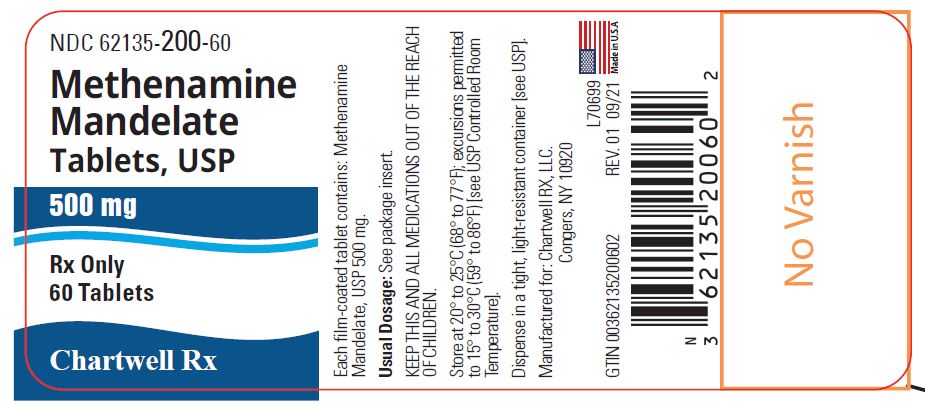
PACKAGE LABEL-PRINCIPAL DISPLAY PANEL Methenamine Mandelate Tablets, USP 500 mg - NDC 62135-200-60 - 60 Tablets Label Methenamine Mandelate Tablets, USP 500 mg - NDC 62135-200-01 - 100 Tablets Label Methenamine Mandelate Tablets, USP 500 mg - NDC 62135-200-12 - 120 Tablets Label Methenamine Mandelate Tablets, USP 1000 mg - NDC 62135-201-60 - 60 Tablets Label Methenamine Mandelate Tablets, USP 1000 mg - NDC 62135-201-01 - 100 Tablets Label Methenamine Mandelate Tablets, USP 1000 mg - NDC 62135-201-12 - 120 Tablets Label Methenamine Mandelate Tablets, USP 500 mg - NDC 62135-200-60 - 60 Tablets Label Methenamine Mandelate Tablets, USP 500 mg - NDC 62135-200-01 - 100 Tablets Label Methenamine Mandelate Tablets, USP 500 mg - NDC 62135-200-12 - 120 Tablets Label Methenamine Mandelate Tablets, USP 1000 mg - NDC 62135-201-60 - 60 Tablets Label Methenamine Mandelate Tablets, USP 1000 mg - NDC 62135-201-01 - 100 Tablets Label Methenamine Mandelate Tablets, USP 1000 mg - NDC 62135-201-12 - 120 Tablets Label
Medicaid utilization by pack size
Medicare Part D spend CMS · PART D · 2026 (Q1)
About this NDC listing & data coverage
Listed without an FDA application
This product's marketing category indicates it is marketed without an approved FDA application (no NDA, ANDA, or BLA on file). Having an NDC does not by itself establish FDA approval — the NDC Directory is a listing system, not an approval decision. Approval-linked data such as Orange Book therapeutic-equivalence ratings therefore does not apply.
What data is (and isn’t) available for this NDC — tap to expand
| NDC identity (package / product / labeler codes) | ✓ Available |
| Labeler | ✓ Available |
| Product & package description | ✓ Available |
| Marketing category & status | ✓ Available |
| Active ingredient / dosage form / route | ✓ Available |
| FDA label (SPL via DailyMed) | ✓ Available |
| Package photos | ✓ Available |
| Inactive ingredients (structured) | ✓ Available |
| NADAC pharmacy acquisition price (CMS) | ✓ Available |
| Orange Book / therapeutic-equivalence data | — Not published for this NDC Applies only to products approved under an NDA/ANDA; many listings are out of scope. |
| HCPCS J-code billing crosswalk | — Not published for this NDC Most self-administered / retail products have no J-code — that is normal. |
| Medicaid utilization (CMS SDUD) | — Not published for this NDC CMS reports utilization only for NDCs with Medicaid claims above its privacy threshold. |