
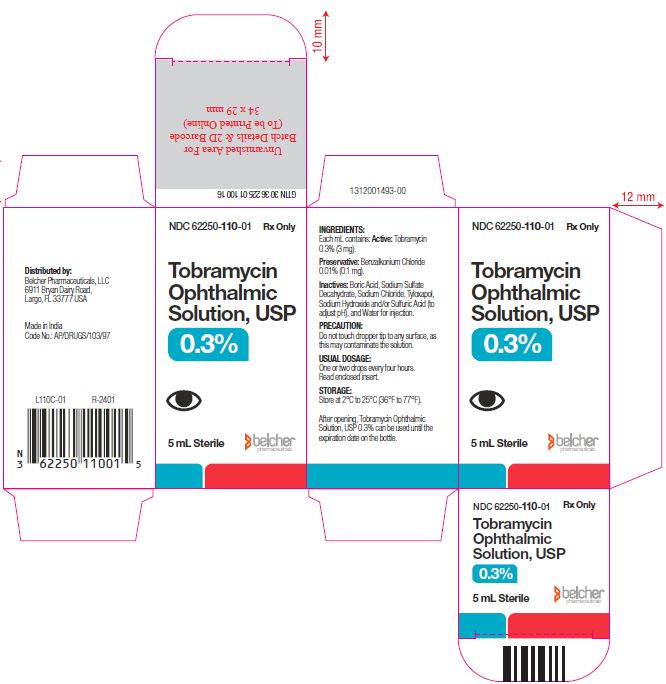
Tobramycin 3 mg/mL Solution/ Drops — NDC 62250-110-01 (Billing 62250-0110-01)
This is a package of Tobramycin 3 mg/mL Solution/ Drops from Belcher Pharmaceuticals, LLC, marketed since Apr 2024 and currently FDA-listed. It is this product's only package size.
NDC database record
One package, one record: these facts belong to NDC 62250-110-01 alone.
- Record
- FDA NDC Directory package listing · Human prescription drug
- Code segments
- 62250 labeler · 110 product · 01 package
- Package marketed since
- Apr 1, 2024
- Sample package
- No — commercial package
- Listing certified through
- Dec 31, 2026
- Barcode (UPC-A, from the NDC)
- 3 6225011001 5
- FDA record last changed
- Jul 24, 2026
Identity & classification
Regulatory identifiers FDA, NLM and CMS codes for this package
- RxCUI (RxNorm): 313415
Where does this data come from?
- FDA openFDA NDC Directory · synced Oct 1, 2026
- FDA label on DailyMed · label index refreshed Oct 6, 2026
- RxNorm (NLM RxNav) · catalog refreshed Oct 1, 2026
- Medi-Span GPI (licensed)
- First Databank (licensed) · refreshed Oct 1, 2026
RxNorm drug class
This medicine belongs to the Aminoglycoside Antibacterial class.
Where does this data come from?
- RxClass (NLM) · catalog refreshed Oct 1, 2026
Clinical
- It depends on the form. Inhaled tobramycin treats Pseudomonas aeruginosa lung infection in cystic fibrosis. Eye drops and ointment treat external eye infections. The injection trea...
- You breathe it in by mouth, usually twice a day about 12 hours apart, for 28 days. Then you take 28 days off. TOBI Podhaler capsules must never be swallowed; they are used only wit...
- Cough, shortness of breath, fever, sore throat, hoarseness and headache are common with the inhaled form. Mention them to your care team if they bother you.
- Call about ringing in the ears, hearing loss, dizziness or balance trouble, new muscle weakness, or wheezing after a dose. These can be signs of serious effects.
Patient education
Supplement & herbal interactions
Some supplements/herbs that may interact with Tobramycin — tap one for details:
Tobramycin may be associated with lower levels of 8 nutrients — worth a chat with your pharmacist, not a cause for alarm.
Where does this data come from?
- MedlinePlus (NLM) · refreshed Oct 1, 2026
- FDA label on DailyMed · label index refreshed Oct 6, 2026
Ask a licensed pharmacist directly — free, answered by our team.
Pricing
A drug doesn't have one price. Each row is a different public payment system, and none is what you'd pay at the counter — that depends on your insurance. The ⓘ on each row explains what it measures.
| Price system | Per mL | Per package |
|---|---|---|
| Retail pharmacies payNADAC · weekly | Not in the retail survey — common for institutional, discontinued, or low-volume packs. | |
| Medicaid paysCMS SDUD · 12 mo | No recent Medicaid claims on file for this NDC — rare and low-volume NDCs are suppressed in the public data. | |
| Medicare drug plans payPart D · Q2 2026 | $0.9370 | $4.69 / 5 ml |
Where does this data come from?
- CMS NADAC weekly file
- CMS ASP pricing files · refreshed Sep 20, 2026
- CMS Medicaid State Drug Utilization Data · refreshed Oct 7, 2026
- CMS Part D plan pricing files · refreshed Sep 24, 2026
- VA National Acquisition Center price file
Packaging — all sizes for this product
| Package NDC | Description | Marketing start | Marketing end | Status |
|---|---|---|---|---|
| 62250-0110-01 You're viewing this Main listing | 1 BOTTLE, PLASTIC in 1 CARTON / 5 mL in 1 BOTTLE, PLASTIC | 2024-04-01 | — | Active |
Therapeutic equivalents
| Product | Labeler | Pack | NADAC/unit | TE | Status | Price vs. this |
|---|---|---|---|---|---|---|
| Tobramycin 3 mg/mL 24208-0290-05 | Bausch | 1 bottle | $1.108 | AT | Availability likely | — |
| Tobramycin 3 mg/mL 61314-0643-05 | Sandoz | 5 ml | $1.108 | AT | Availability likely | — |
| Tobramycin Ophthalmic Solution 3 mg/mL 62332-0518-05 | Alembic | 1 bottle | $1.108 | AT | Availability likely | — |
| Tobramycin 3 mg/mL 70069-0131-01 | Somerset | 1 bottle | $1.108 | AT | Availability likely | — |
| Tobramycin Ophthalmic Solution 3 mg/mL 46708-0518-05 | Alembic | 1 bottle | — | AT | FDA listed | — |
| Tobramycin 3 mg/mL 50090-2127-00 | A-S | 1 bottle | — | AT | FDA listed | — |
| Tobramycin 3 mg/mL 50090-4190-00 | A-S | 1 bottle | — | AT | FDA listed | — |
| Tobramycin 3 mg/mL 60760-0583-05 | St. | 1 bottle | — | AT | FDA listed | — |
| Tobramycin 3 mg/mL 61919-0642-05 | DirectRX | 5 ml | — | AT | FDA listed | — |
| Tobramycin 3 mg/mLthis 62250-0110-01 | Belcher | 1 bottle | — | AT | FDA listed | — |
| Tobramycin 3 mg/mL 63187-0024-05 | Proficient | 1 bottle | — | AT | FDA listed | — |
| Tobramycin 3 mg/mL 63187-0902-02 | Proficient | 1 bottle | — | — | FDA listed | — |
| Tobramycin 3 mg/mL 63187-0973-05 | Proficient | 5 ml | — | AT | FDA listed | — |
| Tobramycin 3 mg/mL 66267-0936-05 | NuCare | 5 ml | — | AT | FDA listed | — |
| Tobramycin 3 mg/mL 68071-2272-05 | NuCare | 1 bottle | — | AT | FDA listed | — |
| Tobramycin 3 mg/mL 68083-0374-01 | Gland | 1 bottle | — | AT | FDA listed | — |
| Tobramycin 3 mg/mL 68788-7252-05 | Preferred | 1 bottle | — | AT | FDA listed | — |
| Tobramycin 3 mg/mL 70518-1370-00 | REMEDYREPACK | 1 bottle | — | AT | FDA listed | — |
| Tobramycin 3 mg/mL 71205-0101-05 | Proficient | 1 bottle | — | AT | FDA listed | — |
| Tobramycin 3 mg/mL 76420-0092-05 | Asclemed | 5 ml | — | AT | FDA listed | — |
| Tobramycin 3 mg/mL 76420-0791-05 | Asclemed | 1 bottle | — | AT | FDA listed | — |
| Tobramycin 3 mg/mL 80425-0341-01 | Advanced | 1 bottle | — | AT | FDA listed | — |
| Tobramycin 3 mg/mL 85766-0025-05 | Sportpharm | 1 bottle | — | AT | FDA listed | — |
| Tobramycin 3 mg/mL 85766-0189-05 | Sportpharm | 1 bottle | — | AT | FDA listed | — |
| Tobramycin 3 mg/mL 86211-0110-01 | JVET | 1 bottle | — | AT | FDA listed | — |
| Tobramycin 3 mg/mL 68788-4149-05 | Preferred | 1 bottle | — | AT | FDA listed | — |
Where does this data come from?
- FDA openFDA NDC Directory · synced Oct 1, 2026
- FDA Orange Book · refreshed Oct 3, 2026
- CMS NADAC weekly file
Availability & generic status
This product is an FDA-approved generic. Other versions of the same drug are listed under Therapeutic equivalents, least expensive first.
Where does this data come from?
- FDA Orange Book · refreshed Oct 3, 2026
Inactive Ingredients / Excipients
Inactive ingredients, also called excipients, are components of the drug product other than the active ingredient. They may include fillers, dyes, coatings, preservatives, flavors, or other formulation ingredients.
🧪 Avoiding an ingredient? See Tobramycin inactive ingredients by manufacturer: every current product's list side by side, so you can ask your pharmacy for the version that does not list it.
💡 Tap an ingredient (hover on desktop) to see what it is and why it’s used.
-
UNII F5UM2KM3W7
Benzalkonium chloride is a chemical compound that works as a preservative and antimicrobial agent in medications. It prevents bacterial and fungal growth in liquid formulations to keep the product safe during storage and use.
-
UNII R57ZHV85D4
Boric acid is a weak acid derived from boron. In medicines, it typically serves as a buffer to help maintain the product's pH level and may act as a preservative in certain formulations.
-
UNII 451W47IQ8X
Sodium chloride is common table salt. It's used in medicines as a buffer to maintain proper pH, as a filler to add bulk, or to adjust the osmotic balance in liquid formulations.
-
UNII 55X04QC32I
A strong alkaline chemical used to adjust and maintain the pH balance of liquid medicines. It helps keep the medicine stable and ensures it stays effective during storage.
-
UNII 0YPR65R21J
Sodium sulfate is a mineral salt used in pharmaceuticals as a filler and diluent. It helps provide bulk and stability to tablets and capsules while remaining inert in the body.
-
UNII O40UQP6WCF
A strong acid used in small amounts to adjust and maintain the pH balance of a medicine, helping ensure stability and proper dissolution of the active ingredients.
-
UNII Y27PUL9H56
Tyloxapol is a synthetic detergent and surfactant used in medications as a solubilizer and emulsifier. It helps dissolve or blend ingredients that don't naturally mix well, improving how the medicine disperses in liquid formulations.
-
UNII 059QF0KO0R
Water is a liquid solvent that dissolves and mixes ingredients together in liquid medicines, syrups, and injections. It helps distribute the active drug evenly throughout the product.
8 inactive ingredients listed in the exact product block matched to this NDC.
Where does this data come from?
ingredient classCode="IACT" elements from the exact product block matched by this NDC. Label-section narrative from DailyMed / the openFDA label index is shown separately when available.- FDA label on DailyMed · label index refreshed Oct 6, 2026
- FDA openFDA NDC Directory · synced Oct 1, 2026
Inactive ingredient FAQ
Are inactive ingredients the same for every manufacturer?
Why might an inactive ingredient be missing?
Can inactive ingredients matter?
Manufacturer & labeler
More NDCs from Belcher Pharmaceuticals, LLC labeler code 62250
Where does this data come from?
- FDA openFDA NDC Directory · synced Oct 1, 2026
- Drugs@FDA
Full prescribing information FDA SPL
🎯 Indications and Usage ▾
INDICATIONS AND USAGE Tobramycin ophthalmic solution USP, 0.3% is a topical antibiotic indicated in the treatment of external infections of the eye and its adnexa caused by susceptible bacteria. Appropriate monitoring of bacterial response to topical antibiotic therapy should accompany the use of tobramycin ophthalmic solution USP, 0.3%. Clinical studies have shown tobramycin to be safe and effective for use in children.
⏱️ Dosage and Administration ▾
DOSAGE AND ADMINISTRATION: In mild to moderate disease, instill 1 or 2 drops into the affected eye(s) every 4 hours. In severe infections, instill 2 drops into the eye(s) hourly until improvement, following which treatment should be reduced prior to discontinuation.
⛔ Contraindications ▾
CONTRAINDICATIONS Tobramycin ophthalmic solution USP, 0.3% is contraindicated in patients with known hypersensitivity to any of its components.
⚠️ Warnings ▾
WARNINGS FOR TOPICAL OPHTHALMIC USE. NOT FOR INJECTION INTO THE EYE. Sensitivity to topically applied aminoglycosides may occur in some patients. Severity of hypersensitivity reactions may vary from local effects to generalized reactions such as erythema, itching, urticaria, skin rash, anaphylaxis, anaphylactoid reactions, or bullous reactions. If a sensitivity reaction to tobramycin ophthalmic solution USP, 0.3% occurs, discontinue use.
🤒 Adverse Reactions ▾
ADVERSE REACTIONS: The most frequent adverse reactions to tobramycin ophthalmic solution 0.3% are hypersensitivity and localized ocular toxicity, including lid itching and swelling, and conjunctival erythema. These reactions occur in less than three of 100 patients treated with tobramycin ophthalmic solution. To report SUSPECTED ADVERSE REACTIONS, contact Belcher Pharmaceuticals, LLC at 1-727-471-0850 or FDA at 1-800-FDA-1088 or www.fda.gov/medwatch.
Postmarketing Experience: Additional adverse reactions identified from post-marketing use include anaphylactic reaction, Stevens-Johnson syndrome, and erythema multiforme. The following additional adverse reactions have been reported with systemic aminoglycosides: Neurotoxicity, ototoxicity and nephrotoxicity have occurred in patients receiving systemic aminoglycoside therapy. Aminoglycosides may aggravate muscle weakness in patients with known or suspected neuromuscular disorders, such as myasthenia gravis or Parkinson’s disease, because of their potential effect on neuromuscular function.
🧬 Clinical Pharmacology ▾
CLINICAL PHARMACOLOGY: In Vitro Data: In vitro studies have demonstrated tobramycin is active against susceptible strains of the following microorganisms: Staphylococci, including S. aureus and S. epidermidis (coagulase-positive and coagulase-negative), including penicillin-resistant strains. Streptococci, including some of the Group A-beta-hemolytic species, some nonhemolytic species, and some Streptococcus pneumoniae . Pseudomonas aeruginosa, Escherichia coli, Klebsiella pneumoniae, Enterobacter aerogenes, Proteus mirabilis, Morganella morganii, most Proteus vulgaris strains, Haemophilus influenzae and H. aegyptius, Moraxella lacunata, Acinetobacter calcoaceticus and some Neisseria species.
Bacterial susceptibility studies demonstrate that in some cases, microorganisms resistant to gentamicin retain susceptibility to tobramycin.
📦 How Supplied / Storage and Handling ▾
HOW SUPPLIED: 5 mL sterile solution supplied in opaque white low density polyethylene bottle which is closed with natural low density polyethylene nozzle and then with Tan colored high density polyethylene cap as follows: 5 mL containing tobramycin 0.3% (3 mg/mL)…. NDC 62250-110-01 Storage: Store at 2°C to 25°C (36°F to 77°F). After opening, Tobramycin Ophthalmic Solution, USP 0.3% can be used until the expiration date on the bottle.
Distributed by: Belcher Pharmaceuticals, LLC 6911 Bryan Dairy Road, Largo, FL 33777 USA Made in India January 2024 L100I R-2401
📋 Description ▾
DESCRIPTION: Tobramycin ophthalmic solution USP, 0.3% is a sterile topical ophthalmic antibiotic formulation prepared specifically for topical therapy of external ophthalmic infections. Each mL of tobramycin ophthalmic solution USP, 0.3% contains: Active: tobramycin 0.3 % (3 mg). Preservative: benzalkonium chloride 0.01 % (0.1 mg).
Inactives: boric acid, sodium sulfate decahydrate, sodium chloride, tyloxapol, sodium hydroxide and/or sulfuric acid (to adjust pH) and water for injection. Tobramycin ophthalmic solution USP, 0.3% has a pH range between 7.0 and 8.0 and an osmolality of 260-320 mOsm/kg. Tobramycin is a water-soluble aminoglycoside antibiotic active against a wide variety of gram-negative and gram-positive ophthalmic pathogens.
The chemical structure of tobramycin is: Molecular Weight = 467.52 Molecular Formula: C18H37N5O9 Chemical name: O-3-Amino-3-deoxy-α-D-glucopyranosyl-(1→4)-O-[2,6-diamino-2,3,6-trideoxy-α-D-ribo- hexopyranosyl-(1→6)]-2-deoxy-L-streptamine. tobramycinstructure
⚠️ Precautions ▾
PRECAUTIONS: General: As with other antibiotic preparations, prolonged use may result in overgrowth of nonsusceptible organisms, including fungi. If superinfection occurs, appropriate therapy should be initiated. Cross-sensitivity to other aminoglycoside antibiotics may occur; if hypersensitivity develops with this product, discontinue use and institute appropriate therapy.
Patients should be advised not to wear contact lenses if they have signs and symptoms of bacterial ocular infection. Information for Patients: Do not touch dropper tip to any surface, as this may contaminate the solution. Pregnancy: Reproduction studies in 3 types of animals at doses up to 33 times the normal human systemic dose have revealed no evidence of impaired fertility or harm to the fetus due to tobramycin.
There are, however, no adequate and well-controlled studies in pregnant women. Because animal studies are not always predictive of human response, this drug should be used during pregnancy only if clearly needed. Nursing Mothers: Because of the potential for adverse reactions in nursing infants from tobramycin ophthalmic solution, a decision should be made whether to discontinue nursing the infant or discontinue the drug, taking into account the importance of the drug to the mother.
Pediatric Use: Safety and effectiveness in pediatric patients below the age of 2 months has not been established. Geriatric Use: No overall differences in safety or effectiveness have been observed between elderly and younger patients.
📄 Package Label / Principal Display Panel ▾
PACKAGE LABEL.PRINCIPAL DISPLAY PANEL Bottle Label: NDC 62250-110-01 Tobramycin Ophthalmic solution, USP 0.3% Sterile 5 mL Rx Only Bottle Carton: NDC 62250-110-01 Tobramycin Ophthalmic solution, USP 0.3% Sterile 5 mL Rx Only tobramycinlabel tobramycincarton
Medicare Part D spend CMS · PART D · 2026 (Q1)
About this NDC listing & data coverage
What data is (and isn’t) available for this NDC — tap to expand
| NDC identity (package / product / labeler codes) | ✓ Available |
| Labeler | ✓ Available |
| Product & package description | ✓ Available |
| Marketing category & status | ✓ Available |
| Active ingredient / dosage form / route | ✓ Available |
| FDA label (SPL via DailyMed) | ✓ Available |
| Package photos | ✓ Available |
| Inactive ingredients (structured) | ✓ Available |
| NADAC pharmacy acquisition price (CMS) | — Not published for this NDC CMS publishes NADAC only for NDCs reported in its retail-pharmacy survey. |
| Orange Book / therapeutic-equivalence data | ✓ Available |
| HCPCS J-code billing crosswalk | — Not published for this NDC Most self-administered / retail products have no J-code — that is normal. |
| Medicaid utilization (CMS SDUD) | — Not published for this NDC CMS reports utilization only for NDCs with Medicaid claims above its privacy threshold. |