
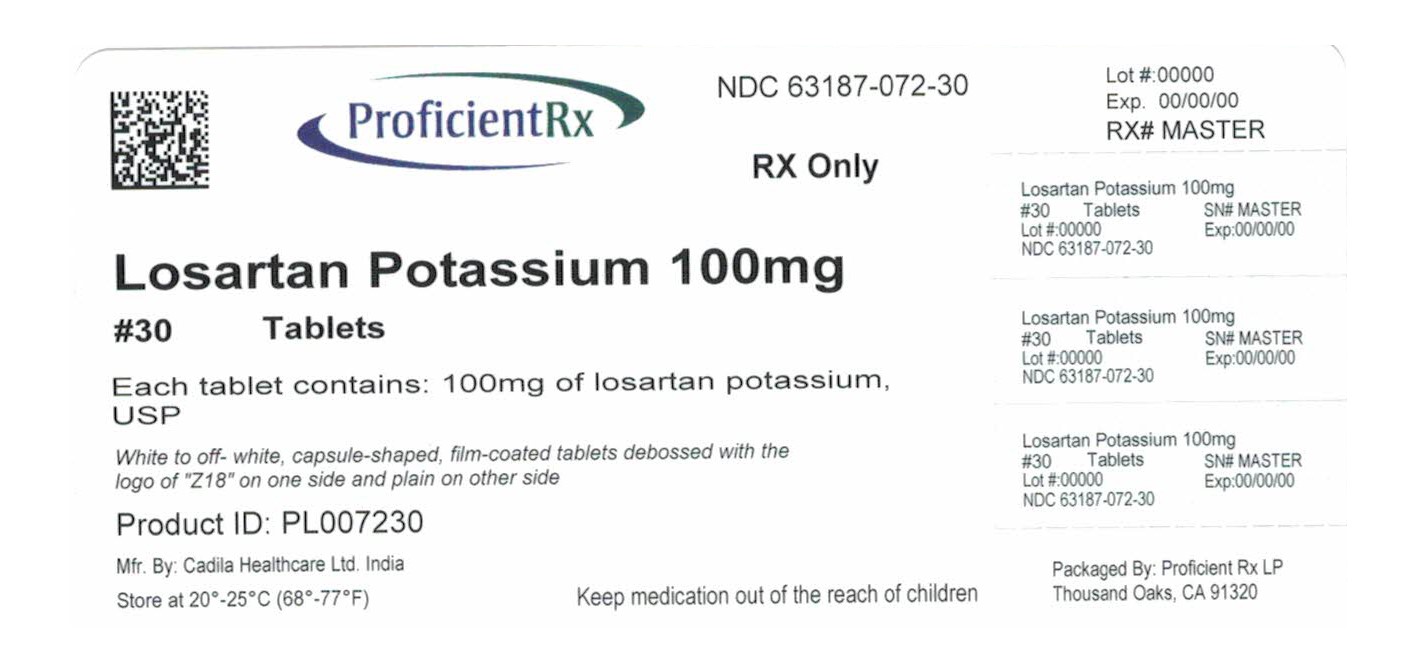
Losortan Potassium Losartan 100 mg Tablet, Film Coated, 30-count — NDC 63187-072-30 (Billing 63187-0072-30)
This is a package of 30 tablets of Losortan Potassium Losartan 100 mg Tablet, Film Coated from Proficient Rx LP, marketed since Oct 2010 and currently FDA-listed. It is the main listing for this product, which comes in 3 package sizes.
Identity & classification
Regulatory identifiers FDA, NLM and CMS codes for this package
- RxCUI (RxNorm): 979480
Where does this data come from?
- FDA openFDA NDC Directory · synced Oct 1, 2026
- FDA label on DailyMed · label index refreshed Oct 1, 2026
- RxNorm (NLM RxNav) · catalog refreshed Oct 1, 2026
- Medi-Span GPI (licensed)
- First Databank (licensed) · refreshed Oct 1, 2026
RxNorm drug class
This medicine belongs to the Angiotensin 2 Receptor Blocker class.
Where does this data come from?
- RxClass (NLM) · catalog refreshed Oct 1, 2026
Clinical
Losartan is used alone or in combination with other medications to treat high blood pressure. Losartan is also used to decrease the risk of stroke in people who have high blood pressure and a heart condition called left ventricular hypertrophy (enlargement of the walls of the left side of the heart). Losartan may not decrease the risk of stroke in African Americans who have these conditions. This medication is also used to treat kidney disease in people who have type 2 diabetes (condition in which the body does not use insulin normally and therefore cannot control the amount of sugar in the bl...
Read the full MedlinePlus article ↗- Losartan is used mainly to treat high blood pressure in adults and children 6 and older. It's also used to lower the risk of stroke in people who have high blood pressure and an en...
- Cough is much less common with losartan than with ACE inhibitors (like lisinopril). In clinical trials, the rate of cough with losartan was similar to that seen with a placebo. So...
- Does losartan cause a cough like some other blood pressure medicines?
- It's best to check with your doctor or pharmacist first. NSAIDs like ibuprofen and naproxen can reduce how well losartan controls your blood pressure, and they can also put extra s...
Patient education
Supplement & herbal interactions
Some supplements/herbs that may interact with Losartan Potassium — tap one for details:
Losartan Potassium may be associated with lower levels of 1 nutrient — worth a chat with your pharmacist, not a cause for alarm.
Where does this data come from?
- MedlinePlus (NLM) · refreshed Oct 1, 2026
- FDA label on DailyMed · label index refreshed Oct 1, 2026
Ask a licensed pharmacist directly — free, answered by our team.
Pricing
A drug doesn't have one price. Each row is a different public payment system, and none is what you'd pay at the counter — that depends on your insurance. The ⓘ on each row explains what it measures.
| Price system | Per each | Per package |
|---|---|---|
| Retail pharmacies payNADAC · weekly | Not in the retail survey — common for institutional, discontinued, or low-volume packs. | |
| Medicaid paysCMS SDUD · 12 mo | No recent Medicaid claims on file for this NDC — rare and low-volume NDCs are suppressed in the public data. | |
| Medicare drug plans payPart D · quarterly | No Part D plan price is available for this NDC in our data. | |
Where does this data come from?
- CMS NADAC weekly file
- CMS ASP pricing files · refreshed Sep 20, 2026
- CMS Medicaid State Drug Utilization Data · refreshed Oct 3, 2026
- CMS Part D plan pricing files · refreshed Sep 24, 2026
- VA National Acquisition Center price file
Packaging — all sizes for this product
| Package NDC | Description | Marketing start | Marketing end | Status |
|---|---|---|---|---|
| 63187-0072-30 You're viewing this Main listing | 30 TABLET, FILM COATED in 1 BOTTLE | 2014-04-30 | — | Active |
| 63187-0072-60 63187-072-60 | 60 TABLET, FILM COATED in 1 BOTTLE | 2014-04-30 | — | Active |
| 63187-0072-90 63187-072-90 | 90 TABLET, FILM COATED in 1 BOTTLE | 2014-04-30 | — | Active |
You're viewing the smallest of 3 pack sizes for this product.
Pack size FAQ
What quantity is in this package?
How does this package differ from NDC 63187-0072-60?
What NDC number is used to bill for this package of Losortan Potassium Losartan 100 mg Tablet, Film Coated?
Therapeutic equivalents
| Product | Labeler | Pack | NADAC/unit | TE | Status | Price vs. this |
|---|---|---|---|---|---|---|
| LOSARTAN POTASSIUM 100 mg 64380-0935-04 | Strides | 30 tablets | $0.044 | AB | Availability likely | — |
| Losartan Potassium 100 mg 00904-7049-61 | Major | 1 tablet | $0.045 | AB | Availability likely | — |
| Losartan Potassium 100 mg 11788-0102-10 | AiPing | 1000 tablets | $0.045 | AB | Availability likely | — |
| Losartan potassium 100 mg 33342-0046-07 | Macleods | 30 tablets | $0.045 | AB | Availability likely | — |
| Losartan Potassium 100 mg 43547-0362-03 | Solco | 30 tablets | $0.045 | AB | Availability likely | — |
| Losortan Potassium 100 mg 50268-0506-15 | AvPAK | 1 tablet | $0.045 | AB | Availability likely | — |
| Losartan Potassium 100 mg 62332-0029-30 | Alembic | 30 tablets | $0.045 | AB | Availability likely | — |
| Losartan Potassium 100 mg 65862-0203-30 | Aurobindo | 30 tablets | $0.045 | — | Availability likely | — |
| Losartan Potassium 100 mg 68084-0348-01 | American | 1 tablet | $0.045 | AB | Availability likely | — |
| Losartan Potassium 100 mg 70010-0743-03 | Granules | 30 tablets | $0.045 | AB | Availability likely | — |
| Losartan potassium 100 mg 72205-0143-30 | Novadoz | 30 tablets | $0.045 | AB | Availability likely | — |
| Losartan Potassium 100 mg 72603-0342-01 | NorthStar | 90 tablets | $0.045 | AB | Availability likely | — |
| Losartan Potassium 100 mg 82009-0044-10 | Quallent | 1000 tablets | $0.045 | AB | Availability likely | — |
| Losartan Potassium 100 mg 42571-0112-10 | Micro | 1000 tablets | $0.056 | AB | Discontinued | — |
| Cozaar 100 mg 78206-0123-01 | Organon | 30 tablets | $6.140 | AB | Availability likely | — |
| Losartan Potassium 100 mg 00615-7960-05 | NCS | 15 tablets | — | AB | FDA listed | — |
| Losartan Potassium 100 mg 29300-0146-01 | Unichem | 100 tablets | — | AB | FDA listed | — |
| Losartan Potassium 100 mg 31722-0702-05 | Camber | 500 tablets | — | AB | FDA listed | — |
| Losartan Potassium 100 mg 43063-0954-30 | PD-Rx | 30 tablets | — | AB | FDA listed | — |
| Losartan Potassium 100 mg 46708-0447-30 | Alembic | 30 tablets | — | AB | FDA listed | — |
| Losartan Potassium 100 mg 50090-3403-00 | A-S | 90 tablets | — | AB | FDA listed | — |
| Losartan Potassium 100 mg 50090-4712-00 | A-S | 90 tablets | — | AB | FDA listed | — |
| Losartan Potassium 100 mg 50090-4914-00 | A-S | 90 tablets | — | AB | FDA listed | — |
| Losartan Potassium 100 mg 51655-0791-26 | Northwind | 90 tablets | — | AB | FDA listed | — |
| Losartan Potassium 100 mg 51655-0828-26 | Northwind | 90 tablets | — | AB | FDA listed | — |
| Losartan Potassium 100 mg 55154-2333-00 | Cardinal | 1 tablet | — | AB | FDA listed | — |
| Losartan Potassium 100 mg 55154-6643-00 | Cardinal | 1 tablet | — | AB | FDA listed | — |
| Losartan potassium Tablets, 100 mg 59746-0335-01 | Jubilant | 100 tablets | — | AB | FDA listed | — |
| Losartan Potassium 100 mg 62207-0743-49 | Granules | 1000 tablets | — | AB | FDA listed | — |
| Losortan Potassium 100 mgthis 63187-0072-30 | Proficient | 30 tablets | — | AB | FDA listed | — |
| Losartan Potassium 100 mg 63187-0708-30 | Proficient | 30 tablets | — | AB | FDA listed | — |
| Losartan Potassium 100 mg 63187-0808-30 | Proficient | 30 tablets | — | AB | FDA listed | — |
| Losartan potassium Tablets, 100 mg 63629-2428-01 | Bryant | 1000 tablets | — | AB | FDA listed | — |
| Losartan Potassium 100 mg 65841-0731-01 | Zydus | 100 tablets | — | AB | FDA listed | — |
| Losartan Potassium 100 mg 67046-0702-03 | Coupler | 30 tablets | — | AB | FDA listed | — |
| Losartan potassium Tablets, 100 mg 67046-1511-03 | Coupler | 30 tablets | — | AB | FDA listed | — |
| LOSARTAN POTASSIUM 100 mg 68071-2203-09 | NuCare | 90 tablets | — | AB | FDA listed | — |
| Losartan Potassium 100 mg 68071-2216-03 | NuCare | 30 tablets | — | AB | FDA listed | — |
| Losartan Potassium 100 mg 68071-2344-03 | NuCare | 30 tablets | — | AB | FDA listed | — |
| Losartan Potassium 100 mg 68071-3846-03 | NuCare | 30 tablets | — | AB | FDA listed | — |
| Losartan Potassium 100 mg 68071-5181-09 | NuCare | 90 tablets | — | AB | FDA listed | — |
| Losartan Potassium 100 mg 68180-0378-01 | Lupin | 100 tablets | — | AB | FDA listed | — |
| Losartan Potassium 100 mg 68382-0137-01 | Zydus | 100 tablets | — | AB | FDA listed | — |
| Losartan Potassium 100 mg 68788-8186-01 | Preferred | 100 tablets | — | AB | FDA listed | — |
| Losartan Potassium 100 mg 70518-0718-00 | REMEDYREPACK | 30 tablets | — | AB | FDA listed | — |
| Losartan potassium 100 mg 70518-4289-00 | REMEDYREPACK | 30 tablets | — | AB | FDA listed | — |
| Losartan Potassium 100 mg 71335-1235-01 | Bryant | 30 tablets | — | AB | Discontinued | — |
| Losartan Potassium 100 mg 71335-1580-01 | Bryant | 30 tablets | — | AB | FDA listed | — |
| Losartan Potassium 100 mg 71335-2083-01 | Bryant | 30 tablets | — | AB | FDA listed | — |
| Losartan Potassium 100 mg 71610-0083-30 | Aphena | 30 tablets | — | AB | FDA listed | — |
| Losartan Potassium 100 mg 71610-0465-30 | Aphena | 30 tablets | — | AB | FDA listed | — |
| Losartan potassium Tablets, 100 mg 72162-1698-00 | Bryant | 1000 tablets | — | AB | FDA listed | — |
| Losartan Potassium 100 mg 72162-2508-00 | Bryant | 1000 tablets | — | AB | FDA listed | — |
| Losartan Potassium 100 mg 72189-0097-30 | Direct_Rx | 30 tablets | — | AB | FDA listed | — |
| Losartan Potassium 100 mg 72789-0044-30 | PD-Rx | 30 tablets | — | AB | FDA listed | — |
| LOSARTAN POTASSIUM 100 mg 72789-0165-90 | PD-Rx | 90 tablets | — | AB | FDA listed | — |
| Losartan Potassium 100 mg 72865-0143-10 | XLCare | 1000 tablets | — | AB | FDA listed | — |
| Losartan Potassium 100 mg 70518-4695-00 | REMEDYREPACK | 100 tablets | — | AB | FDA listed | — |
Where does this data come from?
- FDA openFDA NDC Directory · synced Oct 1, 2026
- FDA Orange Book · refreshed Sep 3, 2026
- CMS NADAC weekly file
Availability & generic status
This product is an FDA-approved generic. Other versions of the same drug are listed under Therapeutic equivalents, least expensive first.
Where does this data come from?
- FDA Orange Book · refreshed Sep 3, 2026
Inactive Ingredients / Excipients
Inactive ingredients, also called excipients, are components of the drug product other than the active ingredient. They may include fillers, dyes, coatings, preservatives, flavors, or other formulation ingredients.
Where does this data come from?
IACT rows and label-wide narrative are kept separate; availability and product-level specificity depend on the submitted label.- FDA label on DailyMed · label index refreshed Oct 1, 2026
- FDA openFDA NDC Directory · synced Oct 1, 2026
Inactive ingredient FAQ
Are inactive ingredients the same for every manufacturer?
Why might an inactive ingredient be missing?
Can inactive ingredients matter?
Manufacturer & labeler
Where does this data come from?
- FDA openFDA NDC Directory · synced Oct 1, 2026
- Drugs@FDA
Full prescribing information FDA SPL
🚨 Boxed Warning ▾
WARNING: FETAL TOXICITY • When pregnancy is detected, discontinue losartan potassium as soon as possible. • Drugs that act directly on the renin-angiotensin system can cause injury and death to the developing fetus. See WARNINGS, Fetal Toxicity.
🎯 Indications and Usage ▾
INDICATIONS AND USAGE Hypertension: Losartan potassium tablets are indicated for the treatment of hypertension. It may be used alone or in combination with other antihypertensive agents, including diuretics. Hypertensive Patients with Left Ventricular Hypertrophy: Losartan potassium tablets are indicated to reduce the risk of stroke in patients with hypertension and left ventricular hypertrophy, but there is evidence that this benefit does not apply to Black patients (see PRECAUTIONS, Race and CLINICAL PHARMACOLOGY, Pharmacodynamics and Clinical Effects , Reduction in the Risk of Stroke , Race ).
Nephropathy in Type 2 Diabetic Patients Losartan potassium tablets are indicated for the treatment of diabetic nephropathy with an elevated serum creatinine and proteinuria (urinary albumin to creatinine ratio ≥ 300 mg/g) in patients with type 2 diabetes and a history of hypertension. In this population, losartan potassium reduces the rate of progression of nephropathy as measured by the occurrence of doubling of serum creatinine or end stage renal disease (need for dialysis or renal transplantation) (see CLINICAL PHARMACOLOGY, Pharmacodynamics and Clinical Effects ).
⏱️ Dosage and Administration ▾
DOSAGE AND ADMINISTRATION Adult Hypertensive Patients: Losartan potassium tablets may be administered with other antihypertensive agents, and with or without food. Dosing must be individualized. The usual starting dose of losartan potassium tablets is 50 mg once daily, with 25 mg used in patients with possible depletion of intravascular volume (e.g., patients treated with diuretics) (see WARNINGS, Hypotension — Volume-Depleted Patients ) and patients with a history of hepatic impairment (see PRECAUTIONS, General ).
Losartan potassium tablets can be administered once or twice daily with total daily doses ranging from 25 mg to 100 mg. If the antihypertensive effect measured at trough using once-a-day dosing is inadequate, a twice-a-day regimen at the same total daily dose or an increase in dose may give a more satisfactory response. The effect of losartan is substantially present within one week but in some studies the maximal effect occurred in 3 to 6 weeks (see CLINICAL PHARMACOLOGY, Pharmacodynamics and Clinical Effects, Hypertension ).
If blood pressure is not controlled by losartan potassium tablets alone, a low dose of a diuretic may be added. Hydrochlorothiazide has been shown to have an additive effect (see CLINICAL PHARMACOLOGY, Pharmacodynamics and Clinical Effects, Hypertension ). No initial dosage adjustment is necessary for elderly patients or for patients with renal impairment, including patients on dialysis.
Pediatric Hypertensive patient ≥ 6 years of age: The usual recommended starting dose is 0.7 mg/kg once daily (up to 50 mg total) administered as a tablet or a suspension (see Preparation of Suspension ). Dosage should be adjusted according to blood pressure response. Doses above 1.4 mg/kg (or in excess of 100 mg) daily have not been studied in pediatric patients (see CLINICAL PHARMACOLOGY, Pharmacokinetics, Special Populations and Pharmacodynamics and Clinical Effects and WARNINGS, Hypotension — Volume-Depleted Patients, ).
Losartan potassium tablets are not recommended in pediatric patients <6 years of age or in pediatric patients with glomerular filtration rate <30 mL/min/1.73 m 2 (see CLINICAL PHARMACOLOGY, Pharmacokinetics, Special Populations , Pharmacodynamics and Clinical Effects , and PRECAUTIONS ). Preparation of Suspension (for 200 mL of a 2.5 mg/mL suspension): Add 10 mL of Purified Water USP to an 8 ounce (240 mL) amber polyethylene terephthalate (PET) bottle containing ten 50 mg losartan potassium tablets. Immediately shake for at least 2 minutes.
Let the concentrate stand for 1 hour and then shake for 1 minute to disperse the tablet contents. Separately prepare a 50/50 volumetric mixture of Ora-Plus™ and Ora-Sweet SF™. Add 190 mL of the 50/50 Ora-Plus™ /Ora-Sweet SF™ mixture to the tablet and water slurry in the PET bottle and shake for 1 minute to disperse the ingredients.
The suspension should be refrigerated at 2 to 8°C (36 to 46°F) and can be stored for up to 4 weeks. Shake the suspension prior to each use and return promptly to the refrigerator. Hypertensive Patients with Left Ventricular Hypertrophy: The usual starting dose is 50 mg of losartan potassium tablets once daily.
Hydrochlorothiazide 12.5 mg daily should be added and/or the dose of losartan potassium tablets should be increased to 100 mg once daily followed by an increase in hydrochlorothiazide to 25 mg once daily based on blood pressure response (see CLINICAL PHARMACOLOGY, Pharmacodynamics and Clinical Effects, Reduction in the Risk of Stroke ). Nephropathy in Type 2 Diabetic Patients The usual starting dose is 50 mg once daily. The dose should be increased to 100 mg once daily based on blood pressure response (see CLINICAL PHARMACOLOGY , Pharmacodynamics and Clinical Effects , Nephropathy in Type 2 Diabetic Patients ).
Losartan potassium may be administered with insulin and other commonly used hypoglycemic agents (e.g., sulfonylureas, glitazones and glucosidase inhibitors).
⛔ Contraindications ▾
CONTRAINDICATIONS Losartan potassium tablets are contraindicated in patients who are hypersensitive to any component of this product. Do not co-administer aliskiren with losartan potassium tablets in patients with diabetes.
⚠️ Warnings ▾
WARNINGS Fetal Toxicity Pregnancy Category D Use of drugs that act on the renin-angiotensin system during the second and third trimesters of pregnancy reduces renal function and increases fetal and neonatal morbidity and death. Resulting oligohydramnios can be associated with fetal lung hypoplasia and skeletal deformations. Potential neonatal adverse effects include skull hypoplasia, anuria, hypotension, renal failure, and death.
When pregnancy is detected, discontinue losartan potassium as soon as possible. These adverse outcomes are usually associated with the use of these drugs in the second and third trimester of pregnancy. Most epidemiologic studies examining fetal abnormalities after exposure to antihypertensive use in the first trimester have not distinguished drugs affecting the renin-angiotensin system from other antihypertensive agents.
Appropriate management of maternal hypertension during pregnancy is important to optimize outcomes for both mother and fetus. In the unusual case that there is no appropriate alternative to therapy with drugs affecting the renin angiotensin system for a particular patient, apprise the mother of the potential risk to the fetus. Perform serial ultrasound examinations to assess the intra-amniotic environment.
If oligohydramnios is observed, discontinue losartan potassium, unless it is considered life-saving for the mother. Fetal testing may be appropriate, based on the week of pregnancy. Patients and physicians should be aware, however, that oligohydramnios may not appear until after the fetus has sustained irreversible injury.
Closely observe infants with histories of in utero exposure to losartan potassium for hypotension, oliguria, and hyperkalemia (see PRECAUTIONS, Pediatric Use ). Losartan potassium has been shown to produce adverse effects in rat fetuses and neonates, including decreased body weight, delayed physical and behavioral development, mortality and renal toxicity. With the exception of neonatal weight gain (which was affected at doses as low as 10 mg/kg/day), doses associated with these effects exceeded 25 mg/kg/day (approximately three times the maximum recommended human dose of 100 mg on a mg/m 2 basis).
These findings are attributed to drug exposure in late gestation and during lactation. Significant levels of losartan and its active metabolite were shown to be present in rat fetal plasma during late gestation and in rat milk. Hypotension — Volume-Depleted Patients: In patients who are intravascularly volume-depleted (e.g., those treated with diuretics), symptomatic hypotension may occur after initiation of therapy with losartan potassium tablets.
These conditions should be corrected prior to administration of losartan potassium tablets, or a lower starting dose should be used (see DOSAGE AND ADMINISTRATION ).
🤒 Adverse Reactions ▾
ADVERSE REACTIONS Hypertension: Losartan potassium tablets have been evaluated for safety in more than 3300 adult patients treated for essential hypertension and 4058 patients/subjects overall. Over 1200 patients were treated for over 6 months and more than 800 for over one year. In general, treatment with losartan potassium tablets was well-tolerated.
The overall incidence of adverse experiences reported with losartan potassium tablets was similar to placebo. In controlled clinical trials, discontinuation of therapy due to clinical adverse experiences was required in 2.3 percent of patients treated with losartan potassium tablets and 3.7 percent of patients given placebo. The following table of adverse events is based on four 6 to 12 week, placebo-controlled trials involving over 1000 patients on various doses (10 to 150 mg) of losartan and over 300 patients given placebo.
All doses of losartan are grouped because none of the adverse events appeared to have a dose-related frequency. The adverse experiences reported in ≥1% of patients treated with losartan potassium tablets and more commonly than placebo are shown in the table below. Losartan (n=1075) Incidence % Placebo (n=334) Incidence % Musculoskeletal Cramp, muscle Pain, back Pain, leg 1 2 1 0 1 0 Nervous System/Psychiatric Dizziness 3 2 Respiratory Congestion, nasal Infection, upper respiratory Sinusitis 2 8 1 1 7 0 The following adverse events were also reported at a rate of 1% or greater in patients treated with losartan, but were as, or more frequent, in the placebo group: asthenia/fatigue, edema/swelling, abdominal pain, chest pain, nausea, headache, pharyngitis, diarrhea, dyspepsia, myalgia, insomnia, cough, sinus disorder.
Adverse events occurred at about the same rates in men and women, older and younger patients, and Black and non-Black patients. A patient with known hypersensitivity to aspirin and penicillin, when treated with losartan potassium tablets, was withdrawn from study due to swelling of the lips and eyelids and facial rash, reported as angioedema, which returned to normal 5 days after therapy was discontinued. Superficial peeling of palms and hemolysis were reported in one subject.
In addition to the adverse events above, potentially important events that occurred in at least two patients/subjects exposed to losartan or other adverse events that occurred in <1% of patients in clinical studies are listed below. It cannot be determined whether these events were causally related to losartan: Body as a Whole : Facial edema, fever, orthostatic effects, syncope Cardiovascular : Angina pectoris, second degree AV block, CVA, hypotension, myocardial infarction, arrhythmias including atrial fibrillation, palpitation, sinus bradycardia, tachycardia, ventricular tachycardia, ventricular fibrillation Digestive : Anorexia, constipation, dental pain, dry mouth, flatulence, gastritis, vomiting Hematologic : Anemia Metabolic : Gout Musculoskeletal : Arm pain, hip pain, joint swelling, knee pain, musculoskeletal pain, shoulder pain, stiffness, arthralgia, arthritis, fibromyalgia, muscle weakness Nervous System/Psychiatric : Anxiety, anxiety disorder, ataxia, confusion, depression, dream abnormality, hypesthesia, decreased libido, memory impairment, migraine, nervousness, paresthesia, peripheral neuropathy, panic disorder, sleep disorder, somnolence, tremor, vertigo Respiratory : Dyspnea, bronchitis, pharyngeal discomfort, epistaxis, rhinitis, respiratory congestion Skin : Alopecia, dermatitis, dry skin, ecchymosis, erythema, flushing, photosensitivity, pruritus, rash, sweating, urticaria Special Senses : Blurred vision, burning/stinging in the eye, conjunctivitis, taste perversion, tinnitus, decrease in visual acuity Urogenital : Impotence, nocturia, urinary frequency, urinary tract infection Persistent dry cough (with an incidence of a few percent) has been associated with ACE-inhibitor use and in practice can be a cause of discontinuation of ACE-inhibitor therapy.
Tw…
🆘 Overdosage ▾
OVERDOSAGE Significant lethality was observed in mice and rats after oral administration of 1000 mg/kg and 2000 mg/kg, respectively, about 44 and 170 times the maximum recommended human dose on a mg/m 2 basis. Limited data are available in regard to overdosage in humans. The most likely manifestation of overdosage would be hypotension and tachycardia; bradycardia could occur from parasympathetic (vagal) stimulation.
If symptomatic hypotension should occur, supportive treatment should be instituted. Neither losartan nor its active metabolite can be removed by hemodialysis.
🧬 Clinical Pharmacology ▾
CLINICAL PHARMACOLOGY Mechanism of Action: Angiotensin II [formed from angiotensin I in a reaction catalyzed by angiotensin converting enzyme (ACE, kininase II)], is a potent vasoconstrictor, the primary vasoactive hormone of the renin-angiotensin system and an important component in the pathophysiology of hypertension. It also stimulates aldosterone secretion by the adrenal cortex. Losartan and its principal active metabolite block the vasoconstrictor and aldosterone-secreting effects of angiotensin II by selectively blocking the binding of angiotensin II to the AT 1 receptor found in many tissues, (e.g., vascular smooth muscle, adrenal gland).
There is also an AT 2 receptor found in many tissues but it is not known to be associated with cardiovascular homeostasis. Both losartan and its principal active metabolite do not exhibit any partial agonist activity at the AT 1 receptor and have much greater affinity (about 1000-fold) for the AT 1 receptor than for the AT 2 receptor. In vitro binding studies indicate that losartan is a reversible, competitive inhibitor of the AT 1 receptor.
The active metabolite is 10 to 40 times more potent by weight than losartan and appears to be a reversible, non-competitive inhibitor of the AT 1 receptor. Neither losartan nor its active metabolite inhibits ACE (kininase II, the enzyme that converts angiotensin I to angiotensin II and degrades bradykinin); nor do they bind to or block other hormone receptors or ion channels known to be important in cardiovascular regulation. Pharmacokinetics: General: Losartan is an orally active agent that undergoes substantial first-pass metabolism by cytochrome P450 enzymes.
It is converted, in part, to an active carboxylic acid metabolite that is responsible for most of the angiotensin II receptor antagonism that follows losartan treatment. Losartan metabolites have been identified in human plasma and urine. In addition to the active carboxylic acid metabolite, several inactive metabolites are formed.
Following oral and intravenous administration of 14 C-labeled losartan potassium, circulating plasma radioactivity is primarily attributed to losartan and its active metabolite. In vitro studies indicate that cytochrome P450 2C9 and 3A4 are involved in the biotransformation of losartan to its metabolites. Minimal conversion of losartan to the active metabolite (less than 1% of the dose compared to 14% of the dose in normal subjects) was seen in about one percent of individuals studied.
The terminal half-life of losartan is about 2 hours and of the metabolite is about 6 to 9 hours. The pharmacokinetics of losartan and its active metabolite are linear with oral losartan doses up to 200 mg and do not change over time. Neither losartan nor its metabolite accumulates in plasma upon repeated once-daily dosing.
Following oral administration, losartan is well absorbed (based on absorption of radiolabeled losartan) and undergoes substantial first-pass metabolism; the systemic bioavailability of losartan is approximately 33%. About 14% of an orally-administered dose of losartan is converted to the active metabolite. Mean peak concentrations of losartan and its active metabolite are reached in 1 hour and in 3 to 4 hours, respectively.
While maximum plasma concentrations of losartan and its active metabolite are approximately equal, the AUC of the metabolite is about 4 times as great as that of losartan. A meal slows absorption of losartan and decreases its C max but has only minor effects on losartan AUC or on the AUC of the metabolite (about 10% decreased). The pharmacokinetics of losartan and its active metabolite were also determined after IV doses of each component separately in healthy volunteers.
The volume of distribution of losartan and the active metabolite is about 34 liters and 12 liters, respectively. Total plasma clearance of losartan and the active metabolite is about 600 mL/min and 50 mL/min, respectively, with renal clearance of about 75 mL/min and 25 mL/min…
📦 How Supplied / Storage and Handling ▾
HOW SUPPLIED Losartan Potassium Tablets USP, 50 mg are white to off-white, capsule-shaped, film-coated tablets debossed with the logo of "Z16" on one side and lip type breakline on other side and are supplied as follows: NDC 63187-071-30 in bottle of 30 tablets NDC 63187-071-60 in bottle of 60 tablets NDC 63187-071-90 in bottle of 90 tablets Losartan Potassium Tablets USP, 100 mg are white to off-white, capsule-shaped, film-coated tablets debossed with the logo of "Z18" on one side and plain on other side and are supplied as follows: NDC 63187-072-30 in bottle of 30 tablets NDC 63187-072-60 in bottle of 60 tablets NDC 63187-072-90 in bottle of 90 tablets Storage: Store at 20° to 25°C (68° to 77°F) [See USP Controlled Room Temperature].
Keep container tightly closed. Protect from light. Dispense in a tight, light-resistant container.
The trademarks depicted herein are owned by their respective companies Manufactured by: Cadila Healthcare Ltd. Ahmedabad, India Distributed by: Zydus Pharmaceuticals USA Inc. Pennington, NJ 08534 Rev.: 01/14 Repackaged by: Proficient Rx LP Thousand Oaks, CA 91320
📋 Description ▾
DESCRIPTION Losartan potassium is an angiotensin II receptor (type AT 1 ) antagonist. Losartan potassium, a non-peptide molecule, is chemically described as 2-butyl-4-chloro-1-[ p-(o-1H -tetrazol-5-ylphenyl)benzyl]imidazole-5-methanol monopotassium salt. Its molecular formula is C 22 H 22 ClKN 6 O, and its structural formula is: Losartan potassium, USP is white to off-white powder with a molecular weight of 461.01.
It is freely soluble in water; soluble in isopropyl alcohol; slightly soluble in acetonitrile. Oxidation of the 5-hydroxymethyl group on the imidazole ring results in the active metabolite of losartan. Each losartan potassium tablet intended for oral administration contains 25 mg or 50 mg or 100 mg of losartan potassium.
In addition, each tablet contains the following inactive ingredients: colloidal silica anhydrous, hydroxypropyl cellulose (low substituted), hypromellose, lactose monohydrate, magnesium stearate, maize starch (corn starch), microcrystalline cellulose, polyethylene glycol, sodium starch glycolate, talc and titanium dioxide. Losartan potassium 25 mg, 50 mg and 100 mg tablets contain potassium in the following amounts: 2.12 mg (0.054 mEq), 4.24 mg (0.108 mEq) and 8.48 mg (0.216 mEq), respectively. Structured formula for losartan
Medicare Part D spend CMS · PART D · 2026 (Q1)
About this NDC listing & data coverage
What data is (and isn’t) available for this NDC — tap to expand
| NDC identity (package / product / labeler codes) | ✓ Available |
| Labeler | ✓ Available |
| Product & package description | ✓ Available |
| Marketing category & status | ✓ Available |
| Active ingredient / dosage form / route | ✓ Available |
| FDA label (SPL via DailyMed) | ✓ Available |
| Package photos | ✓ Available |
| Inactive ingredients (structured) | — Not published for this NDC The labeler did not submit a structured excipient list, or no SPL is available. |
| NADAC pharmacy acquisition price (CMS) | — Not published for this NDC CMS publishes NADAC only for NDCs reported in its retail-pharmacy survey. |
| Orange Book / therapeutic-equivalence data | ✓ Available |
| HCPCS J-code billing crosswalk | — Not published for this NDC Most self-administered / retail products have no J-code — that is normal. |
| Medicaid utilization (CMS SDUD) | — Not published for this NDC CMS reports utilization only for NDCs with Medicaid claims above its privacy threshold. |