
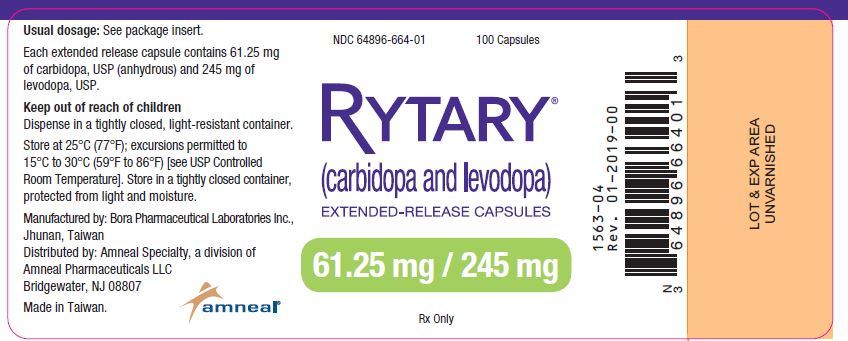
RYTARY Carbidopa and Levodopa 245 mg; 61.25 mg Capsule, Extended Release, 100-count — NDC 64896-664-01 (Billing 64896-0664-01)
This is a package of 100 capsules of RYTARY Carbidopa and Levodopa 245 mg; 61.25 mg Capsule, Extended Release from Amneal Pharmaceuticals LLC, marketed since Jan 2015 and currently FDA-listed; retail pharmacies pay about $5.00 per capsule (NADAC). It is the main listing for this product, which comes in 2 package sizes.
NDC database record
One package, one record: these facts belong to NDC 64896-664-01 alone.
- Record
- FDA NDC Directory package listing · Human prescription drug
- Code segments
- 64896 labeler · 664 product · 01 package
- Package marketed since
- Jan 12, 2015
- Sample package
- No — commercial package
- Listing certified through
- Dec 31, 2027
- Billing quantity
- 100 EA per package
- Barcode (UPC)
- 0364896663016, 0364896664013, 0364896662019, 0364896661012
- Medicaid fills, this package
- 684 prescriptions in the last four reported quarters
- FDA record last changed
- Oct 8, 2026
Identity & classification
Regulatory identifiers FDA, NLM and CMS codes for this package
Drug-database identifiers Medi-Span GPI and First Databank GCN / HICL / AHFS classification
- GSN (GCN sequence number): 073311
- GCN: 37696
- GPI-14 (Medi-Span): 73209902100250
- HICL (First Databank): 013894
- AHFS class code: 28:36.16.00
- RxCUI (RxNorm): 1600773
Where does this data come from?
- FDA openFDA NDC Directory · synced Oct 8, 2026
- FDA label on DailyMed · label index refreshed Oct 8, 2026
- RxNorm (NLM RxNav) · catalog refreshed Oct 1, 2026
- Medi-Span GPI (licensed)
- First Databank (licensed) · refreshed Oct 8, 2026
RxNorm drug class
This medicine belongs to the Aromatic Amino Acid Decarboxylation Inhibitor class.
Where does this data come from?
- RxClass (NLM) · catalog refreshed Oct 1, 2026
Clinical
- It treats Parkinson’s disease and related parkinsonism, including parkinsonism after brain inflammation or carbon monoxide or manganese poisoning. Duopa is specifically for motor f...
- Follow your prescription exactly, since your doctor adjusts the dose slowly. Extended-release forms shouldn’t be chewed or crushed. Rytary and Crexont can be taken with or without...
- Nausea, dizziness, headache, vivid dreams, and uncontrolled movements called dyskinesia are common. Tell your doctor if these bother you, because a dose change may help.
- Be careful. Some people fall asleep suddenly with no warning, even after being on it a long time. If that happens, don’t drive or do risky activities, and tell your doctor.
Patient education
Supplement & herbal interactions
Where does this data come from?
- MedlinePlus (NLM) · refreshed Oct 8, 2026
- FDA label on DailyMed · label index refreshed Oct 8, 2026
Ask a licensed pharmacist directly — free, answered by our team.
Pricing
A drug doesn't have one price. Each row is a different public payment system, and none is what you'd pay at the counter — that depends on your insurance. The ⓘ on each row explains what it measures.
| Price system | Per ea | Per package |
|---|---|---|
| Retail pharmacies payNADAC · weekly | $4.997 | $499.72 / 100 capsules |
| Medicaid paysCMS SDUD · 12 mo | $5.08 | $507.58 / 100 capsules |
| Medicare drug plans payPart D · Q2 2026 | $5.02 | $501.92 / 100 capsules |
Where does this data come from?
- CMS NADAC weekly file · file of Oct 7, 2026
- CMS ASP pricing files · refreshed Sep 20, 2026
- CMS Medicaid State Drug Utilization Data · through Q1 2026
- CMS Part D plan pricing files · refreshed Sep 24, 2026
- VA National Acquisition Center price file
Packaging — all sizes for this product
| Package NDC | Description | Per unit | Per pack | Marketing start | Marketing end | Status |
|---|---|---|---|---|---|---|
| 64896-0664-01 You're viewing this Main listing | 100 CAPSULE, EXTENDED RELEASE in 1 BOTTLE | $5.00 / ea | $499.72 | 2015-01-12 | — | Active |
| 64896-0664-43 64896-664-43 | 240 CAPSULE, EXTENDED RELEASE in 1 BOTTLE | — | — | 2015-01-12 | — | Active |
You're viewing the smallest of 2 pack sizes for this product.
In Medicaid, this is the most-dispensed pack of this product — about 100% of fills over the last four reported quarters. See all packs ↓
Pack size FAQ
What quantity is in this package?
How does this package differ from NDC 64896-0664-43?
What NDC number is used to bill for this package of RYTARY Carbidopa and Levodopa 245 mg; 61.25 mg Capsule, Extended Release?
Prices are the latest CMS NADAC pharmacy acquisition cost per NDC; per-pack figures are per-unit × pack quantity, shown only when the pack is denominated in the same measure NADAC prices.
Therapeutic equivalents
| Product | Labeler | Pack | NADAC/unit | TE | Status | Price vs. this |
|---|---|---|---|---|---|---|
| Carbidopa and Levodopa 61.25 mg/1; 245 mg 70710-2142-01 | Zydus | 100 capsules | $3.928 | — | Availability likely | save 21% |
| Rytary 245 mg/1; 61.25 mgthis 64896-0664-01 | Amneal | 100 capsules | $4.997 | — | Availability likely | — |
| Carbidopa and Levodopa 61.25 mg/1; 245 mg 70518-4610-00 | REMEDYREPACK | 1 capsule | — | — | FDA listed | — |
Where does this data come from?
- FDA openFDA NDC Directory · synced Oct 8, 2026
- FDA Orange Book · refreshed Oct 3, 2026
- CMS NADAC weekly file · file of Oct 7, 2026
Availability & generic status
We did not find an FDA-approved generic match for this exact strength, form and route. Patent/protection dates below may affect future generic timing.
Why the date isn’t exact: Generic timing can change because patents may be challenged, settled, licensed, added, removed, or worked around with a narrower label — and FDA approval does not always mean a pharmacy can get the generic today.
🛈 What do these terms mean?
- Patent
- Legal protection listed in the Orange Book that may delay generic approval or launch. Issued by the U.S. Patent & Trademark Office.
- Substance patent
- Covers the active drug molecule itself — the hardest to design around. A generic generally can’t launch until it expires.
- Formulation (product) patent
- Covers a specific formulation or dosage form. A generic can sometimes work around it with a different formulation.
- Method-of-use patent
- A patent covering one specific approved use of the drug — not necessarily the whole molecule. A generic can sometimes launch with a “skinny label” that carves out the protected use and keeps the others.
- Skinny label
- A generic label that omits a still-patented use when the FDA allows it — letting a generic reach the market for the unprotected uses.
- Exclusivity
- FDA-granted marketing protection, separate from patents — e.g. 5-yr new chemical entity, 7-yr orphan drug, or a +6-month pediatric extension.
- Paragraph IV
- A generic applicant’s formal challenge to a listed patent. It can potentially lead to earlier generic entry, but often involves litigation or a settlement.
- RLD / RS
- Reference Listed Drug — the brand product the FDA uses as the reference for generic applications. Reference Standard — the product the FDA expects generics to compare against in bioequivalence testing.
- TE / AB rating
- FDA therapeutic-equivalence rating. An AB rating generally means the FDA considers a generic therapeutically equivalent to — and substitutable for — the brand.
- LOE (loss of exclusivity)
- The latest patent or exclusivity currently listed — the loss-of-exclusivity / latest-listed-protection date shown on this page. Paragraph-IV challenges and settlements can move the real date earlier; FDA approval and a manufacturer’s decision to market can move it later.
Built from the FDA Orange Book. The bars above are scaled to each protection’s expiry; the red LOE marker is the last one to lapse.
| Patent | Type | Use code | Expires |
|---|---|---|---|
| US 9089607 ↗ | Method of use | U-1645 | Dec 26, 2028 |
| US 9089607 ↗ | Method of use | U-1720 | Dec 26, 2028 |
| US 9089607 ↗ | Method of use | U-1645 | Dec 26, 2028 |
| US 8377474 ↗ | Method of use | U-219 | Dec 26, 2028 |
| US 8377474 ↗ | Method of use | U-1645 | Dec 26, 2028 |
| US 8377474 ↗ | Method of use | U-219 | Dec 26, 2028 |
| US 8377474 ↗ | Method of use | U-219 | Dec 26, 2028 |
| US 8377474 ↗ | Method of use | U-1645 | Dec 26, 2028 |
| US 8454998 ↗ | Method of use | U-1645 | Dec 26, 2028 |
| US 8454998 ↗ | Method of use | U-1649 | Dec 26, 2028 |
| US 8454998 ↗ | Method of use | U-1646 | Dec 26, 2028 |
| US 8454998 ↗ | Method of use | U-1649 | Dec 26, 2028 |
| US 8454998 ↗ | Method of use | U-219 | Dec 26, 2028 |
| US 8454998 ↗ | Method of use | U-1647 | Dec 26, 2028 |
| US 8454998 ↗ | Method of use | U-1645 | Dec 26, 2028 |
| US 8454998 ↗ | Method of use | U-1647 | Dec 26, 2028 |
| US 8454998 ↗ | Method of use | U-1649 | Dec 26, 2028 |
| US 8454998 ↗ | Method of use | U-219 | Dec 26, 2028 |
| US 8454998 ↗ | Method of use | U-1646 | Dec 26, 2028 |
| US 8454998 ↗ | Method of use | U-219 | Dec 26, 2028 |
| US 8454998 ↗ | Method of use | U-1645 | Dec 26, 2028 |
| US 8557283 ↗ | Method of use | U-219 | Dec 26, 2028 |
| US 8557283 ↗ | Method of use | U-1645 | Dec 26, 2028 |
| US 9901640 ↗ | Method of use | U-219 | Dec 26, 2028 |
| US 9089607 ↗ | Method of use | U-1645 | Dec 26, 2028 |
| US 9089607 ↗ | Method of use | U-1645 | Dec 26, 2028 |
| US 9089607 ↗ | Method of use | U-1720 | Dec 26, 2028 |
| US 9533046 ↗ | Method of use | U-219 | Dec 26, 2028 |
| US 9463246 ↗ | Method of use | U-219 | Dec 26, 2028 |
| US 9463246 ↗ | Method of use | U-219 | Dec 26, 2028 |
| US 8557283 ↗ | Method of use | U-219 | Dec 26, 2028 |
| US 8557283 ↗ | Method of use | U-1645 | Dec 26, 2028 |
| US 9901640 ↗ | Method of use | U-219 | Dec 26, 2028 |
| US 9089607 ↗ | Method of use | U-1720 | Dec 26, 2028 |
| US 9089607 ↗ | Method of use | U-1720 | Dec 26, 2028 |
| US 8454998 ↗ | Method of use | U-1647 | Dec 26, 2028 |
| US 8454998 ↗ | Method of use | U-1645 | Dec 26, 2028 |
| US 8454998 ↗ | Method of use | U-1646 | Dec 26, 2028 |
| US 8377474 ↗ | Method of use | U-1645 | Dec 26, 2028 |
| US 8557283 ↗ | Method of use | U-1645 | Dec 26, 2028 |
| US 8454998 ↗ | Method of use | U-1646 | Dec 26, 2028 |
| US 8377474 ↗ | Method of use | U-219 | Dec 26, 2028 |
| US 8454998 ↗ | Method of use | U-1649 | Dec 26, 2028 |
| US 8557283 ↗ | Method of use | U-219 | Dec 26, 2028 |
| US 9463246 ↗ | Method of use | U-219 | Dec 26, 2028 |
| US 9901640 ↗ | Method of use | U-219 | Dec 26, 2028 |
| US 9901640 ↗ | Method of use | U-219 | Dec 26, 2028 |
| US 9533046 ↗ | Method of use | U-219 | Dec 26, 2028 |
| US 8557283 ↗ | Method of use | U-1645 | Dec 26, 2028 |
| US 8454998 ↗ | Method of use | U-219 | Dec 26, 2028 |
| US 8557283 ↗ | Method of use | U-219 | Dec 26, 2028 |
| US 8377474 ↗ | Method of use | U-1645 | Dec 26, 2028 |
| US 8454998 ↗ | Method of use | U-1647 | Dec 26, 2028 |
| US 9533046 ↗ | Method of use | U-219 | Dec 26, 2028 |
| US 9533046 ↗ | Method of use | U-219 | Dec 26, 2028 |
| US 9463246 ↗ | Method of use | U-219 | Dec 26, 2028 |
| US 9089608 ↗ | Drug product | — | Dec 26, 2028 |
| US 9089608 ↗ | Drug product | — | Dec 26, 2028 |
| US 9089608 ↗ | Drug product | — | Dec 26, 2028 |
| US 9089608 ↗ | Drug product | — | Dec 26, 2028 |
Is there a generic version of RYTARY ER 61.25 MG-245 MG CAP?
The FDA approved a generic — why can’t I get it at my pharmacy yet?
Why do different websites show different generic release dates?
What does “FDA listed” mean?
What does a patent or protection date mean here?
What does “current Orange Book estimate” mean?
Can a generic come out before the last patent expires?
Can a generic come out after the listed dates?
What is the difference between patents and exclusivity?
Why are there multiple patent dates?
Where does this data come from?
- FDA Orange Book · refreshed Oct 3, 2026
What it looks like
Where does this data come from?
- FDA label on DailyMed · label index refreshed Oct 8, 2026
Inactive Ingredients / Excipients
Inactive ingredients, also called excipients, are components of the drug product other than the active ingredient. They may include fillers, dyes, coatings, preservatives, flavors, or other formulation ingredients.
🧪 Avoiding an ingredient? See Levodopa and Carbidopa inactive ingredients by manufacturer: every current product's list side by side, so you can ask your pharmacy for the version that does not list it.
💡 Tap an ingredient (hover on desktop) to see what it is and why it’s used.
-
UNII 3K9958V90M
A liquid solvent derived from fermentation or chemical synthesis. In medicines, alcohol dissolves active ingredients, helps preserve the product, and improves how the body absorbs certain drugs.
-
UNII 5138Q19F1X
Ammonia is a colorless gas made from nitrogen and hydrogen. It's used in medicines as a pH buffer to maintain the correct acidity level and help keep the product stable.
-
UNII 8PJ61P6TS3
Butyl alcohol is a clear liquid organic solvent derived from petroleum or natural sources. In medicines, it helps dissolve active ingredients and serves as a solvent in liquid formulations and some topical products.
-
UNII M28OL1HH48
Croscarmellose sodium is a plant-based substance derived from cellulose. It acts as a disintegrant, helping tablets and capsules break down quickly in the digestive system so the medicine can be absorbed.
-
UNII 7Z8S9VYZ4B
Ethylcellulose is a plant-derived thickener and film-former made by chemically modifying cellulose. It's used as a binder to hold tablet ingredients together, a coating to control how quickly medicine is released, or a thickener in liquid formulations.
-
UNII L06K8R7DQK
A synthetic blue dye approved by the FDA for use in medications and foods. It serves as a colorant to make pills and liquids visually distinct and easier to identify.
-
UNII EX438O2MRT
Ferric oxide yellow is a naturally occurring iron compound used as a colorant in medications. It gives tablets, capsules, and other forms a yellow or golden hue for identification and appearance.
-
UNII 2G86QN327L
Gelatin is a protein derived from animal collagen, commonly used in medicines as a gelling agent and capsule material. It helps create soft or hard capsule shells that hold and release medication, and can also thicken liquid formulations.
-
UNII 0WZ8WG20P6
Hypromellose 2910 is a plant-based cellulose derivative that acts as a thickener, binder, and film-coating agent. It helps control how quickly the medicine dissolves and protects the tablet or capsule from moisture and light.
-
UNII ND2M416302
Isopropyl alcohol is a clear liquid solvent derived from petroleum. In medicines, it dissolves active ingredients and other components, helps the product flow smoothly, and aids in sterilization during manufacturing.
-
UNII 70097M6I30
Magnesium stearate is a salt made from magnesium and stearic acid, a fatty substance. It's used in tablets and capsules as a lubricant and glidant to help ingredients flow smoothly during manufacturing and prevent sticking.
-
UNII 3OWL53L36A
A natural sugar alcohol derived from seaweed or synthesized in the lab. It's used as a filler to add bulk, a sweetener in sugar-free formulas, and a disintegrant to help tablets break apart in the stomach.
-
UNII 74G4R6TH13
A synthetic polymer made by combining two plastic-like chemicals. It forms a coating on tablets or capsules that dissolves at a specific point in the digestive tract, controlling where and when the medicine releases.
-
UNII 5KY68S2577
A synthetic plastic polymer made from two chemical compounds combined in a specific ratio. It forms a coating on tablets and capsules to control how and where the medication dissolves in the digestive tract.
-
UNII OP1R32D61U
Microcrystalline cellulose is a purified form of cellulose, a natural fiber from plant sources. It acts as a binder and filler in tablets and capsules, helping hold ingredients together and give the medicine its shape and size.
-
UNII FZ989GH94E
Povidone is a synthetic polymer made from a plastic-like material. It acts as a binder to hold tablet ingredients together and as a disintegrant to help the tablet break apart in your stomach so the medicine can be absorbed.
-
UNII 6DC9Q167V3
Propylene glycol is a clear liquid derived from petroleum or vegetable sources. It acts as a solvent, humectant, and preservative in medicines, helping dissolve active ingredients and maintain product stability.
-
UNII 46N107B71O
Shellac is a natural resin secreted by the lac beetle. It's used as a coating on tablets and capsules to control how quickly the medicine dissolves and to improve appearance and stability.
-
UNII 368GB5141J
A detergent and foaming agent derived from coconut or palm oil. In medications, it helps break down and mix oil and water-based ingredients, aids in tablet disintegration, and improves how the drug dissolves and spreads in the mouth or digestive system.
-
UNII 5856J3G2A2
A starch-based powder made from potatoes and processed with sodium. It acts as a disintegrant, helping the tablet or capsule break apart quickly in the stomach so the medicine can be absorbed.
-
UNII 7SEV7J4R1U
A powder made from a naturally occurring mineral. In medicines, talc works as a glidant and anti-caking agent, helping tablets and capsules flow smoothly during manufacturing and preventing clumping.
-
UNII W4888I119H
Tartaric acid is a natural organic acid found in grapes and tamarinds. In medicines, it works as a buffer to control acidity, an antioxidant to prevent spoilage, and sometimes a flavoring or binding agent.
-
UNII 15FIX9V2JP
Titanium dioxide is a bright white mineral powder commonly used as a colorant and opacifying agent. It makes pills and tablets white or lighter in color and helps make coatings non-transparent.
-
UNII 8Z96QXD6UM
Triethyl citrate is a clear liquid derived from citric acid. It acts as a plasticizer and solvent in tablet coatings and film formulations, helping the coating remain flexible and adhere properly to the medicine.
24 inactive ingredients listed in the exact product block matched to this NDC.
Where does this data come from?
ingredient classCode="IACT" elements from the exact product block matched by this NDC. Label-section narrative from DailyMed / the openFDA label index is shown separately when available.- FDA label on DailyMed · label index refreshed Oct 8, 2026
- FDA openFDA NDC Directory · synced Oct 8, 2026
Inactive ingredient FAQ
Are inactive ingredients the same for every manufacturer?
Why might an inactive ingredient be missing?
Can inactive ingredients matter?
Manufacturer & labeler
More NDCs from Amneal Pharmaceuticals LLC labeler code 64896
- Ongentys opicapone 25 mg Capsule NDC 64896-402-01
- Ongentys opicapone 50 mg Capsule NDC 64896-403-01
- BREKIYA Dihydroergotamine Mesylate 1 mg/mL Injection NDC 64896-509-02
- RYTARY Carbidopa and Levodopa 95 mg; 23.75 mg Capsule, Extended Release NDC 64896-661-01
- RYTARY Carbidopa and Levodopa 145 mg; 36.25 mg Capsule, Extended Release NDC 64896-662-01
- RYTARY Carbidopa and Levodopa 195 mg; 48.75 mg Capsule, Extended Release NDC 64896-663-01
- Dexedrine Spansule dextroamphetamine sulfate 5 mg Capsule, Extended Release NDC 64896-673-10
- Dexedrine Spansule dextroamphetamine sulfate 10 mg Capsule, Extended Release NDC 64896-674-10
- Dexedrine Spansule dextroamphetamine sulfate 15 mg Capsule, Extended Release NDC 64896-675-10
- Albenza albendazole 200 mg Tablet, Film Coated NDC 64896-693-49
- Oxymorphone hydrochloride 5 mg Tablet, Film Coated, Extended Release NDC 64896-695-01
- Oxymorphone hydrochloride 7.5 mg Tablet, Film Coated, Extended Release NDC 64896-696-01
Where does this data come from?
- FDA openFDA NDC Directory · synced Oct 8, 2026
- Drugs@FDA
Full prescribing information FDA SPL
🎯 Indications and Usage ▾
1 INDICATIONS AND USAGE RYTARY is indicated for the treatment of Parkinson's disease, post-encephalitic parkinsonism, and parkinsonism that may follow carbon monoxide intoxication or manganese intoxication. RYTARY is a combination of carbidopa (an aromatic amino acid decarboxylation inhibitor) and levodopa (an aromatic amino acid) indicated for the treatment of Parkinson's disease, post-encephalitic parkinsonism, and parkinsonism that may follow carbon monoxide intoxication or manganese intoxication. ( 1 )
⏱️ Dosage and Administration ▾
2 DOSAGE AND ADMINISTRATION Evaluate vitamin B6 levels prior to starting treatment with carbidopa/levodopa therapies. ( 2.1 ) Levodopa-naïve patients: Starting dose is 23.75 mg/95 mg three times daily; may increase to 36.25 mg/145 mg three times daily on the fourth day of treatment. ( 2.2 ) See Table 1 for instructions for converting patients taking immediate-release carbidopa-levodopa to an initial dose of RYTARY.
Dosages of RYTARY are not interchangeable with other carbidopa-levodopa products. ( 2.3 ) The maximum recommended daily dose of RYTARY is 612.5 mg/2,450 mg. ( 2.2 , 2.3 ) RYTARY may be taken with or without food; do not chew, divide or crush.
( 2.5 , 12.3 )
2.1Management of Vitamin B6 Levels Evaluate vitamin B6 levels prior to initiating carbidopa/levodopa therapies, including RYTARY, periodically during treatment, and as clinically indicated [see Warnings and Precautions (5.7) ]. If vitamin B6 levels are low, supplement to sufficient levels per standard of care. Patients may initiate and continue treatment with RYTARY while supplementing vitamin B6.
2.2Dosage in Patients Naïve to Levodopa Therapy The recommended starting dosage of RYTARY in levodopa-naïve patients is 23.75 mg/95 mg taken orally three times a day for the first 3 days. On the fourth day of treatment, the dosage of RYTARY may be increased to 36.25 mg/145 mg taken three times a day. Based upon individual patient clinical response and tolerability, the RYTARY dose may be increased up to a maximum recommended dose of 97.5 mg/390 mg taken three times a day.
The dosing frequency may be changed from three times a day to a maximum of five times a day if more frequent dosing is needed and if tolerated. Maintain patients on the lowest dosage required to achieve symptomatic control and to minimize adverse reactions such as dyskinesia and nausea. The maximum recommended daily dose of RYTARY is 612.5 mg/2,450 mg.
2.3Converting from Immediate-Release Carbidopa-Levodopa to RYTARY The dosages of other carbidopa and levodopa products are not interchangeable on a 1:1 basis with the dosages of RYTARY. To convert patients from immediate-release carbidopa-levodopa to RYTARY, first calculate the patient’s current total daily dose of levodopa. The starting total daily dose of RYTARY is as recommended in Table 1.
After conversion, any combination of the four RYTARY dosage strengths can be used to achieve an optimal dosing. Adjust the dose and dosing frequency as necessary to maintain patient tolerance and sufficient symptomatic control. Administration of concomitant Parkinson’s disease medications should remain stable while adjusting the RYTARY dose.
In clinical trials, RYTARY was administered in divided doses of three to five times a day. The maximum recommended total daily dose of RYTARY is 612.5 mg/2,450 mg. For patients currently treated with carbidopa and levodopa plus a catechol-O-methyl transferase (COMT) inhibitor (such as entacapone), the initial total daily dose of levodopa in RYTARY described in Table 1 may need to be increased.
Use of RYTARY in combination with other levodopa products has not been studied. Table 1 : Conversion from Immediate-Release Carbidopa-Levodopa to RYTARY Total Daily Dose of Levodopa in Immediate-Release Carbidopa-Levodopa Recommended Starting Dosage of RYTARY Total Daily Dose of Levodopa in RYTARY RYTARY Dosing Regimen 400 mg to 549 mg 855 mg 3 capsules RYTARY 23.75 mg/95 mg taken TID a 550 mg to 749 mg 1,140 mg 4 capsules RYTARY 23.75 mg/95 mg taken TID 750 mg to 949 mg 1,305 mg 3 capsules RYTARY 36.25 mg/145 mg taken TID 950 mg to 1,249 mg 1,755 mg 3 capsules RYTARY 48.75 mg/195 mg taken TID Equal to or greater than 1,250 mg 2,340 mg or 4 capsules RYTARY 48.75 mg/195 mg taken TID or 2,205 mg 3 capsules RYTARY 61.25 mg/245 mg taken TID a TID: three times a day
2.4Discontinuation of RYTARY Avoid sudden discontinuation or rapid dose reduction of RYTARY. The daily dose of RYTARY should be tapered at the time of treatment discontinuation… [Excerpted — this section continues on DailyMed.]
💊 Dosage Forms and Strengths ▾
3 DOSAGE FORMS AND STRENGTHS Extended-release capsules: 23.75 mg carbidopa and 95 mg levodopa: blue and white capsule imprinted with IPX066 on the capsule cap and 95 on the capsule body. 36.25 mg carbidopa and 145 mg levodopa: blue and light blue capsule imprinted with IPX066 on the capsule cap and 145 on the capsule body. 48.75 mg carbidopa and 195 mg levodopa: blue and yellow capsule imprinted with IPX066 on the capsule cap and 195 on the capsule body.
61.25mg carbidopa and 245 mg levodopa: blue capsule imprinted with IPX066 on the capsule cap and 245 on the capsule body. Extended-release capsules: Carbidopa and levodopa 23.75 mg/95 mg, 36.25 mg/145 mg, 48.75 mg/195 mg, 61.25 mg/245 mg. ( 3 )
⛔ Contraindications ▾
4 CONTRAINDICATIONS RYTARY is contraindicated in patients: Currently taking a nonselective monoamine oxidase (MAO) inhibitor (e.g., phenelzine and tranylcypromine) or have recently (within 2 weeks) taken a nonselective MAO inhibitor. Hypertension can occur if these drugs are used concurrently [see Drug Interactions (7.1) ] . Nonselective MAO inhibitors. ( 4 )
⚠️ Warnings and Cautions ▾
5 WARNINGS AND PRECAUTIONS May cause falling asleep during activities of daily living. ( 5.1 ) Avoid sudden discontinuation or rapid dose reduction to reduce the risk of withdrawal-emergent hyperpyrexia and confusion. ( 5.2 ) Cardiovascular Events: Monitor patients with a history of cardiovascular disease.
( 5.3 ) Hallucinations/Psychosis may occur. ( 5.4 ) Impulse Control Disorders: Consider dose reduction or stopping RYTARY if occurs. ( 5.5 ) May cause or exacerbate dyskinesia: Consider dose reduction.
( 5.6 )
5.1Falling Asleep During Activities of Daily Living and Somnolence Patients treated with levodopa, a component of RYTARY, have reported falling asleep while engaged in activities of daily living, including the operation of motor vehicles, which sometimes resulted in accidents. Although many of these patients reported somnolence while on levodopa, some perceived that they had no warning signs (sleep attack), such as excessive drowsiness, and believed that they were alert immediately prior to the event. Some of these events have been reported more than 1 year after initiation of treatment.
It has been reported that falling asleep while engaged in activities of daily living usually occurs in a setting of pre-existing somnolence, although patients may not give such a history. For this reason, prescribers should reassess patients for drowsiness or sleepiness in RYTARY-treated patients, especially since some of the events occur well after the start of treatment. Prescribers should also be aware that patients may not acknowledge drowsiness or sleepiness until directly questioned about drowsiness or sleepiness during specific activities.
Before initiating treatment with RYTARY, advise patients of the potential to develop drowsiness and specifically ask about factors that may increase the risk for somnolence with RYTARY such as concomitant sedating medications or the presence of a sleep disorder. Consider discontinuing RYTARY in patients who report significant daytime sleepiness or episodes of falling asleep during activities that require active participation (e.g., conversations, eating, etc.). If a decision is made to continue RYTARY, patients should be advised not to drive and to avoid other potentially dangerous activities that might result in harm if the patients become somnolent.
There is insufficient information to establish that dose reduction will eliminate episodes of falling asleep while engaged in activities of daily living.
5.2Withdrawal-Emergent Hyperpyrexia and Confusion A symptom complex that resembles neuroleptic malignant syndrome (characterized by elevated temperature, muscular rigidity, altered consciousness, and autonomic instability), with no other obvious etiology, has been reported in association with rapid dose reduction, withdrawal of, or changes in dopaminergic therapy. Avoid sudden discontinuation or rapid dose reduction in patients taking RYTARY. If the decision is made to discontinue RYTARY, the dose should be tapered to reduce the risk of hyperpyrexia and confusion [see Dosage and Administration (2.4) ] .
5.3Cardiovascular Ischemic Events Cardiovascular ischemic events have occurred in patients taking RYTARY. In a placebo controlled clinical study in patients with early Parkinson's disease, 7/289 (2.4%) of RYTARY-treated patients experienced cardiovascular ischemic adverse reactions compared to 1/92 (1.1%) of placebo-treated patients. In an active-controlled clinical study in patients with advanced Parkinson's disease, 3/450 (0.7%) of RYTARY-treated patients experienced cardiovascular ischemic adverse reactions compared to 0/471 oral immediate-release carbidopa-levodopa-treated patients.
These patients all had a previous history of ischemic heart disease or risk factors for ischemic heart disease. In patients with a history of myocardial infarction who have residual atrial, nodal, or ventricular arrhythmias, cardiac function should be monitored in an intensive cardiac care facility during the p… [Excerpted — this section continues on DailyMed.]
🤒 Adverse Reactions ▾
6 ADVERSE REACTIONS The following serious adverse reactions are discussed below and elsewhere in the labeling: Falling Asleep During Activities of Daily Living and Somnolence [see Warnings and Precautions (5.1) ] Withdrawal-Emergent Hyperpyrexia and Confusion [see Warnings and Precautions (5.2) ] Cardiovascular Ischemic Events [see Warnings and Precautions (5.3) ] Hallucinations/Psychosis [see Warnings and Precautions (5.4) ] Impulse Control/Compulsive Behaviors [see Warnings and Precautions (5.5) ] Dyskinesia [see Warnings and Precautions (5.6) ] Vitamin B6 Deficiency and Seizures [see Warnings and Precautions (5.7) ] Peptic Ulcer Disease [see Warnings and Precautions (5.8) ] Glaucoma [see Warnings and Precautions (5.9) ] Early Parkinson's disease: Most common adverse reactions (incidence ≥ 5% and greater than placebo) are nausea, dizziness, headache, insomnia, abnormal dreams, dry mouth, dyskinesia, anxiety, constipation, vomiting, and orthostatic hypotension.
( 6.1 ) Advanced Parkinson's disease: Most common adverse reactions (incidence ≥ 5% and greater than oral immediate-release carbidopa-levodopa) are nausea and headache. ( 6.1 ) To report SUSPECTED ADVERSE REACTIONS, contact Amneal Pharmaceuticals LLC at 1-877-835-5472 or FDA at 1-800-FDA-1088 or www.fda.gov/medwatch.
6.1Clinical Trials Experience Because clinical trials are conducted under widely varying conditions, adverse reaction rates observed in the clinical trials of a drug cannot be directly compared to rates in the clinical trials of another drug and may not reflect the rates observed in clinical practice. The safety population consisted of a total of 978 Parkinson’s disease patients who received at least one dose of RYTARY, and had an average duration of exposure of 40 weeks. Adverse Reactions in Early Parkinson’s Disease In a placebo-controlled clinical study in patients with early Parkinson’s disease (Study 1), the most common adverse reactions with RYTARY (in at least 5% of patients and more frequently than in placebo) were nausea, dizziness, headache, insomnia, abnormal dreams, dry mouth, dyskinesia, anxiety, constipation, vomiting, and orthostatic hypotension.
Table 2 lists adverse reactions occurring in at least 5% of RYTARY-treated patients and at a higher rate than placebo in Study 1. Table 2: Adverse Reactions in Study 1 in Patients with Early Stage Parkinson’s Disease Placebo RYTARY 36.25 mg Carbidopa 145 mg Levodopa TID RYTARY 61.25 mg Carbidopa 245 mg Levodopa TID RYTARY 97.5 mg Carbidopa 390 mg Levodopa TID (N=92) % (N=87) % (N=104) % (N=98) % Nausea 9 14 19 20 Dizziness 5 9 19 12 Headache 11 7 13 17 Insomnia 3 2 9 6 Abnormal Dreams 0 2 6 5 Dry Mouth 1 3 2 7 Dyskinesia 0 2 4 5 Anxiety 0 2 3 5 Constipation 1 2 6 2 Vomiting 3 2 2 5 Orthostatic Hypotension 1 1 1 5 Adverse Reactions Leading to Discontinuation in Study 1 In Study 1, 12% of patients discontinued RYTARY early due to adverse reactions; a higher proportion of patients in the 61.25 mg/245 mg RYTARY-treated group (14%) and in the 97.5 mg/390 mg RYTARY-treated group (15%) experienced adverse reactions leading to early discontinuation compared to (4%) in the placebo group.
The most common adverse reactions resulting in early discontinuation were nausea, dizziness, and vomiting. Adverse Reactions in Advanced Parkinson’s Disease In an active-controlled clinical study in patients with advanced Parkinson’s disease (Study 2), the most common adverse reactions with RYTARY that occurred during dose conversion or maintenance (in at least 5% of patients and more frequently than on oral immediate-release carbidopa-levodopa) were nausea and headache. Table 3 lists adverse reactions occurring in at least 5% of RYTARY-treated patients and at a higher rate than oral immediate-release carbidopa-levodopa in Study 2.
Table 3: Adverse Reactions in Study 2 in Patients with Advanced Parkinson’s Disease RYTARY (N=201) Immediate-Release Carbidopa-Levodopa (N=192) Period Dose Conversion a % Maintenance % Dose Conve… [Excerpted — this section continues on DailyMed.]
🔄 Drug Interactions ▾
7 DRUG INTERACTIONS Iron salts and dopamine D2 antagonists including metoclopramide: May reduce the effectiveness of RYTARY. ( 7.2 , 7.3 )
7.1Monoamine Oxidase (MAO) Inhibitors The use of nonselective MAO inhibitors with RYTARY is contraindicated [see Contraindications (4) ] . Discontinue use of any nonselective MAO inhibitors at least two weeks prior to initiating RYTARY. The use of selective MAO-B inhibitors (e.g., rasagiline and selegiline) with RYTARY may be associated with orthostatic hypotension. Monitor patients who are taking these drugs concurrently.
7.2Dopamine D2 Receptor Antagonists and Isoniazid Dopamine D2 receptor antagonists (e.g., phenothiazines, butyrophenones, risperidone, metoclopramide) and isoniazid may reduce the effectiveness of levodopa. Monitor patients for worsening Parkinson's symptoms.
7.3Iron Salts Iron salts or multivitamins containing iron salts can form chelates with levodopa and carbidopa and can cause a reduction in the bioavailability of RYTARY. If iron salts or multivitamins containing iron salts are co-administered with RYTARY, monitor patients for worsening Parkinson's symptoms.
👥 Use in Specific Populations ▾
8 USE IN SPECIFIC POPULATIONS Pregnancy: Based on animal data, may cause fetal harm. ( 8.1 )
8.1Pregnancy Risk Summary There are no adequate data on the developmental risk associated with the use of RYTARY in pregnant women. In animal studies, carbidopa-levodopa has been shown to be developmentally toxic (including teratogenic effects) at clinically relevant doses (see Data) . The estimated background risk of major birth defects and miscarriage in the indicated population is unknown.
In the U.S. general population, the estimated background risk of major birth defects and miscarriage in clinically recognized pregnancies is 2% to 4% and 15% to 20%, respectively. Data Animal Data When administered to pregnant rabbits throughout organogenesis, carbidopa-levodopa caused both visceral and skeletal malformation in fetuses at all doses and ratios of carbidopa-levodopa tested. No teratogenic effects were observed when carbidopa-levodopa was administered to pregnant mice throughout organogenesis.
There was a decrease in the number of live pups delivered by rats receiving carbidopa-levodopa during organogenesis.
8.2Lactation Risk Summary Levodopa has been detected in human milk after administration of carbidopa-levodopa. There are no data on the presence of carbidopa in human milk, the effects of levodopa or carbidopa on the breastfed infant, or the effects on milk production. However, inhibition of lactation may occur because levodopa decreases secretion of prolactin in humans.
Carbidopa is excreted in rat milk. The developmental and health benefits of breastfeeding should be considered along with the mother’s clinical need for RYTARY and any potential adverse effects on the breastfed infant from RYTARY or from the underlying maternal condition.
8.4Pediatric Use Safety and effectiveness in pediatric patients have not been established.
8.5Geriatric Use In controlled clinical trials of RYTARY, 418 patients were 65 years or older and no overall differences in safety and efficacy were observed between these patients and those under 65 years of age.
🤰 Pregnancy ▾
8.1Pregnancy Risk Summary There are no adequate data on the developmental risk associated with the use of RYTARY in pregnant women. In animal studies, carbidopa-levodopa has been shown to be developmentally toxic (including teratogenic effects) at clinically relevant doses (see Data) . The estimated background risk of major birth defects and miscarriage in the indicated population is unknown.
In the U.S. general population, the estimated background risk of major birth defects and miscarriage in clinically recognized pregnancies is 2% to 4% and 15% to 20%, respectively. Data Animal Data When administered to pregnant rabbits throughout organogenesis, carbidopa-levodopa caused both visceral and skeletal malformation in fetuses at all doses and ratios of carbidopa-levodopa tested. No teratogenic effects were observed when carbidopa-levodopa was administered to pregnant mice throughout organogenesis.
There was a decrease in the number of live pups delivered by rats receiving carbidopa-levodopa during organogenesis.
🧒 Pediatric Use ▾
8.4Pediatric Use Safety and effectiveness in pediatric patients have not been established.
🧓 Geriatric Use ▾
8.5Geriatric Use In controlled clinical trials of RYTARY, 418 patients were 65 years or older and no overall differences in safety and efficacy were observed between these patients and those under 65 years of age.
🆘 Overdosage ▾
10 OVERDOSAGE In the active-controlled clinical study, a patient accidentally ingested 4.68 grams of carbidopa/18.7 grams of levodopa contained in RYTARY over a 2-day period. The patient experienced acute psychosis and dyskinesias. The patient recovered and completed the study on a reduced dose of RYTARY.
Based on the limited available information, the acute symptoms of levodopa/dopa decarboxylase inhibitor overdosage can be expected to arise from dopaminergic overstimulation. Doses of a few grams may result in CNS disturbances, with an increasing likelihood of cardiovascular disturbance (e.g., hypotension, tachycardia) and more severe psychiatric problems at higher doses. An isolated report of rhabdomyolysis and another of transient renal insufficiency suggest that levodopa overdosage may give rise to systemic complications, secondary to dopaminergic overstimulation.
Monitor patients and provide supportive care. Patients should receive electrocardiographic monitoring for the development of arrhythmias; if needed, appropriate antiarrhythmic therapy should be given. The possibility that the patient may have taken other drugs, increasing the risk of drug interactions (especially catechol-structured drugs) should be taken into consideration.
🧬 Clinical Pharmacology ▾
12 CLINICAL PHARMACOLOGY
12.1Mechanism of Action Carbidopa When levodopa is administered orally, it is rapidly decarboxylated to dopamine in extracerebral tissues so that only a small portion of a given dose is transported unchanged to the central nervous system. Carbidopa inhibits the decarboxylation of peripheral levodopa, making more levodopa available for delivery to the brain. Levodopa Levodopa is the metabolic precursor of dopamine, does cross the blood-brain barrier, and presumably is converted to dopamine in the brain.
This is thought to be the mechanism whereby levodopa relieves symptoms of Parkinson's disease.
12.2Pharmacodynamics Because its decarboxylase inhibiting activity is limited to extracerebral tissues, administration of carbidopa with levodopa makes more levodopa available to the brain. The addition of carbidopa to levodopa reduces the peripheral effects (nausea, vomiting) due to decarboxylation of levodopa; however, carbidopa does not decrease the adverse reactions due to the central effects of levodopa. Patients treated with levodopa therapy for Parkinson's disease may develop motor fluctuations characterized by end-of-dose failure, peak dose dyskinesia, ‘on-off’ phenomenon, and akinesia.
12.3Pharmacokinetics Absorption Carbidopa Following oral dosing of RYTARY the maximum concentration occurred at approximately 3 hours. The bioavailability of carbidopa from RYTARY relative to immediate-release carbidopa-levodopa tablets was approximately 50%. Levodopa The pharmacokinetics of RYTARY were evaluated following single-doses in healthy subjects and following single- and multiple-doses in patients with Parkinson’s disease.
The bioavailability of levodopa from RYTARY in patients was approximately 70% relative to immediate-release carbidopa-levodopa. For comparable doses, RYTARY results in a levodopa peak concentration (C max ) that is 30% that of immediate-release carbidopa-levodopa. Following an initial peak at about one hour, plasma concentrations are maintained for about 4 to 5 hours before declining.
In patients with Parkinson’s disease, multiple-dose pharmacokinetics was comparable to single-dose pharmacokinetics, i.e., there was minimal accumulation of levodopa. Variation in levodopa peak to trough plasma concentrations at steady-state defined as (C max -C min )/C avg was approximately 1.5 for RYTARY compared to approximately 3.2 for immediate-release levodopa. Distribution Carbidopa is approximately 36% bound to plasma proteins.
Approximately 10% to 30% of levodopa is bound to plasma protein. Metabolism and Elimination Carbidopa The terminal phase elimination half-life of carbidopa is approximately 2 hours. Carbidopa is metabolized to two main metabolites: α-methyl-3-methoxy-4-hydroxyphenylpropionic acid and α-methyl-3,4-dihydroxy-phenylpropionic acid.
These two metabolites are primarily eliminated in the urine unchanged or as a glucuronide. Unchanged carbidopa accounts for 30% of the total urinary excretion. Peripheral dopa-decarboxylase may be saturated by carbidopa in other carbidopa-levodopa products at 70 mg per day to 100 mg per day, which produces equivalent exposure to 140 mg to 200 mg of carbidopa provided by RYTARY.
Levodopa The terminal phase elimination half-life of levodopa, the active moiety of antiparkinsonian activity, is approximately 2 hours in the presence of carbidopa. Levodopa is extensively metabolized to various metabolites. The two major metabolic pathways are decarboxylation by dopa decarboxylase (DDC) and O-methylation by catechol-O-methyltransferase (COMT).
Dose Proportionality RYTARY shows approximately dose proportional pharmacokinetics for both carbidopa and levodopa over the levodopa dosage strength range of 95 mg to 245 mg. Effect of Food In healthy adults, oral administration of RYTARY after a high-fat, high-calorie meal reduced C max approximately 21% and increased AUC inf approximately 13% for levodopa compared to administration in the fasted state. There may be a del… [Excerpted — this section continues on DailyMed.]
🧬 Mechanism of Action ▾
12.1Mechanism of Action Carbidopa When levodopa is administered orally, it is rapidly decarboxylated to dopamine in extracerebral tissues so that only a small portion of a given dose is transported unchanged to the central nervous system. Carbidopa inhibits the decarboxylation of peripheral levodopa, making more levodopa available for delivery to the brain. Levodopa Levodopa is the metabolic precursor of dopamine, does cross the blood-brain barrier, and presumably is converted to dopamine in the brain.
This is thought to be the mechanism whereby levodopa relieves symptoms of Parkinson's disease.
📦 How Supplied / Storage and Handling ▾
16 HOW SUPPLIED/STORAGE AND HANDLING
16.1How Supplied RYTARY (carbidopa and levodopa) Extended-Release Capsules are available in the following strengths: 23.75 mg Carbidopa and 95 mg of Levodopa: blue and white capsule imprinted with IPX066 on the capsule cap and 95 on the capsule body. They are available as follows: Bottles of 100: (NDC 64896-661-01) Bottles of 240: (NDC 64896-661-43) 36.25 mg Carbidopa and 145 mg Levodopa: blue and light blue capsule imprinted with IPX066 on the capsule cap and 145 on the capsule body. They are available as follows: Bottles of 100: (NDC 64896-662-01) Bottles of 240: (NDC 64896-662-43) 48.75 mg Carbidopa and 195 mg Levodopa: blue and yellow capsule imprinted with IPX066 on the capsule cap and 195 on the capsule body.
They are available as follows: Bottles of 100: (NDC 64896-663-01) Bottles of 240: (NDC 64896-663-43) 61.25 mg Carbidopa and 245 mg Levodopa: blue capsule imprinted with IPX066 on the capsule cap and 245 on the capsule body. They are available as follows: Bottles of 100: (NDC 64896-664-01) Bottles of 240: (NDC 64896-664-43)
16.2Storage and Handling Store at 20°C to 25°C (68°F to 77°F); excursions permitted between 15°C to 30°C (59°F to 86°F) [see USP Controlled Room Temperature]. Store in a tightly closed container, protected from light and moisture. Dispense in a tightly closed, light-resistant container.
16.1How Supplied RYTARY (carbidopa and levodopa) Extended-Release Capsules are available in the following strengths: 23.75 mg Carbidopa and 95 mg of Levodopa: blue and white capsule imprinted with IPX066 on the capsule cap and 95 on the capsule body. They are available as follows: Bottles of 100: (NDC 64896-661-01) Bottles of 240: (NDC 64896-661-43) 36.25 mg Carbidopa and 145 mg Levodopa: blue and light blue capsule imprinted with IPX066 on the capsule cap and 145 on the capsule body. They are available as follows: Bottles of 100: (NDC 64896-662-01) Bottles of 240: (NDC 64896-662-43) 48.75 mg Carbidopa and 195 mg Levodopa: blue and yellow capsule imprinted with IPX066 on the capsule cap and 195 on the capsule body.
They are available as follows: Bottles of 100: (NDC 64896-663-01) Bottles of 240: (NDC 64896-663-43) 61.25 mg Carbidopa and 245 mg Levodopa: blue capsule imprinted with IPX066 on the capsule cap and 245 on the capsule body. They are available as follows: Bottles of 100: (NDC 64896-664-01) Bottles of 240: (NDC 64896-664-43)
📦 Storage and Handling ▾
16.2Storage and Handling Store at 20°C to 25°C (68°F to 77°F); excursions permitted between 15°C to 30°C (59°F to 86°F) [see USP Controlled Room Temperature]. Store in a tightly closed container, protected from light and moisture. Dispense in a tightly closed, light-resistant container.
📋 Description ▾
11 DESCRIPTION RYTARY is a combination of carbidopa, an inhibitor of aromatic amino acid decarboxylation, and levodopa, an aromatic amino acid, in extended-release capsules for oral use. Carbidopa is a white to creamy white powder, slightly soluble in water, with a molecular weight of 244.2. It is designated chemically as (-)-L-α-hydrazino-3, 4-dihydroxy-α-methylhydrocinnamic acid monohydrate.
Its molecular formula is C 10 H 14 N 2 O 4 • H 2 O and its structural formula is: Capsule content is expressed in terms of anhydrous carbidopa, which has a molecular weight of 226.2. Levodopa is a white to off-white, crystalline powder, slightly soluble in water, with a molecular weight of 197.2. It is designated chemically as (−)-3-(3, 4-Dihydroxyphenyl)-L-alanine.
Its molecular formula is C 9 H 11 NO 4 and its structural formula is: Each extended-release capsule contains 23.75 mg carbidopa, USP and 95 mg levodopa USP, 36.25 mg carbidopa, USP and 145 mg levodopa USP, 48.75 mg carbidopa, USP and 195 mg levodopa USP, or 61.25 mg carbidopa, USP and 245 mg levodopa USP. The inactive ingredients are microcrystalline cellulose, mannitol, tartaric acid, ethyl cellulose, hypromellose, sodium starch glycolate, sodium lauryl sulfate, povidone, talc, methacrylic acid copolymers, triethyl citrate, croscarmellose sodium, and magnesium stearate.
All capsule shells contain gelatin and titanium dioxide. In addition, all blue capsule shells contain FD&C Blue #2 and yellow iron oxide. All yellow capsule shells contain yellow iron oxide.
All capsules imprinted with blue pharmaceutical ink contain FD&C Blue #2, butyl alcohol, dehydrated alcohol, isopropyl alcohol, propylene glycol, shellac and strong ammonia solution. 1 2
💬 Information for Patients ▾
17 PATIENT COUNSELING INFORMATION Dosing Instructions Advise patients to not take other carbidopa-levodopa preparations with RYTARY without consulting their healthcare provider [see Dosage and Administration (2.3) ] . Advise patients to call their healthcare provider before stopping RYTARY. Discontinue RYTARY slowly.
Tell patients to call their healthcare provider if they develop withdrawal symptoms such as fever, confusion or severe muscle stiffness [see Dosage and Administration (2.4) and Warnings and Precautions (5.2) ]. Advise patients to swallow RYTARY capsules whole, without chewing, dividing, or crushing [see Dosage and Administration (2.5) ] . For patients with difficulty swallowing, the entire contents of the RYTARY capsule may be sprinkled on 1 to 2 tablespoons of applesauce and should be taken immediately [see Dosage and Administration (2.5) ] .
Inform patients that a high fat, high calorie meal may delay the absorption of levodopa and the onset of action by 2 to 3 hours. For this reason, consideration should be given to taking the first dose of the day about 1 to 2 hours before eating [see Dosage and Administration (2.5) and Clinical Pharmacology (12.3) ] . Falling Asleep Advise patients that certain side effects such as sleepiness and dizziness that have been reported with RYTARY may affect some patients’ ability to drive and operate machinery safely [see Warnings and Precautions (5.1) and Adverse Reactions (6.1) ] .
Suicide Attempt and Suicidal Ideation Instruct patients, family members and caregivers to notify their healthcare provider if suicide attempt and/or suicidal ideation are experienced by patients using RYTARY [see Adverse Reactions (6.2) ] . Hallucinations and Psychosis Inform patients that hallucinations can occur with levodopa products [see Warnings and Precautions (5.4) ] . Impulse Control Disorder Inform patients of the potential for experiencing intense urges to gamble, increased sexual urges, and other intense urges and the inability to control these urges while taking one or more of the medications that increase central dopaminergic tone, that are generally used for the treatment of Parkinson’s disease [see Warnings and Precautions (5.5) ] .
Dyskinesia Instruct patients to notify their healthcare provider if abnormal involuntary movements appear or get worse during treatment with RYTARY [see Warnings and Precautions (5.6 )] . Vitamin B6 Deficiency and Seizures Inform patients that vitamin B6 deficiency may develop during treatment with carbidopa/levodopa therapies, including RYTARY. Tell patients to inform their healthcare provider if they develop symptoms such as depression, confusion, cheilosis, glossitis, dermatitis, anemia, neuropathy, and/or seizures [see Warnings and Precautions (5.7) ] .
Hypotension and Syncope Advise patients that they may develop orthostatic hypotension with or without symptoms such as dizziness, nausea, syncope, and sweating [see Adverse Reactions (6.1) ] . Advise patients to rise slowly after sitting or lying down, especially if they have been doing so for a prolonged period. Advise patients of the possible additive sedative effects when taking other CNS depressants in combination with RYTARY.
Pregnancy and Breastfeeding Advise patients to notify their healthcare provider if they become pregnant or intend to become pregnant during RYTARY therapy [see Use in Specific Populations ( 8.1 ) ] . Advise female patients to notify their physicians if they intend to breastfeed or are breastfeeding an infant [see Use in Specific Populations ( 8.2 ) ] . Manufactured by: Bora Pharmaceutical Laboratories Inc.
Jhunan, Taiwan Or Amneal Pharmaceuticals Pvt. Ltd. Ahmedabad 382220, INDIA Distributed by: Amneal Specialty, a division of Amneal Pharmaceuticals LLC Bridgewater, NJ 08807 Copyright 2019 Amneal Pharmaceuticals LLC All rights reserved Rev.
03-2026-02 1566-05
🧬 Pharmacokinetics ▾
12.3Pharmacokinetics Absorption Carbidopa Following oral dosing of RYTARY the maximum concentration occurred at approximately 3 hours. The bioavailability of carbidopa from RYTARY relative to immediate-release carbidopa-levodopa tablets was approximately 50%. Levodopa The pharmacokinetics of RYTARY were evaluated following single-doses in healthy subjects and following single- and multiple-doses in patients with Parkinson’s disease.
The bioavailability of levodopa from RYTARY in patients was approximately 70% relative to immediate-release carbidopa-levodopa. For comparable doses, RYTARY results in a levodopa peak concentration (C max ) that is 30% that of immediate-release carbidopa-levodopa. Following an initial peak at about one hour, plasma concentrations are maintained for about 4 to 5 hours before declining.
In patients with Parkinson’s disease, multiple-dose pharmacokinetics was comparable to single-dose pharmacokinetics, i.e., there was minimal accumulation of levodopa. Variation in levodopa peak to trough plasma concentrations at steady-state defined as (C max -C min )/C avg was approximately 1.5 for RYTARY compared to approximately 3.2 for immediate-release levodopa. Distribution Carbidopa is approximately 36% bound to plasma proteins.
Approximately 10% to 30% of levodopa is bound to plasma protein. Metabolism and Elimination Carbidopa The terminal phase elimination half-life of carbidopa is approximately 2 hours. Carbidopa is metabolized to two main metabolites: α-methyl-3-methoxy-4-hydroxyphenylpropionic acid and α-methyl-3,4-dihydroxy-phenylpropionic acid.
These two metabolites are primarily eliminated in the urine unchanged or as a glucuronide. Unchanged carbidopa accounts for 30% of the total urinary excretion. Peripheral dopa-decarboxylase may be saturated by carbidopa in other carbidopa-levodopa products at 70 mg per day to 100 mg per day, which produces equivalent exposure to 140 mg to 200 mg of carbidopa provided by RYTARY.
Levodopa The terminal phase elimination half-life of levodopa, the active moiety of antiparkinsonian activity, is approximately 2 hours in the presence of carbidopa. Levodopa is extensively metabolized to various metabolites. The two major metabolic pathways are decarboxylation by dopa decarboxylase (DDC) and O-methylation by catechol-O-methyltransferase (COMT).
Dose Proportionality RYTARY shows approximately dose proportional pharmacokinetics for both carbidopa and levodopa over the levodopa dosage strength range of 95 mg to 245 mg. Effect of Food In healthy adults, oral administration of RYTARY after a high-fat, high-calorie meal reduced C max approximately 21% and increased AUC inf approximately 13% for levodopa compared to administration in the fasted state. There may be a delay by 2 hours in the absorption of levodopa when RYTARY is taken with a high-fat, high-calorie meal.
In addition, absorption of levodopa may be decreased by a high protein meal. Specific Populations Elderly In pharmacokinetics studies following a single-dose of RYTARY, the peak concentrations of carbidopa and levodopa are generally similar between younger (45 to 60 years) and older (60 to 75 years) subjects. Gender In pharmacokinetics studies following a single-dose of RYTARY: Carbidopa At comparable doses females are reported to have higher carbidopa peak concentrations and systemic exposure (approximately 33%) compared to males.
Median time to peak concentration and terminal half-life are comparable between males and females. Levodopa At comparable doses females are reported to have higher levodopa peak concentrations (approximately 23% to 33%) and systemic exposure (approximately 33% to 37%) compared to males. Median time to peak concentration and terminal half-life are comparable between males and females.
🧬 Pharmacodynamics ▾
12.2Pharmacodynamics Because its decarboxylase inhibiting activity is limited to extracerebral tissues, administration of carbidopa with levodopa makes more levodopa available to the brain. The addition of carbidopa to levodopa reduces the peripheral effects (nausea, vomiting) due to decarboxylation of levodopa; however, carbidopa does not decrease the adverse reactions due to the central effects of levodopa. Patients treated with levodopa therapy for Parkinson's disease may develop motor fluctuations characterized by end-of-dose failure, peak dose dyskinesia, ‘on-off’ phenomenon, and akinesia.
🔬 Clinical Studies ▾
14 CLINICAL STUDIES
14.1Patients with Early Parkinson's Disease The effectiveness of RYTARY in patients with early Parkinson’s disease was established in a randomized, double-blind, placebo-controlled, fixed-dose, parallel-group, 30-week clinical trial (Study 1). Patients enrolled in Study 1 (n=381) were Hoehn and Yahr Stage I–III with a median disease duration of 1 year, and had limited or no prior exposure to levodopa and dopamine agonists. Patients continued taking concomitant selective monoamine oxidase B (MAO-B) inhibitors, amantadine, and anticholinergics provided the doses were stable for at least 4 weeks before screening.
Eligible patients were randomized (1:1:1:1) to placebo or one of three fixed doses of RYTARY (carbidopa/levodopa doses of 36.25 mg/145 mg, 61.25 mg/245 mg, or 97.5 mg/390 mg, three times a day). Patients were not allowed to receive supplemental levodopa or catechol-O-methyl transferase (COMT) inhibitors. Patients receiving RYTARY initiated treatment at 23.75 mg/95 mg three times daily (TID).
The dose was increased on Day 4 and the maximum study dose (97.5 mg/390 mg TID) was achieved by Day 22 . The clinical outcome measure in Study 1 was the mean change from baseline in the sum of the Unified Parkinson’s Disease Rating Scale (UPDRS) Part II (activities of daily living) score, and UPDRS Part III (motor score) for RYTARY, compared to placebo at Week 30 (or early termination). The mean score decrease (i.e., improvement) from baseline to Week 30 for each of the three RYTARY dosage groups was significantly greater than for placebo.
The results of Study 1 are shown in Table 4. Table 4: Study 1: Change from Baseline in UPDRS Part II plus Part III Score at Week 30 (or at Early Termination) in Levodopa-Naïve Patients with Early Parkinson’s Disease Treatment Mean UPDRS (Part II and Part III) Score a Baseline b Week 30 Change from Baseline at Week 30 c Placebo 36.5 35.9 −0.6 RYTARY 36.25 mg/145 mg TID 36.1 24.4 −11.7 d RYTARY 61.25 mg/245 mg TID 38.2 25.3 −12.9 d RYTARY 97.5 mg/390 mg TID 36.3 21.4 −14.9 d a For the UPDRS, higher scores indicate greater severity of impairment. b All values based on 361 patients who had valid End-of-Study values. c Negative numbers indicate improvement as compared with the baseline value. d P-value is less than 0.05.
14.2Patients with Advanced Parkinson's Disease Study 2 was a 22-week trial consisting of a 3-week dose adjustment of current levodopa treatment prior to a 6-week conversion to RYTARY, which was followed by a 13-week, randomized, multicenter, double-blind, levodopa-containing active control, double-dummy, parallel group trial. The study enrolled 471 (393 randomized) patients (Hoehn & Yahr Stages I-IV) who had been maintained on a stable regimen of at least 400 mg per day of levodopa prior to entry into the trial. Patients were continued on concomitant dopamine agonists, selective monoamine oxidase B (MAO-B) inhibitors, amantadine, and anticholinergics provided the doses were stable for at least 4 weeks prior to screening.
Patients were randomized to receive either RYTARY or immediate-release carbidopa-levodopa at the dose determined during the adjustment or conversion phases. Patients were not allowed to receive supplemental carbidopa-levodopa or catechol-O-methyl transferase (COMT) inhibitor products during the trial. In Study 2, approximately 60% of patients required further up titration and approximately 16% of patients required down titration compared to the recommended starting dose of RYTARY.
The final total daily dose of levodopa from RYTARY was approximately double that of the final total daily dose of levodopa from immediate-release tablets. The majority (88%) of patients in Study 2 received less than 2,400 mg; the median dose was 1,365 mg. The clinical outcome measure in Study 2 was the percentage of “off” time during waking hours at Week 22 (or at early termination), as assessed by the patient’s Parkinson’s Disease Diary.
The “off” time was significantly… [Excerpted — this section continues on DailyMed.]
🧪 Nonclinical Toxicology ▾
13 NONCLINICAL TOXICOLOGY
13.1Carcinogenesis, Mutagenesis, Impairment of Fertility Carcinogenesis In rats, oral administration of carbidopa-levodopa for two years resulted in no evidence of carcinogenicity. Mutagenesis Carbidopa was mutagenic in the in vitro Ames test and in the in vitro mouse lymphoma tk assay but was negative in the in vivo mouse micronucleus assay. Impairment of Fertility In reproduction studies, no effects on fertility were observed in rats receiving carbidopa-levodopa.
📄 Carcinogenesis, Mutagenesis, Impairment of Fertility ▾
13.1Carcinogenesis, Mutagenesis, Impairment of Fertility Carcinogenesis In rats, oral administration of carbidopa-levodopa for two years resulted in no evidence of carcinogenicity. Mutagenesis Carbidopa was mutagenic in the in vitro Ames test and in the in vitro mouse lymphoma tk assay but was negative in the in vivo mouse micronucleus assay. Impairment of Fertility In reproduction studies, no effects on fertility were observed in rats receiving carbidopa-levodopa.
📄 Recent Major Changes ▾
RECENT MAJOR CHANGES Dosage and Administration ( 2.1 ) 3/2026 Warnings and Precautions ( 5.7 ) 3/20296
📄 Package Label / Principal Display Panel ▾
PRINCIPAL DISPLAY PANEL - 23.75 mg/95 mg Capsule Bottle Label NDC 64896-661-01 RYTARY ® (Carbidopa and Levodopa) Extended-Release Capsules 23.75 mg/95 mg 100 Capsules Rx Only Amneal Specialty, a division of Amneal Pharmaceuticals LLC 1
PRINCIPAL DISPLAY PANEL - 36.25 mg/145 mg Capsule Bottle Label NDC 64896-662-01 RYTARY ® (Carbidopa and Levodopa) Extended-Release Capsules 36.25 mg/145 mg 100 Capsules Rx Only Amneal Specialty, a division of Amneal Pharmaceuticals LLC 1
PRINCIPAL DISPLAY PANEL - 48.75 mg/195 mg Capsule Bottle Label NDC 64896-663-01 RYTARY ® (Carbidopa and Levodopa) Extended-Release Capsules 48.75 mg/195 mg 100 Capsules Rx Only Amneal Specialty, a division of Amneal Pharmaceuticals LLC 1
PRINCIPAL DISPLAY PANEL - 61.25 mg/245 mg Capsule Bottle Label NDC 64896-664-01 RYTARY ® (Carbidopa and Levodopa) Extended-Release Capsules 61.25 mg/245 mg 100 Capsules Rx Only Amneal Specialty, a division of Amneal Pharmaceuticals LLC 1