
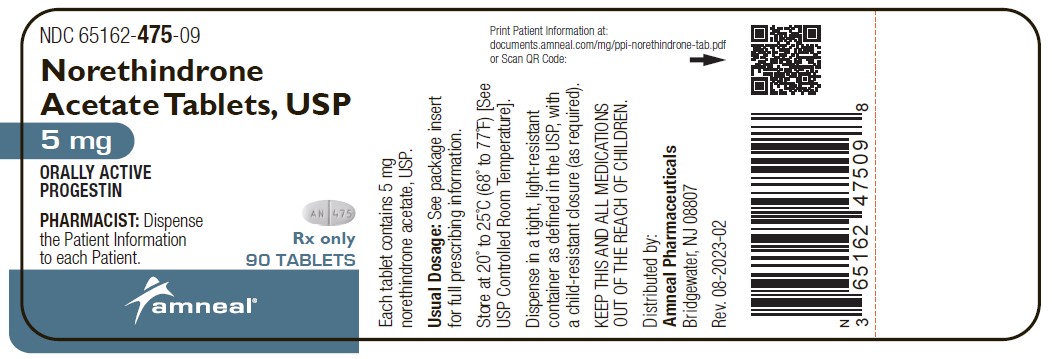
Norethindrone Acetate 5 mg Tablet, 50-count — NDC 65162-475-05 (Billing 65162-0475-05)
This is a package of 50 tablets of Norethindrone Acetate 5 mg Tablet from Amneal Pharmaceuticals LLC, marketed since Jul 2009 and currently FDA-listed; retail pharmacies pay about $0.2898 per tablet (NADAC). It is the main listing for this product, which comes in 4 package sizes.
NDC database record
One package, one record: these facts belong to NDC 65162-475-05 alone.
- Record
- FDA NDC Directory package listing · Human prescription drug
- Code segments
- 65162 labeler · 475 product · 05 package
- Package marketed since
- Jul 1, 2009
- Sample package
- No — commercial package
- Listing certified through
- Dec 31, 2026
- Billing quantity
- 50 EA per package
- Barcode (UPC)
- 0365162475098
- Medicaid fills, this package
- 15,553 prescriptions in the last four reported quarters
- FDA record last changed
- Jul 24, 2026
Identity & classification
Regulatory identifiers FDA, NLM and CMS codes for this package
Drug-database identifiers Medi-Span GPI and First Databank GCN / HICL / AHFS classification
- GSN (GCN sequence number): 003274
- GCN: 11280
- GPI-14 (Medi-Span): 26000030100305
- HICL (First Databank): 001443
- AHFS class code: 68:32.00.00
- RxCUI (RxNorm): 1000405
Where does this data come from?
- FDA openFDA NDC Directory · synced Oct 1, 2026
- FDA label on DailyMed · label index refreshed Oct 6, 2026
- RxNorm (NLM RxNav) · catalog refreshed Oct 1, 2026
- Medi-Span GPI (licensed)
- First Databank (licensed) · refreshed Oct 1, 2026
RxNorm drug class
This medicine belongs to the Progestin class.
Where does this data come from?
- RxClass (NLM) · catalog refreshed Oct 1, 2026
Clinical
Norethindrone is used to treat endometriosis (a condition in which the type of tissue that lines the uterus [womb] grows in other areas of the body and causes pain, heavy or irregular menstruation [periods], and other symptoms). Norethindrone is also used to treat abnormal periods or bleeding and to bring on a normal menstrual cycle in women who menstruated normally in the past but have not menstruated for at least 3 months and who are not pregnant or experiencing menopause (change of life; the end of monthly menstrual periods). Norethindrone is in a class of medications called progestins. It...
Read the full MedlinePlus article ↗- Most norethindrone products, like Errin, Camila and Emzahh, are progestin-only birth control pills that prevent pregnancy. Norethindrone acetate tablets, such as Gallifrey, are use...
- Take one tablet by mouth every day at the same time. Don't take a break between packs. Following the schedule exactly gives you the best protection, so follow your label and the pa...
- Changes in your bleeding are the most common, including irregular or frequent bleeding. Some people get headache, breast tenderness, nausea or dizziness. Call me or your doctor if...
- It's best not to. Smoking greatly raises the risk of heart attack and stroke in women using oral contraceptives. If you smoke, let's talk about options and quitting.
Patient education
Supplement & herbal interactions
Some supplements/herbs that may interact with Norethindrone — tap one for details:
Where does this data come from?
- MedlinePlus (NLM) · refreshed Oct 1, 2026
- FDA label on DailyMed · label index refreshed Oct 6, 2026
Ask a licensed pharmacist directly — free, answered by our team.
Pricing
A drug doesn't have one price. Each row is a different public payment system, and none is what you'd pay at the counter — that depends on your insurance. The ⓘ on each row explains what it measures.
| Price system | Per ea | Per package |
|---|---|---|
| Retail pharmacies payNADAC · weekly | $0.290 | $14.49 / 50 tablets |
| Medicaid paysCMS SDUD · 12 mo | $0.4980 | $24.90 / 50 tablets |
| Medicare drug plans payPart D · quarterly | No Part D plan price is available for this NDC in our data. | |
Where does this data come from?
- CMS NADAC weekly file · file of Sep 30, 2026
- CMS ASP pricing files · refreshed Sep 20, 2026
- CMS Medicaid State Drug Utilization Data · through Q1 2026
- CMS Part D plan pricing files · refreshed Sep 24, 2026
- VA National Acquisition Center price file
Packaging — all sizes for this product
| Package NDC | Description | Per unit | Per pack | Marketing start | Marketing end | Status |
|---|---|---|---|---|---|---|
| 65162-0475-03 65162-475-03 | 30 TABLET in 1 BOTTLE | — | — | 2009-07-01 | — | Active |
| 65162-0475-05 You're viewing this Main listing | 50 TABLET in 1 BOTTLE | $0.2898 / ea | $14.49 | 2009-07-01 | — | Active |
| 65162-0475-09 65162-475-09 | 90 TABLET in 1 BOTTLE | $0.2898 / ea | $26.09 | 2009-07-01 | — | Active |
| 65162-0475-50 65162-475-50 | 500 TABLET in 1 BOTTLE | — | — | 2009-07-01 | — | Active |
You're viewing one of 4 pack sizes for this product.
This pack has the lowest per-ea cost of the 2 priced pack sizes ($0.2898 NADAC).
In Medicaid, this is the most-dispensed pack of this product — about 97% of fills over the last four reported quarters. See all packs ↓
Pack size FAQ
What quantity is in this package?
How does this package differ from NDC 65162-0475-03?
What NDC number is used to bill for this package of Norethindrone Acetate 5 mg Tablet?
Prices are the latest CMS NADAC pharmacy acquisition cost per NDC; per-pack figures are per-unit × pack quantity, shown only when the pack is denominated in the same measure NADAC prices.
Therapeutic equivalents
| Product | Labeler | Pack | NADAC/unit | TE | Status | Price vs. this |
|---|---|---|---|---|---|---|
| Norethindrone Acetate 5 mg 00555-0211-10 | Teva | 50 tablets | $0.290 | AB | Availability likely | — |
| Norethindrone acetate 5 mg 50742-0267-50 | Ingenus | 50 tablets | $0.290 | AB | Availability likely | — |
| Norethindrone Acetate 5 mg 60687-0921-21 | American | 30 tablets | $0.290 | AB | Availability likely | — |
| Norethindrone Acetate 5 mgthis 65162-0475-05 | Amneal | 50 tablets | $0.290 | AB | Availability likely | — |
| Gallifrey 5 mg 70700-0326-50 | Xiromed | 50 tablets | $0.290 | AB | Availability likely | — |
| Norethindrone Acetate 5 mg 42291-0650-90 | AvKARE | 90 tablets | — | AB | FDA listed | — |
| Norethindrone Acetate 5 mg 51407-0599-50 | Golden | 50 tablets | — | AB | FDA listed | — |
| Norethindrone Acetate 5 mg 68462-0304-05 | Glenmark | 500 tablets | — | AB | FDA listed | — |
Where does this data come from?
- FDA openFDA NDC Directory · synced Oct 1, 2026
- FDA Orange Book · refreshed Oct 3, 2026
- CMS NADAC weekly file · file of Sep 30, 2026
Availability & generic status
This product is an FDA-approved generic. Other versions of the same drug are listed under Therapeutic equivalents, least expensive first.
Where does this data come from?
- FDA Orange Book · refreshed Oct 3, 2026
What it looks like
Where does this data come from?
- FDA label on DailyMed · label index refreshed Oct 6, 2026
Inactive Ingredients / Excipients
Inactive ingredients, also called excipients, are components of the drug product other than the active ingredient. They may include fillers, dyes, coatings, preservatives, flavors, or other formulation ingredients.
🧪 Avoiding an ingredient? See Norethindrone inactive ingredients by manufacturer: every current product's list side by side, so you can ask your pharmacy for the version that does not list it.
💡 Tap an ingredient (hover on desktop) to see what it is and why it’s used.
-
UNII OP1R32D61U
Microcrystalline cellulose is a purified form of cellulose, a natural fiber from plant sources. It acts as a binder and filler in tablets and capsules, helping hold ingredients together and give the medicine its shape and size.
-
UNII J2B2A4N98G
Lactose is a natural sugar derived from milk. In medications, it serves as a filler and binder to add bulk and help hold tablet or capsule ingredients together during manufacturing.
-
UNII 70097M6I30
Magnesium stearate is a salt made from magnesium and stearic acid, a fatty substance. It's used in tablets and capsules as a lubricant and glidant to help ingredients flow smoothly during manufacturing and prevent sticking.
3 inactive ingredients listed in the exact product block matched to this NDC.
Where does this data come from?
ingredient classCode="IACT" elements from the exact product block matched by this NDC. Label-section narrative from DailyMed / the openFDA label index is shown separately when available.- FDA label on DailyMed · label index refreshed Oct 6, 2026
- FDA openFDA NDC Directory · synced Oct 1, 2026
Inactive ingredient FAQ
Are inactive ingredients the same for every manufacturer?
Why might an inactive ingredient be missing?
Can inactive ingredients matter?
Manufacturer & labeler
More NDCs from Amneal Pharmaceuticals LLC labeler code 65162
- Entecavir 1 mg Tablet, Film Coated NDC 65162-449-03
- Ibuprofen 400 mg Tablet NDC 65162-464-03
- Ibuprofen 600 mg Tablet NDC 65162-465-03
- Ibuprofen 800 mg Tablet NDC 65162-466-03
- Clindamycin Palmitate Hydrochloride (Pediatric) 75 mg/5mL Powder, For Solution NDC 65162-468-19
- EluRyng Etonogestrel and Ethinyl Estradiol .12 mg/d; .015 mg/d Ring NDC 65162-469-35
- Nitrofurantoin (monohydrate/macrocrystals) 75 mg; 25 mg Capsule NDC 65162-478-10
- Indomethacin 75 mg Capsule, Extended Release NDC 65162-506-03
- Spironolactone 25 mg Tablet NDC 65162-511-03
- Salsalate 500 mg Tablet NDC 65162-512-10
- Salsalate 750 mg Tablet NDC 65162-513-10
- Spironolactone 50 mg Tablet NDC 65162-514-03
Where does this data come from?
- FDA openFDA NDC Directory · synced Oct 1, 2026
- Drugs@FDA
Full prescribing information FDA SPL
🎯 Indications and Usage ▾
INDICATIONS AND USAGE Norethindrone acetate tablets, USP is indicated for the treatment of secondary amenorrhea, endometriosis, and abnormal uterine bleeding due to hormonal imbalance in the absence of organic pathology, such as submucous fibroids or uterine cancer. Norethindrone acetate tablets, USP are not intended, recommended or approved to be used with concomitant estrogen therapy in postmenopausal women for endometrial protection.
⏱️ Dosage and Administration ▾
DOSAGE AND ADMINISTRATION Therapy with norethindrone acetate tablets, USP must be adapted to the specific indications and therapeutic response of the individual patient. Secondary amenorrhea, abnormal uterine bleeding due to hormonal imbalance in the absence of organic pathology: 2.5 to 10 mg norethindrone acetate, USP may be given daily for 5 to 10 days to produce secretory transformation of an endometrium that has been adequately primed with either endogenous or exogenous estrogen. Progestin withdrawal bleeding usually occurs within three to seven days after discontinuing norethindrone acetate, USP therapy.
Patients with a past history of recurrent episodes of abnormal uterine bleeding may benefit from planned menstrual cycling with norethindrone acetate tablets, USP. Endometriosis: Initial daily dosage of 5 mg norethindrone acetate, USP for two weeks. Dosage should be increased by 2.5 mg per day every two weeks until 15 mg per day of norethindrone acetate, USP is reached.
Therapy may be held at this level for six to nine months or until annoying breakthrough bleeding demands temporary termination.
⛔ Contraindications ▾
CONTRAINDICATIONS Known or suspected pregnancy. There is no indication for norethindrone acetate, USP in pregnancy. (See PRECAUTIONS .) Undiagnosed vaginal bleeding Known, suspected or history of cancer of the breast Active deep vein thrombosis, pulmonary embolism or history of these conditions Active or recent (e.g., within the past year) arterial thromboembolic disease (e.g., stroke, myocardial infarction) Impaired liver function or liver disease As a diagnostic test for pregnancy Hypersensitivity to any of the drug components
⚠️ Warnings ▾
WARNINGS 1. Cardiovascular disorders Patients with risk factors for arterial vascular disease (e.g., hypertension, diabetes mellitus, tobacco use, hypercholesterolemia, and obesity) and/or venous thromboembolism (e.g., personal history or family history of VTE, obesity, and systemic lupus erythematosus) should be managed appropriately. 2.
Visual abnormalities Discontinue medication pending examination if there is a sudden partial or complete loss of vision or if there is sudden onset of proptosis, diplopia, or migraine. If examination reveals papilledema or retinal vascular lesions, medication should be discontinued.
🤒 Adverse Reactions ▾
ADVERSE REACTIONS See WARNINGS and PRECAUTIONS . The following adverse reactions have been observed in women taking progestins: Breakthrough bleeding Spotting Change in menstrual flow Amenorrhea Edema Changes in weight (decreases, increases) Changes in the cervical squamo-columnar junction and cervical secretions Cholestatic jaundice Rash (allergic) with and without pruritus Melasma or chloasma Clinical depression Acne Breast enlargement/tenderness Headache/migraine Urticaria Abnormalities of liver tests (i.e., AST, ALT, Bilirubin) Decreased HDL cholesterol and increased LDL/HDL ratio Mood swings Nausea Insomnia Anaphylactic/anaphylactoid reactions Thrombotic and thromboembolic events (e.g., deep vein thrombosis, pulmonary embolism, retinal vascular thrombosis, cerebral thrombosis and embolism) Optic neuritis (which may lead to partial or complete loss of vision)
🧬 Clinical Pharmacology ▾
CLINICAL PHARMACOLOGY Norethindrone acetate induces secretory changes in an estrogen-primed endometrium. On a weight basis, it is twice as potent as norethindrone. Pharmacokinetics Absorption Norethindrone acetate is completely and rapidly deacetylated to norethindrone (NET) after oral administration, and the disposition of norethindrone acetate is indistinguishable from that of orally administered norethindrone.
Norethindrone acetate is rapidly absorbed from norethindrone acetate tablets, with maximum plasma concentration of norethindrone generally occurring at about 2 hours post-dose. The pharmacokinetic parameters of norethindrone following single oral administration of norethindrone acetate in 29 healthy female volunteers are summarized in Table 1. Table 1.Pharmacokinetic Parameters after a Single Dose of Norethindrone Acetate in Healthy Women Norethindrone Acetate (n=29) Arithmetic Mean ± SD Norethindrone (NET) AUC = area under the curve, C max = maximum plasma concentration, t max = time at maximum plasma concentration, t 1/2 = half-life, SD = standard deviation AUC (0-inf) (ng/ml*h) 166.90 ±
56.28C max (ng/ml) 26.19 ± 6.19 t max (h) 1.83 ± 0.58 t 1/2 (h) 8.51 ±
2.19Figure 1. Mean Plasma Concentration Profile after a Single Dose of 5 mg Administered to 29 Healthy Female Volunteers under Fasting Conditions Effect of Food The effect of food administration on the pharmacokinetics of norethindrone acetate has not been studied. Distribution Norethindrone is 36% bound to sex hormone-binding globulin (SHBG) and 61% bound to albumin.
Volume of distribution of norethindrone is about 4 L/kg. Metabolism Norethindrone undergoes extensive biotransformation, primarily via reduction, followed by sulfate and glucuronide conjugation. The majority of metabolites in the circulation are sulfates, with glucuronides accounting for most of the urinary metabolites.
Excretion Plasma clearance value for norethindrone is approximately
0.4L/hr/kg. Norethindrone is excreted in both urine and feces, primarily as metabolites. The mean terminal elimination half-life of norethindrone following a single dose administration of norethindrone acetate is approximately 9 hours.
Special Populations Geriatrics The effect of age on the pharmacokinetics of norethindrone after norethindrone acetate administration has not been evaluated. Race The effect of race on the disposition of norethindrone after norethindrone acetate administration has not been evaluated. Renal Insufficiency The effect of renal disease on the disposition of norethindrone after norethindrone acetate administration has not been evaluated.
In premenopausal women with chronic renal failure undergoing peritoneal dialysis who received multiple doses of an oral contraceptive containing ethinyl estradiol and norethindrone, plasma norethindrone concentration was unchanged compared to concentrations in premenopausal women with normal renal function. Hepatic Insufficiency The effect of hepatic disease on the disposition of norethindrone after norethindrone acetate administration has not been evaluated. However, norethindrone acetate is contraindicated in markedly impaired liver function or liver disease.
Drug Interactions No pharmacokinetic drug interaction studies investigating any drug-drug interactions with norethindrone acetate have been conducted. 898a98a2-figure-02
📦 How Supplied / Storage and Handling ▾
HOW SUPPLIED Norethindrone acetate tablets, USP, 5 mg, are supplied as white to off-white oval, biconvex tablets debossed with “AN” bisect “475” on one side and plain on the other side. They are available as follows: Bottles of 50: NDC 65162-475-05 Bottles of 90: NDC 65162-475-09 Bottles of 500: NDC 65162-475-50 Store at 20º to 25ºC (68º to 77ºF) [See USP Controlled Room Temperature]. Distributed by: Amneal Pharmaceuticals Bridgewater, NJ 08807 Rev.
08-2023-01
📋 Description ▾
DESCRIPTION Norethindrone acetate tablets, USP - 5 mg oral tablets. Norethindrone acetate, USP (17-hydroxy-19-nor-17α-pregn-4-en-20-yn-3-one acetate), a synthetic, orally active progestin, is the acetic acid ester of norethindrone, USP. It is a white, or creamy white, crystalline powder. Norethindrone acetate tablets, USP contain the following inactive ingredients: lactose, magnesium stearate, and microcrystalline cellulose. 898a98a2-figure-01
💬 Medication Guide ▾
PATIENT INFORMATION Norethindrone Acetate Tablets Read this PATIENT INFORMATION before you start taking norethindrone acetate tablets and read what you get each time you refill norethindrone acetate tablets. There may be new information. This information does not take the place of talking to your healthcare provider about your medical condition.
What is the most important information I should know about norethindrone acetate (A Progestin Hormone) tablets? Do not use norethindrone acetate if you are pregnant, breastfeeding or are trying to conceive. Do not use norethindrone acetate if you have had a previous blood clot, stroke, or heart attack.
Do not use norethindrone acetate if you are postmenopausal. What is norethindrone acetate? Norethindrone acetate is similar to the progesterone hormones naturally produced by the body.
What are norethindrone acetate tablets used for? Norethindrone acetate tablets are used for the treatment of secondary amenorrhea (absence of menstrual periods in women who have previously had a menstrual period who are not pregnant), the treatment of endometriosis, and the treatment of irregular menstrual periods due to hormone imbalance. Who should not take norethindrone acetate tablets?
You should not take norethindrone acetate tablets if you are postmenopausal, pregnant or breast-feeding. You should not take norethindrone acetate tablets if you have the following conditions: Known or suspected pregnancy . Norethindrone acetate tablets are not indicated during pregnancy as it may cause fetal harm when administered to pregnant women.
There is an increased risk of minor birth defects in children whose mothers take norethindrone acetate during the first 4 months of pregnancy (mild masculinization of the external genitalia of the female fetus, as well as hypospadias in the male fetus). If you take norethindrone acetate and later find out you were pregnant, talk with your healthcare provider right away. History of blood clots in the legs, lungs, eyes, brain, or elsewhere, or a past history of these conditions Liver impairment or disease Known or suspected cancer of the breast.
If you have or had cancer of the breast, talk with your healthcare provider about whether you should take norethindrone acetate. Undiagnosed vaginal bleeding Hypersensitivity to norethindrone acetate tablets. See the end of this leaflet for a list of all of the ingredients in norethindrone acetate tablets.
What are the risks associated with norethindrone acetate tablets? Risk to the Fetus Norethindrone acetate tablets should not be used if you are pregnant. Norethindrone acetate tablets are contraindicated during pregnancy as it may cause fetal harm when administered to pregnant women.
There is an increased risk of minor birth defects in children whose mothers take this drug during the first 4 months of pregnancy. Several reports suggest an association between mothers who take these drugs in the first trimester of pregnancy and congenital abnormalities in male and female babies. Although it is not clear that these events were drug related, you should check with your healthcare provider about the risks to your unborn child of any medication taken during pregnancy.
You should avoid using norethindrone acetate tablets during pregnancy. If you take norethindrone acetate tablets and later find you were pregnant when you took it, be sure to discuss this with your healthcare provider as soon as possible. Abnormal Blood Clotting Use of progestational drugs, such as norethindrone acetate, has been associated with changes in the blood-clotting system.
These changes allow the blood to clot more easily, possibly allowing clots to form in the bloodstream. If blood clots do form in your bloodstream, they can cut off the blood supply to vital organs, causing serious problems. These problems may include a stroke (by cutting off blood to part of the brain), a heart attack (by cutting off blood to part of the heart), a pulmonary embolus (by cutting off… [Excerpted — this section continues on DailyMed.]
⚠️ Precautions ▾
PRECAUTIONS General Precautions Because this drug may cause some degree of fluid retention, conditions which might be influenced by this factor, such as epilepsy, migraine, cardiac or renal dysfunctions, require careful observation. In cases of breakthrough bleeding, and in all cases of irregular bleeding per vagina, nonfunctional causes should be borne in mind. In cases of undiagnosed vaginal bleeding, adequate diagnostic measures are indicated.
Patients who have a history of clinical depression should be carefully observed and the drug discontinued if the depression recurs to a serious degree. Data suggest that progestin therapy may have adverse effects on lipid and carbohydrate metabolism. The choice of progestin, its dose, and its regimen may be important in minimizing these adverse effects, but these issues will require further study before they are clarified.
Women with hyperlipidemias and/or diabetes should be monitored closely during progestin therapy. The pathologist should be advised of progestin therapy when relevant specimens are submitted. Information for the Patient Healthcare providers are advised to discuss the PATIENT INFORMATION leaflet with patients for whom they prescribe norethindrone acetate.
Drug/Laboratory Test Interactions The following laboratory test results may be altered by the use of estrogen/progestin combination drugs: Accelerated prothrombin time, partial thromboplastin time, and platelet aggregation time; increased platelet count; increased factors II, VII antigen, VIII antigen, VIII coagulant activity, IX, X, XII, VII-X complex, II-VII-X complex, and beta-thromboglobulin; decreased levels of antifactor X a and antithrombin III, decreased antithrombin III activity; increased levels of fibrinogen and fibrinogen activity; increased plasminogen antigen and activity.
Increased thyroid-binding globulin (TBG) levels leading to increased circulating total thyroid hormone levels as measured by protein-bound iodine (PBI), T 4 levels (by column or by radioimmunoassay) or T 3 levels by radioimmunoassay. T 3 resin uptake is decreased, reflecting the elevated TBG. Free T 4 and free T 3 concentrations are unaltered.
Patients on thyroid replacement therapy may require higher doses of thyroid hormone. Other binding proteins may be elevated in serum (i.e., corticosteroid binding globulin (CBG), sex hormone binding globulin (SHBG)) leading to increased circulating corticosteroid and sex steroids, respectively. Free or biologically active hormone concentrations are unchanged.
Other plasma proteins may be increased (angiotensinogen/renin substrate, alpha-1-antitrypsin, ceruloplasmin). Increased plasma HDL and HDL 2 cholesterol subfraction concentrations, reduced LDL cholesterol concentration, increased triglycerides levels. Impaired glucose metabolism.
Reduced response to metyrapone test. Carcinogenesis, Mutagenesis, Impairment of Fertility Some beagle dogs treated with medroxyprogesterone acetate developed mammary nodules. Although nodules occasionally appeared in control animals, they were intermittent in nature, whereas nodules in treated animals were larger and more numerous, and persisted.
There is no general agreement as to whether the nodules are benign or malignant. Their significance with respect to humans has not been established. Pregnancy Pregnancy Category X Norethindrone acetate is contraindicated during pregnancy as it may cause fetal harm when administered to pregnant women.
Several reports suggest an association between intrauterine exposure to progestational drugs in the first trimester of pregnancy and congenital abnormalities in male and female fetuses. Some progestational drugs induce mild virilization of the external genitalia of female fetuses. Nursing Mothers Detectable amounts of progestins have been identified in the milk of mothers receiving them.
Caution should be exercised when progestins are administered to a nursing woman. Pediatric Use Norethindrone acetate tablets are not indicate… [Excerpted — this section continues on DailyMed.]
📄 Package Label / Principal Display Panel ▾
PACKAGE LABEL.PRINCIPAL DISPLAY PANEL kj