
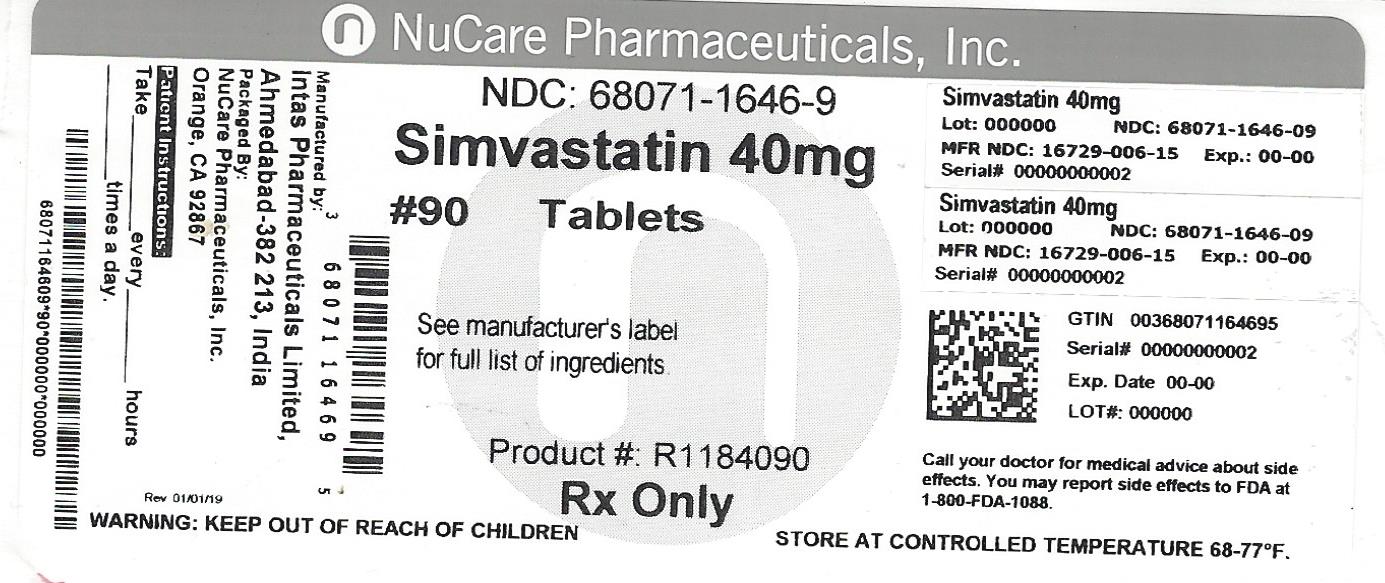
simvastatin 40 mg Tablet, Film Coated, 90-count — NDC 68071-1646-9 (Billing 68071-1646-09)
This is a package of 90 tablets of simvastatin 40 mg Tablet, Film Coated from NuCare Pharmaceuticals,Inc., marketed since Feb 2008 and currently FDA-listed. It is this product's only package size.
Identity & classification
Regulatory identifiers FDA, NLM and CMS codes for this package
- RxCUI (RxNorm): 198211
Where does this data come from?
- FDA openFDA NDC Directory · synced Oct 1, 2026
- FDA label on DailyMed · label index refreshed Oct 1, 2026
- RxNorm (NLM RxNav) · catalog refreshed Oct 1, 2026
- Medi-Span GPI (licensed)
- First Databank (licensed) · refreshed Oct 1, 2026
RxNorm drug class
This medicine belongs to the HMG-CoA Reductase Inhibitor class.
Where does this data come from?
- RxClass (NLM) · catalog refreshed Oct 1, 2026
Clinical
Simvastatin is used to reduce the risk of heart attack and stroke in patients at high risk of these developing decrease the amount of cholesterol (a fat-like substance) Simvastatin is in a class of medications called HMG-CoA reductase inhibitors (statins). It works by slowing how much cholesterol your body makes. This lowers the amount of cholesterol that can build up on the walls of the arteries and block blood flow to the heart, brain, and other parts of the body.
Read the full MedlinePlus article ↗- It’s a statin that lowers cholesterol and triglycerides when diet alone isn’t enough. It also lowers the risk of heart attack, stroke and heart-related death in people at high risk...
- Take it once a day in the evening, as your prescriber directs. If you use FloLipid liquid, take it on an empty stomach and shake the bottle well. Use a proper measuring device, not...
- The most common are cold-like symptoms, headache, stomach pain, constipation and nausea. Call your doctor if you notice muscle pain, tenderness or weakness you can’t explain, espec...
- Avoid it. Grapefruit juice can raise simvastatin levels in your blood and increase the risk of muscle damage.
Patient education
Supplement & herbal interactions
Some supplements/herbs that may interact with Simvastatin — tap one for details:
Simvastatin may be associated with lower levels of 2 nutrients — worth a chat with your pharmacist, not a cause for alarm.
Where does this data come from?
- MedlinePlus (NLM) · refreshed Oct 1, 2026
- FDA label on DailyMed · label index refreshed Oct 1, 2026
Ask a licensed pharmacist directly — free, answered by our team.
Pricing
A drug doesn't have one price. Each row is a different public payment system, and none is what you'd pay at the counter — that depends on your insurance. The ⓘ on each row explains what it measures.
| Price system | Per each | Per package |
|---|---|---|
| Retail pharmacies payNADAC · weekly | Not in the retail survey — common for institutional, discontinued, or low-volume packs. | |
| Medicaid paysCMS SDUD · 12 mo | No recent Medicaid claims on file for this NDC — rare and low-volume NDCs are suppressed in the public data. | |
| Medicare drug plans payPart D · Q2 2026 | $0.0936 | $8.42 / 90 tablets |
Where does this data come from?
- CMS NADAC weekly file
- CMS ASP pricing files · refreshed Sep 20, 2026
- CMS Medicaid State Drug Utilization Data · refreshed Oct 2, 2026
- CMS Part D plan pricing files · refreshed Sep 24, 2026
- VA National Acquisition Center price file
Packaging — all sizes for this product
| Package NDC | Description | Marketing start | Marketing end | Status |
|---|---|---|---|---|
| 68071-1646-09 You're viewing this Main listing | 90 TABLET, FILM COATED in 1 BOTTLE | 2017-07-20 | — | Active |
Therapeutic equivalents
| Product | Labeler | Pack | NADAC/unit | TE | Status | Price vs. this |
|---|---|---|---|---|---|---|
| Simvastatin 40 mg 16714-0684-01 | NorthStar | 30 tablets | $0.054 | AB | Availability likely | — |
| Simvastatin 40 mg 60687-0210-01 | American | 1 tablet | $0.054 | AB | Discontinued | — |
| Simvastatin 40 mg 68180-0464-03 | Lupin | 1000 tablets | $0.054 | AB | Availability likely | — |
| Simvastatin 40 mg 69367-0376-09 | Westminster | 90 tablets | $0.054 | AB | Availability likely | — |
| Simvastatin 40 mg 70377-0004-12 | Biocon | 30 tablets | $0.054 | AB | Availability likely | — |
| Simvastatin 40 mg 82009-0015-10 | Quallent | 1000 tablets | $0.054 | AB | Availability likely | — |
| Zocor 40 mg 78206-0182-01 | Organon | 30 tablets | $9.729 | AB | Availability likely | — |
| Simvastatin 40 mg 00615-8056-05 | NCS | 15 tablets | — | AB | FDA listed | — |
| simvastatin 40 mg 16729-0006-10 | Accord | 30 tablets | — | AB | FDA listed | — |
| Simvastatin 40 mg 31722-0513-01 | Camber | 100 tablets | — | AB | FDA listed | — |
| Simvastatin 40 mg 42571-0040-05 | Micro | 500 tablets | — | AB | Discontinued | — |
| Simvastatin 40 mg 42708-0168-30 | QPharma, | 30 tablets | — | AB | FDA listed | — |
| simvastatin 40 mg 43063-0726-30 | PD-Rx | 30 tablets | — | AB | FDA listed | — |
| Simvastatin 40 mg 50090-4736-00 | A-S | 1000 tablets | — | AB | FDA listed | — |
| Simvastatin 40 mg 50090-4901-00 | A-S | 90 tablets | — | AB | FDA listed | — |
| Simvastatin 40 mg 50090-6421-00 | A-S | 90 tablets | — | AB | FDA listed | — |
| Simvastatin 40 mg 50090-6424-01 | A-S | 30 tablets | — | AB | FDA listed | — |
| Simvastatin 40 mg 50090-6425-00 | A-S | 90 tablets | — | AB | FDA listed | — |
| Simvastatin 40 mg 50090-7782-00 | A-S | 45 tablets | — | AB | FDA listed | — |
| Simvastatin 40 mg 51655-0113-26 | Northwind | 90 tablets | — | AB | FDA listed | — |
| Simvastatin 40 mg 51655-0387-26 | Northwind | 90 tablets | — | AB | FDA listed | — |
| simvastatin 40 mg 51655-0643-26 | Northwind | 90 tablets | — | AB | FDA listed | — |
| Simvastatin 40 mg 51655-0841-26 | Northwind | 90 tablets | — | AB | FDA listed | — |
| Simvastatin 40 mg 60760-0579-30 | St. | 30 tablets | — | AB | FDA listed | — |
| simvastatin 40 mg 63187-0449-30 | Proficient | 30 tablets | — | AB | FDA listed | — |
| simvastatin 40 mg 63629-3385-01 | Bryant | 30 tablets | — | AB | FDA listed | — |
| Simvastatin 40 mg 65862-0053-00 | Aurobindo | 100 tablets | — | — | FDA listed | — |
| Simvastatin 40 mg 67046-0628-03 | Coupler | 30 tablets | — | AB | FDA listed | — |
| simvastatin 40 mgthis 68071-1646-09 | NuCare | 90 tablets | — | AB | FDA listed | — |
| Simvastatin 40 mg 68071-2559-03 | NuCare | 30 tablets | — | AB | FDA listed | — |
| Simvastatin 40 mg 68071-3426-03 | NuCare | 30 tablets | — | AB | FDA listed | — |
| simvastatin 40 mg 68071-4998-03 | NuCare | 30 tablets | — | AB | FDA listed | — |
| Simvastatin 40 mg 70518-3349-00 | REMEDYREPACK | 1 tablet | — | AB | Discontinued | — |
| Simvastatin 40 mg 71205-0192-30 | Proficient | 30 tablets | — | AB | FDA listed | — |
| Simvastatin 40 mg 71335-1906-01 | Bryant | 30 tablets | — | AB | FDA listed | — |
| Simvastatin 40 mg 71335-9630-01 | Bryant | 30 tablets | — | AB | FDA listed | — |
| simvastatin 40 mg 71610-0050-30 | Aphena | 30 tablets | — | AB | FDA listed | — |
| Simvastatin 40 mg 71610-0610-45 | Aphena | 45 tablets | — | AB | FDA listed | — |
| Simvastatin 40 mg 71610-0623-15 | Aphena | 15 tablets | — | AB | FDA listed | — |
| Simvastatin 40 mg 72189-0427-30 | Direct_Rx | 30 tablets | — | AB | FDA listed | — |
| Simvastatin 40 mg 72789-0304-30 | PD-Rx | 30 tablets | — | AB | FDA listed | — |
| Simvastatin 40 mg 72865-0308-01 | XLCare | 100 tablets | — | AB | FDA listed | — |
| Simvastatin 40 mg 84677-0017-10 | Golden | 1000 tablets | — | AB | FDA listed | — |
| Simvastatin 40 mg 53401-0026-45 | Aphena | 45 tablets | — | AB | FDA listed | — |
Where does this data come from?
- FDA openFDA NDC Directory · synced Oct 1, 2026
- FDA Orange Book · refreshed Sep 3, 2026
- CMS NADAC weekly file
Availability & generic status
This product is an FDA-approved generic. Other versions of the same drug are listed under Therapeutic equivalents, least expensive first.
Where does this data come from?
- FDA Orange Book · refreshed Sep 3, 2026
What it looks like
Where does this data come from?
- FDA label on DailyMed · label index refreshed Oct 1, 2026
Inactive Ingredients / Excipients
Inactive ingredients, also called excipients, are components of the drug product other than the active ingredient. They may include fillers, dyes, coatings, preservatives, flavors, or other formulation ingredients.
💡 Tap an ingredient (hover on desktop) to see what it is and why it’s used.
-
UNII PQ6CK8PD0R
Ascorbic acid, also known as vitamin C, is a white crystalline powder. It serves as an antioxidant to prevent degradation of other ingredients and may also function as a preservative in the formulation.
-
UNII REK4960K2U
Butylated hydroxyanisole is a synthetic preservative that prevents oils and fats in medicines from spoiling or becoming rancid. It keeps the medicine stable and extends its shelf life.
-
UNII OP1R32D61U
Microcrystalline cellulose is a purified form of cellulose, a natural fiber from plant sources. It acts as a binder and filler in tablets and capsules, helping hold ingredients together and give the medicine its shape and size.
-
UNII 2968PHW8QP
A weak organic acid derived from citrus fruits or made through fermentation. It works as a buffer to control pH, a preservative to extend shelf life, and a flavoring agent in medications.
-
UNII M28OL1HH48
Croscarmellose sodium is a plant-based substance derived from cellulose. It acts as a disintegrant, helping tablets and capsules break down quickly in the digestive system so the medicine can be absorbed.
-
UNII 1K09F3G675
Ferric oxide red is an inorganic iron compound used as a colorant in medicines. It gives tablets, capsules, or other dosage forms a red or reddish tint for identification and appearance.
-
UNII RFW2ET671P
Hydroxypropyl cellulose is a plant-derived thickening agent made from cellulose. It acts as a binder to hold tablet ingredients together and as a film-former to coat tablets or control how fast the medicine releases.
-
UNII R75537T0T4
Hypromellose 2910 is a plant-derived thickening agent made from cellulose. It serves as a binder that holds tablet ingredients together, a film-coating for pills, and a viscosity controller in liquids.
-
UNII EWQ57Q8I5X
Lactose monohydrate is a natural sugar derived from milk. It serves as a filler and binder in tablets and capsules, helping create the proper size, texture, and consistency of the medicine.
-
UNII 70097M6I30
Magnesium stearate is a salt made from magnesium and stearic acid, a fatty substance. It's used in tablets and capsules as a lubricant and glidant to help ingredients flow smoothly during manufacturing and prevent sticking.
-
UNII O8232NY3SJ
A plant-based carbohydrate derived from corn kernels. It acts as a filler to add bulk, a binder to hold ingredients together, and a disintegrant to help the tablet break apart in your stomach for absorption.
-
UNII 7SEV7J4R1U
A powder made from a naturally occurring mineral. In medicines, talc works as a glidant and anti-caking agent, helping tablets and capsules flow smoothly during manufacturing and preventing clumping.
-
UNII 15FIX9V2JP
Titanium dioxide is a bright white mineral powder commonly used as a colorant and opacifying agent. It makes pills and tablets white or lighter in color and helps make coatings non-transparent.
-
UNII 8Z96QXD6UM
Triethyl citrate is a clear liquid derived from citric acid. It acts as a plasticizer and solvent in tablet coatings and film formulations, helping the coating remain flexible and adhere properly to the medicine.
14 inactive ingredients listed in the exact product block matched to this NDC.
Where does this data come from?
ingredient classCode="IACT" elements from the exact product block matched by this NDC. Label-section narrative from DailyMed / the openFDA label index is shown separately when available.- FDA label on DailyMed · label index refreshed Oct 1, 2026
- FDA openFDA NDC Directory · synced Oct 1, 2026
Inactive ingredient FAQ
Are inactive ingredients the same for every manufacturer?
Why might an inactive ingredient be missing?
Can inactive ingredients matter?
Manufacturer & labeler
Where does this data come from?
- FDA openFDA NDC Directory · synced Oct 1, 2026
- Drugs@FDA
Full prescribing information FDA SPL
🎯 Indications and Usage ▾
1. INDICATIONS AND USAGE Therapy with lipid-altering agents should be only one component of multiple risk factor intervention in individuals at significantly increased risk for atherosclerotic vascular disease due to hypercholesterolemia. Drug therapy is indicated as an adjunct to diet when the response to a diet restricted in saturated fat and cholesterol and other nonpharmacologic measures alone has been inadequate.
In patients with coronary heart disease (CHD) or at high risk of CHD, simvastatin tablets can be started simultaneously with diet. Simvastatin tablets are an HMG-CoA reductase inhibitor (statin) indicated as an adjunctive therapy to diet to: Reduce the risk of total mortality by reducing CHD deaths and reduce the risk of non-fatal myocardial infarction, stroke, and the need for revascularization procedures in patients at high risk of coronary events. ( 1.1 ) Reduce elevated total-C, LDL-C, Apo B, TG and increase HDL-C in patients with primary hyperlipidemia (heterozygous familial and nonfamilial) and mixed dyslipidemia.
( 1.2 ) Reduce elevated TG in patients with hypertriglyceridemia and reduce TG and VLDL-C in patients with primary dysbeta-lipoproteinemia. ( 1.2 ) Reduce total-C and LDL-C in adult patients with homozygous familial hypercholesterolemia. ( 1.2 ) Reduce elevated total-C, LDL-C, and Apo B in boys and postmenarchal girls, 10 to 17 years of age with heterozygous familial hypercholesterolemia after failing an adequate trial of diet therapy.
( 1.2 , 1.3 ) Limitations of Use Simvastatin tablets have not been studied in Fredrickson Types I and V dyslipidemias. ( 1.4 )
1.1Reductions in Risk of CHD Mortality and Cardiovascular Events In patients at high risk of coronary events because of existing coronary heart disease, diabetes, peripheral vessel disease, history of stroke or other cerebrovascular disease, simvastatin tablets are indicated to: Reduce the risk of total mortality by reducing CHD deaths. Reduce the risk of non-fatal myocardial infarction and stroke. Reduce the need for coronary and non-coronary revascularization procedures.
1.2Hyperlipidemia Simvastatin tablets are indicated to: Reduce elevated total cholesterol (total-C), low-density lipoprotein cholesterol (LDL-C), apolipoprotein B (Apo B), and triglycerides (TG), and to increase high-density lipoprotein cholesterol (HDL-C) in patients with primary hyperlipidemia (Fredrickson type IIa, heterozygous familial and nonfamilial) or mixed dyslipidemia (Fredrickson type IIb). Reduce elevated TG in patients with hypertriglyceridemia (Fredrickson type lV hyperlipidemia). Reduce elevated TG and VLDL-C in patients with primary dysbetalipoproteinemia (Fredrickson type III hyperlipidemia).
Reduce total-C and LDL-C in patients with homozygous familial hypercholesterolemia (HoFH) as an adjunct to other lipid-lowering treatments (e.g., LDL apheresis) or if such treatments are unavailable.
1.3Adolescent Patients with Heterozygous Familial Hypercholesterolemia (HeFH) Simvastatin tablets are indicated as an adjunct to diet to reduce total-C, LDL-C, and Apo B levels in adolescent boys and girls who are at least one year post-menarche, 10 to 17 years of age, with HeFH, if after an adequate trial of diet therapy the following findings are present: LDL cholesterol remains ≥190 mg/dL; or LDL cholesterol remains ≥160 mg/dL and There is a positive family history of premature cardiovascular disease (CVD) or Two or more other CVD risk factors are present in the adolescent patient.
The minimum goal of treatment in pediatric and adolescent patients is to achieve a mean LDL-C <130 mg/dL. The optimal age at which to initiate lipid-lowering therapy to decrease the risk of symptomatic adulthood CAD has not been determined.
1.4Limitations of Use Simvastatin tablets have not been studied in conditions where the major abnormality is elevation of chylomicrons (i.e., hyperlipidemia Fredrickson types I and V).
⏱️ Dosage and Administration ▾
2. DOSAGE AND ADMINISTRATION Dose range is 5 to 40 mg/day. ( 2.1 ) Recommended usual starting dose is 10 or 20 mg once a day in the evening.
( 2.1 ) Recommended starting dose for patients at high risk of CHD is 40 mg/day. ( 2.1 ) Due to the increased risk of myopathy, including rhabdomyolysis, use of the 80-mg dose of simvastatin tablets should be restricted to patients who have been taking simvastatin 80 mg chronically (e.g., for 12 months or more) without evidence of muscle toxicity. ( 2.2 ) Patients who are currently tolerating the 80-mg dose of simvastatin tablets who need to be initiated on an interacting drug that is contraindicated or is associated with a dose cap for simvastatin should be switched to an alternative statin with less potential for the drug-drug interaction.
( 2.2 ) Due to the increased risk of myopathy, including rhabdomyolysis, associated with the 80-mg dose of simvastatin tablets, patients unable to achieve their LDL-C goal utilizing the 40-mg dose of simvastatin tablets should not be titrated to the 80-mg dose, but should be placed on alternative LDL-C-lowering treatment(s) that provides greater LDL-C lowering. ( 2.2 ) Adolescents (10 to 17 years of age) with HeFH: starting dose is 10 mg/day; maximum recommended dose is 40 mg/day. ( 2.5 )
2.1Recommended Dosing The usual dosage range is 5 to 40 mg/day. In patients with CHD or at high risk of CHD, simvastatin tablets can be started simultaneously with diet. The recommended usual starting dose is 10 or 20 mg once a day in the evening.
For patients at high risk for a CHD event due to existing CHD, diabetes, peripheral vessel disease, history of stroke or other cerebrovascular disease, the recommended starting dose is 40 mg/day. Lipid determinations should be performed after 4 weeks of therapy and periodically thereafter.
2.2Restricted Dosing for 80 mg Due to the increased risk of myopathy, including rhabdomyolysis, particularly during the first year of treatment, use of the 80-mg dose of simvastatin tablets should be restricted to patients who have been taking simvastatin 80 mg chronically (e.g., for 12 months or more) without evidence of muscle toxicity. [see Warnings and Precautions (5.1) ] Patients who are currently tolerating the 80-mg dose of simvastatin tablets who need to be initiated on an interacting drug that is contraindicated or is associated with a dose cap for simvastatin should be switched to an alternative statin with less potential for the drug-drug interaction.
Due to the increased risk of myopathy, including rhabdomyolysis, associated with the 80-mg dose of simvastatin tablets, patients unable to achieve their LDL-C goal utilizing the 40-mg dose of simvastatin tablets should not be titrated to the 80-mg dose, but should be placed on alternative LDL-C-lowering treatment(s) that provides greater LDL-C lowering.
2.3Coadministration with Other Drugs Patients taking Verapamil, Diltiazem, or Dronedarone The dose of simvastatin tablets should not exceed 10 mg/day [see Warnings and Precautions (5.1) , Drug Interactions (7.3) , and Clinical Pharmacology (12.3) ]. . Patients taking Amiodarone, Amlodipine or Ranolazine The dose of simvastatin tablets should not exceed 20 mg/day [see Warnings and Precautions (5.1) , Drug Interactions (7.3) , and Clinical Pharmacology (12.3) ].
2.4Patients with Homozygous Familial Hypercholesterolemia The recommended dosage is 40 mg/day in the evening [see Dosage and Administration, Restricted Dosing for 80 mg (2.2) ] . Simvastatin tablets should be used as an adjunct to other lipid-lowering treatments (e.g., LDL apheresis) in these patients or if such treatments are unavailable. Simvastatin exposure is approximately doubled with concomitant use of lomitapide; therefore, the dose of simvastatin tablets should be reduced by 50% if initiating lomitapide.
Simvastatin tablets dosage should not exceed 20 mg/day (or 40 mg/day for patients who have previously taken simvastatin tablets 80 mg/day chronically, e.g., for 1… [Excerpted — this section continues on DailyMed.]
💊 Dosage Forms and Strengths ▾
3. DOSAGE FORMS AND STRENGTHS Simvastatin tablets 5 mg are brick red colored, round shaped, biconvex, film coated tablet debossed “SI” on one side and plain on other side. Simvastatin tablets 10 mg are brick red colored,oval shaped, biconvex,film-coated tablets, debossed “S 4” on one side and plain on the other side Simvastatin tablets 20 mg are brick red colored,oval shaped, biconvex,film-coated tablets, debossed “S 5” on one side and plain on the other side.
Simvastatin tablets 40 mg are brick red colored,oval shaped, biconvex,film-coated tablets,debossed “S 6” on one side and plain on the other side Simvastatin tablets 80 mg are brick red colored, capsule-shaped, biconvex, film-coated tablets, debossed with “SMV” on one side and “80” on the other side Tablets: 5 mg; 10 mg; 20 mg; 40.0#160;mg; 80 mg ( 3 )
⛔ Contraindications ▾
4. CONTRAINDICATIONS Simvastatin tablets are contraindicated in the following conditions: Concomitant administration of strong CYP3A4 inhibitors (e.g., itraconazole, ketoconazole, posaconazole, voriconazole, HIV protease inhibitors, boceprevir, telaprevir, erythromycin, clarithromycin, telithromycin, nefazodone, and cobicistat-containing products) [see Warnings and Precautions (5.1) ] . Concomitant administration of gemfibrozil, cyclosporine, or danazol [see Warnings and Precautions (5.1) ] .
Hypersensitivity to any component of this medication [see Adverse Reactions (6.2) ] . Active liver disease, which may include unexplained persistent elevations in hepatic transaminase levels [see Warnings and Precautions (5.2) ] . Women who are pregnant or may become pregnant.
Serum cholesterol and triglycerides increase during normal pregnancy, and cholesterol or cholesterol derivatives are essential for fetal development. Because HMG-CoA reductase inhibitors (statins) decrease cholesterol synthesis and possibly the synthesis of other biologically active substances derived from cholesterol, simvastatin tablets may cause fetal harm when administered to a pregnant woman. Atherosclerosis is a chronic process and the discontinuation of lipid-lowering drugs during pregnancy should have little impact on the outcome of long-term therapy of primary hypercholesterolemia.
There are no adequate and well-controlled studies of use with simvastatin tablets during pregnancy; however, in rare reports congenital anomalies were observed following intrauterine exposure to statins. In rat and rabbit animal reproduction studies, simvastatin revealed no evidence of teratogenicity. Simvastatin tablets should be administered to women of childbearing age only when such patients are highly unlikely to conceive.
If the patient becomes pregnant while taking this drug, simvastatin tablets should be discontinued immediately and the patient should be apprised of the potential hazard to the fetus [see Use in Specific Populations (8.1) ] . Nursing mothers. It is not known whether simvastatin is excreted into human milk; however, a small amount of another drug in this class does pass into breast milk.
Because statins have the potential for serious adverse reactions in nursing infants, women who require treatment with simvastatin tablets should not breastfeed their infants [see Use in Specific Populations (8.3) ] . Concomitant administration of strong CYP3A4 inhibitors. ( 4 , 5.1 ) Concomitant administration of gemfibrozil, cyclosporine, or danazol.
( 4 , 5.1 ) Hypersensitivity to any component of this medication. ( 4 , 6.2 ) Active liver disease, which may include unexplained persistent elevations in hepatic transaminase levels. ( 4 , 5.2 ) Women who are pregnant or may become pregnant.
( 4 , 8.1 ) Nursing mothers. ( 4 , 8.3 )
⚠️ Warnings and Cautions ▾
5. WARNINGS AND PRECAUTIONS Patients should be advised of the increased risk of myopathy including rhabdomyolysis with the 80-mg dose. ( 5.1 ) Skeletal muscle effects (e.g., myopathy and rhabdomyolysis): Risks increase with higher doses and concomitant use of certain medicines.
Predisposing factors include advanced age (≥65), female gender, uncontrolled hypothyroidism, and renal impairment. Rare cases of rhabdomyolysis with acute renal failure secondary to myoglobinuria have been reported. ( 4 , 5.1 , 8.5 , 8.6 ) Patients should be advised to report promptly any unexplained and/or persistent muscle pain, tenderness, or weakness.
Simvastatin therapy should be discontinued immediately if myopathy is diagnosed or suspected. See Drug Interaction table. ( 5.1 ) Liver enzyme abnormalities: Persistent elevations in hepatic transaminases can occur.
Check liver enzyme tests before initiating therapy and as clinically indicated thereafter. ( 5.2 )
5.1Myopathy/Rhabdomyolysis Simvastatin occasionally causes myopathy manifested as muscle pain, tenderness or weakness with creatine kinase (CK) above ten times the upper limit of normal (ULN). Myopathy sometimes takes the form of rhabdomyolysis with or without acute renal failure secondary to myoglobinuria, and rare fatalities have occurred. The risk of myopathy is increased by high levels of statin activity in plasma.
Predisposing factors for myopathy include advanced age (≥65 years),female gender, uncontrolled hypothyroidism, and renal impairment. The risk of myopathy, including rhabdomyolysis, is dose related. In a clinical trial database in which 41,413 patients were treated with simvastatin.
24,747 (approximately 60%) of whom were enrolled in studies with a median follow-up of at least 4 years, the incidence of myopathy was approximately 0.03% and 0.08% at 20 and 40 mg/day, respectively. The incidence of myopathy with 80 mg (0.61%) was disproportionately higher than that observed at the lower doses. In these trials, patients were carefully monitored and some interacting medicinal products were excluded In a clinical trial in which 12,064 patients with a history of myocardial infarction were treated with simvastatin (mean follow-up 6.7 years), the incidence of myopathy (defined as unexplained muscle weakness or pain with a serum creatine kinase [CK] >10 times upper limit of normal [ULN]) in patients on 80 mg/day was approximately 0.9% compared with 0.02% for patients on 20 mg/day.
The incidence of rhabdomyolysis (defined as myopathy with a CK >40 times ULN) in patients on 80 mg/day was approximately 0.4% compared with 0% for patients on 20 mg/day. The incidence of myopathy, including rhabdomyolysis, was highest during the first year and then notably decreased during the subsequent years of treatment. In this trial, patients were carefully monitored and some interacting medicinal products were excluded.
The risk of myopathy, including rhabdomyolysis, is greater in patients on simvastatin 80 mg compared with other statin therapies with similar or greater LDL-C-lowering efficacy and compared with lower doses of simvastatin. Therefore, the 80-mg dose of simvastatin should be used only in patients who have been taking simvastatin 80 mg chronically (e.g., for 12 months or more) without evidence of muscle toxicity [See Dosage and Administration, Restricted Dosing for 80 mg (2.2) .] If, however, a patient who is currently tolerating the 80-mg dose of simvastatin needs to be initiated on an interacting drug that is contraindicated or is associated with a dose cap for simvastatin, that patient should be switched to an alternative statin with less potential for the drug-drug interaction.
Patients should be advised of the increased risk of myopathy, including rhabdomyolysis, and to report promptly any unexplained muscle pain, tenderness or weakness. If symptoms occur, treatment should be discontinued immediately. [See Warnings and Precautions (5.2) .] There have been rare reports of immune-mediated n… [Excerpted — this section continues on DailyMed.]
🤒 Adverse Reactions ▾
6. ADVERSE REACTIONS Most common adverse reactions (incidence ≥5.0%) are: upper respiratory infection, headache, abdominal pain, constipation, and nausea. ( 6.1 ) To report SUSPECTED ADVERSE REACTIONS, contact Accord Healthcare Inc. at 1-866-941-7875 or FDA at 1-800-FDA-1088 or www.fda.gov/medwatch
6.1Clinical Trials Experience Because clinical studies are conducted under widely varying conditions, adverse reaction rates observed in the clinical studies of a drug cannot be directly compared to rates in the clinical studies of another drug and may not reflect the rates observed in practice. In the pre-marketing controlled clinical studies and their open extensions (2,423 patients with median duration of follow-up of approximately 18 months), 1.4% of patients were discontinued due to adverse reactions. The most common adverse reactions that led to treatment discontinuation were: gastrointestinal disorders (0.5%), myalgia (0.1%), and arthralgia (0.1%).
The most commonly reported adverse reactions (incidence ≥5%) in simvastatin controlled clinical trials were: upper respiratory infections (9.0%), headache (7.4%), abdominal pain (7.3%), constipation (6.6%), and nausea (5.4%). Scandinavian Simvastatin Survival Study In 4S involving 4,444 (age range 35 to 71 years, 19% women, 100% Caucasians) treated with 20 to 40 mg/day of simvastatin (n=2,221) or placebo (n=2,223) over a median of 5.4 years, adverse reactions reported in ≥2% of patients and at a rate greater than placebo are shown in Table 2.
Table 2: Adverse Reactions Reported Regardless of Causality by ≥2% of Patients Treated with Simvastatin Tablets and Greater than Placebo in 4S Simvastatin Tablets (N = 2,221) % Placebo (N = 2,223) % Body as a Whole Edema/swelling Abdominal pain 2.7 5.9 2.3
5.8Cardiovascular System Disorders Atrial fibrillation 5.7
5.1Digestive System Disorders Constipation Gastritis 2.2 4.9 1.6
3.9Endocrine Disorders Diabetes mellitus 4.2
3.6Musculoskeletal Disorders Myalgia 3.7
3.2Nervous System / Psychiatric Disorders Headache Insomnia Vertigo 2.5 4.0 4.5 2.1 3.8
4.2Respiratory System Disorders Bronchitis Sinusitis 6.6 2.3 6.3
1.8Skin / Skin Appendage Disorders Eczema 4.5
3.0Urogenital System Disorders Infection, urinary tract 3.2
3.1Heart Protection Study In the Heart Protection Study (HPS), involving 20,536 patients (age range 40 to 80 years, 25% women, 97% Caucasians, 3% other races) treated with simvastatin tablets 40 mg/day (n=10,269) or placebo (n=10,267) over a mean of 5 years, only serious adverse reactions and discontinuations due to any adverse reactions were recorded. Discontinuation rates due to adverse reactions were 4.8% in patients treated with simvastatin tablets compared with 5.1% in patients treated with placebo. The incidence of myopathy/rhabdomyolysis was <0.1% in patients treated with simvastatin tablets.
Other Clinical Studies In a clinical trial in which 12,064 patients with a history of myocardial infarction were treated with simvastatin (mean follow-up 6.7 years), the incidence of myopathy (defined as unexplained muscle weakness or pain with a serum creatine kinase [CK] >10 times upper limit of normal [ULN]) in patients on 80 mg/day was approximately 0.9% compared with 0.02% for patients on 20 mg/day. The incidence of rhabdomyolysis (defined as myopathy with a CK >40 times ULN) in patients on 80 mg/day was approximately 0.4% compared with 0% for patients on 20 mg/day.
The incidence of myopathy, including rhabdomyolysis, was highest during the first year and then notably decreased during the subsequent years of treatment. In this trial, patients were carefully monitored and some interacting medicinal products were excluded. Other adverse reactions reported in clinical trials were: diarrhea, rash, dyspepsia, flatulence, and asthenia.
Laboratory Tests Marked persistent increases of hepatic transaminases have been noted [see Warnings and Precautions (5.2) ]. Elevated alkaline phosphatase and γ-glutamyl transpeptidase have also… [Excerpted — this section continues on DailyMed.]
🔄 Drug Interactions ▾
7. DRUG INTERACTIONS Drug Interactions Associated with Increased Risk of Myopathy/Rhabdomyolysis ( 2.3 , 2.4 , 4 , 5.1 , 7.1 , 7.2 , 7.3 , 12.3 ) Interacting Agents Prescribing Recommendations Strong CYP3A4 inhibitors (e.g. itraconazole, ketoconazole, posaconazole, voriconazole, erythromycin, clarithromycin, telithromycin, HIV protease inhibitors, boceprevir, telaprevir, nefazodone cobicistat-containing products), gemfibrozil, cyclosporine, danazol Contraindicated with simvastatin Verapamil, diltiazem, dronedarone Do not exceed 10 mg simvastatin daily Amiodarone, amlodipine, ranolazine Do not exceed 20 mg simvastatin daily Lomitapide For patients with HoFH, do not exceed 20 mg simvastatin daily For patients with HoFH who have been taking 80 mg simvastatin chronically (e.g., for 12 months or more) without evidence of muscle toxicity, do not exceed 40 mg simvastatin when taking lomitapide.
Grapefruit juice Avoid grapefruit juice Other Lipid-lowering Medications: Use with other fibrate products or lipid-modifying doses (≥1 g/day) of niacin increases the risk of adverse skeletal muscle effects. Caution should be used when prescribing with simvastatin. ( 5.1 , 7.2 , 7.4 ) Coumarin anticoagulants: Concomitant use with simvastatin tablets prolongs INR.
Achieve stable INR prior to starting simvastatin tablets. Monitor INR frequently until stable upon initiation or alteration of simvastatin tablets therapy. ( 7.6 )
7.1Strong CYP3A4 Inhibitors, Cyclosporine, or Danazol Strong CYP3A4 inhibitors: Simvastatin, like several other inhibitors of HMG-CoA reductase, is a substrate of CYP3A4. Simvastatin is metabolized by CYP3A4 but has no CYP3A4 inhibitory activity; therefore it is not expected to affect the plasma concentrations of other drugs metabolized by CYP3A4. Elevated plasma levels of HMG-CoA reductase inhibitory activity increases the risk of myopathy and rhabdomyolysis, particularly with higher doses of simvastatin. [See Warnings and Precautions (5.1) and Clinical Pharmacology (12.3) .] Concomitant use of drugs labeled as having a strong inhibitory effect on CYP3A4 is contraindicated [see Contraindications (4) ] .
If treatment with itraconazole, ketoconazole, posaconazole, voriconazole, erythromycin, clarithromycin or telithromycin is unavoidable, therapy with simvastatin must be suspended during the course of treatment. Cyclosporine or Danazol: The risk of myopathy, including rhabdomyolysis is increased by concomitant administration of cyclosporine or danazol. Therefore, concomitant use of these drugs is contraindicated. [see Contraindications (4) , Warnings and Precautions (5.1) and Clinical Pharmacology (12.3) ] .
7.2Lipid-Lowering Drugs That Can Cause Myopathy When Given Alone Gemfibrozil: Contraindicated with simvastatin [see Contraindications (4) and Warnings and Precautions (5.1) ] . Other fibrates: Caution should be used when prescribing with simvastatin [ see Warnings and Precautions (5.1) ] .
7.3Amiodarone, Dronedarone, Ranolazine, or Calcium Channel Blockers The risk of myopathy, including rhabdomyolysis, is increased by concomitant administration of amiodarone, dronedarone, ranolazine, or calcium channel blockers such as verapamil, diltiazem, or amlodipine [see Dosage and Administration (2.3) and Warnings and Precautions (5.1) and Table 3 in Clinical Pharmacology (12.3) ].
7.4Niacin Cases of myopathy/rhabdomyolysis have been observed with simvastatin coadministered with lipid-modifying doses (≥ 1 g/day niacin) of niacin-containing products. In particular, caution should be used when treating Chinese patients with simvastatin doses exceeding 20 mg/day coadministered with lipid-modifying doses of niacin-containing products. Because the risk for myopathy is dose-related, Chinese patients should not receive simvastatin 80 mg coadministered with lipid-modifying doses of niacin-containing products. [see Warnings and Precautions (5.1) and Clinical Pharmacology (12.3) ] .
7.5Digoxin In one study, concomitant administration of… [Excerpted — this section continues on DailyMed.]
👥 Use in Specific Populations ▾
8. USE IN SPECIFIC POPULATIONS Severe renal impairment: patients should be started at 5 mg/day and be closely monitored. ( 2.6 , 8.6 )
8.1Pregnancy Pregnancy Category X [See Contraindications (4) .] Simvastatin tablets are contraindicated in women who are or may become pregnant. Lipid lowering drugs offer no benefit during pregnancy, because cholesterol and cholesterol derivatives are needed for normal fetal development. Atherosclerosis is a chronic process, and discontinuation of lipid-lowering drugs during pregnancy should have little impact on long-term outcomes of primary hypercholesterolemia therapy.
There are no adequate and well-controlled studies of use with simvastatin tablets during pregnancy; however, there are rare reports of congenital anomalies in infants exposed to statins in utero . Animal reproduction studies of simvastatin in rats and rabbits showed no evidence of teratogenicity. Serum cholesterol and triglycerides increase during normal pregnancy, and cholesterol or cholesterol derivatives are essential for fetal development.
Because statins decrease cholesterol synthesis and possibly the synthesis of other biologically active substances derived from cholesterol, simvastatin tablets may cause fetal harm when administered to a pregnant woman. If simvastatin tablets are used during pregnancy or if the patient becomes pregnant while taking this drug, the patient should be apprised of the potential hazard to the fetus. There are rare reports of congenital anomalies following intrauterine exposure to statins.
In a review Manson, J.M., Freyssinges, C., Ducrocq, M.B., Stephenson, W.P., Postmarketing Surveillance of Lovastatin and Simvastatin Exposure During Pregnancy, Reproductive Toxicology,, 10(6):439-446, 1996. of approximately 100 prospectively followed pregnancies in women exposed to simvastatin or another structurally related statin, the incidences of congenital anomalies, spontaneous abortions, and fetal deaths/stillbirths did not exceed those expected in the general population. However, the study was only able to exclude a 3- to 4-fold increased risk of congenital anomalies over the background rate.
In 89% of these cases, drug treatment was initiated prior to pregnancy and was discontinued during the first trimester when pregnancy was identified. Simvastatin was not teratogenic in rats or rabbits at doses (25, 10 mg/kg/day, respectively) that resulted in 3 times the human exposure based on mg/m 2 surface area. However, in studies with another structurally-related statin, skeletal malformations were observed in rats and mice.
Women of childbearing potential, who require treatment with simvastatin tablets for a lipid disorder, should be advised to use effective contraception. For women trying to conceive, discontinuation of simvastatin tablets should be considered. If pregnancy occurs, simvastatin tablets should be immediately discontinued.
8.3Nursing Mothers It is not known whether simvastatin is excreted in human milk. Because a small amount of another drug in this class is excreted in human milk and because of the potential for serious adverse reactions in nursing infants, women taking simvastatin should not nurse their infants. A decision should be made whether to discontinue nursing or discontinue drug, taking into account the importance of the drug to the mother [see Contraindications (4) ] .
8.4Pediatric Use Safety and effectiveness of simvastatin in patients 10 to 17 years of age with heterozygous familial hypercholesterolemia have been evaluated in a controlled clinical trial in adolescent boys and in girls who were at least 1 year post-menarche. Patients treated with simvastatin had an adverse reaction profile similar to that of patients treated with placebo. Doses greater than 40 mg have not been studied in this population .
In this limited controlled study, there was no significant effect on growth or sexual maturation in the adolescent boys or girls, or on menstrual cycle length in girls. [See… [Excerpted — this section continues on DailyMed.]
🤰 Pregnancy ▾
8.1Pregnancy Pregnancy Category X [See Contraindications (4) .] Simvastatin tablets are contraindicated in women who are or may become pregnant. Lipid lowering drugs offer no benefit during pregnancy, because cholesterol and cholesterol derivatives are needed for normal fetal development. Atherosclerosis is a chronic process, and discontinuation of lipid-lowering drugs during pregnancy should have little impact on long-term outcomes of primary hypercholesterolemia therapy.
There are no adequate and well-controlled studies of use with simvastatin tablets during pregnancy; however, there are rare reports of congenital anomalies in infants exposed to statins in utero . Animal reproduction studies of simvastatin in rats and rabbits showed no evidence of teratogenicity. Serum cholesterol and triglycerides increase during normal pregnancy, and cholesterol or cholesterol derivatives are essential for fetal development.
Because statins decrease cholesterol synthesis and possibly the synthesis of other biologically active substances derived from cholesterol, simvastatin tablets may cause fetal harm when administered to a pregnant woman. If simvastatin tablets are used during pregnancy or if the patient becomes pregnant while taking this drug, the patient should be apprised of the potential hazard to the fetus. There are rare reports of congenital anomalies following intrauterine exposure to statins.
In a review Manson, J.M., Freyssinges, C., Ducrocq, M.B., Stephenson, W.P., Postmarketing Surveillance of Lovastatin and Simvastatin Exposure During Pregnancy, Reproductive Toxicology,, 10(6):439-446, 1996. of approximately 100 prospectively followed pregnancies in women exposed to simvastatin or another structurally related statin, the incidences of congenital anomalies, spontaneous abortions, and fetal deaths/stillbirths did not exceed those expected in the general population. However, the study was only able to exclude a 3- to 4-fold increased risk of congenital anomalies over the background rate.
In 89% of these cases, drug treatment was initiated prior to pregnancy and was discontinued during the first trimester when pregnancy was identified. Simvastatin was not teratogenic in rats or rabbits at doses (25, 10 mg/kg/day, respectively) that resulted in 3 times the human exposure based on mg/m 2 surface area. However, in studies with another structurally-related statin, skeletal malformations were observed in rats and mice.
Women of childbearing potential, who require treatment with simvastatin tablets for a lipid disorder, should be advised to use effective contraception. For women trying to conceive, discontinuation of simvastatin tablets should be considered. If pregnancy occurs, simvastatin tablets should be immediately discontinued.
🧒 Pediatric Use ▾
8.4Pediatric Use Safety and effectiveness of simvastatin in patients 10 to 17 years of age with heterozygous familial hypercholesterolemia have been evaluated in a controlled clinical trial in adolescent boys and in girls who were at least 1 year post-menarche. Patients treated with simvastatin had an adverse reaction profile similar to that of patients treated with placebo. Doses greater than 40 mg have not been studied in this population .
In this limited controlled study, there was no significant effect on growth or sexual maturation in the adolescent boys or girls, or on menstrual cycle length in girls. [See Dosage and Administration (2.5) , Adverse Reactions (6.1) , Clinical Studies (14.2) .] Adolescent females should be counseled on appropriate contraceptive methods while on simvastatin therapy [see Contraindications (4) and Use in Specific Populations (8.1) ]. Simvastatin has not been studied in patients younger than 10 years of age, nor in pre-menarchal girls.
🧓 Geriatric Use ▾
8.5Geriatric Use Of the 2,423 patients who received simvastatin tablets in Phase III clinical studies and the 10,269 patients in the Heart Protection Study who received simvastatin tablets, 363 (15%) and 5,366 (52%), respectively were ≥65 years old. In HPS, 615 (6%) were ≥75 years old. No overall differences in safety or effectiveness were observed between these subjects and younger subjects, and other reported clinical experience has not identified differences in responses between the elderly and younger patients, but greater sensitivity of some older individuals cannot be ruled out.
Since advanced age (≥65 years) is a predisposing factor for myopathy, simvastatin tablets should be prescribed with caution in the elderly. [See Clinical Pharmacology (12.3) .] A pharmacokinetic study with simvastatin showed the mean plasma level of statin activity to be approximately 45% higher in elderly patients between 70 to 78 years of age compared with patients between 18 to 30 years of age. In 4S, 1,021 (23%) of 4,444 patients were 65 or older. Lipid-lowering efficacy was at least as great in elderly patients compared with younger patients, and simvastatin tablets significantly reduced total mortality and CHD mortality in elderly patients with a history of CHD.
In HPS, 52% of patients were elderly (4,891 patients 65 to 69 years and 5,806 patients 70 years or older). The relative risk reductions of CHD death, non-fatal MI, coronary and non-coronary revascularization procedures, and stroke were similar in older and younger patients [see Clinical Studies (14.1) ]. In HPS, among 32,145 patients entering the active run-in period, there were 2 cases of myopathy/rhabdomyolysis; these patients were aged 67 and 73.
Of the 7 cases of myopathy/rhabdomyolysis among 10,269 patients allocated to simvastatin, 4 were aged 65 or more (at baseline), of whom one was over 75. There were no overall differences in safety between older and younger patients in either 4S or HPS. Because advanced age (≥65 years) is a predisposing factor for myopathy, including rhabdomyolysis, simvastatin tablets should be prescribed with caution in the elderly.
In a clinical trial of patients treated with simvastatin 80 mg/day, patients ≥65 years of age had an increased risk of myopathy, including rhabdomyolysis, compared to patients <65 years of age. [see Warnings and Precautions (5.1) and Clinical Pharmacology (12.3) ] .
🆘 Overdosage ▾
10. OVERDOSAGE Significant lethality was observed in mice after a single oral dose of 9 g/m 2 . No evidence of lethality was observed in rats or dogs treated with doses of 30 and 100 g/m 2 , respectively.
No specific diagnostic signs were observed in rodents. At these doses the only signs seen in dogs were emesis and mucoid stools. A few cases of overdosage with simvastatin tablets have been reported; the maximum dose taken was 3.6 g.
All patients recovered without sequelae. Supportive measures should be taken in the event of an overdose. The dialyzability of simvastatin and its metabolites in man is not known at present.
🧬 Clinical Pharmacology ▾
12. CLINICAL PHARMACOLOGY
12.1Mechanism of Action Simvastatin is a prodrug and is hydrolyzed to its active β-hydroxyacid form, simvastatin acid, after administration. Simvastatin is a specific inhibitor of 3-hydroxy-3-methylglutaryl-coenzyme A (HMG-CoA) reductase, the enzyme that catalyzes the conversion of HMG-CoA to mevalonate, an early and rate limiting step in the biosynthetic pathway for cholesterol. In addition, simvastatin reduces VLDL and TG and increases HDL-C.
12.2Pharmacodynamics Epidemiological studies have demonstrated that elevated levels of total-C, LDL-C, as well as decreased levels of HDL-C are associated with the development of atherosclerosis and increased cardiovascular risk. Lowering LDL-C decreases this risk. However, the independent effect of raising HDL-C or lowering TG on the risk of coronary and cardiovascular morbidity and mortality has not been determined.
12.3Pharmacokinetics Simvastatin is a lactone that is readily hydrolyzed in vivo to the corresponding β-hydroxyacid, a potent inhibitor of HMG-CoA reductase. Inhibition of HMG-CoA reductase is the basis for an assay in pharmacokinetic studies of the β-hydroxyacid metabolites (active inhibitors) and, following base hydrolysis, active plus latent inhibitors (total inhibitors) in plasma following administration of simvastatin. Following an oral dose of 14 C-labeled simvastatin in man, 13% of the dose was excreted in urine and 60% in feces.
Plasma concentrations of total radioactivity (simvastatin plus 14 C-metabolites) peaked at 4 hours and declined rapidly to about 10% of peak by 12 hours postdose. Since simvastatin undergoes extensive first-pass extraction in the liver, the availability of the drug to the general circulation is low (<5%). Both simvastatin and its β-hydroxyacid metabolite are highly bound (approximately 95%) to human plasma proteins.
Rat studies indicate that when radiolabeled simvastatin was administered, simvastatin-derived radioactivity crossed the blood-brain barrier. The major active metabolites of simvastatin present in human plasma are the β-hydroxyacid of simvastatin and its 6′-hydroxy, 6′-hydroxymethyl, and 6′-exomethylene derivatives. Peak plasma concentrations of both active and total inhibitors were attained within 1.3 to 2.4 hours postdose.
While the recommended therapeutic dose range is 5 to 40 mg/day, there was no substantial deviation from linearity of AUC of inhibitors in the general circulation with an increase in dose to as high as 120 mg. Relative to the fasting state, the plasma profile of inhibitors was not affected when simvastatin was administered immediately before an American Heart Association recommended low-fat meal. In a study including 16 elderly patients between 70 and 78 years of age who received simvastatin tablets 40 mg/day, the mean plasma level of HMG-CoA reductase inhibitory activity was increased approximately 45% compared with 18 patients between 18 to 30 years of age.
Clinical study experience in the elderly (n=1522), suggests that there were no overall differences in safety between elderly and younger patients [see Use in Specific Populations (8.5) ]. Kinetic studies with another statin, having a similar principal route of elimination, have suggested that for a given dose level higher systemic exposure may be achieved in patients with severe renal insufficiency (as measured by creatinine clearance). Simvastatin acid is a substrate of the transport protein OATP1B1.
Concomitant administration of medicinal products that are inhibitors of the transport protein OATP1B1 may lead to increased plasma concentrations of simvastatin acid and an increased risk of myopathy. For example, cyclosporine has been shown to increase the AUC of statins; although the mechanism is not fully understood, the increase in AUC for simvastatin acid is presumably due, in part, to inhibition of CYP3A4 and/or OATP1B1. The risk of myopathy is increased by high levels of HMG-CoA reductase inhibitory activity in plasma.
Inh… [Excerpted — this section continues on DailyMed.]
🧬 Mechanism of Action ▾
12.1Mechanism of Action Simvastatin is a prodrug and is hydrolyzed to its active β-hydroxyacid form, simvastatin acid, after administration. Simvastatin is a specific inhibitor of 3-hydroxy-3-methylglutaryl-coenzyme A (HMG-CoA) reductase, the enzyme that catalyzes the conversion of HMG-CoA to mevalonate, an early and rate limiting step in the biosynthetic pathway for cholesterol. In addition, simvastatin reduces VLDL and TG and increases HDL-C.
📦 How Supplied / Storage and Handling ▾
16. HOW SUPPLIED/STORAGE AND HANDLING Simvastatin tablets USP 40 mg are brick red coloured, oval shaped, biconvex, film-coated tablets, debossed "S 6" on one side and plain on other side. NDC 68071-1646-9 Bottles of 90 Storage Store at 20°C to 25°C (68°F to 77°F). [See USP Controlled Room Temperature]. "Dispense in tight containers as defined in the USP"
📋 Description ▾
11. DESCRIPTION Simvastatin is a lipid-lowering agent that is derived synthetically from a fermentation product of Aspergillus terreus . After oral ingestion, simvastatin, which is an inactive lactone, is hydrolyzed to the corresponding β-hydroxyacid form.
This is an inhibitor of 3-hydroxy-3-methylglutaryl-coenzyme A (HMG-CoA) reductase. This enzyme catalyzes the conversion of HMG-CoA to mevalonate, which is an early and rate-limiting step in the biosynthesis of cholesterol. Simvastatin is butanoic acid, 2,2-dimethyl-,1,2,3,7,8,8a-hexahydro-3,7-dimethyl-8-[2-(tetrahydro-4-hydroxy-6-oxo-2 H -pyran-2-yl)-ethyl]-1-naphthalenyl ester, [1 S -[1α,3α,7β,8β(2 S* ,4 S* ),-8aβ]].
The empirical formula of simvastatin is C 25 H 38 O 5 and its molecular weight is 418.57. Its structural formula is: Simvastatin is a white to off-white, nonhygroscopic, crystalline powder that is practically insoluble in water, and freely soluble in chloroform, methanol and ethanol. Simvastatin tablets USP for oral administration contain either 5 mg, 10 mg, 20 mg, 40 mg or 80 mg of simvastatin and the following inactive ingredients: microcrystalline cellulose, hydroxypropyl cellulose, hypromellose E5, croscarmellose sodium, ferric oxide red, lactose monohydrate, magnesium stearate, maize starch, talc, titanium dioxide, butylated hydroxyanisole , ascorbic acid, citric acid monohydrate, and triethyl citrate.
Simvastatin
💬 Information for Patients ▾
17. PATIENT COUNSELING INFORMATION Patients should be advised to adhere to their National Cholesterol Education Program (NCEP)-recommended diet, a regular exercise program, and periodic testing of a fasting lipid panel. Patients should be advised about substances they should not take concomitantly with simvastatin [see Contraindications (4) and Warnings and Precautions (5.1) ].
Patients should also be advised to inform other healthcare professionals prescribing a new medication or increasing the dose of an existing medication that they are taking simvastatin tablets.
17.1Muscle Pain All patients starting therapy with simvastatin tablets should be advised of the risk of myopathy , including rhabdomyolysis, and told to report promptly any unexplained muscle pain, tenderness or weakness particularly if accompanied by malaise or fever or if these muscle signs or symptoms persist after discontinuing simvastatin tablets. Patients using the 80-mg dose should be informed that the risk of myopathy, including rhabdomyolysis, is increased with use of the 80-mg dose. The risk of myopathy, including rhabdomyolysis, occurring with use of simvastatin tablets are increased when taking certain types of medication or consuming grapefruit juice.
Patients should discuss all medication, both prescription and over the counter, with their healthcare professional.
17.2Liver Enzymes It is recommended that liver function tests be performed before the initiation of simvastatin tablets, and thereafter when clinically indicated. All patients treated with simvastatin tablets should be advised to report promptly any symptoms that may indicate liver injury, including fatigue, anorexia, right upper abdominal discomfort, dark urine or jaundice.
17.3Pregnancy Women of childbearing age should be advised to use an effective method of birth control to prevent pregnancy while using simvastatin tablets. Discuss future pregnancy plans with your patients, and discuss when to stop taking simvastatin tablets if they are trying to conceive. Patients should be advised that if they become pregnant they should stop taking simvastatin tablets and call their healthcare professional.
17.4Breastfeeding Women who are breastfeeding should not use simvastatin tablets. Patients who have a lipid disorder and are breastfeeding should be advised to discuss the options with their healthcare professional. Manufactured For: Accord Healthcare, Inc., 1009, Slater Road, Suite 210-B, Durham, NC 27703, USA Manufactured By: Intas Pharmaceuticals Limited, Ahmedabad -380 009, India. 10 9351 1 659550 Issued February 2015
🍼 Nursing Mothers ▾
8.3Nursing Mothers It is not known whether simvastatin is excreted in human milk. Because a small amount of another drug in this class is excreted in human milk and because of the potential for serious adverse reactions in nursing infants, women taking simvastatin should not nurse their infants. A decision should be made whether to discontinue nursing or discontinue drug, taking into account the importance of the drug to the mother [see Contraindications (4) ] .
🧬 Pharmacokinetics ▾
12.3Pharmacokinetics Simvastatin is a lactone that is readily hydrolyzed in vivo to the corresponding β-hydroxyacid, a potent inhibitor of HMG-CoA reductase. Inhibition of HMG-CoA reductase is the basis for an assay in pharmacokinetic studies of the β-hydroxyacid metabolites (active inhibitors) and, following base hydrolysis, active plus latent inhibitors (total inhibitors) in plasma following administration of simvastatin. Following an oral dose of 14 C-labeled simvastatin in man, 13% of the dose was excreted in urine and 60% in feces.
Plasma concentrations of total radioactivity (simvastatin plus 14 C-metabolites) peaked at 4 hours and declined rapidly to about 10% of peak by 12 hours postdose. Since simvastatin undergoes extensive first-pass extraction in the liver, the availability of the drug to the general circulation is low (<5%). Both simvastatin and its β-hydroxyacid metabolite are highly bound (approximately 95%) to human plasma proteins.
Rat studies indicate that when radiolabeled simvastatin was administered, simvastatin-derived radioactivity crossed the blood-brain barrier. The major active metabolites of simvastatin present in human plasma are the β-hydroxyacid of simvastatin and its 6′-hydroxy, 6′-hydroxymethyl, and 6′-exomethylene derivatives. Peak plasma concentrations of both active and total inhibitors were attained within 1.3 to 2.4 hours postdose.
While the recommended therapeutic dose range is 5 to 40 mg/day, there was no substantial deviation from linearity of AUC of inhibitors in the general circulation with an increase in dose to as high as 120 mg. Relative to the fasting state, the plasma profile of inhibitors was not affected when simvastatin was administered immediately before an American Heart Association recommended low-fat meal. In a study including 16 elderly patients between 70 and 78 years of age who received simvastatin tablets 40 mg/day, the mean plasma level of HMG-CoA reductase inhibitory activity was increased approximately 45% compared with 18 patients between 18 to 30 years of age.
Clinical study experience in the elderly (n=1522), suggests that there were no overall differences in safety between elderly and younger patients [see Use in Specific Populations (8.5) ]. Kinetic studies with another statin, having a similar principal route of elimination, have suggested that for a given dose level higher systemic exposure may be achieved in patients with severe renal insufficiency (as measured by creatinine clearance). Simvastatin acid is a substrate of the transport protein OATP1B1.
Concomitant administration of medicinal products that are inhibitors of the transport protein OATP1B1 may lead to increased plasma concentrations of simvastatin acid and an increased risk of myopathy. For example, cyclosporine has been shown to increase the AUC of statins; although the mechanism is not fully understood, the increase in AUC for simvastatin acid is presumably due, in part, to inhibition of CYP3A4 and/or OATP1B1. The risk of myopathy is increased by high levels of HMG-CoA reductase inhibitory activity in plasma.
Inhibitors of CYP3A4 can raise the plasma levels of HMG-CoA reductase inhibitory activity and increase the risk of myopathy [see Warnings and Precautions (5.1) and Drug Interactions (7.1) ] . Table 3: Effect of Coadministered Drugs or Grapefruit Juice on Simvastatin Systemic Exposure Coadministered Drug or Grapefruit Juice Dosing of Coadministered Drug or Grapefruit Juice Dosing of Simvastatin Geometric Mean Ratio (Ratio Results based on a chemical assay except results with propranolol as indicated. with / without co-administered drug) No Effect =
1.00AUC C max C max Contraindicated with simvastatin [see Contraindications (4) and Warnings and Precautions (5.1) ] Telithromycin Results could be representative of the following CYP3A4 inhibitors: ketoconazole, erythromycin, clarithromycin, HIV protease inhibitors, and nefazodone. 200 mg QD for 4 days 80 mg simvastatin acid Simvastatin acid re… [Excerpted — this section continues on DailyMed.]
🧬 Pharmacodynamics ▾
12.2Pharmacodynamics Epidemiological studies have demonstrated that elevated levels of total-C, LDL-C, as well as decreased levels of HDL-C are associated with the development of atherosclerosis and increased cardiovascular risk. Lowering LDL-C decreases this risk. However, the independent effect of raising HDL-C or lowering TG on the risk of coronary and cardiovascular morbidity and mortality has not been determined.
🔬 Clinical Studies ▾
14. CLINICAL STUDIES
14.1Clinical Studies in Adults Reductions in Risk of CHD Mortality and Cardiovascular Events In 4S, the effect of therapy with simvastatin tablets on total mortality was assessed in 4,444 patients with CHD and baseline total cholesterol 212 to 309 mg/dL (5.5 to 8.0 mmol/L). In this multicenter, randomized, double-blind, placebo-controlled study, patients were treated with standard care, including diet, and either simvastatin tablets 20 to 40 mg/day (n=2,221) or placebo (n=2,223) for a median duration of 5.4 years. Over the course of the study, treatment with simvastatin tablets led to mean reductions in total-C, LDL-C and TG of 25%, 35%, and 10%, respectively, and a mean increase in HDL-C of 8%.
Simvastatin tablets significantly reduced the risk of mortality by 30% (p=0.0003, 182 deaths in the simvastatin tablets group vs 256 deaths in the placebo group). The risk of CHD mortality was significantly reduced by 42% (p=0.00001, 111 vs 189 deaths). There was no statistically significant difference between groups in non-cardiovascular mortality.
Simvastatin tablets significantly decreased the risk of having major coronary events (CHD mortality plus hospital-verified and silent non-fatal myocardial infarction [MI]) by 34% (p<0.00001, 431 vs 622 patients with one or more events). The risk of having a hospital-verified non-fatal MI was reduced by 37%. Simvastatin tablets significantly reduced the risk for undergoing myocardial revascularization procedures (coronary artery bypass grafting or percutaneous transluminal coronary angioplasty) by 37% (p<0.00001, 252 vs 383 patients).
Simvastatin tablets significantly reduced the risk of fatal plus non-fatal cerebrovascular events (combined stroke and transient ischemic attacks) by 28% (p=0.033, 75 vs 102 patients). Simvastatin tablets reduced the risk of major coronary events to a similar extent across the range of baseline total and LDL cholesterol levels. Because there were only 53 female deaths, the effect of simvastatin tablets on mortality in women could not be adequately assessed.
However, simvastatin tablets significantly lessened the risk of having major coronary events by 34% (60 vs 91 women with one or more event). The randomization was stratified by angina alone (21% of each treatment group) or a previous MI. Because there were only 57 deaths among the patients with angina alone at baseline, the effect of simvastatin tablets on mortality in this subgroup could not be adequately assessed.
However, trends in reduced coronary mortality, major coronary events and revascularization procedures were consistent between this group and the total study cohort. Additionally, simvastatin tablets resulted in similar decreases in relative risk for total mortality, CHD mortality, and major coronary events in elderly patients (≥65 years) , compared with younger patients. The Heart Protection Study (HPS) was a large, multi-center, placebo-controlled, double-blind study with a mean duration of 5 years conducted in 20,536 patients (10,269 on simvastatin tablets 40 mg and 10,267 on placebo).
Patients were allocated to treatment using a covariate adaptive method D.R. Taves, Minimization: a new method of assigning patients to treatment and control groups. Clin.
Pharmacol. Ther. 15 (1974), pp.
443-453 which took into account the distribution of 10 important baseline characteristics of patients already enrolled and minimized the imbalance of those characteristics across the groups. Patients had a mean age of 64 years (range 40 to 80 years), were 97% Caucasian and were at high risk of developing a major coronary event because of existing CHD (65%), diabetes (Type 2, 26%; Type 1, 3%), history of stroke or other cerebrovascular disease (16%), peripheral vessel disease (33%), or hypertension in males ≥65 years (6%).
At baseline, 3,421 patients (17%) had LDL-C levels below 100 mg/dL, of whom 953 (5%) had LDL-C levels below 80 mg/dL; 7,068 patients (34%) had levels between 100 and 130 mg/… [Excerpted — this section continues on DailyMed.]
🧪 Nonclinical Toxicology ▾
13. NONCLINICAL TOXICOLOGY
13.1Carcinogenesis, Mutagenesis, Impairment of Fertility In a 72-week carcinogenicity study, mice were administered daily doses of simvastatin of 25, 100, and 400 mg/kg body weight, which resulted in mean plasma drug levels approximately 1, 4, and 8 times higher than the mean human plasma drug level, respectively (as total inhibitory activity based on AUC) after an 80-mg oral dose. Liver carcinomas were significantly increased in high-dose females and mid- and high-dose males with a maximum incidence of 90% in males.
The incidence of adenomas of the liver was significantly increased in mid- and high-dose females. Drug treatment also significantly increased the incidence of lung adenomas in mid- and high-dose males and females. Adenomas of the Harderian gland (a gland of the eye of rodents) were significantly higher in high-dose mice than in controls.
No evidence of a tumorigenic effect was observed at 25 mg/kg/day. In a separate 92-week carcinogenicity study in mice at doses up to 25 mg/kg/day, no evidence of a tumorigenic effect was observed (mean plasma drug levels were 1 times higher than humans given 80 mg simvastatin as measured by AUC). In a two-year study in rats at 25 mg/kg/day, there was a statistically significant increase in the incidence of thyroid follicular adenomas in female rats exposed to approximately 11 times higher levels of simvastatin than in humans given 80 mg simvastatin (as measured by AUC).
A second two-year rat carcinogenicity study with doses of 50 and 100 mg/kg/day produced hepatocellular adenomas and carcinomas (in female rats at both doses and in males at 100 mg/kg/day). Thyroid follicular cell adenomas were increased in males and females at both doses; thyroid follicular cell carcinomas were increased in females at 100 mg/kg/day. The increased incidence of thyroid neoplasms appears to be consistent with findings from other statins.
These treatment levels represented plasma drug levels (AUC) of approximately 7 and 15 times (males) and 22 and 25 times (females) the mean human plasma drug exposure after an 80 milligram daily dose. No evidence of mutagenicity was observed in a microbial mutagenicity (Ames) test with or without rat or mouse liver metabolic activation. In addition, no evidence of damage to genetic material was noted in an in vitro alkaline elution assay using rat hepatocytes, a V-79 mammalian cell forward mutation study, an in vitro chromosome aberration study in CHO cells, or an in vivo chromosomal aberration assay in mouse bone marrow.
There was decreased fertility in male rats treated with simvastatin for 34 weeks at 25 mg/kg body weight (4 times the maximum human exposure level, based on AUC, in patients receiving 80 mg/day); however, this effect was not observed during a subsequent fertility study in which simvastatin was administered at this same dose level to male rats for 11 weeks (the entire cycle of spermatogenesis including epididymal maturation). No microscopic changes were observed in the testes of rats from either study. At 180 mg/kg/day, (which produces exposure levels 22 times higher than those in humans taking 80 mg/day based on surface area, mg/m 2 ), seminiferous tubule degeneration (necrosis and loss of spermatogenic epithelium) was observed.
In dogs, there was drug-related testicular atrophy, decreased spermatogenesis, spermatocytic degeneration and giant cell formation at 10 mg/kg/day, (approximately 2 times the human exposure, based on AUC, at 80 mg/day). The clinical significance of these findings is unclear.
13.2Animal Toxicology and/or Pharmacology CNS Toxicity Optic nerve degeneration was seen in clinically normal dogs treated with simvastatin for 14 weeks at 180 mg/kg/day, a dose that produced mean plasma drug levels about 12 times higher than the mean plasma drug level in humans taking 80 mg/day. A chemically similar drug in this class also produced optic nerve degeneration (Wallerian degeneration of retinogeniculate fibers) in… [Excerpted — this section continues on DailyMed.]
📄 Carcinogenesis, Mutagenesis, Impairment of Fertility ▾
13.1Carcinogenesis, Mutagenesis, Impairment of Fertility In a 72-week carcinogenicity study, mice were administered daily doses of simvastatin of 25, 100, and 400 mg/kg body weight, which resulted in mean plasma drug levels approximately 1, 4, and 8 times higher than the mean human plasma drug level, respectively (as total inhibitory activity based on AUC) after an 80-mg oral dose. Liver carcinomas were significantly increased in high-dose females and mid- and high-dose males with a maximum incidence of 90% in males.
The incidence of adenomas of the liver was significantly increased in mid- and high-dose females. Drug treatment also significantly increased the incidence of lung adenomas in mid- and high-dose males and females. Adenomas of the Harderian gland (a gland of the eye of rodents) were significantly higher in high-dose mice than in controls.
No evidence of a tumorigenic effect was observed at 25 mg/kg/day. In a separate 92-week carcinogenicity study in mice at doses up to 25 mg/kg/day, no evidence of a tumorigenic effect was observed (mean plasma drug levels were 1 times higher than humans given 80 mg simvastatin as measured by AUC). In a two-year study in rats at 25 mg/kg/day, there was a statistically significant increase in the incidence of thyroid follicular adenomas in female rats exposed to approximately 11 times higher levels of simvastatin than in humans given 80 mg simvastatin (as measured by AUC).
A second two-year rat carcinogenicity study with doses of 50 and 100 mg/kg/day produced hepatocellular adenomas and carcinomas (in female rats at both doses and in males at 100 mg/kg/day). Thyroid follicular cell adenomas were increased in males and females at both doses; thyroid follicular cell carcinomas were increased in females at 100 mg/kg/day. The increased incidence of thyroid neoplasms appears to be consistent with findings from other statins.
These treatment levels represented plasma drug levels (AUC) of approximately 7 and 15 times (males) and 22 and 25 times (females) the mean human plasma drug exposure after an 80 milligram daily dose. No evidence of mutagenicity was observed in a microbial mutagenicity (Ames) test with or without rat or mouse liver metabolic activation. In addition, no evidence of damage to genetic material was noted in an in vitro alkaline elution assay using rat hepatocytes, a V-79 mammalian cell forward mutation study, an in vitro chromosome aberration study in CHO cells, or an in vivo chromosomal aberration assay in mouse bone marrow.
There was decreased fertility in male rats treated with simvastatin for 34 weeks at 25 mg/kg body weight (4 times the maximum human exposure level, based on AUC, in patients receiving 80 mg/day); however, this effect was not observed during a subsequent fertility study in which simvastatin was administered at this same dose level to male rats for 11 weeks (the entire cycle of spermatogenesis including epididymal maturation). No microscopic changes were observed in the testes of rats from either study. At 180 mg/kg/day, (which produces exposure levels 22 times higher than those in humans taking 80 mg/day based on surface area, mg/m 2 ), seminiferous tubule degeneration (necrosis and loss of spermatogenic epithelium) was observed.
In dogs, there was drug-related testicular atrophy, decreased spermatogenesis, spermatocytic degeneration and giant cell formation at 10 mg/kg/day, (approximately 2 times the human exposure, based on AUC, at 80 mg/day). The clinical significance of these findings is unclear.
📄 Recent Major Changes ▾
Contraindication ( 4 ) 02/2014 Warnings and Precautions Myopathy/Rhabdomyolysis ( 5.1 ) 02/2014
📄 Package Label / Principal Display Panel ▾
pdp
Medicare Part D spend CMS · PART D · 2026 (Q1)
About this NDC listing & data coverage
What data is (and isn’t) available for this NDC — tap to expand
| NDC identity (package / product / labeler codes) | ✓ Available |
| Labeler | ✓ Available |
| Product & package description | ✓ Available |
| Marketing category & status | ✓ Available |
| Active ingredient / dosage form / route | ✓ Available |
| FDA label (SPL via DailyMed) | ✓ Available |
| Package photos | ✓ Available |
| Inactive ingredients (structured) | ✓ Available |
| NADAC pharmacy acquisition price (CMS) | — Not published for this NDC CMS publishes NADAC only for NDCs reported in its retail-pharmacy survey. |
| Orange Book / therapeutic-equivalence data | ✓ Available |
| HCPCS J-code billing crosswalk | — Not published for this NDC Most self-administered / retail products have no J-code — that is normal. |
| Medicaid utilization (CMS SDUD) | — Not published for this NDC CMS reports utilization only for NDCs with Medicaid claims above its privacy threshold. |