
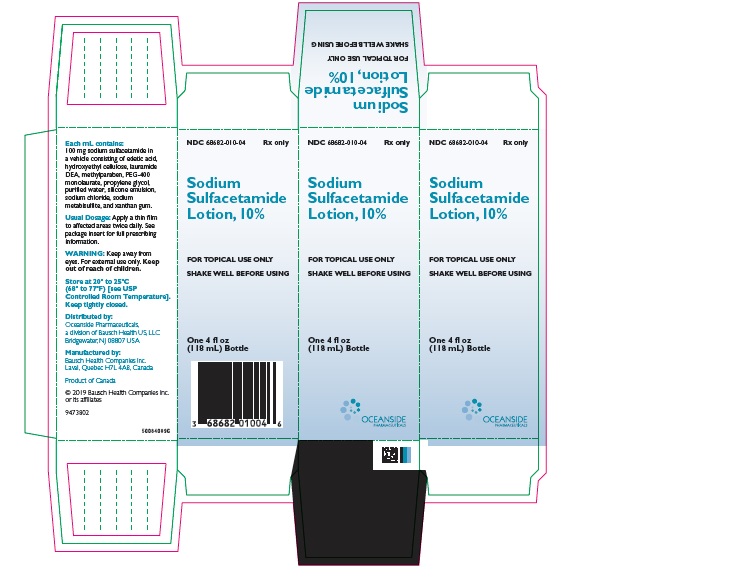
Sodium sulfacetamide 100 mg/mL Lotion — NDC 68682-010-04 (Billing 68682-0010-04)
This is a package of Sodium sulfacetamide 100 mg/mL Lotion from Oceanside Pharmaceuticals, marketed since Dec 2015 and currently FDA-listed; retail pharmacies pay about $0.5859 per mL (NADAC). It is this product's only package size.
NDC database record
One package, one record: these facts belong to NDC 68682-010-04 alone.
- Record
- FDA NDC Directory package listing · Human prescription drug
- Code segments
- 68682 labeler · 010 product · 04 package
- Package marketed since
- Dec 18, 2015
- Sample package
- No — commercial package
- Listing certified through
- Dec 31, 2026
- Barcode (UPC-A, from the NDC)
- 3 6868201004 6
- Medicaid fills, this package
- 2,294 prescriptions in the last four reported quarters
- FDA record last changed
- Jul 24, 2026
Identity & classification
Regulatory identifiers FDA, NLM and CMS codes for this package
Drug-database identifiers Medi-Span GPI and First Databank GCN / HICL / AHFS classification
- GSN (GCN sequence number): 041745
- GCN: 94446
- GPI-14 (Medi-Span): 90051036104120
- HICL (First Databank): 003345
- AHFS class code: 84:04.92.00
- RxCUI (RxNorm): 1006688
Where does this data come from?
- FDA openFDA NDC Directory · synced Oct 8, 2026
- FDA label on DailyMed · label index refreshed Oct 8, 2026
- RxNorm (NLM RxNav) · catalog refreshed Oct 1, 2026
- Medi-Span GPI (licensed)
- First Databank (licensed) · refreshed Oct 8, 2026
RxNorm drug class
This medicine belongs to the Sulfonamide Antibacterial class.
Where does this data come from?
- RxClass (NLM) · catalog refreshed Oct 1, 2026
Clinical
Patient education
Supplement & herbal interactions
Some supplements/herbs that may interact with sodium sulfacetamide — tap one for details:
Where does this data come from?
- MedlinePlus (NLM) · refreshed Oct 8, 2026
- FDA label on DailyMed · label index refreshed Oct 8, 2026
Ask a licensed pharmacist directly — free, answered by our team.
Pricing
A drug doesn't have one price. Each row is a different public payment system, and none is what you'd pay at the counter — that depends on your insurance. The ⓘ on each row explains what it measures.
| Price system | Per mL | Per package |
|---|---|---|
| Retail pharmacies payNADAC · weekly | $0.586 | $69.14 / 118 ml |
| Medicaid paysCMS SDUD · 12 mo | $0.6628 | $78.21 / 118 ml |
| Medicare drug plans payPart D · Q2 2026 | $0.8429 | $99.46 / 118 ml |
Where does this data come from?
- CMS NADAC weekly file · file of Feb 21, 2024
- CMS ASP pricing files · refreshed Sep 20, 2026
- CMS Medicaid State Drug Utilization Data · through Q4 2025
- CMS Part D plan pricing files · refreshed Sep 24, 2026
- VA National Acquisition Center price file
Packaging — all sizes for this product
| Package NDC | Description | Marketing start | Marketing end | Status |
|---|---|---|---|---|
| 68682-0010-04 You're viewing this Main listing | 1 BOTTLE, PLASTIC in 1 CARTON / 118 mL in 1 BOTTLE, PLASTIC | 2015-12-18 | — | Active |
Therapeutic equivalents
| Product | Labeler | Pack | NADAC/unit | TE | Status | Price vs. this |
|---|---|---|---|---|---|---|
| Sulfacetamide Sodium 100 mg/mL 45802-0896-26 | Padagis | 118 ml | $0.515 | AB | Availability likely | save 12% |
| Sodium sulfacetamide 100 mg/mLthis 68682-0010-04 | Oceanside | 1 bottle | $0.586 | AB | FDA listed | — |
| Klaron 100 mg/mL 00187-5198-04 | Bausch | 1 bottle | — | AB | FDA listed | — |
| Sodium Sulfacetamide 100 mg/mL 16477-0411-08 | Laser | 1 bottle | — | — | FDA listed | — |
| Sodium Sulfacetamide 100 mg/mL 71399-1599-08 | Akron | 237 ml | — | — | FDA listed | — |
| Sodium Sulfacetamide 100 mg/mL 44523-0510-08 | BioComp | 237 ml | — | — | FDA listed | — |
Where does this data come from?
- FDA openFDA NDC Directory · synced Oct 8, 2026
- FDA Orange Book · refreshed Oct 3, 2026
- CMS NADAC weekly file · file of Feb 21, 2024
Availability & generic status
The FDA lists approved generic versions of this medicine, but that does not always mean a pharmacy can get one today. Patent rules, launch agreements, supply and pricing can affect when generics actually arrive.
Where does this data come from?
- FDA Orange Book · refreshed Oct 3, 2026
Inactive Ingredients / Excipients
Inactive ingredients, also called excipients, are components of the drug product other than the active ingredient. They may include fillers, dyes, coatings, preservatives, flavors, or other formulation ingredients.
Where does this data come from?
IACT rows and label-wide narrative are kept separate; availability and product-level specificity depend on the submitted label.- FDA label on DailyMed · label index refreshed Oct 8, 2026
- FDA openFDA NDC Directory · synced Oct 8, 2026
Inactive ingredient FAQ
Are inactive ingredients the same for every manufacturer?
Why might an inactive ingredient be missing?
Can inactive ingredients matter?
Manufacturer & labeler
More NDCs from Oceanside Pharmaceuticals labeler code 68682
- Diltiazem Hydrochloride 30 mg Tablet NDC 68682-006-10
- Diltiazem Hydrochloride 60 mg Tablet NDC 68682-007-10
- Diltiazem Hydrochloride 90 mg Tablet NDC 68682-008-10
- Diltiazem Hydrochloride 120 mg Tablet NDC 68682-009-10
- ethacrynic acid 25 mg Tablet NDC 68682-011-10
- Metformin hydrochloride 1000 mg Tablet, Film Coated, Extended Release NDC 68682-018-90
- Ribavirin 6 g Powder, For Solution NDC 68682-019-01
- Metformin hydrochloride 500 mg Tablet, Film Coated, Extended Release NDC 68682-021-50
- Timolol Maleate 5 mg/mL Solution/ Drops NDC 68682-045-25
- Omeprazole and Sodium Bicarbonate 20 mg; 1100 mg Capsule NDC 68682-102-30
Where does this data come from?
- FDA openFDA NDC Directory · synced Oct 8, 2026
- Drugs@FDA
Full prescribing information FDA SPL
🎯 Indications and Usage ▾
INDICATIONS Sodium Sulfacetamide Lotion is indicated in the topical treatment of acne vulgaris .
⏱️ Dosage and Administration ▾
DOSAGE AND ADMINISTRATION Apply a thin film to affected areas twice daily.
⛔ Contraindications ▾
CONTRAINDICATIONS Sodium Sulfacetamide Lotion is contraindicated for use by patients having known hypersensitivity to sulfonamides or any other component of this preparation (see WARNINGS ).
⚠️ Warnings ▾
WARNINGS Fatalities have occurred, although rarely, due to severe reactions to sulfonamides including Stevens-Johnson syndrome, toxic epidermal necrolysis, fulminant hepatic necrosis, agranulocytosis, aplastic anemia, and other blood dyscrasias. Hypersensitivity reactions may occur when a sulfonamide is readministered, irrespective of the route of administration. Sensitivity reactions have been reported in individuals with no prior history of sulfonamide hypersensitivity.
At the first sign of hypersensitivity, skin rash, or other reactions, discontinue use of this preparation (see ADVERSE REACTIONS ). Sodium Sulfacetamide Lotion contains sodium metabisulfite, a sulfite that may cause allergic-type reactions including anaphylactic symptoms and life-threatening or less severe asthmatic episodes in certain susceptible people. The overall prevalence of sulfite sensitivity in the general population is unknown and probably low.
Sulfite sensitivity is seen more frequently in asthmatic than in non-asthmatic people (see CONTRAINDICATIONS ).
🤒 Adverse Reactions ▾
ADVERSE REACTIONS In controlled clinical trials for the management of acne vulgaris , the occurrence of adverse reactions associated with the use of Sodium Sulfacetamide Lotion was infrequent and restricted to local events. The total incidence of adverse reactions reported in these studies was less than 2%. Only one of 105 patients treated with Sodium Sulfacetamide Lotion had adverse reactions of erythema, itching, and edema.
It has been reported that sodium sulfacetamide may cause local irritation, stinging, and burning. While the irritation may be transient, occasionally the use of medication has to be discontinued. To report SUSPECTED ADVERSE REACTIONS, contact Oceanside Pharmaceuticals at 1-800-321-4576 or FDA at 1-800-FDA-1088 or www.fda.gov/medwatch.
🤰 Pregnancy ▾
Animal reproduction studies have not been conducted with Sodium Sulfacetamide Lotion. It is also not known whether Sodium Sulfacetamide Lotion can cause fetal harm when administered to a pregnant woman or can affect reproduction capacity. Sodium Sulfacetamide Lotion should be given to a pregnant woman only if clearly needed.
Kernicterus may occur in the newborn as a result of treatment of a pregnant woman at term with orally administered sulfonamide. There are no adequate and well-controlled studies of Sodium Sulfacetamide Lotion in pregnant women, and it is not known whether topically applied sulfonamides can cause fetal harm when administered to a pregnant woman.
🧒 Pediatric Use ▾
Pediatric Use Safety and effectiveness in pediatric patients under the age of 12 have not been established.
🧬 Clinical Pharmacology ▾
CLINICAL PHARMACOLOGY The most widely accepted mechanism of action of sulfonamides is the Woods-Fildes theory, based on sulfonamides acting as a competitive inhibitor of para-aminobenzoic acid (PABA) utilization, an essential component for bacterial growth. While absorption through intact skin in humans has not been determined, in vitro studies with human cadaver skin indicated a percutaneous absorption of about 4%. Sodium sulfacetamide is readily absorbed from the gastrointestinal tract when taken orally and excreted in the urine largely unchanged.
The biological half-life has been reported to be between 7 to 13 hours. The pharmacokinetics of sulfacetamide and its major metabolite sulfaniliamide in Sodium Sulfacetamide Lotion was evaluated in adult subjects (N=14) with acne vulgaris . The subjects applied Sodium Sulfacetamide Lotion to their face, back, chest, and shoulders every 12 hours for 28 days.
The percentage of the applied dose of Sodium Sulfacetamide Lotion excreted in the urine as sulfacetamide plus sulfanilamide ranged from 0.08 to 0.33%.
📦 How Supplied / Storage and Handling ▾
HOW SUPPLIED 4 fl oz (118 mL) Bottles NDC 68682-010-04 Store at 20° to 25°C (68° to 77°F) [see USP Controlled Room Temperature]. Shake well before using. Keep tightly closed.
📋 Description ▾
DESCRIPTION Each mL of Sodium Sulfacetamide Lotion, 10% contains 100 mg of sodium sulfacetamide in a vehicle consisting of edetic acid, hydroxyethyl cellulose, lauramide DEA, methylparaben, PEG-400 monolaurate, propylene glycol, purified water, silicone emulsion, sodium chloride, sodium metabisulfite, and xanthan gum. Sodium sulfacetamide is a sulfonamide with antibacterial activity. Chemically, sodium sulfacetamide is N' -[(4-amino phenyl) sulfonyl] - acetamide, monosodium salt, monohydrate.
The structural formula is: Chemical Structure
⚠️ Precautions ▾
PRECAUTIONS General For external use only. Keep away from eyes. If irritation develops, use of the product should be discontinued and appropriate therapy instituted.
Patients should be carefully observed for possible local irritation or sensitization during long-term therapy. Hypersensitivity reactions may occur when a sulfonamide is readministered irrespective of the route of administration, and cross-sensitivity between different sulfonamides may occur. Sodium sulfacetamide can cause reddening and scaling of the skin.
Particular caution should be employed if areas of involved skin to be treated are denuded or abraded. Keep out of reach of children. Carcinogenesis, Mutagenesis, Impairment of Fertility Long-term studies in animals have not been performed to evaluate carcinogenic potential.
Animal reproduction studies have not been conducted with Sodium Sulfacetamide Lotion. It is also not known whether Sodium Sulfacetamide Lotion can cause fetal harm when administered to a pregnant woman or can affect reproduction capacity. Sodium Sulfacetamide Lotion should be given to a pregnant woman only if clearly needed.
Kernicterus may occur in the newborn as a result of treatment of a pregnant woman at term with orally administered sulfonamide. There are no adequate and well-controlled studies of Sodium Sulfacetamide Lotion in pregnant women, and it is not known whether topically applied sulfonamides can cause fetal harm when administered to a pregnant woman. Nursing Mothers It is not known whether sodium sulfacetamide is excreted in human milk following topical use of Sodium Sulfacetamide Lotion.
Systemically administered sulfonamides are capable of producing kernicterus in the infants of lactating women. Small amounts of orally administered sulfonamides have been reported to be eliminated in human milk. Because many drugs are excreted in human milk, caution should be exercised in prescribing for nursing women.
Pediatric Use Safety and effectiveness in pediatric patients under the age of 12 have not been established.
🍼 Nursing Mothers ▾
Nursing Mothers It is not known whether sodium sulfacetamide is excreted in human milk following topical use of Sodium Sulfacetamide Lotion. Systemically administered sulfonamides are capable of producing kernicterus in the infants of lactating women. Small amounts of orally administered sulfonamides have been reported to be eliminated in human milk.
Because many drugs are excreted in human milk, caution should be exercised in prescribing for nursing women.
🧬 Pharmacokinetics ▾
The pharmacokinetics of sulfacetamide and its major metabolite sulfaniliamide in Sodium Sulfacetamide Lotion was evaluated in adult subjects (N=14) with acne vulgaris . The subjects applied Sodium Sulfacetamide Lotion to their face, back, chest, and shoulders every 12 hours for 28 days. The percentage of the applied dose of Sodium Sulfacetamide Lotion excreted in the urine as sulfacetamide plus sulfanilamide ranged from 0.08 to 0.33%.
📄 Carcinogenesis, Mutagenesis, Impairment of Fertility ▾
Carcinogenesis, Mutagenesis, Impairment of Fertility Long-term studies in animals have not been performed to evaluate carcinogenic potential.
📄 Package Label / Principal Display Panel ▾
PRINCIPAL DISPLAY PANEL - 118 mL Bottle Carton NDC 68682-010-04 Rx only Sodium Sulfacetamide Lotion, 10% FOR TOPICAL USE ONLY SHAKE WELL BEFORE USING One 4 fl oz (118 mL) Bottle OCEANSIDE PHARMACEUTICALS carton.jpg