
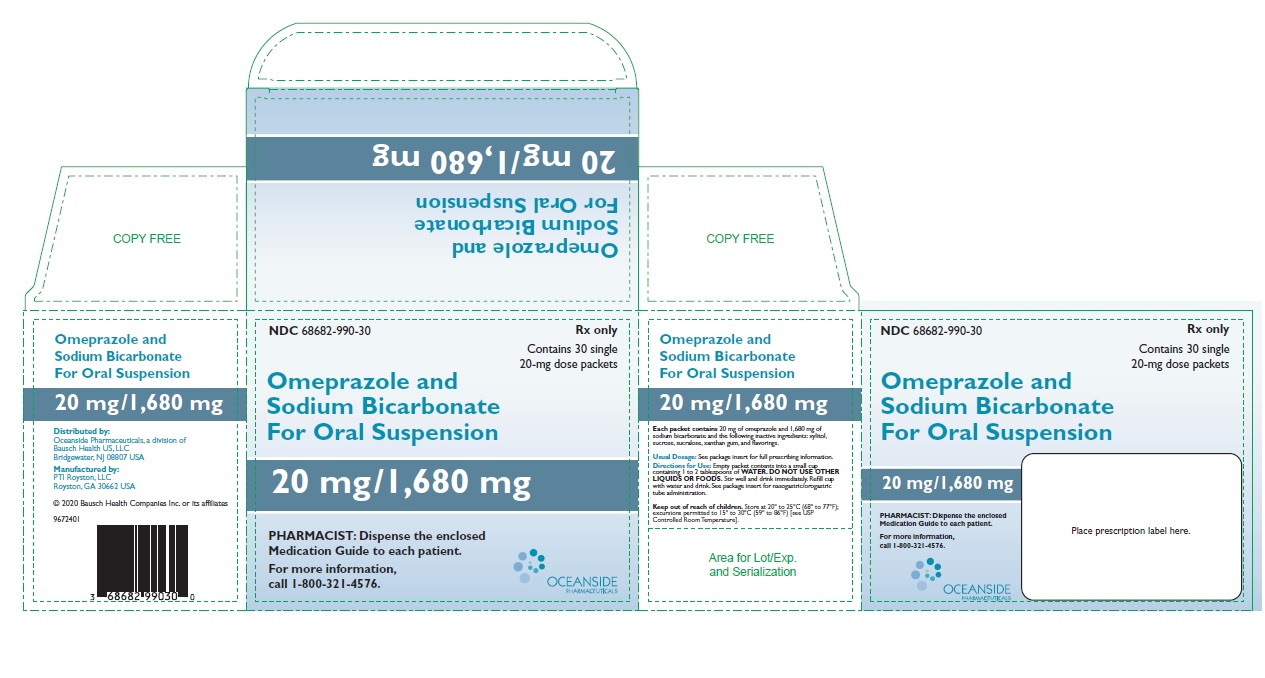
Omeprazole and Sodium Bicarbonate 20 mg; 1680 mg Powder, For Suspension, 30 packets — NDC 68682-990-30 (Billing 68682-0990-30)
This is a package of 30 packets of Omeprazole and Sodium Bicarbonate 20 mg; 1680 mg Powder, For Suspension from Oceanside Pharmaceuticals, no longer marketed (first marketed Jun 2004), no longer in the FDA NDC Directory, this package's marketing ended Aug 2026. It is this product's only package size.
NDC database record
One package, one record: these facts belong to NDC 68682-990-30 alone.
- Record
- FDA NDC Directory package listing · Human prescription drug
- Code segments
- 68682 labeler · 990 product · 30 package
- Package marketed since
- Jun 15, 2004
- Package marketing ended
- Aug 31, 2026
- Sample package
- No — commercial package
- Billing quantity
- 30 EA per package
- Barcode (UPC)
- 0368682102307, 0368682104301
- Medicaid fills, this package
- 12 prescriptions in the last four reported quarters
- FDA record last changed
- Aug 27, 2026
Past resolved recalls for this product (1)
Identity & classification
Regulatory identifiers FDA, NLM and CMS codes for this package
Drug-database identifiers Medi-Span GPI and First Databank GCN / HICL / AHFS classification
- GSN (GCN sequence number): 060473
- GCN: 26634
- GPI-14 (Medi-Span): 49996002603020
- HICL (First Databank): 033512
- AHFS class code: 56:28.36.00
- RxCUI (RxNorm): 616539
Where does this data come from?
- FDA openFDA NDC Directory · synced Oct 8, 2026
- FDA label on DailyMed · label index refreshed Oct 6, 2026
- RxNorm (NLM RxNav) · catalog refreshed Oct 1, 2026
- Medi-Span GPI (licensed)
- First Databank (licensed) · refreshed Oct 8, 2026
RxNorm drug class
This medicine belongs to the Salt solutions class.
Where does this data come from?
- RxClass (NLM) · catalog refreshed Oct 1, 2026
Clinical
Prescription omeprazole is used alone or with other medications to treat the symptoms of gastroesophageal reflux disease (GERD), a condition in which backward flow of acid from the stomach causes heartburn and possible injury of the esophagus (the tube between the throat and stomach) in adults and children 1 year of age and older. Prescription omeprazole is used to treat damage from GERD in adults and children 1 month of age and older. Prescription omeprazole is used to allow the esophagus to heal and prevent further damage to the esophagus in adults and children 1 year of age and older with G...
Read the full MedlinePlus article ↗- It lowers stomach acid. Prescription versions treat ulcers, GERD and erosive esophagitis, and over-the-counter versions treat frequent heartburn in adults. Zegerid oral suspension...
- Take it once a day, at least 1 hour before eating, usually in the morning. Swallow capsules whole with water and don’t chew, crush or open them. If you use the powder, mix it in 2...
- Use it for 14 days. You can repeat a course every 4 months if needed. If you need it longer or more often, talk to a doctor first.
- How long can I use the over-the-counter version?
Patient education
Supplement & herbal interactions
Some supplements/herbs that may interact with Omeprazole, Sodium Bicarbonate — tap one for details:
Omeprazole, Sodium Bicarbonate may be associated with lower levels of 9 nutrients — worth a chat with your pharmacist, not a cause for alarm.
Where does this data come from?
- MedlinePlus (NLM) · refreshed Oct 1, 2026
- FDA label on DailyMed · label index refreshed Oct 6, 2026
Ask a licensed pharmacist directly — free, answered by our team.
Pricing
A drug doesn't have one price. Each row is a different public payment system, and none is what you'd pay at the counter — that depends on your insurance. The ⓘ on each row explains what it measures.
| Price system | Per mL | Per package |
|---|---|---|
| Retail pharmacies payNADAC · weekly | Not in the retail survey — common for institutional, discontinued, or low-volume packs. | |
| Medicaid paysCMS SDUD · 12 mo | $10.34 | — |
| Medicare drug plans payPart D · quarterly | No Part D plan price is available for this NDC in our data. | |
Where does this data come from?
- CMS NADAC weekly file
- CMS ASP pricing files · refreshed Sep 20, 2026
- CMS Medicaid State Drug Utilization Data · through Q3 2025
- CMS Part D plan pricing files · refreshed Sep 24, 2026
- VA National Acquisition Center price file
Packaging — all sizes for this product
| Package NDC | Description | Marketing start | Marketing end | Status |
|---|---|---|---|---|
| 68682-0990-30 You're viewing this Main listing | 30 PACKET in 1 CARTON / 1 POWDER, FOR SUSPENSION in 1 PACKET | 2004-06-15 | Aug 31, 2026 | Discontinued by firm |
Therapeutic equivalents
| Product | Labeler | Pack | NADAC/unit | TE | Status | Price vs. this |
|---|---|---|---|---|---|---|
| Omeprazole and Sodium Bicarbonate 20 mg/1; 1680 mg 27241-0029-31 | Ajanta | 30 fors | $8.113 | AB | Availability likely | — |
| Omeprazole/Sodium Bicarbonate 20 mg/1700mg; 1680 mg/1700mg 64380-0182-02 | Strides | 30 pouches | $8.113 | AB | Availability likely | — |
| Omeprazole and Sodium Bicarbonate 20 mg/1; 1680 mg 70954-0797-20 | ANI | 30 packets | $8.113 | AB | Availability likely | — |
| Omeprazole and Sodium Bicarbonate 20 mg/1; 1680 mg 43598-0010-01 | Dr. | 1 packet | — | — | FDA listed | — |
| Omeprazole and Sodium Bicarbonate 20 mg/1; 1680 mg 43598-0307-01 | Dr. | 1 packet | — | — | FDA listed | — |
| Omeprazole and Sodium Bicarbonate 20 mg/1; 1680 mgthis 68682-0990-30 | Oceanside | 30 packets | — | — | Discontinued | — |
| Omeprazole and Sodium Bicarbonate 20 mg/1; 1680 mg 72162-1906-03 | Bryant | 30 packets | — | — | Discontinued | — |
| Omeprazole and Sodium Bicarbonate 20 mg/1; 1680 mg 75907-0138-42 | Dr. | 42 packets | — | — | FDA listed | — |
| Acid Reducer Powder 20 mg/1; 1680 mg 75907-0237-14 | Dr. | 14 packets | — | — | FDA listed | — |
Where does this data come from?
- FDA openFDA NDC Directory · synced Oct 8, 2026
- FDA Orange Book · refreshed Oct 3, 2026
- CMS NADAC weekly file
Availability & generic status
We did not find an FDA-approved generic match for this exact strength, form and route.
Where does this data come from?
- FDA Orange Book · refreshed Oct 3, 2026
What it looks like
Where does this data come from?
- FDA label on DailyMed · label index refreshed Oct 6, 2026
Inactive Ingredients / Excipients
Inactive ingredients, also called excipients, are components of the drug product other than the active ingredient. They may include fillers, dyes, coatings, preservatives, flavors, or other formulation ingredients.
🧪 Avoiding an ingredient? See Omeprazole / Sodium Bicarbonate inactive ingredients by manufacturer: every current product's list side by side, so you can ask your pharmacy for the version that does not list it.
Where does this data come from?
IACT rows and label-wide narrative are kept separate; availability and product-level specificity depend on the submitted label.- FDA label on DailyMed · label index refreshed Oct 6, 2026
- FDA openFDA NDC Directory · synced Oct 8, 2026
Inactive ingredient FAQ
Are inactive ingredients the same for every manufacturer?
Why might an inactive ingredient be missing?
Can inactive ingredients matter?
Manufacturer & labeler
More NDCs from Oceanside Pharmaceuticals labeler code 68682
- Tretinoin .05 g/100g Gel NDC 68682-800-45
- Luliconazole 10 mg/g Cream NDC 68682-850-60
- Erythromycin and Benzoyl Peroxide Kit NDC 68682-900-23
- Erythromycin and Benzoyl Peroxide Kit NDC 68682-901-46
- Tetracaine Hydrochloride 5 mg/mL Solution/ Drops NDC 68682-920-05
- Tolcapone 100 mg Tablet, Film Coated NDC 68682-938-90
- Diltiazem Hydrochloride 120 mg Capsule, Extended Release NDC 68682-993-98
- Diltiazem Hydrochloride 180 mg Capsule, Extended Release NDC 68682-994-98
- Diltiazem Hydrochloride 240 mg Capsule, Extended Release NDC 68682-997-98
- Diltiazem Hydrochloride 300 mg Capsule, Extended Release NDC 68682-998-98
Where does this data come from?
- FDA openFDA NDC Directory · synced Oct 8, 2026
- Drugs@FDA
Full prescribing information FDA SPL
🎯 Indications and Usage ▾
1 INDICATIONS AND USAGE Omeprazole and Sodium Bicarbonate for oral suspension and Omeprazole and Sodium Bicarbonate capsules are indicated in adults for the : short-term treatment of active duodenal ulcer. Most patients heal within four weeks. Some patients may require an additional four weeks of therapy. short-term treatment (4 to 8 weeks) of active benign gastric ulcer. treatment of heartburn and other symptoms associated with GERD for up to 4 weeks. short-term treatment (4 to 8 weeks) of EE due to acid-mediated GERD which has been diagnosed by endoscopy in adults.
The efficacy of Omeprazole and Sodium Bicarbonate used for longer than 8 weeks in patients with EE has not been established. If a patient does not respond to 8 weeks of treatment, an additional 4 weeks of treatment may be given. If there is recurrence of EE or GERD symptoms (e.g., heartburn), additional 4 to 8-week courses of Omeprazole and Sodium Bicarbonate may be considered. maintenance of healing of EE due to acid-mediated GERD.
Controlled studies do not extend beyond 12 months. Omeprazole and Sodium Bicarbonate for oral suspension is indicated in adults for the : reduction of risk of upper GI bleeding in critically ill adult patients. Omeprazole and Sodium Bicarbonate is a proton pump inhibitor (PPI).
Omeprazole and Sodium Bicarbonate for oral suspension and Omeprazole and Sodium Bicarbonate capsules are indicated in adults for: Treatment of active duodenal ulcer ( 1 ) Treatment of active benign gastric ulcer ( 1 ) Treatment of erosive esophagitis (EE) due to acid-mediated gastroesophageal reflux disease (GERD) ( 1 ) Maintenance of healing of EE ( 1 ) Omeprazole and Sodium Bicarbonate for oral suspension is indicated in adults for: Reduction of risk of upper gastrointestinal (GI) bleeding in critically ill patients ( 1 )
⏱️ Dosage and Administration ▾
2 DOSAGE AND ADMINISTRATION Indication ( 2 ) Recommended Adult Dosage ( 2 ) Omeprazole and Sodium Bicarbonate for oral suspension or Omeprazole and Sodium Bicarbonate capsules ( 2 ) Active Duodenal Ulcer ( 2 ) 20 mg once daily for 4 weeks; some patients may require an additional 4 weeks ( 2 ) Active Benign Gastric Ulcer ( 2 ) 40 mg once daily for 4 to 8 weeks ( 2 ) Treatment of Symptomatic GERD ( 2 ) 20 mg once daily for up to 4 weeks ( 2 ) Treatment of EE due to Acid-Mediated GERD 20 mg once daily for 4 to 8 weeks* ( 2 ) Maintenance of Healing of EE due to Acid-Mediated GERD ( 2 ) 20 mg once daily** ( 2 ) 40 mg Omeprazole and Sodium Bicarbonate for oral suspension ( 2 ) Reduction of Risk of Upper GI Bleeding in Critically Ill Patients ( 2 ) 40 mg initially followed by 40 mg 6 to 8 hours later and 40 mg once daily thereafter for 14 days ( 2 ) *an additional 4 weeks of treatment may be given if no response; if recurrence, additional 4 to 8-week courses may be considered.
( 2 ) **studied for 12 months. ( 2 )
2.1Important Administration Instructions Omeprazole and Sodium Bicarbonate is available as a capsule and as a powder for oral suspension in 20 mg and 40 mg strengths of omeprazole for adult use. All recommended doses throughout the labeling are based upon omeprazole. The sodium content of Omeprazole and Sodium Bicarbonate capsules and Omeprazole and Sodium Bicarbonate for oral suspension should be taken into consideration when prescribing this product [see Warnings and Precautions (5.3) ] : Omeprazole and Sodium Bicarbonate capsule: each 20 mg and 40 mg capsule contains 1,100 mg (13 mEq) of sodium bicarbonate.
The total content of sodium in each capsule is 304 mg. Omeprazole and Sodium Bicarbonate for oral suspension: each 20 mg and 40 mg packet of contains 1,680 mg (20 mEq) of sodium bicarbonate. The total content of sodium in each packet is 460 mg.
Due to the sodium bicarbonate content of Omeprazole and Sodium Bicarbonate: Do not substitute two packets of 20 mg Omeprazole and Sodium Bicarbonate for oral suspension with one packet of 40 mg Omeprazole and Sodium Bicarbonate for oral suspension. Do not substitute two 20 mg Omeprazole and Sodium Bicarbonate capsules with one 40 mg Omeprazole and Sodium Bicarbonate capsule.
2.2Dosage Regimen The recommended dosage regimen by indication in adults of Omeprazole and Sodium Bicarbonate for oral suspension and Omeprazole and Sodium Bicarbonate capsules is summarized in Table 1 . Only 40 mg Omeprazole and Sodium Bicarbonate for oral suspension is indicated for the reduction of risk of upper GI bleeding in critically ill adult patients and the dosage regimen is summarized in Table 2 . All recommended dosages are based upon omeprazole content.
Table 1: Recommended Dosage Regimen of Omeprazole and Sodium Bicarbonate for Oral Suspension and Omeprazole and Sodium Bicarbonate Capsules in Adults by Indication Indication Dosage of Omeprazole and Sodium Bicarbonate for oral suspension or Omeprazole and Sodium Bicarbonate capsules Treatment Duration Treatment of Active Duodenal Ulcer 20 mg once daily 4 weeks *† Treatment of Active Benign Gastric Ulcer 40 mg once daily 4 to 8 weeks Treatment of Symptomatic GERD 20 mg once daily Up to 4 weeks Treatment of EE due to Acid-Mediated GERD 20 mg once daily 4 to 8 weeks † Maintenance of Healing of EE due to Acid-Mediated GERD 20 mg once daily Controlled studies do not extend beyond 12 months.
Table 2: Recommended Dosage Regimen of 40 mg Omeprazole and Sodium Bicarbonate for Oral Suspension in Adults by Indication Indication Dosage of 40 mg Omeprazole and Sodium Bicarbonate for oral suspension Treatment Duration Reduction of Risk of Upper GI Bleeding in Critically Ill Patients 40 mg initially; followed by 40 mg 6 to 8 hours later; and 40 mg once daily thereafter 14 days
2.3Preparation and Administration Omeprazole and Sodium Bicarbonate Capsules Swallow capsules intact with water. Do not open the capsule and do not administer with liquids other than… [Excerpted — this section continues on DailyMed.]
💊 Dosage Forms and Strengths ▾
3 DOSAGE FORMS AND STRENGTHS Omeprazole and Sodium Bicarbonate is available as: Capsules 20 mg: Each opaque, hard gelatin, white capsule, imprinted with the Santarus logo and “20”, contains 20 mg omeprazole and 1,100 mg sodium bicarbonate. 40 mg: Each opaque, hard gelatin, colored dark blue and white capsule, imprinted with the Santarus logo and “40”, contains 40 mg omeprazole and 1,100 mg sodium bicarbonate. For Oral Suspension 20 mg: white, flavored powder packaged in unit-dose packets.
Each packet contains 20 mg omeprazole and 1,680 mg sodium bicarbonate. 40 mg: white, flavored powder packaged in unit-dose packets. Each packet contains 40 mg omeprazole and 1,680 mg sodium bicarbonate.
For Capsules ( 3 ) : 20 mg omeprazole and 1,100 mg sodium bicarbonate 40 mg omeprazole and 1,100 mg sodium bicarbonate For Oral Suspension ( 3 ) : 20 mg omeprazole and 1,680 mg sodium bicarbonate in unit-dose packets 40 mg omeprazole and 1,680 mg sodium bicarbonate in unit-dose packets
⛔ Contraindications ▾
4 CONTRAINDICATIONS Omeprazole and Sodium Bicarbonate is contraindicated in patients with known hypersensitivity to substituted benzimidazoles or to any component of the formulation. Hypersensitivity reactions may include anaphylaxis, anaphylactic shock, angioedema, bronchospasm, acute tubulointerstitial nephritis, and urticaria [see Warnings and Precautions (5.2) Error! Hyperlink reference not valid.
Adverse Reactions (6.2)] . Proton pump inhibitors (PPIs), including Omeprazole and Sodium Bicarbonate, are contraindicated in patients receiving rilpivirine containing products [see Drug Interactions (7) ] . Known hypersensitivity to any components of the formulation ( 4 ) Patients receiving rilpivirine-containing products ( 4 , 7 )
⚠️ Warnings and Cautions ▾
5 WARNINGS AND PRECAUTIONS Gastric Malignancy : In adults, symptomatic response does not preclude the presence of gastric malignancy. Consider additional follow-up and diagnostic testing. ( 5.1 ) Acute Tubulointerstitial Nephritis: Discontinue treatment and evaluate patients.
( 5.2 ) Sodium Bicarbonate Buffer Content : Take sodium content into consideration in patients on a sodium-restricted diet. Avoid in patients with Bartter’s syndrome, hypokalemia, hypocalcemia, and problems with acid-base balance. ( 5.3 ) Clostridium difficile -Associated Diarrhea : PPI therapy may be associated with increased risk.
( 5.4 ) Bone Fracture : Long-term and multiple daily dose PPI therapy may be associated with an increased risk for osteoporosis-related fractures of the hip, wrist, or spine. ( 5.5 ) Severe Cutaneous Adverse Reactions: Discontinue at the first signs or symptoms of severe cutaneous adverse reactions or other signs of hypersensitivity and consider further evaluation. ( 5.6 ) Cutaneous and Systemic Lupus Erythematosus : Mostly cutaneous; new onset or exacerbation of existing disease; discontinue Omeprazole and Sodium Bicarbonate and refer to specialist for evaluation.
( 5.7 ) Interaction with Clopidogrel : Avoid concomitant use of Omeprazole and Sodium Bicarbonate. ( 5.8 ) Cyanocobalamin (Vitamin B-12) Deficiency : Daily long-term use (e.g., longer than 3 years) may lead to malabsorption or a deficiency of cyanocobalamin. ( 5.9 ) Hypomagnesemia and Mineral Metabolism : Reported rarely with prolonged treatment with PPIs.
( 5.10 ) Interaction with St. John’s wort or Rifampin : Avoid concomitant use of Omeprazole and Sodium Bicarbonate. ( 5.11 , 7 ) Interactions with Diagnostic Investigations for Neuroendocrine Tumors : Increased Chromogranin A (CgA) levels may interfere with diagnostic investigations for neuroendocrine tumors; temporarily stop Omeprazole and Sodium Bicarbonate at least 14 days before assessing CgA levels.
( 5.12 ) Interaction with Methotrexate : Concomitant use with PPIs may elevate and/or prolong serum concentrations of methotrexate and/or its metabolite, possibly leading to toxicity. With high dose methotrexate administration, consider a temporary withdrawal of Omeprazole and Sodium Bicarbonate. ( 5.13 , 7 ) Fundic Gland Polyps : Risk increases with long-term use, especially beyond one year.
Use the shortest duration of therapy. ( 5.14 )
5.1Presence of Gastric Malignancy In adults, symptomatic response to therapy with Omeprazole and Sodium Bicarbonate does not preclude the presence of gastric malignancy. Consider additional follow-up and diagnostic testing in adult patients who have a suboptimal response or an early symptomatic relapse after completing treatment with a proton pump inhibitor (PPI). In older patients, also consider an endoscopy.
5.2Acute Tubulointerstitial Nephritis Acute tubulointerstitial nephritis (TIN) has been observed in patients taking PPIs and may occur at any point during PPI therapy. Patients may present with varying signs and symptoms from symptomatic hypersensitivity reactions to non-specific symptoms of decreased renal function (e.g., malaise, nausea and anorexia). In reported case series, some patients were diagnosed on biopsy and in the absence of extra-renal manifestations (e.g., fever, rash or arthralgia).
Discontinue Omeprazole and Sodium Bicarbonate and evaluate patients with suspected acute TIN [ see Contraindications (4) ].
5.3Sodium Bicarbonate Buffer Content Each 20 mg and 40 mg Omeprazole and Sodium Bicarbonate capsule contains 1,100 mg (13 mEq) of sodium bicarbonate. The total content of sodium in each capsule is 304 mg. Each 20 mg and 40 mg packet of Omeprazole and Sodium Bicarbonate for oral suspension contains 1,680 mg (20 mEq) of sodium bicarbonate.
The total content of sodium in each packet is 460 mg. Chronic administration of bicarbonate with calcium or milk can cause milk-alkali syndrome. Chronic use of sodium bicarbonate may lead to systemic alkalosis, and increa… [Excerpted — this section continues on DailyMed.]
🤒 Adverse Reactions ▾
6 ADVERSE REACTIONS The following serious adverse reactions are described below and elsewhere in labeling: Acute Tubulointerstitial Nephritis [see Warnings and Precautions (5.2) ] Clostridium difficile -Associated Diarrhea [see Warnings and Precautions (5.4) ] Bone Fracture [see Warnings and Precautions (5.5) ] Severe Cutaneous Adverse Reactions [see Warnings and Precautions (5.6) ] Cutaneous and Systemic Lupus Erythematosus [see Warnings and Precautions (5.7) ] Cyanocobalamin (Vitamin B-12) Deficiency [see Warnings and Precautions (5.9) ] Hypomagnesemia and Mineral Metabolism [see Warnings and Precautions (5.10) ] Fundic Gland Polyps [see Warnings and Precautions (5.14) ] Most common adverse reactions (≥2%) are: headache, abdominal pain, nausea, diarrhea, vomiting, and flatulence.
( 6.1 ) To report SUSPECTED ADVERSE REACTIONS, contact Oceanside Pharmaceuticals at 1-800-321-4576 or FDA at 1-800-FDA-1088 or www.fda.gov/medwatch.
6.1Clinical Trials Experience Because clinical trials are conducted under widely varying conditions, adverse reaction rates observed in the clinical trials of a drug cannot be directly compared to rates in the clinical trials of another drug and may not reflect the rates observed in practice. The safety of Omeprazole and Sodium Bicarbonate has been established, in part, based on oral studies of an oral delayed-release omeprazole product. Clinical Trials with Omeprazole In the U.S. clinical trial population of 465 adult patients, the adverse reactions summarized in Table 3 were reported to occur in 1% or more of patients on therapy with omeprazole.
Table 3: Adverse Reactions Occurring in 1% or More of Adult Patients in US Clinical Trials of Omeprazole Therapy Omeprazole % (n = 465) Placebo % (n = 64) Ranitidine % (n = 195) Headache 7 6 8 Diarrhea 3 3 2 Abdominal Pain 2 3 3 Nausea 2 3 4 Upper Respiratory Infection (URI) 2 2 3 Dizziness 2 0 3 Vomiting 2 5 2 Rash 2 0 0 Constipation 1 0 0 Cough 1 0 2 Asthenia 1 2 2 Back Pain 1 0 1 Table 4 summarizes the adverse reactions that occurred in 1% or more of omeprazole-treated patients from international double-blind and open-label clinical trials in which 2,631 patients and subjects received omeprazole.
Table 4: Adverse Reactions Occurring in 1% or More of Adult Patients in International Clinical Trials of Omeprazole Therapy Omeprazole % (N = 2631) Placebo % (N = 120) Abdominal Pain 5.2
3.3Nausea 4.0
6.7Diarrhea 3.7
2.5Vomiting 3.2
10.0Headache 2.9
2.5Flatulence 2.7
5.8Acid Regurgitation 1.9
3.3Constipation 1.5
0.8Asthenia 1.3
0.8Clinical Trial of 40 mg Omeprazole and Sodium Bicarbonate for Oral Suspension Adverse reactions reported in at least 3% of critically ill adult patients in a clinical trial of 40 mg Omeprazole and Sodium Bicarbonate for oral suspension compared to intravenous cimetidine for up to 14 days are presented in Table 5 . Table 5: Common Adverse Reactions by Body System and Preferred Term in a Randomized Controlled Trial of Critically Ill Adult Patients Treated up to 14 Days Body System Preferred Term Omeprazole and Sodium Bicarbonate 40 mg for oral suspension once daily % (N=178) Intravenous Cimetidine 1,200 mg per day % (N=181) Blood and Lymphatic System Disorders Anemia NOS 7.9
7.7Anemia NOS Aggravated 2.2
3.9Thrombocytopenia 10.1
6.1Cardiac Disorders Atrial Fibrillation 6.2
3.9Bradycardia NOS 3.9
2.8Supraventricular Tachycardia 3.4
1.1Tachycardia NOS 3.4
3.3Ventricular Tachycardia 4.5
3.3Gastrointestinal Disorders Constipation 4.5
4.4Diarrhea NOS 3.9
8.3Gastric Hypomotility 1.7
3.3General Disorders and Administration Site Conditions Hyperpyrexia 4.5
1.7Edema NOS 2.8
6.1Pyrexia 20.2
16.0Infections and Infestations Candidal Infection NOS 1.7
3.9Oral Candidiasis 3.9
0.6Sepsis NOS 5.1
5.0Urinary Tract Infection 2.2
3.3Investigations Liver Function Tests NOS Abnormal 1.7
3.3Metabolism and Nutrition Disorders Fluid Overload 5.1
7.7Hyperglycemia NOS 10.7
11.6Hyperkalemia 2.2
3.3Hypernatremia 1.7
5.0Hypocalcemia 6.2 5… [Excerpted — this section continues on DailyMed.]
🔄 Drug Interactions ▾
7 DRUG INTERACTIONS Tables 6 and 7 include drugs with clinically important drug interactions and interaction with diagnostics when administered concomitantly with omeprazole and instructions for preventing or managing them. Consult the labeling of concomitantly used drugs to obtain further information about interactions with PPIs. Table 6: Clinically Relevant Interactions Affecting Drugs Co-Administered with Omeprazole and Interaction with Diagnostics Antiretrovirals Clinical Impact: The effect of PPIs on antiretroviral drugs is variable.
The clinical importance and the mechanisms behind these interactions are not always known. Decreased exposure of some antiretroviral drugs (e.g., rilpivirine, atazanavir and nelfinavir) when used concomitantly with omeprazole may reduce antiviral effect and promote the development of drug resistance [see Clinical Pharmacology (12.3) ] . Increased exposure of other antiretroviral drugs (e.g., saquinavir) when used concomitantly with omeprazole may increase toxicity [see Clinical Pharmacology (12.3) ] .
There are other antiretroviral drugs which do not result in clinically relevant interactions with omeprazole. Intervention: Rilpivirine-containing products: Concomitant use with Omeprazole and Sodium Bicarbonate is contraindicated [see Contraindications (4) ]. Atazanavir: Avoid concomitant use with Omeprazole and Sodium Bicarbonate.
See prescribing information for atazanavir for dosing information. Nelfinavir: Avoid concomitant use with Omeprazole and Sodium Bicarbonate. See prescribing information for nelfinavir.
Saquinavir: See the prescribing information for saquinavir for monitoring of potential saquinavir-related toxicities. Other antiretrovirals: See prescribing information for specific antiretroviral drugs. Warfarin Clinical Impact: Increased INR and prothrombin time in patients receiving PPIs, including omeprazole, and warfarin concomitantly.
Increases in INR and prothrombin time may lead to abnormal bleeding and even death. Intervention: Monitor INR and prothrombin time and adjust the dose of warfarin, if needed, to maintain target INR range. Methotrexate Clinical Impact: Concomitant use of omeprazole with methotrexate (primarily at high dose) may elevate and prolong serum concentrations of methotrexate and/or its metabolite hydroxymethotrexate, possibly leading to methotrexate toxicities.
No formal drug interaction studies of high-dose methotrexate with PPIs have been conducted [see Warnings and Precautions (5.13) ]. Intervention: A temporary withdrawal of Omeprazole and Sodium Bicarbonate may be considered in some patients receiving high-dose methotrexate. CYP2C19 Substrates (e.g., clopidogrel, citalopram, cilostazol, phenytoin, diazepam) Clopidogrel Clinical Impact: Concomitant use of omeprazole 80 mg results in reduced plasma concentrations of the active metabolite of clopidogrel and a reduction in platelet inhibition [see Clinical Pharmacology (12.3) ].
There are no adequate combination studies of a lower dose of omeprazole or a higher dose of clopidogrel in comparison with the approved dose of clopidogrel . Intervention: Avoid concomitant use with Omeprazole and Sodium Bicarbonate. Consider use of alternative anti-platelet therapy [see Warnings and Precautions (5.8) ].
Citalopram Clinical Impact: Increased exposure of citalopram leading to an increased risk of QT prolongation [see Clinical Pharmacology (12.3) ] . Intervention: Limit the dose of citalopram to a maximum of 20 mg per day. See prescribing information for citalopram.
Cilostazol Clinical Impact: Increased exposure of one of the active metabolites of cilostazol (3,4-dihydro-cilostazol) [see Clinical Pharmacology (12.3) ]. Intervention: Reduce the dose of cilostazol to 50 mg twice daily. See prescribing information for cilostazol.
Phenytoin Clinical Impact: Potential for increased exposure of phenytoin. Intervention: Monitor phenytoin serum concentrations. Dose adjustment may be needed to maintain therapeutic drug concent… [Excerpted — this section continues on DailyMed.]
👥 Use in Specific Populations ▾
8 USE IN SPECIFIC POPULATIONS Hepatic Impairment and Asian Patients : Avoid use for maintenance of healing of erosive esophagitis. ( 8.6 , 8.7 )
8.1Pregnancy Risk Summary There are no adequate and well-controlled studies with Omeprazole and Sodium Bicarbonate in pregnant women. Omeprazole and Sodium Bicarbonate contains omeprazole and sodium bicarbonate. Omeprazole There are no adequate and well-controlled studies with omeprazole in pregnant women.
Available epidemiologic data fail to demonstrate an increased risk of major congenital malformations or other adverse pregnancy outcomes with first trimester omeprazole use. Reproduction studies in rats and rabbits resulted in dose-dependent embryo-lethality at omeprazole doses that were approximately 3.4 to 34 times an oral human dose of 40 mg (based on a body surface area for a 60 kg person). Teratogenicity was not observed in animal reproduction studies with administration of oral esomeprazole (an enantiomer of omeprazole) magnesium in rats and rabbits during organogenesis with doses about 68 times and 42 times, respectively, an oral human dose of 40 mg esomeprazole or 40 mg omeprazole (based on body surface area for a 60 kg person).
Changes in bone morphology were observed in offspring of rats dosed through most of pregnancy and lactation at doses equal to or greater than approximately 34 times an oral human dose of 40 mg esomeprazole or 40 mg omeprazole. When maternal administration was confined to gestation only, there were no effects on bone physeal morphology in the offspring at any age ( see Data ). Sodium Bicarbonate Available data with sodium bicarbonate use in pregnant women are insufficient to identify a drug associated risk of major birth defects or miscarriage.
Published animal studies report that sodium bicarbonate administered to rats, mice or rabbits during pregnancy did not cause adverse developmental effects in offspring. The estimated background risks of major birth defects and miscarriage for the indicated population are unknown. All pregnancies have a background risk of birth defect, loss or other adverse outcomes.
In the U.S. general population, the estimated background risk of major birth defects and miscarriage in clinically recognized pregnancies is 2% to 4% and 15% to 20%, respectively. Data Human Data There are no adequate and well-controlled studies with Omeprazole and Sodium Bicarbonate in pregnant women. Four published epidemiological studies compared the frequency of congenital abnormalities among infants born to women who used omeprazole during pregnancy with the frequency of abnormalities among infants of women exposed to H 2 -receptor antagonists or other controls.
A population-based retrospective cohort epidemiological study from the Swedish Medical Birth Register, covering approximately 99% of pregnancies, from 1995-99, reported on 955 infants (824 exposed during the first trimester with 39 of these exposed beyond first trimester, and 131 exposed after the first trimester) whose mothers used omeprazole during pregnancy. The number of infants exposed in utero to omeprazole that had any malformation, low birth weight, low Apgar score, or hospitalization was similar to the number observed in this population.
The number of infants born with ventricular septal defects and the number of stillborn infants was slightly higher in the omeprazole-exposed infants than the expected number in this population. A population-based retrospective cohort study covering all live births in Denmark from 1996-2009 reported on 1,800 live births whose mothers used omeprazole during the first trimester of pregnancy and 837,317 live births whose mothers did not use any PPI. The overall rate of birth defects in infants born to mothers with first trimester exposure to omeprazole was 2.9% and 2.6% in infants born to mothers not exposed to any PPI during the first trimester.
A retrospective cohort study reported on 689 pregnant women exposed to either H 2 -blockers or omepraz… [Excerpted — this section continues on DailyMed.]
🤰 Pregnancy ▾
8.1Pregnancy Risk Summary There are no adequate and well-controlled studies with Omeprazole and Sodium Bicarbonate in pregnant women. Omeprazole and Sodium Bicarbonate contains omeprazole and sodium bicarbonate. Omeprazole There are no adequate and well-controlled studies with omeprazole in pregnant women.
Available epidemiologic data fail to demonstrate an increased risk of major congenital malformations or other adverse pregnancy outcomes with first trimester omeprazole use. Reproduction studies in rats and rabbits resulted in dose-dependent embryo-lethality at omeprazole doses that were approximately 3.4 to 34 times an oral human dose of 40 mg (based on a body surface area for a 60 kg person). Teratogenicity was not observed in animal reproduction studies with administration of oral esomeprazole (an enantiomer of omeprazole) magnesium in rats and rabbits during organogenesis with doses about 68 times and 42 times, respectively, an oral human dose of 40 mg esomeprazole or 40 mg omeprazole (based on body surface area for a 60 kg person).
Changes in bone morphology were observed in offspring of rats dosed through most of pregnancy and lactation at doses equal to or greater than approximately 34 times an oral human dose of 40 mg esomeprazole or 40 mg omeprazole. When maternal administration was confined to gestation only, there were no effects on bone physeal morphology in the offspring at any age ( see Data ). Sodium Bicarbonate Available data with sodium bicarbonate use in pregnant women are insufficient to identify a drug associated risk of major birth defects or miscarriage.
Published animal studies report that sodium bicarbonate administered to rats, mice or rabbits during pregnancy did not cause adverse developmental effects in offspring. The estimated background risks of major birth defects and miscarriage for the indicated population are unknown. All pregnancies have a background risk of birth defect, loss or other adverse outcomes.
In the U.S. general population, the estimated background risk of major birth defects and miscarriage in clinically recognized pregnancies is 2% to 4% and 15% to 20%, respectively. Data Human Data There are no adequate and well-controlled studies with Omeprazole and Sodium Bicarbonate in pregnant women. Four published epidemiological studies compared the frequency of congenital abnormalities among infants born to women who used omeprazole during pregnancy with the frequency of abnormalities among infants of women exposed to H 2 -receptor antagonists or other controls.
A population-based retrospective cohort epidemiological study from the Swedish Medical Birth Register, covering approximately 99% of pregnancies, from 1995-99, reported on 955 infants (824 exposed during the first trimester with 39 of these exposed beyond first trimester, and 131 exposed after the first trimester) whose mothers used omeprazole during pregnancy. The number of infants exposed in utero to omeprazole that had any malformation, low birth weight, low Apgar score, or hospitalization was similar to the number observed in this population.
The number of infants born with ventricular septal defects and the number of stillborn infants was slightly higher in the omeprazole-exposed infants than the expected number in this population. A population-based retrospective cohort study covering all live births in Denmark from 1996-2009 reported on 1,800 live births whose mothers used omeprazole during the first trimester of pregnancy and 837,317 live births whose mothers did not use any PPI. The overall rate of birth defects in infants born to mothers with first trimester exposure to omeprazole was 2.9% and 2.6% in infants born to mothers not exposed to any PPI during the first trimester.
A retrospective cohort study reported on 689 pregnant women exposed to either H 2 -blockers or omeprazole in the first trimester (134 exposed to omeprazole) and 1,572 pregnant women unexposed to either during the first trimester. The overall malfo… [Excerpted — this section continues on DailyMed.]
🧒 Pediatric Use ▾
8.4Pediatric Use Safety and effectiveness of Omeprazole and Sodium Bicarbonate have not been established in pediatric patients. Juvenile Animal Data Esomeprazole, an enantiomer of omeprazole, was shown to decrease body weight, body weight gain, femur weight, femur length, and overall growth at oral doses about 34 to 68 times a daily human dose of 40 mg esomeprazole or 40 mg omeprazole based on body surface area in a juvenile rat toxicity study. The animal to human dose multiples are based on the assumption of equal systemic exposure to esomeprazole in humans following oral administration of either 40 mg esomeprazole or 40 mg omeprazole.
A 28-day toxicity study with a 14-day recovery phase was conducted in juvenile rats with esomeprazole magnesium at doses of 70 to 280 mg/kg/day (about 17 to 68 times a daily oral human dose of 40 mg esomeprazole or 40 mg omeprazole on a body surface area basis). An increase in the number of deaths at the high dose of 280 mg/kg/day was observed when juvenile rats were administered esomeprazole magnesium from postnatal day 7 through postnatal day 35. In addition, doses equal to or greater than 140 mg/kg/day (about 34 times a daily oral human dose of 40 mg esomeprazole or 40 mg omeprazole on a body surface area basis), produced treatment-related decreases in body weight (approximately 14%) and body weight gain, decreases in femur weight and femur length, and affected overall growth.
Comparable findings described above have also been observed in this study with another esomeprazole salt, esomeprazole strontium, at equimolar doses of esomeprazole.
🧓 Geriatric Use ▾
8.5Geriatric Use Omeprazole was administered to over 2,000 elderly individuals (≥65 years of age) in clinical trials in the U.S. and Europe. There were no differences in safety and effectiveness between the elderly and younger subjects. Other reported clinical experience has not identified differences in response between the elderly and younger subjects, but greater sensitivity of some older individuals cannot be ruled out.
Pharmacokinetic studies with buffered omeprazole have shown the elimination rate was somewhat decreased in the elderly and bioavailability was increased. The plasma clearance of omeprazole was 250 mL/min (about half that of young subjects). The plasma half-life averaged one hour, about twice that in nonelderly, healthy subjects taking Omeprazole and Sodium Bicarbonate.
However, no dosage adjustment is necessary in the elderly [see Clinical Pharmacology (12.3) ] .
🆘 Overdosage ▾
10 OVERDOSAGE If over-exposure occurs, call your Poison Control Center at 1-800-222-1222 for current information on the management of poisoning or overdosage. Omeprazole Reports have been received of overdosage with omeprazole in humans. Doses ranged up to 2,400 mg (120 times the usual recommended clinical dose).
Manifestations were variable, but included confusion, drowsiness, blurred vision, tachycardia, nausea, vomiting, diaphoresis, flushing, headache, dry mouth, and other adverse reactions similar to those seen in clinical experience with the recommended dosage [ Error! Hyperlink reference not valid. Adverse Reactions (6) ].
Symptoms were transient, and no serious clinical outcome has been reported when omeprazole was taken alone. No specific antidote for omeprazole overdosage is known. Omeprazole is extensively protein bound and is, therefore, not readily dialyzable.
In the event of overdosage, treatment should be symptomatic and supportive. Sodium Bicarbonate Overdosage of sodium bicarbonate can cause electrolyte abnormalities (hypocalcemia, hypokalemia, hypernatremia), metabolic alkalosis, and seizures. Institute supportive care and correct electrolyte abnormalities.
🧬 Clinical Pharmacology ▾
12 CLINICAL PHARMACOLOGY
12.1Mechanism of Action Omeprazole belongs to a class of antisecretory compounds, the substituted benzimidazoles, that suppress gastric acid secretion by specific inhibition of the H+/K+ ATPase enzyme system at the secretory surface of the gastric parietal cell. Because this enzyme system is regarded as the acid (proton) pump within the gastric mucosa, omeprazole has been characterized as a gastric acid-pump inhibitor, in that it blocks the final step of acid production. This effect is dose related and leads to inhibition of both basal and stimulated acid secretion irrespective of the stimulus.
12.2Pharmacodynamics Antisecretory Activity Results from a pharmacokinetic/pharmacodynamic (PK/PD) study of the antisecretory effect of repeated once-daily dosing of 40 mg and 20 mg of Omeprazole and Sodium Bicarbonate for oral suspension in healthy subjects are shown in Table 8 below. Table 8: Effect of Omeprazole and Sodium Bicarbonate for Oral Suspension on Intragastric pH, Day 7 Once-Daily Dosage of Omeprazole and Sodium Bicarbonate for Oral Suspension Parameter 40 mg omeprazole and 1,680 mg sodium bicarbonate (n = 24) 20 mg omeprazole and 1,680 mg sodium bicarbonate (n = 28) % Decrease from Baseline for Integrated Gastric Acidity (mmol•hr/L) 84% 82% Coefficient of Variation 20% 24% % Time Gastric pH > 4 (Hours) 77% (18.6 h) 51% (12.2 h) Coefficient of Variation 27% 43% Median pH 5.2
4.2Coefficient of Variation 17% 37% Note: Values represent medians. All parameters were measured over a 24-hour period. Results from a separate PK/PD study of antisecretory effect on repeated once-daily dosing of 40 mg/1,100 mg and 20 mg/1,100 mg of Omeprazole and Sodium Bicarbonate capsules in healthy subjects show similar effects in general on the above three PD parameters as those for Omeprazole and Sodium Bicarbonate for oral suspension 40 mg/1,680 mg and 20 mg/1,680 mg, respectively.
The antisecretory effect lasts longer than would be expected from the very short (1 hour) plasma half-life, apparently due to irreversible binding to the parietal H+/K+ ATPase enzyme. Enterochromaffin-like (ECL) Cell Effects Human gastric biopsy specimens have been obtained from more than 3000 patients treated with omeprazole in long-term clinical trials. The incidence of ECL cell hyperplasia in these studies increased with time; however, no case of ECL cell carcinoids, dysplasia, or neoplasia has been found in these patients.
These studies are of insufficient duration and size to rule out the possible influence of long-term administration of omeprazole on the development of any premalignant or malignant conditions. Serum Gastrin Effects In studies involving more than 200 patients, serum gastrin levels increased during the first 1 to 2 weeks of once-daily administration of therapeutic doses of omeprazole in parallel with inhibition of acid secretion. No further increase in serum gastrin occurred with continued treatment.
In comparison with histamine H 2 -receptor antagonists, the median increases produced by 20 mg doses of omeprazole were higher (1.3 to 3.6-fold vs. 1.1- to 1.8-fold increase). Gastrin values returned to pretreatment levels, usually within 1 to 2 weeks after discontinuation of therapy.
Increased gastrin causes enterochromaffin-like cell hyperplasia and increased serum Chromogranin A (CgA) levels. The increased CgA levels may cause false positive results in diagnostic investigations for neuroendocrine tumors [see Warnings and Precautions (5.12) ] . Other Effects Systemic effects of omeprazole in the central nervous system (CNS), cardiovascular and respiratory systems have not been found to date.
Omeprazole, given in oral doses of 30 or 40 mg for 2 to 4 weeks, had no effect on thyroid function, carbohydrate metabolism, or circulating levels of parathyroid hormone, cortisol, estradiol, testosterone, prolactin, cholecystokinin or secretin. No effect on gastric emptying of the solid and liquid components of a test meal was demonst… [Excerpted — this section continues on DailyMed.]
🧬 Mechanism of Action ▾
12.1Mechanism of Action Omeprazole belongs to a class of antisecretory compounds, the substituted benzimidazoles, that suppress gastric acid secretion by specific inhibition of the H+/K+ ATPase enzyme system at the secretory surface of the gastric parietal cell. Because this enzyme system is regarded as the acid (proton) pump within the gastric mucosa, omeprazole has been characterized as a gastric acid-pump inhibitor, in that it blocks the final step of acid production. This effect is dose related and leads to inhibition of both basal and stimulated acid secretion irrespective of the stimulus.
📦 How Supplied / Storage and Handling ▾
16 HOW SUPPLIED/STORAGE AND HANDLING Omeprazole and Sodium Bicarbonate is supplied as: Omeprazole and Sodium Bicarbonate Capsules NDC Strength Quantity Description 68682‑102‑30 20 mg omeprazole and 1,100 mg sodium bicarbonate Bottles of 30 capsules Opaque, hard gelatin, white capsule, imprinted with the Santarus logo and “20” 68682‑104‑30 40 mg omeprazole and 1,100 mg sodium bicarbonate Bottles of 30 capsules Opaque, hard gelatin, colored dark blue and white capsule, imprinted with the Santarus logo and “40” Omeprazole and Sodium Bicarbonate for Oral Suspension NDC Strength Quantity Description 68682‑990‑30 20 mg omeprazole and 1,680 mg sodium bicarbonate Cartons of 30 unit‑dose packets White, flavored powder packaged in unit-dose packets 68682‑991‑30 40 mg omeprazole and 1,680 mg sodium bicarbonate Cartons of 30 unit‑dose packets White, flavored powder packaged in unit-dose packets.
Storage Store at 20° to 25°C (68° to 77°F); excursions permitted to 15° to 30°C (59° to 86°F) [see USP Controlled Room Temperature]. Keep container tightly closed. Protect from light and moisture.
📋 Description ▾
11 DESCRIPTION Omeprazole and Sodium Bicarbonate is a combination of omeprazole, a proton-pump inhibitor, and sodium bicarbonate, an antacid. Omeprazole is a substituted benzimidazole, 5-methoxy-2-[[(4-methoxy-3,5-dimethyl-2-pyridinyl)methyl]sulfinyl]-1 H -benzimidazole, a racemic mixture of two enantiomers that inhibits gastric acid secretion. Its empirical formula is C 17 H 19 N 3 O 3 S, with a molecular weight of 345.42.
The structural formula is: Omeprazole is a white to off-white crystalline powder which melts with decomposition at about 155°C. It is a weak base, freely soluble in ethanol and methanol, slightly soluble in acetone and isopropanol and very slightly soluble in water. The stability of omeprazole is a function of pH; it is rapidly degraded in acid media but has acceptable stability under alkaline conditions.
Omeprazole and Sodium Bicarbonate is supplied as immediate-release capsules and unit-dose packets as powder for oral suspension. Each capsule contains either 40 mg or 20 mg of omeprazole and 1,100 mg of sodium bicarbonate with the following excipients: croscarmellose sodium and sodium stearyl fumarate. Packets of powder for oral suspension contain either 40 mg or 20 mg of omeprazole and 1,680 mg of sodium bicarbonate with the following excipients: sucralose, sucrose, xanthan gum, xylitol, and flavorings.
Omeprazole and Sodium Bicarbonate capsules and Omeprazole and Sodium Bicarbonate for oral suspension are immediate-release formulations that contain sodium bicarbonate which raises the gastric pH and thus protects omeprazole from acid degradation. chem structure
💬 Information for Patients ▾
17 PATIENT COUNSELING INFORMATION Advise the patient to read the FDA-approved patient labeling (Medication Guide). Acute Tubulointerstitial Nephritis Advise the patient to call their healthcare provider immediately if they experience signs and/or symptoms associated with acute tubulointerstitial nephritis [see Warnings and Precautions (5.2) ] . Sodium Bicarbonate Buffer Content Inform patients on a sodium-restricted diet or patients at risk of developing congestive heart failure of the sodium content of Omeprazole and Sodium Bicarbonate capsules (304 mg per capsule) and Omeprazole and Sodium Bicarbonate for oral suspension (460 mg per packet).
Advise patients that: chronic use of bicarbonate with calcium or milk can cause milk-alkali syndrome chronic use of sodium bicarbonate may systemic alkalosis increased sodium intake can cause swelling and weight gain. If any of these occur, instruct patients to contact their healthcare provider [see Warnings and Precautions (5.3) ]. Clostridium difficile -Associated Diarrhea Advise the patient to immediately call their healthcare provider if they experience diarrhea that does not improve [see Warnings and Precautions (5.4) ] .
Bone Fracture Advise the patient to report any fractures, especially of the hip, wrist or spine, to their healthcare provider [see Warnings and Precautions (5.5) ] . Severe Cutaneous Adverse Reactions Advise the patient to discontinue Omeprazole and Sodium Bicarbonate and immediately call their healthcare provider at first appearance of a severe cutaneous adverse reaction or other sign of hypersensitivity [see Warnings and Precautions (5.6) ]. Cutaneous and Systemic Lupus Erythematosus Advise the patient to immediately call their healthcare provider for any new or worsening of symptoms associated with cutaneous or systemic lupus erythematosus [see Warnings and Precautions (5.7) ].
Cyanocobalamin (Vitamin B-12) Deficiency Advise the patient to report any clinical symptoms that may be associated with cyanocobalamin deficiency to their healthcare provider if they have been receiving Omeprazole and Sodium Bicarbonate for longer than 3 years [see Warnings and Precautions (5.9) ] . Hypomagnesemia and Mineral Metabolism Advise the patient to report any clinical symptoms that may be associated with hypomagnesemia, hypocalcemia, and/or hypokalemia to their healthcare provider, if they have been receiving Omeprazole and Sodium Bicarbonate for at least 3 months [see Warnings and Precautions (5.10) ] .
Drug Interactions Advise patients to report to their healthcare provider if they start treatment with rilpivirine-containing products, clopidogrel, St. John’s wort or rifampin, or if they take high-dose methotrexate [see Contraindications (4) and Warnings and Precautions (5.8, 5.11 , 5.13 )]. Administration Instruct patients not to substitute: Two packets of 20 mg Omeprazole and Sodium Bicarbonate for oral suspension with one packet of 40 mg Omeprazole and Sodium Bicarbonate for oral suspension.
Two 20 mg Omeprazole and Sodium Bicarbonate capsules with one 40 mg Omeprazole and Sodium Bicarbonate capsule. Administration of Omeprazole and Sodium Bicarbonate Capsules Instruct patients to swallow Omeprazole and Sodium Bicarbonate capsules intact with water. Do not open the capsule and do not administer with liquids other than water.
Instruct patients to take Omeprazole and Sodium Bicarbonate capsules on an empty stomach at least one hour before a meal [ Error! Hyperlink reference not valid. Dosage and Administration (2.3) ] .
Administration of Omeprazole and Sodium Bicarbonate for Oral Suspension Advise patients that Omeprazole and Sodium Bicarbonate for oral suspension is intended to be mixed with water and administered orally or via a nasogastric (NG)/orogastric (OG) tube, as described in the Medication Guide. Instruct patients to suspend enteral feeding approximately 3 hours before and 1 hour after administration of Omeprazole and Sodium Bicarbonate for oral suspension [ Error! H… [Excerpted — this section continues on DailyMed.]
💬 Medication Guide ▾
MEDICATION GUIDE Omeprazole and Sodium Bicarbonate for oral suspension and capsules, for oral use What is the most important information I should know about Omeprazole and Sodium Bicarbonate? Omeprazole and Sodium Bicarbonate may help your acid-related symptoms, but you could still have serious stomach problems. Talk with your doctor.
Omeprazole and Sodium Bicarbonate can cause serious side effects, including: A type of kidney problem (acute tubulointerstitial nephritis). Some people who take proton pump inhibitor (PPI) medicines, including Omeprazole and Sodium Bicarbonate, may develop a kidney problem called acute tubulointerstitial nephritis that can happen at any time during treatment with Omeprazole and Sodium Bicarbonate. Call your doctor right away if you have a decrease in the amount that you urinate or if you have blood in your urine.
Omeprazole and Sodium Bicarbonate contains sodium bicarbonate. Long-term use of bicarbonate with calcium or milk can cause a condition called “milk-alkali syndrome”. Long-term use of sodium bicarbonate can cause a condition called “systemic alkalosis”.
Talk to your doctor about any questions you may have. Too much sodium can cause swelling and weight gain. Tell your doctor if you are on a low-sodium diet or if you have Bartter’s Syndrome (a rare kidney disorder).
Tell your doctor right away if you have confusion, shaking hands, dizziness, muscle twitching, nausea, vomiting, and numbness or tingling in the face, arms, or legs. Diarrhea caused by an infection ( Clostridium difficile ) in your intestines. Call your doctor right away if you have watery stools or stomach pain that does not go away.
You may or may not have a fever. Bone fractures (hip, wrist, or spine). Bone fractures in the hip, wrist or spine may happen in people who take multiple daily doses of PPI medicines and for a long period of time (a year or longer).
Tell your doctor if you have bone fracture, especially in the hip, wrist, or spine. Certain types of lupus erythematosus. Lupus erythematosus is an autoimmune disorder (the body’s immune cells attack other cells or organs in the body).
Some people who take PPI medicines, including Omeprazole and Sodium Bicarbonate, may develop certain types of lupus erythematosus or have worsening of the lupus they already have. Call your doctor right away if you have new or worsening joint pain or a rash on your cheeks or arms that gets worse in the sun. Talk to your doctor about your risk of these serious side effects.
Omeprazole and Sodium Bicarbonate can have other serious side effects. See “What are the possible side effects of Omeprazole and Sodium Bicarbonate?” What is Omeprazole and Sodium Bicarbonate? A prescription medicine called a proton pump inhibitor (PPI) used to reduce the amount of acid in your stomach.
Omeprazole and Sodium Bicarbonate for oral suspension and Omeprazole and Sodium Bicarbonate capsules is used in adults for: up to 8 weeks for the healing of duodenal ulcers. up to 8 weeks for the healing of stomach ulcers. up to 4 weeks to treat heartburn and other symptoms that happen with gastroesophageal reflux disease (GERD). up to 8 weeks for the healing and symptom relief of acid-related damage to the lining of the esophagus (called erosive esophagitis or EE). Your doctor may prescribe another 4 weeks of Omeprazole and Sodium Bicarbonate in patients whose EE does not heal. maintaining healing of EE and to help prevent the return of heartburn symptoms caused by GERD.
It is not known if Omeprazole and Sodium Bicarbonate is safe and effective when used for longer than 12 months for this purpose. Omeprazole and Sodium Bicarbonate for oral suspension is used: in critically ill adults to lower the risk of stomach bleeding (40 mg oral suspension only). It is not known if Omeprazole and Sodium Bicarbonate is safe and effective in children.
Do not take Omeprazole and Sodium Bicarbonate if you are: allergic to omeprazole, any other PPI medicine, or any of the ingredients in O… [Excerpted — this section continues on DailyMed.]
🧬 Pharmacokinetics ▾
12.3Pharmacokinetics Absorption Tables 9 and 10 show the systemic exposures and the time reach peak concentration (T max ) of omeprazole in healthy subjects following administration of Omeprazole and Sodium Bicarbonate capsules and oral suspension, respectively, on an empty stomach one hour prior to a meal. Table 9: Arithmetic Mean (CV%) of the Systemic Exposures (C max , AUC) and T max of Omeprazole after a Single Oral Dose and Multiple Once-Daily Doses of Omeprazole and Sodium Bicarbonate Capsules 20 mg Omeprazole and Sodium Bicarbonate capsules 40 mg Omeprazole and Sodium Bicarbonate capsules Day 1 Day 7 % Change (Day 7/Day 1) Day 1 Day 7 % Change (Day 7/Day 1) C max (ng/mL) 498.1 (50.9) 679.8 (44.0) 36 1154 (53.0) 1526 (48.7) 32 T max (hr) [min – max] 0.61 [0.25-1.5] 0.82 [0.25-1.5] n.a.
0.56[0.25-1.5] 0.97 [0.25-3.5] n.a. AUC 0-inf * (ng•hr/mL) 509.7 (60.5) 1029 (67.9) 102 1882 (120) 3866 (83.3) 105 n.a.: not applicable * AUC 0-24h was used on Day 7 Table 10: Arithmetic Mean (CV%) of the Systemic Exposures (C max , AUC) and T max of Omeprazole after a Single Oral Dose and Multiple Once-Daily Doses of Omeprazole and Sodium Bicarbonate Oral Suspension 20 mg Omeprazole and Sodium Bicarbonate oral suspension 40 mg Omeprazole and Sodium Bicarbonate oral suspension Day 1 Day 7 % Change (Day 7/Day 1) Day 1 Day 7 % Change (Day 7/Day 1) C max (ng/mL) 671.9 (43.8) 902.2 (39.6) 34 1412 (43.7) 1954 (33.5) 38 T max (hr) [min – max] 0.50 [0.17-1.5] 0.47 [0.17-1.0] n.a.
0.44[0.17-1.0] 0.58 [0.25-1.0] n.a. AUC 0-inf * (ng•hr/mL) 825.4 (71.9) 1449 (61.7) 76 2228 (107) 4692 (60.5) 111 n.a.: not applicable * AUC 0-24h was used on Day 7 Following single or repeated once-daily dosing, peak plasma concentrations (C max ) of omeprazole from Omeprazole and Sodium Bicarbonate were approximately proportional from 20 to 40 mg doses. A greater than dose proportional increase in mean steady-state AUC (more than three-fold increase on Day 7) was observed when doubling the dose to 40 mg.
The bioavailability of omeprazole from Omeprazole and Sodium Bicarbonate increases upon repeated administration. The percent changes in C max and AUC between steady-state (Day 7) and single dose (Day 1) indicate omeprazole is a time-dependent autoinhibitor of CYP2C19. When Omeprazole and Sodium Bicarbonate for oral suspension 40 mg was administered in a two-dose loading regimen, the omeprazole AUC( 0-inf ) (ng•hr/mL) was 1665 after Dose 1 and 3356 after Dose 2, while T max was approximately 30 minutes for both Dose 1 and Dose 2.
When Omeprazole and Sodium Bicarbonate for oral suspension 40 mg or Omeprazole and Sodium Bicarbonate capsule 40 mg is administered one hour after a meal, the omeprazole AUC is reduced by approximately 27% and 22%, respectively, relative to administration one hour prior to a meal [ Error! Hyperlink reference not valid. Dosage and Administration (2.3) ] .
Distribution Omeprazole is bound to plasma proteins. Protein binding is approximately 95%. Elimination Metabolism Omeprazole is extensively metabolized by the cytochrome P450 (CYP) enzyme system.
The major part of its metabolism is dependent on the polymorphically expressed CYP2C19 [see Clinical Pharmacology (12.5) ] , responsible for the formation of hydroxyomeprazole, the major metabolite in plasma. The remaining part is dependent on another specific isoform, CYP3A4, responsible for the formation of omeprazole sulphone. The mean plasma omeprazole half-life following administration of Omeprazole and Sodium Bicarbonate capsule or Omeprazole and Sodium Bicarbonate oral suspension in healthy subjects is approximately 1 hour (range 0.4 to 4.2 hours), and the total body clearance is 500 to 600 mL/min.
Excretion Following single-dose oral administration of a buffered solution of omeprazole, the majority of the dose (about 77%) is eliminated in urine as at least six metabolites. Two metabolites have been identified as hydroxyomeprazole and the corresponding carboxylic acid. The remainder of the do… [Excerpted — this section continues on DailyMed.]
🧬 Pharmacodynamics ▾
12.2Pharmacodynamics Antisecretory Activity Results from a pharmacokinetic/pharmacodynamic (PK/PD) study of the antisecretory effect of repeated once-daily dosing of 40 mg and 20 mg of Omeprazole and Sodium Bicarbonate for oral suspension in healthy subjects are shown in Table 8 below. Table 8: Effect of Omeprazole and Sodium Bicarbonate for Oral Suspension on Intragastric pH, Day 7 Once-Daily Dosage of Omeprazole and Sodium Bicarbonate for Oral Suspension Parameter 40 mg omeprazole and 1,680 mg sodium bicarbonate (n = 24) 20 mg omeprazole and 1,680 mg sodium bicarbonate (n = 28) % Decrease from Baseline for Integrated Gastric Acidity (mmol•hr/L) 84% 82% Coefficient of Variation 20% 24% % Time Gastric pH > 4 (Hours) 77% (18.6 h) 51% (12.2 h) Coefficient of Variation 27% 43% Median pH 5.2
4.2Coefficient of Variation 17% 37% Note: Values represent medians. All parameters were measured over a 24-hour period. Results from a separate PK/PD study of antisecretory effect on repeated once-daily dosing of 40 mg/1,100 mg and 20 mg/1,100 mg of Omeprazole and Sodium Bicarbonate capsules in healthy subjects show similar effects in general on the above three PD parameters as those for Omeprazole and Sodium Bicarbonate for oral suspension 40 mg/1,680 mg and 20 mg/1,680 mg, respectively.
The antisecretory effect lasts longer than would be expected from the very short (1 hour) plasma half-life, apparently due to irreversible binding to the parietal H+/K+ ATPase enzyme. Enterochromaffin-like (ECL) Cell Effects Human gastric biopsy specimens have been obtained from more than 3000 patients treated with omeprazole in long-term clinical trials. The incidence of ECL cell hyperplasia in these studies increased with time; however, no case of ECL cell carcinoids, dysplasia, or neoplasia has been found in these patients.
These studies are of insufficient duration and size to rule out the possible influence of long-term administration of omeprazole on the development of any premalignant or malignant conditions. Serum Gastrin Effects In studies involving more than 200 patients, serum gastrin levels increased during the first 1 to 2 weeks of once-daily administration of therapeutic doses of omeprazole in parallel with inhibition of acid secretion. No further increase in serum gastrin occurred with continued treatment.
In comparison with histamine H 2 -receptor antagonists, the median increases produced by 20 mg doses of omeprazole were higher (1.3 to 3.6-fold vs. 1.1- to 1.8-fold increase). Gastrin values returned to pretreatment levels, usually within 1 to 2 weeks after discontinuation of therapy.
Increased gastrin causes enterochromaffin-like cell hyperplasia and increased serum Chromogranin A (CgA) levels. The increased CgA levels may cause false positive results in diagnostic investigations for neuroendocrine tumors [see Warnings and Precautions (5.12) ] . Other Effects Systemic effects of omeprazole in the central nervous system (CNS), cardiovascular and respiratory systems have not been found to date.
Omeprazole, given in oral doses of 30 or 40 mg for 2 to 4 weeks, had no effect on thyroid function, carbohydrate metabolism, or circulating levels of parathyroid hormone, cortisol, estradiol, testosterone, prolactin, cholecystokinin or secretin. No effect on gastric emptying of the solid and liquid components of a test meal was demonstrated after a single dose of omeprazole 90 mg. In healthy subjects, a single intravenous dose of omeprazole (0.35 mg/kg) had no effect on intrinsic factor secretion.
No systematic dose-dependent effect has been observed on basal or stimulated pepsin output in humans. However, when intragastric pH is maintained at 4.0 or above, basal pepsin output is low, and pepsin activity is decreased. As do other agents that elevate intragastric pH, omeprazole administered for 14 days in healthy subjects produced a significant increase in the intragastric concentrations of viable bacteria.
The pattern of the bacterial species was unch… [Excerpted — this section continues on DailyMed.]
🔬 Clinical Studies ▾
14 CLINICAL STUDIES The effectiveness of Omeprazole and Sodium Bicarbonate has been established, in part, based on studies of an oral delayed-release omeprazole product for the treatment of active duodenal ulcer, active benign gastric ulcer, symptomatic GERD, EE due to acid-mediated GERD, and maintenance of healing of EE due to acid-mediated GERD [see Clinical Studies (14.1 , 14.2 , 14.3 , 14.4 , 14.5) ]. Omeprazole and Sodium Bicarbonate for oral suspension was studied for the reduction of risk of upper GI bleeding in critically ill adult patients [see Clinical Studies (14.6) ].
14.1Active Duodenal Ulcer In a multicenter, double-blind, placebo-controlled study of 147 patients with endoscopically documented duodenal ulcer, the percentage of patients healed (per protocol) at 2 and 4 weeks was significantly higher with omeprazole delayed-release capsules 20 mg once a day than with placebo (p ≤ 0.01) (See Table 11 ). Table 11: Treatment of Active Duodenal Ulcer % of Patients Healed Omeprazole 20 mg a.m. (n = 99) Placebo a.m.
(n = 48) Week 2 41 13 Week 4 75 27 Complete daytime and nighttime pain relief occurred significantly faster (p ≤ 0.01) in patients treated with omeprazole 20 mg than in patients treated with placebo. At the end of the study, significantly more patients who had received omeprazole had complete relief of daytime pain (p ≤ 0.05) and nighttime pain (p ≤ 0.01). In a multicenter, double-blind study of 293 patients with endoscopically documented duodenal ulcer, the percentage of patients healed (per protocol) at 4 weeks was significantly higher with omeprazole 20 mg once a day than with ranitidine 150 mg twice daily (p < 0.01) (See Table 12 ).
Table 12: Treatment of Active Duodenal Ulcer % of Patients Healed Omeprazole 20 mg a.m. (n = 145) Ranitidine 150 mg twice daily (n = 148) Week 2 42 34 Week 4 82 63 Healing occurred significantly faster in patients treated with omeprazole than in those treated with ranitidine 150 mg twice daily (p < 0.01). In a foreign multinational randomized, double-blind study of 105 patients with endoscopically documented duodenal ulcer, 40 mg and 20 mg of omeprazole were compared to 150 mg twice daily of ranitidine at 2, 4 and 8 weeks.
At 2 and 4 weeks both doses of omeprazole were statistically superior (per protocol) to ranitidine, but 40 mg was not superior to 20 mg of omeprazole, and at 8 weeks there was no significant difference between any of the active drugs. (See Table 13. ) Table 13: Treatment of Active Duodenal Ulcer % of Patients Healed Omeprazole Ranitidine 150 mg twice daily (n = 35) 40 mg (n = 36) 20 mg (n = 34) Week 2 83 83 53 Week 4 100 97 82 Week 8 100 100 94
14.2Active Benign Gastric Ulcer In a U.S. multicenter, double-blind study of omeprazole 40 mg once a day, 20 mg once a day, and placebo in 520 patients with endoscopically diagnosed gastric ulcer, the following results were obtained. (See Table 14. ) Table 14: Treatment of Gastric Ulcer % of Patients Healed (All Patients Treated) Omeprazole 40 mg once daily (n = 214) Omeprazole 20 mg once daily (n = 202) Placebo (n = 104) Week 4 55.6 47.5
30.8Week 8 82.7 74.8
48.1For the stratified groups of patients with ulcer size less than or equal to 1 cm, no difference in healing rates between 40 mg and 20 mg was detected at either 4 or 8 weeks. For patients with ulcer size greater than 1 cm, 40 mg was significantly more effective than 20 mg at 8 weeks. In a foreign, multinational, double-blind study of 602 patients with endoscopically diagnosed gastric ulcer, omeprazole 40 mg once a day, 20 mg once a day, and ranitidine 150 mg twice a day were evaluated.
(See Table 15. ) Table 15: Treatment of Gastric Ulcer % of Patients Healed (All Patients Treated) Omeprazole 40 mg once daily (n = 187) Omeprazole 20 mg once daily (n = 200) Ranitidine 150 mg twice daily (n = 199) Week 4 78.1 63.5
56.3Week 8 91.4 81.5 78.4 * (p < 0.01) omeprazole 40 mg versus ranitidine
14.3Symptomatic GERD A placebo-controlled study was conducted in Scand… [Excerpted — this section continues on DailyMed.]
🧪 Nonclinical Toxicology ▾
13 NONCLINICAL TOXICOLOGY
13.1Carcinogenesis, Mutagenesis, Impairment of Fertility In two 24-month carcinogenicity studies in rats, omeprazole at daily doses of 1.7, 3.4, 13.8, 44 and 140.8 mg/kg/day (approximately 0.4 to 34.2 times the human dose of 40 mg/day on a body surface area basis) produced gastric ECL cell carcinoids in a dose-related manner in both male and female rats; the incidence of this effect was markedly higher in female rats, which had higher blood levels of omeprazole. Gastric carcinoids seldom occur in the untreated rat.
In addition, ECL cell hyperplasia was present in all treated groups of both sexes. In one of these studies, female rats were treated with 13.8 mg omeprazole/kg/day (approximately 3.36 times the human dose of 40 mg/day on a body surface area basis) for one year, then followed for an additional year without the drug. No carcinoids were seen in these rats.
An increased incidence of treatment-related ECL cell hyperplasia was observed at the end of one year (94% treated versus 10% controls). By the second year the difference between treated and control rats was much smaller (46% versus 26%) but still showed more hyperplasia in the treated group. Gastric adenocarcinoma was seen in one rat (2%).
No similar tumor was seen in male or female rats treated for two years. For this strain of rat no similar tumor has been noted historically, but a finding involving only one tumor is difficult to interpret. In a 52-week toxicity study in Sprague Dawley rats, brain astrocytomas were found in a small number of males that received omeprazole at dose levels of 0.4, 2, and 16 mg/kg/day (about 0.1 to 3.9 times the human dose of 40 mg/day on a body surface area basis).
No astrocytomas were observed in female rats in this study. In a 2-year carcinogenicity study in Sprague Dawley rats, no astrocytomas were found in males and females at the high dose of 140.8 mg/kg/day (about 34 times the human dose of 40 mg/day on a body surface area basis). A 78-week mouse carcinogenicity study of omeprazole did not show increased tumor occurrence, but the study was not conclusive.
A 26-week p53 (+/-) transgenic mouse carcinogenicity study was not positive. Omeprazole was positive for clastogenic effects in an in vitro human lymphocyte chromosomal aberration assay, in one of two in vivo mouse micronucleus tests, and in an in vivo bone marrow cell chromosomal aberration assay. Omeprazole was negative in the in vitro Ames test, an in vitro mouse lymphoma cell forward mutation assay and an in vivo rat liver DNA damage assay.
In a 24-month carcinogenicity studies in rats, a dose-related significant increase in gastric carcinoid tumors and ECL cell hyperplasia was observed in both male and female animals . Carcinoid tumors have also been observed in rats subjected to fundectomy or long-term treatment with other PPIs or high doses of H 2 -receptor antagonists. Omeprazole at oral doses up to 138 mg/kg/day (about 33.6 times the human dose of 40 mg/day on a body surface area basis) was found to have no effect on the fertility and general reproductive performance in rats.
📄 Carcinogenesis, Mutagenesis, Impairment of Fertility ▾
13.1Carcinogenesis, Mutagenesis, Impairment of Fertility In two 24-month carcinogenicity studies in rats, omeprazole at daily doses of 1.7, 3.4, 13.8, 44 and 140.8 mg/kg/day (approximately 0.4 to 34.2 times the human dose of 40 mg/day on a body surface area basis) produced gastric ECL cell carcinoids in a dose-related manner in both male and female rats; the incidence of this effect was markedly higher in female rats, which had higher blood levels of omeprazole. Gastric carcinoids seldom occur in the untreated rat.
In addition, ECL cell hyperplasia was present in all treated groups of both sexes. In one of these studies, female rats were treated with 13.8 mg omeprazole/kg/day (approximately 3.36 times the human dose of 40 mg/day on a body surface area basis) for one year, then followed for an additional year without the drug. No carcinoids were seen in these rats.
An increased incidence of treatment-related ECL cell hyperplasia was observed at the end of one year (94% treated versus 10% controls). By the second year the difference between treated and control rats was much smaller (46% versus 26%) but still showed more hyperplasia in the treated group. Gastric adenocarcinoma was seen in one rat (2%).
No similar tumor was seen in male or female rats treated for two years. For this strain of rat no similar tumor has been noted historically, but a finding involving only one tumor is difficult to interpret. In a 52-week toxicity study in Sprague Dawley rats, brain astrocytomas were found in a small number of males that received omeprazole at dose levels of 0.4, 2, and 16 mg/kg/day (about 0.1 to 3.9 times the human dose of 40 mg/day on a body surface area basis).
No astrocytomas were observed in female rats in this study. In a 2-year carcinogenicity study in Sprague Dawley rats, no astrocytomas were found in males and females at the high dose of 140.8 mg/kg/day (about 34 times the human dose of 40 mg/day on a body surface area basis). A 78-week mouse carcinogenicity study of omeprazole did not show increased tumor occurrence, but the study was not conclusive.
A 26-week p53 (+/-) transgenic mouse carcinogenicity study was not positive. Omeprazole was positive for clastogenic effects in an in vitro human lymphocyte chromosomal aberration assay, in one of two in vivo mouse micronucleus tests, and in an in vivo bone marrow cell chromosomal aberration assay. Omeprazole was negative in the in vitro Ames test, an in vitro mouse lymphoma cell forward mutation assay and an in vivo rat liver DNA damage assay.
In a 24-month carcinogenicity studies in rats, a dose-related significant increase in gastric carcinoid tumors and ECL cell hyperplasia was observed in both male and female animals . Carcinoid tumors have also been observed in rats subjected to fundectomy or long-term treatment with other PPIs or high doses of H 2 -receptor antagonists. Omeprazole at oral doses up to 138 mg/kg/day (about 33.6 times the human dose of 40 mg/day on a body surface area basis) was found to have no effect on the fertility and general reproductive performance in rats.
📖 Instructions for Use ▾
INSTRUCTIONS FOR USE Omeprazole and Sodium Bicarbonate for oral suspension Taking Omeprazole and Sodium Bicarbonate for oral suspension: Important: Omeprazole and Sodium Bicarbonate should be taken on an empty stomach at least 1 hour before a meal. Omeprazole and Sodium Bicarbonate comes in packets containing 20 mg or 40 mg of Omeprazole and Sodium Bicarbonate. Use an oral syringe to draw up the amount of water needed to mix your dose.
Ask your pharmacist for an oral syringe. Using the oral syringe, draw up 5 mL to 10 mL of water and add the water to a small cup. Do not mix Omeprazole and Sodium Bicarbonate with foods or liquids other than water.
Empty the contents of the packet into the small cup. Stir well to dissolve the powder and drink the mixture right away. If any medicine remains after drinking, add more water, stir, and drink right away.
Giving Omeprazole and Sodium Bicarbonate for oral suspension with water through a nasogastric (NG) tube or orogastric (OG) tube: Important: For patients receiving Omeprazole and Sodium Bicarbonate through a NG tube or OG tube, enteral feeding should be stopped approximately 3 hours before giving Omeprazole and Sodium Bicarbonate. You should wait at least 1 hour after giving Omeprazole and Sodium Bicarbonate before you start enteral feeding again. Omeprazole and Sodium Bicarbonate comes in packets containing 20 mg or 40 mg of Omeprazole and Sodium Bicarbonate.
You will mix Omeprazole and Sodium Bicarbonate with 20 mL of water in a catheter tipped syringe. Use only a catheter tipped syringe to give Omeprazole and Sodium Bicarbonate through the NG or OG tube. Talk to your doctor about the size catheter tipped syringe you should use.
Add 20 mL of water to the catheter tipped syringe. Do not use any food or liquids other than water to mix Omeprazole and Sodium Bicarbonate. Add the contents of 1 packet of Omeprazole and Sodium Bicarbonate to the syringe.
Shake the syringe well to dissolve the powder. Inject the medicine through the NG or OG tube into the stomach right away. Refill the syringe with the same amount of water (20 mL) you used to prepare your dose of Omeprazole and Sodium Bicarbonate.
Shake the syringe and flush any remaining medicine from the NG tube or OG tube into the stomach. Distributed by: Oceanside Pharmaceuticals, a division of Bausch Health US, LLC Bridgewater, NJ 08807 USA Any other product/brand names are trademarks of the respective owners. © 2023 Bausch Health Companies Inc. or its affiliates Capsules: 9658904 20005340 Powder: 9672704 Revised: 07/2023
📄 Package Label / Principal Display Panel ▾
Package/Label Display Panel-20 mg Carton NDC 68682-990-30 Rx only Contains 30 single 20-mg dose patches Omeprazole and Sodium Bicarbonate For Oral Suspension 20 mg/1680 mg PHARMACIST: Dispense the enclosed Medication Guide to each patient. For more information, call 1-800-321-4576. OCEANSIDE PHARMACEUTICALS 20mgcarton
Package/Label Display Panel-40 mg Carton NDC 68682-991-30 Rx only Contains 30 single 40-mg dose packets Omeprazole and Sodium Bicarbonate For Oral Suspension 40 mg/1680 mg PHARMACIST: Dispense the enclosed Medication Guide to each patient. For more information, call 1-800-321-4576. OCEANSIDE PHARMACEUTICALS 40mgcarton
Package/Label Display Panel-40 mg Bottle Label NDC 68682-104-30 Rx only Omeprazole and Sodium Bicarbonate Capsules 40 mg/1,100 mg 30 Capsules PHARMACIST: Dispense the enclosed Medication Guide to each patient. OCEANSIDE PHARMACEUTICALS 40mg label
Package/Label Display Panel- 20 mg Bottle Label NDC 68682-102-30 Rx only Omeprazole and Sodium Bicarbonate Capsules 20 mg/1,100 mg 30 Capsules PHARMACIST: Dispense the enclosed Medication Guide to each patient. OCEANSIDE PHARMACEUTICALS 20mg label
Medicaid utilization & spend
Medicare Part D spend CMS · PART D · 2026 (Q1)
Reported adverse events (FAERS)
Top reported reactions
Reporter sex
Serious outcomes
Where does this data come from?
About this NDC listing & data coverage
What data is (and isn’t) available for this NDC — tap to expand
| NDC identity (package / product / labeler codes) | ✓ Available |
| Labeler | ✓ Available |
| Product & package description | ✓ Available |
| Marketing category & status | ✓ Available |
| Active ingredient / dosage form / route | ✓ Available |
| FDA label (SPL via DailyMed) | ✓ Available |
| Package photos | ✓ Available |
| Inactive ingredients (structured) | — Not published for this NDC The labeler did not submit a structured excipient list, or no SPL is available. |
| NADAC pharmacy acquisition price (CMS) | — Not published for this NDC CMS publishes NADAC only for NDCs reported in its retail-pharmacy survey. |
| Orange Book / therapeutic-equivalence data | — Not published for this NDC Applies only to products approved under an NDA/ANDA; many listings are out of scope. |
| HCPCS J-code billing crosswalk | — Not published for this NDC Most self-administered / retail products have no J-code — that is normal. |
| Medicaid utilization (CMS SDUD) | ✓ Available |