
Urea Cream 40 Percent 400 mg/g Cream, 85 g — NDC 72162-2203-4 (Billing 72162-2203-04)
This is a package of 85 g of Urea Cream 40 Percent 400 mg/g Cream from Bryant Ranch Prepack, marketed since Oct 2023 and currently FDA-listed. It is the main listing for this product, which comes in 3 package sizes.
Identity & classification
Regulatory identifiers FDA, NLM and CMS codes for this package
Drug-database identifiers Medi-Span GPI and First Databank GCN / HICL / AHFS classification
- GSN (GCN sequence number): 016308
- GCN: 24774
- HICL (First Databank): 002716
- AHFS class code: 24:36.12.00
- RxCUI (RxNorm): 198342
Where does this data come from?
- FDA openFDA NDC Directory · synced Oct 1, 2026
- FDA label on DailyMed · label index refreshed Oct 1, 2026
- RxNorm (NLM RxNav) · catalog refreshed Oct 1, 2026
- Medi-Span GPI (licensed)
- First Databank (licensed) · refreshed Oct 1, 2026
RxNorm drug class
This medicine belongs to the Helicobacter pylori Diagnostic class.
Where does this data come from?
- RxClass (NLM) · catalog refreshed Oct 1, 2026
Clinical
- It softens thick, dry, scaly skin. Providers use it for conditions like psoriasis, eczema, ichthyosis, calluses, and damaged or ingrown nails. It can also help clear dead tissue fr...
- Most urea creams on the label are applied twice a day, or as your prescriber directs. Rub it in until it is fully absorbed. Wash your hands first. Avenaster Fungal Nail Care Duo Se...
- It can. Some people notice temporary stinging, burning, itching or irritation, which usually fades once you stop using it. If you get redness, a rash, or things get worse, stop and...
- No. It is for external use only. Keep it away from your eyes, lips and the inside of your nose or mouth. If it is swallowed, call Poison Control or get medical help right away.
Patient education
Supplement & herbal interactions
Some supplements/herbs that may interact with Urea — tap one for details:
Urea may be associated with lower levels of 7 nutrients — worth a chat with your pharmacist, not a cause for alarm.
Where does this data come from?
- MedlinePlus (NLM) · refreshed Oct 1, 2026
- FDA label on DailyMed · label index refreshed Oct 1, 2026
Ask a licensed pharmacist directly — free, answered by our team.
Pricing
A drug doesn't have one price. Each row is a different public payment system, and none is what you'd pay at the counter — that depends on your insurance. The ⓘ on each row explains what it measures.
| Price system | Per g | Per package |
|---|---|---|
| Retail pharmacies payNADAC · weekly | Not in the retail survey — common for institutional, discontinued, or low-volume packs. | |
| Medicaid paysCMS SDUD · 12 mo | No recent Medicaid claims on file for this NDC — rare and low-volume NDCs are suppressed in the public data. | |
| Medicare drug plans payPart D · quarterly | No Part D plan price is available for this NDC in our data. | |
Where does this data come from?
- CMS NADAC weekly file
- CMS ASP pricing files · refreshed Sep 20, 2026
- CMS Medicaid State Drug Utilization Data · refreshed Oct 3, 2026
- CMS Part D plan pricing files · refreshed Sep 24, 2026
- VA National Acquisition Center price file
Packaging — all sizes for this product
| Package NDC | Description | Marketing start | Marketing end | Status |
|---|---|---|---|---|
| 72162-2203-04 You're viewing this Main listing | 85 g in 1 BOTTLE | 2023-12-19 | — | Active |
| 72162-2203-07 72162-2203-7 | 28.35 g in 1 BOTTLE | 2023-12-19 | — | Active |
| 72162-2203-08 72162-2203-8 | 198.4 g in 1 BOTTLE | 2023-12-19 | — | Active |
Pack size FAQ
What quantity is in this package?
How does this package differ from NDC 72162-2203-07?
What NDC number is used to bill for this package of Urea Cream 40 Percent 400 mg/g Cream?
Therapeutic equivalents
| Product | Labeler | Pack | NADAC/unit | TE | Status | Price vs. this |
|---|---|---|---|---|---|---|
| Urea 40% 400 mg/g 39328-0019-01 | Patrin | 1 bottle | $1.049 | — | Availability likely | — |
| Urea 40 g/100g 50268-0872-28 | AvPAK | 28.35 g | $1.049 | — | Availability likely | — |
| Urea Cream 40 Percent 400 mg/g 58657-0489-01 | Method | 28.35 g | $1.049 | — | Availability likely | — |
| Urea 40 Percent 400 mg/g 58657-0487-01 | Method | 28.35 g | $1.382 | — | FDA listed | — |
| Urea Cream 40% 400 mg/g 16477-0340-01 | Laser | 1 bottle | — | — | FDA listed | — |
| Urea 400 mg/g 24470-0939-01 | Cintex | 1 bottle | — | — | FDA listed | — |
| Urea 400 mg/g 44523-0617-01 | BioComp | 1 bottle | — | — | FDA listed | — |
| Urea 40 Percent 400 mg/g 63629-9267-01 | Bryant | 198.4 g | — | — | FDA listed | — |
| Urea Cream 40 Percent 400 mg/g 71335-2868-01 | Bryant | 28.35 g | — | — | FDA listed | — |
| Urea 40 Percent 400 mg/g 71335-2890-01 | Bryant | 198.4 g | — | — | FDA listed | — |
| Urea Cream 40% 400 mg/g 71399-8456-01 | Akron | 28.35 g | — | — | FDA listed | — |
| Urea 40 Percent 400 mg/g 72162-1668-02 | Bryant | 198.4 g | — | — | FDA listed | — |
| Urea Cream 40 Percent 400 mg/gthis 72162-2203-04 | Bryant | 85 g | — | — | FDA listed | — |
| Urevia Plus 400 mg/g 85622-0603-04 | Blue | 1 jar | — | — | FDA listed | — |
| Urea 40 400 mg/g 87021-0603-04 | Krewe | 1 jar | — | — | FDA listed | — |
| Urea 400 mg/g 24470-0962-08 | Cintex | 226.8 g | — | — | FDA listed | — |
| Urea 400 mg/g 81542-0201-08 | Bantry | 226.8 g | — | — | FDA listed | — |
Where does this data come from?
- FDA openFDA NDC Directory · synced Oct 1, 2026
- FDA Orange Book · refreshed Oct 3, 2026
- CMS NADAC weekly file
Availability & generic status
We did not find an FDA-approved generic match for this exact strength, form and route.
Where does this data come from?
- FDA Orange Book · refreshed Oct 3, 2026
Inactive Ingredients / Excipients
Inactive ingredients, also called excipients, are components of the drug product other than the active ingredient. They may include fillers, dyes, coatings, preservatives, flavors, or other formulation ingredients.
💡 Tap an ingredient (hover on desktop) to see what it is and why it’s used.
-
UNII 0A5MM307FC
A synthetic polymer that absorbs water and forms a thick, gel-like substance. In medicines, it works as a thickener and stabilizer to improve texture and help ingredients stay mixed together in creams, gels, and lotions.
-
UNII 936JST6JCN
Cetyl alcohol is a waxy, fatty substance derived from plant or animal sources. It acts as an emulsifier and thickener in medicines, helping blend oil and water components and giving products a smooth, creamy texture.
-
UNII PDC6A3C0OX
Glycerin is a clear, thick liquid derived from plant oils or fats. It acts as a humectant to retain moisture, a sweetener, and a solvent in medications.
-
UNII FCZ5MH785I
A waxy substance made from glycerin and stearic acid. It works as an emulsifier to help mix oil and water ingredients together, and as a thickener to give the medicine its proper texture and consistency.
-
UNII T5L8T28FGP
Mineral oil is a clear, odorless liquid derived from crude oil. It acts as a lubricant and emollient in medications, helping pills slide smoothly during manufacturing and aiding moisture retention in topical products.
-
UNII 059QF0KO0R
Water is a liquid solvent that dissolves and mixes ingredients together in liquid medicines, syrups, and injections. It helps distribute the active drug evenly throughout the product.
-
UNII B6E5W8RQJ4
White petrolatum is a purified mineral oil product used as a lubricant and skin protectant in medications. It helps pills slide through manufacturing equipment and can soften or protect the skin when applied topically.
7 inactive ingredients listed in the exact product block matched to this NDC.
Where does this data come from?
ingredient classCode="IACT" elements from the exact product block matched by this NDC. Label-section narrative from DailyMed / the openFDA label index is shown separately when available.- FDA label on DailyMed · label index refreshed Oct 1, 2026
- FDA openFDA NDC Directory · synced Oct 1, 2026
Inactive ingredient FAQ
Are inactive ingredients the same for every manufacturer?
Why might an inactive ingredient be missing?
Can inactive ingredients matter?
Manufacturer & labeler
Where does this data come from?
- FDA openFDA NDC Directory · synced Oct 1, 2026
- Drugs@FDA
Full prescribing information FDA SPL
🎯 Indications and Usage ▾
Indications and Usage For debridement and promotion of normal healing of hyperkeratotic surface lesions, particularly where healing is retarded by local infection, necrotic tissue, fibrinous or purulent debris or eschar. Urea is useful for the treatment of hyperkeratotic conditions such as dry, rough skin, dermatitis, psoriasis, xerosis, ichthyosis, eczema, keratosis pilaris, keratosis palmaris, keratoderma, corns and calluses, as well as damaged, ingrown and devitalized nails.
⏱️ Dosage and Administration ▾
Dosage and Administration Apply Urea 40% to affected skin twice per day, or as directed by your physician. Rub in until completely absorbed. Apply to diseased or damaged nail(s) twice per day, or as directed by a physician.
⛔ Contraindications ▾
Contraindications Known hypersensitivity to any of the listed ingredients.
⚠️ Warnings ▾
Warnings For topical use only. Avoid contact with eyes, lips or mucous membranes.
🤒 Adverse Reactions ▾
Adverse Reactions Transient stinging, burning, itching or irritation may occur and normally disappear upon discontinuing the use of this product. To report SUSPECTED ADVERSE REACTIONS, contact Method Pharmaceuticals, LLC at 1-877-250-3427; or FDA at 1-800-FDA-1088 or www.fda.gov/medwatch .
🧬 Clinical Pharmacology ▾
Clinical Pharmacology Urea gently dissolves the intercellular matrix which results in loosening the horny layer of skin and shedding scaly skin at regular intervals, thereby softening hyperkeratotic areas of the skin.
📦 How Supplied / Storage and Handling ▾
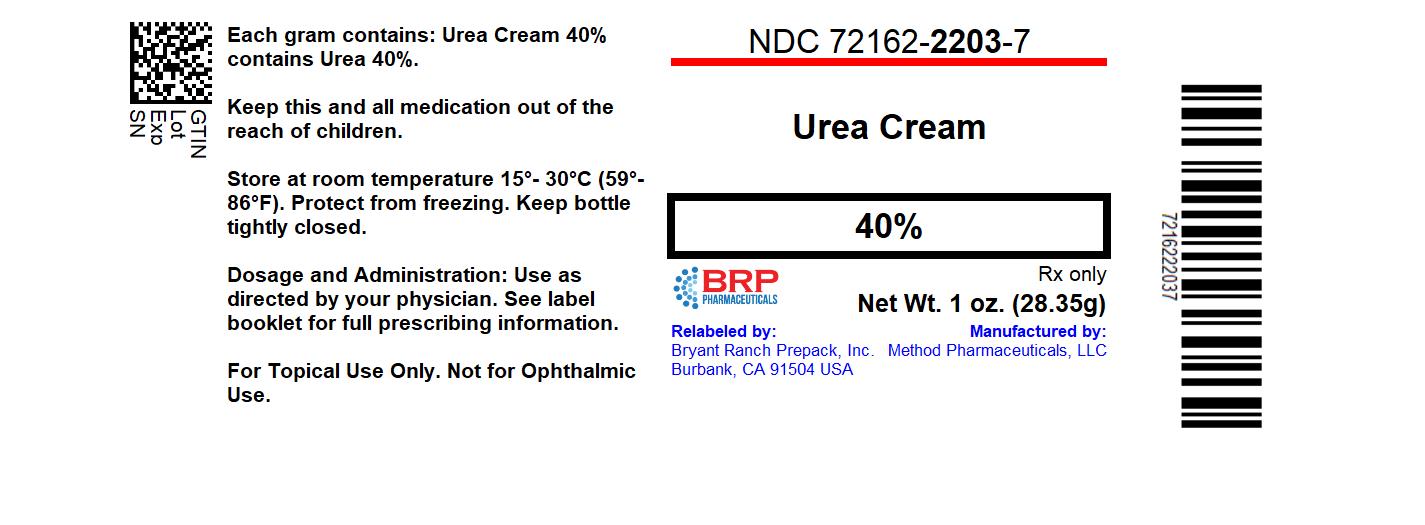
How Supplied Urea 40% Cream 3 oz. (85 g): NDC 72162-2203-4 1 oz. (28.35 g): NDC 72162-2203-7 7 oz. (198.4 g): NDC 72162-2203-8 Store at room temperature 15°C - 30°C (59°F-86°F). Protect from freezing. Keep bottle tightly closed. KEEP THIS AND ALL MEDICATIONS OUT OF THE REACH OF CHILDREN. Repackaged/Relabeled by: Bryant Ranch Prepack, Inc. Burbank, CA 91504
📋 Description ▾
Description Urea 40% is a keratolytic emollient which is a gentle, yet potent, tissue softener for nails and/or skin. Each gram of Urea 40% contains 40% urea as an active ingredient, and the following inactive ingredients: Carbomer, Cetearyl Alcohol, Glycerin, Glyceryl Stearate SE, Mineral Oil, Purified Water, White Petrolatum. Urea is a diamide of carbonic acid with the following chemical structure:
⚠️ Precautions ▾
Precautions This medication is to be used as directed by a physician and should not be used to treat any condition other than that for which it was prescribed. If redness or irritation occurs, discontinue use and consult a physician. PREGNANCY: Pregnancy Category B.
Animal reproduction studies have revealed no evidence of harm to the fetus, however, there are no adequate and well-controlled studies in pregnant women. Because animal reproductive studies are not always predictive of human response, Urea 40% should be given to a pregnant woman only if clearly needed. NURSING MOTHERS: It is not known whether or not this drug is excreted in human milk.
Because many drugs are excreted in human milk, caution should be exercised when Urea 40% is administered to a nursing woman.
🧬 Pharmacokinetics ▾
Pharmacokinetics The mechanism of action of topically applied urea is not yet known.
📄 Package Label / Principal Display Panel ▾
Urea Cream 40% image description
Medicare Part D spend CMS · PART D · 2026 (Q1)
Reported adverse events (FAERS)
Top reported reactions
Age at onset
Reporter sex
Serious outcomes
Where does this data come from?
About this NDC listing & data coverage
Listed without an FDA application
This product's marketing category indicates it is marketed without an approved FDA application (no NDA, ANDA, or BLA on file). Having an NDC does not by itself establish FDA approval — the NDC Directory is a listing system, not an approval decision. Approval-linked data such as Orange Book therapeutic-equivalence ratings therefore does not apply.
What data is (and isn’t) available for this NDC — tap to expand
| NDC identity (package / product / labeler codes) | ✓ Available |
| Labeler | ✓ Available |
| Product & package description | ✓ Available |
| Marketing category & status | ✓ Available |
| Active ingredient / dosage form / route | ✓ Available |
| FDA label (SPL via DailyMed) | ✓ Available |
| Package photos | ✓ Available |
| Inactive ingredients (structured) | ✓ Available |
| NADAC pharmacy acquisition price (CMS) | — Not published for this NDC CMS publishes NADAC only for NDCs reported in its retail-pharmacy survey. |
| Orange Book / therapeutic-equivalence data | — Not published for this NDC Applies only to products approved under an NDA/ANDA; many listings are out of scope. |
| HCPCS J-code billing crosswalk | — Not published for this NDC Most self-administered / retail products have no J-code — that is normal. |
| Medicaid utilization (CMS SDUD) | — Not published for this NDC CMS reports utilization only for NDCs with Medicaid claims above its privacy threshold. |