
Doxorubicin Hydrochloride 2 mg/mL Injectable, Liposomal — NDC 72603-200-01 (Billing 72603-0200-01)
This is a package of Doxorubicin Hydrochloride 2 mg/mL Injectable, Liposomal from NorthStar RxLLC, marketed since May 2019 and currently FDA-listed. It is this product's only package size.
NDC database record
One package, one record: these facts belong to NDC 72603-200-01 alone.
- Record
- FDA NDC Directory package listing · Human prescription drug
- Code segments
- 72603 labeler · 200 product · 01 package
- Package marketed since
- May 29, 2019
- Sample package
- No — commercial package
- Listing certified through
- Dec 31, 2027
- Barcode (UPC)
- 0372603200010
- FDA record last changed
- Jul 24, 2026
Identity & classification
Regulatory identifiers FDA, NLM and CMS codes for this package
Drug-database identifiers Medi-Span GPI and First Databank GCN / HICL / AHFS classification
- GSN (GCN sequence number): 024447
- GCN: 47343
- GPI-14 (Medi-Span): 21200040401820
- HICL (First Databank): 010222
- AHFS class code: 10:00.00.00
- RxCUI (RxNorm): 1790115
Where does this data come from?
- FDA openFDA NDC Directory · synced Oct 8, 2026
- FDA label on DailyMed · label index refreshed Oct 8, 2026
- RxNorm (NLM RxNav) · catalog refreshed Oct 1, 2026
- Medi-Span GPI (licensed)
- First Databank (licensed) · refreshed Oct 8, 2026
RxNorm drug class
This medicine belongs to the Anthracycline Topoisomerase Inhibitor class.
Where does this data come from?
- RxClass (NLM) · catalog refreshed Oct 1, 2026
Clinical
- It is a chemotherapy medicine for many cancers. Standard forms treat breast cancer, leukemias, lymphomas, and several spread cancers. Liposomal forms like Doxil treat ovarian cance...
- A healthcare professional gives it into a vein in treatment cycles, usually every few weeks. You do not take it by mouth. Your team sets the exact schedule.
- Tiredness, nausea, vomiting, mouth sores, diarrhea or constipation, rash, and low blood counts are common. Liposomal forms can cause hand-foot syndrome. Let your team know about an...
- Call right away for fever or chills, unusual bleeding, shortness of breath, leg swelling, a racing heartbeat, or pain, redness, or swelling where the IV is. Heart problems can also...
Patient education
Supplement & herbal interactions
Doxorubicin may be associated with lower levels of 1 nutrient — worth a chat with your pharmacist, not a cause for alarm.
Where does this data come from?
- MedlinePlus (NLM) · refreshed Oct 8, 2026
- FDA label on DailyMed · label index refreshed Oct 8, 2026
Ask a licensed pharmacist directly — free, answered by our team.
Pricing
A drug doesn't have one price. Each row is a different public payment system, and none is what you'd pay at the counter — that depends on your insurance. The ⓘ on each row explains what it measures.
| Price system | Per each | Per package |
|---|---|---|
| Retail pharmacies payNADAC · weekly | Not in the retail survey — common for institutional, discontinued, or low-volume packs. | |
| Medicaid paysCMS SDUD · 12 mo | No recent Medicaid claims on file for this NDC — rare and low-volume NDCs are suppressed in the public data. | |
| Medicare drug plans payPart D · quarterly | No Part D plan price is available for this NDC in our data. | |
| Medicare Part B allowsASP · Q2050 | $116.605 / Q2050 unit | — |
Where does this data come from?
- CMS NADAC weekly file
- CMS ASP pricing files · refreshed Sep 20, 2026
- CMS Medicaid State Drug Utilization Data · refreshed Oct 8, 2026
- CMS Part D plan pricing files · refreshed Sep 24, 2026
- VA National Acquisition Center price file
Billing & reimbursement
Where does this data come from?
- CMS ASP NDC-HCPCS crosswalk · refreshed Sep 22, 2026
- DMEPDAC NDC-HCPCS crosswalk
- openFDA NSDE billing units · refreshed Oct 7, 2026
Packaging — all sizes for this product
| Package NDC | Description | Marketing start | Marketing end | Status |
|---|---|---|---|---|
| 72603-0200-01 You're viewing this Main listing | 1 VIAL, SINGLE-DOSE in 1 PACKAGE / 25 mL in 1 VIAL, SINGLE-DOSE | 2019-05-29 | — | Active |
Therapeutic equivalents
| Product | Labeler | Pack | NADAC/unit | TE | Status | Price vs. this |
|---|---|---|---|---|---|---|
| Doxil 2 mg/mL 00338-0067-01 | Baxter | 1 vial | — | AB | FDA listed | — |
| Doxorubicin Hydrochloride Liposome 2 mg/mL 00338-0086-01 | Baxter | 1 vial | — | AB | FDA listed | — |
| Doxil 2 mg/mL 00338-9665-01 | Baxter | 1 vial | — | AB | FDA listed | — |
| Doxorubicin Hydrochloride 2 mg/mL 16714-0856-01 | NorthStar | 1 vial | — | AB | Discontinued | — |
| Doxorubicin Hydrochloride Liposome 2 mg/mL 25021-0263-10 | Sagent | 1 vial | — | AB | FDA listed | — |
| doxorubicin hydrochloride 2 mg/mL 46708-0525-25 | Alembic | 1 vial | — | AB | FDA listed | — |
| Doxorubicin Hydrochloride 2 mg/mL 47335-0050-40 | Sun | 1 vial | — | AB | FDA listed | — |
| Doxorubicin Hydrochloride 2 mg/mL 49315-0009-07 | Zydus | 1 vial | — | AB | FDA listed | — |
| doxorubicin hydrochloride 2 mg/mL 62332-0525-25 | Alembic | 1 vial | — | AB | FDA listed | — |
| Doxorubicin Hydrochloride 2 mg/mL 68001-0345-26 | BluePoint | 1 vial | — | AB | FDA listed | — |
| Doxorubicin Hydrochloride 2 mg/mL 68001-0493-26 | BluePoint | 1 vial | — | AB | FDA listed | — |
| Doxorubicin Hydrochloride 2 mg/mL 68001-0629-26 | BluePoint | 1 vial | — | AB | FDA listed | — |
| Doxorubicin Hydrochloride 2 mg/mL 68001-0704-26 | BluePoint | 1 vial | — | AB | FDA listed | — |
| Doxorubicin Hydrochloride 2 mg/mL 68083-0249-01 | Gland | 1 vial | — | AP | FDA listed | — |
| Doxorubicin Hydrochloride 2 mg/mL 70710-1531-01 | Zydus | 1 vial | — | AB | FDA listed | — |
| Doxorubicin Hydrochloride 2 mg/mL 70748-0340-01 | Lupin | 1 vial | — | AB | FDA listed | — |
| Doxorubicin Hydrochloride 2 mg/mLthis 72603-0200-01 | NorthStar | 1 vial | — | AB | FDA listed | — |
| doxorubicin hydrochloride 2 mg/mL 75907-0364-01 | Dr. | 1 vial | — | AB | FDA listed | — |
| Doxorubicin Hydrochloride 2 mg/mL 49315-0008-03 | Zydus | 1 vial | — | AB | FDA listed | — |
| DOXOrubicin Hydrochloride 2 mg/mL 62756-0826-40 | Sun | 1 vial | — | AP | FDA listed | — |
| DOXOrubicin Hydrochloride 2 mg/mL 62756-0827-40 | Sun | 1 vial | — | AP | FDA listed | — |
| Doxorubicin Hydrochloride 2 mg/mL 16714-0742-01 | NorthStar | 1 vial | — | AB | Discontinued | — |
| Doxorubicin Hydrochloride 2 mg/mL 00069-0343-02 | Pfizer | 1 vial | — | AP | FDA listed | — |
| Doxorubicin Hydrochloride 2 mg/mL 00143-9085-01 | Hikma | 1 vial | — | AP | FDA listed | — |
| Doxorubicin Hydrochloride 2 mg/mL 63323-0883-05 | Fresenius | 1 vial | — | AP | FDA listed | — |
| Doxorubicin Hydrochloride 2 mg/mL 68001-0492-36 | BluePoint | 1 vial | — | AB | FDA listed | — |
| Doxorubicin Hydrochloride 2 mg/mL 00069-0277-02 | Pfizer | 1 vial | — | AP | FDA listed | — |
| Doxorubicin hydrochloride 2 mg/mL 45963-0733-55 | Actavis | 1 vial | — | AP | FDA listed | — |
| Doxil 2 mg/mL 00338-0063-01 | Baxter | 1 vial | — | AB | FDA listed | — |
| Doxorubicin Hydrochloride 2 mg/mL 68083-0248-01 | Gland | 1 vial | — | AP | FDA listed | — |
| Doxorubicin Hydrochloride 2 mg/mL 00069-1442-04 | Pfizer | 1 vial | — | AP | FDA listed | — |
| Doxorubicin Hydrochloride 2 mg/mL 00069-3358-25 | Pfizer | 1 vial | — | AP | FDA listed | — |
| Doxorubicin Hydrochloride 2 mg/mL 00069-4031-12 | Pfizer | 1 vial | — | AP | FDA listed | — |
| Doxorubicin Hydrochloride 2 mg/mL 00143-9084-01 | Hikma | 1 vial | — | AP | FDA listed | — |
| Doxorubicin Hydrochloride 2 mg/mL 00143-9090-01 | Hikma | 1 vial | — | AP | FDA listed | — |
| doxorubicin hydrochloride 2 mg/mL 62332-0810-10 | Alembic | 1 vial | — | AB | FDA listed | — |
| Doxorubicin Hydrochloride 2 mg/mL 00069-1542-20 | Pfizer | 1 vial | — | AP | FDA listed | — |
| Doxorubicin Hydrochloride 2 mg/mL 47335-0049-40 | Sun | 1 vial | — | AB | FDA listed | — |
| Doxorubicin Hydrochloride 2 mg/mL 68001-0703-36 | BluePoint | 1 vial | — | AB | FDA listed | — |
| Doxorubicin Hydrochloride 2 mg/mL 70121-1219-01 | Amneal | 1 vial | — | AP | FDA listed | — |
| doxorubicin hydrochloride 2 mg/mL 75907-0363-01 | Dr. | 1 vial | — | AB | FDA listed | — |
| Doxorubicin Hydrochloride 2 mg/mL 00069-0358-20 | Pfizer | 1 vial | — | AP | FDA listed | — |
| Doxorubicin Hydrochloride 2 mg/mL 00069-4205-05 | Pfizer | 1 vial | — | AP | FDA listed | — |
| Doxorubicin Hydrochloride 2 mg/mL 00143-9092-01 | Hikma | 1 vial | — | — | FDA listed | — |
| doxorubicin hydrochloride 2 mg/mL 46708-0810-10 | Alembic | 1 vial | — | AB | FDA listed | — |
| Doxorubicin Hydrochloride 2 mg/mL 00069-0255-10 | Pfizer | 1 vial | — | AP | FDA listed | — |
| Doxorubicin Hydrochloride 2 mg/mL 00143-9086-01 | Hikma | 1 vial | — | AP | FDA listed | — |
| Doxorubicin Hydrochloride 2 mg/mL 00143-9087-01 | Hikma | 1 vial | — | AP | FDA listed | — |
| Doxorubicin Hydrochloride 2 mg/mL 72603-0103-01 | NorthStar | 1 vial | — | AB | FDA listed | — |
| Doxorubicin Hydrochloride 2 mg/mL 00143-9091-01 | Hikma | 1 vial | — | AP | FDA listed | — |
| Doxorubicin Hydrochloride 2 mg/mL 67457-0436-50 | Mylan | 1 vial | — | — | FDA listed | — |
| Doxorubicin Hydrochloride 2 mg/mL 00069-5629-05 | Pfizer | 1 vial | — | AP | FDA listed | — |
| Doxorubicin Hydrochloride 2 mg/mL 68083-0250-01 | Gland | 1 vial | — | AP | FDA listed | — |
| Doxorubicin Hydrochloride 2 mg/mL 63323-0101-61 | Fresenius | 1 vial | — | AP | FDA listed | — |
| doxorubicin hydrochloride 2 mg/mL 25021-0207-25 | Sagent | 1 vial | — | AP | FDA listed | — |
| Doxorubicin Hydrochloride 2 mg/mL 00143-9088-01 | Hikma | 1 vial | — | AP | FDA listed | — |
| Doxorubicin Hydrochloride 2 mg/mL 00143-9089-01 | Hikma | 1 vial | — | AP | FDA listed | — |
| Doxorubicin Hydrochloride 2 mg/mL 00143-9093-01 | Hikma | 1 vial | — | — | FDA listed | — |
| doxorubicin hydrochloride, Liposomal 2 mg/mL 00338-9581-02 | Baxter | 1 vial | — | — | FDA listed | — |
| Doxil 2 mg/mL 00338-9667-01 | Baxter | 1 vial | — | AB | FDA listed | — |
| Doxorubicin Hydrochloride 2 mg/mL 70710-1530-01 | Zydus | 1 vial | — | AB | FDA listed | — |
| Doxorubicin Hydrochloride 2 mg/mL 70748-0339-01 | Lupin | 1 vial | — | AB | FDA listed | — |
| doxorubicin hydrochloride 2 mg/mL 68001-0706-36 | BluePoint | 1 vial | — | AB | FDA listed | — |
| doxorubicin hydrochloride 2 mg/mL 68001-0707-26 | BluePoint | 1 vial | — | AB | FDA listed | — |
Where does this data come from?
- FDA openFDA NDC Directory · synced Oct 8, 2026
- FDA Orange Book · refreshed Oct 3, 2026
- CMS NADAC weekly file
Availability & generic status
This product is an FDA-approved generic. Other versions of the same drug are listed under Therapeutic equivalents, least expensive first.
Where does this data come from?
- FDA Orange Book · refreshed Oct 3, 2026
Inactive Ingredients / Excipients
Inactive ingredients, also called excipients, are components of the drug product other than the active ingredient. They may include fillers, dyes, coatings, preservatives, flavors, or other formulation ingredients.
🧪 Avoiding an ingredient? See Doxorubicin inactive ingredients by manufacturer: every current product's list side by side, so you can ask your pharmacy for the version that does not list it.
💡 Tap an ingredient (hover on desktop) to see what it is and why it’s used.
-
0.6 mg / 1 mL
UNII SU46BAM238
Ammonium sulfate is a mineral salt used in medications as a buffering agent and pH regulator. It helps maintain the chemical stability and balance of the drug formulation.
-
3.19 mg / 1 mL
UNII 97C5T2UQ7J
Cholesterol is a fatty substance found naturally in animal tissues. In medications, it's used as an ingredient in liposomal formulations and lipid-based drug delivery systems to help encapsulate and stabilize active drugs for better absorption.
-
UNII 4QD397987E
An amino acid used as a buffer and stabilizer in medications. It helps maintain the pH balance and protects the active drug from breaking down during storage and use.
-
UNII QTT17582CB
A strong acid used to adjust and maintain the proper pH level in liquid medicines, ensuring stability and preventing breakdown of active ingredients.
-
9.58 mg / 1 mL
UNII H1109Z9J4N
A natural emulsifier derived from soybean oil. It helps mix oil and water-based ingredients together, ensuring even distribution of active ingredients throughout the medicine.
-
UNII 55X04QC32I
A strong alkaline chemical used to adjust and maintain the pH balance of liquid medicines. It helps keep the medicine stable and ensures it stays effective during storage.
-
3.19 mg / 1 mL
UNII 3L6NN8ZZKU
A synthetic lipid compound derived from polyethylene glycol and phospholipids. It functions as an emulsifier and solubilizer in medications, helping to stabilize and distribute oil and water-based ingredients evenly throughout the formulation.
-
UNII C151H8M554
A natural sugar derived from sugar cane or sugar beets. It's used as a sweetener, filler, and binder to improve taste, add bulk, and help hold tablet or capsule ingredients together.
8 inactive ingredients listed in the exact product block matched to this NDC.
Where does this data come from?
ingredient classCode="IACT" elements from the exact product block matched by this NDC. Label-section narrative from DailyMed / the openFDA label index is shown separately when available.- FDA label on DailyMed · label index refreshed Oct 8, 2026
- FDA openFDA NDC Directory · synced Oct 8, 2026
Inactive ingredient FAQ
Are inactive ingredients the same for every manufacturer?
Why might an inactive ingredient be missing?
Can inactive ingredients matter?
Manufacturer & labeler
More NDCs from NorthStar RxLLC labeler code 72603
- ofloxacin 3 mg/mL Solution/ Drops NDC 72603-192-01
- Sapropterin dihydrochloride 100 mg Powder, For Solution NDC 72603-193-30
- Sapropterin dihydrochloride 500 mg Powder, For Solution NDC 72603-194-30
- Enoxaparin Sodium 80 mg/.8mL Injection, Solution NDC 72603-195-10
- Nitrofurantoin (monohydrate/macrocrystals) 75 mg; 25 mg Capsule NDC 72603-196-01
- Zoledronic acid 4 mg/5mL Injection, Solution, Concentrate NDC 72603-198-01
- Ephedrine sulfate 50 mg/mL Injection NDC 72603-203-10
- Enoxaparin Sodium 100 mg/mL Injection, Solution NDC 72603-205-10
- Gemfibrozil 600 mg Tablet, Film Coated NDC 72603-206-01
- Diclofenac Sodium 20 mg/g Solution NDC 72603-207-01
- arformoterol tartrate 15 ug/2mL Solution NDC 72603-208-30
- Sodium Bicarbonate 84 mg/mL Injection, Solution NDC 72603-209-25
Where does this data come from?
- FDA openFDA NDC Directory · synced Oct 8, 2026
- Drugs@FDA
Full prescribing information FDA SPL
🚨 Boxed Warning ▾
WARNING: CARDIOMYOPATHY and INFUSION-RELATED REACTIONS Doxorubicin hydrochloride liposome injection can cause myocardial damage, including acute left ventricular failure. The risk of cardiomyopathy was 11% when the cumulative anthracycline dose was between 450 mg/m 2 to 550 mg/m 2 . Assess left ventricular cardiac function prior to initiation of doxorubicin hydrochloride liposome injection and during and after treatment [see Warnings and Precautions (5.1)].
Serious, life-threatening, and fatal infusion-related reactions can occur with doxorubicin hydrochloride liposome injection. Acute infusion-related reactions occurred in 11% of patients with solid tumors. Withhold doxorubicin hydrochloride liposome injection for infusion-related reactions and resume at a reduced rate.
Discontinue doxorubicin hydrochloride liposome injection for serious or life-threatening infusion-related reactions [see Warnings and Precautions (5.2)]. WARNING: CARDIOMYOPATHY and INFUSION-RELATED REACTIONS See full prescribing information for complete boxed warning. Doxorubicin hydrochloride liposome injection can cause myocardial damage, including acute left ventricular failure.
The risk of cardiomyopathy was 11% when the cumulative anthracycline dose was between 450 mg/m 2 to 550 mg/m 2 . Assess left ventricular cardiac function prior to initiation of Doxorubicin hydrochloride liposome injection, during treatment, and after treatment (5.1). Serious, life-threatening, and fatal infusion-related reactions can occur.
Acute infusion-related reactions occurred in 11% of patients with solid tumors. Withhold doxorubicin hydrochloride liposome injection for infusion-related reactions and resume at a reduced rate. Discontinue doxorubicin hydrochloride liposome injection for serious or life-threatening infusion-related reactions (5.2).
🎯 Indications and Usage ▾
1 INDICATIONS AND USAGE Doxorubicin hydrochloride is an anthracycline topoisomerase inhibitor indicated for: Ovarian cancer: After failure of platinum-based chemotherapy (1.1). AIDS-related Kaposi’s Sarcoma: After failure of prior systemic chemotherapy or intolerance to such therapy (1.2). Multiple Myeloma: In combination with bortezomib in patients who have not previously received bortezomib and have received at least one prior therapy (1.3).
1.1Ovarian Cancer Doxorubicin hydrochloride liposome injection is indicated for the treatment of patients with ovarian cancer whose disease has progressed or recurred after platinum-based chemotherapy.
1.2AIDS-Related Kaposi's Sarcoma Doxorubicin hydrochloride liposome injection is indicated for the treatment of AIDS-related Kaposi's sarcoma in patients after failure of prior systemic chemotherapy or intolerance to such therapy.
1.3Multiple Myeloma Doxorubicin hydrochloride liposome injection, in combination with bortezomib, is indicated for the treatment of patients with multiple myeloma who have not previously received bortezomib and have received at least one prior therapy.
⏱️ Dosage and Administration ▾
2 DOSAGE AND ADMINISTRATION Administer doxorubicin hydrochloride liposome injection at an initial rate of 1 mg/min to minimize the risk of infusion reactions. If no infusion-related reactions occur, increase rate of infusion to complete administration over 1 hour. Do not administer as bolus injection or undiluted solution (2).
Ovarian cancer: 50 mg/m 2 intravenously every 4 weeks (2.2) AIDS-related Kaposi’s Sarcoma: 20 mg/m 2 intravenously every 3 weeks (2.3) Multiple Myeloma: 30 mg/m 2 intravenously on day 4 following bortezomib (2.4)
2.1Important Use Information Do not substitute doxorubicin hydrochloride liposome injection for other doxorubicin hydrochloride products. Do not administer as an undiluted suspension or as an intravenous bolus [ see Warnings and Precautions (5.2) ].
2.2Ovarian Cancer The recommended dose of doxorubicin hydrochloride liposome injection is 50 mg/m 2 intravenously over 60 minutes every 28 days until disease progression or unacceptable toxicity.
2.3AIDS-Related Kaposi's Sarcoma The recommended dose of doxorubicin hydrochloride liposome injection is 20 mg/m 2 intravenously over 60 minutes every 21 days until disease progression or unacceptable toxicity.
2.4Multiple Myeloma The recommended dose of doxorubicin hydrochloride liposome injection is 30 mg/m 2 intravenously over 60 minutes on day 4 of each 21-day cycle for eight cycles or until disease progression or unacceptable toxicity. Administer doxorubicin hydrochloride liposome injection after bortezomib on day 4 of each cycle [ see Clinical Studies (14.3) ].
2.5Dose Modifications for Adverse Reactions Do not increase doxorubicin hydrochloride liposome injection after a dose reduction for toxicity. Table 1: Recommended Dose Modifications for Hand-Foot Syndrome, Stomatitis, or Hematologic Adverse Reactions Toxicity Dose Adjustment Hand-Foot Syndrome (HFS) Grade 1: Mild erythema, swelling, or desquamation not interfering with daily activities If no previous Grade 3 or 4 HFS: no dose adjustment. If previous Grade 3 or 4 HFS: delay dose up to 2 weeks, then decrease dose by 25%.
Grade 2: Erythema, desquamation, or swelling interfering with, but not precluding normal physical activities; small blisters or ulcerations less than 2 cm in diameter Delay dosing up to 2 weeks or until resolved to Grade 0-1. Discontinue doxorubicin hydrochloride liposome injection if no resolution after 2 weeks. If resolved to Grade 0-1 within 2 weeks: And no previous Grade 3 or 4 HFS: continue treatment at previous dose.
And previous Grade 3 or 4 toxicity: decrease dose by 25%. Grade 3: Blistering, ulceration, or swelling interfering with walking or normal daily activities; cannot wear regular clothing Delay dosing up to 2 weeks or until resolved to Grade 0-1, then decrease dose by 25%. Discontinue doxorubicin hydrochloride liposome injection if no resolution after 2 weeks.
Grade 4: Diffuse or local process causing infectious complications, or a bed ridden state or hospitalization Delay dosing up to 2 weeks or until resolved to Grade 0-1, then decrease dose by 25%. Discontinue doxorubicin hydrochloride liposome injection if no resolution after 2 weeks. Stomatitis Grade 1: Painless ulcers, erythema, or mild soreness If no previous Grade 3 or 4 toxicity: no dose adjustment.
If previous Grade 3 or 4 toxicity: delay up to 2 weeks then decrease dose by 25%. Grade 2: Painful erythema, edema, or ulcers, but can eat Delay dosing up to 2 weeks or until resolved to Grade 0-1. Discontinue doxorubicin hydrochloride liposome injection if there is no resolution after 2 weeks.
If resolved to Grade 0-1 within 2 weeks: And no previous Grade 3 or 4 stomatitis: resume treatment at previous dose. And previous Grade 3 or 4 toxicity: decrease dose by 25%. Grade 3: Painful erythema, edema, or ulcers, and cannot eat Delay dosing up to 2 weeks or until resolved to Grade 0-1.
Decrease dose by 25% and return to original dose interval. If after 2 weeks there is no resolution, discontinue doxorubicin h… [Excerpted — this section continues on DailyMed.]
💊 Dosage Forms and Strengths ▾
3 DOSAGE FORMS AND STRENGTHS Doxorubicin hydrochloride liposome injection: 20 mg/10 mL (2 mg/mL) and 50 mg/25 mL (2 mg/mL) in single-dose vials. The drug product appears as a translucent, red liposomal dispersion. Doxorubicin hydrochloride liposome injection: 20 mg/10 mL (2 mg/mL) and 50 mg/25 mL (2 mg/mL) in single dose vials (3)
⛔ Contraindications ▾
4 CONTRAINDICATIONS Doxorubicin hydrochloride liposome injection is contraindicated in patients who have a history of severe hypersensitivity reactions, including anaphylaxis, to doxorubicin hydrochloride [see Warnings and Precautions (5.2)]. Hypersensitivity reactions to doxorubicin hydrochloride or the components of doxorubicin hydrochloride liposome injection ( 4 , 5.2 )
⚠️ Warnings and Cautions ▾
5 WARNINGS AND PRECAUTIONS Hand-Foot Syndrome may occur. Dose modification or discontinuation may be required ( 5.3 ) Embryo-Fetal Toxicity: Can cause fetal harm. Advise of potential risk to a fetus. Use effective contraception ( 5.5 , 8.1 , 8.3 )
5.1Cardiomyopathy Doxorubicin hydrochloride can cause myocardial damage, including acute left ventricular failure. The risk of cardiomyopathy with doxorubicin hydrochloride is generally proportional to the cumulative exposure. Include prior use of other anthracyclines or anthracenediones in calculations of cumulative dose.
The risk of cardiomyopathy may be increased at lower cumulative doses in patients with prior mediastinal irradiation. In a clinical study in 250 patients with advanced cancer who were treated with doxorubicin hydrochloride liposome injection, the risk of cardiomyopathy was 11% when the cumulative anthracycline dose was between 450 mg/m 2 to 550 mg/m 2 . Cardiomyopathy was defined as >20% decrease in resting left ventricular ejection fraction (LVEF) from baseline where LVEF remained in the normal range or a >10% decrease in LVEF from baseline where LVEF was less than the institutional lower limit of normal.
Two percent of patients developed signs and symptoms of congestive heart failure without documented evidence of cardiomyopathy. Assess left ventricular cardiac function (e.g. MUGA or echocardiogram) prior to initiation of doxorubicin hydrochloride liposome injection, during treatment to detect acute changes, and after treatment to detect delayed cardiomyopathy.
Administer doxorubicin hydrochloride liposome injection to patients with a history of cardiovascular disease only when the potential benefit of treatment outweighs the risk.
5.2Infusion-Related Reactions Serious, life-threatening, and fatal infusion-related reactions characterized by one or more of the following symptoms can occur with doxorubicin hydrochloride liposome injection: flushing, shortness of breath, facial swelling, headache, chills, chest pain, back pain, tightness in the chest and throat, fever, tachycardia, pruritus, rash, cyanosis, syncope, bronchospasm, asthma, apnea, and hypotension. Of 239 patients with ovarian cancer treated with doxorubicin hydrochloride liposome injection in Trial 4, 7% of patients experienced acute infusion-related reactions resulting in dose interruption.
All occurred during cycle 1 and none during subsequent cycles. Across multiple studies of doxorubicin hydrochloride liposome injection monotherapy including this and other studies enrolling 760 patients with various solid tumors, 11% of patients had infusion-related reactions. The majority of infusion-related events occurred during the first infusion.
Ensure that medications to treat infusion-related reactions and cardiopulmonary resuscitative equipment are available for immediate use prior to initiation of doxorubicin hydrochloride liposome injection. Initiate doxorubicin hydrochloride liposome injection infusions at a rate of 1 mg/min and increase rate as tolerated [see Dosage and Administration (2.6)]. Withhold doxorubicin hydrochloride liposome injection for Grade 1, 2, or 3 infusion-related reactions and resume at a reduced infusion rate.
Discontinue doxorubicin hydrochloride liposome injection for serious or life-threatening infusion-related reactions.
5.3Hand-Foot Syndrome(HFS) In Trial 4, the incidence of HFS was 51% of patients in the doxorubicin hydrochloride liposome injection arm and 0.9% of patients in the topotecan arm, including 24% Grade 3 or 4 cases of HFS in doxorubicin hydrochloride liposome injection-treated patients and no Grade 3 or 4 cases in topotecan-treated patients. HFS or other skin toxicity required discontinuation of doxorubicin hydrochloride liposome injection in 4.2% of patients. HFS was generally observed after 2 or 3 cycles of treatment but may occur earlier.
Delay doxorubicin hydrochloride liposome injection for the first episode of Grade 2 or greater HFS [ see Dosage and Admin… [Excerpted — this section continues on DailyMed.]
🤒 Adverse Reactions ▾
6 ADVERSE REACTIONS The following adverse reactions are discussed in more detail in other sections of the labeling. Cardiomyopathy [ see Warnings and Precautions ( 5.1 )] Infusion-Related Reactions [see Warnings and Precautions ( 5.2 )] Hand-Foot Syndrome [see Warnings and Precautions ( 5.3 )] Secondary Oral Neoplasms [see Warnings and Precautions ( 5.4 )] Most common adverse reactions (>20%) are asthenia, fatigue, fever, anorexia, nausea, vomiting, stomatitis, diarrhea, constipation, hand-foot syndrome, rash, neutropenia, thrombocytopenia, and anemia ( 6 ).
To report SUSPECTED ADVERSE REACTIONS contact NorthStar Rx LLC at 1-800-206-7821 or FDA at 1-800-FDA-1088 or www.fda.gov/medwatch.
6.1Clinical Trials Experience Because clinical trials are conducted under widely varying conditions, the adverse reaction rates observed cannot be directly compared to rates on other clinical trials and may not reflect the rates observed in clinical practice. The safety data reflect exposure to doxorubicin hydrochloride liposome injection in 1310 patients including: 239 patients with ovarian cancer, 753 patients with AIDS-related Kaposi’s sarcoma, and 318 patients with multiple myeloma. The most common adverse reactions (>20%) observed with doxorubicin hydrochloride liposome injection are asthenia, fatigue, fever, nausea, stomatitis, vomiting, diarrhea, constipation, anorexia, hand-foot syndrome, rash and neutropenia, thrombocytopenia and anemia.
The following tables present adverse reactions from clinical trials of single-agent doxorubicin hydrochloride liposome injection in ovarian cancer and AIDS-Related Kaposi’s sarcoma. Patients With Ovarian Cancer The safety data described below are from Trial 4, which included 239 patients with ovarian cancer treated with doxorubicin hydrochloride liposome injection 50 mg/m 2 once every 4 weeks for a minimum of four courses in a randomized, multicenter, open-label study. In this trial, patients received doxorubicin hydrochloride liposome injection for a median number of 3.2 months (range 1 day to 25.8 months).
The median age of the patients is 60 years (range 27 to 87), with 91% Caucasian, 6% Black, and 3% Hispanic or Other. Table 3 presents the hematologic adverse reactions from Trial 4. Table 3: Hematologic Adverse Reactions in Trial 4 Doxorubicin Hydrochloride Liposome Injection Patients (n=239) Topotecan Patients (n=235) Neutropenia 500 - <1,000/mm 3 <500/mm 3 8 % 4.2% 14% 62% Anemia 6.5 - <8 g/dL < 6.5 g/dL 5 % 0.4% 25% 4.3% Thrombocytopenia 10,000 - <50,000/mm 3 <10,000/mm 3 1.3% 0% 17% 17% Table 4 presents the non-hematologic adverse reactions from Trial 4.
Table 4: Non-Hematologic Adverse Reactions in Trial 4 Non-Hematologic Adverse Reaction 10% or Greater Doxorubicin Hydrochloride Liposome Injection (%) treated (n=239) Topotecan (%) treated (n=235) All grades Grades 3-4 All grades Grades 3-4 Body as a Whole Asthenia 40 7 52 8 Fever 21 0.8 31 6 Mucous Membrane Disorder 14 3.8 3.4 0 Back Pain 12 1.7 10
0.9Infection 12 2.1 6
0.9Headache 11 0.8 15 0 Digestive Nausea 46 5 63 8 Stomatitis 41 8 15
0.4Vomiting 33 8 44 10 Diarrhea 21 2.5 35
4.2Anorexia 20 2.5 22
1.3Dyspepsia 12 0.8 14 0 Nervous Dizziness 4.2 0 10 0 Respiratory Pharyngitis 16 0 18
0.4Dyspnea 15 4.1 23
4.3Cough increased 10 0 12 0 Skin and Appendages Hand-foot syndrome 51 24 0.9 0 Rash 29 4.2 12
0.4Alopecia 19 N/A 52 N/A The following additional adverse reactions were observed in patients with ovarian cancer with doses administered every four weeks (Trial 4). Incidence 1% to 10% Cardiovascular : vasodilation, tachycardia, deep vein thrombosis, hypotension, cardiac arrest. Digestive : oral moniliasis, mouth ulceration, esophagitis, dysphagia, rectal bleeding, ileus.
Hematologic and Lymphatic : ecchymosis. Metabolic and Nutritional : dehydration, weight loss, hyperbilirubinemia, hypokalemia, hypercalcemia, hyponatremia. Nervous : somnolence, dizziness, depression.
Respiratory : rhinitis, pneumonia, sinusitis, epistaxis. Skin and App… [Excerpted — this section continues on DailyMed.]
🔄 Drug Interactions ▾
7 DRUG INTERACTIONS No formal drug interaction studies have been conducted with doxorubicin hydrochloride liposome injection.
👥 Use in Specific Populations ▾
8 USE IN SPECIFIC POPULATIONS Lactation: Discontinue breastfeeding ( 8.2 ).
8.1Pregnancy Risk Summary Based on findings in animals and its mechanism of action, doxorubicin hydrochloride liposome injection can cause fetal harm when administered to a pregnant woman; avoid the use of doxorubicin hydrochloride liposome injection during the 1 st trimester. In animal reproduction studies, doxorubicin hydrochloride liposome injection was embryotoxic in rats and abortifacient in rabbits following intravenous administration during organogenesis at doses approximately 0.12 times the recommended clinical dose (see Data).
Available human data do not establish the presence or absence of major birth defects and miscarriage related to the use of doxorubicin hydrochloride during the 2 nd and 3 rd trimesters. Advise pregnant women of the potential risk to a fetus. The background risk of major birth defects and miscarriage for the indicated populations are unknown.
However, the background risk in the U.S. general population of major birth defects is 2 to 4% and of miscarriage is 15 to 20% of clinically recognized pregnancies. Data Animal Data Doxorubicin hydrochloride liposome injection was embryotoxic at doses of 1 mg/kg/day in rats and was embryotoxic and abortifacient at 0.5 mg/kg/day in rabbits (both doses are about 0.12 times the recommended dose of 50 mg/m 2 human dose on a mg/m 2 basis). Embryotoxicity was characterized by increased embryo-fetal deaths and reduced live litter sizes.
8.2Lactation Risk Summary It is not known whether doxorubicin hydrochloride is present in human milk. Because many drugs, including anthracyclines, are excreted in human milk and because of the potential for serious adverse reactions in breastfed infants from doxorubicin hydrochloride liposome injection, discontinue breastfeeding during treatment with doxorubicin hydrochloride liposome injection.
8.3Females and Males of Reproductive Potential Pregnancy Testing Verify the pregnancy status of females of reproductive potential prior to initiating doxorubicin hydrochloride liposome injection. Contraception Females Doxorubicin hydrochloride liposome injection can cause fetal harm when administered to a pregnant woman [see Use in Specific Populations ( 8.1 )] . Advise females of reproductive potential to use effective contraception during and for 6 months after treatment with doxorubicin hydrochloride liposome injection.
Males Doxorubicin hydrochloride liposome injection may damage spermatozoa and testicular tissue, resulting in possible genetic fetal abnormalities. Males with female sexual partners of reproductive potential should use effective contraception during and for 6 months after treatment with doxorubicin hydrochloride liposome injection [see Non-clinical Toxicology ( 13.1 )] . Infertility Females In females of reproductive potential, doxorubicin hydrochloride liposome injection may cause infertility and result in amenorrhea.
Premature menopause can occur with doxorubicin hydrochloride. Recovery of menses and ovulation is related to age at treatment. Males Doxorubicin hydrochloride liposome injection may result in oligospermia, azoospermia, and permanent loss of fertility.
Sperm counts have been reported to return to normal levels in some men. This may occur several years after the end of therapy [see Non-clinical Toxicology ( 13.1 )].
8.4Pediatric Use The safety and effectiveness of doxorubicin hydrochloride liposome injection in pediatric patients have not been established.
8.5Geriatric Use Clinical studies of doxorubicin hydrochloride liposome injection conducted in patients with either epithelial ovarian cancer (Trial 4) or with AIDS-related Kaposi’s sarcoma (Trial 5) did not contain sufficient numbers of patients aged 65 and over to determine whether they respond differently from younger subjects. In Trial 6, of 318 patients treated with doxorubicin hydrochloride liposome injection in combination with bortezomib for multiple myeloma, 37% were 65… [Excerpted — this section continues on DailyMed.]
🤰 Pregnancy ▾
8.1Pregnancy Risk Summary Based on findings in animals and its mechanism of action, doxorubicin hydrochloride liposome injection can cause fetal harm when administered to a pregnant woman; avoid the use of doxorubicin hydrochloride liposome injection during the 1 st trimester. In animal reproduction studies, doxorubicin hydrochloride liposome injection was embryotoxic in rats and abortifacient in rabbits following intravenous administration during organogenesis at doses approximately 0.12 times the recommended clinical dose (see Data).
Available human data do not establish the presence or absence of major birth defects and miscarriage related to the use of doxorubicin hydrochloride during the 2 nd and 3 rd trimesters. Advise pregnant women of the potential risk to a fetus. The background risk of major birth defects and miscarriage for the indicated populations are unknown.
However, the background risk in the U.S. general population of major birth defects is 2 to 4% and of miscarriage is 15 to 20% of clinically recognized pregnancies. Data Animal Data Doxorubicin hydrochloride liposome injection was embryotoxic at doses of 1 mg/kg/day in rats and was embryotoxic and abortifacient at 0.5 mg/kg/day in rabbits (both doses are about 0.12 times the recommended dose of 50 mg/m 2 human dose on a mg/m 2 basis). Embryotoxicity was characterized by increased embryo-fetal deaths and reduced live litter sizes.
🧒 Pediatric Use ▾
8.4Pediatric Use The safety and effectiveness of doxorubicin hydrochloride liposome injection in pediatric patients have not been established.
🧓 Geriatric Use ▾
8.5Geriatric Use Clinical studies of doxorubicin hydrochloride liposome injection conducted in patients with either epithelial ovarian cancer (Trial 4) or with AIDS-related Kaposi’s sarcoma (Trial 5) did not contain sufficient numbers of patients aged 65 and over to determine whether they respond differently from younger subjects. In Trial 6, of 318 patients treated with doxorubicin hydrochloride liposome injection in combination with bortezomib for multiple myeloma, 37% were 65 years of age or older and 8% were 75 years of age or older.
No overall differences in safety or efficacy were observed between these patients and younger patients.
🆘 Overdosage ▾
10 OVERDOSAGE Acute overdosage with doxorubicin hydrochloride causes increased risk of severe mucositis, leukopenia, and thrombocytopenia.
🧬 Clinical Pharmacology ▾
12 CLINICAL PHARMACOLOGY
12.1Mechanism of Action The active ingredient of doxorubicin hydrochloride liposome injection is doxorubicin hydrochloride. The mechanism of action of doxorubicin hydrochloride is thought to be related to its ability to bind DNA and inhibit nucleic acid synthesis. Cell structure studies have demonstrated rapid cell penetration and perinuclear chromatin binding, rapid inhibition of mitotic activity and nucleic acid synthesis, and induction of mutagenesis and chromosomal aberrations.
12.3Pharmacokinetics The pharmacokinetic parameters for total doxorubicin following a single dose of doxorubicin hydrochloride liposome injection infused over 30 minutes are presented in Table 8. Table 8: Pharmacokinetic Parameters of Total Doxorubicin from Doxorubicin Hydrochloride Liposome Injection in Patients With AIDS-Related Kaposi’s Sarcoma Parameter (units) Dose 10 mg/m 2 20 mg/m 2 Peak Plasma Concentration (mcg/mL) 4.12 ± 0.215 8.34 ±
0.49Plasma Clearance (L/h/m 2 ) 0.056 ± 0.01 0.041 ± 0.004 Steady State Volume of Distribution (L/m 2 ) 2.83 ± 0.145 2.72 ±
0.12AUC (mcg/mL•h) 277 ± 32.9 590 ±
58.7First Phase (λ 1 ) Half-Life (h) 4.7 ± 1.1 5.2 ±
1.4Second Phase (λ 1 ) Half-Life (h) 52.3 ± 5.6 55 ±
4.8N=23 Mean ± Standard Error Doxorubicin hydrochloride liposome injection displayed linear pharmacokinetics over the range of 10 to 20 mg/m 2 . Relative to doxorubicin hydrochloride liposome injection doses at or below 20 mg/m 2 , the pharmacokinetics of total doxorubicin following a 50 mg/m 2 doxorubicin hydrochloride liposome injection dose are nonlinear. At this dose, the elimination half-life of doxorubicin hydrochloride liposome injection is longer and the clearance lower compared to a 20 mg/m 2 dose.
Distribution Direct measurement of liposomal doxorubicin shows that at least 90% of the drug (the assay used cannot quantify less than 5 to 10% free doxorubicin) remains liposome-encapsulated during circulation. In contrast to doxorubicin, which displays a large volume of distribution (range 700 to 1,100 L/m 2 ), the small steady state volume of distribution of liposomal doxorubicin suggests that doxorubicin hydrochloride liposome injection is largely confined to vascular fluid. Doxorubicin becomes available after the liposomes are extravasated.
Plasma protein binding of doxorubicin hydrochloride liposome injection has not been determined; the plasma protein binding of doxorubicin is approximately 70%. Metabolism Doxorubicinol, the major metabolite of doxorubicin, was detected at concentrations of 0.8 to 26.2 ng/mL in the plasma of patients who received 10 or 20 mg/m 2 doxorubicin hydrochloride liposome injection. Elimination The plasma clearance of total doxorubicin from doxorubicin hydrochloride liposome injection was 0.041 L/h/m 2 at a dose of 20 mg/m 2 .
Following administration of doxorubicin hydrochloride, the plasma clearance of doxorubicin is 24 to 35 L/h/m 2 .
🧬 Mechanism of Action ▾
12.1Mechanism of Action The active ingredient of doxorubicin hydrochloride liposome injection is doxorubicin hydrochloride. The mechanism of action of doxorubicin hydrochloride is thought to be related to its ability to bind DNA and inhibit nucleic acid synthesis. Cell structure studies have demonstrated rapid cell penetration and perinuclear chromatin binding, rapid inhibition of mitotic activity and nucleic acid synthesis, and induction of mutagenesis and chromosomal aberrations.
📦 How Supplied / Storage and Handling ▾
16 HOW SUPPLIED/STORAGE AND HANDLING Doxorubicin hydrochloride liposome injection is a sterile, translucent, red liposomal dispersion in 10 mL or 25 mL glass, single-dose vials. The following individually cartoned vials are available: Table 14 mg in vial fill volume vial size NDC #s 20 mg vial 10 mL 10 mL 72603-103-01 50 mg vial 25 mL 30 mL 72603-200-01 Refrigerate unopened vials of doxorubicin hydrochloride liposome injection at 2° to 8°C (36° to 46°F). Do not freeze.
Discard unused portion. Doxorubicin hydrochloride liposome injection is a cytotoxic drug. Follow applicable special handling and disposal procedures 1 .
📋 Description ▾
11 DESCRIPTION The active ingredient in doxorubicin hydrochloride liposome injection is doxorubicin hydrochloride, an anthracycline topoisomerase inhibitor, that is encapsulated in pegylated liposomes for intravenous use. The chemical name of doxorubicin hydrochloride is (8S,10S)-10-[(3-amino-2,3,6-trideoxy-α-L-lyxo-hexopyranosyl)oxy]-8-glycolyl-7,8,9,10-tetrahydro-6,8,11-trihydroxy-1-methoxy-5,12-naphthacenedione hydrochloride. The molecular formula is C 27 H 29 NO 11 • HCl and the molecular weight is 579.99.
The structural formula is: Doxorubicin hydrochloride liposome injection is a sterile, translucent, red liposomal dispersion. Each single-dose vial contains 20 mg or 50 mg doxorubicin hydrochloride, USP at a concentration of 2 mg/mL (equivalent to 1.87 mg/mL of doxorubicin) and a pH of 6.5. The pegylated liposome carriers are composed of cholesterol, 3.19 mg/mL; fully hydrogenated soy phosphatidylcholine (HSPC), 9.58 mg/mL; and N-(carbonyl-methoxypolyethylene glycol 2000)-1,2-distearoyl-sn-glycero-3-phosphoethanolamine sodium salt (MPEG-DSPE), 3.19 mg/mL.
Each mL also contains ammonium sulfate, approximately 0.6 mg; histidine, 1.50 mg as a buffer; hydrochloric acid and/or sodium hydroxide for pH control; and sucrose, 100 mg to maintain isotonicity. Greater than 90% of the drug is encapsulated in the pegylated liposomes. spl-doxorubicin-structure spl-doxorubicin-structure1 spl-doxorubicin-structure2 spl-doxorubicin-figure
💬 Information for Patients ▾
17 PATIENT COUNSELING INFORMATION Cardiomyopathy Advise patients to contact their healthcare provider if they develop symptoms of heart failure [see Warnings and Precautions ( 5.1 )]. Infusion-Related Reactions Advise patients about the symptoms of infusion related reactions and to seek immediate medical attention if they develop any of these symptoms [see Warnings and Precautions ( 5.2 )]. Myelosuppression Advise patients to contact their healthcare provider for a new onset fever or symptoms of infection.
Hand-Foot Syndrome Advise patients to notify their healthcare provider if they experience tingling or burning, redness, flaking, bothersome swelling, small blisters, or small sores on the palms of their hands or soles of their feet (symptoms of Hand-Foot Syndrome) [see Warnings and Precautions ( 5.3 )]. Stomatitis Advise patients to notify their healthcare provider if they develop painful redness, swelling, or sores in the mouth (symptoms of stomatitis). Embryo-Fetal Toxicity Advise females of reproductive potential of the potential risk to a fetus and to inform their healthcare provider with a known or suspected pregnancy [see Warnings and Precautions ( 5.5 ) and Use in Specific Populations ( 8.1 )].
Advise females and males of reproductive potential to use effective contraception during and for 6 months following treatment with doxorubicin hydrochloride liposome injection [see Use in Specific Populations ( 8.3 )]. Lactation Advise females not to breastfeed during treatment with doxorubicin hydrochloride liposome injection [see Use in Specific Populations ( 8.2 )]. Infertility Advise females and males of reproductive potential that doxorubicin hydrochloride liposome injection may cause temporary or permanent infertility [see Use in Specific Populations ( 8.3 )].
Discoloration of Urine and Body Fluids Inform patients that following doxorubicin hydrochloride liposome injection administration, a reddish-orange color to the urine and other body fluids may be observed. This nontoxic reaction is due to the color of the product and will dissipate as the drug is eliminated from the body. Manufactured for: Northstar Rx LLC Memphis, TN 38141.
Manufactured by: Sun Pharmaceutical Industries Ltd. Halol-Baroda Highway, Halol-389 350, Gujarat, India. ISS.
04/2026 5271751
🧬 Pharmacokinetics ▾
12.3Pharmacokinetics The pharmacokinetic parameters for total doxorubicin following a single dose of doxorubicin hydrochloride liposome injection infused over 30 minutes are presented in Table 8. Table 8: Pharmacokinetic Parameters of Total Doxorubicin from Doxorubicin Hydrochloride Liposome Injection in Patients With AIDS-Related Kaposi’s Sarcoma Parameter (units) Dose 10 mg/m 2 20 mg/m 2 Peak Plasma Concentration (mcg/mL) 4.12 ± 0.215 8.34 ±
0.49Plasma Clearance (L/h/m 2 ) 0.056 ± 0.01 0.041 ± 0.004 Steady State Volume of Distribution (L/m 2 ) 2.83 ± 0.145 2.72 ±
0.12AUC (mcg/mL•h) 277 ± 32.9 590 ±
58.7First Phase (λ 1 ) Half-Life (h) 4.7 ± 1.1 5.2 ±
1.4Second Phase (λ 1 ) Half-Life (h) 52.3 ± 5.6 55 ±
4.8N=23 Mean ± Standard Error Doxorubicin hydrochloride liposome injection displayed linear pharmacokinetics over the range of 10 to 20 mg/m 2 . Relative to doxorubicin hydrochloride liposome injection doses at or below 20 mg/m 2 , the pharmacokinetics of total doxorubicin following a 50 mg/m 2 doxorubicin hydrochloride liposome injection dose are nonlinear. At this dose, the elimination half-life of doxorubicin hydrochloride liposome injection is longer and the clearance lower compared to a 20 mg/m 2 dose.
Distribution Direct measurement of liposomal doxorubicin shows that at least 90% of the drug (the assay used cannot quantify less than 5 to 10% free doxorubicin) remains liposome-encapsulated during circulation. In contrast to doxorubicin, which displays a large volume of distribution (range 700 to 1,100 L/m 2 ), the small steady state volume of distribution of liposomal doxorubicin suggests that doxorubicin hydrochloride liposome injection is largely confined to vascular fluid. Doxorubicin becomes available after the liposomes are extravasated.
Plasma protein binding of doxorubicin hydrochloride liposome injection has not been determined; the plasma protein binding of doxorubicin is approximately 70%. Metabolism Doxorubicinol, the major metabolite of doxorubicin, was detected at concentrations of 0.8 to 26.2 ng/mL in the plasma of patients who received 10 or 20 mg/m 2 doxorubicin hydrochloride liposome injection. Elimination The plasma clearance of total doxorubicin from doxorubicin hydrochloride liposome injection was 0.041 L/h/m 2 at a dose of 20 mg/m 2 .
Following administration of doxorubicin hydrochloride, the plasma clearance of doxorubicin is 24 to 35 L/h/m 2 .
🔬 Clinical Studies ▾
14 CLINICAL STUDIES
14.1Ovarian Cancer Doxorubicin hydrochloride liposome injection was studied in three open-label, single-arm, clinical studies of 176 patients with metastatic ovarian cancer (Trials 1, 2, and 3). One hundred forty-five of these patients were refractory to both paclitaxel- and platinum-based chemotherapy regimens, defined as disease progression while on treatment or relapse within 6 months of completing treatment. Patients received doxorubicin hydrochloride liposome injection at 50 mg/m 2 every 3 or 4 weeks for 3 to 6+ cycles in the absence of dose-limiting toxicity or disease progression.
The median age at diagnosis ranged from 52 to 64 years in the 3 studies, and the range was 22 to 85. Most patients had International Federation of Obstetricians and Gynecologists (FIGO) stage III or IV disease (ranging from 83% to 93%). Approximately one third of the patients had three or more prior lines of therapy (ranging from 22% to 33%).
The primary outcome measure was confirmed response rate based on Southwestern Oncology Group (SWOG) criteria for patients refractory to both paclitaxel- and a platinum-containing regimen. Secondary efficacy parameters were time to response, duration of response, and time to progression. The response rates for the individual single arm trials are given in Table 9 below.
Table 9: Response Rates in Patients With Refractory Ovarian Cancer From Single Arm Ovarian Cancer Trials Trial 1 (U.S.) N=27 Trial 2 (U.S.) N=82 Trial 3 (non-U.S.) N=36 Response Rate 22.2% 17.1% 0% 95% Confidence Interval 8.6% to 42.3% 9.7% to 27% 0% to 9.7% In a pooled analysis of Trials 1-3, the response rate for all patients refractory to paclitaxel and platinum agents was 13.8% (95% CI 8.1% to 19.3%). The median time to progression was 15.9 weeks, the median time to response was 17.6 weeks, and the duration of response was 39.4 weeks.
In Trial 4, a randomized, multicenter, open-label, trial in 474 patients with epithelial ovarian cancer after platinum-based chemotherapy, patients were randomized to receive either doxorubicin hydrochloride liposome injection 50 mg/m 2 every 4 weeks (n=239) or topotecan 1.5 mg/m 2 daily for 5 consecutive days every 3 weeks (n=235). Patients were stratified according to platinum sensitivity (response to initial platinum-based therapy and a progression-free interval of greater than 6 months off treatment) and the presence of bulky disease (tumor mass greater than 5 cm in size).
The primary outcome measure was time to progression (TTP). Other endpoints included overall survival and objective response rate. Of the 474 patients, the median age at diagnosis was 60 years (range 25 to 87), 90% were FIGO stage III and IV; 46% were platinum sensitive; and 45% had bulky disease.
There was no statistically significant difference in TTP between the two arms. Results are provided in Table 10. Table 10: Results of Efficacy Analyses Analysis based on investigators’ strata for protocol defined ITT population.
Protocol Defined ITT Population Doxorubicin Hydrochloride Liposome Injection (n=239) Topotecan (n=235) TTP (Protocol Specified Primary Endpoint) Median (Months) Kaplan-Meier estimates. 4.1 4.2 p-value p-value is based on the stratified log-rank test.
0.62Hazard Ratio Hazard ratio is based on Cox proportional-hazard model with the treatment as single independent variable. A hazard ratio less than 1 indicates an advantage for doxorubicin hydrochloride liposome injection. 0.96 95% CI for Hazard Ratio (0.76, 1.2) Overall Survival Median (Months) 14.4 13.7 p-value p-value not adjusted for multiple comparisons.
0.05Hazard Ratio 0.82 95% CI for Hazard Ratio (0.68, 1) Response Rate Overall Response n (%) 47 (19.7) 40 (17) Complete Response n (%) 9 (3.8) 11 (4.7) Partial Response n (%) 38 (15.9) 29 (12.3) Median Duration of Response (Months) 6.9 5.9
14.2AIDS-Related Kaposi's Sarcoma Doxorubicin hydrochloride liposome injection was studied in an open-label, single-arm, multicenter study at a dose of 20… [Excerpted — this section continues on DailyMed.]
🧪 Nonclinical Toxicology ▾
13 NON-CLINICAL TOXICOLOGY
13.1Carcinogenesis, Mutagenesis, and Impairment of Fertility Mutagenicity or carcinogenicity studies have not been conducted with doxorubicin hydrochloride liposome injection, however doxorubicin was shown to be mutagenic in the in vitro Ames assay, and clastogenic in multiple in vitro assays (CHO cell, V79 hamster cell, human lymphoblast, and SCE assays) and the in vivo mouse micronucleus assay. The possible adverse effects on fertility in animals have not been adequately evaluated. Doxorubicin hydrochloride liposome injection resulted in mild to moderate ovarian and testicular atrophy in mice after administration of a single dose of 36 mg/kg (about 2 times the 50 mg/m 2 human dose on a mg/m 2 basis).
Decreased testicular weights and hypospermia were observed in rats after repeat doses ≥ 0.25 mg/kg/day (about 0.03 times the 50 mg/m 2 human dose on a mg/m 2 basis), and diffuse degeneration of the seminiferous tubules and a marked decrease in spermatogenesis were observed in dogs after repeat doses of 1 mg/kg/day (about 0.4 times the 50 mg/m 2 human dose on a mg/m 2 basis).
📄 Carcinogenesis, Mutagenesis, Impairment of Fertility ▾
13.1Carcinogenesis, Mutagenesis, and Impairment of Fertility Mutagenicity or carcinogenicity studies have not been conducted with doxorubicin hydrochloride liposome injection, however doxorubicin was shown to be mutagenic in the in vitro Ames assay, and clastogenic in multiple in vitro assays (CHO cell, V79 hamster cell, human lymphoblast, and SCE assays) and the in vivo mouse micronucleus assay. The possible adverse effects on fertility in animals have not been adequately evaluated. Doxorubicin hydrochloride liposome injection resulted in mild to moderate ovarian and testicular atrophy in mice after administration of a single dose of 36 mg/kg (about 2 times the 50 mg/m 2 human dose on a mg/m 2 basis).
Decreased testicular weights and hypospermia were observed in rats after repeat doses ≥ 0.25 mg/kg/day (about 0.03 times the 50 mg/m 2 human dose on a mg/m 2 basis), and diffuse degeneration of the seminiferous tubules and a marked decrease in spermatogenesis were observed in dogs after repeat doses of 1 mg/kg/day (about 0.4 times the 50 mg/m 2 human dose on a mg/m 2 basis).
📚 References ▾
15 REFERENCES 1. “Hazardous Drugs”, OSHA, http://www.osha.gov/SLTC/hazardousdrugs/index.html
📄 Package Label / Principal Display Panel ▾
PACKAGE LABEL.PRINCIPAL DISPLAY PANEL - LABEL - 10 ML NDC 72603- 103 -01 Rx only DOXOrubicin Hydrochloride Liposome Injection 20 mg/10 mL (2 mg/mL) Cytotoxic Agent Must be diluted LIPOSOMAL FORMULATION DO NOT SUBSTITUTE FOR DOXORUBICIN HYDROCHLORIDE FOR INTRAVENOUS INFUSION ONLY AFTER DILUTION Sterile 10 mL Single-Dose Vial Aisling doxo-label-20mg-10ml
PACKAGE LABEL.PRINCIPAL DISPLAY PANEL - CARTON - 10 ML Rx only NDC 72603- 103 -01 DOXOrubicin Hydrochloride Liposome Injection 20 mg/10 mL (2 mg/mL) Sterile Cytotoxic Agent MUST BE DILUTED PRIOR TO ADMINISTRATION LIPOSOMAL FORMULATION, DO NOT SUBSTITUTE FOR DOXORUBICIN HYDROCHLORIDE FOR INTRAVENOUS INFUSION ONLY AFTER DILUTION Store in a refrigerator, 2°C to 8°C (36°F to 46°F). Do Not Freeze. 10 mL Single-Dose Vial Aisling doxo-carton-20mg-10ml
PACKAGE LABEL.PRINCIPAL DISPLAY PANEL - LABEL - 25 ML NDC 72603- 200 -01 Rx only DOXOrubicin Hydrochloride Liposome Injection 50 mg/25 mL (2 mg/mL) Cytotoxic Agent Must be diluted LIPOSOMAL FORMULATION, DO NOT SUBSTITUTE FOR DOXORUBICIN HYDROCHLORIDE FOR INTRAVENOUS INFUSION ONLY AFTER DILUTION Sterile 25 mL Single-Dose Vial Aisling doxo-label-50mg-25ml
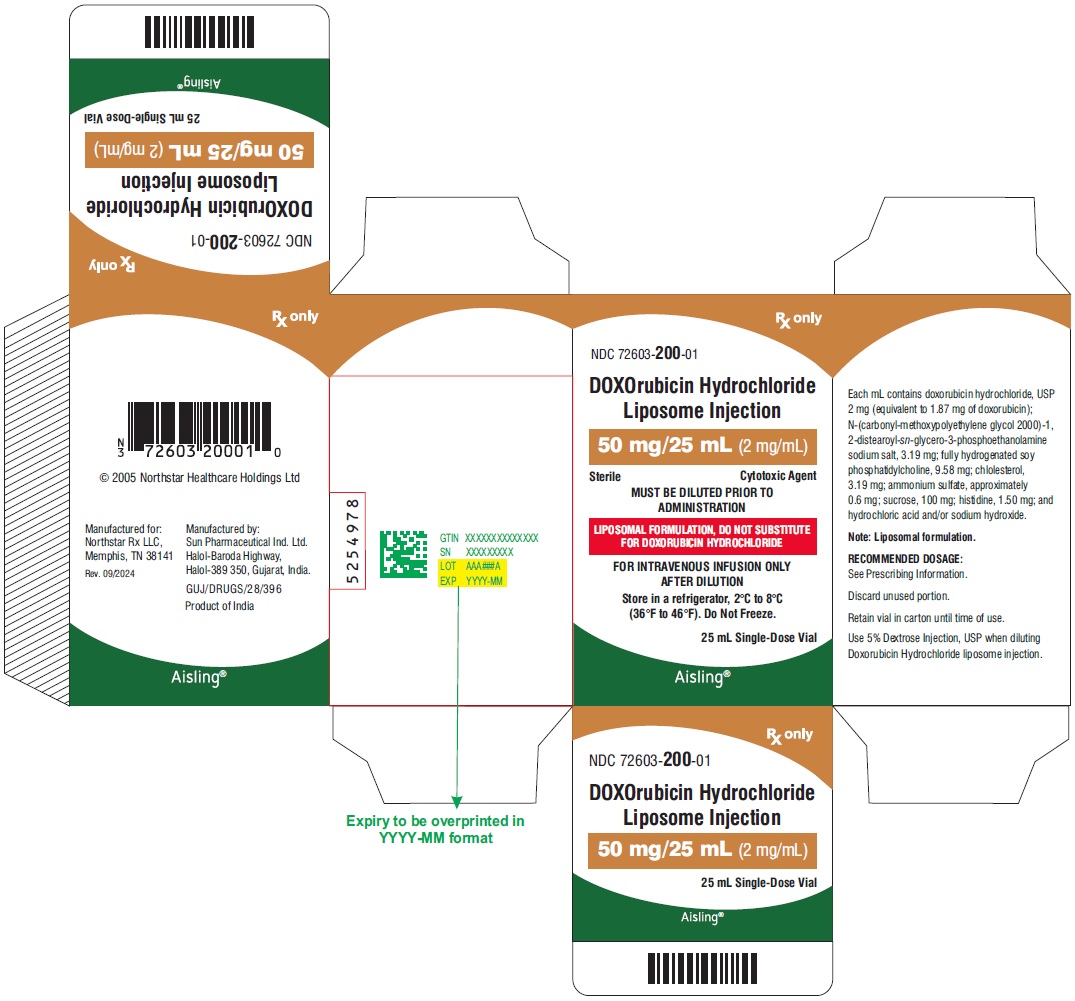
PACKAGE LABEL.PRINCIPAL DISPLAY PANEL - CARTON - 25 ML Rx only NDC 72603- 200 -01 DOXOrubicin Hydrochloride Liposome Injection 50 mg/25 mL (2 mg/mL) Sterile Cytotoxic Agent MUST BE DILUTED PRIOR TO ADMINISTRATION LIPOSOMAL FORMULATION, DO NOT SUBSTITUTE FOR DOXORUBICIN HYDROCHLORIDE FOR INTRAVENOUS INFUSION ONLY AFTER DILUTION Store in a refrigerator, 2°C to 8°C (36°F to 46°F). Do Not Freeze. 25 mL Single-Dose Vial Aisling doxo-carton-50mg-25ml
About this NDC listing & data coverage
What data is (and isn’t) available for this NDC — tap to expand
| NDC identity (package / product / labeler codes) | ✓ Available |
| Labeler | ✓ Available |
| Product & package description | ✓ Available |
| Marketing category & status | ✓ Available |
| Active ingredient / dosage form / route | ✓ Available |
| FDA label (SPL via DailyMed) | ✓ Available |
| Package photos | ✓ Available |
| Inactive ingredients (structured) | ✓ Available |
| NADAC pharmacy acquisition price (CMS) | — Not published for this NDC CMS publishes NADAC only for NDCs reported in its retail-pharmacy survey. |
| Orange Book / therapeutic-equivalence data | ✓ Available |
| HCPCS J-code billing crosswalk | ✓ Available |
| Medicaid utilization (CMS SDUD) | — Not published for this NDC CMS reports utilization only for NDCs with Medicaid claims above its privacy threshold. |