
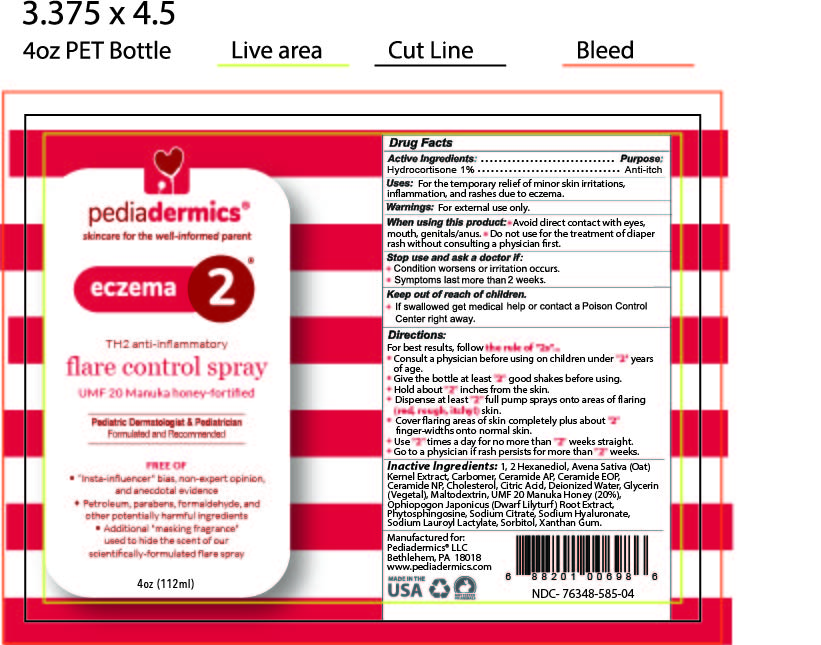
PEDIADERMICS ECZEMA 2 Hydrocortisone 1.12 g/112g Spray, 112 g — NDC 76348-585-04 (Billing 76348-0585-04)
This is a package of 112 g of PEDIADERMICS ECZEMA 2 Hydrocortisone 1.12 g/112g Spray from RENU LABORATORIES, LLC, marketed since Mar 2022 and currently FDA-listed. It is this product's only package size.
NDC database record
One package, one record: these facts belong to NDC 76348-585-04 alone.
- Record
- FDA NDC Directory package listing · Human OTC drug
- Code segments
- 76348 labeler · 585 product · 04 package
- Package marketed since
- Mar 18, 2022
- Sample package
- No — commercial package
- Listing certified through
- Dec 31, 2026
- Barcode (UPC-A, from the NDC)
- 3 7634858504 3
- FDA record last changed
- Jul 24, 2026
Identity & classification
Regulatory identifiers FDA, NLM and CMS codes for this package
- RxCUI (RxNorm): 317564
Where does this data come from?
- FDA openFDA NDC Directory · synced Oct 8, 2026
- FDA label on DailyMed · label index refreshed Oct 8, 2026
- RxNorm (NLM RxNav) · catalog refreshed Oct 8, 2026
- Medi-Span GPI (licensed)
- First Databank (licensed) · refreshed Oct 8, 2026
RxNorm drug class
This medicine belongs to the Corticosteroid class.
Where does this data come from?
- RxClass (NLM) · catalog refreshed Oct 8, 2026
Clinical
- It depends on the product. Tablets and oral granules are used for adrenal insufficiency, among other conditions. Injections are used for severe allergic states and skin diseases. R...
- Don't stop it suddenly if you take it for adrenal insufficiency. Stopping abruptly can cause adrenal crisis, which can be fatal. Talk to your prescriber before making any changes.
- Common ones are fluid retention, higher blood pressure, changes in blood sugar, mood changes, bigger appetite and weight gain. Call your doctor for signs of infection, vision chang...
- Grapefruit juice and some antifungals and antibiotics can raise hydrocortisone levels. Some seizure medicines and rifampicin can lower them. Tell me about any diabetes medicines, w...
Patient education
Supplement & herbal interactions
Some supplements/herbs that may interact with Hydrocortisone — tap one for details:
Hydrocortisone may be associated with lower levels of 8 nutrients — worth a chat with your pharmacist, not a cause for alarm.
Where does this data come from?
- MedlinePlus (NLM) · refreshed Oct 8, 2026
- FDA label on DailyMed · label index refreshed Oct 8, 2026
Ask a licensed pharmacist directly — free, answered by our team.
Pricing
A drug doesn't have one price. Each row is a different public payment system, and none is what you'd pay at the counter — that depends on your insurance. The ⓘ on each row explains what it measures.
| Price system | Per mL | Per package |
|---|---|---|
| Retail pharmacies payNADAC · weekly | Not in the retail survey — common for institutional, discontinued, or low-volume packs. | |
| Medicaid paysCMS SDUD · 12 mo | No recent Medicaid claims on file for this NDC — rare and low-volume NDCs are suppressed in the public data. | |
| Medicare drug plans payPart D · quarterly | No Part D plan price is available for this NDC in our data. | |
Where does this data come from?
- CMS NADAC weekly file
- CMS ASP pricing files · refreshed Sep 20, 2026
- CMS Medicaid State Drug Utilization Data · refreshed Oct 9, 2026
- CMS Part D plan pricing files · refreshed Sep 24, 2026
- VA National Acquisition Center price file
Packaging — all sizes for this product
| Package NDC | Description | Marketing start | Marketing end | Status |
|---|---|---|---|---|
| 76348-0585-04 You're viewing this Main listing | 112 g in 1 BOTTLE, SPRAY | 2022-03-18 | — | Active |
Therapeutic equivalents
| Product | Labeler | Pack | NADAC/unit | TE | Status | Price vs. this |
|---|---|---|---|---|---|---|
| Anti Itch 1 g/100g 00363-9801-01 | Walgreens | 1 can | — | — | FDA listed | — |
| Rite Aid Cortisone 1 g/100g 11822-0113-03 | Rite | 85 g | — | — | FDA listed | — |
| Cooling Itch Relief 1 g/100g 13709-0310-01 | NeilMed | 85 g | — | — | FDA listed | — |
| Anti Itch 1 g/100g 13709-0327-01 | Neilmed | 1 can | — | — | FDA listed | — |
| Kroger Anti Itch 1 g/100g 30142-0270-03 | The | 85 g | — | — | FDA listed | — |
| Cortizone 10 Fast Acting Itch Relief Cooling 1 g/100g 41167-0343-00 | Chattem, | 76 g | — | — | FDA listed | — |
| Instant Cooling Itch Relief 10 mg/g 51316-0388-03 | CVS | 85 g | — | — | FDA listed | — |
| American Red Cross Anti-Itch 1 g/100g 51628-4527-01 | MY | 141 g | — | — | FDA listed | — |
| Hydrocortisone 1.13 g/113g 56104-0250-00 | Premier | 113 g | — | — | FDA listed | — |
| DCH Labs Cortisone 1 g/100g 72839-0113-03 | Derma | 85 g | — | — | FDA listed | — |
| American Red Cross Anti-Itch 1 g/100g 75742-0070-01 | Zhejiang | 141 g | — | — | FDA listed | — |
| Pediadermics Eczema 2 1.12 g/112gthis 76348-0585-04 | RENU | 112 g | — | — | FDA listed | — |
| Hydrocortisone 10 mg/mL 79481-9967-01 | Meijer | 74 ml | — | — | FDA listed | — |
| Equate Cortisone 1 g/100g 79903-0213-03 | Walmart | 85 g | — | — | FDA listed | — |
| Hydrocortisone 10 mg/mL 81522-0914-01 | FSA | 74 ml | — | — | FDA listed | — |
Where does this data come from?
- FDA openFDA NDC Directory · synced Oct 8, 2026
- FDA Orange Book · refreshed Oct 9, 2026
- CMS NADAC weekly file
Availability & generic status
We did not find an FDA-approved generic match for this exact strength, form and route.
Where does this data come from?
- FDA Orange Book · refreshed Oct 9, 2026
Inactive Ingredients / Excipients
Inactive ingredients, also called excipients, are components of the drug product other than the active ingredient. They may include fillers, dyes, coatings, preservatives, flavors, or other formulation ingredients.
🧪 Avoiding an ingredient? See Hydrocortisone inactive ingredients by manufacturer: every current product's list side by side, so you can ask your pharmacy for the version that does not list it.
💡 Tap an ingredient (hover on desktop) to see what it is and why it’s used.
-
UNII TR046Y3K1G
A liquid alcohol derived from petroleum or plant sources. It acts as a solvent and humectant in medicines, helping dissolve active ingredients and retain moisture in the formulation.
-
UNII 0A5MM307FC
A synthetic polymer that absorbs water and forms a thick, gel-like substance. In medicines, it works as a thickener and stabilizer to improve texture and help ingredients stay mixed together in creams, gels, and lotions.
-
UNII 5THT33P7X7
A waxy, lipid-like substance derived from animal or plant sources. It helps soften and moisturize the skin by acting as an emollient and skin-conditioning agent in topical medicines and creams.
-
UNII F1X8L2B00J
A naturally derived fatty substance that helps bind and condition the product's texture. It works as an emollient and skin-conditioning agent in topical formulations, helping maintain moisture and smoothness.
-
UNII 4370DF050B
Ceramide NP is a waxy, lipid-based substance that mimics natural skin oils. It's used in topical formulations as an emollient and skin-conditioning agent to help soften, smooth, and protect the skin barrier.
-
UNII 97C5T2UQ7J
Cholesterol is a fatty substance found naturally in animal tissues. In medications, it's used as an ingredient in liposomal formulations and lipid-based drug delivery systems to help encapsulate and stabilize active drugs for better absorption.
-
UNII 2968PHW8QP
A weak organic acid derived from citrus fruits or made through fermentation. It works as a buffer to control pH, a preservative to extend shelf life, and a flavoring agent in medications.
-
UNII 147D247K3P
Ethylhexylglycerin is a synthetic preservative used to prevent bacteria and mold from growing in medicines and personal care products. It helps keep the product safe and stable throughout its shelf life.
-
UNII PDC6A3C0OX
Glycerin is a clear, thick liquid derived from plant oils or fats. It acts as a humectant to retain moisture, a sweetener, and a solvent in medications.
-
UNII Y9H1V576FH
Honey is a natural sweetener made by bees from flower nectar. In medicines, it adds sweetness to improve taste and may help soothe throat irritation in lozenges or syrups.
-
UNII YSE9PPT4TH
Hyaluronate sodium is a natural carbohydrate that holds moisture. It's used in medicines as a lubricant, thickener, and moisture-retaining agent to improve texture and delivery of the active ingredient.
-
UNII 7CVR7L4A2D
A starch-derived carbohydrate produced by breaking down corn, potato, or tapioca starch. It functions as a filler and binder to give the medicine bulk and texture, and sometimes as a mild sweetener or texture enhancer in powders and tablets.
-
UNII Z6J799EAJK
Oat is a cereal grain used in medicines as a filler and binder. It helps give the medication its shape and structure while adding bulk to the formulation.
-
UNII HIE492ZZ3T
Phenoxyethanol is a synthetic preservative and antimicrobial agent used to prevent bacterial and fungal growth in medicines and cosmetic products, extending shelf life and maintaining product safety.
-
UNII GIN46U9Q2Q
Phytosphingosine is a naturally derived fatty compound that helps stabilize and thicken skincare and cosmetic formulations. It works as an emollient and conditioning agent to improve texture and skin feel in topical products.
-
UNII 1Q73Q2JULR
Sodium citrate is a salt derived from citric acid. It works as a buffer to maintain the medicine's pH level and may also help improve taste or act as a preservative in the formulation.
-
UNII 7243K85WFO
Sodium lauroyl lactylate is a mild surfactant derived from natural fats and lactic acid. It acts as an emulsifier and solubilizer to help blend oil and water-based ingredients and improve how the body absorbs the active drug.
-
UNII 8KW3E207O2
A liquid sweetener made from sorbitol, a sugar alcohol derived from glucose. It sweetens the medicine and also acts as a humectant to help retain moisture and improve texture in liquid formulations.
-
UNII 059QF0KO0R
Water is a liquid solvent that dissolves and mixes ingredients together in liquid medicines, syrups, and injections. It helps distribute the active drug evenly throughout the product.
-
UNII TTV12P4NEE
Xanthan gum is a thickening and stabilizing ingredient made from fermented corn or other sugars. It's added to medicines to improve texture, prevent separation of liquids and solids, and help the product stay consistent.
20 inactive ingredients listed in the exact product block matched to this NDC.
Label-section wording can be broader than the structured product block and may mention additional formulation ingredients.
Where does this data come from?
ingredient classCode="IACT" elements from the exact product block matched by this NDC. Label-section narrative from DailyMed / the openFDA label index is shown separately when available.- FDA label on DailyMed · label index refreshed Oct 8, 2026
- FDA openFDA NDC Directory · synced Oct 8, 2026
Inactive ingredient FAQ
Are inactive ingredients the same for every manufacturer?
Why might an inactive ingredient be missing?
Can inactive ingredients matter?
Manufacturer & labeler
More NDCs from RENU LABORATORIES, LLC labeler code 76348
- Mg plus Menthol with Hemp 5.6 g/112g Cream NDC 76348-471-04
- EXTREME EMU Menthol, Methyl Salicylate 11.2 g/112g; 2.24 g/112g Cream NDC 76348-495-04
- Mag 5 PT Cooling Formula Recovery Cream Menthol 22.7 g/454g Cream NDC 76348-510-05
- MAG 5 PT WARMING FORMULA Menthol 5.6 g/112g Cream NDC 76348-511-05
- MAG 5 PT ROLL-ON PAIN RELIEF COOLING Menthol 4.2 g/84g Liquid NDC 76348-517-01
- Pediadermics eczema 3 Colloidal Oatmeal, Dimethicone 3.36 g/168g; .168 g/168g Cream NDC 76348-580-06
- Electrum Numb Foam Lidocaine HCI 1.92 g/48mL Soap NDC 76348-596-17
- Impact Melanoma SPF 30 ZINC OXIDE 17.5 g/1000g; 70 g/1000g; 10 g/1000g; 12.5 g/1000g Lotion NDC 76348-598-01
- Bright Guard Sport SPF ZINC 17.5 g/1000g; 70 g/1000g; 10 g/1000g; 12.5 g/1000g Lotion NDC 76348-675-01
- Bright Guard Natural SPF 30 Zinc Oxide 209 g/950g Lotion NDC 76348-676-01
- DermaRad Relief Lidocaine Emulsion 1.18 g/118mL; 4.72 g/118mL Emulsion NDC 76348-720-01
- Calm and Correct Serum with Lidocaine Lidocaine 3 percent 1.5 g/50mL Liquid NDC 76348-725-01
Where does this data come from?
- FDA openFDA NDC Directory · synced Oct 8, 2026
- Drugs@FDA
FDA label — Drug Facts FDA SPL
🎯 Indications and Usage ▾
Uses: For the temporary relief of minor skin irritations, inflammation and rashes due to eczema
⏱️ Dosage and Administration ▾
Directions For best results follow the rule of "2s" ... Consult a physician before using on children under "2" years of age Give the bottle at least "2" good shakes before using Hold the botle about "2" inches from the skin Dispense at least "2" full pump sprays onto areas of flaring (red, rough, itchy) skin Cover flaring areas of skin completely plus about "2" finger-widths onto normal skin Use "2" times a day for no more than "2" weeks straight. Go to a physician if rash persists for more than "2" weeks
⚠️ Warnings ▾
Warnings For external use only
🧪 Active Ingredient ▾
Active Ingredients: Hydrocortisone 1%
🧪 Inactive Ingredients ▾
Inactive Ingredients 1, 2 Hexanediol, Avena Sativa (Oat) Kernel Extract, Carbomer, Ceramide AP, Ceramide EOP, Ceramide NP, Cholesterol, Citric Acid, Deionized Water, Glycerin (Vegetal), Maltodextrin, UMF-20 Manuka Honey (20%), Ophiopogon Japonicus (Dwarf Lilyturf) Root Extract, Phytosphingosine, Sodium Citrate, Sodium Hyaluronate, Sodium Lauroyl Lactylate, Sorbitol, Xanthan Gum
🎯 Purpose ▾
Purpose Anti-itch
📄 When Using This Product ▾
When using this product Avoid direct contact with eyes, mouth, genitals/anus Do not use for treatment of diaper rash without consulting a physician first
📄 Stop Use and Ask a Doctor If ▾
Stop use and ask a doctor if Condition worsens or irritation occurs Symptoms last more than 2 weeks
📄 Keep Out of Reach of Children ▾
Keep out of reach of children If swallowed get medical help or contact a Poison Control Center right away
📄 Recent Major Changes ▾
Dosage and Administration - NO Major Changes at all
📄 Package Label / Principal Display Panel ▾
BOTTLE ARTWORK BOTTLE ART
Medicare Part D spend CMS · PART D · 2026 (Q1)
Reported adverse events (FAERS)
Top reported reactions
Age at onset
Reporter sex
Serious outcomes
Where does this data come from?
About this NDC listing & data coverage
What data is (and isn’t) available for this NDC — tap to expand
| NDC identity (package / product / labeler codes) | ✓ Available |
| Labeler | ✓ Available |
| Product & package description | ✓ Available |
| Marketing category & status | ✓ Available |
| Active ingredient / dosage form / route | ✓ Available |
| FDA label (SPL via DailyMed) | ✓ Available |
| Package photos | ✓ Available |
| Inactive ingredients (structured) | ✓ Available |
| NADAC pharmacy acquisition price (CMS) | — Not published for this NDC CMS publishes NADAC only for NDCs reported in its retail-pharmacy survey. |
| Orange Book / therapeutic-equivalence data | — Not published for this NDC Applies only to products approved under an NDA/ANDA; many listings are out of scope. |
| HCPCS J-code billing crosswalk | — Not published for this NDC Most self-administered / retail products have no J-code — that is normal. |
| Medicaid utilization (CMS SDUD) | — Not published for this NDC CMS reports utilization only for NDCs with Medicaid claims above its privacy threshold. |