
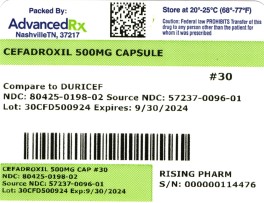
Cefadroxil 500 mg Capsule, 20-count — NDC 80425-0198-3 (Billing 80425-0198-03)
This is a package of 20 capsules of Cefadroxil 500 mg Capsule from Advanced Rx Pharmacy of Tennessee, LLC, marketed since Nov 2022 and currently FDA-listed.
NDC database record
One package, one record: these facts belong to NDC 80425-0198-3 alone.
- Record
- FDA NDC Directory package listing · Human prescription drug
- Code segments
- 80425 labeler · 0198 product · 3 package
- Package marketed since
- Feb 9, 2024
- Sample package
- No — commercial package
- Listing certified through
- Dec 31, 2026
- Billing quantity
- 20 EA per package
- Barcode (UPC-A, from the NDC)
- 3 8042501983 3
- FDA record last changed
- Jul 24, 2026
Identity & classification
Regulatory identifiers FDA, NLM and CMS codes for this package
- RxCUI (RxNorm): 309049
Where does this data come from?
- FDA openFDA NDC Directory · synced Oct 8, 2026
- FDA label on DailyMed · label index refreshed Oct 8, 2026
- RxNorm (NLM RxNav) · catalog refreshed Oct 1, 2026
- Medi-Span GPI (licensed)
- First Databank (licensed) · refreshed Oct 8, 2026
RxNorm drug class
This medicine belongs to the Cephalosporin Antibacterial class.
Where does this data come from?
- RxClass (NLM) · catalog refreshed Oct 1, 2026
Clinical
- It is an antibiotic for bacterial infections of the urinary tract, the skin, and the throat or tonsils (strep). It will not help colds, flu or other viral illnesses. Your prescribe...
- You can take it with or without food. If it upsets your stomach, taking it with a meal may help. Follow the directions on your pharmacy label for how often to take it.
- Take it for the full course your prescriber gave you. For strep throat or tonsillitis, treatment is at least 10 days. Stopping early can let the infection come back.
- Tell your prescriber first. Some people with a penicillin allergy also react to cephalosporins like cefadroxil, up to about 10% in those with a history of penicillin allergy. If yo...
Patient education
Supplement & herbal interactions
Some supplements/herbs that may interact with Cefadroxil — tap one for details:
Cefadroxil may be associated with lower levels of 7 nutrients — worth a chat with your pharmacist, not a cause for alarm.
Where does this data come from?
- MedlinePlus (NLM) · refreshed Oct 8, 2026
- FDA label on DailyMed · label index refreshed Oct 8, 2026
Ask a licensed pharmacist directly — free, answered by our team.
Pricing
A drug doesn't have one price. Each row is a different public payment system, and none is what you'd pay at the counter — that depends on your insurance. The ⓘ on each row explains what it measures.
| Price system | Per each | Per package |
|---|---|---|
| Retail pharmacies payNADAC · weekly | Not in the retail survey — common for institutional, discontinued, or low-volume packs. | |
| Medicaid paysCMS SDUD · 12 mo | No recent Medicaid claims on file for this NDC — rare and low-volume NDCs are suppressed in the public data. | |
| Medicare drug plans payPart D · Q2 2026 | $0.4938 | $9.88 / 20 capsules |
Where does this data come from?
- CMS NADAC weekly file
- CMS ASP pricing files · refreshed Sep 20, 2026
- CMS Medicaid State Drug Utilization Data · refreshed Oct 8, 2026
- CMS Part D plan pricing files · refreshed Sep 24, 2026
- VA National Acquisition Center price file
Packaging — all sizes for this product
| Package NDC | Description | Marketing start | Marketing end | Status |
|---|---|---|---|---|
| 80425-0198-01 80425-0198-1 Main listing | 10 CAPSULE in 1 BOTTLE | 2023-11-02 | — | Active |
| 80425-0198-02 80425-0198-2 | 30 CAPSULE in 1 BOTTLE | 2023-11-02 | — | Active |
| 80425-0198-03 You're viewing this | 20 CAPSULE in 1 BOTTLE | 2024-02-09 | — | Active |
You're viewing one of 3 pack sizes for this product.
Pack size FAQ
What quantity is in this package?
How does this package differ from NDC 80425-0198-01?
What NDC number is used to bill for this package of Cefadroxil 500 mg Capsule?
Therapeutic equivalents
| Product | Labeler | Pack | NADAC/unit | TE | Status | Price vs. this |
|---|---|---|---|---|---|---|
| Cefadroxil 500 mg 00093-3196-01 | Teva | 100 capsules | $0.269 | AB | Availability likely | — |
| Cefadroxil 500 mg 16714-0388-01 | NorthStar | 50 capsules | $0.269 | AB | Availability likely | — |
| Cefadroxil 500 mg 57237-0096-01 | Rising | 100 capsules | $0.269 | AB | Availability likely | — |
| Cefadroxil 500 mg 65862-0085-01 | Aurobindo | 100 capsules | $0.269 | AB | Availability likely | — |
| Cefadroxil 500 mg 68180-0180-01 | Lupin | 100 capsules | $0.269 | AB | Availability likely | — |
| Cefadroxil 500 mg 43063-0553-10 | PD-Rx | 10 capsules | — | AB | FDA listed | — |
| Cefadroxil 500 mg 43063-0595-20 | PD-Rx | 20 capsules | — | AB | FDA listed | — |
| Cefadroxil 500 mg 50090-6050-00 | A-S | 10 capsules | — | AB | FDA listed | — |
| Cefadroxil 500 mg 63187-0883-06 | Proficient | 6 capsules | — | AB | FDA listed | — |
| Cefadroxil 500 mg 63629-7987-01 | Bryant | 20 capsules | — | AB | FDA listed | — |
| Cefadroxil 500 mg 63629-7988-01 | Bryant | 30 capsules | — | AB | FDA listed | — |
| Cefadroxil 500 mg 63629-8253-01 | Bryant | 14 capsules | — | AB | FDA listed | — |
| Cefadroxil 500 mg 63629-9456-01 | Bryant | 20 capsules | — | AB | FDA listed | — |
| Cefadroxil 500 mg 67296-0491-01 | Redpharm | 20 capsules | — | AB | FDA listed | — |
| Cefadroxil 500 mg 67296-1727-01 | RedPharm | 14 capsules | — | AB | FDA listed | — |
| Cefadroxil 500 mg 67296-2199-01 | Redpharm | 14 capsules | — | AB | FDA listed | — |
| Cefadroxil 500 mg 67296-2221-02 | Redpharm | 20 capsules | — | AB | FDA listed | — |
| Cefadroxil 500 mg 68071-3597-06 | NuCare | 6 capsules | — | AB | FDA listed | — |
| Cefadroxil 500 mg 68071-4515-01 | NuCare | 10 capsules | — | AB | FDA listed | — |
| Cefadroxil 500 mg 68071-4690-06 | NuCare | 6 capsules | — | AB | FDA listed | — |
| Cefadroxil 500 mg 68071-4938-01 | NuCare | 10 capsules | — | AB | FDA listed | — |
| Cefadroxil 500 mg 68071-5234-06 | NuCare | 6 capsules | — | AB | FDA listed | — |
| Cefadroxil 500 mg 68788-8261-02 | Preferred | 50 capsules | — | AB | FDA listed | — |
| Cefadroxil 500 mg 68788-8479-02 | Preferred | 20 capsules | — | AB | FDA listed | — |
| Cefadroxil 500 mg 70518-3580-00 | REMEDYREPACK | 20 capsules | — | AB | FDA listed | — |
| Cefadroxil 500 mg 72189-0103-06 | DIRECT | 6 capsules | — | AB | FDA listed | — |
| Cefadroxil 500 mg 72189-0445-06 | Direct_Rx | 6 capsules | — | AB | FDA listed | — |
| Cefadroxil 500 mg 72189-0506-20 | Direct_Rx | 20 capsules | — | AB | FDA listed | — |
| Cefadroxil 500 mgthis 80425-0198-03 | Advanced | 20 capsules | — | AB | FDA listed | — |
| Cefadroxil 500 mg 80425-0400-01 | Advanced | 10 capsules | — | AB | FDA listed | — |
| Cefadroxil 500 mg 80425-0432-01 | Advanced | 10 capsules | — | AB | FDA listed | — |
Where does this data come from?
- FDA openFDA NDC Directory · synced Oct 8, 2026
- FDA Orange Book · refreshed Oct 3, 2026
- CMS NADAC weekly file
Availability & generic status
This product is an FDA-approved generic. Other versions of the same drug are listed under Therapeutic equivalents, least expensive first.
Where does this data come from?
- FDA Orange Book · refreshed Oct 3, 2026
What it looks like
Where does this data come from?
- FDA label on DailyMed · label index refreshed Oct 8, 2026
Inactive Ingredients / Excipients
Inactive ingredients, also called excipients, are components of the drug product other than the active ingredient. They may include fillers, dyes, coatings, preservatives, flavors, or other formulation ingredients.
🧪 Avoiding an ingredient? See Cefadroxil inactive ingredients by manufacturer: every current product's list side by side, so you can ask your pharmacy for the version that does not list it.
Where does this data come from?
IACT rows and label-wide narrative are kept separate; availability and product-level specificity depend on the submitted label.- FDA label on DailyMed · label index refreshed Oct 8, 2026
- FDA openFDA NDC Directory · synced Oct 8, 2026
Inactive ingredient FAQ
Are inactive ingredients the same for every manufacturer?
Why might an inactive ingredient be missing?
Can inactive ingredients matter?
Manufacturer & labeler
More NDCs from Advanced Rx Pharmacy of Tennessee, LLC labeler code 80425
- Ciprofloxacin HCL 500 mg Tablet, Film Coated NDC 80425-0192-1
- Prednisone 10 mg Tablet NDC 80425-0193-1
- Venlafaxine HCL ER 150 mg Capsule, Extended Release NDC 80425-0194-2
- Topiramate 50 mg Tablet NDC 80425-0195-2
- Gabapentin 300 mg Capsule NDC 80425-0196-1
- Diclofenac Sodium DR 50 mg Tablet, Delayed Release NDC 80425-0197-2
- Gabapentin 100 mg Capsule NDC 80425-0199-1
- Sertraline Hydrochloride 50 mg Tablet, Film Coated NDC 80425-0200-1
- Gabapentin 600 mg Tablet, Coated NDC 80425-0201-1
- Ramelteon 8 mg Tablet, Film Coated NDC 80425-0203-1
- Gabapentin 800 mg Tablet, Coated NDC 80425-0204-1
- Baclofen 20 mg Tablet NDC 80425-0205-1
Where does this data come from?
- FDA openFDA NDC Directory · synced Oct 8, 2026
- Drugs@FDA
Full prescribing information FDA SPL
🎯 Indications and Usage ▾
Indications and Usage Cefadroxil is indicated for the treatment of patients with infection caused by susceptible strains of the designated organisms in the following diseases: Urinary tract infections caused by E. coli, P. mirabilis, and Klebsiella species. Skin and skin structure infections caused by staphylococci and/or streptococci. Pharyngitis and/or tonsillitis caused by Streptococcus pyogenes (Group A beta-hemolytic streptococci).
Note: Only penicillin by the intramuscular route of administration has been shown to be effective in the prophylaxis of rheumatic fever. Cefadroxil is generally effective in the eradication of streptococci from the oropharynx. However, data establishing the efficacy of cefadroxil for the prophylaxis of subsequent rheumatic fever are not available.
Note: Culture and susceptibility tests should be initiated prior to and during therapy. Renal function studies should be performed when indicated. To reduce the development of drug-resistant bacteria and maintain the effectiveness of cefadroxil and other antibacterial drugs, cefadroxil should be used only to treat or prevent infections that are proven or strongly suspected to be caused by susceptible bacteria.
When culture and susceptibility information are available, they should be considered in selecting or modifying antibacterial therapy. In the absence of such data, local epidemology and susceptibility patterns may contribute to the empiric selection of therapy.
⏱️ Dosage and Administration ▾
Dosage and Administration Cefadroxil is acid-stable and may be administered orally without regard to meals. Administration with food may be helpful in diminishing potential gastrointestinal complaints occasionally associated with oral cephalosporin therapy. Adults Urinary Tract Infections: For uncomplicated lower urinary tract infections (i.e., cystitis) the usual dosage is 1 or 2 g per day in a single (q.d.) or divided doses (b.i.d.).
For all other urinary tract infections the usual dosage is 2 g per day in divided doses (b.i.d.). Skin and Skin Structure Infections: For skin and skin structure infections the usual dosage is 1 g per day in single (q.d.) or divided doses (b.i.d.). Pharyngitis and Tonsillitis: Treatment of group A beta-hemolytic streptococcal pharyngitis and tonsillitis—1 g per day in single (q.d.) or divided doses (b.i.d.) for 10 days.
Children For urinary tract infections, the recommended daily dosage for children is 30 mg/kg/day in divided doses every 12 hours. For pharyngitis, tonsillitis, and impetigo, the recommended daily dosage for children is 30 mg/kg/day in a single dose or in equally divided doses every 12 hours. For other skin and skin structure infections, the recommended daily dosage is 30 mg/kg/day in equally divided doses every 12 hours.
In the treatment of beta-hemolytic streptococcal infections, a therapeutic dosage of cefadroxil should be administered for at least 10 days. Renal Impairment In patients with renal impairment, the dosage of cefadroxil should be adjusted according to creatinine clearance rates to prevent drug accumulation. The following schedule is suggested.
In adults, the initial dose is 1000 mg of cefadroxil and the maintenance dose (based on the creatinine clearance rate [mL/min/1.73 m2]) is 500 mg at the time intervals listed below. Creatinine Clearances Dosage Interval 0 to 10 mL/min 36 hours 10 to 25 mL/min 24 hours 25 to 50 mL/min 12 hours Patients with creatinine clearance rates over 50 mL/min may be treated as if they were patients having normal renal function.
⛔ Contraindications ▾
Contraindications Cefadroxil is contraindicated in patients with known allergy to the cephalosporin group of antibiotics.
⚠️ Warnings and Cautions ▾
Warnings and Precautions BEFORE THERAPY WITH CEFADROXIL IS INSTITUTED, CAREFUL INQUIRY SHOULD BE MADE TO DETERMINE WHETHER THE PATIENT HAS HAD PREVIOUS HYPERSENSITIVITY REACTIONS TO CEFADROXIL, CEPHALOSPORINS, PENICILLINS, OR OTHER DRUGS. IF THIS PRODUCT IS TO BE GIVEN TO PENICILLIN-SENSITIVE PATIENTS, CAUTION SHOULD BE EXERCISED BECAUSE CROSS-SENSITIVITY AMONG BETA-LACTAM ANTIBIOTICS HAS BEEN CLEARLY DOCUMENTED AND MAY OCCUR IN UP TO 10% OF PATIENTS WITH A HISTORY OF PENICILLIN ALLERGY. IF AN ALLERGIC REACTION TO CEFADROXIL OCCURS, DISCONTINUE THE DRUG.
SERIOUS ACUTE HYPERSENSITIVITY REACTIONS MAY REQUIRE TREATMENT WITH EPINEPHRINE AND OTHER EMERGENCY MEASURES, INCLUDING OXYGEN, INTRAVENOUS FLUIDS, INTRAVENOUS ANTIHISTAMINES, CORTICOSTEROIDS, PRESSOR AMINES, AND AIRWAY MANAGEMENT, AS CLINICALLY INDICATED. Clostridium difficile associated diarrhea (CDAD) has been reported with use of nearly all antibacterial agents, including cefadroxil, and may range in severity from mild diarrhea to fatal colitis. Treatment with antibacterial agents alters the normal flora of the colon leading to overgrowth of C. difficile.
C. difficile produces toxins A and B which contribute to the development of CDAD. Hypertoxin producing strains of C. difficile cause increased morbidity and mortality, as these infections can be refractory to antimicrobial therapy and may require colectomy. CDAD must be considered in all patients who present with diarrhea following antibiotic use.
Careful medical history is necessary since CDAD has been reported to occur over two months after the administration of antibacterial agents. If CDAD is suspected or confirmed, ongoing antibiotic use not directed against C. difficile may need to be discontinued. Appropriate fluid and electrolyte management, protein supplementation, antibiotic treatment of C. difficile, and surgical evaluation should be instituted as clinically indicated.
General Cefadroxil should be used with caution in the presence of markedly impaired renal function (creatinine clearance rate of less than 50 mL/min/1.73 m2). (See DOSAGE AND ADMINISTRATION.) In patients with known or suspected renal impairment, careful clinical observation and appropriate laboratory studies should be made prior to and during therapy. Prescribing cefadroxil in the absence of a proven or strongly suspected bacterial infection or a prophylactic indication is unlikely to provide benefit to the patient and increases the risk of the development of drug-resistant bacteria.
Prolonged use of cefadroxil may result in the overgrowth of nonsusceptible organisms. Careful observation of the patient is essential. If superinfection occurs during therapy, appropriate measures should be taken.
Cefadroxil should be prescribed with caution in individuals with history of gastrointestinal disease particularly colitis. Information for Patients Patients should be counseled that antibacterial drugs including cefadroxil should only be used to treat bacterial infections. They do not treat viral infections (e.g., the common cold).
When cefadroxil is prescribed to treat a bacterial infection, patients should be told that although it is common to feel better early in the course of therapy, the medication should be taken exactly as directed. Skipping doses or not completing the full course of therapy may (1) decrease the effectiveness of the immediate treatment and (2) increase the likelihood that bacteria will develop resistance and will not be treatable by cefadroxil or other antibacterial drugs in the future. Diarrhea is a common problem caused by antibiotics which usually ends when the antibiotic is discontinued.
Sometimes after starting treatment with antibiotics, patients can develop watery and bloody stools (with or without stomach cramps and fever) even as late as two or more months after having taken the last dose of the antibiotic. If this occurs, patients should contact their physician as soon as possible. Drug/Laboratory Test Interactions Positive… [Excerpted — this section continues on DailyMed.]
🤒 Adverse Reactions ▾
Adverse Reactions Gastrointestinal Onset of pseudomembranous colitis symptoms may occur during or after antibiotic treatment (see WARNINGS). Dyspepsia, nausea and vomiting have been reported rarely. Diarrhea has also occurred.
Hypersensitivity Allergies (in the form of rash, urticaria, angioedema, and pruritus) have been observed. These reactions usually subsided upon discontinuation of the drug. Anaphylaxis has also been reported.
Other Other reactions have included hepatic dysfunction including cholestasis and elevations in serum transaminase, genital pruritus, genital moniliasis, vaginitis, moderate transient neutropenia, fever. Agranulocytosis, thrombocytopenia, idiosyncratic hepatic failure, erythema multiforme, Stevens-Johnson syndrome, serum sickness, and arthralgia have been rarely reported. In addition to the adverse reactions listed above which have been observed in patients treated with cefadroxil, the following adverse reactions and altered laboratory tests have been reported for cephalosporin-class antibiotics: Toxic epidermal necrolysis, abdominal pain, superinfection, renal dysfunction, toxic nephropathy, aplastic anemia, hemolytic anemia, hemorrhage, prolonged prothrombin time, positive Coombs’ test, increased BUN, increased creatinine, elevated alkaline phosphatase, elevated aspartate aminotransferase (AST), elevated alanine aminotransferase (ALT), elevated bilirubin, elevated LDH, eosinophilia, pancytopenia, neutropenia.
Several cephalosporins have been implicated in triggering seizures, particularly in patients with renal impairment, when the dosage was not reduced (see DOSAGE AND ADMINISTRATION and OVERDOSAGE). If seizures associated with drug therapy occur, the drug should be discontinued. Anticonvulsant therapy can be given if clinically indicated.
🆘 Overdosage ▾
Overdosage A study of children under six years of age suggested that ingestion of less than 250 mg/kg of cephalosporins is not associated with significant outcomes. No action is required other than general support and observation. For amounts greater than 250 mg/kg, induce gastric emptying. In five anuric patients, it was demonstrated that an average of 63% of a 1 g oral dose is extracted from the body during a 6 to 8 hour hemodialysis session.
🧬 Clinical Pharmacology ▾
Clinical Pharmacology Cefadroxil is rapidly absorbed after oral administration. Following single doses of 500 mg and 1000 mg, average peak serum concentrations were approximately 16 and 28 mcg/mL, respectively. Measurable levels were present 12 hours after administration.
Over 90% of the drug is excreted unchanged in the urine within 24 hours. Peak urine concentrations are approximately 1800 mcg/mL during the period following a single 500 mg oral dose. Increases in dosage generally produce a proportionate increase in cefadroxil urinary concentration.
The urine antibiotic concentration, following a 1 g dose, was maintained well above the MIC of susceptible urinary pathogens for 20 to 22 hours. Microbiology In vitro tests demonstrate that the cephalosporins are bactericidal because of their inhibition of cell-wall synthesis. Cefadroxil has been shown to be active against the following organisms both in vitro and in clinical infections (see INDICATIONS AND USAGE): Beta-hemolytic streptococci Staphylococci, including penicillinase-producing strains Streptococcus (Diplococcus) pneumoniae Escherichia coli Proteus mirabilis Klebsiella species Moraxella (Branhamella) catarrhalis Note: Most strains of Enterococcus faecalis (formerly Streptococcus faecalis) and Enterococcus faecium (formerly Streptococcus faecium) are resistant to cefadroxil.
It is not active against most strains of Enterobacter species, Morganella morganii (formerly Proteus morganii), and P. vulgaris. It has no activity against Pseudomonas species and Acinetobacter calcoaceticus (formerly Mima and Herellea species). Susceptibility Testing For specific information regarding susceptibility test interpretive criteria and associated test methods and quality control standards recognized by FDA for this drug, please see: https://www.fda.gov/STIC.
📦 How Supplied / Storage and Handling ▾
How Supplied/Storage and Handling Cefadroxil Capsules, USP 500 mg are maroon/white colored, size “0” hard gelatin capsules filled with white to off-white granular free flowing powder and imprinted with “C” on maroon opaque cap and “97” on white opaque body with black ink. Bottles of 10 Capsules NDC: 80425-0198-01 Bottles of 30 Capsules NDC: 80425-0198-02 Bottles of 20 Capsules NDC: 80425-0198-03 Store at 20° to 25°C (68° to 77°F); excursions permitted to 15° to 30°C (59° to 86°F) [see USP Controlled Room Temperature].
Distributed by: Rising Health, LLC Saddle Brook, NJ 07663 Made in India Code: TS/DRUGS/78/1996 Revised: 09/2018 Distributed by: Advanced Rx Pharmacy of Tennessee, LLC
📋 Description ▾
Description Cefadroxil, USP is a semisynthetic cephalosporin antibiotic intended for oral administration. It is a white to yellowish-white crystalline powder. It is soluble in water and it is acid-stable.
It is chemically designated as 5-Thia-1-azabicyclo[4.2.0]oct-2-ene-2-carboxylic acid, 7-[[amino(4-hydroxyphenyl)acetyl]amino]-3-methyl-8-oxo-, monohydrate, [6R-[6α,7β(R*)]]-. It has the formula C16H17N3O5S · H2O and the molecular weight of 381.40. It has the following structural formula: Cefadroxil capsules contain the following inactive ingredients: Lactose monohydrate, magnesium stearate, FD&C Blue No.1, D&C Red No.28, FD&C Red No.
40, titanium dioxide, gelatin, sodium lauryl sulphate, and edible black ink (black iron oxide). Description
📄 Package Label / Principal Display Panel ▾
Principal Display Panel label 1 label 2 Cefadroxil 500mg #20
Medicare Part D spend CMS · PART D · 2026 (Q1)
Reported adverse events (FAERS)
Top reported reactions
Reporter sex
Serious outcomes
Where does this data come from?
About this NDC listing & data coverage
What data is (and isn’t) available for this NDC — tap to expand
| NDC identity (package / product / labeler codes) | ✓ Available |
| Labeler | ✓ Available |
| Product & package description | ✓ Available |
| Marketing category & status | ✓ Available |
| Active ingredient / dosage form / route | ✓ Available |
| FDA label (SPL via DailyMed) | ✓ Available |
| Package photos | ✓ Available |
| Inactive ingredients (structured) | — Not published for this NDC The labeler did not submit a structured excipient list, or no SPL is available. |
| NADAC pharmacy acquisition price (CMS) | — Not published for this NDC CMS publishes NADAC only for NDCs reported in its retail-pharmacy survey. |
| Orange Book / therapeutic-equivalence data | ✓ Available |
| HCPCS J-code billing crosswalk | — Not published for this NDC Most self-administered / retail products have no J-code — that is normal. |
| Medicaid utilization (CMS SDUD) | — Not published for this NDC CMS reports utilization only for NDCs with Medicaid claims above its privacy threshold. |