
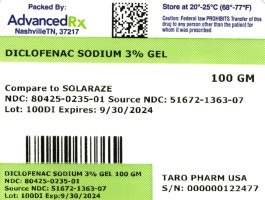
Diclofenac Sodium 30 mg/g Gel
Other active recalls for Diclofenac Sodium (different manufacturers) — 3 · tap to view
🆔 Identity & classification
Where does this data come from?
🏷️ RxNorm drug class
This medicine belongs to the Nonsteroidal Anti-inflammatory Drug class.
Where does this data come from?
🏭 Manufacturer & labeler
Where does this data come from?
🩺 Clinical
Diclofenac topical gel (Solaraze) is used to treat actinic keratosis (flat, scaly growths on the skin caused by too much sun exposure). Diclofenac is in a class of medications called nonsteroidal anti-inflammatory drugs (NSAIDs). The way diclofenac gel works to treat actinic keratosis is not known. Diclofenac is also available as a liquid (Pennsaid) and a gel (Voltaren) that are applied to the skin to treat arthritis pain. This monograph only gives information about diclofenac gel (Solaraze) for actinic keratosis. If you are using either of the products for osteoarthritis, read the monograph e...
Read the full MedlinePlus article ↗- An actinic keratosis — often just called an AK — is a rough, scaly patch on the skin caused by years of sun exposure. These patches are considered precancerous, meaning they could...
- What exactly is an actinic keratosis, and why do I need a prescription gel for it?
- The typical treatment course runs 60 to 90 days of twice-daily application — that's a solid commitment, but it's necessary for the gel to do its job. Here's the thing: even after y...
- How long do I need to use this gel, and how will I know it's working?
Patient education
Supplement & herbal interactions
Some supplements/herbs that may interact with Diclofenac Sodium — tap one for details:
Diclofenac Sodium may be associated with lower levels of 1 nutrient — worth a chat with your pharmacist, not a cause for alarm.
Where does this data come from?
Ask a licensed pharmacist directly — free, answered by our team.
🧪 Inactive Ingredients / Excipients
Inactive ingredients, also called excipients, are components of the drug product other than the active ingredient. They may include fillers, dyes, coatings, preservatives, flavors, or other formulation ingredients.
Where does this data come from?
IACT rows and label-wide narrative are kept separate; availability and product-level specificity depend on the submitted label.Inactive ingredient FAQ
Are inactive ingredients the same for every manufacturer?
Why might an inactive ingredient be missing?
Can inactive ingredients matter?
💲 Pricing
A drug doesn't have one price. Each row is a different public payment system, and none is what you'd pay at the counter — that depends on your insurance. The ⓘ on each row explains what it measures.
| Price system | Per g | Per package |
|---|---|---|
| Retail pharmacies payNADAC · weekly | Not in the retail survey — common for institutional, discontinued, or low-volume packs. | |
| Medicaid paysCMS SDUD · 12 mo | No recent Medicaid claims on file for this NDC — rare and low-volume NDCs are suppressed in the public data. | |
| Medicare drug plans payPart D · Q2 2026 | $0.5711 | $57.11 / 100 g |
Where does this data come from?
🔁 Therapeutic equivalents
| Product | Labeler | Pack | NADAC/unit | TE | Status | Price vs. this |
|---|---|---|---|---|---|---|
| Diclofenac Sodium 30 mg/g 00472-1783-10 | Actavis | 1 tube | $0.370 | AB | Availability likely | — |
| diclofenac sodium 30 mg/g 45802-0111-01 | Padagis | 1 tube | $0.370 | AB | Availability likely | — |
| Diclofenac Sodium 30 mg/g 62332-0581-31 | Alembic | 1 tube | $0.370 | AB | Availability likely | — |
| Diclofenac Sodium 30 mg/g 68462-0355-94 | GLENMARK | 1 tube | $0.370 | AB | Availability likely | — |
| Diclofenac Sodium 30 mg/g 00115-1483-56 | Amneal | 1 tube | — | — | Discontinued | — |
| Diclofenac Sodium 30 mg/g 45865-0260-01 | Medsource | 100 g | — | AB | FDA listed | — |
| Diclofenac Sodium 30 mg/g 46708-0581-31 | Alembic | 1 tube | — | AB | FDA listed | — |
| Diclofenac sodium 30 mg/g 51672-1363-03 | Sun | 1 tube | — | AB | FDA listed | — |
| diclofenac sodium 30 mg/g 63629-2526-01 | Bryant | 1 tube | — | AB | FDA listed | — |
| Diclofenac Sodium 30 mg/g 68071-3516-01 | NuCare | 1 tube | — | AB | FDA listed | — |
| Diclofenac sodium 30 mg/g 68071-3688-01 | NuCare | 1 tube | — | AB | FDA listed | — |
| diclofenac sodium 30 mg/g 68071-4859-01 | NuCare | 100 g | — | AB | FDA listed | — |
| Diclofenac sodium 30 mg/g 68788-8236-01 | Preferred | 1 tube | — | AB | FDA listed | — |
| Diclofenac Sodium 30 mg/g 68788-8456-01 | Preferred | 1 tube | — | AB | FDA listed | — |
| Diclofenac Sodium 30 mg/g 68788-9435-01 | Preferred | 1 tube | — | AB | FDA listed | — |
| diclofenac sodium 30 mg/g 70518-2526-00 | REMEDYREPACK | 1 tube | — | AB | FDA listed | — |
| Diclofenac Sodium 30 mg/g 70518-3315-00 | REMEDYREPACK | 1 tube | — | AB | FDA listed | — |
| Diclofenac Sodium 30 mg/g 70518-3779-00 | REMEDYREPACK | 1 tube | — | AB | FDA listed | — |
| Diclofenac sodium 30 mg/g 71205-0538-00 | Proficient | 1 tube | — | AB | FDA listed | — |
| diclofenac sodium 30 mg/g 71205-0692-00 | Proficient | 1 tube | — | AB | FDA listed | — |
| Diclofenac Sodium 30 mg/g 71205-0752-00 | Proficient | 1 tube | — | AB | FDA listed | — |
| diclofenac sodium 30 mg/g 72162-1391-01 | Bryant | 1 tube | — | AB | FDA listed | — |
| Diclofenac Sodium 30 mg/g 72189-0040-01 | Direct_Rx | 1 g | — | AB | FDA listed | — |
| Diclofenac Sodium Gel 30 mg/g 72189-0379-01 | Direct_Rx | 1 g | — | AB | FDA listed | — |
| Diclofenac Sodium Gel 30 mg/g 72189-0473-01 | Direct_Rx | 1 g | — | AB | FDA listed | — |
| Diclofenac Sodium 30 mg/g 76420-0025-01 | Asclemed | 100 g | — | — | FDA listed | — |
| Diclofenac Sodium 30 mg/g 76420-0132-01 | Asclemed | 100 g | — | AB | FDA listed | — |
| Diclofenac Sodium 30 mg/g 76420-0261-01 | Asclemed | 1 tube | — | AB | FDA listed | — |
| Diclofenac sodium 30 mg/g 76420-0275-01 | Asclemed | 100 g | — | AB | FDA listed | — |
| Diclofenac Sodium 30 mg/g 80425-0234-01 | Advanced | 1 tube | — | — | FDA listed | — |
| Diclofenac Sodium 30 mg/gthis 80425-0235-01 | Advanced | 1 tube | — | AB | FDA listed | — |
| Diclofenac Sodium 30 mg/g 80425-0236-01 | Advanced | 1 tube | — | AB | FDA listed | — |
| Diclofenac Sodium 30 mg/g 80425-0338-01 | Advanced | 1 tube | — | AB | FDA listed | — |
| Diclofenac Sodium 30 mg/g 82804-0052-00 | Proficient | 1 tube | — | AB | FDA listed | — |
| Diclofenac Sodium 30 mg/g 82804-0250-00 | Proficient | 1 tube | — | AB | FDA listed | — |
| Diclofenac Sodium 30 mg/g 85509-1581-01 | PHOENIX | 1 tube | — | AB | FDA listed | — |
| Diclofenac Sodium 30 mg/g 87063-0165-01 | ASCLEMED | 1 tube | — | AB | FDA listed | — |
| Diclofenac sodium 30 mg/g 68788-4118-01 | Preferred | 1 tube | — | AB | FDA listed | — |
| Diclofenac Sodium 30 mg/g 85534-0089-00 | HAWAII | 1 tube | — | AB | FDA listed | — |
Where does this data come from?
⏳ Availability & generic status
This product is an FDA-approved generic. Other versions of the same drug are listed under Therapeutic equivalents, least expensive first.
Where does this data come from?
📊 Medicare Part D spend CMS · PART D · 2026 (Q1)
🔬 Reported adverse events (FAERS)
Top reported reactions
Age at onset
Reporter sex
Serious outcomes
Where does this data come from?
📦 Packaging — all sizes for this product
| Package NDC | Description | Marketing start | Status |
|---|---|---|---|
| 80425-0235-01 You're viewing this | 1 TUBE in 1 CARTON (80425-0235-1) / 100 g in 1 TUBE | 2023-01-10 | Active |
🧭 About this NDC listing & data coverage
What data is (and isn’t) available for this NDC — tap to expand
| NDC identity (package / product / labeler codes) | ✓ Available |
| Labeler | ✓ Available |
| Product & package description | ✓ Available |
| Marketing category & status | ✓ Available |
| Active ingredient / dosage form / route | ✓ Available |
| FDA label (SPL via DailyMed) | ✓ Available |
| Package photos | ✓ Available |
| Inactive ingredients (structured) | — Not published for this NDC The labeler did not submit a structured excipient list, or no SPL is available. |
| NADAC pharmacy acquisition price (CMS) | — Not published for this NDC CMS publishes NADAC only for NDCs reported in its retail-pharmacy survey. |
| Orange Book / therapeutic-equivalence data | ✓ Available |
| HCPCS J-code billing crosswalk | — Not published for this NDC Most self-administered / retail products have no J-code — that is normal. |
| Medicaid utilization (CMS SDUD) | — Not published for this NDC CMS reports utilization only for NDCs with Medicaid claims above its privacy threshold. |
Questions about this listing
Why is there no price listed?
Is the NDC printed on the package the same as the 11-digit billing NDC?
What do the three segments of this NDC mean?
Is this package still being marketed?
Who lists this product with the FDA?
Do I need a prescription for this product?
Where does this data come from?
📄 Full prescribing information FDA SPL
🚨 Boxed Warning ▾
Boxed Warning WARNING: RISK OF SERIOUS CARDIOVASCULAR EVENTS Cardiovascular Thrombotic Events Nonsteroidal anti-inflammatory drugs (NSAIDs) cause an increased risk of serious cardiovascular thrombotic events, including myocardial infarction and stroke, which can be fatal. This risk may occur early in treatment and may increase with duration of use. Diclofenac Sodium Gel is contraindicated in the setting of coronary artery bypass graft (CABG) surgery.
🎯 Indications and Usage ▾
Indications and Usage Diclofenac Sodium Gel is indicated for the topical treatment of actinic keratoses (AK). Sun avoidance is indicated during therapy.
⏱️ Dosage and Administration ▾
Dosage and Administration Diclofenac sodium gel is applied to lesion areas twice daily. It is to be smoothed onto the affected skin gently. The amount needed depends upon the size of the lesion site.
Assure that enough diclofenac sodium gel is applied to adequately cover each lesion. Normally 0.5 g of gel is used on each 5 cm × 5 cm lesion site. The recommended duration of therapy is from 60 days to 90 days.
Complete healing of the lesion(s) or optimal therapeutic effect may not be evident for up to 30 days following cessation of therapy. Lesions that do not respond to therapy should be carefully reevaluated and management reconsidered.
⛔ Contraindications ▾
Contraindications Diclofenac Sodium Gel is contraindicated in patients with a known hypersensitivity to diclofenac, benzyl alcohol, polyethylene glycol monomethyl ether 350 and/or hyaluronate sodium. Diclofenac Sodium Gel is contraindicated in the following patients: In the setting of coronary artery bypass graft (CABG) surgery.
⚠️ Warnings and Cautions ▾
Warnings and Precautions Fetal Toxicity Premature Closure of Fetal Ductus Arteriosus Avoid use of NSAIDs, including diclofenac sodium gel, in pregnant women at about 30 weeks gestation and later. NSAIDs including diclofenac sodium gel, increase the risk of premature closure of the fetal ductus arteriosus at approximately this gestational age. Oligohydramnios/Neonatal Renal Impairment Use of NSAIDs, including diclofenac sodium gel, at about 20 weeks gestation or later in pregnancy may cause fetal renal dysfunction leading to oligohydramnios and, in some cases, neonatal renal impairment.
These adverse outcomes are seen, on average, after days to weeks of treatment, although oligohydramnios has been infrequently reported as soon as 48 hours after NSAID initiation. Oligohydramnios is often, but not always, reversible with treatment discontinuation. Complications of prolonged oligohydramnios may, for example, include limb contractures and delayed lung maturation.
In some postmarketing cases of impaired neonatal renal function, invasive procedures such as exchange transfusion or dialysis were required. If NSAID treatment is necessary between about 20 weeks and 30 weeks gestation, limit diclofenac sodium gel use to the lowest effective dose and shortest duration possible. Consider ultrasound monitoring of amniotic fluid if diclofenac sodium gel treatment extends beyond 48 hours.
Discontinue diclofenac sodium gel if oligohydramnios occurs and follow up according to clinical practice [see PRECAUTIONS; PREGNANCY]. As with other NSAIDs, anaphylactoid reactions may occur in patients without prior exposure to diclofenac. Diclofenac sodium should be given with caution to patients with the aspirin triad.
The triad typically occurs in asthmatic patients who experience rhinitis with or without nasal polyps, or who exhibit severe, potentially fatal bronchospasm after taking aspirin or other NSAIDs. Serious Skin Reactions, Drug Reaction with Eosinophilia and Systemic Symptoms (DRESS) Drug Reaction with Eosinophilia and Systemic Symptoms (DRESS) Drug Reaction with Eosinophilia and Systemic Symptoms (DRESS) has been reported in patients taking NSAIDs such as diclofenac sodium gel. Some of these events have been fatal or lifethreatening.
DRESS typically, although not exclusively, presents with fever, rash, lymphadenopathy, and/or facial swelling. Other clinical manifestations may include hepatitis, nephritis, hematological abnormalities, myocarditis, or myositis. Sometimes symptoms of DRESS may resemble an acute viral infection.
Eosinophilia is often present. Because this disorder is variable in its presentation, other organ systems not noted here may be involved. It is important to note that early manifestations of hypersensitivity, such as fever or lymphadenopathy, may be present even though rash is not evident.
If such signs or symptoms are present, discontinue diclofenac sodium gel and evaluate the patient immediately. Cardiovascular Thrombotic Events Clinical trials of several COX-2 selective and nonselective NSAIDs of up to three years duration have shown an increased risk of serious cardiovascular (CV) thrombotic events, including myocardial infarction (MI) and stroke, which can be fatal. Based on available data, it is unclear that the risk for CV thrombotic events is similar for all NSAIDs.
The relative increase in serious CV thrombotic events over baseline conferred by NSAID use appears to be similar in those with and without known CV disease or risk factors for CV disease. However, patients with known CV disease or risk factors had a higher absolute incidence of excess serious CV thrombotic events, due to their increased baseline rate. Some observational studies found that this increased risk of serious CV thrombotic events began as early as the first weeks of treatment.
The increase in CV thrombotic risk has been observed most consistently at higher doses. To minimize the potential risk for an adverse CV event in NSAID-treated patients,…
🤒 Adverse Reactions ▾
Adverse Reactions Of the 423 patients evaluable for safety in adequate and well-controlled trials, 211 were treated with diclofenac sodium gel drug product and 212 were treated with a vehicle gel. Eighty-seven percent (87%) of the diclofenac sodium gel-treated patients (183 patients) and 84% of the vehicletreated patients (178 patients) experienced one or more adverse events (AEs) during the studies. The majority of these reactions were mild to moderate in severity and resolved upon discontinuation of therapy.
Of the 211 patients treated with diclofenac sodium gel, 172 (82%) experienced AEs involving skin and the application site compared to 160 (75%) vehicle-treated patients. Application site reactions (ASRs) were the most frequent AEs in both diclofenac sodium gel- and vehicle-treated groups. Of note, four reactions, contact dermatitis, rash, dry skin and exfoliation (scaling) were significantly more prevalent in the diclofenac sodium gel group than in the vehicle-treated patients.
Eighteen percent of diclofenac sodium gel-treated patients and 4% of vehicle-treated patients discontinued from the clinical trials due to adverse events (whether considered related to treatment or not). These discontinuations were mainly due to skin irritation or related cutaneous adverse reactions. Table 1 below presents the AEs reported at an incidence of >1% for patients treated with either diclofenac sodium gel or vehicle (60- and 90-day treatment groups) during the phase 3 studies.
Table 1. Adverse Events Reported (>1% in Any Treatment Group) During Diclofenac Sodium Gel Phase 3 Clinical Trials Incidences for 60-Day and 90-Day Treatments 60-day Treatment 90-day Treatment Diclofenac Sodium Gel (%) N=48 Gel Vehicle (%) N=49 Diclofenac Sodium Gel (%) N=114 Gel Vehicle (%) N=114 BODY AS A WHOLE 21 20 20 18 Abdominal Pain 2 0 1 0 Accidental Injury 0 0 4 2 Allergic Reaction 0 0 1 3 Asthenia 0 0 2 0 Back Pain 4 0 2 2 Chest Pain 2 0 1 0 Chills 0 2 0 0 Flu Syndrome 10 6 1 4 Headache 0 6 7 6 Infection 4 6 4 5 Neck Pain 0 0 2 0 Pain 2 0 2 2 CARDIOVASCULAR SYSTEM 2 4 3 1 Hypertension 2 0 1 0 Migraine 0 2 1 0 Phlebitis 0 2 0 0 DIGESTIVE SYSTEM 4 0 6 8 Constipation 0 0 0 2 Diarrhea 2 0 2 3 Dyspepsia 2 0 3 4 METABOLIC AND NUTRITIONAL DISORDERS 2 8 7 2 Creatine Phosphokinase Increased 0 0 4 1 Creatinine Increased 2 2 0 1 Edema 0 2 0 0 Hypercholesteremia 0 2 1 0 Hyperglycemia 0 2 1 0 SGOT Increased 0 0 3 0 SGPT Increased 0 0 2 0 MUSCULOSKELETAL SYSTEM 4 0 3 4 Arthralgia 2 0 0 2 Arthrosis 2 0 0 0 Myalgia 2 0 3 1 NERVOUS SYSTEM 2 2 2 5 Anxiety 0 2 0 1 Dizziness 0 0 0 4 Hypokinesia 2 0 0 0 RESPIRATORY SYSTEM 8 8 7 6 Asthma 2 0 0 0 Dyspnea 2 0 2 0 Pharyngitis 2 8 2 4 Pneumonia 2 0 0 1 Rhinitis 2 2 2 2 Sinusitis 0 0 2 0 SKIN AND APPENDAGES 75 86 86 71 Acne 0 2 0 1 Application Site Reaction 75 71 84 70 Acne 0 4 1 0 Alopecia 2 0 1 1 Contact Dermatitis 19 4 33 4 Dry Skin 27 12 25 17 Edema 4 0 3 0 Exfoliation 6 4 24 13 Hyperesthesia 0 0 3 1 Pain 15 22 26 30 Paresthesia 8 4 20 20 Photosensitivity Reaction 0 2 3 0 Pruritus 31 59 52 45 Rash 35 20 46 17 Vesiculobullous Rash 0 0 4 1 Contact Dermatitis 2 0 0 0 Dry Skin 0 4 3 0 Herpes Simplex 0 2 0 0 Maculopapular Rash 0 2 0 0 Pain 2 2 1 0 Pruritus 4 6 4 1 Rash 2 10 4 0 Skin Carcinoma 0 6 2 2 Skin Nodule 0 2 0 0 Skin Ulcer 2 0 1 0 SPECIAL SENSES 2 0 4 2 Conjunctivitis 2 0 4 1 Eye Pain 0 2 2 0 UROGENITAL SYSTEM 0 0 4 5 Hematuria 0 0 2 1 OTHER 0 0 0 3 Procedure 0 0 0 3 Skin and Appendages Adverse Events Reported for Diclofenac Sodium Gel at Less Than 1% Incidence in the Phase 3 Studies: skin hypertrophy, paresthesia, seborrhea, urticaria, application site reactions (skin carcinoma, hypertonia, skin hypertrophy lacrimation disorder, maculopapular rash, purpuric rash, vasodilation).
Adverse Reactions Reported for Oral Diclofenac Dosage Form (not topical diclofenac sodium gel) Body as a Whole: abdominal pain or cramps4, headache4, fluid retention4, abdominal distention4, malaise, swelling of lips and tongue, photosensitivity, an…
🆘 Overdosage ▾
Overdosage Due to the low systemic absorption of topically-applied diclofenac sodium gel, overdosage is unlikely. There have been no reports of ingestion of diclofenac sodium gel. In the event of oral ingestion, resulting in significant systemic side effects, it is recommended that the stomach be emptied by vomiting or lavage.
Forced diuresis may theoretically be beneficial because the drug is excreted in the urine. The effect of dialysis or hemoperfusion in the elimination of diclofenac (99% protein-bound) remains unproven. In addition to supportive measures, the use of oral activated charcoal may help to reduce the absorption of diclofenac.
Supportive and symptomatic treatment should be given for complications such as renal failure, convulsions, gastrointestinal irritation and respiratory depression.
🧬 Clinical Pharmacology ▾
Clinical Pharmacology The mechanism of action of diclofenac sodium in the treatment of actinic keratoses (AK) is unknown. The contribution to efficacy of individual components of the vehicle has not been established. Pharmacokinetics Absorption When diclofenac sodium gel is applied topically, diclofenac is absorbed into the epidermis.
In a study in patients with compromised skin (mainly atopic dermatitis and other dermatitic conditions) of the hands, arms or face, approximately 10% of the applied dose (2 grams of 3% gel over 100 cm2) of diclofenac was absorbed systemically in both normal and compromised epidermis after seven days, with four times daily applications. After topical application of 2 g diclofenac sodium gel three times daily for six days to the calf of the leg in healthy subjects, diclofenac could be detected in plasma. Mean bioavailability parameters were AUC0-t 9±19 ng/hr/mL (mean±SD) with a Cmax of 4±5 ng/mL and a Tmax of 4.5±8 hours.
In comparison, a single oral 75 mg dose of diclofenac (Voltaren®)1 produced an AUC of 1600 ng/hr/mL. Therefore, the systemic bioavailability after topical application of diclofenac sodium gel is lower than after oral dosing. Comparative bioavailability studies have not been conducted between available diclofenac topical products (gels containing 1 to 3% diclofenac) which have different dosing regimens.
A cross-study evaluation of the data indicates that diclofenac is more bioavailable when applied to diseased skin and less bioavailable when applied to intact skin. Blood drawn at the end of treatment from 60 patients with AK lesions treated with diclofenac sodium gel in three adequate and well-controlled clinical trials was assayed for diclofenac levels. Each patient was administered 0.5 g of diclofenac sodium gel twice a day for up to 105 days.
There were up to three 5 cm × 5 cm treatment sites per patient on the face, forehead, hands, forearm, and scalp. Serum concentrations of diclofenac were, on average, at or below 20 ng/mL. These data indicate that systemic absorption of diclofenac in patients treated topically with diclofenac sodium gel is much lower than that occurring after oral daily dosing of diclofenac sodium.
No information is available on the absorption of diclofenac when diclofenac sodium gel is used under occlusion. 1 Voltaren® is a registered trademark of its respective owner. Distribution Diclofenac binds tightly to serum albumin.
The volume of distribution of diclofenac following oral administration is approximately 550 mL/kg. Metabolism Biotransformation of diclofenac following oral administration involves conjugation at the carboxyl group of the side chain or single or multiple hydroxylations resulting in several phenolic metabolites, most of which are converted to glucuronide conjugates. Two of these phenolic metabolites are biologically active, however to a much smaller extent than diclofenac.
Metabolism of diclofenac following topical administration is thought to be similar to that after oral administration. The small amounts of diclofenac and its metabolites appearing in the plasma following topical administration makes the quantification of specific metabolites imprecise. Elimination Diclofenac and its metabolites are excreted mainly in the urine after oral dosing.
Systemic clearance of diclofenac from plasma is 263±56 mL/min (mean±SD). The terminal plasma half-life is 1 to 2 hours. Four of the metabolites also have short terminal half-lives of 1 to 3 hours.
📦 How Supplied / Storage and Handling ▾
How Supplied/Storage and Handling Diclofenac Sodium Gel, 3% is available in 100 g (NDC 80425-0235-01) tubes. Each gram of gel contains 30 mg of diclofenac sodium. Store at 20° to 25°C (68° to 77°F) [see USP Controlled Room Temperature]. Protect from heat. Avoid freezing.
📋 Description ▾
Description Diclofenac Sodium Gel, 3%, contains the active ingredient, diclofenac sodium, in a clear, transparent, colorless to slightly yellow gel base. Diclofenac sodium is a white to slightly yellow crystalline powder. It is freely soluble in methanol, soluble in ethanol, sparingly soluble in water, slightly soluble in acetone, and partially insoluble in ether.
The chemical name for diclofenac sodium is: Sodium [o-(2,6-dichloranilino) phenyl] acetate Diclofenac sodium has a molecular weight of 318.13. The CAS number is CAS-15307-79-6. The structural formula is represented below: Diclofenac Sodium Gel, 3% also contains benzyl alcohol, hyaluronate sodium, polyethylene glycol monomethyl ether, and purified water.
1 g of Diclofenac Sodium Gel contains 30 mg of the active substance, diclofenac sodium. Description
💬 Medication Guide ▾
Medguide Medication Guide Diclofenac (dye-KLOE-fen-ak) Sodium Gel, 3% What is the most important information I should know about Diclofenac Sodium Gel and medicines called Nonsteroidal Anti-inflammatory Drugs (NSAIDs)? Diclofenac Sodium Gel is an NSAID medicine that is used on the skin only (topical). Do not use Diclofenac Sodium Gel in or on the eyes.
NSAIDs can cause serious side effects, including: Increased risk of a heart attack or stroke that can lead to death. This risk may happen early in treatment and may increase: with increasing doses of NSAIDs with longer use of NSAIDs Do not take or use NSAIDs right before or after a heart surgery called a "coronary artery bypass graft (CABG)". Avoid taking NSAIDs after a recent heart attack, unless your healthcare provider tells you to.
You may have an increased risk of another heart attack if you take or use NSAIDs after a recent heart attack. Increased risk of bleeding, ulcers, and tears (perforation) of the esophagus (tube leading from the mouth to the stomach), stomach and intestines:< >anytime during use without warning symptoms that may cause death past history of stomach ulcers, or stomach or intestinal bleeding with use of NSAIDs taking medicines called "corticosteroids", "anticoagulants", "SSRIs", or "SNRIs" increasing doses of NSAIDs longer use of NSAIDs smoking drinking alcohol older age poor health advanced liver disease bleeding problems NSAIDs should only be used: exactly as prescribed at the lowest dose possible for your treatment for the shortest time needed What is Diclofenac Sodium Gel?
Diclofenac Sodium Gel is an NSAID that is used on the skin (topical) to treat a skin condition called actinic keratosis. Diclofenac Sodium Gel is not for use in children. Who should not use Diclofenac Sodium Gel?
Do not use Diclofenac Sodium Gel: if you have had an allergic reaction to any of the ingredients in Diclofenac Sodium Gel. See the end of this Medication Guide for a complete list of ingredients in Diclofenac Sodium Gel. right before or after heart bypass surgery. Before using Diclofenac Sodium Gel, tell your healthcare provider about all of your medical conditions, including if you: have liver or kidney problems have high blood pressure have asthma are pregnant or plan to become pregnant.
Taking NSAIDs at about 20 weeks of pregnancy or later may harm your unborn baby. If you need to take NSAIDs for more than 2 days when you are between 20 and 30 weeks of pregnancy, your healthcare provider may need to monitor the amount of fluid in your womb around your baby. You should not take NSAIDs after about 30 weeks of pregnancy. are breastfeeding or plan to breastfeed.
You and your healthcare provider should decide if you will use Diclofenac Sodium Gel or breastfeed. You should not do both. Tell your healthcare provider about all of the medicines you take, including prescription or over-the-counter medicines, vitamins, or herbal supplements.
NSAIDs and some other medicines can interact with each other and cause serious side effects. Do not start taking any new medicine without talking to your healthcare provider first. How should I use Diclofenac Sodium Gel?
Use Diclofenac Sodium Gel exactly as your healthcare provider tells you to use it. Apply Diclofenac Sodium Gel 2 times a day. Apply enough Diclofenac Sodium Gel to cover each skin lesion and gently rub in.
Diclofenac Sodium Gel may be used for 60 to 90 days. You may not see improvement of skin lesions for up to 30 days after stopping treatment. See your healthcare provider if lesions do not respond to treatment.
Wash your hands after applying Diclofenac Sodium Gel. What should I avoid while using Diclofenac Sodium Gel? Avoid spending time in sunlight or artificial light, such as tanning beds or sunlamps.
Diclofenac Sodium Gel can make your skin sensitive to sunlight and the light from tanning beds and sunlamps. You should avoid applying Diclofenac Sodium Gel to open skin wounds, skin infections, or peeling skin. What are the…