
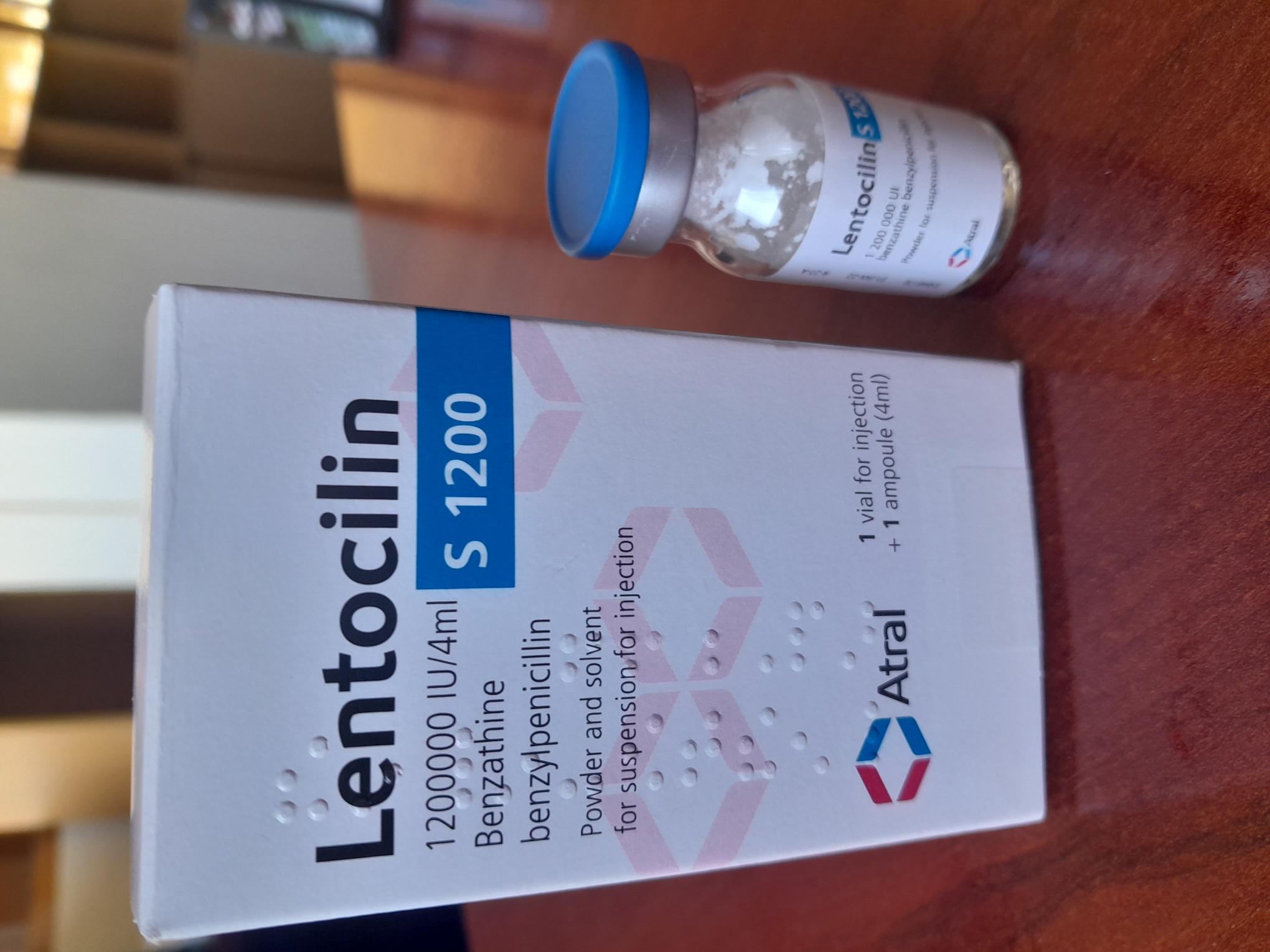
Lentocilin Penicillin G Benzathin 1200000 U/4mL Injection, Powder, For Suspension, 4 mL
🆔 Identity & classification
Where does this data come from?
🏷️ RxNorm drug class
This medicine belongs to the Penicillin-class Antibacterial class.
Where does this data come from?
🏭 Manufacturer & labeler
Where does this data come from?
🩺 Clinical
- Penicillin G injection is reserved for serious, potentially life-threatening infections where we need high levels of antibiotic in your blood fast. An IV or intramuscular injection...
- Why am I getting this antibiotic through an IV instead of just taking a pill?
- Prior exposure without a reaction is reassuring, but it doesn't completely rule out a future allergic reaction. Allergies can develop over time or after repeated exposures. The mor...
- I've taken penicillin before without a problem. Do I still need to worry about an allergic reaction?
Patient education
Supplement & herbal interactions
Some supplements/herbs that may interact with Penicillin G Benzathine — tap one for details:
Penicillin G Benzathine may be associated with lower levels of 7 nutrients — worth a chat with your pharmacist, not a cause for alarm.
Where does this data come from?
Ask a licensed pharmacist directly — free, answered by our team.
🧪 Inactive Ingredients / Excipients
Inactive ingredients, also called excipients, are components of the drug product other than the active ingredient. They may include fillers, dyes, coatings, preservatives, flavors, or other formulation ingredients.
💡 Tap an ingredient (hover on desktop) to see what it is and why it’s used.
-
60 mg / 4 mL
UNII V13007Z41A
Lidocaine hydrochloride is a local anesthetic compound added to some medicines as a numbing agent. It reduces pain or irritation at the site where the medicine is applied or administered.
-
37 mg / 4 mL
UNII 68538UP9SE
Monosodium citrate is a salt derived from citric acid. It's used in medicines as a buffer to control acidity and help stabilize the product's pH level.
-
0.2 / 4 mL
UNII 6OZP39ZG8H
Polysorbate 80 is a synthetic emulsifier derived from sorbitol and oleic acid. It helps mix oil and water-based ingredients together in medications and improves how the product disperses in the body.
-
4 mL / 4 mL
UNII 1DI56QDM62
A natural fatty substance from soybeans that helps mix oil and water-based ingredients together. It acts as an emulsifier and lubricant in medicines to improve texture and help the product break down properly in your body.
-
4 mL / 4 mL
UNII 059QF0KO0R
Water is a liquid solvent that dissolves and mixes ingredients together in liquid medicines, syrups, and injections. It helps distribute the active drug evenly throughout the product.
5 inactive ingredients listed in the exact product block matched to this NDC.
Where does this data come from?
ingredient classCode="IACT" elements from the exact product block matched by this NDC. Label-section narrative from DailyMed / the openFDA label index is shown separately when available.Inactive ingredient FAQ
Are inactive ingredients the same for every manufacturer?
Why might an inactive ingredient be missing?
Can inactive ingredients matter?
💲 Pricing
A drug doesn't have one price. Each row is a different public payment system, and none is what you'd pay at the counter — that depends on your insurance. The ⓘ on each row explains what it measures.
| Price system | Per mL | Per package |
|---|---|---|
| Retail pharmacies payNADAC · weekly | Not in the retail survey — common for institutional, discontinued, or low-volume packs. | |
| Medicaid paysCMS SDUD · 12 mo | No recent Medicaid claims on file for this NDC — rare and low-volume NDCs are suppressed in the public data. | |
| Medicare drug plans payPart D · quarterly | No Part D plan price is available for this NDC in our data. | |
Where does this data come from?
🔁 Therapeutic equivalents
| Product | Labeler | Pack | NADAC/unit | TE | Status | Price vs. this |
|---|---|---|---|---|---|---|
| Lentocilin 1200000 U/4mLthis 84383-0110-01 | LABORATRIOS | 4 ml | — | — | FDA listed | — |
Where does this data come from?
⏳ Availability & generic status
We did not find an FDA-approved generic match for this exact strength, form and route.
Where does this data come from?
🔬 Reported adverse events (FAERS)
Top reported reactions
Reporter sex
Where does this data come from?
📦 Packaging — all sizes for this product
| Package NDC | Description | Marketing start | Status |
|---|---|---|---|
| 84383-0110-01 You're viewing this | 4 mL in 1 VIAL (84383-110-01) | 2024-06-01 | Active |
🧭 About this NDC listing & data coverage
Listed without an FDA application
This product's marketing category indicates it is marketed without an approved FDA application (no NDA, ANDA, or BLA on file). Having an NDC does not by itself establish FDA approval — the NDC Directory is a listing system, not an approval decision. Approval-linked data such as Orange Book therapeutic-equivalence ratings therefore does not apply.
What data is (and isn’t) available for this NDC — tap to expand
| NDC identity (package / product / labeler codes) | ✓ Available |
| Labeler | ✓ Available |
| Product & package description | ✓ Available |
| Marketing category & status | ✓ Available |
| Active ingredient / dosage form / route | ✓ Available |
| FDA label (SPL via DailyMed) | ✓ Available |
| Package photos | ✓ Available |
| Inactive ingredients (structured) | ✓ Available |
| NADAC pharmacy acquisition price (CMS) | — Not published for this NDC CMS publishes NADAC only for NDCs reported in its retail-pharmacy survey. |
| Orange Book / therapeutic-equivalence data | — Not published for this NDC Applies only to products approved under an NDA/ANDA; many listings are out of scope. |
| HCPCS J-code billing crosswalk | — Not published for this NDC Most self-administered / retail products have no J-code — that is normal. |
| Medicaid utilization (CMS SDUD) | — Not published for this NDC CMS reports utilization only for NDCs with Medicaid claims above its privacy threshold. |
Questions about this listing
Is this NDC FDA-approved?
Why is there no price listed?
Is the NDC printed on the package the same as the 11-digit billing NDC?
What do the three segments of this NDC mean?
Is this package still being marketed?
Who lists this product with the FDA?
Do I need a prescription for this product?
Where does this data come from?
📄 Full prescribing information FDA SPL
🎯 Indications and Usage ▾
Lentocilin S is indicated for the treatment of the following infections in adults and children: - Upper respiratory tract infections, namely group A streptococcal infections - Primary and secondary syphilis - Latent syphilis - Tertiary syphilis (in adults) - Congenital syphilis (in children) - Yaws - Bejel - Pinta Lentocilin S is also indicated prophylactically in the following situations: - Rheumatic fever - Diphtheria (including elimination of the asymptomatic carrier state) Consideration should be given to official guidelines for appropriate use of antimicrobial agents. indications&usage section
⏱️ Dosage and Administration ▾
Lentocilin S suspension for injection is to be EXCLUSIVELY administered by DEEP INTRAMUSCULAR (IM) INJECTION. Deep IM administration of this medicine requires a rigorous technique and should be performed only by experienced health technicians and in places prepared for the emergency treatment of a possible anaphylactic reaction. Posology Adults Group A streptococcal infections - Upper respiratory tract infections: 1,200,000 IUunits in a single dose.
Primary, secondary and early latent syphilis: 2,400,000 unitsIU in a single dose (injection at two different sites). Late latent syphilis or of unknown duration: 2,400,000 unitsIU (injection at two different sites) weekly for 3 consecutive weeks. Tertiary syphilis: 2,400,000 unitsIU (injection at two different sites) weekly for 3 consecutive weeks.
Yaws, bejel and pinta: 1,200,000 unitsIU in a single dose. Prophylaxis of rheumatic fever: 1,200,000 unitsIU every 4 weeks. In high-risk patients it is recommended administration of 3 inevery 3 weeks.
Prevention of diphtheria, including elimination of the asymptomatic carrier state: 1,200,000 unitsIU in a single dose. Newborns aged ≥ 1 month Asymptomatic congenital syphilis: 50,000 unitsIU/kg in a single dose (maximum dose: 2,400,000 unitsIU/dose). Benzathine benzylpenicillin is not recommended in newborns with proven or highly probable congenital syphilis.
Children Group A Streptococcal infections - Upper respiratory tract infections: 25,000 - 50,000 unitsIU/kg in a single dose (maximum dose: 1,200,000 IUunits/dose) or weight < 27 kg: 300,000-600,000 IU units in a single dose weight ≥ 27 kg: 1,200,000 unitsIU in a single dose. - Primary, secondary and early latent syphilis: 50,000 unitsIU/kg (maximum dose: 2,400,000 unitsIU/dose) in a single dose. - Late latent syphilis or latent syphilis of unknown duration: 50,000 unitsIU/kg (maximum dose: 2,400,000 unitsIU/dose) weekly for 3 weeks. - Yaws, bejel and pinta: 300,000 unitsIU as a single dose in children aged less than 6 years or 1,200,000 IUunits in a single dose in children aged 6 years and older. -Prophylaxis of rheumatic fever: 25,000 - 50,000 unitsIU/kg in a single dose (maximum dose: 1,200,000 unitsIU/dose) or weight < 27 kg: 300,000 - 600,000 unitsIU in a single dose weight ≥ 27 kg: 1,200,000 unitsIU in a single dose.
Prevention of diphtheria (including elimination of the asymptomatic carrier state): - children aged < 6 years (or weight < 30 kg): 600,000 unitsIU in a single dose - children aged ≥ 6 years (or weight ≥ 30 kg): 1,200,000 unitsIU in a single dose. Special populations Elderly - Dose adjustment is not necessary. However, since the elderly have a higher likelihood of decreased renal function, this must be taken into consideration during the selection of the posology and may be useful to monitor renal function.
Renal insufficiency - Toxic concentrations of benzylpenicillin following administration of the usually recommended dose are not expected. Liver insufficiency - Dose adjustment is not necessary.
💊 Dosage Forms and Strengths ▾
Powder and diluent for suspension for injection: 1200000 units carton-vial
⛔ Contraindications ▾
Hypersensitivity to the active substance, to other penicillin or to any of the excipients. Hypersensitivity to lidocaine or local anesthetics of the amide type.
⚠️ Warnings and Cautions ▾
Lentocilin S suspension for injection should ONLY be administered by INTRAMUSCULAR ROUTE. To avoid injury, Lentocilin S suspension should not be administered by intravenous, intraarterial or subcutaneous route, in the adipose layer, into or near a peripheral nerve or blood vessel. Before injecting the suspension, the position of the needle should be controlled by aspiration.
If blood shows up in the syringe, pull back the needle and inject on another site. Administer Lentocilin S suspension EXCLUSIVELY by DEEP INTRAMUSCULAR INJECTION in the external upper quadrant of the buttock. In children and infants, the IM injections should be done, preferably, in the middle of the external lateral side of the thigh.
In infants younger than 2 years, and if considered necessary, the dosage may be divided and administered in two separate sites. The IM injection site should be changed in case of repeated doses. Deep IM administration of this medicine requires a rigorous technique and should be performed only by experienced health technicians and in places prepared for the emergency treatment of a possible anaphylactic reaction.
A needle to use in the administration of the injectable suspensions should have a minimum internal diameter of 0.8 mm (caliber: 18 gauge). The deep IM injection should be made slowly and with a constant flow rate to prevent needle blockage. If the needle is clogged, replace it with a new needle.
The deep IM injection should be discontinued if there are signs or symptoms of immediate acute pain, especially in children and infants. Serious hypersensitivity reactions (anaphylactic reactions), sometimes fatal, have been reported in patients on penicillin therapy. These reactions are more likely to occur in individuals with a history of penicillin hypersensitivity and in atopic individuals.
If an allergic reaction occurs, therapy with Lentocillin S should be discontinued immediately and the appropriate therapy instituted. In case of severe anaphylactic reaction, immediate emergency treatment (including adrenaline, corticosteroids, airway management, oxygen) is required. Usually, subcutaneous, or intravenous adrenaline is the treatment of choice for an immediate or accelerated hypersensitivity reaction to a penicillin.
Before initiating therapy with benzylpenicillin, careful inquiry should be made concerning previous hypersensitivity reactions to penicillin, cephalosporins, and other beta-lactam antibiotics. Contact with the penicillin during handling the product should be avoided due to the possibility of skin sensitization. To minimize the overgrowth of resistant bacteria and maintain the effectiveness of benzylpenicillin, this medicine should only be used in the treatment of infections proven to be caused by susceptible bacteria.
Therapy should be based on bacteriological studies (including sensitivity tests) and the patient's clinical response. Prolonged administration of Lentocilin S can occasionally result in overgrowth of non-susceptible organisms particularly Candida, Pseudomonas or Enterobacter. Antibiotic treatment modifies the commensal flora of the colon, allowing the growth of Clostridium difficile.
This microorganism produces toxins, which are responsible for diarrhea associated to antibiotherapy, which can range from mild diarrhea to fatal colitis. Patients with diarrhea during or even up to two months after treatment with antibiotics should be subject to investigation and differential diagnosis. Confirming pseudomembranous colitis, treatment should be discontinued and, if necessary, use supportive hydro-electrolyte measures, recommended antibiotherapy and protein supplement.
Because of the risk of neurotoxicity, caution is recommended especially in the case of administration of high doses of benzylpenicillin to renal impaired patients. During prolonged treatment with high doses of benzylpenicillin is recommended to monitor the renal and haematological functions. The use of benzylpenicillin for more than 2 we…
🤒 Adverse Reactions ▾
The most common undesirable effects of benzylpenicillin are hypersensitivity reactions, especially skin rashes. Anaphylactic reactions occurred occasionally, which have sometimes been fatal. The overall incidence of allergic reactions to penicillin ranges between 1 and 10%.
Anaphylactic reactions occur in approximately 0.05% of patients, usually after parenteral administration. The following undesirable effects were observed with benzylpenicillin: Blood and lymphatic system disorders - Eosinophilia and hemolytic anemia (both with immunological basis), leukopenia and thrombocytopenia. These effects are usually reversible after discontinuation of treatment.
Immune system disorders - Hypersensitivity reactions to penicillin cause a wide variety of clinical syndromes. Immediate reactions include anaphylaxis, laryngeal edema, angioedema, urticaria and maculopapular rashes. Late reactions include hemolytic anemia and immune complex self-limited sickness-like reactions, characterized by fever, malaise, urticaria, arthralgia, myalgia, lymphadenopathy and splenomegaly.
In order to determine which patients will probably develop severe allergic reactions, hypersensitivity skin tests may be used. Jarisch – Herxheimer reaction. Nervous system disorders - Benzylpenicillin is very irritating to the central and peripheral nervous systems.
Neurotoxic reactions include anxiety, asthenia, cerebrovascular accident (CVA), confusion, dizziness, euphoria, nervousness, hallucinations, headache, neuropathy, neurovascular injury, localized or generalized seizures, coma, tremor and vasospasm at the administration site, and occur after parenteral administration of benzylpenicillin potassium. These reactions are most common when the benzylpenicillin is given daily in doses of more than 20,000,000 IU intravenously to renal impaired patients. The accidental injection of preparations of benzylpenicillin into or near by the nerves may produce neuromuscular damage, which rarely may be permanent.
Rarely, inadvertent intravascular administration of benzathine benzylpenicillin or procaine benzylpenicillin, including direct administration into an artery - or adjacent to an artery - causes occlusion, thrombosis and severe neurovascular injury, especially in children. Deep injection in the glutes gluteal muscles can cause paralysis, dysfunction and painful irritation of the sciatic nerve. Repeated intramuscular injection of benzylpenicillin preparations in the anterolateral side of the thigh of newborns has rarely caused generalized muscular contractions, as well as atrophy and fibrosis of the quadriceps femoris muscle.
After intramuscular administration of benzathine benzylpenicillin may occurs Hoigné syndrome may occur, characterized by agitation accompanied by symptoms such as fear of impending death and visual and auditory hallucinations. Transversal myelitis with permanent paralysis, gangrene requiring amputation of fingers and the more proximal regions of the extremities, and necrosis with formation of scars surrounding the site of injection, have occurred after injections in the buttocks, thighs and deltoid muscle. Eye disorders - Blurred vision, transient blindness.
Cardiac disorders - Hypotension, palpitations, syncope, tachycardia, vasodilation and vasovagal syndrome characterized by anxiety, sweating, hypotension, peripheral arterial vasodilation and bradycardia. Cardiopulmonary arrest and death due to inadvertent IV administration. Respiratory, thoracic and mediastinal disorders - Apnea, dyspnea, hypoxia, pulmonary embolism and pulmonary hypertension.
Gastro-intestinal disorders - Intestinal necrosis, melena, nausea, vomiting, and pseudomembranous colitis, which can arise during or after treatment. Hepatobiliary disorders - Transient increases in SGOT, hepatitis and cholestatic jaundice. Skin and subcutaneous tissue disorders - Diaphoresis, pruritus and urticaria.
Musculo-skeletal, connective tissue and bone disorders - Arthritis, arthropathy, myoglobinu…
🔄 Drug Interactions ▾
Bacteriostatic antibiotics: Bacteriostatic antibiotics, such as tetracycline, erythromycin and chloramphenicol, may antagonize the bactericidal effect of benzylpenicillin by interfering with active bacterial growth necessary to benzylpenicillin’s effect. Oral contraceptives: The efficacy of oral contraceptives may be impaired in case of concomitant therapy with benzylpenicillin, which may result in an unwanted pregnancy. Women taking oral contraceptives should be alerted to this situation and should be informed about the need to adopt alternative methods of contraception.
Methotrexate: Penicillins may reduce the renal excretion of methotrexate causing a potential increase in its toxicity. Probenecid: Probenecid decreases the renal tubular secretion of benzylpenicillin. Its concomitant use with benzylpenicillin can prolong blood levels of benzylpenicillin.
Probenecid may be used therapeutically for this purpose.