
Benfotiamine Drug Interactions, Uses, Effectiveness, Safety & More
What is this page for?
First and foremost: how Benfotiamine interacts with medications. The heart of this page is the interaction list — every drug Benfotiamine is known to interact with, and how serious each one is.
But these pages have grown well beyond that into a full monograph — what Benfotiamine is, what people use it for and how strong the evidence is, its safety and side effects, and answers to the questions we’re asked most — written and reviewed by the clinical staff at HelloPharmacist. It’s educational information from our licensed clinical databases, not medical advice, and we don’t sell or endorse products. Our editorial policy
Check Benfotiamine against your medication
Add one medicationDrugs that interact with Benfotiamine
0 medications have a known interaction with Benfotiamine, graded by severity. Select any drug for the full evidence-based detail.
We don’t currently list any known drug interactions for Benfotiamine. This doesn’t guarantee none exist — always confirm with your pharmacist before combining supplements with your medications.
What Severity, Likelihood & Evidence Mean
Severity — How Serious It Can Be
- Major. Clinically significant; generally best avoided, or used only under direct professional supervision.
- Moderate. May need monitoring, a dose adjustment, or separating the times you take each one.
- Minor. Generally not clinically significant, but still worth noting and mentioning to your pharmacist.
- No known interaction. Checked against our sources with nothing documented — not the same as proven safety.
Likelihood — How Well It’s Documented
- Likely. Well-controlled human studies have demonstrated the likely existence of this interaction
- Probable. Interaction has not been documented in well-controlled studies, however, the interaction has been demonstrated in some small human studies or in controlled animal studies in conjunction with multiple case reports.
- Possible. Interaction has been documented in animal or in lab research, or the interaction has been documented in humans but is limited to case reports or conflicting clinical research exists
- Unlikely. Interaction has been demonstrated in animal or in lab research but has been shown not to occur in humans.
Where This Data Comes From
- Interaction records are evidence-graded and sourced from the Natural Medicines database (TRC Healthcare), the same reference used by pharmacists and hospitals.
- Each drug listed above links to the full report for that exact Benfotiamine combination — clinical detail, likelihood, evidence level, and citations.
- Content is reviewed by licensed HelloPharmacist pharmacists — see our data sources and editorial standards.
Benfotiamine: Uses, Safety & Side Effects
Benfotiamine is a man-made, fat-soluble form of vitamin B1 (thiamine) that the body may absorb more easily than regular thiamine. It is mostly studied for diabetic nerve problems, but the evidence is mixed and limited, so it should not replace prescribed treatments. Talk with your pharmacist or doctor before starting it.
- Part used
- Synthetic compound (a derivative of vitamin B1)
- Common forms
- Tablets, capsules
- Diabetic nerve pain (neuropathy)
- Supporting healthy nerve function
- Thiamine deficiency
- Oxidative stress
- General wellness
Popular and traditional uses — not proof it works. See “Uses & effectiveness” below for the evidence.
Generally well tolerated in studies, but long-term safety is not fully known.
Insufficient reliable information is available; avoid using.
Read the full pregnancy detailInsufficient reliable information is available; avoid using.
Read the full breastfeeding detailPregnancy & breastfeeding ratings are from Natural Medicines (Therapeutic Research Center). Safety guidance is general; always confirm with your pharmacist or doctor for your situation.
Overview
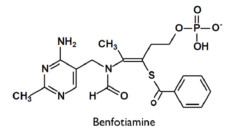
Benfotiamine is a synthetic (man-made) version of thiamine, also known as vitamin B1. Its chemical name is S-benzoylthiamine O-monophosphate. Unlike regular thiamine, which dissolves in water, benfotiamine is fat-soluble. This difference is thought to help it pass through cell membranes more easily and may lead to higher levels of active vitamin B1 in the body.
It is sold as a dietary supplement, usually in tablet or capsule form. People often take it hoping to support nerve health, manage problems linked to diabetes, or correct low thiamine levels. It is not a plant or herb but a laboratory-made compound based on a natural vitamin.
How it works
Once absorbed, benfotiamine is converted in the body into thiamine and its active form, thiamine diphosphate. Thiamine is an important helper (cofactor) for several enzymes that the body uses to turn food into energy.
Researchers believe benfotiamine may help reduce harmful byproducts of high blood sugar, sometimes called advanced glycation end-products (AGEs), and may lower certain types of cellular stress. These ideas come mostly from laboratory and animal studies, and it is not certain how strongly they apply to people in everyday life.
Does Benfotiamine work?
How to read these evidence grades
Natural Medicines’ 7-point scale. We show each rating’s label word-for-word.
Possibly Effective Diabetic neuropathy
Oral benfotiamine might improve symptoms of diabetic neuropathy.
Possibly Ineffective Diabetic nephropathy
Oral benfotiamine does not seem to improve markers of diabetic nephropathy.
Also studied for 5 conditions — evidence insufficient to rate
Insufficient Reliable Evidence To Rate Alcohol use disorder
Small clinical studies suggest that oral benfotiamine may modestly improve symptoms and reduce alcohol consumption in some patients with alcohol use disorder.
Insufficient Reliable Evidence To Rate Alzheimer disease
It is unclear if oral benfotiamine helps to prevent Alzheimer disease onset or progression.
Insufficient Reliable Evidence To Rate Osteoarthritis
Oral benfotiamine has only been evaluated in combination with other B vitamins; its effect when used alone is unclear.
Insufficient Reliable Evidence To Rate Peripheral neuropathy
It is unclear if oral benfotiamine is beneficial in patients with alcohol-induced peripheral neuropathy.
Insufficient Reliable Evidence To Rate Rheumatoid arthritis (RA)
Oral benfotiamine has only been evaluated in combination with other B vitamins; its effect when used alone is unclear.
Source & disclaimer. Effectiveness ratings and evidence summaries are provided by Natural Medicines (Therapeutic Research Center) and shown as licensed. Where Natural Medicines hasn’t rated a use, HelloPharmacist’s pharmacists may add their own reviewed rating and evidence (each such entry is labeled). This is educational information, not medical advice — talk with your pharmacist or doctor before starting, stopping, or changing a supplement.
Safety & precautions
In studies, benfotiamine has generally been well tolerated when taken by mouth for several weeks to months. However, its long-term safety has not been fully studied.
People with diabetes should not use benfotiamine in place of their prescribed medicines, and they should keep monitoring their blood sugar and following their care plan. Anyone with a medical condition, or who takes regular medications, should check with a pharmacist or doctor first.
For pregnancy and breastfeeding, there is not enough safety information available. To be safe, it is best to avoid benfotiamine during these times unless your healthcare provider specifically recommends it.
Side effects
Benfotiamine is usually well tolerated. When side effects occur, they tend to be mild and may include stomach upset, nausea, or mild skin reactions.
Serious side effects appear to be rare. As with any supplement, an allergic reaction is possible. Stop using it and seek medical care if you notice signs such as rash, swelling, or trouble breathing.
Benfotiamine: Reported Adverse Effects
Documented safety reports on Benfotiamine from the evidence-graded Natural Medicines (TRC Healthcare) database, shown word-for-word from the licensed record.
Reports by conditionMyasthenia gravis Dermatologic
Orally, allergic skin reactions have been reported in two out of 98 patients taking benfotiamine 300-600 mg daily for 6 weeks in one clinical study. The rate of adverse events was not different between treatment and placebo groups.
Myasthenia gravis Gastrointestinal
Orally, slight gastrointestinal discomfort has been reported in six out of 98 patients taking benfotiamine 300-600 mg daily for 6 weeks in one clinical study. The rate of adverse events was not different between treatment and placebo groups.
Adverse-effects data: Natural Medicines, Therapeutic Research Center
Dosing
There is no official standardized dose of benfotiamine for any condition. Doses used in studies have varied, and the best amount for a given person is not well established.
The safest approach is to follow the directions on the product label and to ask your pharmacist or doctor what is appropriate for you. Do not assume that taking more will work better, and avoid using it to self-treat a serious condition without medical guidance.
Benfotiamine & Pregnancy
Benfotiamine & Breastfeeding
© 2026 Therapeutic Research Center
Pregnancy & lactation ratings: Natural Medicines, Therapeutic Research Center
References & further reading
The 1 references that drive our Benfotiamine monograph and interaction data, from the evidence-graded Natural Medicines (TRC Healthcare) database. Citations with a link open the study on PubMed or the publisher’s site.
- Stracke H, Gaus W, Achenbach U, Federlin K, Bretzel RG. Benfotiamine in diabetic polyneuropathy (BENDIP): results of a randomised, double blind, placebo-controlled clinical study. Exp Clin Endocrinol Diabetes 2008;116(10):600-5. PubMed
This information is for education only and is not a substitute for professional medical advice. Always check with your pharmacist or doctor before starting, stopping, or combining supplements and medications.
Parts of this content are provided by the Therapeutic Research Center, LLC.
DISCLAIMER: Currently this does not check for drug-drug interactions. This is not an all-inclusive comprehensive list of potential interactions and is for informational purposes only. Not all interactions are known or well-reported in the scientific literature, and new interactions are continually being reported. Input is needed from a qualified healthcare provider including a pharmacist before starting any therapy. Application of clinical judgment is necessary.
© 2021 Therapeutic Research Center, LLC
Brands that make products with Benfotiamine
89 brands in our database make a supplement containing Benfotiamine.
Supplement products with Benfotiamine
360 products in our database contain Benfotiamine. Open any to see its full ingredient list and every drug interaction we check.
Benfotiamine: Common Questions
What is Benfotiamine used for, and does it work?
Does Benfotiamine interact with prescription medications?
How are Benfotiamine interactions rated?
Is it safe to take Benfotiamine with my medications?
Where does this Benfotiamine interaction information come from?
What is Benfotiamine used for?
Is Benfotiamine the same as vitamin B1?
Is Benfotiamine safe to take?
Can I take Benfotiamine while pregnant or breastfeeding?
Written and reviewed by the HelloPharmacist editorial staff. Our editorial policy
Products that contain Benfotiamine
A rotating sample of real supplements in our database that list Benfotiamine — open any to see its full ingredients and every drug interaction we check.
- Benfotiamine Powder 150 mg by BulkSupplements.com
- Multivitamin by OptiYouRX
- Super Carnosine 500 mg by Life Extension
- Methyl B-Complex 50 by Solaray
- Anti-Alcohol HepatoProtection Complex by Life Extension
- Nerve Support by Sunergetic
- Benfotiamine 150 mg by Source Naturals
- Nerve Support Complex by Thorne
- Benfotiamine with Thiamine by Lake Avenue Nutrition
- BrainSustain Vanilla Delight by XYMOGEN
Have a question about Benfotiamine?
Our pharmacists answer your medication & supplement questions — free.