
Back Formula Ingredients & Drug Interactions
What is this page for?
First and foremost: checking Back Formula against your medications. The heart of this page is the interaction checker and the full interaction report — how this product’s ingredients may interact with prescription and over-the-counter medicines you may be taking.
Around that, we add a pharmacist’s high-level view of the product as a whole — what’s inside, the evidence for its stated use, how transparent the label is, and what safety data exists — so you can see the full picture in one place. It’s educational information from our licensed clinical databases and the clinical staff at HelloPharmacist — not medical advice — and we don’t sell or endorse products. Our editorial policy
Back Formula is a dietary supplement by Indiana Botanic Gardens with 3 active ingredients. Its ingredients are commonly taken for bone health and osteoporosis, correcting vitamin d deficiency, immune system support.Based on those ingredients, 935 medications have a known interaction with it, the most serious rated moderate. The ingredients most likely to interact are Devil's Claw extract, Vitamin D3, Willow bark extract. Use the checker below to test your specific medication, or read the full HelloPharmacist Interaction Report.
Check Your Meds Against Back Formula by Indiana Botanic Gardens
Ask about any prescription or over-the-counter medication and we check it for interactions with Back Formula by Indiana Botanic Gardens — and tell you which ingredient is responsible.
AI summaries are generated from our interaction database for education only — always confirm with your pharmacist. How we use AI
Ask the Pharmacist
A licensed pharmacist will answer your question by email — free, usually within 24 hours.
Got it — thank you!
A licensed pharmacist will answer within 24 hours. Keep an eye on your email (worth checking spam, just in case).
HelloPharmacist Scorecard of Back Formula by Indiana Botanic Gardens
Our pharmacy team’s full take, with four database checks built into the cards below — a summary of what is known, not a grade of the product itself.
What’s inside
Full disclosure
Back Formula contains 3 active ingredients. Vitamin D3 is a fat-soluble vitamin used to treat conditions like rickets, osteomalacia (soft bones), and low blood calcium; it's effective for those uses at therapeutic doses.
Willow bark extract is a plant-based ingredient with salicin (a compound related to aspirin) that may help with back pain. Devil's claw extract is another botanical ingredient, also studied for back pain and osteoarthritis support.
The product also contains several inactive ingredients—rice flour, gelatin, maltodextrin, magnesium stearate, sucrose, corn starch, vitamin E (DL-alpha-tocopherol), and stearic acid—which serve as fillers, binders, and capsule material.
Does it work?
Moderate evidence
Vitamin D3 is effective for rickets, osteomalacia, renal bone disease, and hypoparathyroidism—conditions involving bone health and calcium regulation—at appropriate medical doses. Willow bark extract and devil's claw extract are both rated possibly effective for back pain, meaning the evidence suggests they may help but isn't definitive.
For other uses listed on the label, like headache or common cold (willow bark), the evidence we hold is insufficient to rate them.
How safe is it?
Well-documented data
Vitamin D3 is generally well tolerated at recommended doses, though very high doses over time can cause vitamin D toxicity with symptoms of high blood calcium (hypercalcemia). It's likely safe in pregnancy and lactation at recommended amounts, but use only under your doctor's guidance.
Willow bark is generally tolerated short-term by healthy adults but acts like aspirin and isn't safe for everyone; the data advises against it during pregnancy due to aspirin-like risks, especially later in pregnancy, and while breastfeeding due to insufficient safety data. Devil's claw is generally well tolerated for short-term use but can cause digestive upset (diarrhea, heartburn, nausea); the data advises against it in pregnancy because it may affect the uterus and while breastfeeding due to insufficient safety information.
Serious adverse effects (like gastrointestinal bleeding) are rare with all three ingredients.
Meds to double-check
Moderate interaction found
Before taking Back Formula, double-check if you're on blood thinners (anticoagulants) or antiplatelet drugs like warfarin, aspirin, or clopidogrel—willow bark and devil's claw can interfere. If you take heart rhythm medications (verapamil, diltiazem, digoxin), diuretics, statins like atorvastatin, or any drug metabolized by your liver's CYP2C9, CYP2C19, or CYP3A4 enzymes, flag this product with your pharmacist.
Also check if you're on stomach-acid reducers (H2-blockers or PPIs) or any salicylate-containing pain medication. Use the medication checker below to verify your specific drugs.
The bottom line
Scorecard at a glanceFully disclosed formula with some supporting evidence for its stated purpose. Moderate medication interactions have been identified, and safety information is well characterized.
Back Formula may be worth considering if you have back pain or osteoarthritis and don't take blood thinners, heart medications, or stomach-acid reducers. If you take any prescription drugs—especially for the heart, blood clotting, cholesterol, or digestion—check your medications with the tool on this page first.
Pregnant or breastfeeding? Talk to your pharmacist or doctor before starting; the ingredients have specific cautions for both.
It's a good idea to run this by your pharmacist regardless, given the number of potential interactions.
Educational only — not medical advice; always confirm with your pharmacist. Our editorial policy · How we use AI
Assessment coverage: 3 of 3 active ingredients matched to our full ingredient reviews (monographs). Based on the product label dated Jun 25, 2015.
This Scorecard evaluates available label information, ingredient evidence, and known medication-safety considerations. It does not independently verify product identity, purity, potency, contamination, or manufacturing quality. How these ratings are computed
General information
Key facts about Back Formula, straight from the product label.
| Brand | Indiana Botanic Gardens |
|---|---|
| Barcode (UPC) | 703308810370 |
| Net contents | 30 Capsule(s) |
| Market status | On market |
| Date entered into DSLD | Jun 25, 2015 |
| DSLD ID | 46855 |
| Product type | Botanical |
| Supplement form | Capsule |
| Dietary claims / uses | All Other |
| Intended target group(s) | Adult (18 - 50 Years) |
Everything in this section is reproduced from the manufacturer’s own product label — it’s the label speaking, not HelloPharmacist. We show it so you can see exactly what the maker states; we don’t verify or endorse those statements.
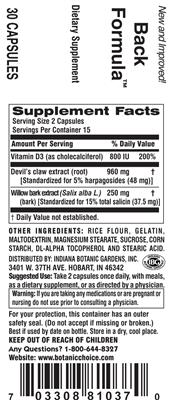
Supplement Facts
The label details for Back Formula by Indiana Botanic Gardens, sourced from the NIH Dietary Supplement Label Database.
Supplement Facts
| Ingredient | Amount | % DV |
|---|---|---|
| Vitamin D3 | 800 IU | 200% |
| Willow bark extract | 250 mg | -- |
| Devil's Claw extract | 960 mg | -- |
Other ingredients: Rice Flour, Gelatin, Maltodextrin, Magnesium Stearate, Sucrose, Corn Starch, DL-Alpha-Tocopherol, Stearic Acid
Tap any ingredient to jump to its full detail below.
These statements are the manufacturer’s wording, reproduced from the product label — the label is saying it, not HelloPharmacist. We don’t verify or endorse them.
General Statements
New and Improved!
FDA Statement of Identity
Dietary Supplement
Seals/Symbols
IBG INDIANA BOTANIC GARDENS(R)
Suggested/Recommended/Usage/Directions
Suggested Use: Take 2 capsules once daily, with meals, as a dietary supplement, or as directed by a physician.
Precautions
Warning: If you are taking any medications or are pregnant or nursing do not use prior to consulting a physician.
For your protection, this container has an outer safety seal. (Do not accept if missing or broken.)
KEEP OUT OF REACH OF CHILDREN
Storage
Store in a dry, cool place.
Is this label outdated? Report a formula or label change and our pharmacy team will review it.
Back Formula by Indiana Botanic Gardens label
The label scan from the NIH Dietary Supplement Label Database. Tap to enlarge.
Label images are published by the NIH Dietary Supplement Label Database for the version of this product on file. Always read your actual product label.
View the full label (PDF)The Ingredients in Back Formula by Indiana Botanic Gardens
These are the 3 active ingredients this product is made of. Select any to open its full monograph.
Serving size2 Capsule(s) Dosage formCapsule Servings per container15 Amounts shown are per serving.
Most supplement products combine several ingredients, and a medication can interact with the product through any one of them. Each ingredient below shows whether it has known drug interactions.
Vitamin D3
Interacts with715 drugs
Vitamin D is a fat-soluble vitamin that helps your body absorb calcium and is important for healthy bones, muscles, and immune function. Many people,...
Vitamin D3 monograph & interactionsWillow bark extract
Interacts with127 drugs
Willow bark is a traditional plant remedy that contains salicin, a compound related to aspirin, and is most often used for pain and inflammation. Some...
Willow bark extract monograph & interactionsDevil's Claw extract
Interacts with804 drugs
Devil's claw is a southern African plant used mainly for arthritis and back pain, and some studies suggest it may help ease these types of discomfort....
Devil's Claw extract monograph & interactionsOther (inactive) ingredients: Rice Flour, Gelatin, Maltodextrin, Magnesium Stearate, Sucrose, Corn Starch, DL-Alpha-Tocopherol, Stearic Acid. These complete the product’s ingredient list but are not active constituents.
Back Formula by Indiana Botanic Gardens Drug Interactions
HelloPharmacist Interaction Report
Back Formula by Indiana Botanic Gardens contains three active ingredients, and together they interact with a substantial number of medications.
Vitamin D3, the first ingredient, has the most serious documented interaction: it can theoretically increase the risk of high blood calcium (hypercalcemia) when combined with thiazide water pills, which is rated Moderate severity. Vitamin D3 also interacts Moderately with heart rhythm drugs like verapamil and diltiazem, the cardiac glycoside digoxin, the statin atorvastatin, and several other drug types.
Read the full breakdown — every affected drug type, severity by severity
Willow bark extract, which works like aspirin, carries Moderate interactions with blood thinners and antiplatelet drugs, aspirin itself, and several other salicylate-containing medications—all due to additive effects on bleeding and other adverse effects.
Devil's claw extract may theoretically increase blood levels of drugs broken down by three major liver enzymes (CYP2C19, CYP2C9, and CYP3A4), all rated Moderate, and has a Moderate interaction with warfarin, a blood thinner. It also has Minor interactions with stomach-acid-reducing medications.
Altogether, these interactions span 922 individual medications. Use the medication checker on this page to look up your exact prescriptions before starting this product.
Check your own medications below · Editorial policy · How we use AI
Want to check YOUR meds against Back Formula?
Ask about interactions with your drugs in plain English — “Can I take it with lisinopril?” — and we find you the answer in seconds, ingredient by ingredient.
Go to the checkerIngredients driving the most interactions
Individual Drug Interactions
The ingredients in Back Formula interact with 935 drugs. Click any drug to see the details.
3 of the 3 ingredients in Back Formula interact with drugs. Each result below shows which ingredient is responsible. Devil's Claw extract Vitamin D3 Willow bark extract
Aripiprazole LauroxilAristada, Aristada Initio Kit
How Aripiprazole Lauroxil interacts with Back Formula — through 2 ingredients. Tap an ingredient for the detail:
Devil's Claw ExtractCytochrome P450 3a4 (cyp3a4) Substrates Moderate
Interaction Summary
Theoretically, devil's claw might increase levels of drugs metabolized by CYP3A4.
Read the full Devil's Claw Extract + Aripiprazole Lauroxil interactionVitamin D3Cytochrome P450 3a4 (cyp3a4) Substrates Minor
Interaction Summary
Vitamin D might induce CYP3A4 enzymes and reduce the bioavailability of CYP3A4 substrates.
Read the full Vitamin D3 + Aripiprazole Lauroxil interactionArmodafinilNuvigil
How Armodafinil interacts with Back Formula — through 2 ingredients. Tap an ingredient for the detail:
Devil's Claw ExtractCytochrome P450 3a4 (cyp3a4) Substrates, P-glycoprotein Substrates Moderate
Interaction Summary
Theoretically, devil's claw might increase levels of drugs metabolized by CYP3A4.
Read the full Devil's Claw Extract + Armodafinil interactionVitamin D3Cytochrome P450 3a4 (cyp3a4) Substrates Minor
Interaction Summary
Vitamin D might induce CYP3A4 enzymes and reduce the bioavailability of CYP3A4 substrates.
Read the full Vitamin D3 + Armodafinil interactionAspirinAngettes 75, ASA, Asaphen, Aspirin, Caprin, Cartia +8 more
How Aspirin interacts with Back Formula — through 1 ingredient. Tap an ingredient for the detail:
Willow Bark ExtractAnticoagulant/antiplatelet Drugs, Aspirin Moderate
Interaction Summary
Theoretically, willow bark might increase the risk of bleeding when taken with anticoagulant/antiplatelet drugs.
Read the full Willow Bark Extract + Aspirin interactionAspirin, Aluminum Hydroxide, Codeine Phosphate, Magnesium HydroxideAscriptin Codeine #3
How Aspirin, Aluminum Hydroxide, Codeine Phosphate, Magnesium Hydroxide interacts with Back Formula — through 2 ingredients. Tap an ingredient for the detail:
Vitamin D3Aluminum Moderate
Interaction Summary
Vitamin D might increase aluminum absorption and toxicity, but this has only been reported in people with renal failure.
Read the full Vitamin D3 + Aspirin, Aluminum Hydroxide, Codeine Phosphate, Magnesium Hydroxide interactionWillow Bark ExtractAnticoagulant/antiplatelet Drugs, Aspirin Moderate
Interaction Summary
Theoretically, willow bark might increase the risk of bleeding when taken with anticoagulant/antiplatelet drugs.
Read the full Willow Bark Extract + Aspirin, Aluminum Hydroxide, Codeine Phosphate, Magnesium Hydroxide interactionAspirin, ButalbitalAxotal
How Aspirin, Butalbital interacts with Back Formula — through 1 ingredient. Tap an ingredient for the detail:
Willow Bark ExtractAnticoagulant/antiplatelet Drugs, Aspirin Moderate
Interaction Summary
Theoretically, willow bark might increase the risk of bleeding when taken with anticoagulant/antiplatelet drugs.
Read the full Willow Bark Extract + Aspirin, Butalbital interactionAspirin, Butalbital, CaffeineFiorinal
How Aspirin, Butalbital, Caffeine interacts with Back Formula — through 3 ingredients. Tap an ingredient for the detail:
Willow Bark ExtractAnticoagulant/antiplatelet Drugs, Aspirin Moderate
Interaction Summary
Theoretically, willow bark might increase the risk of bleeding when taken with anticoagulant/antiplatelet drugs.
Read the full Willow Bark Extract + Aspirin, Butalbital, Caffeine interactionDevil's Claw ExtractCytochrome P450 3a4 (cyp3a4) Substrates Moderate
Interaction Summary
Theoretically, devil's claw might increase levels of drugs metabolized by CYP3A4.
Read the full Devil's Claw Extract + Aspirin, Butalbital, Caffeine interactionVitamin D3Cytochrome P450 3a4 (cyp3a4) Substrates Minor
Interaction Summary
Vitamin D might induce CYP3A4 enzymes and reduce the bioavailability of CYP3A4 substrates.
Read the full Vitamin D3 + Aspirin, Butalbital, Caffeine interactionAspirin, Butalbital, Caffeine, Codeine PhosphateFiorinal w/ Codeine
How Aspirin, Butalbital, Caffeine, Codeine Phosphate interacts with Back Formula — through 3 ingredients. Tap an ingredient for the detail:
Devil's Claw ExtractCytochrome P450 3a4 (cyp3a4) Substrates Moderate
Interaction Summary
Theoretically, devil's claw might increase levels of drugs metabolized by CYP3A4.
Read the full Devil's Claw Extract + Aspirin, Butalbital, Caffeine, Codeine Phosphate interactionWillow Bark ExtractAnticoagulant/antiplatelet Drugs, Aspirin Moderate
Interaction Summary
Theoretically, willow bark might increase the risk of bleeding when taken with anticoagulant/antiplatelet drugs.
Read the full Willow Bark Extract + Aspirin, Butalbital, Caffeine, Codeine Phosphate interactionVitamin D3Cytochrome P450 3a4 (cyp3a4) Substrates Minor
Interaction Summary
Vitamin D might induce CYP3A4 enzymes and reduce the bioavailability of CYP3A4 substrates.
Read the full Vitamin D3 + Aspirin, Butalbital, Caffeine, Codeine Phosphate interactionAspirin, Butalbital, Caffeine, PhenacetinMarnal
How Aspirin, Butalbital, Caffeine, Phenacetin interacts with Back Formula — through 3 ingredients. Tap an ingredient for the detail:
Willow Bark ExtractAnticoagulant/antiplatelet Drugs, Aspirin Moderate
Interaction Summary
Theoretically, willow bark might increase the risk of bleeding when taken with anticoagulant/antiplatelet drugs.
Read the full Willow Bark Extract + Aspirin, Butalbital, Caffeine, Phenacetin interactionDevil's Claw ExtractCytochrome P450 3a4 (cyp3a4) Substrates Moderate
Interaction Summary
Theoretically, devil's claw might increase levels of drugs metabolized by CYP3A4.
Read the full Devil's Claw Extract + Aspirin, Butalbital, Caffeine, Phenacetin interactionVitamin D3Cytochrome P450 3a4 (cyp3a4) Substrates Minor
Interaction Summary
Vitamin D might induce CYP3A4 enzymes and reduce the bioavailability of CYP3A4 substrates.
Read the full Vitamin D3 + Aspirin, Butalbital, Caffeine, Phenacetin interactionAspirin, CaffeineAnacin
How Aspirin, Caffeine interacts with Back Formula — through 3 ingredients. Tap an ingredient for the detail:
Devil's Claw ExtractCytochrome P450 3a4 (cyp3a4) Substrates Moderate
Interaction Summary
Theoretically, devil's claw might increase levels of drugs metabolized by CYP3A4.
Read the full Devil's Claw Extract + Aspirin, Caffeine interactionWillow Bark ExtractAnticoagulant/antiplatelet Drugs, Aspirin Moderate
Interaction Summary
Theoretically, willow bark might increase the risk of bleeding when taken with anticoagulant/antiplatelet drugs.
Read the full Willow Bark Extract + Aspirin, Caffeine interactionVitamin D3Cytochrome P450 3a4 (cyp3a4) Substrates Minor
Interaction Summary
Vitamin D might induce CYP3A4 enzymes and reduce the bioavailability of CYP3A4 substrates.
Read the full Vitamin D3 + Aspirin, Caffeine interactionAspirin, Caffeine, Codeine PhosphateAnacin w/ Codeine
How Aspirin, Caffeine, Codeine Phosphate interacts with Back Formula — through 3 ingredients. Tap an ingredient for the detail:
Willow Bark ExtractAnticoagulant/antiplatelet Drugs, Aspirin Moderate
Interaction Summary
Theoretically, willow bark might increase the risk of bleeding when taken with anticoagulant/antiplatelet drugs.
Read the full Willow Bark Extract + Aspirin, Caffeine, Codeine Phosphate interactionDevil's Claw ExtractCytochrome P450 3a4 (cyp3a4) Substrates Moderate
Interaction Summary
Theoretically, devil's claw might increase levels of drugs metabolized by CYP3A4.
Read the full Devil's Claw Extract + Aspirin, Caffeine, Codeine Phosphate interactionVitamin D3Cytochrome P450 3a4 (cyp3a4) Substrates Minor
Interaction Summary
Vitamin D might induce CYP3A4 enzymes and reduce the bioavailability of CYP3A4 substrates.
Read the full Vitamin D3 + Aspirin, Caffeine, Codeine Phosphate interactionAspirin, Caffeine, Dihydrocodeine BitartrateSynalgos DC
How Aspirin, Caffeine, Dihydrocodeine Bitartrate interacts with Back Formula — through 3 ingredients. Tap an ingredient for the detail:
Devil's Claw ExtractCytochrome P450 3a4 (cyp3a4) Substrates Moderate
Interaction Summary
Theoretically, devil's claw might increase levels of drugs metabolized by CYP3A4.
Read the full Devil's Claw Extract + Aspirin, Caffeine, Dihydrocodeine Bitartrate interactionWillow Bark ExtractAnticoagulant/antiplatelet Drugs, Aspirin Moderate
Interaction Summary
Theoretically, willow bark might increase the risk of bleeding when taken with anticoagulant/antiplatelet drugs.
Read the full Willow Bark Extract + Aspirin, Caffeine, Dihydrocodeine Bitartrate interactionVitamin D3Cytochrome P450 3a4 (cyp3a4) Substrates Minor
Interaction Summary
Vitamin D might induce CYP3A4 enzymes and reduce the bioavailability of CYP3A4 substrates.
Read the full Vitamin D3 + Aspirin, Caffeine, Dihydrocodeine Bitartrate interactionAspirin, Caffeine, Dover's PwdAcedoval, Dovacet
How Aspirin, Caffeine, Dover's Pwd interacts with Back Formula — through 3 ingredients. Tap an ingredient for the detail:
Willow Bark ExtractAnticoagulant/antiplatelet Drugs, Aspirin Moderate
Interaction Summary
Theoretically, willow bark might increase the risk of bleeding when taken with anticoagulant/antiplatelet drugs.
Read the full Willow Bark Extract + Aspirin, Caffeine, Dover's Pwd interactionDevil's Claw ExtractCytochrome P450 3a4 (cyp3a4) Substrates Moderate
Interaction Summary
Theoretically, devil's claw might increase levels of drugs metabolized by CYP3A4.
Read the full Devil's Claw Extract + Aspirin, Caffeine, Dover's Pwd interactionVitamin D3Cytochrome P450 3a4 (cyp3a4) Substrates Minor
Interaction Summary
Vitamin D might induce CYP3A4 enzymes and reduce the bioavailability of CYP3A4 substrates.
Read the full Vitamin D3 + Aspirin, Caffeine, Dover's Pwd interactionAspirin, Caffeine, HydrocodoneDamason-P
How Aspirin, Caffeine, Hydrocodone interacts with Back Formula — through 3 ingredients. Tap an ingredient for the detail:
Devil's Claw ExtractCytochrome P450 3a4 (cyp3a4) Substrates Moderate
Interaction Summary
Theoretically, devil's claw might increase levels of drugs metabolized by CYP3A4.
Read the full Devil's Claw Extract + Aspirin, Caffeine, Hydrocodone interactionWillow Bark ExtractAnticoagulant/antiplatelet Drugs, Aspirin Moderate
Interaction Summary
Theoretically, willow bark might increase the risk of bleeding when taken with anticoagulant/antiplatelet drugs.
Read the full Willow Bark Extract + Aspirin, Caffeine, Hydrocodone interactionVitamin D3Cytochrome P450 3a4 (cyp3a4) Substrates Minor
Interaction Summary
Vitamin D might induce CYP3A4 enzymes and reduce the bioavailability of CYP3A4 substrates.
Read the full Vitamin D3 + Aspirin, Caffeine, Hydrocodone interactionAspirin, Caffeine, Isobutylallylbarbituric Acid, PhenacetinLanorinal
How Aspirin, Caffeine, Isobutylallylbarbituric Acid, Phenacetin interacts with Back Formula — through 3 ingredients. Tap an ingredient for the detail:
Willow Bark ExtractAnticoagulant/antiplatelet Drugs, Aspirin Moderate
Interaction Summary
Theoretically, willow bark might increase the risk of bleeding when taken with anticoagulant/antiplatelet drugs.
Read the full Willow Bark Extract + Aspirin, Caffeine, Isobutylallylbarbituric Acid, Phenacetin interactionDevil's Claw ExtractCytochrome P450 3a4 (cyp3a4) Substrates Moderate
Interaction Summary
Theoretically, devil's claw might increase levels of drugs metabolized by CYP3A4.
Read the full Devil's Claw Extract + Aspirin, Caffeine, Isobutylallylbarbituric Acid, Phenacetin interactionVitamin D3Cytochrome P450 3a4 (cyp3a4) Substrates Minor
Interaction Summary
Vitamin D might induce CYP3A4 enzymes and reduce the bioavailability of CYP3A4 substrates.
Read the full Vitamin D3 + Aspirin, Caffeine, Isobutylallylbarbituric Acid, Phenacetin interactionAspirin, Caffeine, OrphenadrineInvagesic, Invagesic Forte, Norgesic, Norgesic Forte, Orphengesic, Orphengesic Forte
How Aspirin, Caffeine, Orphenadrine interacts with Back Formula — through 3 ingredients. Tap an ingredient for the detail:
Devil's Claw ExtractCytochrome P450 3a4 (cyp3a4) Substrates Moderate
Interaction Summary
Theoretically, devil's claw might increase levels of drugs metabolized by CYP3A4.
Read the full Devil's Claw Extract + Aspirin, Caffeine, Orphenadrine interactionWillow Bark ExtractAnticoagulant/antiplatelet Drugs, Aspirin Moderate
Interaction Summary
Theoretically, willow bark might increase the risk of bleeding when taken with anticoagulant/antiplatelet drugs.
Read the full Willow Bark Extract + Aspirin, Caffeine, Orphenadrine interactionVitamin D3Cytochrome P450 3a4 (cyp3a4) Substrates Minor
Interaction Summary
Vitamin D might induce CYP3A4 enzymes and reduce the bioavailability of CYP3A4 substrates.
Read the full Vitamin D3 + Aspirin, Caffeine, Orphenadrine interactionAspirin, Caffeine, Phenacetin, PropoxypheneMargesic Comp. 65
How Aspirin, Caffeine, Phenacetin, Propoxyphene interacts with Back Formula — through 3 ingredients. Tap an ingredient for the detail:
Willow Bark ExtractAnticoagulant/antiplatelet Drugs, Aspirin Moderate
Interaction Summary
Theoretically, willow bark might increase the risk of bleeding when taken with anticoagulant/antiplatelet drugs.
Read the full Willow Bark Extract + Aspirin, Caffeine, Phenacetin, Propoxyphene interactionDevil's Claw ExtractCytochrome P450 3a4 (cyp3a4) Substrates Moderate
Interaction Summary
Theoretically, devil's claw might increase levels of drugs metabolized by CYP3A4.
Read the full Devil's Claw Extract + Aspirin, Caffeine, Phenacetin, Propoxyphene interactionVitamin D3Cytochrome P450 3a4 (cyp3a4) Substrates Minor
Interaction Summary
Vitamin D might induce CYP3A4 enzymes and reduce the bioavailability of CYP3A4 substrates.
Read the full Vitamin D3 + Aspirin, Caffeine, Phenacetin, Propoxyphene interactionAspirin, Calcium Carbonate, Magnesium Carbonate, Magnesium OxideBufferin
How Aspirin, Calcium Carbonate, Magnesium Carbonate, Magnesium Oxide interacts with Back Formula — through 1 ingredient. Tap an ingredient for the detail:
Willow Bark ExtractAnticoagulant/antiplatelet Drugs, Aspirin Moderate
Interaction Summary
Theoretically, willow bark might increase the risk of bleeding when taken with anticoagulant/antiplatelet drugs.
Read the full Willow Bark Extract + Aspirin, Calcium Carbonate, Magnesium Carbonate, Magnesium Oxide interactionAspirin, CarisoprodolSoma Compound
How Aspirin, Carisoprodol interacts with Back Formula — through 2 ingredients. Tap an ingredient for the detail:
Willow Bark ExtractAnticoagulant/antiplatelet Drugs, Aspirin Moderate
Interaction Summary
Theoretically, willow bark might increase the risk of bleeding when taken with anticoagulant/antiplatelet drugs.
Read the full Willow Bark Extract + Aspirin, Carisoprodol interactionDevil's Claw ExtractCytochrome P450 2c19 (cyp2c19) Substrates Moderate
Interaction Summary
Theoretically, devil's claw might increase levels of drugs metabolized by CYP2C19.
Read the full Devil's Claw Extract + Aspirin, Carisoprodol interactionAspirin, Carisoprodol, Codeine PhosphateSoma Compound w/ Codeine
How Aspirin, Carisoprodol, Codeine Phosphate interacts with Back Formula — through 2 ingredients. Tap an ingredient for the detail:
Willow Bark ExtractAnticoagulant/antiplatelet Drugs, Aspirin Moderate
Interaction Summary
Theoretically, willow bark might increase the risk of bleeding when taken with anticoagulant/antiplatelet drugs.
Read the full Willow Bark Extract + Aspirin, Carisoprodol, Codeine Phosphate interactionDevil's Claw ExtractCytochrome P450 2c19 (cyp2c19) Substrates Moderate
Interaction Summary
Theoretically, devil's claw might increase levels of drugs metabolized by CYP2C19.
Read the full Devil's Claw Extract + Aspirin, Carisoprodol, Codeine Phosphate interactionAspirin, Chlorpheniramine, PhenylpropanolamineAlka-Seltzer Plus Cold
How Aspirin, Chlorpheniramine, Phenylpropanolamine interacts with Back Formula — through 3 ingredients. Tap an ingredient for the detail:
Willow Bark ExtractAnticoagulant/antiplatelet Drugs, Aspirin Moderate
Interaction Summary
Theoretically, willow bark might increase the risk of bleeding when taken with anticoagulant/antiplatelet drugs.
Read the full Willow Bark Extract + Aspirin, Chlorpheniramine, Phenylpropanolamine interactionDevil's Claw ExtractCytochrome P450 3a4 (cyp3a4) Substrates Moderate
Interaction Summary
Theoretically, devil's claw might increase levels of drugs metabolized by CYP3A4.
Read the full Devil's Claw Extract + Aspirin, Chlorpheniramine, Phenylpropanolamine interactionVitamin D3Cytochrome P450 3a4 (cyp3a4) Substrates Minor
Interaction Summary
Vitamin D might induce CYP3A4 enzymes and reduce the bioavailability of CYP3A4 substrates.
Read the full Vitamin D3 + Aspirin, Chlorpheniramine, Phenylpropanolamine interactionAspirin, Citric Acid, Sodium BicarbonateAlka-Seltzer Pain Reliever and Antacid
How Aspirin, Citric Acid, Sodium Bicarbonate interacts with Back Formula — through 1 ingredient. Tap an ingredient for the detail:
Willow Bark ExtractAnticoagulant/antiplatelet Drugs, Aspirin Moderate
Interaction Summary
Theoretically, willow bark might increase the risk of bleeding when taken with anticoagulant/antiplatelet drugs.
Read the full Willow Bark Extract + Aspirin, Citric Acid, Sodium Bicarbonate interactionAspirin, Codeine PhosphateAspirin w/ Codeine
How Aspirin, Codeine Phosphate interacts with Back Formula — through 1 ingredient. Tap an ingredient for the detail:
Willow Bark ExtractAnticoagulant/antiplatelet Drugs, Aspirin Moderate
Interaction Summary
Theoretically, willow bark might increase the risk of bleeding when taken with anticoagulant/antiplatelet drugs.
Read the full Willow Bark Extract + Aspirin, Codeine Phosphate interactionAspirin, Codeine Phosphate, MethocarbamolRobaxisal C
How Aspirin, Codeine Phosphate, Methocarbamol interacts with Back Formula — through 1 ingredient. Tap an ingredient for the detail:
Willow Bark ExtractAnticoagulant/antiplatelet Drugs, Aspirin Moderate
Interaction Summary
Theoretically, willow bark might increase the risk of bleeding when taken with anticoagulant/antiplatelet drugs.
Read the full Willow Bark Extract + Aspirin, Codeine Phosphate, Methocarbamol interactionAspirin, Codeine Phosphate, PhenobarbitalPhenaphen
How Aspirin, Codeine Phosphate, Phenobarbital interacts with Back Formula — through 1 ingredient. Tap an ingredient for the detail:
Willow Bark ExtractAnticoagulant/antiplatelet Drugs, Aspirin Moderate
Interaction Summary
Theoretically, willow bark might increase the risk of bleeding when taken with anticoagulant/antiplatelet drugs.
Read the full Willow Bark Extract + Aspirin, Codeine Phosphate, Phenobarbital interactionAspirin, Diphenhydramine, PhenylpropanolamineAlka Seltzer Plus Night Time Effervescent
How Aspirin, Diphenhydramine, Phenylpropanolamine interacts with Back Formula — through 1 ingredient. Tap an ingredient for the detail:
Willow Bark ExtractAnticoagulant/antiplatelet Drugs, Aspirin Moderate
Interaction Summary
Theoretically, willow bark might increase the risk of bleeding when taken with anticoagulant/antiplatelet drugs.
Read the full Willow Bark Extract + Aspirin, Diphenhydramine, Phenylpropanolamine interactionAspirin, DipyridamoleAggrenox, Asasantin Retard
How Aspirin, Dipyridamole interacts with Back Formula — through 1 ingredient. Tap an ingredient for the detail:
Willow Bark ExtractAnticoagulant/antiplatelet Drugs, Aspirin Moderate
Interaction Summary
Theoretically, willow bark might increase the risk of bleeding when taken with anticoagulant/antiplatelet drugs.
Read the full Willow Bark Extract + Aspirin, Dipyridamole interactionAspirin, Ethoheptazine, MeprobamateEquagesic
How Aspirin, Ethoheptazine, Meprobamate interacts with Back Formula — through 1 ingredient. Tap an ingredient for the detail:
Willow Bark ExtractAnticoagulant/antiplatelet Drugs, Aspirin Moderate
Interaction Summary
Theoretically, willow bark might increase the risk of bleeding when taken with anticoagulant/antiplatelet drugs.
Read the full Willow Bark Extract + Aspirin, Ethoheptazine, Meprobamate interactionAspirin, HydrocodoneAlor 5 500, Lortab ASA
How Aspirin, Hydrocodone interacts with Back Formula — through 3 ingredients. Tap an ingredient for the detail:
Willow Bark ExtractAnticoagulant/antiplatelet Drugs, Aspirin Moderate
Interaction Summary
Theoretically, willow bark might increase the risk of bleeding when taken with anticoagulant/antiplatelet drugs.
Read the full Willow Bark Extract + Aspirin, Hydrocodone interactionDevil's Claw ExtractCytochrome P450 3a4 (cyp3a4) Substrates Moderate
Interaction Summary
Theoretically, devil's claw might increase levels of drugs metabolized by CYP3A4.
Read the full Devil's Claw Extract + Aspirin, Hydrocodone interactionVitamin D3Cytochrome P450 3a4 (cyp3a4) Substrates Minor
Interaction Summary
Vitamin D might induce CYP3A4 enzymes and reduce the bioavailability of CYP3A4 substrates.
Read the full Vitamin D3 + Aspirin, Hydrocodone interactionAspirin, MeprobamateMicrainin
How Aspirin, Meprobamate interacts with Back Formula — through 1 ingredient. Tap an ingredient for the detail:
Willow Bark ExtractAnticoagulant/antiplatelet Drugs, Aspirin Moderate
Interaction Summary
Theoretically, willow bark might increase the risk of bleeding when taken with anticoagulant/antiplatelet drugs.
Read the full Willow Bark Extract + Aspirin, Meprobamate interactionAspirin, MethocarbamolRobaxisal
How Aspirin, Methocarbamol interacts with Back Formula — through 1 ingredient. Tap an ingredient for the detail:
Willow Bark ExtractAnticoagulant/antiplatelet Drugs, Aspirin Moderate
Interaction Summary
Theoretically, willow bark might increase the risk of bleeding when taken with anticoagulant/antiplatelet drugs.
Read the full Willow Bark Extract + Aspirin, Methocarbamol interactionEach ingredient & the kinds of drugs it affects
For each ingredient in Back Formula with known interactions, here are the types of medications they can affect. Open any type for the detail — or search your exact drug in the checker above.
Devil's Claw extract
Cytochrome P450 2C19 (Cyp2C19) Substrates
Theoretically, devil's claw might increase levels of drugs metabolized by CYP2C19.
In vitro research shows that devil's claw might inhibit CYP2C19, although this has not been reported in humans.
Cytochrome P450 2C9 (Cyp2C9) Substrates
Theoretically, devil's claw might increase levels of drugs metabolized by CYP2C9.
In vitro research shows that devil's claw might inhibit CYP2C9, although this has not been reported in humans.
Cytochrome P450 3A4 (Cyp3A4) Substrates
Theoretically, devil's claw might increase levels of drugs metabolized by CYP3A4.
In vitro research shows that devil's claw might inhibit CYP3A4, although this has not been reported in humans.
Warfarin (Coumadin)
Theoretically, Devil's claw might increase the activity of warfarin.
In one case report, purpura occurred in a patient taking warfarin and devil's claw concurrently. This might indicate over-anticoagulation. It is unclear if this was due to Devil's claw or other contributing factors.
H2-Blockers
Theoretically, devil's claw might decrease the effectiveness of H2-blockers.
Devil's claw has been reported to increase stomach acid, which might interfere with the effects of H2-blockers.
P-Glycoprotein Substrates
Theoretically, devil's claw might increase levels of P-glycoprotein substrates.
In vitro research shows that devil's claw inhibits P-glycoprotein, which transports many drugs out of cells. This might increase intracellular levels of P-glycoprotein substrates, although it is unclear if this effect would be clinically important.
Proton Pump Inhibitors (Ppis)
Theoretically, devil's claw might decrease the effectiveness of PPIs.
Devil's claw has been reported to increase stomach acid, which might interfere with the effects of PPIs.
Vitamin D3
Aluminum
Vitamin D might increase aluminum absorption and toxicity, but this has only been reported in people with renal failure.
The protein that transports calcium across the intestinal wall can also bind and transport aluminum. This protein is stimulated by vitamin D, which may therefore increase aluminum absorption. This mechanism may contribute to increased aluminum levels and toxicity in people with renal failure, when they take vitamin D and aluminum-containing phosphate binders chronically.
Atorvastatin (Lipitor)
Vitamin D might reduce absorption of atorvastatin.
A small, low-quality clinical study shows that taking vitamin D reduces levels of atorvastatin and its active metabolites by up to 55%. However, while atorvastatin levels decreased, total cholesterol, low-density lipoprotein (LDL) cholesterol, and high-density lipoprotein (HDL) cholesterol levels did not substantially change. Atorvastatin is metabolized in the gut by CYP3A4 enzymes, and researchers theorized that vitamin D might induce CYP3A4, causing reduced levels of atorvastatin. However, this proposed mechanism was not specifically studied.
Calcipotriene (Dovonex)
Taking calcipotriene with vitamin D increases the risk for hypercalcemia.
Calcipotriene is a vitamin D analog used topically for psoriasis. It can be absorbed in sufficient amounts to cause systemic effects, including hypercalcemia. Theoretically, combining calcipotriene with vitamin D supplements might increase the risk of hypercalcemia.
Digoxin (Lanoxin)
Theoretically, hypercalcemia induced by high-dose vitamin D can increase the risk of arrhythmia from digoxin.
High doses of vitamin D can cause hypercalcemia. Hypercalcemia increases the risk of fatal cardiac arrhythmias with digoxin. Avoid vitamin D doses above the tolerable upper intake level (4000 IU daily for adults) and monitor serum calcium levels in people taking vitamin D and digoxin concurrently.
Diltiazem (Cardizem, Others)
Theoretically, hypercalcemia induced by high-dose vitamin D can reduce the therapeutic effects of diltiazem for arrhythmia.
High doses of vitamin D can cause hypercalcemia. Hypercalcemia can reduce the effectiveness of verapamil in atrial fibrillation. Theoretically this could also occur with diltiazem. Avoid vitamin D doses above the tolerable upper intake level (4000 IU daily for adults) and monitor serum calcium levels in people taking vitamin D and diltiazem concurrently.
Thiazide Diuretics
Theoretically, taking thiazide diuretics and high-dose vitamin D can increase the risk of hypercalcemia.
Thiazide diuretics decrease urinary calcium excretion, which could lead to hypercalcemia if vitamin D supplements are taken concurrently. This has been reported in people being treated with vitamin D for hypoparathyroidism, and also in elderly people with normal parathyroid function who were taking a thiazide, vitamin D, and calcium-containing antacids daily.
Verapamil (Calan, Others)
Hypercalcemia induced by high-dose vitamin D can reduce the therapeutic effects of verapamil for arrhythmia.
Hypercalcemia due to high doses of vitamin D can reduce the effectiveness of verapamil in atrial fibrillation. Avoid vitamin D doses above the tolerable upper intake level (4000 IU daily for adults) and monitor serum calcium levels in people taking vitamin D and verapamil concurrently.
Cytochrome P450 3A4 (Cyp3A4) Substrates
Vitamin D might induce CYP3A4 enzymes and reduce the bioavailability of CYP3A4 substrates.
There is some concern that vitamin D might induce CYP3A4. In vitro research suggests that vitamin D induces CYP3A4 transcription. Additionally, observational research has found that increased UV light exposure and serum vitamin D levels are associated with decreased serum levels of CYP3A4 substrates such as tacrolimus and sirolimus, while no association between UV light exposure or vitamin D levels and levels of mycophenolic acid, a non-CYP3A4 substrate, was found. A small, low-quality clinical study shows that taking vitamin D reduces levels of the CYP3A4 substrate atorvastatin and its active metabolites by up to 55%; however, the clinical effects of atorvastatin were not reduced. While researchers theorized that vitamin D might induce CYP3A4, this proposed mechanism was not specifically studied.
Willow bark extract
Acetazolamide
Theoretically, willow bark might result in additive adverse effects associated with acetazolamide.
Willow bark contains salicin, a plant salicylate. Human case reports suggests that a combination of acetazolamide and salicylate increases unbound plasma levels of acetazolamide, as well as adverse effects related to acetazolamide.
Anticoagulant/Antiplatelet Drugs
Theoretically, willow bark might increase the risk of bleeding when taken with anticoagulant/antiplatelet drugs.
Willow bark has antiplatelet effects, but less so than aspirin.
Aspirin
Theoretically, willow bark might increase the effects and adverse effects of aspirin.
Willow bark contains salicin, a plant salicylate. It might have an additive effect when taken with other salicylate-containing drugs such as aspirin.
Choline Magnesium Trisalicylate (Trilisate)
Theoretically, willow bark might increase the effects and adverse effects of choline magnesium trisalicylate.
Willow bark contains salicin, a plant salicylate. It might have an additive effect when taken with other salicylate-containing drugs such as choline magnesium trisalicylate.
Salsalate (Disalcid)
Theoretically, willow bark might increase the effects and adverse effects of salsalate.
Willow bark contains salicin, a plant salicylate. It might have an additive effect when taken with other salicylate-containing drugs such as salsalate.
Brand information
Manufacturer and brand details for Back Formula, from the product label.
Back Formula by Indiana Botanic Gardens: Common Questions
Does Back Formula by Indiana Botanic Gardens interact with any medications?
How can one product interact with so many drugs?
Where does this information come from?
Does Back Formula actually help with back pain?
Is this safe to take if I'm pregnant?
What are the most common side effects?
Can I take this while breastfeeding?
What exactly is in this capsule?
Why does this interact with so many medications?
Written and reviewed by the HelloPharmacist editorial staff. Our editorial policy
Not sure if Back Formula is safe with your meds?
Our pharmacists answer your medication & supplement questions — free.
Label information is sourced from the NIH Dietary Supplement Label Database and reflects the product version on file; always read your actual product label. This page is for education only and is not a substitute for professional medical advice. Confirm with your pharmacist or doctor before combining supplements and medications.
The Full Monographs Behind Back Formula’s Ingredients
Every ingredient we hold a full HelloPharmacist monograph for — uses, evidence, safety, and the complete interaction list.
Vitamin D
Interacts with 715 drugsVitamin D is a fat-soluble vitamin that helps your body absorb calcium and is important for healthy bones, muscles, and immune function. Many people, especially those with low sun exposure,...
Read the full Vitamin D monograph → Herb & supplement monographWillow Bark
Interacts with 127 drugsWillow bark is a traditional plant remedy that contains salicin, a compound related to aspirin, and is most often used for pain and inflammation. Some evidence suggests it may modestly help...
Read the full Willow Bark monograph → Herb & supplement monographDevil's Claw
Interacts with 804 drugsDevil's claw is a southern African plant used mainly for arthritis and back pain, and some studies suggest it may help ease these types of discomfort. The evidence is moderate at best, and p...
Read the full Devil's Claw monograph →Sources & How We Checked
Back Formula's label data comes from the NIH Dietary Supplement Label Database; the ingredient interaction data is from the Natural Medicines database, reviewed by our pharmacists.
- NIH Dietary Supplement Label Database (DSLD) — The official product label on file for this supplement.
- Natural Medicines (Therapeutic Research Center) — Evidence-graded clinical reference behind the ingredient interaction data.
Content is written and reviewed by licensed HelloPharmacist pharmacists. See our data sources and editorial standards for how this information is built and checked.
The 56 references behind this product’s interaction data
Every citation that drives the interaction findings for this product’s ingredients, from the evidence-graded Natural Medicines (TRC Healthcare) database. Open an ingredient to browse its citations — links open the study on PubMed or the publisher’s site.
Vitamin D 26 references
- McEvoy GK, ed. AHFS Drug Information. Bethesda, MD: American Society of Health-System Pharmacists, 1998.
- Tatro DS, ed. Drug Interactions Facts. Facts and Comparisons Inc., St. Louis, MO. 1999.
- Koutkia P, Chen TC, Holick MF. Vitamin D intoxication associated with an over-the-counter supplement. N Engl J Med 2001;345:66-7. PubMed
- Bar-Or D, Yoel G. Calcium and calciferol antagonize effect of verapamil in atrial fibrillation. Br Med J 1981;282:1585-6.
- Demontis R, Leflon A, Fournier A, et al. 1 alpha(OH) vitamin D3 increases plasma aluminum in hemodialyzed patients taking AI(OH)3. Clin Nephrol 1986;26:146-9.
- Crowe M, Wollner L, Griffiths RA. Hypercalcemia following vitamin D and thiazide therapy in the elderly. Practitioner 1984;228:312-3.
- Parfitt AM. Thiazide-induced hypercalcemia in vitamin D-treated hypoparathyroidism. Ann Intern Med 1972;77:557-63. PubMed
- Thiazide diuretics and the risk of osteoporosis. Pharmacist's Letter/Prescriber's Letter 2003;19(11):191105.
- Moon J. The role of vitamin D in toxic metal absorption. J Am Coll Nutr 1994;13:559-64.
- Demontis R, Reissi D, Noel C, et al. Indirect clinical evidence that 1alphaOH vitamin D<SUB>3</SUB> increases the intestinal absorption of aluminum. Clin Nephrol 1989;31:123-7.
- Adler AJ, Berlyne GM. Duodenal aluminum absorption in the rat: effect of vitamin D. Am J Physiol 1985;249:G209-13. PubMed
- Schwartz JB. Effects of vitamin D supplementation in atorvastatin-treated patients: A new drug interaction with an unexpected consequence. Clin Pharmacol Ther 2009;85:198-203. PubMed
- Dietary reference intakes for calcium and vitamin D. Institute of Medicine, November 30, 2010. Available at: http://www.iom.edu/~/media/Files/Report%20Files/2010/Dietary-Reference-Intakes-for-Calcium-and-Vitamin-D/Vitamin%20D%20and%20Calcium%202010%20Repo
- Cox KA, Dunn MA. Aluminum toxicity alters the regulation of calbindin-D28k protein and mRNA expression in chick intestine. J Nutr 2001;131:2007-13. PubMed
- Escribano, J., Balaguer, A., Pagone, F., Feliu, A., and Roque, I. Figuls. Pharmacological interventions for preventing complications in idiopathic hypercalciuria. Cochrane.Database.Syst.Rev. 2009;(1):CD004754. PubMed
- Carlton, S., Clopton, D., and Cappuzzo, K. A. Vitamin D deficiency: appropriate replenishment therapies and the effects of vitamin D toxicity. Consult Pharm 2010;25(3):171-177. PubMed
- Wang, H., Xia, N., Yang, Y., and Peng, D. Q. Influence of vitamin D supplementation on plasma lipid profiles: a meta-analysis of randomized controlled trials. Lipids Health Dis. 2012;11:42. PubMed
- Turner AN, Carr Reese P, Fields KS, Anderson J, Ervin M, Davis JA, Fichorova RN, Roberts MW, Klebanoff MA, Jackson RD. A blinded, randomized controlled trial of high-dose vitamin D supplementation to reduce recurrence of bacterial vaginosis. Am J Obstet G PubMed
- Weiner M, Epstein FH. Signs and symptoms of electrolyte disorders. Yale J Biol Med. 1970;43(2):76-109.
- Lappe J, Watson P, Travers-Gustafson D, Recker R, Garland C, Gorham E, Baggerly K, McDonnell SL. Effect of Vitamin D and Calcium Supplementation on Cancer Incidence in Older Women: A Randomized Clinical Trial. JAMA. 2017 Mar 28;317(12):1234-1243. PubMed
- Roth DE, Leung M, Mesfin E, Qamar H, Watterworth J, Papp E. Vitamin D supplementation during pregnancy: state of the evidence from a systematic review of randomised trials. BMJ. 2017;359:j5237. PubMed
- Murai IH, Fernandes AL, Sales LP, et al. Effect of a single high dose of vitamin D3 on hospital length of stay in patients with moderate to severe COVID-19: A randomized clinical trial. JAMA. 2021.
- Wang Z, Schuetz EG, Xu Y, Thummel KE. Interplay between vitamin D and the drug metabolizing enzyme CYP3A4. J Steroid Biochem Mol Biol 2013;136:54-8. PubMed
- Doyle D, Browne U, Brickley A, Murphy D. Vitamin D-induced hypercalcaemia and acute kidney injury in sarcoidosis. BMJ Case Rep 2023;16(1):e250580. PubMed
- Williamson A, Martineau AR, Sheikh A, Jolliffe D, Griffiths CJ. Vitamin D for the management of asthma. Cochrane Database Syst Rev 2023;2(2):CD011511. PubMed
- Kinesya E, Santoso D, Gde Arya N, et al. Vitamin D as adjuvant therapy for diabetic foot ulcers: Systematic review and meta-analysis approach. Clin Nutr ESPEN 2023;54:137-143. PubMed
Willow Bark 12 references
- Chrubasik S, Eisenberg E, Balan E, et al. Treatment of low back pain exacerbations with willow bark extract: a randomized double-blind study. Am J Med 2000;109:9-14. PubMed
- Schmid B, Ludtke R, Selbmann HK, et al. Efficacy and tolerability of a standardized willow bark extract in patients with osteoarthritis: randomized placebo-controlled, double blind clinical trial. Phytother Res 2001;15:344-50. PubMed
- Biegert C, Wagner I, Ludtke R, et al. Efficacy and safety of willow bark extract in the treatment of osteoarthritis and rheumatoid arthritis: results of 2 randomized double-blind controlled trials. J Rheumatol 2004;31:2121-30.
- Unsworth J, d'Assis-Fonseca A, Beswick DT, Blake DR. Serum salicylate levels in a breast fed infant. Ann Rheum Dis 1987;46:638-9. PubMed
- Clark JH, Wilson WG. A 16-day-old breast-fed infant with metabolic acidosis caused by salicylate. Clin Pediatr (Phila) 1981;20:53-4. PubMed
- Chrubasik S, Kunzel O, Model A, et al. Treatment of low back pain with a herbal or synthetic anti-rheumatic: a randomized controlled study. Willow bark extract for low back pain. Rheumatology (Oxford) 2001;40:1388-93. PubMed
- Schmid B, Kotter I, Heide L. Pharmacokinetics of salicin after oral administration of a standardised willow bark extract. Eur J Clin Pharmacol. 2001;57:387-91. PubMed
- Krivoy N, Pavlotzky E, Chrubasik S, et al. Effect of salicis cortex extract on human platelet aggregation. Planta Med 2001;67:209-12. PubMed
- Mills SY, Jacoby RK, Chacksfield M, Willoughby M. Effect of a proprietary herbal medicine on the relief of chronic arthritic pain: a double-blind study. Br J Rheumatol 1996;35:874-8. PubMed
- Chrubasik, S., Kunzel, O., Black, A., Conradt, C., and Kerschbaumer, F. Potential economic impact of using a proprietary willow bark extract in outpatient treatment of low back pain: an open non-randomized study. Phytomedicine 2001;8(4):241-251. PubMed
- <p>Moro PA, Flacco V, Cassetti F, Clementi V, Colombo ML, Chiesa GM, Menniti-Ippolito F, Raschetti R, Santuccio C. Hypovolemic shock due to severe gastrointestinal bleeding in a child taking an herbal syrup. Ann Ist Super Sanita. 2011;47(3):278-83.</p>
- Sweeney, K. R., Chapron, D. J., Brandt, J. L., Gomolin, I. H., Feig, P. U., and Kramer, P. A. Toxic interaction between acetazolamide and salicylate: case reports and a pharmacokinetic explanation. Clin Pharmacol Ther 1986;40(5):518-524.
Devil's Claw 18 references
- Brinker F. Herb Contraindications and Drug Interactions. 2nd ed. Sandy, OR: Eclectic Medical Publications, 1998.
- Shaw D, Leon C, Kolev S, Murray V. Traditional remedies and food supplements: a 5-year toxicological study (1991-1995). Drug Saf 1997;17:342-56.
- Chantre P, Cappelaere A, Leblan D, et al. Efficacy and tolerance or Harpagophytum procumbens versus diacerhein in treatment of osteoarthritis. Phytomedicine 2000;7:177-83.
- Chrubasik S, Thanner J, Kunzel O, et al. Comparison of outcome measures during treatment with the proprietary Harpagophytum extract doloteffin in patients with pain in the lower back, knee or hip. Phytomedicine 2002;9:181-94. PubMed
- Circosta C, Occhiuto F, Ragusa S, et al. A drug used in traditional medicine: Harpagophytum procumbens DC. II. Cardiovascular activity. J Ethnopharmacol 1984;11:259-74. PubMed
- Grahame R, Robinson BV. Devils's claw (Harpagophytum procumbens): pharmacological and clinical studies. Ann Rheum Dis 1981;40:632. PubMed
- Unger M, Frank A. Simultaneous determination of the inhibitory potency of herbal extracts on the activity of six major cytochrome P450 enzymes using liquid chromatography/mass spectrometry and automated online extraction. Rapid Commun Mass Spectrom 2004;1 PubMed
- Wegener T, Lupke NP. Treatment of patients with arthrosis of hip or knee with an aqueous extract of devil's claw (Harpagophytum procumbens DC). Phytother Res 2003;17:1165-72.
- Chrubasik S, Kunzel O, Thanner J, et al. A 1-year follow-up after a pilot study with Doloteffin for low back pain. Phytomedicine 2005;12:1-9. PubMed
- Romiti N, Tramonti G, Corti A, Chieli E. Effects of Devil's Claw (Harpagophytum procumbens) on the multidrug transporter ABCB1/P-glycoprotein. Phytomedicine 2009;16:1095-100. PubMed
- Chrubasik, S., Junck, H., Breitschwerdt, H., Conradt, C., and Zappe, H. Effectiveness of Harpagophytum extract WS 1531 in the treatment of exacerbation of low back pain: a randomized, placebo-controlled, double- blind study. Eur.J Anaesthesiol. 1999;16(2 DOI
- Laudahn, D. and Walper, A. Efficacy and tolerance of Harpagophytum extract LI 174 in patients with chronic non-radicular back pain. Phytother.Res. 2001;15(7):621-624.
- Belaiche P. Etude clinique de 630 cas d'artrose traites par le nebulisat aqueux d'Harpagophytum procumbens (Radix). Phytotherapy 1982;1:22-28.
- Chrubasik S, Model A, Black A, and et al. A randomized double-blind pilot study comparing Doloteffin® and Vioxx® in the treatment of low back pain. Rheumatology 2003;42:141-148.
- Cuspidi C, Sala C, Tadic M, et al. Systemic hypertension induced by Harpagophytum procumbens (devil's claw): a case report. J Clin Hypertens (Greenwich) 2015;17(11):908-10.
- Mahomed IM, Ojewole JAO. Oxytocin-like effect of Harpagophytum procumbens [Pedaliacae] secondary root aqueous extract on rat isolated uterus. Afr J Trad CAM 2006;3(1):82-89.
- Carvalho RR, Donadel CD, Cortez AF, Valviesse VR, Vianna PF, Correa BB. J Bras Nefrol. 2017 Mar;39(1):79-81.
- Anon. Devil's claw root: ulcers and gastrointestinal bleeding. Prescrire Int 2013;22(144):296.
Parts of this content are provided by the Therapeutic Research Center, LLC.
DISCLAIMER: Currently this does not check for drug-drug interactions. This is not an all-inclusive comprehensive list of potential interactions and is for informational purposes only. Not all interactions are known or well-reported in the scientific literature, and new interactions are continually being reported. Input is needed from a qualified healthcare provider including a pharmacist before starting any therapy. Application of clinical judgment is necessary.
© 2021 Therapeutic Research Center, LLC