
Best BCAA Sweet Lemonade Ingredients & Drug Interactions
by BPI Sports
What is this page for?
First and foremost: checking Best BCAA Sweet Lemonade against your medications. The heart of this page is the interaction checker and the full interaction report — how this product’s ingredients may interact with prescription and over-the-counter medicines you may be taking.
Around that, we add a pharmacist’s high-level view of the product as a whole — what’s inside, the evidence for its stated use, how transparent the label is, and what safety data exists — so you can see the full picture in one place. It’s educational information from our licensed clinical databases and the clinical staff at HelloPharmacist — not medical advice — and we don’t sell or endorse products. Our editorial policy
Best BCAA Sweet Lemonade is a dietary supplement by BPI Sports with 8 active ingredients. Its ingredients are commonly taken for pre- and post-workout support, muscle pumps and exercise performance, cognitive support and mood.Based on those ingredients, 375 medications have a known interaction with it, the most serious rated moderate. The ingredients most likely to interact are Agmatine, Safflower oil, Coconut Oil. Use the checker below to test your specific medication, or read the full HelloPharmacist Interaction Report.
Check Your Meds Against Best BCAA Sweet Lemonade by BPI Sports
Ask about any prescription or over-the-counter medication and we check it for interactions with Best BCAA Sweet Lemonade by BPI Sports — and tell you which ingredient is responsible.
AI summaries are generated from our interaction database for education only — always confirm with your pharmacist. How we use AI
Ask the Pharmacist
A licensed pharmacist will answer your question by email — free, usually within 24 hours.
Got it — thank you!
A licensed pharmacist will answer within 24 hours. Keep an eye on your email (worth checking spam, just in case).
HelloPharmacist Scorecard of Best BCAA Sweet Lemonade by BPI Sports
Our pharmacy team’s full take, with four database checks built into the cards below — a summary of what is known, not a grade of the product itself.
What’s inside
Partial disclosure
BPI Sports Best BCAA Sweet Lemonade is a powder with 8 active ingredients centered on amino acids and plant oils. The formula includes three branched-chain amino acids in peptide form (Glycyl-Alanyl-Lysine-L-Leucine, Glycyl-Alanyl-Lysine-L-Isoleucine, and Glycyl-Alanyl-Lysine-L-Valine), which are building blocks your body uses for muscle.
You also get Conjugated Linoleic Acid, Avocado Oil, Coconut Oil, Agmatine, and a proprietary blend of Safflower oil. The powder also contains inactive ingredients — thickeners, sweeteners (sucralose and acesulfame-K), flavor compounds, citric acid, and colorant (FD&C Blue No.
1).
Does it work?
Not established
The effectiveness data we hold doesn't specifically cover this product's primary role as a branched-chain amino acid supplement for muscle performance. For individual ingredients, avocado oil shows possibly effective evidence for high cholesterol, but the other components in this formula either lack established evidence in our data or are rated insufficient to rate for their potential uses.
This product's effectiveness for athletic or muscle-building purposes isn't documented in the facts we hold.
How safe is it?
Well-documented data
Avocado oil and coconut oil are generally well tolerated when used as food, though concentrated supplements of either haven't been well studied in pregnancy or while breastfeeding. Avocado can rarely cause allergic reactions (especially in people sensitive to latex) or an acute gastrointestinal hypersensitivity reaction called FPIES marked by vomiting and diarrhea.
Coconut can trigger allergic reactions ranging from hives to anaphylaxis in those with coconut hypersensitivity. Agmatine appears well tolerated short-term but long-term human safety data is sparse; some people report diarrhea, indigestion, or nausea.
Safflower oil at high doses has been linked in rare cases to serious liver failure, though it's unclear what dose caused these events.
Meds to double-check
Moderate interaction found
Double-check this product before starting if you take blood thinners (anticoagulants) like warfarin or other antiplatelet drugs — safflower oil and avocado oil may increase bleeding risk at Moderate severity. Also verify your blood pressure medications and any diabetes drugs, since agmatine, safflower oil, and coconut oil interact with both at Moderate or Minor severity, potentially lowering blood pressure or blood sugar.
The bottom line
Scorecard at a glancePartially disclosed formula with no established evidence rating for its marketed use. Moderate medication interactions have been identified, and safety information is well characterized.
This BCAA powder is worth considering if you're training hard and want amino acid support, but talk to your pharmacist first if you take blood thinners, blood pressure meds, or diabetes medications — this product has documented interactions with all three. If you're pregnant, breastfeeding, or have a latex or tree-nut allergy, check with your doctor or pharmacist before starting.
Educational only — not medical advice; always confirm with your pharmacist. Our editorial policy · How we use AI
Assessment coverage: 4 of 8 active ingredients matched to our full ingredient reviews (monographs). Based on the product label dated Mar 23, 2018.
This Scorecard evaluates available label information, ingredient evidence, and known medication-safety considerations. It does not independently verify product identity, purity, potency, contamination, or manufacturing quality. How these ratings are computed
General information
Key facts about Best BCAA Sweet Lemonade, straight from the product label.
| Brand | BPI Sports |
|---|---|
| Barcode (UPC) | 810516030404 |
| Net contents | 4.9 oz.; 140 Gram(s) |
| Market status | On market |
| Date entered into DSLD | Mar 23, 2018 |
| DSLD ID | 174697 |
| Product type | Other Combinations |
| Supplement form | Powder |
| Dietary claims / uses | All Other, Structure/Function |
| Intended target group(s) | Adult (18 - 50 Years) |
Everything in this section is reproduced from the manufacturer’s own product label — it’s the label speaking, not HelloPharmacist. We show it so you can see exactly what the maker states; we don’t verify or endorse those statements.
Supplement Facts
The label details for Best BCAA Sweet Lemonade by BPI Sports, sourced from the NIH Dietary Supplement Label Database.
Supplement Facts
| Ingredient | Amount | % DV |
|---|---|---|
| Conjugated Linoleic Acid | 0 NP | -- |
| Avocado Oil | 0 NP | -- |
| Glycyl-Alanyl-Lysine-L-Leucine | 2.5 Gram(s) | -- |
| Glycyl-Alanyl-Lysine-L-Isoleucine | 1.25 Gram(s) | -- |
| Glycyl-Alanyl-Lysine-L-Valine | 1.25 Gram(s) | -- |
| Coconut Oil | 0 NP | -- |
| Agmatine | 250 mg | -- |
| CLA Matrix (Proprietary Blend) | 1 Gram(s) | -- |
| Safflower oil | 0 NP | -- |
Other ingredients: Oligopeptide-Enzymatic Technology, Maltodextrin, Citric Acid, Natural and Artificial flavors, Malic Acid, Silica, Fiber Blend, Sucralose, Acesulfame-K, FD&C Blue No. 1
Tap any ingredient to jump to its full detail below.
These statements are the manufacturer’s wording, reproduced from the product label — the label is saying it, not HelloPharmacist. We don’t verify or endorse them.
General Statements
Lean muscle
Statements based on early-stage independent 3rd party in vivo and/or in vitro model scientific research data findings for individual ingredients.
Recovery
New!
Natural and artificial flavors
14 servings
~ Muscle recovery ~ Muscle protein synthesis ~ Lean muscle
General
Rev. 01-001-BCA078 11/17
Precautions
To report an adverse event or for more information call: 954.926.0900 (tel)
Contain(s): Tree nuts (coconut).
Warnings: Not intended for use by persons under age 18.
Do not exceed recommended dose. The daily recommended intake for agmatine should not exceed 1000 mg / day.
Get the consent of a licensed physician before using this product, especially if you are taking medication, have a medical condition, you are pregnant, nursing or thinking about becoming pregnant.
Discontinue use two weeks prior to surgery.
Keep this product and all supplements out of the reach of children.
FDA Disclaimer Statement
These statements have not been evaluated by the Food and Drug Administration. This product is not intended to diagnose, treat, cure, or prevent any disease.
ChromaDex Quality Verified Trusted Independent Laboratory
Suggested/Recommended/Usage/Directions
When combined with a proper exercise and nutrition regimen.
Please read entire label before use. Suggested Use: Take one (1) serving (1 scoop) blended into 8oz of ice cold water, either before, during, or after workout, or as directed by a qualified healthcare practitioner. On non-training days, take one (1) serving (1 scoop) first thing in the morning, on an empty stomach, or as directed by a qualified healthcare practitioner.
Brand IP Statement(s)
BeBetter. BeStronger. BPI.
Formula
+ CLA Matrix + Agmatine
Peptide Linked Branched Chain Aminos
Contain(s): Tree nuts (coconut).
FDA Statement of Identity
Dietary Supplement
Is this label outdated? Report a formula or label change and our pharmacy team will review it.
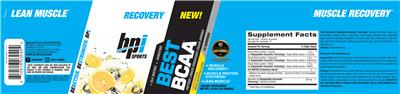
Best BCAA Sweet Lemonade by BPI Sports label
The label scan from the NIH Dietary Supplement Label Database. Tap to enlarge.
Label images are published by the NIH Dietary Supplement Label Database for the version of this product on file. Always read your actual product label.
View the full label (PDF)The Ingredients in Best BCAA Sweet Lemonade by BPI Sports
These are the 8 active ingredients this product is made of. Select any to open its full monograph.
Serving size10 Gram(s) Dosage formPowder Servings per container14 Amounts shown are per serving.
Most supplement products combine several ingredients, and a medication can interact with the product through any one of them. Each ingredient below shows whether it has known drug interactions.
Glycyl-Alanyl-Lysine-L-Leucine
Glycyl-Alanyl-Lysine-L-Isoleucine
Glycyl-Alanyl-Lysine-L-Valine
Agmatine
Interacts with258 drugs
Agmatine is a compound your body makes from the amino acid arginine, and it is sold mainly as a workout and 'pump' supplement. Human evidence for most...
Agmatine monograph & interactionsCLA Matrix (Proprietary Blend)
- › Conjugated Linoleic Acid
- › Avocado Oil
- › Coconut Oil
- › Safflower oil
Other (inactive) ingredients: Oligopeptide-Enzymatic Technology, Maltodextrin, Citric Acid, Natural and Artificial flavors, Malic Acid, Silica, Fiber Blend, Sucralose, Acesulfame-K, FD&C Blue No. 1. These complete the product’s ingredient list but are not active constituents.
Best BCAA Sweet Lemonade by BPI Sports Drug Interactions
HelloPharmacist Interaction Report
BPI Sports Best BCAA Sweet Lemonade contains several ingredients with documented interactions.
The most serious concern involves safflower oil, which can increase bleeding risk at high doses when combined with blood thinners like warfarin (anticoagulants) — this is rated Moderate severity and includes at least one case report of elevated bleeding markers in a patient on warfarin.
Read the full breakdown — every affected drug type, severity by severity
Agmatine carries Moderate-severity interactions with blood pressure medications (antihypertensives) and diabetes drugs (antidiabetes medications), as animal research suggests it can lower both blood pressure and blood sugar. Safflower oil also interacts with these same drug types at Moderate severity — it may affect blood glucose control and theoretically increase bleeding risk with antiplatelet agents.
Coconut oil has a Minor interaction with diabetes drugs, as animal data hints it might increase insulin and lower blood glucose.
Avocado oil shows a Moderate interaction with warfarin specifically, though only one case report exists. Several ingredients — Conjugated Linoleic Acid, Glycyl-Alanyl-Lysine-L-Leucine, Glycyl-Alanyl-Lysine-L-Isoleucine, and Glycyl-Alanyl-Lysine-L-Valine — we could not check because no interaction data is held for them.
Altogether, these interactions span 372 individual medications. Use the medication checker on this page to verify your exact drugs before starting this product.
Check your own medications below · Editorial policy · How we use AI
Want to check YOUR meds against Best BCAA Sweet Lemonade?
Ask about interactions with your drugs in plain English — “Can I take it with lisinopril?” — and we find you the answer in seconds, ingredient by ingredient.
Go to the checkerIngredients driving the most interactions
Individual Drug Interactions
The ingredients in Best BCAA Sweet Lemonade interact with 375 drugs. Click any drug to see the details.
4 of the 8 ingredients in Best BCAA Sweet Lemonade interact with drugs. Each result below shows which ingredient is responsible. Agmatine Safflower oil Coconut Oil Avocado Oil
AbciximabReoPro
How Abciximab interacts with Best BCAA Sweet Lemonade — through 1 ingredient. Tap an ingredient for the detail:
Safflower OilAnticoagulant/antiplatelet Drugs Moderate
Interaction Summary
High doses of safflower oil might increase the risk of bleeding when taken with anticoagulant or antiplatelet drugs.
Read the full Safflower Oil + Abciximab interactionAbrocitinibCibinqo
How Abrocitinib interacts with Best BCAA Sweet Lemonade — through 1 ingredient. Tap an ingredient for the detail:
Safflower OilAnticoagulant/antiplatelet Drugs Moderate
Interaction Summary
High doses of safflower oil might increase the risk of bleeding when taken with anticoagulant or antiplatelet drugs.
Read the full Safflower Oil + Abrocitinib interactionAcarboseGlucobay, Prandase, Precose
How Acarbose interacts with Best BCAA Sweet Lemonade — through 3 ingredients. Tap an ingredient for the detail:
Safflower OilAntidiabetes Drugs Moderate
Interaction Summary
Theoretically, safflower oil might alter the effects of antidiabetes drugs.
Read the full Safflower Oil + Acarbose interactionAgmatineAntidiabetes Drugs Moderate
Interaction Summary
Theoretically, agmatine might increase the risk of hypoglycemia when taken with antidiabetes drugs.
Read the full Agmatine + Acarbose interactionCoconut OilAntidiabetes Drugs Minor
Interaction Summary
Theoretically, taking coconut with antidiabetes drugs might increase the risk of hypoglycemia.
Read the full Coconut Oil + Acarbose interactionAcebutololRhotral, Sectral
How Acebutolol interacts with Best BCAA Sweet Lemonade — through 1 ingredient. Tap an ingredient for the detail:
AgmatineAntihypertensive Drugs Moderate
Interaction Summary
Theoretically, agmatine might increase the risk of hypotension when taken with antihypertensive drugs.
Read the full Agmatine + Acebutolol interactionAcenocoumarolSintrom
How Acenocoumarol interacts with Best BCAA Sweet Lemonade — through 1 ingredient. Tap an ingredient for the detail:
Safflower OilAnticoagulant/antiplatelet Drugs Moderate
Interaction Summary
High doses of safflower oil might increase the risk of bleeding when taken with anticoagulant or antiplatelet drugs.
Read the full Safflower Oil + Acenocoumarol interactionAcetaminophen, AspirinGemnisyn
How Acetaminophen, Aspirin interacts with Best BCAA Sweet Lemonade — through 1 ingredient. Tap an ingredient for the detail:
Safflower OilAnticoagulant/antiplatelet Drugs Moderate
Interaction Summary
High doses of safflower oil might increase the risk of bleeding when taken with anticoagulant or antiplatelet drugs.
Read the full Safflower Oil + Acetaminophen, Aspirin interactionAcetaminophen, Aspirin, CaffeineExcedrin, Excedrin Extra Strength, Excedrin Migraine
How Acetaminophen, Aspirin, Caffeine interacts with Best BCAA Sweet Lemonade — through 1 ingredient. Tap an ingredient for the detail:
Safflower OilAnticoagulant/antiplatelet Drugs Moderate
Interaction Summary
High doses of safflower oil might increase the risk of bleeding when taken with anticoagulant or antiplatelet drugs.
Read the full Safflower Oil + Acetaminophen, Aspirin, Caffeine interactionAcetaminophen, IbuprofenCombogesic
How Acetaminophen, Ibuprofen interacts with Best BCAA Sweet Lemonade — through 1 ingredient. Tap an ingredient for the detail:
Safflower OilAnticoagulant/antiplatelet Drugs Moderate
Interaction Summary
High doses of safflower oil might increase the risk of bleeding when taken with anticoagulant or antiplatelet drugs.
Read the full Safflower Oil + Acetaminophen, Ibuprofen interactionAcetazolamideAk-Zol, Diamox
How Acetazolamide interacts with Best BCAA Sweet Lemonade — through 1 ingredient. Tap an ingredient for the detail:
AgmatineAntihypertensive Drugs Moderate
Interaction Summary
Theoretically, agmatine might increase the risk of hypotension when taken with antihypertensive drugs.
Read the full Agmatine + Acetazolamide interactionAcetohexamideDymelor
How Acetohexamide interacts with Best BCAA Sweet Lemonade — through 3 ingredients. Tap an ingredient for the detail:
AgmatineAntidiabetes Drugs Moderate
Interaction Summary
Theoretically, agmatine might increase the risk of hypoglycemia when taken with antidiabetes drugs.
Read the full Agmatine + Acetohexamide interactionSafflower OilAntidiabetes Drugs Moderate
Interaction Summary
Theoretically, safflower oil might alter the effects of antidiabetes drugs.
Read the full Safflower Oil + Acetohexamide interactionCoconut OilAntidiabetes Drugs Minor
Interaction Summary
Theoretically, taking coconut with antidiabetes drugs might increase the risk of hypoglycemia.
Read the full Coconut Oil + Acetohexamide interactionAcetylsalicylic AcidEntrophen
How Acetylsalicylic Acid interacts with Best BCAA Sweet Lemonade — through 1 ingredient. Tap an ingredient for the detail:
Safflower OilAnticoagulant/antiplatelet Drugs Moderate
Interaction Summary
High doses of safflower oil might increase the risk of bleeding when taken with anticoagulant or antiplatelet drugs.
Read the full Safflower Oil + Acetylsalicylic Acid interactionAlbiglutideTanzeum
How Albiglutide interacts with Best BCAA Sweet Lemonade — through 3 ingredients. Tap an ingredient for the detail:
Safflower OilAntidiabetes Drugs Moderate
Interaction Summary
Theoretically, safflower oil might alter the effects of antidiabetes drugs.
Read the full Safflower Oil + Albiglutide interactionAgmatineAntidiabetes Drugs Moderate
Interaction Summary
Theoretically, agmatine might increase the risk of hypoglycemia when taken with antidiabetes drugs.
Read the full Agmatine + Albiglutide interactionCoconut OilAntidiabetes Drugs Minor
Interaction Summary
Theoretically, taking coconut with antidiabetes drugs might increase the risk of hypoglycemia.
Read the full Coconut Oil + Albiglutide interactionAliskirenTekturna
How Aliskiren interacts with Best BCAA Sweet Lemonade — through 1 ingredient. Tap an ingredient for the detail:
AgmatineAntihypertensive Drugs Moderate
Interaction Summary
Theoretically, agmatine might increase the risk of hypotension when taken with antihypertensive drugs.
Read the full Agmatine + Aliskiren interactionAlogliptinNesina
How Alogliptin interacts with Best BCAA Sweet Lemonade — through 3 ingredients. Tap an ingredient for the detail:
Safflower OilAntidiabetes Drugs Moderate
Interaction Summary
Theoretically, safflower oil might alter the effects of antidiabetes drugs.
Read the full Safflower Oil + Alogliptin interactionAgmatineAntidiabetes Drugs Moderate
Interaction Summary
Theoretically, agmatine might increase the risk of hypoglycemia when taken with antidiabetes drugs.
Read the full Agmatine + Alogliptin interactionCoconut OilAntidiabetes Drugs Minor
Interaction Summary
Theoretically, taking coconut with antidiabetes drugs might increase the risk of hypoglycemia.
Read the full Coconut Oil + Alogliptin interactionAlogliptin, MetforminKazano
How Alogliptin, Metformin interacts with Best BCAA Sweet Lemonade — through 3 ingredients. Tap an ingredient for the detail:
AgmatineAntidiabetes Drugs Moderate
Interaction Summary
Theoretically, agmatine might increase the risk of hypoglycemia when taken with antidiabetes drugs.
Read the full Agmatine + Alogliptin, Metformin interactionSafflower OilAntidiabetes Drugs Moderate
Interaction Summary
Theoretically, safflower oil might alter the effects of antidiabetes drugs.
Read the full Safflower Oil + Alogliptin, Metformin interactionCoconut OilAntidiabetes Drugs Minor
Interaction Summary
Theoretically, taking coconut with antidiabetes drugs might increase the risk of hypoglycemia.
Read the full Coconut Oil + Alogliptin, Metformin interactionAlogliptin, PioglitazoneOseni
How Alogliptin, Pioglitazone interacts with Best BCAA Sweet Lemonade — through 3 ingredients. Tap an ingredient for the detail:
Safflower OilAntidiabetes Drugs Moderate
Interaction Summary
Theoretically, safflower oil might alter the effects of antidiabetes drugs.
Read the full Safflower Oil + Alogliptin, Pioglitazone interactionAgmatineAntidiabetes Drugs Moderate
Interaction Summary
Theoretically, agmatine might increase the risk of hypoglycemia when taken with antidiabetes drugs.
Read the full Agmatine + Alogliptin, Pioglitazone interactionCoconut OilAntidiabetes Drugs Minor
Interaction Summary
Theoretically, taking coconut with antidiabetes drugs might increase the risk of hypoglycemia.
Read the full Coconut Oil + Alogliptin, Pioglitazone interactionAlteplase, TpaActilyse, Activase
How Alteplase, Tpa interacts with Best BCAA Sweet Lemonade — through 1 ingredient. Tap an ingredient for the detail:
Safflower OilAnticoagulant/antiplatelet Drugs Moderate
Interaction Summary
High doses of safflower oil might increase the risk of bleeding when taken with anticoagulant or antiplatelet drugs.
Read the full Safflower Oil + Alteplase, Tpa interactionAluminum Hydroxide, Aspirin, Codeine Phosphate, Magnesium HydroxideAscriptin Codeine #2
How Aluminum Hydroxide, Aspirin, Codeine Phosphate, Magnesium Hydroxide interacts with Best BCAA Sweet Lemonade — through 1 ingredient. Tap an ingredient for the detail:
Safflower OilAnticoagulant/antiplatelet Drugs Moderate
Interaction Summary
High doses of safflower oil might increase the risk of bleeding when taken with anticoagulant or antiplatelet drugs.
Read the full Safflower Oil + Aluminum Hydroxide, Aspirin, Codeine Phosphate, Magnesium Hydroxide interactionAluminum Hydroxide, Aspirin, Magnesium HydroxideAscriptin
How Aluminum Hydroxide, Aspirin, Magnesium Hydroxide interacts with Best BCAA Sweet Lemonade — through 1 ingredient. Tap an ingredient for the detail:
Safflower OilAnticoagulant/antiplatelet Drugs Moderate
Interaction Summary
High doses of safflower oil might increase the risk of bleeding when taken with anticoagulant or antiplatelet drugs.
Read the full Safflower Oil + Aluminum Hydroxide, Aspirin, Magnesium Hydroxide interactionAmbrisentanLetairis, Volibris
How Ambrisentan interacts with Best BCAA Sweet Lemonade — through 1 ingredient. Tap an ingredient for the detail:
AgmatineAntihypertensive Drugs Moderate
Interaction Summary
Theoretically, agmatine might increase the risk of hypotension when taken with antihypertensive drugs.
Read the full Agmatine + Ambrisentan interactionAmilorideAmilamont, Midamor
How Amiloride interacts with Best BCAA Sweet Lemonade — through 1 ingredient. Tap an ingredient for the detail:
AgmatineAntihypertensive Drugs Moderate
Interaction Summary
Theoretically, agmatine might increase the risk of hypotension when taken with antihypertensive drugs.
Read the full Agmatine + Amiloride interactionAmiloride, HydrochlorothiazideAmil-Co, Amilzide, Moduret 25, Moduretic
How Amiloride, Hydrochlorothiazide interacts with Best BCAA Sweet Lemonade — through 1 ingredient. Tap an ingredient for the detail:
AgmatineAntihypertensive Drugs Moderate
Interaction Summary
Theoretically, agmatine might increase the risk of hypotension when taken with antihypertensive drugs.
Read the full Agmatine + Amiloride, Hydrochlorothiazide interactionAmlodipineNorliqva
How Amlodipine interacts with Best BCAA Sweet Lemonade — through 1 ingredient. Tap an ingredient for the detail:
AgmatineAntihypertensive Drugs Moderate
Interaction Summary
Theoretically, agmatine might increase the risk of hypotension when taken with antihypertensive drugs.
Read the full Agmatine + Amlodipine interactionAmlodipine BenzoateKaterzia
How Amlodipine Benzoate interacts with Best BCAA Sweet Lemonade — through 1 ingredient. Tap an ingredient for the detail:
AgmatineAntihypertensive Drugs Moderate
Interaction Summary
Theoretically, agmatine might increase the risk of hypotension when taken with antihypertensive drugs.
Read the full Agmatine + Amlodipine Benzoate interactionAmlodipine BesilateIstin
How Amlodipine Besilate interacts with Best BCAA Sweet Lemonade — through 1 ingredient. Tap an ingredient for the detail:
AgmatineAntihypertensive Drugs Moderate
Interaction Summary
Theoretically, agmatine might increase the risk of hypotension when taken with antihypertensive drugs.
Read the full Agmatine + Amlodipine Besilate interactionAmlodipine BesylateNorvasc
How Amlodipine Besylate interacts with Best BCAA Sweet Lemonade — through 1 ingredient. Tap an ingredient for the detail:
AgmatineAntihypertensive Drugs Moderate
Interaction Summary
Theoretically, agmatine might increase the risk of hypotension when taken with antihypertensive drugs.
Read the full Agmatine + Amlodipine Besylate interactionAmlodipine Besylate, BenazeprilLotrel
How Amlodipine Besylate, Benazepril interacts with Best BCAA Sweet Lemonade — through 1 ingredient. Tap an ingredient for the detail:
AgmatineAntihypertensive Drugs Moderate
Interaction Summary
Theoretically, agmatine might increase the risk of hypotension when taken with antihypertensive drugs.
Read the full Agmatine + Amlodipine Besylate, Benazepril interactionAmlodipine, CelecoxibConsensi
How Amlodipine, Celecoxib interacts with Best BCAA Sweet Lemonade — through 1 ingredient. Tap an ingredient for the detail:
AgmatineAntihypertensive Drugs Moderate
Interaction Summary
Theoretically, agmatine might increase the risk of hypotension when taken with antihypertensive drugs.
Read the full Agmatine + Amlodipine, Celecoxib interactionAmmonium ChlorideAmmonium Chloride
How Ammonium Chloride interacts with Best BCAA Sweet Lemonade — through 1 ingredient. Tap an ingredient for the detail:
AgmatineAntihypertensive Drugs Moderate
Interaction Summary
Theoretically, agmatine might increase the risk of hypotension when taken with antihypertensive drugs.
Read the full Agmatine + Ammonium Chloride interactionAnacaulase-bcdbNexoBrid
How Anacaulase-bcdb interacts with Best BCAA Sweet Lemonade — through 1 ingredient. Tap an ingredient for the detail:
Safflower OilAnticoagulant/antiplatelet Drugs Moderate
Interaction Summary
High doses of safflower oil might increase the risk of bleeding when taken with anticoagulant or antiplatelet drugs.
Read the full Safflower Oil + Anacaulase-bcdb interactionEach ingredient & the kinds of drugs it affects
For each ingredient in Best BCAA Sweet Lemonade with known interactions, here are the types of medications they can affect. Open any type for the detail — or search your exact drug in the checker above.
Agmatine
Antidiabetes Drugs
Theoretically, agmatine might increase the risk of hypoglycemia when taken with antidiabetes drugs.
Animal and in vitro research suggest that agmatine has mild hypoglycemic effects.
Antihypertensive Drugs
Theoretically, agmatine might increase the risk of hypotension when taken with antihypertensive drugs.
Animal research suggests that agmatine can modestly decrease heart rate and blood pressure.
Safflower oil
Anticoagulant/Antiplatelet Drugs
High doses of safflower oil might increase the risk of bleeding when taken with anticoagulant or antiplatelet drugs.
Small clinical studies show that taking safflower oil, approximately 55 grams daily for 2-3 weeks, decreases platelet aggregation. However, taking lower doses of safflower oil, such as 5 grams daily for 4 weeks, does not seem to affect platelet function. In one case report, a 74-year-old male stabilized on warfarin developed urinary tract bleeding and an elevated INR after taking a safflower extract 20 grams daily for 14 days.
Antidiabetes Drugs
Theoretically, safflower oil might alter the effects of antidiabetes drugs.
Some clinical research shows that taking safflower oil 10 grams daily for 3 weeks can increase fasting blood glucose in patients with type 2 diabetes. However, clinical research in patients with metabolic syndrome with or without impaired glucose tolerance shows that taking safflower oil 8 grams daily for 12 weeks reduces fasting glucose levels by around 8 mg/dL. Some clinical research also shows that taking safflower oil 8 grams daily for 16 weeks does not affect fasting glucose levels in patients with type 2 diabetes.
Warfarin
Theoretically, safflower oil might increase the risk of bleeding when taken with warfarin.
In one case report, a 74-year-old male stabilized on warfarin developed urinary tract bleeding and an elevated INR after taking a safflower extract 20 grams daily for 14 days.
Coconut Oil
Antidiabetes Drugs
Theoretically, taking coconut with antidiabetes drugs might increase the risk of hypoglycemia.
Animal research suggests that coconut milk might increase insulin levels and/or decrease blood glucose levels.
Avocado Oil
Warfarin (Coumadin)
Avocado may antagonize the anticoagulant effects of warfarin.
Avocado may antagonize the anticoagulant effects of warfarin; however, there has been only one case report of this interaction.
Brand information
Manufacturer and brand details for Best BCAA Sweet Lemonade, from the product label.
BPI Sports
See all BPI Sports products- Name
- BPI Sports
- Street Address
- 3149 SW 42nd St. Suite 200
- City
- Hollywood
- State
- FL
- ZipCode
- 33312
- Phone Number
- 954.926.0900
- Web Address
- www.bpisports.com
Best BCAA Sweet Lemonade by BPI Sports: Common Questions
Does Best BCAA Sweet Lemonade by BPI Sports interact with any medications?
How can one product interact with so many drugs?
Where does this information come from?
Does this product work for muscle building?
Can I take this if I'm pregnant?
Can I take this while breastfeeding?
What's agmatine and why is it in this product?
Could this trigger allergies?
What side effects should I watch for?
Written and reviewed by the HelloPharmacist editorial staff. Our editorial policy
Not sure if Best BCAA Sweet Lemonade is safe with your meds?
Our pharmacists answer your medication & supplement questions — free.
Label information is sourced from the NIH Dietary Supplement Label Database and reflects the product version on file; always read your actual product label. This page is for education only and is not a substitute for professional medical advice. Confirm with your pharmacist or doctor before combining supplements and medications.
The Full Monographs Behind Best BCAA Sweet Lemonade’s Ingredients
Every ingredient we hold a full HelloPharmacist monograph for — uses, evidence, safety, and the complete interaction list.
Agmatine
Interacts with 258 drugsAgmatine is a compound your body makes from the amino acid arginine, and it is sold mainly as a workout and 'pump' supplement. Human evidence for most of its claimed benefits is limited and...
Read the full Agmatine monograph → Herb & supplement monographAvocado
Interacts with 2 drugsAvocado is a nutritious fruit rich in healthy monounsaturated fats, fiber, and potassium, and eating it as part of a balanced diet may support heart health. A specific extract called avocado...
Read the full Avocado monograph → Herb & supplement monographCoconut
Interacts with 86 drugsCoconut is a nutritious tropical food enjoyed as oil, water, milk, and flesh, and it is generally safe to eat in normal food amounts. While some uses (like skin moisturizing and hydration) h...
Read the full Coconut monograph → Herb & supplement monographSafflower
Interacts with 208 drugsSafflower is a thistle-like plant used mainly for its seed oil (a common cooking oil) and its colorful flowers. Safflower oil is a reasonable source of unsaturated fats, but strong proof tha...
Read the full Safflower monograph →Sources & How We Checked
Best BCAA Sweet Lemonade's label data comes from the NIH Dietary Supplement Label Database; the ingredient interaction data is from the Natural Medicines database, reviewed by our pharmacists.
- NIH Dietary Supplement Label Database (DSLD) — The official product label on file for this supplement.
- Natural Medicines (Therapeutic Research Center) — Evidence-graded clinical reference behind the ingredient interaction data.
Content is written and reviewed by licensed HelloPharmacist pharmacists. See our data sources and editorial standards for how this information is built and checked.
The 37 references behind this product’s interaction data
Every citation that drives the interaction findings for this product’s ingredients, from the evidence-graded Natural Medicines (TRC Healthcare) database. Open an ingredient to browse its citations — links open the study on PubMed or the publisher’s site.
Avocado 10 references
- Blickstein D, Shaklai M, Inbal A. Warfarin antagonism by avocado. Lancet 1991;337:914-5. PubMed
- Blanco C, Diaz-Perales A, Collada C, et al. Class I chitinases as potential panallergens involved in the latex-fruit syndrome. J Allergy Clin Immunol 1999;103(3 Pt 1):507-13. PubMed
- Diaz-Perales A, Collada C, Blanco C, et al. Cross-reactions in the latex-fruit syndrome: A relevant role of chitinases but not of complex asparagine-linked glycans. J Allergy Clin Immunol 1999;104:681-7. PubMed
- Stucker M, Memmel U, Hoffmann M, et al. Vitamin B(12) cream containing avocado oil in the therapy of plaque psoriasis. Dermatology 2001;203:141-7.
- Ahlroth, M., Alenius, H., Turjanmaa, K., Makinen-Kiljunen, S., Reunala, T., and Palosuo, T. Cross-reacting allergens in natural rubber latex and avocado. J.Allergy Clin.Immunol. 1995;96(2):167-173. PubMed
- de Groot, A. C., van der Meeren, H. L., and Weyland, J. W. Contact allergy to avocado oil in a sunscreen. Contact Dermatitis 1987;16(2):108-109. PubMed
- Blanco, C., Carrillo, T., Castillo, R., Quiralte, J., and Cuevas, M. Avocado hypersensitivity. Allergy 1994;49(6):454-459. PubMed
- Crisi, G. and Belsito, D. V. Contact urticaria from latex in a patient with immediate hypersensitivity to banana, avocado and peach. Contact Dermatitis 1993;28(4):247-248.
- Cherian S, Neupert K, Varshney P. Avocado as an emerging trigger for food protein-induced enterocolitis syndrome. Ann Allergy Asthma Immunol. 2018;121(3):369-71. PubMed
- Lichtenstein AH, Kris-Etherton PM, Petersen KS, et al. Effect of Incorporating 1 Avocado Per Day Versus Habitual Diet on Visceral Adiposity: A Randomized Trial. J Am Heart Assoc 2022;11(14):e025657.
Coconut 10 references
- Teuber SS, Peterson WR. Systemic allergic reaction to coconut (Cocos nucifera) in 2 subjects with hypersensitivity to tree nut and demonstration of cross-reactivity to legumin-like seed storage proteins: new coconut and walnut food allergens. J Allergy Cl PubMed
- Rosado A, Fernandez-Rivas M, Gonzalez-Mancebo E, et al. Anaphylaxis to coconut. Allergy 2002;57(2):182-3. PubMed
- Karmakar PR, Das A, Chatterjee BP. Placebo-controlled immunotherapy with Cocos nucifera pollen extract. Int Arch Allergy Immunol 1994;103(2):194-201. PubMed
- Anagnostou K. Coconut Allergy Revisited. Children (Basel). 2017;4(10). pii: E85. PubMed
- Cifuentes L, Mistrello G, Amato S, et al. Identification of cross-reactivity between buckwheat and coconut. Ann Allergy Asthma Immunol. 2015;115(6):530-2. PubMed
- Michavila Gomez A, Amat Bou M, Gonzalez Cortés MV, Segura Navas L, Moreno Palanques MA, Bartolomé B. Coconut anaphylaxis: Case report and review. Allergol Immunopathol (Madr). 2015;43(2):219-20. PubMed
- 21CFR170.3. U.S. Food and Drug Administration Department of Health and Human Services. Updated April 1, 2017. https://www.accessdata.fda.gov/scripts/cdrh/cfdocs/cfcfr/CFRSearch.cfm?fr=170.3
- Alatawi KA, Alshubaily FA. Coconut products alleviate hyperglycaemic, hyperlipidimic and nephropathy indices in streptozotocin-induced diabetic wistar rats. Saudi J Biol Sci. 2021;28(8):4224-4231. PubMed
- Kruse L, Lor J, Yousif R, Pongracic JA, Fishbein AB. Coconut allergy: Characteristics of reactions and diagnostic predictors in a pediatric tertiary care center. Ann Allergy Asthma Immunol 2021;126(5):562-568.
- Pathmanandavel K, Kaur N, Joshi P, Ford LS. Anaphylaxis and allergy to coconut: An Australian pediatric case series. J Allergy Clin Immunol Pract 2020;8(10):3657-3659. PubMed
Agmatine 3 references
- Piletz JE, Aricioglu F, Cheng JT, et al. Agmatine: clinical applications after 100 years in translation. Drug Discov Today 2013;18(17-18):880-93. PubMed
- Keynan O, Mirovsky Y, Dekel S, Gilad VH, Gilad GM. Safety and efficacy of dietary agmatine sulfate in lumbar disc-associated radiculopathy. An open-label, dose-escalating study followed by a randomized, double-blind, placebo-controlled trial. Pain Med 201 PubMed
- Shopsin B. The clinical antidepressant effect of exogenous agmatine is not reversed by parachlorophenylalanine: a pilot study. Acta Neuropsychiatr 2013;25(2):113-8. PubMed
Safflower 14 references
- The Review of Natural Products by Facts and Comparisons. St. Louis, MO: Wolters Kluwer Co., 1999.
- Leung AY, Foster S. Encyclopedia of Common Natural Ingredients Used in Food, Drugs and Cosmetics. 2nd ed. New York, NY: John Wiley & Sons, 1996.
- McGuffin M, Hobbs C, Upton R, Goldberg A, eds. American Herbal Products Association's Botanical Safety Handbook. Boca Raton, FL: CRC Press, LLC 1997.
- Borkman M, Chisholm DJ, Furler SM, et al. Effects of fish oil supplementation on glucose and lipid metabolism in NIDDM. Diabetes 1989;38:1314-9.. PubMed
- Amato, P. and Quercia, R. A. A historical perspective and review of the safety of lipid emulsion in pregnancy. Nutr Clin Pract. 1991;6(5):189-192. PubMed
- Demke, D. M., Peters, G. R., Linet, O. I., Metzler, C. M., and Klott, K. A. Effects of a fish oil concentrate in patients with hypercholesterolemia. Atherosclerosis 1988;70(1-2):73-80. PubMed
- Kaji, K., Yoshida, S., Nagata, N., Yamashita, T., Mizukoshi, E., Honda, M., Kojima, Y., and Kaneko, S. An open-label study of administration of EH0202, a health-food additive, to patients with chronic hepatitis C. J Gastroenterol. 2004;39(9):873-878. PubMed
- Kwon, J. S., Snook, J. T., Wardlaw, G. M., and Hwang, D. H. Effects of diets high in saturated fatty acids, canola oil, or safflower oil on platelet function, thromboxane B2 formation, and fatty acid composition of platelet phospholipids. Am.J.Clin.Nutr. PubMed
- Lloyd-Still, J. D., Simon, S. H., Wessel, H. U., and Gibson, L. E. Negative effects of oral fatty acid supplementation on sweat chloride in cystic fibrosis. Pediatrics 1979;64(1):50-52. DOI
- Challen, A. D., Branch, W. J., and Cummings, J. H. The effect of aspirin and linoleic acid on platelet aggregation, platelet fatty acid composition and haemostasis in man. Hum Nutr Clin Nutr 1983;37(3):197-208.
- Asp ML, Collene AL, Norris LE, Cole RM, Stout MB, Tang SY, Hsu JC, Belury MA. Time-dependent effects of safflower oil to improve glycemia, inflammation and blood lipids in obese, post-menopausal women with type 2 diabetes: a randomized, double-masked, cro
- Liu Y, Liu S, Shi Y, et al. Effects of safflower injection on the pharmacodynamics and pharmacokinetics of warfarin in rats. Xenobiotica. 2017 Oct 25:1-6. [Epub ahead of print] PubMed
- de Ataide EC, Reges Perales S, de Oliveira Peres MA, et al. Acute liver failure induced by Carthamus tinctorius oil: Case reports and literature review. Transplant Proc. 2018;50(2):476-477. PubMed
- Ruyvaran M, Zamani A, Mohamadian A, et al. Safflower (Carthamus tinctorius L.) oil could improve abdominal obesity, blood pressure, and insulin resistance in patients with metabolic syndrome: a randomized, double-blind, placebo-controlled clinical trial. PubMed
Parts of this content are provided by the Therapeutic Research Center, LLC.
DISCLAIMER: Currently this does not check for drug-drug interactions. This is not an all-inclusive comprehensive list of potential interactions and is for informational purposes only. Not all interactions are known or well-reported in the scientific literature, and new interactions are continually being reported. Input is needed from a qualified healthcare provider including a pharmacist before starting any therapy. Application of clinical judgment is necessary.
© 2021 Therapeutic Research Center, LLC