
Bromelain Plus Ingredients & Drug Interactions
by Isotonix
What is this page for?
First and foremost: checking Bromelain Plus against your medications. The heart of this page is the interaction checker and the full interaction report — how this product’s ingredients may interact with prescription and over-the-counter medicines you may be taking.
Around that, we add a pharmacist’s high-level view of the product as a whole — what’s inside, the evidence for its stated use, how transparent the label is, and what safety data exists — so you can see the full picture in one place. It’s educational information from our licensed clinical databases and the clinical staff at HelloPharmacist — not medical advice — and we don’t sell or endorse products. Our editorial policy
Bromelain Plus is a dietary supplement by Isotonix with 4 active ingredients. Its ingredients are commonly taken for inflammation and swelling, sinus and nasal congestion, digestion support.Based on those ingredients, 208 medications have a known interaction with it, the most serious rated moderate. The ingredients most likely to interact are Bromelain, White Willow bark extract, Potassium. Use the checker below to test your specific medication, or read the full HelloPharmacist Interaction Report.
Check Your Meds Against Bromelain Plus by Isotonix
Ask about any prescription or over-the-counter medication and we check it for interactions with Bromelain Plus by Isotonix — and tell you which ingredient is responsible.
AI summaries are generated from our interaction database for education only — always confirm with your pharmacist. How we use AI
Ask the Pharmacist
A licensed pharmacist will answer your question by email — free, usually within 24 hours.
Got it — thank you!
A licensed pharmacist will answer within 24 hours. Keep an eye on your email (worth checking spam, just in case).
HelloPharmacist Scorecard of Bromelain Plus by Isotonix
Our pharmacy team’s full take, with four database checks built into the cards below — a summary of what is known, not a grade of the product itself.
What’s inside
Full disclosure
Bromelain Plus contains four active ingredients. Bromelain is a protein-digesting enzyme from pineapple stem that may help reduce swelling and support tissue healing.
Protease is another protein-digesting enzyme with similar effects. Potassium is an electrolyte your body needs for heart rhythm, muscle function, and nerve signaling.
White willow bark extract contains salicin, a plant compound with aspirin-like properties that may ease pain and inflammation, particularly back pain. The product also contains inactive ingredients—fructose, citric acid, maltodextrin, and other fillers and flavorings.
Does it work?
Moderate evidence
The evidence supporting Bromelain Plus is mixed. White willow bark is possibly effective for back pain, but for bromelain itself—the main ingredient—the data we hold shows insufficient reliable evidence for allergic rhinitis, burns, cancer, chemotherapy nerve damage, chronic venous insufficiency, and diabetes.
For the other ingredients in this product, effectiveness ratings are not established in our data. If you're considering this product for a specific condition, talk with your pharmacist about what the research actually shows for your situation.
How safe is it?
Well-documented data
Bromelain and white willow bark are generally well tolerated short-term in healthy adults, but long-term safety data is limited. The most common side effects are digestive—diarrhea, flatulence, stomach upset, nausea, and vomiting.
White willow bark may also cause heartburn, and both it and bromelain can trigger allergic reactions, including severe ones in people allergic to aspirin. Protease is generally well tolerated but may cause digestive upset or allergies.
Potassium from food is safe, but supplements can dangerously raise blood potassium levels, especially in people with kidney disease. Avoid this product during pregnancy—bromelain and willow bark are not safe enough during pregnancy, and potassium supplements should only be used under medical guidance.
Breastfeeding safety data is insufficient or lacking for bromelain, protease, and willow bark, so avoid those while nursing; potassium from supplements should be checked with your doctor first.
Meds to double-check
Moderate interaction found
Before taking Bromelain Plus, check with your pharmacist if you use ACE inhibitors (like enalapril or lisinopril), ARBs (like losartan or valsartan), potassium-sparing diuretics (like spironolactone), anticoagulants (like warfarin or apixaban), antiplatelet drugs (like aspirin or clopidogrel), or aspirin-like drugs (acetazolamide, choline magnesium trisalicylate, or salsalate). All of these carry Moderate severity interactions with one or more ingredients.
If you're on a tetracycline antibiotic, bromelain may theoretically increase its levels—a Minor interaction, but worth mentioning to your pharmacist.
The bottom line
Scorecard at a glanceFully disclosed formula with some supporting evidence for its stated purpose. Moderate medication interactions have been identified, and safety information is well characterized.
Bromelain Plus may appeal to people looking for natural enzyme-based support for digestion, inflammation, or pain—but the evidence for most of its uses is not well established. If you take blood pressure medications, potassium-sparing diuretics, or blood thinners, do not start this product without checking with your pharmacist first.
Pregnant or breastfeeding? Talk with your doctor or pharmacist—the safety data advises against it.
Run your medications through the checker below before you buy.
Educational only — not medical advice; always confirm with your pharmacist. Our editorial policy · How we use AI
Assessment coverage: 4 of 4 active ingredients matched to our full ingredient reviews (monographs). Based on the product label dated Jun 20, 2024.
This Scorecard evaluates available label information, ingredient evidence, and known medication-safety considerations. It does not independently verify product identity, purity, potency, contamination, or manufacturing quality. How these ratings are computed
General information
Key facts about Bromelain Plus, straight from the product label.
| Brand | Isotonix |
|---|---|
| Barcode (UPC) | 848570001375 |
| Net contents | 10.6 Ounce(s); 300 Gram(s) |
| Market status | On market |
| Date entered into DSLD | Jun 20, 2024 |
| DSLD ID | 313389 |
| Product type | Other Combinations |
| Supplement form | Powder |
| Dietary claims / uses | All Other, Structure/Function |
| Intended target group(s) | Vegan, Vegetarian, Adult (18 - 50 Years), Gluten Free, Dairy Free |
Everything in this section is reproduced from the manufacturer’s own product label — it’s the label speaking, not HelloPharmacist. We show it so you can see exactly what the maker states; we don’t verify or endorse those statements.
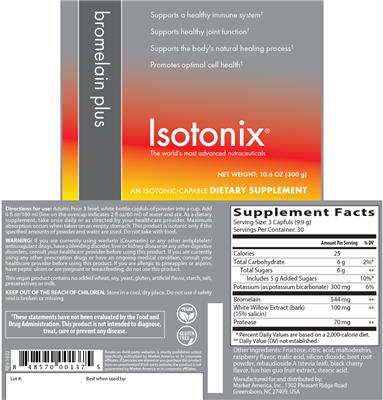
Supplement Facts
The label details for Bromelain Plus by Isotonix, sourced from the NIH Dietary Supplement Label Database.
Supplement Facts
| Ingredient | Amount | % DV |
|---|---|---|
| Calories | 25 Calorie(s) | -- |
| Bromelain | 544 mg | -- |
| Total Sugars | 6 Gram(s) | -- |
| added Sugars | 5 Gram(s) | 10% |
| Protease | 70 mg | -- |
| Total Carbohydrates | 6 Gram(s) | 2% |
| Potassium | 300 mg | 6% |
| White Willow bark extract | 100 mg | -- |
Other ingredients: Fructose, Citric Acid, Maltodextrin, Raspberry flavor, Malic Acid, Silicon Dioxide, Beet root powder, Rebaudioside A, Black Cherry flavor, Luo Han Guo fruit extract, Stearic Acid
Tap any ingredient to jump to its full detail below.
These statements are the manufacturer’s wording, reproduced from the product label — the label is saying it, not HelloPharmacist. We don’t verify or endorse them.
Formulation
Supports a healthy immune system Supports healthy joint function Supports the body's natural healing process Promotes optimal cell health
This vegan product contains no added wheat, soy, yeast, gluten, artificial flavor, starch, salt, preservatives or milk.
This vegan product contains no added wheat, soy, yeast, gluten, artificial flavor, starch, salt, preservatives or milk.
Vegan
Gluten free
Brand IP Statement(s)
Isotonix The world's most advanced nutraceuticals
FDA Statement of Identity
An isotonic-capable Dietary Supplement
Suggested/Recommended/Usage/Directions
Directions for use: Adults: Pour 3 level, white bottle capfuls of powder into a cup. Add 6 fl oz/180 ml (line on the overcap indicates 2 fl oz/60 ml) of water and stir. As a dietary supplement, take once daily or as directed by your healthcare provider. Maximum absorption occurs when taken on an empty stomach. This product is isotonic only if the specified amounts of powder and water are used. Do not take with food.
Precautions
Warning: If you are currently using warfarin (Coumadin) or any other antiplatelet/anticoagulant drugs, have a bleeding disorder, liver or kidney disease or any other digestive disorders, consult your healthcare provider before using this product. If you are currently using any other prescription drugs or have an ongoing medical condition, consult your healthcare provider before using this product. If you are allergic to pineapples or aspirin, have peptic ulcers or are pregnant or breastfeeding, do not use this product.
If you are allergic to pineapples or aspirin, have peptic ulcers or are pregnant or breastfeeding, do not use this product.
Keep out of the reach of children.
Do not use if safety seal is broken or missing.
Resale on third-party websites is strictly prohibited unless specifically authorized by Market America or its corporate affiliates. If barcodes are altered or you purchase this product from an unauthorized third-party website, the product is not guaranteed by Market America or its corporate affiliates.
Storage
Store in a cool, dry place.
FDA Disclaimer Statement
These statements have not been evaluated by the Food and Drug Administration. This product is not intended to diagnose, treat, cure or prevent any disease.
Is this label outdated? Report a formula or label change and our pharmacy team will review it.
Bromelain Plus by Isotonix label
The label scan from the NIH Dietary Supplement Label Database. Tap to enlarge.
Label images are published by the NIH Dietary Supplement Label Database for the version of this product on file. Always read your actual product label.
View the full label (PDF)The Ingredients in Bromelain Plus by Isotonix
These are the 4 active ingredients this product is made of. Select any to open its full monograph.
Serving size9.9 Gram(s) Dosage formPowder Servings per container30 Amounts shown are per serving.
Most supplement products combine several ingredients, and a medication can interact with the product through any one of them. Each ingredient below shows whether it has known drug interactions.
Bromelain
Interacts with141 drugs
Bromelain is a group of protein-digesting enzymes from pineapple that people take mainly for inflammation, swelling, and sinus problems. Some early st...
Bromelain monograph & interactionsProtease
No knowninteractions
Proteolytic enzymes are proteins that help break down other proteins, and common examples include bromelain (from pineapple), papain (from papaya), tr...
Protease monograph & interactionsPotassium
Interacts with62 drugs
Potassium is an essential mineral your body needs for nerve signals, muscle function, and a steady heartbeat, and most people get enough from a balanc...
Potassium monograph & interactionsWhite Willow bark extract
Interacts with127 drugs
Willow bark is a traditional plant remedy that contains salicin, a compound related to aspirin, and is most often used for pain and inflammation. Some...
White Willow bark extract monograph & interactionsOther (inactive) ingredients: Fructose, Citric Acid, Maltodextrin, Raspberry flavor, Malic Acid, Silicon Dioxide, Beet root powder, Rebaudioside A, Black Cherry flavor, Luo Han Guo fruit extract, Stearic Acid. These complete the product’s ingredient list but are not active constituents.
Bromelain Plus by Isotonix Drug Interactions
HelloPharmacist Interaction Report
Bromelain Plus by Isotonix contains four active ingredients, three of which interact with medications.
The most serious concern is potassium: if you're taking blood pressure drugs like ACE inhibitors (enalapril, lisinopril) or ARBs (losartan, valsartan), or potassium-sparing diuretics (spironolactone), adding potassium supplements can raise your blood potassium to dangerous levels (hyperkalemia). This is a Moderate severity interaction.
Read the full breakdown — every affected drug type, severity by severity
Bromelain and white willow bark both thin the blood. If you take anticoagulants (warfarin, apixaban) or antiplatelet drugs (aspirin, clopidogrel), either ingredient may increase your bleeding risk—also Moderate severity.
White willow bark also has Moderate interactions with aspirin-like drugs: acetazolamide, choline magnesium trisalicylate, and salsalate. Bromelain may theoretically increase tetracycline antibiotic levels, though a study in healthy adults found no real change (Minor severity).
Protease, the second ingredient, has no documented interactions in our data. Altogether, these interactions span 208 individual medications.
Use the medication checker below with your exact prescriptions before starting this product.
Check your own medications below · Editorial policy · How we use AI
Want to check YOUR meds against Bromelain Plus?
Ask about interactions with your drugs in plain English — “Can I take it with lisinopril?” — and we find you the answer in seconds, ingredient by ingredient.
Go to the checkerIngredients driving the most interactions
Individual Drug Interactions
The ingredients in Bromelain Plus interact with 208 drugs. Click any drug to see the details.
3 of the 4 ingredients in Bromelain Plus interact with drugs. Each result below shows which ingredient is responsible. Bromelain White Willow bark extract Potassium
AbciximabReoPro
How Abciximab interacts with Bromelain Plus — through 2 ingredients. Tap an ingredient for the detail:
White Willow Bark ExtractAnticoagulant/antiplatelet Drugs Moderate
Interaction Summary
Theoretically, willow bark might increase the risk of bleeding when taken with anticoagulant/antiplatelet drugs.
Read the full White Willow Bark Extract + Abciximab interactionBromelainAnticoagulant/antiplatelet Drugs Moderate
Interaction Summary
Bromelain may have antiplatelet effects and may increase the risk of bleeding if used with anticoagulant or antiplatelet drugs.
Read the full Bromelain + Abciximab interactionAbrocitinibCibinqo
How Abrocitinib interacts with Bromelain Plus — through 2 ingredients. Tap an ingredient for the detail:
BromelainAnticoagulant/antiplatelet Drugs Moderate
Interaction Summary
Bromelain may have antiplatelet effects and may increase the risk of bleeding if used with anticoagulant or antiplatelet drugs.
Read the full Bromelain + Abrocitinib interactionWhite Willow Bark ExtractAnticoagulant/antiplatelet Drugs Moderate
Interaction Summary
Theoretically, willow bark might increase the risk of bleeding when taken with anticoagulant/antiplatelet drugs.
Read the full White Willow Bark Extract + Abrocitinib interactionAcenocoumarolSintrom
How Acenocoumarol interacts with Bromelain Plus — through 2 ingredients. Tap an ingredient for the detail:
White Willow Bark ExtractAnticoagulant/antiplatelet Drugs Moderate
Interaction Summary
Theoretically, willow bark might increase the risk of bleeding when taken with anticoagulant/antiplatelet drugs.
Read the full White Willow Bark Extract + Acenocoumarol interactionBromelainAnticoagulant/antiplatelet Drugs Moderate
Interaction Summary
Bromelain may have antiplatelet effects and may increase the risk of bleeding if used with anticoagulant or antiplatelet drugs.
Read the full Bromelain + Acenocoumarol interactionAcetaminophen, AspirinGemnisyn
How Acetaminophen, Aspirin interacts with Bromelain Plus — through 2 ingredients. Tap an ingredient for the detail:
BromelainAnticoagulant/antiplatelet Drugs Moderate
Interaction Summary
Bromelain may have antiplatelet effects and may increase the risk of bleeding if used with anticoagulant or antiplatelet drugs.
Read the full Bromelain + Acetaminophen, Aspirin interactionWhite Willow Bark ExtractAnticoagulant/antiplatelet Drugs, Aspirin Moderate
Interaction Summary
Theoretically, willow bark might increase the risk of bleeding when taken with anticoagulant/antiplatelet drugs.
Read the full White Willow Bark Extract + Acetaminophen, Aspirin interactionAcetaminophen, Aspirin, CaffeineExcedrin, Excedrin Extra Strength, Excedrin Migraine
How Acetaminophen, Aspirin, Caffeine interacts with Bromelain Plus — through 2 ingredients. Tap an ingredient for the detail:
White Willow Bark ExtractAspirin, Anticoagulant/antiplatelet Drugs Moderate
Interaction Summary
Theoretically, willow bark might increase the effects and adverse effects of aspirin.
Read the full White Willow Bark Extract + Acetaminophen, Aspirin, Caffeine interactionBromelainAnticoagulant/antiplatelet Drugs Moderate
Interaction Summary
Bromelain may have antiplatelet effects and may increase the risk of bleeding if used with anticoagulant or antiplatelet drugs.
Read the full Bromelain + Acetaminophen, Aspirin, Caffeine interactionAcetaminophen, IbuprofenCombogesic
How Acetaminophen, Ibuprofen interacts with Bromelain Plus — through 2 ingredients. Tap an ingredient for the detail:
BromelainAnticoagulant/antiplatelet Drugs Moderate
Interaction Summary
Bromelain may have antiplatelet effects and may increase the risk of bleeding if used with anticoagulant or antiplatelet drugs.
Read the full Bromelain + Acetaminophen, Ibuprofen interactionWhite Willow Bark ExtractAnticoagulant/antiplatelet Drugs Moderate
Interaction Summary
Theoretically, willow bark might increase the risk of bleeding when taken with anticoagulant/antiplatelet drugs.
Read the full White Willow Bark Extract + Acetaminophen, Ibuprofen interactionAcetazolamideAk-Zol, Diamox
How Acetazolamide interacts with Bromelain Plus — through 1 ingredient. Tap an ingredient for the detail:
White Willow Bark ExtractAcetazolamide Moderate
Interaction Summary
Theoretically, willow bark might result in additive adverse effects associated with acetazolamide.
Read the full White Willow Bark Extract + Acetazolamide interactionAcetylsalicylic AcidEntrophen
How Acetylsalicylic Acid interacts with Bromelain Plus — through 2 ingredients. Tap an ingredient for the detail:
White Willow Bark ExtractAspirin, Anticoagulant/antiplatelet Drugs Moderate
Interaction Summary
Theoretically, willow bark might increase the effects and adverse effects of aspirin.
Read the full White Willow Bark Extract + Acetylsalicylic Acid interactionBromelainAnticoagulant/antiplatelet Drugs Moderate
Interaction Summary
Bromelain may have antiplatelet effects and may increase the risk of bleeding if used with anticoagulant or antiplatelet drugs.
Read the full Bromelain + Acetylsalicylic Acid interactionAlteplase, TpaActilyse, Activase
How Alteplase, Tpa interacts with Bromelain Plus — through 2 ingredients. Tap an ingredient for the detail:
BromelainAnticoagulant/antiplatelet Drugs Moderate
Interaction Summary
Bromelain may have antiplatelet effects and may increase the risk of bleeding if used with anticoagulant or antiplatelet drugs.
Read the full Bromelain + Alteplase, Tpa interactionWhite Willow Bark ExtractAnticoagulant/antiplatelet Drugs Moderate
Interaction Summary
Theoretically, willow bark might increase the risk of bleeding when taken with anticoagulant/antiplatelet drugs.
Read the full White Willow Bark Extract + Alteplase, Tpa interactionAluminum Hydroxide, Aspirin, Codeine Phosphate, Magnesium HydroxideAscriptin Codeine #2
How Aluminum Hydroxide, Aspirin, Codeine Phosphate, Magnesium Hydroxide interacts with Bromelain Plus — through 2 ingredients. Tap an ingredient for the detail:
White Willow Bark ExtractAnticoagulant/antiplatelet Drugs, Aspirin Moderate
Interaction Summary
Theoretically, willow bark might increase the risk of bleeding when taken with anticoagulant/antiplatelet drugs.
Read the full White Willow Bark Extract + Aluminum Hydroxide, Aspirin, Codeine Phosphate, Magnesium Hydroxide interactionBromelainAnticoagulant/antiplatelet Drugs Moderate
Interaction Summary
Bromelain may have antiplatelet effects and may increase the risk of bleeding if used with anticoagulant or antiplatelet drugs.
Read the full Bromelain + Aluminum Hydroxide, Aspirin, Codeine Phosphate, Magnesium Hydroxide interactionAluminum Hydroxide, Aspirin, Magnesium HydroxideAscriptin
How Aluminum Hydroxide, Aspirin, Magnesium Hydroxide interacts with Bromelain Plus — through 2 ingredients. Tap an ingredient for the detail:
BromelainAnticoagulant/antiplatelet Drugs Moderate
Interaction Summary
Bromelain may have antiplatelet effects and may increase the risk of bleeding if used with anticoagulant or antiplatelet drugs.
Read the full Bromelain + Aluminum Hydroxide, Aspirin, Magnesium Hydroxide interactionWhite Willow Bark ExtractAnticoagulant/antiplatelet Drugs, Aspirin Moderate
Interaction Summary
Theoretically, willow bark might increase the risk of bleeding when taken with anticoagulant/antiplatelet drugs.
Read the full White Willow Bark Extract + Aluminum Hydroxide, Aspirin, Magnesium Hydroxide interactionAmilorideAmilamont, Midamor
How Amiloride interacts with Bromelain Plus — through 1 ingredient. Tap an ingredient for the detail:
PotassiumPotassium-sparing Diuretics Moderate
Interaction Summary
Concomitant use increases the risk of hyperkalemia.
Read the full Potassium + Amiloride interactionAmiloride, HydrochlorothiazideAmil-Co, Amilzide, Moduret 25, Moduretic
How Amiloride, Hydrochlorothiazide interacts with Bromelain Plus — through 1 ingredient. Tap an ingredient for the detail:
PotassiumPotassium-sparing Diuretics Moderate
Interaction Summary
Concomitant use increases the risk of hyperkalemia.
Read the full Potassium + Amiloride, Hydrochlorothiazide interactionAmlodipine Besylate, BenazeprilLotrel
How Amlodipine Besylate, Benazepril interacts with Bromelain Plus — through 1 ingredient. Tap an ingredient for the detail:
PotassiumAce Inhibitors (aceis) Moderate
Interaction Summary
Using ACEIs with high doses of potassium increases the risk of hyperkalemia.
Read the full Potassium + Amlodipine Besylate, Benazepril interactionAnacaulase-bcdbNexoBrid
How Anacaulase-bcdb interacts with Bromelain Plus — through 2 ingredients. Tap an ingredient for the detail:
BromelainAnticoagulant/antiplatelet Drugs Moderate
Interaction Summary
Bromelain may have antiplatelet effects and may increase the risk of bleeding if used with anticoagulant or antiplatelet drugs.
Read the full Bromelain + Anacaulase-bcdb interactionWhite Willow Bark ExtractAnticoagulant/antiplatelet Drugs Moderate
Interaction Summary
Theoretically, willow bark might increase the risk of bleeding when taken with anticoagulant/antiplatelet drugs.
Read the full White Willow Bark Extract + Anacaulase-bcdb interactionAnagrelideAgrylin
How Anagrelide interacts with Bromelain Plus — through 2 ingredients. Tap an ingredient for the detail:
BromelainAnticoagulant/antiplatelet Drugs Moderate
Interaction Summary
Bromelain may have antiplatelet effects and may increase the risk of bleeding if used with anticoagulant or antiplatelet drugs.
Read the full Bromelain + Anagrelide interactionWhite Willow Bark ExtractAnticoagulant/antiplatelet Drugs Moderate
Interaction Summary
Theoretically, willow bark might increase the risk of bleeding when taken with anticoagulant/antiplatelet drugs.
Read the full White Willow Bark Extract + Anagrelide interactionAnisindioneMiradon
How Anisindione interacts with Bromelain Plus — through 2 ingredients. Tap an ingredient for the detail:
BromelainAnticoagulant/antiplatelet Drugs Moderate
Interaction Summary
Bromelain may have antiplatelet effects and may increase the risk of bleeding if used with anticoagulant or antiplatelet drugs.
Read the full Bromelain + Anisindione interactionWhite Willow Bark ExtractAnticoagulant/antiplatelet Drugs Moderate
Interaction Summary
Theoretically, willow bark might increase the risk of bleeding when taken with anticoagulant/antiplatelet drugs.
Read the full White Willow Bark Extract + Anisindione interactionAntithrombin IiiThrombate III
How Antithrombin Iii interacts with Bromelain Plus — through 2 ingredients. Tap an ingredient for the detail:
White Willow Bark ExtractAnticoagulant/antiplatelet Drugs Moderate
Interaction Summary
Theoretically, willow bark might increase the risk of bleeding when taken with anticoagulant/antiplatelet drugs.
Read the full White Willow Bark Extract + Antithrombin Iii interactionBromelainAnticoagulant/antiplatelet Drugs Moderate
Interaction Summary
Bromelain may have antiplatelet effects and may increase the risk of bleeding if used with anticoagulant or antiplatelet drugs.
Read the full Bromelain + Antithrombin Iii interactionApixabanEliquis
How Apixaban interacts with Bromelain Plus — through 2 ingredients. Tap an ingredient for the detail:
BromelainAnticoagulant/antiplatelet Drugs Moderate
Interaction Summary
Bromelain may have antiplatelet effects and may increase the risk of bleeding if used with anticoagulant or antiplatelet drugs.
Read the full Bromelain + Apixaban interactionWhite Willow Bark ExtractAnticoagulant/antiplatelet Drugs Moderate
Interaction Summary
Theoretically, willow bark might increase the risk of bleeding when taken with anticoagulant/antiplatelet drugs.
Read the full White Willow Bark Extract + Apixaban interactionArgatrobanArgatroban
How Argatroban interacts with Bromelain Plus — through 2 ingredients. Tap an ingredient for the detail:
White Willow Bark ExtractAnticoagulant/antiplatelet Drugs Moderate
Interaction Summary
Theoretically, willow bark might increase the risk of bleeding when taken with anticoagulant/antiplatelet drugs.
Read the full White Willow Bark Extract + Argatroban interactionBromelainAnticoagulant/antiplatelet Drugs Moderate
Interaction Summary
Bromelain may have antiplatelet effects and may increase the risk of bleeding if used with anticoagulant or antiplatelet drugs.
Read the full Bromelain + Argatroban interactionAspirinAngettes 75, ASA, Asaphen, Aspirin, Caprin, Cartia +8 more
How Aspirin interacts with Bromelain Plus — through 2 ingredients. Tap an ingredient for the detail:
BromelainAnticoagulant/antiplatelet Drugs Moderate
Interaction Summary
Bromelain may have antiplatelet effects and may increase the risk of bleeding if used with anticoagulant or antiplatelet drugs.
Read the full Bromelain + Aspirin interactionWhite Willow Bark ExtractAnticoagulant/antiplatelet Drugs, Aspirin Moderate
Interaction Summary
Theoretically, willow bark might increase the risk of bleeding when taken with anticoagulant/antiplatelet drugs.
Read the full White Willow Bark Extract + Aspirin interactionAspirin, Aluminum Hydroxide, Codeine Phosphate, Magnesium HydroxideAscriptin Codeine #3
How Aspirin, Aluminum Hydroxide, Codeine Phosphate, Magnesium Hydroxide interacts with Bromelain Plus — through 2 ingredients. Tap an ingredient for the detail:
White Willow Bark ExtractAnticoagulant/antiplatelet Drugs, Aspirin Moderate
Interaction Summary
Theoretically, willow bark might increase the risk of bleeding when taken with anticoagulant/antiplatelet drugs.
Read the full White Willow Bark Extract + Aspirin, Aluminum Hydroxide, Codeine Phosphate, Magnesium Hydroxide interactionBromelainAnticoagulant/antiplatelet Drugs Moderate
Interaction Summary
Bromelain may have antiplatelet effects and may increase the risk of bleeding if used with anticoagulant or antiplatelet drugs.
Read the full Bromelain + Aspirin, Aluminum Hydroxide, Codeine Phosphate, Magnesium Hydroxide interactionAspirin, ButalbitalAxotal
How Aspirin, Butalbital interacts with Bromelain Plus — through 2 ingredients. Tap an ingredient for the detail:
BromelainAnticoagulant/antiplatelet Drugs Moderate
Interaction Summary
Bromelain may have antiplatelet effects and may increase the risk of bleeding if used with anticoagulant or antiplatelet drugs.
Read the full Bromelain + Aspirin, Butalbital interactionWhite Willow Bark ExtractAnticoagulant/antiplatelet Drugs, Aspirin Moderate
Interaction Summary
Theoretically, willow bark might increase the risk of bleeding when taken with anticoagulant/antiplatelet drugs.
Read the full White Willow Bark Extract + Aspirin, Butalbital interactionAspirin, Butalbital, CaffeineFiorinal
How Aspirin, Butalbital, Caffeine interacts with Bromelain Plus — through 2 ingredients. Tap an ingredient for the detail:
White Willow Bark ExtractAspirin, Anticoagulant/antiplatelet Drugs Moderate
Interaction Summary
Theoretically, willow bark might increase the effects and adverse effects of aspirin.
Read the full White Willow Bark Extract + Aspirin, Butalbital, Caffeine interactionBromelainAnticoagulant/antiplatelet Drugs Moderate
Interaction Summary
Bromelain may have antiplatelet effects and may increase the risk of bleeding if used with anticoagulant or antiplatelet drugs.
Read the full Bromelain + Aspirin, Butalbital, Caffeine interactionAspirin, Butalbital, Caffeine, Codeine PhosphateFiorinal w/ Codeine
How Aspirin, Butalbital, Caffeine, Codeine Phosphate interacts with Bromelain Plus — through 2 ingredients. Tap an ingredient for the detail:
BromelainAnticoagulant/antiplatelet Drugs Moderate
Interaction Summary
Bromelain may have antiplatelet effects and may increase the risk of bleeding if used with anticoagulant or antiplatelet drugs.
Read the full Bromelain + Aspirin, Butalbital, Caffeine, Codeine Phosphate interactionWhite Willow Bark ExtractAnticoagulant/antiplatelet Drugs, Aspirin Moderate
Interaction Summary
Theoretically, willow bark might increase the risk of bleeding when taken with anticoagulant/antiplatelet drugs.
Read the full White Willow Bark Extract + Aspirin, Butalbital, Caffeine, Codeine Phosphate interactionAspirin, Butalbital, Caffeine, PhenacetinMarnal
How Aspirin, Butalbital, Caffeine, Phenacetin interacts with Bromelain Plus — through 2 ingredients. Tap an ingredient for the detail:
White Willow Bark ExtractAnticoagulant/antiplatelet Drugs, Aspirin Moderate
Interaction Summary
Theoretically, willow bark might increase the risk of bleeding when taken with anticoagulant/antiplatelet drugs.
Read the full White Willow Bark Extract + Aspirin, Butalbital, Caffeine, Phenacetin interactionBromelainAnticoagulant/antiplatelet Drugs Moderate
Interaction Summary
Bromelain may have antiplatelet effects and may increase the risk of bleeding if used with anticoagulant or antiplatelet drugs.
Read the full Bromelain + Aspirin, Butalbital, Caffeine, Phenacetin interactionAspirin, CaffeineAnacin
How Aspirin, Caffeine interacts with Bromelain Plus — through 2 ingredients. Tap an ingredient for the detail:
BromelainAnticoagulant/antiplatelet Drugs Moderate
Interaction Summary
Bromelain may have antiplatelet effects and may increase the risk of bleeding if used with anticoagulant or antiplatelet drugs.
Read the full Bromelain + Aspirin, Caffeine interactionWhite Willow Bark ExtractAnticoagulant/antiplatelet Drugs, Aspirin Moderate
Interaction Summary
Theoretically, willow bark might increase the risk of bleeding when taken with anticoagulant/antiplatelet drugs.
Read the full White Willow Bark Extract + Aspirin, Caffeine interactionAspirin, Caffeine, Codeine PhosphateAnacin w/ Codeine
How Aspirin, Caffeine, Codeine Phosphate interacts with Bromelain Plus — through 2 ingredients. Tap an ingredient for the detail:
White Willow Bark ExtractAspirin, Anticoagulant/antiplatelet Drugs Moderate
Interaction Summary
Theoretically, willow bark might increase the effects and adverse effects of aspirin.
Read the full White Willow Bark Extract + Aspirin, Caffeine, Codeine Phosphate interactionBromelainAnticoagulant/antiplatelet Drugs Moderate
Interaction Summary
Bromelain may have antiplatelet effects and may increase the risk of bleeding if used with anticoagulant or antiplatelet drugs.
Read the full Bromelain + Aspirin, Caffeine, Codeine Phosphate interactionAspirin, Caffeine, Dihydrocodeine BitartrateSynalgos DC
How Aspirin, Caffeine, Dihydrocodeine Bitartrate interacts with Bromelain Plus — through 2 ingredients. Tap an ingredient for the detail:
BromelainAnticoagulant/antiplatelet Drugs Moderate
Interaction Summary
Bromelain may have antiplatelet effects and may increase the risk of bleeding if used with anticoagulant or antiplatelet drugs.
Read the full Bromelain + Aspirin, Caffeine, Dihydrocodeine Bitartrate interactionWhite Willow Bark ExtractAnticoagulant/antiplatelet Drugs, Aspirin Moderate
Interaction Summary
Theoretically, willow bark might increase the risk of bleeding when taken with anticoagulant/antiplatelet drugs.
Read the full White Willow Bark Extract + Aspirin, Caffeine, Dihydrocodeine Bitartrate interactionAspirin, Caffeine, Dover's PwdAcedoval, Dovacet
How Aspirin, Caffeine, Dover's Pwd interacts with Bromelain Plus — through 2 ingredients. Tap an ingredient for the detail:
White Willow Bark ExtractAnticoagulant/antiplatelet Drugs, Aspirin Moderate
Interaction Summary
Theoretically, willow bark might increase the risk of bleeding when taken with anticoagulant/antiplatelet drugs.
Read the full White Willow Bark Extract + Aspirin, Caffeine, Dover's Pwd interactionBromelainAnticoagulant/antiplatelet Drugs Moderate
Interaction Summary
Bromelain may have antiplatelet effects and may increase the risk of bleeding if used with anticoagulant or antiplatelet drugs.
Read the full Bromelain + Aspirin, Caffeine, Dover's Pwd interactionEach ingredient & the kinds of drugs it affects
For each ingredient in Bromelain Plus with known interactions, here are the types of medications they can affect. Open any type for the detail — or search your exact drug in the checker above.
Bromelain
Anticoagulant/Antiplatelet Drugs
Bromelain may have antiplatelet effects and may increase the risk of bleeding if used with anticoagulant or antiplatelet drugs.
There is one case report of a patient experiencing minor bruising while taking bromelain with naproxen. Bromelain is thought to have antiplatelet activity. Whether this interaction is of concern with topical bromelain is unclear. Interference with coagulation of burn wounds has been reported in a patient receiving bromelain-based enzymatic debridement. However, observational research has found that topical bromelain debridement is not associated with increases or decreases in laboratory markers of coagulation when compared with surgical debridement.
Tetracycline Antibiotics
Theoretically, bromelain might increase levels of tetracycline antibiotics.
Laboratory research suggests that bromelain might increase the absorption of tetracycline antibiotics. However, a study in healthy adults reported no difference in tetracycline plasma levels when a 500 mg dose was taken with or without bromelain 80 mg.
White Willow bark extract
Acetazolamide
Theoretically, willow bark might result in additive adverse effects associated with acetazolamide.
Willow bark contains salicin, a plant salicylate. Human case reports suggests that a combination of acetazolamide and salicylate increases unbound plasma levels of acetazolamide, as well as adverse effects related to acetazolamide.
Anticoagulant/Antiplatelet Drugs
Theoretically, willow bark might increase the risk of bleeding when taken with anticoagulant/antiplatelet drugs.
Willow bark has antiplatelet effects, but less so than aspirin.
Aspirin
Theoretically, willow bark might increase the effects and adverse effects of aspirin.
Willow bark contains salicin, a plant salicylate. It might have an additive effect when taken with other salicylate-containing drugs such as aspirin.
Choline Magnesium Trisalicylate (Trilisate)
Theoretically, willow bark might increase the effects and adverse effects of choline magnesium trisalicylate.
Willow bark contains salicin, a plant salicylate. It might have an additive effect when taken with other salicylate-containing drugs such as choline magnesium trisalicylate.
Salsalate (Disalcid)
Theoretically, willow bark might increase the effects and adverse effects of salsalate.
Willow bark contains salicin, a plant salicylate. It might have an additive effect when taken with other salicylate-containing drugs such as salsalate.
Potassium
Ace Inhibitors (Aceis)
Using ACEIs with high doses of potassium increases the risk of hyperkalemia.
ACEIs block the actions of the renin-angiotensin-aldosterone system and reduce potassium excretion. Concomitant use of these drugs with potassium supplements increases the risk of hyperkalemia. However, concomitant use of these drugs with moderate dietary potassium intake (about 3775-5200 mg daily) does not increase serum potassium levels.
Angiotensin Receptor Blockers (Arbs)
Using ARBs with high doses of potassium increases the risk of hyperkalemia.
ARBs block the actions of the renin-angiotensin-aldosterone system and reduce potassium excretion. Concomitant use of these drugs with potassium supplements increases the risk of hyperkalemia. However, concomitant use of these drugs with moderate dietary potassium intake (about 3775-5200 mg daily) does not increase serum potassium levels.
Potassium-Sparing Diuretics
Concomitant use increases the risk of hyperkalemia.
Using potassium-sparing diuretics with potassium supplements increases the risk of hyperkalemia.
Brand information
Manufacturer and brand details for Bromelain Plus, from the product label.
Isotonix
See all Isotonix products- Name
- Market America, Inc.
- Street Address
- 1302 Pleasant Ridge Road
- City
- Greensboro
- State
- NC
- ZipCode
- 27409
Bromelain Plus by Isotonix: Common Questions
Does Bromelain Plus by Isotonix interact with any medications?
How can one product interact with so many drugs?
Where does this information come from?
Can I take Bromelain Plus if I'm pregnant or breastfeeding?
What side effects might I notice?
Does this product actually work?
What is bromelain and why is it in here?
Why does this powder have potassium in it?
Can I take this with my aspirin or blood thinner?
Written and reviewed by the HelloPharmacist editorial staff. Our editorial policy
Not sure if Bromelain Plus is safe with your meds?
Our pharmacists answer your medication & supplement questions — free.
Label information is sourced from the NIH Dietary Supplement Label Database and reflects the product version on file; always read your actual product label. This page is for education only and is not a substitute for professional medical advice. Confirm with your pharmacist or doctor before combining supplements and medications.
The Full Monographs Behind Bromelain Plus’s Ingredients
Every ingredient we hold a full HelloPharmacist monograph for — uses, evidence, safety, and the complete interaction list.
Bromelain
Interacts with 141 drugsBromelain is a group of protein-digesting enzymes from pineapple that people take mainly for inflammation, swelling, and sinus problems. Some early studies are promising, but the overall evi...
Read the full Bromelain monograph → Herb & supplement monographProteolytic Enzymes (proteases)
Proteolytic enzymes are proteins that help break down other proteins, and common examples include bromelain (from pineapple), papain (from papaya), trypsin, chymotrypsin, and pancreatin. Peo...
Read the full Proteolytic Enzymes (proteases) monograph → Herb & supplement monographPotassium
Interacts with 62 drugsPotassium is an essential mineral your body needs for nerve signals, muscle function, and a steady heartbeat, and most people get enough from a balanced diet rich in fruits and vegetables. P...
Read the full Potassium monograph → Herb & supplement monographWillow Bark
Interacts with 127 drugsWillow bark is a traditional plant remedy that contains salicin, a compound related to aspirin, and is most often used for pain and inflammation. Some evidence suggests it may modestly help...
Read the full Willow Bark monograph →Sources & How We Checked
Bromelain Plus's label data comes from the NIH Dietary Supplement Label Database; the ingredient interaction data is from the Natural Medicines database, reviewed by our pharmacists.
- NIH Dietary Supplement Label Database (DSLD) — The official product label on file for this supplement.
- Natural Medicines (Therapeutic Research Center) — Evidence-graded clinical reference behind the ingredient interaction data.
Content is written and reviewed by licensed HelloPharmacist pharmacists. See our data sources and editorial standards for how this information is built and checked.
The 46 references behind this product’s interaction data
Every citation that drives the interaction findings for this product’s ingredients, from the evidence-graded Natural Medicines (TRC Healthcare) database. Open an ingredient to browse its citations — links open the study on PubMed or the publisher’s site.
Bromelain 19 references
- Nettis E, Napoli G, Ferrannini A, Tursi A. IgE-mediated allergy to bromelain. Allergy 2001;56:257-8. PubMed
- Taussig SJ, Batkin S. Bromelain, the enzyme complex of pineapple (Ananas comosus) and its clinical application. An update. J Ethnopharmacol 1988;22:191-203.. PubMed
- Bradbrook ID, Morrison PJ, Rogers HJ. The effect of bromelain on the absorption of orally administered tetracycline. Br J Clin Pharmacol 1978;6:552-4. PubMed
- Bush TM, Rayburn KS, Holloway SW, et al. Adverse interactions between herbal and dietary substances and prescription medications: a clinical survey. Altern Ther Health Med 2007;13:30-5.
- Brien S, Lewith G, Walker AF, et al. Bromelain as an adjunctive treatment for moderate-to-severe osteoarthritis of the knee: a randomized placebo-controlled pilot study. QJM 2006;99:841-50. PubMed
- Mori S, Ojima Y, Hirose T, et al. The clinical effect of proteolytic enzyme containing bromelain and trypsin on urinary tract infection evaluated by double blind method. Acta Obstet Gynaecol Jpn 1972;19:147-53.
- Glaser D, Hilberg T. The influence of bromelain on platelet count and platelet activity in vitro. Platelets 2006;17:37-41. PubMed
- Heinicke R M, van der Wal L, Yokoyama M. Effect of bromelain (Ananase) on human platelet aggregation. Experientia 1972;28:844-5. PubMed
- Gailhofer, G., Wilders-Truschnig, M., Smolle, J., and Ludvan, M. Asthma caused by bromelain: an occupational allergy. Clin Allergy 1988;18(5):445-450. PubMed
- Mattei, O., Fabri, G., and Farina, G. [Occupational health experience regarding four cases of asthma due to bromelain (author's transl)]. Medicina del Lavoro 1979;70(5):404-409.
- Galleguillos, F. and Rodriguez, J. C. Asthma caused by bromelin inhalation. Clin Allergy 1978;8(1):21-24. PubMed
- Perez-Camo I, Quirce S, Duran MA, and et al. Latex allergy: evidence of cross-reactivity with papain and bromelain [abstract]. Allergy 1996;51(suppl 31):48.
- Martin GJ, Ehrenreich J, and Asbell N. Bromelain: pineapple proteases with anti-edema activity. Exp Med Surg 1962;20:227-247.
- Kasemsuk T, Saengpetch N, Sibmooh N, Unchern S. Improved WOMAC score following 16-week treatment with bromelain for knee osteoarthritis. Clin Rheumatol. 2016 Oct;35(10):2531-40. PubMed
- Kutlu Ö, DemirbaS A, Elmas ÖF, Güvenç U, Metin A. Fixed drug eruption: a new side effect of bromelain. Contact Dermatitis 2020. Online ahead of print. PubMed
- Shoham Y, Shapira E, Haik J, et al. Bromelain-based enzymatic debridement of chronic wounds: Results of a multicentre randomized controlled trial. Wound Repair Regen 2021;29(6):899-907. PubMed
- Pfister P, Garcia Wendel PD, Kim BS, et al. Coagulation side effects of enzymatic debridement in burned patients. Burns 2022. PubMed
- Hasham S, Riyat H, Fletcher A, O'Boyle CP, Alexander S. To bleed or not to bleed? Case series and discussion of haemorrhage risk with enzymatic debridement in burn injuries. Scars Burn Heal 2023;9:20595131231168333. PubMed
- Leelakanok N, Petchsomrit A, Janurai T, Saechan C, Sunsandee N. Efficacy and safety of bromelain: A systematic review and meta-analysis. Nutr Health 2023. PubMed
Proteolytic Enzymes (proteases) 3 references
- Weeks JA, Harper RA, Simon RA, Burdick JD. Assessment of sensitization risk of a laundry pre-spotter containing protease. Cutan Ocul Toxicol. 2011;30(4):272-9. PubMed
- Marquès LI, Lara S, Abós T, Bartolomé B. Occupational rhinitis due to pepsin. J Investig Allergol Clin Immunol. 2006;16(2):136-7. DOI
- Cartier A, Malo JL, Pineau L, Dolovich J. Occupational asthma due to pepsin. J Allergy Clin Immunol. 1984;73(5 Pt 1):574-7. PubMed
See these in context on the Proteolytic Enzymes (proteases) monograph →
Potassium 12 references
- McEvoy GK, ed. AHFS Drug Information. Bethesda, MD: American Society of Health-System Pharmacists, 1998.
- Gennaro A. Remington: The Science and Practice of Pharmacy. 19th ed. Lippincott: Williams & Wilkins, 1996.
- Whelton PK, He J, Cutler JA, et al. Effects of oral potassium on blood pressure. Meta-analysis of randomized controlled clinical trials. JAMA 1997;277:1624-32. PubMed
- Phillips, C. O., Kashani, A., Ko, D. K., Francis, G., and Krumholz, H. M. Adverse effects of combination angiotensin II receptor blockers plus angiotensin-converting enzyme inhibitors for left ventricular dysfunction: a quantitative review of data from ra DOI
- Altieri, P. I., Herrero, C., Suero, R., and Ortiz, A. Bleeding duodenal ulcer in a patient taking slow-releasing potassium tablets. Bol.Asoc.Med P.R. 1977;69(8):276.
- Raf, L. E. Enteric-coated potassium chloride tablets and ulcer of the small intestine. Acta Chir Scand Suppl 1967;(374):1-87.
- Potassium chloride oral solution [package insert]. Allentown, PA: Lehigh Valley Technologies, Inc.; 2014.
- Potassium chloride injection [package insert]. Lake Forest, IL: Hospira Inc.; 2009.
- Patel RB, Tannenbaum S, Viana-Tejedor A, et al. Serum potassium levels, cardiac arrhythmias, and mortality following non-ST-elevation myocardial infarction or unstable angina: insights from MERLIN-TIMI 36. Eur Heart J Acute Cardiovasc Care 2017 Feb;6(1):1 PubMed
- Malta D, Arcand J, Ravindran A, Floras V, Allard JP, Newton GE. Adequate intake of potassium does not cause hyperkalemia in hypertensive individuals taking medications that antagonize the renin angiotensin aldosterone system. Am J Clin Nutr 2016 Oct;104(4 PubMed
- Keskin M, Kaya A, Tatlisu MA, et al. The effect of serum potassium level on in-hospital and long-term mortality in ST elevation myocardial infarction. Int J cardiol. 2016 Oct 15;221:505-10.
- Stallings VA, Harrison M, Oria M; Committee to Review the Dietary Reference Intakes for Sodium and Potassium, Food and Nutrition Board, Health and Medicine Division, National Academies of Sciences, Engineering, and Medicine. Washington (DC): National Acad
Willow Bark 12 references
- Chrubasik S, Eisenberg E, Balan E, et al. Treatment of low back pain exacerbations with willow bark extract: a randomized double-blind study. Am J Med 2000;109:9-14. PubMed
- Schmid B, Ludtke R, Selbmann HK, et al. Efficacy and tolerability of a standardized willow bark extract in patients with osteoarthritis: randomized placebo-controlled, double blind clinical trial. Phytother Res 2001;15:344-50. PubMed
- Biegert C, Wagner I, Ludtke R, et al. Efficacy and safety of willow bark extract in the treatment of osteoarthritis and rheumatoid arthritis: results of 2 randomized double-blind controlled trials. J Rheumatol 2004;31:2121-30.
- Unsworth J, d'Assis-Fonseca A, Beswick DT, Blake DR. Serum salicylate levels in a breast fed infant. Ann Rheum Dis 1987;46:638-9. PubMed
- Clark JH, Wilson WG. A 16-day-old breast-fed infant with metabolic acidosis caused by salicylate. Clin Pediatr (Phila) 1981;20:53-4. PubMed
- Chrubasik S, Kunzel O, Model A, et al. Treatment of low back pain with a herbal or synthetic anti-rheumatic: a randomized controlled study. Willow bark extract for low back pain. Rheumatology (Oxford) 2001;40:1388-93. PubMed
- Schmid B, Kotter I, Heide L. Pharmacokinetics of salicin after oral administration of a standardised willow bark extract. Eur J Clin Pharmacol. 2001;57:387-91. PubMed
- Krivoy N, Pavlotzky E, Chrubasik S, et al. Effect of salicis cortex extract on human platelet aggregation. Planta Med 2001;67:209-12. PubMed
- Mills SY, Jacoby RK, Chacksfield M, Willoughby M. Effect of a proprietary herbal medicine on the relief of chronic arthritic pain: a double-blind study. Br J Rheumatol 1996;35:874-8. PubMed
- Chrubasik, S., Kunzel, O., Black, A., Conradt, C., and Kerschbaumer, F. Potential economic impact of using a proprietary willow bark extract in outpatient treatment of low back pain: an open non-randomized study. Phytomedicine 2001;8(4):241-251. PubMed
- <p>Moro PA, Flacco V, Cassetti F, Clementi V, Colombo ML, Chiesa GM, Menniti-Ippolito F, Raschetti R, Santuccio C. Hypovolemic shock due to severe gastrointestinal bleeding in a child taking an herbal syrup. Ann Ist Super Sanita. 2011;47(3):278-83.</p>
- Sweeney, K. R., Chapron, D. J., Brandt, J. L., Gomolin, I. H., Feig, P. U., and Kramer, P. A. Toxic interaction between acetazolamide and salicylate: case reports and a pharmacokinetic explanation. Clin Pharmacol Ther 1986;40(5):518-524.
Parts of this content are provided by the Therapeutic Research Center, LLC.
DISCLAIMER: Currently this does not check for drug-drug interactions. This is not an all-inclusive comprehensive list of potential interactions and is for informational purposes only. Not all interactions are known or well-reported in the scientific literature, and new interactions are continually being reported. Input is needed from a qualified healthcare provider including a pharmacist before starting any therapy. Application of clinical judgment is necessary.
© 2021 Therapeutic Research Center, LLC