
gPLC Glycine Propionyl L-Carnitine Ingredients & Drug Interactions
by Solgar
What is this page for?
First and foremost: checking gPLC Glycine Propionyl L-Carnitine against your medications. The heart of this page is the interaction checker and the full interaction report — how this product’s ingredients may interact with prescription and over-the-counter medicines you may be taking.
Around that, we add a pharmacist’s high-level view of the product as a whole — what’s inside, the evidence for its stated use, how transparent the label is, and what safety data exists — so you can see the full picture in one place. It’s educational information from our licensed clinical databases and the clinical staff at HelloPharmacist — not medical advice — and we don’t sell or endorse products. Our editorial policy
gPLC Glycine Propionyl L-Carnitine is a dietary supplement by Solgar with 2 active ingredients. Its ingredients are commonly taken for sleep quality and insomnia, relaxation, cognitive function.Based on those ingredients, 20 medications have a known interaction with it, the most serious rated moderate. The ingredients most likely to interact are Propionyl L-Carnitine, Glycine. Use the checker below to test your specific medication, or read the full HelloPharmacist Interaction Report.
Check Your Meds Against gPLC Glycine Propionyl L-Carnitine by Solgar
Ask about any prescription or over-the-counter medication and we check it for interactions with gPLC Glycine Propionyl L-Carnitine by Solgar — and tell you which ingredient is responsible.
AI summaries are generated from our interaction database for education only — always confirm with your pharmacist. How we use AI
Ask the Pharmacist
A licensed pharmacist will answer your question by email — free, usually within 24 hours.
Got it — thank you!
A licensed pharmacist will answer within 24 hours. Keep an eye on your email (worth checking spam, just in case).
HelloPharmacist Scorecard of gPLC Glycine Propionyl L-Carnitine by Solgar
Our pharmacy team’s full take, with four database checks built into the cards below — a summary of what is known, not a grade of the product itself.
What’s inside
Full disclosure
This product contains two active ingredients. Glycine is an amino acid; the product lists it as possibly effective for schizophrenia, though evidence for other uses — ADHD, benign prostatic hyperplasia, cystic fibrosis, and a rare enzyme deficiency — is insufficient.
Propionyl-L-carnitine is a compound derived from the amino acid carnitine and is listed as possibly effective for heart-related conditions including congestive heart failure, angina, and cardiovascular disease, as well as ulcerative colitis. The tablet also contains inactive ingredients (microcrystalline cellulose, vegetable cellulose, silica, vegetable magnesium stearate, and vegetable glycerin) that serve as fillers and binders.
Does it work?
Moderate evidence
Glycine is rated possibly effective for schizophrenia. For ADHD, benign prostatic hyperplasia, cystic fibrosis, and a rare enzyme deficiency called 3-phosphoglycerate dehydrogenase deficiency, the evidence we hold is insufficient to rate it either way.
Propionyl-L-carnitine is rated possibly effective for congestive heart failure, angina, cardiovascular disease, and ulcerative colitis. These ratings mean there's some evidence these uses may work, but more research would help confirm it.
How safe is it?
Well-documented data
Glycine is generally well tolerated at typical doses, though long-term safety data are limited. Rarely, it's caused mild sedation, and GI symptoms like soft stools, nausea, vomiting, and upper stomach discomfort — all of which resolve quickly if you stop taking it.
Other reported symptoms (irritability, insomnia, fatigue, memory problems, headache, and dry mouth) have been noted, but whether they're actually caused by glycine isn't clear. Propionyl-L-carnitine is well tolerated short-term.
The most common side effects are diarrhea, stomach pain, nausea, and vomiting. A metabolite can cause a fishy odor in urine, breath, and sweat.
In clinical trials, bronchitis and back pain occurred more often with propionyl-L-carnitine than placebo. Propionyl-L-carnitine is best avoided in pregnancy; breastfeeding safety data are insufficient, so caution is advised while nursing.
Glycine safety data during pregnancy and breastfeeding are insufficient — talk with your doctor or pharmacist for personalized guidance.
Meds to double-check
Moderate interaction found
Before taking this product, double-check if you use blood thinners (anticoagulants) like warfarin or acenocoumarol, clozapine (an antipsychotic), or thyroid hormone replacement — all have documented Moderate interactions with ingredients here.
The bottom line
Scorecard at a glanceFully disclosed formula with some supporting evidence behind its ingredients' uses. Moderate medication interactions have been identified, and safety information is well characterized.
This product may help with certain heart conditions and ulcerative colitis, though evidence is still developing. If you take clozapine, warfarin, acenocoumarol, or thyroid hormone, this product isn't a fit without checking with your pharmacist or doctor first.
Even if you don't take those medications, search your complete medication list on this page before starting.
Educational only — not medical advice; always confirm with your pharmacist. Our editorial policy · How we use AI
Assessment coverage: 2 of 2 active ingredients matched to our full ingredient reviews (monographs). Based on the product label dated Feb 26, 2020.
This Scorecard evaluates available label information, ingredient evidence, and known medication-safety considerations. It does not independently verify product identity, purity, potency, contamination, or manufacturing quality. How these ratings are computed
General information
Key facts about gPLC Glycine Propionyl L-Carnitine, straight from the product label.
| Brand | Solgar |
|---|---|
| Barcode (UPC) | 033984013735 |
| Net contents | 30 Tablet(s) |
| Market status | On market |
| Date entered into DSLD | Feb 26, 2020 |
| DSLD ID | 214377 |
| Product type | Non-nutrient/non-botanical |
| Supplement form | Tablet Or Pill |
| Dietary claims / uses | All Other |
| Intended target group(s) | Vegetarian, Adult (18 - 50 Years), Kosher, Dairy Free, Sugar Free |
Everything in this section is reproduced from the manufacturer’s own product label — it’s the label speaking, not HelloPharmacist. We show it so you can see exactly what the maker states; we don’t verify or endorse those statements.
Supplement Facts
The label details for gPLC Glycine Propionyl L-Carnitine by Solgar, sourced from the NIH Dietary Supplement Label Database.
Supplement Facts
| Ingredient | Amount | % DV |
|---|---|---|
| Total Carbohydrates | 1 Gram(s) | 1% |
| Glycine | 210 mg | -- |
| Propionyl L-Carnitine | 600 mg | -- |
| GlycoCarn Glycine Propionyl L-Carnitine HCl | 925 mg | -- |
Other ingredients: Microcrystalline Cellulose, Vegetable Cellulose, Silica, Vegetable Magnesium Stearate, Vegetable Glycerin
Tap any ingredient to jump to its full detail below.
These statements are the manufacturer’s wording, reproduced from the product label — the label is saying it, not HelloPharmacist. We don’t verify or endorse them.
Formulation
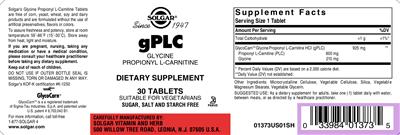
Solgar's Glycine Propionyl L-Carnitine Tablets are free of corn, yeast, wheat, soy and dairy products and are formulated without the use of artificial preservatives, flavors or colors.
Suitable for vetetarians
Sugar, salt and starch free
Storage
To assure freshness and potency, store at room temperature 59 degrees-86 degrees F (15 degrees-30 degrees C). Store away from heat, light and moisture.
Precautions
If you are pregnant, nursing, taking any medication or have a medical condition, please consult your healthcare practitioner before taking any dietary supplement.
Keep out of reach of children.
Do not use if outer bottle seal is missing, torn or damaged in any way.
Formula
Solgar's KOF-K certification #K-1250
Brand IP Statement(s)
GlycoCarn is a registered trademark of Sigma-Tau Industries, S.p.A. and patented under U.S. patent # 6,703,042 B1.
General Statements
For more information, call toll-free 1-877-SOLGAR 4 www.solgar.com Solgar since 1947
FDA Statement of Identity
Dietary Supplement
Seals/Symbols
K Parve (Kosher)
Suggested/Recommended/Usage/Directions
Suggested Use: As a dietary supplement for adults, take one (1) tablet daily with water, between meals, or as directed by a healthcare practitioner.
Is this label outdated? Report a formula or label change and our pharmacy team will review it.
gPLC Glycine Propionyl L-Carnitine by Solgar label
The label scan from the NIH Dietary Supplement Label Database. Tap to enlarge.
Label images are published by the NIH Dietary Supplement Label Database for the version of this product on file. Always read your actual product label.
View the full label (PDF)The Ingredients in gPLC Glycine Propionyl L-Carnitine by Solgar
These are the 2 active ingredients this product is made of. Select any to open its full monograph.
Serving size1 Tablet(s) Dosage formTablet Or Pill Amounts shown are per serving.
Most supplement products combine several ingredients, and a medication can interact with the product through any one of them. Each ingredient below shows whether it has known drug interactions.
GlycoCarn Glycine Propionyl L-Carnitine HCl
Other (inactive) ingredients: Microcrystalline Cellulose, Vegetable Cellulose, Silica, Vegetable Magnesium Stearate, Vegetable Glycerin. These complete the product’s ingredient list but are not active constituents.
gPLC Glycine Propionyl L-Carnitine by Solgar Drug Interactions
HelloPharmacist Interaction Report
Solgar's gPLC Glycine Propionyl L-Carnitine contains two active ingredients, both of which have documented interactions with medications.
The most serious concern is with propionyl-L-carnitine and blood thinners (anticoagulants): it may increase how strongly warfarin (Coumadin) and acenocoumarol (Sintrom) work, raising your bleeding risk. This is a Moderate-severity interaction.
Read the full breakdown — every affected drug type, severity by severity
Propionyl-L-carnitine also interacts with thyroid hormone replacement therapy (Moderate severity) — it may decrease how well your thyroid medication works by blocking the hormone from entering your cells properly.
Glycine carries a separate Moderate interaction with clozapine (Clozaril), an antipsychotic: one small study suggests adding glycine to clozapine worsens schizophrenia symptoms, though the reason isn't fully understood.
Always check your exact medications with the search tool on this page before starting.
Check your own medications below · Editorial policy · How we use AI
Want to check YOUR meds against gPLC Glycine Propionyl L-Carnitine?
Ask about interactions with your drugs in plain English — “Can I take it with lisinopril?” — and we find you the answer in seconds, ingredient by ingredient.
Go to the checkerIngredients driving the most interactions
Individual Drug Interactions
The ingredients in gPLC Glycine Propionyl L-Carnitine interact with 20 drugs. Click any drug to see the details.
2 of the 2 ingredients in gPLC Glycine Propionyl L-Carnitine interact with drugs. Each result below shows which ingredient is responsible. Propionyl L-Carnitine Glycine
AcenocoumarolSintrom
How Acenocoumarol interacts with gPLC Glycine Propionyl L-Carnitine — through 1 ingredient. Tap an ingredient for the detail:
Propionyl L-carnitineAcenocoumarol (sintrom) Moderate
Interaction Summary
Theoretically, propionyl-L-carnitine might increase the anticoagulant effects of acenocoumarol.
Read the full Propionyl L-carnitine + Acenocoumarol interactionClozapineClozaril, Versacloz
How Clozapine interacts with gPLC Glycine Propionyl L-Carnitine — through 1 ingredient. Tap an ingredient for the detail:
GlycineClozapine (clozaril) Moderate
Interaction Summary
Theoretically, glycine might decrease the effectiveness of clozapine.
Read the full Glycine + Clozapine interactionConjugated EstrogensCenestin, Enjuvia, Premarin, Premarin Vaginal Cream
How Conjugated Estrogens interacts with gPLC Glycine Propionyl L-Carnitine — through 1 ingredient. Tap an ingredient for the detail:
Propionyl L-carnitineThyroid Hormone Moderate
Interaction Summary
Theoretically, acetyl-L-carnitine might decrease the effectiveness of thyroid hormone replacement.
Read the full Propionyl L-carnitine + Conjugated Estrogens interactionDesiccated Thyroid ExtractWesthroid, WP Thyroid
How Desiccated Thyroid Extract interacts with gPLC Glycine Propionyl L-Carnitine — through 1 ingredient. Tap an ingredient for the detail:
Propionyl L-carnitineThyroid Hormone Moderate
Interaction Summary
Theoretically, acetyl-L-carnitine might decrease the effectiveness of thyroid hormone replacement.
Read the full Propionyl L-carnitine + Desiccated Thyroid Extract interactionDesiccated Thyroid Extract (prescription Drug)Nature-Throid, Thyrar
How Desiccated Thyroid Extract (prescription Drug) interacts with gPLC Glycine Propionyl L-Carnitine — through 1 ingredient. Tap an ingredient for the detail:
Propionyl L-carnitineThyroid Hormone Moderate
Interaction Summary
Theoretically, acetyl-L-carnitine might decrease the effectiveness of thyroid hormone replacement.
Read the full Propionyl L-carnitine + Desiccated Thyroid Extract (prescription Drug) interactionDextrothyroxineCholoxin
How Dextrothyroxine interacts with gPLC Glycine Propionyl L-Carnitine — through 1 ingredient. Tap an ingredient for the detail:
Propionyl L-carnitineThyroid Hormone Moderate
Interaction Summary
Theoretically, acetyl-L-carnitine might decrease the effectiveness of thyroid hormone replacement.
Read the full Propionyl L-carnitine + Dextrothyroxine interactionHuman Chorionic Gonadotropin (hcg)Pregnyl
How Human Chorionic Gonadotropin (hcg) interacts with gPLC Glycine Propionyl L-Carnitine — through 1 ingredient. Tap an ingredient for the detail:
Propionyl L-carnitineThyroid Hormone Moderate
Interaction Summary
Theoretically, acetyl-L-carnitine might decrease the effectiveness of thyroid hormone replacement.
Read the full Propionyl L-carnitine + Human Chorionic Gonadotropin (hcg) interactionLevothyroxineEltroxin, Estre, Euthyrox, Levo-T, Levolet, Levothroid +5 more
How Levothyroxine interacts with gPLC Glycine Propionyl L-Carnitine — through 1 ingredient. Tap an ingredient for the detail:
Propionyl L-carnitineThyroid Hormone Moderate
Interaction Summary
Theoretically, acetyl-L-carnitine might decrease the effectiveness of thyroid hormone replacement.
Read the full Propionyl L-carnitine + Levothyroxine interactionLevothyroxine SodiumErmez, Thyquidity, Tirosint-Sol
How Levothyroxine Sodium interacts with gPLC Glycine Propionyl L-Carnitine — through 1 ingredient. Tap an ingredient for the detail:
Propionyl L-carnitineThyroid Hormone Moderate
Interaction Summary
Theoretically, acetyl-L-carnitine might decrease the effectiveness of thyroid hormone replacement.
Read the full Propionyl L-carnitine + Levothyroxine Sodium interactionLevothyroxine, LiothyronineArmour Thyroid
How Levothyroxine, Liothyronine interacts with gPLC Glycine Propionyl L-Carnitine — through 1 ingredient. Tap an ingredient for the detail:
Propionyl L-carnitineThyroid Hormone Moderate
Interaction Summary
Theoretically, acetyl-L-carnitine might decrease the effectiveness of thyroid hormone replacement.
Read the full Propionyl L-carnitine + Levothyroxine, Liothyronine interactionLiothyronineCytomel
How Liothyronine interacts with gPLC Glycine Propionyl L-Carnitine — through 1 ingredient. Tap an ingredient for the detail:
Propionyl L-carnitineThyroid Hormone Moderate
Interaction Summary
Theoretically, acetyl-L-carnitine might decrease the effectiveness of thyroid hormone replacement.
Read the full Propionyl L-carnitine + Liothyronine interactionLiotrixEuthroid 1, Euthroid 1/2, Euthroid 3
How Liotrix interacts with gPLC Glycine Propionyl L-Carnitine — through 1 ingredient. Tap an ingredient for the detail:
Propionyl L-carnitineThyroid Hormone Moderate
Interaction Summary
Theoretically, acetyl-L-carnitine might decrease the effectiveness of thyroid hormone replacement.
Read the full Propionyl L-carnitine + Liotrix interactionLiotrix, T4/t3Euthroid 2
How Liotrix, T4/t3 interacts with gPLC Glycine Propionyl L-Carnitine — through 1 ingredient. Tap an ingredient for the detail:
Propionyl L-carnitineThyroid Hormone Moderate
Interaction Summary
Theoretically, acetyl-L-carnitine might decrease the effectiveness of thyroid hormone replacement.
Read the full Propionyl L-carnitine + Liotrix, T4/t3 interactionMenotropinsMenopur, Repronex
How Menotropins interacts with gPLC Glycine Propionyl L-Carnitine — through 1 ingredient. Tap an ingredient for the detail:
Propionyl L-carnitineThyroid Hormone Moderate
Interaction Summary
Theoretically, acetyl-L-carnitine might decrease the effectiveness of thyroid hormone replacement.
Read the full Propionyl L-carnitine + Menotropins interactionOspemifeneOsphena
How Ospemifene interacts with gPLC Glycine Propionyl L-Carnitine — through 1 ingredient. Tap an ingredient for the detail:
Propionyl L-carnitineThyroid Hormone Moderate
Interaction Summary
Theoretically, acetyl-L-carnitine might decrease the effectiveness of thyroid hormone replacement.
Read the full Propionyl L-carnitine + Ospemifene interactionTestosterone UndecanoateAndriol, Aveed, Jatenzo, Kyzatrex
How Testosterone Undecanoate interacts with gPLC Glycine Propionyl L-Carnitine — through 1 ingredient. Tap an ingredient for the detail:
Propionyl L-carnitineThyroid Hormone Moderate
Interaction Summary
Theoretically, acetyl-L-carnitine might decrease the effectiveness of thyroid hormone replacement.
Read the full Propionyl L-carnitine + Testosterone Undecanoate interactionThyroglobulinProloid
How Thyroglobulin interacts with gPLC Glycine Propionyl L-Carnitine — through 1 ingredient. Tap an ingredient for the detail:
Propionyl L-carnitineThyroid Hormone Moderate
Interaction Summary
Theoretically, acetyl-L-carnitine might decrease the effectiveness of thyroid hormone replacement.
Read the full Propionyl L-carnitine + Thyroglobulin interactionThyroid HormoneEtwon
How Thyroid Hormone interacts with gPLC Glycine Propionyl L-Carnitine — through 1 ingredient. Tap an ingredient for the detail:
Propionyl L-carnitineThyroid Hormone Moderate
Interaction Summary
Theoretically, acetyl-L-carnitine might decrease the effectiveness of thyroid hormone replacement.
Read the full Propionyl L-carnitine + Thyroid Hormone interactionWarfarinWarfarin
How Warfarin interacts with gPLC Glycine Propionyl L-Carnitine — through 1 ingredient. Tap an ingredient for the detail:
Propionyl L-carnitineWarfarin (coumadin) Moderate
Interaction Summary
Theoretically, propionyl-L-carnitine might increase the anticoagulant effects of warfarin.
Read the full Propionyl L-carnitine + Warfarin interactionWarfarin SodiumCoumadin, Panwarfin, Sofarin
How Warfarin Sodium interacts with gPLC Glycine Propionyl L-Carnitine — through 1 ingredient. Tap an ingredient for the detail:
Propionyl L-carnitineWarfarin (coumadin) Moderate
Interaction Summary
Theoretically, propionyl-L-carnitine might increase the anticoagulant effects of warfarin.
Read the full Propionyl L-carnitine + Warfarin Sodium interactionEach ingredient & the kinds of drugs it affects
For each ingredient in gPLC Glycine Propionyl L-Carnitine with known interactions, here are the types of medications they can affect. Open any type for the detail — or search your exact drug in the checker above.
Propionyl L-Carnitine
Acenocoumarol (Sintrom)
Theoretically, propionyl-L-carnitine might increase the anticoagulant effects of acenocoumarol.
L-carnitine, the parent compound of propionyl-L-carnitine, might enhance the anticoagulant effects of acenocoumarol, an oral anticoagulant similar to warfarin, but shorter-acting. There are at least two case reports of INR elevation when L-carnitine was taken with acenocoumarol. In one case, a 33-year-old male with a previously stable INR had an elevated INR of 4.65 after L-carnitine was started and continued for 10 weeks. INR normalized after discontinuation of the L-carnitine-containing product. It is unclear if such an interaction would also occur with propionyl-L-carnitine.
Thyroid Hormone
Theoretically, acetyl-L-carnitine might decrease the effectiveness of thyroid hormone replacement.
L-carnitine appears to act as a peripheral thyroid hormone antagonist by inhibiting entry of thyroid hormone into the nucleus of cells. Taking L-carnitine also seems to diminish some of the symptoms of hyperthyroidism. It is unclear if such an interaction would occur with propionyl-L-carnitine.
Warfarin (Coumadin)
Theoretically, propionyl-L-carnitine might increase the anticoagulant effects of warfarin.
L-carnitine, the parent compound of propionyl-L-carnitine, might increase the anticoagulant effects of acenocoumarol, a shorter-acting oral anticoagulant similar to warfarin. There is not enough information to know whether this interaction occurs with propionyl-L-carnitine and warfarin.
Glycine
Clozapine (Clozaril)
Theoretically, glycine might decrease the effectiveness of clozapine.
One small clinical study in patients with schizophrenia shows that adding glycine to clozapine therapy worsens symptoms of schizophrenia when compared with clozapine alone. The mechanism of this interaction is unclear.
Brand information
Manufacturer and brand details for gPLC Glycine Propionyl L-Carnitine, from the product label.
Solgar
See all Solgar products- Name
- Solgar Vitamin and Herb
- Street Address
- 500 Willow Tree Road
- City
- Leonia
- State
- N.J.
- ZipCode
- 07605
- Phone Number
- 1-877-765-4234
- Web Address
- www.solgar.com
gPLC Glycine Propionyl L-Carnitine by Solgar: Common Questions
Does gPLC Glycine Propionyl L-Carnitine by Solgar interact with any medications?
How can one product interact with so many drugs?
Where does this information come from?
Is this product safe to take during pregnancy?
Is it safe while breastfeeding?
What are the most common side effects?
Will this help my heart condition?
Does the product contain any fillers?
Is glycine the same as glycine supplements sold separately?
Written and reviewed by the HelloPharmacist editorial staff. Our editorial policy
Not sure if gPLC Glycine Propionyl L-Carnitine is safe with your meds?
Our pharmacists answer your medication & supplement questions — free.
Label information is sourced from the NIH Dietary Supplement Label Database and reflects the product version on file; always read your actual product label. This page is for education only and is not a substitute for professional medical advice. Confirm with your pharmacist or doctor before combining supplements and medications.
The Full Monographs Behind gPLC Glycine Propionyl L-Carnitine’s Ingredients
Every ingredient we hold a full HelloPharmacist monograph for — uses, evidence, safety, and the complete interaction list.
Glycine
Interacts with 1 drugGlycine is a non-essential amino acid your body makes on its own and that also appears in protein-rich foods. It is most studied for improving sleep quality, where early research is promisin...
Read the full Glycine monograph → Herb & supplement monographPropionyl-l-carnitine
Interacts with 19 drugsPropionyl-l-carnitine is a form of the amino acid derivative carnitine that the body uses to help turn fat into energy, and it is studied mostly for circulation problems like peripheral arte...
Read the full Propionyl-l-carnitine monograph →Sources & How We Checked
gPLC Glycine Propionyl L-Carnitine's label data comes from the NIH Dietary Supplement Label Database; the ingredient interaction data is from the Natural Medicines database, reviewed by our pharmacists.
- NIH Dietary Supplement Label Database (DSLD) — The official product label on file for this supplement.
- Natural Medicines (Therapeutic Research Center) — Evidence-graded clinical reference behind the ingredient interaction data.
Content is written and reviewed by licensed HelloPharmacist pharmacists. See our data sources and editorial standards for how this information is built and checked.
The 17 references behind this product’s interaction data
Every citation that drives the interaction findings for this product’s ingredients, from the evidence-graded Natural Medicines (TRC Healthcare) database. Open an ingredient to browse its citations — links open the study on PubMed or the publisher’s site.
Glycine 5 references
- Heresco-Levy U, Javitt DC, Ermilov M, et al. Efficacy of high-dose glycine in the treatment of enduring negative symptoms of schizophrenia. Arch Gen Psychiatry 1999;56:29-36.. PubMed
- Potkin SG, Jin Y, Bunney BG, Costa J, Gulasekaram B. Effect of clozapine and adjunctive high-dose glycine in treatment-resistant schizophrenia. Am J Psychiatry 1999;156:145-7.. PubMed
- Gusev EI, Skvortsova VI, Dambinova SA, et al. Neuroprotective effects of glycine for therapy of acute ischaemic stroke. Cerebrovasc Dis 2000;10:49-60. PubMed
- Inagawa K, Kawai N, Ono K, Sukegawa E, Tsubuku S, Takahashi M. Assessment of acute adverse effects of glycine ingestion at a high dose in human volunteers. Seikatsu Eisei. 2006; 50:27-32.
- Woods SW, Walsh BC, Hawkins KA, Miller TJ, Saksa JR, D'Souza DC, Pearlson GD, Javitt DC, McGlashan TH, Krystal JH. Glycine treatment of the risk syndrome for psychosis: report of two pilot studies. Eur Neuropsychopharmacol. 2013 Aug;23(8):931-40. PubMed
Propionyl-l-carnitine 12 references
- Cherchi A, Lai C, Onnis E, et al. Propionyl carnitine in stable effort angina. Cardiovasc Drugs Ther 1990;4:481-6. PubMed
- Bartels GL, Remme WJ, den Hartog FR, et al. Additional anti-ischemic effects of long-term L-propionylcarnitine in anginal patients treated with conventional antianginal therapy. Cardiovasc Drugs Ther 1995;9:749-53.
- Caponnetto S, Canale C, Masperone MA, et al. Efficacy of L-propionylcarnitine treatment in patients with left ventricular dysfunction. Eur Heart J 1994;15:1267-73. PubMed
- Benvenga S, Ruggeri RM, Russo A, et al. Usefulness of L-carnitine, a naturally occurring peripheral antagonist of thyroid hormone action, in iatrogenic hyperthyroidism: a randomized, double-blind, placebo-controlled clinical trial. J Clin Endocrinol Meta
- Martinez E, Domingo P, Roca-Cusachs A. Potentiation of acenocoumarol action by L-carnitine. J Intern Med 1993;233:94.
- Bachmann HU, Hoffmann A. Interaction of food supplement L-carnitine with oral anticoagulant acenocoumarol. Swiss Med Wkly 2004;134:385. PubMed
- Gentile V, Vicini P, Prigiotti G, et al. Preliminary observations on the use of propionyl-L-carnitine in combination with sildenafil in patients with erectile dysfunction and diabetes. Curr Med Res Opin 2004;20:1377-84. PubMed
- 12761 Benvenga S, Amato A, Calvani M, Trimarchi F. Effects of carnitine on thyroid hormone action. Ann N Y Acad Sci 2004;1033:158-67. PubMed
- Brass EP, Koster D, Hiatt WR, Amato A. A systematic review and meta-analysis of propionyl-L-carnitine effects on exercise performance in patients with claudication. Vasc Med 2013;18:3-12.
- Hiatt WR, Creager MA, Amato A, Brass EP. Effect of propionyl-L-carnitine on a background of monitored exercise in patients with claudication secondary to peripheral artery disease. J Cardiopulm Rehabil Prev 2011;31:125-32. PubMed
- Jacobs PL, Goldstein ER, Blackburn W, et al. Glycine propionyl-L-carnitine produces enhanced anaerobic work capacity with reduced lactate accumulation in resistance trained males. J Int Soc Sports Nutr 2009;6:9. PubMed
- Jacobs PL, Goldstein ER. Long-term glycine propionyl-l-carnitine supplementation and paradoxical effects on repeated anaerobic sprint performance. J Int Soc Sports Nutr 2010;7:35.
See these in context on the Propionyl-l-carnitine monograph →
Parts of this content are provided by the Therapeutic Research Center, LLC.
DISCLAIMER: Currently this does not check for drug-drug interactions. This is not an all-inclusive comprehensive list of potential interactions and is for informational purposes only. Not all interactions are known or well-reported in the scientific literature, and new interactions are continually being reported. Input is needed from a qualified healthcare provider including a pharmacist before starting any therapy. Application of clinical judgment is necessary.
© 2021 Therapeutic Research Center, LLC