
Herbal Sleep Aid Ingredients & Drug Interactions
by Kirkman
What is this page for?
First and foremost: checking Herbal Sleep Aid against your medications. The heart of this page is the interaction checker and the full interaction report — how this product’s ingredients may interact with prescription and over-the-counter medicines you may be taking.
Around that, we add a pharmacist’s high-level view of the product as a whole — what’s inside, the evidence for its stated use, how transparent the label is, and what safety data exists — so you can see the full picture in one place. It’s educational information from our licensed clinical databases and the clinical staff at HelloPharmacist — not medical advice — and we don’t sell or endorse products. Our editorial policy
Herbal Sleep Aid is a dietary supplement by Kirkman with 4 active ingredients. Its ingredients are commonly taken for anxiety and stress, trouble sleeping, restlessness.Based on those ingredients, 1,308 medications have a known interaction with it, the most serious rated moderate. The ingredients most likely to interact are Chamomile Flower Extract, Skullcap Root Extract, Passionflower extract. Use the checker below to test your specific medication, or read the full HelloPharmacist Interaction Report.
Check Your Meds Against Herbal Sleep Aid by Kirkman
Ask about any prescription or over-the-counter medication and we check it for interactions with Herbal Sleep Aid by Kirkman — and tell you which ingredient is responsible.
AI summaries are generated from our interaction database for education only — always confirm with your pharmacist. How we use AI
Ask the Pharmacist
A licensed pharmacist will answer your question by email — free, usually within 24 hours.
Got it — thank you!
A licensed pharmacist will answer within 24 hours. Keep an eye on your email (worth checking spam, just in case).
HelloPharmacist Scorecard of Herbal Sleep Aid by Kirkman
Our pharmacy team’s full take, with four database checks built into the cards below — a summary of what is known, not a grade of the product itself.
What’s inside
Full disclosure
Kirkman's Herbal Sleep Aid contains four ingredients. The three active herbal extracts are passionflower, chamomile flower, lemon balm leaf and stem, and skullcap root — all traditionally used to support sleep and relaxation.
The product also contains inactive ingredients (hypromellose, water, silicon dioxide, and ascorbyl palmitate) that serve as capsule material, thickeners, and preservatives.
Does it work?
Moderate evidence
Passionflower extract is rated possibly effective for insomnia and pre-procedural anxiety based on available evidence. Lemon balm is rated possibly effective for stress and depression, though it's also known for cold sore relief.
The evidence for skullcap root is not established in our data — it carries multiple 'insufficient evidence' ratings for the conditions it's traditionally used for, including anxiety, ADHD, and headache.
How safe is it?
Well-documented data
Passionflower is generally well tolerated short-term but can cause drowsiness, confusion, dizziness, and sedation. The safety data advises against passionflower during pregnancy due to lack of safety data and possible effects on the uterus, and recommends avoiding it while breastfeeding.
Lemon balm is generally well tolerated for short-term use, though high-dose and long-term safety aren't well studied; there isn't enough reliable safety data to recommend it during pregnancy, and you should talk with your doctor before using it while breastfeeding. Skullcap root has limited human safety data and quality varies across products.
There isn't enough safety information to recommend it during pregnancy or while breastfeeding. All three checked ingredients have reported rare serious adverse effects, including heart rhythm changes in case reports.
Meds to double-check
Moderate interaction found
Before taking this product, check your exact medications against our interaction tool on this page. Pay special attention to sedative drugs (the most serious concern), thyroid medications, blood pressure medications, blood thinners, diabetes medications, and any drugs your liver metabolizes.
If you take lithium or estrogen replacement therapy, check those too.
The bottom line
Scorecard at a glanceFully disclosed formula with some supporting evidence for its stated purpose. Moderate medication interactions have been identified, and safety information is well characterized.
This product may help with sleep and anxiety if you're not taking sedatives, thyroid medications, blood pressure drugs, or blood thinners. If you take any prescription medication, check it against the list below before starting.
Talk to your pharmacist or doctor — especially if you're pregnant, breastfeeding, or managing a chronic condition.
Educational only — not medical advice; always confirm with your pharmacist. Our editorial policy · How we use AI
Assessment coverage: 4 of 4 active ingredients matched to our full ingredient reviews (monographs). Based on the product label dated May 21, 2025.
This Scorecard evaluates available label information, ingredient evidence, and known medication-safety considerations. It does not independently verify product identity, purity, potency, contamination, or manufacturing quality. How these ratings are computed
General information
Key facts about Herbal Sleep Aid, straight from the product label.
| Brand | Kirkman |
|---|---|
| Barcode (UPC) | 812325024575 |
| Net contents | 60 Capsule(s) |
| Market status | On market |
| Date entered into DSLD | May 21, 2025 |
| DSLD ID | 333048 |
| Product type | Botanical |
| Supplement form | Capsule |
| Dietary claims / uses | All Other, Structure/Function |
| Intended target group(s) | Children 4 or More Years of Age, Adult (18 - 50 Years), Women (not pregnant or lactating), No Allergies, Gluten Free, Dairy Free |
Everything in this section is reproduced from the manufacturer’s own product label — it’s the label speaking, not HelloPharmacist. We show it so you can see exactly what the maker states; we don’t verify or endorse those statements.
Supplement Facts
The label details for Herbal Sleep Aid by Kirkman, sourced from the NIH Dietary Supplement Label Database.
Supplement Facts
| Ingredient | Amount | % DV |
|---|---|---|
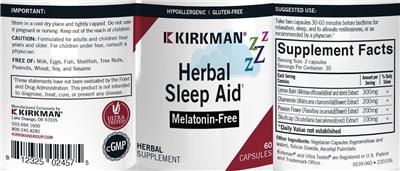
| Passionflower extract | 200 mg | -- |
| Chamomile Flower Extract | 200 mg | -- |
| Lemon Balm Leaf, Stem Extract | 300 mg | -- |
| Skullcap Root Extract | 100 mg | -- |
Other ingredients: Hypromellose, Water, Silicon Dioxide, Ascorbyl Palmitate
Tap any ingredient to jump to its full detail below.
These statements are the manufacturer’s wording, reproduced from the product label — the label is saying it, not HelloPharmacist. We don’t verify or endorse them.
Storage
Important: Store in a cool dry place and tightly capped.
Precautions
Do not use if pregnant or nursing.
Keep out of the reach of children. Caution: Formulated for adults and children four years and older. For children under four, consult a physician.
Formulation
Free of: Milk, eggs, fish, shellfish, tree nuts, peanuts, wheat, soy, and sesame
Hypoallergenic
Gluten-free Melatonin-free
FDA Disclaimer Statement
These statements have not been evaluated by the Food and Drug Administration. This product is not intended to diagnose, treat, cure or prevent any disease.
Seals/Symbols
Ultra Tested cGMP
FDA Statement of Identity
Herbal Supplement
Suggested/Recommended/Usage/Directions
Suggested use: Take two capsules 30-60 minutes before bedtime for relaxation, sleep, and to alleviate restlessness, or as recommended by a physician.
Brand IP Statement(s)
Kirkman and Ultra Tested, are registered in U.S. Patent and Trademark Office.
Is this label outdated? Report a formula or label change and our pharmacy team will review it.
Herbal Sleep Aid by Kirkman label
The label scan from the NIH Dietary Supplement Label Database. Tap to enlarge.
Label images are published by the NIH Dietary Supplement Label Database for the version of this product on file. Always read your actual product label.
View the full label (PDF)The Ingredients in Herbal Sleep Aid by Kirkman
These are the 4 active ingredients this product is made of. Select any to open its full monograph.
Serving size2 Capsule(s) Dosage formCapsule Servings per container30 Amounts shown are per serving.
Most supplement products combine several ingredients, and a medication can interact with the product through any one of them. Each ingredient below shows whether it has known drug interactions.
Passionflower extract
Interacts with836 drugs
Passion flower is a traditional calming herb that many people use for anxiety and sleep. Early studies hint it may help with mild anxiety and restless...
Passionflower extract monograph & interactionsChamomile Flower Extract
Interacts with960 drugs
German chamomile is a widely used herbal remedy taken mainly as a tea for calming, sleep, and digestive complaints. Early research suggests possible b...
Chamomile Flower Extract monograph & interactionsLemon Balm Leaf, Stem Extract
Interacts with264 drugs
Lemon balm is a gentle, lemon-scented mint-family herb traditionally used to ease stress, support sleep, and calm digestion, and topically for cold so...
Lemon Balm Leaf, Stem Extract monograph & interactionsSkullcap Root Extract
Interacts with946 drugs
Baikal skullcap is a traditional Chinese herb (Huang Qin) used for inflammation, allergies, and infections, with active compounds like baicalin and ba...
Skullcap Root Extract monograph & interactionsOther (inactive) ingredients: Hypromellose, Water, Silicon Dioxide, Ascorbyl Palmitate. These complete the product’s ingredient list but are not active constituents.
Herbal Sleep Aid by Kirkman Drug Interactions
HelloPharmacist Interaction Report
Kirkman's Herbal Sleep Aid contains four ingredients, three of which have documented interactions with medications.
The most serious concern is with passionflower extract, which has moderate-severity interactions with sedative drugs (CNS depressants) — concomitant use can cause additive sedation and side effects, similar to what happens when combining sedatives like lorazepam.
Read the full breakdown — every affected drug type, severity by severity
Lemon balm leaf extract also carries moderate-severity interactions with sedative drugs through the same additive mechanism, and theoretically may interfere with thyroid hormone replacement therapy. Skullcap root extract has the broadest interaction profile: moderate interactions with blood pressure medications (antihypertensive drugs), drugs metabolized by two liver enzymes (CYP2C19 and CYP1A2 substrates), estrogen replacement therapy, blood thinners (anticoagulant and antiplatelet drugs), diabetes medications, lithium, and antithyroid drugs.
Passionflower also has minor interactions with certain drug transporters (OATP substrates) and CYP3A4 substrates. We could not check chamomile flower extract for interactions.
Altogether, these interactions span 1,249 individual medications.
Check your own medications below · Editorial policy · How we use AI
Want to check YOUR meds against Herbal Sleep Aid?
Ask about interactions with your drugs in plain English — “Can I take it with lisinopril?” — and we find you the answer in seconds, ingredient by ingredient.
Go to the checkerIngredients driving the most interactions
Individual Drug Interactions
The ingredients in Herbal Sleep Aid interact with 1,308 drugs. Click any drug to see the details.
4 of the 4 ingredients in Herbal Sleep Aid interact with drugs. Each result below shows which ingredient is responsible. Chamomile Flower Extract Skullcap Root Extract Passionflower extract Lemon Balm Leaf, Stem Extract
Ado-trastuzumab EmtansineKadcyla
How Ado-trastuzumab Emtansine interacts with Herbal Sleep Aid — through 2 ingredients. Tap an ingredient for the detail:
Chamomile Flower ExtractCytochrome P450 3a4 (cyp3a4) Substrates Moderate
Interaction Summary
Theoretically, German chamomile might inhibit CYP3A4 and increase levels of drugs metabolized by these enzymes.
Read the full Chamomile Flower Extract + Ado-trastuzumab Emtansine interactionPassionflower ExtractCytochrome P450 3a4 (cyp3a4) Substrates Minor
Interaction Summary
Theoretically, passion flower might decrease the effects of CYP3A4 substrates.
Read the full Passionflower Extract + Ado-trastuzumab Emtansine interactionAbciximabReoPro
How Abciximab interacts with Herbal Sleep Aid — through 1 ingredient. Tap an ingredient for the detail:
Skullcap Root ExtractAnticoagulant/antiplatelet Drugs Moderate
Interaction Summary
Theoretically, Baikal skullcap might increase the risk of bleeding when used concomitantly with anticoagulant and antiplatelet drugs.
Read the full Skullcap Root Extract + Abciximab interactionAbemaciclibVerzenio
How Abemaciclib interacts with Herbal Sleep Aid — through 2 ingredients. Tap an ingredient for the detail:
Chamomile Flower ExtractCytochrome P450 3a4 (cyp3a4) Substrates Moderate
Interaction Summary
Theoretically, German chamomile might inhibit CYP3A4 and increase levels of drugs metabolized by these enzymes.
Read the full Chamomile Flower Extract + Abemaciclib interactionPassionflower ExtractCytochrome P450 3a4 (cyp3a4) Substrates Minor
Interaction Summary
Theoretically, passion flower might decrease the effects of CYP3A4 substrates.
Read the full Passionflower Extract + Abemaciclib interactionAbiraterone
How Abiraterone interacts with Herbal Sleep Aid — through 2 ingredients. Tap an ingredient for the detail:
Chamomile Flower ExtractCytochrome P450 3a4 (cyp3a4) Substrates Moderate
Interaction Summary
Theoretically, German chamomile might inhibit CYP3A4 and increase levels of drugs metabolized by these enzymes.
Read the full Chamomile Flower Extract + Abiraterone interactionPassionflower ExtractCytochrome P450 3a4 (cyp3a4) Substrates Minor
Interaction Summary
Theoretically, passion flower might decrease the effects of CYP3A4 substrates.
Read the full Passionflower Extract + Abiraterone interactionAbiraterone AcetateYonsa, Zytiga
How Abiraterone Acetate interacts with Herbal Sleep Aid — through 2 ingredients. Tap an ingredient for the detail:
Chamomile Flower ExtractCytochrome P450 3a4 (cyp3a4) Substrates Moderate
Interaction Summary
Theoretically, German chamomile might inhibit CYP3A4 and increase levels of drugs metabolized by these enzymes.
Read the full Chamomile Flower Extract + Abiraterone Acetate interactionPassionflower ExtractCytochrome P450 3a4 (cyp3a4) Substrates Minor
Interaction Summary
Theoretically, passion flower might decrease the effects of CYP3A4 substrates.
Read the full Passionflower Extract + Abiraterone Acetate interactionAbrocitinibCibinqo
How Abrocitinib interacts with Herbal Sleep Aid — through 2 ingredients. Tap an ingredient for the detail:
Skullcap Root ExtractAnticoagulant/antiplatelet Drugs, Cytochrome P450 2c19 (cyp2c19) Substrates Moderate
Interaction Summary
Theoretically, Baikal skullcap might increase the risk of bleeding when used concomitantly with anticoagulant and antiplatelet drugs.
Read the full Skullcap Root Extract + Abrocitinib interactionChamomile Flower ExtractCytochrome P450 2c9 (cyp2c9) Substrates Moderate
Interaction Summary
Theoretically, German chamomile might inhibit CYP2C9 and increase levels of drugs metabolized by these enzymes.
Read the full Chamomile Flower Extract + Abrocitinib interactionAcalabrutinibCalquence
How Acalabrutinib interacts with Herbal Sleep Aid — through 3 ingredients. Tap an ingredient for the detail:
Chamomile Flower ExtractCytochrome P450 3a4 (cyp3a4) Substrates Moderate
Interaction Summary
Theoretically, German chamomile might inhibit CYP3A4 and increase levels of drugs metabolized by these enzymes.
Read the full Chamomile Flower Extract + Acalabrutinib interactionSkullcap Root ExtractP-glycoprotein Substrates Minor
Interaction Summary
Theoretically, Baikal skullcap might increase levels of drugs transported by P-glycoprotein.
Read the full Skullcap Root Extract + Acalabrutinib interactionPassionflower ExtractCytochrome P450 3a4 (cyp3a4) Substrates Minor
Interaction Summary
Theoretically, passion flower might decrease the effects of CYP3A4 substrates.
Read the full Passionflower Extract + Acalabrutinib interactionAcarboseGlucobay, Prandase, Precose
How Acarbose interacts with Herbal Sleep Aid — through 1 ingredient. Tap an ingredient for the detail:
Skullcap Root ExtractAntidiabetes Drugs Moderate
Interaction Summary
Theoretically, concomitant use of Baikal skullcap with antidiabetes drugs might enhance blood glucose lowering effects.
Read the full Skullcap Root Extract + Acarbose interactionAcebutololRhotral, Sectral
How Acebutolol interacts with Herbal Sleep Aid — through 1 ingredient. Tap an ingredient for the detail:
Skullcap Root ExtractAntihypertensive Drugs Moderate
Interaction Summary
Theoretically, concomitant use of Baikal skullcap with antihypertensive drugs might have additive effects and increase the risk of hypotension.
Read the full Skullcap Root Extract + Acebutolol interactionAcenocoumarolSintrom
How Acenocoumarol interacts with Herbal Sleep Aid — through 1 ingredient. Tap an ingredient for the detail:
Skullcap Root ExtractAnticoagulant/antiplatelet Drugs Moderate
Interaction Summary
Theoretically, Baikal skullcap might increase the risk of bleeding when used concomitantly with anticoagulant and antiplatelet drugs.
Read the full Skullcap Root Extract + Acenocoumarol interactionAcepromazineAtravet
How Acepromazine interacts with Herbal Sleep Aid — through 4 ingredients. Tap an ingredient for the detail:
Chamomile Flower ExtractCns Depressants Moderate
Interaction Summary
Theoretically, German chamomile might have additive effects when used with CNS depressants.
Read the full Chamomile Flower Extract + Acepromazine interactionPassionflower ExtractCns Depressants Moderate
Interaction Summary
Concomitant use of passion flower with sedative drugs might cause additive effects and side effects.
Read the full Passionflower Extract + Acepromazine interactionLemon Balm Leaf, Stem ExtractCns Depressants Moderate
Interaction Summary
Theoretically, concomitant use of lemon balm might have additive effects with CNS depressant drugs.
Read the full Lemon Balm Leaf, Stem Extract + Acepromazine interactionSkullcap Root ExtractCns Depressants Minor
Interaction Summary
Theoretically, Baikal skullcap might cause additive therapeutic and adverse effects when used concomitantly with drugs with sedative properties.
Read the full Skullcap Root Extract + Acepromazine interactionAcetaminophenChildren's Tylenol, Children's Tylenol Meltaways, Tylenol, Tylenol Ex Strength
How Acetaminophen interacts with Herbal Sleep Aid — through 2 ingredients. Tap an ingredient for the detail:
Skullcap Root ExtractCytochrome P450 1a2 (cyp1a2) Substrates Moderate
Interaction Summary
Theoretically, Baikal skullcap may increase levels of drugs metabolized by CYP1A2 enzymes.
Read the full Skullcap Root Extract + Acetaminophen interactionChamomile Flower ExtractCytochrome P450 1a2 (cyp1a2) Substrates Minor
Interaction Summary
Theoretically, German chamomile might inhibit CYP1A2 and increase levels of drugs metabolized by these enzymes.
Read the full Chamomile Flower Extract + Acetaminophen interactionAcetaminophen, AspirinGemnisyn
How Acetaminophen, Aspirin interacts with Herbal Sleep Aid — through 2 ingredients. Tap an ingredient for the detail:
Skullcap Root ExtractAnticoagulant/antiplatelet Drugs, Cytochrome P450 1a2 (cyp1a2) Substrates Moderate
Interaction Summary
Theoretically, Baikal skullcap might increase the risk of bleeding when used concomitantly with anticoagulant and antiplatelet drugs.
Read the full Skullcap Root Extract + Acetaminophen, Aspirin interactionChamomile Flower ExtractCytochrome P450 1a2 (cyp1a2) Substrates Minor
Interaction Summary
Theoretically, German chamomile might inhibit CYP1A2 and increase levels of drugs metabolized by these enzymes.
Read the full Chamomile Flower Extract + Acetaminophen, Aspirin interactionAcetaminophen, Aspirin, CaffeineExcedrin, Excedrin Extra Strength, Excedrin Migraine
How Acetaminophen, Aspirin, Caffeine interacts with Herbal Sleep Aid — through 3 ingredients. Tap an ingredient for the detail:
Skullcap Root ExtractCytochrome P450 1a2 (cyp1a2) Substrates, Anticoagulant/antiplatelet Drugs Moderate
Interaction Summary
Theoretically, Baikal skullcap may increase levels of drugs metabolized by CYP1A2 enzymes.
Read the full Skullcap Root Extract + Acetaminophen, Aspirin, Caffeine interactionChamomile Flower ExtractCytochrome P450 1a2 (cyp1a2) Substrates, Cytochrome P450 3a4 (cyp3a4) Substrates Moderate
Interaction Summary
Theoretically, German chamomile might inhibit CYP1A2 and increase levels of drugs metabolized by these enzymes.
Read the full Chamomile Flower Extract + Acetaminophen, Aspirin, Caffeine interactionPassionflower ExtractCytochrome P450 3a4 (cyp3a4) Substrates Minor
Interaction Summary
Theoretically, passion flower might decrease the effects of CYP3A4 substrates.
Read the full Passionflower Extract + Acetaminophen, Aspirin, Caffeine interactionAcetaminophen, Brompheniramine, PhenylpropanolamineDimetapp Cold and Flu
How Acetaminophen, Brompheniramine, Phenylpropanolamine interacts with Herbal Sleep Aid — through 2 ingredients. Tap an ingredient for the detail:
Skullcap Root ExtractCytochrome P450 1a2 (cyp1a2) Substrates Moderate
Interaction Summary
Theoretically, Baikal skullcap may increase levels of drugs metabolized by CYP1A2 enzymes.
Read the full Skullcap Root Extract + Acetaminophen, Brompheniramine, Phenylpropanolamine interactionChamomile Flower ExtractCytochrome P450 1a2 (cyp1a2) Substrates Minor
Interaction Summary
Theoretically, German chamomile might inhibit CYP1A2 and increase levels of drugs metabolized by these enzymes.
Read the full Chamomile Flower Extract + Acetaminophen, Brompheniramine, Phenylpropanolamine interactionAcetaminophen, ButalbitalAxocet, Bancap, Bucet, Butex Forte, Esgic CF, Orbivan CF +5 more
How Acetaminophen, Butalbital interacts with Herbal Sleep Aid — through 2 ingredients. Tap an ingredient for the detail:
Skullcap Root ExtractCytochrome P450 1a2 (cyp1a2) Substrates Moderate
Interaction Summary
Theoretically, Baikal skullcap may increase levels of drugs metabolized by CYP1A2 enzymes.
Read the full Skullcap Root Extract + Acetaminophen, Butalbital interactionChamomile Flower ExtractCytochrome P450 1a2 (cyp1a2) Substrates Minor
Interaction Summary
Theoretically, German chamomile might inhibit CYP1A2 and increase levels of drugs metabolized by these enzymes.
Read the full Chamomile Flower Extract + Acetaminophen, Butalbital interactionAcetaminophen, Butalbital, CaffeineEsgic, Esgic Plus, Fiogesic, Fioricet, Repan, Tecnal +1 more
How Acetaminophen, Butalbital, Caffeine interacts with Herbal Sleep Aid — through 3 ingredients. Tap an ingredient for the detail:
Skullcap Root ExtractCytochrome P450 1a2 (cyp1a2) Substrates Moderate
Interaction Summary
Theoretically, Baikal skullcap may increase levels of drugs metabolized by CYP1A2 enzymes.
Read the full Skullcap Root Extract + Acetaminophen, Butalbital, Caffeine interactionChamomile Flower ExtractCytochrome P450 1a2 (cyp1a2) Substrates, Cytochrome P450 3a4 (cyp3a4) Substrates Moderate
Interaction Summary
Theoretically, German chamomile might inhibit CYP1A2 and increase levels of drugs metabolized by these enzymes.
Read the full Chamomile Flower Extract + Acetaminophen, Butalbital, Caffeine interactionPassionflower ExtractCytochrome P450 3a4 (cyp3a4) Substrates Minor
Interaction Summary
Theoretically, passion flower might decrease the effects of CYP3A4 substrates.
Read the full Passionflower Extract + Acetaminophen, Butalbital, Caffeine interactionAcetaminophen, Butalbital, Caffeine, CodeineEsgic with Codeine, Fioricet w/ Codeine
How Acetaminophen, Butalbital, Caffeine, Codeine interacts with Herbal Sleep Aid — through 4 ingredients. Tap an ingredient for the detail:
Passionflower ExtractCytochrome P450 3a4 (cyp3a4) Substrates, Cns Depressants Moderate
Interaction Summary
Theoretically, passion flower might decrease the effects of CYP3A4 substrates.
Read the full Passionflower Extract + Acetaminophen, Butalbital, Caffeine, Codeine interactionSkullcap Root ExtractCns Depressants, Cytochrome P450 1a2 (cyp1a2) Substrates Moderate
Interaction Summary
Theoretically, Baikal skullcap might cause additive therapeutic and adverse effects when used concomitantly with drugs with sedative properties.
Read the full Skullcap Root Extract + Acetaminophen, Butalbital, Caffeine, Codeine interactionLemon Balm Leaf, Stem ExtractCns Depressants Moderate
Interaction Summary
Theoretically, concomitant use of lemon balm might have additive effects with CNS depressant drugs.
Read the full Lemon Balm Leaf, Stem Extract + Acetaminophen, Butalbital, Caffeine, Codeine interactionChamomile Flower ExtractCytochrome P450 2d6 (cyp2d6) Substrates, Cytochrome P450 1a2 (cyp1a2) Substrates +2 Moderate
Interaction Summary
Theoretically, German chamomile might inhibit CYP2D6 and increase levels of drugs metabolized by these enzymes.
Read the full Chamomile Flower Extract + Acetaminophen, Butalbital, Caffeine, Codeine interactionAcetaminophen, Butalbital, CodeineBancap w/ Codeine
How Acetaminophen, Butalbital, Codeine interacts with Herbal Sleep Aid — through 4 ingredients. Tap an ingredient for the detail:
Lemon Balm Leaf, Stem ExtractCns Depressants Moderate
Interaction Summary
Theoretically, concomitant use of lemon balm might have additive effects with CNS depressant drugs.
Read the full Lemon Balm Leaf, Stem Extract + Acetaminophen, Butalbital, Codeine interactionSkullcap Root ExtractCns Depressants, Cytochrome P450 1a2 (cyp1a2) Substrates Moderate
Interaction Summary
Theoretically, Baikal skullcap might cause additive therapeutic and adverse effects when used concomitantly with drugs with sedative properties.
Read the full Skullcap Root Extract + Acetaminophen, Butalbital, Codeine interactionPassionflower ExtractCns Depressants Moderate
Interaction Summary
Concomitant use of passion flower with sedative drugs might cause additive effects and side effects.
Read the full Passionflower Extract + Acetaminophen, Butalbital, Codeine interactionChamomile Flower ExtractCns Depressants, Cytochrome P450 2d6 (cyp2d6) Substrates +1 Moderate
Interaction Summary
Theoretically, German chamomile might have additive effects when used with CNS depressants.
Read the full Chamomile Flower Extract + Acetaminophen, Butalbital, Codeine interactionAcetaminophen, Butalbital, Codeine PhosphatePhrenilin #3
How Acetaminophen, Butalbital, Codeine Phosphate interacts with Herbal Sleep Aid — through 4 ingredients. Tap an ingredient for the detail:
Chamomile Flower ExtractCytochrome P450 2d6 (cyp2d6) Substrates, Cytochrome P450 1a2 (cyp1a2) Substrates +1 Moderate
Interaction Summary
Theoretically, German chamomile might inhibit CYP2D6 and increase levels of drugs metabolized by these enzymes.
Read the full Chamomile Flower Extract + Acetaminophen, Butalbital, Codeine Phosphate interactionSkullcap Root ExtractCytochrome P450 1a2 (cyp1a2) Substrates, Cns Depressants Moderate
Interaction Summary
Theoretically, Baikal skullcap may increase levels of drugs metabolized by CYP1A2 enzymes.
Read the full Skullcap Root Extract + Acetaminophen, Butalbital, Codeine Phosphate interactionPassionflower ExtractCns Depressants Moderate
Interaction Summary
Concomitant use of passion flower with sedative drugs might cause additive effects and side effects.
Read the full Passionflower Extract + Acetaminophen, Butalbital, Codeine Phosphate interactionLemon Balm Leaf, Stem ExtractCns Depressants Moderate
Interaction Summary
Theoretically, concomitant use of lemon balm might have additive effects with CNS depressant drugs.
Read the full Lemon Balm Leaf, Stem Extract + Acetaminophen, Butalbital, Codeine Phosphate interactionAcetaminophen, Caffeine, Chlorpheniramine, Hydrocodone, PhenylephrineHycomine Compound
How Acetaminophen, Caffeine, Chlorpheniramine, Hydrocodone, Phenylephrine interacts with Herbal Sleep Aid — through 4 ingredients. Tap an ingredient for the detail:
Lemon Balm Leaf, Stem ExtractCns Depressants Moderate
Interaction Summary
Theoretically, concomitant use of lemon balm might have additive effects with CNS depressant drugs.
Read the full Lemon Balm Leaf, Stem Extract + Acetaminophen, Caffeine, Chlorpheniramine, Hydrocodone, Phenylephrine interactionPassionflower ExtractCytochrome P450 3a4 (cyp3a4) Substrates, Cns Depressants Moderate
Interaction Summary
Theoretically, passion flower might decrease the effects of CYP3A4 substrates.
Read the full Passionflower Extract + Acetaminophen, Caffeine, Chlorpheniramine, Hydrocodone, Phenylephrine interactionSkullcap Root ExtractCns Depressants, Cytochrome P450 1a2 (cyp1a2) Substrates Moderate
Interaction Summary
Theoretically, Baikal skullcap might cause additive therapeutic and adverse effects when used concomitantly with drugs with sedative properties.
Read the full Skullcap Root Extract + Acetaminophen, Caffeine, Chlorpheniramine, Hydrocodone, Phenylephrine interactionChamomile Flower ExtractCytochrome P450 3a4 (cyp3a4) Substrates, Cytochrome P450 1a2 (cyp1a2) Substrates +2 Moderate
Interaction Summary
Theoretically, German chamomile might inhibit CYP3A4 and increase levels of drugs metabolized by these enzymes.
Read the full Chamomile Flower Extract + Acetaminophen, Caffeine, Chlorpheniramine, Hydrocodone, Phenylephrine interactionAcetaminophen, Caffeine, CodeineGesic C15, Gesic C30, Gesic C8, Lenoltec 1, Lenoltec 2, Lenoltec 3 +1 more
How Acetaminophen, Caffeine, Codeine interacts with Herbal Sleep Aid — through 4 ingredients. Tap an ingredient for the detail:
Chamomile Flower ExtractCytochrome P450 2d6 (cyp2d6) Substrates, Cns Depressants +2 Moderate
Interaction Summary
Theoretically, German chamomile might inhibit CYP2D6 and increase levels of drugs metabolized by these enzymes.
Read the full Chamomile Flower Extract + Acetaminophen, Caffeine, Codeine interactionSkullcap Root ExtractCytochrome P450 1a2 (cyp1a2) Substrates, Cns Depressants Moderate
Interaction Summary
Theoretically, Baikal skullcap may increase levels of drugs metabolized by CYP1A2 enzymes.
Read the full Skullcap Root Extract + Acetaminophen, Caffeine, Codeine interactionPassionflower ExtractCns Depressants, Cytochrome P450 3a4 (cyp3a4) Substrates Moderate
Interaction Summary
Concomitant use of passion flower with sedative drugs might cause additive effects and side effects.
Read the full Passionflower Extract + Acetaminophen, Caffeine, Codeine interactionLemon Balm Leaf, Stem ExtractCns Depressants Moderate
Interaction Summary
Theoretically, concomitant use of lemon balm might have additive effects with CNS depressant drugs.
Read the full Lemon Balm Leaf, Stem Extract + Acetaminophen, Caffeine, Codeine interactionAcetaminophen, Caffeine, Codeine, SalicylamideCodalan No.1, Codalan No.2, Codalan No.3
How Acetaminophen, Caffeine, Codeine, Salicylamide interacts with Herbal Sleep Aid — through 4 ingredients. Tap an ingredient for the detail:
Chamomile Flower ExtractCytochrome P450 3a4 (cyp3a4) Substrates, Cytochrome P450 2d6 (cyp2d6) Substrates +2 Moderate
Interaction Summary
Theoretically, German chamomile might inhibit CYP3A4 and increase levels of drugs metabolized by these enzymes.
Read the full Chamomile Flower Extract + Acetaminophen, Caffeine, Codeine, Salicylamide interactionSkullcap Root ExtractCytochrome P450 1a2 (cyp1a2) Substrates, Cns Depressants Moderate
Interaction Summary
Theoretically, Baikal skullcap may increase levels of drugs metabolized by CYP1A2 enzymes.
Read the full Skullcap Root Extract + Acetaminophen, Caffeine, Codeine, Salicylamide interactionPassionflower ExtractCytochrome P450 3a4 (cyp3a4) Substrates, Cns Depressants Moderate
Interaction Summary
Theoretically, passion flower might decrease the effects of CYP3A4 substrates.
Read the full Passionflower Extract + Acetaminophen, Caffeine, Codeine, Salicylamide interactionLemon Balm Leaf, Stem ExtractCns Depressants Moderate
Interaction Summary
Theoretically, concomitant use of lemon balm might have additive effects with CNS depressant drugs.
Read the full Lemon Balm Leaf, Stem Extract + Acetaminophen, Caffeine, Codeine, Salicylamide interactionAcetaminophen, Caffeine, DihydrocodeineDHC Plus, Panlor DC, Panlor SS
How Acetaminophen, Caffeine, Dihydrocodeine interacts with Herbal Sleep Aid — through 4 ingredients. Tap an ingredient for the detail:
Lemon Balm Leaf, Stem ExtractCns Depressants Moderate
Interaction Summary
Theoretically, concomitant use of lemon balm might have additive effects with CNS depressant drugs.
Read the full Lemon Balm Leaf, Stem Extract + Acetaminophen, Caffeine, Dihydrocodeine interactionPassionflower ExtractCytochrome P450 3a4 (cyp3a4) Substrates, Cns Depressants Moderate
Interaction Summary
Theoretically, passion flower might decrease the effects of CYP3A4 substrates.
Read the full Passionflower Extract + Acetaminophen, Caffeine, Dihydrocodeine interactionSkullcap Root ExtractCns Depressants, Cytochrome P450 1a2 (cyp1a2) Substrates Moderate
Interaction Summary
Theoretically, Baikal skullcap might cause additive therapeutic and adverse effects when used concomitantly with drugs with sedative properties.
Read the full Skullcap Root Extract + Acetaminophen, Caffeine, Dihydrocodeine interactionChamomile Flower ExtractCytochrome P450 3a4 (cyp3a4) Substrates, Cytochrome P450 2d6 (cyp2d6) Substrates +2 Moderate
Interaction Summary
Theoretically, German chamomile might inhibit CYP3A4 and increase levels of drugs metabolized by these enzymes.
Read the full Chamomile Flower Extract + Acetaminophen, Caffeine, Dihydrocodeine interactionAcetaminophen, Caffeine, IsomethepteneMigralam
How Acetaminophen, Caffeine, Isometheptene interacts with Herbal Sleep Aid — through 3 ingredients. Tap an ingredient for the detail:
Chamomile Flower ExtractCytochrome P450 1a2 (cyp1a2) Substrates, Cytochrome P450 3a4 (cyp3a4) Substrates Moderate
Interaction Summary
Theoretically, German chamomile might inhibit CYP1A2 and increase levels of drugs metabolized by these enzymes.
Read the full Chamomile Flower Extract + Acetaminophen, Caffeine, Isometheptene interactionSkullcap Root ExtractCytochrome P450 1a2 (cyp1a2) Substrates Moderate
Interaction Summary
Theoretically, Baikal skullcap may increase levels of drugs metabolized by CYP1A2 enzymes.
Read the full Skullcap Root Extract + Acetaminophen, Caffeine, Isometheptene interactionPassionflower ExtractCytochrome P450 3a4 (cyp3a4) Substrates Minor
Interaction Summary
Theoretically, passion flower might decrease the effects of CYP3A4 substrates.
Read the full Passionflower Extract + Acetaminophen, Caffeine, Isometheptene interactionAcetaminophen, Caffeine, PyrilamineMidol Max Strength Menstrual
How Acetaminophen, Caffeine, Pyrilamine interacts with Herbal Sleep Aid — through 3 ingredients. Tap an ingredient for the detail:
Chamomile Flower ExtractCytochrome P450 3a4 (cyp3a4) Substrates, Cytochrome P450 1a2 (cyp1a2) Substrates Moderate
Interaction Summary
Theoretically, German chamomile might inhibit CYP3A4 and increase levels of drugs metabolized by these enzymes.
Read the full Chamomile Flower Extract + Acetaminophen, Caffeine, Pyrilamine interactionSkullcap Root ExtractCytochrome P450 1a2 (cyp1a2) Substrates Moderate
Interaction Summary
Theoretically, Baikal skullcap may increase levels of drugs metabolized by CYP1A2 enzymes.
Read the full Skullcap Root Extract + Acetaminophen, Caffeine, Pyrilamine interactionPassionflower ExtractCytochrome P450 3a4 (cyp3a4) Substrates Minor
Interaction Summary
Theoretically, passion flower might decrease the effects of CYP3A4 substrates.
Read the full Passionflower Extract + Acetaminophen, Caffeine, Pyrilamine interactionAcetaminophen, Chlorpheniramine Maleate, Dextromethorphan HbrVicks Formula 44M Cough, Cold & Flu Relief
How Acetaminophen, Chlorpheniramine Maleate, Dextromethorphan Hbr interacts with Herbal Sleep Aid — through 3 ingredients. Tap an ingredient for the detail:
Chamomile Flower ExtractCytochrome P450 3a4 (cyp3a4) Substrates, Cytochrome P450 2d6 (cyp2d6) Substrates +1 Moderate
Interaction Summary
Theoretically, German chamomile might inhibit CYP3A4 and increase levels of drugs metabolized by these enzymes.
Read the full Chamomile Flower Extract + Acetaminophen, Chlorpheniramine Maleate, Dextromethorphan Hbr interactionSkullcap Root ExtractCytochrome P450 1a2 (cyp1a2) Substrates Moderate
Interaction Summary
Theoretically, Baikal skullcap may increase levels of drugs metabolized by CYP1A2 enzymes.
Read the full Skullcap Root Extract + Acetaminophen, Chlorpheniramine Maleate, Dextromethorphan Hbr interactionPassionflower ExtractCytochrome P450 3a4 (cyp3a4) Substrates Minor
Interaction Summary
Theoretically, passion flower might decrease the effects of CYP3A4 substrates.
Read the full Passionflower Extract + Acetaminophen, Chlorpheniramine Maleate, Dextromethorphan Hbr interactionAcetaminophen, Chlorpheniramine, Codeine, PhenylephrineColrex
How Acetaminophen, Chlorpheniramine, Codeine, Phenylephrine interacts with Herbal Sleep Aid — through 4 ingredients. Tap an ingredient for the detail:
Chamomile Flower ExtractCytochrome P450 1a2 (cyp1a2) Substrates, Cytochrome P450 2d6 (cyp2d6) Substrates +2 Moderate
Interaction Summary
Theoretically, German chamomile might inhibit CYP1A2 and increase levels of drugs metabolized by these enzymes.
Read the full Chamomile Flower Extract + Acetaminophen, Chlorpheniramine, Codeine, Phenylephrine interactionSkullcap Root ExtractCytochrome P450 1a2 (cyp1a2) Substrates, Cns Depressants Moderate
Interaction Summary
Theoretically, Baikal skullcap may increase levels of drugs metabolized by CYP1A2 enzymes.
Read the full Skullcap Root Extract + Acetaminophen, Chlorpheniramine, Codeine, Phenylephrine interactionPassionflower ExtractCytochrome P450 3a4 (cyp3a4) Substrates, Cns Depressants Moderate
Interaction Summary
Theoretically, passion flower might decrease the effects of CYP3A4 substrates.
Read the full Passionflower Extract + Acetaminophen, Chlorpheniramine, Codeine, Phenylephrine interactionLemon Balm Leaf, Stem ExtractCns Depressants Moderate
Interaction Summary
Theoretically, concomitant use of lemon balm might have additive effects with CNS depressant drugs.
Read the full Lemon Balm Leaf, Stem Extract + Acetaminophen, Chlorpheniramine, Codeine, Phenylephrine interactionAcetaminophen, Chlorpheniramine, DextromethorphanCoricidin II Extra Strength Cold and Flu
How Acetaminophen, Chlorpheniramine, Dextromethorphan interacts with Herbal Sleep Aid — through 3 ingredients. Tap an ingredient for the detail:
Chamomile Flower ExtractCytochrome P450 3a4 (cyp3a4) Substrates, Cytochrome P450 1a2 (cyp1a2) Substrates +1 Moderate
Interaction Summary
Theoretically, German chamomile might inhibit CYP3A4 and increase levels of drugs metabolized by these enzymes.
Read the full Chamomile Flower Extract + Acetaminophen, Chlorpheniramine, Dextromethorphan interactionSkullcap Root ExtractCytochrome P450 1a2 (cyp1a2) Substrates Moderate
Interaction Summary
Theoretically, Baikal skullcap may increase levels of drugs metabolized by CYP1A2 enzymes.
Read the full Skullcap Root Extract + Acetaminophen, Chlorpheniramine, Dextromethorphan interactionPassionflower ExtractCytochrome P450 3a4 (cyp3a4) Substrates Minor
Interaction Summary
Theoretically, passion flower might decrease the effects of CYP3A4 substrates.
Read the full Passionflower Extract + Acetaminophen, Chlorpheniramine, Dextromethorphan interactionAcetaminophen, Chlorpheniramine, Dextromethorphan HydrobromideCoricidin HBP Maximum Strength Flu
How Acetaminophen, Chlorpheniramine, Dextromethorphan Hydrobromide interacts with Herbal Sleep Aid — through 3 ingredients. Tap an ingredient for the detail:
Chamomile Flower ExtractCytochrome P450 3a4 (cyp3a4) Substrates, Cytochrome P450 2d6 (cyp2d6) Substrates +1 Moderate
Interaction Summary
Theoretically, German chamomile might inhibit CYP3A4 and increase levels of drugs metabolized by these enzymes.
Read the full Chamomile Flower Extract + Acetaminophen, Chlorpheniramine, Dextromethorphan Hydrobromide interactionSkullcap Root ExtractCytochrome P450 1a2 (cyp1a2) Substrates Moderate
Interaction Summary
Theoretically, Baikal skullcap may increase levels of drugs metabolized by CYP1A2 enzymes.
Read the full Skullcap Root Extract + Acetaminophen, Chlorpheniramine, Dextromethorphan Hydrobromide interactionPassionflower ExtractCytochrome P450 3a4 (cyp3a4) Substrates Minor
Interaction Summary
Theoretically, passion flower might decrease the effects of CYP3A4 substrates.
Read the full Passionflower Extract + Acetaminophen, Chlorpheniramine, Dextromethorphan Hydrobromide interactionEach ingredient & the kinds of drugs it affects
For each ingredient in Herbal Sleep Aid with known interactions, here are the types of medications they can affect. Open any type for the detail — or search your exact drug in the checker above.
Chamomile Flower Extract
Cns Depressants
Theoretically, German chamomile might have additive effects when used with CNS depressants.
German chamomile has mild sedative effects. Theoretically, concomitant use with drugs with sedative properties can cause additive effects and side effects.
Contraceptive Drugs
Theoretically, large amounts of German chamomile might reduce the effectiveness of oral contraceptives.
In vitro, German chamomile has demonstrated antiestrogenic activity. Theoretically, concomitant use of large amounts of German chamomile might interfere with contraceptive drugs through competition for estrogen receptors.
Cytochrome P450 2C9 (Cyp2C9) Substrates
Theoretically, German chamomile might inhibit CYP2C9 and increase levels of drugs metabolized by these enzymes.
In vitro evidence shows that German chamomile might inhibit CYP2C9. So far, this interaction has not been reported in humans. However, there might be an increase in the levels of drugs metabolized by CYP2C9 in patients taking German chamomile.
Cytochrome P450 2D6 (Cyp2D6) Substrates
Theoretically, German chamomile might inhibit CYP2D6 and increase levels of drugs metabolized by these enzymes.
In vitro evidence shows that German chamomile might inhibit CYP2D6. So far, this interaction has not been reported in humans. However, there might be an increase in the levels of drugs metabolized by CYP2D6 in patients taking German chamomile.
Cytochrome P450 3A4 (Cyp3A4) Substrates
Theoretically, German chamomile might inhibit CYP3A4 and increase levels of drugs metabolized by these enzymes.
In vitro evidence shows that German chamomile might inhibit CYP3A4. So far, this interaction has not been reported in humans. However, there might be an increase in the levels of drugs metabolized by CYP3A4 in patients taking German chamomile.
Estrogens
Theoretically, large amounts of German chamomile might reduce the effectiveness of estrogens.
In vitro, German chamomile has demonstrated antiestrogenic activity. Theoretically, large amounts of German chamomile might interfere with hormone replacement therapy through competition for estrogen receptors.
Tamoxifen (Nolvadex)
Theoretically, large amounts of German chamomile might interfere with the activity of tamoxifen.
In vitro, German chamomile has demonstrated antiestrogenic activity.
Warfarin (Coumadin)
German chamomile might increase the effects of warfarin and increase the risk of bleeding.
In one case, a 70-year-old female taking warfarin developed retroperitoneal hematoma and bilateral recti muscle bleeding along with an INR of 7.9 following ingestion of German chamomile tea 4-5 cups daily and use of a topical chamomile-based lotion applied 4-5 times daily.
Cytochrome P450 1A2 (Cyp1A2) Substrates
Theoretically, German chamomile might inhibit CYP1A2 and increase levels of drugs metabolized by these enzymes.
In vitro and animal research shows that German chamomile might inhibit CYP1A2. So far, this interaction has not been reported in humans. However, there might be an increase in the levels of drugs metabolized by CYP1A2 in patients taking German chamomile.
Skullcap Root Extract
Anticoagulant/Antiplatelet Drugs
Theoretically, Baikal skullcap might increase the risk of bleeding when used concomitantly with anticoagulant and antiplatelet drugs.
Preliminary clinical research suggests that taking capsules containing a combination of astragalus, goldthread, and Baikal skullcap daily for 4 weeks inhibits platelet aggregation; the effect seems to be similar to that of aspirin 50 mg daily. It is unclear if this effect is due to Baikal skullcap, other ingredients, or the combination.
Antidiabetes Drugs
Theoretically, concomitant use of Baikal skullcap with antidiabetes drugs might enhance blood glucose lowering effects.
Baicalein, a constituent of Baikal skullcap, has alpha-glucosidase inhibitory activity in vitro. Animal research also suggests that Baikal skullcap enhances the antidiabetic effects of metformin. However, in a small human study, taking Baikal skullcap extract did not enhance the antidiabetic effects of metformin, although it did modestly lower glucose levels during an oral glucose tolerance test (OGTT). Until more is known, use cautiously.
Antihypertensive Drugs
Theoretically, concomitant use of Baikal skullcap with antihypertensive drugs might have additive effects and increase the risk of hypotension.
Animal research suggests that baicalein, a constituent of Baikal skullcap, might lower blood pressure.
Antithyroid Drugs
Theoretically, concomitant use of Baikal skullcap and antithyroid drugs may result in additive activity and increase the risk of hypothyroidism.
In an animal hyperthyroid model, Baikal skullcap improved levels of triiodothyronine (T3), thyroxine (T4), and thyroid stimulating hormone (TSH). The clinical significance of this effect is unclear.
Cytochrome P450 1A2 (Cyp1A2) Substrates
Theoretically, Baikal skullcap may increase levels of drugs metabolized by CYP1A2 enzymes.
In vitro evidence suggests that constituents of Baikal skullcap inhibit the activity of CYP1A2. This effect has not been reported in humans.
Cytochrome P450 2C19 (Cyp2C19) Substrates
Theoretically, Baikal skullcap might increase levels of drugs metabolized by CYP2C19 enzymes.
In vitro evidence suggest that wogonin, a constituent of Baikal skullcap, modestly inhibits the activity of CYP2C19 enzymes. This effect has not been reported in humans.
Estrogens
Theoretically, concomitant use of large amounts of Baikal skullcap might interfere with hormone replacement therapy, due to competition for estrogen receptors.
In vitro evidence suggests that Baikal skullcap has estrogenic activity.
Lithium
Theoretically, Baikal skullcap might reduce lithium excretion and increase serum levels of lithium.
Baikal skullcap is thought to have diuretic properties, which may reduce lithium excretion. The dose of lithium might need to be decreased.
Alcohol (Ethanol)
Theoretically, Baikal skullcap might potentiate the sedative effects of alcohol.
In vitro and animal research suggests that Baikal skullcap binds to GABA-A receptors and causes sedation. Theoretically, Baikal skullcap might potentiate the sedative effects of alcohol. Preliminary clinical research has not identified clinically relevant sedation after use of Baikal skullcap; however, a thorough evaluation of safety outcomes has not been conducted.
Cns Depressants
Theoretically, Baikal skullcap might cause additive therapeutic and adverse effects when used concomitantly with drugs with sedative properties.
In vitro and animal research suggests that Baikal skullcap binds to GABA-A receptors and causes sedation. Theoretically, Baikal skullcap might cause additive therapeutic and adverse effects when used concomitantly with drugs with sedative properties. Preliminary clinical research has not identified clinically relevant sedation after use of Baikal skullcap; however, a thorough evaluation of safety outcomes has not been conducted.
Organic Anion-Transporting Polypeptide Substrates (Oatp)
Theoretically, Baikal skullcap might alter the levels and clinical effects of OATP substrates.
Some pharmacokinetic research shows that baicalin, a constituent of Baikal skullcap, can decrease plasma levels of rosuvastatin. The mechanism is thought to involve stimulation of the activity of the organic anion-transporting polypeptide 1B1 (OATP1B1), which transports rosuvastatin into the liver. This decreases plasma levels of the drug, but increases levels at the site of action in the liver. The degree to which rosuvastatin levels are affected depends on the OATP1B1 haplotype of the individual. Baikal skullcap might also affect other OATP1B1 substrates.
P-Glycoprotein Substrates
Theoretically, Baikal skullcap might increase levels of drugs transported by P-glycoprotein.
In vitro and animal research suggests that baicalein, oroxylin A, and wogonin, constituents of Baikal skullcap, can inhibit P-glycoprotein. This effect has not been reported in humans.
Passionflower extract
Cns Depressants
Concomitant use of passion flower with sedative drugs might cause additive effects and side effects.
Research in animals and humans shows that passion flower has sedative effects which can be additive when used with sedative medications like lorazepam.
Cytochrome P450 3A4 (Cyp3A4) Substrates
Theoretically, passion flower might decrease the effects of CYP3A4 substrates.
In vitro research suggests that passion flower can induce CYP3A4 enzymes, albeit to a much lower degree than rifampin, a known CYP3A4 inducer.
Organic Anion-Transporting Polypeptide Substrates (Oatp)
Theoretically, passion flower might reduce the bioavailability of OATP2B1 and OATP1A2 substrates.
In vitro research shows that the passion flower constituents apigenin and vitexin inhibit OATP2B1 and OATP1A2. This inhibition may be dose-dependent. One specific high-flavonoid passion flower extract (Valverde) seems to inhibit OATP2B1 and OATP1A2, while another extract with a lower flavonoid concentration (Arkocaps) shows less potent inhibition. OATPs are responsible for the uptake of drugs and other compounds into the body; however, the specific activities of OATP2B1 and OATP1A2 are not well characterized.
Lemon Balm Leaf, Stem Extract
Cns Depressants
Theoretically, concomitant use of lemon balm might have additive effects with CNS depressant drugs.
Lemon balm seems to have CNS depressant activity in animals and in humans.
Thyroid Hormone
Theoretically, lemon balm might interfere with thyroid hormone replacement therapy.
In vitro, constituents of lemon balm extract bind to thyroid stimulating hormone (TSH), preventing TSH receptor-binding and leading to the inhibition of TSH-stimulated adenylate cyclase activity. In animals, lemon balm extract has been shown to decrease levels of circulating TSH and inhibit thyroid secretion.
Brand information
Manufacturer and brand details for Herbal Sleep Aid, from the product label.
Kirkman
See all Kirkman products- Name
- Kirkman
- City
- Lake Oswego
- State
- OR
- ZipCode
- 97035
- Phone Number
- 1-800-245-8282
- Web Address
- KirkmanGroup.com
Herbal Sleep Aid by Kirkman: Common Questions
Does Herbal Sleep Aid by Kirkman interact with any medications?
How can one product interact with so many drugs?
Where does this information come from?
Can I take this if I'm on a sleeping pill or anti-anxiety medication?
Is this safe during pregnancy?
Can I breastfeed while taking this?
What's the most common side effect I might experience?
Does this product actually work for insomnia?
I take thyroid medication. Can I use this?
Written and reviewed by the HelloPharmacist editorial staff. Our editorial policy
Not sure if Herbal Sleep Aid is safe with your meds?
Our pharmacists answer your medication & supplement questions — free.
Label information is sourced from the NIH Dietary Supplement Label Database and reflects the product version on file; always read your actual product label. This page is for education only and is not a substitute for professional medical advice. Confirm with your pharmacist or doctor before combining supplements and medications.
The Full Monographs Behind Herbal Sleep Aid’s Ingredients
Every ingredient we hold a full HelloPharmacist monograph for — uses, evidence, safety, and the complete interaction list.
Passion Flower
Interacts with 836 drugsPassion flower is a traditional calming herb that many people use for anxiety and sleep. Early studies hint it may help with mild anxiety and restlessness, but the evidence is limited and mo...
Read the full Passion Flower monograph → Herb & supplement monographGerman Chamomile
Interacts with 960 drugsGerman chamomile is a widely used herbal remedy taken mainly as a tea for calming, sleep, and digestive complaints. Early research suggests possible benefits for mild anxiety and some skin o...
Read the full German Chamomile monograph → Herb & supplement monographLemon Balm
Interacts with 264 drugsLemon balm is a gentle, lemon-scented mint-family herb traditionally used to ease stress, support sleep, and calm digestion, and topically for cold sores. Early studies are promising but gen...
Read the full Lemon Balm monograph → Herb & supplement monographBaikal Skullcap
Interacts with 946 drugsBaikal skullcap is a traditional Chinese herb (Huang Qin) used for inflammation, allergies, and infections, with active compounds like baicalin and baicalein studied mostly in the lab. Human...
Read the full Baikal Skullcap monograph →Sources & How We Checked
Herbal Sleep Aid's label data comes from the NIH Dietary Supplement Label Database; the ingredient interaction data is from the Natural Medicines database, reviewed by our pharmacists.
- NIH Dietary Supplement Label Database (DSLD) — The official product label on file for this supplement.
- Natural Medicines (Therapeutic Research Center) — Evidence-graded clinical reference behind the ingredient interaction data.
Content is written and reviewed by licensed HelloPharmacist pharmacists. See our data sources and editorial standards for how this information is built and checked.
The 80 references behind this product’s interaction data
Every citation that drives the interaction findings for this product’s ingredients, from the evidence-graded Natural Medicines (TRC Healthcare) database. Open an ingredient to browse its citations — links open the study on PubMed or the publisher’s site.
Passion Flower 19 references
- Newall CA, Anderson LA, Philpson JD. Herbal Medicine: A Guide for Healthcare Professionals. London, UK: The Pharmaceutical Press, 1996.
- The Review of Natural Products by Facts and Comparisons. St. Louis, MO: Wolters Kluwer Co., 1999.
- Fisher AA, Purcell P, Le Couteur DG. Toxicity of Passiflora incarnata L. J Toxicol Clin Toxicol 2000;38:63-6.
- Akhondzadeh S, Naghavi HR, Shayeganpour A, et al. Passionflower in the treatment of generalized anxiety: a pilot double-blind randomized controlled trial with oxazepam. J Clin Pharm Ther 2001;26:363-7. PubMed
- Farnsworth N, Bingel A, Cordell G, et al. Potential value of plants as sources of new antifertility agents I. J Pharm Sci 1975;64:535-98. DOI
- Mori A, Hasegawa K, Murasaki M, et al. Clinical evaluation of Passiflamin (passiflora extract) on neurosis - multicenter double blind study in comparison with mexazolam. Rinsho Hyoka (Clinical Evaluation) 1993;21:383-440.
- Miyasaka LS, Atallah AN, Soares BG. Passiflora for anxiety disorder. Cochrane Database Syst Rev 2007;(1):CD004518. DOI
- Speroni E., Minghetti A. Neuropharmacological activity of extracts from Passiflora incarnata. Planta Med. 1988;54:488-91.
- Capasso A., Sorrentino L. Pharmacological studies on the sedative and hypnotic effect of Kava kava and Passiflora extracts combination. Phytomedicine. 2005;12:39-45. PubMed
- Carrasco MC, Vallejo JR, Pardo-de-Santayana M, et al. Interactions of Valeriana officinalis L. and Passiflora incarnata L. in a patient treated with lorazepam. Phytother Res. 2009 Dec;23:1795-6.
- Smith, G. W., Chalmers, T. M., and Nuki, G. Vasculitis associated with herbal preparation containing Passiflora extract. Br J Rheumatol. 1993;32(1):87-88.
- Soulimani, R., Younos, C., Jarmouni, S., Bousta, D., Misslin, R., and Mortier, F. Behavioural effects of Passiflora incarnata L. and its indole alkaloid and flavonoid derivatives and maltol in the mouse. J Ethnopharmacol. 1997;57(1):11-20. PubMed
- Nojoumi M, Ghaeli P, Salimi S, Sharifi A, Raisi F. Effects of Passion Flower Extract, as an Add-On Treatment to Sertraline, on Reaction Time in Patients ?with Generalized Anxiety Disorder: A Double-Blind Placebo-Controlled Study. Iran J Psychiatry. 2016;1
- Rokhtabnak F, Ghodraty MR, Kholdebarin A, et al. Comparing the Effect of Preoperative Administration of Melatonin and Passiflora incarnata on Postoperative Cognitive Disorders in Adult Patients Undergoing Elective Surgery. Anesth Pain Med. 2016;7(1):e4123 PubMed
- Dantas LP, de Oliveira-Ribeiro A, de Almeida-Souza LM, Groppo FC. Effects of passiflora incarnata and midazolam for control of anxiety in patients undergoing dental extraction. Med Oral Patol Oral Cir Bucal. 2017;22(1):e95-e101. PubMed
- Ozturk Z, Kalayci CC. Pregnancy outcomes in psychiatric patients treated with passiflora incarnata. Complement Ther Med. 2018 Feb;36:30-32. PubMed
- da Cunha RS, Amorim KS, Gercina AC, et al. Herbal medicines as anxiolytics prior to third molar surgical extraction. A randomized controlled clinical trial. Clin Oral Investig. 2020. PubMed
- Schäfer AM, Gilgen PM, Spirgi C, et al. Constituents of Passiflora incarnata, but Not of Valeriana officinalis, Interact with the Organic Anion Transporting Polypeptides (OATP)2B1 and OATP1A2. Planta Med. 2021. PubMed
- Mazzari ALDA, Lacerda MG, Milton FA, et al. In vitro effects of European and Latin-American medicinal plants in CYP3A4 gene expression, glutathione levels, and P-glycoprotein activity. Front Pharmacol 2022;13:826395. PubMed
German Chamomile 15 references
- Subiza J, Subiza JL, Hinojosa M, et al. Anaphylactic reaction after the ingestion of chamomile tea; a study of cross-reactivity with other composite pollens. J Allergy Clin Immunol 1989;84:353-8. PubMed
- Budzinski JW, Foster BC, Vandenhoek S, Arnason JT. An in vitro evaluation of human cytochrome P450 3A4 inhibition by selected commercial herbal extracts and tinctures. Phytomedicine 2000;7:273-82. PubMed
- Viola H, Wasowski C, Levi de Stein M, et al. Apigenin, a component of Matricaria recutita flowers, is a central benzodiazepine receptors-ligand with anxiolytic effects. Planta Med 1995;61:213-6.
- van Ketel WG. Allergy to Matricaria chamomilla. Contact Dermatitis 1982;8:143. PubMed
- van Ketel WG. Allergy to Matricaria chamomilla. Contact Dermatitis 1987;16:50-1. PubMed
- Hormann HP, Korting HC. Evidence for the efficacy and safety of topical herbal drugs in dermatology: part I: anti-inflammatory agents. Phytomedicine 1994;1:161-71. PubMed
- Avallone R, Zanoli P, Puia G, et al. Pharmacological profile of apigenin, a flavonoid isolated from Matricaria chamomilla. Biochem Pharmacol 2000;59:1387-94. PubMed
- Kassi E, Papoutsi Z, Fokialakis N, et al. Greek plant extracts exhibit selective estrogen receptor modulator (SERM)-like properties. J Agric Food Chem 2004;52:6956-61. PubMed
- Maliakal PP, Wanwimolruk S. Effect of herbal teas on hepatic drug metabolizing enzymes in rats. J Pharm Pharmacol 2001;53:1323-9. PubMed
- Segal R, Pilote L. Warfarin interaction with Matricaria chamomilla. CMAJ 2006;174:1281-2. PubMed
- Loggia RD, Traversa U, Scarcia V, et al. Depressive effects of Chamomilla recutita (L.) Rausch, tubular flowers, on central nervous system in mice. Pharmacol Res Commun 1982;14(2):153-162. PubMed
- Ganzera M, Schneider P, Stuppner H. Inhibitory effects of the essential oil of chamomile (Matricaria recutita L.) and its major constituents on human cytochrome P450 enzymes. Life Sci 2006;78(8):856-861. PubMed
- Benito P, Rodríguez-Perez R, García F, Juste S, Moneo I, Caballero ML. Occupational allergic rhinoconjunctivitis induced by Matricaria chamomilla with tolerance of chamomile tea. J Investig Allergol Clin Immunol. 2014;24(5):369-70. No abstract available.
- Braga FT, Santos AC, Bueno PC, et al. Use of Chamomilla recutita in the prevention and treatment of oral mucositis in patients undergoing hematopoietic stem cell transplantation: a randomized, controlled, phase II clinical trial. Cancer Nurs 2015;38(4):32 PubMed
- Sarris J, Ravindran A, Yatham LN, et al. Clinician guidelines for the treatment of psychiatric disorders with nutraceuticals and phytoceuticals: The World Federation of Societies of Biological Psychiatry (WFSBP) and Canadian Network for Mood and Anxiety T
Lemon Balm 12 references
- Wolbling RH, Leonhardt K. Local therapy of herpes simplex with dried extract from Melissa officinalis. Phytomedicine 1994;1:25-31.
- Akhondzadeh S, Noroozian M, Mohammadi M, et al. Melissa officinalis extract in the treatment of patients with mild to moderate Alzheimer's disease: a double blind, randomised, placebo controlled trial. J Neurol Neurosurg Psychiatry 2003;74:863-6. PubMed
- Kennedy DO, Scholey AB, Tildesley NT, et al. Modulation of mood and cognitive performance following acute administration of Melissa officinalis (lemon balm). Pharmacol Biochem Behav 2002;72:953-64. PubMed
- Albrecht M, Berger W, Laux P, Schmidt U, et al. Psychopharmaka und Verkehrssicherheit. Der Einfluß von Euvegal® - Dragees forte auf die Fahrtüchtigkeit und Kombinationswirkungen mit Alkohol Z Allg Med 1995;71:1215-25.
- Herberg, KW. Nebenwirkungen pflanzlicher Beruhigungsmittel/ Leistung und Befinden nach Einnahme einer Baldrian-Hopfen-Kombination. Z.Allg Med 1996;72:234-240.
- Soulimani R, Fleurentin J, Mortier F, et al. Neurotropic action of the hydroalcoholic extract of Melissa officinalis in the mouse. Planta Med. 1991 Apr;57:105-9.
- Sourgens H, Winterhoff H, Gumbinger HG, et al. Antihormonal effects of plant extracts. TSH- and prolactin-suppressing properties of Lithospermum officinale and other plants. Planta Med. 1982 Jun;45:78-86. DOI
- Auf'mkolk M, Ingbar JC, Amir SM, et al. Inhibition by certain plant extracts of the binding and adenylate cyclase stimulatory effect of bovine thyrotropin in human thyroid membranes. Endocrinology. 1984 Aug;115:527-34. PubMed
- Santini F, Vitti P, Ceccarini G, et al. In vitro assay of thyroid disruptors affecting TSH-stimulated adenylate cyclase activity. J Endocrinol Invest. 2003 Oct;26:950-5. PubMed
- Alijaniha F, et al. Heart palpitation relief with Melissa officinalis leaf extract: double blind, randomized, placebo controlled trial of efficacy and safety. J Ethnopharmacol. 2015;164:378-384. doi: 10.1016/j.jep.2015.02.007. Epub 2015 Feb 11. PubMed
- Araj-Khodaei M, Noorbala AA, Yarani R, et al. A double-blind, randomized pilot study for comparison of Melissa officinalis L. and Lavandula angustifolia Mill. with Fluoxetine for the treatment of depression. BMC Complement Med Ther. 2020;20(1):207. PubMed
- Kucuk U, Pham M, Raza Raja MH, Saad Shaukat MH, Clark R. Transient complete atrioventricular block associated with herbal supplement use. S D Med 2023;76(7):311-313.
Baikal Skullcap 34 references
- Huang KC. The pharmacology of Chinese herbs. 2nd ed. New York, NY: CRC Press LLC. 1999;385-6, 400-1.
- Hui KM, Wang XH, Xue H. Interaction of flavones from the roots of Scutellaria baicalensis with the benzodiazepine site. Planta Med 2000;66:91-3.
- Liao JF, Wang HH, Chen MC, et al. Benzodiazepine binding site-interactive flavones from Scutellaria baicalensis root. Planta Med 1998;64:571-2.
- Nishioka T, Kawabata J, Aoyama Y. Baicalein, an alpha-glucosidase inhibitor from Scutellaria baicalensis. J Nat Prod 1998;61:1413-5.
- Zhang CZ, Wang SX, Zhang Y, et al. In vitro estrogenic activities of Chinese medicinal plants traditionally used for the management of menopausal symptoms. J Ethnopharmacol 2005;98:295-300. PubMed
- Fan L, Zhang W, Guo D, et al. The effect of herbal medicine baicalin on pharmacokinetics of rosuvastatin, substrate of organic anion-transporting polypeptide 1B1. Clin Pharmacol Ther 2007;83:471-6. PubMed
- Chen C, Mireles RJ, Campbell SD, et al. Differential interaction of 3-hydroxy-3-methylglutaryl-CoA reductase inhibitors with ABCB1, ABCC2, and OATP1B1. Drug Metab Dispos 2005;33:537-46. PubMed
- Pasanen MK, Fredrikson H, Neuvonen PJ, Niemi M. Different effects of SLCO1B1 polymorphism on the pharmacokinetics of atorvastatin and rosuvastatin. Clin Pharmacol Ther 2007;82:726-33. PubMed
- Konig J, Seithel A, Gradhand U, Fromm MF. Pharmacogenomics of human OATP transporters. Naunyn-Schmiedeberg Arch Pharmacol 2006;372:432-43. PubMed
- Chalasani N, Vuppalanchi R, Navarro V, et al. Acute liver injury due to flavocoxid (Limbrel), a medical food for osteoarthritis: a case series. Ann Intern Med 2012;156:857-60. PubMed
- Reichenbach S, Juni P. Medical food and food supplements: not always as safe as generally assumed. Ann Intern Med 2012;156:894-5. PubMed
- Huang, W. M., Yan, J., and Xu, J. [Clinical and experimental study on inhibitory effect of sanhuang mixture on platelet aggregation]. Zhongguo Zhong.Xi.Yi.Jie.He.Za Zhi. 1995;15(8):465-467.
- Kim, B. R., Kim, D. H., Park, R., Kwon, K. B., Ryu, D. G., Kim, Y. C., Kim, N. Y., Jeong, S., Kang, B. K., and Kim, K. S. Effect of an extract of the root of Scutellaria baicalensis and its flavonoids on aflatoxin B1 oxidizing cytochrome P450 enzymes. Pl PubMed
- Lee, Y., Yeo, H., Liu, S. H., Jiang, Z., Savizky, R. M., Austin, D. J., and Cheng, Y. C. Increased anti-P-glycoprotein activity of baicalein by alkylation on the A ring. J Med Chem 10-21-2004;47(22):5555-5566. PubMed
- Huang, Y., Tsang, S. Y., Yao, X., and Chen, Z. Y. Biological properties of baicalein in cardiovascular system. Curr Drug Targets.Cardiovasc.Haematol.Disord 2005;5(2):177-184. PubMed
- Lee, E., Enomoto, R., Suzuki, C., Ohno, M., Ohashi, T., Miyauchi, A., Tanimoto, E., Maeda, K., Hirano, H., Yokoi, T., and Sugahara, C. Wogonin, a plant flavone, potentiates etoposide-induced apoptosis in cancer cells. Ann N Y Acad Sci 2007;1095:521-526. PubMed
- Waisundara, V. Y., Hsu, A., Huang, D., and Tan, B. K. Scutellaria baicalensis enhances the anti-diabetic activity of metformin in streptozotocin-induced diabetic Wistar rats. Am J Chin Med 2008;36(3):517-540.
- Go, W. J., Ryu, J. H., Qiang, F., and Han, H. K. Evaluation of the flavonoid oroxylin A as an inhibitor of P-glycoprotein-mediated cellular efflux. J Nat Prod 2009;72(9):1616-1619. PubMed
- Linnebur, S. A., Rapacchietta, O. C., and Vejar, M. Hepatotoxicity associated with chinese skullcap contained in Move Free Advanced dietary supplement: two case reports and review of the literature. Pharmacotherapy 2010;30(7):750, 258e-750, 262e. PubMed
- Enomoto, R., Koshiba, C., Suzuki, C., and Lee, E. Wogonin potentiates the antitumor action of etoposide and ameliorates its adverse effects. Cancer Chemother.Pharmacol 2011;67(5):1063-1072. PubMed
- Chang, H. H., Yi, P. L., Cheng, C. H., Lu, C. Y., Hsiao, Y. T., Tsai, Y. F., Li, C. L., and Chang, F. C. Biphasic effects of baicalin, an active constituent of Scutellaria baicalensis Georgi, in the spontaneous sleep-wake regulation. J Ethnopharmacol. 5- PubMed
- Li, T., Li, N., Guo, Q., Ji, H., Zhao, D., Xie, S., Li, X., Qiu, Z., Han, D., Chen, X., and You, Q. Inhibitory effects of wogonin on catalytic activity of cytochrome P450 enzyme in human liver microsomes. Eur J Drug Metab Pharmacokinet. 6-29-2011; PubMed
- Lin H, Zhou J, Lin K, et al. Efficacy of Scutellaria baicalensis for the treatment of hand, foot, and mouth disease associated with encephalitis in patients infected with EV71: a multicenter, retrospective analysis. Biomed Res Int 2016;2016:5697571.
- Papafragkakis C, Ona MA, Reddy M, Anand S. Acute hepatitis after ingestion of a preparation of Chinese skullcap and black catechu for joint pain. Case Reports Heptal 2016;2016:4356749. PubMed
- Kim M, Lee BC. Therapeutic effect of Scutellaria baicalensis on L-thyroxine-induced hyperthyroidism rats. Evid Based Complement Alternat Med. 2019;2019:3239649.
- Braude MR, Bassily R. Drug-induced liver injury secondary to Scutellaria baicalensis (Chinese skullcap). Intern Med J. 2019;49(4):544-546. PubMed
- Shin NR, Gu N, Choi HS, Kim H. Combined effects of Scutellaria baicalensis with metformin on glucose tolerance of patients with type 2 diabetes via gut microbiota modulation. Am J Physiol Endocrinol Metab. 2020;318(1):E52-E61.
- Li WJ, Bao J, Zheng DC, et al. Treatments of Peyronie's disease with Scutellaria baicalensis and surgery according to the disease course: a single-center retrospective study of 261 patients. Ann Palliat Med. 2021 Mar;10(3):2979-2989. PubMed
- Adam T, Bursztejn AC, Schmutz JL. Facial eczema from a sunscreen: Scutellaria baicalensis, a novel allergen beginning to attract attention. Contact Dermatitis. 2020 Apr;82(4):253-254.
- Luna-Bastante L, Gatica-Ortega ME, Pastor-Nieto MA, et al. Allergic contact dermatitis to Tinosorb S, Scutellaria baicalensis, and other emerging allergens in cosmetics. Contact Dermatitis. 2020 May;82(5):307-309.
- US Food and Drug Administration (FDA). FDA Alerts Consumers About Potentially Life-Threatening Health Problems Linked to Limbrel. December 19, 2017. Available at: https://www.fda.gov/food/alerts-advisories-safety-information/fda-alerts-consumers-about-pot
- Li L, Gao H, Lou K, et al. Safety, tolerability, and pharmacokinetics of oral baicalein tablets in healthy Chinese subjects: A single-center, randomized, double-blind, placebo-controlled multiple-ascending-dose study. Clin Transl Sci 2021;14(5):2017-2024. PubMed
- Badaoui A. Allergic contact dermatitis to resveratrol and Scutellaria baicalensis root extract in a cosmetic product. Contact Dermatitis 2022.
- Nogami T, Arai M. Incidence of Herb-induced Liver Injury Caused by Kampo Formulae Containing Scutellariae Radix. Tokai J Exp Clin Med 2022;47(3):94-98.
Parts of this content are provided by the Therapeutic Research Center, LLC.
DISCLAIMER: Currently this does not check for drug-drug interactions. This is not an all-inclusive comprehensive list of potential interactions and is for informational purposes only. Not all interactions are known or well-reported in the scientific literature, and new interactions are continually being reported. Input is needed from a qualified healthcare provider including a pharmacist before starting any therapy. Application of clinical judgment is necessary.
© 2021 Therapeutic Research Center, LLC