
Horse Chestnut Extract Ingredients & Drug Interactions
What is this page for?
First and foremost: checking Horse Chestnut Extract against your medications. The heart of this page is the interaction checker and the full interaction report — how this product’s ingredients may interact with prescription and over-the-counter medicines you may be taking.
Around that, we add a pharmacist’s high-level view of the product as a whole — what’s inside, the evidence for its stated use, how transparent the label is, and what safety data exists — so you can see the full picture in one place. It’s educational information from our licensed clinical databases and the clinical staff at HelloPharmacist — not medical advice — and we don’t sell or endorse products. Our editorial policy
Horse Chestnut Extract is a dietary supplement by BulkSupplements.com with 1 active ingredient. Its ingredients are commonly taken for chronic venous insufficiency, leg swelling and heaviness, varicose veins.Based on those ingredients, 122 medications have a known interaction with it, the most serious rated moderate. The ingredients most likely to interact are Horse Chestnut extract. Use the checker below to test your specific medication, or read the full HelloPharmacist Interaction Report.
Check Your Meds Against Horse Chestnut Extract by BulkSupplements.com
Ask about any prescription or over-the-counter medication and we check it for interactions with Horse Chestnut Extract by BulkSupplements.com — and tell you which ingredient is responsible.
AI summaries are generated from our interaction database for education only — always confirm with your pharmacist. How we use AI
Ask the Pharmacist
A licensed pharmacist will answer your question by email — free, usually within 24 hours.
Got it — thank you!
A licensed pharmacist will answer within 24 hours. Keep an eye on your email (worth checking spam, just in case).
HelloPharmacist Scorecard of Horse Chestnut Extract by BulkSupplements.com
Our pharmacy team’s full take, with four database checks built into the cards below — a summary of what is known, not a grade of the product itself.
What’s inside
Full disclosure
This product contains one active ingredient: horse chestnut extract, a standardized seed extract from the horse chestnut tree. The extract has been processed to remove esculin, the toxic compound found in raw plant parts, making it safer for oral use.
There are no inactive ingredients listed.
Does it work?
Moderate evidence
Horse chestnut extract is possibly effective for chronic venous insufficiency (CVI) — a condition where veins in the legs have trouble returning blood to the heart. The evidence supports its use for that specific purpose.
For hemorrhoids, irritable bowel syndrome, and kidney stones, the evidence isn't established yet — we don't have enough reliable data to say whether it works.
How safe is it?
Well-documented data
When properly processed to remove the toxic part, horse chestnut extract is generally well tolerated. The most common side effects are dizziness, upset stomach, headache, and itching.
Rare reports include calf spasms in people with CVI and one case of heart inflammation. Because there isn't enough safety data, it's best avoided during pregnancy and while breastfeeding.
Raw plant parts are toxic, so make sure you're using a processed extract, not the whole seed or bark.
Meds to double-check
Moderate interaction found
Before you start, double-check any anticoagulant or antiplatelet medications you're taking — blood thinners, aspirin, warfarin, clopidogrel, or similar drugs — with your doctor or pharmacist. Horse chestnut can increase bleeding risk with these medications.
The bottom line
Scorecard at a glanceFully disclosed formula with some supporting evidence behind its ingredients' uses. Moderate medication interactions have been identified, and safety information is well characterized.
Horse chestnut extract may help with chronic venous insufficiency if you're looking for a botanical option. If you take blood thinners or antiplatelet drugs, check with your doctor or pharmacist first — the bleeding risk is real.
Pregnant or breastfeeding? Skip it until you've talked it over with your healthcare provider.
Educational only — not medical advice; always confirm with your pharmacist. Our editorial policy · How we use AI
Assessment coverage: 1 of 1 active ingredient matched to our full ingredient reviews (monographs). Based on the product label dated Apr 23, 2024.
This Scorecard evaluates available label information, ingredient evidence, and known medication-safety considerations. It does not independently verify product identity, purity, potency, contamination, or manufacturing quality. How these ratings are computed
General information
Key facts about Horse Chestnut Extract, straight from the product label.
| Brand | BulkSupplements.com |
|---|---|
| Barcode (UPC) | X00148SK9V |
| Net contents | 1 Kilogram(s); 35.3 Ounce(s) |
| Market status | On market |
| Date entered into DSLD | Apr 23, 2024 |
| DSLD ID | 311997 |
| Product type | Botanical |
| Supplement form | Powder |
| Dietary claims / uses | All Other, Structure/Function |
| Intended target group(s) | Adult (18 - 50 Years), Gluten Free, Dairy Free |
Everything in this section is reproduced from the manufacturer’s own product label — it’s the label speaking, not HelloPharmacist. We show it so you can see exactly what the maker states; we don’t verify or endorse those statements.
Supplement Facts
The label details for Horse Chestnut Extract by BulkSupplements.com, sourced from the NIH Dietary Supplement Label Database.
Supplement Facts
| Ingredient | Amount | % DV |
|---|---|---|
| Horse Chestnut extract | 300 mg | -- |
Tap any ingredient to jump to its full detail below.
These statements are the manufacturer’s wording, reproduced from the product label — the label is saying it, not HelloPharmacist. We don’t verify or endorse them.
Brand IP Statement(s)
BulkSupplements.com Clean & pure bulk supplements
Formulation
Color may vary
Free of: Added sugar, soy, dairy, yeast, gluten.
FDA Disclaimer Statement
Warning: This product is not intended to diagnose, treat, cure, or prevent any disease.
Precautions
Always consult a physician before taking any dietary supplement.
Keep out of reach of children.
Suggested/Recommended/Usage/Directions
Suggested use: As a dietary supplement, take 300 mg (about 1/6 tsp) once or twice daily, or as directed by a physician.
Storage
Store in a dry, cool place. Contents are sold by weight, not volume. Settling may occur.
General Statements
Use an accurate milligram scale. New
Is this label outdated? Report a formula or label change and our pharmacy team will review it.
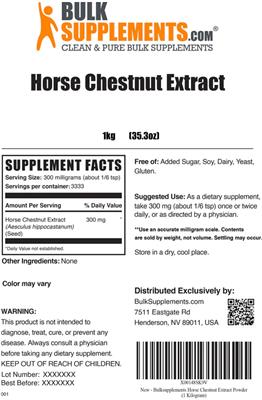
Horse Chestnut Extract by BulkSupplements.com label
The label scan from the NIH Dietary Supplement Label Database. Tap to enlarge.
Label images are published by the NIH Dietary Supplement Label Database for the version of this product on file. Always read your actual product label.
View the full label (PDF)The Ingredients in Horse Chestnut Extract by BulkSupplements.com
This is the 1 active ingredient this product is made of. Select it to open its full monograph.
Serving size300 mg Dosage formPowder Servings per container3333 Amounts shown are per serving.
Horse Chestnut extract
Interacts with122 drugs
Horse chestnut seed extract is most often used for chronic venous insufficiency, where standardized products may help reduce leg swelling, pain, and h...
Horse Chestnut extract monograph & interactionsHorse Chestnut Extract by BulkSupplements.com Drug Interactions
HelloPharmacist Interaction Report
BulkSupplements.com Horse Chestnut Extract may interact with blood thinners and antiplatelet drugs through its horse chestnut extract content.
Horse chestnut contains a compound called esculin that can thin the blood, and using it alongside anticoagulants or antiplatelet medications raises your bleeding risk — this is a Moderate concern. The interaction hasn't been proven in humans yet, but the mechanism is clear enough that you'll want to check any blood-thinning medications you're on before starting this product.
Read the full breakdown — every affected drug type, severity by severity
Altogether, these interactions span 122 individual medications.
If you take any anticoagulant (like warfarin or heparin) or antiplatelet drug (like aspirin or clopidogrel), run them through the checker on this page before you go ahead. Your doctor or pharmacist can tell you whether the combination is safe for you.
Check your own medications below · Editorial policy · How we use AI
Want to check YOUR meds against Horse Chestnut Extract?
Ask about interactions with your drugs in plain English — “Can I take it with lisinopril?” — and we find you the answer in seconds, ingredient by ingredient.
Go to the checkerIngredients driving the most interactions
Individual Drug Interactions
The ingredients in Horse Chestnut Extract interact with 122 drugs. Click any drug to see the details.
1 of the 1 ingredient in Horse Chestnut Extract interact with drugs. Each result below shows which ingredient is responsible. Horse Chestnut extract
Diclofenac Sodium, MisoprostolArthrotec 50, Arthrotec 75
How Diclofenac Sodium, Misoprostol interacts with Horse Chestnut Extract — through 1 ingredient. Tap an ingredient for the detail:
Horse Chestnut ExtractAnticoagulant/antiplatelet Drugs Moderate
Interaction Summary
Horse chestnut may have antiplatelet effects and may increase the risk of bleeding if used with anticoagulant or antiplatelet drugs.
Read the full Horse Chestnut Extract + Diclofenac Sodium, Misoprostol interactionDiclofenac EpolamineFlector, Licart
How Diclofenac Epolamine interacts with Horse Chestnut Extract — through 1 ingredient. Tap an ingredient for the detail:
Horse Chestnut ExtractAnticoagulant/antiplatelet Drugs Moderate
Interaction Summary
Horse chestnut may have antiplatelet effects and may increase the risk of bleeding if used with anticoagulant or antiplatelet drugs.
Read the full Horse Chestnut Extract + Diclofenac Epolamine interactionDicumarolDicumarol
How Dicumarol interacts with Horse Chestnut Extract — through 1 ingredient. Tap an ingredient for the detail:
Horse Chestnut ExtractAnticoagulant/antiplatelet Drugs Moderate
Interaction Summary
Horse chestnut may have antiplatelet effects and may increase the risk of bleeding if used with anticoagulant or antiplatelet drugs.
Read the full Horse Chestnut Extract + Dicumarol interactionDiphenhydramine Hydrochloride, Naproxen SodiumAleve PM
How Diphenhydramine Hydrochloride, Naproxen Sodium interacts with Horse Chestnut Extract — through 1 ingredient. Tap an ingredient for the detail:
Horse Chestnut ExtractAnticoagulant/antiplatelet Drugs Moderate
Interaction Summary
Horse chestnut may have antiplatelet effects and may increase the risk of bleeding if used with anticoagulant or antiplatelet drugs.
Read the full Horse Chestnut Extract + Diphenhydramine Hydrochloride, Naproxen Sodium interactionDipyridamoleDipyridamole, Persantin, Persantin Injection, Persantin Retard, Persantine
How Dipyridamole interacts with Horse Chestnut Extract — through 1 ingredient. Tap an ingredient for the detail:
Horse Chestnut ExtractAnticoagulant/antiplatelet Drugs Moderate
Interaction Summary
Horse chestnut may have antiplatelet effects and may increase the risk of bleeding if used with anticoagulant or antiplatelet drugs.
Read the full Horse Chestnut Extract + Dipyridamole interactionEdoxabanSavaysa
How Edoxaban interacts with Horse Chestnut Extract — through 1 ingredient. Tap an ingredient for the detail:
Horse Chestnut ExtractAnticoagulant/antiplatelet Drugs Moderate
Interaction Summary
Horse chestnut may have antiplatelet effects and may increase the risk of bleeding if used with anticoagulant or antiplatelet drugs.
Read the full Horse Chestnut Extract + Edoxaban interactionEffientPrasugrel
How Effient interacts with Horse Chestnut Extract — through 1 ingredient. Tap an ingredient for the detail:
Horse Chestnut ExtractAnticoagulant/antiplatelet Drugs Moderate
Interaction Summary
Horse chestnut may have antiplatelet effects and may increase the risk of bleeding if used with anticoagulant or antiplatelet drugs.
Read the full Horse Chestnut Extract + Effient interactionEnoxaparinLovenox
How Enoxaparin interacts with Horse Chestnut Extract — through 1 ingredient. Tap an ingredient for the detail:
Horse Chestnut ExtractAnticoagulant/antiplatelet Drugs Moderate
Interaction Summary
Horse chestnut may have antiplatelet effects and may increase the risk of bleeding if used with anticoagulant or antiplatelet drugs.
Read the full Horse Chestnut Extract + Enoxaparin interactionEptifibatideIntegrilin
How Eptifibatide interacts with Horse Chestnut Extract — through 1 ingredient. Tap an ingredient for the detail:
Horse Chestnut ExtractAnticoagulant/antiplatelet Drugs Moderate
Interaction Summary
Horse chestnut may have antiplatelet effects and may increase the risk of bleeding if used with anticoagulant or antiplatelet drugs.
Read the full Horse Chestnut Extract + Eptifibatide interactionEsomeprazole, NaproxenVimovo
How Esomeprazole, Naproxen interacts with Horse Chestnut Extract — through 1 ingredient. Tap an ingredient for the detail:
Horse Chestnut ExtractAnticoagulant/antiplatelet Drugs Moderate
Interaction Summary
Horse chestnut may have antiplatelet effects and may increase the risk of bleeding if used with anticoagulant or antiplatelet drugs.
Read the full Horse Chestnut Extract + Esomeprazole, Naproxen interactionFamotidine, IbuprofenDuexis
How Famotidine, Ibuprofen interacts with Horse Chestnut Extract — through 1 ingredient. Tap an ingredient for the detail:
Horse Chestnut ExtractAnticoagulant/antiplatelet Drugs Moderate
Interaction Summary
Horse chestnut may have antiplatelet effects and may increase the risk of bleeding if used with anticoagulant or antiplatelet drugs.
Read the full Horse Chestnut Extract + Famotidine, Ibuprofen interactionFish Oil TriglyceridesOmegaven
How Fish Oil Triglycerides interacts with Horse Chestnut Extract — through 1 ingredient. Tap an ingredient for the detail:
Horse Chestnut ExtractAnticoagulant/antiplatelet Drugs Moderate
Interaction Summary
Horse chestnut may have antiplatelet effects and may increase the risk of bleeding if used with anticoagulant or antiplatelet drugs.
Read the full Horse Chestnut Extract + Fish Oil Triglycerides interactionFondaparinuxArixtra
How Fondaparinux interacts with Horse Chestnut Extract — through 1 ingredient. Tap an ingredient for the detail:
Horse Chestnut ExtractAnticoagulant/antiplatelet Drugs Moderate
Interaction Summary
Horse chestnut may have antiplatelet effects and may increase the risk of bleeding if used with anticoagulant or antiplatelet drugs.
Read the full Horse Chestnut Extract + Fondaparinux interactionHeparinHeparin
How Heparin interacts with Horse Chestnut Extract — through 1 ingredient. Tap an ingredient for the detail:
Horse Chestnut ExtractAnticoagulant/antiplatelet Drugs Moderate
Interaction Summary
Horse chestnut may have antiplatelet effects and may increase the risk of bleeding if used with anticoagulant or antiplatelet drugs.
Read the full Horse Chestnut Extract + Heparin interactionHydrocodone, IbuprofenVicoprofen
How Hydrocodone, Ibuprofen interacts with Horse Chestnut Extract — through 1 ingredient. Tap an ingredient for the detail:
Horse Chestnut ExtractAnticoagulant/antiplatelet Drugs Moderate
Interaction Summary
Horse chestnut may have antiplatelet effects and may increase the risk of bleeding if used with anticoagulant or antiplatelet drugs.
Read the full Horse Chestnut Extract + Hydrocodone, Ibuprofen interactionIbrutinibImbruvica
How Ibrutinib interacts with Horse Chestnut Extract — through 1 ingredient. Tap an ingredient for the detail:
Horse Chestnut ExtractAnticoagulant/antiplatelet Drugs Moderate
Interaction Summary
Horse chestnut may have antiplatelet effects and may increase the risk of bleeding if used with anticoagulant or antiplatelet drugs.
Read the full Horse Chestnut Extract + Ibrutinib interactionIbuprofenAdvil, Arthrofen, Brufen, Brufen Retard, Calodor, Calprofen +14 more
How Ibuprofen interacts with Horse Chestnut Extract — through 1 ingredient. Tap an ingredient for the detail:
Horse Chestnut ExtractAnticoagulant/antiplatelet Drugs Moderate
Interaction Summary
Horse chestnut may have antiplatelet effects and may increase the risk of bleeding if used with anticoagulant or antiplatelet drugs.
Read the full Horse Chestnut Extract + Ibuprofen interactionIbuprofen LysineNeoProfen
How Ibuprofen Lysine interacts with Horse Chestnut Extract — through 1 ingredient. Tap an ingredient for the detail:
Horse Chestnut ExtractAnticoagulant/antiplatelet Drugs Moderate
Interaction Summary
Horse chestnut may have antiplatelet effects and may increase the risk of bleeding if used with anticoagulant or antiplatelet drugs.
Read the full Horse Chestnut Extract + Ibuprofen Lysine interactionIbuprofen, AcetaminophenAdvil Dual Action
How Ibuprofen, Acetaminophen interacts with Horse Chestnut Extract — through 1 ingredient. Tap an ingredient for the detail:
Horse Chestnut ExtractAnticoagulant/antiplatelet Drugs Moderate
Interaction Summary
Horse chestnut may have antiplatelet effects and may increase the risk of bleeding if used with anticoagulant or antiplatelet drugs.
Read the full Horse Chestnut Extract + Ibuprofen, Acetaminophen interactionIbuprofen, HydrocodoneIbucodone
How Ibuprofen, Hydrocodone interacts with Horse Chestnut Extract — through 1 ingredient. Tap an ingredient for the detail:
Horse Chestnut ExtractAnticoagulant/antiplatelet Drugs Moderate
Interaction Summary
Horse chestnut may have antiplatelet effects and may increase the risk of bleeding if used with anticoagulant or antiplatelet drugs.
Read the full Horse Chestnut Extract + Ibuprofen, Hydrocodone interactionIbuprofen, OxycodoneCombunox
How Ibuprofen, Oxycodone interacts with Horse Chestnut Extract — through 1 ingredient. Tap an ingredient for the detail:
Horse Chestnut ExtractAnticoagulant/antiplatelet Drugs Moderate
Interaction Summary
Horse chestnut may have antiplatelet effects and may increase the risk of bleeding if used with anticoagulant or antiplatelet drugs.
Read the full Horse Chestnut Extract + Ibuprofen, Oxycodone interactionIbuprofen, PseudoephedrineDristan
How Ibuprofen, Pseudoephedrine interacts with Horse Chestnut Extract — through 1 ingredient. Tap an ingredient for the detail:
Horse Chestnut ExtractAnticoagulant/antiplatelet Drugs Moderate
Interaction Summary
Horse chestnut may have antiplatelet effects and may increase the risk of bleeding if used with anticoagulant or antiplatelet drugs.
Read the full Horse Chestnut Extract + Ibuprofen, Pseudoephedrine interactionIcosapent Ethyl (prescription Drug)Vascepa
How Icosapent Ethyl (prescription Drug) interacts with Horse Chestnut Extract — through 1 ingredient. Tap an ingredient for the detail:
Horse Chestnut ExtractAnticoagulant/antiplatelet Drugs Moderate
Interaction Summary
Horse chestnut may have antiplatelet effects and may increase the risk of bleeding if used with anticoagulant or antiplatelet drugs.
Read the full Horse Chestnut Extract + Icosapent Ethyl (prescription Drug) interactionIloprostAurlumyn, Ventavis
How Iloprost interacts with Horse Chestnut Extract — through 1 ingredient. Tap an ingredient for the detail:
Horse Chestnut ExtractAnticoagulant/antiplatelet Drugs Moderate
Interaction Summary
Horse chestnut may have antiplatelet effects and may increase the risk of bleeding if used with anticoagulant or antiplatelet drugs.
Read the full Horse Chestnut Extract + Iloprost interactionInotersenTegsedi
How Inotersen interacts with Horse Chestnut Extract — through 1 ingredient. Tap an ingredient for the detail:
Horse Chestnut ExtractAnticoagulant/antiplatelet Drugs Moderate
Interaction Summary
Horse chestnut may have antiplatelet effects and may increase the risk of bleeding if used with anticoagulant or antiplatelet drugs.
Read the full Horse Chestnut Extract + Inotersen interactionKetoprofenOrudis, Oruvail Gel, Oruvail Injection, Powergel
How Ketoprofen interacts with Horse Chestnut Extract — through 1 ingredient. Tap an ingredient for the detail:
Horse Chestnut ExtractAnticoagulant/antiplatelet Drugs Moderate
Interaction Summary
Horse chestnut may have antiplatelet effects and may increase the risk of bleeding if used with anticoagulant or antiplatelet drugs.
Read the full Horse Chestnut Extract + Ketoprofen interactionLepirudinRefludan
How Lepirudin interacts with Horse Chestnut Extract — through 1 ingredient. Tap an ingredient for the detail:
Horse Chestnut ExtractAnticoagulant/antiplatelet Drugs Moderate
Interaction Summary
Horse chestnut may have antiplatelet effects and may increase the risk of bleeding if used with anticoagulant or antiplatelet drugs.
Read the full Horse Chestnut Extract + Lepirudin interactionMinocyclineAcnamino MR, Aknemin, Amzeeq, Arestin Miscrosperes, Dynacin, Minocin +6 more
How Minocycline interacts with Horse Chestnut Extract — through 1 ingredient. Tap an ingredient for the detail:
Horse Chestnut ExtractAnticoagulant/antiplatelet Drugs Moderate
Interaction Summary
Horse chestnut may have antiplatelet effects and may increase the risk of bleeding if used with anticoagulant or antiplatelet drugs.
Read the full Horse Chestnut Extract + Minocycline interactionNadroparinFraxiparine
How Nadroparin interacts with Horse Chestnut Extract — through 1 ingredient. Tap an ingredient for the detail:
Horse Chestnut ExtractAnticoagulant/antiplatelet Drugs Moderate
Interaction Summary
Horse chestnut may have antiplatelet effects and may increase the risk of bleeding if used with anticoagulant or antiplatelet drugs.
Read the full Horse Chestnut Extract + Nadroparin interactionNaproxenAleve, Anaprox, Anaprox DS, Arthroxen, EC-Naprosyn, Naprelan +7 more
How Naproxen interacts with Horse Chestnut Extract — through 1 ingredient. Tap an ingredient for the detail:
Horse Chestnut ExtractAnticoagulant/antiplatelet Drugs Moderate
Interaction Summary
Horse chestnut may have antiplatelet effects and may increase the risk of bleeding if used with anticoagulant or antiplatelet drugs.
Read the full Horse Chestnut Extract + Naproxen interactionEach ingredient & the kinds of drugs it affects
For each ingredient in Horse Chestnut Extract with known interactions, here are the types of medications it can affect. Open any type for the detail — or search your exact drug in the checker above.
Horse Chestnut extract
Anticoagulant/Antiplatelet Drugs
Horse chestnut may have antiplatelet effects and may increase the risk of bleeding if used with anticoagulant or antiplatelet drugs.
Horse chestnut contains the constituent esculin which has been shown to have antithrombotic effects. Therefore, horse chestnut might have antiplatelet effects. This has not been shown in humans.
Brand information
Manufacturer and brand details for Horse Chestnut Extract, from the product label.
BulkSupplements.com
See all BulkSupplements.com products- Name
- BulkSupplements.com
- Street Address
- 7511 Eastgate Rd
- City
- Henderson
- State
- NV
- ZipCode
- 89011
- Web Address
- BulkSupplements.com
Horse Chestnut Extract by BulkSupplements.com: Common Questions
Does Horse Chestnut Extract by BulkSupplements.com interact with any medications?
How can one product interact with so many drugs?
Where does this information come from?
Can I take this if I'm pregnant or breastfeeding?
What's horse chestnut extract actually used for?
What side effects might I notice?
Is the raw horse chestnut seed safe to take?
Why does this interact with blood thinners?
Written and reviewed by the HelloPharmacist editorial staff. Our editorial policy
Not sure if Horse Chestnut Extract is safe with your meds?
Our pharmacists answer your medication & supplement questions — free.
Label information is sourced from the NIH Dietary Supplement Label Database and reflects the product version on file; always read your actual product label. This page is for education only and is not a substitute for professional medical advice. Confirm with your pharmacist or doctor before combining supplements and medications.
The Full Monographs Behind Horse Chestnut Extract’s Ingredients
Every ingredient we hold a full HelloPharmacist monograph for — uses, evidence, safety, and the complete interaction list.
Sources & How We Checked
Horse Chestnut Extract's label data comes from the NIH Dietary Supplement Label Database; the ingredient interaction data is from the Natural Medicines database, reviewed by our pharmacists.
- NIH Dietary Supplement Label Database (DSLD) — The official product label on file for this supplement.
- Natural Medicines (Therapeutic Research Center) — Evidence-graded clinical reference behind the ingredient interaction data.
Content is written and reviewed by licensed HelloPharmacist pharmacists. See our data sources and editorial standards for how this information is built and checked.
The 21 references behind this product’s interaction data
Every citation that drives the interaction findings for this product’s ingredients, from the evidence-graded Natural Medicines (TRC Healthcare) database. Open an ingredient to browse its citations — links open the study on PubMed or the publisher’s site.
Horse Chestnut 21 references
- Blumenthal M, ed. The Complete German Commission E Monographs: Therapeutic Guide to Herbal Medicines. Trans. S. Klein. Boston, MA: American Botanical Council, 1998.
- Ellenhorn MJ, et al. Ellenhorn's Medical Toxicology: Diagnoses and Treatment of Human Poisoning. 2nd ed. Baltimore, MD: Williams & Wilkins, 1997.
- Gruenwald J, Brendler T, Jaenicke C. PDR for Herbal Medicines. 1st ed. Montvale, NJ: Medical Economics Company, Inc., 1998.
- Brinker F. Herb Contraindications and Drug Interactions. 2nd ed. Sandy, OR: Eclectic Medical Publications, 1998.
- Greeske K, Pohlmann BK. Horse chestnut seed extract-an effective therapy principle in general practice. Drug therapy of chronic venous insufficiency. Fortschr Med 1996;114:196-200.
- Robbers JE, Tyler VE. Tyler's Herbs of Choice: The Therapeutic Use of Phytomedicinals. New York, NY: The Haworth Herbal Press, 1999.
- Takegoshi K, Tohyama T, Okuda K, et al. A case of Venoplant-induced hepatic injury. Gastroenterol Jpn 1986;21:62-5.
- Jaspersen-Schib R, Theus L, Guirguis-Oeschger M, et al. [Serious plant poisonings in Switzerland 1966-1994. Case analysis from the Swiss Toxicology Information Center]. Schweiz Med Wochenschr 1996;126:1085-98.
- Popp W, Horak F, Jager S, et al. Horse chestnut (Aesculus hippocastanum) pollen: a frequent cause of allergic sensitization in urban children. Allergy 1992;47:380-3.
- Diaz-Perales A, Collada C, Blanco C, et al. Cross-reactions in the latex-fruit syndrome: A relevant role of chitinases but not of complex asparagine-linked glycans. J Allergy Clin Immunol 1999;104:681-7. PubMed
- Blanco C, Diaz-Perales A, Collada C, et al. Class I chitinases as potential panallergens involved in the latex-fruit syndrome. J Allergy Clin Immunol 1999;103:507-13. PubMed
- Comaish JS, Kersey PJ. Contact dermatitis to extract of horse chestnut (esculin). Contact Dermatitis 1980;6:150-1. PubMed
- Pittler MH, Ernst E. Horse chestnut seed extract for chronic venous insufficiency (Cochrane Review). In: The Cochrane Library, Issue 3, 2004. Chichester, UK: John Wiley & Sons, Ltd. PubMed
- Ottillinger, B. and Greeske, K. Rational therapy of chronic venous insufficiency--chances and limits of the therapeutic use of horse-chestnut seeds extract. BMC.Cardiovasc.Disord. 2001;1(1):5. PubMed
- Pittler, M. H. and Ernst, E. Horse chestnut seed extract for chronic venous insufficiency. Cochrane.Database.Syst.Rev. 2004;(2):CD003230. PubMed
- Fang, Y., Zhao, L., Yan, F., Xia, X., Xu, D., and Cui, X. Escin improves sperm quality in male patients with varicocele-associated infertility. Phytomedicine. 2010;17(3-4):192-196. PubMed
- De Smet, P. A., Van den Eertwegh, A. J., Lesterhuis, W., and Stricker, B. H. Hepatotoxicity associated with herbal tablets. BMJ 7-13-1996;313(7049):92.
- Rehn, D., Unkauf, M., Klein, P., Jost, V., and Lucker, P. W. Comparative clinical efficacy and tolerability of oxerutins and horse chestnut extract in patients with chronic venous insufficiency. Arzneimittelforschung 1996;46(5):483-487.
- Edem E, Kahyaoglu B, Çakar MA. Acute Effusive Pericarditis due to Horse Chestnut Consumption. Am J Case Rep. 2016;17:305-8. PubMed
- Costa Santos D, Lérias G, Madruga I. Drug-induced Liver Injury Due to a Horse Chestnut Dietary Supplement. Eur J Case Rep Intern Med 2021;8(3):002389. PubMed
- Yi HY, Lee JY. Poisoning due to consumption of horse chestnut seed. Clin Exp Emerg Med 2021;8(4):333-335. PubMed
Parts of this content are provided by the Therapeutic Research Center, LLC.
DISCLAIMER: Currently this does not check for drug-drug interactions. This is not an all-inclusive comprehensive list of potential interactions and is for informational purposes only. Not all interactions are known or well-reported in the scientific literature, and new interactions are continually being reported. Input is needed from a qualified healthcare provider including a pharmacist before starting any therapy. Application of clinical judgment is necessary.
© 2021 Therapeutic Research Center, LLC