
Infa Skin Probiotic Ingredients & Drug Interactions
What is this page for?
First and foremost: checking Infa Skin Probiotic against your medications. The heart of this page is the interaction checker and the full interaction report — how this product’s ingredients may interact with prescription and over-the-counter medicines you may be taking.
Around that, we add a pharmacist’s high-level view of the product as a whole — what’s inside, the evidence for its stated use, how transparent the label is, and what safety data exists — so you can see the full picture in one place. It’s educational information from our licensed clinical databases and the clinical staff at HelloPharmacist — not medical advice — and we don’t sell or endorse products. Our editorial policy
Infa Skin Probiotic is a dietary supplement by Douglas Laboratories with 6 active ingredients. Its ingredients are commonly taken for digestive health and regularity, diarrhea (including antibiotic-related), irritable bowel syndrome (ibs) symptoms.Based on those ingredients, 182 medications have a known interaction with it, the most serious rated moderate. The ingredients most likely to interact are Bifidobacterium bifidum. Use the checker below to test your specific medication, or read the full HelloPharmacist Interaction Report.
Check Your Meds Against Infa Skin Probiotic by Douglas Laboratories
Ask about any prescription or over-the-counter medication and we check it for interactions with Infa Skin Probiotic by Douglas Laboratories — and tell you which ingredient is responsible.
AI summaries are generated from our interaction database for education only — always confirm with your pharmacist. How we use AI
Ask the Pharmacist
A licensed pharmacist will answer your question by email — free, usually within 24 hours.
Got it — thank you!
A licensed pharmacist will answer within 24 hours. Keep an eye on your email (worth checking spam, just in case).
HelloPharmacist Scorecard of Infa Skin Probiotic by Douglas Laboratories
Our pharmacy team’s full take, with four database checks built into the cards below — a summary of what is known, not a grade of the product itself.
What’s inside
Low disclosure
This product contains 4 active ingredients: two Bifidobacterium species (B. animalis lactis and B. bifidum), Lactococcus lactis, and Fat — all live-culture probiotics meant to support your skin and digestive health. It also contains rice starch, maltodextrin, and ascorbic acid as inactive ingredients to stabilize and preserve the cultures.
Does it work?
Moderate evidence
The evidence is clearest for Bifidobacterium bifidum in irritable bowel syndrome (IBS) and respiratory tract infections, where it's rated possibly effective. For allergic rhinitis (hay fever) and generalized anxiety disorder, the evidence isn't strong enough yet to say whether it works.
The evidence on Alzheimer disease is also insufficient to rate. The other probiotic ingredients in this blend don't have established effectiveness ratings in our data.
How safe is it?
Well-documented data
Bifidobacterium bifidum is generally well tolerated in healthy people. Those with weakened immune systems should be cautious, and because the evidence is limited, talk with your doctor or pharmacist before starting it.
Bloating and flatulence can happen with probiotics generally, though they haven't been reported specifically from B. bifidum. One child in a study had vomiting and fever while taking B. bifidum with another probiotic, but it's unclear if the probiotics caused it.
Sepsis from Bifidobacterium is very rare and hasn't been linked to B. bifidum in particular.
Meds to double-check
Moderate interaction found
If you take antibiotic drugs, separate them from this probiotic by several hours — antibiotics can kill off the live organisms and make the supplement less effective. Use the medication checker below to see if any of your other medications have interactions we've documented.
The bottom line
Scorecard at a glanceFormula with limited ingredient disclosure with some supporting evidence for its stated purpose. Moderate medication interactions have been identified, and safety information is well characterized.
If you have IBS or recurrent respiratory infections, this probiotic may be worth discussing with your doctor. Keep in mind you'll need to time it carefully if you're on antibiotics — they can interfere with how well the probiotic works.
Check with your doctor or pharmacist before starting, especially if your immune system is compromised.
Educational only — not medical advice; always confirm with your pharmacist. Our editorial policy · How we use AI
Assessment coverage: 1 of 4 active ingredients matched to our full ingredient reviews (monographs). Based on the product label dated Mar 23, 2012.
This Scorecard evaluates available label information, ingredient evidence, and known medication-safety considerations. It does not independently verify product identity, purity, potency, contamination, or manufacturing quality. How these ratings are computed
General information
Key facts about Infa Skin Probiotic, straight from the product label.
| Brand | Douglas Laboratories |
|---|---|
| Barcode (UPC) | 310539033777 |
| Net contents | 30 Sachet(s) |
| Market status | On market |
| Date entered into DSLD | Mar 23, 2012 |
| DSLD ID | 6216 |
| Product type | Non-nutrient/non-botanical |
| Supplement form | Other (e.g. Tea Bag) |
| Dietary claims / uses | All Other, Structure/Function |
| Intended target group(s) | Pregnant Women, Infants/Baby (0 - 1 Year), Lactating, Children more than 1 but less than 4 |
Everything in this section is reproduced from the manufacturer’s own product label — it’s the label speaking, not HelloPharmacist. We show it so you can see exactly what the maker states; we don’t verify or endorse those statements.
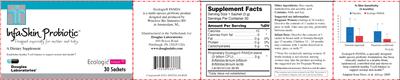
Supplement Facts
The label details for Infa Skin Probiotic by Douglas Laboratories, sourced from the NIH Dietary Supplement Label Database.
Supplement Facts
| Ingredient | Amount | % DV |
|---|---|---|
| Calories | 10 {Calories} | -- |
| Calories from Fat | 0 {Calories} | -- |
| Protein | 0 g | -- |
| Carbohydrates | 3 g | 1% |
| Bifidobacterium animalis lactis | 0 NP | -- |
| Bifidobacterium bifidum | 0 NP | -- |
| Lactococcus lactis | 0 NP | -- |
| Fat | 0 g | -- |
| Proprietary Ecologic(R) PANDA blend | 3 g | -- |
Other ingredients: Rice Starch, Maltodextrin, Ascorbic Acid
Tap any ingredient to jump to its full detail below.
These statements are the manufacturer’s wording, reproduced from the product label — the label is saying it, not HelloPharmacist. We don’t verify or endorse them.
FDA Statement of Identity
A Dietary Supplement
Suggested/Recommended/Usage/Directions
**Note for exclusively nursing women: If bottle feeding is not elected, nursing women may take the product according to the suggested use for Pregnant Women.
Infant Dose: Dissolve the contents of 1 sachet in breast milk or formula through age 12 months. Children 12-24 months may continue with 1 sachet dissolved in water, juice, or milk.**
Suggested use information: Pregnant Women (starting at 34 weeks): Dissolve the contents of 1 sachet in water, juice or milk. Take once per day, preferably between meals.
FDA Disclaimer Statement
*This statement has not been evaluated by the FDA. This product is not intended to diagnose, treat, cure or prevent any disease.
Storage
Refrigeration not necessary.
Store in a cool dry place.
Formula
Designed especially for mother and baby.
General Statements
% Skin Sensitivity (3 months) Placebo Ecologic PANDA 50 45 40 35 30 25 20 15 10 5 0 Parental-reported 29 12 Physician-confirmed 21 6 *P<0.05
Adapted from Niers, et al. Allergy 2009.
Establishes healthy T-cell balance to support normal skin health.*
General
Component# 65201-DOUGLAS-BOX
Brand IP Statement(s)
Ecologic(R) PANDA is a multi-species probiotic product designed and produced by Winclove Bio Industries BV in Amsterdam, NL.
Ecologic(R) PANDA, a specially designed multi-species probiotic formulation, has been clinically studied in a double-blind, randomized, controlled trial and shown to help establish healthy T-cell balance to support normal skin health.*
Precautions
Contains: Milk and Soy.
Seals/Symbols
Ecologic(R) PANDA
Is this label outdated? Report a formula or label change and our pharmacy team will review it.
Infa Skin Probiotic by Douglas Laboratories label
The label scan from the NIH Dietary Supplement Label Database. Tap to enlarge.
Label images are published by the NIH Dietary Supplement Label Database for the version of this product on file. Always read your actual product label.
View the full label (PDF)The Ingredients in Infa Skin Probiotic by Douglas Laboratories
These are the 6 active ingredients this product is made of. Select any to open its full monograph.
Serving size3 Gram(s) Dosage formOther (e.g. Tea Bag) Servings per container30 Amounts shown are per serving.
Most supplement products combine several ingredients, and a medication can interact with the product through any one of them. Each ingredient below shows whether it has known drug interactions.
Protein
Carbohydrates
Fat
Proprietary Ecologic(R) PANDA blend
- › Bifidobacterium animalis lactis
- › Bifidobacterium bifidum
- › Lactococcus lactis
Other (inactive) ingredients: Rice Starch, Maltodextrin, Ascorbic Acid. These complete the product’s ingredient list but are not active constituents.
Infa Skin Probiotic by Douglas Laboratories Drug Interactions
HelloPharmacist Interaction Report
Infa Skin Probiotic by Douglas Laboratories contains Bifidobacterium bifidum, which has documented interactions with antibiotic drugs.
When you take antibiotics at the same time as B. bifidum, the antibiotics may kill off a significant portion of the live organisms in the probiotic, potentially reducing how well the probiotic works (Moderate severity).
Read the full breakdown — every affected drug type, severity by severity
We couldn't check three other active ingredients in this product — Bifidobacterium animalis lactis, Lactococcus lactis, and the Fat component — because we hold no interaction data for them. To see how your specific medications might interact with this probiotic, use the medication checker on this page.
Check your own medications below · Editorial policy · How we use AI
Want to check YOUR meds against Infa Skin Probiotic?
Ask about interactions with your drugs in plain English — “Can I take it with lisinopril?” — and we find you the answer in seconds, ingredient by ingredient.
Go to the checkerIngredients driving the most interactions
Individual Drug Interactions
The ingredients in Infa Skin Probiotic interact with 182 drugs. Click any drug to see the details.
1 of the 6 ingredients in Infa Skin Probiotic interact with drugs. Each result below shows which ingredient is responsible. Bifidobacterium bifidum
CefotetanCefotan
How Cefotetan interacts with Infa Skin Probiotic — through 1 ingredient. Tap an ingredient for the detail:
Bifidobacterium BifidumAntibiotic Drugs Moderate
Interaction Summary
Theoretically, taking Bifidobacterium.
Read the full Bifidobacterium Bifidum + Cefotetan interactionCefoxitinMefoxin
How Cefoxitin interacts with Infa Skin Probiotic — through 1 ingredient. Tap an ingredient for the detail:
Bifidobacterium BifidumAntibiotic Drugs Moderate
Interaction Summary
Theoretically, taking Bifidobacterium.
Read the full Bifidobacterium Bifidum + Cefoxitin interactionCefpodoxime ProxetilVantin
How Cefpodoxime Proxetil interacts with Infa Skin Probiotic — through 1 ingredient. Tap an ingredient for the detail:
Bifidobacterium BifidumAntibiotic Drugs Moderate
Interaction Summary
Theoretically, taking Bifidobacterium.
Read the full Bifidobacterium Bifidum + Cefpodoxime Proxetil interactionCefprozilCefzil
How Cefprozil interacts with Infa Skin Probiotic — through 1 ingredient. Tap an ingredient for the detail:
Bifidobacterium BifidumAntibiotic Drugs Moderate
Interaction Summary
Theoretically, taking Bifidobacterium.
Read the full Bifidobacterium Bifidum + Cefprozil interactionCeftazidimeCeftazidime, Ceptaz, Fortaz, Tazicef, Tazidime
How Ceftazidime interacts with Infa Skin Probiotic — through 1 ingredient. Tap an ingredient for the detail:
Bifidobacterium BifidumAntibiotic Drugs Moderate
Interaction Summary
Theoretically, taking Bifidobacterium.
Read the full Bifidobacterium Bifidum + Ceftazidime interactionCeftibutenCedax
How Ceftibuten interacts with Infa Skin Probiotic — through 1 ingredient. Tap an ingredient for the detail:
Bifidobacterium BifidumAntibiotic Drugs Moderate
Interaction Summary
Theoretically, taking Bifidobacterium.
Read the full Bifidobacterium Bifidum + Ceftibuten interactionCeftizoximeCefizox
How Ceftizoxime interacts with Infa Skin Probiotic — through 1 ingredient. Tap an ingredient for the detail:
Bifidobacterium BifidumAntibiotic Drugs Moderate
Interaction Summary
Theoretically, taking Bifidobacterium.
Read the full Bifidobacterium Bifidum + Ceftizoxime interactionCeftolozane Sulfate, Tazobactam SodiumZerbaxa
How Ceftolozane Sulfate, Tazobactam Sodium interacts with Infa Skin Probiotic — through 1 ingredient. Tap an ingredient for the detail:
Bifidobacterium BifidumAntibiotic Drugs Moderate
Interaction Summary
Theoretically, taking Bifidobacterium.
Read the full Bifidobacterium Bifidum + Ceftolozane Sulfate, Tazobactam Sodium interactionCeftriaxoneRocephin
How Ceftriaxone interacts with Infa Skin Probiotic — through 1 ingredient. Tap an ingredient for the detail:
Bifidobacterium BifidumAntibiotic Drugs Moderate
Interaction Summary
Theoretically, taking Bifidobacterium.
Read the full Bifidobacterium Bifidum + Ceftriaxone interactionCefuroximeCeftin, Kefurox, Zinacef
How Cefuroxime interacts with Infa Skin Probiotic — through 1 ingredient. Tap an ingredient for the detail:
Bifidobacterium BifidumAntibiotic Drugs Moderate
Interaction Summary
Theoretically, taking Bifidobacterium.
Read the full Bifidobacterium Bifidum + Cefuroxime interactionCephalexinCephalex, Keflex, Keftab, Lexin
How Cephalexin interacts with Infa Skin Probiotic — through 1 ingredient. Tap an ingredient for the detail:
Bifidobacterium BifidumAntibiotic Drugs Moderate
Interaction Summary
Theoretically, taking Bifidobacterium.
Read the full Bifidobacterium Bifidum + Cephalexin interactionCephapirinCefadyl
How Cephapirin interacts with Infa Skin Probiotic — through 1 ingredient. Tap an ingredient for the detail:
Bifidobacterium BifidumAntibiotic Drugs Moderate
Interaction Summary
Theoretically, taking Bifidobacterium.
Read the full Bifidobacterium Bifidum + Cephapirin interactionCephradineAnspor, Velosef
How Cephradine interacts with Infa Skin Probiotic — through 1 ingredient. Tap an ingredient for the detail:
Bifidobacterium BifidumAntibiotic Drugs Moderate
Interaction Summary
Theoretically, taking Bifidobacterium.
Read the full Bifidobacterium Bifidum + Cephradine interactionChloramphenicolChloromycetin, Chloromycetin Injection, Chloromycetin Ophthalmic
How Chloramphenicol interacts with Infa Skin Probiotic — through 1 ingredient. Tap an ingredient for the detail:
Bifidobacterium BifidumAntibiotic Drugs Moderate
Interaction Summary
Theoretically, taking Bifidobacterium.
Read the full Bifidobacterium Bifidum + Chloramphenicol interactionChlortetracyclineAureomycin
How Chlortetracycline interacts with Infa Skin Probiotic — through 1 ingredient. Tap an ingredient for the detail:
Bifidobacterium BifidumAntibiotic Drugs Moderate
Interaction Summary
Theoretically, taking Bifidobacterium.
Read the full Bifidobacterium Bifidum + Chlortetracycline interactionCinoxacinCinobac
How Cinoxacin interacts with Infa Skin Probiotic — through 1 ingredient. Tap an ingredient for the detail:
Bifidobacterium BifidumAntibiotic Drugs Moderate
Interaction Summary
Theoretically, taking Bifidobacterium.
Read the full Bifidobacterium Bifidum + Cinoxacin interactionCiprofloxacinCiloxan, Cipro, Cipro IV, Cipro XR, Ciprobay, Otiprio
How Ciprofloxacin interacts with Infa Skin Probiotic — through 1 ingredient. Tap an ingredient for the detail:
Bifidobacterium BifidumAntibiotic Drugs Moderate
Interaction Summary
Theoretically, taking Bifidobacterium.
Read the full Bifidobacterium Bifidum + Ciprofloxacin interactionClarithromycinBiaxin, Biaxin XL
How Clarithromycin interacts with Infa Skin Probiotic — through 1 ingredient. Tap an ingredient for the detail:
Bifidobacterium BifidumAntibiotic Drugs Moderate
Interaction Summary
Theoretically, taking Bifidobacterium.
Read the full Bifidobacterium Bifidum + Clarithromycin interactionClinafloxacinClinafloxacin
How Clinafloxacin interacts with Infa Skin Probiotic — through 1 ingredient. Tap an ingredient for the detail:
Bifidobacterium BifidumAntibiotic Drugs Moderate
Interaction Summary
Theoretically, taking Bifidobacterium.
Read the full Bifidobacterium Bifidum + Clinafloxacin interactionClindamycinCleocin, Cleocin T Gel, ClindaMax, Clindesse, Dalacin C
How Clindamycin interacts with Infa Skin Probiotic — through 1 ingredient. Tap an ingredient for the detail:
Bifidobacterium BifidumAntibiotic Drugs Moderate
Interaction Summary
Theoretically, taking Bifidobacterium.
Read the full Bifidobacterium Bifidum + Clindamycin interactionClofazimineLamprene
How Clofazimine interacts with Infa Skin Probiotic — through 1 ingredient. Tap an ingredient for the detail:
Bifidobacterium BifidumAntibiotic Drugs Moderate
Interaction Summary
Theoretically, taking Bifidobacterium.
Read the full Bifidobacterium Bifidum + Clofazimine interactionCloxacillin SodiumCloxapen, Cloxi, Tegopen
How Cloxacillin Sodium interacts with Infa Skin Probiotic — through 1 ingredient. Tap an ingredient for the detail:
Bifidobacterium BifidumAntibiotic Drugs Moderate
Interaction Summary
Theoretically, taking Bifidobacterium.
Read the full Bifidobacterium Bifidum + Cloxacillin Sodium interactionColistimethateColy-Mycin M
How Colistimethate interacts with Infa Skin Probiotic — through 1 ingredient. Tap an ingredient for the detail:
Bifidobacterium BifidumAntibiotic Drugs Moderate
Interaction Summary
Theoretically, taking Bifidobacterium.
Read the full Bifidobacterium Bifidum + Colistimethate interactionCyclacillinCyclapen-W, Cylcapen
How Cyclacillin interacts with Infa Skin Probiotic — through 1 ingredient. Tap an ingredient for the detail:
Bifidobacterium BifidumAntibiotic Drugs Moderate
Interaction Summary
Theoretically, taking Bifidobacterium.
Read the full Bifidobacterium Bifidum + Cyclacillin interactionCycloserineSeromycin
How Cycloserine interacts with Infa Skin Probiotic — through 1 ingredient. Tap an ingredient for the detail:
Bifidobacterium BifidumAntibiotic Drugs Moderate
Interaction Summary
Theoretically, taking Bifidobacterium.
Read the full Bifidobacterium Bifidum + Cycloserine interactionDalbavancin HydrochlorideDalvance
How Dalbavancin Hydrochloride interacts with Infa Skin Probiotic — through 1 ingredient. Tap an ingredient for the detail:
Bifidobacterium BifidumAntibiotic Drugs Moderate
Interaction Summary
Theoretically, taking Bifidobacterium.
Read the full Bifidobacterium Bifidum + Dalbavancin Hydrochloride interactionDapsoneAczone, Avlosulfon, Dapsone
How Dapsone interacts with Infa Skin Probiotic — through 1 ingredient. Tap an ingredient for the detail:
Bifidobacterium BifidumAntibiotic Drugs Moderate
Interaction Summary
Theoretically, taking Bifidobacterium.
Read the full Bifidobacterium Bifidum + Dapsone interactionDaptomycinCubicin, Dapzura RT
How Daptomycin interacts with Infa Skin Probiotic — through 1 ingredient. Tap an ingredient for the detail:
Bifidobacterium BifidumAntibiotic Drugs Moderate
Interaction Summary
Theoretically, taking Bifidobacterium.
Read the full Bifidobacterium Bifidum + Daptomycin interactionDemeclocyclineDeclomycin
How Demeclocycline interacts with Infa Skin Probiotic — through 1 ingredient. Tap an ingredient for the detail:
Bifidobacterium BifidumAntibiotic Drugs Moderate
Interaction Summary
Theoretically, taking Bifidobacterium.
Read the full Bifidobacterium Bifidum + Demeclocycline interactionDicloxacillin InjectionDynapen Injection
How Dicloxacillin Injection interacts with Infa Skin Probiotic — through 1 ingredient. Tap an ingredient for the detail:
Bifidobacterium BifidumAntibiotic Drugs Moderate
Interaction Summary
Theoretically, taking Bifidobacterium.
Read the full Bifidobacterium Bifidum + Dicloxacillin Injection interactionEach ingredient & the kinds of drugs it affects
For each ingredient in Infa Skin Probiotic with known interactions, here are the types of medications it can affect. Open any type for the detail — or search your exact drug in the checker above.
Bifidobacterium bifidum
Antibiotic Drugs
Theoretically, taking Bifidobacterium. bifidum with antibiotic drugs might decrease the effectiveness of B. bifidum.
Since B. bifidum preparations usually contain live and active organisms, simultaneously taking antibiotics might kill a significant number of the organisms. Tell patients to separate administration of antibiotics and B. bifidum preparations by at least 2 hours.
Brand information
Manufacturer and brand details for Infa Skin Probiotic, from the product label.
Douglas Laboratories
See all Douglas Laboratories products- Name
- Douglas Laboratories
- Street Address
- 600 Boyce Road
- City
- Pittsburgh
- State
- PA
- ZipCode
- 15205
- Web Address
- www.douglaslabs.com
Infa Skin Probiotic by Douglas Laboratories: Common Questions
Does Infa Skin Probiotic by Douglas Laboratories interact with any medications?
How can one product interact with so many drugs?
Where does this information come from?
Will this probiotic work if I'm on antibiotics?
Can I take this if I have a weak immune system?
Is it safe during pregnancy?
What side effects should I watch for?
Does this help with allergies or anxiety?
Written and reviewed by the HelloPharmacist editorial staff. Our editorial policy
Not sure if Infa Skin Probiotic is safe with your meds?
Our pharmacists answer your medication & supplement questions — free.
Label information is sourced from the NIH Dietary Supplement Label Database and reflects the product version on file; always read your actual product label. This page is for education only and is not a substitute for professional medical advice. Confirm with your pharmacist or doctor before combining supplements and medications.
The Full Monographs Behind Infa Skin Probiotic’s Ingredients
Every ingredient we hold a full HelloPharmacist monograph for — uses, evidence, safety, and the complete interaction list.
Sources & How We Checked
Infa Skin Probiotic's label data comes from the NIH Dietary Supplement Label Database; the ingredient interaction data is from the Natural Medicines database, reviewed by our pharmacists.
- NIH Dietary Supplement Label Database (DSLD) — The official product label on file for this supplement.
- Natural Medicines (Therapeutic Research Center) — Evidence-graded clinical reference behind the ingredient interaction data.
Content is written and reviewed by licensed HelloPharmacist pharmacists. See our data sources and editorial standards for how this information is built and checked.
The 7 references behind this product’s interaction data
Every citation that drives the interaction findings for this product’s ingredients, from the evidence-graded Natural Medicines (TRC Healthcare) database. Open an ingredient to browse its citations — links open the study on PubMed or the publisher’s site.
Bifidobacterium Bifidum 7 references
- Pierce A. The American Pharmaceutical Association Practical Guide to Natural Medicines. New York: The Stonesong Press, 1999:19.
- Xiao JZ, Takahashi S, Odamaki T, et al. Antibiotic susceptibility of bifidobacterial strains distributed in the Japanese market. Biosci Biotechnol Biochem. 2010;74(2):336-42. PubMed
- Rerksuppaphol S, Rerksuppaphol L. Randomized controlled trial of probiotics to reduce common cold in schoolchildren. Pediatr Int. 2012;54(5):682-7. PubMed
- Karamali M, Dadkhah F, Sadrkhanlou M, et al. Effects of probiotic supplementation on glycaemic control and lipid profiles in gestational diabetes: a randomized, double-blind, placebo-controlled trial. Diabetes Metab 2016;42(4):234-41. PubMed
- Badehnoosh B, Karamali M, Zarrati M, et al. The effects of probiotic supplementation on biomarkers of inflammation, oxidative stress and pregnancy outcomes in gestational diabetes. J Matern Fetal Neonatal Med. 2018 May;31(9):1128-1136.
- Pruccoli G, Silvestro E, Pace Napoleone C, Aidala E, Garazzino S, Scolfaro C. Are probiotics safe? Bifidobacterium bacteremia in a child with severe heart failure. Infez Med. 2019;27(2):175-178.
- Esaiassen E, Hjerde E, Cavanagh JP, Simonsen GS, Klingenberg C; Norwegian Study Group on Invasive Bifidobacterial Infections. Bifidobacterium bacteremia: Clinical characteristics and a genomic approach to assess pathogenicity. J Clin Microbiol. 2017;55(7) PubMed
See these in context on the Bifidobacterium Bifidum monograph →
Parts of this content are provided by the Therapeutic Research Center, LLC.
DISCLAIMER: Currently this does not check for drug-drug interactions. This is not an all-inclusive comprehensive list of potential interactions and is for informational purposes only. Not all interactions are known or well-reported in the scientific literature, and new interactions are continually being reported. Input is needed from a qualified healthcare provider including a pharmacist before starting any therapy. Application of clinical judgment is necessary.
© 2021 Therapeutic Research Center, LLC